TITLE: 06/17 Owl Shift: 07:00-15:00 UTC (00:00-08:00 PST), all times posted in UTC
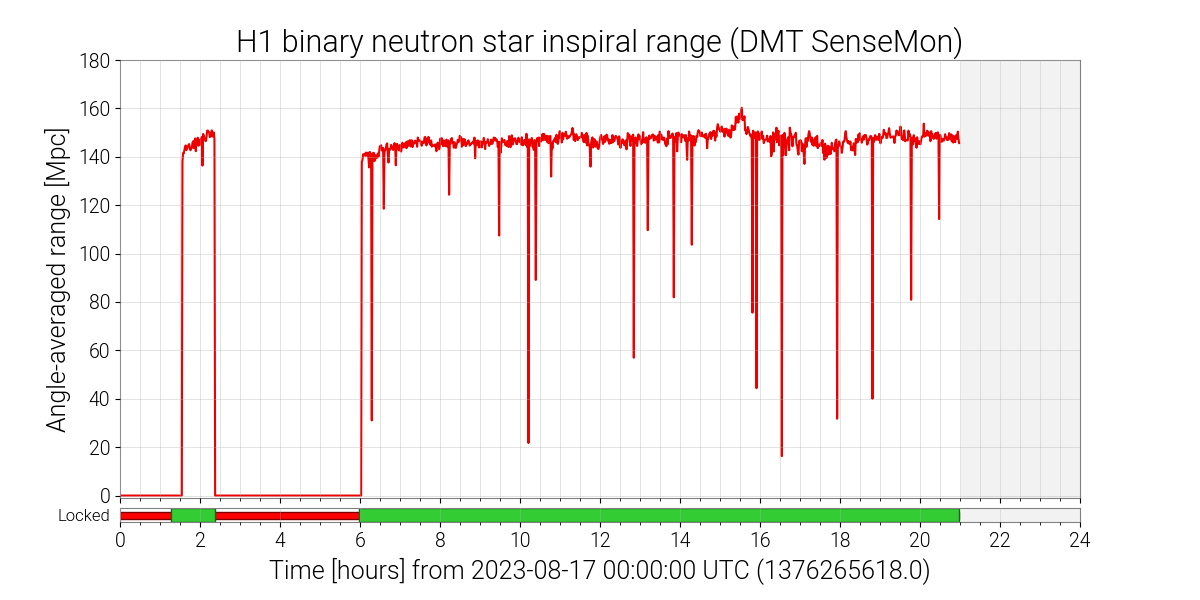
STATE of H1: Observing at 134Mpc
SHIFT SUMMARY:
- Lock #1:
- Lock #2:
- Lock #3:
- A good chunk of the night was a wash due to multiple EQs, high wind speeds, and slow lock reaquisitions, leaving H1 to Ryan S. in observing, hopefully seismic actiivity will taper down soon
LOG:
No log for this shift.
LOCKLOSS @ 13:23, not seeing a whole lot of ASC motion, but am seeing a bit in the LSC loops. Can probably rule out the earthquakes since ground motion has been on the decline. Wind speeds however are getting fairly high, hovering around 30 mph.
I have trended the top mass OSEM inmon channels, the optic align offsets, and the FMCS temps for zone 1A and zone 5, both over short term (~3 weeks, around the start of the excursion), and over a couple of months. From looking at the plots over the long term and after recovery, most OSEM and optic align readouts are relatively where they were before the excursion EXCEPT for DAMP_P_INMON and DAMP_V_INMON. Looking at the scopes, the DAMP_P was ~ -650 counts before the excursion and is now hovering around -640. DAMP_V seems to have had the biggest change, coming from ~32 before the excursion to roughly 50 today. In principal, this makes sense, since temperature swings mostly affects suspensions in the vertical direction, P and V. This is direct evidence that the OSEM vertical sensors are definitely not in the alignment they were before, but the rest for the most part have been restored to their original values.
Following a lockloss, H1 is now relocked and in observing as of 10:39 UTC. A 5.5 magnitude earthquake from Taiwan is currently rolling in, though ground motion has been relatively low so far.
LOCKLOSS @ 9:10, looks like a potential LSC PRCL ringup. Wind is also on the rise.
TITLE: 06/16 Eve Shift: 23:00-07:00 UTC (16:00-00:00 PST), all times posted in UTC
STATE of H1: Lock Acquisition
SHIFT SUMMARY:
Decent shift with no EQs which knocked us out (appeared to ride through a Japan and Panama EQ), but an EY wind probably caused a lockloss (the other one most likely from a HAM1 ASC FF filter change). Reacquisition was fairly good (except during the 90-min wind storm.
LOCK#1: (2335-2357) After a very short OBSERVING segment
LOCK#2: (2358-0056)
LOCK#3: (0339-0459)
LOG:
TITLE: 06/17 Owl Shift: 07:00-15:00 UTC (00:00-08:00 PST), all times posted in UTC
STATE of H1: Observing at 132Mpc
CURRENT ENVIRONMENT:
SEI_ENV state: CALM
Wind: 15mph Gusts, 10mph 5min avg
Primary useism: 0.04 μm/s
Secondary useism: 0.14 μm/s
QUICK SUMMARY:
- H1 has been locked an in observing as of 4:59
- CDS/DMs ok
- SEI motion a little elevated due to previous EQs but looks to have stabilized
After initial locking work, H1's been nicely locked for 2.25+hrs with a range just under 135Mpc. Breezes picked up a little earlier, but have been stable. With the long weekend, I went and shut off alot of the lights around the OSB & Mechanical Room.
Had a lockloss (0336utc) as winds slightly begin to pop above 30mph in the last 30min. X-arm took a while to lock with 1-round of INCREASE FLASHES.
(Corey, Elenna)
With our short OBSERVING stretch (6-min) ending due to a ringing-up (over 90-sec) ASC MICH_P (see attached), Elenna and I decided to back out her HAM ASC FF change for this recent lock.
Elenna's change was:
We have now reverted from this new FM4 to the original FM3 ("FFX0423").
TITLE: 06/16 Day Shift: 15:00-23:00 UTC (08:00-16:00 PST), all times posted in UTC
STATE of H1: Lock Acquisition
SHIFT SUMMARY: Shift was full of earthquakes, keeping us down for several hours.
Lock #1:
Lock #2:
Lock #3:
Lock #4:
Lock #5:
Handing off to Corey, H1 currently at MAX_POWER.
LOG:
| Start Time | System | Name | Location | Lazer_Haz | Task | Time End |
|---|---|---|---|---|---|---|
| 15:45 | FAC | Karen | Optics/Vac Labs | - | Technical cleaning | 16:05 |
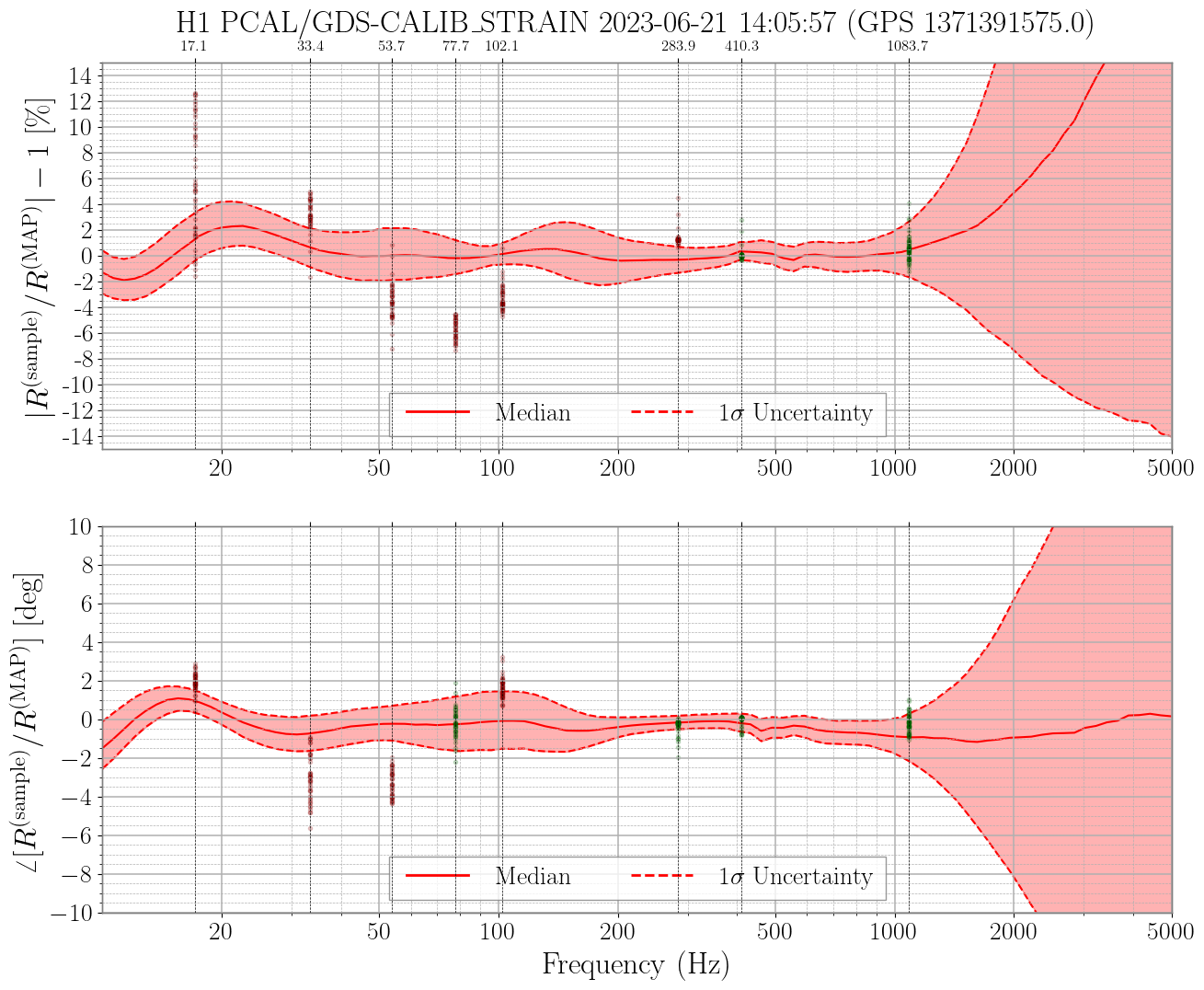
| 16:12 | CAL | Ryan | CR | - | Sensing function calibration meas. | 16:46 |
| 16:56 | CDS | Marc, Jonathan | CER | - | Check on HAM6 camera | 17:06 |
| 17:06 | VAC | Janos | MY | - | Check pump | 17:23 |
| 17:18 | PEM | Robert | LVEA | - | Set up scatter test on HAM3 | 17:23 |
| 18:35 | PEM | Robert | LVEA | - | HAM3 scatter test (Wifi on) | 18:47 |
| 18:47 | FAC | Kim | H2 | - | Technical cleaning | 19:04 |
| 21:27 | VAC | Janos | EX | - | VAC checks | 21:51 |
TITLE: 06/16 Eve Shift: 23:00-07:00 UTC (16:00-00:00 PST), all times posted in UTC
STATE of H1: Earthquake
CURRENT ENVIRONMENT:
SEI_ENV state: CALM
Wind: 18mph Gusts, 14mph 5min avg
Primary useism: 0.03 μm/s
Secondary useism: 0.09 μm/s
QUICK SUMMARY:
Arrived to see h1 working on getting back to NOMINAL LOW NOISE due to a big earthquake.
HAM6 OMC camera is still not on nuc30.
It's a little windy, but still better than earlier this week!
I have found a couple cases lately where SEI_ENV was switching out of earthquake mode too quickly. Peakmon was still around 1000nm/s, fairly high, and SEI_ENV would switch back to the nominal state. During the winter, I had to increase this transition threshold from 600 to 1100 because the high microseism was fooling the SEI_ENV guardian. After that, I made an adjustment to the bandpass filter peakmon uses, to better filter out the microseism (here), but didn't reassess the SEI_ENV thresholds. I've set it back to 600 for now, I'll try to figure out if we can live with this threshold wrt the filter I installed in January.
This shouldn't really affect my alog about the earthquake robustness. This threshold affects the transition out of the earthquake mode, there is a separate threshold of 400nm/s for the transition into the eq mode with seismon early notifications, and we are mostly losing lock before even reaching that threshold.
J. Kissel
For quick reference -- the current HAM-ISI blend filters are:
(X, Y, Z) are all using the "comp_250" blend filter pair, whose blend frequency is 0.18 Hz (or 180 mHz -- hilariously *not* 250 mHz...)
(RX, RY) are both using the "many_notches" blend pair, whose blend frequency is 0.375 mHz
(RZ) is using the "fc_yaw_filt_lp."
The recent ECR E2200473 that improves the performance of switching between blend filters also completely revamped the naming scheme for the filter banks which house the blend filters. That means older, extremely useful code like
/ligo/svncommon/SeiSVN/seismic/Common/MatlabTools/plot_current_blends.m
which converts the "as installed" foton representation of the blend filters into their design-intent, dimensionless "complementary" form broke.
Not having that code forced the infrequent viewer / non-designer to cut corners and only look at the displacement sensor blend, and either waive their hands guessing at the blend frequency / frequency-shaping or invent their own metric for "at what frequency do we start to get inertial isolation," e.g. as in LHO:70313.
I've now fixed the above mentioned code for the HAMs -- see attached collection of plots which show the 4 pairs of blend filters which are in play on ALL HAM ISIs at LHO (ISI HAMs 2 - 8).
Along the way, I couldn't help myself but to improve the plots:
(1) I've added an explicit indication of the the blend frequency,
(2) tightened up the frequency range and magnitude limits so you can quantitatively read off the magnitude better
(3) For the phase, we used to plot both the individual filter's phase and the sum, but really only the sum matters. The sum of the HP and LP pair's deviation from 1.0 magnitude and 0.0 phase is a metric for *lack* of complementarity, and thus
(a) how much the open loop gain shape is impacted for *this* pair of filters and
(b) how much the phase will *change* when we switch to another set of blends with different [lack of] complementarity)
The code still needs further updates to handle BSC-ISI ST1 sensor blends, but I leave that for another day, or the initiative-full reader.
Lockloss @ 18:40 UTC from placing the retro-reflector into a viewport on HAM3 for a backscatter test.
Here is a list of the things we need to change to return as closely as possible to a desirable 60W configuration.
If you are looking for a timestamp to determine when the power change occurred, the last full lock at 60W was on April 6 from about 17:00 UTC to April 7 3:30 UTC.
Under LSC controls, I claimed that we should revert the PRCL loop design, however Gabriele reminded me that the new PRCL design has better suppression, see alog 68817. We should keep this new design, but we should still determine how/if we need to change the gain to ensure the loop UGF is around 30 Hz.
Under LSC feedforward, I forgot to mention that we did not run with PRCL feedforward at 60W, so we can turn that back off at 60W.
I have also recovered the old MICH FF filter that was in FM9, called "May_d". At 60W, we will need to engage FM6-9. labeled May a-d.
We will need to update the violin mode threshhold checker. The counts value for the DARM offset was hard coded, and will be different at 60W.This value will only need to change if we change the DARM offset.
Tagging a lot of the teams who will either need to be involved in these changes, or at least be impacted by these changes when/while we revert.
J. Kissel, J. Driggers, N. Aritomi, S. Dwyer
Just FYI I brought up the open question in Elenna's aLOG about
DARM offset: 20 mA, not sure if we want to revert this value
The quick consensus (without agreeing to write it in stone) is that we "plan" to *not* revert the DARM offset, leaving us with 40 mA of current on the DCPDs, as has been the case since May 05 2023 (see LHO:69358).
J. Kissel, J. Driggers, S. Dwyer
Regarding the following setting suggestions in this bullet point,
SRCL offset: we had been running with an offset of -175.
This was also with the previous LSC-POP_RF45 whitening at 21 dB.
We could revert the whitening change as well if we think it's better
for noise considerations
The plan is to *definitely* go to the -175 ct SRCL offset, however -- upon discussion this morning -- we've decided *not* to revert the reduction in POP A RF45 whitening gain from +21 dB to +15 dB. Said with all positives to avoid confusion, we'll continue to reduce the gain to +15 dB rather than revert to +21 dB.
We think
- the extra ADC range head room is nice,
- the sacrifice in SRCL / PRCL sensing noise is minimal, and/or has minimal impact***
- for now, today, when we power down, we want to change as little as is need to achieve stability, rather than revert absolutely everything.
***One may find the assessment of the noise impact in LHO:69350.
I forgot to include this in this alog, but the CSOFT P gain should probably be reduced to 20 again. This was a change made late last week.
Commissioning period,
The Ham1 FF was turned off for testing on 06/14/23 21:32:15. It stayed off for 5 minutes and was turned back on at 21:37:15.
My motivation for this test came from a bruco that I ran on the data from a long lock over the weekend: https://ldas-jobs.ligo-wa.caltech.edu/~elenna.capote/brucos/CAL_1370343461/
Specifically, the CHARD P, INP1 P and HAM1 TT L4C RY coherence were much higher than expected, and much higher than they had been in the past after successful HAM1 FF tuning and A2L gain adjustments.
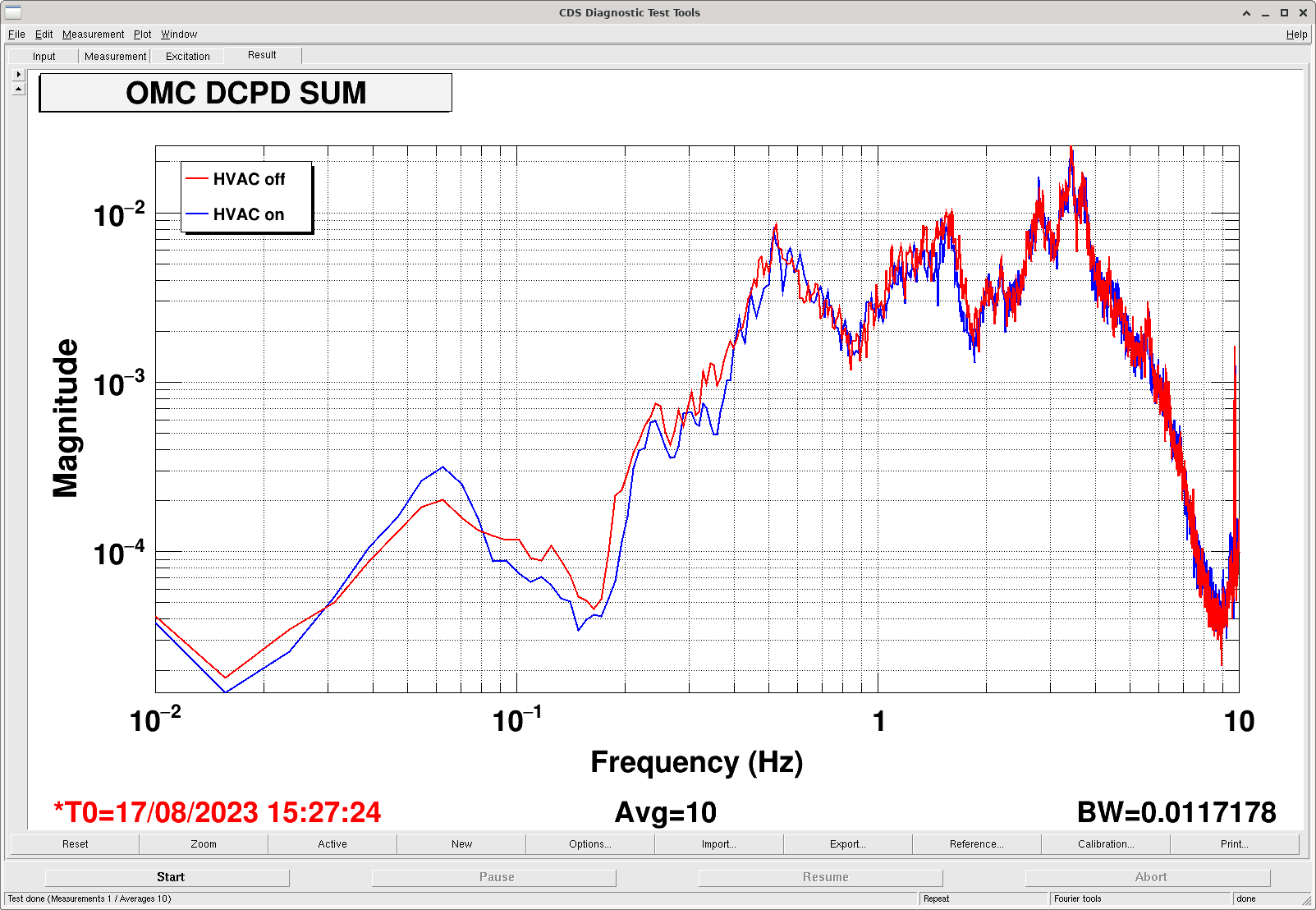
The test first confirmed that we are still seeing decent subtraction of the HAM1 noise from the ASC loops, as seen in an OMC DCPD sum comparison with the feedforward on and off. I also grabbed spectra of each of the ASC loops with the feedforward on and off (in this plot the red, live traces are with the feedforward off, and the blue reference traces are with the feedforward on).
I used the feedforward off time to run the NonSENS training code and calculate a new feedforward for CHARD P, INP1 P and PRC2 P. The code also makes plots of the expected subtraction of the loops. I compared the expected subtraction plots (linked below) to the current subtraction plots linked above, and I conclude that:
I didn't check any yaw loops because there is already decent noise removal, and coherences are low. I don't expect to see much improvement there.
I will install the new INP1 P and PRC2 P feedforward filters, labeled with today's date. I think they should be engaged for the next lock if possible.
I don't understand why the coupling has changed, but I think this is a similar mystery change that changed like several other things in the IFO changed recently- perhaps some new alignment from the PR3 move? In other words, unless we have to make another big alignment change like that, I don't expect us to need to update this feedforward for a while.
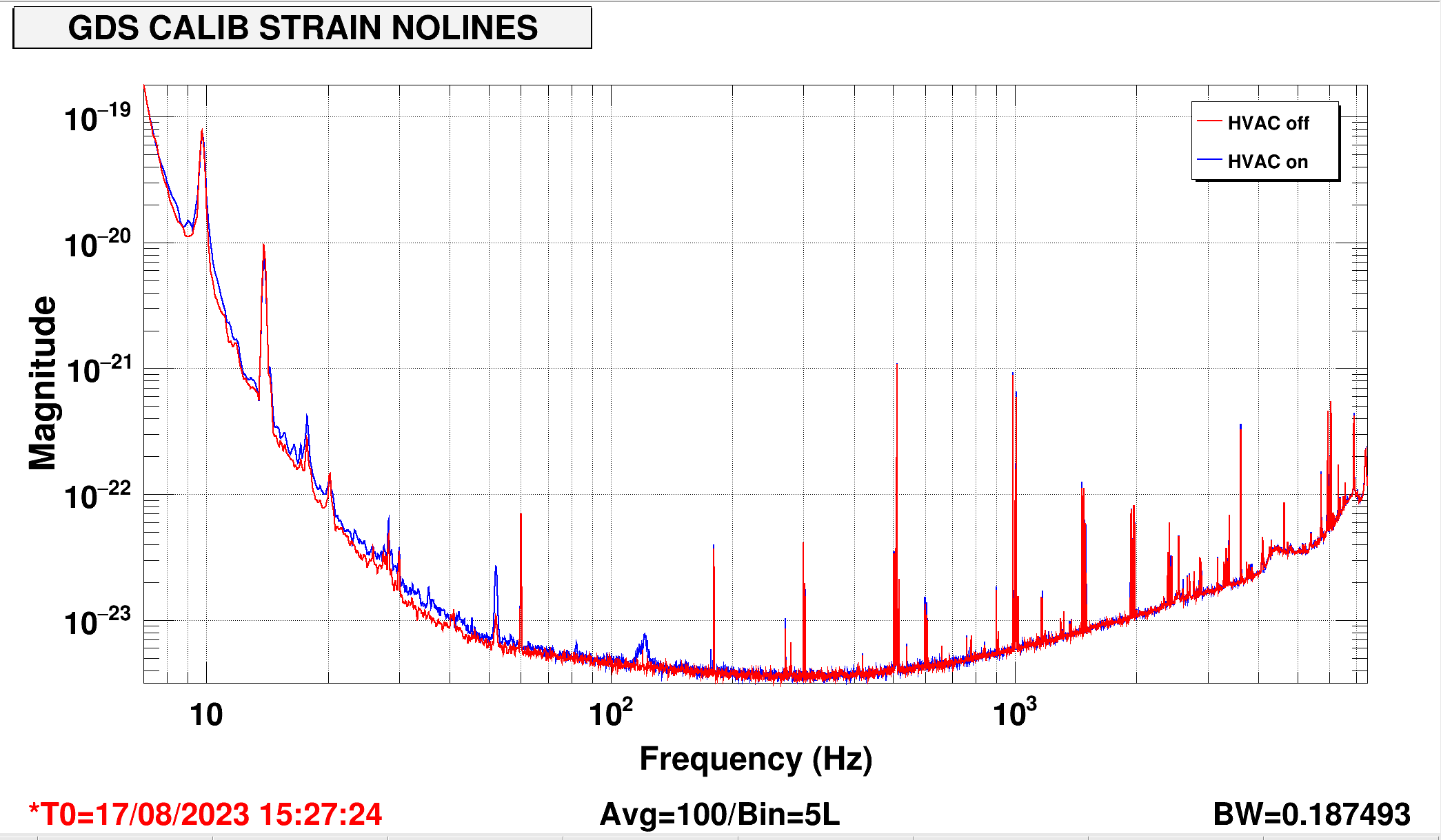
Turning off the HAM1 feedforward made the CHARD and PRC2 noise signficantly larger, by about a factor 10. The effect on DARM is significant, and consistent with the fact that CHARD or PRC2 are coupling more now than before, and when the FF was on were just below the measured DARM. This is consistent with the measured coherence between DARM and CHARD or HAM1 sensors.
One possible reason for the higher coupling of HAM1 noise to DARM is that the beam spot might have moved on PR2 (where PRC2 is driven) and therefore the A2L we tuned some time ago might be wrong. It's worth and quick retuning the PR2 A2L and see if that improves the coupling of PRC2 to DARM and maybe even DARM noise.
The new filters have not yet been installed because I am getting errors from foton when I try to copy them in. I will try again tomorrow.
I have installed the new feedforward filters for INP1 and PRC2. They are labeled with "0616" for today's date. They are currently not in use, but can be quickly tested during a commissioning period. A thermalized IFO is best for the test, but they can be tried at any time.
New filters implemented and SDFed.
The previous timing master which was again running out of range on the voltage to the OCXO, see alog 61988, has been retuned using the mechanical adjustment of the OCXO.
Today's readback voltage is at +3.05V. We will keep it running over the next few months to see, if it eventually settles.
4/14/23: OCXO control voltage at 2.05V
6/16/23: OCXO control voltage at +1.43V.
We again ran out of range.