Displaying reports 18841-18860 of 87024.Go to page Start 939 940 941 942 943 944 945 946 947 End
Reports until 22:54, Wednesday 07 June 2023
H1 SQZ (ISC)
victoriaa.xu@LIGO.ORG - posted 22:54, Wednesday 07 June 2023 - last comment - 22:54, Wednesday 07 June 2023(70261)
More thoughts on SQZ levels

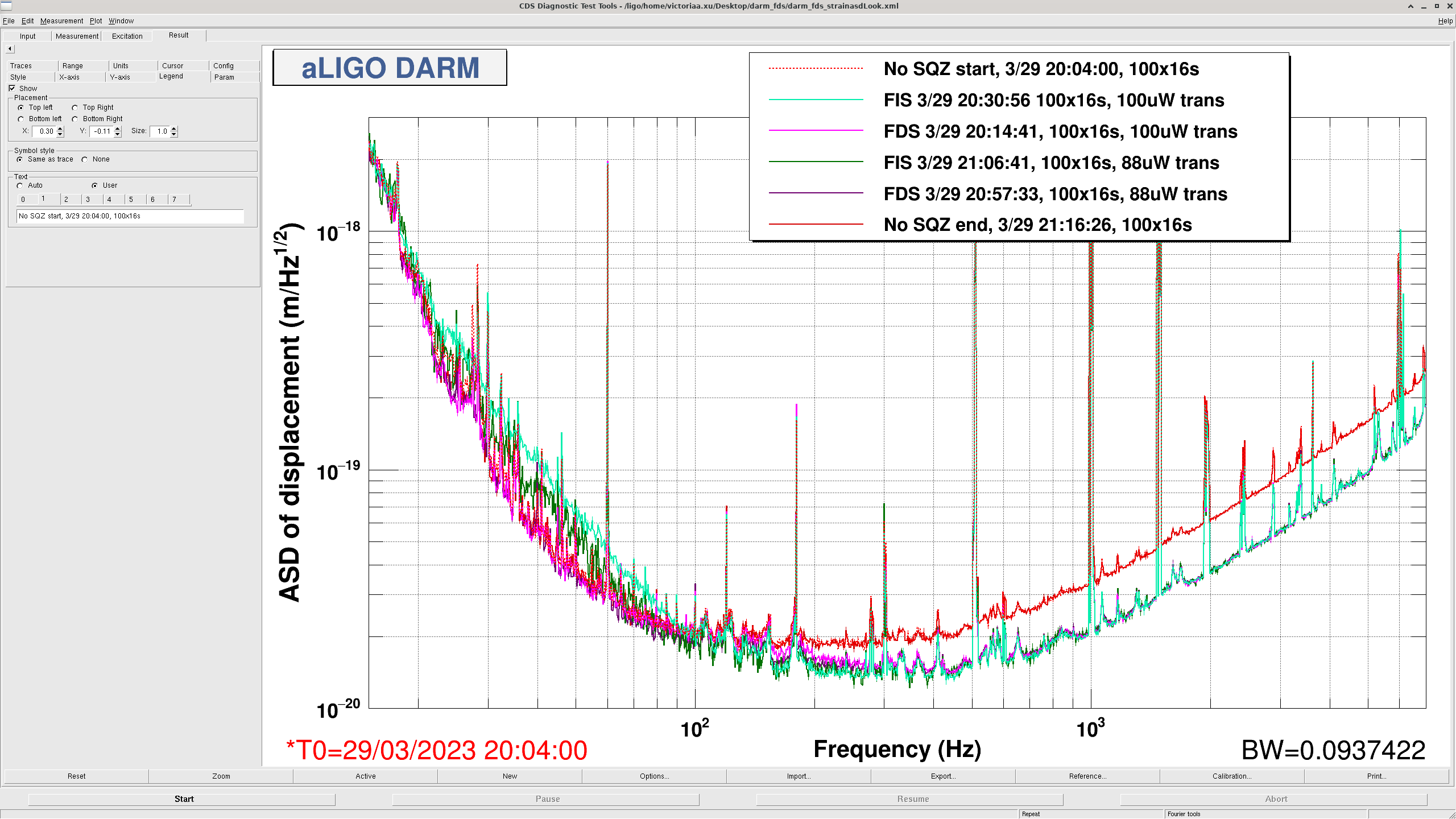
Summarizing some thoughts regarding the sqz levels at LHO going into O4. Best-case, we've observed up to 4.5dB DARM noise reduction with squeezing at 50W and 60W. Ignoring phase noise, this 4.5dB sqz is about 30-35% total sqz losses (~19% known, ~15% mystery). At 76W at start of O4, we've typically seen 3-3.5 dB at high frequencies, and almost up to 4dB once (we can hopefully recover this after fixing on-table alignments). Some of the major questions that I'm thinking about, towards more squeezing at LHO:

  1. IFO output lossesis shot-noise-limited displacement sensitivity consistent w/circulating arm power? (LHO:67610)
    • ~13% known SQZ output losses (sqz budget)
    • Model suggests ~20-30% total IFO output losses (i.e., reconcile quantum noise calculation for no-sqz DARM with arm power). How do IFO+SQZ output losses relate?
    • LHO:69707, measures only 82% ham6 carrier throughput. Seems relatively consistent w/previous measurements ~20% output losses.
      - new thoughts on the losses this time-- a lossy OMC (92% throughput?)    
      → updates known total sqz losses to ~19%if only these known losses + good phase noise, we could see up to 6dB sqz (nearly what L1 sees).
      - still leaves ~7% excess ham6 ifo loss    (could this be ifo-omc mode-matching? TSAMS?)
      - in principle, SQZ-OMC could have different mode-matching than IFO-OMC, so output losses like this could be different between sqz / ifo (unlike omc losses, which would be common).
    • To-do: precisely measure OMC finesse? Is it worse now? Could tsams help? Is this ifo power dependent?
       
  2. IFO technical noise – how shot-noise-limited is DARM? 
    • SQZ can reduce quantum noise, which only helps up to the next limiting noise source. That is, if there's no quantum noise (or infinite squeezing of it), DARM will simply be limited by the next thing.
    • 76W H1 noise budget suggests only shot-noise-limited by about 3-6x @ 1kHz?  
      • 69767, this level of classical noise can look like an effective 5-10% sqz loss.
      • Comparison: L1 noise budget shot-noise-limited by >10-fold @ 2kHz, with sqz (a lot more clearance)
         
  3. SQZ losses – what are excess sqzer losses, and does sqz introduce its own technical noise?
    • ~7% known sqz injection losses (w/o mode-matching)  (sqz budget)
      • In addition, homodyne sees < 10% excess mystery sqz loss 67219 (so total in-chamber losses < 17% (from e.g. clipping), much of this loss is likely related to HD and not ham7)
    • CLF can introduce sqz technical noise, projected at ~5-10x below DARM, 68991
    • Phase noise? can re-measure loops
    • To-do: can we directly measure sqz losses (vary gen sqz, more NLG sweeps on darm)? use absolute calibration of the ADF line to measure sqz losses? optimize sqz alignment? Psams? sqz loops/phase noise? Fc backscatter (could contribute to #4)? Recover homodyne to check sqz? Can we even observe changes in sqz level given the large losses + drifty technical noise? Helps to have stable ifo for sqz commissioning. And there's probably more thinking to be done re: what are good measurements to make.
       
  4. Is there residual noise ~50-200 Hz related to the squeezer? Is it worse at higher power? Related to RPN or backscatter (e.g. LLO:64968, 65120)? Can we make it better? How? This noise is not obviously quantum noise (started analysis previously, w/some evidence of it), but need to compare it no-sqz vs. sqz with the quantum subbudget to confirm
    • To-do: more modeling of high + low power scenarios to learn what various knobs do, more commissioning, etc, but not sure yet..
Comments related to this report
victoriaa.xu@LIGO.ORG - 20:49, Wednesday 07 June 2023 (70263)ISC, TCS

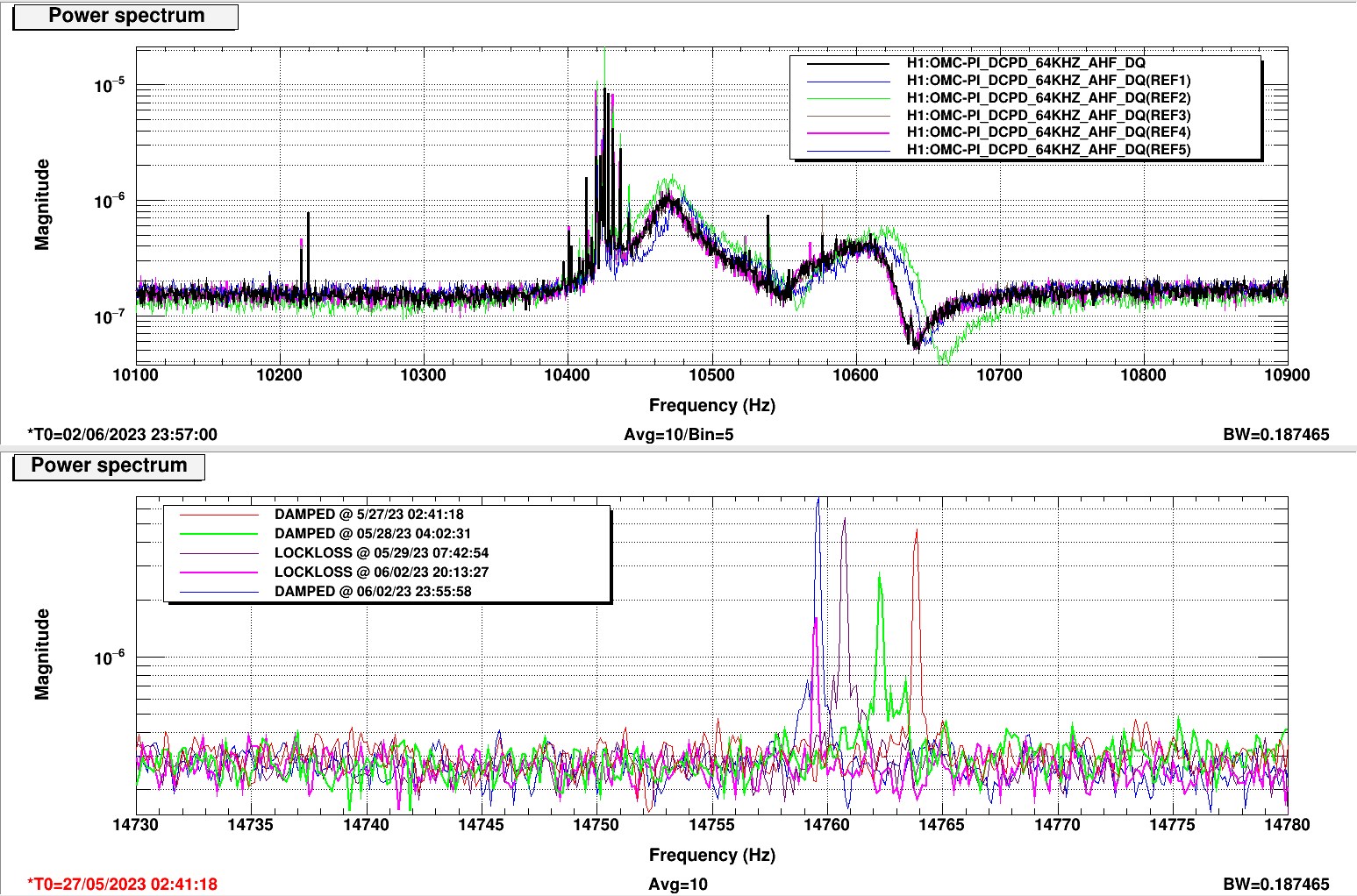
Re: #2, technical noise in the IFO. At some point I compared the 64 kHz channel DCPD noise spectra from various IFO configurations, see screenshot. I think the main points of comparison are:
  - green trace:       60W before TCS tuning , middle                                         (dcpds 20mA)
  - pink/blue traces:  60W after TCS tuning , lower ,  no sqz (red) / sqz (blue)  (dcpds 20mA)
  - red/cyan traces:  76W, middle of ER     , upper,  no sqz (pink)/ sqz(cyan)    (dcpds 40mA)

There's a lot going on and a lot of confusing things. My only real take-away so far is that broadband technical noise was better with the TCS / ETM ring-heater tuning at 60W (68236), which coincided with sqz levels quickly going from 4dB to 4.5dB. I don't know how DCPD total mA factors into this. Overall, the spectra looked better by ~3dB at 5kHz, and ~5-15dB above 7kHz. I think the relation might just be that the broadband noise reduction w/TCS makes the IFO more shot-noise-limited, and so we can directly observe more squeezing in DARM (ie, w/o subtraction).

I'm not sure how mode-matching plays into all of this, but I wonder also if we can learn stuff looking at the broadband technical noise around various higher-order-mode peaks.

Images attached to this comment
H1 SUS
ryan.crouch@LIGO.ORG - posted 20:11, Wednesday 07 June 2023 (70264)
Turning off empty filter modules

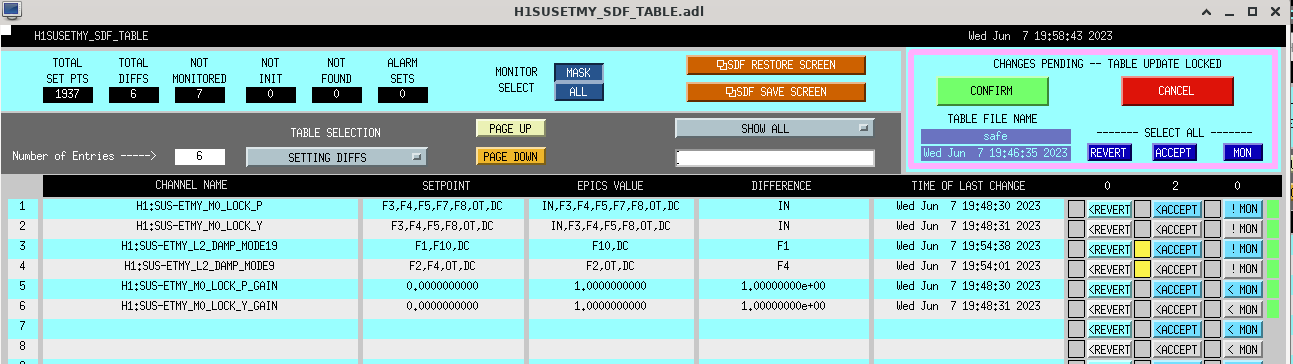
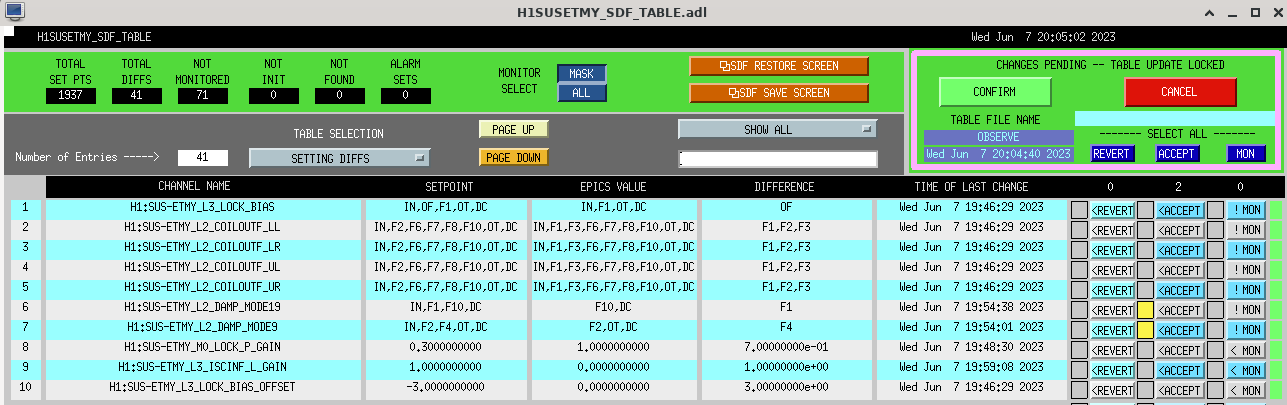
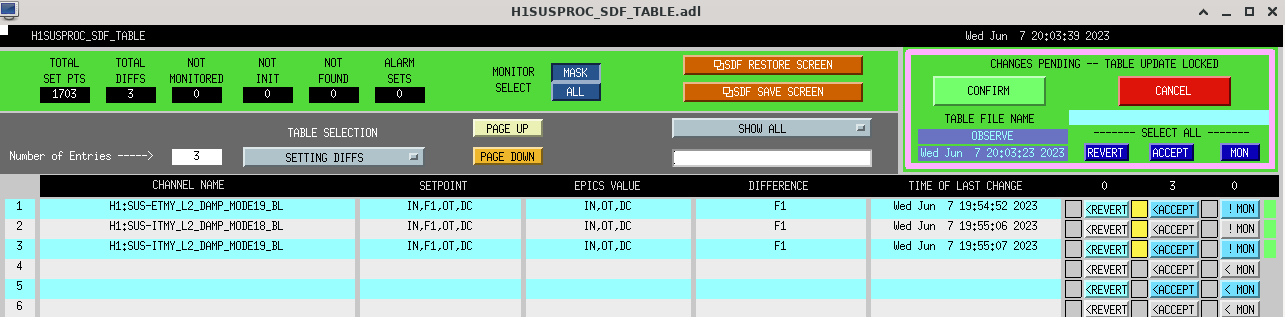
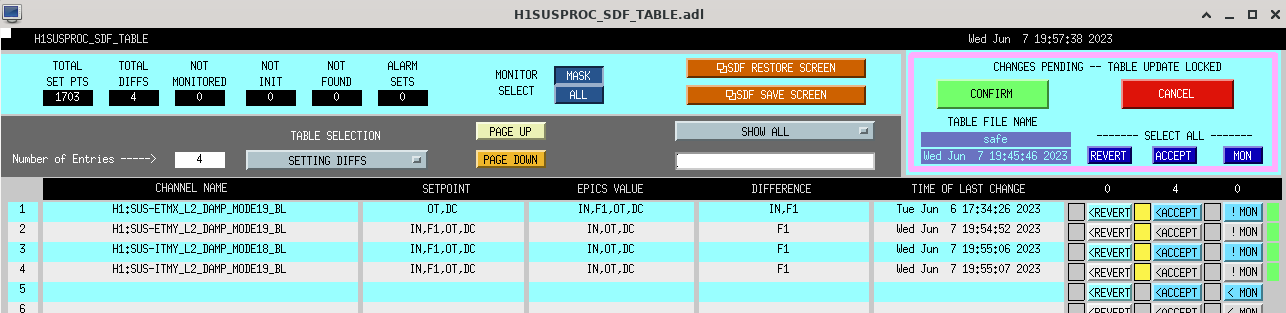
I've turned off some empty filters modules that were engaged following LHO70179 for some violins modes (ETMY9, ETMY19, ITMY18, ITMY19), damping (SUSETMY) and monitoring (SUSPROC) filters. I've accepted the following in SAFE and OBSERVE.

Images attached to this report
H1 General
ryan.crouch@LIGO.ORG - posted 19:50, Wednesday 07 June 2023 (70262)
OPS Wednesday Eve mid shift update

STATE of H1: Lock Aquisition

In observing at 23:03UTC out at 02:45UTC from the lockloss

We had a fast lockloss at 02:45UTC, DCPC saturated right beforehand. No obvious reason for the lockloss.


H1 ISC (DetChar, FMP, OpsInfo, SEI, SYS)
jeffrey.kissel@LIGO.ORG - posted 17:17, Wednesday 07 June 2023 - last comment - 07:27, Friday 09 June 2023(70258)
Debating Between 60W and 75/76W: Lack of Duty Cycle is NOT related to Input Power Choice
J. Kissel

There's an on-going debate whether we prefer 76 W (now 75W) PSL input power vs. 60 W PSL power, because we think that we had better noise performance at 60 W. It's a great debate, and I'm all for it. One thing I want to make super clear -- the lack of duty cycle during the engineering run and through the start of O4 has *NOT* been because of the increase in power from 60W to 76W. We've had one heck of a couple of months in terms of 
    (1) An insidiously slow drift in yaw on all of our HAM ISIs due to an innocent oversight of a foton-induced copy-and-paste error in ISI RZ blend filters (now fixed)
    (2) Literally every Tuesday for the past 4 Tuesdays, we've had a 1 deg C (~1-2 deg F) rapid temperature excursion in the LVEA, and some not even on Teusdays
    (3) A particularly earthquake full couple of months
    (4) We've had 3 or 4 inadvertent, system-wide, inter-computer communication "dolphin" crashes, sometimes causing a day of confusion from settings lost
    (5) Several electronics chassis fail all inadvertently

Further, (1) and (2) caused all sorts of apparent trouble that we interpreted as PR3 alignment / ISCT1 alignment troubles, and thus there may be some residual noise knock-on effects as a result.

Indeed, though I don't yet have the quantitative evidence to prove it, I think our issues with (1) and (2) drove us to move PR3 into a different position -- which in turn pushed the arm cavity spots to a different position onto a different point absorber/ acoustic mode situation -- which in turn caused our problems with "a new PI" at the start of the run -- and drove the choice to decrease the ETMX Ring Heater power -- which then drove us to decrease the power from 76W to 75W.

All of these issues cropped up right around the increase in power, and have continued through the start of the run, so I think some -- including myself -- had gathered an incorrect impression that H1's low duty cycle at the start of the run has been because of the power increase. With the trends in this aLOG, I argue it has not.

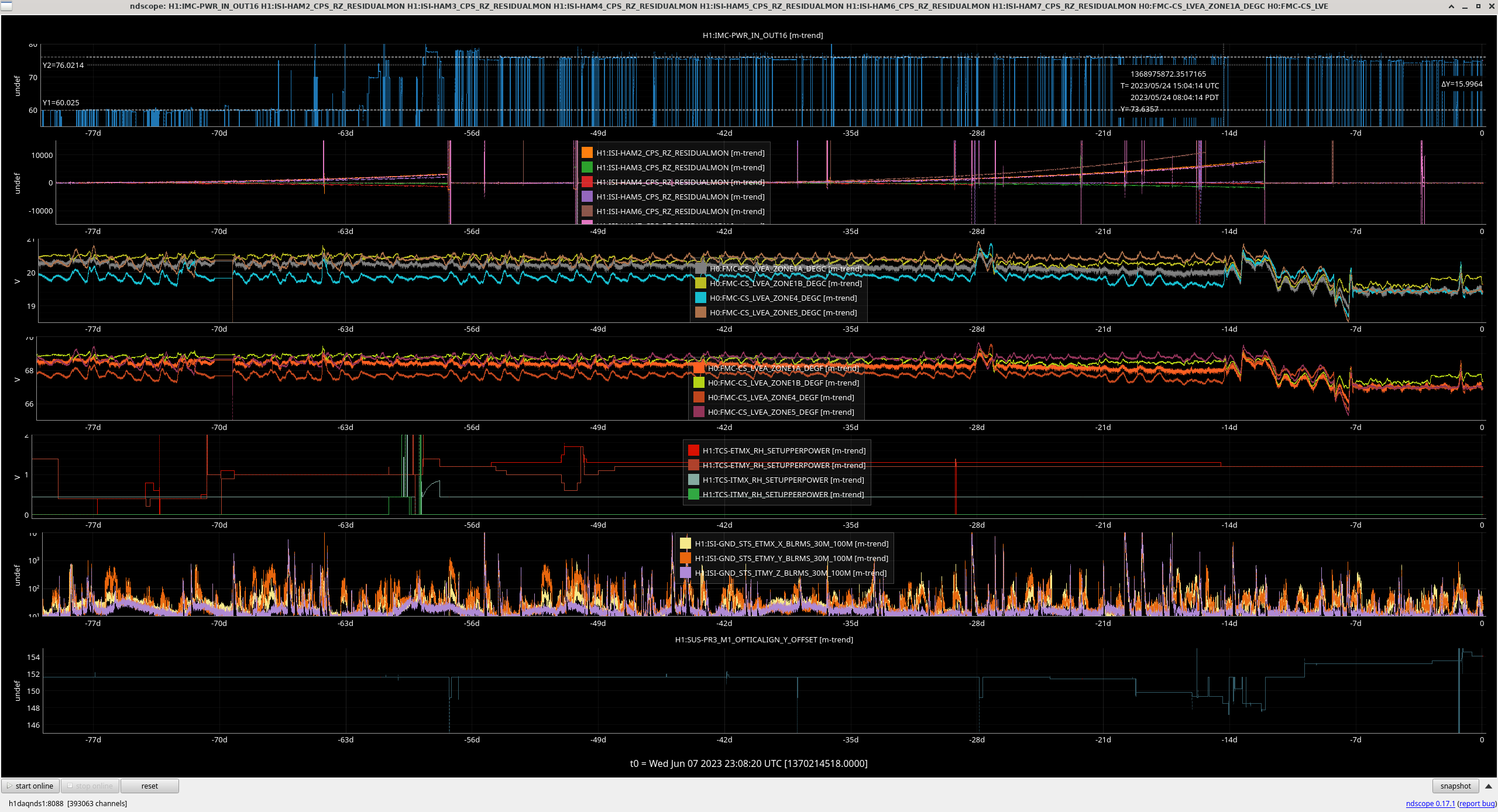
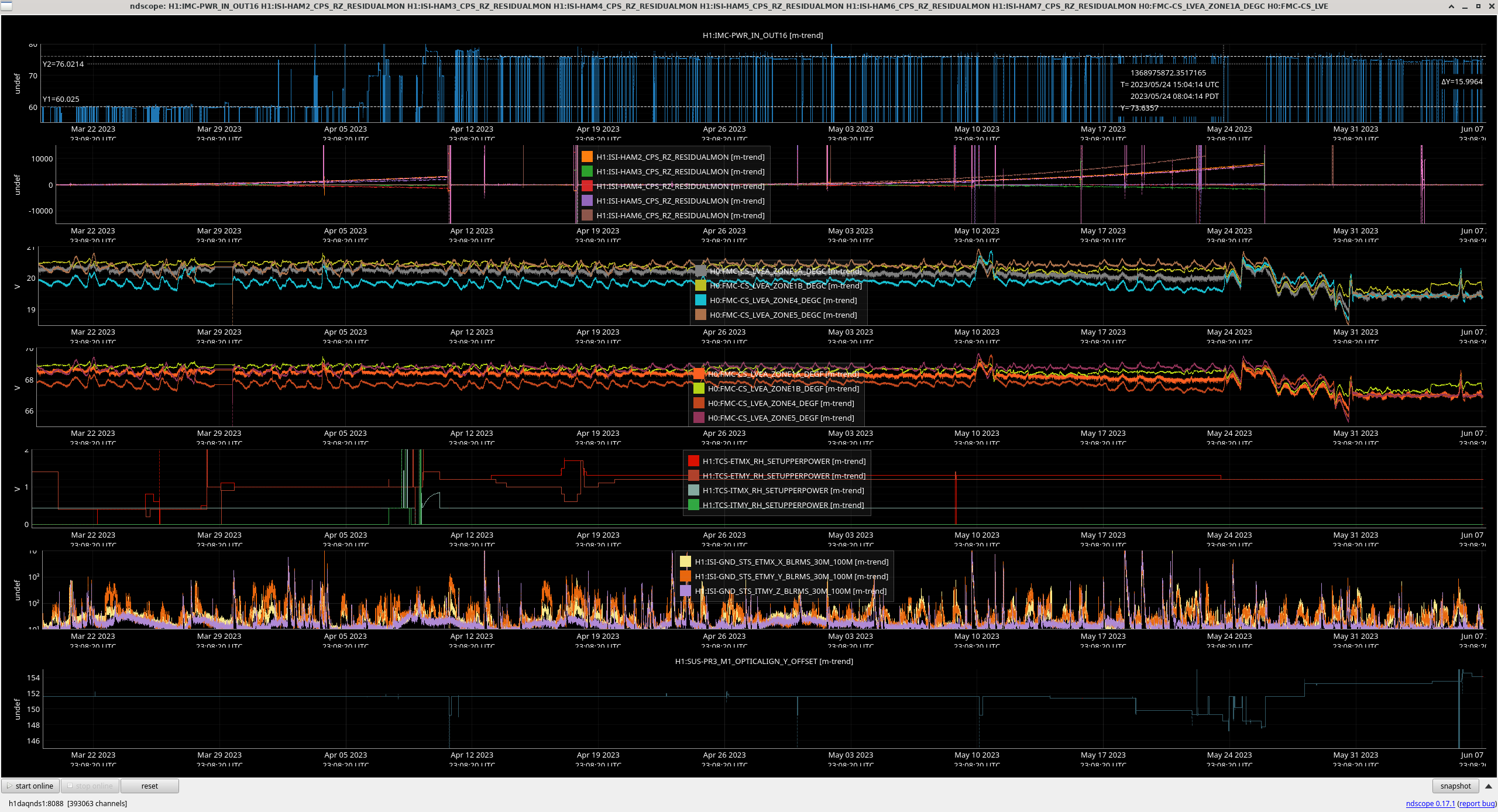
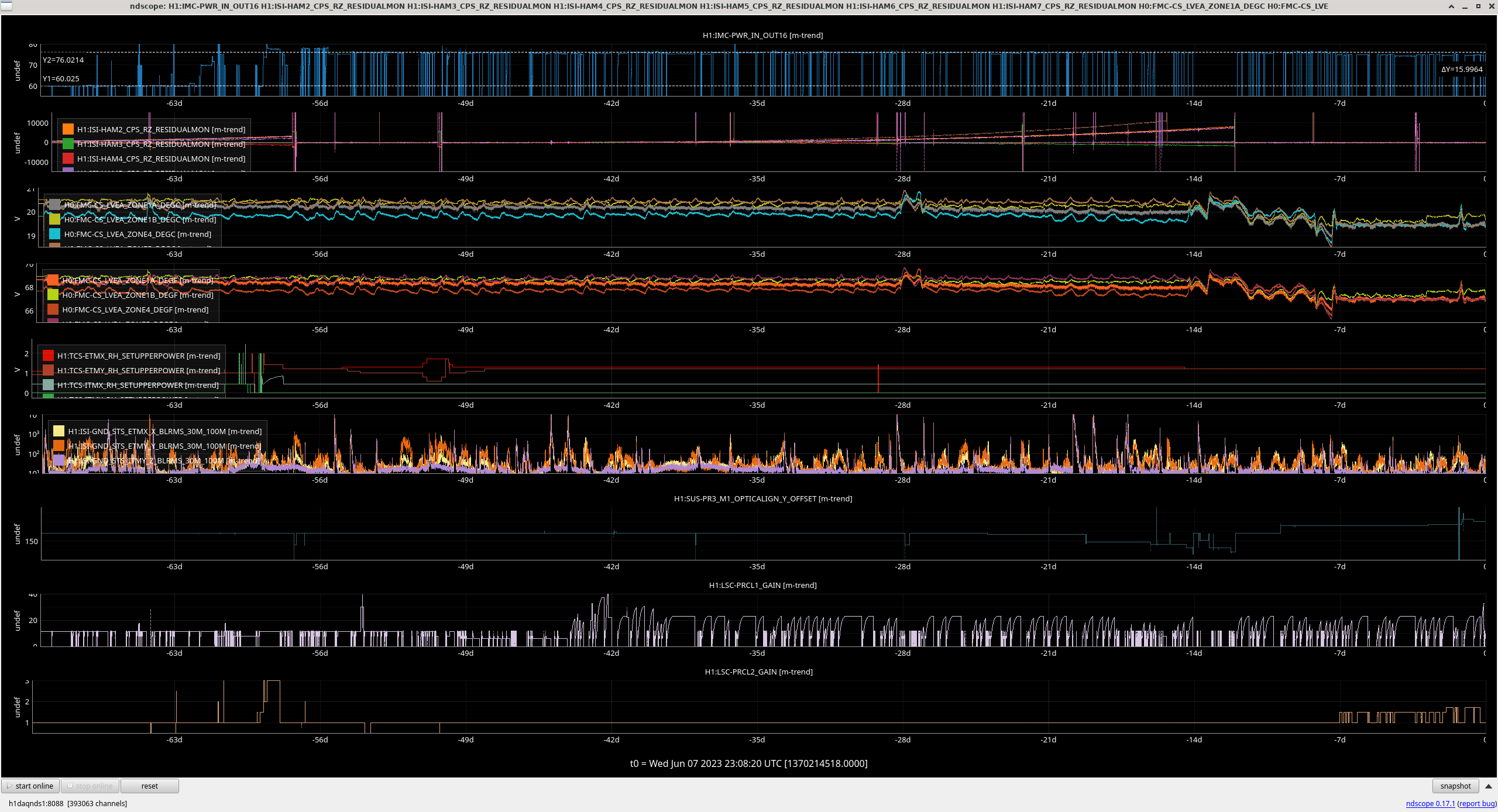
Check out the attached past 3 months worth of trends, in both relative time axis and absolute UTC time axis. 

Remember, the observing run starts -15 days ago, or on May 24 2023 at 15:00 UTC.

1st panel: IMC input power, in Watts, showing the transition from 60W to 76W

2nd panel: residual HAM-ISI position in RZ, in nanoradians, showing the 10-20 urad drift of the tables due to (1)

3rd and 4th panel: temperature zones in the LVEA, in deg C and deg F, respectively, showing the last 4 Teusday's worth of temperature excursions

5th panel: all test mass ring heater power level settings, in Watts showing the early explorations of ring heater settings after power up, and the ETMX reduction during the HAM ISI alignment excursion (the upper half is shown, but both upper and lower halves are set equally each time)
 
6th panel: 0.03 - 0.1 Hz BLRMS of the ground motion at each of the three buildings, showing the "earthquake and wind" band, highlighting (3)

7th panel: PR3's yaw alignment slider, indicating that we've been steering PR3 around all over the place only in the past 4 weeks, likely a result of the ISI yaw drifts (1) and temperature excursions (2).
Images attached to this report
Comments related to this report
jeffrey.kissel@LIGO.ORG - 09:35, Thursday 08 June 2023 (70277)
Adding another dimension to the problem...

I was thinking over night about this, and realized "well, maybe there's *one* part of the power increase that has impacted duty cycle; the 11 Hz ring ups from PRCL going unstable thru too much gain."

But, I've added the PRCL gain adjustments to the series of trends -- see new attachments in relative time and UTC time -- and I think the new-ish PRCL instabilities can also be explained by drifts and changes in alignment.
- We started using the THERMALIZATION guardian around Apr 24. This slow ramps the PRCL2 gain through the thermalization period

- We made a change, *reducing* the PRCL2 end-point setting on May 21 -- but this was reactive to the time when the ISI YAW drifts were at maximum. 

- We then restored that end-point setting on May 26

- Then, on May 31, after having starting to have trouble with 11 Hz ring ups of PRCL gain, we adjusted the "base" PRCL1 gain from 1.0 to 1.5, -- but this was reactive is after several days of LVEA temperature drifting around between May 25 and May 31, and an especially bad Tuesday on May 29th.

- On Jun 4th, the LVEA temperature controls settle on a "new normal" and we "find" we need to increase the "base" PRCL set point again to 1.7 on June 6

- Then on Jun 7th, we reset the "base" PRCL1 gain to 1.0, but instead increase the thermalization set point higher.

My vote is the following: we take the hit in time that this will mean:
- Restore (or change to re-create) the LVEA temperature to values we had consistently for months up until May 10th. Since the LVEA is en-mass cooler than before, we can use the individual zone heater settings to bring each zome back *up* to is "prior to May 10th" value.
- Once that's settled, we re-align PR3 YAW to the slider values we had up until May 10th of 151.6 "urad," and run an initial alignment.
- Once that's settled, we go out to ISCT1 and re-reset the alignment of the table (though it's not reproducible, hopefully, doing so will get us back to the ISCT1 alignment we've had for many moons prior to all this mess).
- Once that's settled, restore ETMX ring heater to its value of 1.3 W.
- Once that's settled, we go back to the May10th era PRCL gains and THERMALIZATION guardian set points of PRCL1 = 1.0 and PRCL2 = 23.0.

If all that works, then we re-calibrate PR3's sliders, optical levers, and OSEMs.
Images attached to this comment
jeffrey.kissel@LIGO.ORG - 10:19, Thursday 08 June 2023 (70279)
Since it's perhaps quite tough to see all these traces stacked vertically on top of each other (a regrettable "must" because the timing of all these changes is important to the story) I've capture this epic ndscope session as a .yaml template. 

/ligo/home/jeffrey.kissel/2023-06-07/
    2023-06-07_3motrend_IMCPWR_ISIYAW_LVEATEMP_GNDBLRMS_PR3YAW_PRCGAINs.yaml

I can't attach a file with the ".yaml" or ".yml" extension to the aLOG, but it's linux, so I've just changed the file extension to .txt (because, in the end, it *is* just a text file). So if you'd like to download it from here and look around, download and then change the extension back to ".yaml".
Non-image files attached to this comment
richard.mccarthy@LIGO.ORG - 07:27, Friday 09 June 2023 (70297)

With the temperatures more stable then they had been we are waiting to get the cooling coil strainers cleaned before attempting other changes.  The major flucuations we were seeing we caused primarily by a cooling coil not getting to temperature creating an issue for mulitiple days.  Once the strainers are clean temperature control can be changed to try and recreate previous zone temperatures.  Though it was nice have all zones grouped together for once.

H1 DetChar (DetChar)
andrew.lundgren@LIGO.ORG - posted 16:13, Wednesday 07 June 2023 (70257)
Return of ETMX cryo baffle noise
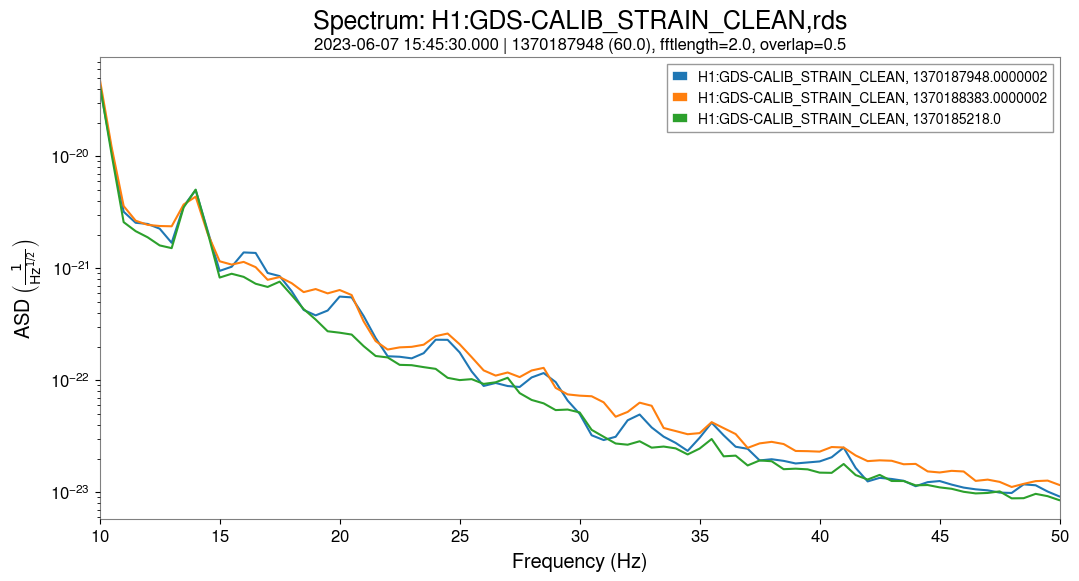
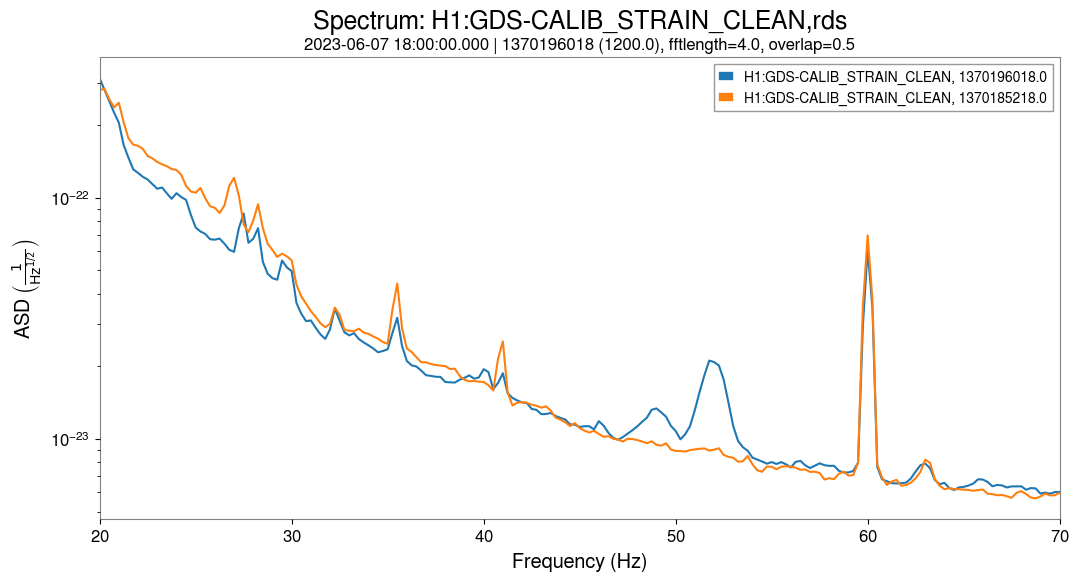
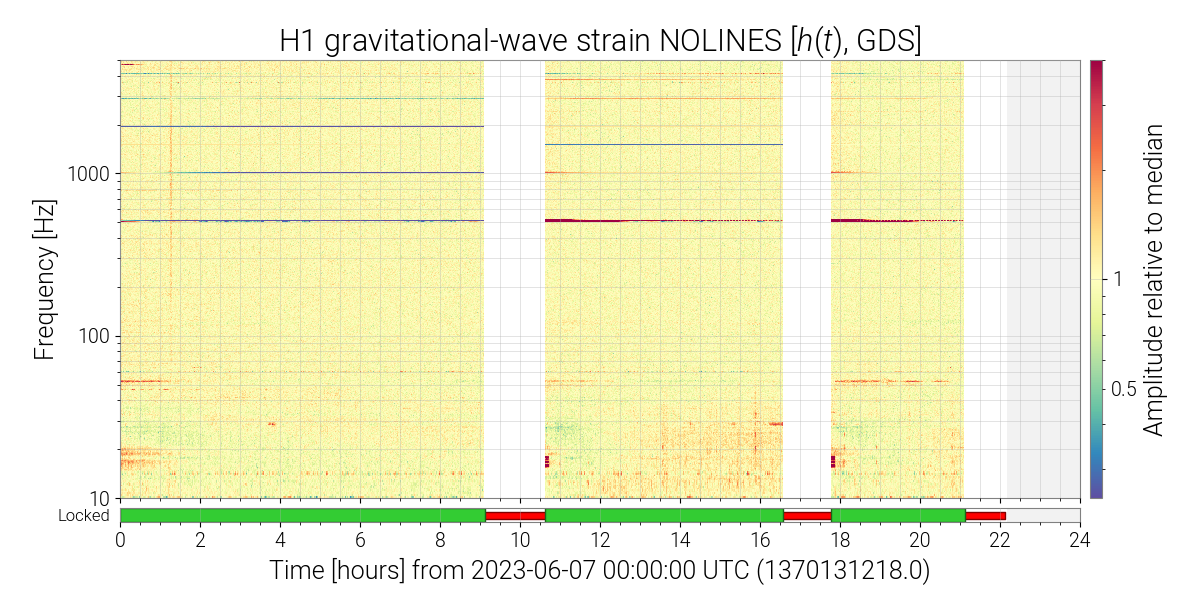
There have again been a few instances of the 4.05 Hz harmonics that were tracked to scattered light from the ETMX cryobaffle (alog 69578) and mitigated by making changes to the fans (alog 69635). They appear slightly different on the summary pages now because they now use cleaned h(t) which makes the harmonic at 16 Hz visible. The spectrum looks otherwise the same.
Images attached to this report
LHO General
thomas.shaffer@LIGO.ORG - posted 16:03, Wednesday 07 June 2023 (70233)
Ops Day Shift Summary

TITLE: 06/07 Day Shift: 15:00-23:00 UTC (08:00-16:00 PST), all times posted in UTC
STATE of H1: Observing
SHIFT SUMMARY: Just got back to NLN from a lock loss. Recovery today has been mostly hands off. The lock losses today are still unknown and need more people to keep looking at them.

LOG:

Start Time System Name Location Lazer_Haz Task Time End
15:40 FAC Tyler OSB Mech room n Checking in air handlers 16:01
21:19 VAC Gerardo Ends n Get reading at LN2 tanks 21:49
22:04 FAC Christina LSB to VPW n Forklift crates while out of lock 22:24
H1 CAL (ISC)
jeffrey.kissel@LIGO.ORG - posted 16:03, Wednesday 07 June 2023 (70255)
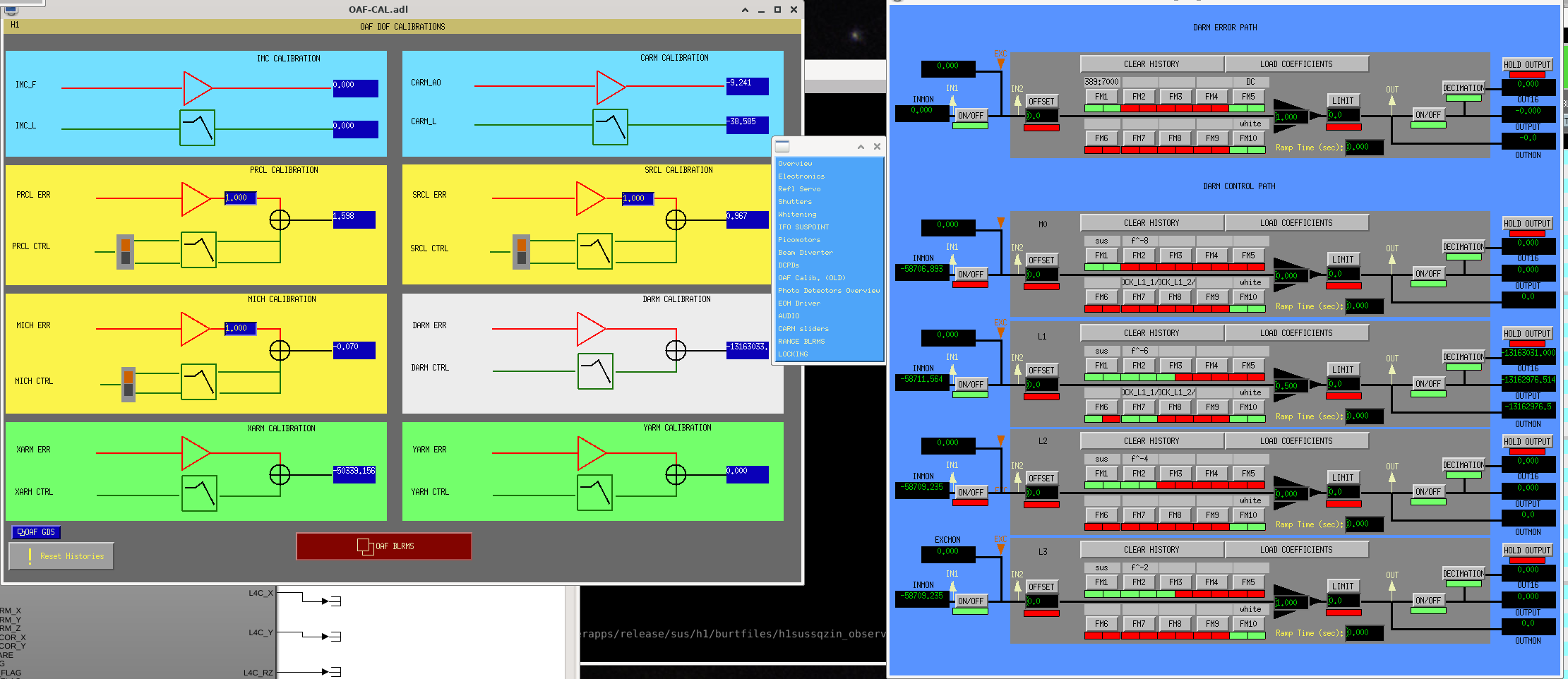
H1OAF: Turning OFF (Inconsequential) Defunct OAF-DARM Filter Modules that were Requested ON with No Filter Present
J. Kissel

E.J. identified recently that there were some filter modules which were requested to be ON, but had no filter in them -- see LHO:70179.

Between lock stretches, I reviewed the H1OAF filter banks,
Front-end    Filter Bank                   Module        Function
h1oaf :      'OAF-CAL_SUM_DARM_L1',        'FM3',        An old, very much defunct, uncommissioned, and unused version of the DARM calibration
             'OAF-CAL_SUM_DARM_L1',        'FM6', 

             'OAF-CAL_SUM_DARM_L3',        'FM3'

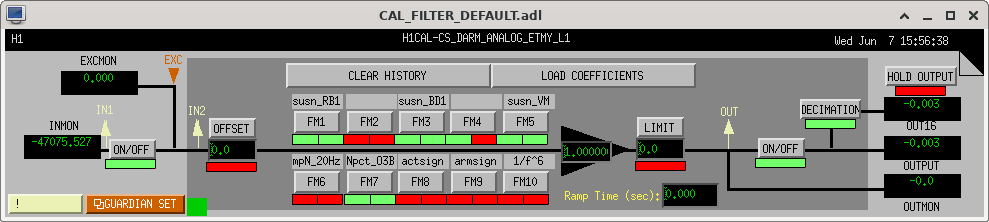
h1calcs :    'CAL-CS_DARM_ANALOG_ETMY_L1', 'FM4'         An unused, out-of-date filter bank for calibrating ETMY's UIM stage (which is not currently out DARM actuator)


And found that they can be safely turned off without issue.

I've turned these filter requests OFF and accepted that "offness" in SDF to reduce confusion.
Both h1oaf and h1calcs are one of those front-ends whose OBSERVE and safe.snaps are the same, so accepting is good enough preserve this setting.
Images attached to this report
H1 SUS (DetChar, Lockloss)
brina.martinez@LIGO.ORG - posted 16:02, Wednesday 07 June 2023 - last comment - 16:02, Wednesday 07 June 2023(70243)
80 kHz PI29 lockloss investigation updates

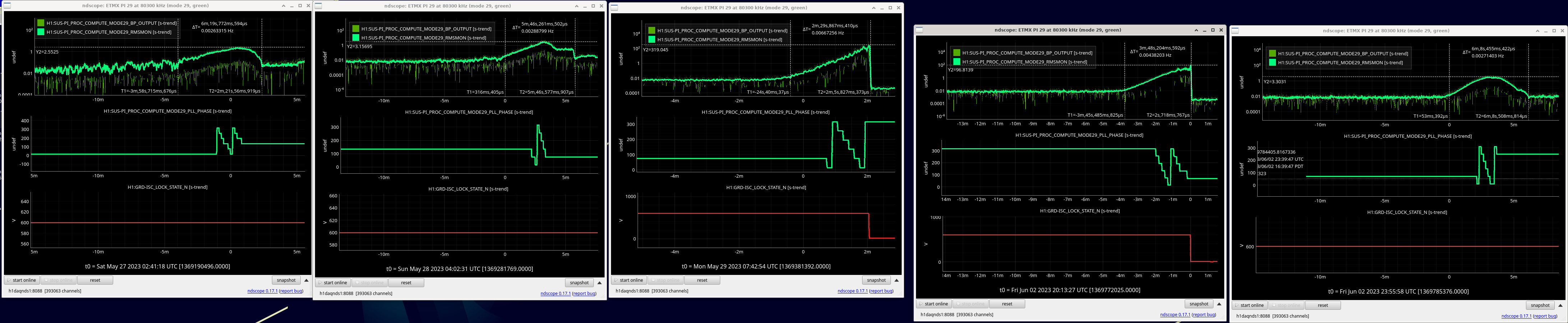
Vicky and I have been looking into how the 80 kHz PI29 dampens or leads to a locklosses recently (alog 70161) .

I looked between 05/24/23 to 06/06/23 and recorded the few dates that this channel witnessed instability and either dampened or did not dampen the issue.

DAMPENED, 600 NLN, May 27 2023 02:41:18, PI managed to keep the detector from losing lock, this lasted about 6 minutes 19s

DAMPENED, 600 NLN, May 28 2023 04:02:31, PI managed to keep the detector from losing lock, this lasted about 5 min 45s

LOCKLOSS, 600 NLN, May 29 2023 07:42:54, PI did not manage to dampen the mode and the IFO lost lock, this lasted about 2 min 30s (power was changed from 76 W to 75 W after this date)

LOCKLOSS, 600 NLN, June 02 2023 20:13:27, PI did not manage to dampen the mode and the IFO lost lock, this lasted about 3 min 48s

DAMPENED, 600 NLN, June 02 2023 23:55:58, PI managed to keep the detector from losing lock, this lasted about 6 min 8s

Images for reference.


edit:

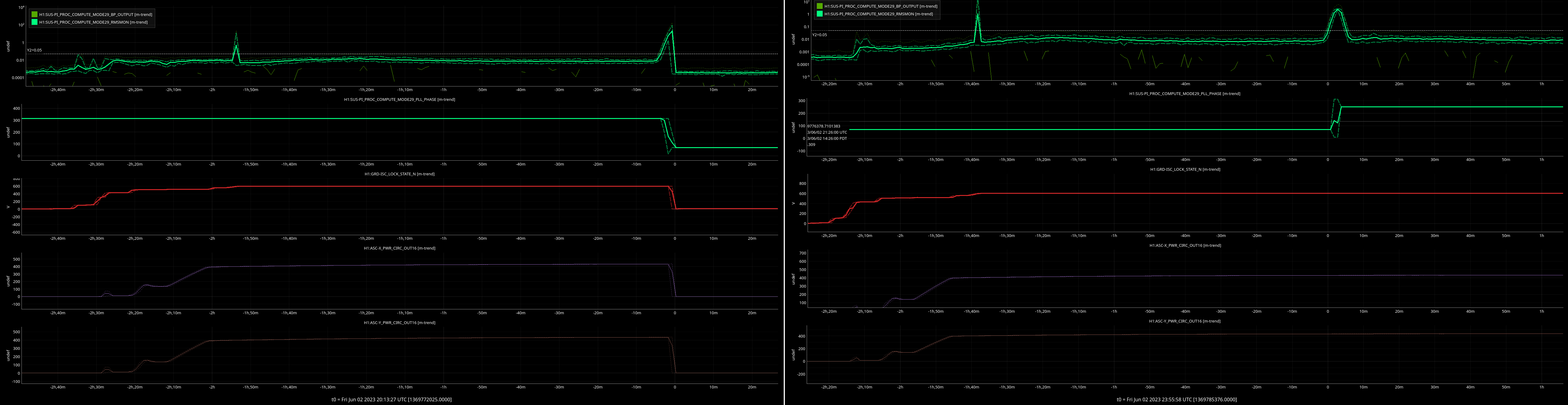
comparing the two cases that were near eachother on 06/02/23, it seems the first one at 20:13:27 which lost lock the IFO was at NLN and observing for about 2 hours and the second case at 06/02/23 23:55:58 which kept lock the IFO was at NLN and observing for just a bit over an hour only, both had similar power ranges. (image 3).

Images attached to this report
Comments related to this report
victoriaa.xu@LIGO.ORG - 15:38, Wednesday 07 June 2023 (70248)

Great analysis -- is it possible that these PI's are different modes, either different ETMX modes outside of our signal bandpass of PI29, or else modes on different test masses (maybe ITMX) ? Maybe PI 29 DAMPING works for the higher frequency peak (>14760) that is in-band of our PI damping on ETMX, but the lower frequency peak (<14,760) is out of our PLL signal band pass or a different mass, so we don't effectively damp it?

But the 6/2 pink lockloss vs. blue damped peaks are interesting; the time traces suggest we lost lock from it the first time, then damped it the second time. I wonder if it depends on the time in lock, or the arm power at which it shows up? This would also suggest the lower PI is still on ETMX? I think these cases are interesting to look at and undersatnd.

If we continue to have issues, I think it might be interesting to install new PI damping channels/modes for this lower frequency peak (new ones, so we don't lose the maybe-working PI29 channel).

H1 General
ryan.crouch@LIGO.ORG - posted 16:00, Wednesday 07 June 2023 (70254)
OPS Wednesday Eve shift start

TITLE: 06/07 Eve Shift: 23:00-07:00 UTC (16:00-00:00 PST), all times posted in UTC
STATE of H1: Lock Acquisition
CURRENT ENVIRONMENT:
    SEI_ENV state: CALM
    Wind: 13mph Gusts, 8mph 5min avg
    Primary useism: 0.03 μm/s
    Secondary useism: 0.10 μm/s
QUICK SUMMARY:

H1 SEI (CDS)
jeffrey.kissel@LIGO.ORG - posted 15:47, Wednesday 07 June 2023 (70251)
H1HPIETMX: Turning OFF (Inconsequential) 3DL4C Filter Modules that were Requested ON with No Filter Present
J. Kissel

E.J. identified recently that there were some filter modules which were requested to be ON, but had no filter in them -- see LHO:70179.

Between lock stretches, I reviewed the H1HPIETMX filter banks,
h1hpietmx :
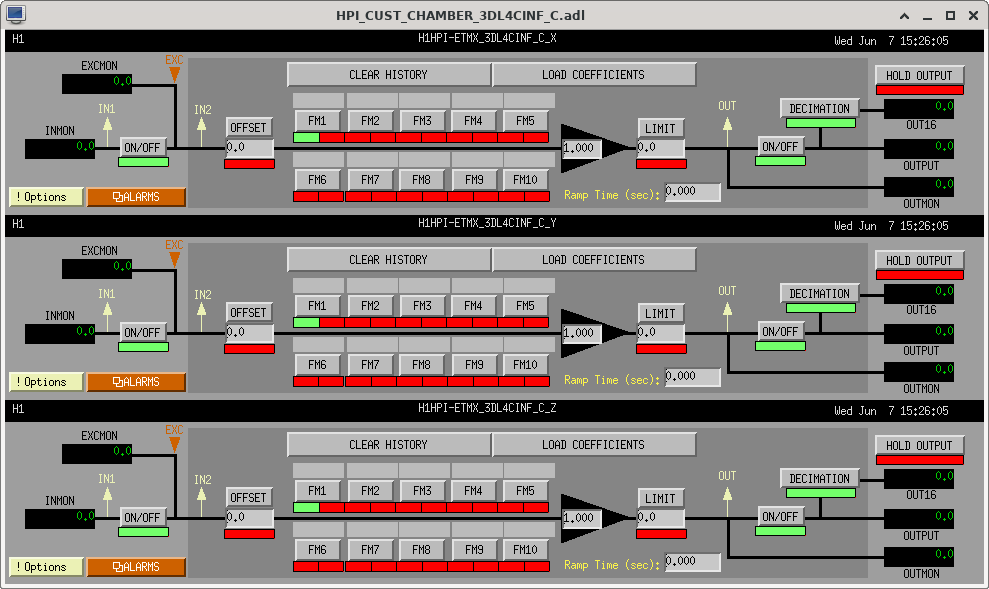
    ('HPI-ETMX_3DL4CINF_A_X', 'FM1'),    A bank screenshot
    ('HPI-ETMX_3DL4CINF_A_Y', 'FM1'), 
    ('HPI-ETMX_3DL4CINF_A_Z', 'FM1'), 

    ('HPI-ETMX_3DL4CINF_B_X', 'FM1'),    B bank screenshot
    ('HPI-ETMX_3DL4CINF_B_Y', 'FM1'), 
    ('HPI-ETMX_3DL4CINF_B_Z', 'FM1'),

    ('HPI-ETMX_3DL4CINF_C_X', 'FM1'),    C bank screenshot
    ('HPI-ETMX_3DL4CINF_C_Y', 'FM1'), 
    ('HPI-ETMX_3DL4CINF_C_Z', 'FM1')  
which are all generic *infrastructure* for spare, unused, analog inputs to HPI (named after an old idea, a 3D L4C, I had for a cheaper, better-at-10 Hz, ground-to-HEPI feed-forward sensor I had in 2011 that never got implemented). In the case of ETMX, this infrastructure can be confirmed to be spare and definitely unused, given that the inputs to the bank are connected to "electrical ground" at the top level of the front-end model which is advrts simulink code for digital zero.

These *must* have been turned on by mistake, or left on from some test (and then blindly accepted in the SDF as such).

I've turned these FM1 filter requests OFF and accepted that "offness" in SDF to reduce confusion.
They've been accepted as such in both the OBSERVE.snap and safe.snap files.

In addition, you can see in the B bank screenshot that there's an "Unknown" filter in the Y DOF's FM2. This is foton code for "the user didn't name this filter." Taking a look at the design of the filter in foton, it's an unnamed gain of 4.46. Who knows. I deleted the unused unnamed filter and re-loaded the coefficient file to clear it out to again reduce confusion.
Images attached to this report
H1 DetChar (DetChar)
andrew.lundgren@LIGO.ORG - posted 15:44, Wednesday 07 June 2023 - last comment - 15:54, Wednesday 07 June 2023(70250)
52Hz peak in DARM
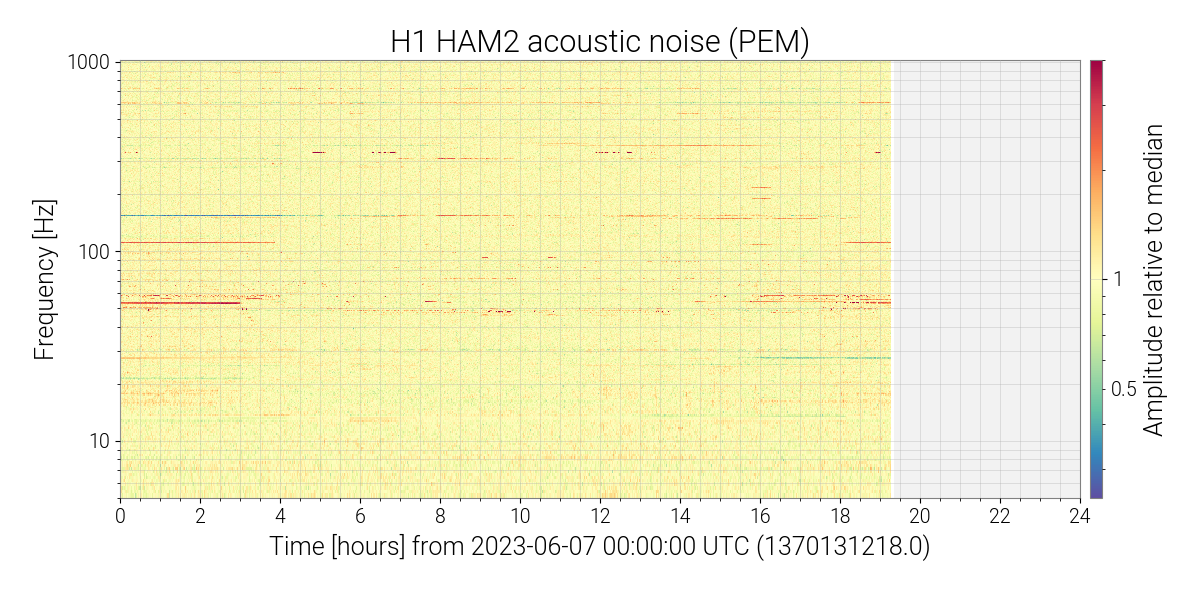
There's a peak in DARM around 52 Hz (with a second bump just below 50 Hz) that has come and gone in DARM the last few days.

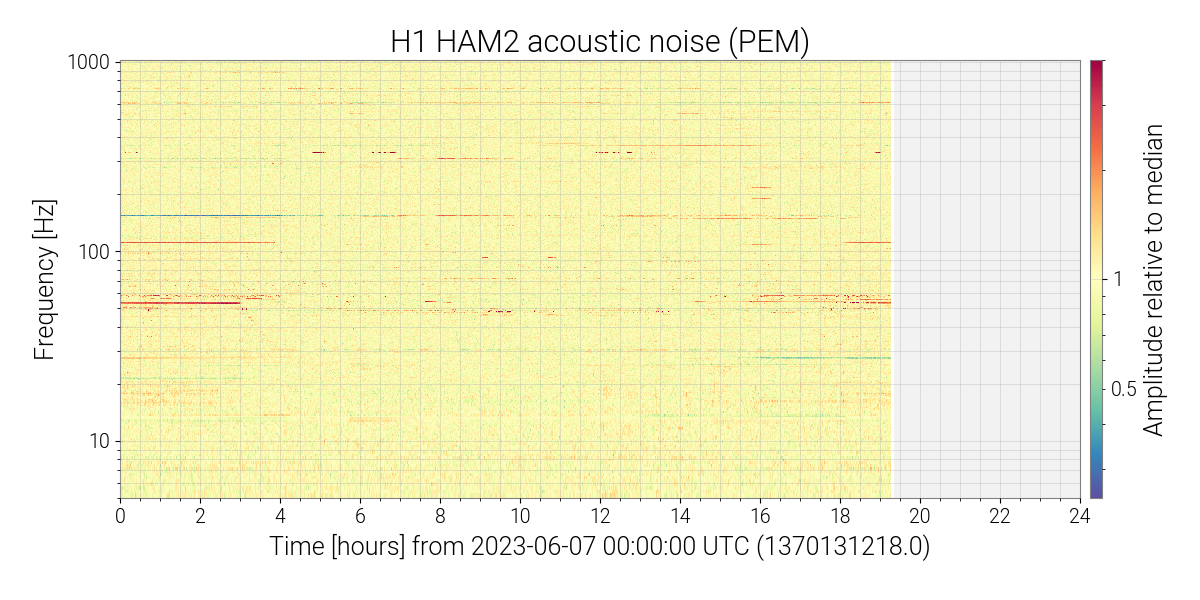
There's a noise source in the input optics mic that is in a similar frequency range. The noise in DARM could maybe be sidebands of the peak in the mic. The noise appears and disappears at some of the same times as in DARM, though the association is not that close.
Images attached to this report
Comments related to this report
jenne.driggers@LIGO.ORG - 15:54, Wednesday 07 June 2023 (70253)

Beverly found that some of these times with reduced range also seem to have had excess ground motion at very low frequencies:  https://ldas-jobs.ligo-wa.caltech.edu/~detchar/summary/day/20230607/sei/ground_spectrograms_x/

Work is ongoing to see if this is related to that 51 Hz peak.

H1 SQZ (CDS, SUS)
jeffrey.kissel@LIGO.ORG - posted 15:13, Wednesday 07 June 2023 (70245)
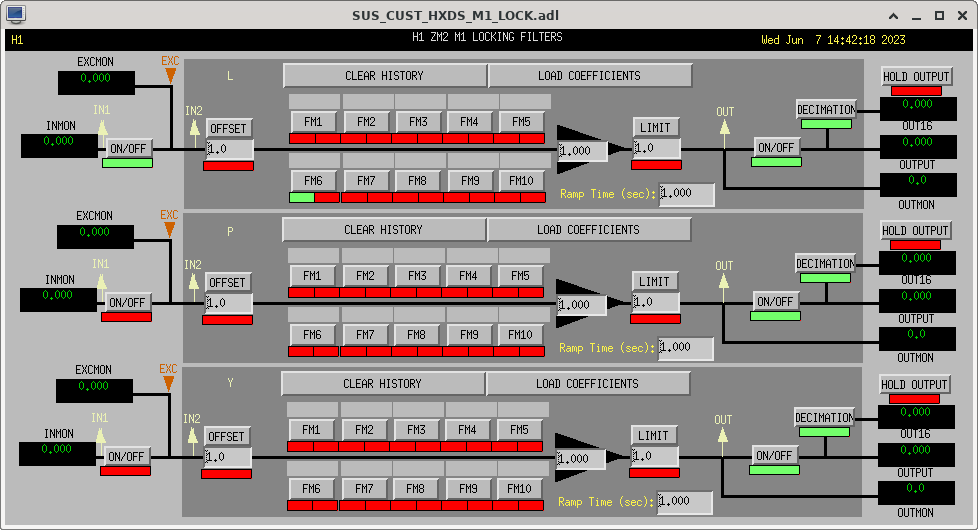
H1SUSSQZIN: Turning OFF (Inconsequential) ZM1 and ZM2 Filter Modules that were Requested ON with No Filter Present
J. Kissel

E.J. identified recently that there were some filter modules which were requested to be ON, but had no filter in them -- see LHO:70179.

Between lock stretches, I reviewed the H1SUSZM1 and H1SUSZM2 filters,
Bank                              Filter Module          Bank Function
SUS-ZM1_M1_WD_OSEMAC_RMSLP_LL     FM6                    To low-pass the 0.1 to 10 Hz band-limited RMS signal 
                                                         of the top mass OSEMs. Only one filter is needed, and 
                                                         by convention that "10s" filter is in FM1
SUS-ZM2_M1_LOCK_L                 FM6                    The *infrastructure* is there generically for longitudinal 
                                                         ISC control for cavity locking, but ZM2 is only a steering
                                                         mirror, not a part of any cavity.
and found that these *must* have been turned on by mistake (and then blindly accepted in the SDF as such).

I've turned these FM6 filter requests OFF and accepted that "offness" in SDF to reduce confusion.
Note that both of these suspensions' channels live in the h1sussqzin model, so it's the same SDF file. 
Further, the h1sussqzin model is one of those models where the safe.snap and OBSERVE.snap are the same file,
so accepting the changes in the "safe.snap" from the SDF GUI interface accepts it in the OBSERVE.snap as well.

Importantly, having these filters mistakenly ON has no, zero, nada, zilch impact on anything. I merely turn them off for peace of mind and preservation of sanity.

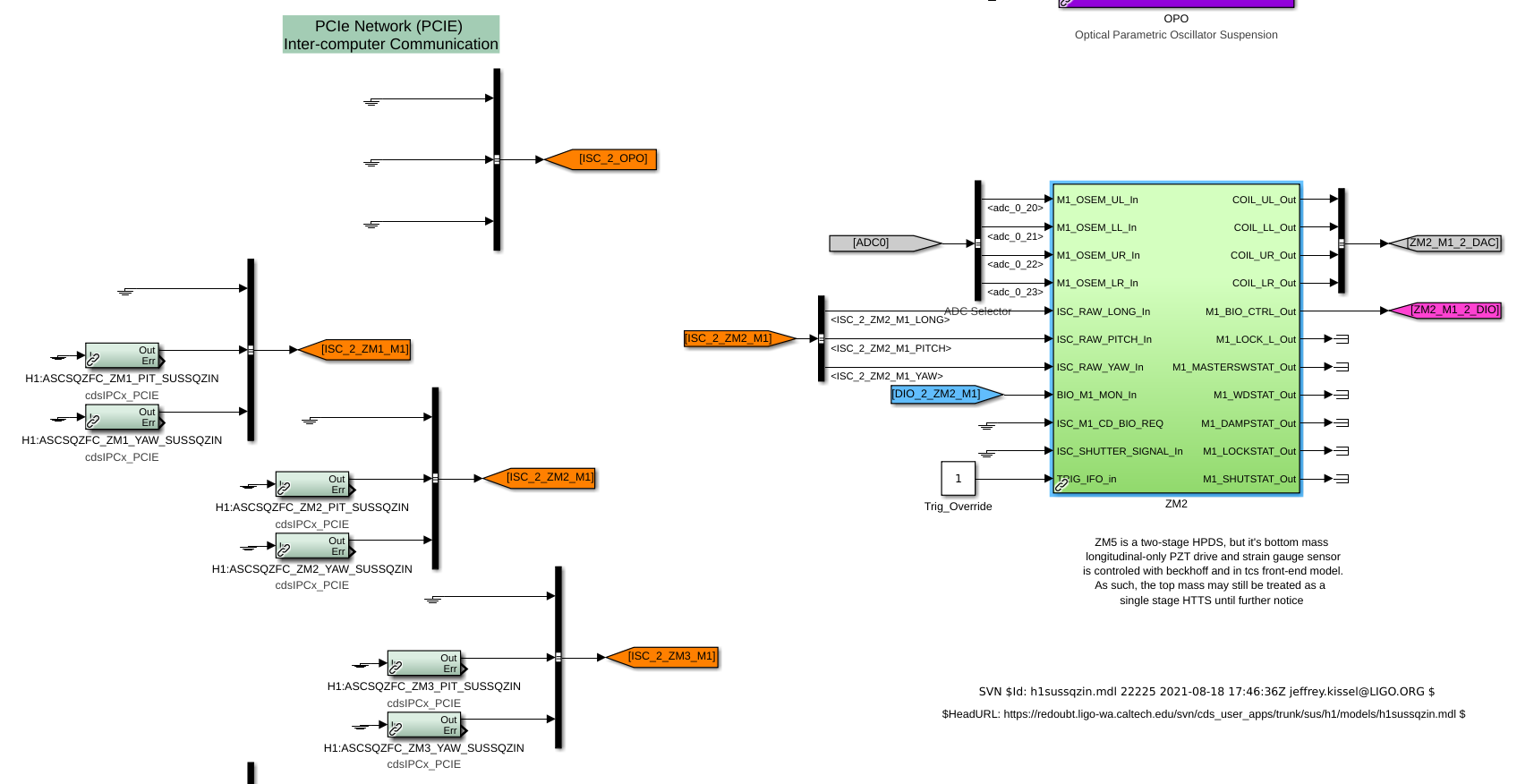
In addition to turning off ZM2_M1_LOCK_L bank's FM6, I've also turned off the bank's input, since it's physically impossible for anything but zero to be fed into this bank -- the input is connected only to a "electrical ground" symbol in the front-end model, which is the advligo rts symbol for a fixed value of "0.0."
Images attached to this report
LHO VE
jordan.vanosky@LIGO.ORG - posted 15:12, Wednesday 07 June 2023 (70246)
Functionality Test Performed on Turbo Pumps

We ran the functionality test on the main turbopumps in the corner during Tuesday Maintenance (6/6/23). The scroll pump is started to take pressure down to low 10^-02 Torr, at which time the turbo pump is started, the system reaches low 10^-08 Torr after a few minutes, then the turbo pump system is left ON for about 1 hour, after the hour the system goes through a shut down sequence.
No issues were encountered while performing the functionality test on this 3 stations.

Output Tube Turbo: Note: The flex hose connecting the turbo exhaust to the WTCB1 header line has been physically disconnected.

Bearing Life:100%

Turbo Hours: 5613

Scroll Pump Hours: 5555

XBM Turbo: Note: The flex hose connecting the turbo exhaust to the WTCB1 header line has been physically disconnected.

Bearing Life:100%

Turbo Hours: 777.4

Scroll Pump Hours: 778

YBM Turbo:

Bearing Life:100%

Turbo Hours: 596

Scroll Pump Hours: 1872

H1 General (Lockloss)
thomas.shaffer@LIGO.ORG - posted 14:13, Wednesday 07 June 2023 - last comment - 17:56, Wednesday 07 June 2023(70244)
Lockloss 2107 UTC

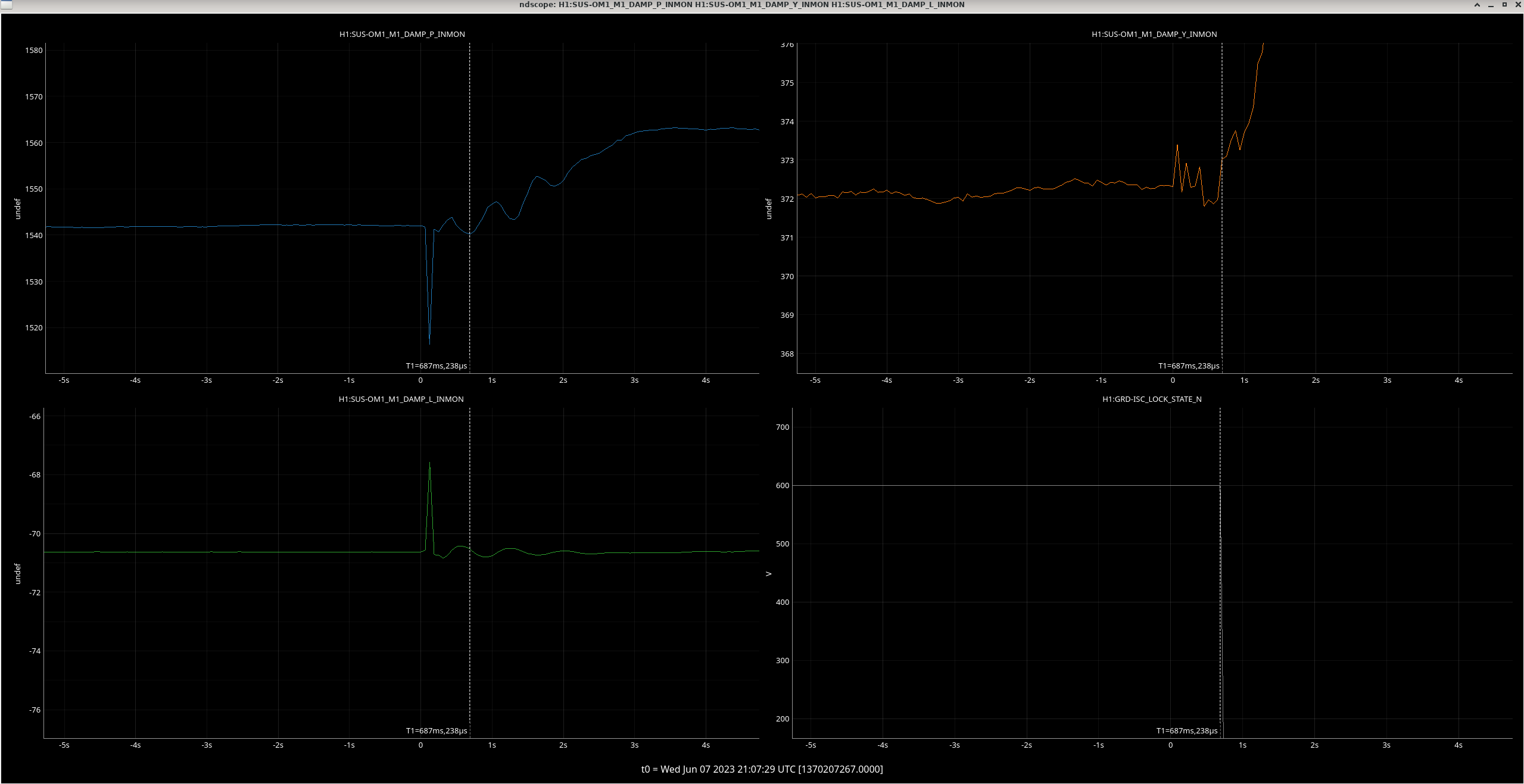
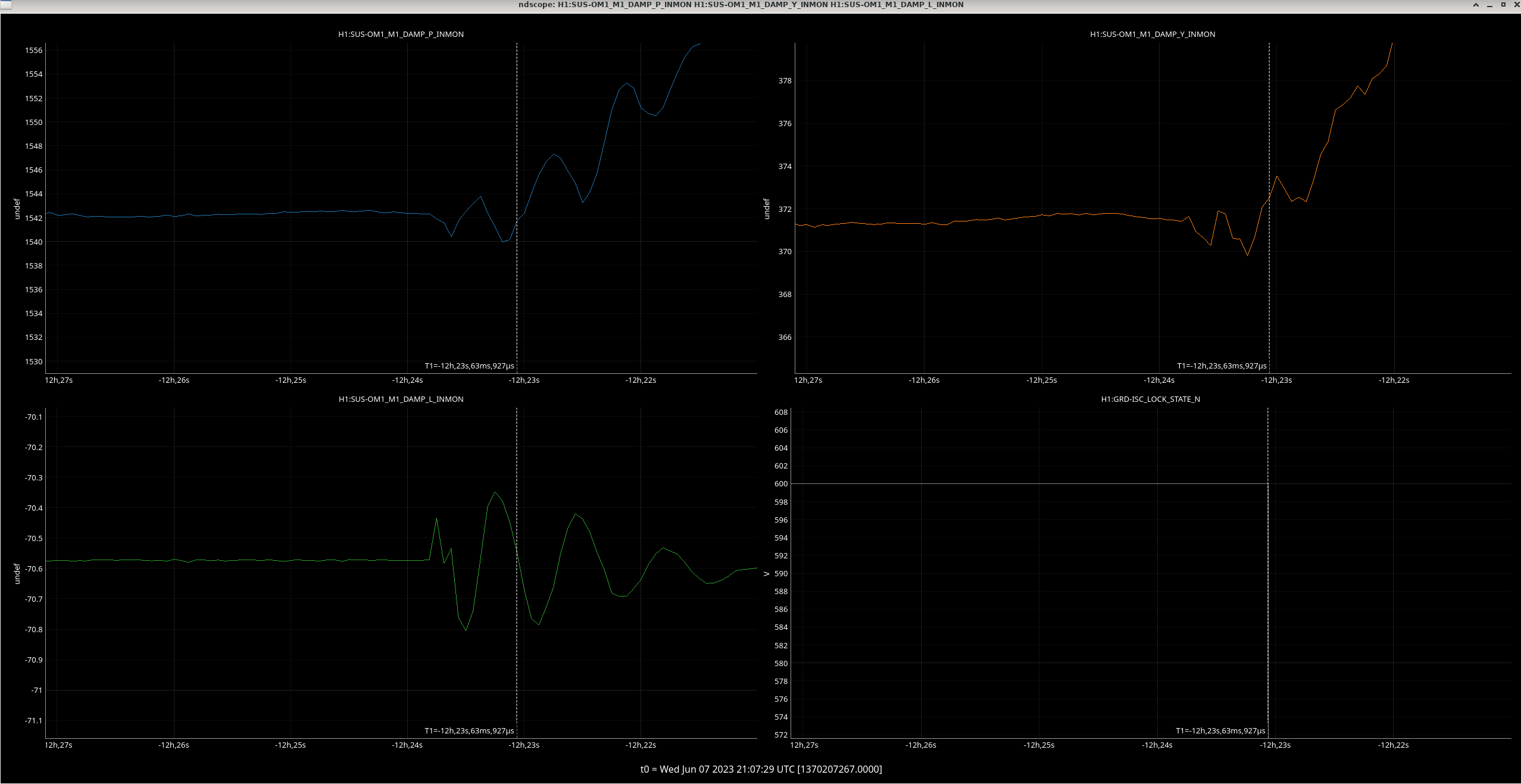
Lost lock at 2107 UTC - 1370207267

No immediate cause for this yet.

Comments related to this report
ryan.crouch@LIGO.ORG - 17:56, Wednesday 07 June 2023 (70260)

Using the lockloss select tool, I saw that ASC-SRC2_Y seemed to step out a bit further than usual, ASC_AS_C feeds into SRC2_Y and it's read at OM1 from our Optical Sensor Layout (DCC G1601619). OM1 appears to show some abnormal motion seconds before the lockloss? But trending back further, this behavior shows up in the 2 previous locklosses (16:35UTC, 09:07UTC) too althought not as strongly, so maybe it's just another witness?

Images attached to this comment
H1 General
ezekiel.dohmen@LIGO.ORG - posted 09:11, Tuesday 06 June 2023 - last comment - 08:53, Friday 09 June 2023(70179)
Filter Stage Enable Mismatch
There are a number of models with filters in modules that have been engaged but no filter has been defined for that stage. This causes some confusion when scanning for unresponsive filter stages, as these will clutter the results. 
Attached is an example of what this looks like on the medm screen. FM2 is enabled, but nothing is loaded in that stage so the 2nd box never turns green. 

My guess is that these stages used to have a filter defined for them, but were removed. The solution is to finish the removal of these stages, buy disabling the stage and saving the new state with SDF. 

Full listing of filters/stages that are enabled but don't have the enabled stage defined in the filter file. 

h1susetmy : [('SUS-ETMY_L2_DAMP_MODE19', 'FM1'), ('SUS-ETMY_L2_DAMP_MODE9', 'FM4')],

h1sussqzin : [('SUS-ZM1_M1_WD_OSEMAC_RMSLP_LL', 'FM6'), ('SUS-ZM2_M1_LOCK_L', 'FM6')]

h1hpietmx : [('HPI-ETMX_3DL4CINF_C_Z', 'FM1'), ('HPI-ETMX_3DL4CINF_C_Y', 'FM1'), ('HPI-ETMX_3DL4CINF_C_X', 'FM1'), ('HPI-ETMX_3DL4CINF_B_Z', 'FM1'), ('HPI-ETMX_3DL4CINF_B_Y', 'FM1'), ('HPI-ETMX_3DL4CINF_B_X', 'FM1'), ('HPI-ETMX_3DL4CINF_A_Z', 'FM1'), ('HPI-ETMX_3DL4CINF_A_Y', 'FM1'), ('HPI-ETMX_3DL4CINF_A_X', 'FM1')]

h1lsc : [('LSC-EXTRA_AI_2', 'FM2')]

h1lscaux : [('LSC-LOCKIN_1_DEMOD_9_I', 'FM1'), ('LSC-LOCKIN_1_DEMOD_9_Q', 'FM1')]

h1oaf : [('OAF-CAL_SUM_DARM_L1', 'FM3'), ('OAF-CAL_SUM_DARM_L1', 'FM6'), ('OAF-CAL_SUM_DARM_L3', 'FM3')]

h1calcs : [('CAL-CS_DARM_ANALOG_ETMY_L1', 'FM4')]

h1susproc : [('SUS-ETMY_L2_DAMP_MODE19_BL', 'FM1'), ('SUS-ITMY_L2_DAMP_MODE18_BL', 'FM1'), ('SUS-ITMY_L2_DAMP_MODE19_BL', 'FM1')]

Edited to remove any filter stages under local control. 
Images attached to this report
Comments related to this report
daniel.sigg@LIGO.ORG - 10:16, Tuesday 06 June 2023 (70184)

Some filters have front-end control over which filters stages are on. Typically, more than one filter stage is used for, say a automatic boost, but only a subset is actually loaded. So, a filter may be on, but empty. This is the expected behaviour. Changing which filter stages are participating would be a front-end model change.

A better solution may be to turn the 2nd box on for empty filters, when they are on.

jeffrey.kissel@LIGO.ORG - 12:16, Wednesday 07 June 2023 (70239)OpsInfo, SUS
After reviewing all the "SUS" filter banks mentioned above, these empty filter banks are either on because they were turned on by mistake (the ZM1 and ZM2 filters) and blindly accepted into SDF, or the bank had never been active use for control or monitoring (the violin MODE control and monitoring filters), so someone was probably playing around with a filter design and cleared it out but forgot to turn off the filter. 

In all SUS cases, the filter module should be turned off and accepted as such in SDF.

We'll make a point to clean this up and clear out the confusion next Tuesday, or during a next convenient lock loss.
jeffrey.kissel@LIGO.ORG - 15:14, Wednesday 07 June 2023 (70247)CDS, SQZ
h1sussqzin ZM1 and ZM2 filters in question have been turned off -- see LHO:70245.
jeffrey.kissel@LIGO.ORG - 15:48, Wednesday 07 June 2023 (70252)CDS, SEI
h1hpietmx filters in question have been turned off -- see LHO:70251.
jeffrey.kissel@LIGO.ORG - 16:04, Wednesday 07 June 2023 (70256)CAL, CDS
The h1oaf and h1calcs filters in question have been turned OFF -- see LHO:70255.
jeffrey.kissel@LIGO.ORG - 08:26, Friday 09 June 2023 (70299)CDS, SUS
The h1susetmy and h1susproc filter modules in question have been addressed -- see LHO:70264.
brian.lantz@LIGO.ORG - 08:53, Friday 09 June 2023 (70300)

To Daniel's point - Another choice is to populate the filter with a gain=1 stage. Then it turns on, but doesn't do anything. SEI does this with some of the calibrations. e.g.  FM1 is the the manufacture's calibration, and FM2 is to tweak the calibration based on measurements. If the sensor is very close to spec, FM2 can just be a gain=1. Then all the automation works more smoothly.

Displaying reports 18841-18860 of 87024.Go to page Start 939 940 941 942 943 944 945 946 947 End