TITLE: 06/28 Day Shift: 15:00-23:00 UTC (08:00-16:00 PST), all times posted in UTC
STATE of H1: Observing at 143Mpc
CURRENT ENVIRONMENT:
SEI_ENV state: CALM
Wind: 4mph Gusts, 1mph 5min avg
Primary useism: 0.01 μm/s
Secondary useism: 0.06 μm/s
QUICK SUMMARY: Locked for almost 18 hours, range in the 140s. Quiet on site so far.
STATE of H1: Observing at 144Mpc. Been at NLN for 14 hours.
Could not see a difference in DARM between the windy and not windy times above, see attached.
I'm attaching the calibration report produced by Tony in LHO 70902. Page three shows tonight's sensing function sweep in a quad plot overlaid with previous sensing sweeps in the current calibration epoch. It looks like we have evidence of a detuned spring in the sensing function.
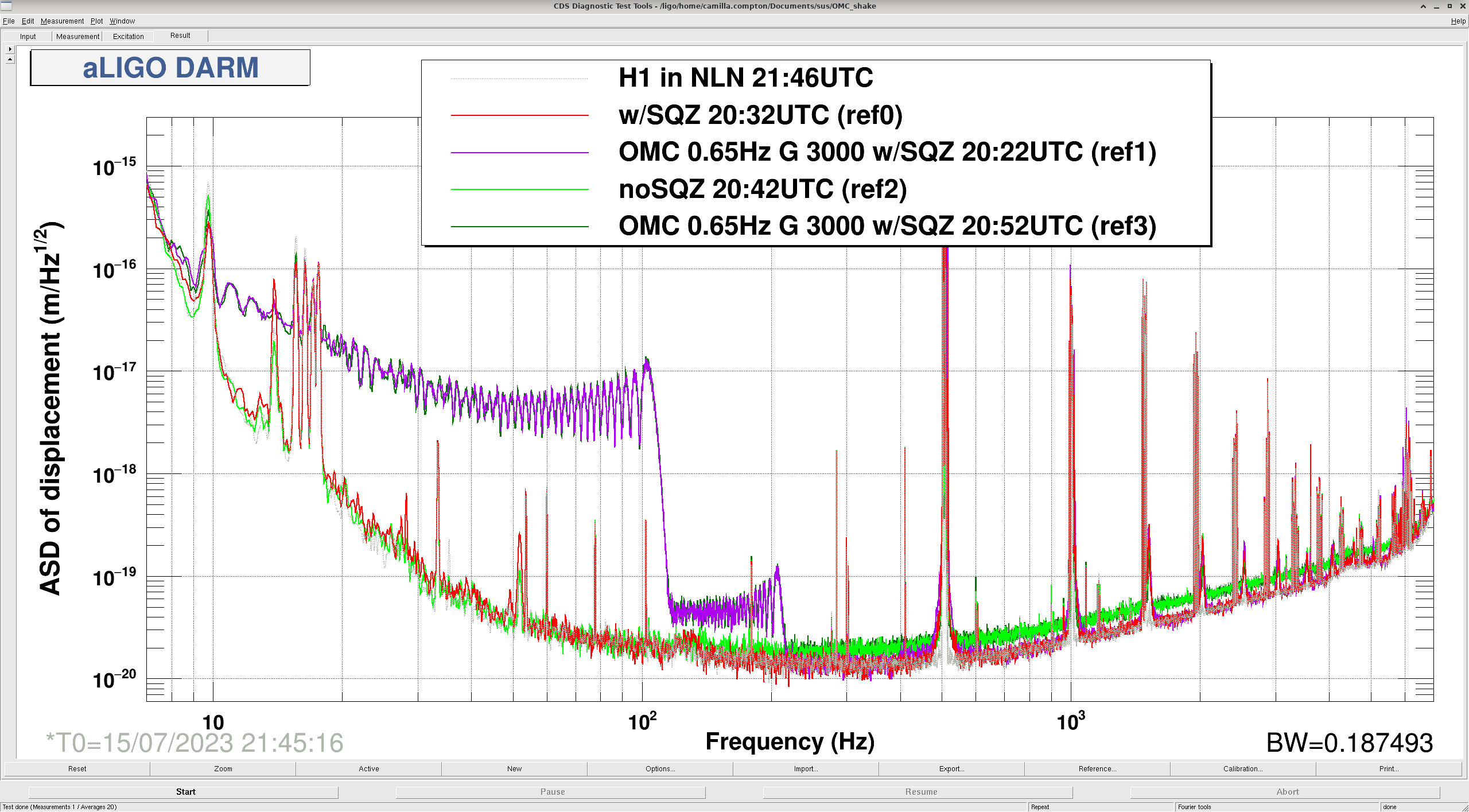
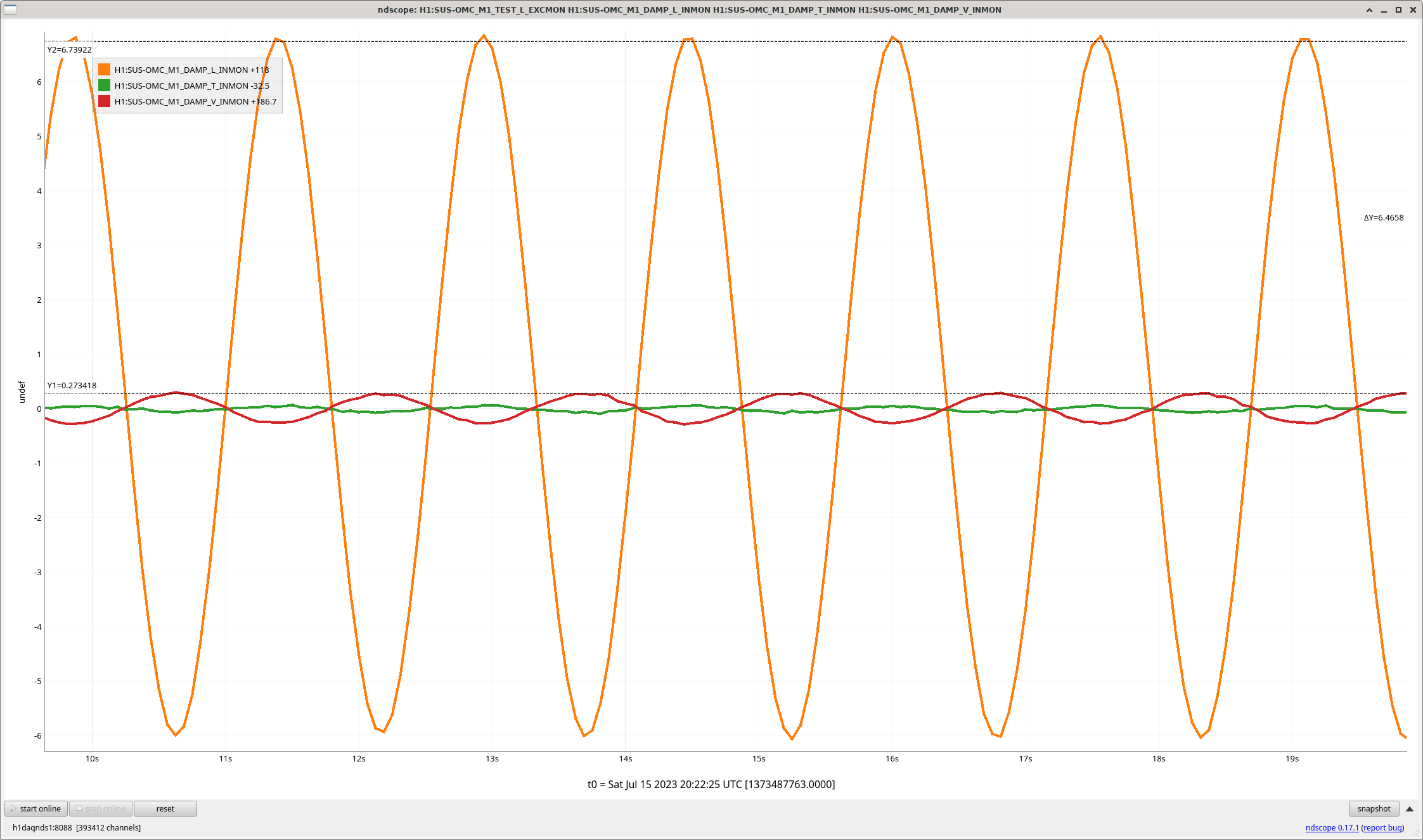
I'm attaching a screenshot showing a comparison of Camilla's broadband calibration measurement (LHO 70854) with the hot OM2 (LHO 70849) vs a measurement taken last week while the OM2 was still cold. The pink trace shows a measurement taken last week on 6/21 and the green was taken while the OM2 was heated. I want to point out the right column, which showsH1:GDS-CALIB_STRAIN_CLEAN / H1:CAL-PCALY_RX_PD_OUT_DQ(since Nonsens cleaning is currently turned off as per LHO 70654H1:GDS-CALIB_STRAIN_CLEANis the same asH1:GDS-CALIB_STRAIN_NOLINES). The OM2 TSAMS changes have resulted is roughly 2% additional error at 20Hz, among several other changes that I can't fully explain yet. It's worth noting here that the GDS pipeline applies time dependent corrections toH1:CAL-DELTAL_EXTERNALin real time as picked up by the TDCFs ("the kappas"). The fact that there are such noticeable differences inH1:GDS-CALIB_STRAIN_CLEAN / H1:CAL-PCALY_RX_PD_OUT_DQindicates that the effects due to the OM2 being heated on the sensing function are not being tracked by the Kappas. If they were then we'd see two overlaid traces on the PCALY to GDS-CALIB_STRAIN plot. I'm also leaving a screenshot showing how the kappas changed after the OM2 adjustment (kappas_scope.png). KappaC and Fcc changed by ~1.6% and 3%, respectively. Notably, the UIM kappa was about 2% off and then slid to ~1? I'm also attaching trends of the systematic error lines (sys_err_lines_scope.png) from/ligo/home/jeffrey.kissel/Templates/NDScope/uncertainty.yaml(not a typo). Several of the systematic error lines experience a drift after the OM2 TSAMS change. Jeff suggested that changes to the sensing function, which will impact the systematic error measurements (1/(1+G)), could "bleed" into and influence the line measurements that the kappa calculations are based on. More on this later. refs in attached dtt screenshot: refs 0-9: same as listed in LHO 70705 6/27 om2 hot: ref 10: deltal_external ref 11: gds calib strain clean
Plot attached, right is a zoom of left. Unsure why the ITMX CO2 laser PZT noise-dived to 0V. Laser temperature looked stable but is now decreasing due to a slightly lower lock point.
TITLE: 06/28 Owl Shift: 07:00-15:00 UTC (00:00-08:00 PST), all times posted in UTC
STATE of H1: Observing at 144Mpc
CURRENT ENVIRONMENT:
SEI_ENV state: CALM
Wind: 17mph Gusts, 14mph 5min avg
Primary useism: 0.05 μm/s
Secondary useism: 0.06 μm/s
QUICK SUMMARY: Been in NLN for 10 hours.
The wind picked up outside and dust monitor counts are EY dust counts are rising with it, see attached.
TITLE: 06/28 Eve Shift: 23:00-07:00 UTC (16:00-00:00 PST), all times posted in UTC
STATE of H1: Observing at 144Mpc
CURRENT ENVIRONMENT:
SEI_ENV state: CALM
Wind: 19mph Gusts, 15mph 5min avg
Primary useism: 0.05 μm/s
Secondary useism: 0.05 μm/s
QUICK SUMMARY:
Handing Camilla an IFO Locked for 10 hours.
The wind started to pick up in the last 3 hours and the Dust monitors in the optics lab are starting to sound off.
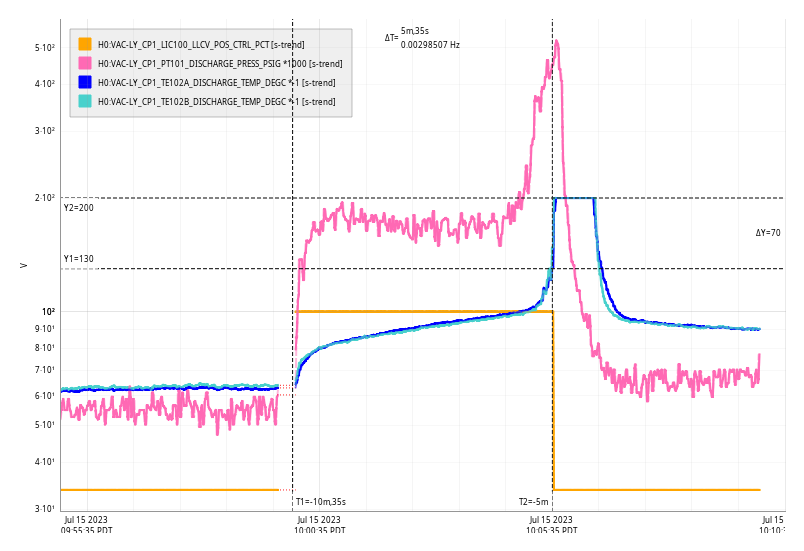
TCS Chiller Water Level Top-Off - FAMIS 21124
| TCS X | TCS Y | |
|---|---|---|
| Previous Level | 30.5 | 9.7 |
| New Level | 30.5 | 10.5 |
| Water added | 0mL | 300mL |
Inherited H1 which was already locked for about 2 hours.
If Livingston unlockes then I will be trying to take Calibration pcal BB and Sensing function, reload Diag_main, and load IMC_LOCK.
1:32 UTC:
Dropped out of Observing and into commisioning due to an accident. See alog.
Since we were no longer in Observing, I took the oppertunity and DIAG_MAIN & IMC_LOCK were reloaded.
Livingston then fell out of observing, and we took the lucky oppertunity to make a calibration measurement. See alog.
NOMINAL_LOW_NOISE was reached again at 2:35
Current H1 IFO Status: NOMINAL_LOW_NOISE & OBSERVING.
1:45 UTC:
Took ISC_LOCK to CNLN_CAL_MEAS
& ran the following terminal command:
pydarm measure --run-headless bb sens pcal
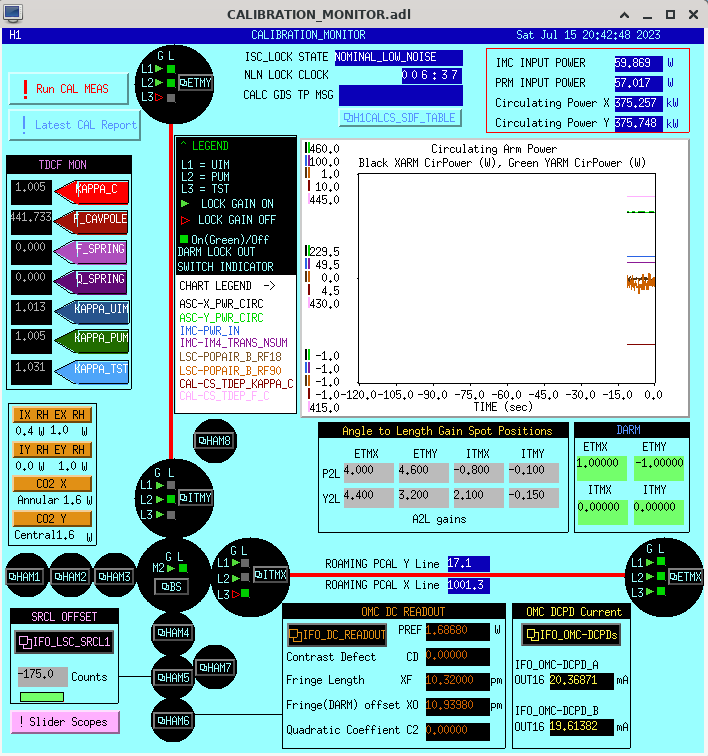
I took a screen shot of the Calibration monitor screen.
Report file path:
/ligo/groups/cal/H1/reports/20230628T015112Z/H1_calibration_report_20230628T015112Z.pdf
Got back to NOMINAL_LOW_NOISE at 2:35 UTC
I was preparing some new ASC filters for testing tomorrow, so I placed the new filters in unused filter banks of CHARD P. I loaded the coefficients, not realizing there were other differences in the ASC file. This pulled us out of observing. I am not sure what the ASC diffs were, as they were all related to the camera servos. Before Tony or I could investigate what the diffs were, they resolved themselves. It looks like the camera servos briefly turned themselves off and back on.
Apologies for the out-of-observing! It looks like whatever the issue was, it resolved itself.
[Jenne, Jason, Daniel]
Since Daniel has seen so much coherence with REFL port RIN (alog 70611), we thought we'd try increasing the ISS gain in case it's due to our being gain limited at high frequencies.
We didn't have much phase margin at all in the second loop (Measured last week in alog 70684), but we did in the first loop (last measured Feb 2022, alog 61826).
So, we increased the first loop by 6 dB (first attachment), now UGF is 46kHz with 39 deg phase margin. The gain slider is now at 11 dB. We also had to adjust the output offset from 5 to 4.3. We can turn on / off the first loop at input power of 2W just fine.
We increased the second loop by 4 dB (second attachment), now UGF measured at the -20dB line is 37 kHz with 32 deg phase margin. We had tried increasing the second loop by a further 2 dB (third attachment), but we decided that 41 kHz UGF wasn't worth having only 23 deg phase margin. These measurements were both taken with the input power at our current nominal 60W, but PRM and both ITMs misaligned. For the current lock (as well as for all these measurements) we just changed the gain after the ISS second loop was closed and DC coupled.
Still to do: At low power / DOWN in IMC_LOCK, the ISS second loop gain slider should be -2 dB (that's where all the offsets were most recently tuned). Then, in CLOSE_ISS, once the ISS is closed, the gain slider should be increased to +2 dB.
Also to do - make sure we know / remember how to get the SR785 connected to the wifi so we can download the data to the control room workstations.
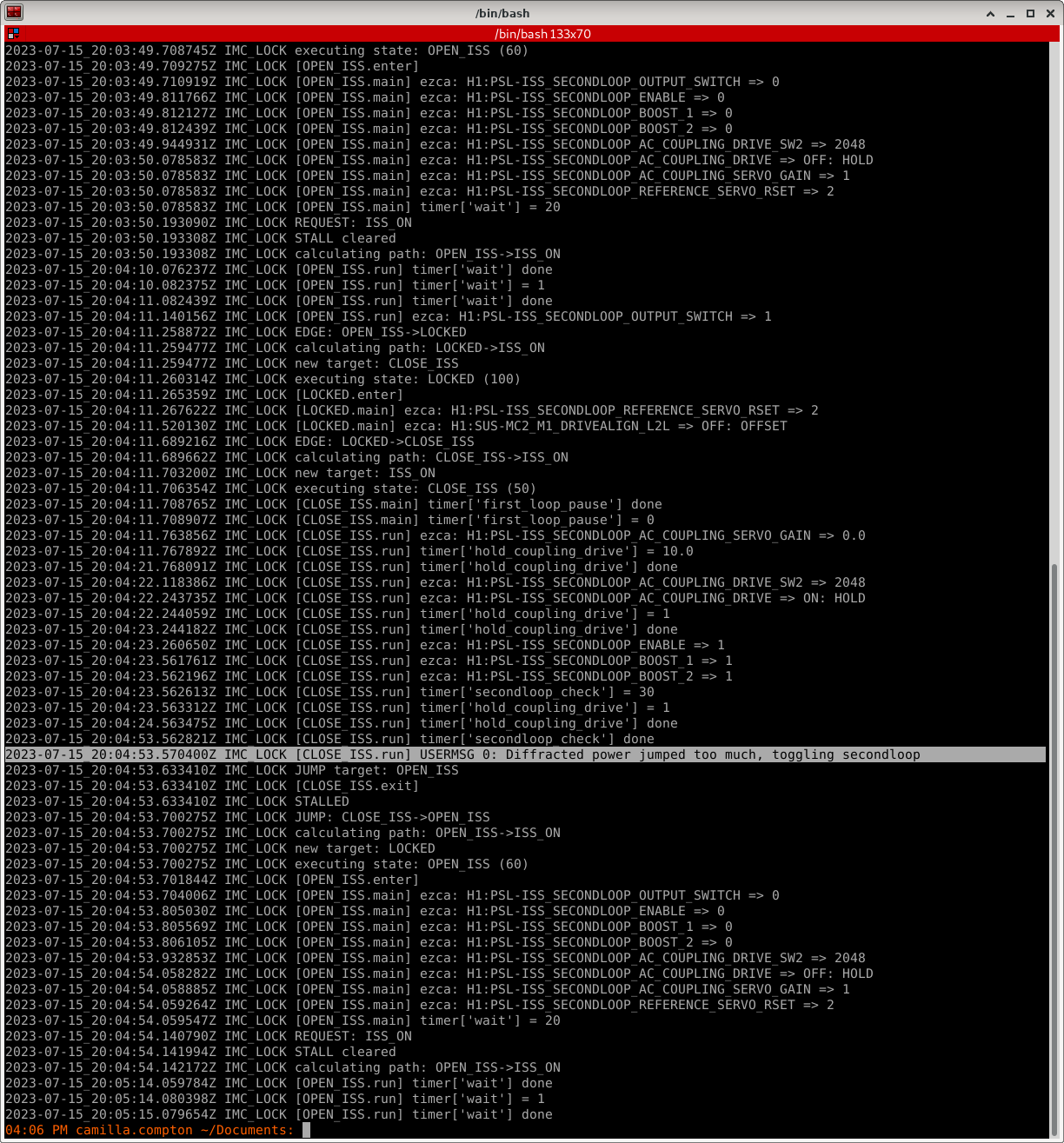
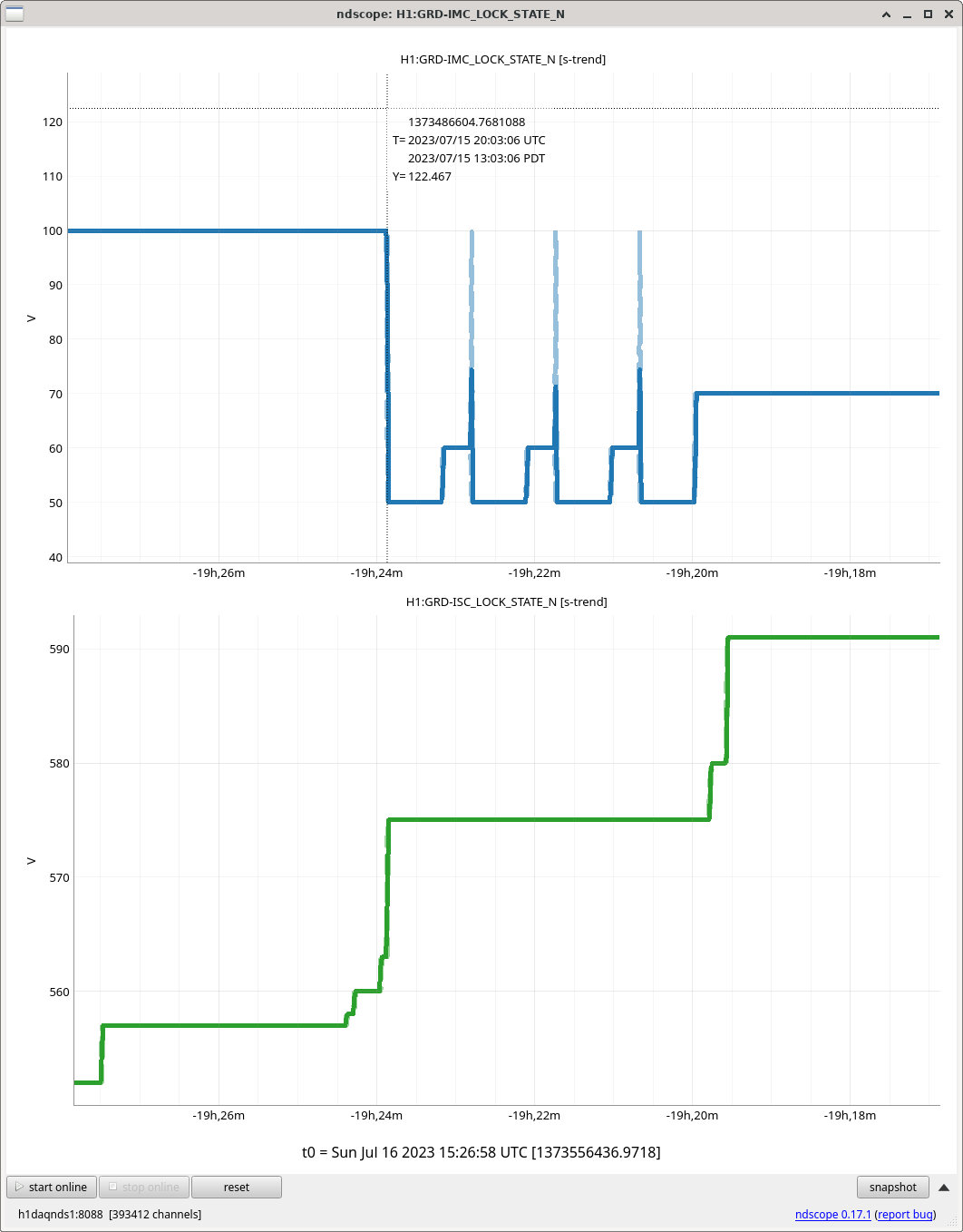
The IMC_LOCK guardian's DOWN state already looks at and uses the lscparams.ISS_acquisition_gain setting of -2.
I have added some logic to the OPEN_ISS state of IMC_LOCK to also reset the second loop gain slider to -2 (to prepare for re-closing it).
I have modified the logic in CLOSE_ISS to increase the second loop gain. The final gain value for H1:PSL-ISS_SECONDLOOP_GAIN when we get to Observing should be +2.
Since we're in Observing, I have not loaded the IMC_LOCK guardian. I'll leave a sticky not for the operator to do that when we're next out of Observe.
If, when we get to Observing, the H1:PSL-ISS_SECONDLOOP_GAIN is not at +2, it is okay (for tonight, until I debug / fix why guardian didn't do it right) to change the slider in units of 1 (which is the default slider click value) until it is +2.
If there are any troubles with this this evening, please give me a call.
TITLE: 06/27 Day Shift: 15:00-23:00 UTC (08:00-16:00 PST), all times posted in UTC
STATE of H1: Observing at 142Mpc
SHIFT SUMMARY: Maintenance day. Recovery was straight forward and hands off, aside from some automation testing (DRMI/PRMI less waiting, even shorter power up times). We've been in and out of observing breifly for a SQZ issue and then a timing port difference. Locked for 2+ hours
LOG:
| Start Time | System | Name | Location | Lazer_Haz | Task | Time End |
|---|---|---|---|---|---|---|
| 14:19 | COMM | Craig | Remote | N | Moddepth up-down test | 14:21 |
| 14:26 | CAL | Camilla | CR | N | BB Calibration Measurement | 14:30 |
| 14:31 | PEM | Camilla | CR | N | Measurementts | 14:53 |
| 14:32 | FAC | Bubba | LVEA | N | Plugging in | 14:48 |
| 14:56 | FAC | Karen, Kim | LVEA | N | Technical Cleaning | 16:24 |
| 15:16 | Property | Christina, Nicole | LVEA | n | Property hunt | 17:37 |
| 15:17 | FAC | Tyler | LVEA | n | Grab a part | 15:27 |
| 15:27 | FAC/VAC | Tyler, Bubba | MX | - | Retrieve Hepta pump | 17:14 |
| 15:38 | CDS/SEI | Fil | EX | n | Cabling for HEPI controller | 17:43 |
| 16:21 | SEI | Jim | EX | n | Check on power cord status | 18:21 |
| 16:22 | - | Jeff, Elenna, Amber | LVEA | n | LVEA tours | 17:57 |
| 16:24 | FAC | Karen, Kim | FCES | n | Tech clean | 17:24 |
| 16:33 | VAC | Janos | LVEA | n | Looking for parts | 16:53 |
| 16:34 | ISC | Daniel | CR | n | OMC single bounce meas | 19:34 |
| 16:45 | CDS | Marc, Fernando | CER | n | ITMY baffle pd chassis inspection | 17:56 |
| 16:48 | VAC | Travis | EX, EY | n | Install fittings on Hepta | 18:53 |
| 16:53 | VAC | Janos | Outbuildings | n | Inventory and labels | 18:53 |
| 17:04 | Contractor | Pepsi | OSB | n | Removing vending machine | 19:04 |
| 17:15 | FAC/CDS | Patrick | remote | n | FMCS channel changes | 18:15 |
| 17:32 | VAC | Norco | CS | n | LN2 fill | 19:32 |
| 17:44 | CDS | Fil | EY | n | Clean up cables, temperature sensor | 18:29 |
| 18:25 | SAF | Betsy | LVEA | YES | Laser hazard transition | 18:32 |
| 18:25 | SQZ | Daniel | LVEA | YES | SQZT0 pictures | 18:42 |
| 18:26 | ISC | Jenne, Jason | CR | n | ISS measurement, higher input power | 18:32 |
| 18:32 | CDS | Fil, Sheila, Betsy | LVEA | YES | OMC camera swap | 19:02 |
| 18:33 | VAC | Gerardo, Jordan | LVEA, EX | - | Grab wrench, then go to EX | 19:18 |
| 19:38 | ISC | Jenne, Jason | LVEA | n | ISS measurement at rack | 19:58 |
TITLE: 06/27 Eve Shift: 23:00-07:00 UTC (16:00-00:00 PST), all times posted in UTC
STATE of H1: Observing at 140Mpc
CURRENT ENVIRONMENT:
SEI_ENV state: CALM
Wind: 23mph Gusts, 20mph 5min avg
Primary useism: 0.03 μm/s
Secondary useism: 0.06 μm/s
QUICK SUMMARY:
Inheriting H1 while it's locked for 2 hours in NOMINAL_LOW_NOISE & OBSERVING.
WP 11139
The temporary setup for synchronizing the Beckhoff system with the NTP server was removed. Part of WP 11139. The following terminals were powered down and removed from MSR Rack 8.
1. EK1101 coupler
2. EL3004
3. EL6688
The EK1101 coupler was connected to the spare Beckhoff computer. The EL6688 terminal was connected to the NTP server. Spare computer was powered off.
There was a timing configuration change that dropped us out of observing briefly. Dave, Erik, Fil figured out this came from removing a spare Beckhoff unit.
Time out of Observing: 2237-2244 UTC
Here are a couple plots of oplevs and OSEM signals during our last lock, focusing on the change related to turning on the OM2 TSAMS. I plotted test mass top mass OSEMs and oplevs (in case they told different stories), and the OSEMs for SRM, SR2, OM3 and OMC.
Conclusion: there doesn't appear to be an alignment change in the arms. We hypothesized that a change in the signal to WFS 45 could change the DHARD and MICH alignment loops. That doesn't appear to be the case. However, we do see a pretty clear change in the OM3 and OMC alignment. There might be some OMC ASC alignment offsets we could try in order to mimic the changes we are seeing from the OM2 change.
From squeezer ASC trends as OM2 heats up, we also see an alignment shift, most strongly related to AS_A_RF45_Pitch (corresponds to SQZ-ASC_ANG_P_OUTPUT). Not implausible that the output alignment is what's changing; this would also be consistent with having to reset SQZ ASC offsets 70890 with a hot OM2.
At 76W, Camilla and I tried walking OMC ASC QPD offsets and didn't find anything better (69307). Before at 60W, Koji had success increasing the optical gain by walking the OMC ASC QPD offsets, but that was in mid-March before great TCS tuning, 67994. I thought this helped to improve and stabilize the range then. He also light heated OM2 after the new OMC ASC offsets 68048 and saw a similar ~2% reduction in optical gain, consistent with now 70859.
So, I also think it makes sense to try walking the OMC alignment, and generally the IFO's output alignment.
Per WP11286 in response to ALOG70818
We installed the spare S1302233 Baffle PD Amplifier directly below the installed Baffle PD Amplifiers into SUS R5 in the Biergarten. ITMX is S1400066 and ITMY was S1400065 but we swapped functionality to the spare we just mounted below it (this rack is mostly empty).
If there are issues with the spare we can immediately swap functality back to the old unit. If the spare fixes the issues, we will recover the old unit and perform a post mortem. As there was no laser light during install we could not verify functionality while on the floor.
M. Pirello, F. Mera
We seem to see some signal on this pd now, unlike before. Interestingly, the pd seems a fair amount of light during the ISC_LOCK state of Move_Spots. Clearly we are moving through a place with high scatter, best to avoid.
I pulled the ITMY Baffle PD Amplifer S1400065 and moved the replacement S1302232 up to occupy positions 11 & 12 to the right of the ITMX Baffle PD Amplifier. Post mortem on S1400065 showed that one of the internal cables was loose, this has been fixed and all cables pull tested. S1400065 has been included in the spares inventory.
This completes WP11286
Relock was fully auto after one lock loss while finding IR. There was a missing comma that brough ISC_LOCK into error in LOWNOISE_LENGTH_CONTROL, easy fix.
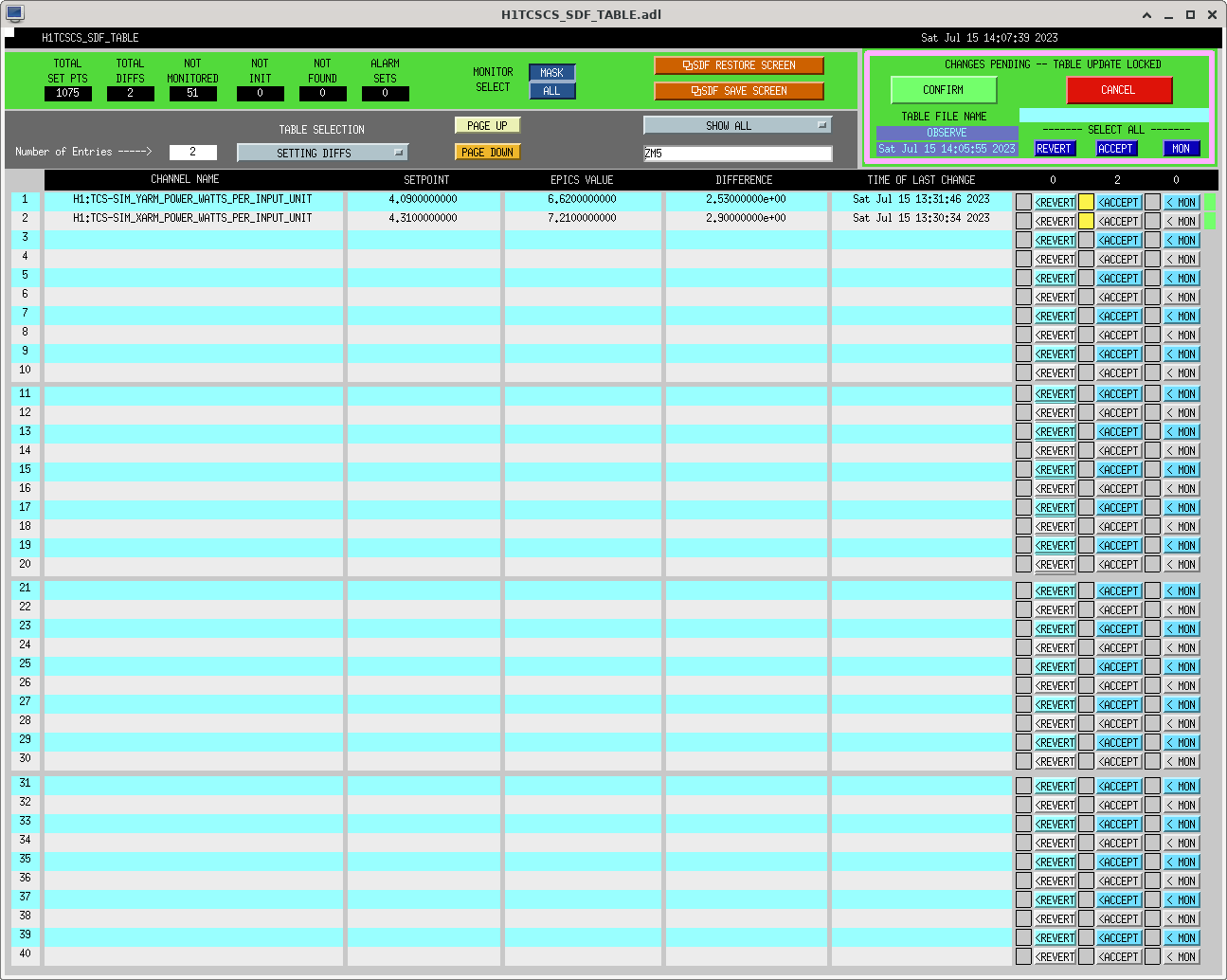
There were a few SDF diffs that look like they need to be accepted based on alog70648. Accepted with screenshots attached.
I turned on the CAL_AWG_LINES Guardian at request of Jeff. I had to change this node's nominal state to LINES_ON for it to be OK.
I'm thinking that this lower range is related to the squeezer. I've attached a screenshot fo the FDS DARM FOM where the live trace is above the refernece in the same frequencies that DARM seems to be higher than normal. I followed the instructions on the Troubleshooting SQZ wiki to adjust the sqeeze angle, but I wasn't able to make anything better, only worse.
I adjusted the sqz angle from 0630-0640 UTC.
Our range is staying low at ~125Mpc, there seems to be extra noise from 20-60Hz. Investigating.
There's a lot more coherence of PRCL and SRCL in the ongoing lock than the previous one. The thermalization cal lines are also very high in DARM and CHARD - maybe they weren't turned on until this new lock though.
Tagging CAL regarding the turn on of CAL_AWG_LINES for this 60W lock stretch -- thanks TJ!
Tagging DetChar as well -- to note that we have 8 extra calibrations on during this nominal low noise stretch that started at June 22 2023 05:04 UTC
These are in because we want to characterize the thermalization of the detector's DARM loop sensing and response functions now that we're operating at 60W rather than 75/76W. I hope to get a few more of these lock acquisitions with these extra lines on, and then we'll turn them off as we had done for the start of the engineering run.
If you'd like to create a data quality flag, you can find the status of these lines "in one go" by looking at the CAL_AWG_LINES guardian state channel,
H1:GRD-CAL_AWG_LINES_STATE_N
The numerical value of the channel is 10.0 when the extra calibration lines are ON (the state is called LINES_ON), and 2.0 when the lines are OFF (the state is called IDLE). See CAL_AWG_LINES_StateGraph for the flow of the state graph.
A retrospect on the lower range: The solution was a lack of capturing the SRCLFF1 gain in SDF / Guardian during yesterday's power reduction from 75W to 60W LHO:70648. See LHO:70712 and LHO:70710 where Tony recovered the correct gain of 2.1. @DetChar -- it might be worth creating a data quality flag for this: Observation segment start (with SRCLFF1 Gain at 1.0): 2023-06-22 05:04:38 UTC 22:04:38 PDT 1371445496 GPS Observation segment stop (with SRCLFF1 Gain at 1.0): 2023-06-22 13:53:47 UTC 06:53:47 PDT 1371477245 GPS
RyanC just added the SRCLFF1 gain of 2.1 to lscparams, saved, and reloaded the ISC_LOCK guardian. So, if we need to relock it'll come back on with the correct gain. Note though, that we expect to update this yet again later today.
Here's that SDF screenshot that I said I was going to attach. Turns out my tired brain had flipped setpoint and epics value in the tables, Doh! My fault.
Adding a quick comment to Jeff's note about lines, with a bit of relevant info from ER15.
Abby Wang and Athena Baches recently analyzed lines in May 2023 data, grouping those that evolve similarly in time. They found a cluster of lines corresponding to the awg lines, but not including any other entries. This is good news; it implies that there are *not* strong narrow artifacts with very similar histories-- i.e. these lines aren't causing unexpected strong lines elsewhere, which ought to have shown up in the same cluster. (Note: it's still possible that there are weak artifacts which aren't caught by this analysis.)
The attached plots show what the time evolution looks: each row is a line (corresponding to 11.475, 11.575, 15.175, 15.275, 24.4, and 24.5 Hz) , yellow = above threshold and blue = below threshold.
Janos noted that while he was at EY he heard some loud banging off in the distance, possible concrete hammer or small explosions?
I took a quick look at the sei .3-1hz blrms time series and didn't notice anything in the last hour (1st attachment). The EY microphones had one small feature at around 14:45:31 UTC (2nd screen shot), and it looks to be lower frequency (3rd screenshot, blue trace at the time, red just before). So maybe this is what Janos was referring to? I'm not seeing any other features elsewhere though.