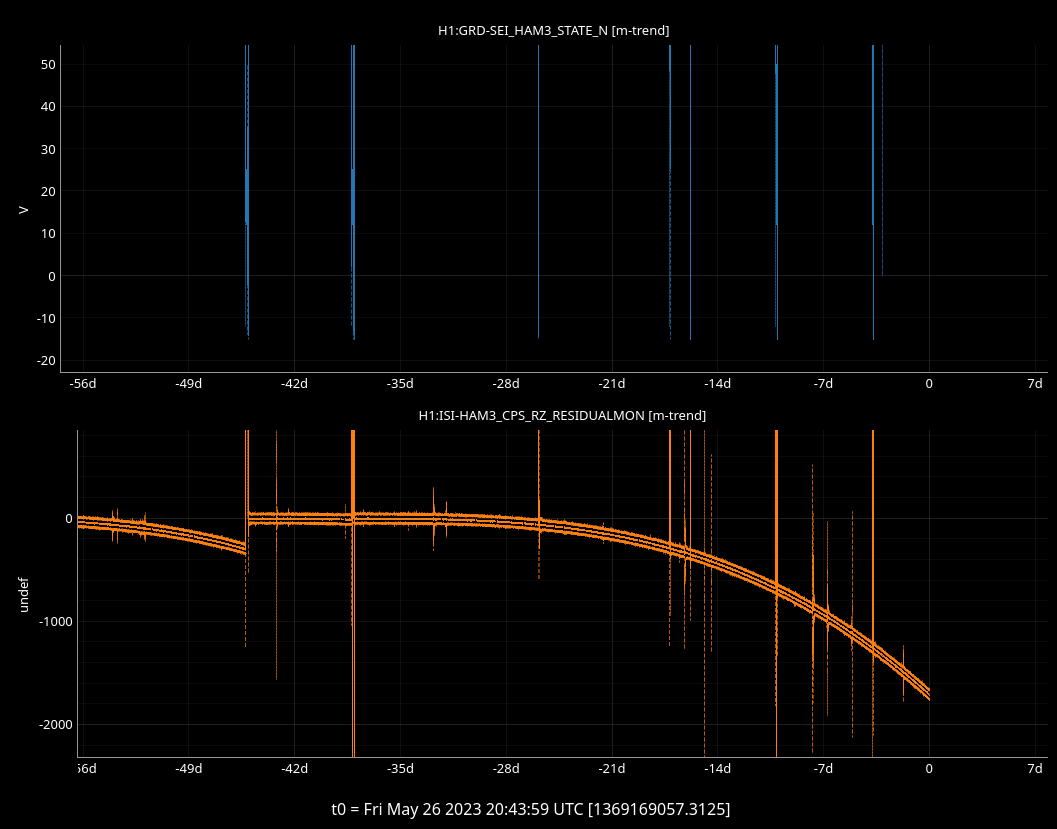
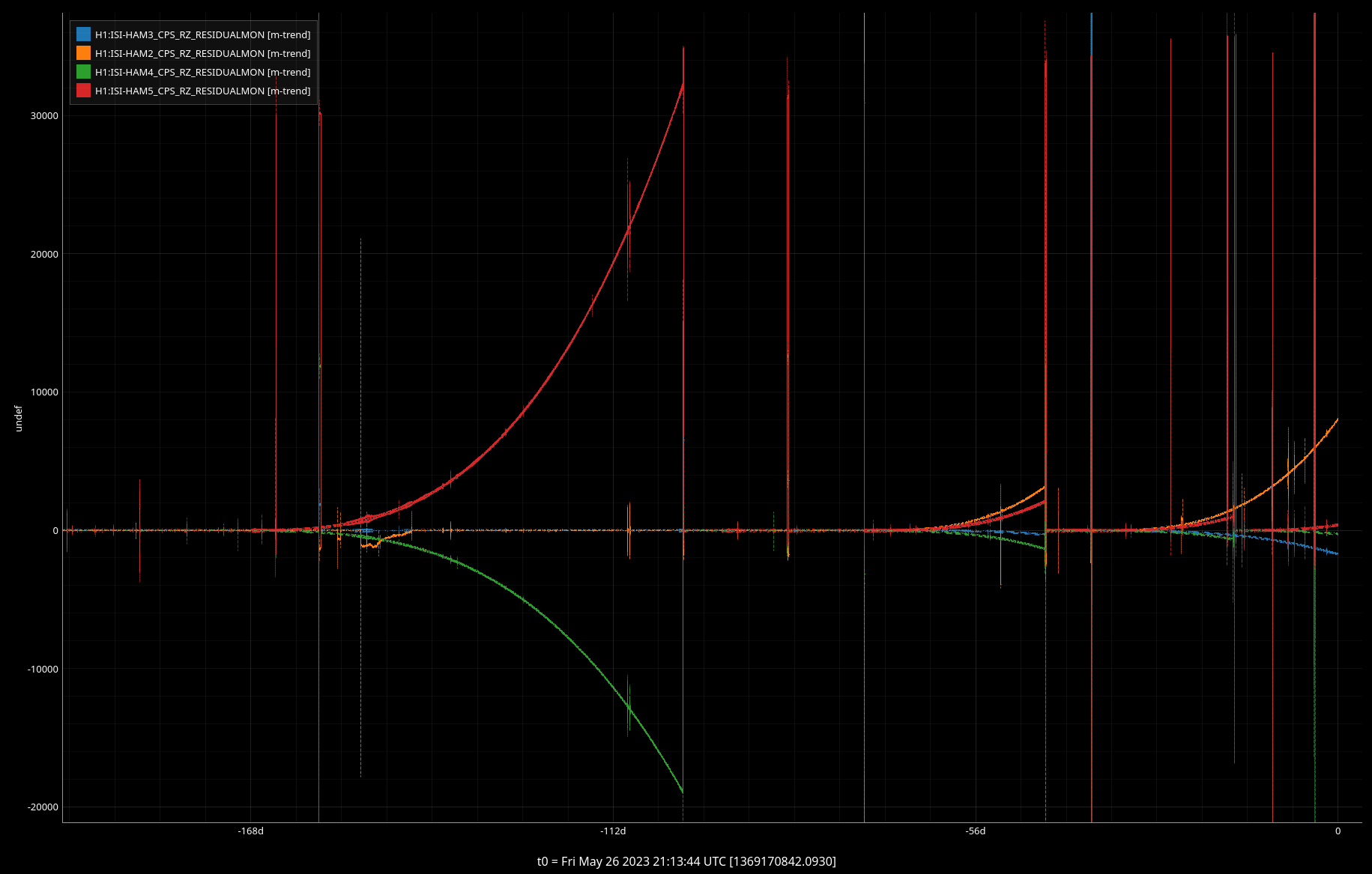
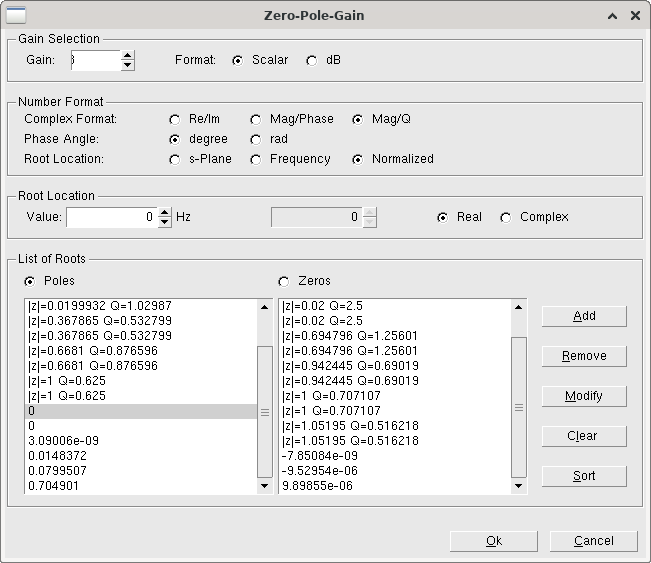
Jeff wrote the more detailed alog of the problems with the interferometer and how we tried to track down the issue, but short version, I installed a bad blend filter that has been causing an offset to accumulate in the ISI RZ locations for all of the HAMs, except HAM8. The accumulations take about 2 weeks to reach 1 urad levels. I designed the filter for HAM8 and it has been running there with no problems since last year, so I installed on HAM4-5 on Dec 11 last year, and March 15 on HAM2-3 this year. Unfortunately, there are some issues with the foton implementation, either because I missed some cleanup in the filter or because I got bit by some issue with writing the filters from Matlab to the foton file. Attached screenshot shows some of the zpk coefficients from Foton. There are 3 poles at, or near 0hz, and there are two negative zeros at 10^-6 hz. I certainly didn't use those in my design in matlab, but I guess I missed a step or two in cleaning up the filters before install. I think I've got a fix for that now, but will wait for Tuesday to try. They shouldn't accumulate much offset over the long weekend.
I've also added a test to DIAG_MAIN, to warn if the errant integration reaches 1urad on any of the HAM chambers. This should take 2 weeks or more at the current rate, but if any of the HAMs reach 1urad offset, DIAG_MAIN will report:
"ISI {} RZ CPS residual bad"
The test in DIAG_MAIN is:
@SYSDIAG.register_test
def HAM_RZ_RESIDUAL():
"""HAM RZ residual test
"""
chambers = ['HAM2', 'HAM3','HAM4', 'HAM5', 'HAM6', 'HAM7','HAM8']
bscs = chambers
tots = []
for chamber in bscs:
if ezca['ISI-' + chamber +'_CPS_RZ_RESIDUALMON'] > 1000:
tots.append(chamber)
if tots:
yield "ISI {} RZ CPS residual bad".format(tots)
Also, it's clear to me after thinking about this a bit, if we need to "reset" this, we don't need to restart the ISI like we did this afternoon. It will be sufficient to turn off the RZ isolation loop, push the "clear history" buttons on the RZ blend filters, wait 20 or so seconds for the filters to settle, then turn the RZ loop back on.
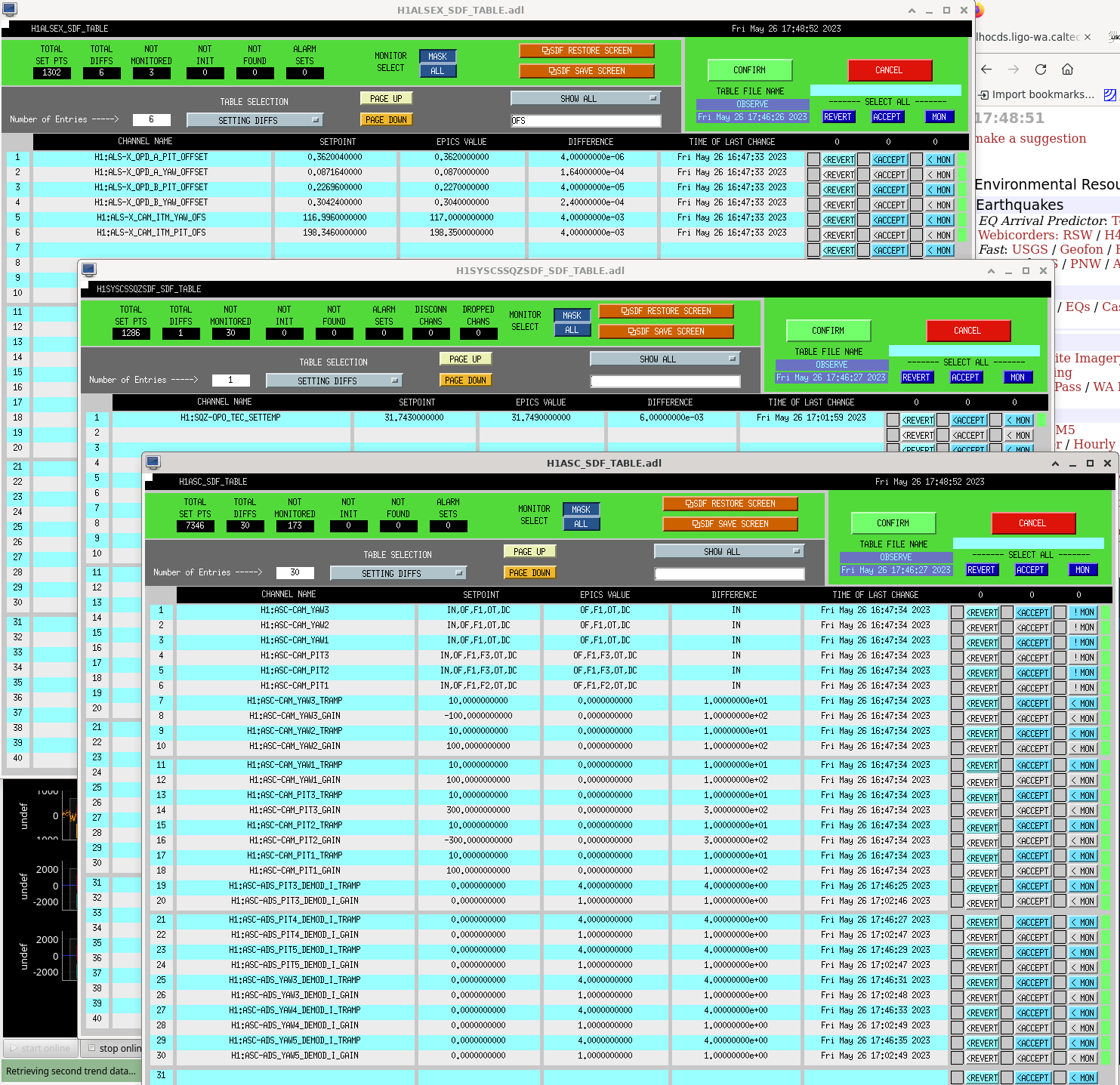
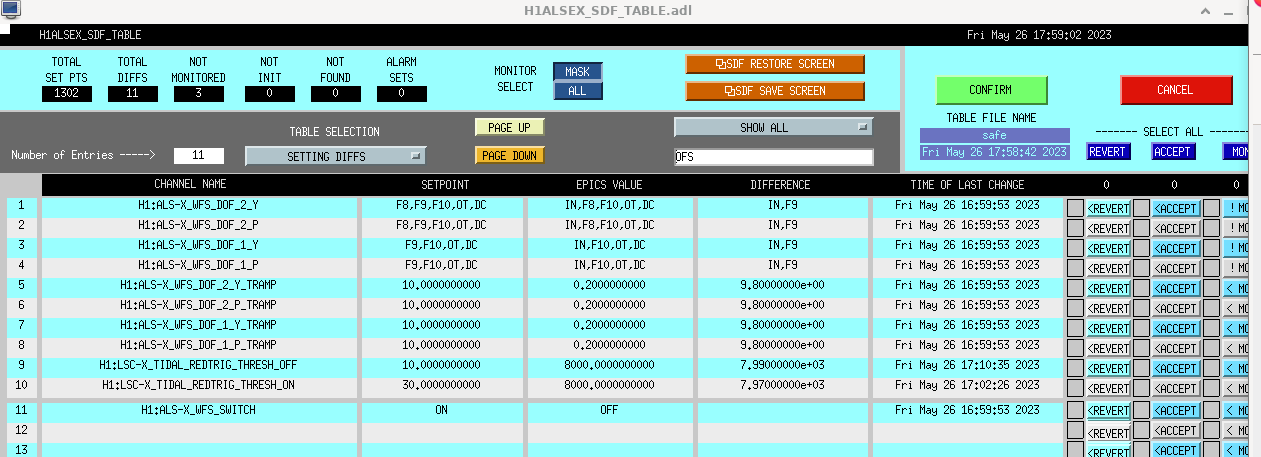
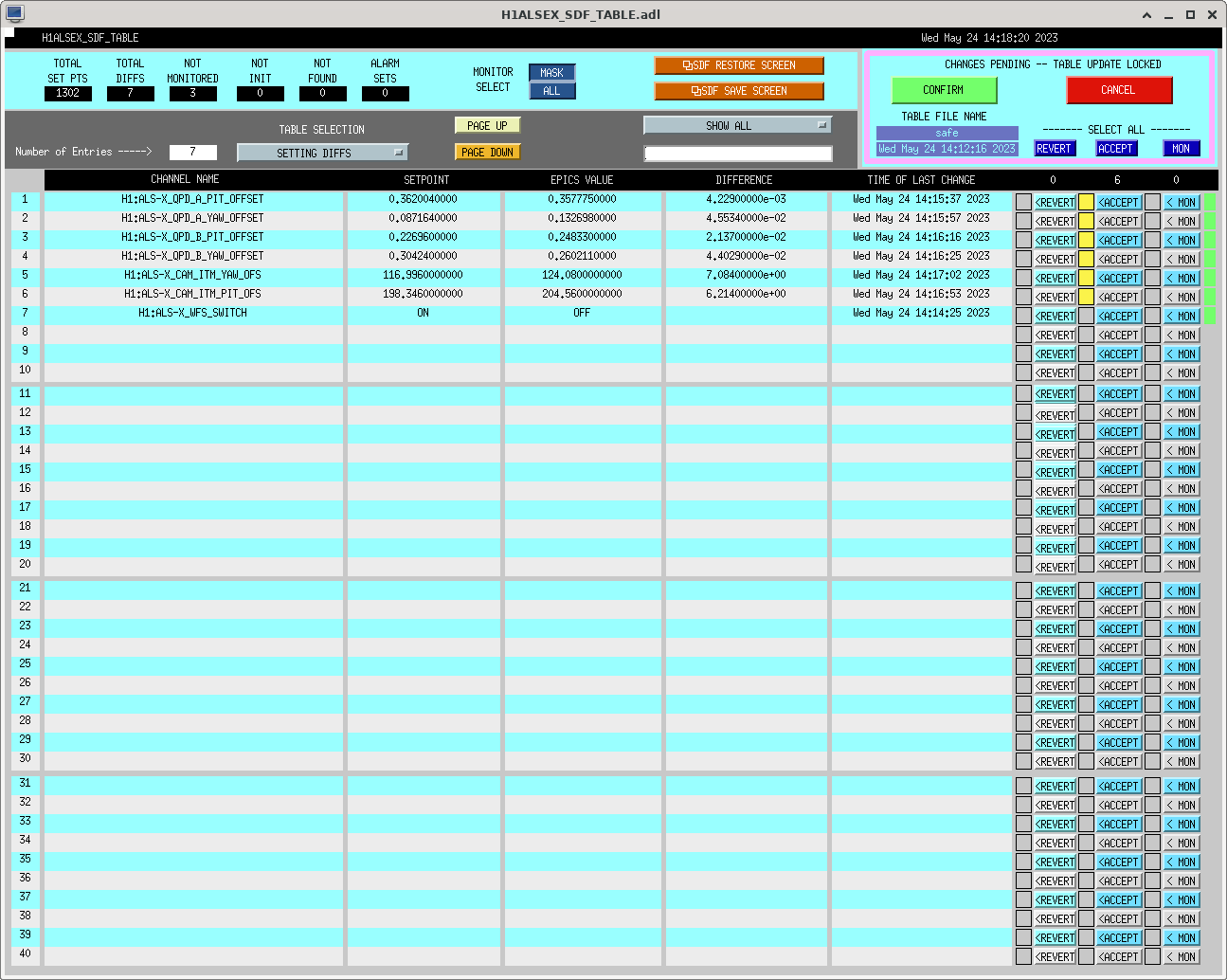
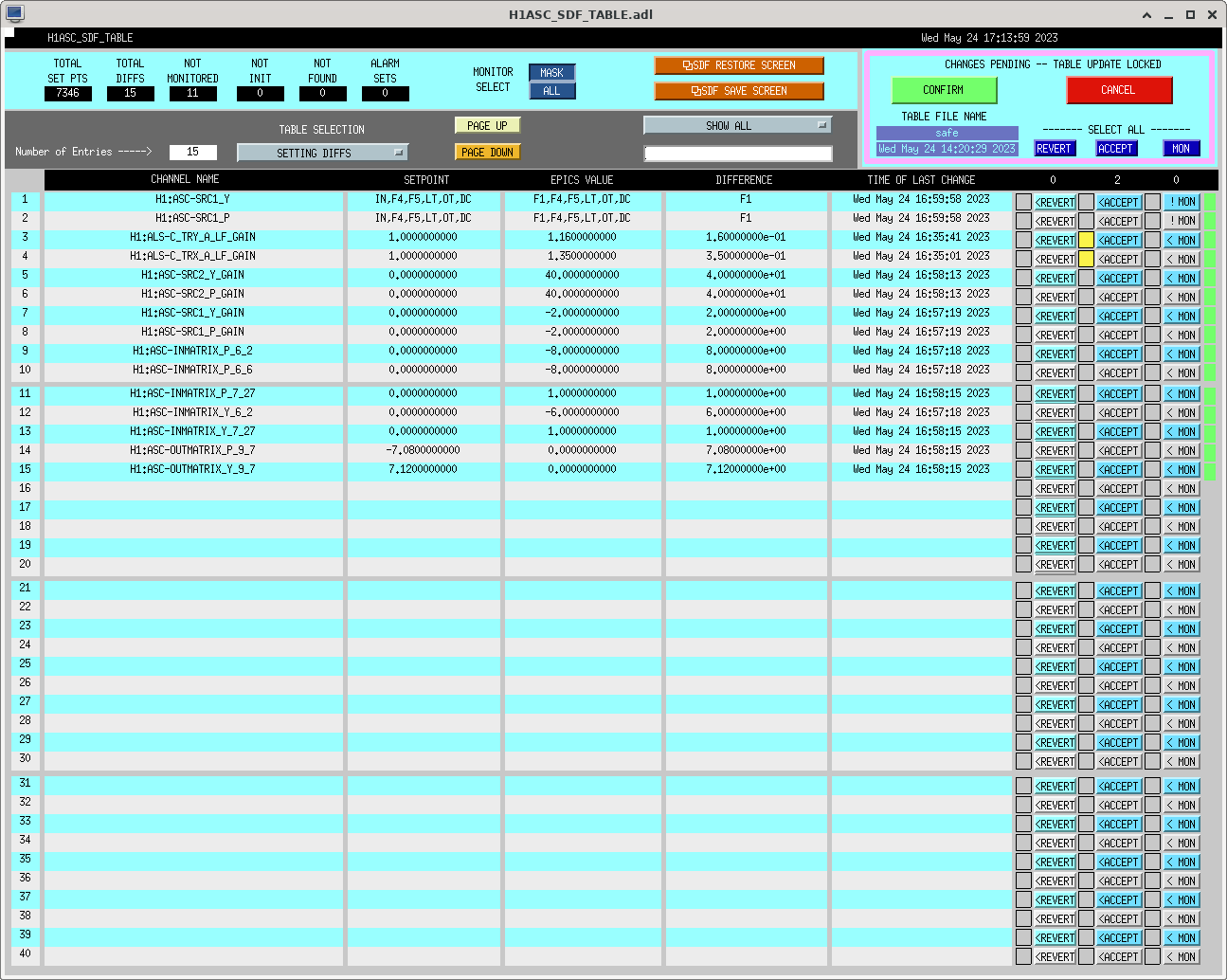
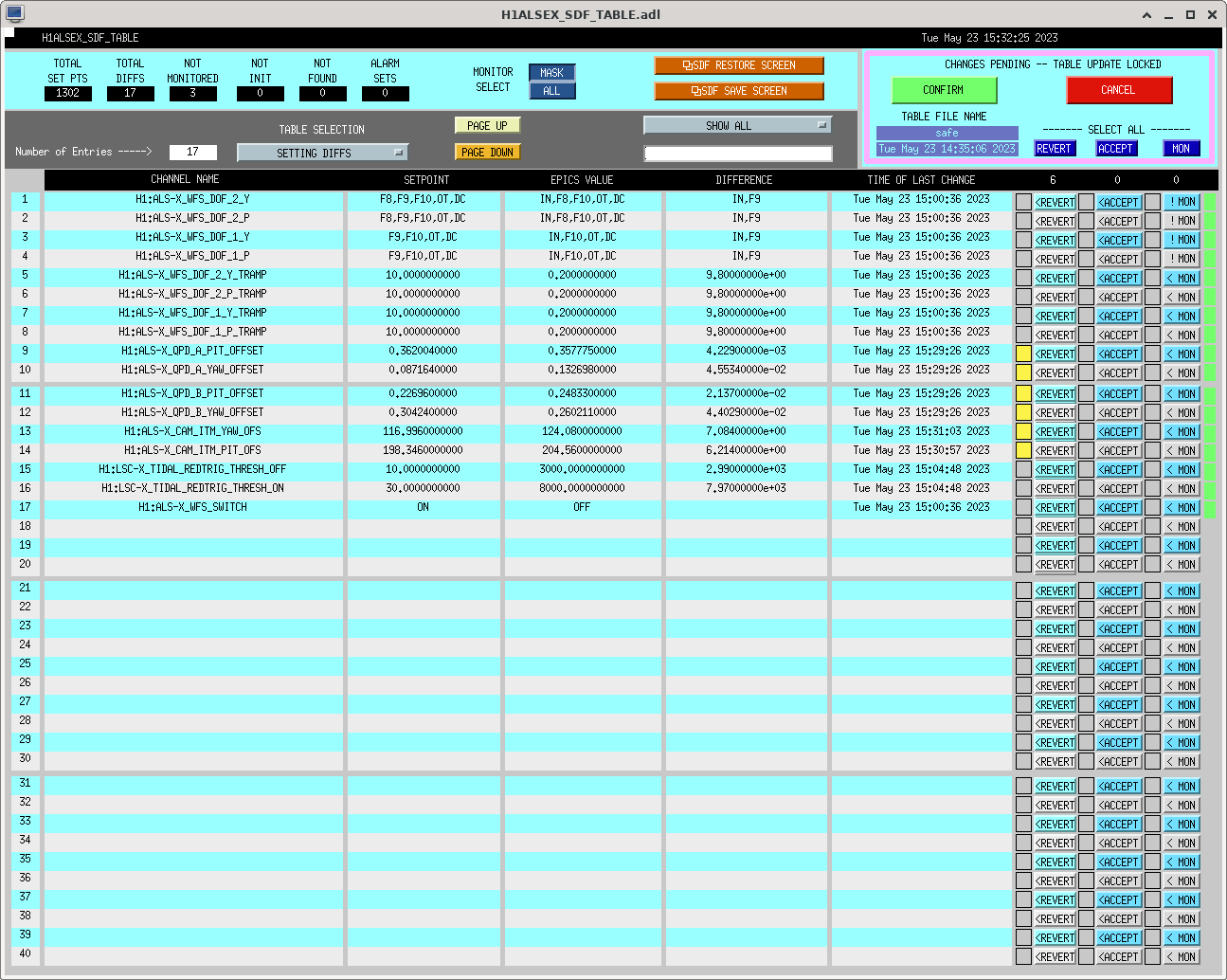
The H1ALSEX_SDF_TABLE Changes seemed to be hand made. I checked them against the Safe.snap and the values are indeed different. So I will accept them as shown.
The H1:SQZ-OPO_TEC_SETTEMP was accepted upon request from Vicki.
The Camera Diffs went away on their own.
(Jordan V., Gerardo M., Janos C., Travis S.)
Late entry, systems ran on May 23rd, during the maintenance period.
Corner Station Dry Air Skid
We ran the vent/purge supply for the Corner station to test dew point and take particulate samples, basically a functionality test.
No issues encountered during start-up and during the period the compressor operated. The dryer tower system ran good, no surprises.
The entire system was allowed to come up to nominal operation, while the system was on, we opened a butterfly valve located far from the dryer system, next to HAM3 to be exact, this action was done to let the purge air dry the line.
We took a couple of samples with the particle counter, after a couple of measurements were taken with the dew point meter, see final results below. After measurements and samples were done system was shut off.
Dew point: -42.0 degrees C. this is good.
Particle counts: 0.3 and 0.5 micron size they were below 10 counts.
Y-End Station Dry Air Skid
We ran the vent/purge supply for the Y-End station to test particulate and dew point, basically a functionality test.
No issues encountered during start-up and during running compressor. The dryer tower ran and did the switching of towers.
We took a couple of samples with the particle counter and with the dew point meter, see final results below. After measurements were done system was shut off.
Dew point: -41.3 degrees C. very good number.
Particle counts: 0.3 and 0.5 micron size <10.
X-End Station Dry Air Skid
No results. We need to run the same functionality test next week for this unit.
On a side note we purged the 2B turbo header using ultra zero bottled dry air, we connected the bottle to the header near but past the XBM turbo pump connection, system flushed for more than 30 minutes.
Quick summary: We've been able to get to DRMI_TO_POP and can now engage most of the DRMI ASC loops. Jim and Jeff are currently looking into an issue with the HAM yaw motion that might help explain the optic moves that we've had to make.
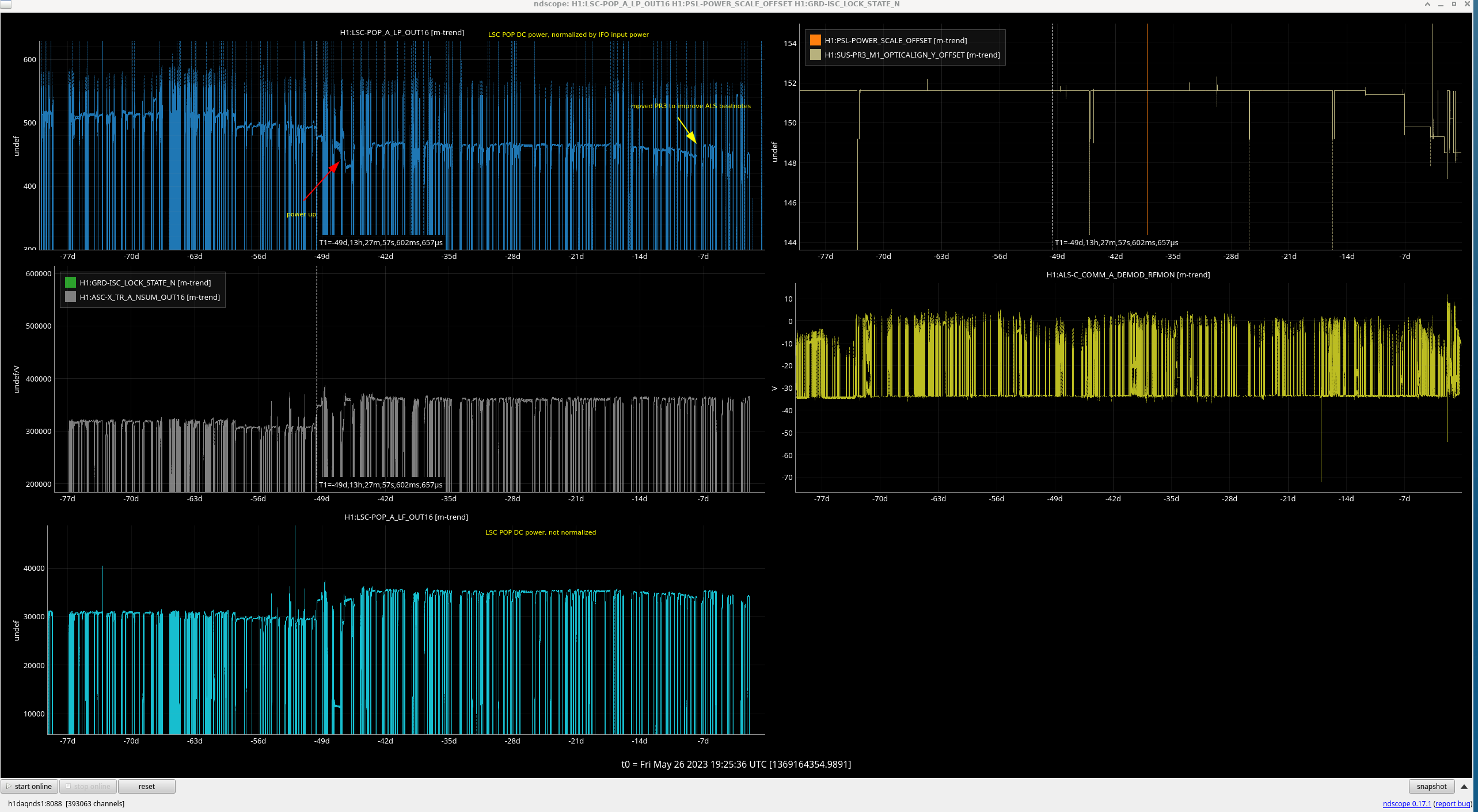
The attached screenshot (taken with the nice flameshot gui which allows easy annotation) shows part of the story of what has been going on.
The top left plots shows the DC power on the LSC pop diode, normalized by input power. This beam is transmitted by PR2 and shares an optical path with the ALS beams as they head to HAM1 and ISCT1. There is one drop in normalized power on this diode about 60days ago, then another drop when the input power was increased. Over the last 2 weeks as the ISI drifts have accelerated, we see the power on the diode dropping further, indicating clipping on this path. You can see in the top right plot the PR3 slider, which has been adjusted over the last 2 weeks to increase the ALS beatnotes, these PR3 steps did partially restore the power on LSC POP, but not compeletely.
This helps to explain why we have re-aligned the ISCT1 table so many times this week.
The problem was that the HAM-ISIs were all drifting off in Yaw (RZ) slowly, but surely, for weeks -- see LHO:69934.
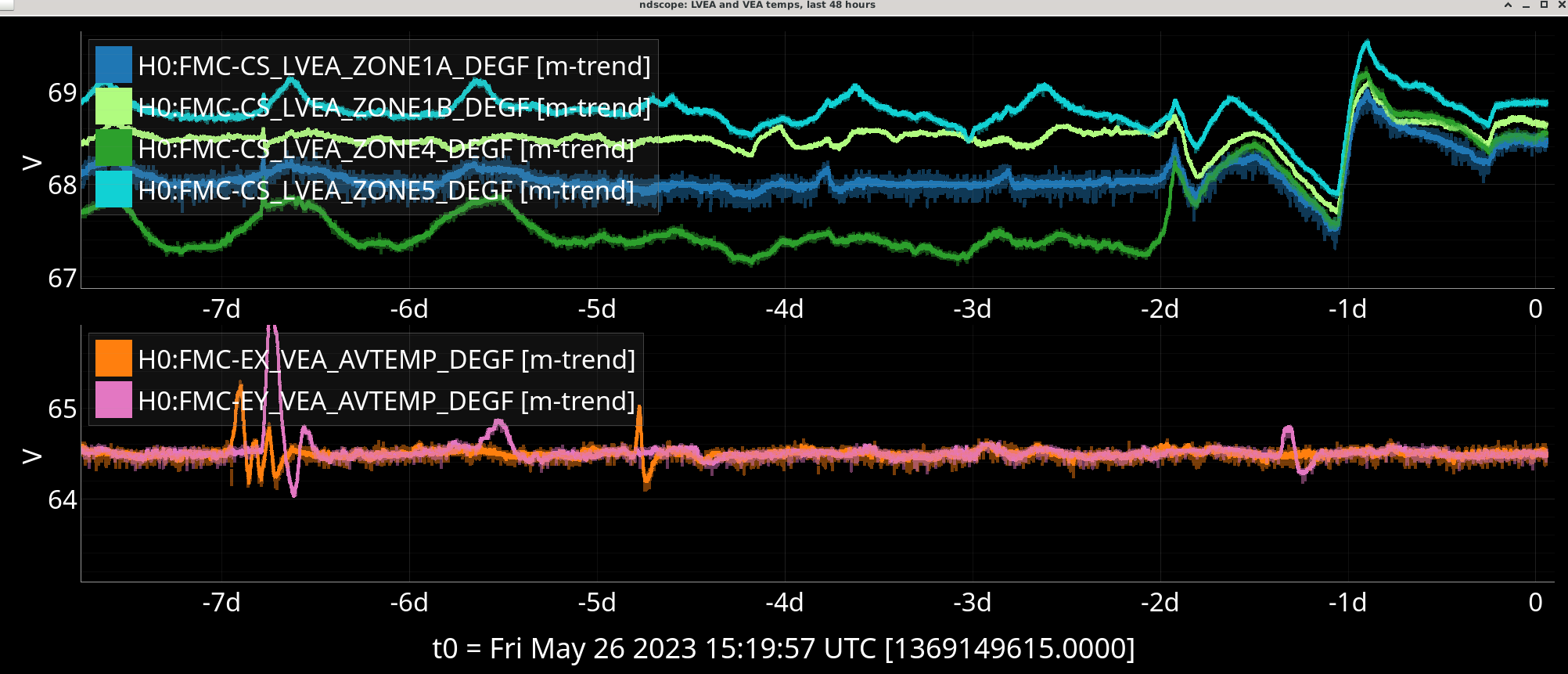
During our locking troubles over the last few days, the LVEA temperatures have been in flux from fan flow changes. The temperatures have definitely stabilized over the last 20 hours, but they are higher than before these tests, zone 4 in particular. Just to rule out any rubbing we ran Jenne's ipynb that checks the top mass OSEMs with a reference time (alog). I tried a few different reference times with the same results - I didn't see any evidence of rubbing on these plots. Plots attached.
Edit: The pdf didn't have all the pages and I've struggled to get them all in and have the alog accept the upload. The currrent attachment has sort of visible plots, but if you're really interested it might be better to go open the notebook up yourself with these already saved.
The problem was that the HAM-ISIs were all drifting off in Yaw (RZ) slowly, but surely, for weeks -- see LHO:69934.
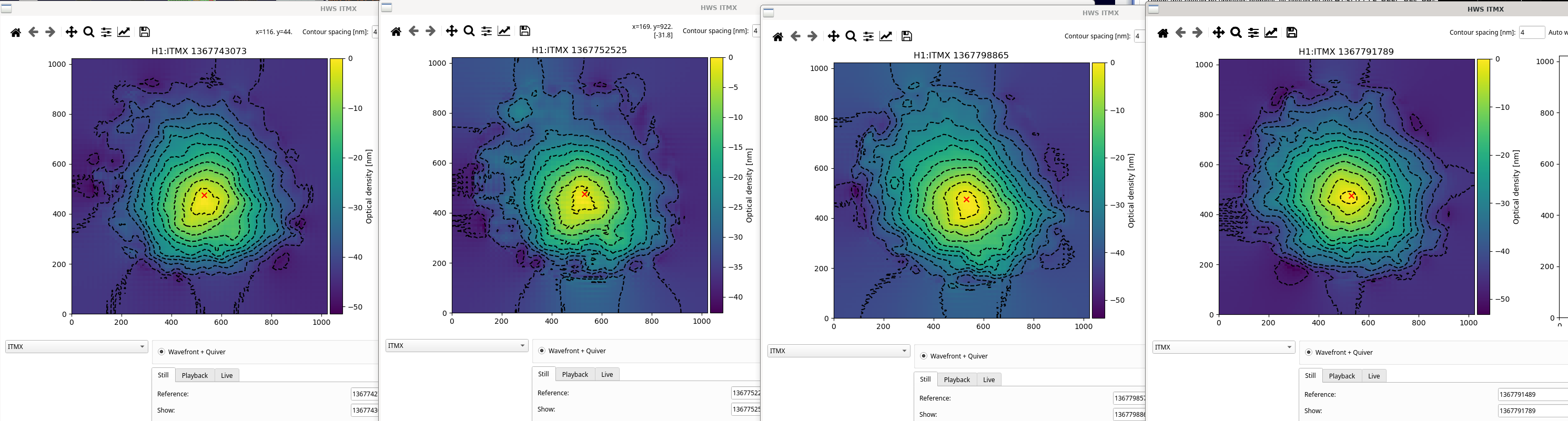
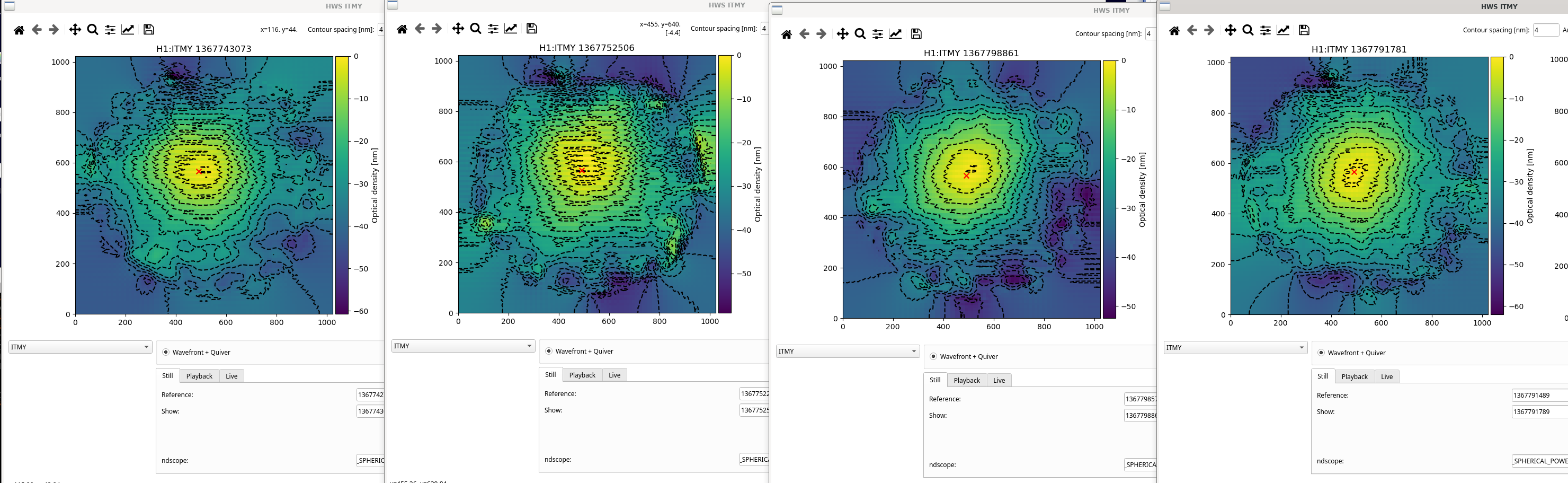
As suggested by Dan Brown, I checked if the HWS could see any ITM beam spots movement during the May 10th/11th temperature excursion alog 69525. I could see nothing.
The attached plots of ITMX and ITMY show (L to R) the two locked before temperature changes and the two locks during temperature change. ndscope attached. HWS ref at at 76W input power compared to show time is 5 minutes after. Lock during the change was 50 minutes long. Videos didn't show anything either.
The problem was that the HAM-ISIs were all drifting off in Yaw (RZ) slowly, but surely, for weeks -- see LHO:69934.
Continuing w/ PR3 move recovery. Still having issues with PRMI.
Ran a Manual Alignment 2-3 times after TJ did one.
PRC_ALIGN required some PRM aligning-by-hand---it was way off and so PRX would not lock.
Forgot to mention that for the locking attempt before the most recent Manual Alignment, FIND_IR did not look great.
The problem was that the HAM-ISIs were all drifting off in Yaw (RZ) slowly, but surely, for weeks -- see LHO:69934.
TITLE: 05/25 Day Shift: 15:00-23:00 UTC (08:00-16:00 PST), all times posted in UTC
STATE of H1: Corrective Maintenance
SHIFT SUMMARY: We are still trying to get our comm/diff beatnotes and PR3 alignment understood. Sheila and Ryan S went on table this morning (alog69907) and maximized our beatnotes with our old PR3 position (Yaw slider 148.5). We struggled to get DRMI locked well after that. Sheila noticed that our green qpd offsets and ITM camera offsets were set back to the old values, incorrect values, so they might have not been saved in SDF and then reverted. Sheila and Ryan made a second trip to the table and retouched the alignment with the correct qpd offsets, camera offsets, PR3 settings, and aligned green arms. Trying to lock again but it looks like we need another initial alignment, running that now.
LOG:
| Start Time | System | Name | Location | Lazer_Haz | Task | Time End |
|---|---|---|---|---|---|---|
| 16:23 | ALS/ISC | Sheila, Ryan S | LVEA - ISCT1 | local | Beatnote alignment on table | 18:47 |
| 17:57 | FAC | Kim | H2 | n | Tech clean | 18:16 |
| 22:43 | ALS/ISC | Sheila, Ryan | LVEA - ISCT1 | local | Beatnote alignment | 22:53 |
The problem was that the HAM-ISIs were all drifting off in Yaw (RZ) slowly, but surely, for weeks -- see LHO:69934.
TITLE: 05/25 Eve Shift: 23:00-07:00 UTC (16:00-00:00 PST), all times posted in UTC
STATE of H1: Corrective Maintenance
CURRENT ENVIRONMENT:
SEI_ENV state: CALM
Wind: 11mph Gusts, 8mph 5min avg
Primary useism: 0.03 μm/s
Secondary useism: 0.08 μm/s
QUICK SUMMARY:
TJ was at early steps of locking (noticed some odd offset sweeps for COMM/DIFF while FINDING IR). PRMI does not look very good sadly and he's moving to CHECK MICH FRINGES.
The problem was that the HAM-ISIs were all drifting off in Yaw (RZ) slowly, but surely, for weeks -- see LHO:69934.
Since the table work this morning we have been struggling to get past DRMI or engage DRMI ASC. Catching PRMI can even prove to be challenging and I've been skipping over PRMI ASC for now. We will next try to get the ASC to work and zero the error signals if we can get back to a stable PRMI.
The problem was that the HAM-ISIs were all drifting off in Yaw (RZ) slowly, but surely, for weeks -- see LHO:69934.
Sheila, Ryan S, TJ
This morning we continued the ISCT1 and PR3 alignment from 69903 , 69897 , 69857.
TJ reverted the X arm green references to what they were yesterday morning, seen snapshot here, and re-ran intial alignment of the X arm. Ryan S and I went to ISCT1 and saw that the beatnotes weren't well aligned, but the whole table alignment was better than what TJ and I found yesterday. We toggled PR3 between 151.6 and 148.5 yaw slider, and saw that the ISCT1 alignment was sort of close to OK for both of these, such that beams were clearing their appertures and making it to the diodes they should have without clipping.
This means that after our table realignment yesterday, the table was in a sort of OK alignment (beams not totally missing their optics) for 4 configurations: both of the green arm alignment set points and both the PR3 pointings. This means that the table alignment that TJ and I did yesterday fixed some gross misalignment that wasn't due to either of those things, (it has been a long time previously since the alignment on table was fixed up).
From the control room TJ, Ryan and I, with PR3 set to 148.5 yaw slider (setting for locks yesterday), adjusted PR2 to lock the X arm in IR, ran the WFS for INPUT align, and did a MICH bright alignment. Ryan and I returned to the table and moved the bottom periscope mirror to improve the alignment of the Y beam onto the trans diode, which allowed TJ to lock the Y arm in green and run inital alignment for that. In the meantime, Ryan and I adjusted the position of the X trans diode, and improved the COMM beatnote using the beatnote BS and the one upstream of it in the X arm path. We eneded up with a COMM beatnote of 6dBm, which drifted down later when TJ re-ran inital alignment for the X arm and is now at -1dBm.
After TJ finished the Y arm green inital alignment, and a MICH bright alignment, Ryan and I realinged the DIFF beatnote, which is now -7dBm. TJ then completed the intial alignment steps we had skipped (PRC and SRC) and is now trying to lock DRMI.
After struggling with poor PRMI buildups, we realized that there was a typo this morning in the camera offsets, so TJ redid the initial alignment with the offsets from yesterday morning. Then Ryan and I went to ISCT1 and realigned the beatnotes, which were already close but not good enough for locking. Now TJ has finished the initial alignment and we are going to attempt locking again.
Both TJ and Corey had difficulty doing INPUT ALIGN, with Corey just now we found that it would lock once I reset the POP 45 I dark offset to -72, which was consistent with last night. I've hard coded that into the guardian, so that it's for now not averaging the dark offset each time the whitening changes but just being set to -72. With this INPUT_ALIGN was able to run and get the X arm transmission to 1. Corey is doing the rest of IR alignment.
In the end this PR3 and ISCT1 alignment was not needed. The problem was that the HAM-ISIs were all drifting off in Yaw (RZ) slowly, but surely, for weeks -- see LHO:69934.
TITLE: 05/25 Day Shift: 15:00-23:00 UTC (08:00-16:00 PST), all times posted in UTC
STATE of H1: Corrective Maintenance
CURRENT ENVIRONMENT:
SEI_ENV state: CALM
Wind: 11mph Gusts, 8mph 5min avg
Primary useism: 0.03 μm/s
Secondary useism: 0.08 μm/s
QUICK SUMMARY: The IFO is still down since the PR3 and ISCT1 work yesterday. It's sounding like these changes will need to be reverted this morning.
In the end the PR3 and ISCT1 table alignment was a temporary fix for the true problem. The true problem was that the HAM-ISIs were all drifting off in Yaw (RZ) slowly, but surely, for weeks -- see LHO:69934.
TITLE: 05/24 Eve Shift: 23:00-07:00 UTC (16:00-00:00 PST), all times posted in UTC
STATE of H1: Corrective Maintenance
SHIFT SUMMARY:
Majority of the shift was focused on attempting to get H1 to lock post ISCT1 table work (worked with Sheila a little before she left for home and then with her over teamspeak). Several Full & Manual alignments were attempted with various changes made to PR2 (and a little with PR3). Unfortunately, all the alignments led to poor locking of anything past Green Arms.
The problem was that the HAM-ISIs were all drifting off in Yaw (RZ) slowly, but surely, for weeks -- see LHO:69934.
We are still having difficulties with SRY locking, but I haven't looked into what is going on. If SRY is not locking in an inital alignment step, it is OK to run SR2 ALIGN offload, and move SRM by hand to increase the SRY flashes.
Editing to add:
Input align wasn't working well because of an apparent dark offset in POP A 45I. I adjusted the dark offset from -68.9 to -72 to get the signal without flashes to be near zero. This must be reset by one of the init align guardian states. This problem has been seen before and TJ attempted to fix it here, but something is still not working.
2nd edit: We weren't able to get above 30 counts on POP18 + POP90 in PRMI with PR3 at 151.6 yaw slider, so we moved it to 150.2 with the renormalizations above and re did initial alignment of the IR cavities. Input align wouldn't lock but the flashes were at 1, so we moved on. SRY has worked twice in a row. With this lower beatnote we've had an ALS lockloss, I think that if a few more tries at this alignment aren't fruitful it would make sense to cancel the owl and go to the table in the morning.
In the end the PR3 and ISCT1 table alignment was a temporary fix for the true problem. The true problem was that the HAM-ISIs were all drifting off in Yaw (RZ) slowly, but surely, for weeks -- see LHO:69934.
After the table work, ran an Initial Alignment (it was a bit rough in that INPUT_ALIGN had trouble locking the X-arm. Restrored PR2 alignment to where it was during the last lock, but it was still tough. However, INPUT ALIGN finally did complete and it looked as though the entire alignment completed.
Unfortunately, DRMI did not look good and PRMI also looked misaligned (there were short 1-2 second locks, but they are very low and so far I have not been fast enough to touch up the PRMI alignment to let ASC take over).
0314utc (814pmPT) SEI_ENV in EarthQuake state due to 6.6 from Panama/Colombia. (Picket Fence has been orange and red.)
Will start another Initial Alignment as Sheila looks at trends.
In the end the PR3 and ISCT1 table alignment was a temporary fix to the true problem. The true problem was that the HAM-ISIs were all drifting off in Yaw (RZ) slowly, but surely, for weeks -- see LHO:69934.
TJ, Sheila, Betsy, Jim
Since we have had increasing drift in the PR3 yaw alignment needed to get ALS beatnotes good enough to lock, we realigned the beat notes on ISCT1 this afternoon. First we set the green x arm references as we found them yesterday while locked with 2W and the spots centered on the optics (69857). Screenshot attached of accepting these new references in SDF.
TJ then ran an intial alignment through the MICH alignment step, we saw that COMM beatnote was -18dBm, TJ adjusted PR3 yaw to 147.2urad to increase the COMM beatnote to -10dBm; 2 weeks ago PR3 yaw was at 151.6 urad so this is an pparnt drift of 4.4 urad. The osems and optical lever do not indicate that PR3 has had any drift like this.
TJ and I went to ISCT1, looked at the beampaths which were mostly reasonably centered with PR3 at 147.2urad, then asked Jim to move it to 151.6 to restore PR3 to it's alignment of 2 weeks ago. Then the Y arm beam was hitting the X arm side of the prism and being directed into the X arm path. We adjusted mostly yaw and a little pitch on the bottom periscope mirror, (layout here), as well as the yaw of the 1 inch BS that splits the X beam between the trans PD path and the beatnote paths, to get both X and Y beams roughly aligned through the paths to the comm and diff beamsplitters.
From there we manually aligned the COMM beatnote, with an IR card then the scope, and got a beatnote strength of 7-8 dBm, for DIFF we have -8.2dBm. The arm transmission diodes were lower than previously, so Betsy and I went back to the table and checked that the beams were centered on the trans PDs, which didn't increase the power. Corey and I then re-normalized the trans diodes, by adding a gain of 1.16 to the Y channel and 1.35 to the X channel. The changes in screenshots on this alog will need to be accepted in OBSERVE.
In the end the PR3 and ISCT1 table alignment was a temporary fix for the true problem. The true problem was that the HAM-ISIs were all drifting off in Yaw (RZ) slowly, but surely, for weeks -- see LHO:69934.
TITLE: 05/24 Owl Shift: 07:00-15:00 UTC (00:00-08:00 PST), all times posted in UTC
STATE of H1: Lock Acquisition
SHIFT SUMMARY:
Lock#1
Couldn't lock PRMI, lockloss
Lock#2
Went right into an initial alignement, OM1 & OM2 were saturated during PRC in initial alignment
DRMI's lock didn't seem great on the buildups but the spot looked ok
OMC locked first try on its own
NLN @ 08:44, 30 ASC SDF diffs but they were all for the camera servos, I waited for ADS to converge for the camera servos to turn on (~ 16mins) which cleared these diffs
Observing mode @ 09:02 while we thermalize
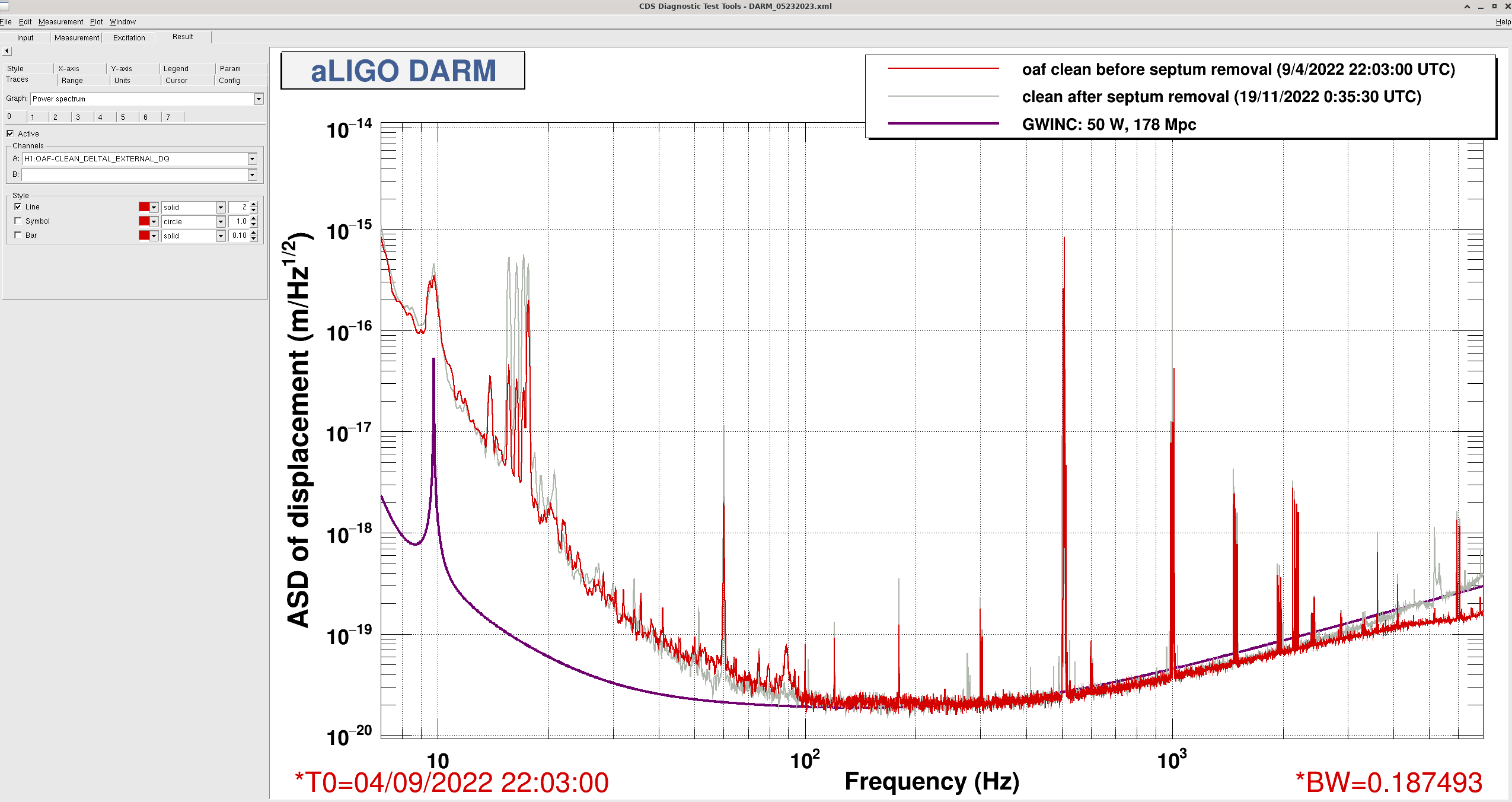
Out of observing at 11:05UTC for a new FF filter test/measurement and then a calibration suite, new FF filter applied at 11:07UTC
I used Coreys template (/ligo/home/corey.gray/Templates/dtt/DARM_05232023.xml) which I had to enable "read data from tape" for it to run. Measurement started at 11:10UTC, finished at 11:12UTC. My DTT session then immediately glitched and crashed before I could save it, great... I restarted the measurement at 11:15UTC, finished at 11:16UTC. It wouldn't let me save it (error: Unable to open output file), but I added it as ref 27 on the previously mentioned xml file in Coreys directory but this might have not saved from that issue. I grabbed a screenshot of it.
I switched back to the old filters to take the calibration suite at 11:21UTC, I wasn't sure if we wanted them on or not for this, apologies if we did want them on.
Lockloss @ 11:25, possibly from PI29, but on NUC25s scope guardian appeared to be successfully damping it? It was tapering down when when the DCPDs saturated and we lost lock, it also coincided with a ground motion spike from that 5.5 from NZ. I then stepped down the EX ring heaters to 1.2 using the console commands Sheila provided in her alog.
Lock#3:
Yarms power was drastically lower after the lockloss and looked clipped on the camera, increase flashes ran twice and wasn't able to get it above 50%, I stepped in and still wasn't able to even get it to 80%. I gave guardian another shot after this and increase flashes ran another 2 times and was not able to get it, I tried again to lock it and was unsuccesful. Lockloss at LOCKING_ALS after some more rounds of adjusting and trying to lock.
Lock#4-11
ALS locklosses
Lock#12
Beatnotes aren't great, -19 & -20, I'm starting another initial alignment. Lots of SRM saturations during SRC align, trending SRMs OSEMs there doesn't appear to be any unusual motion in the past 20 hours.
After a suggestion from Betsy and Jenne, I check PR3 and it seem to have drifted a bit, I moved PR3 in yaw 0.8 microradians negatively which increased the COMM beatnote. I was able to lock ALS after this but got no flashes on PRMI so I started another initial alignment but it didn't do the SRC align correctly again, TJs going back to try and fix this.
Handing off to TJ
LOG:
| Start Time | System | Name | Location | Lazer_Haz | Task | Time End |
|---|---|---|---|---|---|---|
| 14:23 | FAC | Betsy | FCES | N | Closeout checks | 14:38 |
| 14:56 | EE | Ken | Carpenter shop | N | 15:56 |
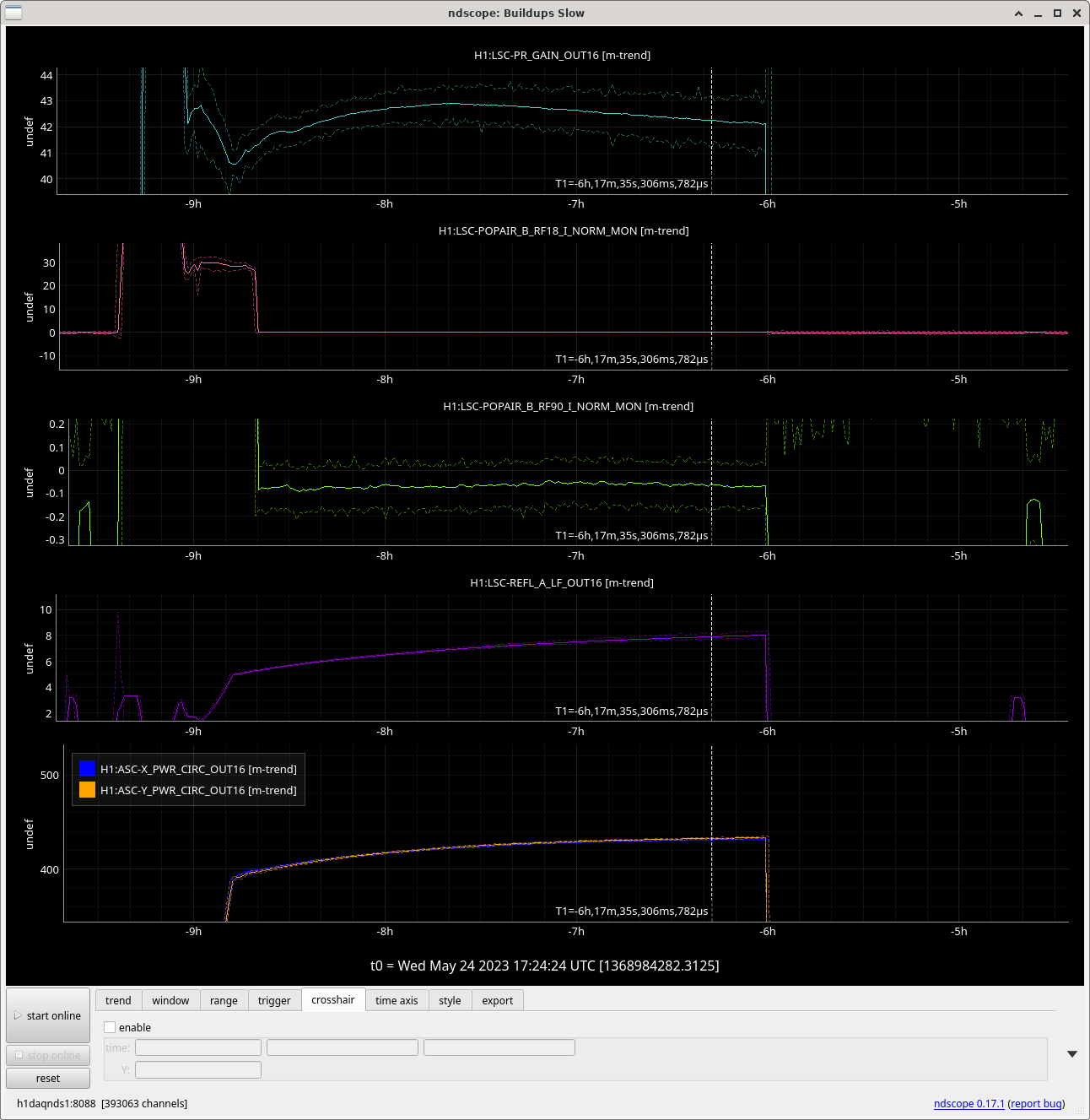
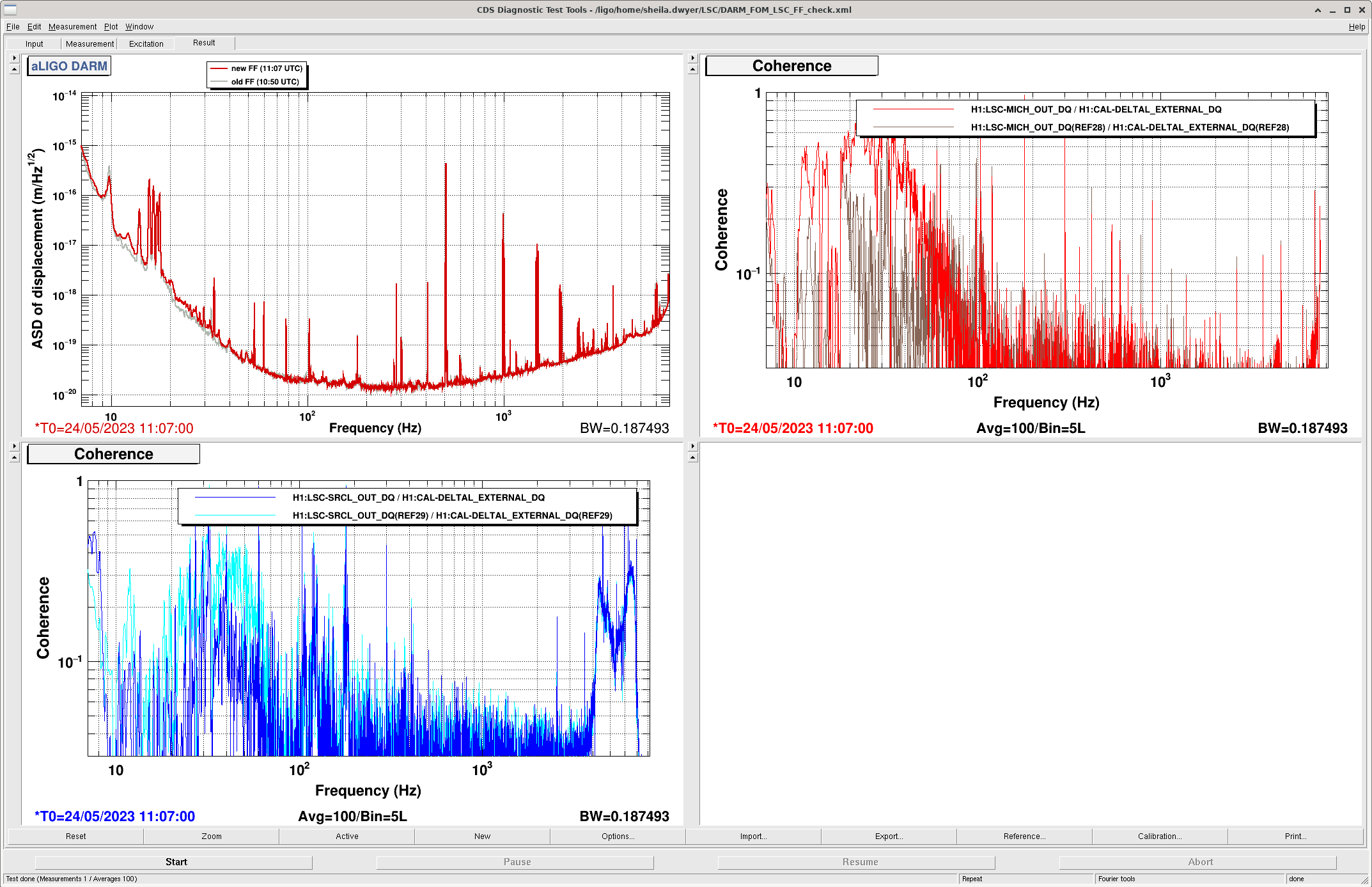
I've attached a screenshot of the DARM spectrum and coherences with MICH and SRCL during the feedforward test. This was done 2.5 hours after power up, the second attached screenshot shows where we were on the thermalization transient.
It seems that the MICH FF is worse, while SRCL is better, similar to the test done at the start of a lock here: 69813
If anyone wants to use this template for a future feedforward check, they can find it at /ligo/home/sheila.dwyer/LSC/DARM_FOM_LSC_FF_check.xml
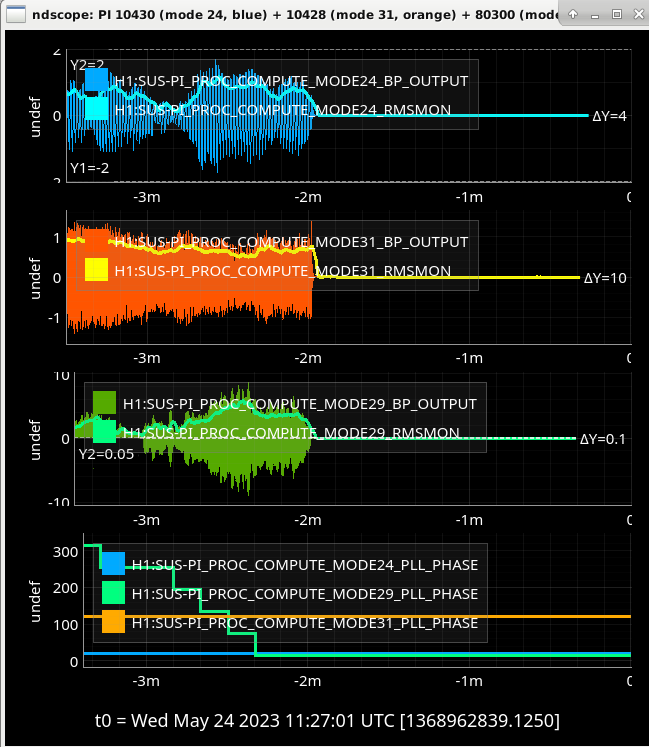
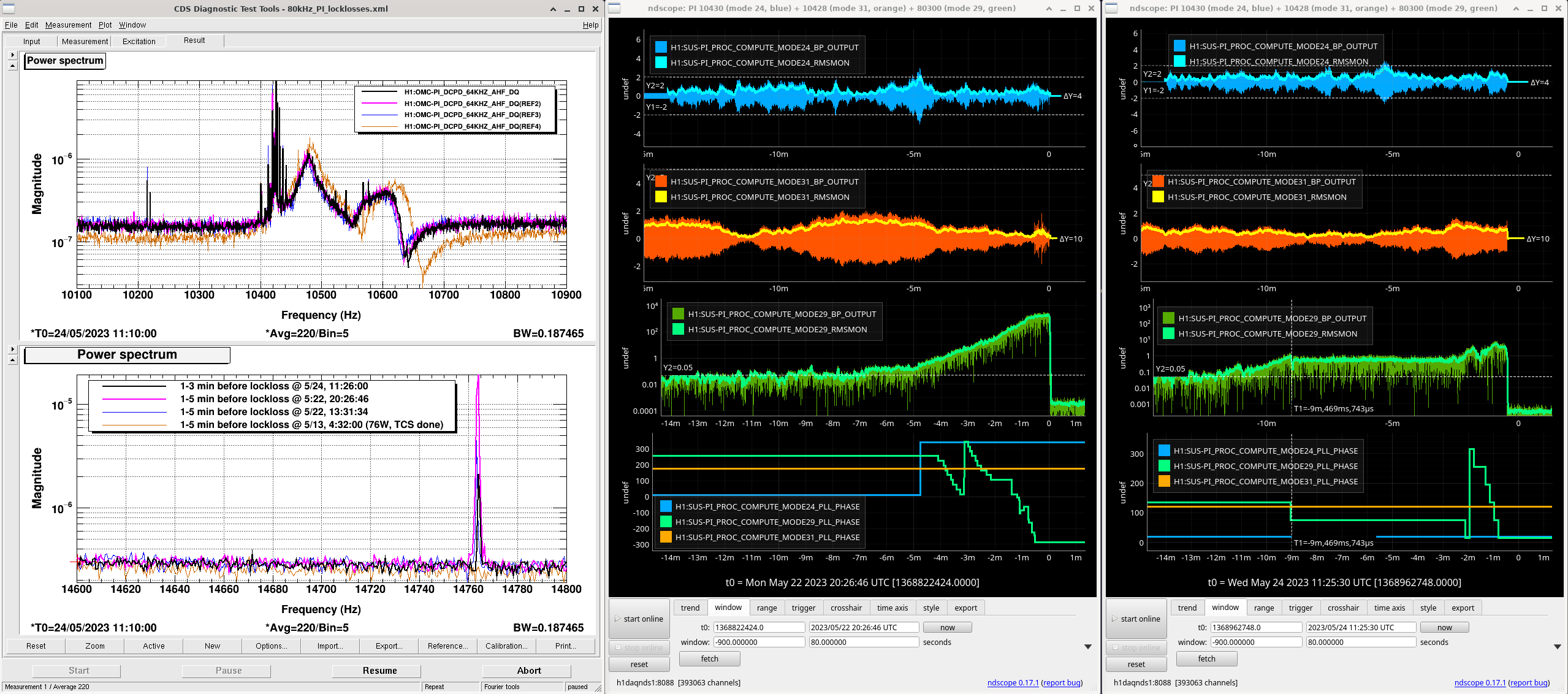
I think this recent attempt at 80 kHz PI damping, which was our first try with this Monday's guardian changes 69800, might have been somewhat successful?
From the screenshot, the DTT shows that when 80 kHz PI damping started, the HOM's were in the same place as that has recently caused locklosses, (comapre the pink/blue vs. black trace). And we see its aliased down 14.76 kHz peak, which visibily shifts down by a few Hz over several averages. Maybe this is a result of our PI damping; we've seen the mode move around before from driving it (68165). And playing the DTT forward in time, you can see the PI doesn't run away like it normally does. It seems likely to me that the 80 kHz didn't cause this lockloss.
From the ndscopes in the screenshot: the first scope shows a recent 80 kHz PI lockloss from Monday, where after the guardian starts damping, the mode's RMS grows ~1e4 in 5 minutes. Then Wednesday, from when the guardian first starts damping, the mode only grew x100 in ~8 minutes! Between Mon/Weds, we started damping with a stonger PI ESD drive in the guardian 69800 (10x DAMP_GAIN, from 5000 --> 50,000), still driving coils differentially (has been like this after 69759).
The ALS issues reported in this aLOG were symptomatic of the true problem: the HAM-ISIs were all drifting off in Yaw (RZ) slowly, but surely, for weeks -- see LHO:69934.
Tagging CAL. It's not super explicit, but this is the aLOG when the ETMX (EX) ring heater power was reduced from 1.3 W to 1.2 W on both segments. It has been later revealed that this has increased the lever of 1064 nm main laser power in the arm cavities, from ~435 kW thermalized to ~440 kW thermalized LHO:70042. This may have changed the optical gain, cavity pole frequency, and the SRCL cavity detuning. The first two should be measured and correct for via the TDCF system, but we should confirm. We should measure more sensing functions and/or turn on the CAL_AWG_LINES low frequency calibration lines to confirm if anything's changes the the SRC detuning.
We lost lock from what seems to have been PI29 at 11:25 UTC (I stepped down the EX ring heaters to 1.2 following Sheilas alog after that) and I haven't been able to lock ALS since, green arms was a big struggle especially Yarm. After a bunch of rounds of adjusting, letting increase flashes run, and a few ALS locklosses I started another initial alignment at 12:32UTC.
After the IA I still can't lock ALS, it look like the IMC keeps losing lock while ALS_COMM is in HANDOFF_PART2 which then stalls
PR3 had drifted a bit, I touched it by .8 microradians in yaw and it was then able to lock als
In the end the PR3 alignments was a temporary fix for the true problem. The true problem was that the HAM-ISIs were all drifting off in Yaw (RZ) slowly, but surely, for weeks -- see LHO:69934.
TITLE: 05/23 Day Shift: 15:00-23:00 UTC (08:00-16:00 PST), all times posted in UTC
STATE of H1: Preventive Maintenance
SHIFT SUMMARY:
Frustrating shift sandwiched with tough locking at early states of ISC_LOCK: Mainly LOCKING_ALS. Seemed to get better, but after MANY attempts and atleast an hour!
Had one lock with some observing time, but it was another shortlived lock (~2hrs).
LOG:
This is really when we start truly feeling the true problem with the IFO -- that the HAM-ISIs were all drifting off in Yaw (RZ) slowly, but surely, for weeks -- see LHO:69934.
Sheila, TJ, Betsy, Keita, Jeff
Over the last 9 days we have moved the PR3 yaw slider by 2 urad (from 151.6 to 149.3) to maintain the ALS beatnotes on ISCT1, to allow locking. Today we had planned to move PR3 back and realign on the table, but when I set PR3 back TJ saw that the beams were clipped arriving on the table, and not reaching the trans PDs well enough to trigger and lock the arms in green. The beam was clipping on the prism, so fixing this on the table would have meant moving the periscope mirrors. We decided to first double check that the green camera for the X arm had not drifted.
Instead of realigning on the table, we decided to check the camera reference. TJ skipped shuttering ALS as we relocked, let ADS converge at 2W, and Keita and I ran the green offset servo (reminder, green reference instructions are here). The attached screenshot shows the QPD offsets and camera offsets that we would have gotten. These are not large changes to the references, so it doesn't seem that the problem is something like a drift of the camera. We reverted these changes to the green references.
A screenshot of the camera is attached, which does show the beam is not well centered on this camera.
We are returning to locking now, but since this has been causing locking troubles and seems to be getting worse over time, we will plan to return to re-align the table next time we are relockign during the day.
In the end the PR3 alignments was a temporary fix for the true problem. The true problem was that the HAM-ISIs were all drifting off in Yaw (RZ) slowly, but surely, for weeks -- see LHO:69934.