[Rick Savage, Jeff Kissel, Timesh Mistry]
This post is a delayed post from yesterday.
Inspection of Cleaned Parts
Since 10 Aug 2019, the Newtonian Calibrator (NCAL) had been fully disassembled and cleaned. The condition to which the parts were required to be cleaned to was not more than a Class B specification i.e. remove surface grime, particulates and residue. This has been completed by Chris Soike (many thanks) and the parts now moved into the optics lab for NCAL re-assembly.
We have not re-assembled the NCAL because we believe there to be some re-work of some of the parts as well as replacing some parts with more suitable components. Therefore, a summary of the todays' efforts are as follows:
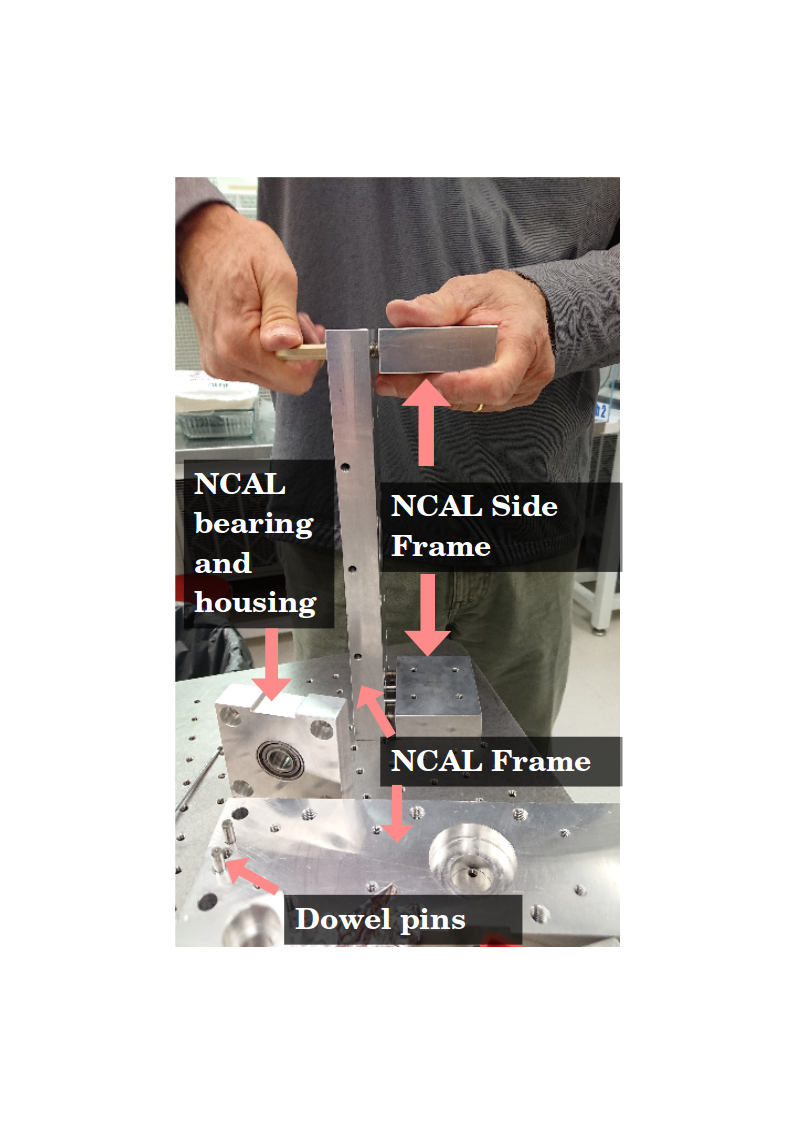
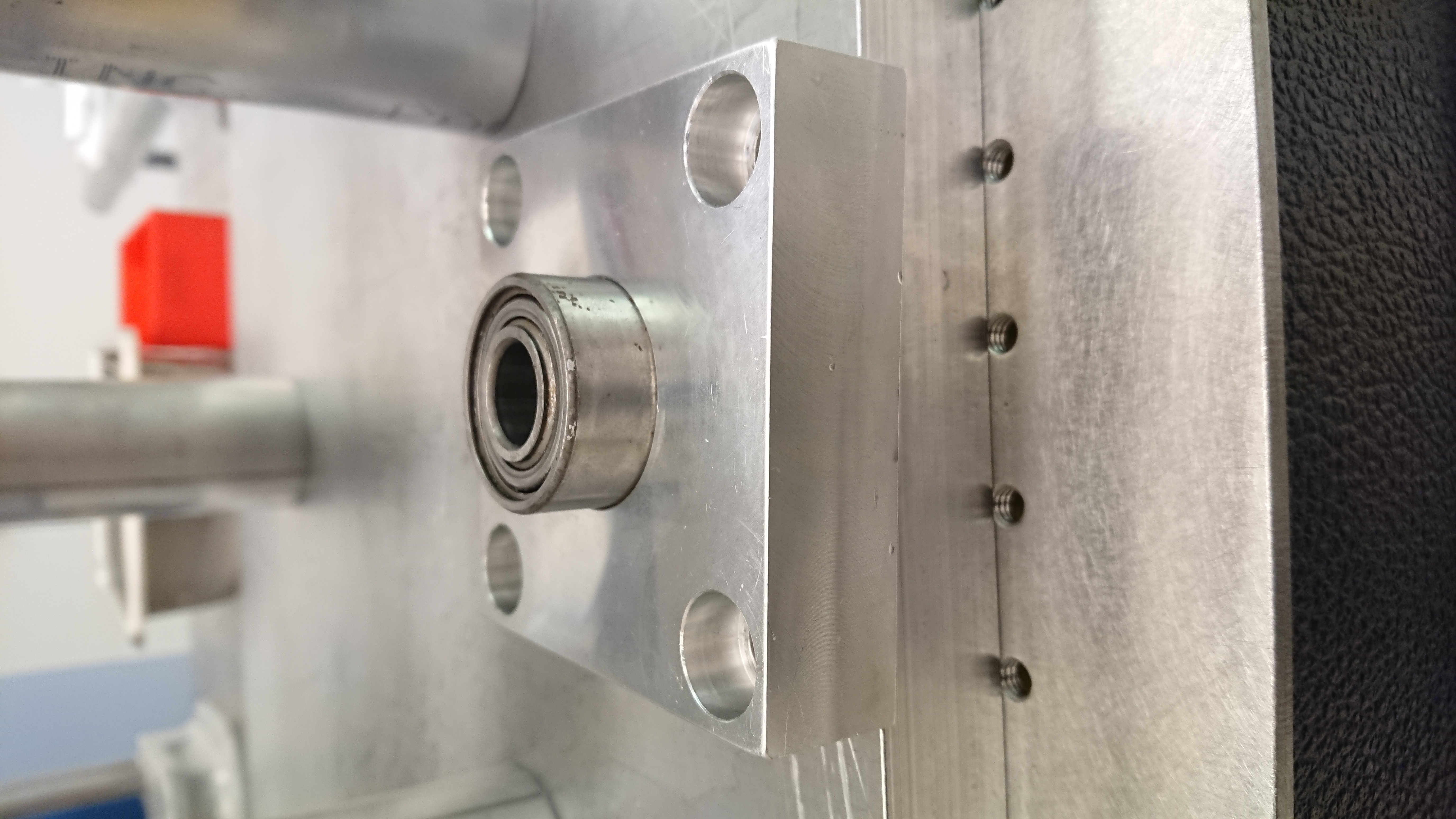
- The bearing that had been removed from the NCAL shaft with a bearing puller, and as a result, from its housing, has been re-pressed back into its' housing. Before doing so, the inner surface of the housing that interfaces with the bearing has been cleaned using alcohol soaked wipes. In the process of cleaning the inner surface of the bearing housing, it was observed that there was a significant amount of dirt, potentially dried grease and glue, that coated the surface. Most of the surface contaminants could be wiped away with the alcohol wipes however, a screwdriver was employed for particularly stubborn dried on contaminants.
- The bearings themselves are not sealed bearings. There is a concern that over time, grease will leak out the and the bearing(s) could seize. The bearings installed do not appear to be the same ones called out in T1900357-v4 (current version at the time of this alog). We have ordered the parts as specified in the NCal Final Design Review and will replace the current bearing with the new parts.
- The metal dowel pins, that locate the top and bottom frame panels via intermediate side panels, protrude from the panels by 0.6". This make assebly and dis-assebmly very difficult since the toloerances are very small. This is considered rather excessive and the proposed idea is to either:
- press them out and replace them with shorted dowel pins.
- partially press them out. This could make dis-assembly more difficult in the future.
- leave them as they are.
- The NCAL shaft has some remaining residue from the bearings, possibly baked on grease from heat cycles from the NCAL tungsten mass install and removal processes. This was removed by polishing the affected areas using a scotchbrite pad and alcohol wipes.
- The NCAL main rotor has a confirmed uniform thickness by using a 2" micrometer.
- The NCAL back plate may require a rework/design modification with the changes allowing easier access to install/remove the NCAL masses as well as perform any maintenance to the bored holes in the NCAL rotor. The suggested changes will be prepared in a separate document.
Parts from RDL
The NCAL mount was expected Oct 1 and has not arrived yet.
The NCAL drill fixture (jib) has already been tested [LHO alog 51605].