Lee, Kentaro, Nutsinee, Daniel
The A+ filter cavity will require more CLF light and demand a stronger requirement on the RIN of the CLF light to not inject noise in DARM. The requirement isn't particularly tough at 5e-5 RIN/rtHz of the CLF light carried with the squeezer field (T1800447-v6 figure 13). The laser already meets the requirement in broadband, but has lines and beam jitter noise that can take it above. Mark upgraded and installed an ISS for the 532 OPO pump as well as one for the CLF itself. Today we studied if the CLF on the SQZ path is witnessed to meet requirements with and without the new ISS's.
Bottom line is that the ISS's do help, and can meet the requirements with them even if we want to turn up the CLF more than needed. As it turns out, the pump RIN is the more important one, as the pump seems to get more noise on it going through the SHG, fiber and OPO. The OPO-transmission signal that the ISS servo feeds back to is the proper witness, but has a very low light level due to the small transmissivity at 532 of OPO-M2.
Setup:
- Pump ISS stabilizes OPO 532 Trans at a low light level, 10-20kHz loop, no boosts. Dominanted by sensing noise from the low light level, the diode looks to be at least nearly shot-noise limited.
- CLF ISS stabilizes the CLF PD DC output. Loop limited to 10kHz BW, no boosts. This loop also has plenty of gain to take the 1e-6 laser RIN to the sensing noise floor to ~1kHz.
- To witness the CLF RIN, the homodyne diode was used. The LO was blocked and one of the diodes was blocked. The single diode allowed the low-noise DIFF output to witness the CLF RIN. The CLF was raised to 280uW on the CLF diode (incident on OPO-M2). This gave 3-6uW on the single homodyne diode depending on the pump power increasing it from parametric gain. Since half the CLF power was lost from blocking a diode, this still corresponds to the 10uW needed for necessary phase sensitivity once the filter cavity is running. The dark noise on the homodyne was relatively large for this measurement, but good enough to check requirements.
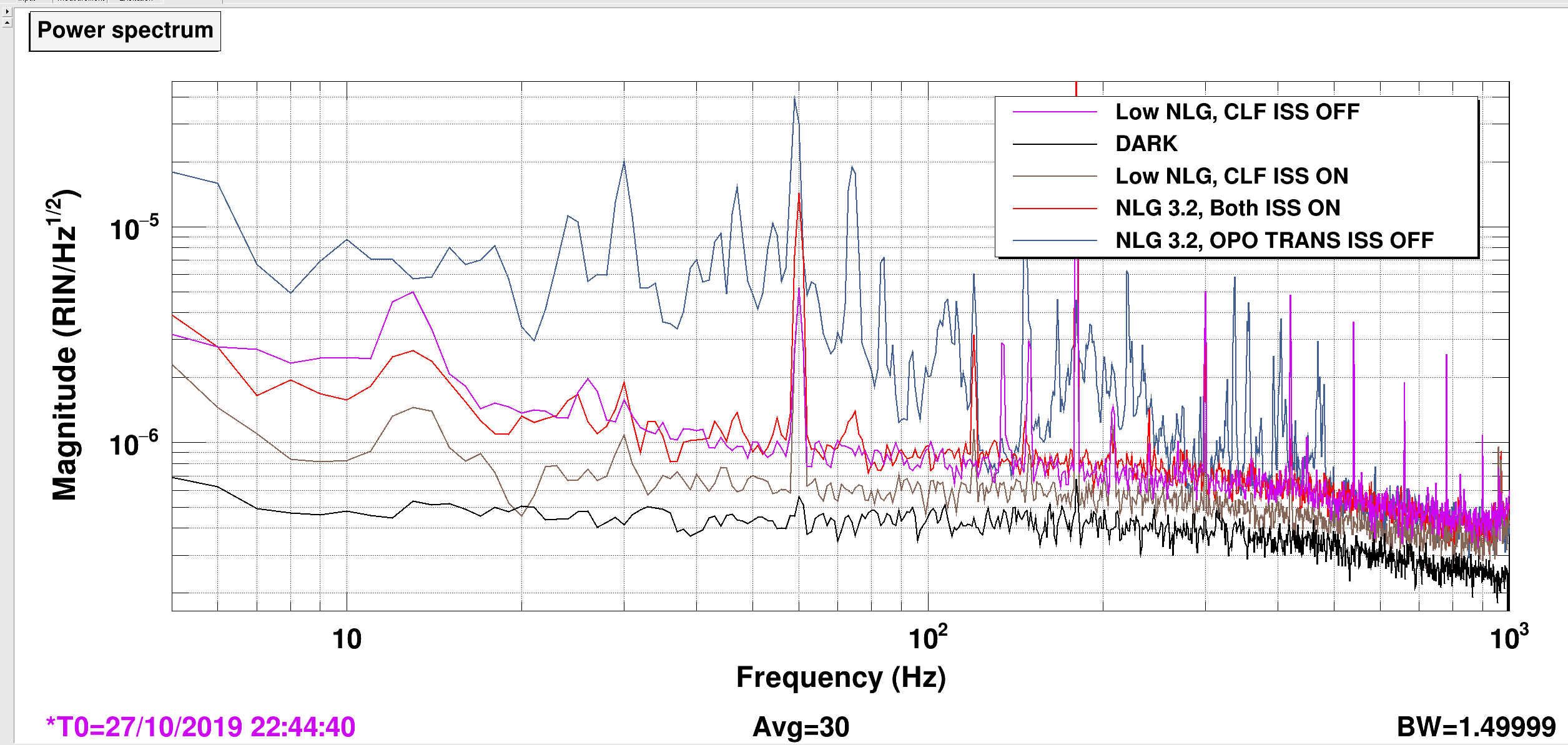
CLF_SQZ_PATH_RIN.png shows the RIN measured from the homodyne at different configurations.
- Purple vs. brown&red shows that the CLF ISS does eat some lines on the laser, cleaning it to a lower floor.
- Red vs. brown shows the addition of pump RIN into CLF RIN due to parametric-gain.
- blue vs. red shows that with parametric gain, the pump RIN does cause considerable noise on the CLF propagating along the SQZ path.
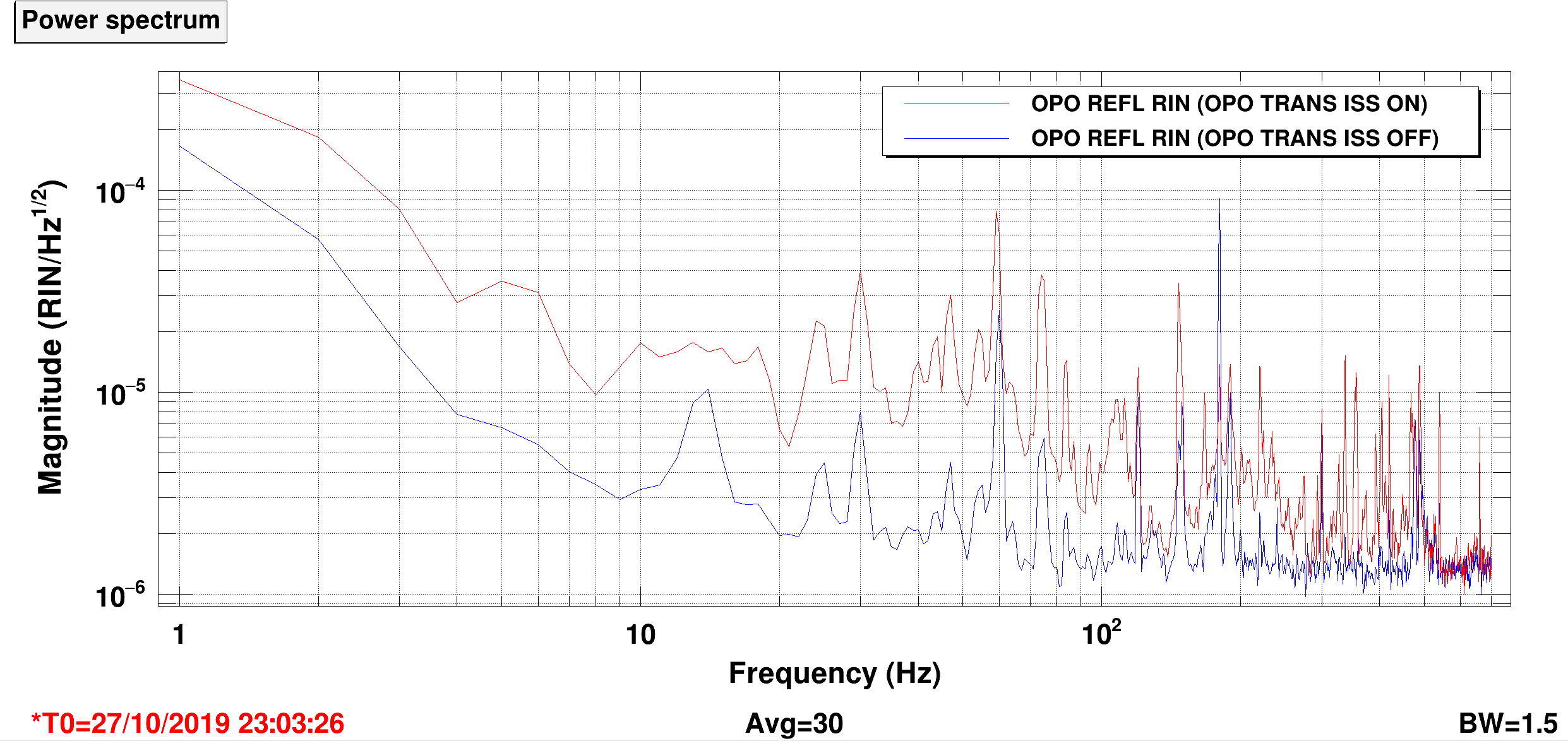
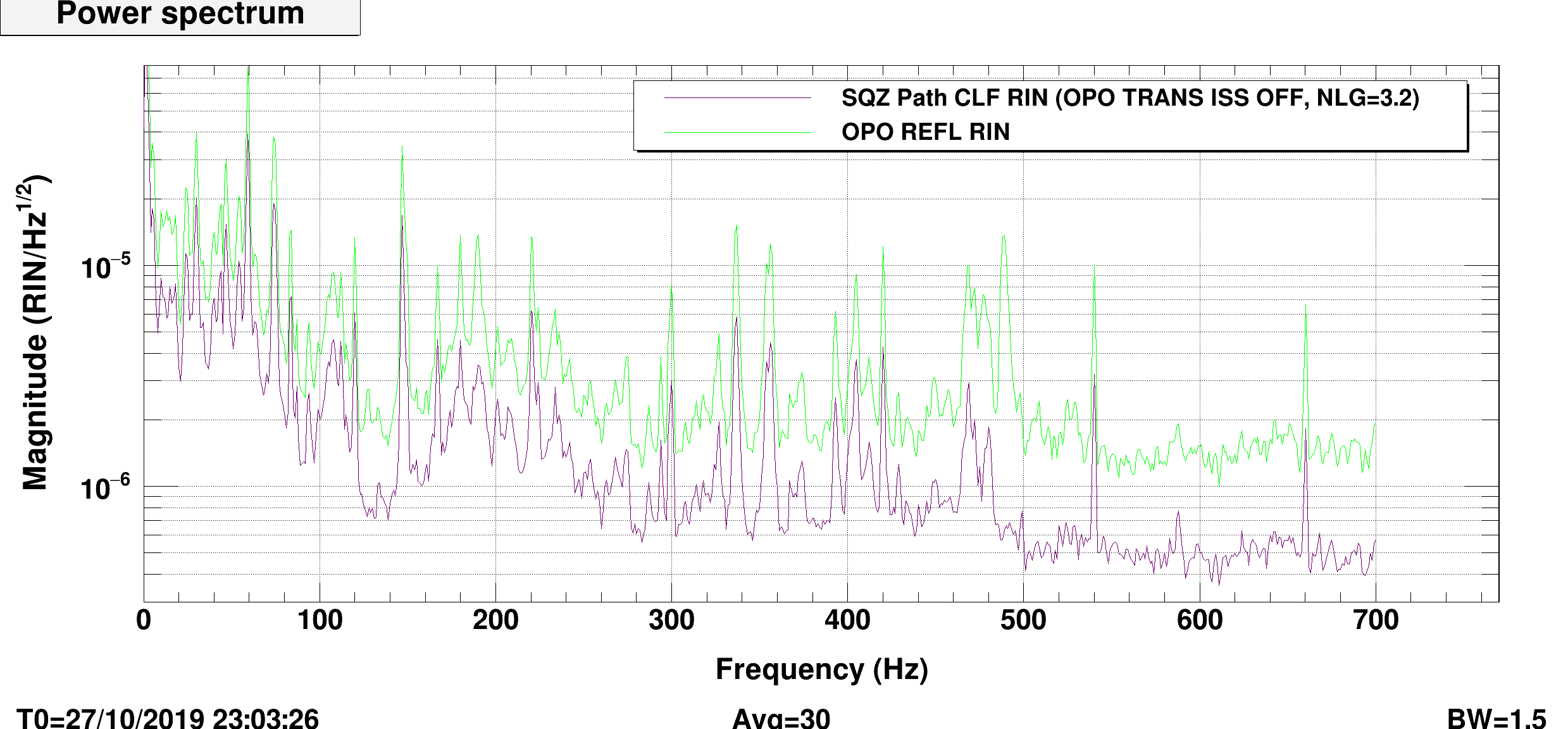
PUMP_RIN_XFER.png uses the OPO 532 REFL as a witness for the RIN during the ISS-OFF time (OPO 532 TRANS was not properly saved). It shows the direct imprint into the CLF RIN with a gain of 0.4. I have an elaborate OPO model for the filter cavity that manages to predict this factor of 0.4 at the operating NLG of 3.2: dNLG.pdf. As we increase the NLG, the RIN2RIN coupling will increase, but not severely.
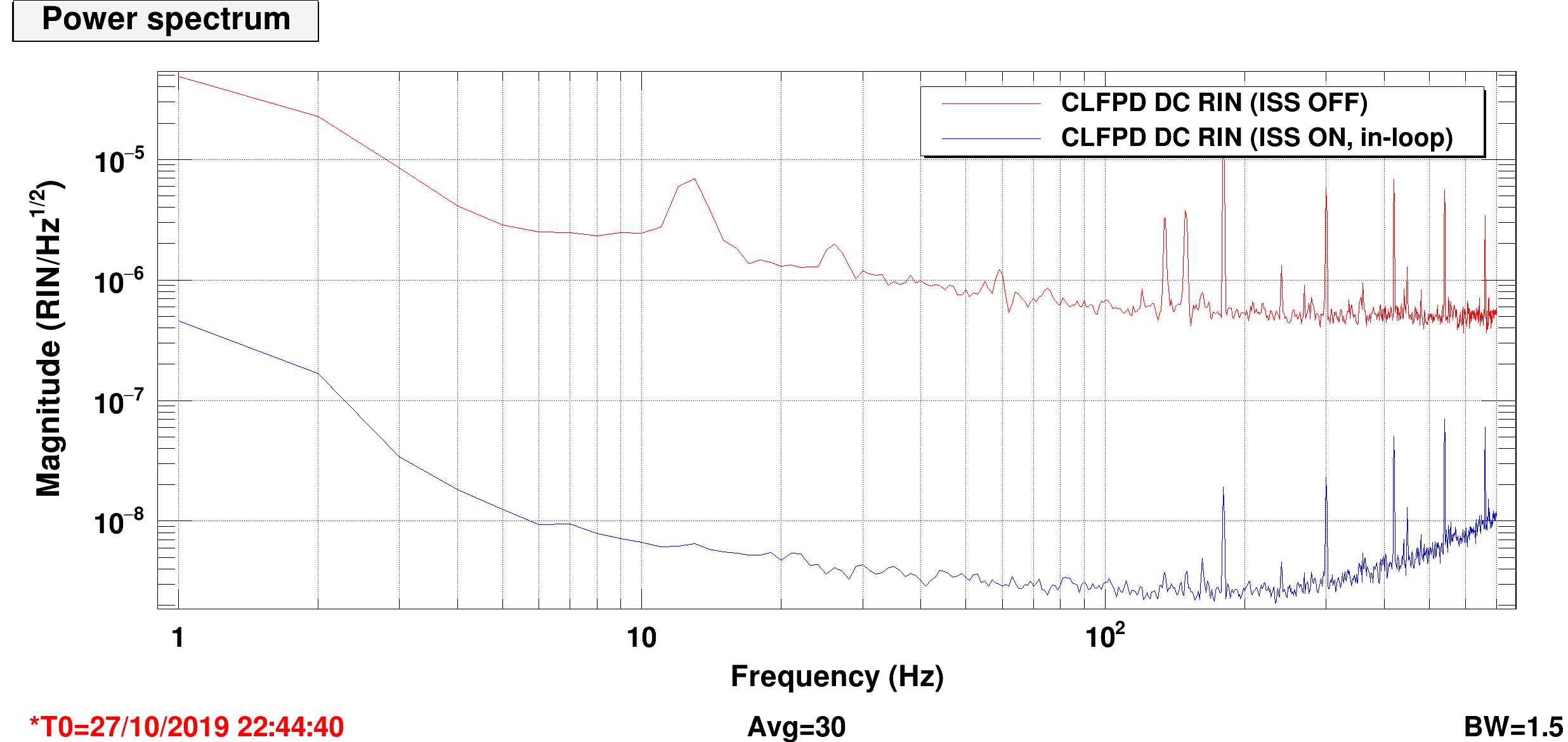
CLFRINONOFF.png shows the in-loop CLFPD DC with and without the servo. The OFF-level agrees with the level expected of the laser + some acoustic excesses.
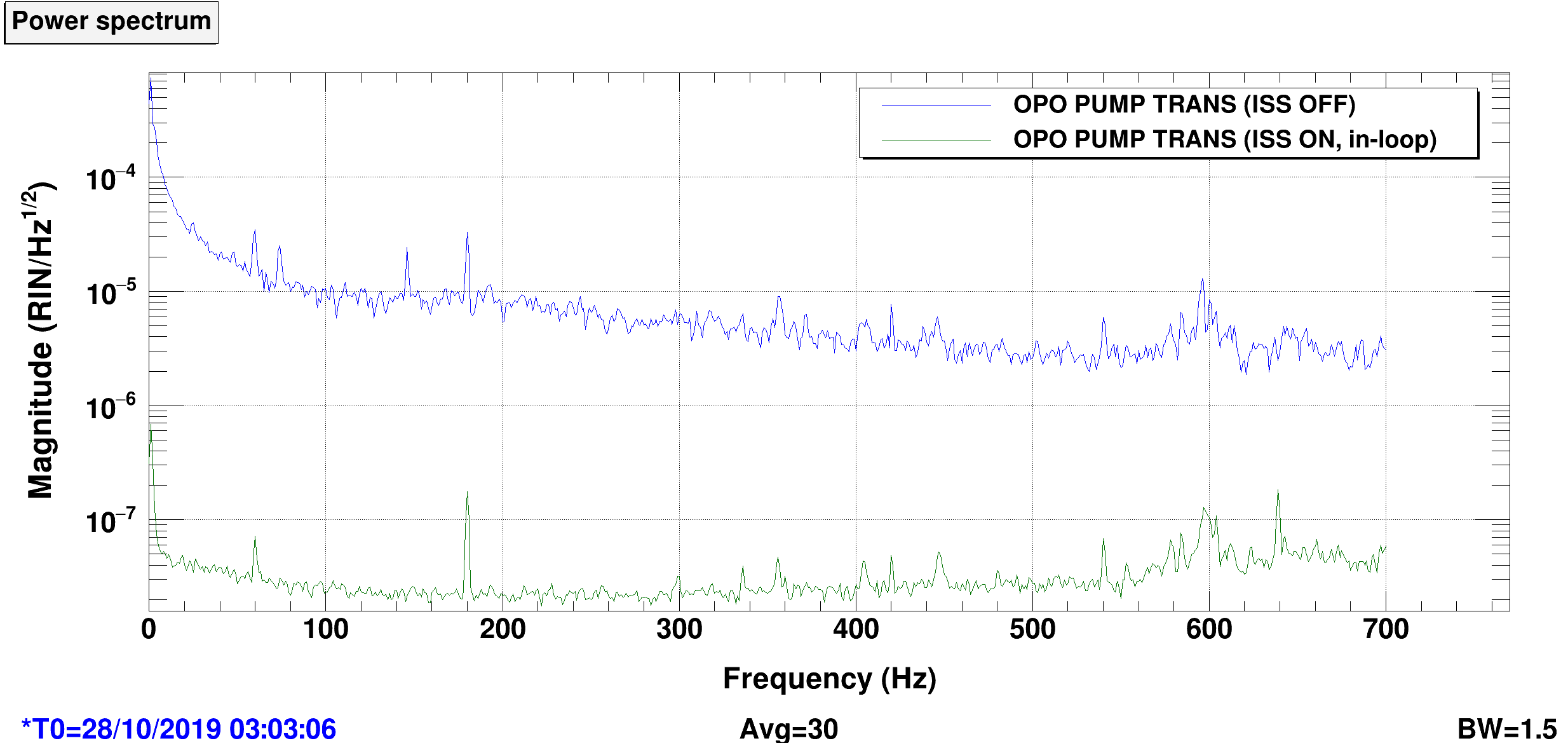
OPO_TRANS_RIN.png shows the pump RIN of the in-loop trans PD with the servo on and off. When it is off, the level corresponds roughly to the shot-noise of a 1uW 532 beam, so the diode doesn't seem to be dark-noise limited, but the sensitivity is still pretty bad.
OPO_REFL_WITNESS.png shows that with the 532 TRANS servo on and off, the REFL does not show the same reduction. While REFL has more light and lower sensing noise than TRANS, the excess shown here while the TRANS-ISS is running indicates that REFL will indeed be a poor witness to stabilize the circulating power. There must be beam jitter noise or other cavity noise driving the difference between the two.