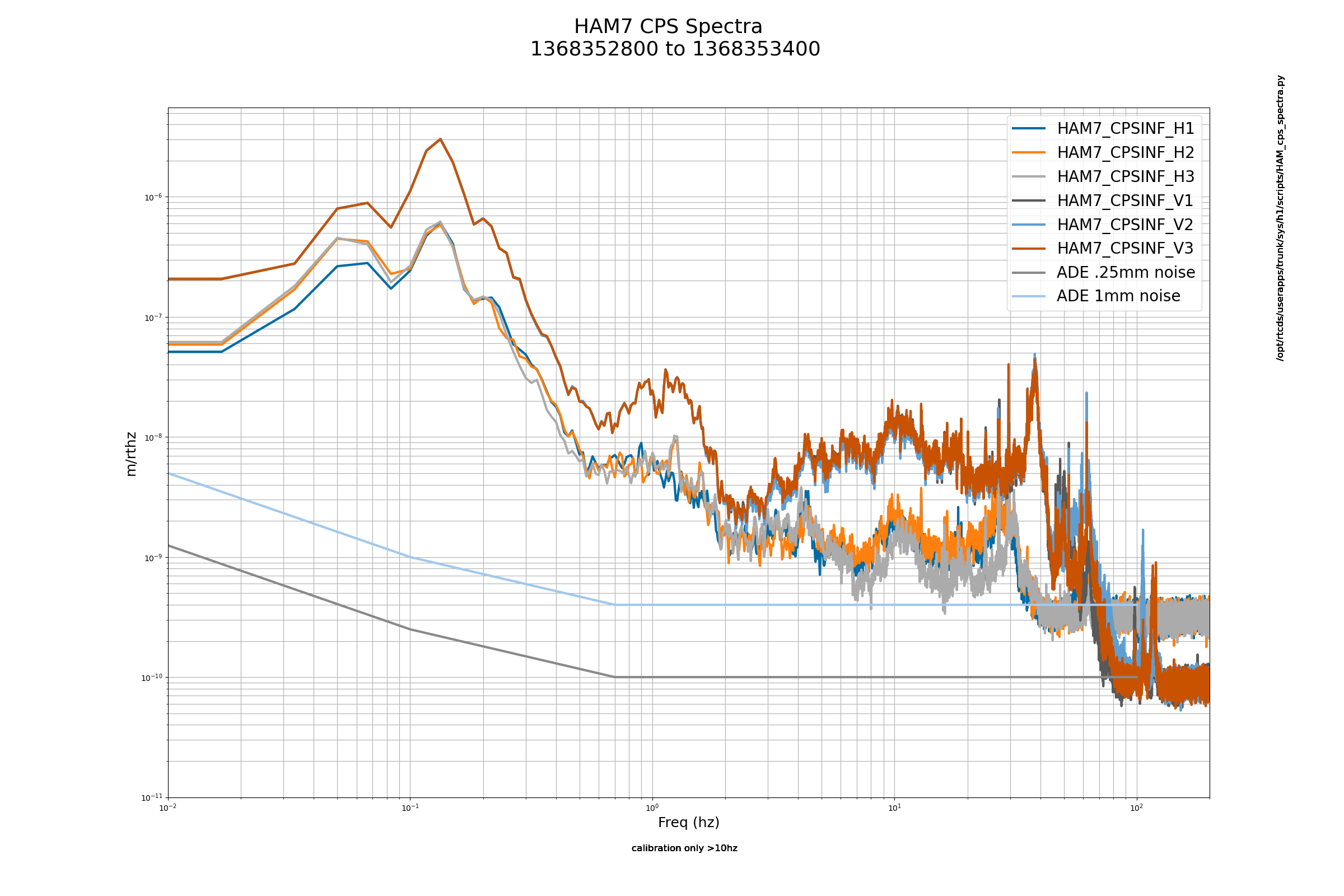
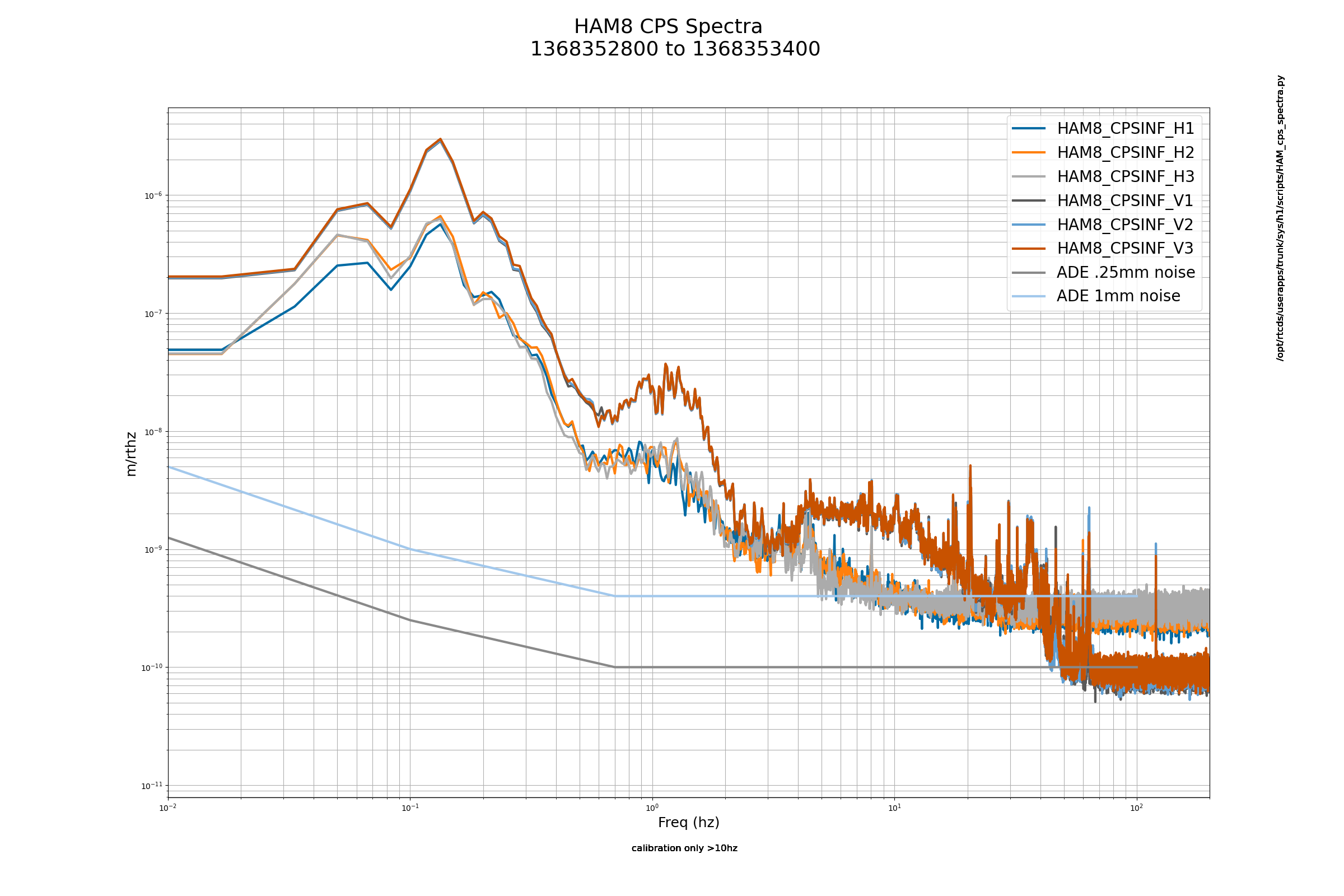
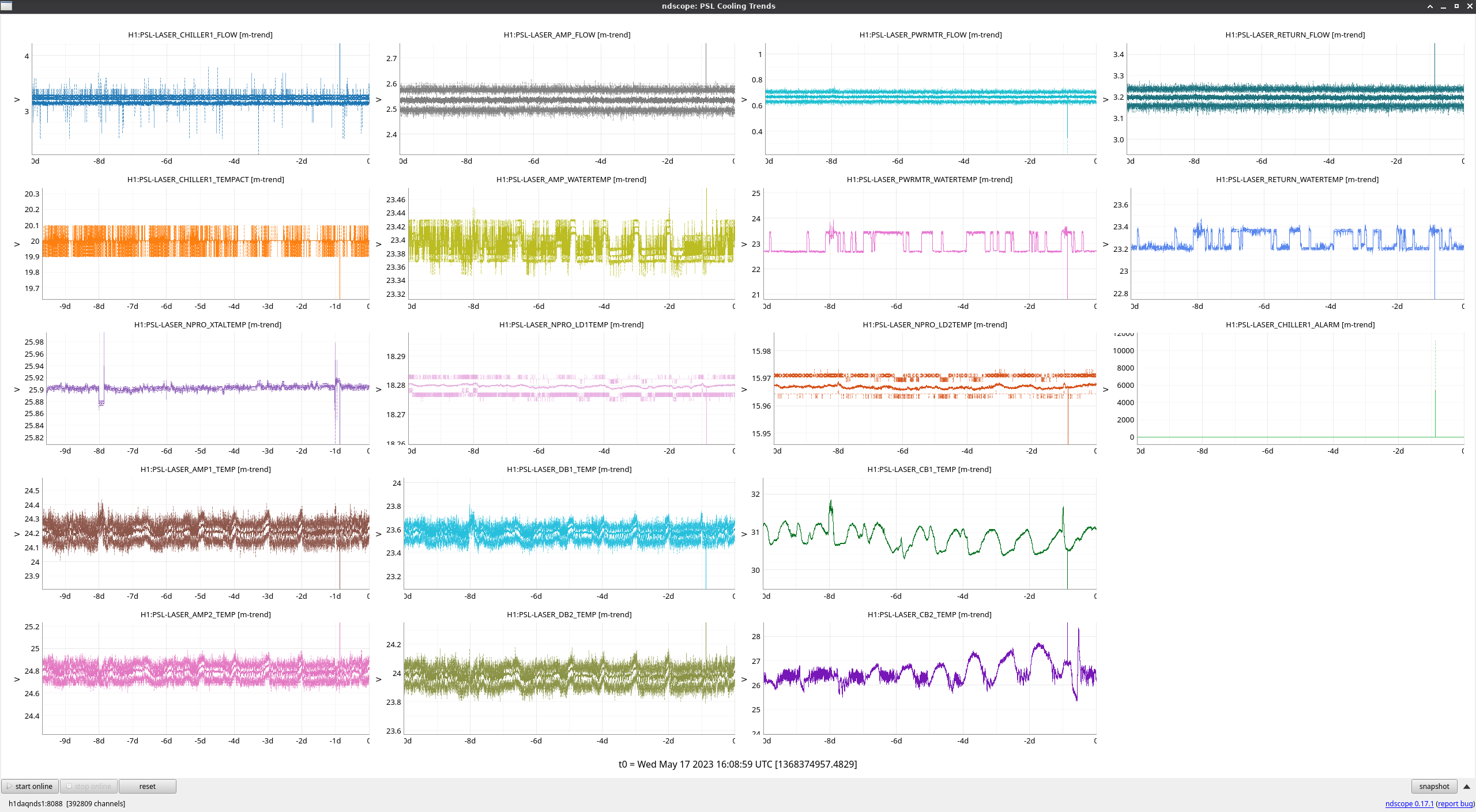
TJ, Dave:
We have installed a new EPICS IOC which hosts PVs to support OPS stand-downs due to astrophysical events reported by external agencies (e.g. GraceDb).
The IOC runs on cdsioc0, is under systemd process control and is configured by puppet.
I have created a simple MEDM (see attachment) for testing. In the example shown it is reporting the system in standdown mode. The IOC reports the event's details, along with a calculated time-to-end.
TITLE: 05/17 Day Shift: 15:00-23:00 UTC (08:00-16:00 PST), all times posted in UTC
STATE of H1: Lock Acquisition
CURRENT ENVIRONMENT:
SEI_ENV state: CALM
Wind: 13mph Gusts, 9mph 5min avg
Primary useism: 0.03 μm/s
Secondary useism: 0.11 μm/s
QUICK SUMMARY:
- IFO is relocking (currently @ DHARD_WFS)
- Once back up to NLN, we plan to continue with PEM injections
- CDS/SEI/DMs ok
TITLE: 05/17 Day Shift: 15:00-23:00 UTC (08:00-16:00 PST), all times posted in UTC
STATE of H1: Observing at 120Mpc
SHIFT SUMMARY:
Fairly basic shift with one lockloss which came back on an acquisition without any intervention (it took 64min.) Started day off with Calibration time and then PEM took over after H1 was relocked. Had one lockloss in last hour which took a few attempts to get past DRMI (& handed off to Austin).
LOG:
Vicky, Camilla
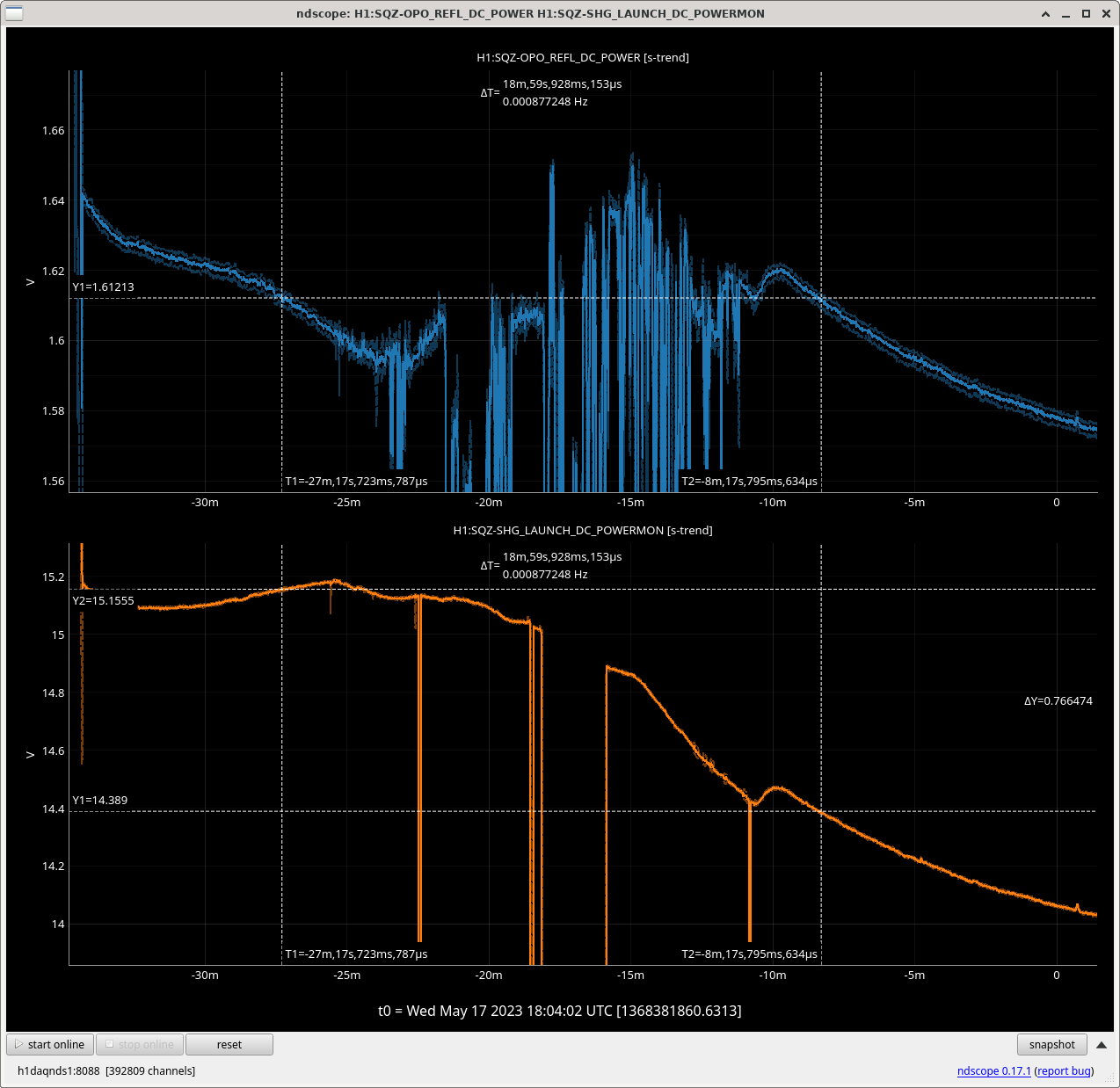
We adjusted the alignment into the OPO pump fiber on SQZT0 but touching BG2 and MG3 (layout on D1201210) to increase power coupling through fiber by ~5%, see attached. Vicky noticed OPO REFL was lower than usual, with 14mW into the OPO pump fiber, we were getting 1.5mW on SQZT7 OPO REFL and 1.0mW REFL Rejected and 50% of total goes to SK path (BS in HAM7), so total of 5mW/14mW = 35% throughout. Nominal Launch power is ~20mW.
Launch power was reducing due to temperature change of having table enclosure open. We pico-ed the HWP (pico I motor 2) to reduce the power into the fiber while we did this.
After the calibration update this morning, I need to retrain the NonSENS noise cleaning. However, the NDS team is still in progress on understanding why we can't get past GDS-CALIB_STRAIN channels right now. Once we can get that past data, I should be able to retrain. Until then, the NOISE_EST is zeros, so GDS-CALIB_STRAIN_CLEAN will be the same as GDS-CALIB_STRAIN_NOLINES.
This doesn't look like it'll get fixed tonight, as it may require a restart of the gstlal-calibration pipeline. I've set the NOISE_CLEANING guardian to have a gain of 0 in the WHITENING_NOISE_EST channel, and accepted it as zero in both safe and observe.
This means that while this is true, GDS-CALIB_STRAIN_CLEAN will be the same as GDS-CALIB_STRAIN_NOLINES.
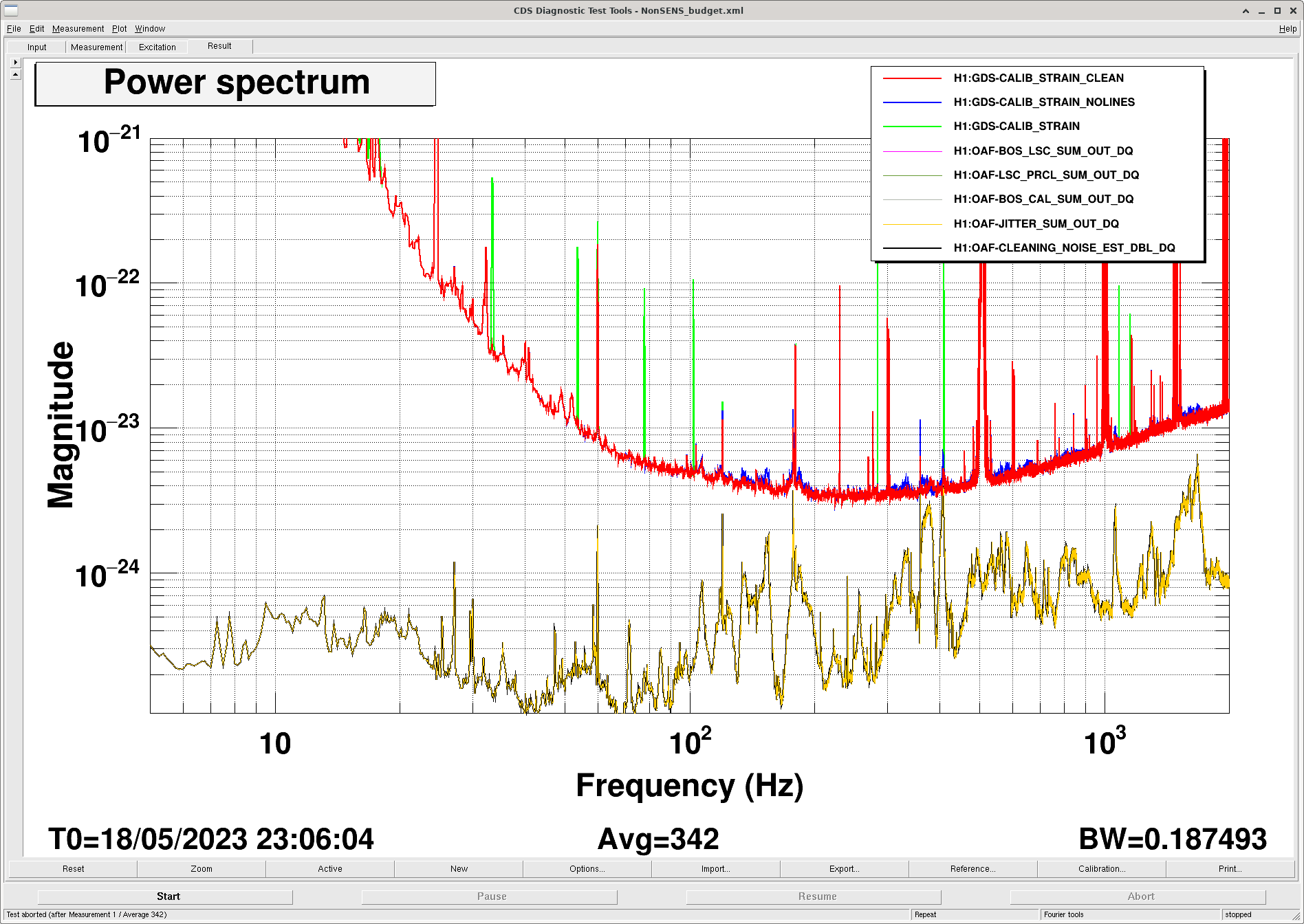
After the newest calib fix and restart that fixed the nonsens subtraction channel (but didn't affect any other parts of the calib), I retrained the jitter subtraction (but not yet retrained the LSC subtraction). The jitter subtraction should be running, and I've accepted the SDFs in both safe and observe.
See attached for the effect, including I've got a bit of noise re-injection that I didn't expect.
The h1sqz and h1sqzfces SDFs have identical safe and observe snap files (and always had).
h1ascsqzfc and h1ascsqzifo did have separate files which were more or less idential. I changed the link of the observe files to point to the safe ones.
All squeezer related SDFs are now using identical observe and safe files.
J. Kissel, L. Dartez, J. Rollins
All dates called out "verbally" rather than automatically generated are in the format YYYY-MM-DD.
All dates embedded into file names, automatically generated, are YYYYMMDD(T)HHMMSS(Z) where "T" represents "Time" and "Z" represents "Zulu" aka UTC time.
Setting aside our desire to have immediate feedback that "what we've done is good" using a thermalized IFO that's not otherwise in use, we've updated the calibration pipeline.
This physics of this update includes:
- Minor changes to the CAL-CS foton filters that represent the calibration model's "free parameters." These are needed because the last update to the sensing function parameters was on May 05 2023 (LHO:69332), using sensing function data from 2023-05-04 -- prior to us finalizing the -290 SRCL offset on May 08 2023 LHO:69402, and the DARM offset equivalent to 40 mA of OMC DCPD SUM LHO:69358. Note that these updates do NOT include measurements taken after, or corrected for the 0.6% systematic error that had been present in PCAL and only corrected for on Friday May 12 2023 (LHO:69539)
:: a new (inverse) optical gain, and cavity pole (actually different because of the new SRCL and DARM offsets)
:: a new set of actuator strengths for the L1, L2, and L3 stages (only different because there's noise in the MCMC fitting)
- Minor changes to "modeled DARM loop transfer functions at calibration line frequencies" EPICs records, corresponding to the above changes in the free parameters
- Updates to final stages of FIR filters within the GDS (DMT) portion of the calibration line related to noise cleaning; no changes were made to the "primary" FIR filters which correct the sensing and actuation paths (since these do not depend on the free parameters).
The new report also comes with, for the first time with the modern pydarm cmd-dev infrastructure, trust-worthy estimates of our "unknown frequency systematic error" [GPR fit results of the sensing and actuation functions]. That should mean we have everything we need to produce a modeled estimate of the response function systematic error (with uncertainty, sometime just referred to as "the uncertainty budget") though, only for frequencies below 1000 Hz, and for times when the IFO is completely thermalized.
#LibrarianshipDetails
This update uses the values and filters from the 20230510T062635Z calibration report (attached, in case it gets overwritten in the future), derived from the collection of "fixed" pydarm model parameter values set by the pydarm_H1.ini parameter file whose version has git hash c0bd4afe, and MCMC fits to the free parameters from
- sensing measurements taken on 2023-05-10, LHO:69462
MCMC chains saved to
~cal/archive/H1/reports/20230510T062635Z/
sensing_mcmc_chain.hdf5
- actuation measurements taken on 2023-05-09, LHO:69427
MCMC chains saved to
~cal/archive/H1/reports/20230510T062635Z/
actuation_L1_EX_mcmc_chain.hdf5
actuation_L2_EX_mcmc_chain.hdf5
actuation_L3_EX_mcmc_chain.hdf5
and generated with the cmd-dev branch of the pydarm software suite, which has git hash 048acc12d.
The GPR fits also live report's folder,
~cal/archive/H1/reports/20230510T062635Z/
sensing_gpr.hdf5
actuation_L1_EX_gpr.hdf5
actuation_L2_EX_gpr.hdf5
actuation_L3_EX_gpr.hdf5
After this report was exported to the front end and pushed to the archive, I restarted the GDS component of the pipeline (gstlal_compute_strain) at around 11:30am local time.
Now that the IFO's back up, things look good based on the metrics I have in the control room. Things are still evolving given that we're still thermalizing, but here's the state 1.0 hour in. opticalplant.png: \kappa_C is now closer to 1.0 (0.993, where it was 1.03). This is expected given the correct optical gain from the new DARM offset is now in place. f_CC is still evolving, currently at 440 Hz, but looks like it will settle on the new thermalized value of 433 Hz. actuatorstrength.png No change, as expected in any of the actuator \kappa values. systematicerror.png Systematic error at *some* line frequencies are better. Some low frequency lines (below 24 Hz) are worse, but I attribute that to thermalization. systematicerror_MEDM.png Screenshot of systematic error values, and a map between line numbers and line frequencies.
Took H1 out of Observing to run Calibration Suite Measurements.
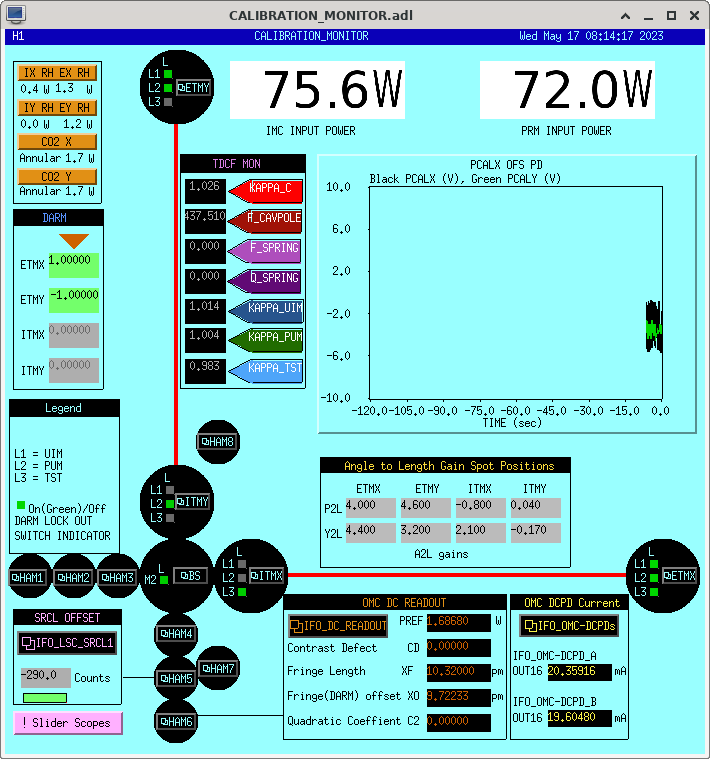
Attached is a screenshot (#1) of the sitemap > CAL CS > Calibration Monitor screen shortly after starting the measurement.
'pydarm report' command gave attached report:
Since, PEM team was going to immediately take H1, did the following:
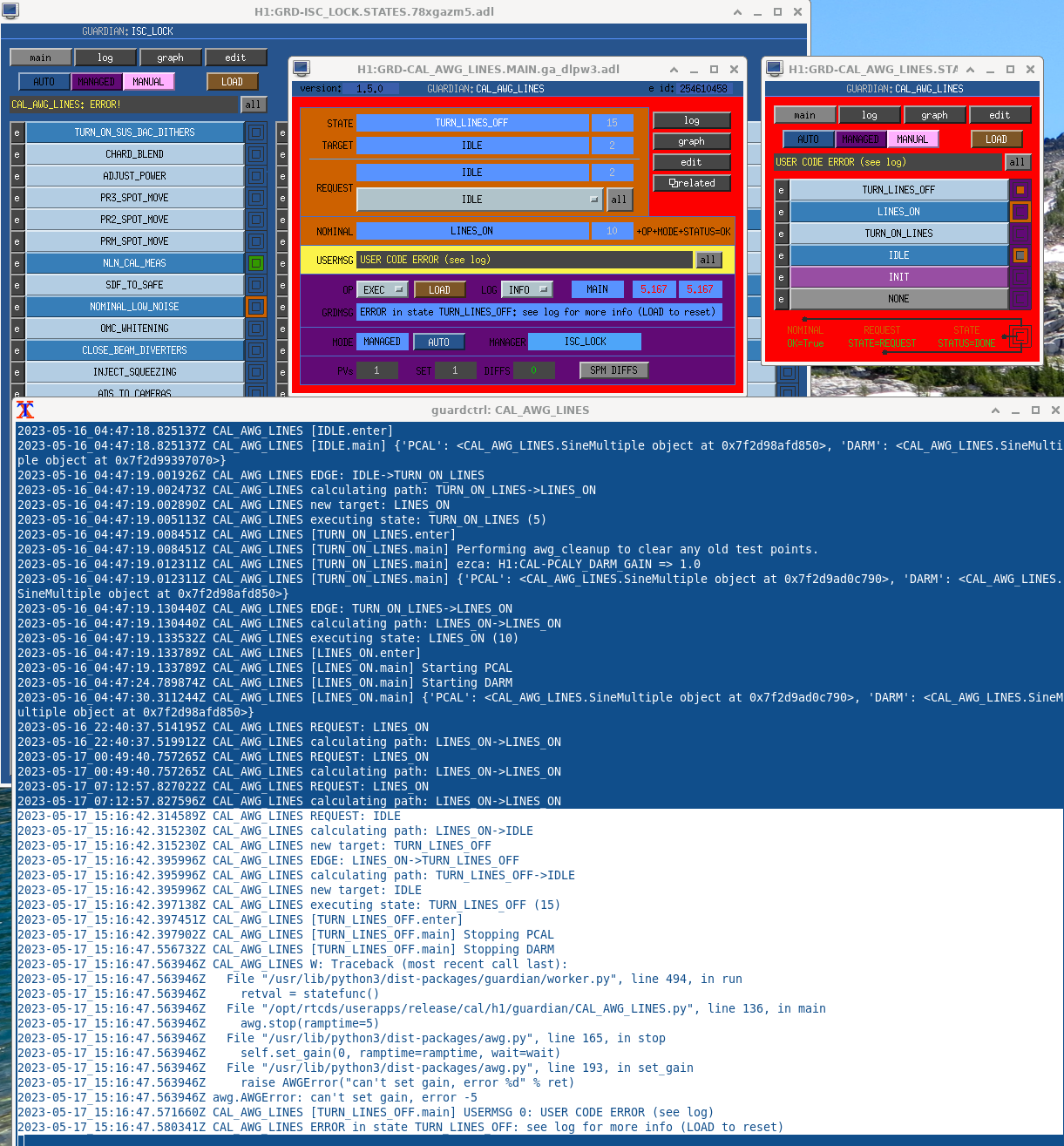
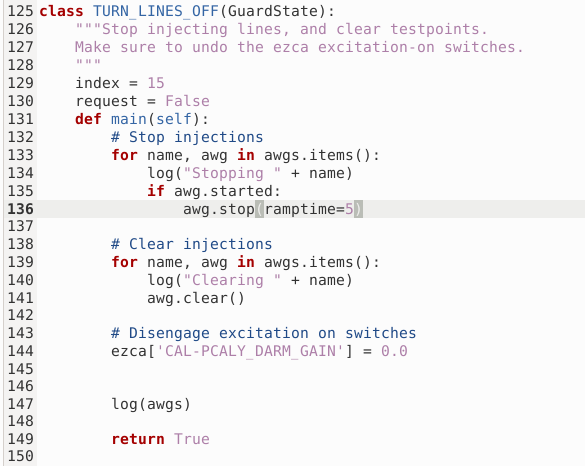
NOTE: CAL_AWG_LINES Goes Into Error (see attached screenshot [#3])
While getting this measurement going, the guardian CAL_AWG_LINES went into ERROR (node is RED).
(I missed this while setting up measurement and then starting draft of this alog. TJ noticed it when he walked in. I should have noticed it from Verbal or from the notification messages on various Guardian windows.)
Jeff mentions that this can happen after there has been a DAQ Restart (there were atleast two yesterday). To get the node back, Jeff hit the LOAD button on CAL_AWG_LINES.
Wed May 17 10:08:44 2023 INFO: Fill completed in 8min 44secs
Jordan confirmed a good fill curbside.
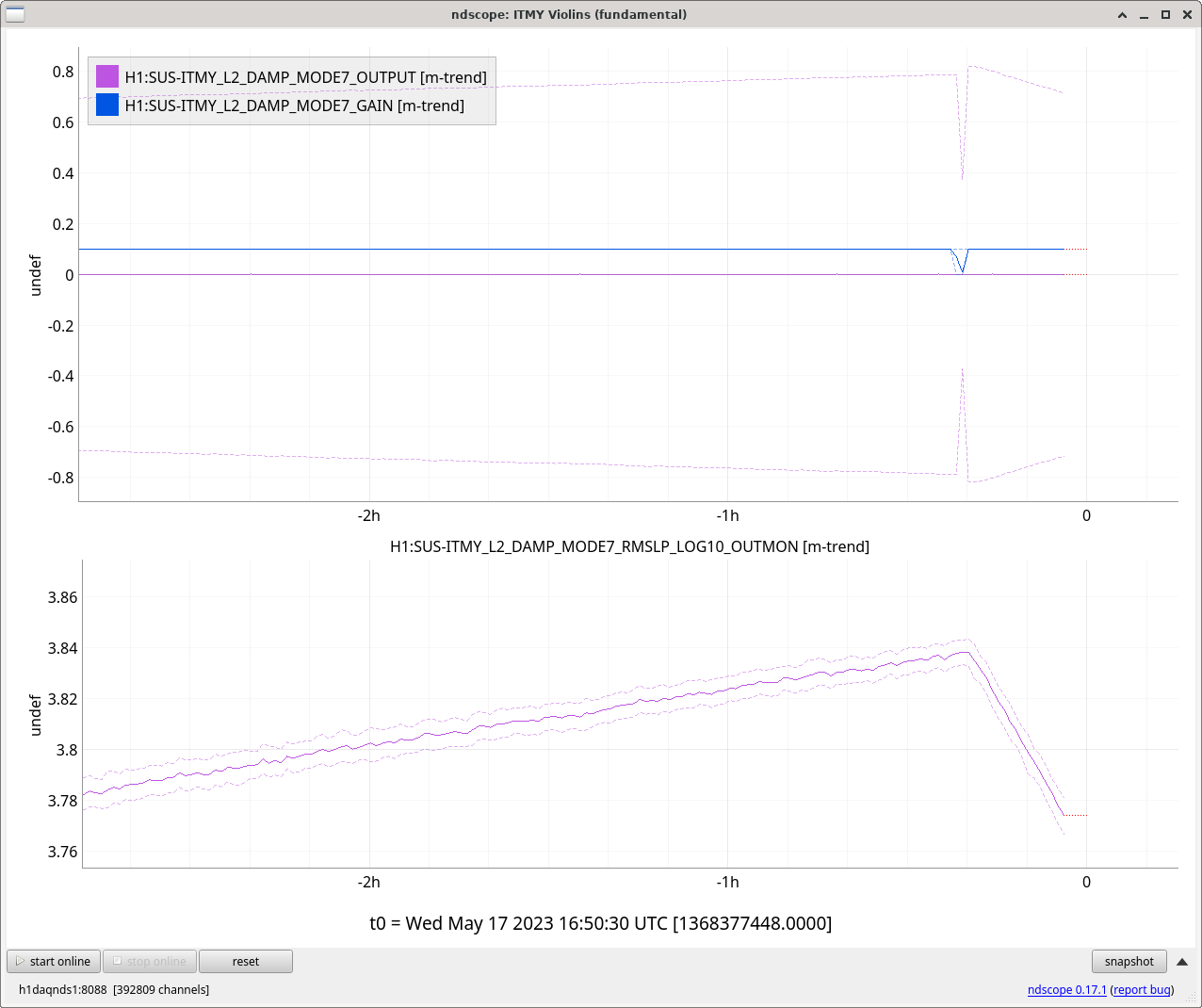
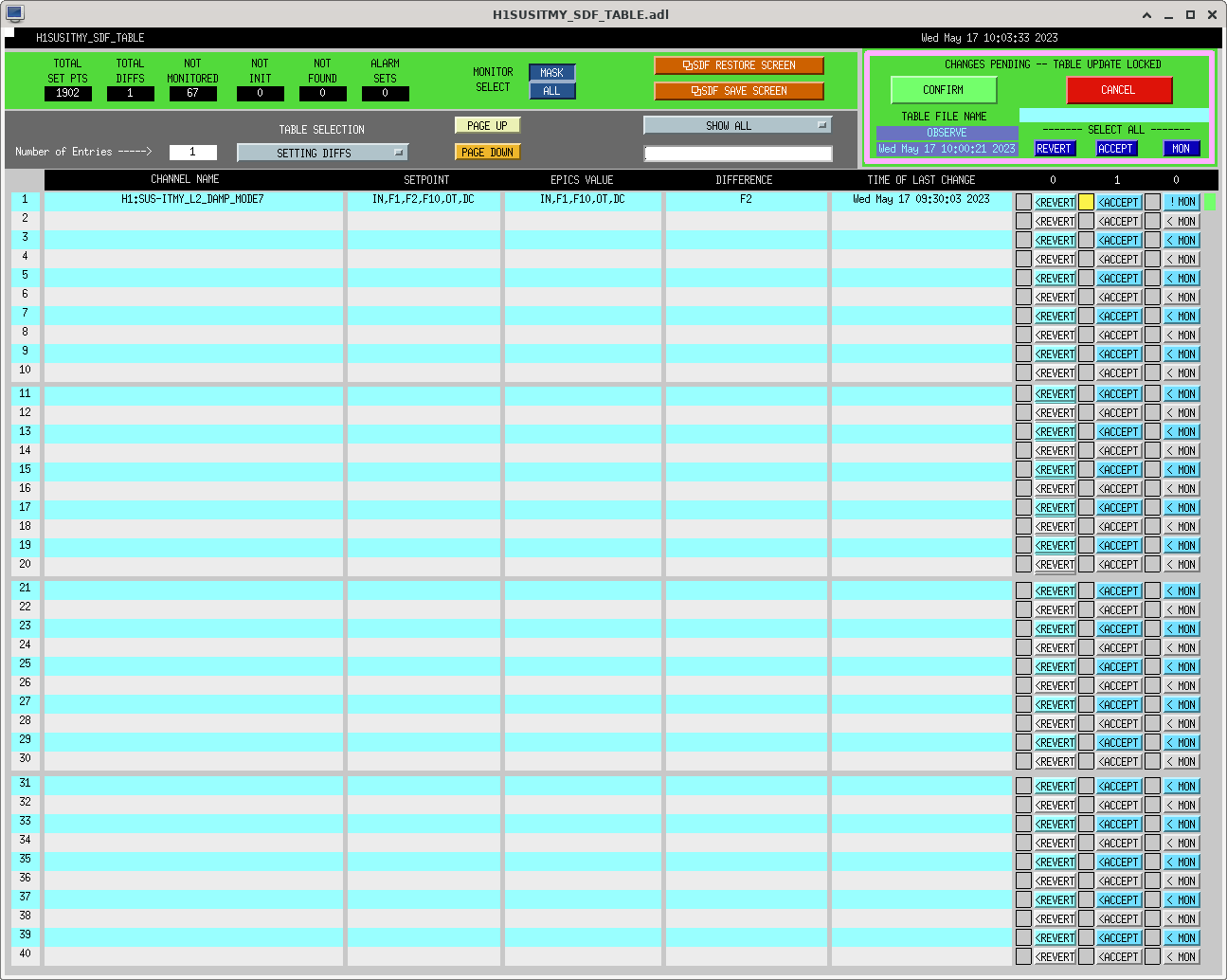
I have found a new setting for ITMY mode 07 since the nominal settings was making it grow (past couple of locks). Given below are the settings which works - see ndscope attached (old settings shows the mode is growing and the new one drops quickly) below,
New: FM1+FM10, Gain 0.1
Old: FM1+FM2+FM10, Gain 0.1
I have made the above changes in lscparams and accepted the changes in SDF.OBSERVE file.
FAMIS 19976
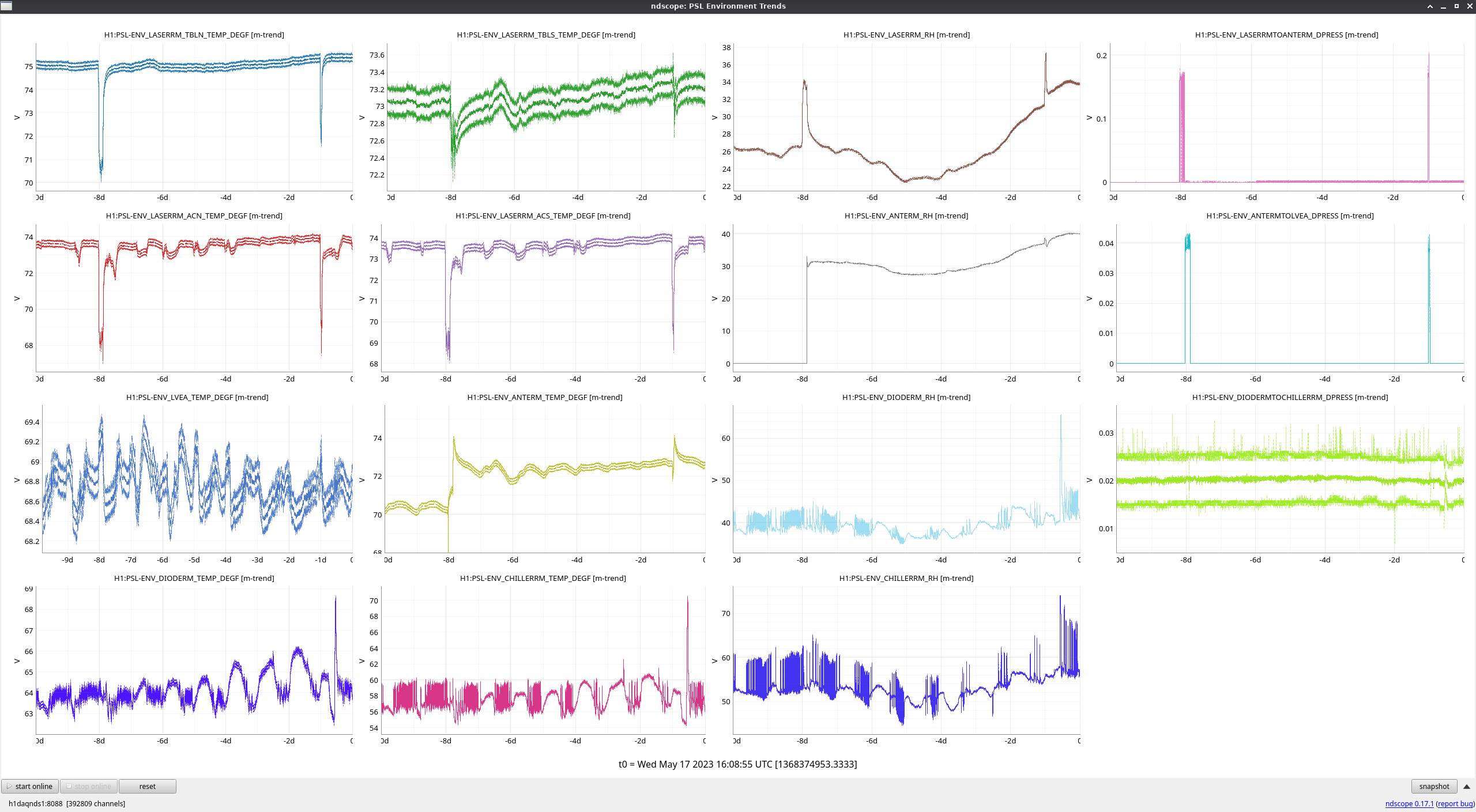
The anteroom humidity sensor seems to have been revived when we power cycled it during last week's incursion, however after that day the differential pressure between the laser room and the anteroom looks a bit noisier and was not fixed during Jason's incursion yesterday. Perhaps the airflow between the rooms has changed somehow?
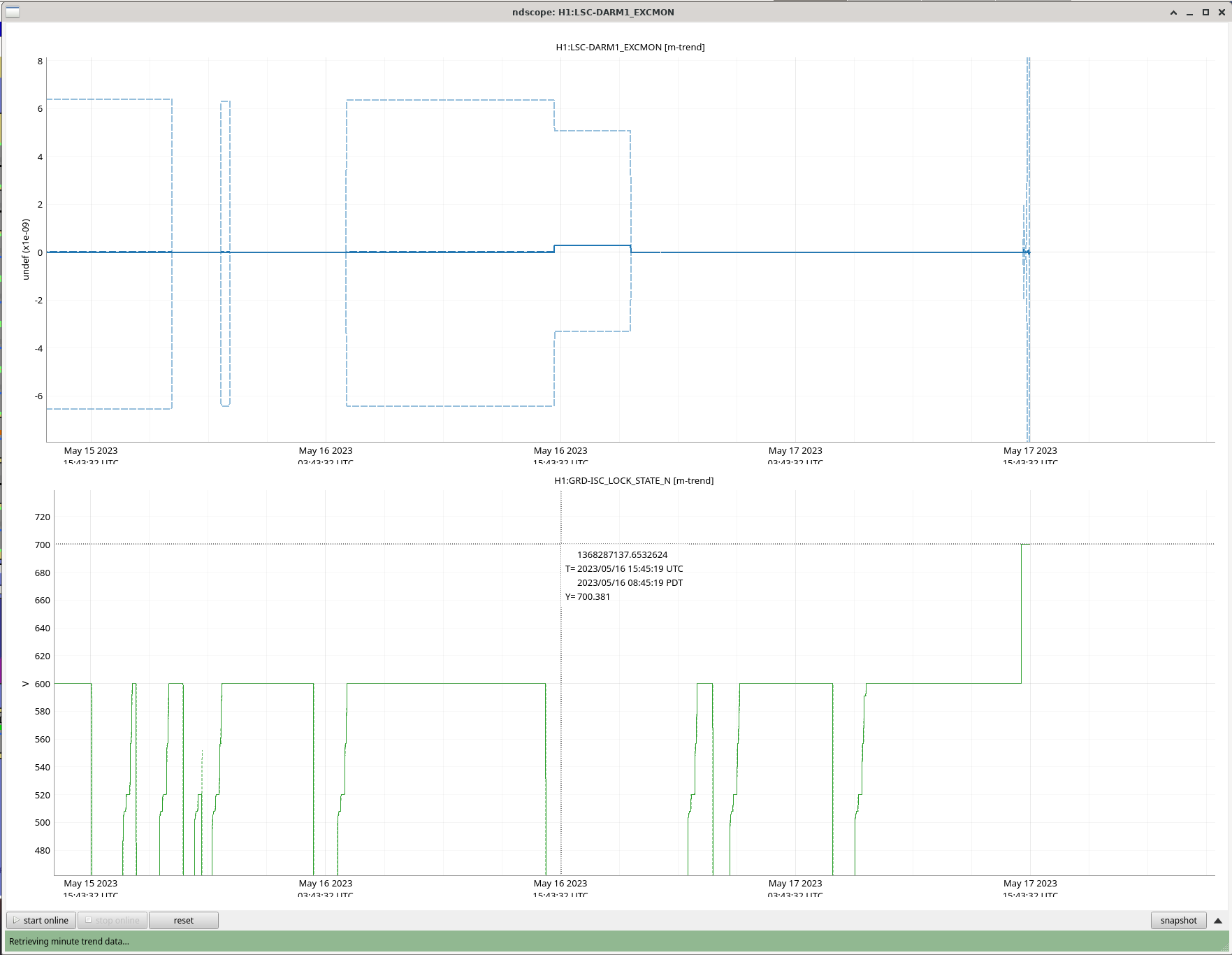
J. Kissel, T. Shaffer TJ noticed that the CAL_AWG_LINES guardian node went into error after Corey and I started the calibration suite this morning (LHO:69684). After some digging and trending, we realized (1) during yesterday's OMC front-end code restarts, and several DAQ restarts (LHO:69655) -- the CAL_AWG_LINES had obliviously remained in its LINES_ON state. (2) Across several of yesterday evening's post-maintenance lock re-acquisitions, the ISC_LOCK guardian merely re-requested the CAL_AWG_LINES "LINES_ON" state. Since CAL_AWG_LINES was already in the LINES_ON state, no action was taken. However, (3) Today, when taking ISC_LOCK to NLN_CAL_MEAS, which requests CAL_AWG_LINES to go to IDLE (through TURN_LINES_OFF), it tried to access the awg test point it had started May 16 2023 04:47:00 UTC (i.e. Monday night, May 15 2023 21:47:00 PDT, likely when the PEM team turned the lines back on after being done for the night), the code fell over. (A) There's nothing to be really sad about here. It just means we missed a few thermalizations. (B) I don't think it's urgent to somehow *make* the calls to python / guardian / AWG system robust across computer reboots and DAQ restarts, though see thoughts below (C) Hopefully, I'll have enough of a plan on what to do about the IFO's thermalization (continuing with all the actions in LHO:69593), that I won't need this guardian (D) The good enough "solution" is for a human to check the logs, confirm it died because it couldn't access test points that don't exist, and "just" reload the guardian just before we're done with our calibration suite in NLN_CAL_MEAS. I would expect this only needs doing across a Tuesday, and there's only one of those left before the observing run. In the fullness of time, though, if we do want to start using guardians to drive awg, we will need to figure out a way around this. For example, currently, as the CAL_AWG_LINES and awg processes are written, we can't "just" ask the guardian to cycle through its LINES ON and LINES OFF state, because the code is in error. It's also not really good practice for a guardian manager node (in this case ISC_LOCK) to "just assume" what's going on and toggle the LOAD button.
J. Kissel, C. Gray After Monday's not-insignificant change in PCAL displacement estimate (LHO:69539), to build up the inventory of data with the detector in a stable (and thermalized) configuration, and to give the operator corps more practice on measuring something we'll need to be doing at least once a week during the run, I've asked Corey to take us out of observing to run a 1.5 hour full suite of calibration measurement following the instructions in the OPS wiki. The time has been cleared with the PEM team. Time of start is 2023-05-17 15:16 UTC.
Calibration measurements complete at 17:00 UTC. That's 01:45 minutes of calibration time consumed (and finished for 8 minutes prior to lock loss). Handing over to the PEM team.
For the results of this measurement, see LHO:69685, i.e. report ID 20230517T163625Z.
TITLE: 05/16 Day Shift: 15:00-23:00 UTC (08:00-16:00 PST), all times posted in UTC
STATE of H1: Lock Acquisition
SHIFT SUMMARY:
Started Maintenance Recovery at about 1:53pmPT with (3) issues which made recovery tough, but help from Jeff & TJ we were able to get to NLN 342pmPT.
LOG:
To help fix the issue that Corey mentioned with the XARM_IR state and the LSC-POP_A_RF45_I_OFFSET, I've added into the PREP_ARM_IR state in ALIGN_IFO to make a new offset from a 5 second average after the whitening is changed.
Jennie, Sheila
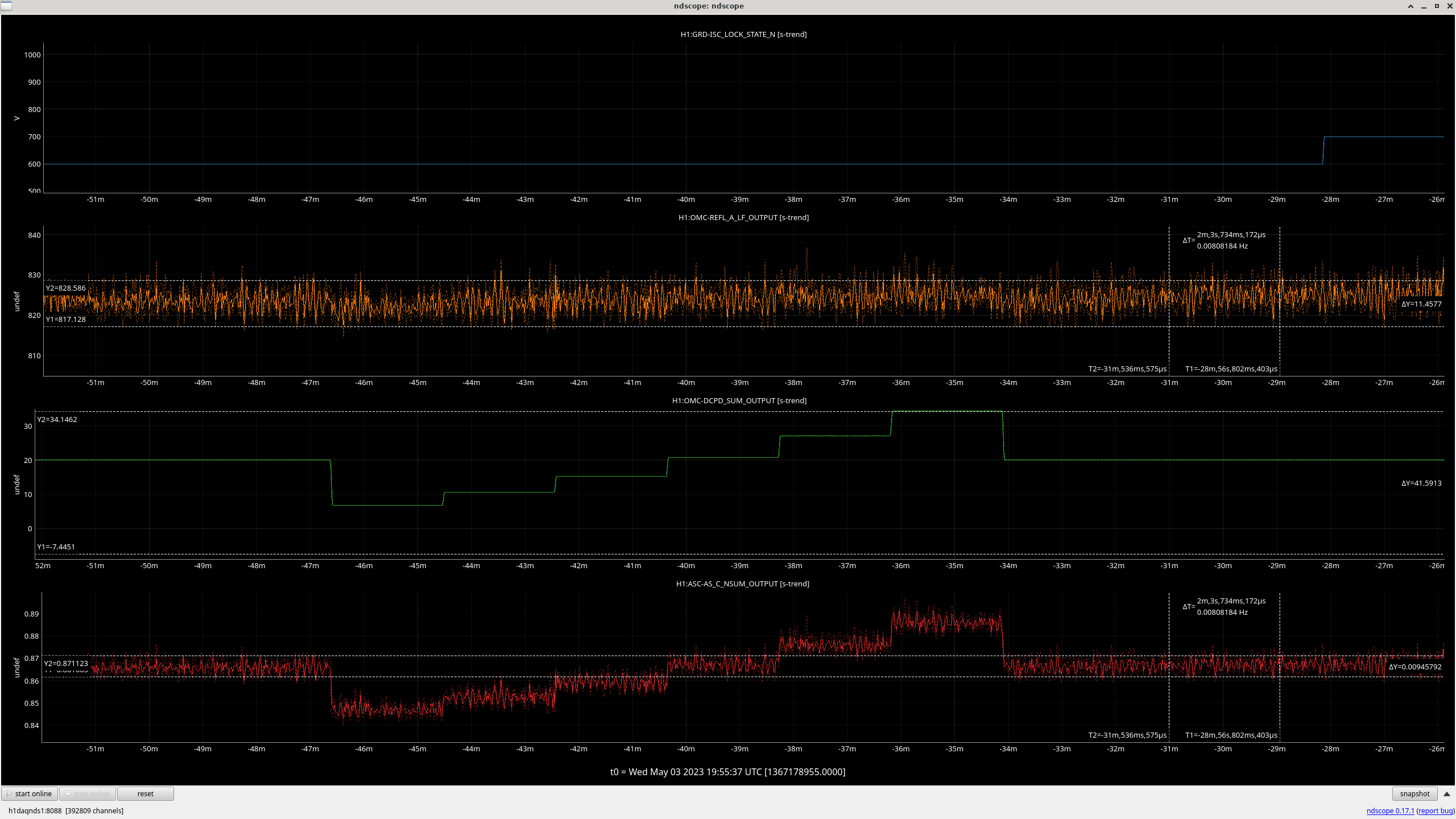
Sheila and I looked at the steps Elenna changed the DARM offset through, the last time the contrast defect measurement was taken (see LHO #69361). To get an idea of how much light seen at the anti-symmetric port (calibrated in terms of power into HAM6) is insensitive to DARM motion I plotted the scaling of the light at ASC-AS_C_NSUM_OUTPUT with DARM offset changing (OMC-DCPD_SUM_OUTPUT).
| DARM offset (mA) (OMC-DCPD_SUM_OUTPUT) |
Power out of SRC (ASC-AS_C_NSUM_OUTPUT) (+/- 0.00945792) |
Time offset changed |
| 19.91 | 0.8655 | - |
| 6.760 | 0.8467 | 1367176162 |
| 10.62 | 0.8519 | 1367176288 |
| 15.15 | 0.8589 | 1367176413 |
| 20.82 | 0.8666 | 1367176538 |
| 27.17 | 0.8755 | 1367176663 |
| 34.15 | 0.8857 | 1367176788 |
Attached is the plot (pdf) of total power into HAM 6 versus the power that gets through the OMC.
The uncertainty in the AS measurement is was estimated using the y cursors on ndscope (shown in png).
0.837W of power is predicted for no DARM offset, and 82% of the light coming into HAM 6 is sensed by the OMC DCPDs.
We also tried to use the total power on OMC REFL to do a similar calculation of the light rejected from the OMC that is insensitive to DARM motion but due the noise on this signal we made need bigger DARM offset steps to see a clear trend.
Since this measurement, whitening has been implemented on the OMC REFL PD by Daniel.
Code is Plot_OMC_REFL_2023-05-12.ipynb in /ligo/home/jennifer.wright/git/OMC_mode_matching/
Figure is in /ligo/home/jennifer.wright/git/OMC_mode_matching/figures
In the SQZ loss budget, HAM6 losses are OM1 (99.3%) OM3 (98.5%), OMC transmission (95/7% measured before installation), and DCPD QE (98% in budget, should be 99%). This gives an expected HAM6 throughput of 92%, which means we are missing 11% loss, including OMC mode mismatch and any degredation of the OMC transmission or PD QE.
See 60885 and the comment above it for a similar measurement from LLO.
Just to clarify, that's 82% of carrier light that gets through the OMC from the input of HAM 6.
Jennie W, Sheila D
We reviewed some alogs and dcc documents about OMC losses, OMC cavity scans suggest that our OMC transmission has degraded from 96% to 92%.
Testing before installation results start on page 140: T1500060 The input output coupler transmission (T) is 7690ppm, 50ppm loss per mirror.
Finesse = pi/(1-r1*r2*rloss) (approximation) with r1=r2 = sqrt(1-T) and rloss is an amplitude reflectivity that represents all the cavity losses.
round trip loss = 1-[(1-pi/F)/(1-T)]^2
cavity transmission = T^2 * (Finesse/pi)^2
I've updated the SQZ Loss wiki, if we assume the OMC transmission is 92%, our known IFO output losses become 13%, and our known squeezing losses become 19%.
Redoing the comparison above of Jennie's HAM6 throughput estimate (82%) to the 12% known HAM6 losses:
Implies that we have 7% unknown HAM6 losses, which could be OMC mode matching.
Testing documents page 143: reports 4690ppm transmission of the input and output couplers, and summing the losses 284ppm, implies finesse of 401 and cavity transmission of 96.4%
Minor comment: This line should be identical to P.140. The transmission of the input/output couplers should be 7690ppm. Did I give you a link to an old document...?
Due to some concerns raised by Evan Hall regarding vibration and noise from the # 1 supply fan at End X, I have switched from Fan 1 to Fan 2.
Tagging ISC, PEM, and DetChar -- this is a follow-up action taken now that we've found that the detector is particularly sensitivity to scattered light from the ETMX cryo baffle; see LHO aLOGs 69598 from Evan, and 69603, Andy's ID that it may be this fan that Bubba has now turned off as indicated in the above aLOG. The game plan: since improving the isolation / damping of the cryo baffle would require an end-station vent which we're not willing to do, we're instead looking to reduce the input motion to the cryo baffle's isolation system.
Last night after this change, the detector was left in observing mode for roughly 9 hours. This data that does not contain any visible 4 Hz glitching (see attached spectrogram). Additional checks of data during daytime hours would be helpful to confirm that the 4 Hz glitching is no longer an issue, but this is a promising sign.