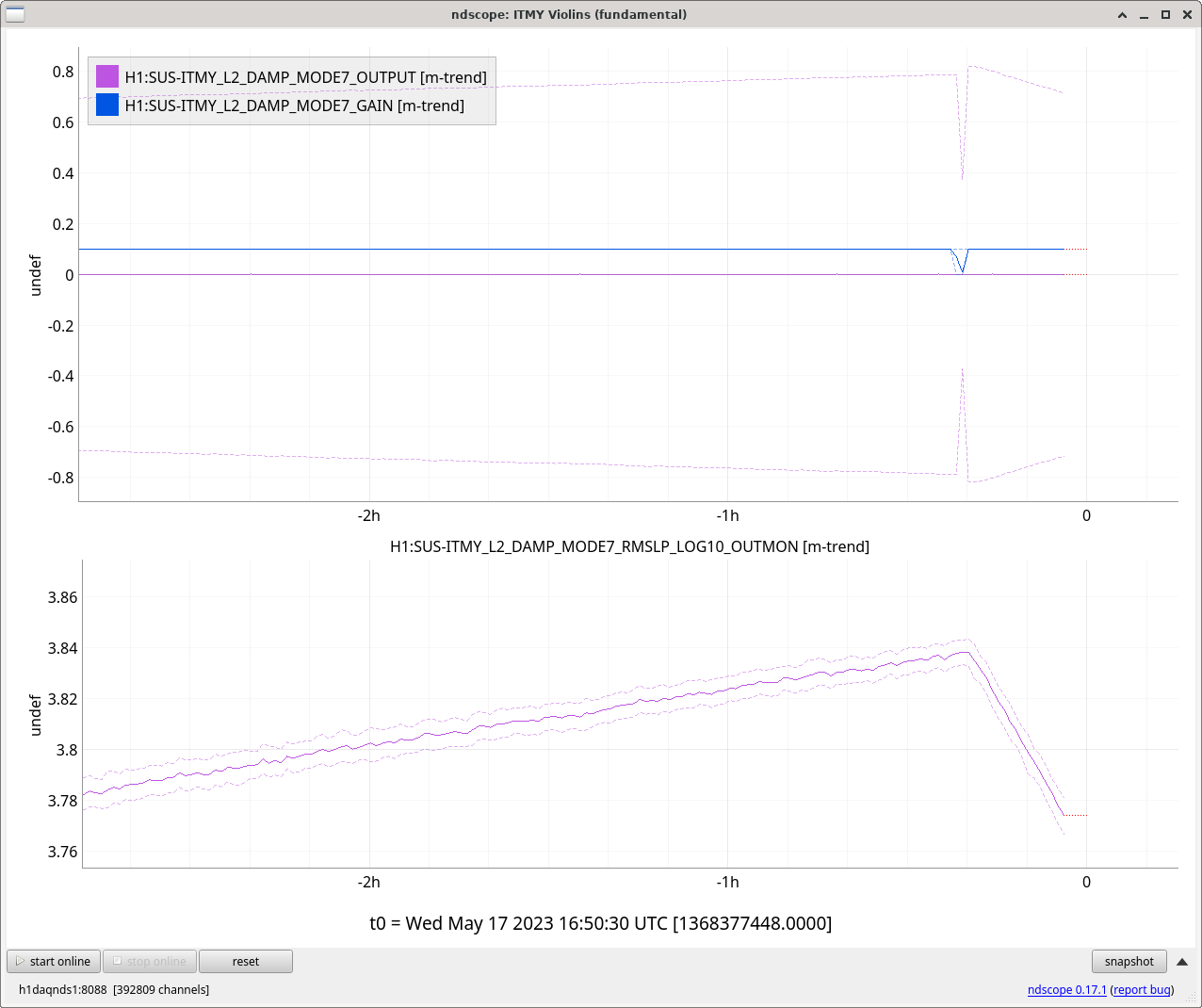
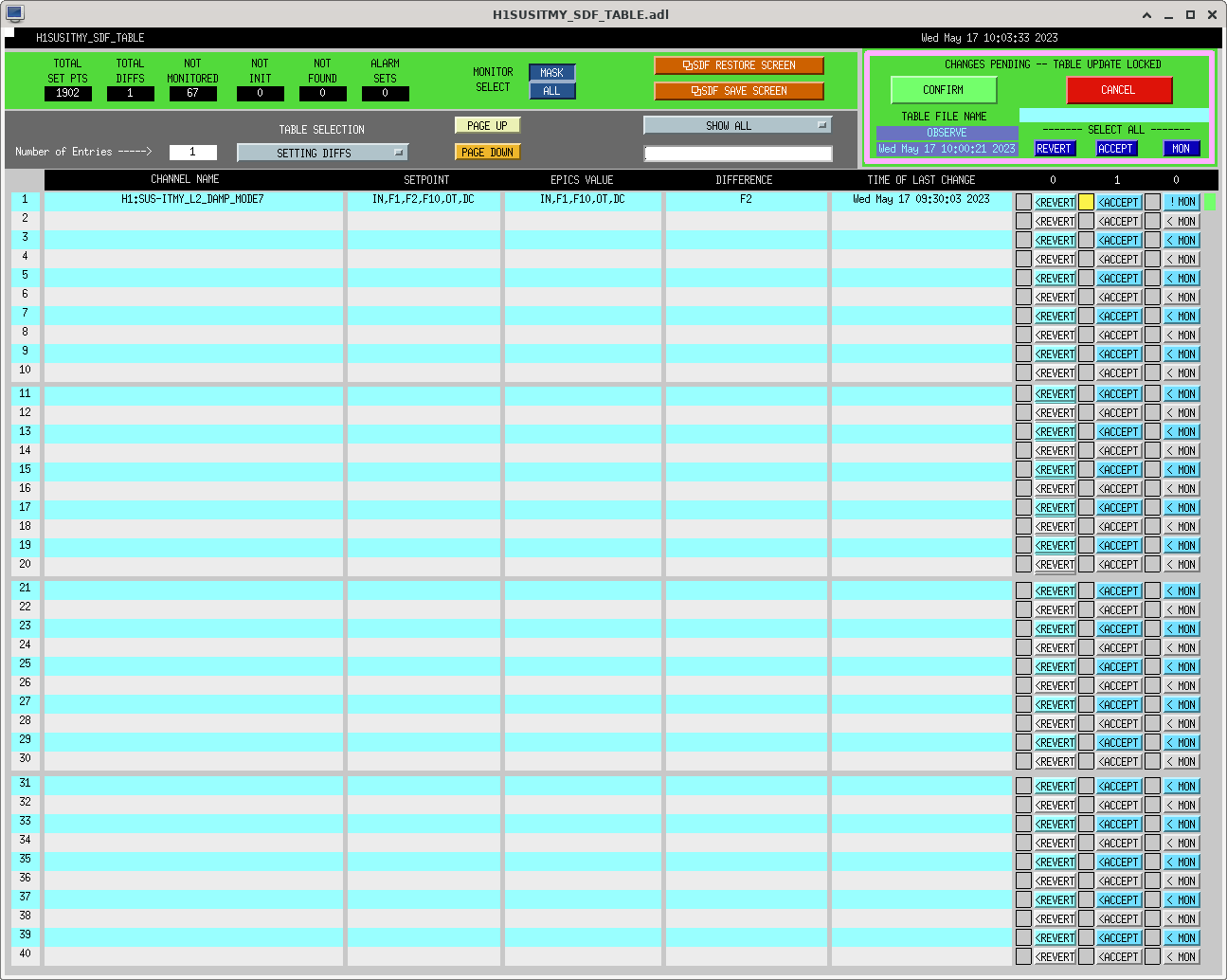
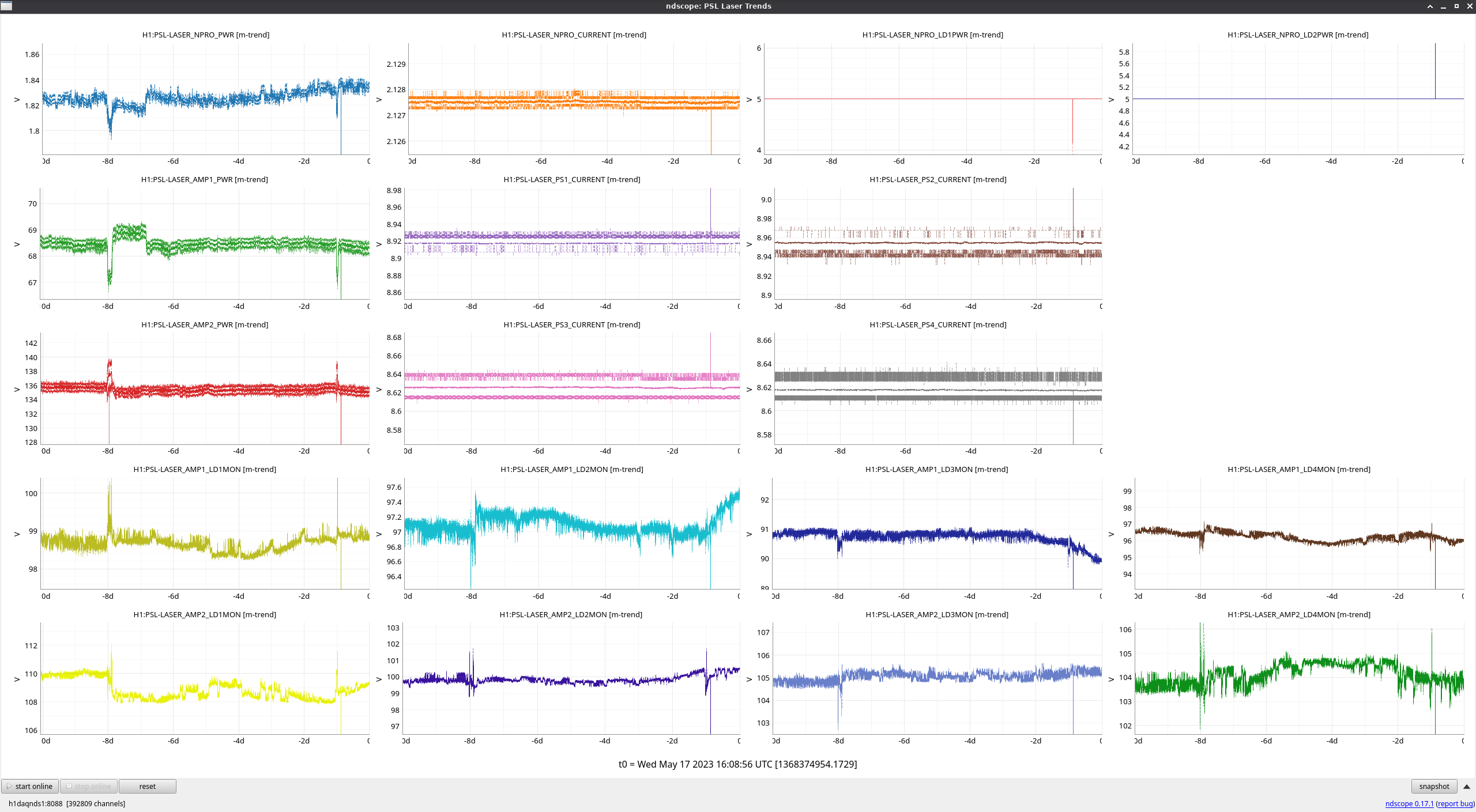
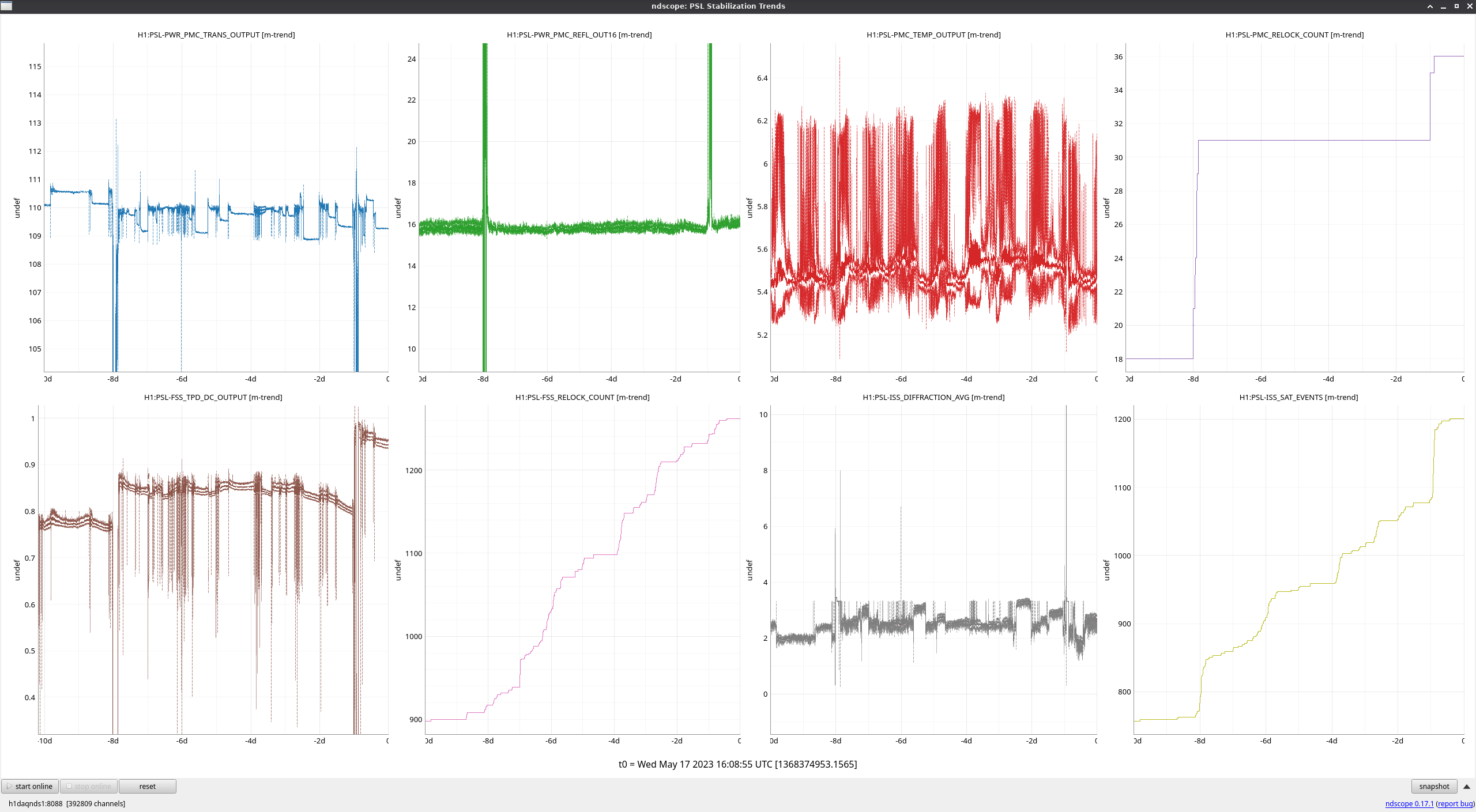
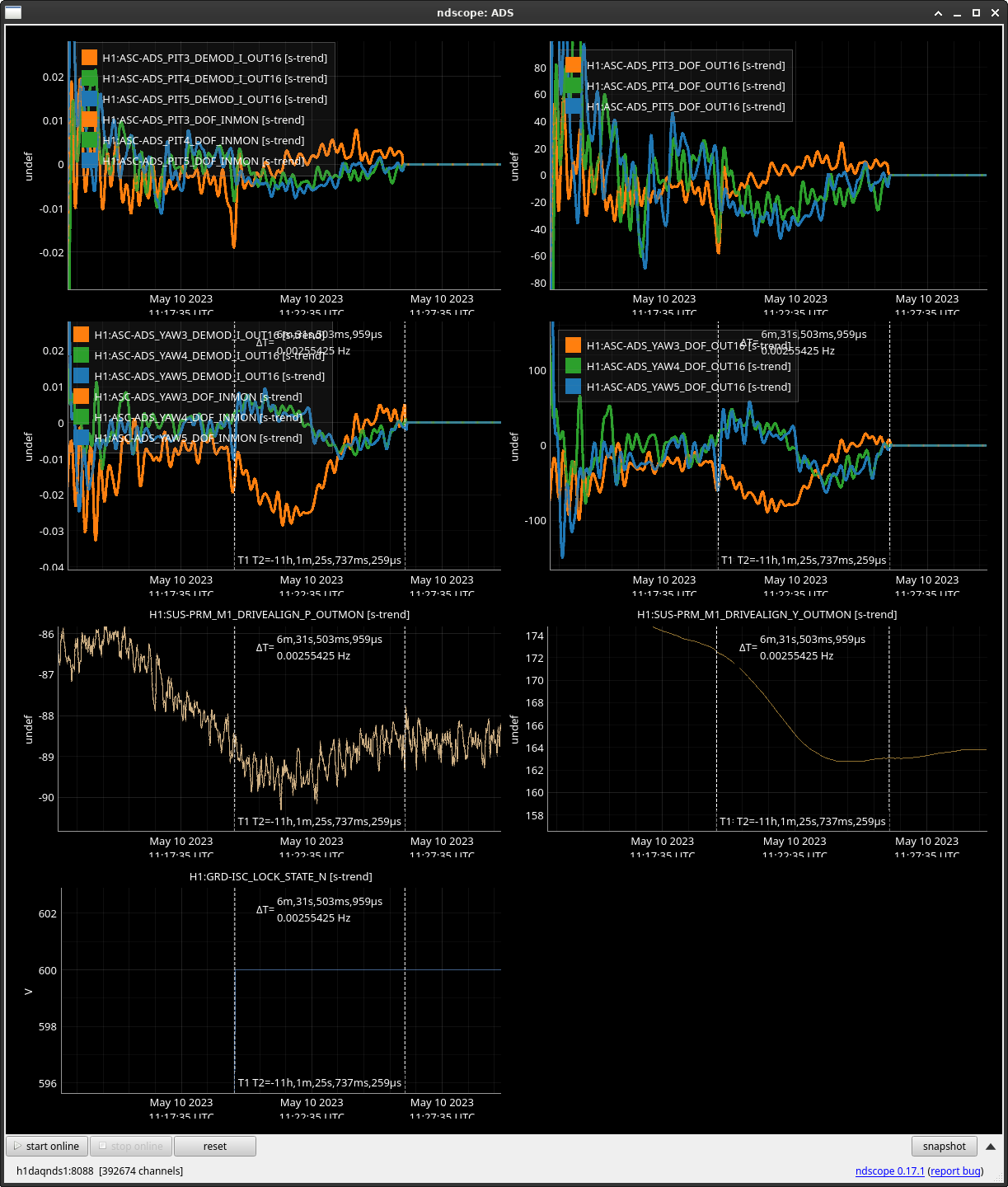
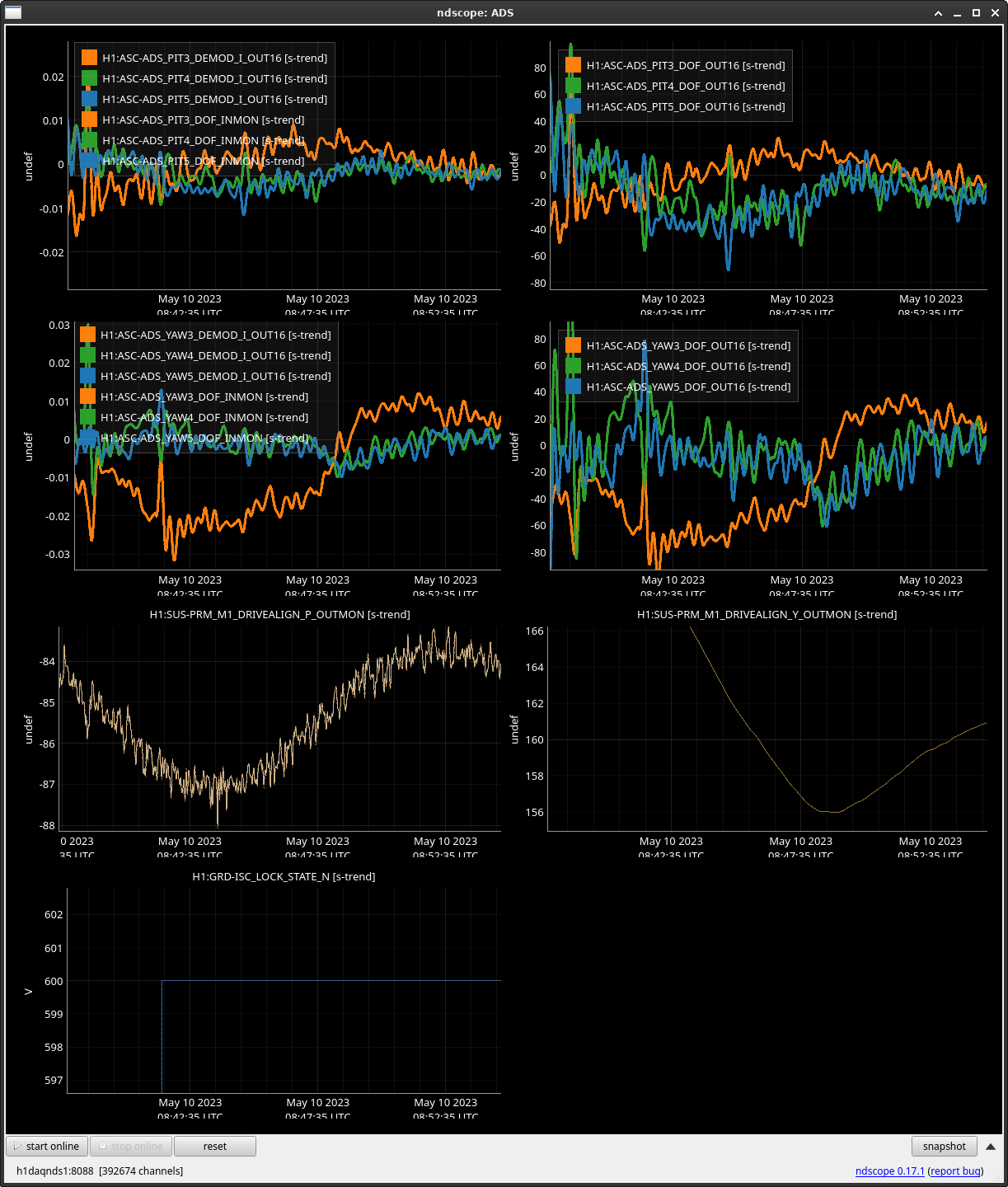
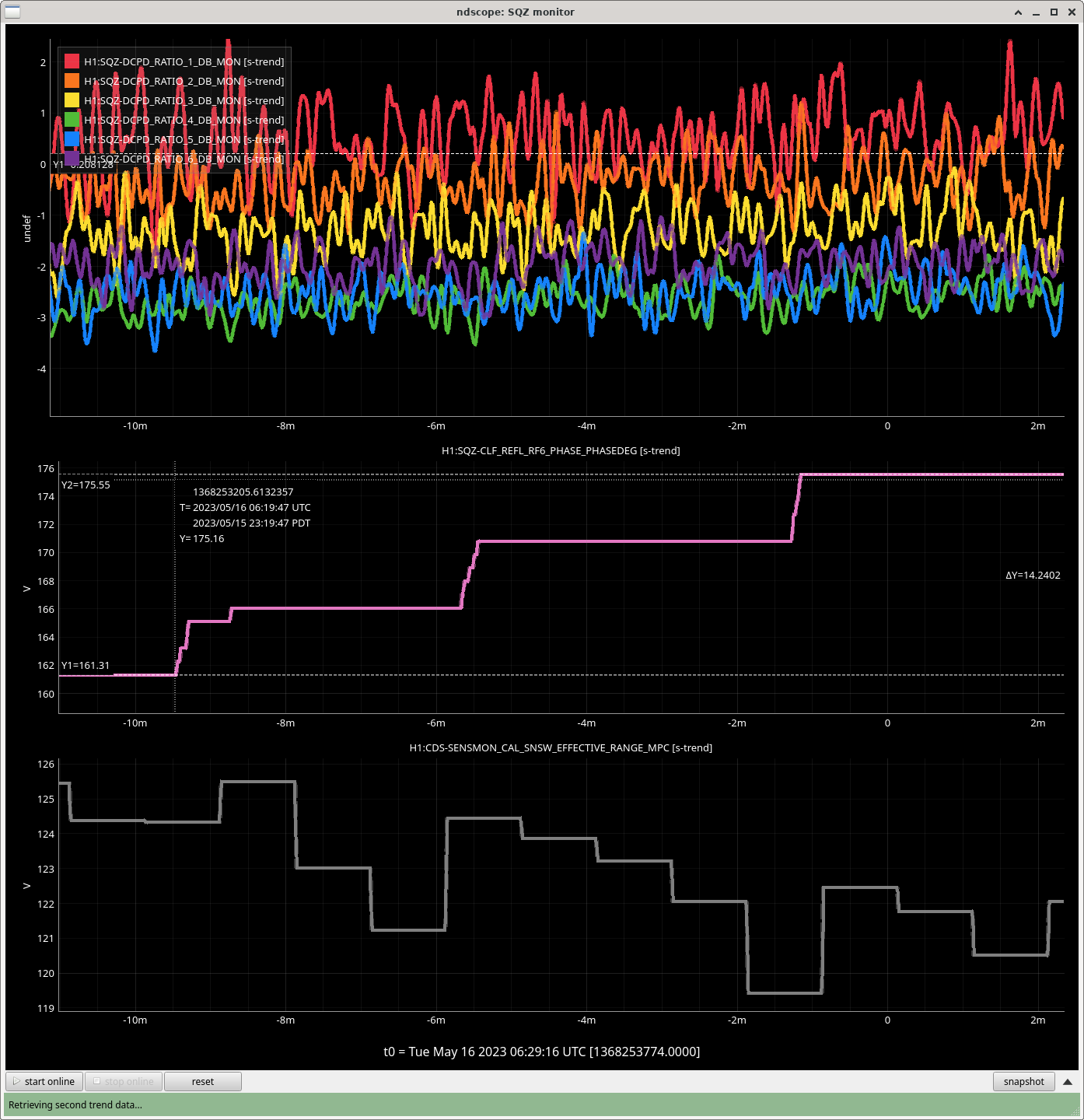
I have found a new setting for ITMY mode 07 since the nominal settings was making it grow (past couple of locks). Given below are the settings which works - see ndscope attached (old settings shows the mode is growing and the new one drops quickly) below,
New: FM1+FM10, Gain 0.1
Old: FM1+FM2+FM10, Gain 0.1
I have made the above changes in lscparams and accepted the changes in SDF.OBSERVE file.
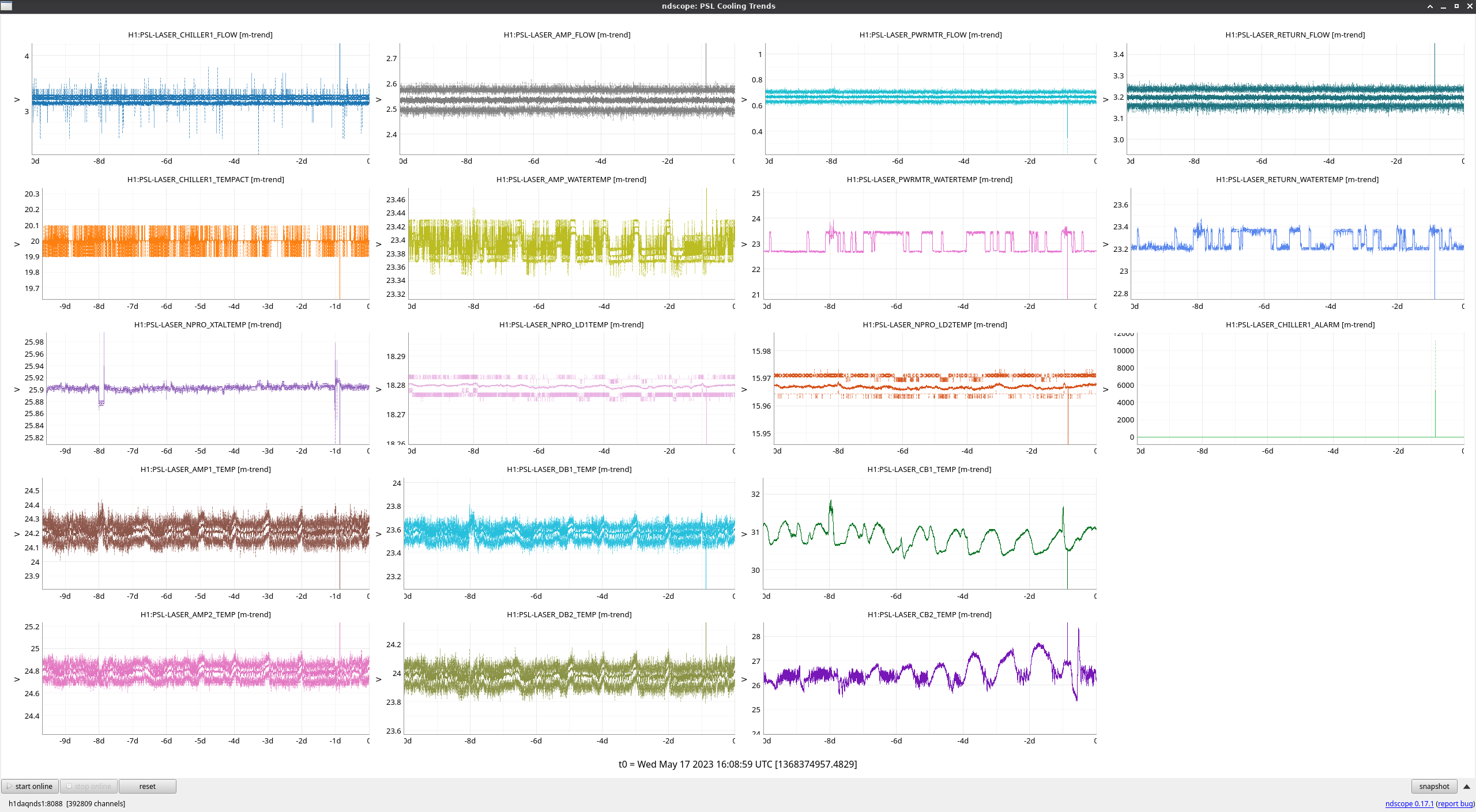
FAMIS 19976
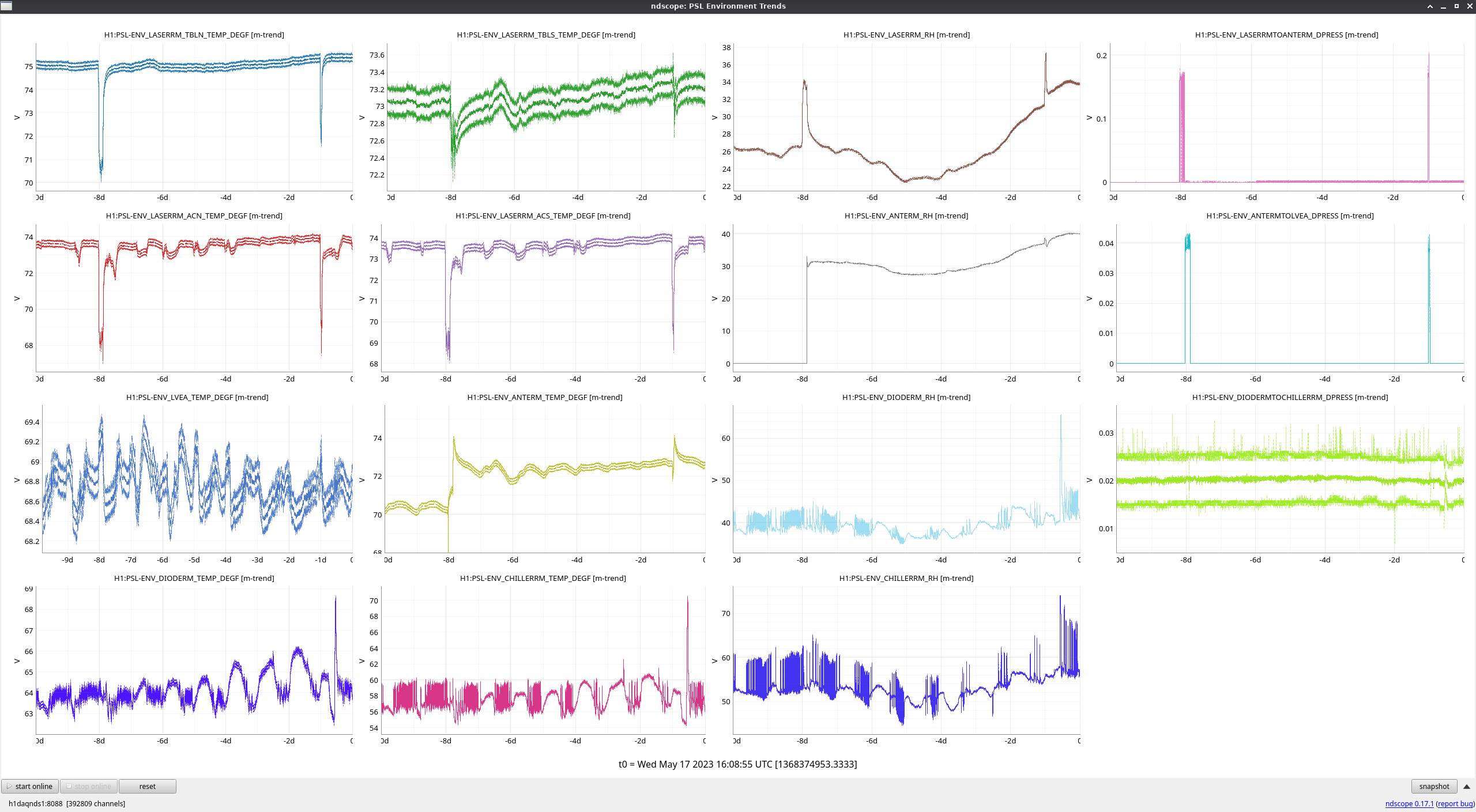
The anteroom humidity sensor seems to have been revived when we power cycled it during last week's incursion, however after that day the differential pressure between the laser room and the anteroom looks a bit noisier and was not fixed during Jason's incursion yesterday. Perhaps the airflow between the rooms has changed somehow?
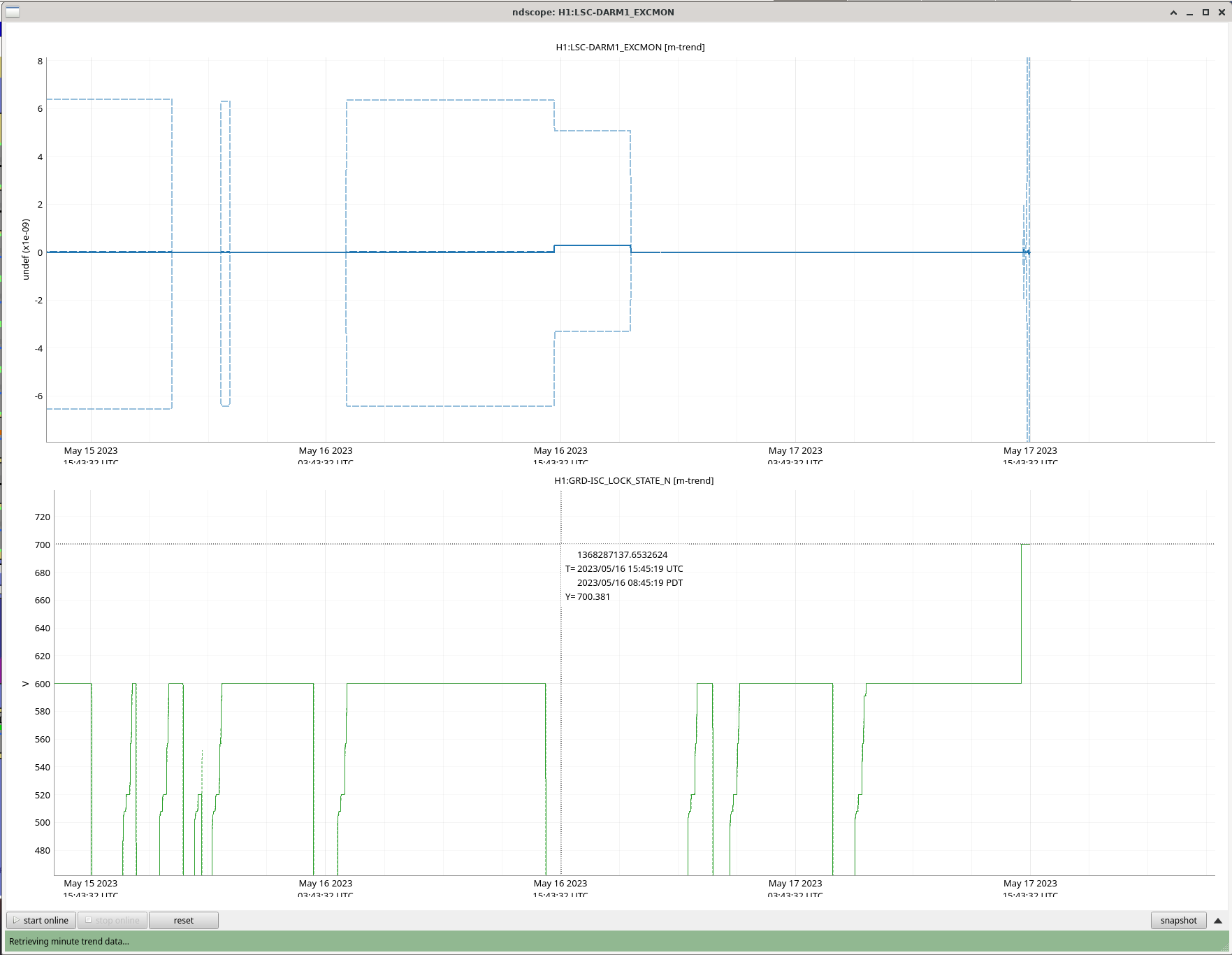
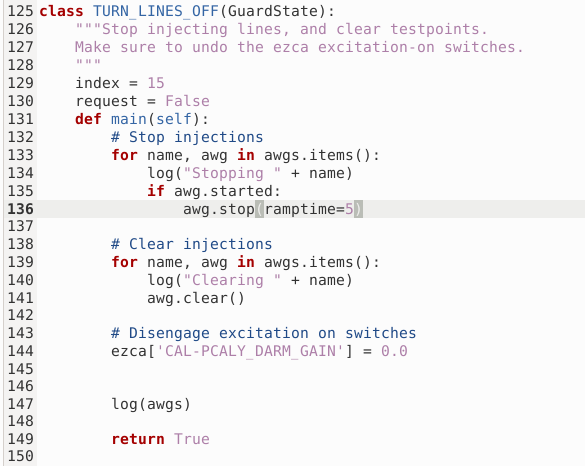
J. Kissel, T. Shaffer TJ noticed that the CAL_AWG_LINES guardian node went into error after Corey and I started the calibration suite this morning (LHO:69684). After some digging and trending, we realized (1) during yesterday's OMC front-end code restarts, and several DAQ restarts (LHO:69655) -- the CAL_AWG_LINES had obliviously remained in its LINES_ON state. (2) Across several of yesterday evening's post-maintenance lock re-acquisitions, the ISC_LOCK guardian merely re-requested the CAL_AWG_LINES "LINES_ON" state. Since CAL_AWG_LINES was already in the LINES_ON state, no action was taken. However, (3) Today, when taking ISC_LOCK to NLN_CAL_MEAS, which requests CAL_AWG_LINES to go to IDLE (through TURN_LINES_OFF), it tried to access the awg test point it had started May 16 2023 04:47:00 UTC (i.e. Monday night, May 15 2023 21:47:00 PDT, likely when the PEM team turned the lines back on after being done for the night), the code fell over. (A) There's nothing to be really sad about here. It just means we missed a few thermalizations. (B) I don't think it's urgent to somehow *make* the calls to python / guardian / AWG system robust across computer reboots and DAQ restarts, though see thoughts below (C) Hopefully, I'll have enough of a plan on what to do about the IFO's thermalization (continuing with all the actions in LHO:69593), that I won't need this guardian (D) The good enough "solution" is for a human to check the logs, confirm it died because it couldn't access test points that don't exist, and "just" reload the guardian just before we're done with our calibration suite in NLN_CAL_MEAS. I would expect this only needs doing across a Tuesday, and there's only one of those left before the observing run. In the fullness of time, though, if we do want to start using guardians to drive awg, we will need to figure out a way around this. For example, currently, as the CAL_AWG_LINES and awg processes are written, we can't "just" ask the guardian to cycle through its LINES ON and LINES OFF state, because the code is in error. It's also not really good practice for a guardian manager node (in this case ISC_LOCK) to "just assume" what's going on and toggle the LOAD button.
FRS27187 was opened 9th March 2023 to cover a spate of ADC errors on h1seih16's 2nd ADC. These errors went quiet for a while. We got another error at 00:17 this morning (Wed 17may2023). I have updated the ticket and we will monitor to see if this ADC should be swapped out.
J. Kissel, C. Gray After Monday's not-insignificant change in PCAL displacement estimate (LHO:69539), to build up the inventory of data with the detector in a stable (and thermalized) configuration, and to give the operator corps more practice on measuring something we'll need to be doing at least once a week during the run, I've asked Corey to take us out of observing to run a 1.5 hour full suite of calibration measurement following the instructions in the OPS wiki. The time has been cleared with the PEM team. Time of start is 2023-05-17 15:16 UTC.
Calibration measurements complete at 17:00 UTC. That's 01:45 minutes of calibration time consumed (and finished for 8 minutes prior to lock loss). Handing over to the PEM team.
For the results of this measurement, see LHO:69685, i.e. report ID 20230517T163625Z.
TITLE: 05/17 Day Shift: 15:00-23:00 UTC (08:00-16:00 PST), all times posted in UTC
STATE of H1: Observing at 126Mpc
CURRENT ENVIRONMENT:
SEI_ENV state: CALM
Wind: 1mph Gusts, 0mph 5min avg
Primary useism: 0.01 μm/s
Secondary useism: 0.11 μm/s
QUICK SUMMARY:
Walking in to an Observing H1 with a lock clock of just over 7.5hrs and range hovering between 125-130Mpc. No alarms. Little bit of red on the CDS Overview (SEIH16 has a red ADC & CALEY has red from EXC & OVF). Seismic & wind are quiet. No Wind Fence Work today!
Switched GRD_IFO from Automatic to Managed.
"PEM Week" continues.
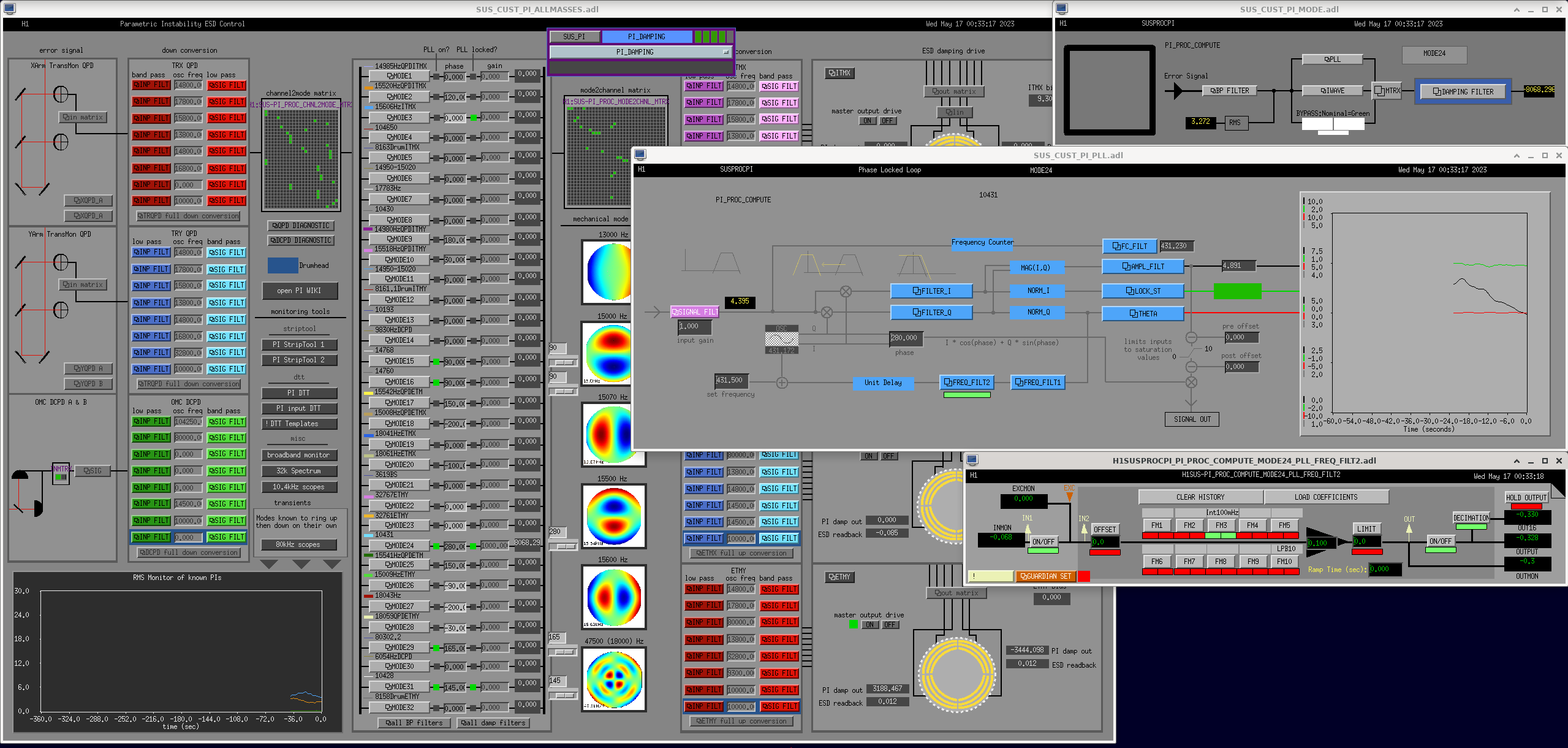
To reconcile SDF differences in the PI damping infrastructure, I've unmonitored the PI PLL Integrators from observe.snap, see the sdf table and the medms, where just the PLL FREQ2 "FM3" integrator filters are now un-monitored in SDF for modes 24, 29, and 31. These integrators are guardian-controlled, so this is probably okay.
TITLE: 05/16 Eve Shift: 23:00-07:00 UTC (16:00-00:00 PST), all times posted in UTC
STATE of H1: Commissioning
SHIFT SUMMARY:
Main Notes:
- PEM injections/SQZ work early on in the day
- Couple locklosses - both due to unknown reasons
- Currently sitting at MAX_POWER on the way back to NLN, I have set the OBSERVING bit to AUTO so it should catch when the SDFs are cleared
- Lock #1:
- LOCKLOSS @ 23:31 UTC - reason currently unknown
- Lock #2:
- Acquired NLN @ 00:52, In OBSERVING @ 4:02
- SQZ/PEM injections ongoing
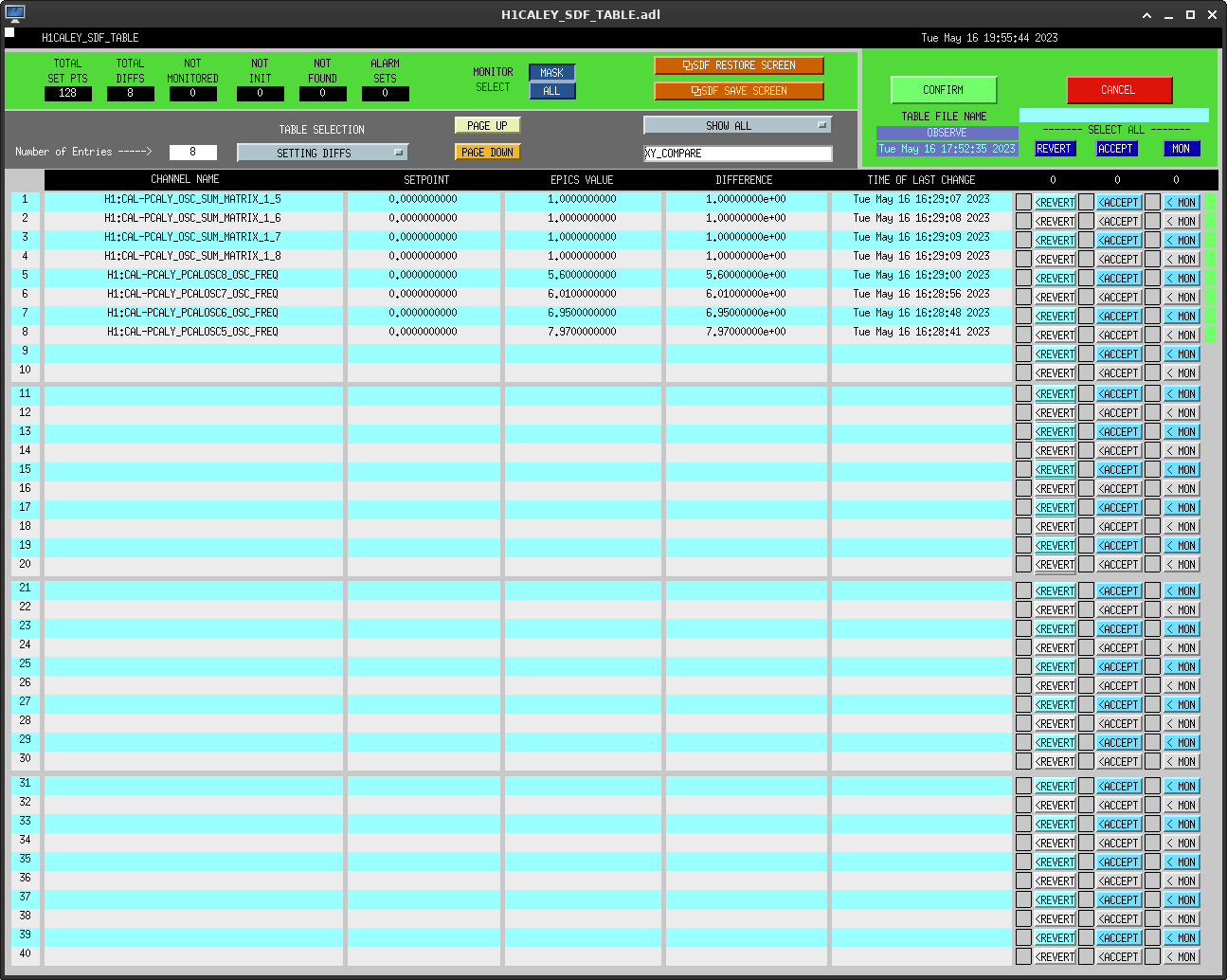
- When trying to transition to OBSERVE, I ran into some SDF diffs for CALEY - accepting, Tagging CAL
- LOCKLOSS @ 05:38 - DCPD saturation, reason unknown
- Lock #3:
- Automation failed 3x trying to ACQUIRE_PRMI, would catch for a bit then fail when the ASC engages, intervened next time around and moved PRM ~17 microradians in Y (353.3 --> 336.6) which allowed it to catch
- INCREASE FLASHES on X seems to work good, but sometimes fails to offload when flashes look good enough to catch
LOG:
| Start Time | System | Name | Location | Lazer_Haz | Task | Time End |
|---|---|---|---|---|---|---|
| 02:30 | PCAL | Tony | PCAL Lab | Y (LOCAL) | Measurements | 02:45 |
| 01:15 | GAINZ | Camilla + gang | X arm | N | Brisk 10k | 02:12 |
These PCALY SDF differences are understood (and it didn't matter whether they were accepted or reverted) -- before I left last night, I was setting up parameters for getting thermalization lines at lower frequency, as desired as a result of LHO:69593. When I left, I restored the amplitude of these oscillators to zero, so no new excitations / calibration lines went in to the detector. Thanks for aLOGging!
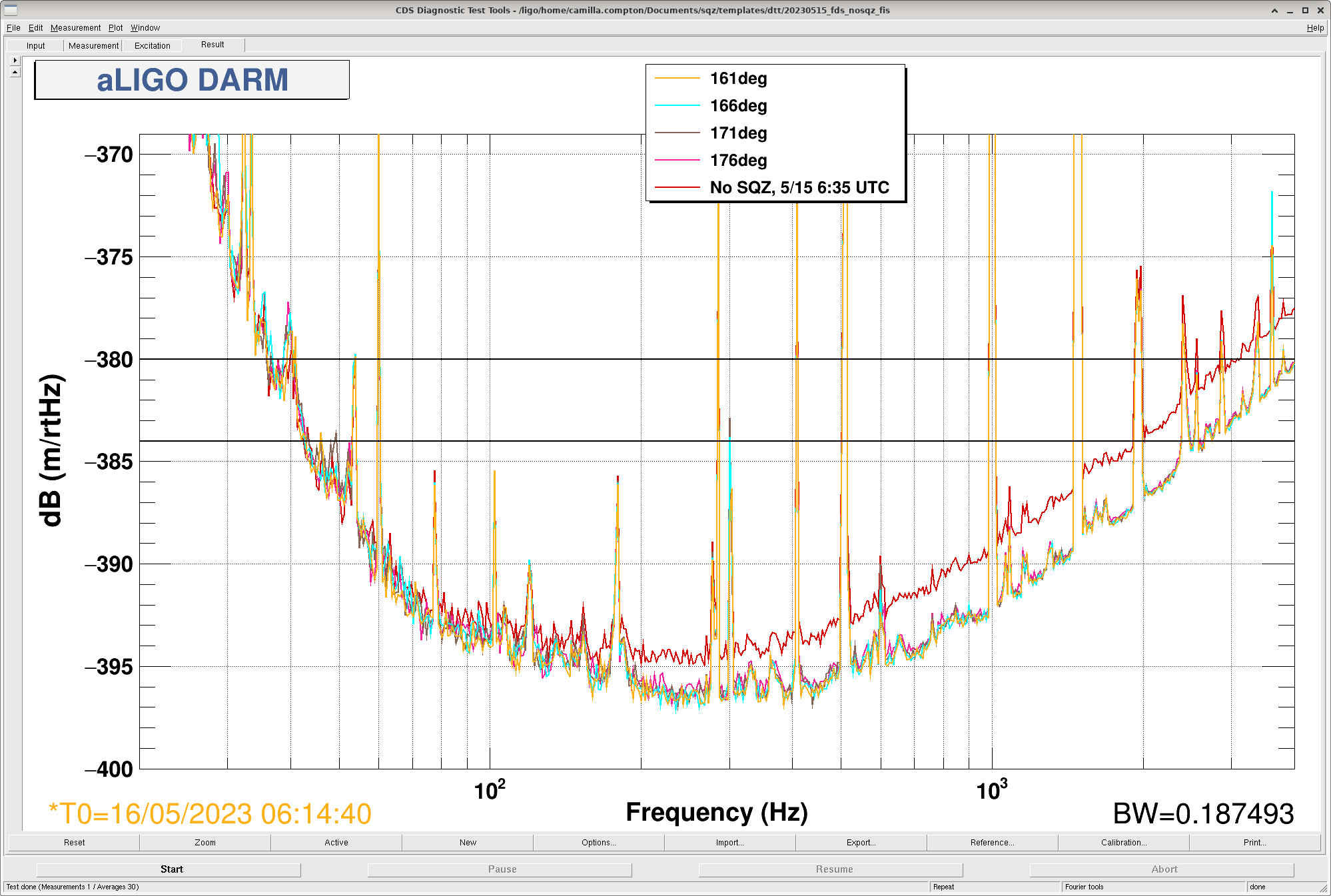
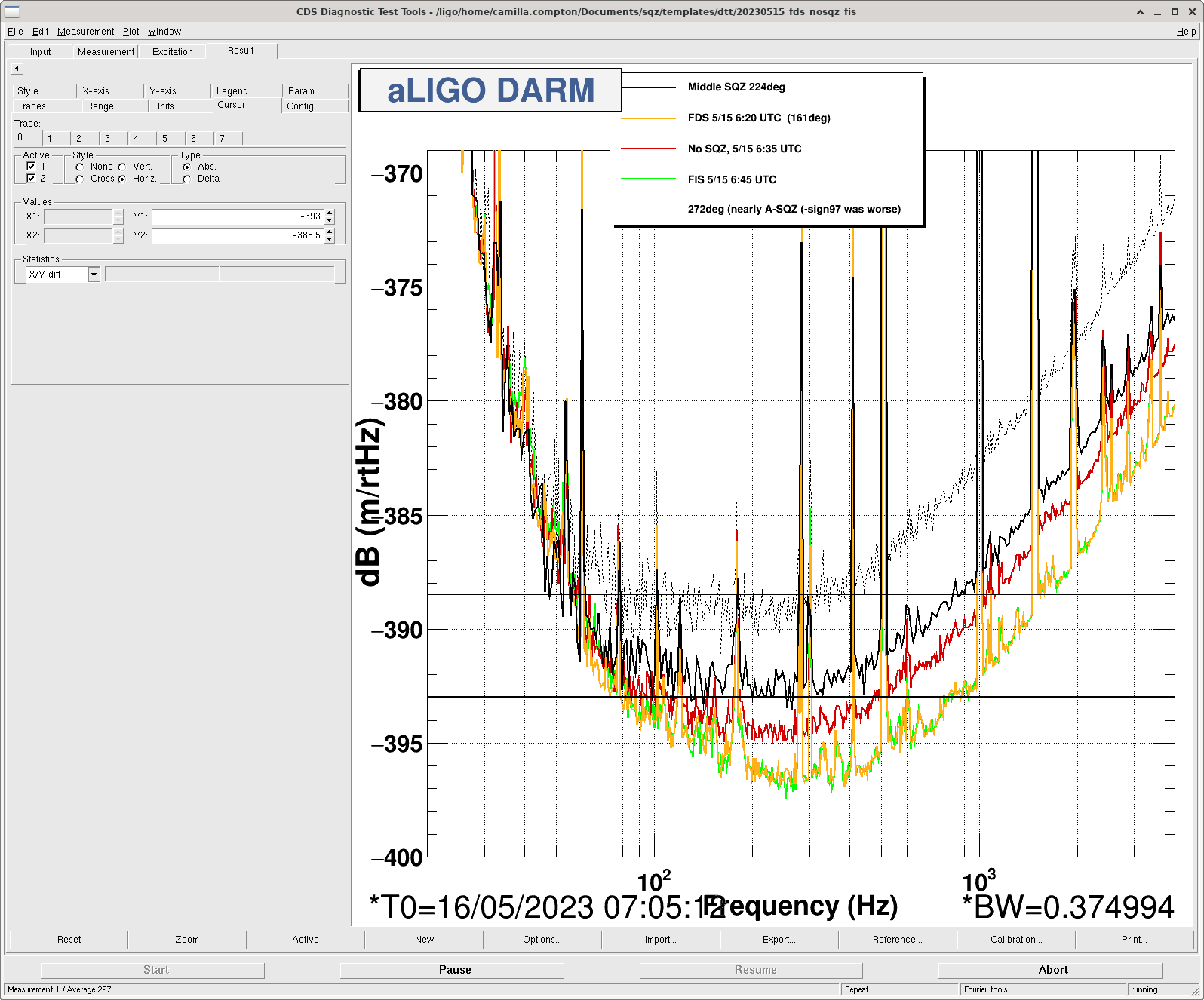
Catching up on issues since computer restarts, lvea temp drifts, and bringing SHG powers back to normal. IFO was lightly thermalizing its last 5kW in the course of these measurements, taken ~2.5-3 hours after reaching NLN. I think increasing generated SQZ levels from about 9 dB --> 14dB (NLG 4-->9) increased high-frequency squeezing by ~0.3-0.6dB.
Lockloss a while after. While IFO was down, I re-aligned fiber polarizations given the recent LVEA temp drifts:
- opo pump fiber (OPO GRD 'LOCKED_CLF_DUAL_NO_ISS', minimize in-vac rejected power H1:SQZ-SHG_FIBR_REJECTED_DC_POWER)
- clf fiber (CLF GRD 'DOWN', maximize CLF_REFL_LF_OUT_DQ)
- fcgs fiber (doesn't matter GRD state, I minimized in-vac rejected power H1:SQZ-FC_FIBR_REJECTED_DC_POWER. This one was pretty close.)
Maybe sometime we can check the SQZ ASC gain / time constant and make sure it makes sense, since its outputs seem to move a lot very quickly? Also, since IFO was still thermalizing, if we have no-sqz time with a very thermalized IFO, it might be worth re-setting the AS42 no-sqz offsets again then.
Ryan C., Ibrahim, Austin
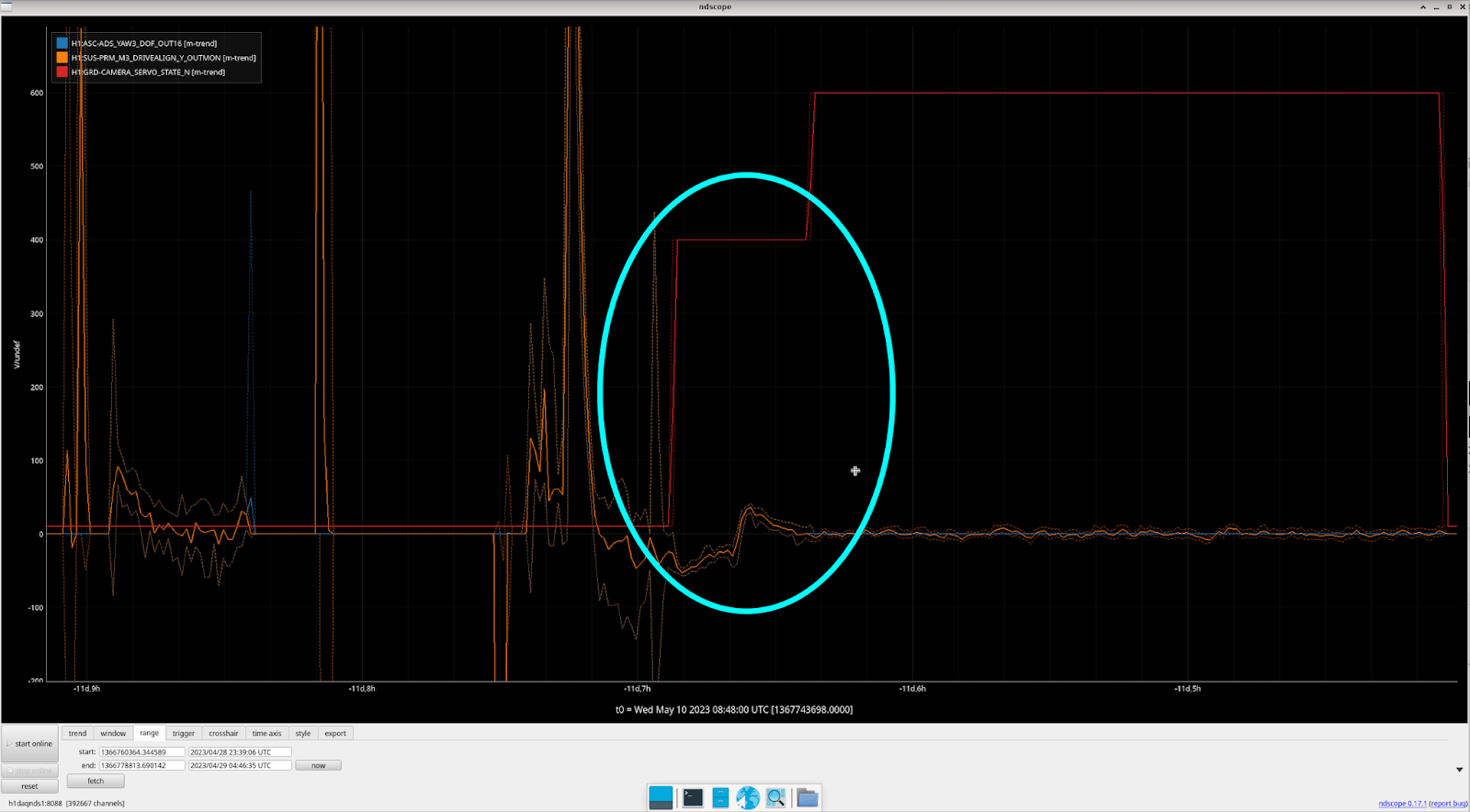
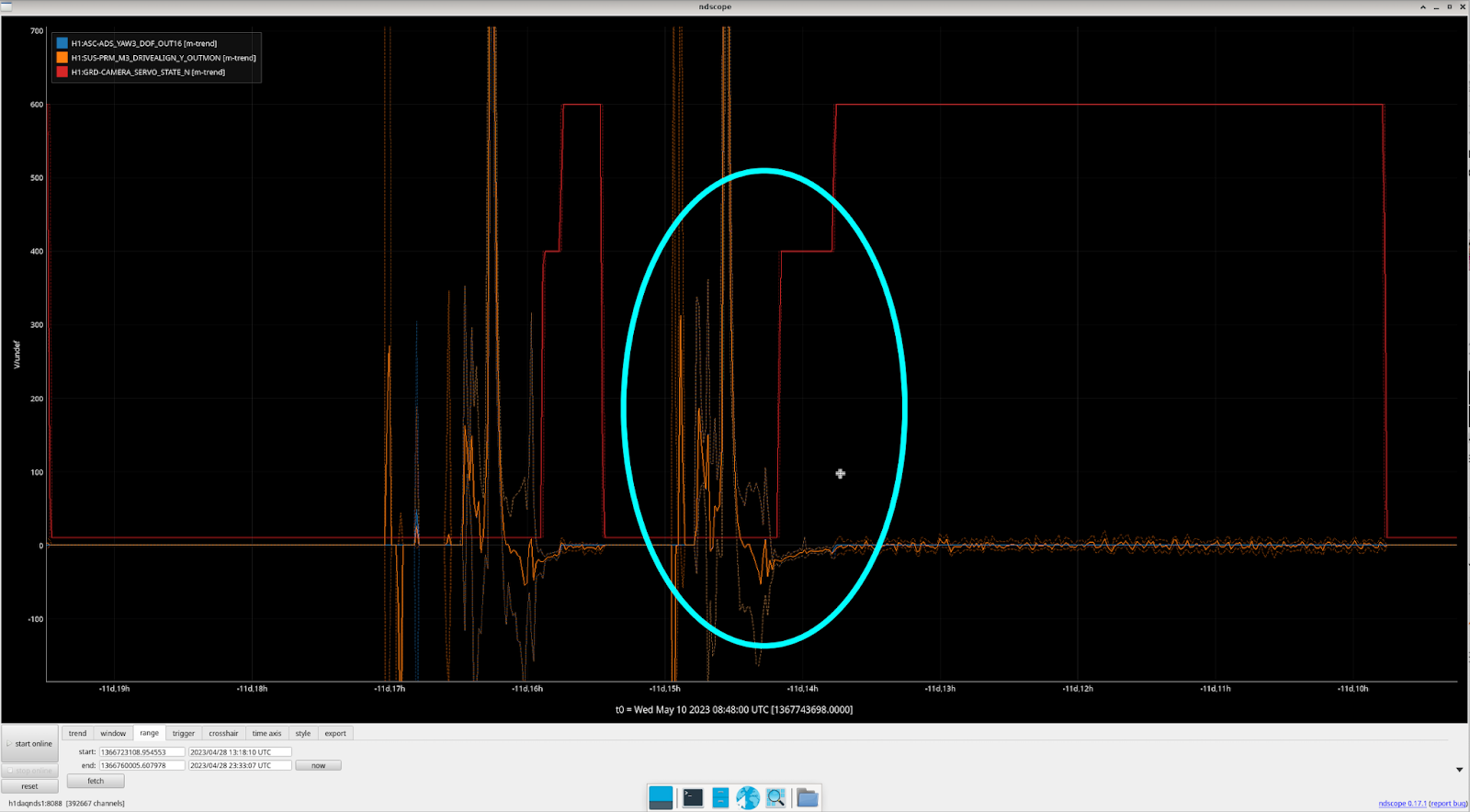
This alog is a follow up to a previous log showing that in every acquisition of NLN, particularly about 7/8 mintues in, the ADS will suddenly drift and signals (most prominent in ADS YAW 3) will start to diverge, and prevent us from going into OBSERVING for ~15 minutes per lock. The magnitude of this drift varies depending on each lock acqusition, but this has been a consistent issue for a while now. With the help of Ryan C and Ibrahim, here are our updates findings/what we looked into.
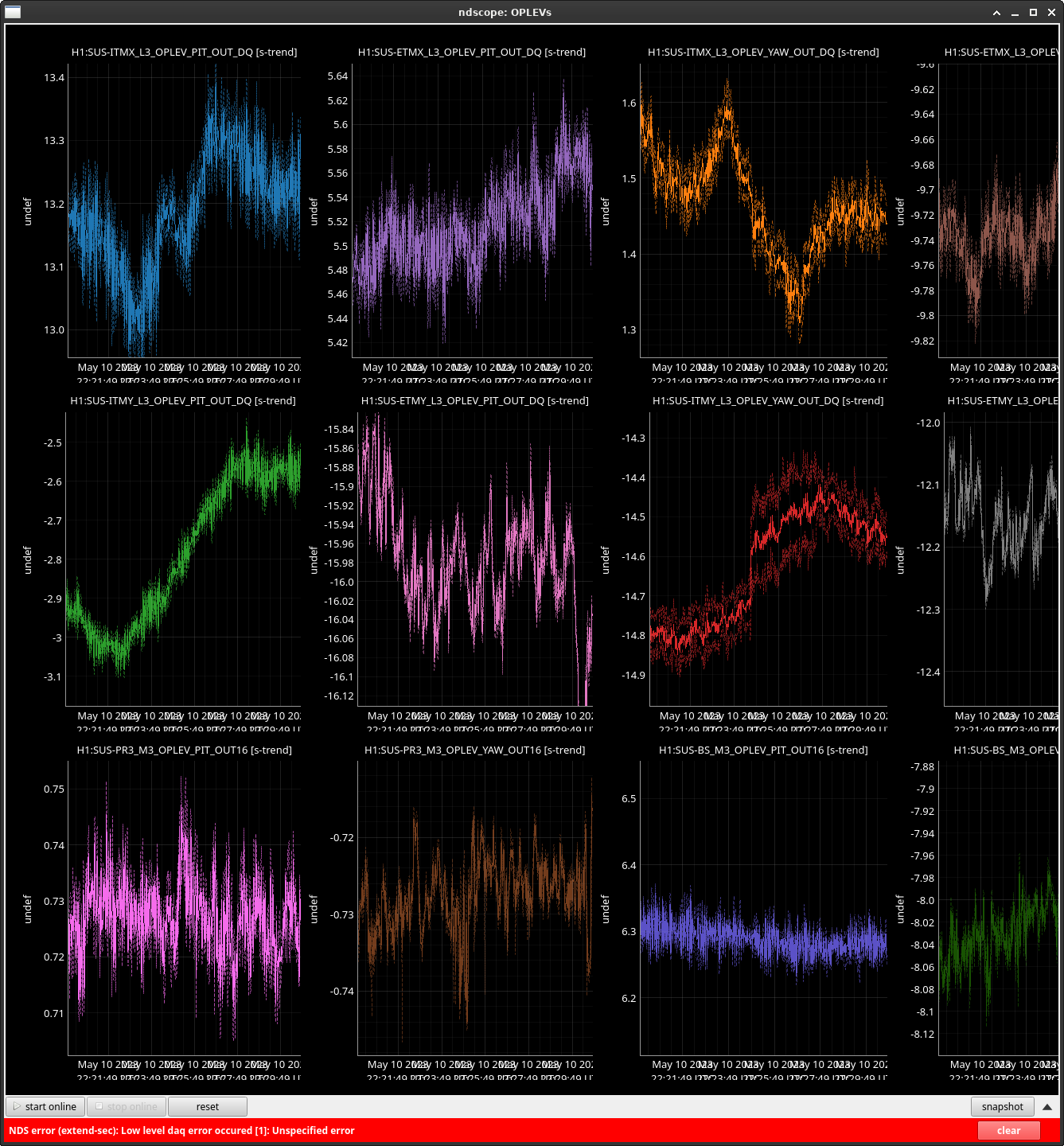
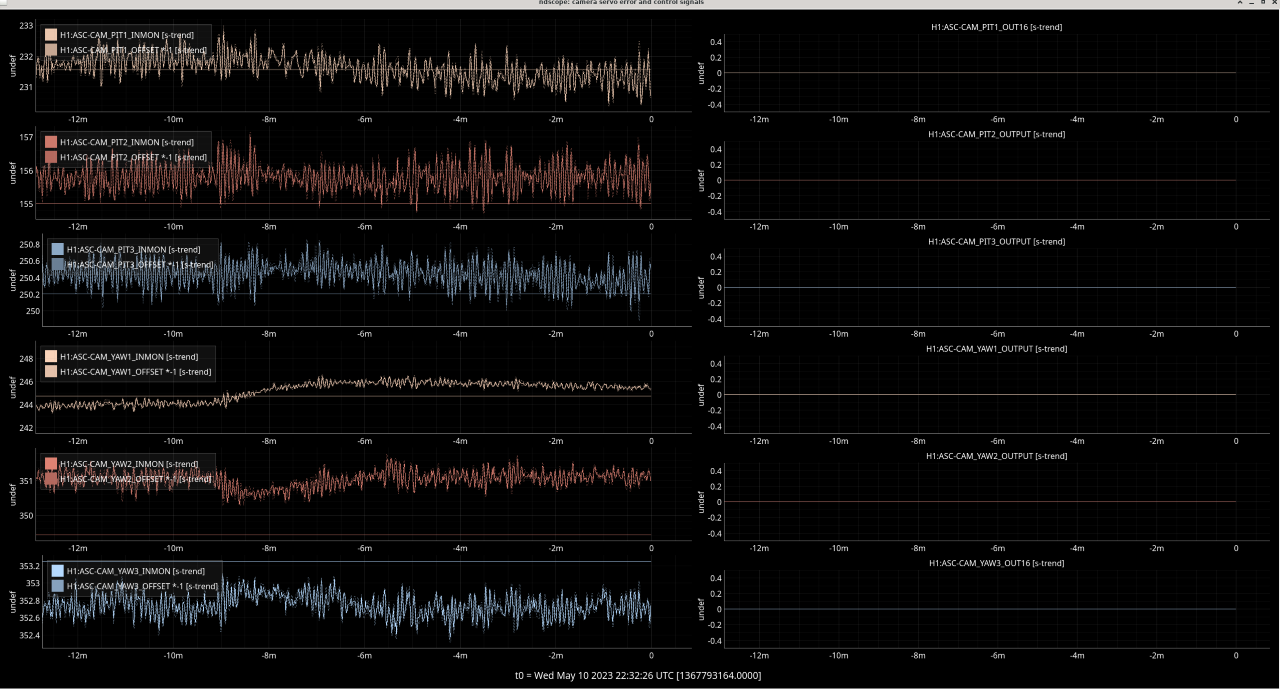
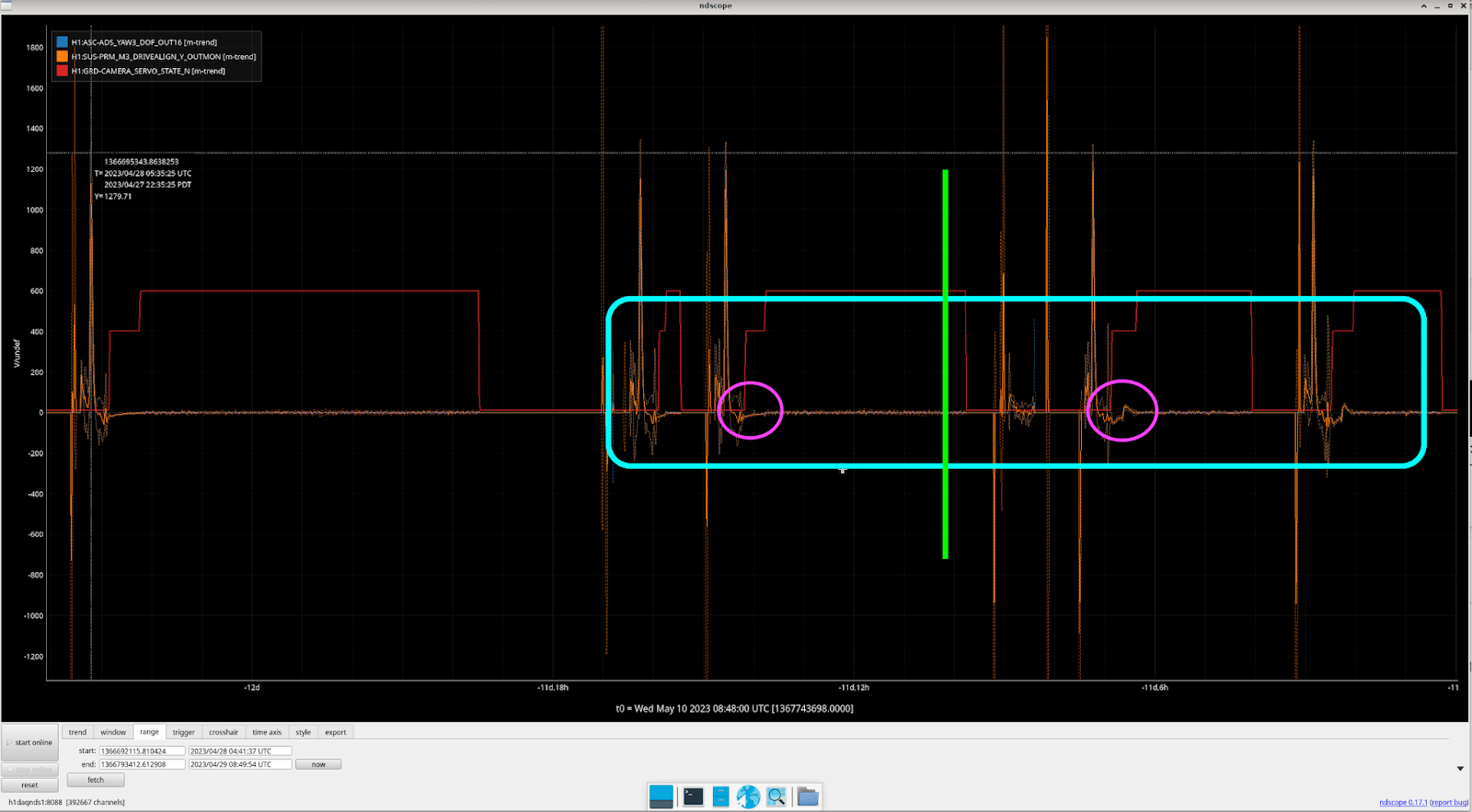
We decided to watch a "live" version of this drift when we acquired NLN and decided to trend a myriad of channels of anything we thought could be worth looking into namely: all oplevs (with the exception of SR3) - screenshot attached - (sorry for x axis looking terrible I couldn't get the scale right), ASC CAMERA SERVO/ERROR signals - screenshot attached, PRM/IM4 witness sensors (based off our findings from the previous log, we were curious how much these suspensions were moving, spoiler - not a whole lot), LSC PRC1, and ASC PRC 2. When reviewing all of these channels when an ADS kick occurred, most checked out ok, but I have attached the CAMERA SERVO error signals as that did move a bit, but not by much.
We then looked directly in the PRM suspension and tried to find any clues, and it turns out we found something interesting. We found that the PRM DRIVE ALIGN M1/M3 stages behave in the exact same fashion as the ADS drift (ss 1 / 2). Is this expected? Might be, since we know that ADS YAW 3 feeds directly into PRM. But we thought it was worth noting here.
In addition, we found something regarding the CAMERA_SERVO guardian. When the CAMERA_SERVO guardian is in state 400 - TURN_CAMERA_SERVO_ON, the issue seems to be most apparent (screenshot). This coincides with the CAMERA guardian and to us makes sense since in that state, many of the ADS settings are changed. However, there does sometimes appear to be some movement (a "dip") before the CAMERA_SERVO guardian actually gets to this state (which can be seen here). If this "dip" feature is causing the drift that we've been seeing it might not be the CAMERA_SERVO guardian since these dips happens when the guardian is in DOWN and not doing any actuation. But, it could be entirely possible that this dip feature is just a red herring too and is a biproduct of the ADS converging. But maybe worth looking into.
So when did this problem start? After trending back a couple weeks and looking at every NLN acquisition, we found that this issue started around April 28th. From the image, you can see that on the lock acquisitions before the 28th, things were mostly quiet and there were no kicks/dips on the drive align signal. But afterwards, it becomes apparent that something has changed. After doing some alog digging around this time, I saw that there was a change to the ADS gains - alog here, acutal changes can be seen here (the change was made on 4/28, but was not committed to svn until 5/6). Though, I'm not entirely convinced this is the culprit, but it might be worth to see what the ADS signals would look like at a NLN lock if we reverted these gain values.
With all this in mind, we plan to take some next steps into narrowing down the issue, by looking more into the CAMERA_SERVO guardian code, figuring out why the kick happens specifically 8 minutes into a lock, and finding other correlated signals that we might have missed (though after seeing what we saw for the better part of the past week, I'm leaning towards the issue being related to the CAMERA guardian). Stay tuned!
Extreme 1-month late post, but probably worth logging even if late. A month ago on April 16, 2023, I turned down the power on OPO REFL's RF80 PD, to not saturate the refl diode we use for opo locking. I noticed that OPO_REFL_DC_VOLTS was saturated at 10V, (like OPO_REFL_DC_POWER ~ 4.3mW), so I pico-waveplate'd to dump power away from the RF PD, towards OPO_REFL_DC_REJECTED_POWER. At first, the OPO_REFL_RF80_DEMOD_RFMON went up as the optical power decreased (bad/weird), then finally the RFMON went down as the optical power decreased, which I think is expected if we're not saturating the diode.
The IFO has been locked for ~2 hours and PEM injections are currently ongoing.
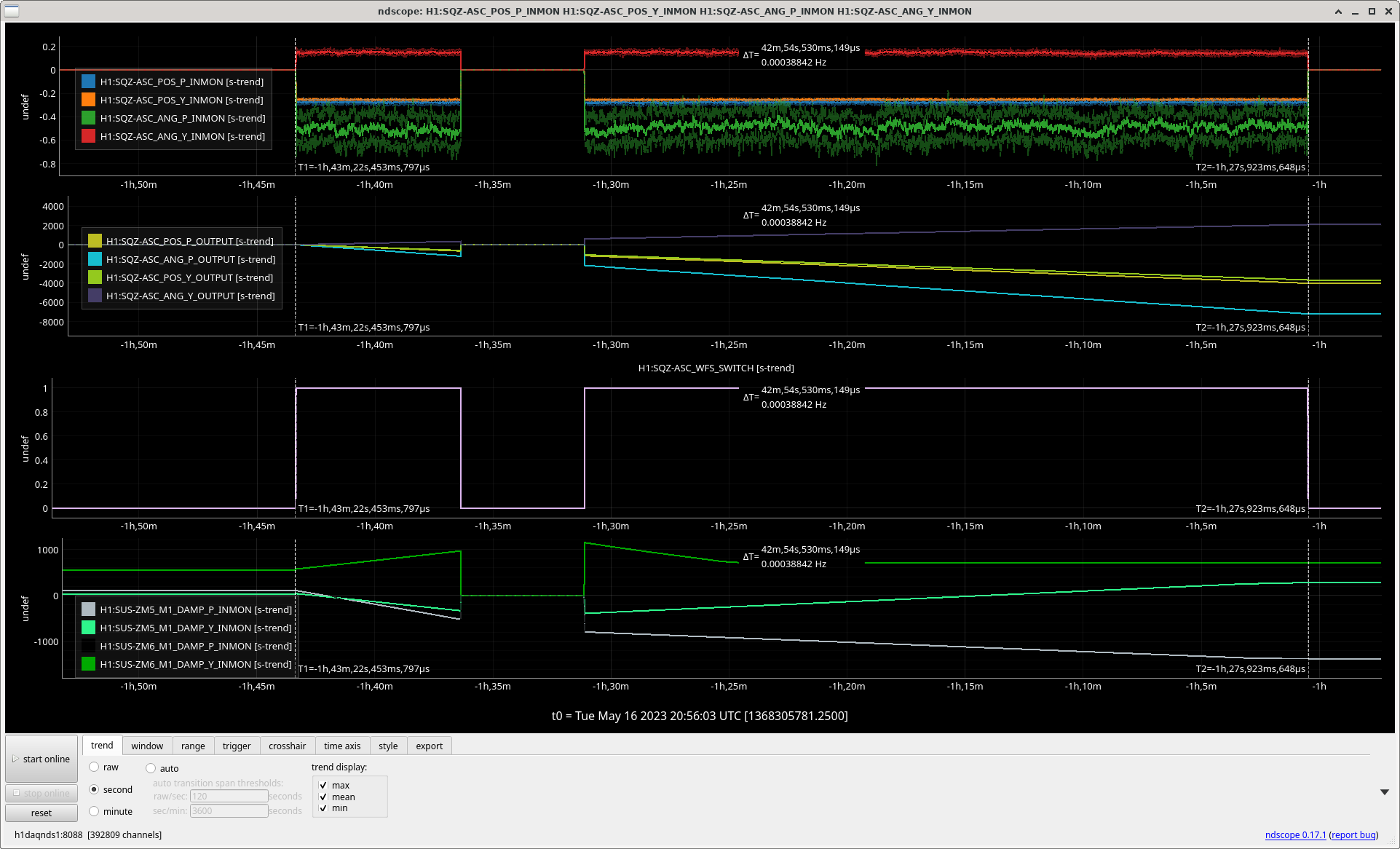
After some restarts this morning, SQZ-ASC came back online and caused SUSSQZOUT saturations from ZM5/6. See trends. It looks like the SQZ ASC switch restarted as "on", and an input signal got sent to the SQZ ASC filter banks (top trend). Our ASC filter banks integrated up this signal (2nd trend), and pushed on ZM5/6 (last trend), leading to verbal saturation alarms.
What I did: Go to SITEMAP > SQZ > SQZ ASC IFO, turn asc to OFF, and then click the "graceful clear history" purple button on top to clear the filter bank outputs. You can also go to SITEMAP > SQZ > SQZ OVERVIEW > "IFO ASC" black button in the middle >> click "OFF". Then click the IFO ASC black button to open the sqz asc medm screen to "graceful clear history".
Problem & solution: The H1:SQZ-ASC_WFS_SWITCH was not monitored in safe.snap SDF, and so it came back online as ON. I have monitored this asc switch now in safe.snap, and will accept it as "OFF" in the next opportunity. Weirdly, in Observe.snap, this asc switch is properly monitored and accepted as "ON", so everything is fine there.
TITLE: 05/16 Day Shift: 15:00-23:00 UTC (08:00-16:00 PST), all times posted in UTC
STATE of H1: Lock Acquisition
SHIFT SUMMARY:
Started Maintenance Recovery at about 1:53pmPT with (3) issues which made recovery tough, but help from Jeff & TJ we were able to get to NLN 342pmPT.
LOG:
To help fix the issue that Corey mentioned with the XARM_IR state and the LSC-POP_A_RF45_I_OFFSET, I've added into the PREP_ARM_IR state in ALIGN_IFO to make a new offset from a 5 second average after the whitening is changed.
Jennie, Sheila
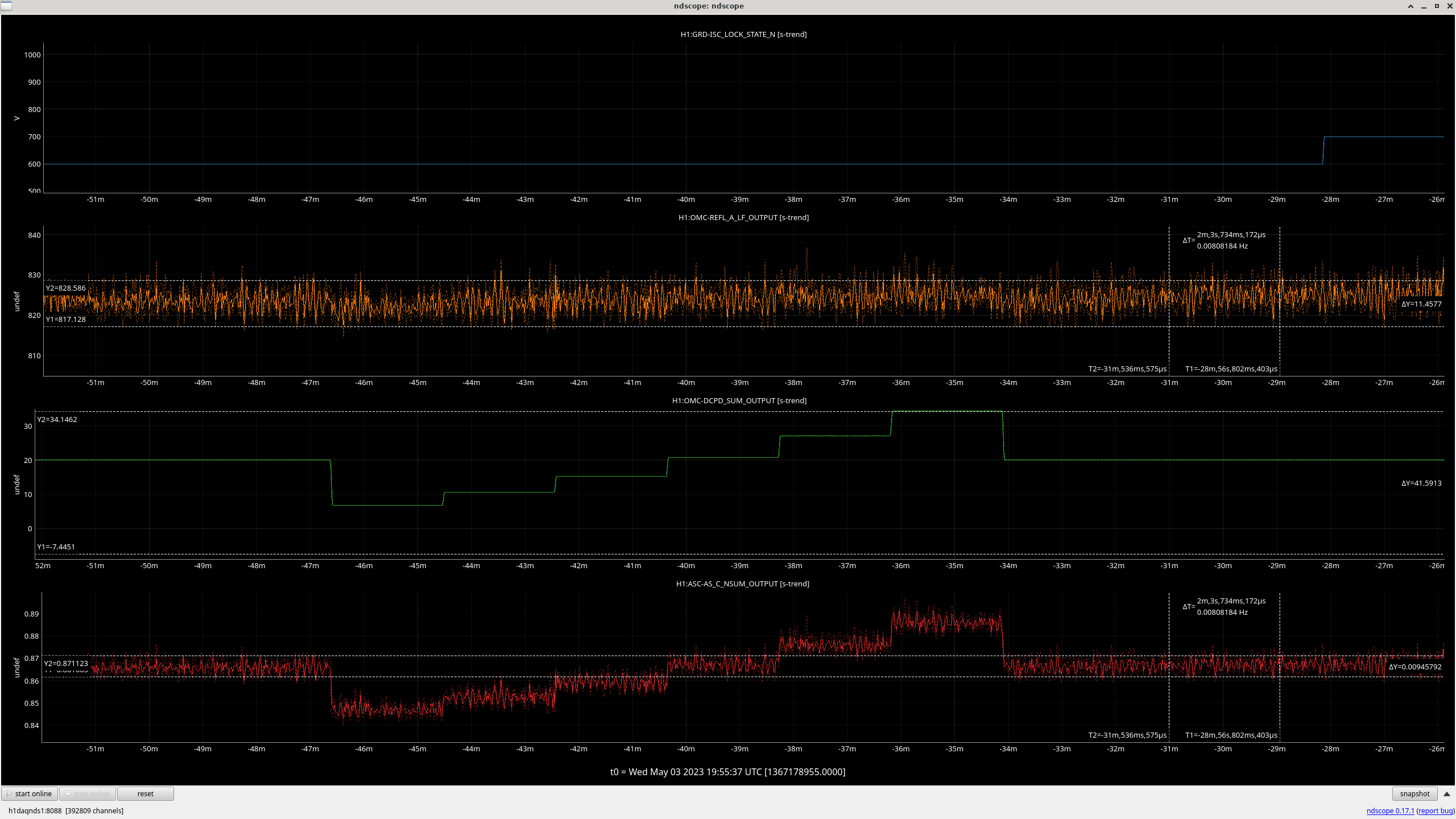
Sheila and I looked at the steps Elenna changed the DARM offset through, the last time the contrast defect measurement was taken (see LHO #69361). To get an idea of how much light seen at the anti-symmetric port (calibrated in terms of power into HAM6) is insensitive to DARM motion I plotted the scaling of the light at ASC-AS_C_NSUM_OUTPUT with DARM offset changing (OMC-DCPD_SUM_OUTPUT).
| DARM offset (mA) (OMC-DCPD_SUM_OUTPUT) |
Power out of SRC (ASC-AS_C_NSUM_OUTPUT) (+/- 0.00945792) |
Time offset changed |
| 19.91 | 0.8655 | - |
| 6.760 | 0.8467 | 1367176162 |
| 10.62 | 0.8519 | 1367176288 |
| 15.15 | 0.8589 | 1367176413 |
| 20.82 | 0.8666 | 1367176538 |
| 27.17 | 0.8755 | 1367176663 |
| 34.15 | 0.8857 | 1367176788 |
Attached is the plot (pdf) of total power into HAM 6 versus the power that gets through the OMC.
The uncertainty in the AS measurement is was estimated using the y cursors on ndscope (shown in png).
0.837W of power is predicted for no DARM offset, and 82% of the light coming into HAM 6 is sensed by the OMC DCPDs.
We also tried to use the total power on OMC REFL to do a similar calculation of the light rejected from the OMC that is insensitive to DARM motion but due the noise on this signal we made need bigger DARM offset steps to see a clear trend.
Since this measurement, whitening has been implemented on the OMC REFL PD by Daniel.
Code is Plot_OMC_REFL_2023-05-12.ipynb in /ligo/home/jennifer.wright/git/OMC_mode_matching/
Figure is in /ligo/home/jennifer.wright/git/OMC_mode_matching/figures
In the SQZ loss budget, HAM6 losses are OM1 (99.3%) OM3 (98.5%), OMC transmission (95/7% measured before installation), and DCPD QE (98% in budget, should be 99%). This gives an expected HAM6 throughput of 92%, which means we are missing 11% loss, including OMC mode mismatch and any degredation of the OMC transmission or PD QE.
See 60885 and the comment above it for a similar measurement from LLO.
Just to clarify, that's 82% of carrier light that gets through the OMC from the input of HAM 6.
Jennie W, Sheila D
We reviewed some alogs and dcc documents about OMC losses, OMC cavity scans suggest that our OMC transmission has degraded from 96% to 92%.
Testing before installation results start on page 140: T1500060 The input output coupler transmission (T) is 7690ppm, 50ppm loss per mirror.
Finesse = pi/(1-r1*r2*rloss) (approximation) with r1=r2 = sqrt(1-T) and rloss is an amplitude reflectivity that represents all the cavity losses.
round trip loss = 1-[(1-pi/F)/(1-T)]^2
cavity transmission = T^2 * (Finesse/pi)^2
I've updated the SQZ Loss wiki, if we assume the OMC transmission is 92%, our known IFO output losses become 13%, and our known squeezing losses become 19%.
Redoing the comparison above of Jennie's HAM6 throughput estimate (82%) to the 12% known HAM6 losses:
Implies that we have 7% unknown HAM6 losses, which could be OMC mode matching.
Testing documents page 143: reports 4690ppm transmission of the input and output couplers, and summing the losses 284ppm, implies finesse of 401 and cavity transmission of 96.4%
Minor comment: This line should be identical to P.140. The transmission of the input/output couplers should be 7690ppm. Did I give you a link to an old document...?
Gabriele, Camilla, Elenna
We have not updated the in-loop LSC feedforward since the increase in the DARM offset and the new SRCL offset (also small increase in MICH gain). These changes had a large effect on the feedforward, and Jenne has been able to subtract some but not all of the LSC noise using nonsens cleaning. I made three injections last night that would allow Gabriele to fit the feedforward and update the filters. I ran a MICH and SRCL injection, as well as a filter bank injection (input off, filters off, gain 1) to get the other preshaping effects in the feedforward. I did not run a PRCL injection, as we will need to update MICH and SRCL first, and then measure PRCL. The PRCL fit will depend on the MICH and SRCL feedforward.
The injection measurements are saved in "/ligo/home/elenna.capote/LSCFF".
Both new filters are labeled "5-16-23" and are placed in FM9 of MICHFF and SRCL1FF respectively. These filters should be used with a gain of 1. I updated the ISC_LOCK guardian to use these filters in lownoise_length_control.
Given that the PRCL feedforward is so dependent on MICH and SRCL FF, in the event that we are unable to implement a new PRCL FF in a timely manner, it is worth checking if the current PRCL feedforward is still improving noise or injecting noise with the MICH and SRCL update.
Unfortunatelt this made the LSC noise worse, which is the exact opposite direction we want to go. I am reverting the change.
The error was likely a sign flip. These filters should be tried one more time.
Overall, this implementation was a failure. The new SRCL filter did not work and caused a lockloss (there was a large high frequency portion of the filter we forgot to correct for). The MICH filter increases the noise in DARM. Both Gabriele and I are confused why the new feedforward has failed to improve the noise.
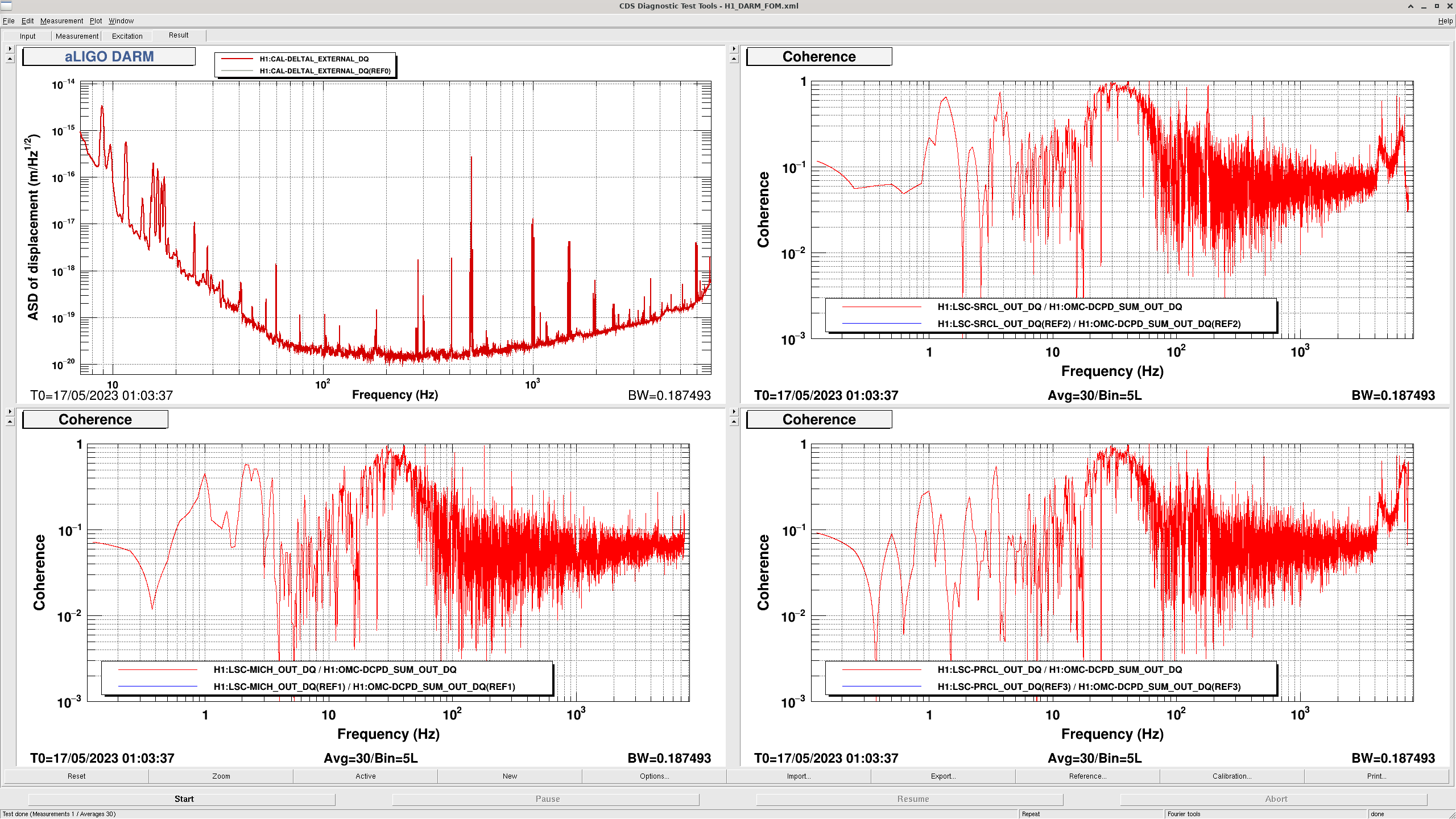
However, I think we need to try again. I am attaching a quick coherence I took from this lock, showing the high coherence from all three LSC loops. This is costing us significant range. This likely explains most of our range drop after we implemented the new DARM and SRCL offsets.
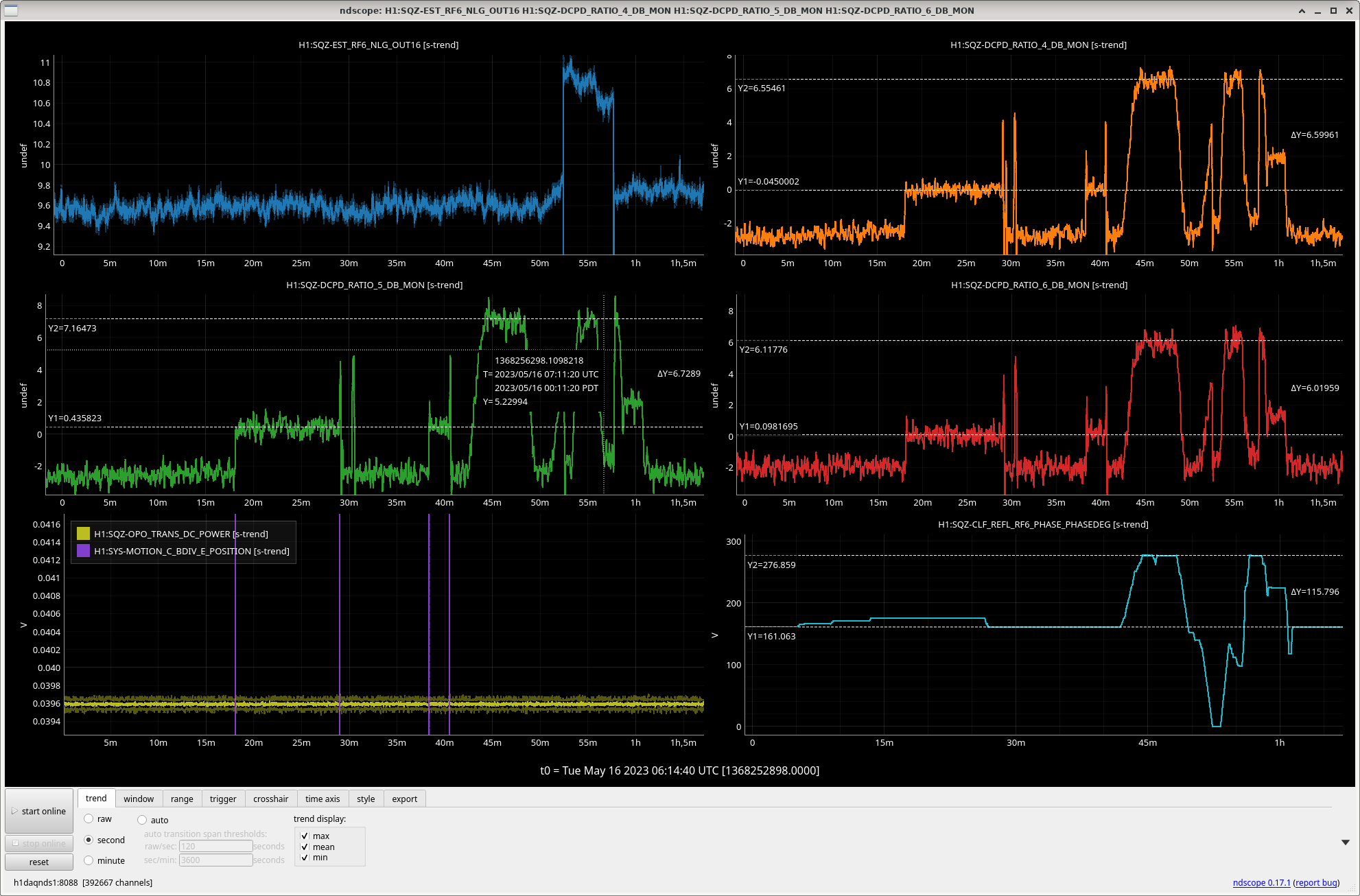
While LLO were not Observing, I took some SQZ data to help better understand our SQZ angle for future overnight tests. Our squeezing hasn't been great over the last few days, we expect as our NLG and power though the SHG have decreased, we will go onto SQZT0 tomorrow.
Naoki, Sheila, Vicky. It was great that Camilla did these meausurements last night!
OPO TRANS DC POWER = 39.6 uW. According to calibration on 2/3/23, which has been pretty trustworthy, this is about NLG = 3.92, so generated SQZ = 9.24dB.
Based on the no-sqz data at this time, IFO losses are below 35%, and more like 20-30%. These sqz/asqz levels suggest either significant 50% squeezer losses (15-30% excess sqz losses from ifo losses), or that our NLG is mis-calibrated/mis-tuned due to wrong opo temperature at the time.
If we had only the known levels of squeezer injection losses (say common 20-30% losses with ifo + additional 7% sqz injection losses, total ~30% loss), I'd expect we'd have seen ~7.5-8 dB asqz, and over -3.7dB sqzed noise reduction, which was clearly not the case.
Assuming fixed/real NLG, adjusting losses to match observed sqz/asqz. With NLG = 3.92, this gives generated SQZ = 9.24dB. To only see Anti-SQZ = 6.5dB and sqz = -2.5dB, suggests the squeezer sees 45-50% total losses, so like 15-30% excess of ifo losses.
Given these SQZ/ASQZ levels, calculate NLG and losses. Best-case for losses, an NLG=3.3 and losses 42% would be sensible. This is still excess 10-20% sqz losses from ifo losses.
What was our NLG? Today Naoki measured NLG=3.75 after several DAQ restarts. This would need about 50% sqz total losses, 15-30% excess sqz loss from ifo losses.
Potentially the opo co-resonance temperature is mistuned for red/green co-resonance, given that I'm not sure we re-tuned the OPO temp optimally with this lower NLG and the recent LVEA temperature drifts. Maybe our AS42 offsets are also bad, we have not updated them in a while, and there have been many computer restarts last week. As well, we've had FC alignment/ASC changes; we've checked for clipping but maybe with recent computer restarts it is worth double-checking. We'll check everythign again after today's sqzt0 table work, and see if we can reconcile these numbers. We can try to more often quickly check asqz/mean-sqz to better understand our losses.
I checked the logic and removed the weighted the edge between SQZ_ASC and FREQ_INDEP_SQZ in SQZ_MANAGER so it should now go straight to FIS if it is requested. It can also go between FIS and FDS as icky and I previously added.
Looking into why SQZ_FC was slow (3 minutes) getting from FIS to FDS, see attached:
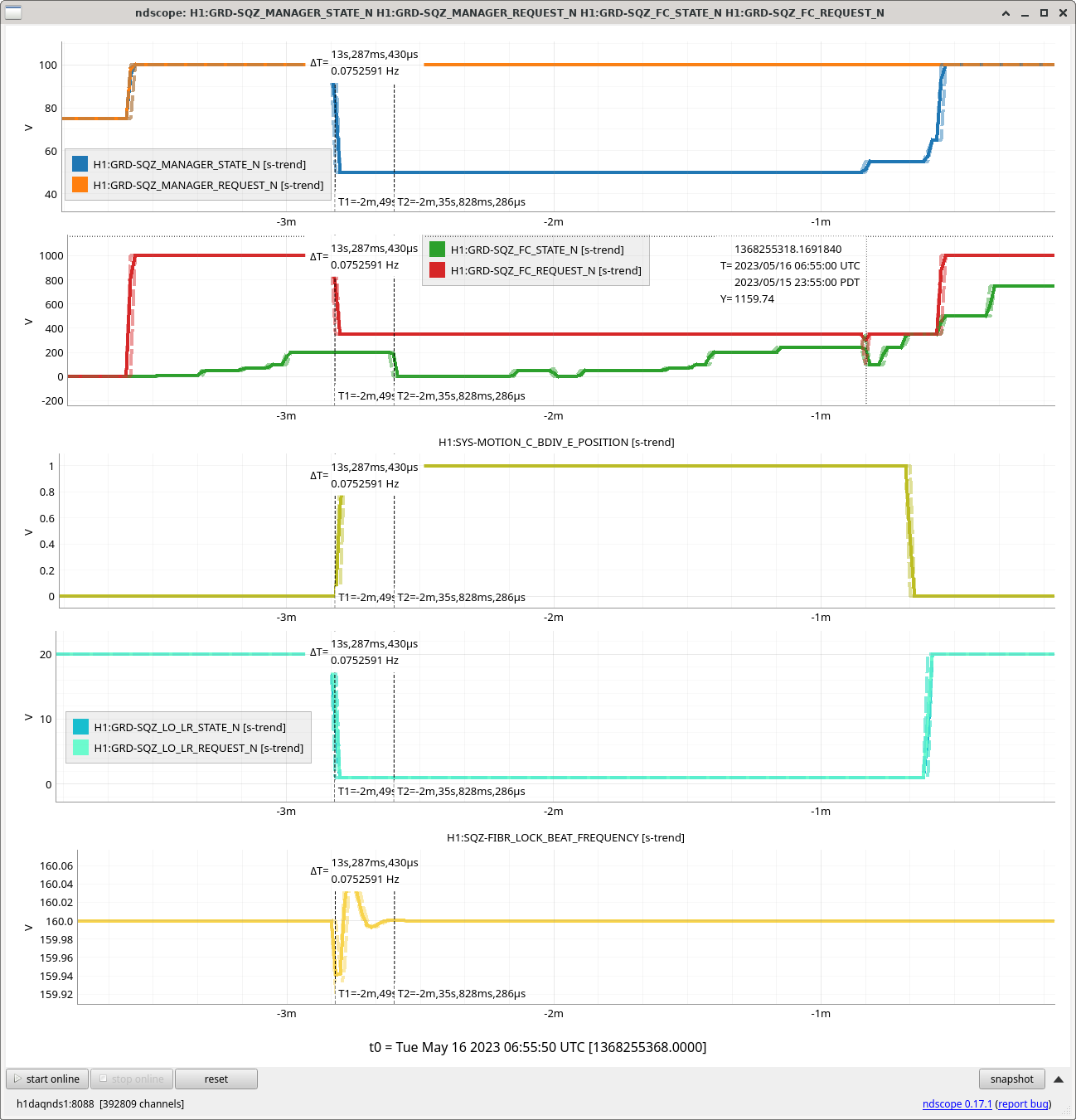
As the FC goes from FIS --> FDS, the FC guardian is bringing FC2 from MISALIGNED --> IR_LOCKED. But in the process of physically moving FC2 back, it is free-swinging, and I wonder if maybe the CLF glitches through FC resonance in this time. The CLF going through FC resonance kicks the LO loop, which kicks TTFSS, and in turns brings down the LO loop, causing SQZ_MANAGER to go back to SQZ_READY_IFO, since it looks like the LO loop failed. When we're locked next, we can check if the LO loop can stay locked while the CLF glitches through, and if it can, maybe the guardian brings down the LO loop pre-emptively even if it doesn't have to.
Maybe we don't care to switch faster between FIS --> FDS. But if we do, I wonder if we could just tune the FC out of band, as far as the RLF-CLF can go. Or, we can bring FC-IR back with bdiv closed, or open with the LO loop unlocked. If we need to do this for upcoming sqz scans, I think we can smoothen out this transition.
To comment about the losses quoted above -- I think the losses were weirdly high b/s squeezer was in a not optimal way, related to our SDF mess after computer restarts, maybe our low NLG and higher CLF powers we happened to be using for a week or so, and other semi-random technical problems that have popped up over the last 1-2 weeks. I think our previous measurements of 3.5-4dB SQZ exclude losses of order 50%, when the squeezer is operating nominally and things are "normal". But we will check asqz/sqz more regularly now, to help track losses.