Displaying reports 20221-20240 of 87728.Go to page Start 1008 1009 1010 1011 1012 1013 1014 1015 1016 End
Reports until 15:32, Friday 12 May 2023
H1 CAL (CAL, DetChar, ISC, OpsInfo)
jeffrey.kissel@LIGO.ORG - posted 15:32, Friday 12 May 2023 - last comment - 10:09, Monday 15 May 2023(69555)
Calibration Line Changes -- Increased amplitudes of H1 SUS ETMX UIM (L1) and PUM (L2) 15.6 and 16.4 Hz Actuator Kappa Lines
J. Kissel, J. Rollins

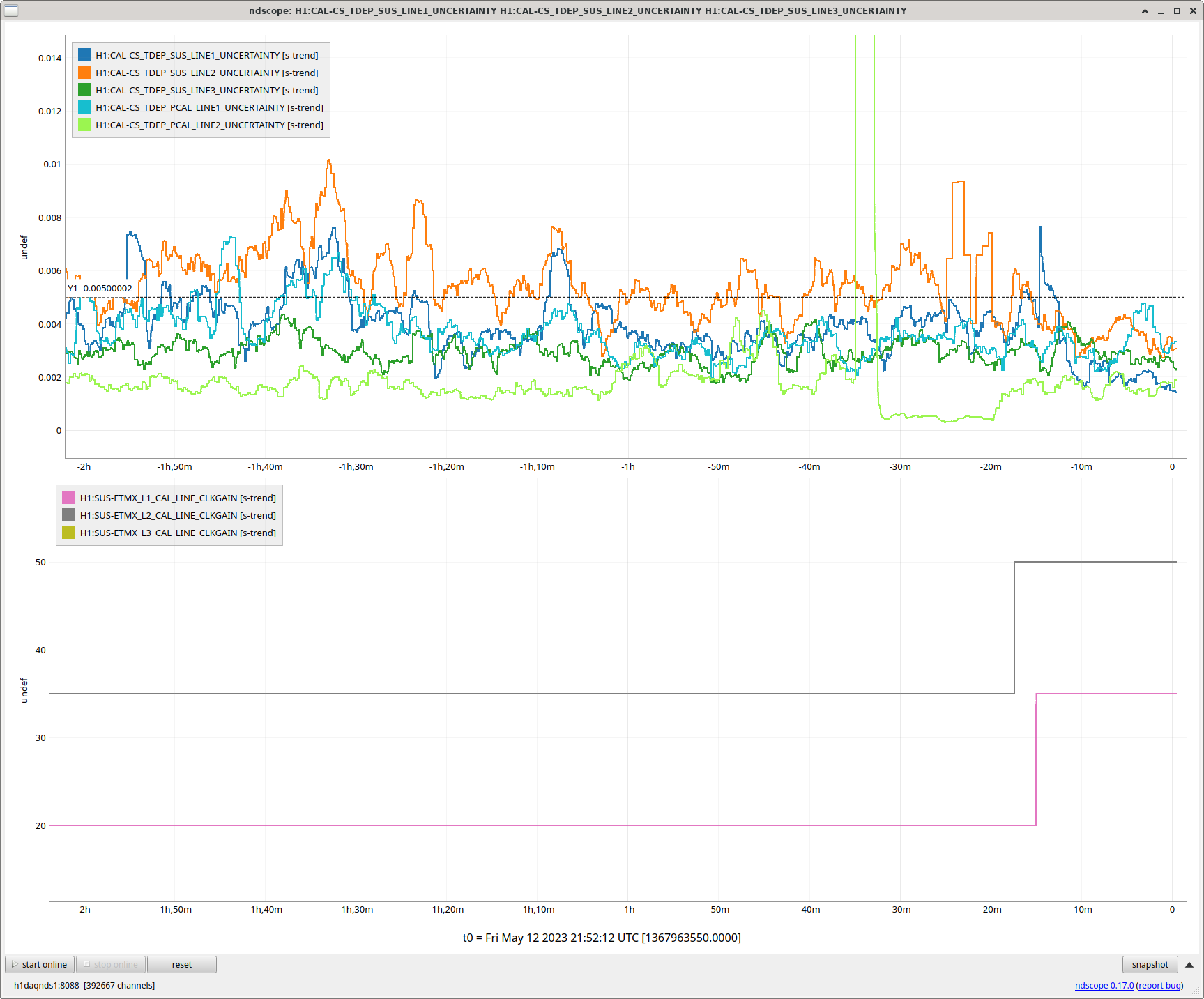
We're putting the final touches on the estimate of the uncertainty on the calibrated data stream, and have found that my factors of 3x and 4x reduction of the low frequency calibration line heights on 2023-03-30 (LHO:68289) were a little but too much of a reduction given the current status of ER15 noise, which we assume will be representative of early O4 noise. We intend for the uncertainty in the transfer function for each of the calibration lines to be less than 0.5%*** (as computed by sqrt( (1 - C) / (2 N C) ) -- where N = 13 averages using an "FFT Length," i.e. a DEMOD low pass filter with time constant of 10 sec). We've found that the uncertainty is regularly 0.8 to 1.0%, and not because of glitches in the detector noise.

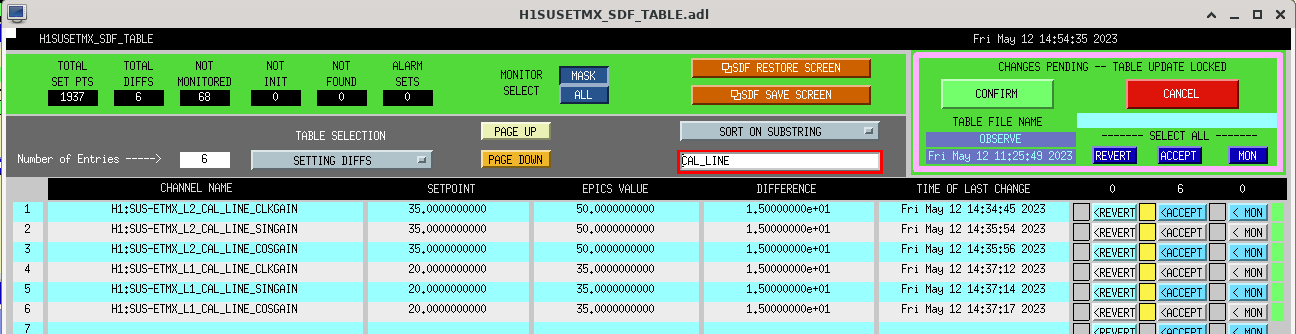
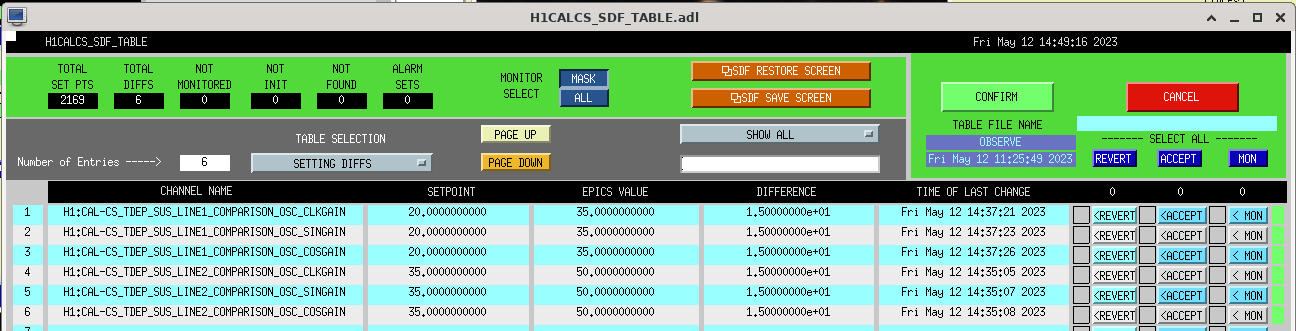
As such, I've increased the amplitude of the H1 SUS ETMX UIM (L1) and PUM (L2) 15.6 and 16.4 Hz Calibration Lines,
                                         O3-era      Mar 30      May 12       May/Mar ratio       May / O3 ratio
    H1:SUS-ETMX_L1_CAL_LINE_CLKGAIN       75.0        20.0        35.0          1.75x                0.46x
    H1:SUS-ETMX_L2_CAL_LINE_CLKGAIN      120.0        35.0        50.0          1.43x                0.41x

Attachment 3 shows how the uncertainty has improved over time with this increase in amplitude compared against 0.005, or 0.5%.

The first two attachments show what needs changing, and their acceptance in the SDF system.

*** 0.5% is, as with a lot of how the uncertainty on the time-dependent correction factors, an arbitrary threshold. The threshold was set in O3 as "when the uncertainty in the TDCFs is larger that 0.5%, then it's starting to 'substantially' impact / dominate the overall response function uncertianty, i.e. the overall uncertainty in the calibrated data stream." Where 'substantially' is defined by thinking about what the uncertainty in the calibration is at ~20 Hz == in O3 this was around 5% == so a factor of ten less than that is 0.5%. Also, since no one likes a "measurement" or "statistical" uncertainty to "dominate" an uncertainty budget (can you hear folks asking "wait, why don't you just integrate for longer?"), we increase the amplitude of these lines.

Here's the latest list of calibration lines:
Freq (Hz)   Actuator               Purpose                      Channel that defines Freq             Since O3
15.6        ETMX UIM (L1) SUS      \kappa_UIM excitation        H1:SUS-ETMY_L1_CAL_LINE_FREQ          Amplitude Change; THIS ALOG previously changed Apr 2023 (LHO:68289)
16.4        ETMX PUM (L2) SUS      \kappa_PUM excitation        H1:SUS-ETMY_L2_CAL_LINE_FREQ          Amplitude Change; THIS ALOG previously changed Apr 2023 (LHO:68289)
17.1        PCALY                  actuator kappa reference     H1:CAL-PCALY_PCALOSC1_OSC_FREQ        Amplitude Change on Apr 2023 (LHO:68289)
17.6        ETMX TST (L3) SUS      \kappa_TST excitation        H1:SUS-ETMY_L3_CAL_LINE_FREQ          Amplitude Change on Apr 2023 (LHO:68289)
33.43       PCALX                  Systematic error lines       H1:CAL-PCALX_PCALOSC4_OSC_FREQ        New since Jul 2022 (LHO:64214, LHO:66268)
53.67         |                        |                        H1:CAL-PCALX_PCALOSC5_OSC_FREQ        Frequency Change on Apr 2023 (LHO:68289)
77.73         |                        |                        H1:CAL-PCALX_PCALOSC6_OSC_FREQ        New since Jul 2022 (LHO:64214, LHO:66268)
102.13        |                        |                        H1:CAL-PCALX_PCALOSC7_OSC_FREQ           |
283.91        V                        V                        H1:CAL-PCALX_PCALOSC8_OSC_FREQ           V
284.01      PCALY                  PCALXY comparison            H1:CAL-PCALY_PCALOSC4_OSC_FREQ        Moved from PCALX 410.2 to PCALY 284.01 LHO:69354
410.3       PCALY                  f_cc and kappa_C             H1:CAL-PCALY_PCALOSC2_OSC_FREQ        No Change
1083.7      PCALY                  f_cc and kappa_C monitor     H1:CAL-PCALY_PCALOSC3_OSC_FREQ        No Change
n*500+1.3   PCALX                  Systematic error lines       H1:CAL-PCALX_PCALOSC1_OSC_FREQ        No Change (n=[2,3,4,5,6,7,8])
Images attached to this report
Comments related to this report
jeffrey.kissel@LIGO.ORG - 10:09, Monday 15 May 2023 (69591)CAL, ISC
I've modified the NOMINAL_LOW_NOISE state generator in ISC_GEN_STATES.py such that NOMINAL_LOW_NOISE in the ISC_LOCK guardian sets these L1 and L2 ETMX CLKGAINs correctly. (See LHO:69590).
H1 SQZ
victoriaa.xu@LIGO.ORG - posted 14:41, Friday 12 May 2023 (69548)
Filter cavity ASC with both WFS-ASC and beam spot control running

Naoki, Vicky

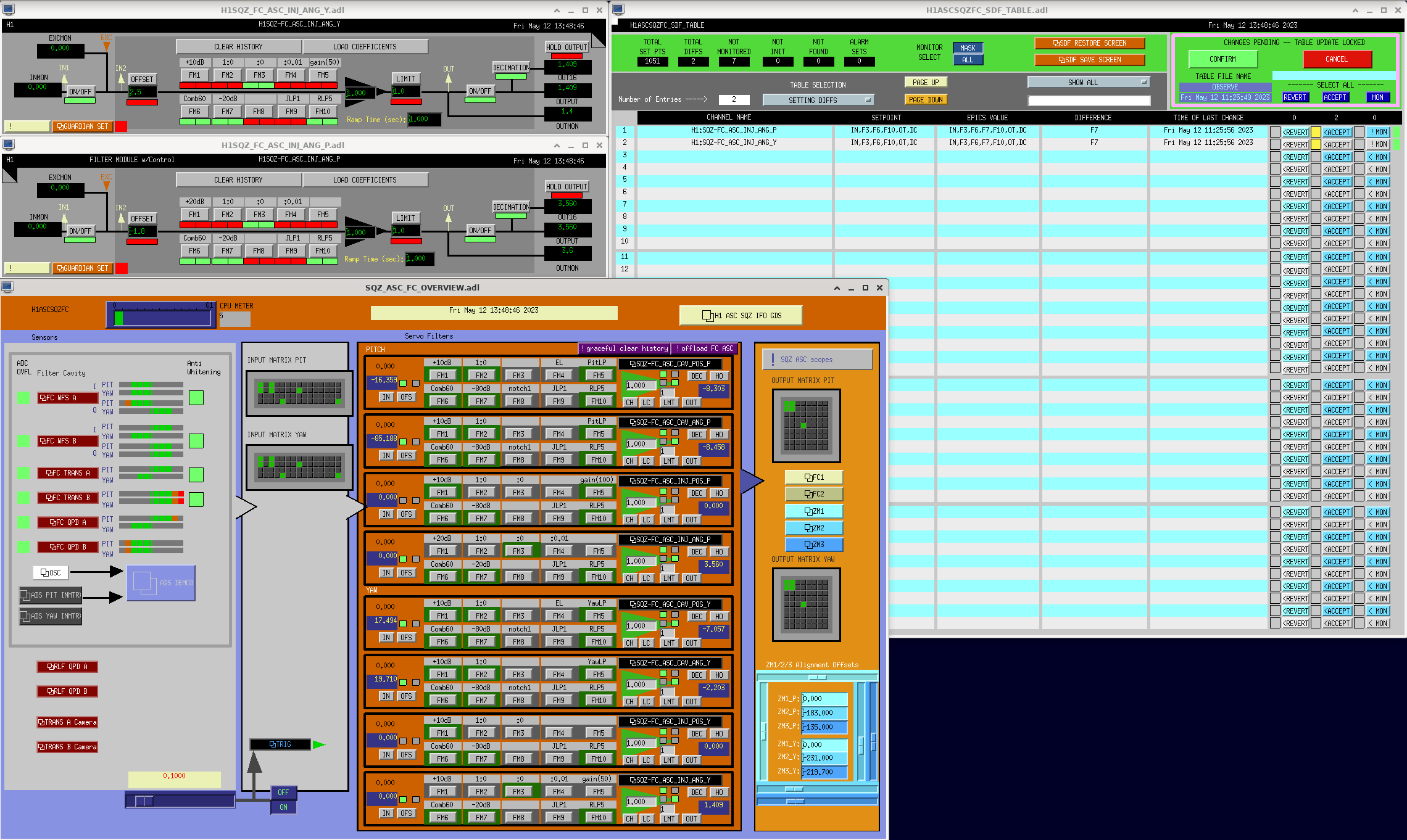
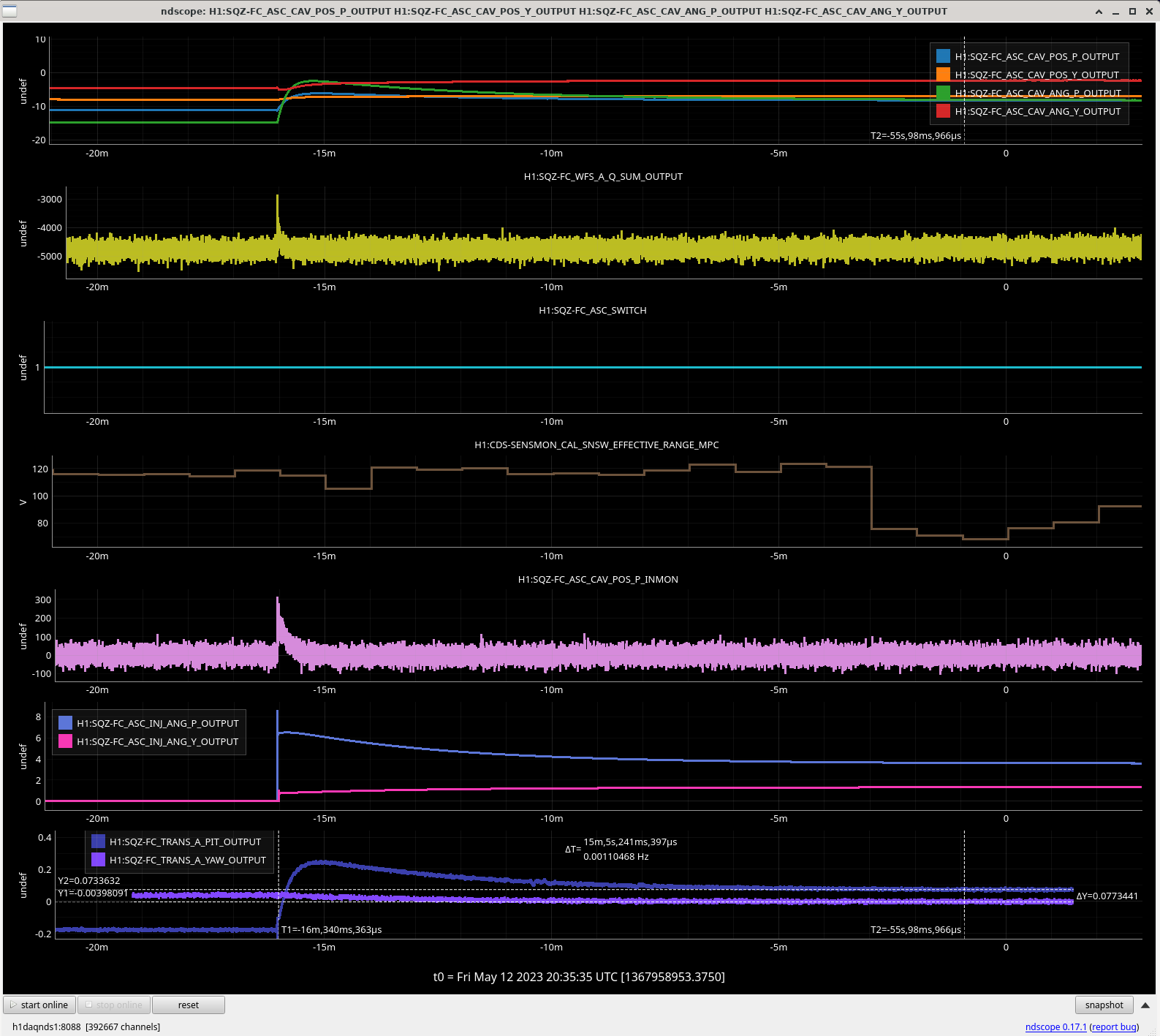
To run FC ASC with both WFS (which aligns the FC cavity axis to the injected beam using FC_WFS aka RLF_QPD) and beam spot control (which aligns the FC injection axis to a green trans QPD in FCES, FC_TRANS_A, LHO:69374), we have now adjusted the time constants of these two loops and engaged them in guardian accordingly so they don't fight each other. This involves using the -20dB (gain(0.1)) filter in H1:SQZ-FC_ASC_INJ_ANG_P/Y filter banks, now in FM7. The -20dB FM7 filter has been saved in SDFs.

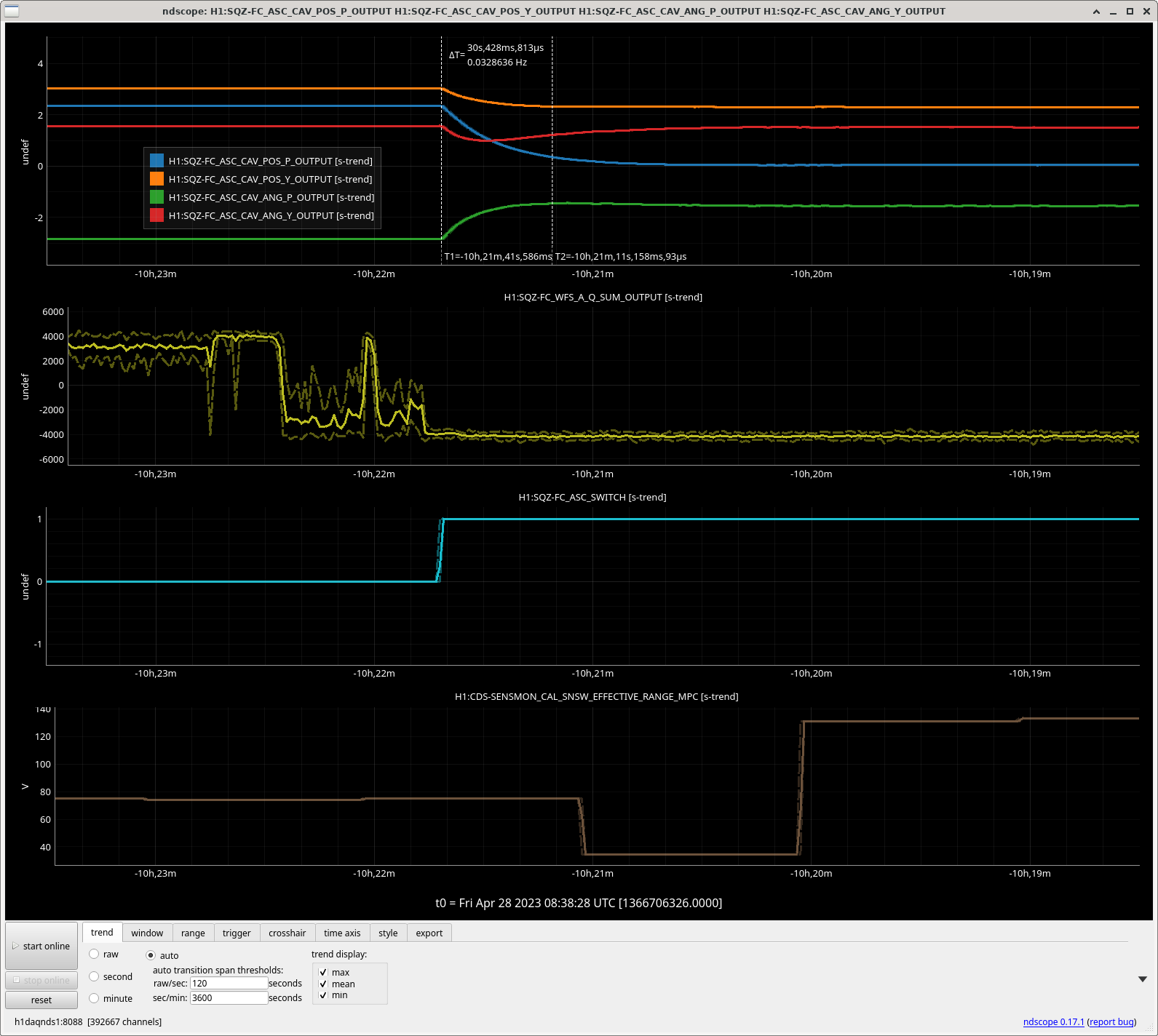
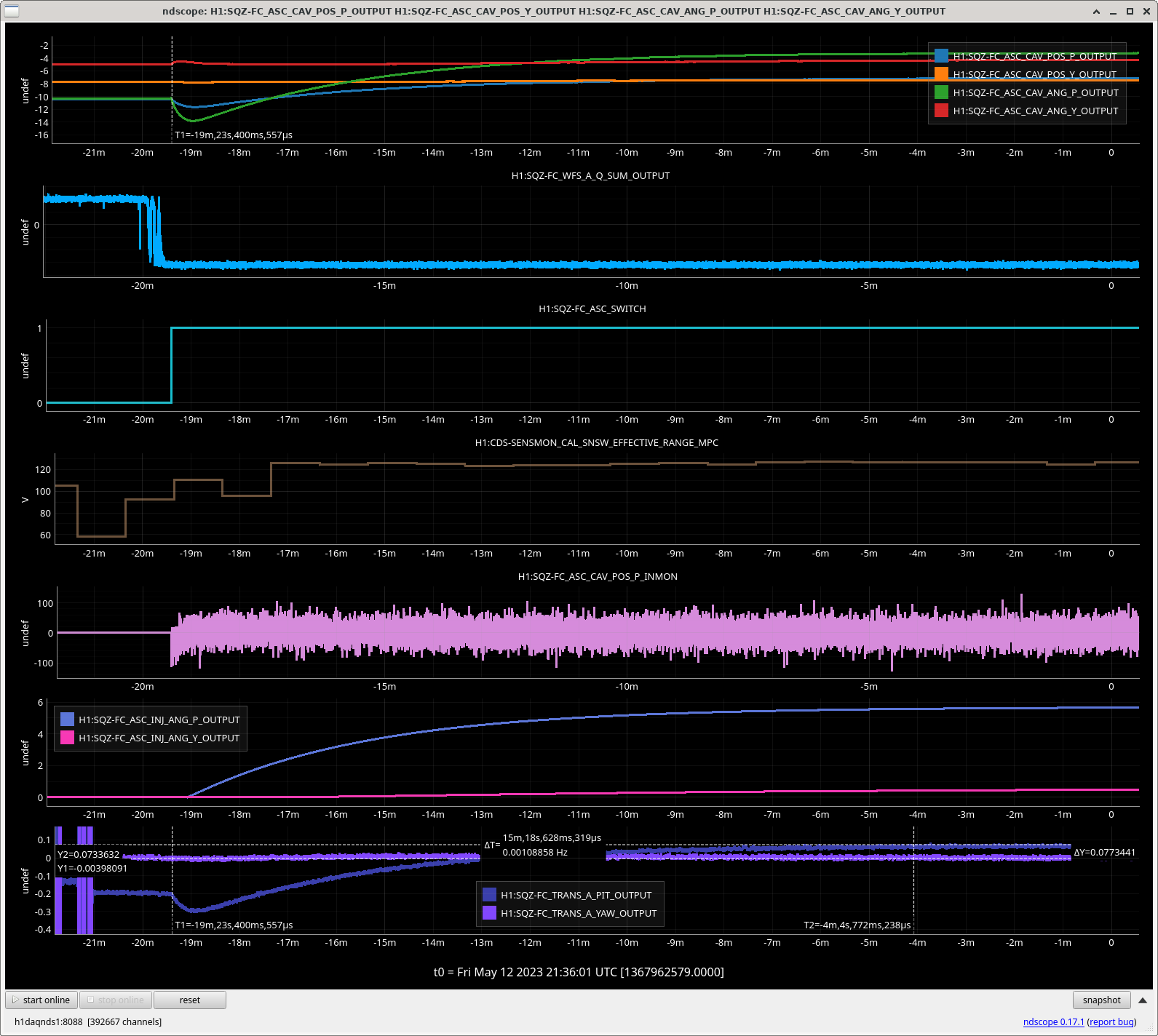
FC WFS ~ 30 seconds (here), FC beam spot control ~ 15 minutes (900 s, here)

FC guardian's "FC_ASC_ON" state now first turns on FC_WFS ASC (FC_CAV_POS/ANG_P/Y), waits 20 seconds to let the FC axis align, then turns on the ASC inputs to the beam spot control filter banks (FC_ASC_INJ_ANG_P/Y). This has been uploaded to FC guardian, and committed to SVN #25626.

Together, you can see the trends of how FC ASC is engaged here. First, FC_WFS aligns the FC axis for 30 seconds (top), then FC beam spot control spends 15 minutes aligning ZM3 to the FC-GR TRANS QPD pitch/yaw beam spot in FCES (bottom), over which time the cavity axis follows the injection axis moving accordingly.

Images attached to this report
H1 INJ
jameson.rollins@LIGO.ORG - posted 14:40, Friday 12 May 2023 - last comment - 14:56, Friday 12 May 2023(69552)
hardware injection test

We did a detchar hardware injection test around GPS 1367955315.

The status bit correct identified the presence of the injection.  However, it seems that a very long impulse response in the one of the H1CAL-INJ_TRANSIENT filter banks caused a signal to persist for many minutes after the excitation ended, which is why the blue STATUS channel above remained high out to about 20m even though the injection effectively stopped at around 15m.  Will need to interact with the calibration group to address that issue, and/or have the injection script clear the filters and shutoff the output after the excitation is done.

I also note the GraceDB upload failed, so there's some sort of auth issue that will need to be resolved there.

Images attached to this report
Comments related to this report
jameson.rollins@LIGO.ORG - 14:56, Friday 12 May 2023 (69553)

Here's an illustration of the very long step response of the filters in the H1CAL-INJ_TRANSIENT filter bank:

Images attached to this comment
H1 SUS
elenna.capote@LIGO.ORG - posted 14:10, Friday 12 May 2023 (69549)
ITMY mode 5 ringing up with damping settings

It appears that the current damping settings are ringing up ITMY mode 5, and having no effect on mode 6. I am turning off the damping gain for now.

Images attached to this report
H1 SQZ
victoriaa.xu@LIGO.ORG - posted 14:07, Friday 12 May 2023 (69547)
Monitoring SQZ alignment sliders in SDFs (safe+observe)

Naoki, (Nutsinee remotely), Vicky

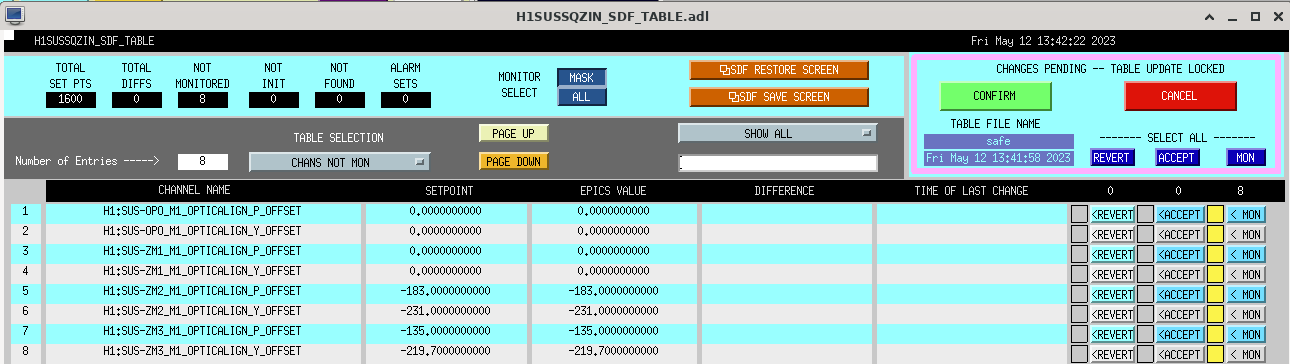
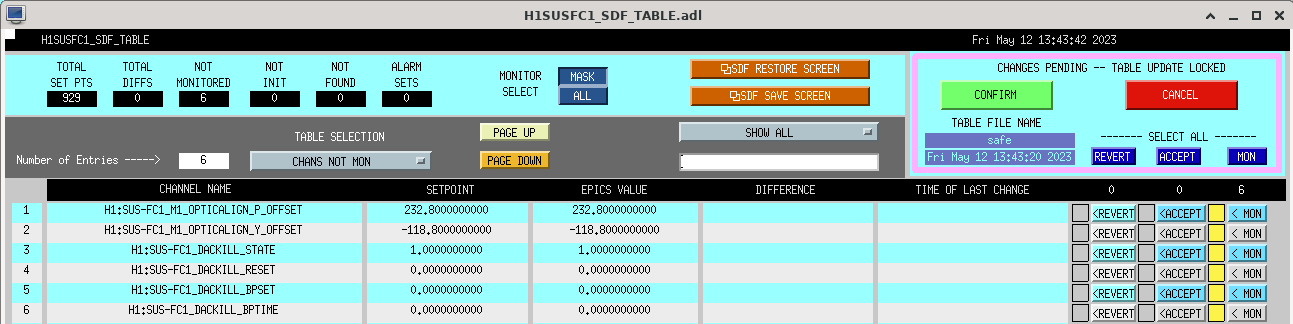
We've had issues transitioning the filter cavity IR locking this week, and we've so far tracked it down to the combination of this week's computer restarts, the addition of FC beam spot control last week (LHO:69374), and LVEA temperature drifts. Our computer issues this week seem to be because we were not monitoring our ZM+FC P/Y slider offsets in SDF, especially we were not monitoring most of these in safe.snap. We are now monitoring all ZM{1,2,3,4,5,6} and FC{1,2} P/Y slider offsets in safe.snap and in OBSERVE.snap, see attached screenshots of accepted SDF's.

Longer story of what we think happened: Computer restarts caused SQZ+FC alignments to come back online quite misaligned, with both SQZ-->IFO and SQZ-->FC misaligned, and so our SQZ LO OMC locking was unreliable, which causes the FC-IR lock handoff to fail. SQZ-ASC (on AS42) would try to realign squeezer to IFO, but at the same time FC ASC would engage, and further confused all the FC+IFO SQZ ASC. Nutsinee finding the LO struggle to lock on OMC helped find the SQZ-ASC as a problematic thing, which helped track down the ZM restart issues. Overall, this resulted in each FC-IR locking attempts aligning the whole system slightly more every time it tried to engage ASC, but quickly the FC-IR lock transition would fail in seconds as all the alignment moved, which would bring the squeezer down, and then the whole thing would start over. So, after many re-locking attempts, the incremental alignment improvements each time eventually allowed the whole squeezer alignment to converge after tens of minutes (ie, the squeezer eventually managed to re-align and re-lock itself to the IFO after tens of minutes of trying and making a little progress each time).

Images attached to this report
H1 SUS (SUS)
rahul.kumar@LIGO.ORG - posted 12:57, Friday 12 May 2023 (69544)
New settings for damping ITMY mode08 (phase and gain change)

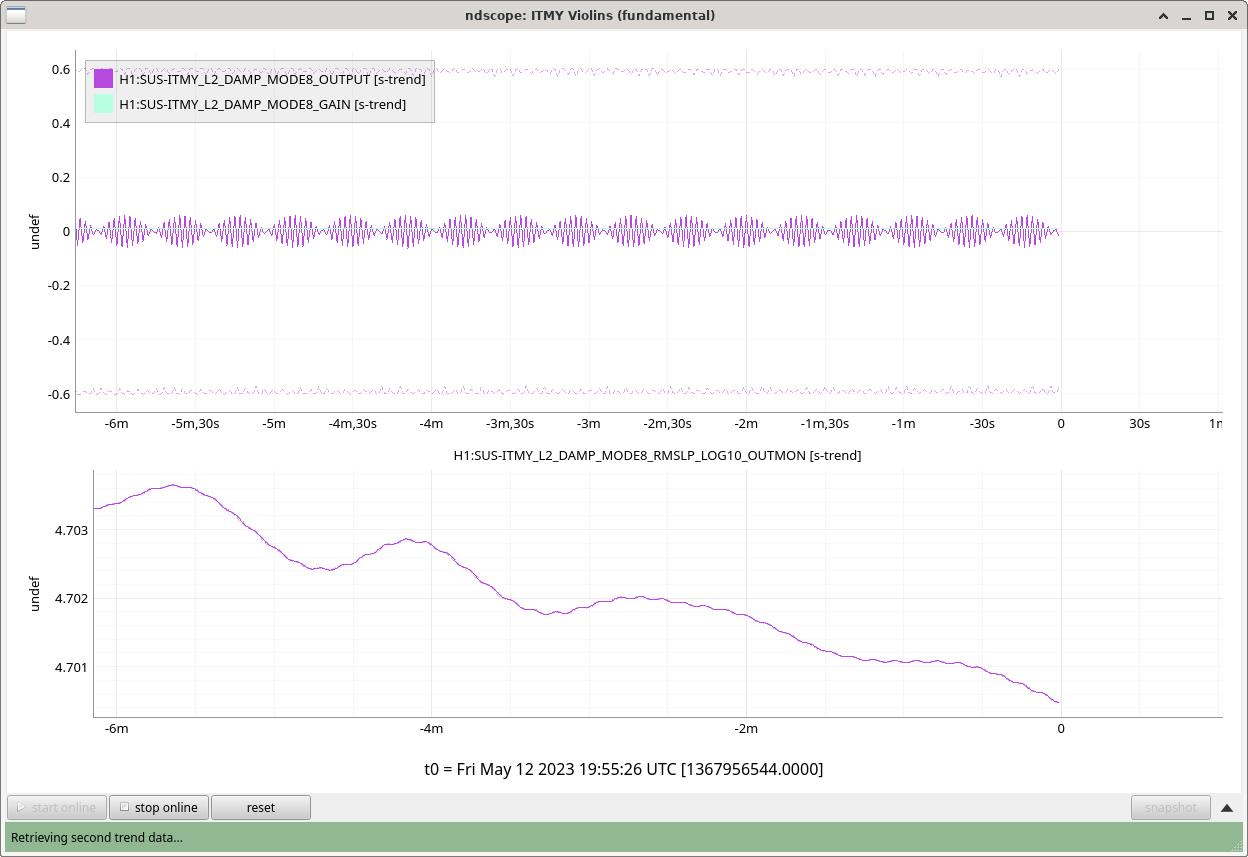
ITMY mode08 has been troubling us for the past few days as the nominal settings has stopped working. I have found a new setting which looks to be working (see screenshot attached below) - with a new phase and gain. I need to test this out for a couple of locks before making the changes in lscparams and in the SDF. The new filters and gain are shown below,

New settings: FM1 FM3 FM10,  Gain = 0.01

Old settings: FM1 FM2 FM10, Gain = -0.04

Images attached to this report
H1 CDS
david.barker@LIGO.ORG - posted 12:01, Friday 12 May 2023 (69543)
Updated Pulizzi remote AC power control EPICS IOC

Ryan S, Erik, Fil, Dave:

We continue to have some issues with the CER pulizzi unit, currently it is very slugish in responding to commands. I have added more delays in the IOC code, and an additional scan after each command to verify the outlet status. This seems to work, but has slowed commands to 4 seconds on all units except CER, which takes 8 seconds to complete.

Until we roll out the second units at the end stations, I have taken them off the MEDM and cleaned up the layout (see attachment)

Images attached to this report
LHO FMCS
thomas.shaffer@LIGO.ORG - posted 11:49, Friday 12 May 2023 (69542)
HVAC Fan Vibrometers FAMIS

FAMIS23805

Two days ago one of the fan units tripped off in the corner station, some the other vibrometers saw the effects of this coming on and off. Since then fans 1 and 2 have looked more noisy. Outbuilding units show no change.

Images attached to this report
H1 CAL (CAL)
richard.savage@LIGO.ORG - posted 11:30, Friday 12 May 2023 - last comment - 16:27, Monday 15 May 2023(69539)
H1 Pcal calibrations updated

DriptaB, TonyS, RickS

The following commands were executed to update the calibrations of the Pcal Tx and Rx laser power sensors at both end stations:

caput H1:CAL-PCALX_FORCE_COEFF_RHO_T 8334.52
caput H1:CAL-PCALX_FORCE_COEFF_RHO_R 10692.3

caput H1:CAL-PCALY_FORCE_COEFF_RHO_T 7157.80
caput H1:CAL-PCALY_FORCE_COEFF_RHO_R 10652.5

These changes increase the calibrations of the Pcal sensors (ct/W) by 0.603 % in response to recent calibration of Pcal transfer standards by NIST and PTB in Germany.  Details of the rationale for the update can be found in LIGO-G2300471, slides 13-18.

This change will result in a 0.063% increase in inspiral range (about 0.84 Mpc).

The changes have been accepted in SDF.

Comments related to this report
jeffrey.kissel@LIGO.ORG - 16:27, Monday 15 May 2023 (69615)DetChar, ISC
There's a typo in Rick's statement
This change will result in a 0.063% increase in inspiral range (about 0.84 Mpc).

It should read
This change will result in a 0.603% increase in inspiral range (about 0.84 Mpc).

Where I confirm this with other statements in the aLOG:
    (a) assuming that he quotes our range at 140 Mpc, and thus the 0.84 Mpc parenthetical above is from 140 Mpc * 0.603% = 140 Mpc * 0.00603 = 0.84 Mpc
    (b) the statement just prior, saying "These changes increase the calibrations of the Pcal sensors (ct/W) by 0.603 %"
and that the math checks out -- that an increase in PCAL force coefficient translates to an increase in detector sensitivity -- based on historical educational material in LHO:52837.
H1 INJ (CAL, INJ)
evan.goetz@LIGO.ORG - posted 11:22, Friday 12 May 2023 (69536)
Updating calibration of the hardware injection paths
As O4 approaches, we will begin running the CW hardware injections soon, perhaps starting next Tuesday maintenance. A crucial part of the injections is calibrating the hardware injection excitation point (note that this calibration may drift, especially if the splitting ratio of the photon calibrator optical follower servo changes, so nominally one would compare the actual injection waveform on the RX or TX PD with the recovered one in strain). I am revisiting the measurements made in LHO aLOG 46848 to update the hardware injection actuation function for CW hardware injections.

As a reminder, the hardware injection path sees the following:
                                                            V              W     N                 1      m     h
[ 61 usec delay x 61 usec delay x AI(d) x 61 usec delay x ----- x AI(a) x --- x --- x sus.norm x ----- x --- x --- ]
                                                           cts             V     W                f^2     N     m

The terms AI(d), AI(a) are the known digital and analog anti-imaging transfer functions, respectively, that we can model in pyDARM; sus.norm, 1/f^2, and m/N are pieces from the SUS dynamical model for the L3 stage of the QUAD suspension; N/W is the watts-to-force transfer coefficient 2*cos(theta)/c where theta is the angle of incidence and c is the speed of light in a vacuum; V/cts is the DAC calibration for the Pcal system 20 V / 2^18 cts; and h/m is the strain per meters, essentially 2/(L_x + L_y). So the remaining term we need to know is the watts per volt of the photon calibrator.

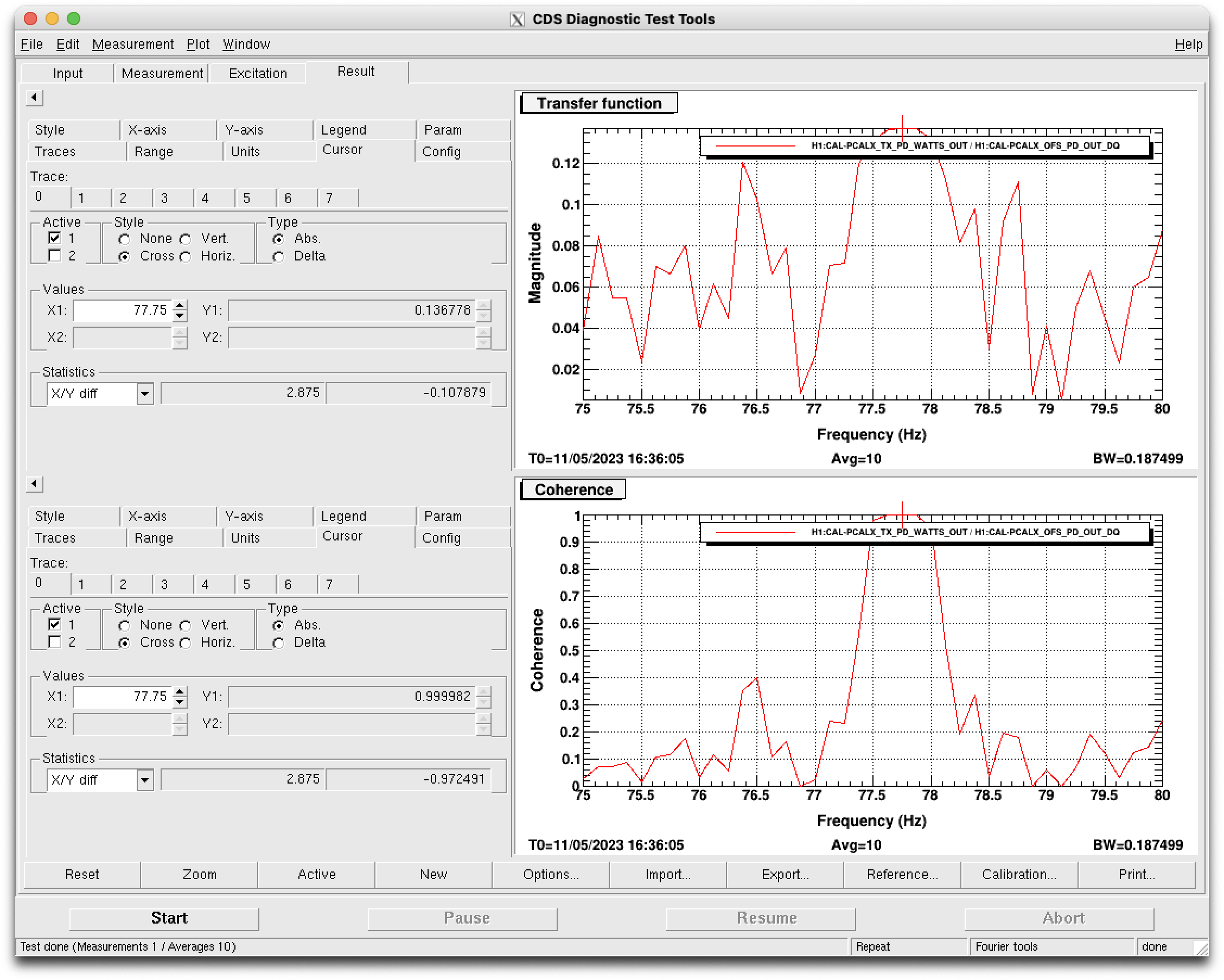
Historically, I calculated this value through a series of calculations and a single transfer function measurement (e.g., LHO aLOG 46846), but now this is a lot simpler due to some front end improvements. Now I can take a transfer function measurement and get the results directly from that measurement H1:CAL-PCALX_TX_PD_WATTS_OUT / H1:CAL-PCALX_OFS_PD_OUT_DQ, using 10 averages and BW setting of 0.1 Hz.

Attached is a screenshot of that transfer function, where I zoomed in on one of the systematic error calibration lines, 77.73 Hz. The coherence at the closest bin, 77.75 Hz is very high (>0.9999) and the resulting transfer function magnitude is 0.136778 W/V. Compared to the previous value of 0.13535, this is a change of just over 1%.

I then used an up-to-date pydarm_H1.ini file with this new value for pcal_etm_watts_per_ofs_volt = 0.136778 to generate an actuation function file attached to this aLOG. The main difference is the new calibration of the W/V value and to remove a DC scaling of the AI(a) of 0.99. These two effects combine to change the DC calibration of the excitation point by 2%.

The next step, not yet done, is to update the CAL INJ filter bank values with updated numbers in the filter banks FM6 antiAIaGain (change to 1.0) and FM7 cts/N (change to 1.4539e13). I am not sure the current value in the FM3 N/m value is correct, if I calculate the m/N value at 1 Hz for the x-arm TST stage, I get a value of 0.00156554 m/N ==> 638.75611903 N/m, which is significantly larger than the current value of 382.954.
Images attached to this report
Non-image files attached to this report
H1 INJ
jameson.rollins@LIGO.ORG - posted 10:40, Friday 12 May 2023 - last comment - 08:27, Tuesday 29 August 2023(69537)
hardware injection infrastructure cleanup

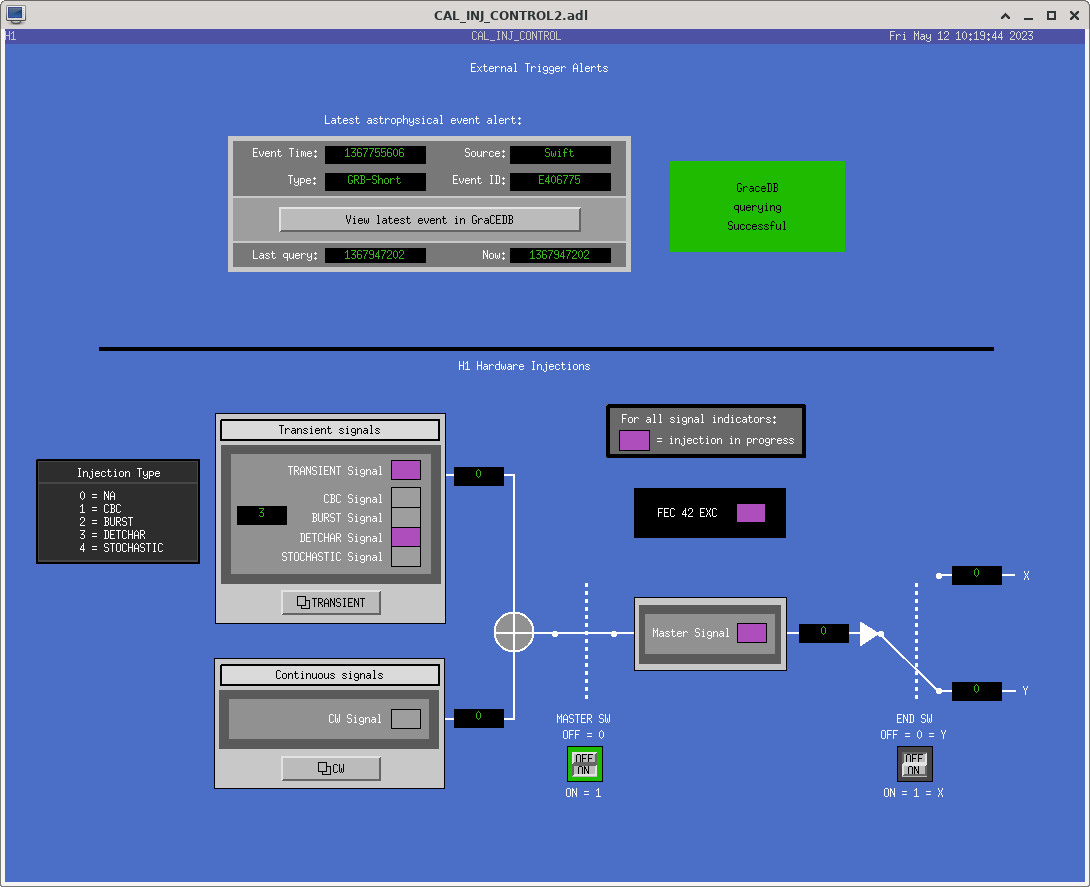
I went through the hardware injection screens (CAL_INJ_CONTROL2, PCAL_END_EXC) and cleaned them up based on the way that we're now handling hardware injections

I then did some test injections and confirmed that all the status bits were working as expected.  Here's an example of the screen with an active "detchar" injection (as labeled by the H1:CAL-INJ_TINJ_TYPE record):

The H1:CAL-INJ_STATUS bit word (purple indicators) behaved correctly, and reset appropriately when the EXC was stopped.

Images attached to this report
Comments related to this report
jameson.rollins@LIGO.ORG - 11:40, Friday 12 May 2023 (69541)

I also note that the H1CALINJ_INJ_TRANSIET filter bank was found to have most of it's filters disengaged.  TJ previous determined that all the banks should be engaged.  I re-engaged all the fitlers and SDF accepted the change.

jeffrey.kissel@LIGO.ORG - 08:27, Tuesday 29 August 2023 (72502)CAL, INJ
I've committed the changes to the PCAL_END_EXC.adl screen (removing the HWINJ master switch, and choice switch for which end-station to drive) to the svn under 
    /opt/rtcds/userapps/release/cal/common/medm/
        PCAL_END_EXC.adl

as of userapps svn repo rev 26171.

Same goes for 
    /opt/rtcds/userapps/release/cal/common/medm/
        CAL_INJ_CONTROL2.adl
committed to rev 26173.
H1 ISC
daniel.sigg@LIGO.ORG - posted 10:27, Friday 12 May 2023 - last comment - 09:04, Monday 15 May 2023(69535)
OMC_REFL whitening

Two stages of whitening were enabled for the OMC-REFL_A photodetector.

The slow controls DC readout is very close to +10V and sometimes saturates. The fast DAQ has more headroom and should be fine. If not the analog PD gain should be reduced to 10dB.

PS. OMC_REFL_A is using the old DCPD whitening chassis: Only the 24dB gain step works, all others will short the output. Filter stage 2 is not a whitening stage. 

Comments related to this report
daniel.sigg@LIGO.ORG - 14:31, Friday 12 May 2023 (69550)

Here is a spectrum of the OMC_REFL PD with 2 stages of whitening. Looking at the violin modes around 500Hz the signal is about a factor of 10 stronger (in Watts) in the OMC-DCPD_SUM compared to OMC_REFL_A.

Clearly visible are the 32Hz and 40Hz lines as well as 2 lines around 100Hz, see also alog 68078. Maybe these lines are added by the AM stabilization circuit for the 45MHz sidebands?

Non-image files attached to this comment
daniel.sigg@LIGO.ORG - 15:15, Friday 12 May 2023 (69554)

A lot of acoustic coherence with PSL accelerometers.

Non-image files attached to this comment
daniel.sigg@LIGO.ORG - 09:04, Monday 15 May 2023 (69588)

Some comments to the possible coupling mechanism:

  • The RIN of the 32Hz signal in OMC-REFL_A is a few ppm. So, this would be a relatively small effect at the EOM.
  • Since changing the modulation frequency doesn't change the location of the 32Hz line, this is not RFAM that is produced indpendent of the EOM.
  • One coupling mechanism would be that the polarization is modulated by acoustic noise which in turn modulates the modulation index through the polarization dependence of the Pockels cell.
  • Maybe more likely is that one of the electronics components forming the tuned circuit (coil?) are acoustically driven at the 45MHz electrode. This in turn may modulate the modulation index directly, or change the load impedance seen by the RFAM stabilization circuit. The control signal of the 45MHz RFAM stabilization circuit sees the 32Hz line indicating that it adjusts to the change of the load impedance and could be partially or fully responsible for what we see in the fluctuations of the modulation depth.
  • The control signal of the 9MHz modulation does not see any acoustic lines.

The EOM mount was changend on Sep 6, 2022, see alog 64882. Looking at the pics one can see the coils just sitting there.

LHO VE
david.barker@LIGO.ORG - posted 10:14, Friday 12 May 2023 (69534)
Fri CP1 Fill

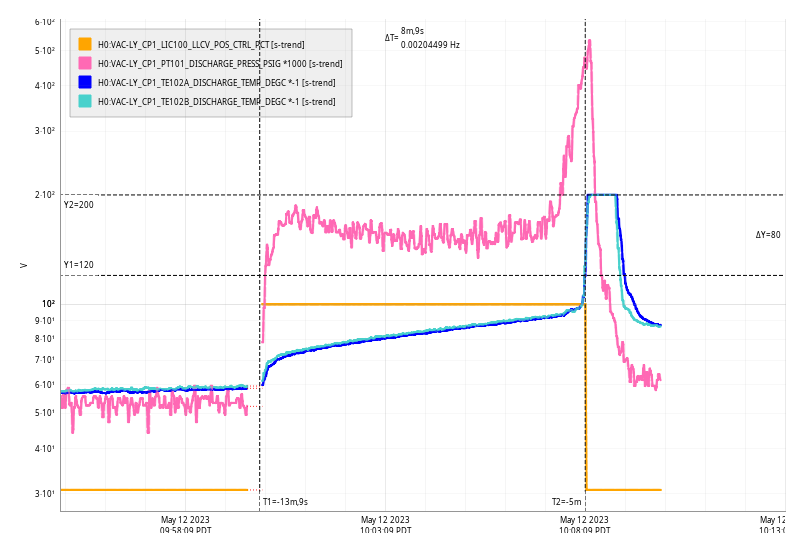
Fri May 12 10:08:09 2023 INFO: Fill completed in 8min 9secs

Images attached to this report
H1 PSL
thomas.shaffer@LIGO.ORG - posted 10:04, Friday 12 May 2023 (69533)
PSL Weekly FAMIS

Laser Status:

NPRO output power is 1.819W (nominal ~2W)

AMP1 output power is 68.61W (nominal ~70W)

AMP2 output power is 135.7W (nominal 135-140W)

NPRO watchdog is GREEN

AMP1 watchdog is GREEN

AMP2 watchdog is GREEN

PMC:

It has been locked 2 days, 21 hr 30 minutes

Reflected power = 15.87W

Transmitted power = 109.9W

PowerSum = 125.8W

FSS:

It has been locked for 0 days 0 hr and 8 min

TPD[V] = 0.8636V

ISS:

The diffracted power is around 2.5%

Last saturation event was 0 days 0 hours and 17 minutes ago

Possible Issues:

PMC reflected power is high

LHO General
ibrahim.abouelfettouh@LIGO.ORG - posted 08:10, Friday 12 May 2023 - last comment - 12:56, Friday 12 May 2023(69531)
OPS Day Shift Start

TITLE: 05/12 Day Shift: 15:00-23:00 UTC (08:00-16:00 PST), all times posted in UTC
STATE of H1: Lock Acquisition
CURRENT ENVIRONMENT:
    SEI_ENV state: CALM
    Wind: 8mph Gusts, 5mph 5min avg
    Primary useism: 0.01 μm/s
    Secondary useism: 0.17 μm/s
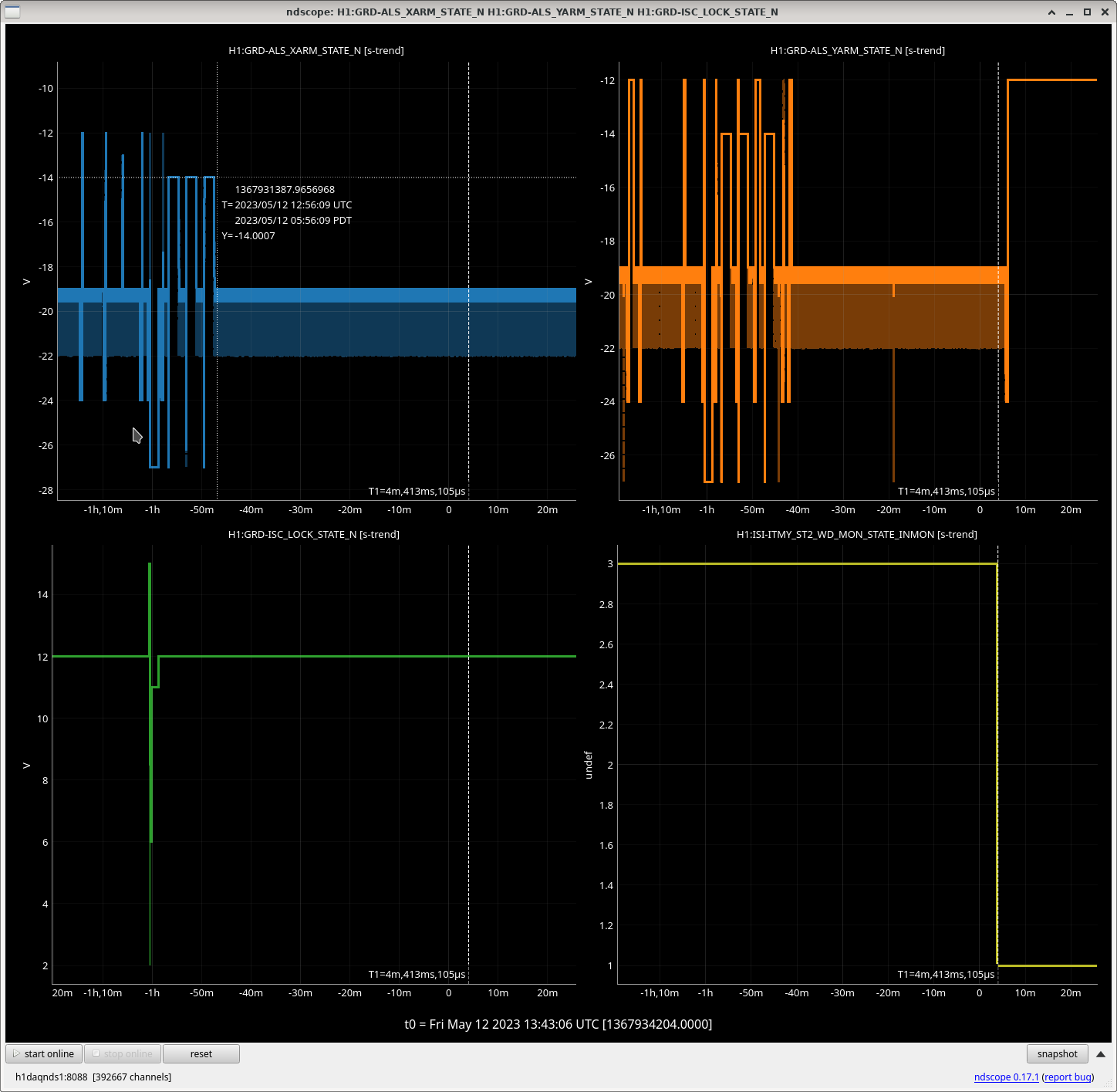
QUICK SUMMARY: IFO was in Locking_Arms_Green since 12:44 UTC (~2 hrs and 20 mins) when I arrived (with log asking to find X ALS by hand).

Comments related to this report
camilla.compton@LIGO.ORG - 08:53, Friday 12 May 2023 (69532)

Future ops automation note: Ibrahim did not have to move the X-arm optics far before it locked. INCREASE_FLASHES (state -14) did run but ran while the ISI watchdogs were still tripped (alog 69530) and ISC_LOCK didn't rerun through DOWN since then. If we were set up for notifications we would have known to untrip the watchdogs eariler. 

Images attached to this comment
Displaying reports 20221-20240 of 87728.Go to page Start 1008 1009 1010 1011 1012 1013 1014 1015 1016 End