DriptaB, TonyS, RickS
The following commands were executed to update the calibrations of the Pcal Tx and Rx laser power sensors at both end stations:
caput H1:CAL-PCALX_FORCE_COEFF_RHO_T 8334.52
caput H1:CAL-PCALX_FORCE_COEFF_RHO_R 10692.3
caput H1:CAL-PCALY_FORCE_COEFF_RHO_T 7157.80
caput H1:CAL-PCALY_FORCE_COEFF_RHO_R 10652.5
These changes increase the calibrations of the Pcal sensors (ct/W) by 0.603 % in response to recent calibration of Pcal transfer standards by NIST and PTB in Germany. Details of the rationale for the update can be found in LIGO-G2300471, slides 13-18.
This change will result in a 0.063% increase in inspiral range (about 0.84 Mpc).
The changes have been accepted in SDF.
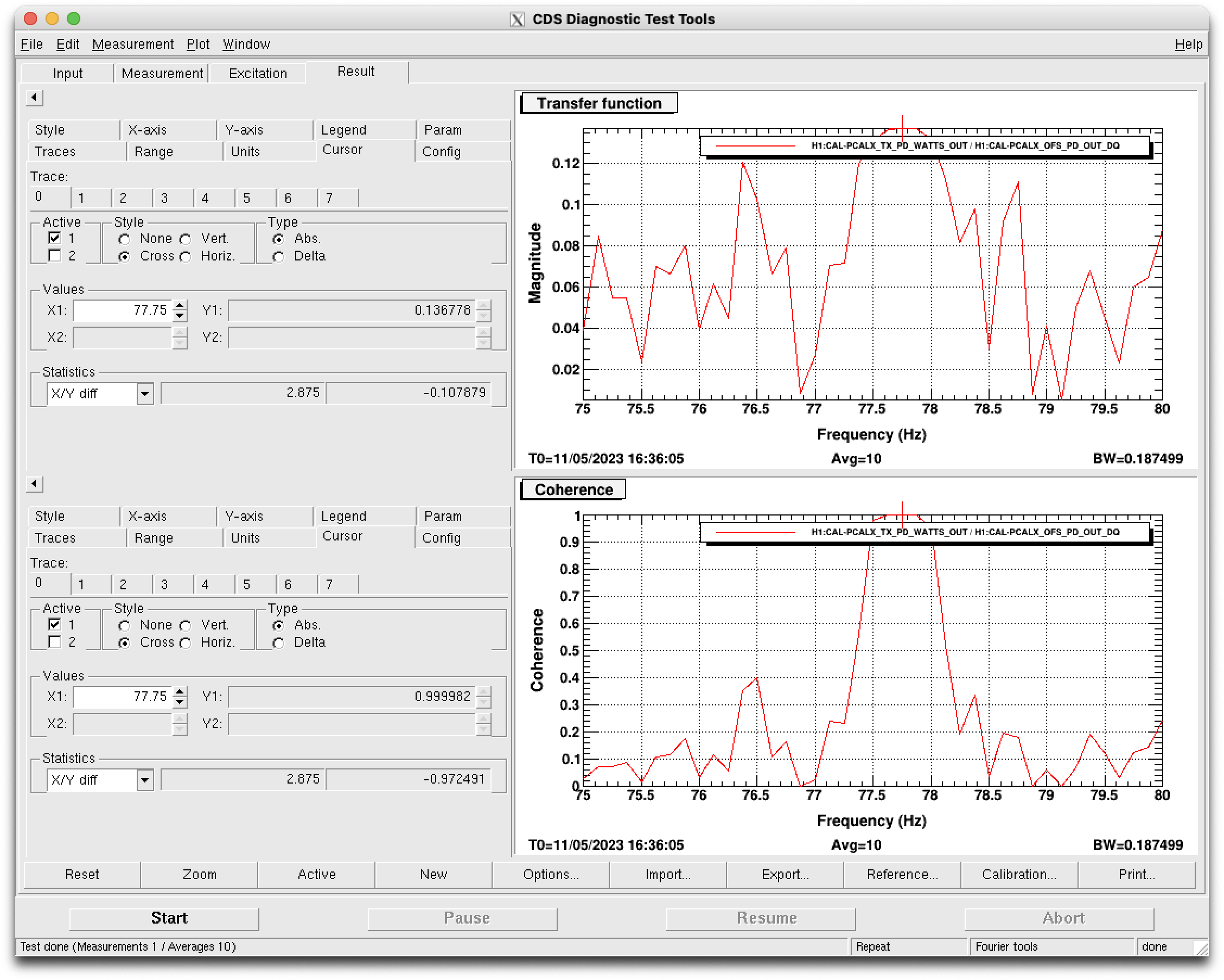
As O4 approaches, we will begin running the CW hardware injections soon, perhaps starting next Tuesday maintenance. A crucial part of the injections is calibrating the hardware injection excitation point (note that this calibration may drift, especially if the splitting ratio of the photon calibrator optical follower servo changes, so nominally one would compare the actual injection waveform on the RX or TX PD with the recovered one in strain). I am revisiting the measurements made in LHO aLOG 46848 to update the hardware injection actuation function for CW hardware injections. As a reminder, the hardware injection path sees the following: V W N 1 m h [ 61 usec delay x 61 usec delay x AI(d) x 61 usec delay x ----- x AI(a) x --- x --- x sus.norm x ----- x --- x --- ] cts V W f^2 N m The terms AI(d), AI(a) are the known digital and analog anti-imaging transfer functions, respectively, that we can model in pyDARM; sus.norm, 1/f^2, and m/N are pieces from the SUS dynamical model for the L3 stage of the QUAD suspension; N/W is the watts-to-force transfer coefficient 2*cos(theta)/c where theta is the angle of incidence and c is the speed of light in a vacuum; V/cts is the DAC calibration for the Pcal system 20 V / 2^18 cts; and h/m is the strain per meters, essentially 2/(L_x + L_y). So the remaining term we need to know is the watts per volt of the photon calibrator. Historically, I calculated this value through a series of calculations and a single transfer function measurement (e.g., LHO aLOG 46846), but now this is a lot simpler due to some front end improvements. Now I can take a transfer function measurement and get the results directly from that measurement H1:CAL-PCALX_TX_PD_WATTS_OUT / H1:CAL-PCALX_OFS_PD_OUT_DQ, using 10 averages and BW setting of 0.1 Hz. Attached is a screenshot of that transfer function, where I zoomed in on one of the systematic error calibration lines, 77.73 Hz. The coherence at the closest bin, 77.75 Hz is very high (>0.9999) and the resulting transfer function magnitude is 0.136778 W/V. Compared to the previous value of 0.13535, this is a change of just over 1%. I then used an up-to-date pydarm_H1.ini file with this new value for pcal_etm_watts_per_ofs_volt = 0.136778 to generate an actuation function file attached to this aLOG. The main difference is the new calibration of the W/V value and to remove a DC scaling of the AI(a) of 0.99. These two effects combine to change the DC calibration of the excitation point by 2%. The next step, not yet done, is to update the CAL INJ filter bank values with updated numbers in the filter banks FM6 antiAIaGain (change to 1.0) and FM7 cts/N (change to 1.4539e13). I am not sure the current value in the FM3 N/m value is correct, if I calculate the m/N value at 1 Hz for the x-arm TST stage, I get a value of 0.00156554 m/N ==> 638.75611903 N/m, which is significantly larger than the current value of 382.954.
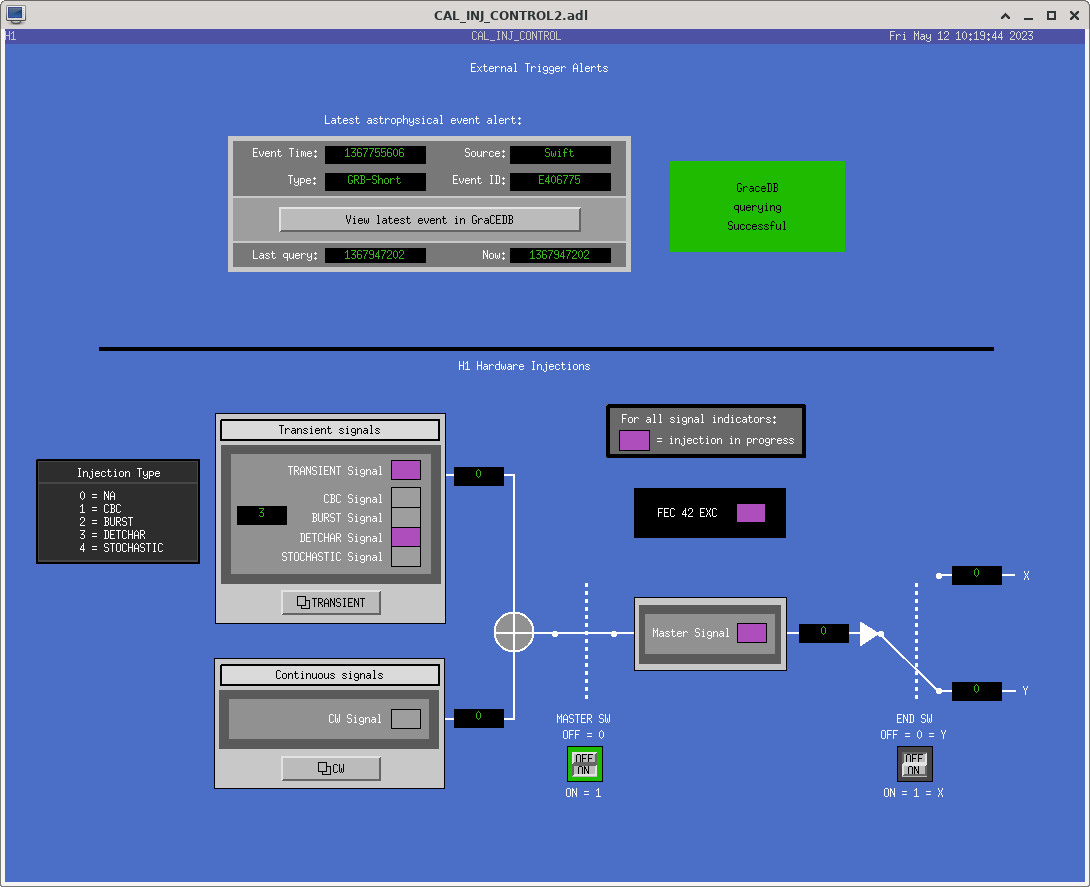
I went through the hardware injection screens (CAL_INJ_CONTROL2, PCAL_END_EXC) and cleaned them up based on the way that we're now handling hardware injections
I then did some test injections and confirmed that all the status bits were working as expected. Here's an example of the screen with an active "detchar" injection (as labeled by the H1:CAL-INJ_TINJ_TYPE record):

The H1:CAL-INJ_STATUS bit word (purple indicators) behaved correctly, and reset appropriately when the EXC was stopped.
I also note that the H1CALINJ_INJ_TRANSIET filter bank was found to have most of it's filters disengaged. TJ previous determined that all the banks should be engaged. I re-engaged all the fitlers and SDF accepted the change.
I've committed the changes to the PCAL_END_EXC.adl screen (removing the HWINJ master switch, and choice switch for which end-station to drive) to the svn under
/opt/rtcds/userapps/release/cal/common/medm/
PCAL_END_EXC.adl
as of userapps svn repo rev 26171.
Same goes for
/opt/rtcds/userapps/release/cal/common/medm/
CAL_INJ_CONTROL2.adl
committed to rev 26173.
Two stages of whitening were enabled for the OMC-REFL_A photodetector.
The slow controls DC readout is very close to +10V and sometimes saturates. The fast DAQ has more headroom and should be fine. If not the analog PD gain should be reduced to 10dB.
PS. OMC_REFL_A is using the old DCPD whitening chassis: Only the 24dB gain step works, all others will short the output. Filter stage 2 is not a whitening stage.
Here is a spectrum of the OMC_REFL PD with 2 stages of whitening. Looking at the violin modes around 500Hz the signal is about a factor of 10 stronger (in Watts) in the OMC-DCPD_SUM compared to OMC_REFL_A.
Clearly visible are the 32Hz and 40Hz lines as well as 2 lines around 100Hz, see also alog 68078. Maybe these lines are added by the AM stabilization circuit for the 45MHz sidebands?
A lot of acoustic coherence with PSL accelerometers.
Some comments to the possible coupling mechanism:
The EOM mount was changend on Sep 6, 2022, see alog 64882. Looking at the pics one can see the coils just sitting there.
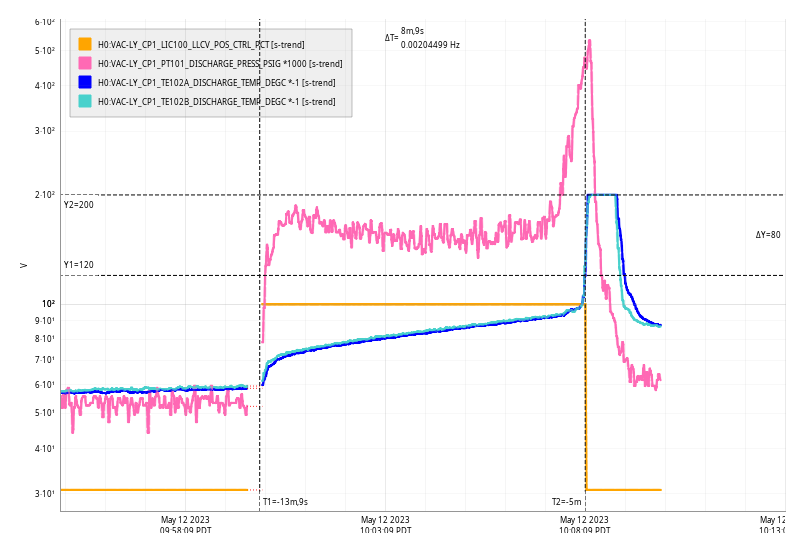
Fri May 12 10:08:09 2023 INFO: Fill completed in 8min 9secs
Laser Status:
NPRO output power is 1.819W (nominal ~2W)
AMP1 output power is 68.61W (nominal ~70W)
AMP2 output power is 135.7W (nominal 135-140W)
NPRO watchdog is GREEN
AMP1 watchdog is GREEN
AMP2 watchdog is GREEN
PMC:
It has been locked 2 days, 21 hr 30 minutes
Reflected power = 15.87W
Transmitted power = 109.9W
PowerSum = 125.8W
FSS:
It has been locked for 0 days 0 hr and 8 min
TPD[V] = 0.8636V
ISS:
The diffracted power is around 2.5%
Last saturation event was 0 days 0 hours and 17 minutes ago
Possible Issues:
PMC reflected power is high
TITLE: 05/12 Day Shift: 15:00-23:00 UTC (08:00-16:00 PST), all times posted in UTC
STATE of H1: Lock Acquisition
CURRENT ENVIRONMENT:
SEI_ENV state: CALM
Wind: 8mph Gusts, 5mph 5min avg
Primary useism: 0.01 μm/s
Secondary useism: 0.17 μm/s
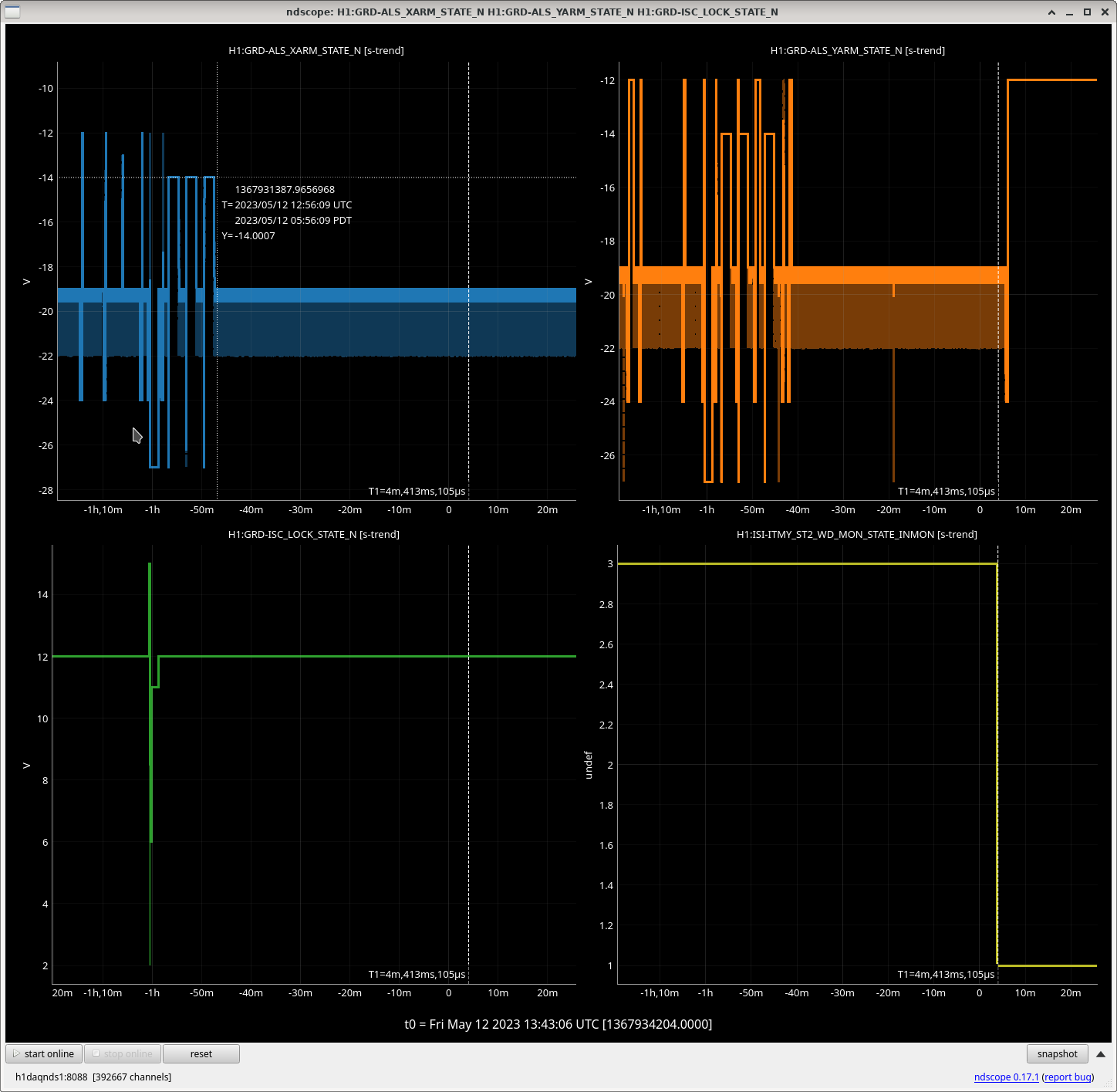
QUICK SUMMARY: IFO was in Locking_Arms_Green since 12:44 UTC (~2 hrs and 20 mins) when I arrived (with log asking to find X ALS by hand).
Future ops automation note: Ibrahim did not have to move the X-arm optics far before it locked. INCREASE_FLASHES (state -14) did run but ran while the ISI watchdogs were still tripped (alog 69530) and ISC_LOCK didn't rerun through DOWN since then. If we were set up for notifications we would have known to untrip the watchdogs eariler.
Came in the mornnig and the ITMX, ITMY and ETMX ISI platforms had watchdog trips. Looking at the seismometer monitor there were multiple earthquakes last night that could have cuased this. I have reset the watchdogs.
Earthquake Hoodsport WA Mag 2.6 200 miles away
Prattville, CA Mag 3.5
I took the opportunity this evening to start tuning the magnetic injection coils to find appropriate gain values for when we drive them. I was able to get through both frequency bands (10-100 Hz and 100-1000 Hz) for the CS vertex, CS SQZ-bay, EX VEA, and EX E-bay coils. To find the right values, I drove the coil using a uniform noise awg injection with an 8th-order butter bandpass filter around the frequency range and changed the gain until I saw saturations on either the ADC for the nearest magnetometers or the DAC driving the coil, then lowered the gain until no more saturations occurred. I plan to finish tuning the remaining coils tomorrow.
After these coils were tuned, I updated the injection gains in the PEM_MAG_INJ guardian and used it to run through all eight injections with a 128-second duration. This proved to be a useful test of this guardian node; the resulting injection log file is:
/ligo/www/www/exports/pem/WeeklyMagneticInjection/logs/1367909400.txt
and is attached for reference.
TITLE: 05/12 Eve Shift: 23:00-07:00 UTC (16:00-00:00 PST), all times posted in UTC
STATE of H1: Observing
SHIFT SUMMARY: IFO has been locked for 6 hours, currently observing with 125 Mpc BNS range.
Started shift with an initial alignment. Both arms needed adjustment for ALS locking, and I moved SRM in both pitch and yaw to align SRC (this was not surprising as the temperature has changed again today in the LVEA closer to what it was before its excursion 2 days ago). Reached NLN @ 01:23
PEM shaker injections were run, magnetic coil injection gains were tuned and the magnetic injection suite was run.
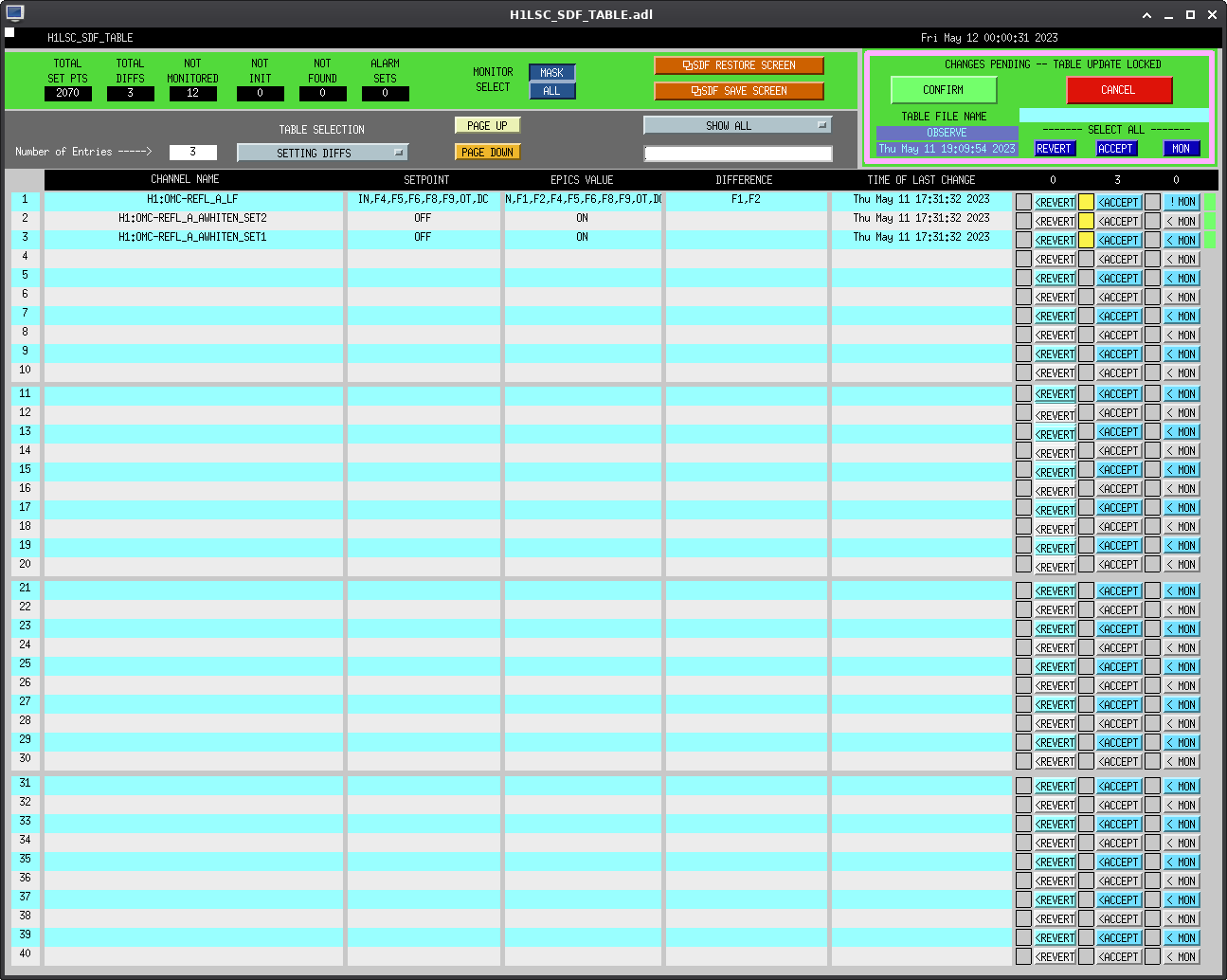
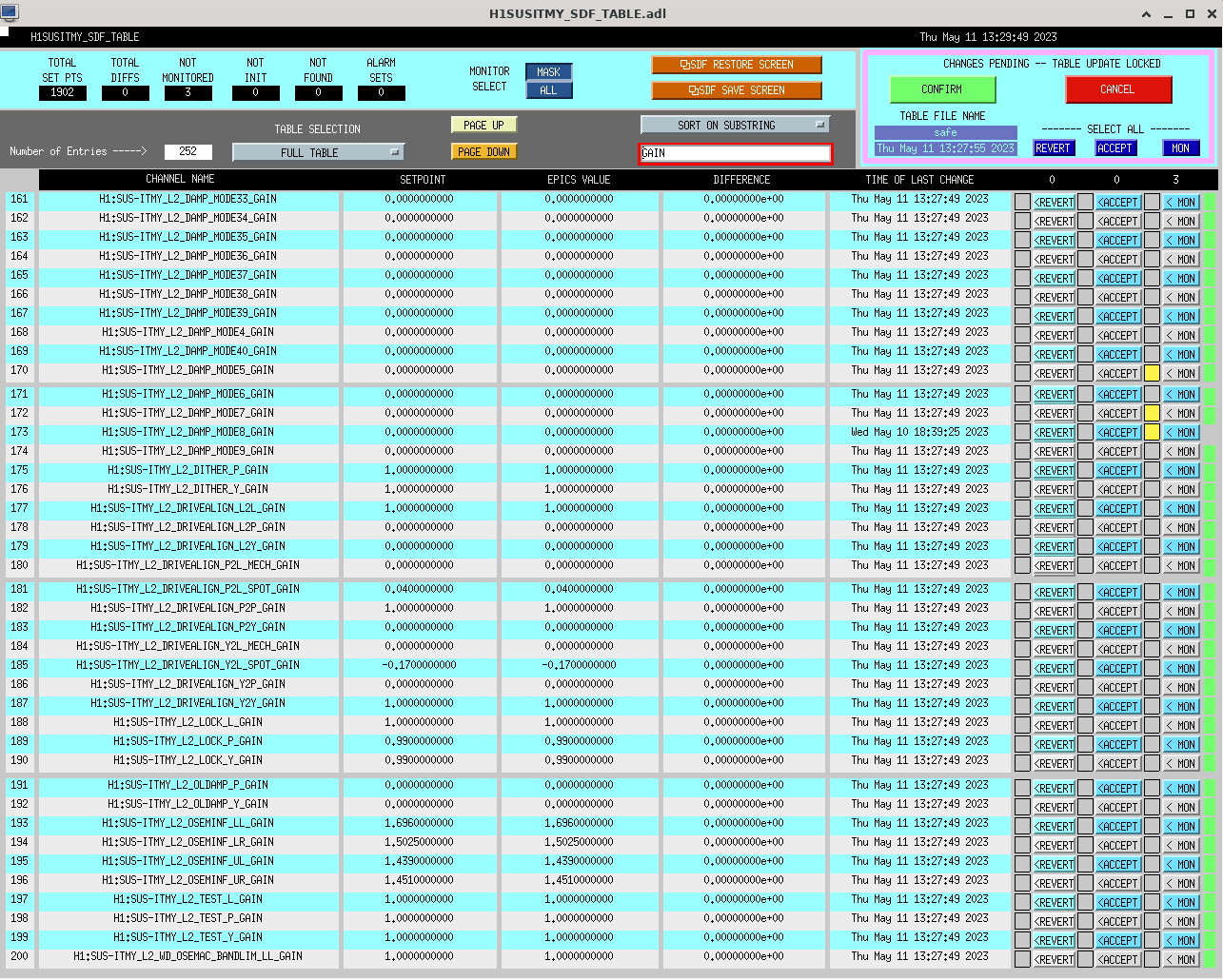
There we three outstanding SDF diffs on the LSC model related to the OMC that I've accepted in order to flip the observation intent bit (screenshot attached, tagging ISC). I was not able to find any information about these channels specifically in recent alogs.
Observation intent bit flipped to OBSERVE and left in automatic operation @ 07:13 UTC (tagging DetChar).
LOG:
IFO has been locked at NLN for about 1.5 hours following a successful initial alignment and lock acquisition. Various PEM shaker injections are ongoing.
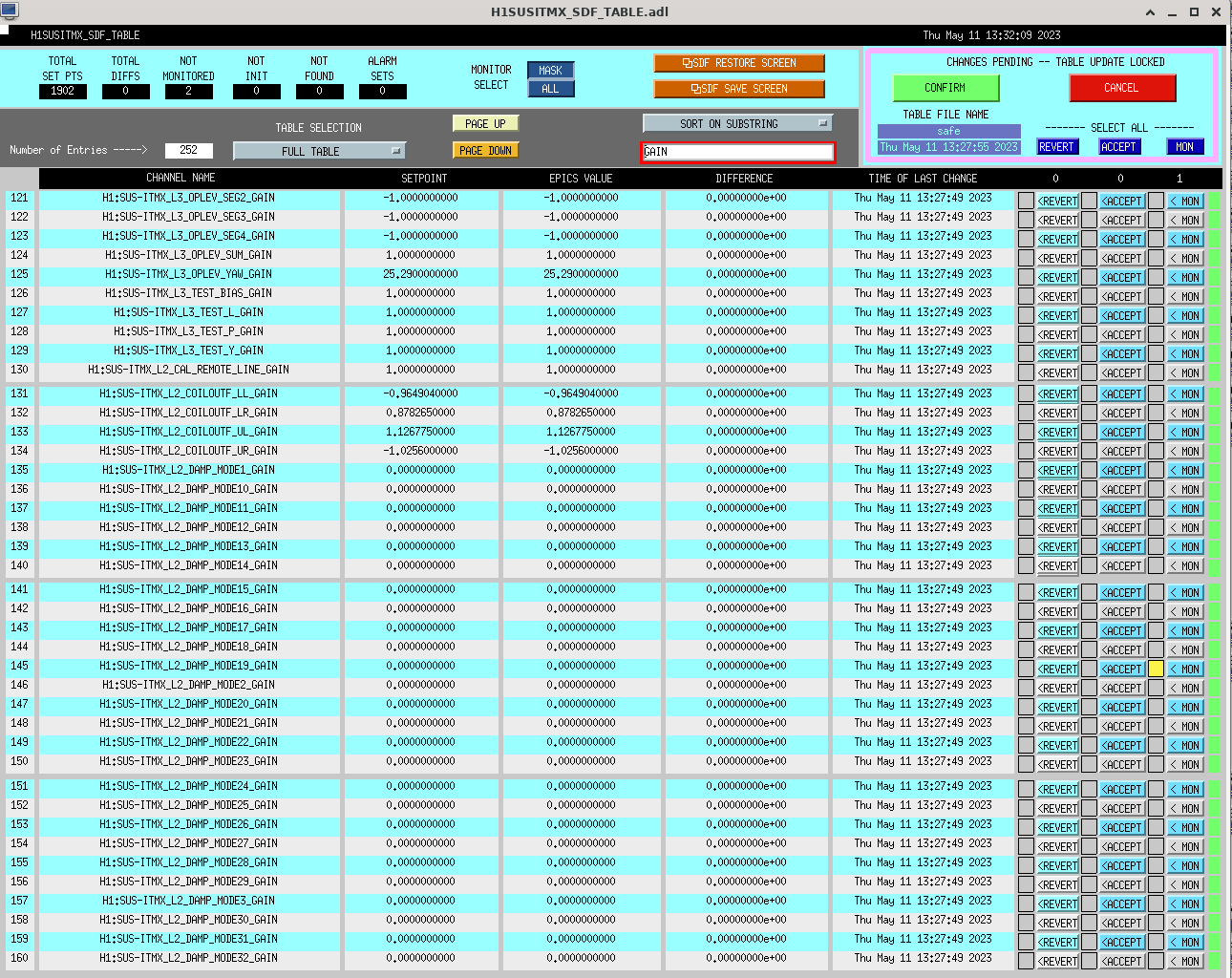
I accepted a filter change for ITMX mode 19 damping as the same filter had been accepted as on in the safe table (screenshot attached, tagging SUS).
TITLE: 05/12 Eve Shift: 23:00-07:00 UTC (16:00-00:00 PST), all times posted in UTC
STATE of H1: Aligning
CURRENT ENVIRONMENT:
SEI_ENV state: CALM
Wind: 5mph Gusts, 3mph 5min avg
Primary useism: 0.15 μm/s
Secondary useism: 0.24 μm/s
QUICK SUMMARY:
The 5.5 earthquake from northern California tripped ISI watchdogs for ITMX, ITMY, ETMX, ETMY, and HAM7; these have all been recovered. Starting an initial alignment to be safe, have just finished aligning green arms.
TITLE: 05/11 Day Shift: 15:00-23:00 UTC (08:00-16:00 PST), all times posted in UTC
STATE of H1: Lock Acquisition
SHIFT SUMMARY: Long day of recovery. Relevant alogs:
alog69517 (OM2 alignment),
alog69516 (LVEA temp excursion),
alog69500 (OMC coil driver chassis and dead osems),
alog69499 (POP A RF 45 gain issues with initial alignment fixed).
Right before the end of my shift we lost lock for an unknown reason and then a 5.4M earthquake from CA came through. Ryan is now starting an initial alignment.
LOG:
| Start Time | System | Name | Location | Lazer_Haz | Task | Time End |
|---|---|---|---|---|---|---|
| 16:46 | FAC | Ken | OSB rec. | n | Moving equipment with forklift | 18:44 |
| 17:26 | CDS | Fil | CER | n | Swap coil driver OMC chassis | 17:45 |
| 17:27 | PEM | Robert | LVEA | n | Equipment setup | 19:27 |
| 17:27 | SEI | Jim, Mitch, Randy | EY | n | Wind fence | 23:27 |
| 18:57 | CDS/PEM | Fil | LVEA | n | Laying cable in E bay | 19:23 |
| 21:26 | VAC | Travis | FCES | n | Grabbing parts | 21:54 |
| 22:15 | CDS/PEM | Marc, Fil | CER | n | Check on accelerometers | 22:45 |
Closing WP11185. I have done a less invasive method. We are simply doing some ssh forwarding into the DMT on the h1guardian1 machine. We will not be coupling the networks tighter. This is to allow control room users to have limited access to the calibration system (by request of the calibration group) to update parameters and restart calibration. The mechanics are in place now so that Jamie Rollins can work on the locked down command (similar to guardctl) for this.
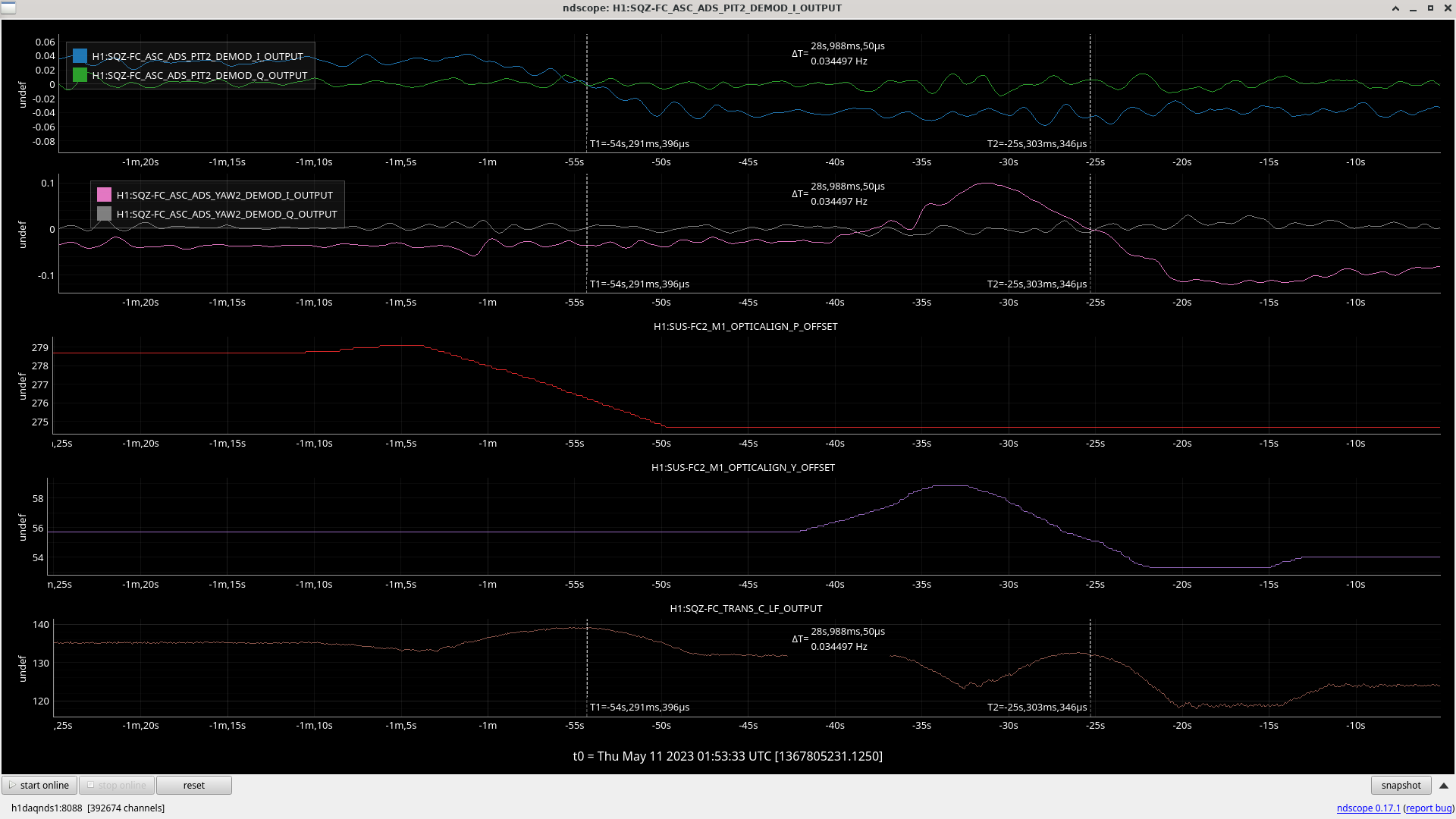
Since we don't have any ASC for green lock, it would be useful to have the green ASC using ADS. The green ASC will run only during the lock acquisition and will be switched to the IR WFS after IR lock. I started the commissioning of the green ADS and checked the ADS error signal of FC2, which looks reasonable.
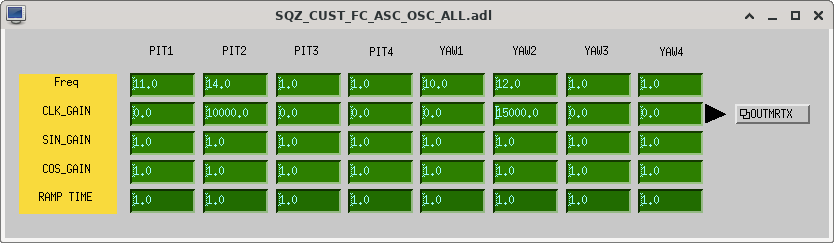
I dithered the FC2 and checked the ADS error signal when FC2 PIT/YAW is moved (Fig 1). The dither frequency and amplitude is shown in Fig 2. The ADS error signal (PIT2/YAW2 DEMOD I) crosses 0 at the maximum of FC green transmission when FC2 PIT/YAW is moved. So we can use these signals for green ADS of FC2.
J. Kissel, T. Shaffer, E. Capote, R. Kumar, J. Driggers, R. McCarthy, B. Gately Recovered nominal low noise 2023-05-11 21:44 UTC.
I have temporarily unmonitored the gains of some of the Violin modes from the SDF. This will help us tweak their settings (if they are rung up) while the IFO is under OBSERVE. I will revert the SDF to monitored before the observing run starts in two weeks. Attached below are the screenshot of SDF changes I have accepted and list of modes I have unmonitored,
IY mode 05, 07, 08
IX mode 19
EY mode 01, 06, 07
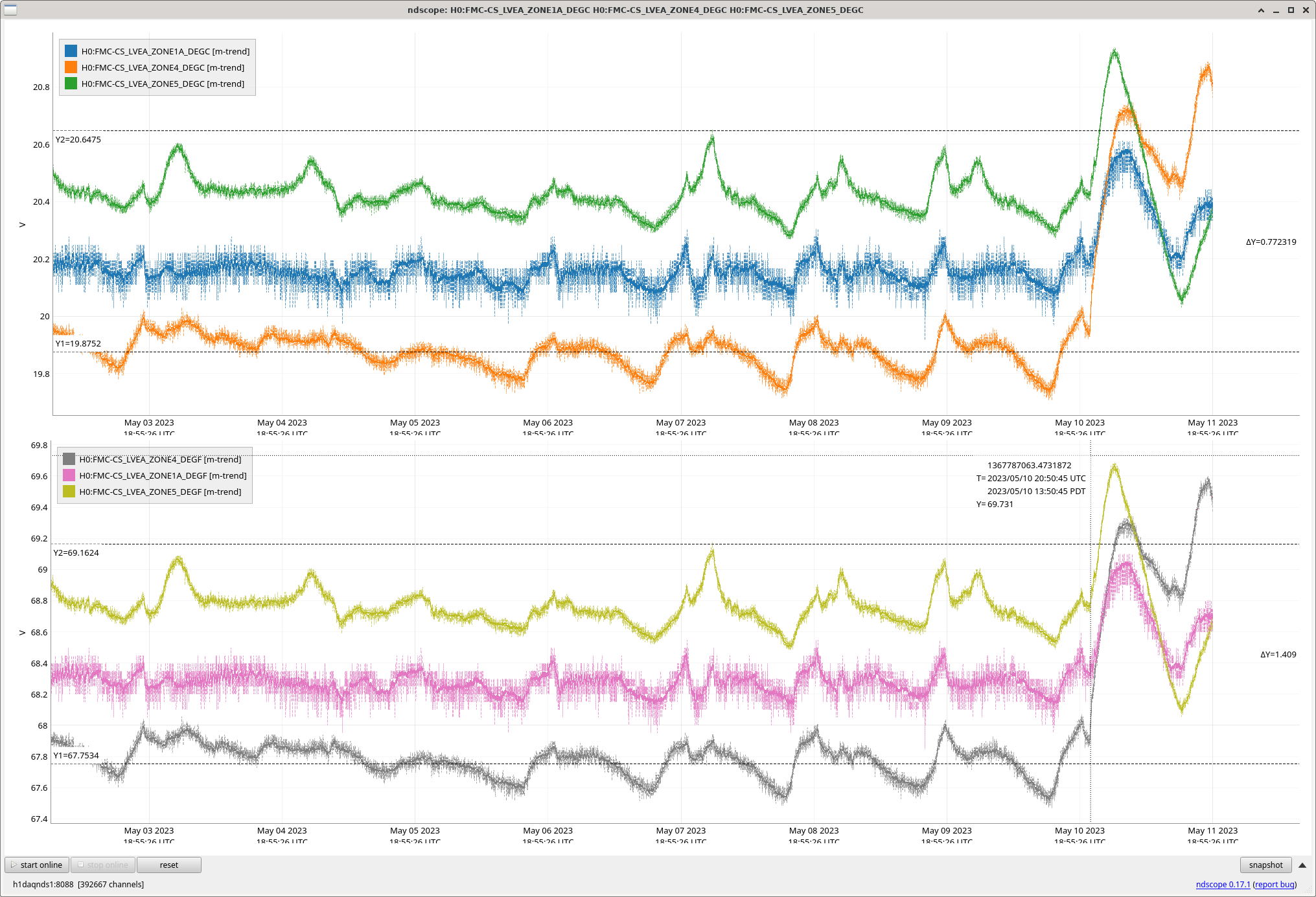
J. Kissel, E. Capote, T. Shaffer We're struggling through alignment of the SRC during lock acquisition, and we looked through some trends of SR3 alignment and we see that it's alignment is quite off in Yaw. TJ said "Oh, well, yeah, the temperature in the VEA has gone bad. That's normal." Trusting but verifying, I trended the average of zones in the LVEA, and I disagree -- there as a marked step-change in the LVEA temperature starting at 2023-05-10 13:45 PDT (20:45 UTC), which, over the course of a day has increased the output arm's temperature by 1 deg C, or ~2 deg F. Perhaps a set point got lost?
After receiving a call from the control room regarding a temperature increase in the HAM 6 area, Tyler and I looked at the FMCS and found that for some reason, AHU 2 was off, both fans down. There has been some fire panel testing which may have contributed to this issue. AHU 2 was restarted and both fans came back up. Made a few adjustments to the dampers for air flow and all seems to be running as designed. I will continue to monitor.
AHU = Air Handler Unit FIXED IT.
Naoki, Camilla
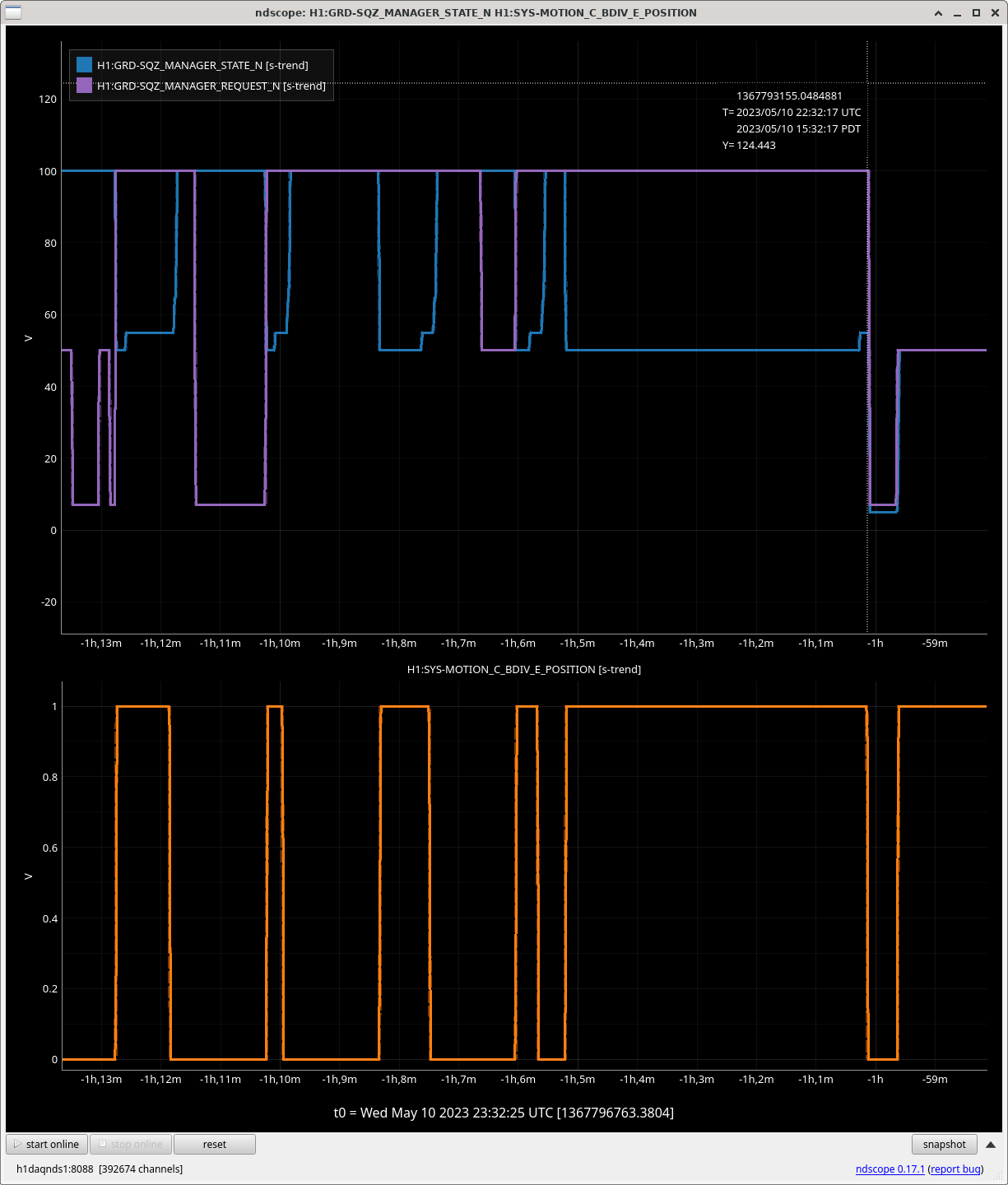
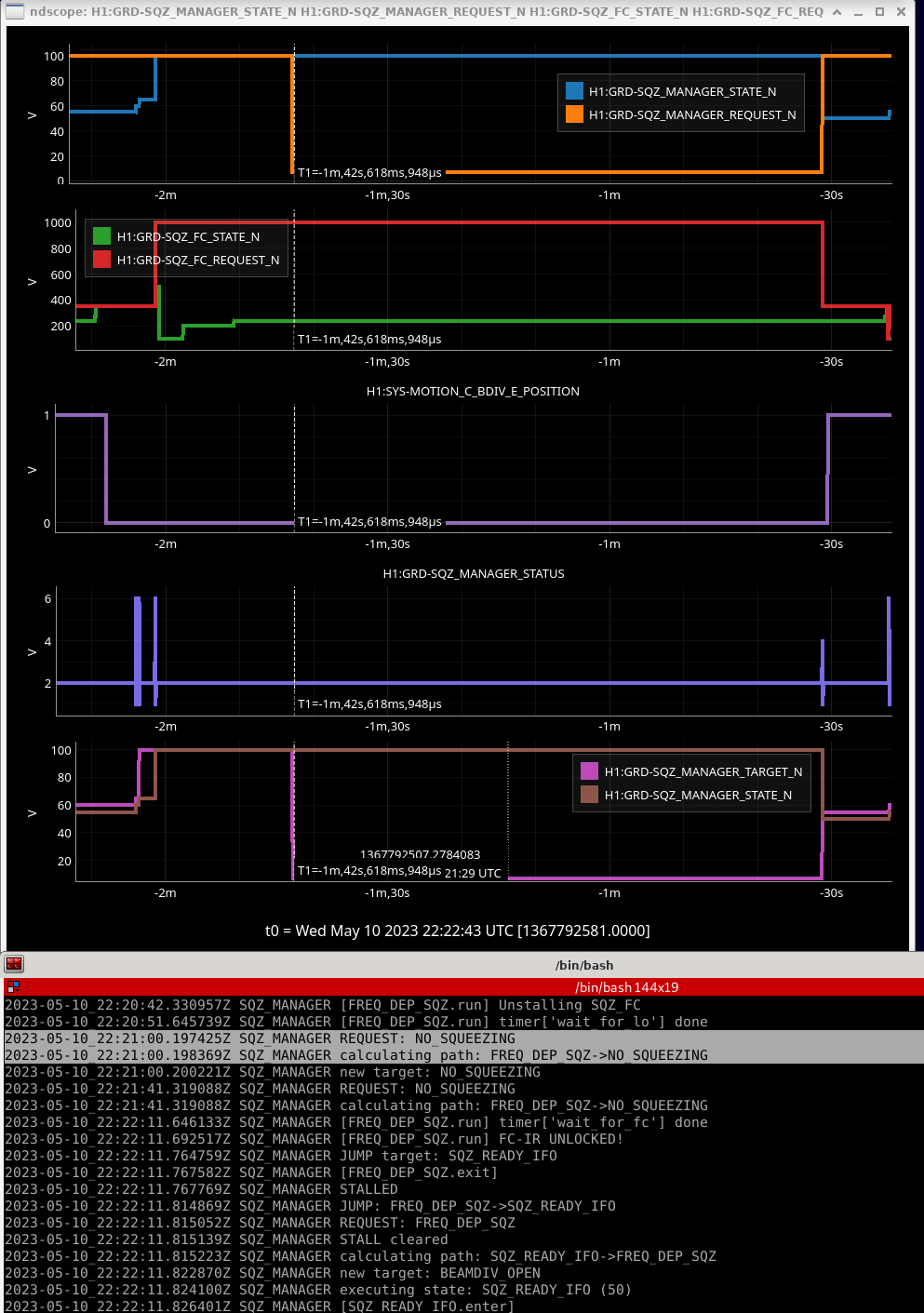
We will investigate this logic tomorrow. We think we got into a strange state as the FC was struggling to lock in IR but Naoki double the IR gain and SQZ_FC is now working.
There's a typo in Rick's statement This change will result in a 0.063% increase in inspiral range (about 0.84 Mpc). It should read This change will result in a 0.603% increase in inspiral range (about 0.84 Mpc). Where I confirm this with other statements in the aLOG: (a) assuming that he quotes our range at 140 Mpc, and thus the 0.84 Mpc parenthetical above is from 140 Mpc * 0.603% = 140 Mpc * 0.00603 = 0.84 Mpc (b) the statement just prior, saying "These changes increase the calibrations of the Pcal sensors (ct/W) by 0.603 %" and that the math checks out -- that an increase in PCAL force coefficient translates to an increase in detector sensitivity -- based on historical educational material in LHO:52837.