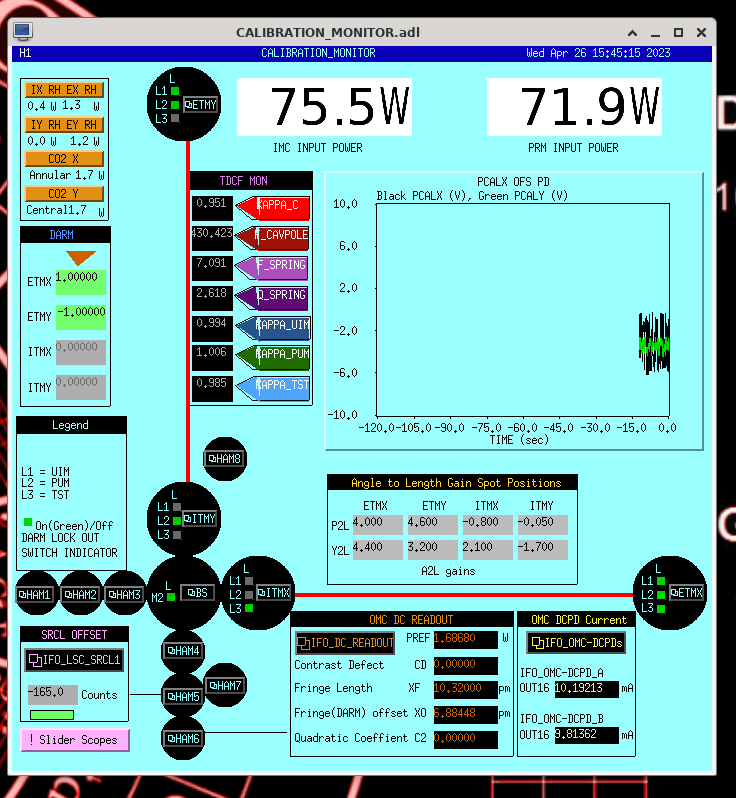
Betsy, TJ, Rahul
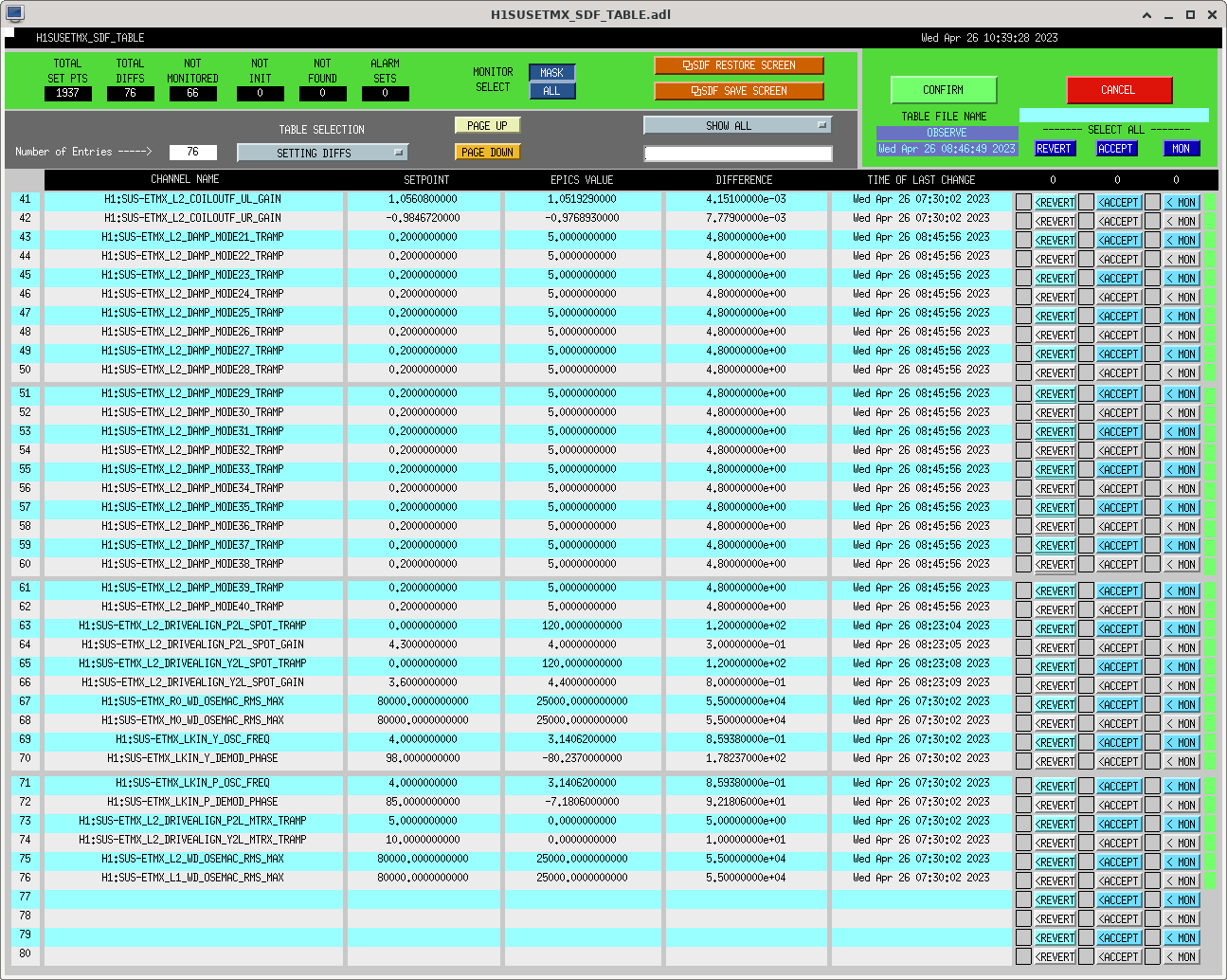
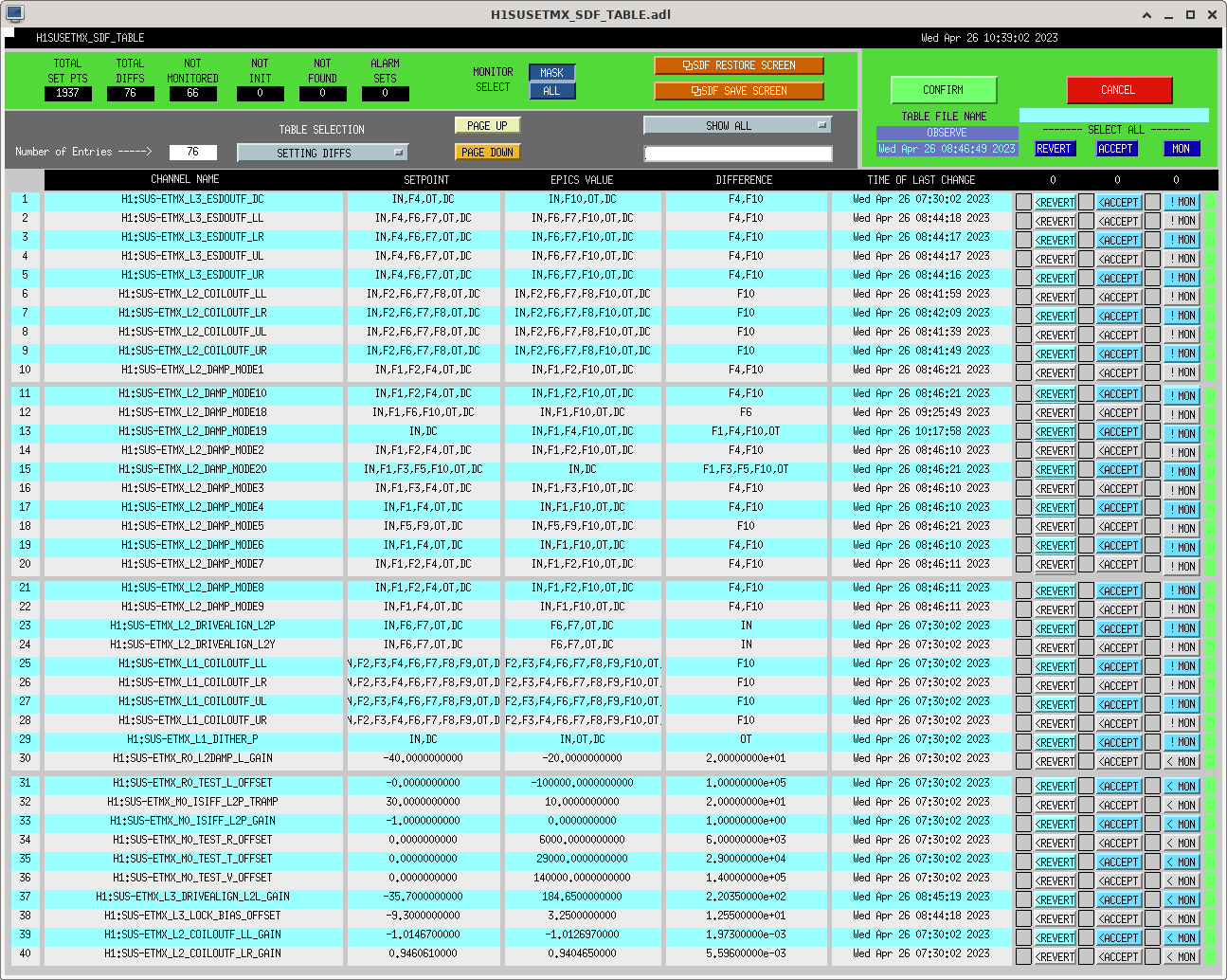
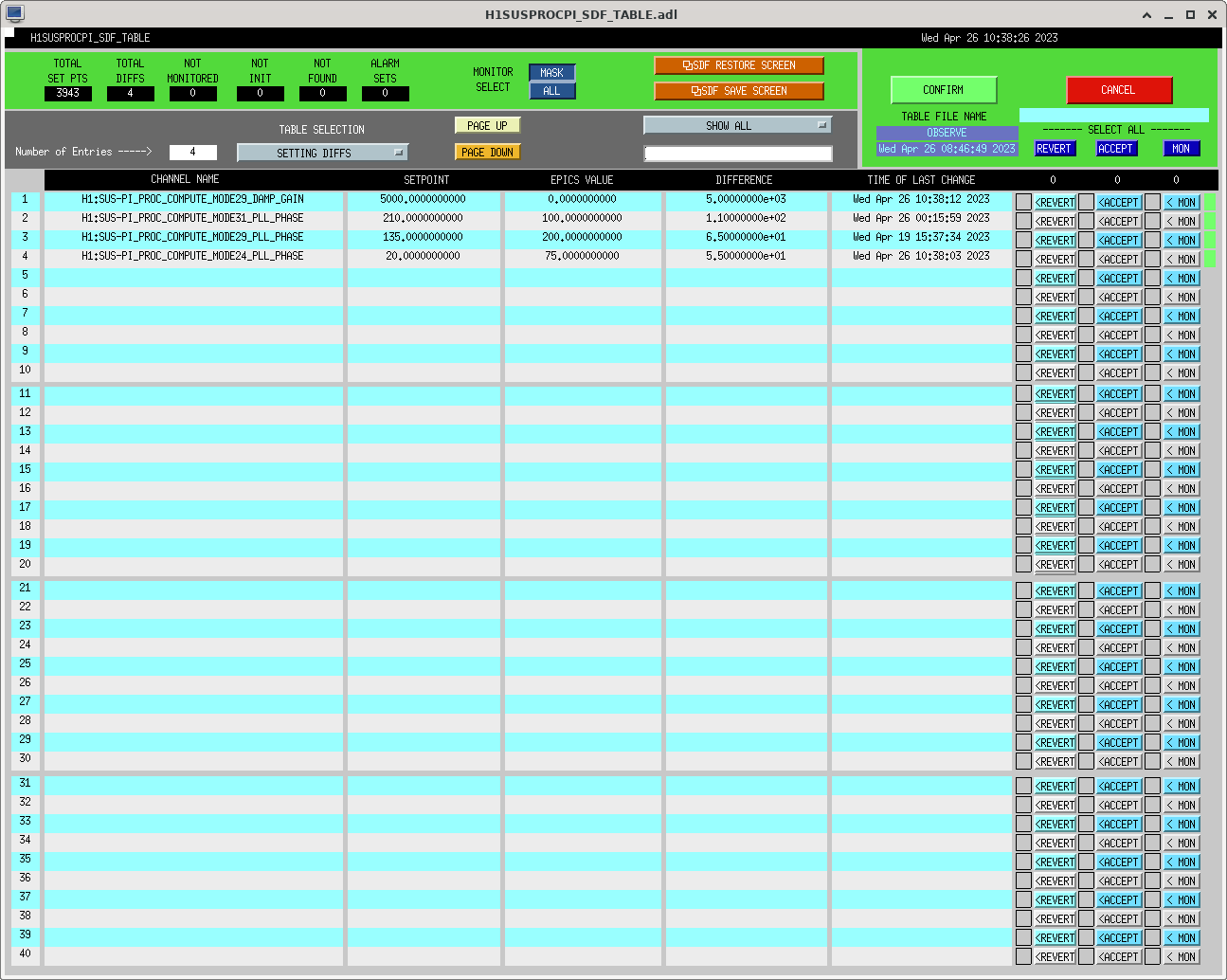
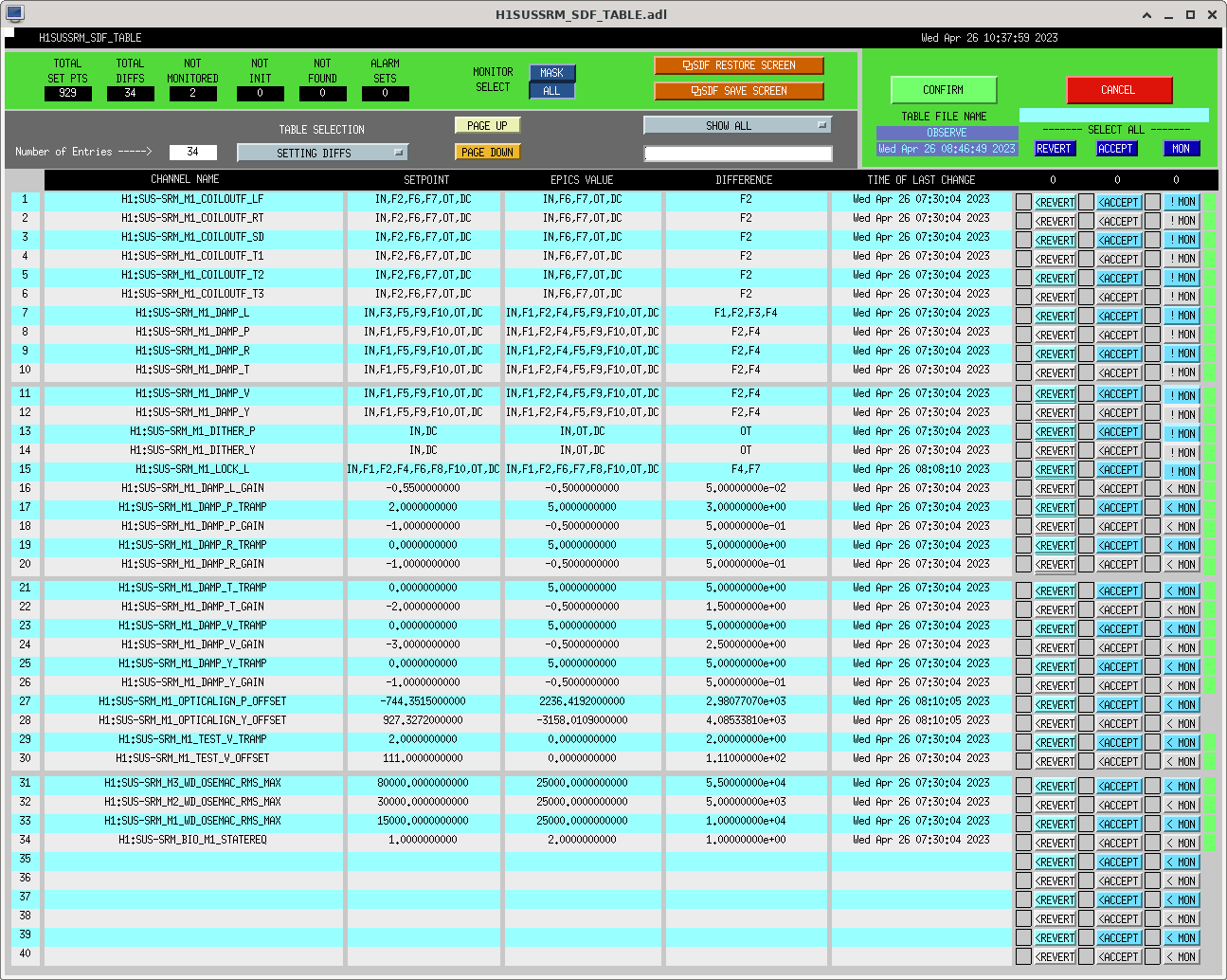
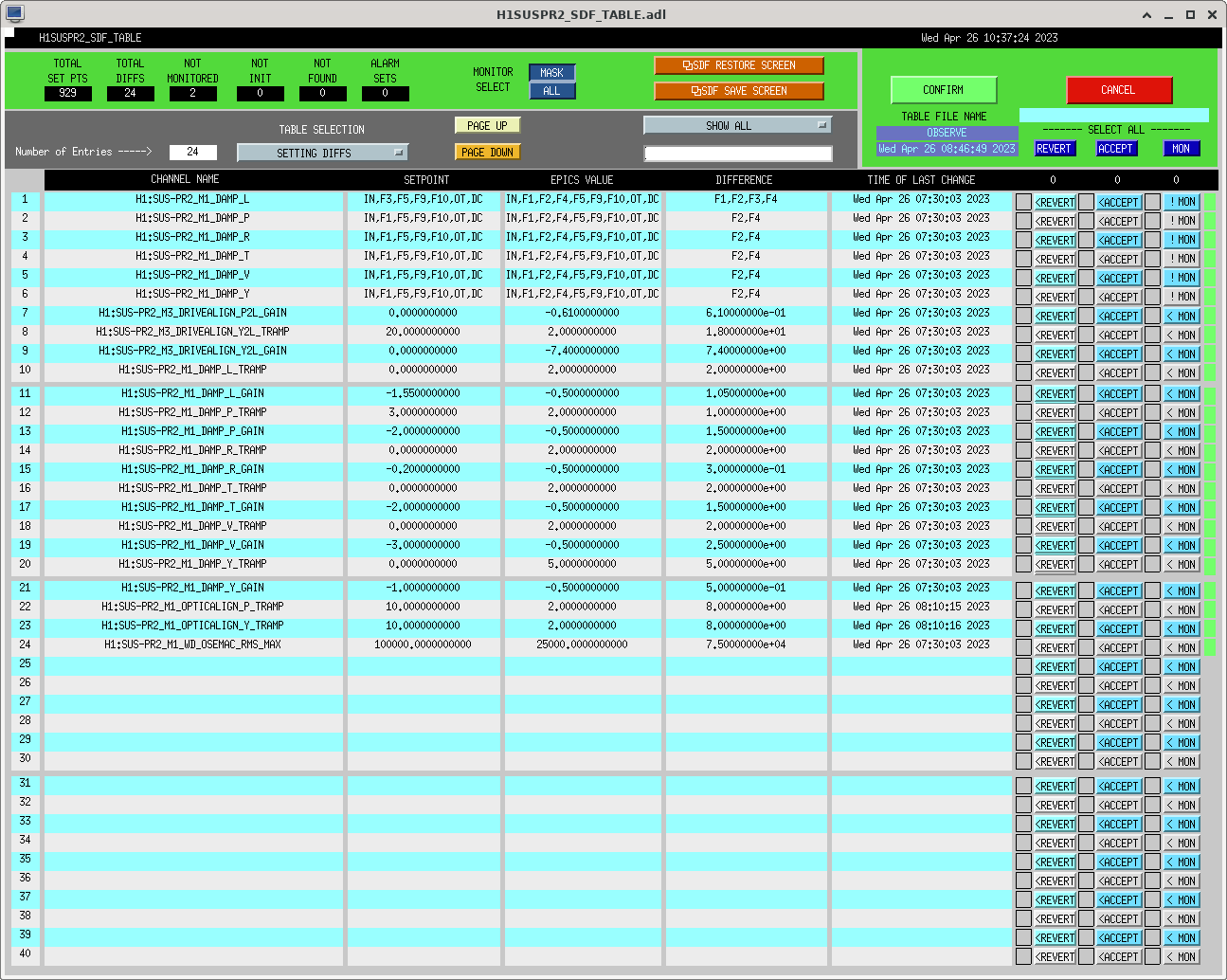
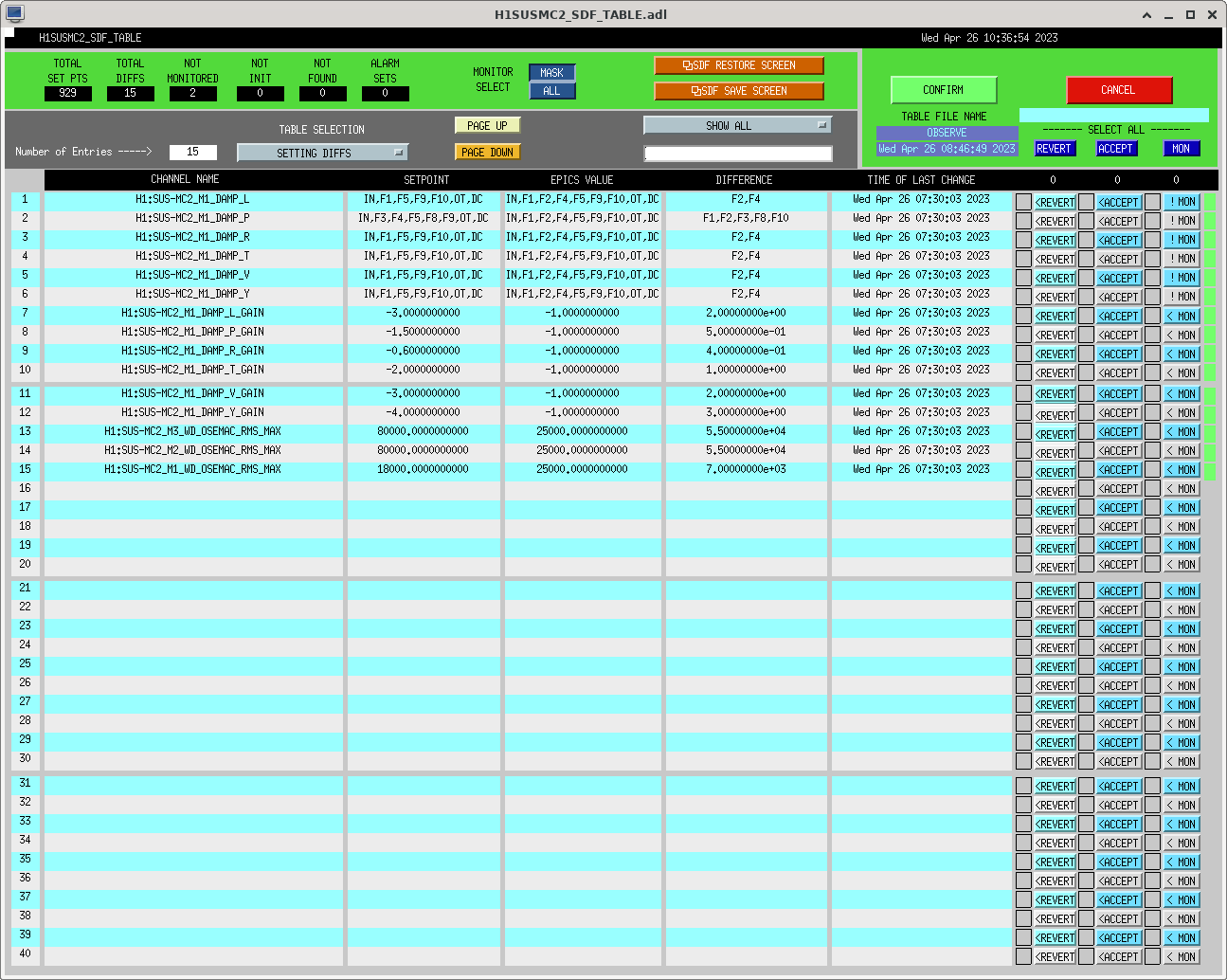
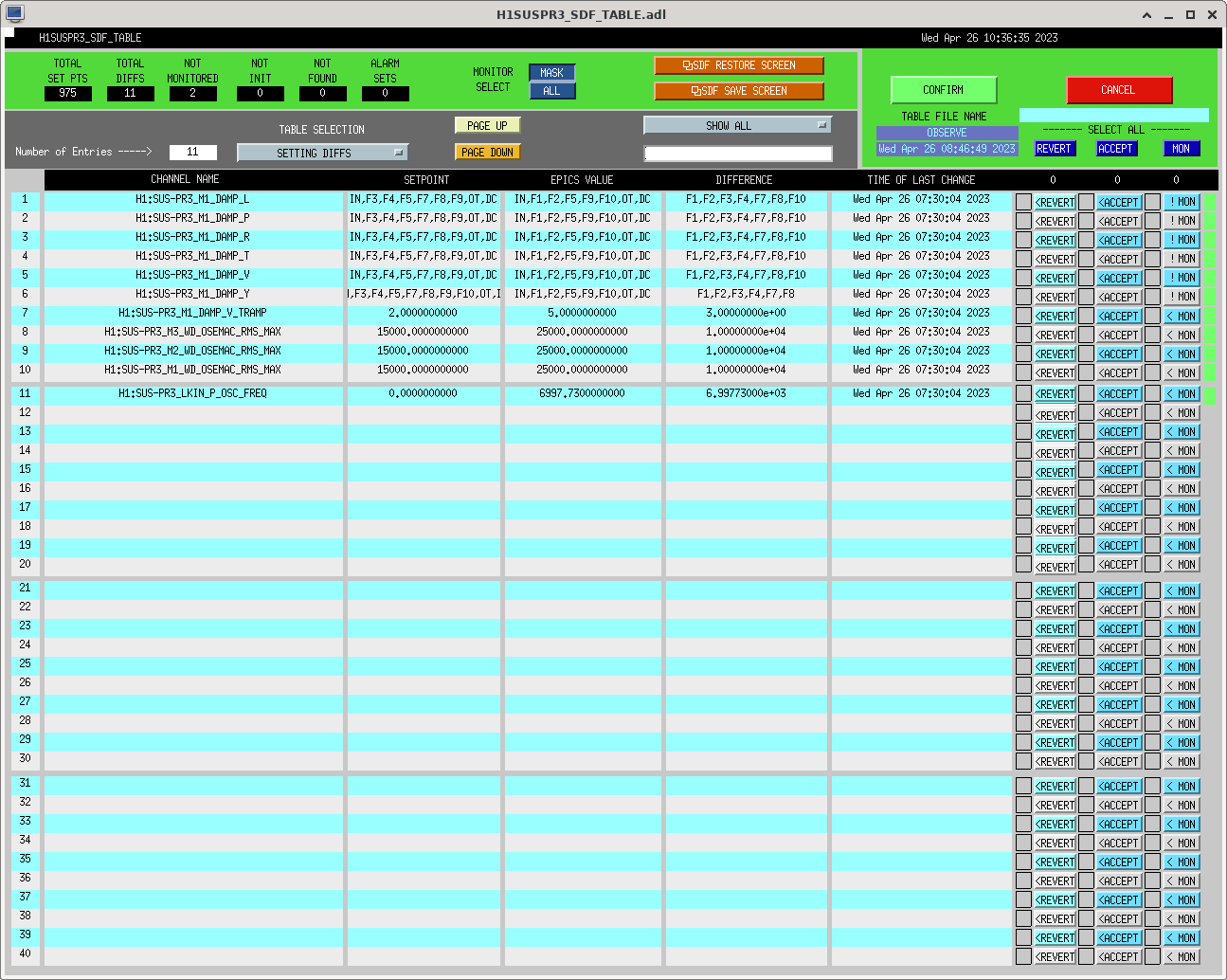
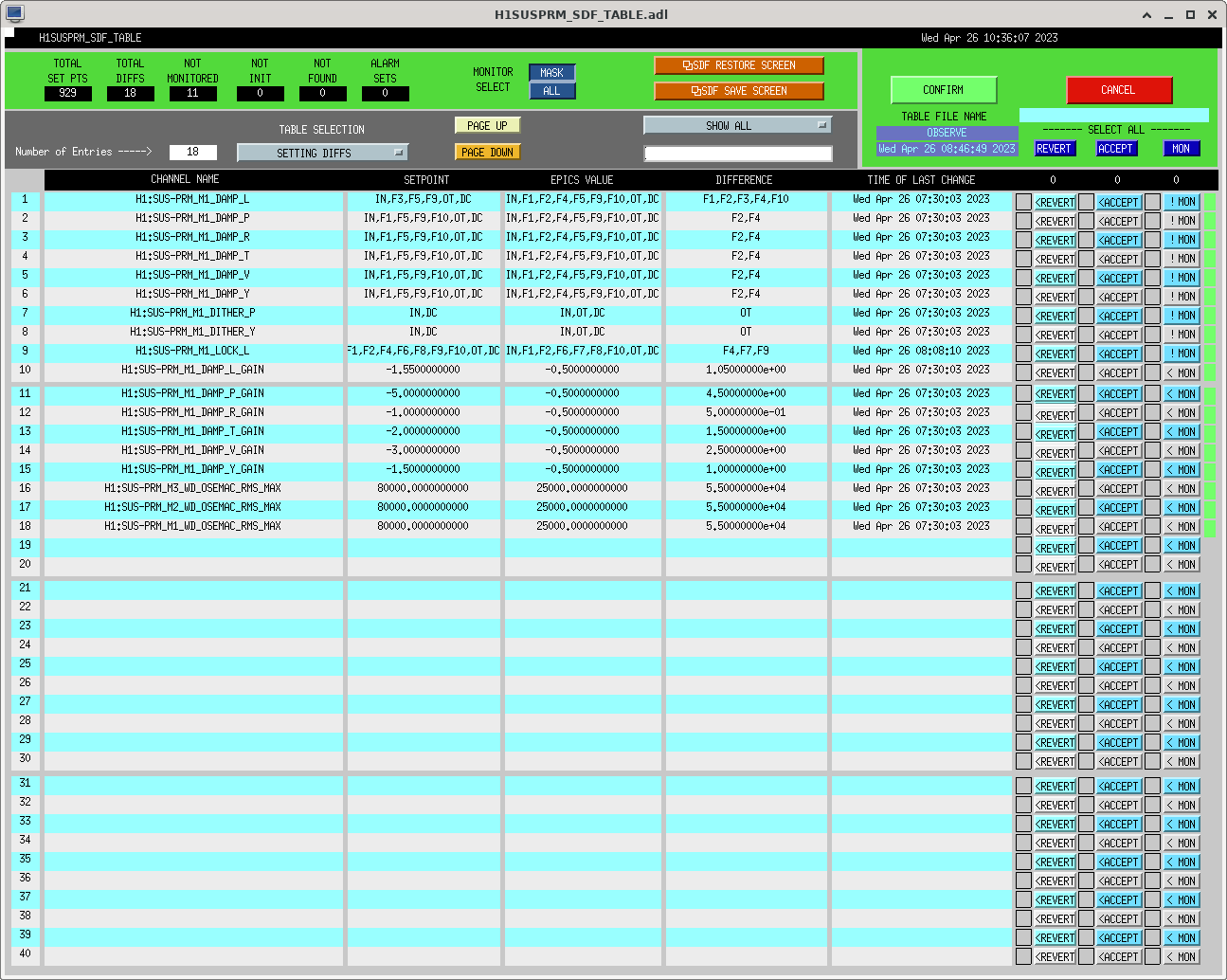
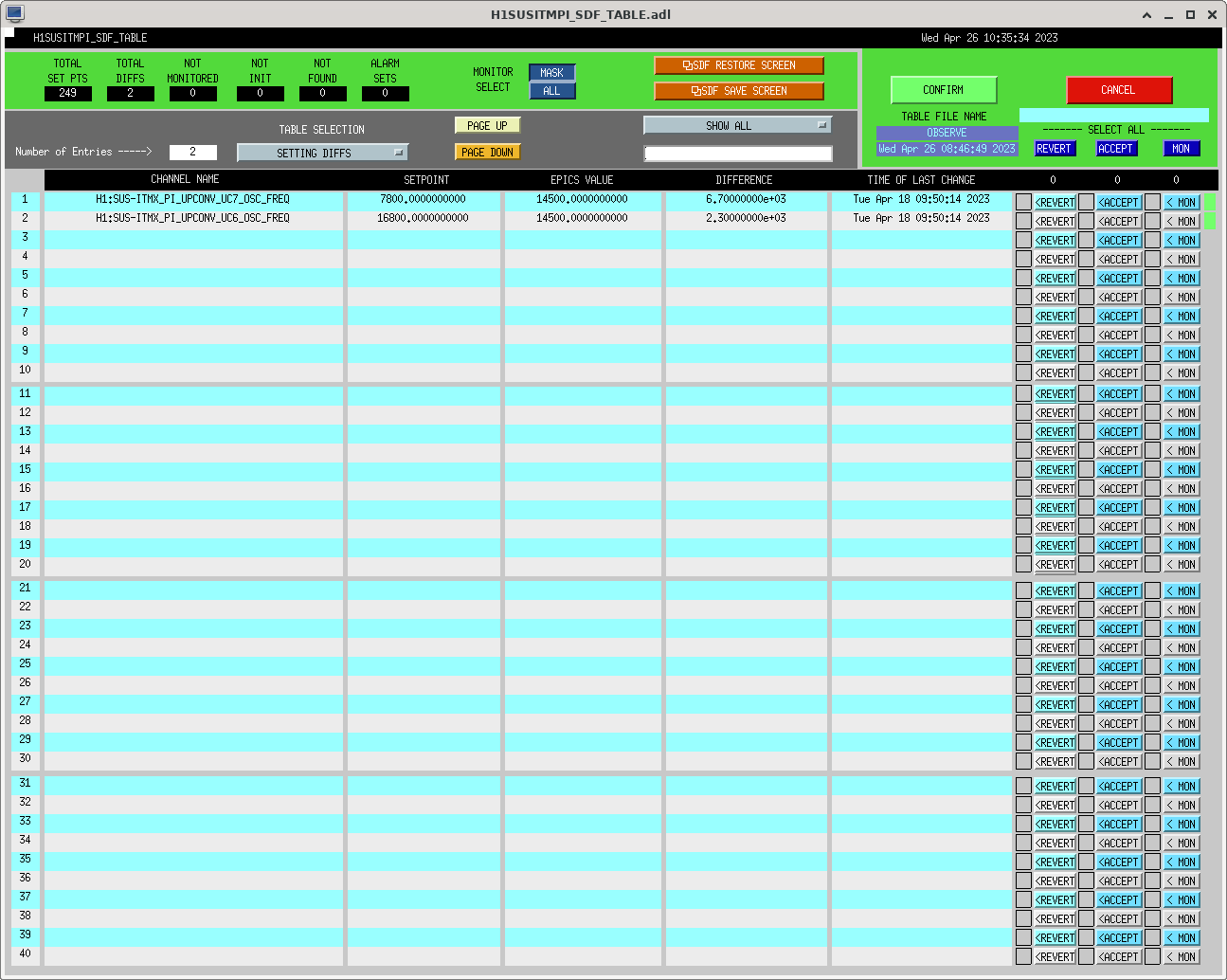
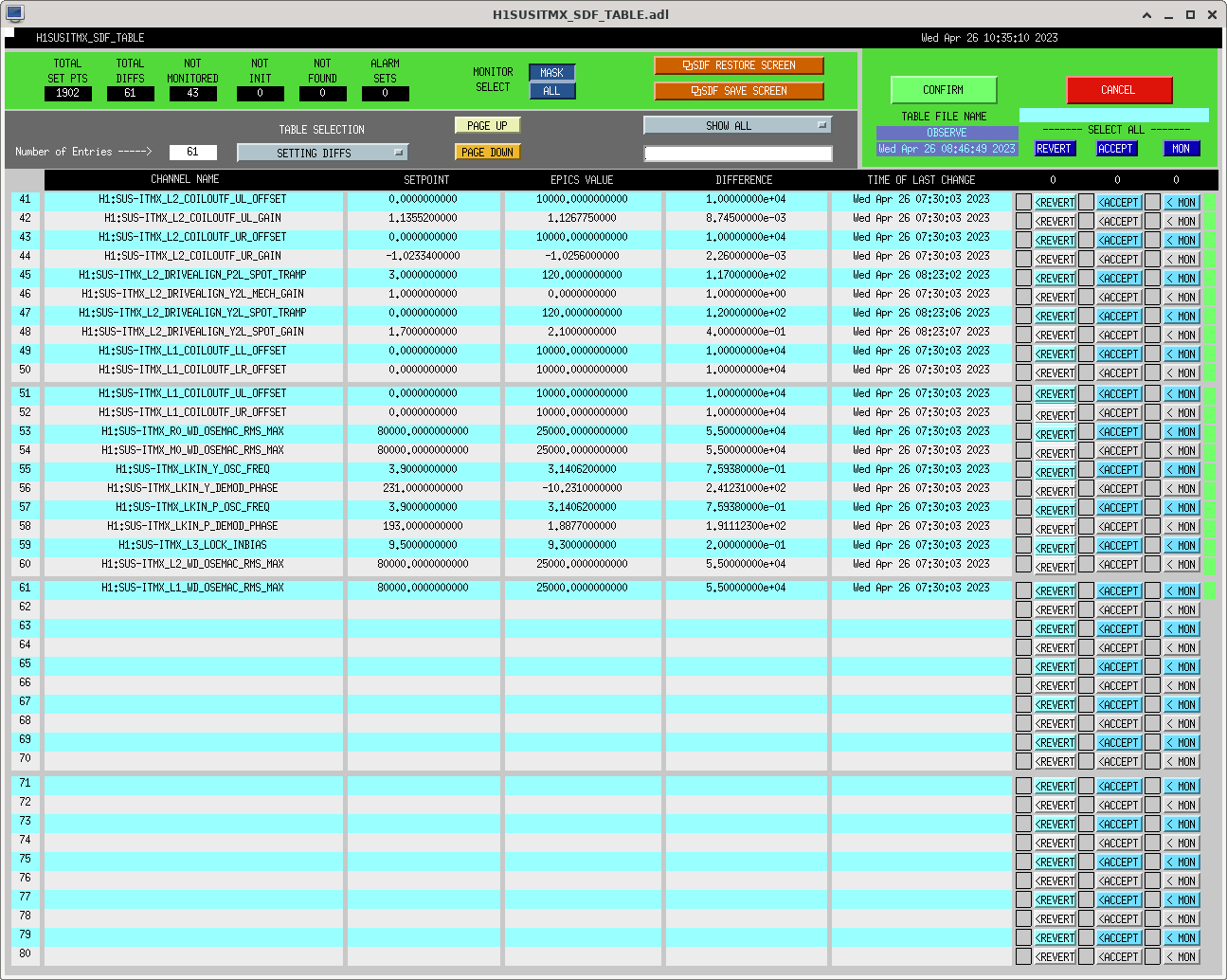
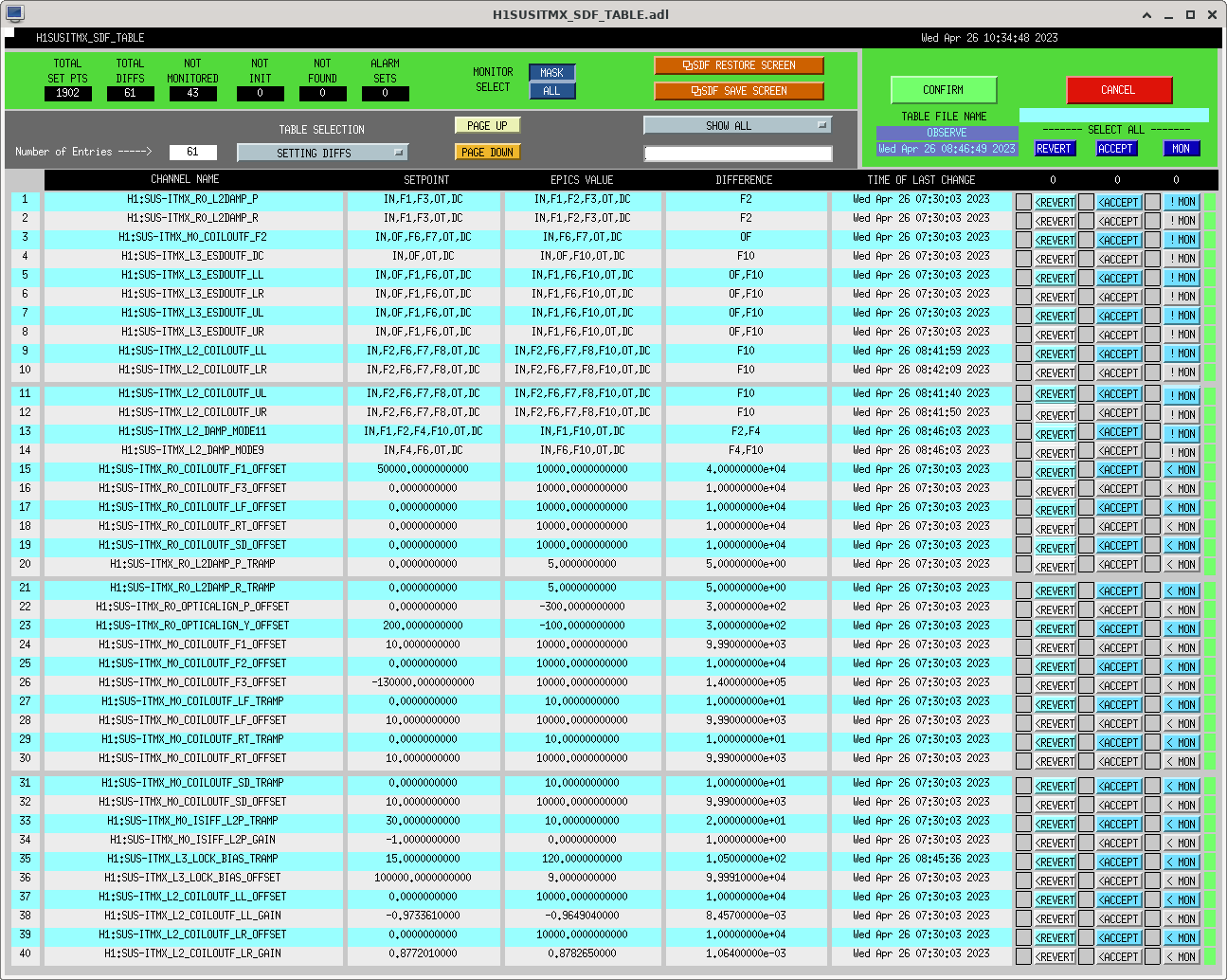
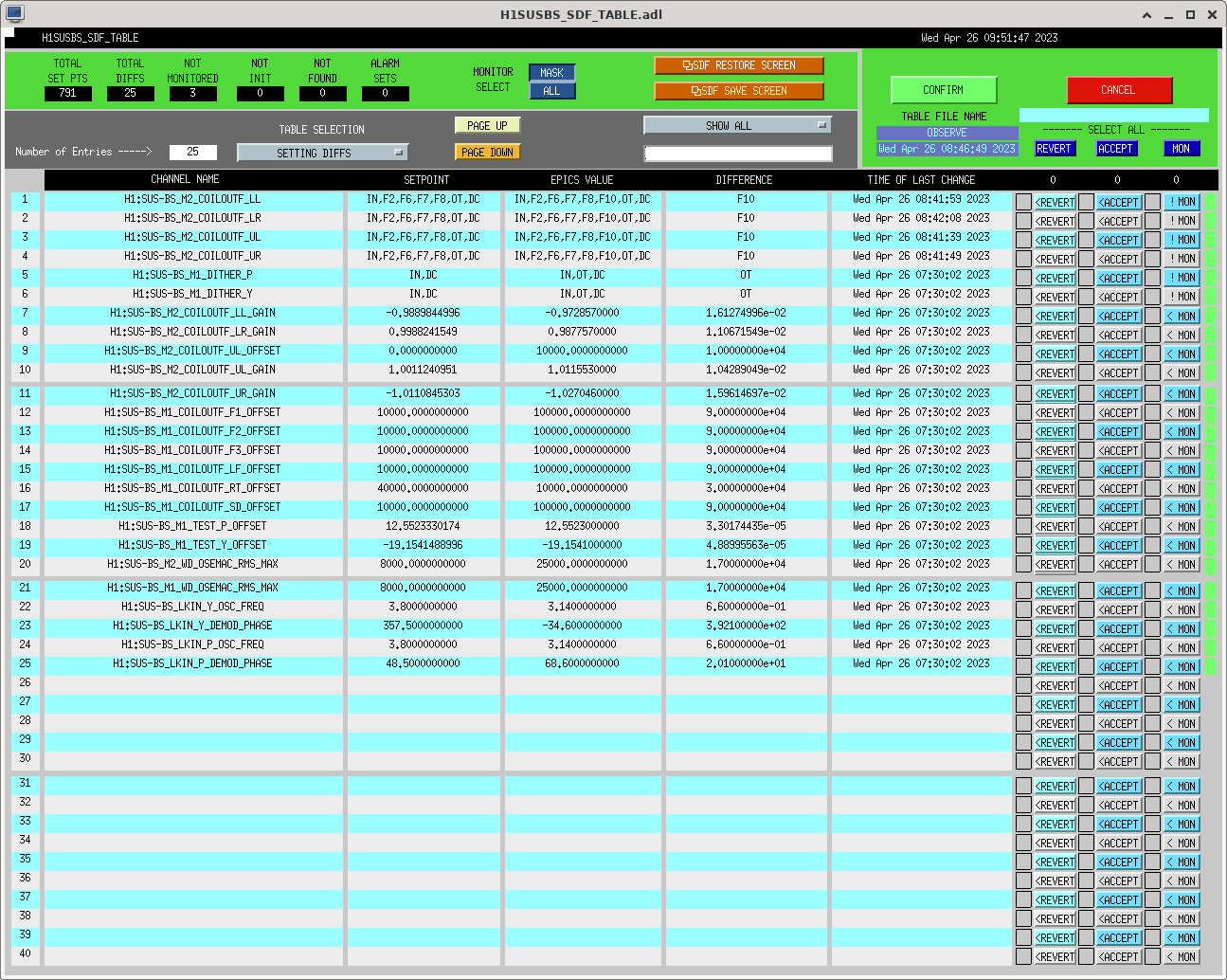
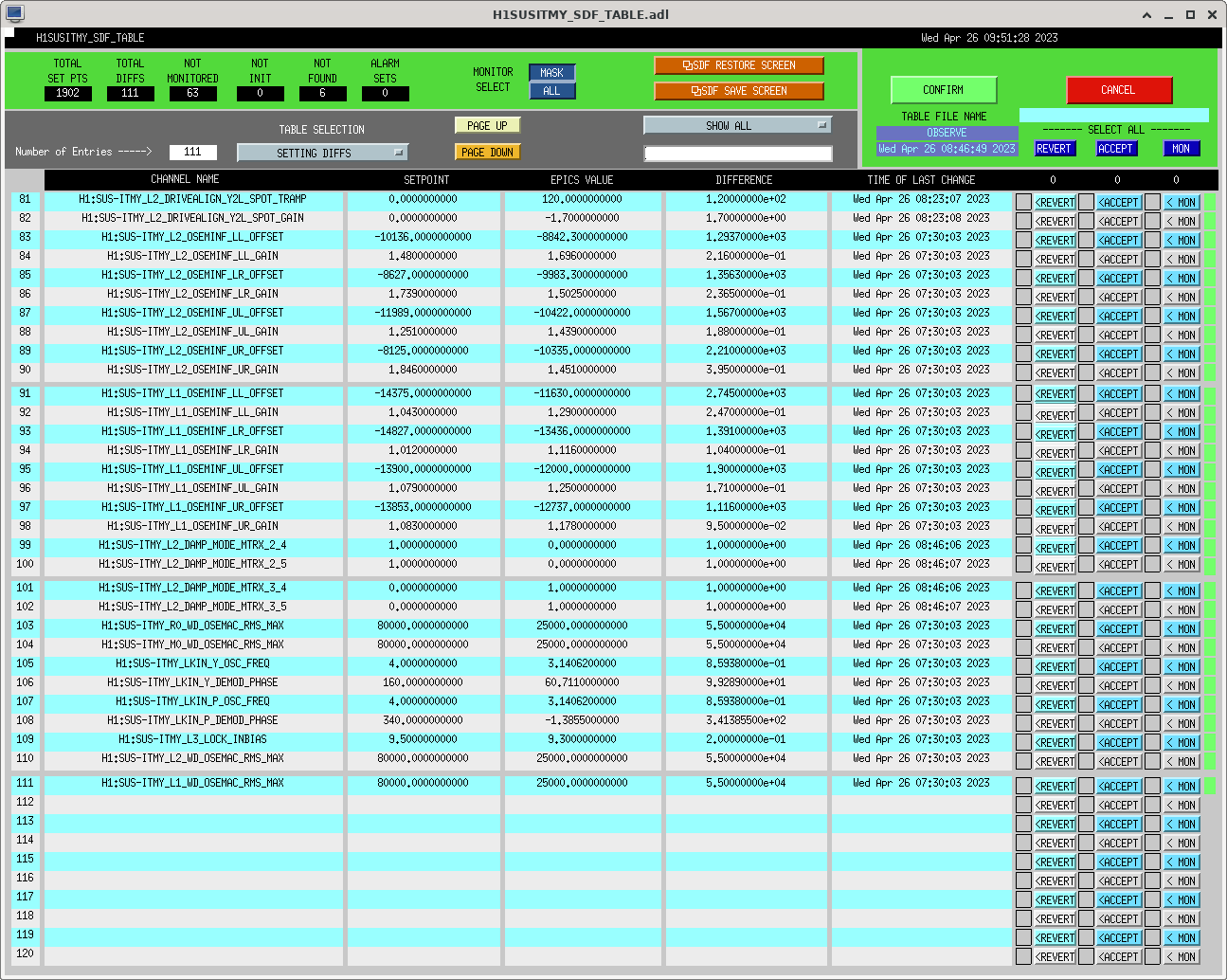
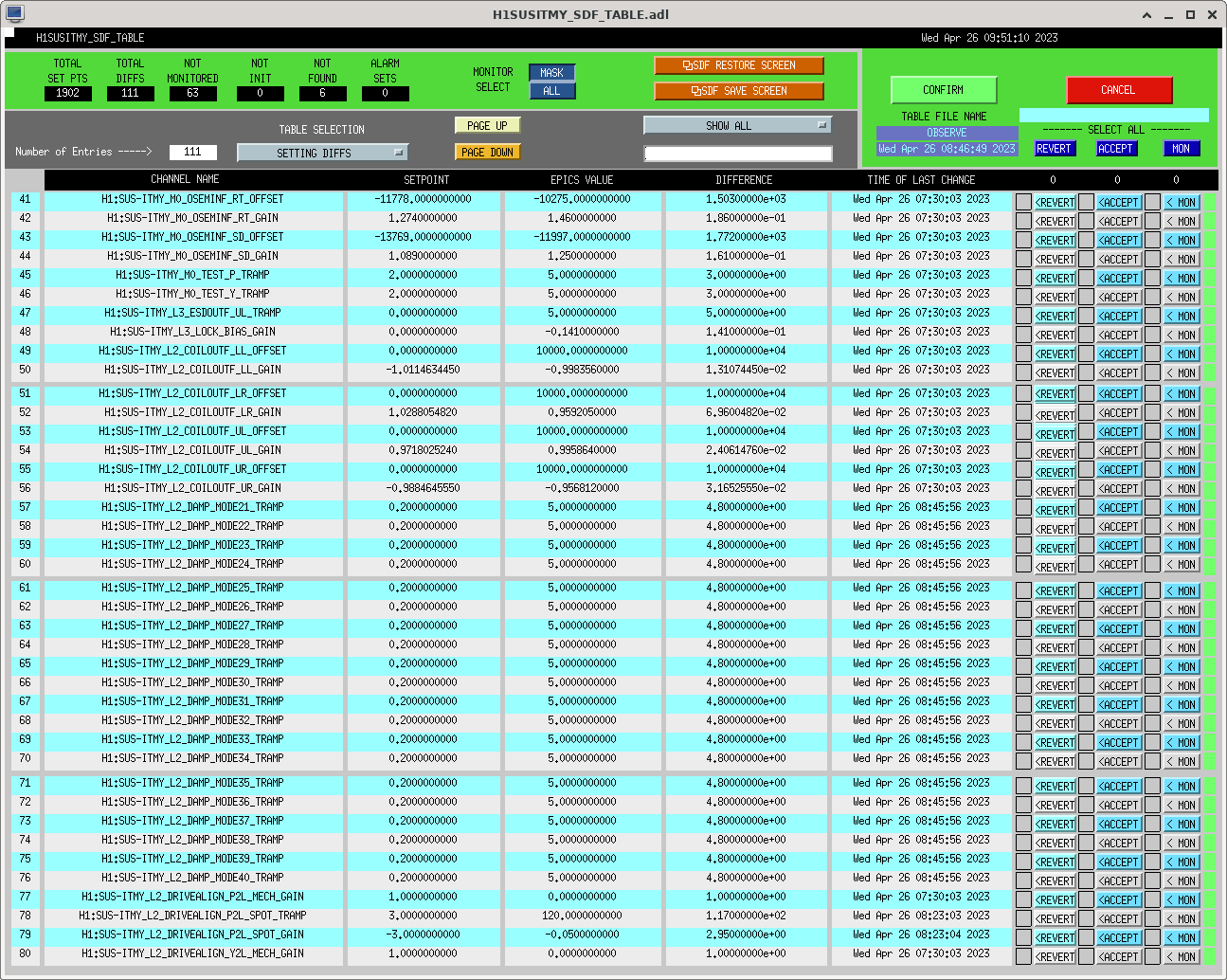
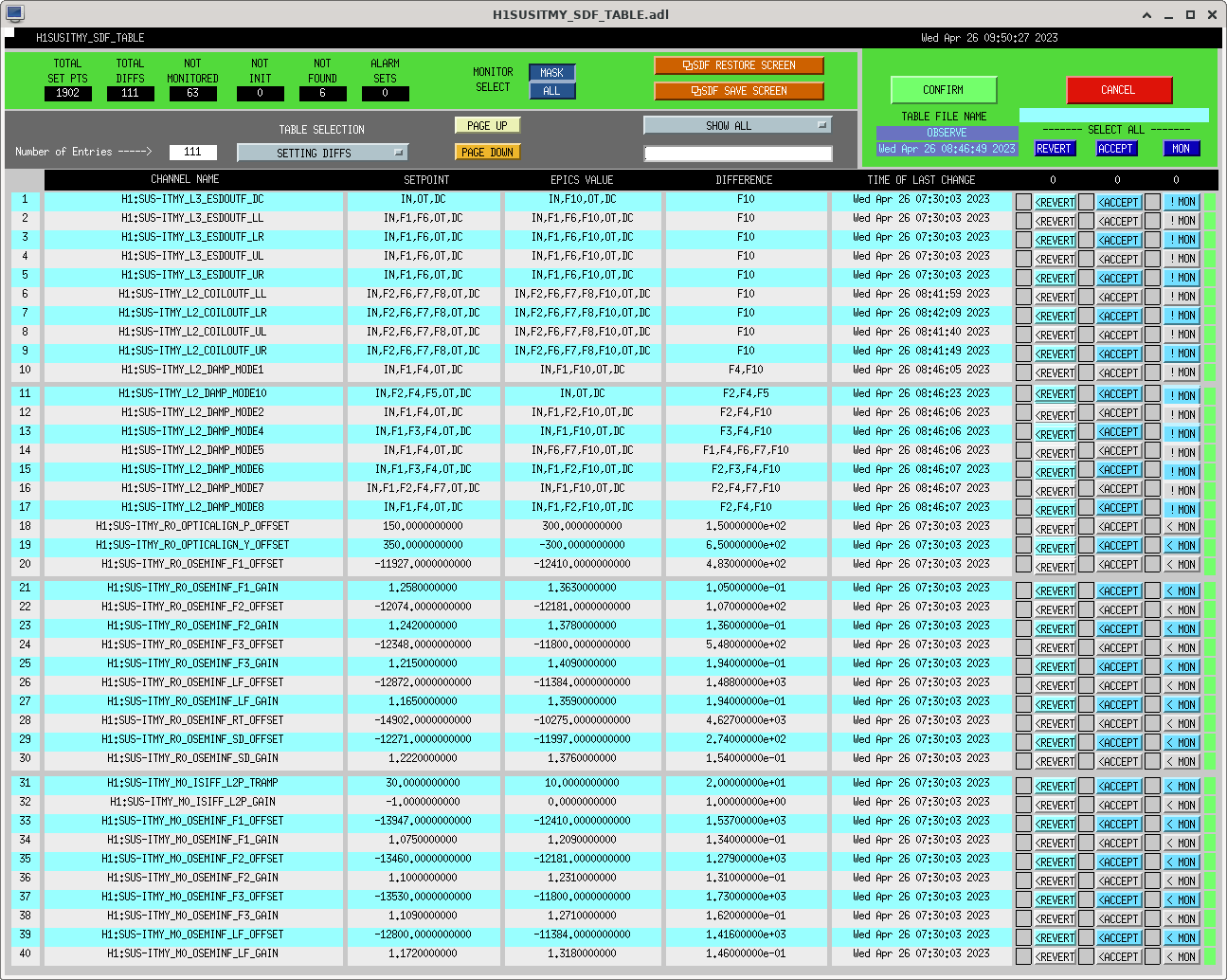
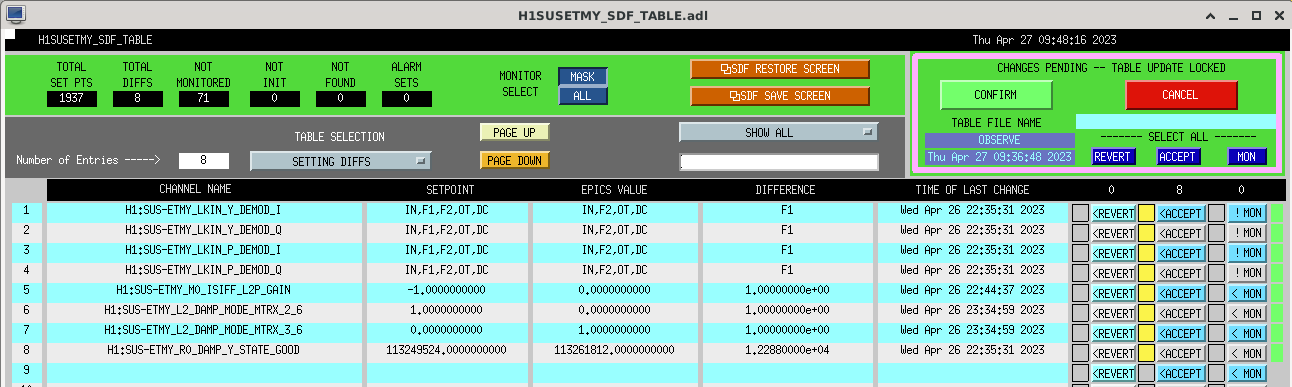
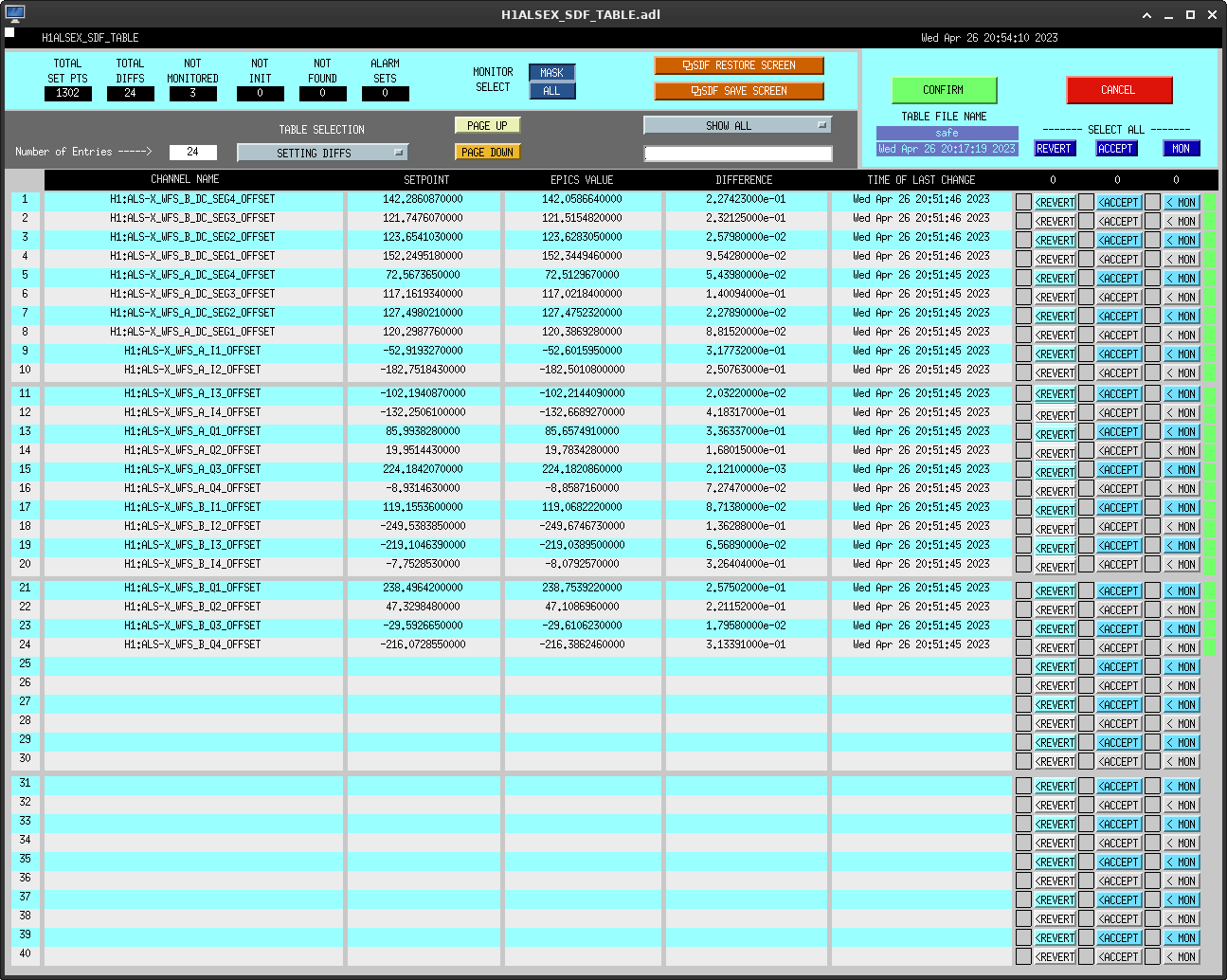
I have accepted or unmonitored a bunch of settings on SUS SDF for the OBSERVE STATE. I trended all the settings difference and accepted everything which didn't change in the last few months. I have also set the offsets (for COILOUTF) to zero for all the QUADs and R0 chain after going through all of them. There were a few things which were changed by the GRD, hence I have either accepted them or unmonitored (things like TRAMP) them.
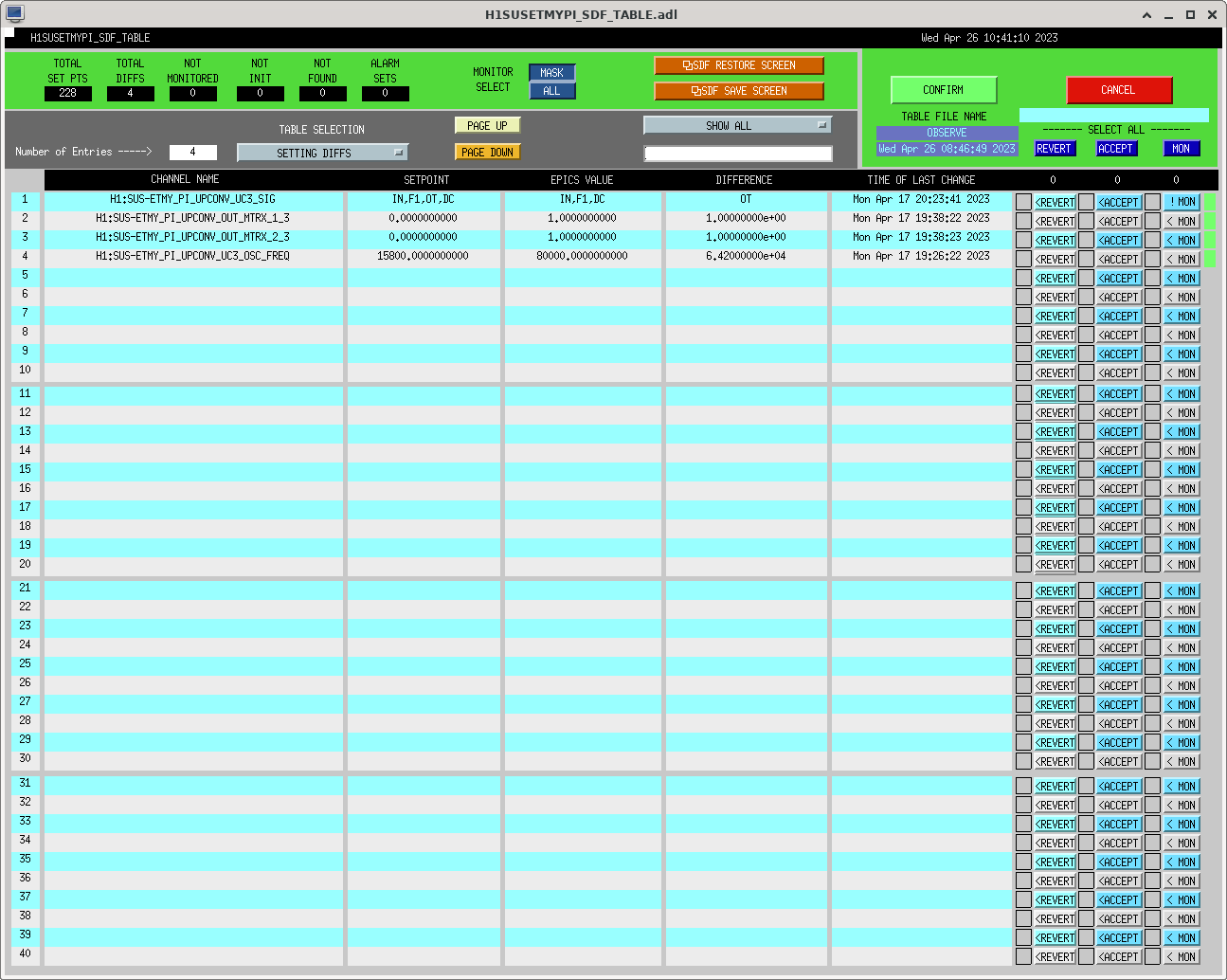
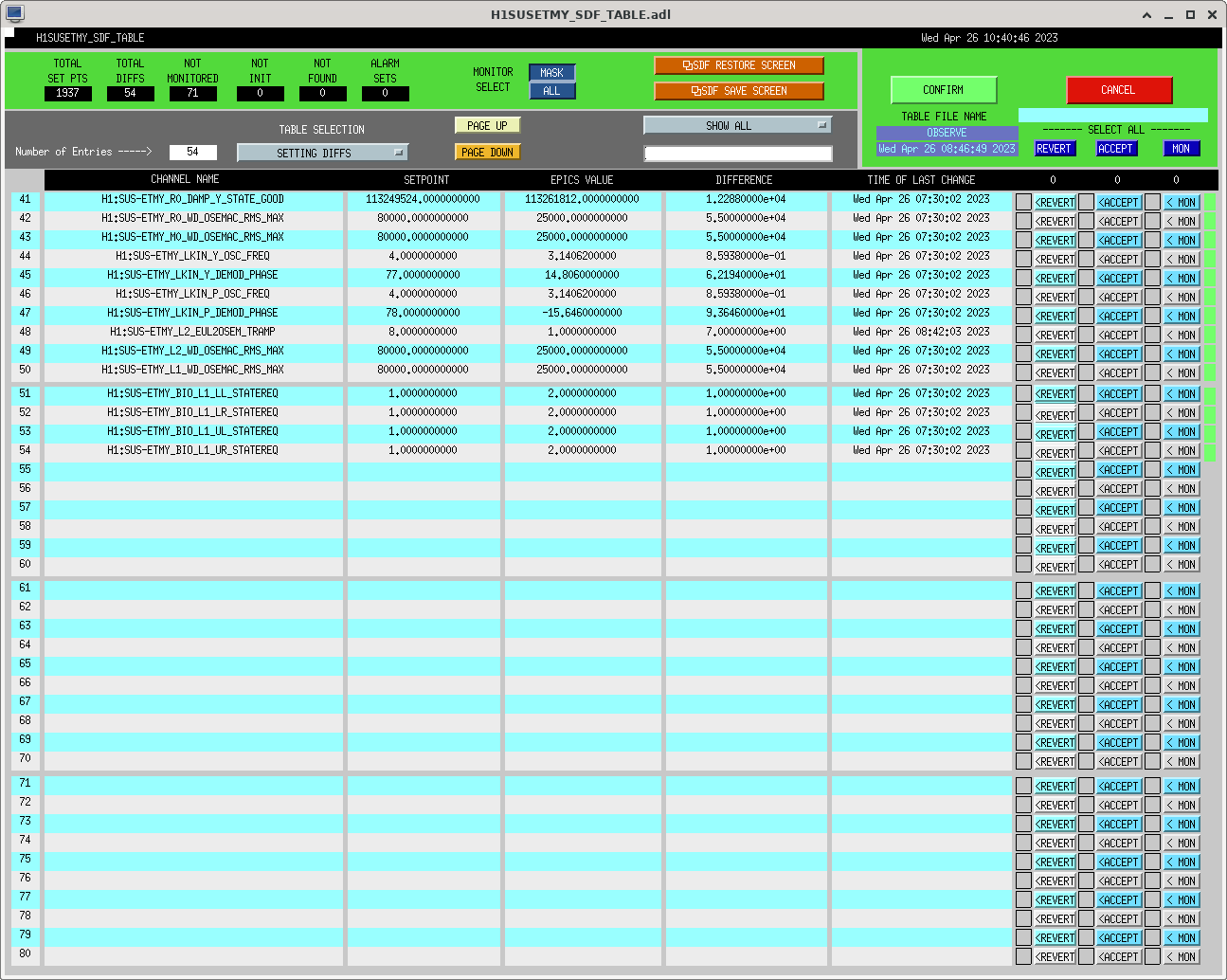
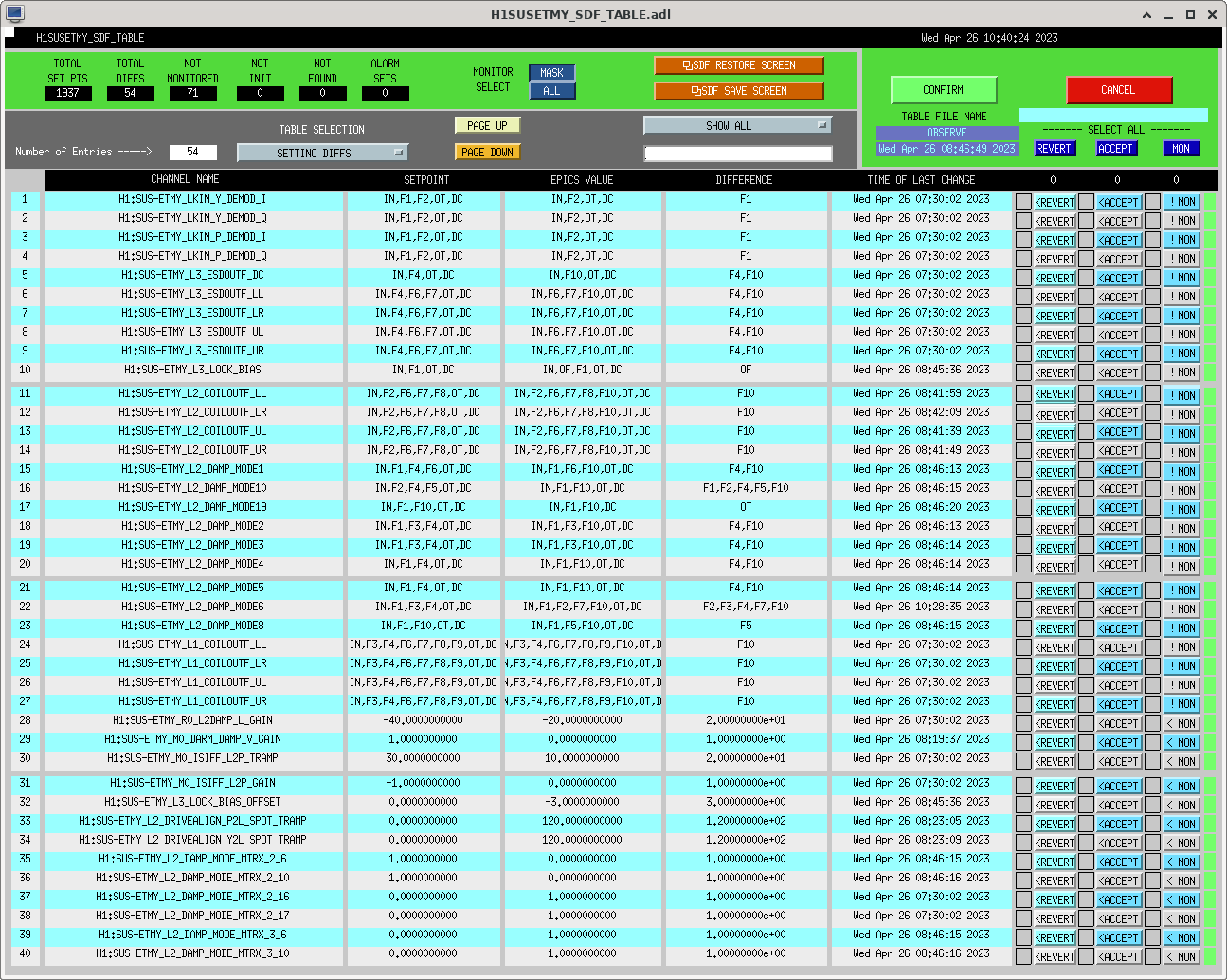
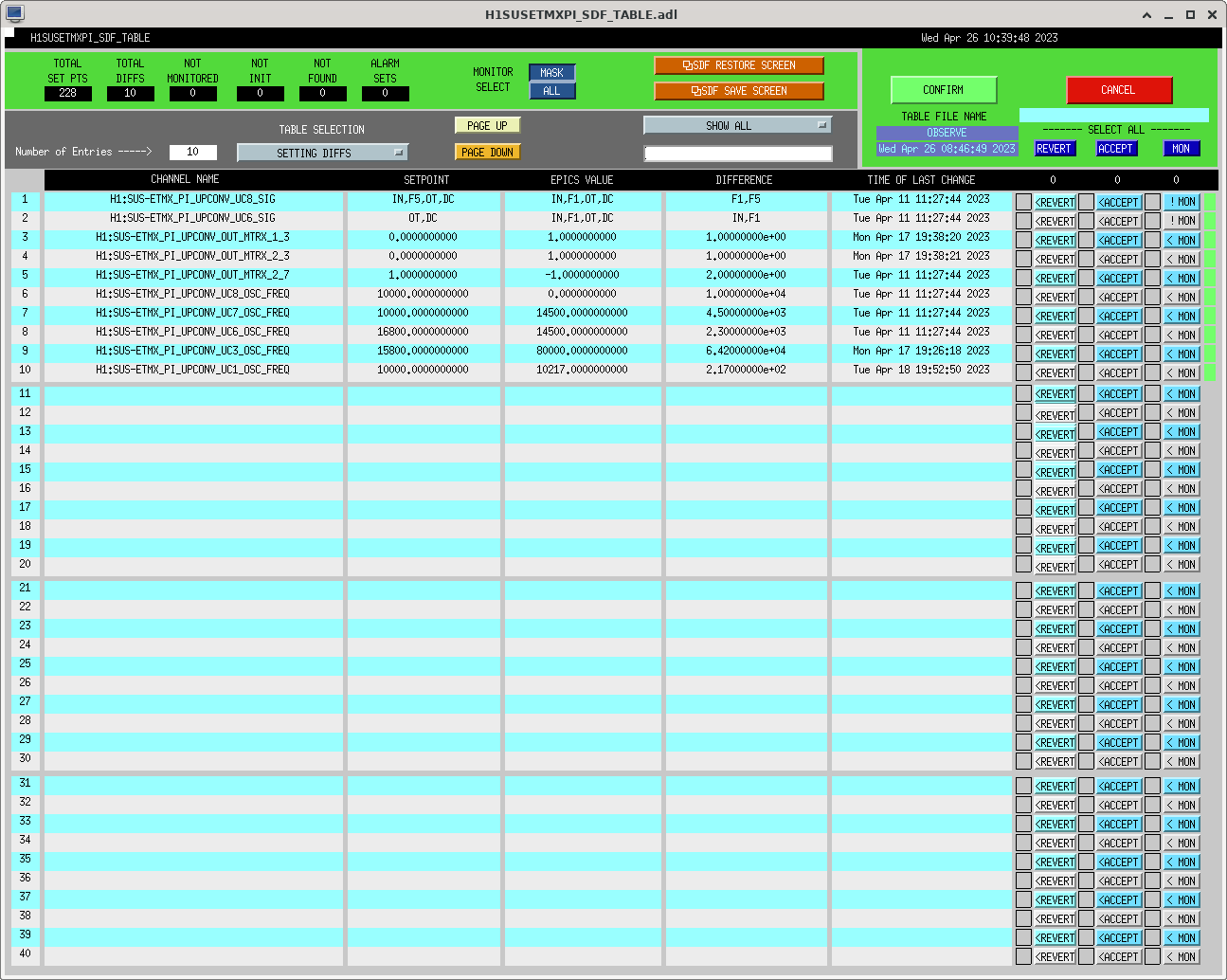
Attached below are the screenshot of all the SDF which original existed when I started yesterday morning. Hence if changes were accepted by mistake then please compare it with the screenshot and make the necessary changes.
Still there are a few SUS SDF remaining and we are planning to tackle this today (currently ongoing).
My first attempt at Calibration Sweeps created a report here :
/ligo/groups/cal/data/H1/reports/20230426T224835Z
This measurement was interupted by a lockloss .
Jeff and I spoke about what measurments it was able to get done before the lock loss and were surprised that it didn't make any BroadBand measurements. We had also edited line 28 of /ligo/groups/cal/ifo/H1/pydarm_cmd_H1.yaml by adding: - pcal before - bb. I will have to look more into what this script does to understand why it performed like this.
Tony's sentence "We had also edited line 28 of /ligo/groups/cal/ifo/H1/pydarm_cmd_H1.yaml by adding: - pcal before - bb." is referring to the changes mentioned in LHO:69059. His sentence "Jeff and I spoke about where what measurments it was able to get done before the lock loss and were surprised that it didn't make any BroadBand measurements." is reflecting that the command used to run "pydarm measure --run-headless" -- which is nicely copied over to the report directory exactly for this historical record -- /ligo/groups/cal/data/H1/reports/20230426T224835Z/pydarm_cmd_H1.yaml indeed shows that it *should* have taken a "bb" at the beginning at least. Instead, the contents of the directory are /ligo/groups/cal/data/H1/reports/20230426T224835Z/ DARMOLG_SS_20230426T224835Z.xml PCALY2DARM_SS_20230426T230552Z.xml SUSETMX_L1_SS_20230410T162452Z.xml PCALY2DARM_SS_20230410T164209Z.xml SUSETMX_L2_SS_20230410T165928Z.xml PCALY2DARM_SS_20230410T171645Z.xml SUSETMX_L3_SS_20230410T173402Z.xml so -- we're not sure *when* we lost lock during the measurement suite, so maybe it's OK that we don't have a PCALY2DARM_SS that pairs with the SUSETMX_L3_SS, but we should at *least* have a "start of the suite" BB measurement. Actually -- looking at what's in the directory, it looks like we lost lock in the middle of or after 2023-04-26 23:05:52 UTC, since all the other actuator measurements are from 2023-04-10. Bummer. We'll check with the development team to understand.
it should have taken a broadband at the start. we'll look into why it didn't. if we lost lock during the measurement the operator will need to kill the pydarm measure command (ctrl-c) and then clear the test point via diag
Diaggui is updated to 3.1.5~dev11. This version fixes a crash when an NDS connection is dropped. When the '--fom' or '--autostart' option is used, diaggui will try to restart failed tests, e.g. from a dropped connection. These options are used on wall displays to ease startup and to keep the diaggui screens running.
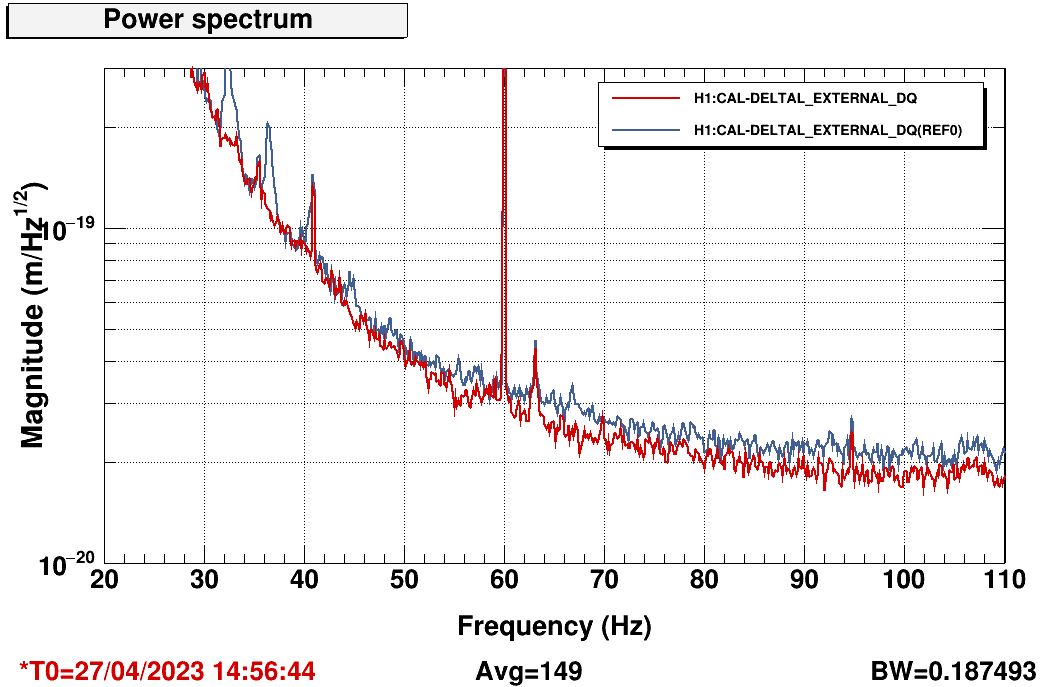
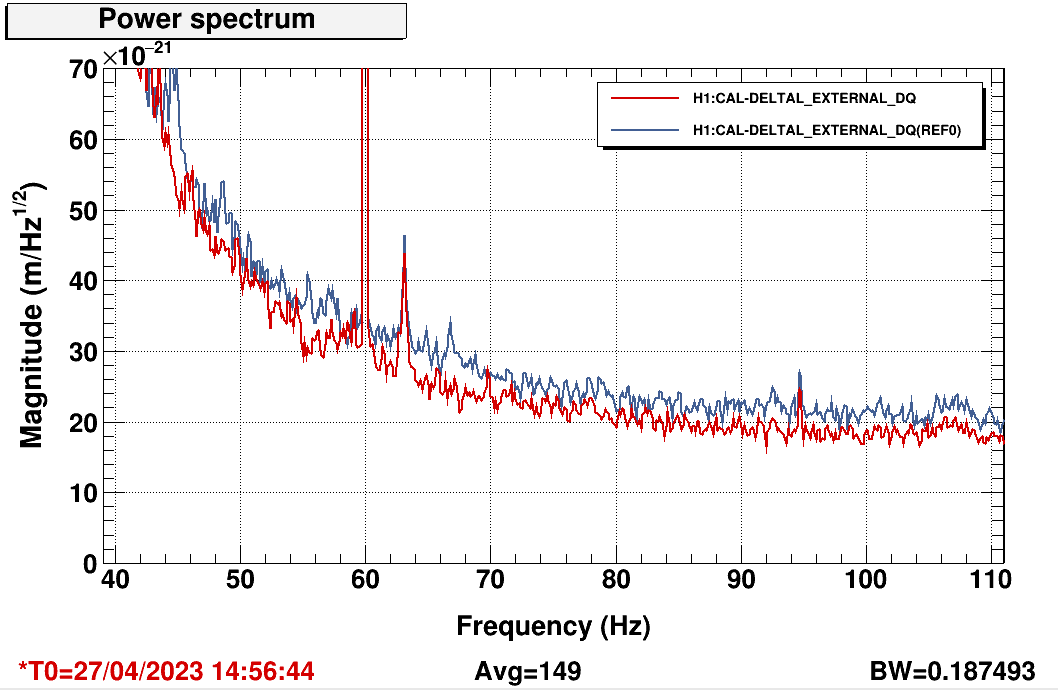
- all calibartion lines off (NLN_CAL_MEAS) with frequency dependent squeezing
from PDT: 2023-04-27 07:56:44 PDT
UTC: 2023-04-27 14:56:44 UTC
GPS: 1366642622
to PDT: 2023-04-27 08:06:56 PDT
UTC: 2023-04-27 15:06:56 UTC
GPS: 1366643234
- no squeezing
from PDT: 2023-04-27 08:07:28 PDT
UTC: 2023-04-27 15:07:28 UTC
GPS: 1366643266
to PDT: 2023-04-27 08:17:29 PDT
UTC: 2023-04-27 15:17:29 UTC
GPS: 1366643867
TITLE: 04/27 Day Shift: 15:00-23:00 UTC (08:00-16:00 PST), all times posted in UTC
STATE of H1: Commissioning
CURRENT ENVIRONMENT:
SEI_ENV state: CALM
Wind: 15mph Gusts, 12mph 5min avg
Primary useism: 0.04 μm/s
Secondary useism: 0.09 μm/s
QUICK SUMMARY:
IFO Status: NLN_CAL_MEAS, Comissioning.
We are sitting in some quiet time.
Big Red has to be moved from the Water tank to the staging building before a large delivery arrives in a connex container today.
Picket fence seems like it's not working properly, I'll reboot it.
This morning Kim Stewart heard a beeping from the Diode room. We investigated and the Low Level alarm was coming in and out. I added 152 ml of water to the chiller and the alarm stopped.
TITLE: 04/26 Eve Shift: 23:00-07:00 UTC (16:00-00:00 PST), all times posted in UTC
STATE of H1: Calibration
SHIFT SUMMARY:
- IFO was locked until 23:34 UTC when there was a DCPD saturation and a subsequent lockloss - Reason unknown
- Lock #1-2:
- GRD needed to do an increase flashes on X but it was able to catch ALS after
- Unfortunately it could not find IR on ALS COMM and flashes were not getting better after ~5 minutes so I tried to rerequest FAST_SEARCH so GRD could cycle through the offsets again, but had a subsequent lockloss ~3 minutes after this request was made
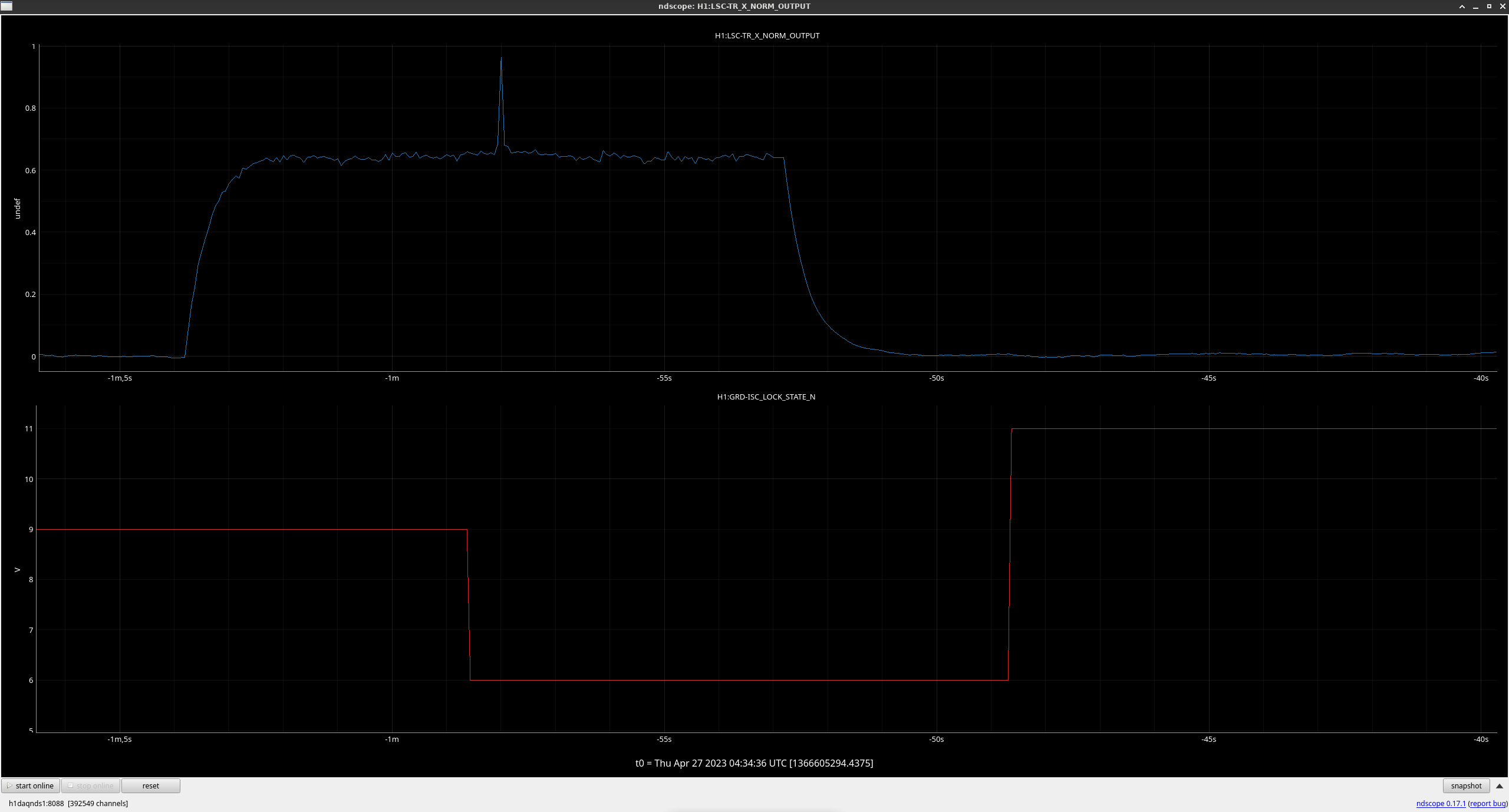
- Jenne noticed that the H1:LSC-TR_X_NORM_OUTPUT channel was hovering below 0 (~ -0.6, which shouldn't be the case since this channel looks at the DC ouput of a PD and you cannot have negative photons), and recommended that we zero the COMM offset values.
- Lock #3:
- After finishing an initial alignment after the troubleshooting saga - looks like we are stuck at the same spot as we were before despite all our changes :))
- AHA, something interesting - Ran through INIT one more time but this time ran through CHECK_SDF and FINALLY was able to catch CHECK_IR
- Acquired NLN @ 06:35 UTC!
- Other Notes:
- Having issues with initial alignment, seems to be stuck in ACQUIRE_XARM_IR, Gabriele and I are looking into it
Issue Troubleshooting Log:
Jenne's comments regarding the ISS loops during this whole debacle:
I checked that the number that Daniel said in a comment that he had turned to zero from ten, went back to 10 via guardian or some SDF thing, and tried disabling the whole ISS second loop output, no change
And, I put that offset 'thirdloop' (even though it's not actually for the 3rd loop anymore) back to the 500-ish val. All no success
- 1:05 UTC - ITMX ST/2 WD Tripped - This is weird...no one is in the LVEA, plot attached
- Leaving the IFO locked at NLN and in UNDISTURBED, twas an eventful night to kick off ER15 🥲, but we are back in business!
LOG:
| Start Time | System | Name | Location | Lazer_Haz | Task | Time End |
|---|---|---|---|---|---|---|
| 19:56 | LVEA | LAZER HAZARD | LVEA | YES | THE LVEA IS LASER HAZARD | 16:57 |
| 22:42 | CAL | Tony & Jeff & Evan | Ctrl Rm | n | Calibration Sweep | 00:17 |
| 23:52 | ISC | Gabriele/Elenna | PSL Racks | Y | Swap CARM noise injecton to freq noise injection | 23:56 |
| 00:05 | VAC | Gerardo | LVEA | YES | Move racks | 00:14 |
IFO is set to UNDISTURBED @ 7:01 UTC, April 27th
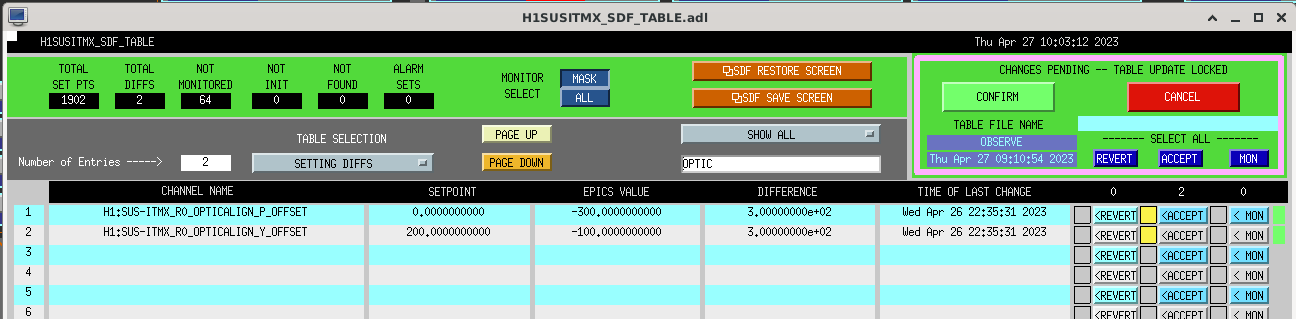
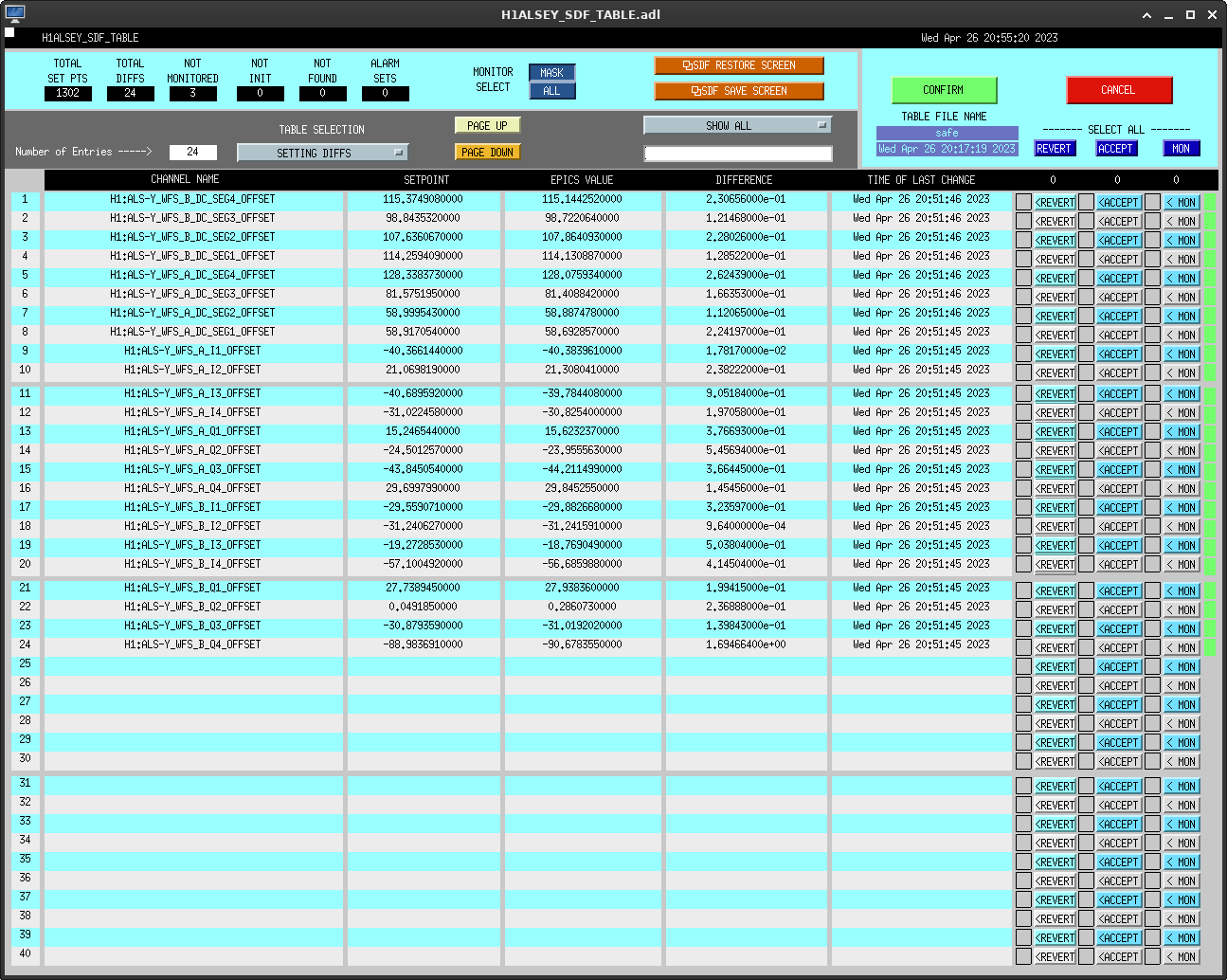
Last night I accepted several of the safe.snaps of the _OFFSET values after Austin ran the dark offset script. (First two attachments are 2 of those)
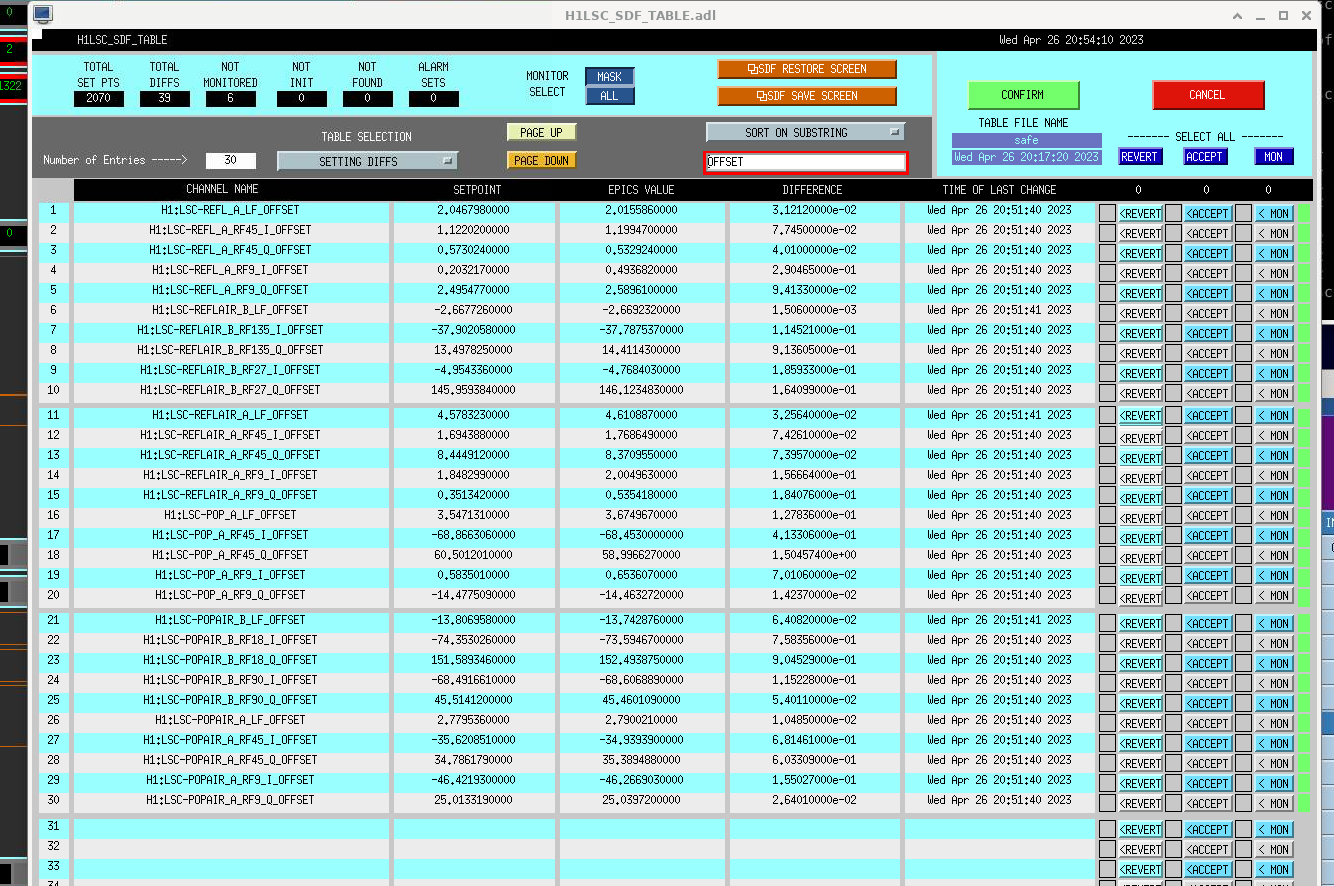
Also, this morning, I've accepted all the _OFFSET values that I could find in the OBSERVE.snap files. (3rd attachment is one of these that I thought was intersting)
We attempted to move to a new router tonight from roughly 6pm-7pm localtime. We ran into some issues and had to roll back. Some items we need to check on. * We had significantly less light on the fiber when using the new router, close to non-viable levels. * While we did get light we where not able to exchange bgp routes.
The attached screenshot shows a filter module and its 2 hour old counterpart. Comparing the two it looks like the only difference in the settings is that that the decimate button was turned off in the past. However, the actually difference is that the hold button was on!
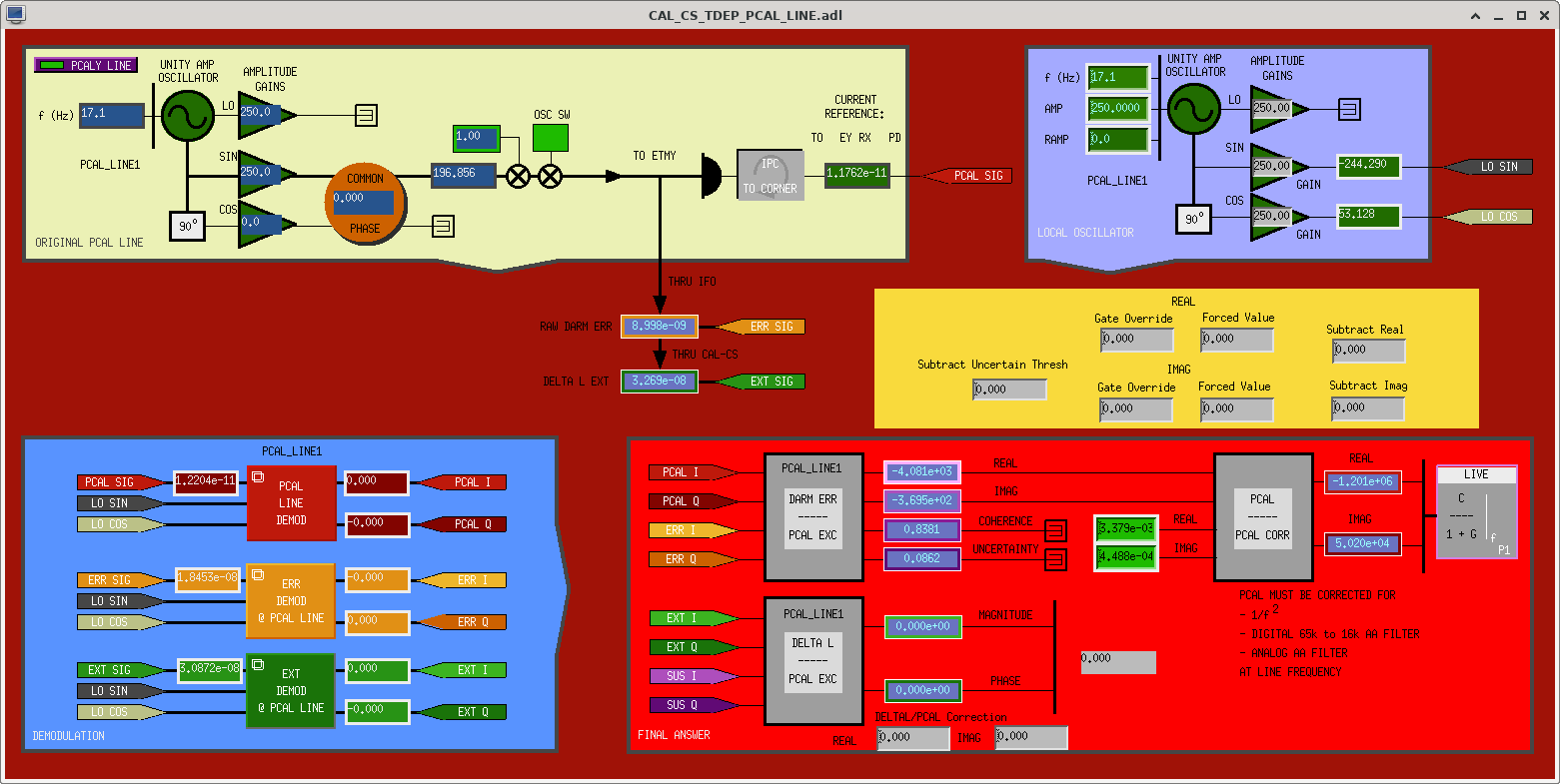
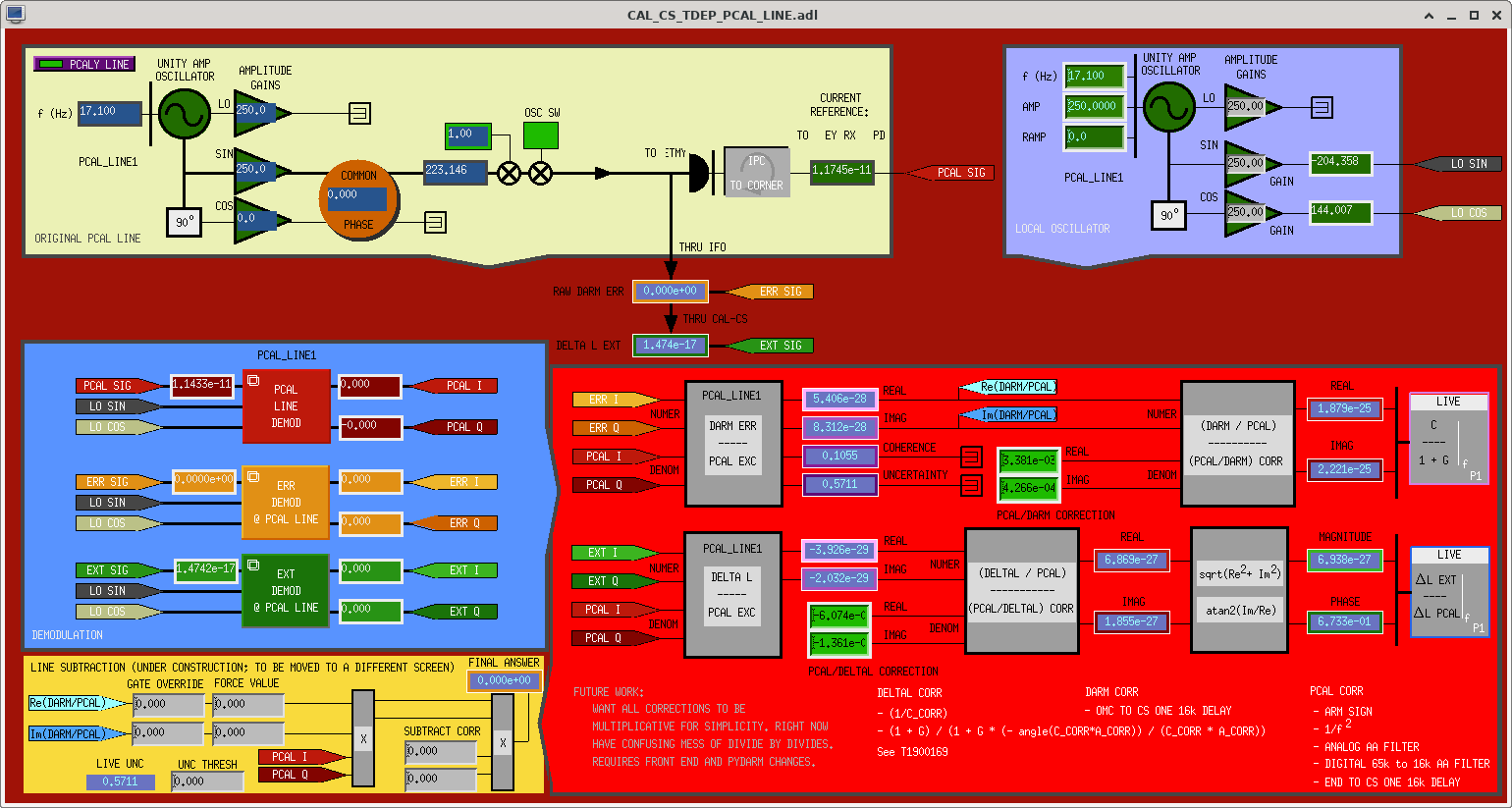
J. Kissel, E. Goetz As Evan and I continue to debug / populate the new demodulation of the PCALX calibration lines in order to get a front-end made, real-time estimate of the systematic error in CAL-DELTAL_EXTERNAL (see e.g. LHO:69061), we found and fixed some bugs in yesterday's update of the MEDM user interface for the time-dependent correction factor and systematic error monitoring infrastructure (LHO:68999). Some minor typos in the CAL_CS_TDEP_OVERVIEW.adl, but really overhauled the PCAL_LINE.adl DEMOD OVERVIEW screen with the following changes: - Increased the precision on the displayed frequency of the oscillator - Moved the newish uncommissioned line-subtraction stuff (in the Yellow Box) out of the way, improving the representation of what's happening along the way - Flipped (and therefore corrected) the visual representation of how the I and Q inputs to the DARM/PCAL transfer function COMPLEX_RATIO block are shown, - Replaced (and therefore corrected) SUS tags with PCAL tags in the visual representation of I and Q inputs of the denominator of the DELTAL/PCAL transfer function COMPLEX_RATIO block, - Updated the graphical representation of the COMPLEX_RATIO between (DARM/PCAL) and (DELTAL/PCAL) with their respective (DARM_CORR/PCAL_CORR) and (DELTAL_CORR/PCAL CORR) corrective transfer function values - Showed the rotation between Real / Imaginary to Mag / Phase for the corrected (DELTAL / PCAL) transfer function. - Added a bunch of notation defining the physical components of what each of the corrective transfer functions should be. See attached before vs. after screenshots. The screens /opt/rtcds/userapps/release/cal/common/medm CAL_CS_TDEP_PCAL_LINE.adl CAL_CS_TDEP_OVERVIEW.adl have been committed to the repo.
J. Kissel, E. Goetz
Now that some front end infrastructure is in-place for monitoring the systematic error of CAL-DELTAL_EXTERNAL against PCAL, we have to include corrections to DELTAL_EXTERNAL and PCAL to account for the impacts of anti-aliasing, delays, and imperfect estimation of the inverse sensing and actuation in the CALCS model. To that end, I have included these corrections as transfer function values stored in EPICS records (note that these are higher precision than what is currently written to the EPICS records; in the next days we will have a better solution to push these EPICS records to the front end)
'CAL-CS_TDEP_PCAL_LINE1_DELTAL_PCAL_CORR_REAL': -0.006073503332940157,
'CAL-CS_TDEP_PCAL_LINE1_DELTAL_PCAL_CORR_IMAG': -0.0013606856967624704,
'CAL-CS_TDEP_PCAL_LINE2_DELTAL_PCAL_CORR_REAL': 5.899769524086836e-06,
'CAL-CS_TDEP_PCAL_LINE2_DELTAL_PCAL_CORR_IMAG': -3.699645821510619e-07,
'CAL-CS_TDEP_PCAL_LINE3_DELTAL_PCAL_CORR_REAL': 8.386397287449958e-07,
'CAL-CS_TDEP_PCAL_LINE3_DELTAL_PCAL_CORR_IMAG': -1.5081314667072642e-07,
'CAL-CS_TDEP_PCAL_X_COMPARE_DELTAL_PCAL_CORR_REAL': -5.9041552773359905e-06,
'CAL-CS_TDEP_PCAL_X_COMPARE_DELTAL_PCAL_CORR_IMAG': 3.7352291714501767e-07,
'CAL-CS_TDEP_PCAL_Y_COMPARE_DELTAL_PCAL_CORR_REAL': 5.899769524086836e-06,
'CAL-CS_TDEP_PCAL_Y_COMPARE_DELTAL_PCAL_CORR_IMAG': -3.699645821510619e-07,
'CAL-CS_TDEP_PCAL_LINE5_CORRECTION_REAL': -0.000891357719598607,
'CAL-CS_TDEP_PCAL_LINE5_CORRECTION_IMAG': -6.855875512501219e-05,
'CAL-CS_TDEP_PCAL_LINE5_DELTAL_PCAL_CORR_REAL': 0.0019506922912537398,
'CAL-CS_TDEP_PCAL_LINE5_DELTAL_PCAL_CORR_IMAG': -0.0012367241766306207,
'CAL-CS_TDEP_PCAL_LINE6_CORRECTION_REAL': -0.0003463121477292491,
'CAL-CS_TDEP_PCAL_LINE6_CORRECTION_IMAG': -2.2361738471929133e-05,
'CAL-CS_TDEP_PCAL_LINE6_DELTAL_PCAL_CORR_REAL': 0.00031722752183511923,
'CAL-CS_TDEP_PCAL_LINE6_DELTAL_PCAL_CORR_IMAG': -0.0011010520099375882,
'CAL-CS_TDEP_PCAL_LINE7_CORRECTION_REAL': -0.00016511918561500546,
'CAL-CS_TDEP_PCAL_LINE7_CORRECTION_IMAG': -1.0773445503552214e-05,
'CAL-CS_TDEP_PCAL_LINE7_DELTAL_PCAL_CORR_REAL': -0.0002494269255759141,
'CAL-CS_TDEP_PCAL_LINE7_DELTAL_PCAL_CORR_IMAG': -0.0005356018866498055,
'CAL-CS_TDEP_PCAL_LINE8_CORRECTION_REAL': -9.56073427066754e-05,
'CAL-CS_TDEP_PCAL_LINE8_CORRECTION_IMAG': -6.836645060102044e-06,
'CAL-CS_TDEP_PCAL_LINE8_DELTAL_PCAL_CORR_REAL': -0.0002616172956290841,
'CAL-CS_TDEP_PCAL_LINE8_DELTAL_PCAL_CORR_IMAG': -0.00018845087631648119,
'CAL-CS_TDEP_PCAL_LINE9_CORRECTION_REAL': -1.2253118668315672e-05,
'CAL-CS_TDEP_PCAL_LINE9_CORRECTION_IMAG': -1.866404318229895e-06,
'CAL-CS_TDEP_PCAL_LINE9_DELTAL_PCAL_CORR_REAL': -9.67618312303927e-06,
'CAL-CS_TDEP_PCAL_LINE9_DELTAL_PCAL_CORR_IMAG': 5.78098087799133e-06,
'CAL-CS_TDEP_PCAL_LINE10_CORRECTION_REAL': -6.138898212894542e-07,
'CAL-CS_TDEP_PCAL_LINE10_CORRECTION_IMAG': -4.1525414776953105e-07,
'CAL-CS_TDEP_PCAL_LINE10_DELTAL_PCAL_CORR_REAL': -7.42023357685704e-07,
'CAL-CS_TDEP_PCAL_LINE10_DELTAL_PCAL_CORR_IMAG': 1.4076461554037913e-07
These were computed by using the method pydarm.calcs.CALCSModel.deltal_ext_pcal_correction() for the CAL-CS_TDEP_PCAL_LINE*_DELTAL_PCAL_CORR_* channels. Note that this calculates DELTAL/PCAL correction and what we need to install (because the front end does a division instead of multiplication) is the inverse of what this method returns. We have also specified include_whitening=False, endstation=False because the DELTAL_EXTERNAL signal is not whitened and the PCAL channels are corner station channels.
Note that CAL-CS_TDEP_PCAL_LINE*_CORRECTION_* channels are computed the usual way using pydarm.pcal.PcalModel.pcal.compute_pcal_correction() using endstation=False inside of pydarm.calcs.CALCSModel.compute_epics_records().
We also had to be a little careful because the LINE1-3 PCAL channels are Y-arm channels while 5-10 are X-arm channels, so we had to make sure to set ref_pcal_2_darm_act_sign=1 for X and ref_pcal_2_darm_act_sign=-1 for Y EPICS records. This should be improved in a future merge request.
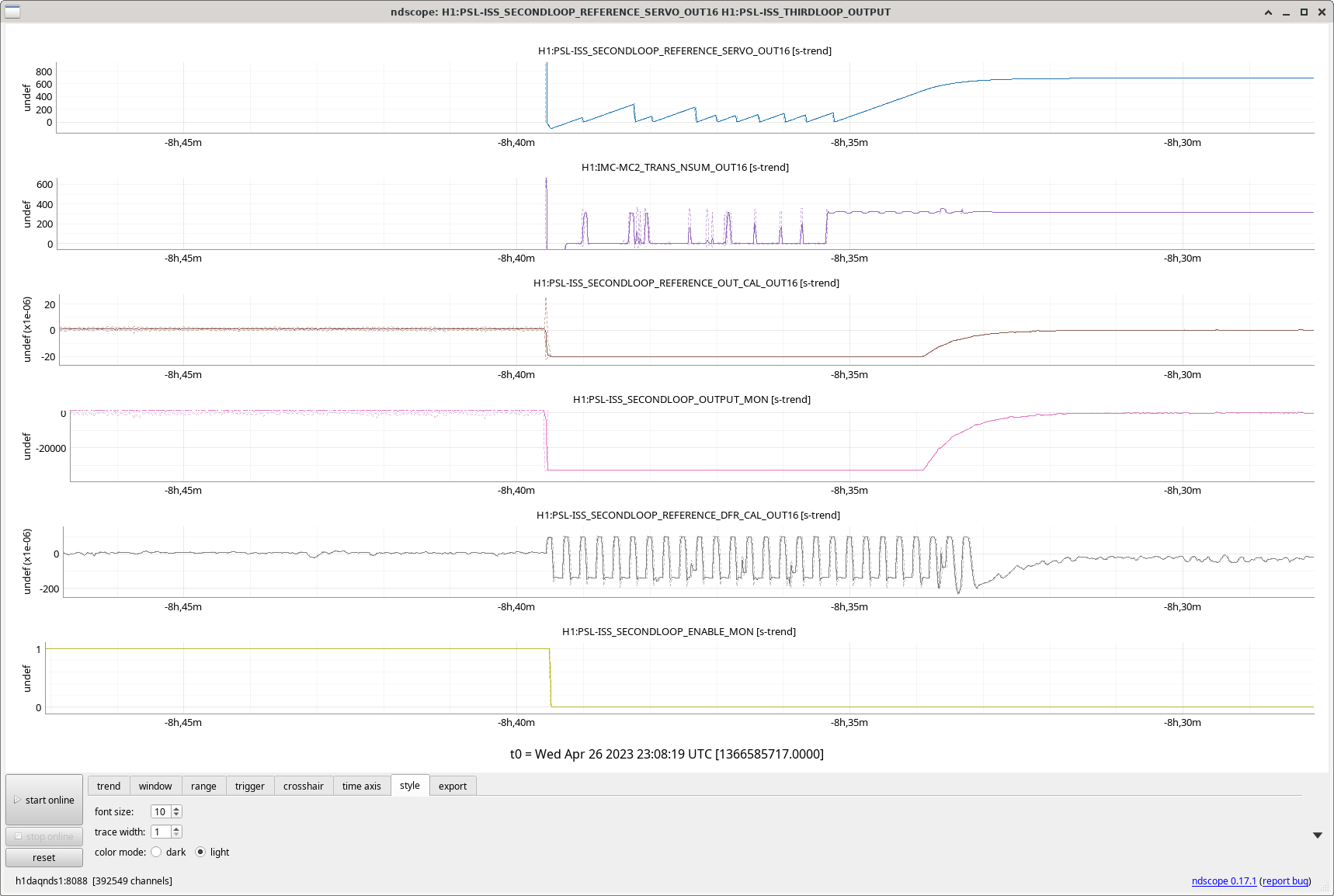
When the gain of the ISS second loop was changed, the input offset was not adjusted. This results in the output of the 2nd loop ISS to saturate after a lock loss, until the offset slowly gets compensated by the offset loop. But, this now typically takes like 5 minutes. I adjusted the offset (H1:PSL-ISS_THIRDLOOP_OUTPUT_OFFSET) from 587.3 to 1272. We will have to check after the next lock loss that this actually works.
Just had a lock loss. Looks a lot better now.
I disabled the diffraction servo by setting H1:PSL-ISS_SECONDLOOP_REFERENCE_IN_MTRX_1_4 to 0 (from 10). This should stabilize the power after the IMC, rather than keep the pwer at the PSL AOM constant. The downside is that we may run out of range of the AOM, since we only work at 2% diffraction power.
Tagging PSL.
The diffraction servo value that Daniel has made 0 from 10 had been hard-coded into the DOWN state of the IMC_LOCK guardian, so was getting overwritten.
RyanS and I just set the value in the guardian to zero, loaded, and checked it in to the svn.
First hour trend during a lock with the diffraction compensation off: The powers are no longer drifting a significant amount after the mode cleaner.
J. Kissel, E. Goetz, T. Sanchez
While teaching Tony how to use the command line infrastructure to gather a full set of calibration sweeps, we noticed that the default list of measurements was missing a companion PCAL measurement to the last TST stage actuation strength measurement.
Before we changed anything we ran the check of "what will the command do if I just run it," and got
$ pydarm measure
available measurements:
pcal: PCal response, swept-sine (/ligo/groups/cal/ifo/H1/templates/PCALY2DARM_SS__template_.xml)
bb : PCal response, broad-band (/ligo/groups/cal/ifo/H1/templates/PCALY2DARM_BB__template_.xml)
sens: sensing function (/ligo/groups/cal/ifo/H1/templates/DARMOLG_SS__template_.xml)
act1x: actuation X L1 (UIM) stage response (/ligo/groups/cal/ifo/H1/templates/SUSETMX_L1_SS__template_.xml)
act2x: actuation X L2 (PUM) stage response (/ligo/groups/cal/ifo/H1/templates/SUSETMX_L2_SS__template_.xml)
act3x: actuation X L3 (TST) stage response (/ligo/groups/cal/ifo/H1/templates/SUSETMX_L3_SS__template_.xml)
measurement sequence:
['bb', 'sens', 'pcal', 'act1x', 'pcal', 'act2x', 'pcal', 'act3x', 'bb']
Use --run-* option to actually execute measurement
You'll see that the list is missing a companion 'pcal' to 'act3x'.
So, we edited the default list by changing
/ligo/groups/cal/ifo/H1/
pydarm_cmd_H1.yaml
Specifically, the lines under the parameter "measurement_sequence" such that it now reads
measurement_sequence:
- bb
- sens
- pcal
- act1x
- pcal
- act2x
- pcal
- act3x
- pcal
- bb
Now, the dry-run of pydarm measure reads
$ pydarm measure
available measurements:
pcal: PCal response, swept-sine (/ligo/groups/cal/ifo/H1/templates/PCALY2DARM_SS__template_.xml)
bb : PCal response, broad-band (/ligo/groups/cal/ifo/H1/templates/PCALY2DARM_BB__template_.xml)
sens: sensing function (/ligo/groups/cal/ifo/H1/templates/DARMOLG_SS__template_.xml)
act1x: actuation X L1 (UIM) stage response (/ligo/groups/cal/ifo/H1/templates/SUSETMX_L1_SS__template_.xml)
act2x: actuation X L2 (PUM) stage response (/ligo/groups/cal/ifo/H1/templates/SUSETMX_L2_SS__template_.xml)
act3x: actuation X L3 (TST) stage response (/ligo/groups/cal/ifo/H1/templates/SUSETMX_L3_SS__template_.xml)
measurement sequence:
['bb', 'sens', 'pcal', 'act1x', 'pcal', 'act2x', 'pcal', 'act3x', 'pcal', 'bb']
Use --run-* option to actually execute measurement
I've committed this new version of the yaml to the Calibration/ifo/H1/ git repo, as of 092dc147.
it wasn't missing a pcal for act3x. It would have just used the pcal measurement taken right before act3x during processing. This cuts down the overall time needed for the calibration suite. the pcal measurements are sandwiched between the actuation and OLG ('sens') measurements for this purpose.
Adrian, Camilla, Gabriele, Fil, Richard
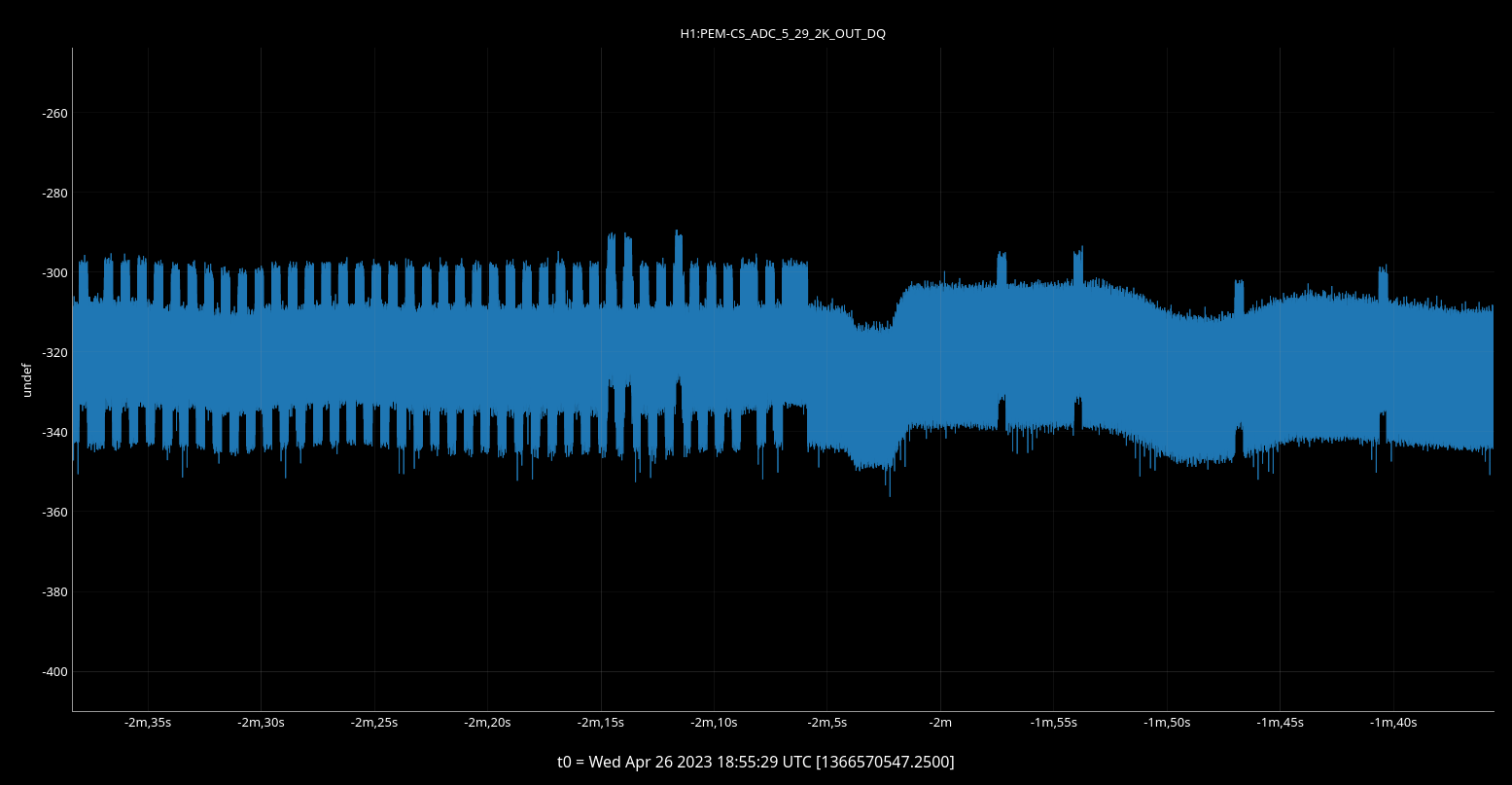
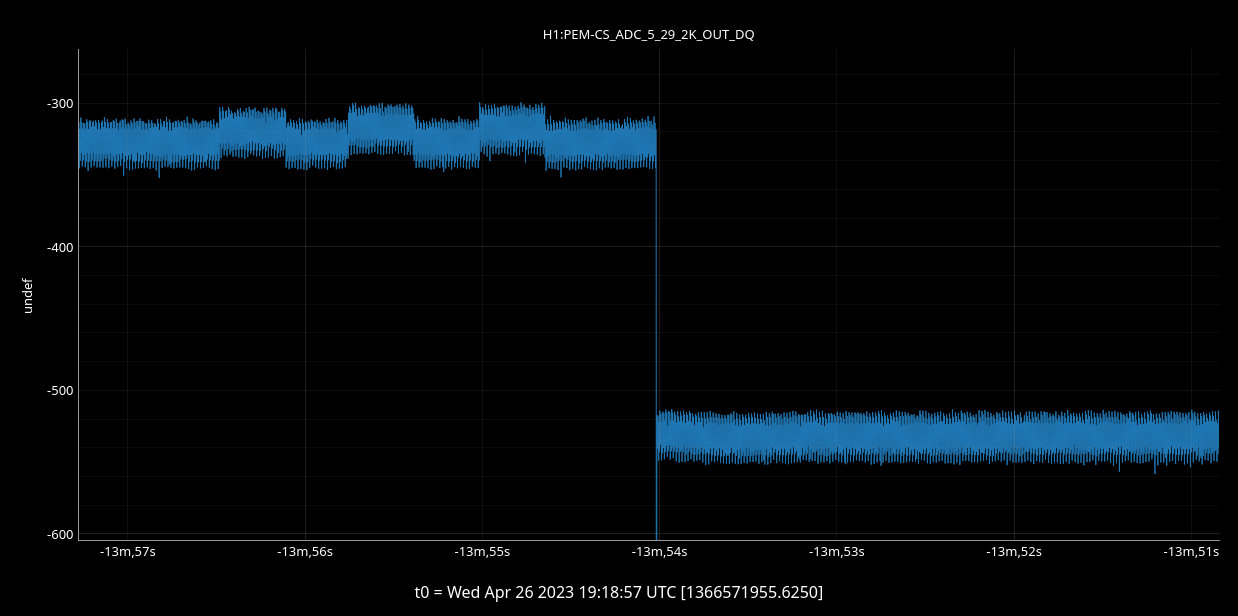
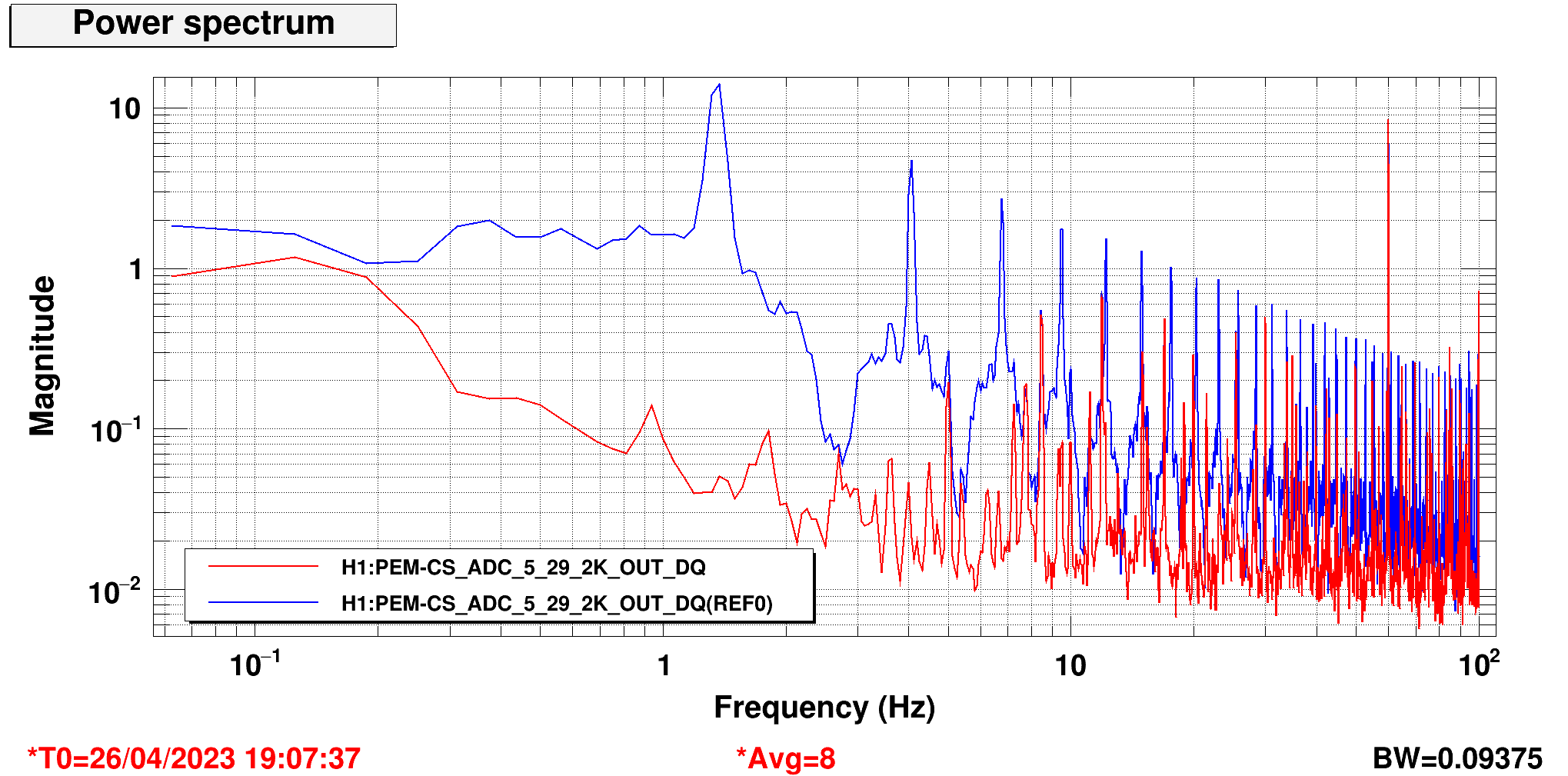
While trying to track down the source of the 4 Hz bumps in DARM, Richard noticed the cosmic ray photomultiplier tube (PMT) power supply voltage display numbers were jumping around. When he reset the dial, we noticed the 4 Hz oscillations in H1:PEM-ADC_5_29_2K_OUT_DQ disappeared for a few minutes. We unplugged the power supply to the PMTs at 19:05:00 UTC and have not seen 4 Hz features in the ADC channel or DARM since. Plots of the change in ADC channel timeseries behavior when Richard first touched the power supply knobs as well as the ADC channel behavior after the power supply was unplugged are attached. A spectrum comparing the ADC power supply plugged in (blue) and unplugged (red) is attached. We had about 40 minutes to watch DARM before some commissioning tasks started and we didn't see any more bumps. Another plot is forthcoming for this...
(edit for spelling...)
We need to collect more data to be sure, but for now it looks like the 4.05 Hz bumps in DARM are gone
This is awesome and fingers crossed that it fixes things.
Just a quick note that as we try to figure out how this coupled, it seems that H1:PEM-CS_ADC_5_29_2K_OUT_DQ might not be our best witness channel because while today it saw the 1.35Hz and 4.05Hz before the CR PS unplug, it did not see those peaks during some past times when n*4.05Hz bumps were seen in h(t) such as 4/12, 4/14, and 4/16.
Some of the other PEM channels such as H1:PEM-CS_ACC_LVEAFLOOR_HAM6_Z_DQ do seem to be reliable witnesses, having seen the 1.35Hz and 4.05Hz during h(t) bump times on those previous days as well as today before CR PS unplug, but not after unplug.
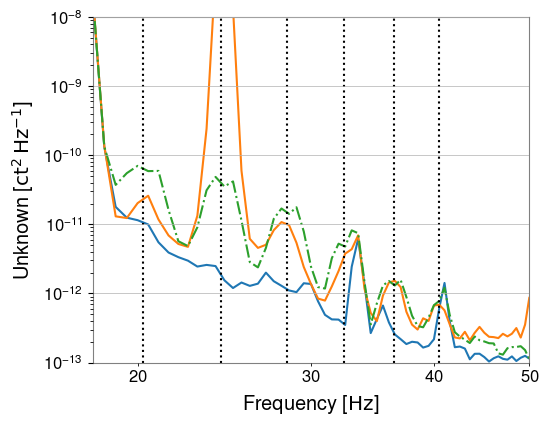
There was another instance of the 4 Hz bumps at 20:50 UTC. The attached plot shows OMC-DCPD_SUM, with blue as a reference, green dotted an example of the glitch a few days ago, and orange the one now. It's complicated a little by the PCal line at 24 Hz; it could be notched if we wanted a better plot. The bump at 20 Hz does look weaker but the rest are similar to before.
Most likely one of the photomultiplier tubes has developed a minor short and is going through a charge/discharge cycle. Not surprising after ~20 years! It is probably worth testing if the discharge is in the PMTs or the HV power supply by disconnecting the HV cables from the power supply and powering it back up. Either the fluctuations in the display will stay or not.
It looks like there are fewer of those 4.05Hz bump / glitches, but the problem is still with us, some of them quite loud.
Power was restored to the PMTs around 11:00:00 local on May 16, 2023, as we believe the 4 Hz glitching is coming from the the cryyobaffle. All four displays worked when I turned the power supply back on again.
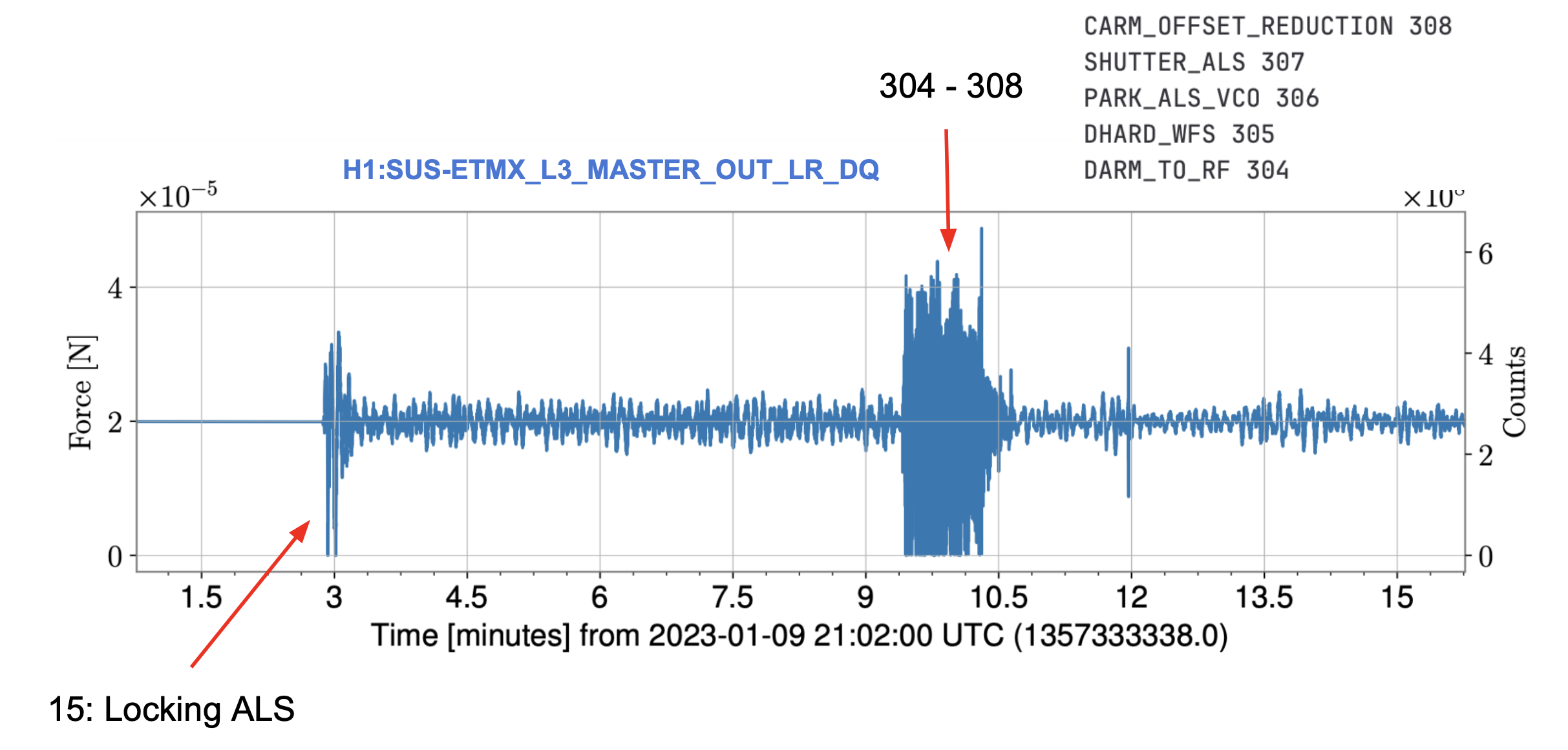
Sidd, Peter, Craig, Jeff This is a copy/paste of an email thread to the alog for the purpose of outside citations. Hey Sidd, Thanks for putting this study together, it was very interesting at the Heavy Sus meeting. I'm looking at the following two plots together: https://ldas-jobs.ligo-wa.caltech.edu/~siddharth.soni/ESD_study/GRD_states/H1_1354310689/zoomed_force_count_H1-ETMX-1354310689.pdf https://ldas-jobs.ligo-wa.caltech.edu/~siddharth.soni/ESD_study/GRD_states/H1_1354310689 /zoomed_grd_state_H1-1354310689.pdf Here are the names of the ISC_LOCK state numbers at HanfordLooks like the high noise starts in state 304 (DARM_TO_RF) at Hanford and slowly goes away during 308 (CARM_OFFSET_REDUCTION). I took a quick look at the DARM_TO_RF run state.
Here's the code from the state. It seems that the high noise begins after line 2182, which is when we turn off FM9 in the LSC-DARM2 filter bank "LP55", which is just a modest 55 Hz low pass filter with a two second ramp time:
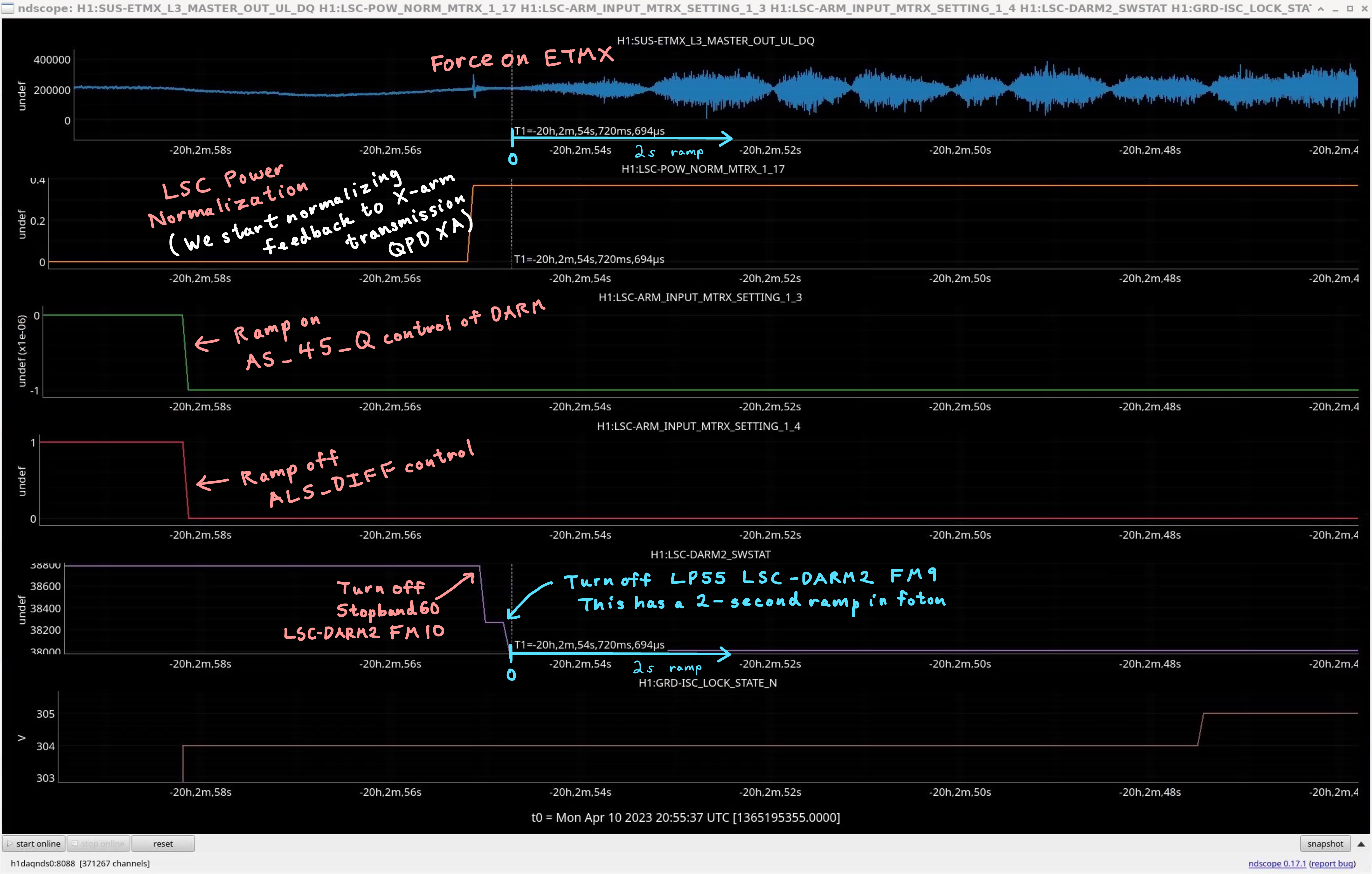
So the excess noise we see is a direct result of us turning off some LP55 filter in LSC-DARM2. This filter never gets turned on again, and appears to go away in CARM_OFFSET_REDUCTION when we bring CARM closer to RESONANCE. This part of the guardian is some pre-conditioning for the CARM_OFFSET_REDUCTION state. The noise we witness is terrible sensing noise from locking on the fringe, having the transmitted power be in loop (from the power normalization), and not filtering it away because it's not really necessary. The conclusion from the meeting still stands in my opinion: if we had needed to we would have commissioned this excess noise away. Because we weren't hitting any saturations or locklosses here we've left it like this. We could even try locking CARM and DARM directly from ALS_COMM and DIFF at this point (as the powers that be intended), but that is extremely low priority. The real question of "how much maximum force is required to lock" is may be during state 15: LOCKING_ALS, which the ALS_DIFF guardian actually controls. I'm seeing a 300k count peak-to-peak initial swing in the EX UL MASTER OUT during the latest example lock there, afterwards it calms down significantly. Probably also possible to acquire ALS_DIFF more gently. Would be interesting if you compiled a bunch of these ALS_DIFF acquisitions similar to what you've already done for state 304, and maybe we can do a deeper dive into what ALS_DIFF acquisition is actually doing similar to this study. Craig P.S. We sometimes have trouble locking ALS_DIFF for ~hour in bad conditions. If we looked deeply at this, we may be able to improve IFO uptime.
Peter comments in reply to Craig's info above: I assume that the 55 Hz low-pass filter is being turned off so that the DARM loop has more gain margin for the CARM offset reduction process, is that right? If so, it seems like it might also work to move up the LP, say to 200 Hz, rather than to remove it.
To understand the max force ESDs apply during the stage of locking, I had looked at a bunch of cases and found that as the state transitions from 304 to 305, there is an increase in the force/noise which goes away around the state 308 (CARM offset reduction). These examples are here. Now based on Craig’s suggestion, I looked at the ALS Locking (state 15) for several of these examples. Indeed apart from the 304-308 states, the next highest noise is during this ALS Locking stage. In most of the examples I looked at, the duration of this state is ~ 55 seconds.
As shown by the second zoomed in plot, there is an increase in noise a few seconds after the transition to state 15, the noise then settles down and unlike the states 304-308, it does not stay high throughout. So it looks more like a glitch.
I analyzed the data for some of the Dec 2022 Jan 2023 locks at H1 for this state, the plots are here. I also looked at more recent data, specifically Apr 1 and Apr 12. On both of these days, there were a number of lock attempts. The plots for these days are here and here.
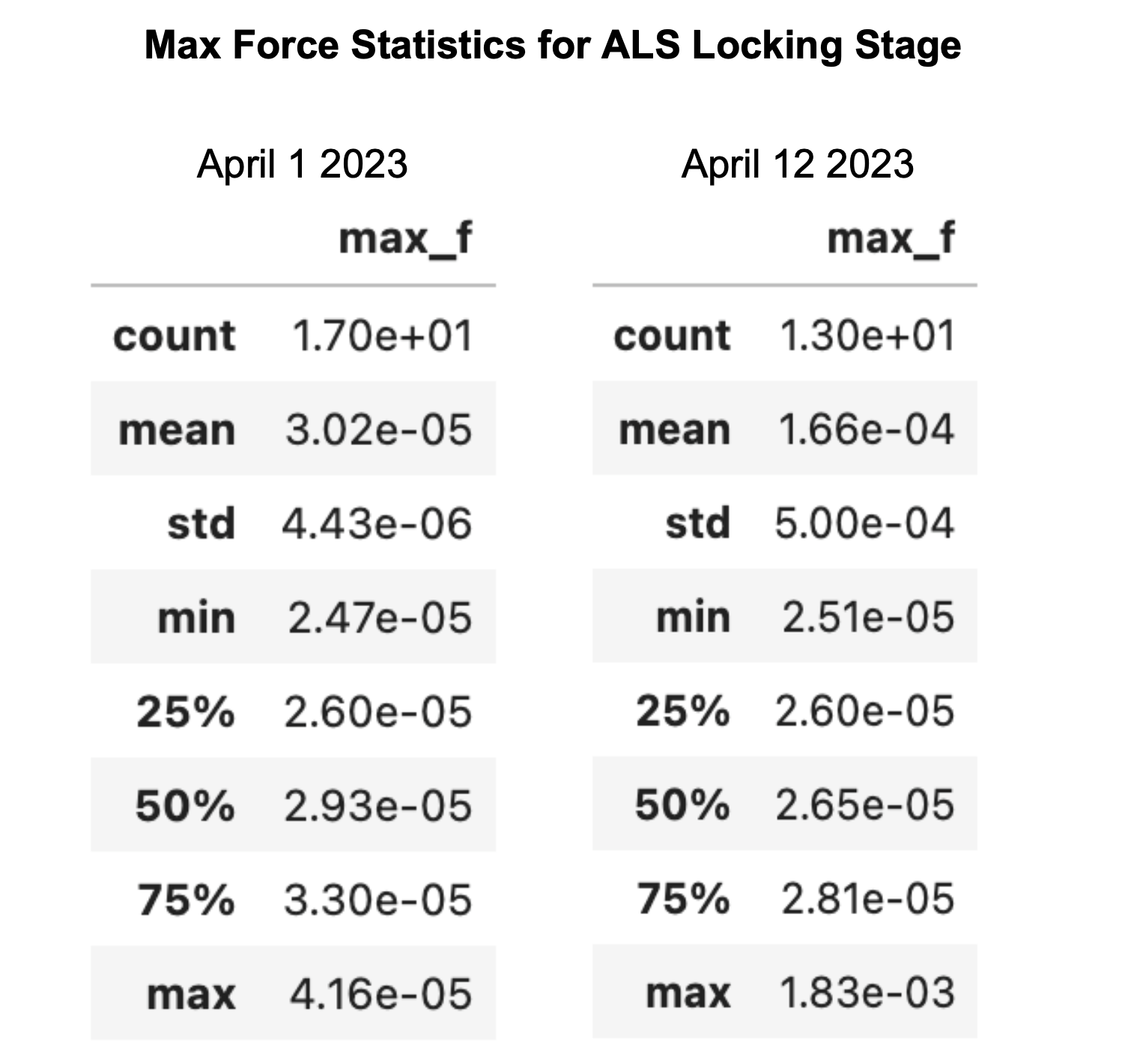
Max force statistics: For Apr 1 lock attempts, the median value during state 15 is 29.3 µN which is about 60% of the median force during the 305 state (48 µN) DCC. For Apr 12 lock attempts, its very similar with the median force being 26.5 µN.