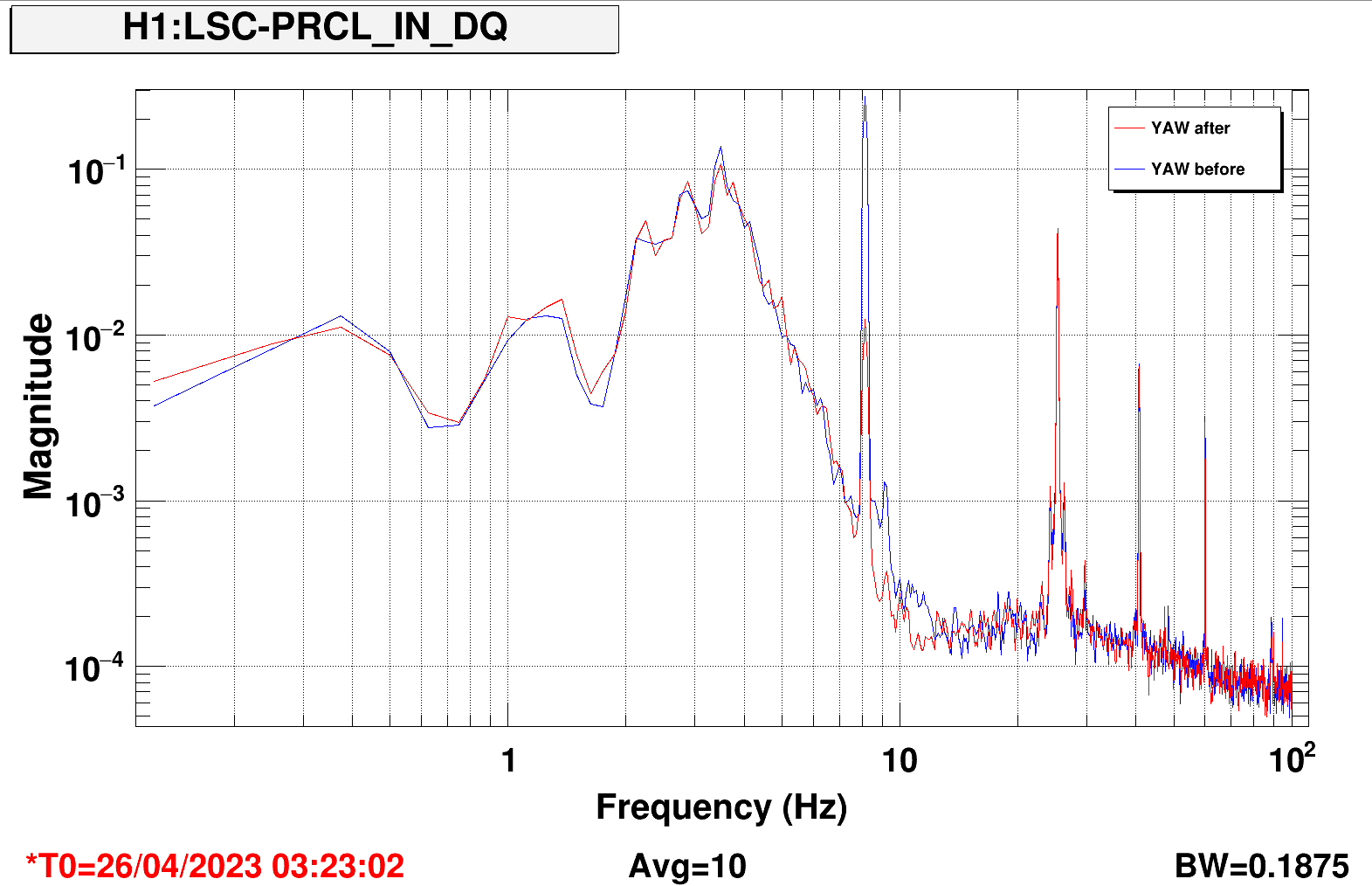
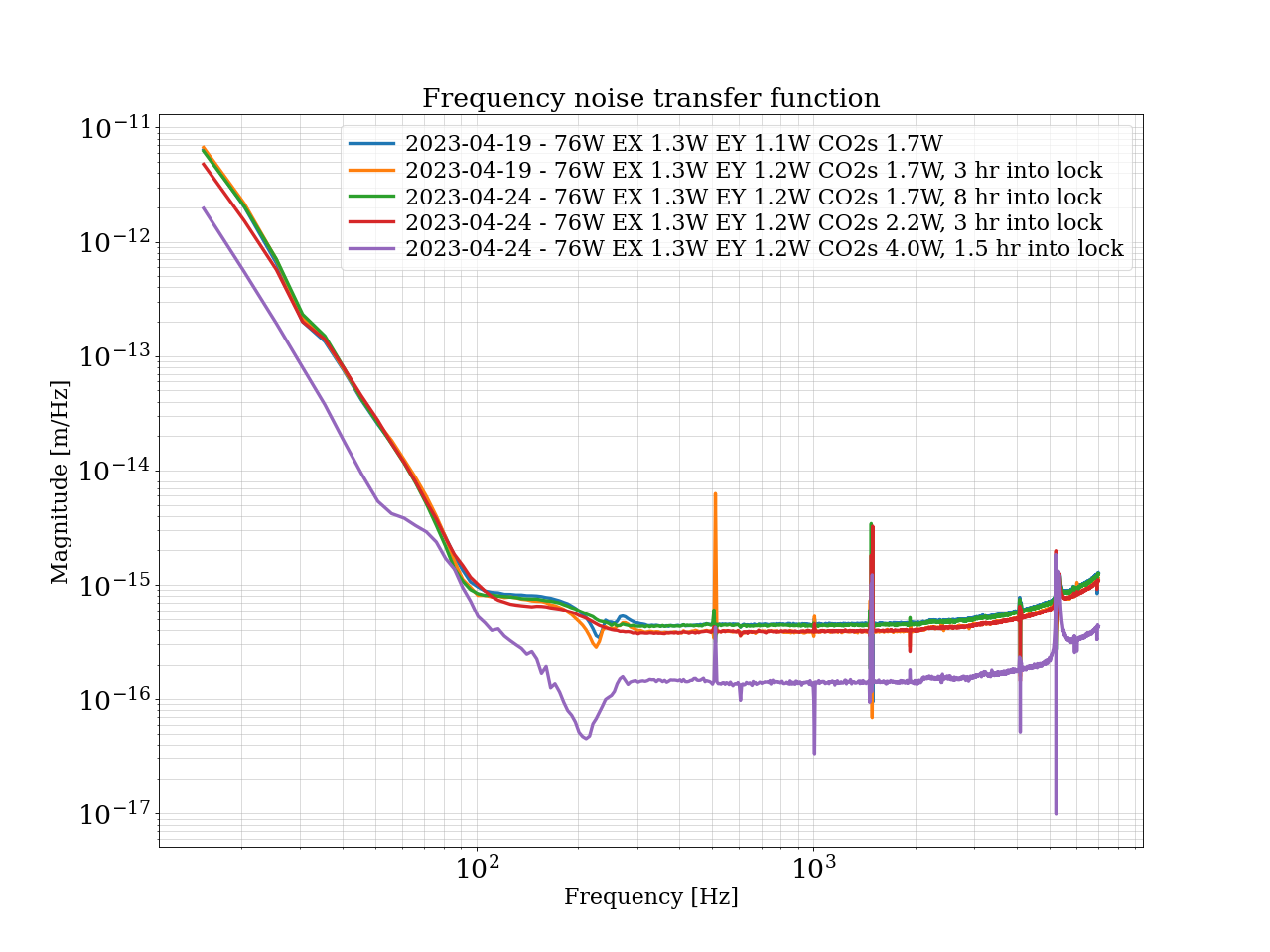
Today we made more tests of the effect of differential CO2 annular heating and the effect of thermalization on various parameters. Specifically, we measured the CARM open loop gain, PRCL open loop gain, and DARM spring at various times during power up. In parallel, the squeezing team also attempted to tune sqz during different points of thermalization. We also intended to measure frequency noise and contrast defect, but were unable to due to locklosses. See alog 68971 for details on last night's CO2 tests and the preliminary results of contrast defect and frequency noise.
The TCS setting that we tested was a differential annular CO2 step. CO2X was increased to 4W and CO2Y was left at 1.7W. The annular heating engages at the Power 25W state. The preliminary results showed marked improvement in frequency noise. The ring heaters were set to the nominal 76W settings: ETMX 1.3W, ETMY 1.2W.
CARM OLG
We measured the CARM olg during the first three hours of IFO thermalization. The results are plotted here. The show that the CARM gain drops in similar fashion to PRCL. However, we are not in danger of instability, and the gain levels off into the second hour of lock. We can increase the CARM gain as we thermalize, and increasing it will likely improve our frequency noise above 4 kHz (see 68967). Gabriele is working on implementation. He will add a comment describing the implementation.
PRCL UGF
We returned to changing the PRCL gain by hand. The PRCL gain does drop steadily as we thermalize, but at a different rate than measured by Gabriele. The UGF servo will need to be recommissioned for a few locks to collect data and then we can fit the thermalization trend.
DARM Spring
I made some measurements of the DARM spring through thermalization and also with different SRCL offsets. See the plot here. I measured both the DARM OLGTF and a PCAL to DARM transfer function to create this plot. I think the trend shows that we need less SRCL offset at the start of the lock, and then thermalization increases the SRCL detuning. For example, within the first hour, a SRCL offset of -80 was sufficient. By the third hour, we were moving towards needing something like the usual SRCL offset of -165. Jeff has commissioned low frequency line injections to track this better than I can with these measurements. I look forward to further results on this front.
Other effects
We were not able to make any well-defined measurements of these quantities, but two things were evident by eye during this lock: The frequency noise was improved, and the jitter noise was worse.
Lockloss
At the end of the third hour, we experienced an ASC lockloss. By eye, it seems to be a CSOFT P ring up, but given the amount of cross coupling it is hard to be sure. During a subsequent lock, I made some sensing matrix measurements of the ASC REFL signals at high power. There are some changes in the PRC2 P sensing that could be causing problems. Or, the problem could be something else entirely.
Unfortunately we don't have enough time right now to determine what exactly is the ASC problem and how fix it. Gabriele and I have chosen to revert the CO2X annular change to the previous setting of 1.7W (common with CO2Y). We know this setting is stable. We have commissioned the PRCL gain, various feedforward and more at this particular setting. We would also like to deliver a stable interferometer to the start of ER15 in the morning. We don't think we should give up on this setting though. We would like to use commissioning time in the next week to debug the ASC problem and regain stability with the new setting. We think this is a good change for the frequency noise. We also think that the increased jitter noise present is a clue that there are perhaps ASC offsets that could be causing the instability. We are making the CARM gain change though, as that is something that will occur independent of the CO2 change, and it will improve our frequency noise above 4 kHz.
We added some logic to the THERMALIZATION guardian to increase the CARM gain.
The gain sliders can be changed only in steps of 1 db, so we are implementing the discrete changes in the table below to follow the decrease in CARM UGF we measured over one lock
| Time from LOWNOISE_LENGTH_CONTROL [min] |
Additional REFL SERVO gain [db] |
|---|---|
| 10 | 1 |
| 25 | 2 |
| 45 | 3 |
| 80 | 4 |
| 160 | 5 |
We are increasing both LSC-REFL_SERVO_IN1GAIN and LSC-REFL_SERVO_IN2GAIN at the same time, starting from the gain they had when the THERMALIZATION guardian is asked to go to THERMALIZED
There was a problem with the new REFL servo gain adjustment. The THERMALIZATION guardian red the initial CARM gains at LOWNOISE_LENGTH_CONTROL, but at that state CARM was using only one REFL signal. So during the last lock the THERMALIZATION guardian was also keeping one of the REFL diode gains low.
I fixed the problem by writing explicitly the initial gain of the two REFL signals (6db and 6db) since those numbers are hard-coded in the LASER_NOISE_SUPPRESSION state.
I restarted the THERMALIZATION guardian and set back the CARM gain slider to 6 and 6 db
This gain change is a discrete step in an analog circuit when an output from a lower gain OpAmp is switched to a higher one. This is implemented as a binary ladder with 1dB step size, so depending on the actual gain values some elements may go down in gain while others go up. This will introduce a transient which may or may not be visible at the anti-symmetric port. The transisiton time is sub micro seconds.
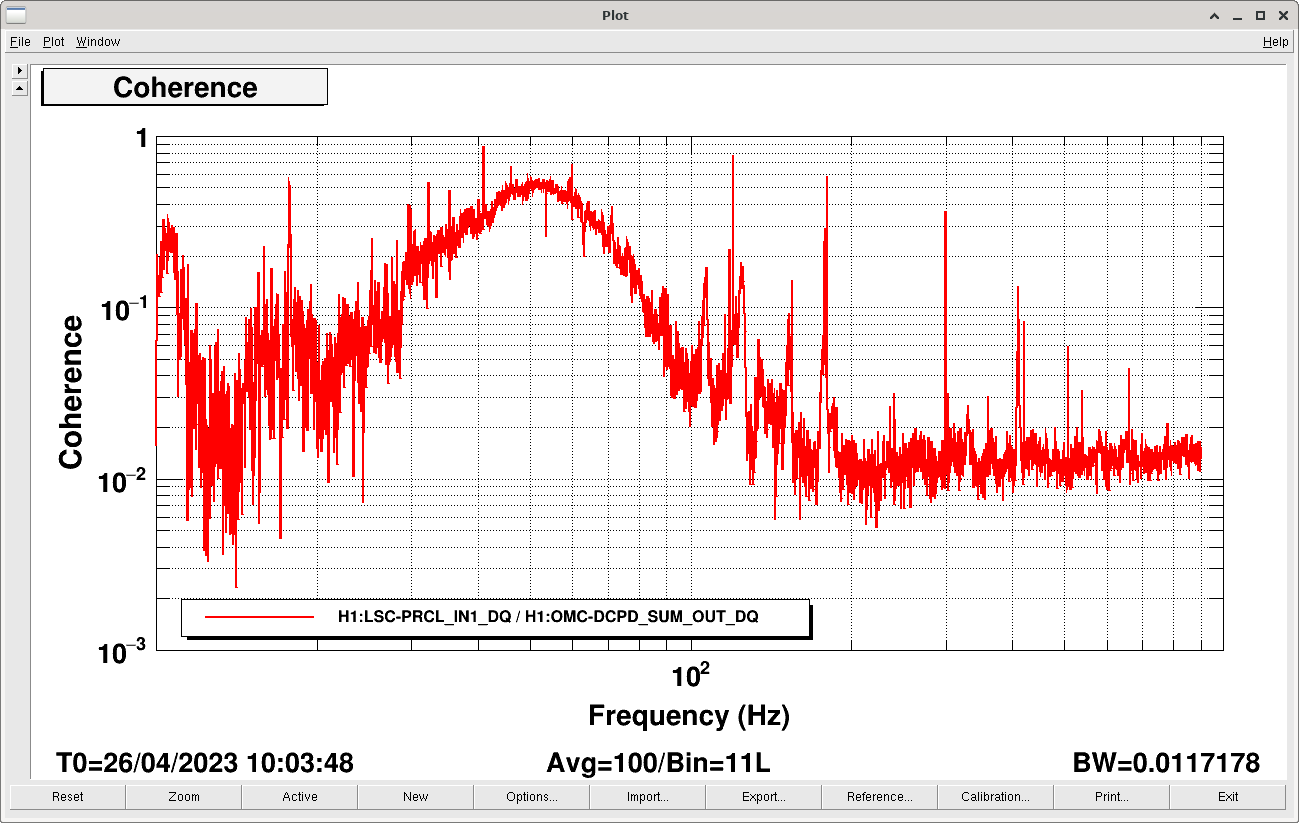
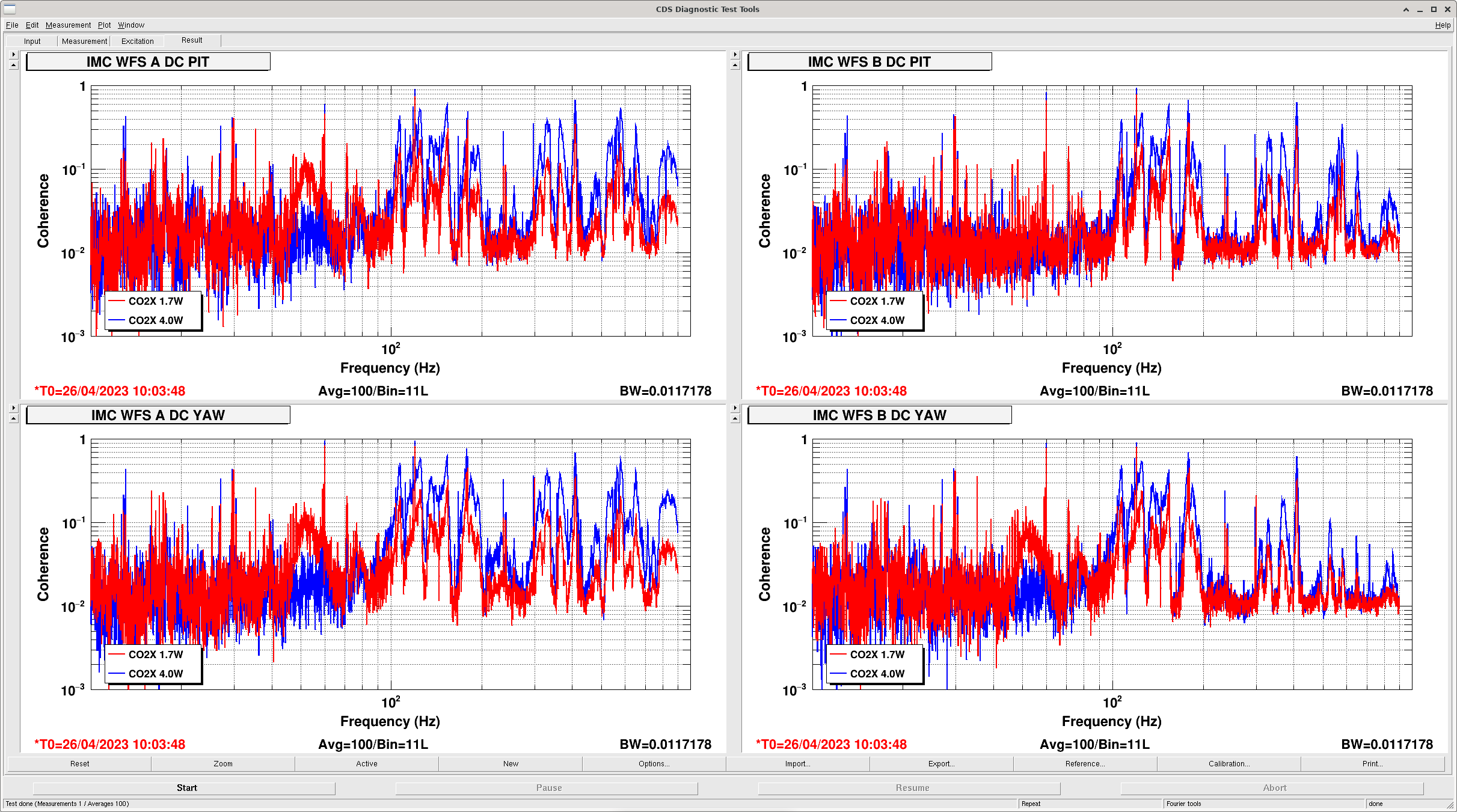
Bye eye, we could see that the jitter in DARM increased with the new CO2 setting. I ran a coherence comparison of DARM with the IMC WFS DC channels during the time we were at 4W CO2X versus when we are at 1.7W CO2X. All other TCS settings are the same. Above 100 Hz, the coherence of DARM with the IMC WFS increases almost everywhere when we are on higher CO2X annular power.
The one place where jitter is worse at CO2X = 1.7W is around 50 Hz. DARM is has high coherence with PRCL there. We think that the PRCL gain was mistuned, and that PRCL also sees input jitter. We think we can mitigate that region with better tuning of the PRCL gain.
However, the increased jitter is one argument against moving to differential CO2 annular power.
Note: we are not applying any jitter subtraction at either of these times.
Sina, Elenna, Kevin, Evan
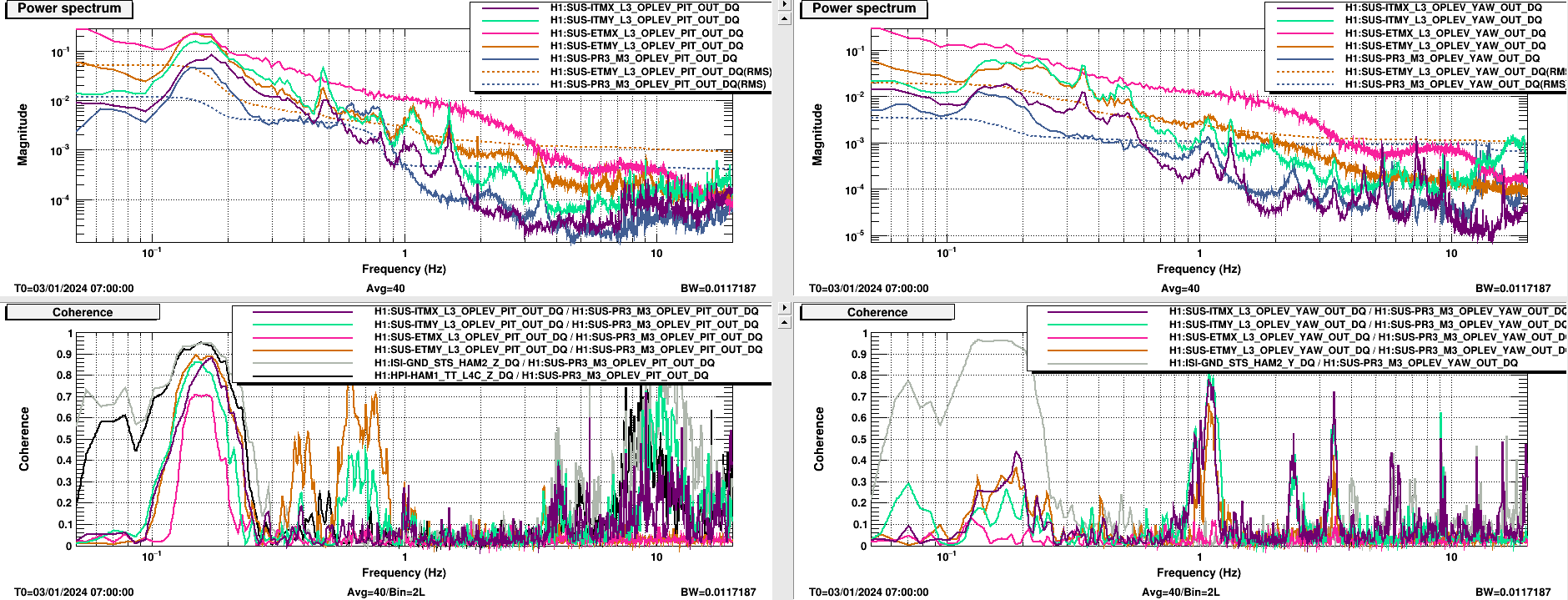
Similar to Anamaria's measurements at Livingston last year (LLO:58623), we drove PR3 sinusoidally in pitch and yaw at low frequency to try to ascertain the amount of beam spot motion coupling into the arms. The following times are all 2023–04–12 UTC:
At 0.34 Hz, the transfer functions from oplev to oplev are
The absolute values are indicated because the measured phases are neither clearly around 0° nor 180°. The coherences are above 0.85. (At 0.11 Hz, the coherences are somewhat lower so I omitted those values.)
Livingston also saw order-unity transfer functions like this: LLO:59846.
A series of finesse simulations (G2400278, G2400281) indicated that by itself, PR3 cannot drive arm cavity motion at this level since (in the absence of any angular feedback control) the arm cavity finesse suppresses PR3-induced spot motion by a factor of order 100. On the other hand, PR3 motion can appear in the reflection wavefront sensors with an optical strength similar to or even greater than cHard motion, meaning that if PR3 has not been carefully diagonalized out of the sensing matrix then its motion can easily be impressed onto the test masses with an order unity ratio.
The attachment shows coherences between PR3 oplev and test mass oplevs from the end of O4a. Ignoring the microseism region, there is coherence between PR3 pitch and EY pitch from 0.4 to 0.8 Hz. One might guess this coherence arises because of LVEA ground motion, but there is no coherence between the PR3 oplev and either the HAM1 Z L4C channel or the HAM2 Z ground motion.
Elenna, Gabriele
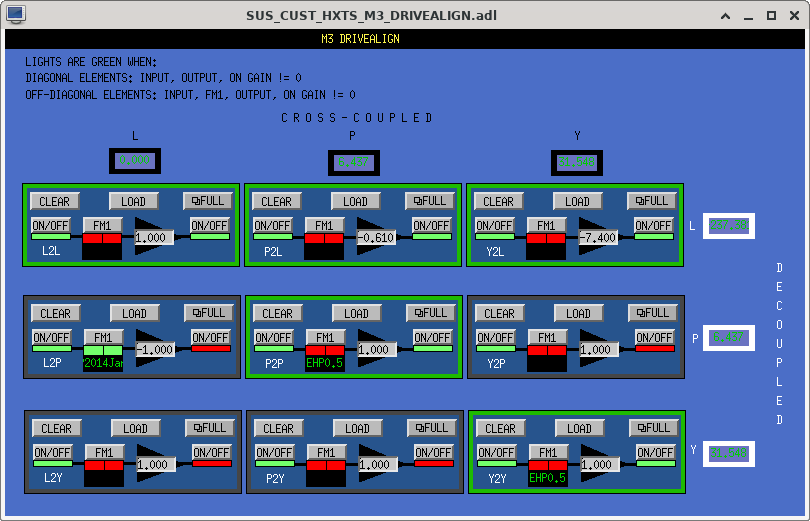
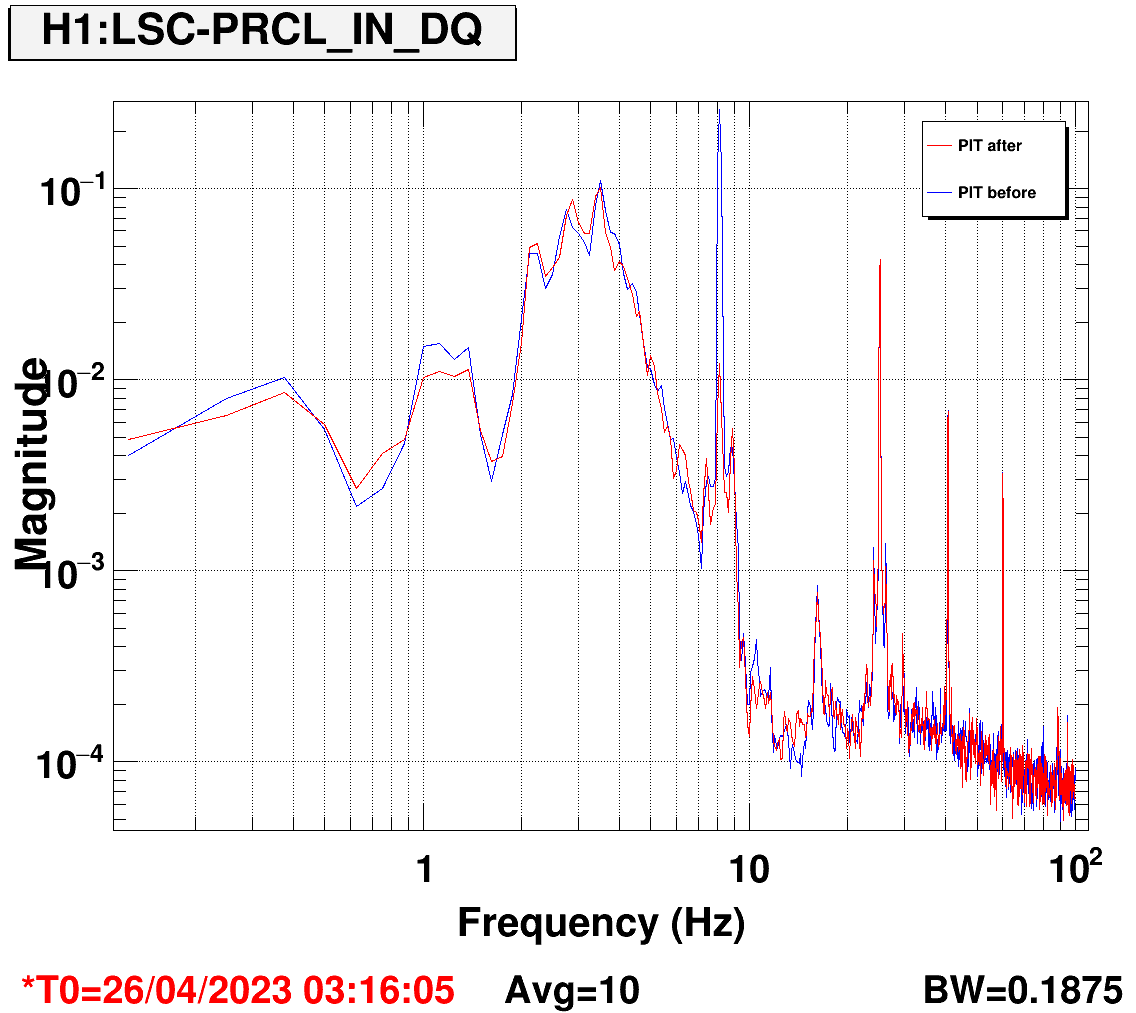
We noticed that driving PRC2 P and Y produced a very large coupling into PRCL and DARM. So we changed H1:SUS-PR2_M3_DRIVEALIGN_P2L_GAIN and H1:SUS-PR2_M3_DRIVEALIGN_Y2L_GAIN to minimize this effect. We reduced P to L and Y to L for PR2 by a factor 20
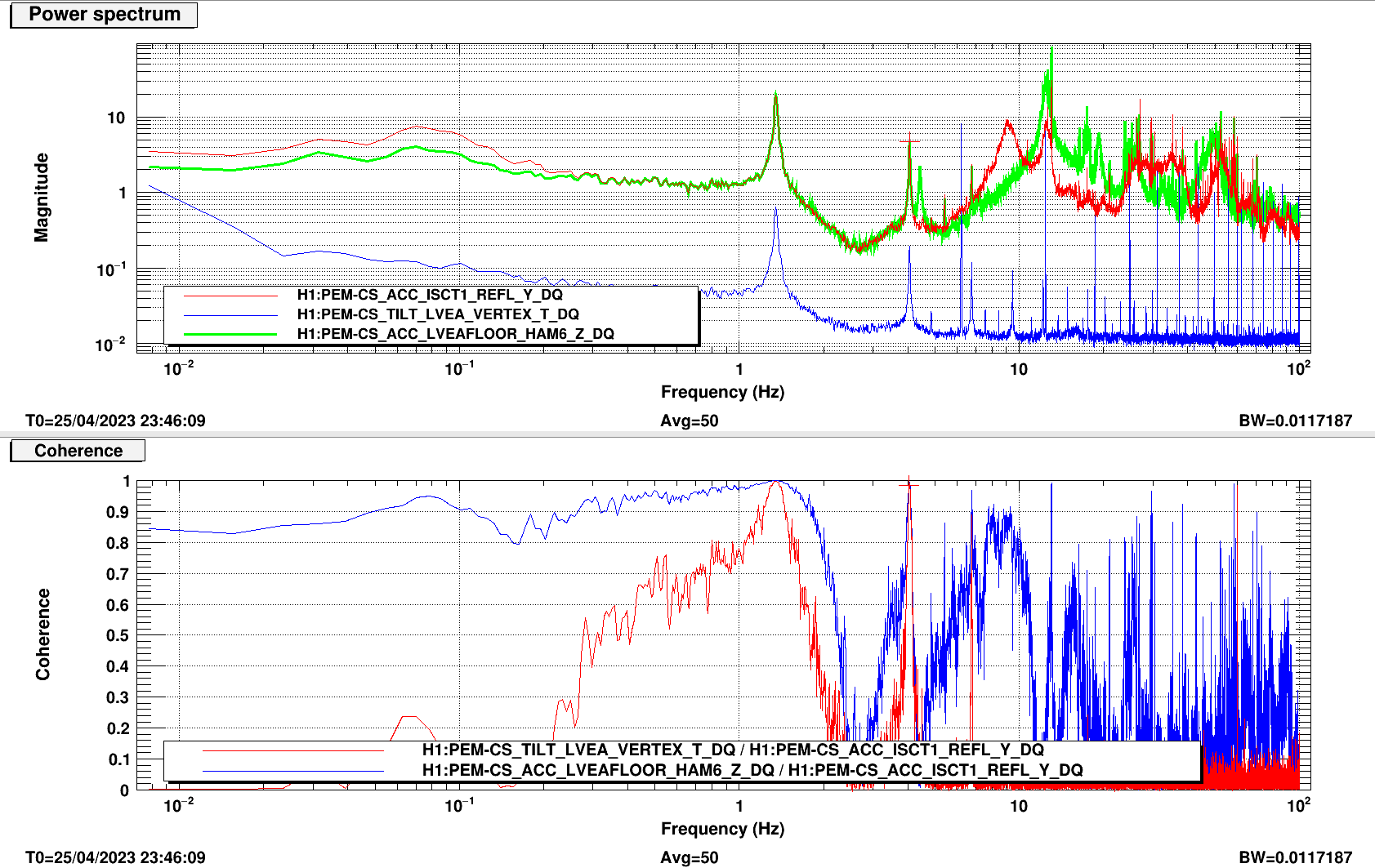
More peak hunting for the 4.05 Hz bumps. I tweaked a bit the parameters for my peak finder code, adn the channel list got a bit bigger. Full list below.
Most interesting are
H1:PEM-CS_ACC_ISCT1_REFL_Y_DQ
H1:PEM-CS_ACC_LVEAFLOOR_HAM6_Z_DQ
H1:PEM-CS_TILT_LVEA_VERTEX_T_DQ
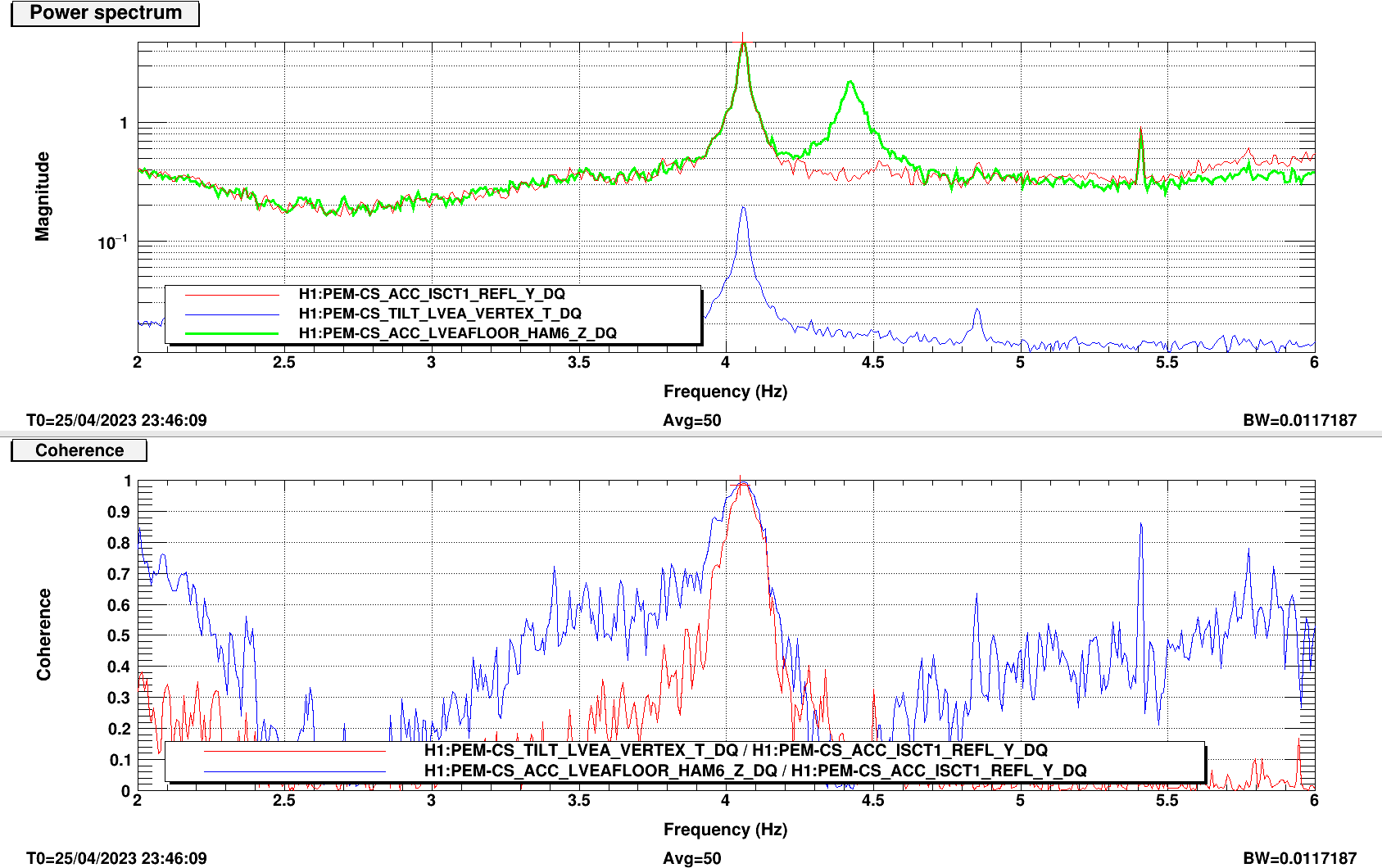
It looks like something it's shaking the ground at 4.05 Hz in the LVEA. The 4.,05 Hz peak in those channels is coherent.
H1:PEM-CS_ACC_ISCT1_REFL_Y_DQ
H1:PEM-CS_ACC_LVEAFLOOR_HAM6_Z_DQ
H1:PEM-CS_ADC_5_26_2K_OUT_DQ
H1:PEM-CS_ADC_5_29_2K_OUT_DQ
H1:PEM-CS_MAG_EBAY_LSCRACK_Y_DQ
H1:PEM-CS_MAG_EBAY_LSCRACK_Z_DQ
H1:PEM-CS_MAG_EBAY_SUSRACK_Y_DQ
H1:PEM-CS_MAG_EBAY_SUSRACK_Z_DQ
H1:PEM-CS_MAG_LVEA_VERTEX_X_DQ
H1:PEM-CS_MAG_LVEA_VERTEX_Z_DQ
H1:PEM-CS_RADIO_EBAY_NARROWBAND_1_DQ
H1:PEM-CS_RADIO_EBAY_NARROWBAND_2_DQ
H1:PEM-CS_RADIO_LVEA_NARROWBAND_1_DQ
H1:PEM-CS_RADIO_LVEA_NARROWBAND_2_DQ
H1:PEM-CS_TILT_LVEA_VERTEX_T_DQ
H1:PEM-EX_ADC_0_09_OUT_DQ
H1:PEM-EX_LOWFMIC_VEA_FLOOR_DQ
H1:PEM-EX_MAG_EBAY_SUSRACK_X_DQ
H1:PEM-EX_MAG_EBAY_SUSRACK_Y_DQ
H1:PEM-EX_MAG_EBAY_SUSRACK_Z_DQ
H1:PEM-EX_TEMPERATURE_BSC9_ETMX_DQ
H1:PEM-EX_VMON_ETMX_ESDPOWER48_DQ
H1:PEM-EY_ADC_0_14_OUT_DQ
H1:PEM-EY_MAG_EBAY_SEIRACK_X_DQ
H1:PEM-EY_MAG_EBAY_SEIRACK_Y_DQ
H1:PEM-EY_MAG_EBAY_SEIRACK_Z_DQ
H1:PEM-EY_MAG_EBAY_SUSRACK_X_DQ
H1:PEM-EY_MAG_EBAY_SUSRACK_Y_DQ
H1:PEM-EY_MAINSMON_EBAY_2_DQ
H1:CAL-PCALX_IRIGB_DQ
H1:CAL-PCALY_IRIGB_DQ
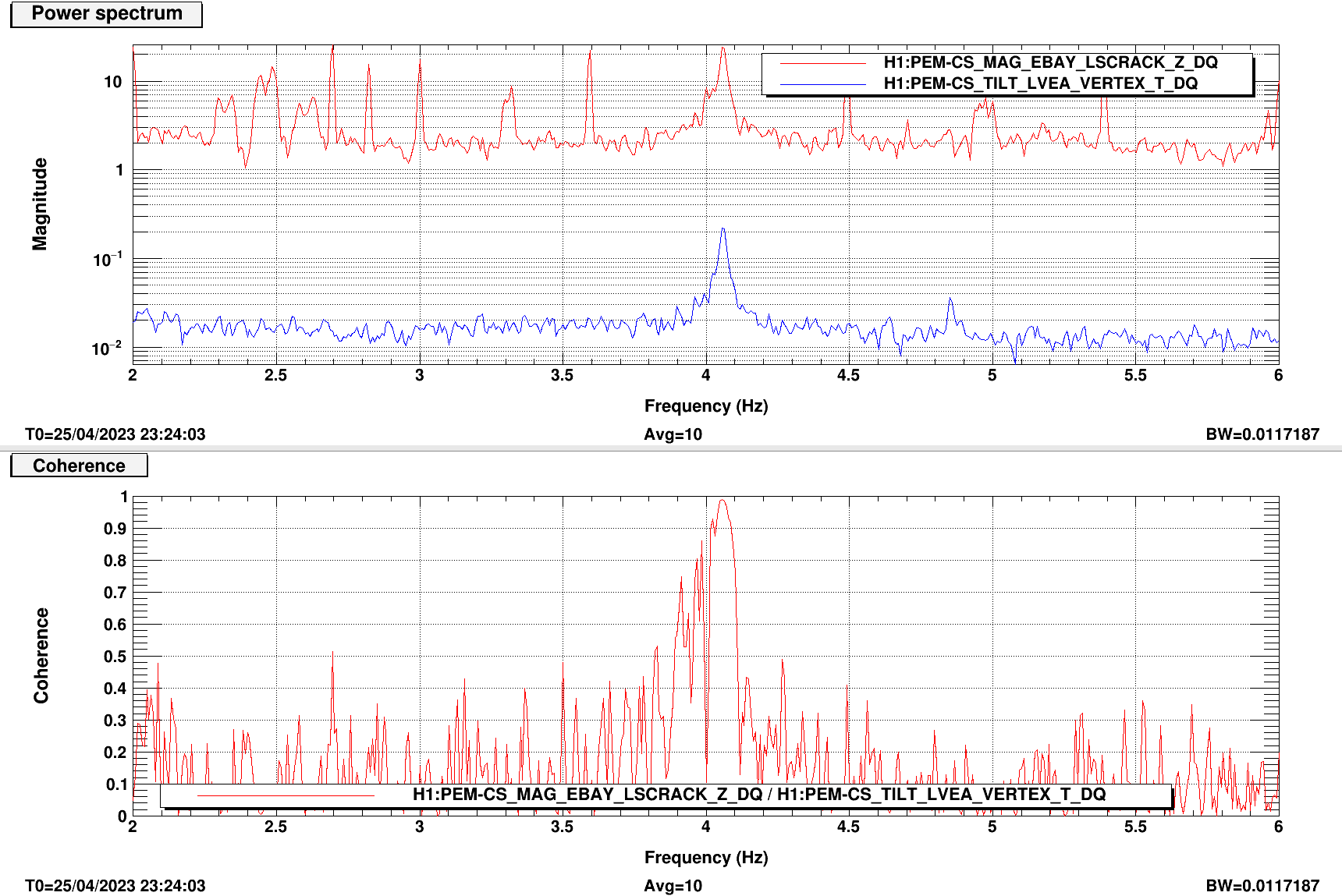
LVEA magnetometers are coherent with the ground motion. Is there some big electrical machine shaking the ground and making a magnetic field at the same frequency?
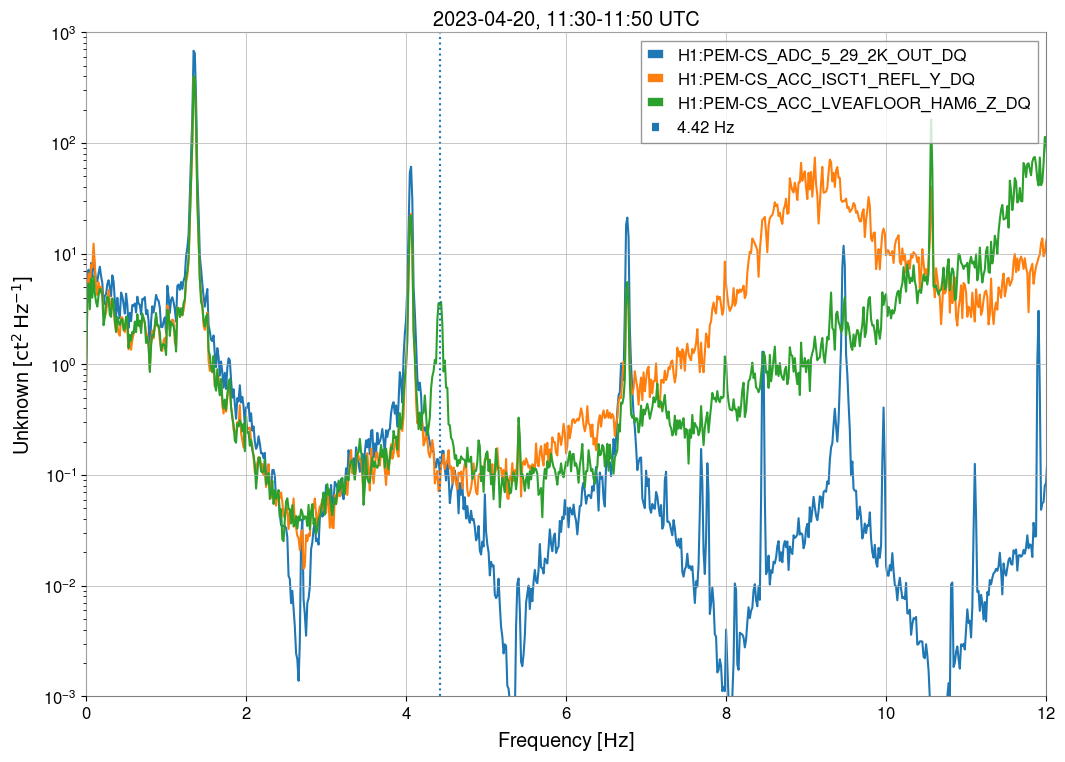
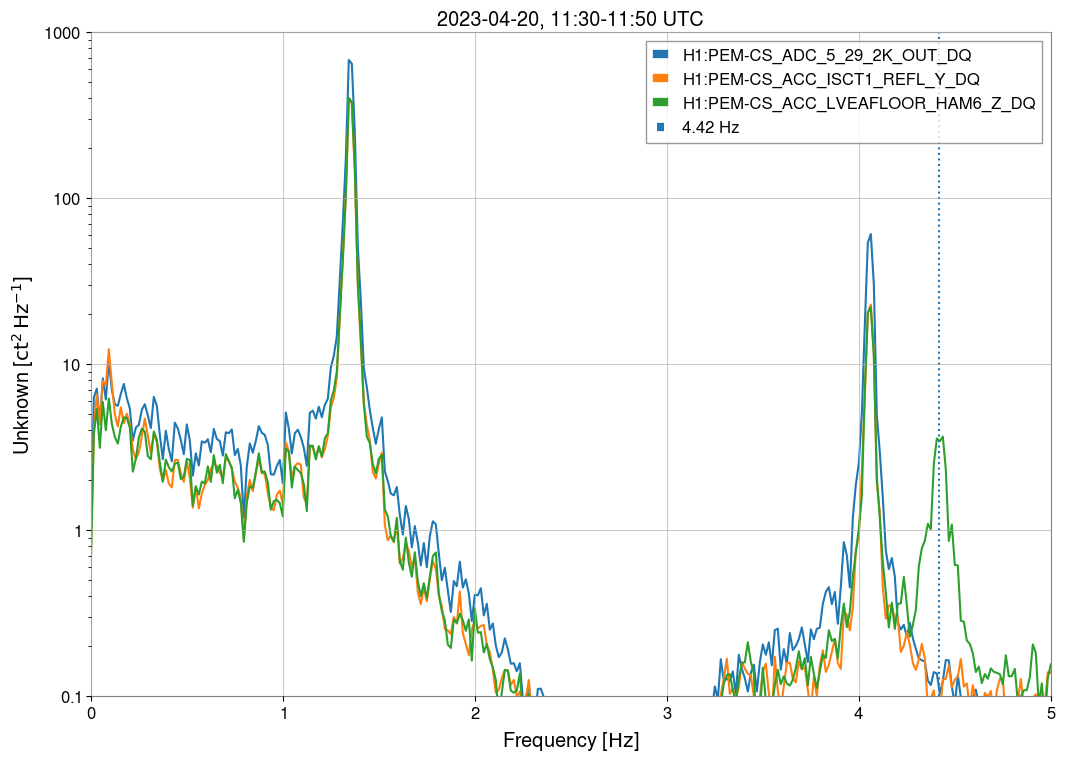
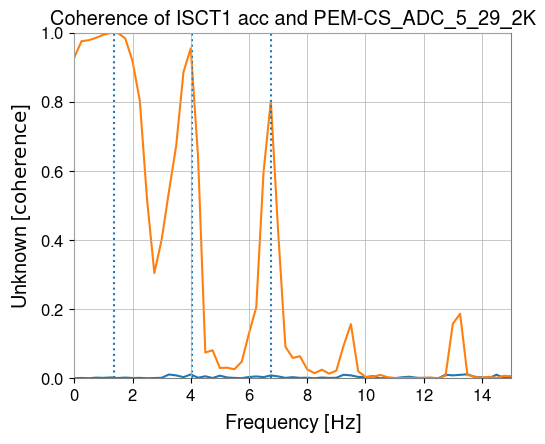
The 4.05 Hz line in the CS accelerometers have to be electrical coupling. They're identical in shape and amplitude ISCT1 and HAM6 despite being different DoFs and locations. They also are coherent with an unused ADC channel, PEM-CS_ADC_5_29_2K. It was used for DAQ stand testing but right now it's almost certainly disconnected. It sees a structure of odd harmonics of 1.35 Hz (4.05 is the third harmonic) which is coherent with both of the accelerometers. I think this structure is contaminating all of the electronics in the CS that Gabriele has identified. The PSDs, a zoomed PSD, and the coherence are attached. So it's not motion, but it does mean there's electrical noise at 4.05 Hz, and it's in many PEM channels at least. The current clamp ADC_5_26 sees it, but is it actual current or just in the ADC?
Closes FAMIS 25063
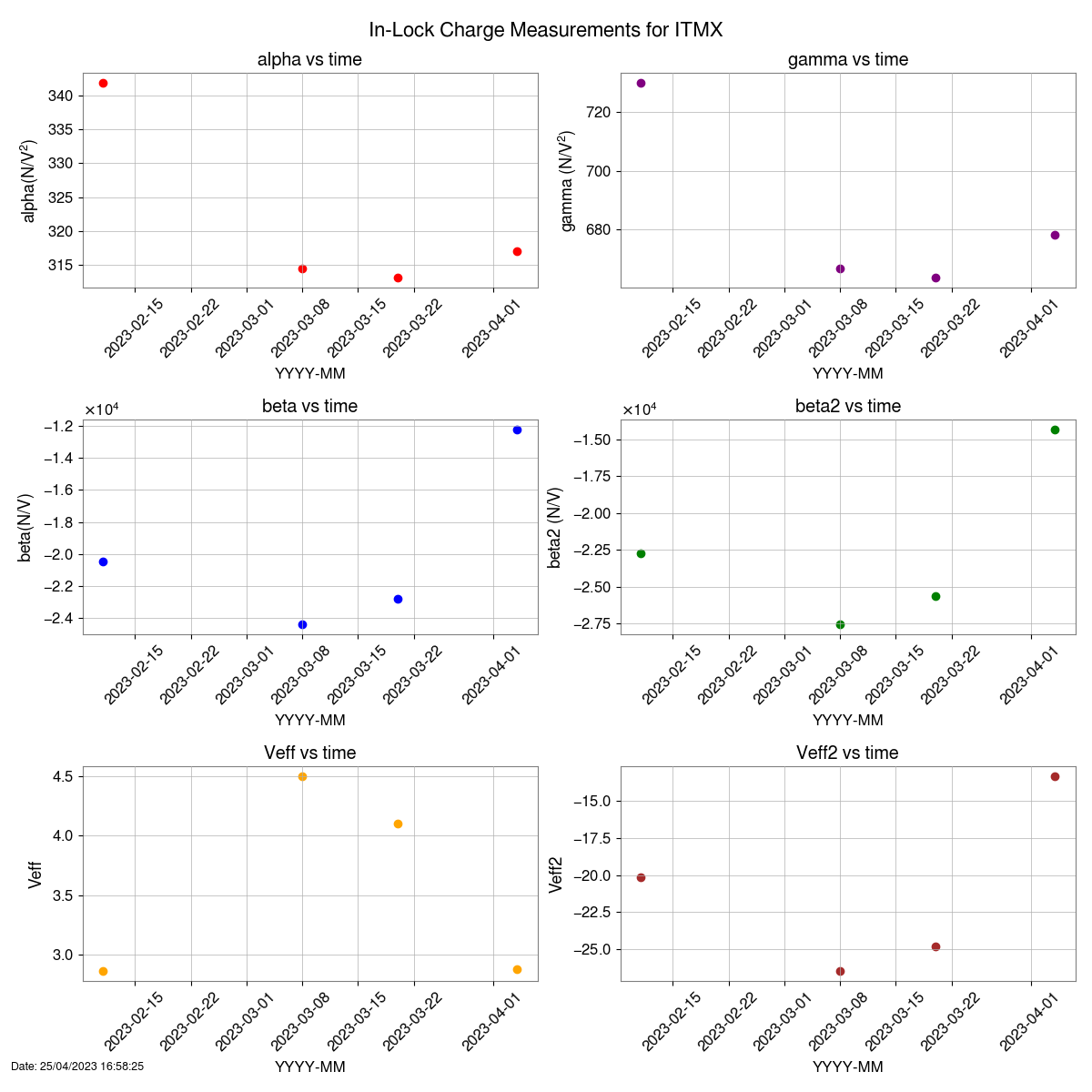
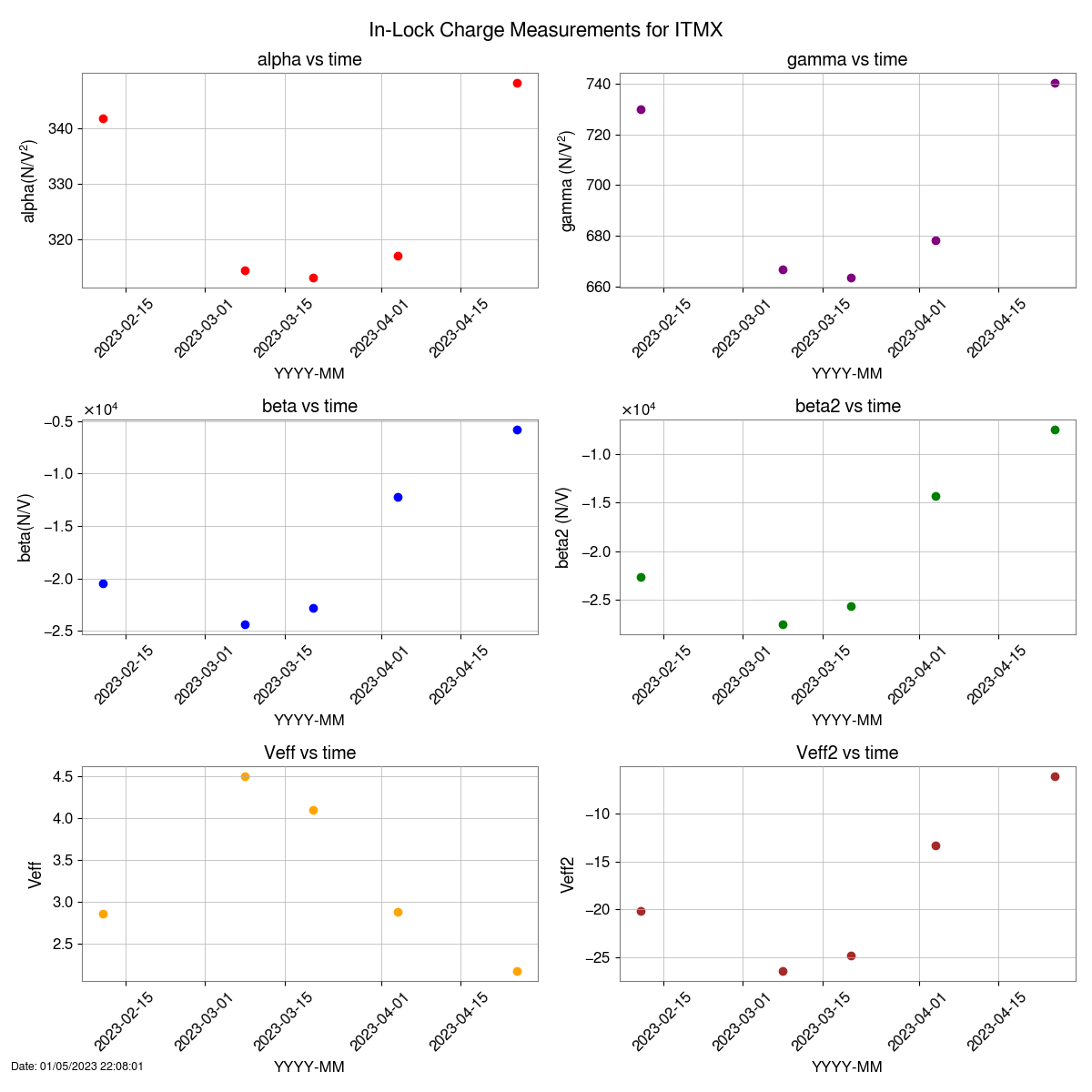
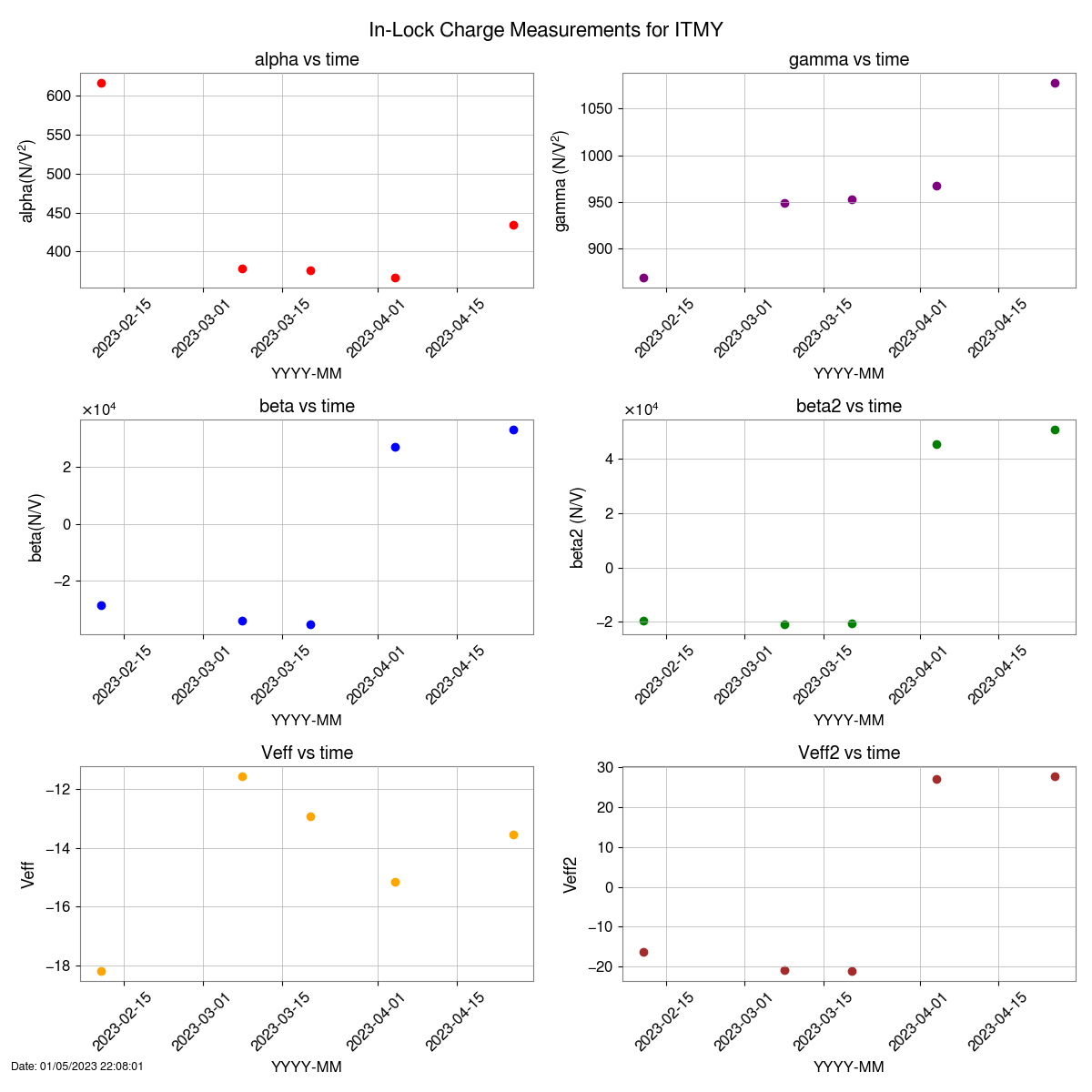
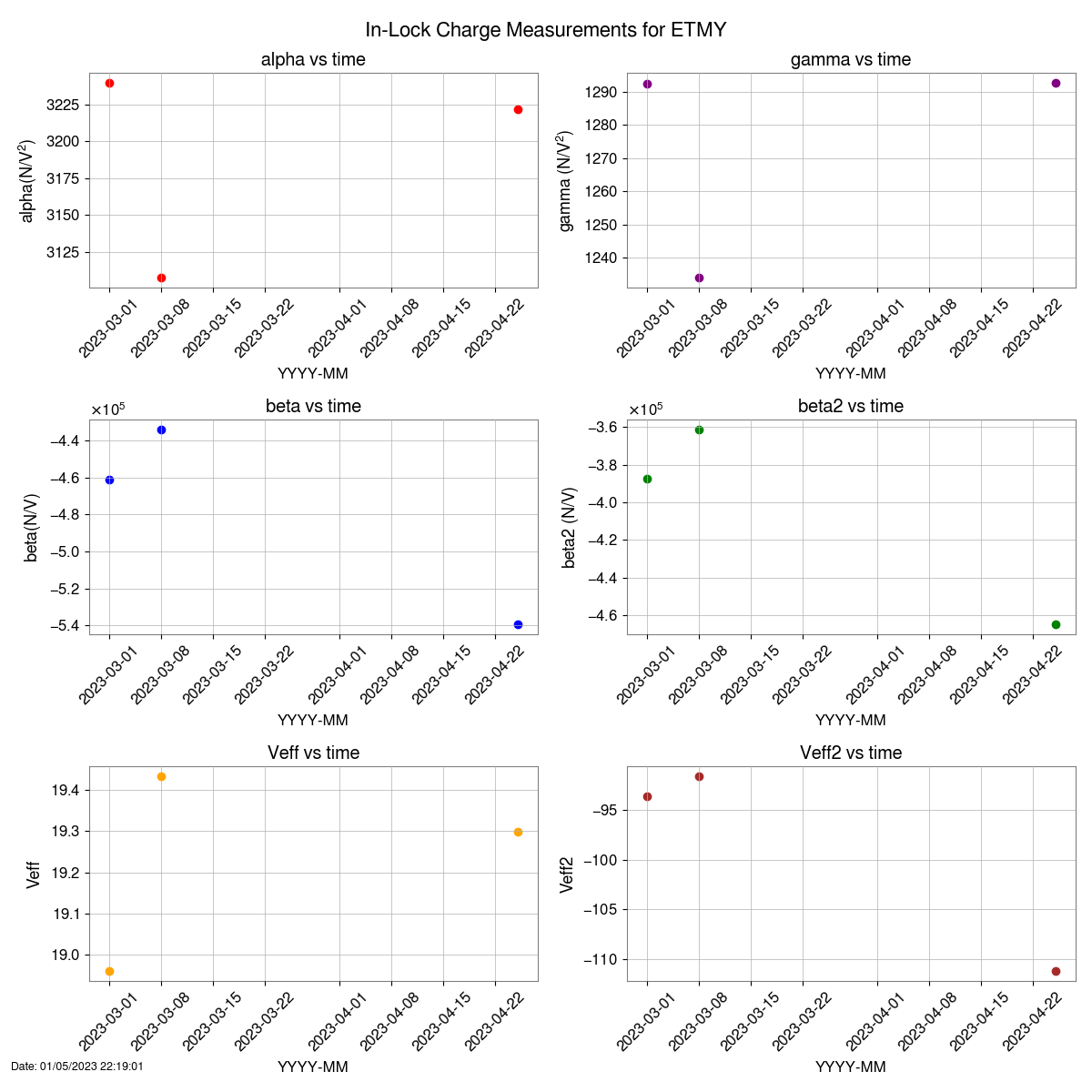
Attached are 4 images of in-lock charge measurements for 3 of the quads. ETMX was omitted as the data produced by the script was bad, alog on that here.
Measurements in the past month or so look for the most part, similar. Ryan last ran these measurements a month ago, alog here.
Ryan C realized that the Matlab analysis didn't run. The RUN_ESD_EXC.py guardian code wasn't clearing the log list so that the times of the old excitations were written to the new list and causing an error. I've fixed this and attached the correct plots.
J. Kissel I've walked through the new front-end (LHO:68961) and MEDM (LHO:68999) infrastructure that supports demodulation of the new(ish) PCALX systematic error lines in order to get it all up and running so that we have a live, real-time estimate of the systematic error in the calibration at any given time. This walk through includes: - Turning on the corner station local oscillators to match the parameters of the PCALX end station drive oscillators - Installing "BP[linefreq]" filters in each PCAL, DARM, and EXT_SIG banks which band pass the "Opposite" reference PCAL (as it's currently set up, this is PCALX), DARM_ERR, and DELTAL_EXTERNAL. For these, I've chosen, for now, I've chosen a 6th order butterworth band pass, with +/- 0.05 Hz corner frequencies symmetrically surrounding the line, i.e. for the 33.43 Hz line, the FM1 "BP33.43" design is butter("BandPass",6,33.38,33.48). The symmetry ensures that at the line frequency, the transfer function has unity magnitude and zero phase. The +/-0.05 Hz bandwidth means that the peak of the filter's impulse response is around ~15 seconds, with a 1/e time within ~20-30 seconds of the impulse. - Installing "LP40s" filters in each following I and Q bank, low-passing the demodulated signal to mitigate contamination of the 1f and 2f components of the demodulation process. I chose and started installing SIG band passes and I and Q low passes. Here, in FM1 of the I and Q banks, I chose a 4th order butterworth, with corner frequency at 0.025 Hz, butter("LowPass",4,0.025). This filter has an impulse response of ~40 seconds, as a compromise between "don't limit my patience in getting the answer" and "don't make the impulse response of I and Q low pass filters shorter than the impulse response of the SIG bandpass." All of these filters, the bank inputs, and back outputs have been turned ON, and the filter bank gains have been set to 1.0. These settings have all been saved in the OBSERVE.snap (and therefore safe.snap) SDF file(s). The H1CALCS.txt foton file has been committed to the userapps repo after all the above filters have been installed. Now we "just" need to populate the EPICs records that account for the flaws in each of the DELTAL and PCAL channels, in the corresponding channels (e.g. for the 33.43 Hz line which is processed by the 5th DEMOD, filling in H1:CAL-CS_TDEP_PCAL_LINE5_DELTAL_PCAL_CORR_REAL and H1:CAL-CS_TDEP_PCAL_LINE5_DELTAL_PCAL_CORR_IMAG). Evan and I will work together to do that tomorrow morning.
Interface 1/1/7 has some interface errors. I will watch the interface over the next day or two to see if they increase. Fil may trace the cable tomorrow and see what it goes to, there are no comments in the switch config. I don't have good history, the switch was replaced but the network monitoring system didn't get updated so our stats are stale for that switch (I got it working in the network monitoring software today). Some snooping around shows it to likely be connected to pwr-ey-h1fe-ac1. The mac address table from the switch: 0019.8500.991d 1/1/7 Dynamic 99 The arp table on the core (sh ip arp | include 0019.8500.991d): 70.3.99.10.in-addr.arpa name = pwr-ey-h1fe-ac1.cds.ligo-wa.caltech.edu. The error counter on the switch: 1269 input errors, 0 CRC, 0 frame, 0 ignored 1269 runts, 0 giants
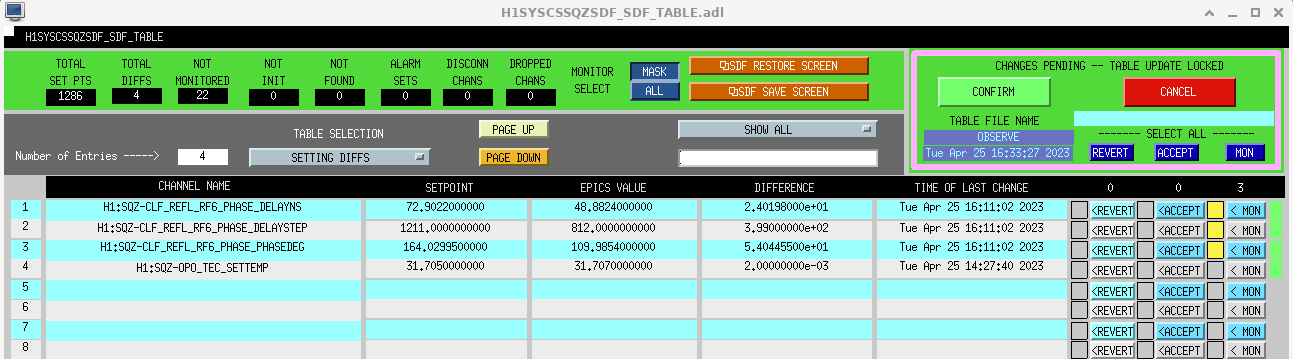
Camilla, Naoki, Nutsinee. Unmonitored SQZ Angle (H1:SQZ-CLF_REFL_RF6_PHASE_PHASEDEG) along with related channels (H1:SQZ-CLF_REFL_RF6_PHASE_DELAY{STEP,NS}) in sdf. Ideally this would remain constant but for now we are having to change the angle during thermalization to optimize SQZ. There is now no observe SQZ SDF diffs.
WP 11121
End Station microphones at both End Stations have been upgraded.
Plan is to start upgrade of microphones in Corner Station next week.
Nutsinee Daniel
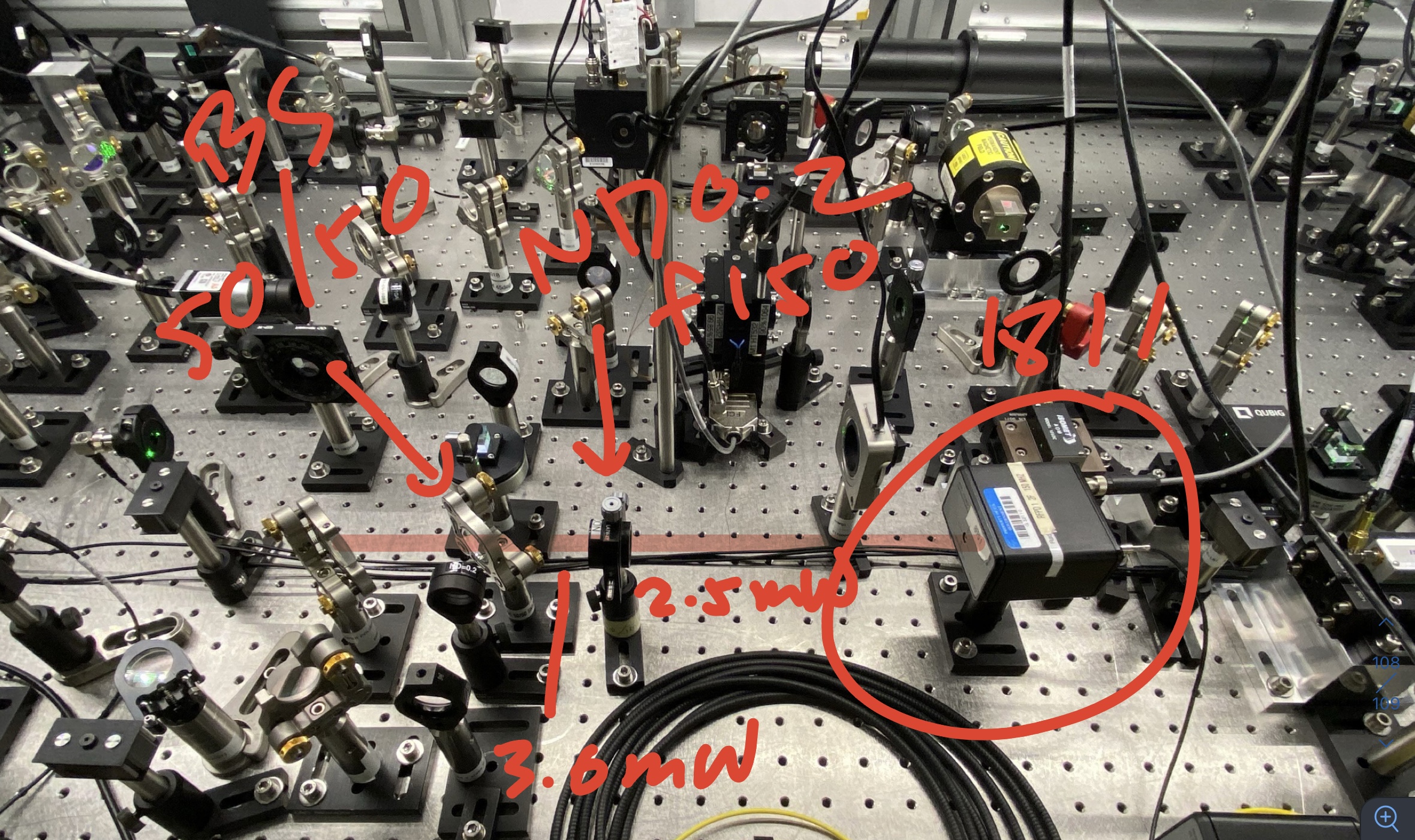
We added an 1811 photodetector to monitor the RF intensity noise of the squeezer laser. The new photodetector is mounted next to the 1611 which is used for the laser locking. There was a 50:50 beam splitter in the path of the laser to the 1611 that dumped about 3.6mW of light onto a beam dump. We added a 03 ND filter and a 150mm lens to this path and ended up with about 400uA of DC current on the 1811. The RF and DC readouts use cables ISC_SQ_540_1 and ISC_SQ_541_1, respectively. They are routed thru the PEM panel that had 2 TNC feedthru adapters available. The RF is then routed by cable ISC_SQ_540_2 to the same RF patch panel used for homodyne and OMC RF at position 3. We diconnected the RF of the homodyne from the demodulator and hooked up the new 1811 RF channel. The DC is routed by cable ISC_SQ_540_2 to the D-sub breakout panel just beneath it on position 4. The corresponding filter module is H1:SQZ-EXTRA_AI_4_OUT.
TITLE: 04/25 Eve Shift: 23:00-07:00 UTC (16:00-00:00 PST), all times posted in UTC
STATE of H1: Commissioning
CURRENT ENVIRONMENT:
SEI_ENV state: CALM
Wind: 13mph Gusts, 8mph 5min avg
Primary useism: 0.06 μm/s
Secondary useism: 0.10 μm/s
QUICK SUMMARY:
- IFO has been locked for ~1 hr and PCAL/CARM measurements are currently ongoing
- CDS/DMs ok
TITLE: 04/25 Day Shift: 15:00-23:00 UTC (08:00-16:00 PST), all times posted in UTC
STATE of H1: Commissioning
SHIFT SUMMARY:
LOG:
IFO Is currently Locked in NLN_CAL MEAS
Today's Lockloss List :
First lockloss happened right after I requested SEI ENV to go to Maintenance mode.
https://ldas-jobs.ligo-wa.caltech.edu/~lockloss/index.cgi?event=1366470047
Maintenace:
-(7:45am-8am) In-lock Charge Measurements if IFO is locked.
-8am - FAC - More Vinyl Work-
-APS door security vendor at FCES/VEA door and high bay LVEA door
-8am - EY Charge (Rahul)
-8am - Corner, then EX, then EY - Jim /CDS - Restart BSC ISI and SEIPROC models.
Continuing ECR updates from HAM work last week, seiproc is getting some dolphin
channels for related to eq mode. Will require daq restarts, and time to copy filters in.
-CDS - DAQ restart to take in 2 new Guardian nodes and remove one node .
- Update to CAL-CS and PCAL Models (Kissel)
-CDS - Marc - Replace two identified overheating power supplies in the CER.
Mezanine Rack C1 U29-U31 LeftHandSide (LHS) +18V 5A -- (SUS C6 ITMs BS) --
Mezzanine Rack C5 U13-15 RightHandSide (RHS) -18V 5A -
-EY - CDS -changed the connections for the daq data and regular FE ip traffic between end-y and mid-y. We changed from standard SFPs to bi-directional sfps.
-EY - VAC - perform functionality test on turbo/hepta pumps.
Post Maintenance Locking:
Tried to use H1 Manager Gaurdian for initial alignment.
It struggled to get green arms just right, but was able to get through initial alignment just fine.
After that it re-requested initial alignment agian, TJ and I then took over and started the normal locking process with out H1 Manager.
Once I started locking it was smooth sailing all the way up to NOMINAL_LOW_NOISE
Comissioning button set so Elena can do some tests.
NUC 30 (DARM screen) needs to have GDS removed from the channels to run correctly for more than an hour or 2.
22:05 IFO taken to NLN_Cal_Meas
22:18 Erik Von Reese turned GDS back on the DARM screen. we are trying to determine how long it takes to freeze the DARM display.
| Start Time | System | Name | Location | Lazer_Haz | Task | Time End |
|---|---|---|---|---|---|---|
| 14:54 | FAC | Karen | EY | N | Technical cleaning | 16:33 |
| 14:55 | FAC | Kim | EX | N | Technical Cleaning | 16:16 |
| 15:07 | SUS | Ryan C | CTRL Rm | N | EY Charge measurements | 16:03 |
| 15:16 | FAC | Vinyl | LVEA | N | Flooring work | 19:16 |
| 15:19 | CDS | Dave Barker | N | CDS Model & DAC Restarts | 19:17 | |
| 15:32 | EE | Fil | CS,EX&Y | N | PEM Power Supply & Microphone work | 19:17 |
| 15:38 | VAC | Gerardo | CS , EX &Y | N | Vacuum System work | 19:18 |
| 15:40 | FAMIS | Ryan S | CS, EX & Y | N | HEPI & dust Pump FAMIS Tasks | 16:31 |
| 15:41 | FAC | MItchel & Randy | EY | N | Wind Fence repair work | 18:40 |
| 16:08 | FAC | Chris | LVEA | N | Filling up forklift batterys | 16:45 |
| 16:15 | FAC | Apollo | FCES | N | Installing locks and security | 21:14 |
| 16:23 | SEI | Jim | CTRL Rm | N | Restart BSC ISI AND SEIPROC models | 17:03 |
| 16:30 | VAC | Jordan, Travis | EX & EY | N | Vacuum work | 19:15 |
| 16:41 | EE | Marc & Fernando | CER | N | Replacing 2 Power supplies, SUS taken to Safe! | 17:38 |
| 16:44 | OPS | Ryan S | EY | N | Wind Fence tractor driving | 18:24 |
| 16:46 | FAC | Chris | EY & EX | N | Filling fork lift Batteries | 18:03 |
| 16:50 | Tour | Gabriele + 2 | LVEA | N | LVEA tour | 17:35 |
| 16:51 | PSL | Jason | LVEA WBay | N | Checking out Test stands | 18:51 |
| 17:00 | EE | Betsy | CER | N | Working with Marc | 17:38 |
| 17:16 | FAC | Cindy,Karen,Kim | LVEA | N | Technical cleaning | 18:32 |
| 18:00 | CDS | Jonathan & Fil | EY | N | Taking PEM Y offline for a few moments | 19:44 |
| 18:03 | SEI | Jim | CER | N | Resetting signals to watchdogs via CER racks. | 18:04 |
| 18:04 | FAC | Chris | Wind - Y | N | Helping with the Wind fence at End Y | 19:17 |
| 18:51 | ASC | Elena | LVEA | N | Pluging in SR75 into rack | 19:16 |
| 19:09 | PEM | Adrian | EX | N | Checking sensors | 19:35 |
| 19:20 | Vac | Nitrogen | EX | N | Nitrogen delivery since 11:30 | 20:10 |
| 19:52 | SEI | Jim | Ctrl RM | N | SEI Transition checks and testing | 20:06 |
| 19:56 | LVEA | LAZSER HAZARD | LVEA | YES | THE LVEA IS LASER HAZARD | 07:56 |
| 20:05 | SQZr | Nutsinee, Danelle | LVEA | SQZr Bay | Checking SQZ Table | 22:35 |
| 21:28 | VAC | Travis | EX | N | In mechanical room working on pump for past hour. | 21:28 |
| 21:35 | SQZr | Naoki | SQZ table 0 | YES | Helping Nutsinee | 22:11 |
| 21:50 | ALS | Elena | Ctrl Rm | N | Open Loop Measurment of CARM | 22:10 |
| 22:11 | EE | Fil | LVEA SQZT0 | YES | Running Cables to SQZr Rack. | 22:22 |
| 22:42 | Commish | Elena | CTRL RM | N | CARM & PCAL Meas. & PCAL -> Darm TF | 22:57 |
R. Short, J. Kissel
I've added into ISC_LOCK management of Jeff's new CAL_AWG_LINES guardian. In LOWNOISE_LENGTH_CONTROL, CAL_AWG_LINES will be requested to the LINES_ON state and will remain on. The lines will turn off in NLN_CAL_MEAS and will turn back on when moving back to NLN.
This change is committed to the svn.
WP11151 Guardian new CAL_AW_LINES and THERMALIZATION nodes
Jeff, Dave:
A new H1EPICS_GRD.ini file was generated with the new nodes added. DAQ+EDC restart was needed.
WP11138 latest CAL and PCAL code
Jeff, Erik, Dave:
We built the latest h1calcs, h1calex and h1caley models. It was found that the end station models were removing two slow channels from the DAQ frame, which would require an ECR. Jeff undid that particular change so these models are only adding channels to the DAQ.
| model | num slow added | num slow removed | num fast added | num fast removed |
| h1calcs | 1,220 | 0 | 0 | 0 |
| h1calex | 3 | 0 | 0 | 0 |
| h1caley | 3 | 0 | 0 | 0 |
WP11128 Reduce EY-MY fiber usage, add ADMIN-LAN access to MY
Jonathan, Erik, Fil:
EY to MY fiber usage was reduced by replacing fiber pairs to a single fibre using bi-directional SFPs. The network connections for H1FE and H1DAQ were upgraded to bi-dirs, while the timing was kept as a fiber pair. This freed up two fibers, one of which was used to send the H1ADMIN network to MY using ethernet-fiber media converters at each end.
We now have IPMI control of h1pemmy-mgmt. In a future TM the H1ADMIN lan connection to MX will also be done.
WP11121 Pulizzi PEM Coil power controls
Fil, Erik, Dave:
Fil installed three more Pulizzi ethernet AC-power controllers in the corner station: CER, SQZ and VERTEX. I reconfigued the sw-lvea-aux Cisco switch ports 2, 43, 46 to VLAN105 to connect to these units. I created three new EPICS IOCs on cdsioc0 to run these boxes. The CER unit as intermittent errors, and does not report outlet status except when a SCAN command is explicitly given.
Fil looked at the end station VEA units which had been installed some time ago. We found that they have incorrect IP addresses and are on the wrong VLAN (in H1VID, not H1SLOW). Also, exrpc does not respond to pings, even though its ethernet link lights are on.
WP11142 ISI BSC upgrades, long-range_dolphin end-station to seiproc
Jim, Dave:
We installed Jims latest ISI BSC model changes, including adding an End-Station to h1seiproc long-range Dolphin channel from each end station.
Models upgraded: h1isiitmx, h1isibs, h1isiitmy, h1isietmx, h1isietmy, h1isiham8, h1seiproc.
DAQ changes are summarized below
| model | slow channels added | slow channels removed | fast channels added | fast channels removed |
| h1isiitmx | 2,904 | 876 | 6 | 0 |
| h1isibs | 3,012 | 876 | 6 | 0 |
| h1isiitmy | 2,904 | 876 | 6 | 0 |
| h1isietmx | 2,905 (+1 RFM0 chan) | 876 | 6 | 0 |
| h1isietmy | 2,905 (+1 RFM1 chan) | 876 | 6 | 0 |
| h1isiham8 | 32 | 0 | 0 | 0 |
| h1seiproc | 8 | 0 | 0 | 0 |
add/remove channel names are available in attached tar file.
A new cdsrfm long-range dolphin MEDM was generated to show the additional EX->CS and EY->CS IPC channels.
GDS Broadcaster Additional Channels
Jonathan:
9 new slow channels were added to GDS0 and GDS1 broadcast channel lists. The additional channels are listed below. I've "shown my work" in how to get this list using the new channel-lists archiving system, finding the diffs between the 2am and 2pm files.
david.barker@opslogin0: cd /ligo/www/www/exports/daq/chan_archive/2023/04/25
david.barker@opslogin0: diff h1_gds0_channels_2023_04_25_02_00.txt h1_gds0_channels_2023_04_25_14_00.txt|grep ">"
> H1:CAL-CS_LINE_1_OSC_CLKGAIN
> H1:CAL-CS_LINE_2_OSC_CLKGAIN
> H1:CAL-CS_LINE_3_OSC_CLKGAIN
> H1:SUS-ETMX_L1_CAL_LINE_CLKGAIN
> H1:SUS-ETMX_L2_CAL_LINE_CLKGAIN
> H1:SUS-ETMX_L3_CAL_LINE_CLKGAIN
> H1:SUS-ETMY_L1_CAL_LINE_CLKGAIN
> H1:SUS-ETMY_L2_CAL_LINE_CLKGAIN
> H1:SUS-ETMY_L3_CAL_LINE_CLKGAIN
DAQ Restart
Dave, Jonathan:
The DAQ and EDC were restarted to support the model changes, the EDC changes and the GDS broadcast list changes.
GDS0 needed a second restart to resync its channel lists, but not GDS1.
FW0 spontaneously crashed after running for about 10 minutes. FW1 was not fully operational at this time and we may have lost a full frame.
Reboot/Restart Report
Tue25Apr2023
LOC TIME HOSTNAME MODEL/REBOOT
09:22:42 h1oaf0 h1calcs
09:23:22 h1iscex h1calex
09:23:52 h1iscey h1caley
09:32:05 h1seiex h1isietmx
09:32:34 h1seiey h1isietmy
09:33:14 h1seib1 h1isiitmy
09:33:40 h1seib2 h1isibs
09:34:09 h1seib3 h1isiitmx
09:34:39 h1cdsh8 h1isiham8
09:35:13 h1oaf0 h1seiproc
09:42:01 h1daqdc0 [DAQ]
09:42:11 h1daqfw0 [DAQ]
09:42:12 h1daqnds0 [DAQ]
09:42:12 h1daqtw0 [DAQ]
09:42:19 h1daqgds0 [DAQ]
09:42:38 h1susauxb123 h1edc[DAQ]
09:43:15 h1daqgds0 [DAQ] <<< 2nd GDS0 restart
09:45:11 h1daqdc1 [DAQ]
09:45:21 h1daqfw1 [DAQ]
09:45:21 h1daqtw1 [DAQ]
09:45:24 h1daqnds1 [DAQ]
09:45:31 h1daqgds1 [DAQ]
09:47:21 h1daqfw0 [DAQ] <<< FW0 crash
12:28:54 h1pemmy ***REBOOT***
12:29:51 h1pemmy h1ioppemmy
12:30:04 h1pemmy h1pemmy
Maintenance Detailed Files (tar file)
DAQ Full Frame Channel Changes
In the directory /ligo/www/www/exports/daq/chan_archive/2023/04/25:
Old total num DAQ channels:
wc -l h1_daq0_channels_2023_04_25_02_00.txt
312647 h1_daq0_channels_2023_04_25_02_00.txt
New total num DAQ channels:
wc -l h1_daq0_channels_2023_04_25_14_00.txt
324239 h1_daq0_channels_2023_04_25_14_00.txt
Net change +11592
Using the comm command to show statistics (you can ignore the sort order warnings).
Channels Added to DAQ:
comm -1 -3 h1_daq0_channels_2023_04_25_02_00.txt h1_daq0_channels_2023_04_25_14_00.txt|wc -l
15972
Channels Removed from DAQ:
comm -2 -3 h1_daq0_channels_2023_04_25_02_00.txt h1_daq0_channels_2023_04_25_14_00.txt|wc -l
4380
Which gives a delta of 15,972 - 4,380 = +11,592 (W5 which was what we wanted)
To hone in on fast channels only
Fast channels added (datarate != 16Hz) Qty=30
comm -1 -3 h1_daq0_channels_2023_04_25_02_00.txt h1_daq0_channels_2023_04_25_14_00.txt|grep -v " 16$"
H1:ISI-BS_ST2_SUSPOINT_DRIVE_L_EXC_DQ 4 2048
H1:ISI-BS_ST2_SUSPOINT_DRIVE_P_EXC_DQ 4 2048
H1:ISI-BS_ST2_SUSPOINT_DRIVE_R_EXC_DQ 4 2048
H1:ISI-BS_ST2_SUSPOINT_DRIVE_T_EXC_DQ 4 2048
H1:ISI-BS_ST2_SUSPOINT_DRIVE_V_EXC_DQ 4 2048
H1:ISI-BS_ST2_SUSPOINT_DRIVE_Y_EXC_DQ 4 2048
H1:ISI-ETMX_ST2_SUSPOINT_DRIVE_L_EXC_DQ 4 2048
H1:ISI-ETMX_ST2_SUSPOINT_DRIVE_P_EXC_DQ 4 2048
H1:ISI-ETMX_ST2_SUSPOINT_DRIVE_R_EXC_DQ 4 2048
H1:ISI-ETMX_ST2_SUSPOINT_DRIVE_T_EXC_DQ 4 2048
H1:ISI-ETMX_ST2_SUSPOINT_DRIVE_V_EXC_DQ 4 2048
H1:ISI-ETMX_ST2_SUSPOINT_DRIVE_Y_EXC_DQ 4 2048
H1:ISI-ETMY_ST2_SUSPOINT_DRIVE_L_EXC_DQ 4 2048
H1:ISI-ETMY_ST2_SUSPOINT_DRIVE_P_EXC_DQ 4 2048
H1:ISI-ETMY_ST2_SUSPOINT_DRIVE_R_EXC_DQ 4 2048
H1:ISI-ETMY_ST2_SUSPOINT_DRIVE_T_EXC_DQ 4 2048
H1:ISI-ETMY_ST2_SUSPOINT_DRIVE_V_EXC_DQ 4 2048
H1:ISI-ETMY_ST2_SUSPOINT_DRIVE_Y_EXC_DQ 4 2048
H1:ISI-ITMX_ST2_SUSPOINT_DRIVE_L_EXC_DQ 4 2048
H1:ISI-ITMX_ST2_SUSPOINT_DRIVE_P_EXC_DQ 4 2048
H1:ISI-ITMX_ST2_SUSPOINT_DRIVE_R_EXC_DQ 4 2048
H1:ISI-ITMX_ST2_SUSPOINT_DRIVE_T_EXC_DQ 4 2048
H1:ISI-ITMX_ST2_SUSPOINT_DRIVE_V_EXC_DQ 4 2048
H1:ISI-ITMX_ST2_SUSPOINT_DRIVE_Y_EXC_DQ 4 2048
H1:ISI-ITMY_ST2_SUSPOINT_DRIVE_L_EXC_DQ 4 2048
H1:ISI-ITMY_ST2_SUSPOINT_DRIVE_P_EXC_DQ 4 2048
H1:ISI-ITMY_ST2_SUSPOINT_DRIVE_R_EXC_DQ 4 2048
H1:ISI-ITMY_ST2_SUSPOINT_DRIVE_T_EXC_DQ 4 2048
H1:ISI-ITMY_ST2_SUSPOINT_DRIVE_V_EXC_DQ 4 2048
H1:ISI-ITMY_ST2_SUSPOINT_DRIVE_Y_EXC_DQ 4 2048
Daniel, Naoki and I pluggeg in the SR785 at the PSL racks to run measurements of CARM during lock and determine if we can increase the CARM gain (see alog 68967). This means we have unplugged the cable that allows us to run frequency noise injections, We will try to get carm measurements as we thermalize, and then plug in the frequency injection cable so we can return to those measurements later in the lock.
SR785 unplugged, and frequency noise injection cable plugged back in.
Plugged back in the SR785 for CARM measurements at 0600 UTC.
Elenna, Dan
We wanted to test the original asymmetric CO2 powers we had back at 60W to see if we could get back to lower frequency noise.
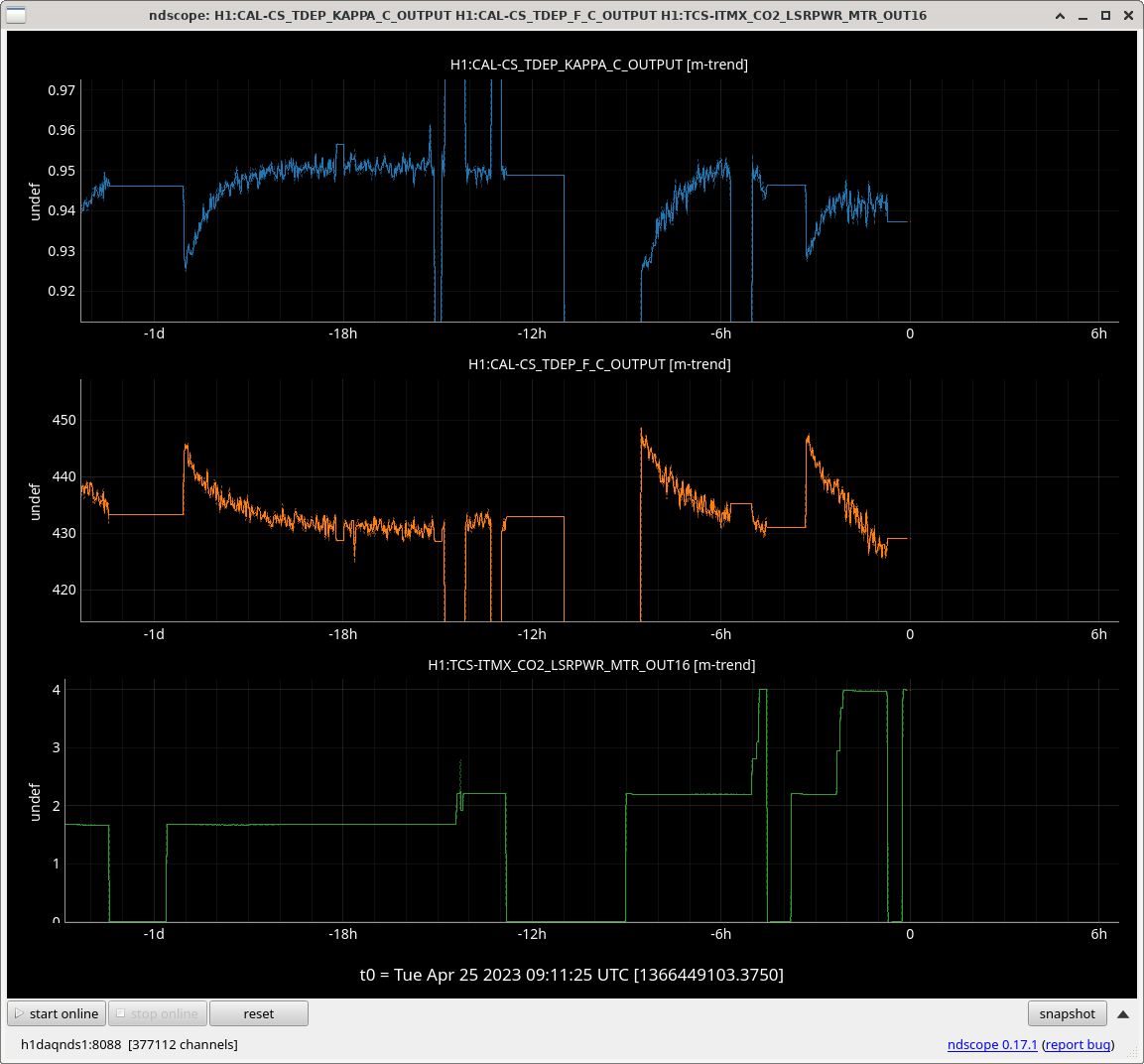
Elenna had been doing some steps and measurements and I took over when she left. Elenna had set the nominal requested CO2 in lscparams to 2.7W (which is actually 4W of actual annular CO2) and I was going to come in a few hours later and take some measurements. However the TCS guardians didn't seem to take us there, probably not reloaded. I changed CO2X by hand up to 4W with the aim of coming back a few hours later to do the measurement.
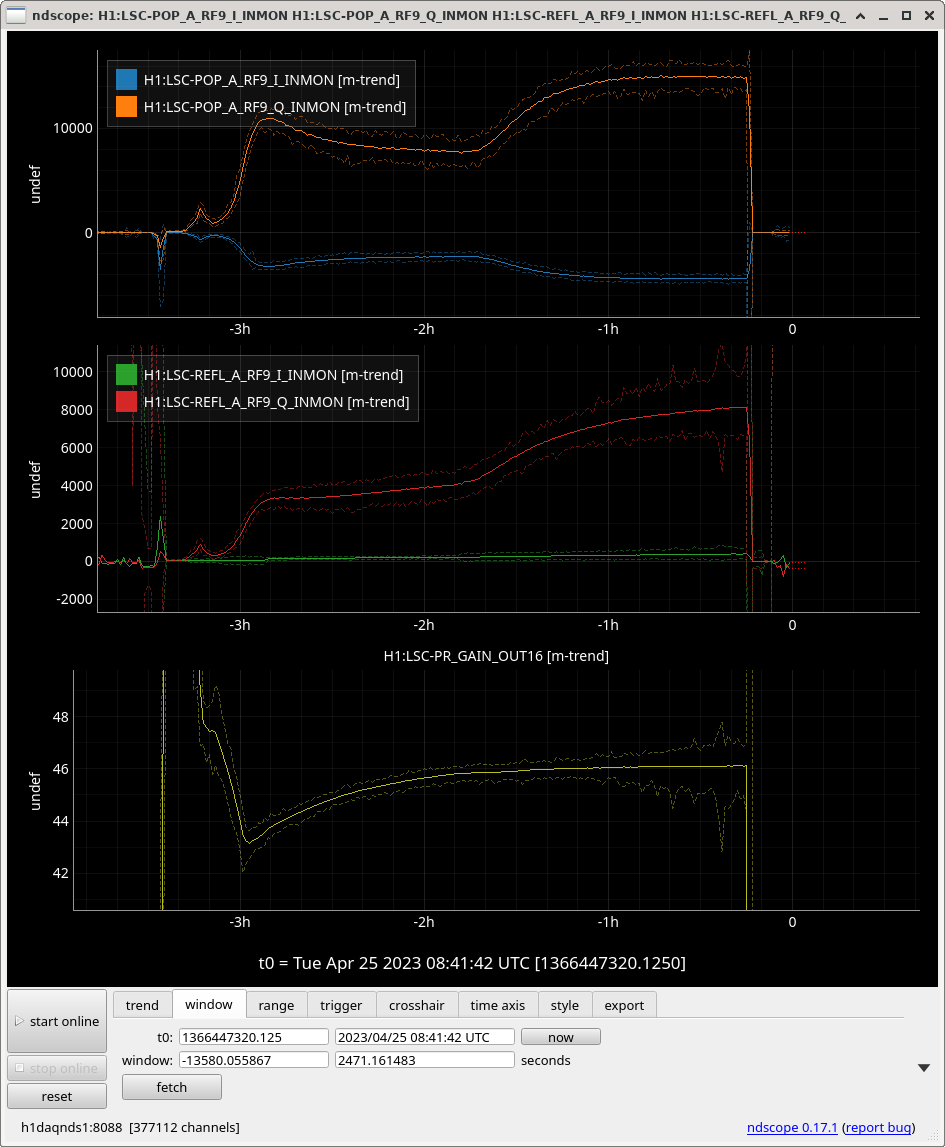
About 1.5 hours later there was a lockloss, PRG became very noisy. Looking at POP_A_RF9_{I,Q}_INMON they both doubled in counts. I didn't measure PRCL gain but maybe this CO2 change in combination with the new fixed thermalisation gain scaler increased it too much.
I didn't get a chance to do the measurements we wanted (contast, spring, frequency coupling) so I've set the nominal CO2X to 2.7W requested and reloaded the guardians. I've set the THERMALISATION guardian to IDLE to see if this will hold a longer lock. I'll come back in a few hours and see how it's doing and try to take the measurements if it survives.
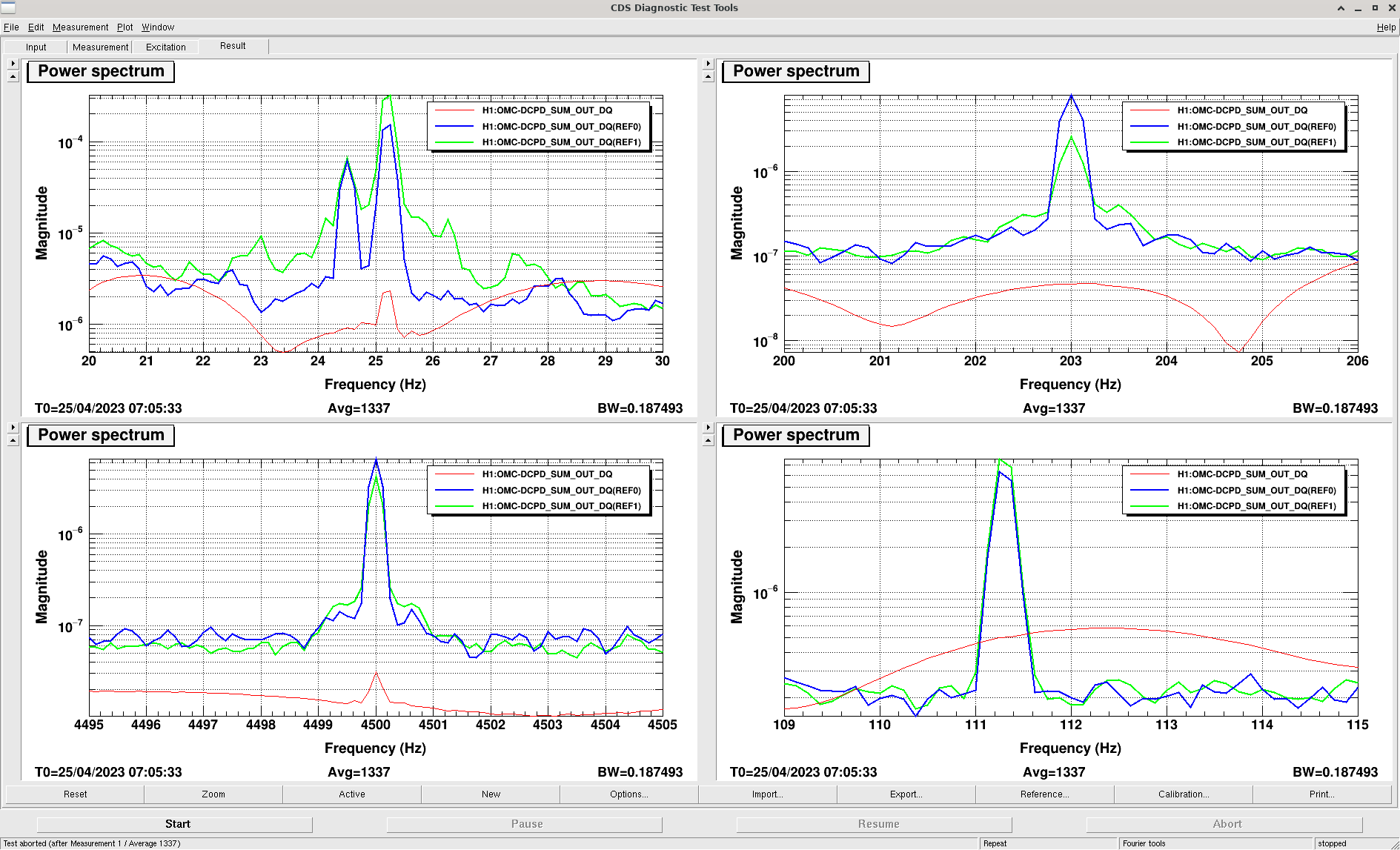
Looking at the lines before lockloss, it seems going back to an asymmetric CO2 setting 4W and 1.7W on X and Y reduces the 200 and 4500 Hz frequency noise coupling a little but increases the 25.2Hz coupling. Arm power is also slightly down by a few kW. This also looks like it will eventually reduce both the optical gain and cavity pole judging by their trends.
I think we have some promising results from this test, although it is mostly inconclusive because we were unable to get well-thermalized data. As an aside, I think many of our locklosses were related to the fact that the PRCL UGF servo trend had been measured at a different thermal state, so it might not have been properly tuned for the new CO2 settings.
CO2X at 4W, CO2Y at 1.7W
Frequency noise: according to this plot it has improved. Keep in mind we are comparing traces later in lock with a trace 1.5 hrs into the lock. However, that is a significant change.
Contrast defect: slightly worse, 2.2 mW again. Same caveat as above
DARM spring: appears improved too, again with caveats. This was measured with the SRCL offset at -165 (nominal)
The frequency noise and DARM spring plots also show the results with CO2X at 2.2W (CO2Y at 1.7W). The results show either no change or minimal change.
I think these results are promising enough that we should keep these CO2 settings in the guardian. Tonight's lock after maintenance we will remeasure these parameters while we thermalize and after thermalization (~3-5 hrs into lock). We will also monitor and adjust the PRCL gain by hand. When we do DARM spring measurements, we will take multiple measurements with different SRCL offsets.
Overnight locklosses reported in alog 68988. One unknown, one from a PI, last 3h lock ended by Tuesday maintainance.
Analysis from the modulation depth test.
Power-recycling gains for sidebands and carrier
9 MHz PRG = 54.6
45 MHz PRG = 27.2
Carrier PRG = 46.2
Reflection ratios for sidebands and carrier
9 MHz reflection ratio = 0.226
45 MHz reflection ratio = 0.316
Carrier reflection ratio = 0.063
| Channels | 9 MHz | 45 MHz | Carrier |
|---|---|---|---|
| H1:IMC-PWR_IN_OUT16 | 0.013 | 0.015 | 0.973 |
| H1:IMC-IM4_TRANS_NSUM_OUT16 | 0.013 | 0.015 | 0.972 |
| H1:LSC-REFL_A_LF_OUT16 | 0.043 | 0.068 | 0.889 |
| H1:LSC-REFL_B_LF_OUT16 | 0.041 | 0.066 | 0.893 |
| H1:LSC-POP_A_LF_OUT16 | 0.015 | 0.009 | 0.976 |
| H1:ASC-POP_A_NSUM_OUT16 | 0.015 | 0.009 | 0.976 |
| H1:ASC-POP_B_NSUM_OUT16 | 0.015 | 0.009 | 0.976 |
| H1:ASC-AS_C_NSUM_OUT16 | 0.190 | 0.509 | 0.301 |
| H1:ASC-OMC_A_NSUM_OUT16 | 0.190 | 0.557 | 0.253 |
| H1:ASC-OMC_B_NSUM_OUT16 | 0.197 | 0.635 | 0.168 |
| H1:ASC-X_TR_A_NSUM_OUT16 | 0.004 | 0.007 | 0.989 |
| H1:ASC-X_TR_B_NSUM_OUT16 | 0.004 | 0.007 | 0.989 |
| H1:ASC-Y_TR_A_NSUM_OUT16 | 0.004 | 0.007 | 0.989 |
| H1:ASC-Y_TR_B_NSUM_OUT16 | 0.004 | 0.007 | 0.989 |
Relative to https://alog.ligo-wa.caltech.edu/aLOG/index.php?callRep=68696
We seem to be reflecting more 9 and less 45. The 45 PRG has increased to 27. We appear to still have a large percentage of 9 at the AS port