Checked the running dust monitor operations, by sending stop/start commands to each unit. All are working at this time.
FYI - I noticed an audible "beep" coming from the chiller unit in the ante-chamber room (room 172B) adjacent to the OSB receiving area.
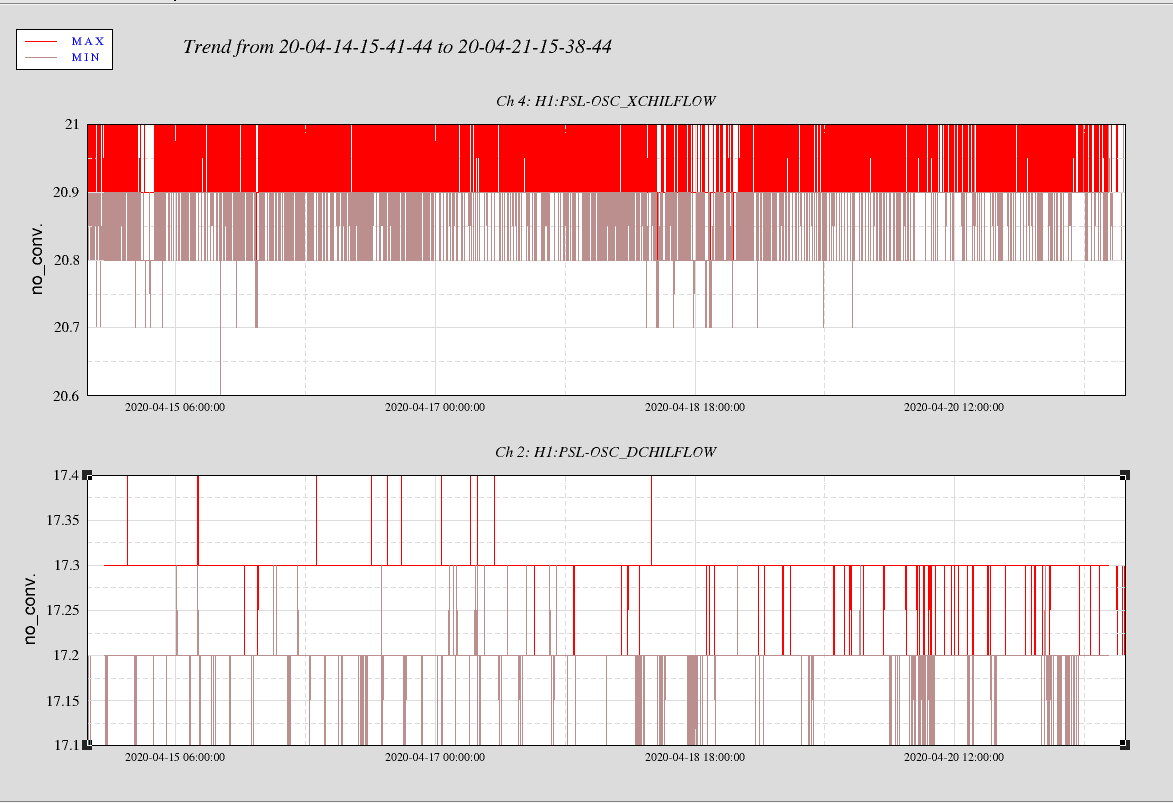
The flows on the Crystal and Diode chillers for the past week look normal.
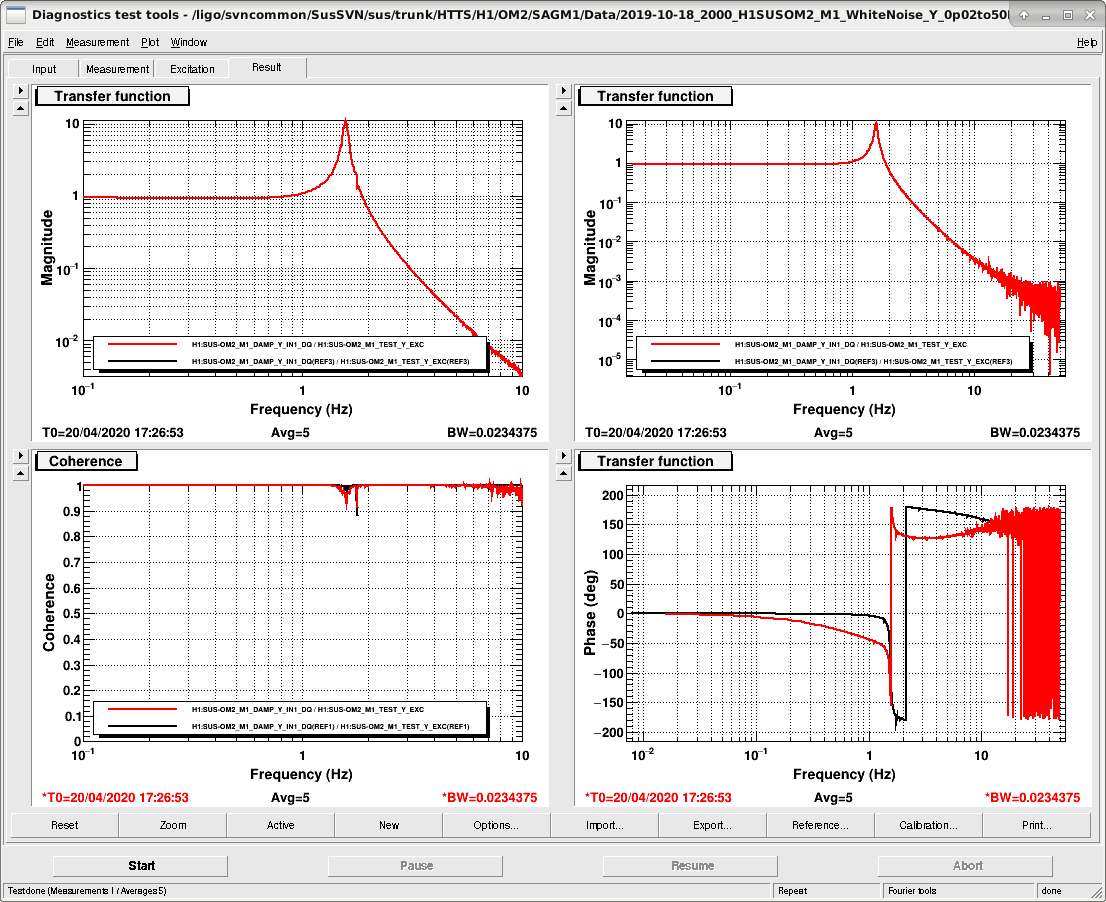
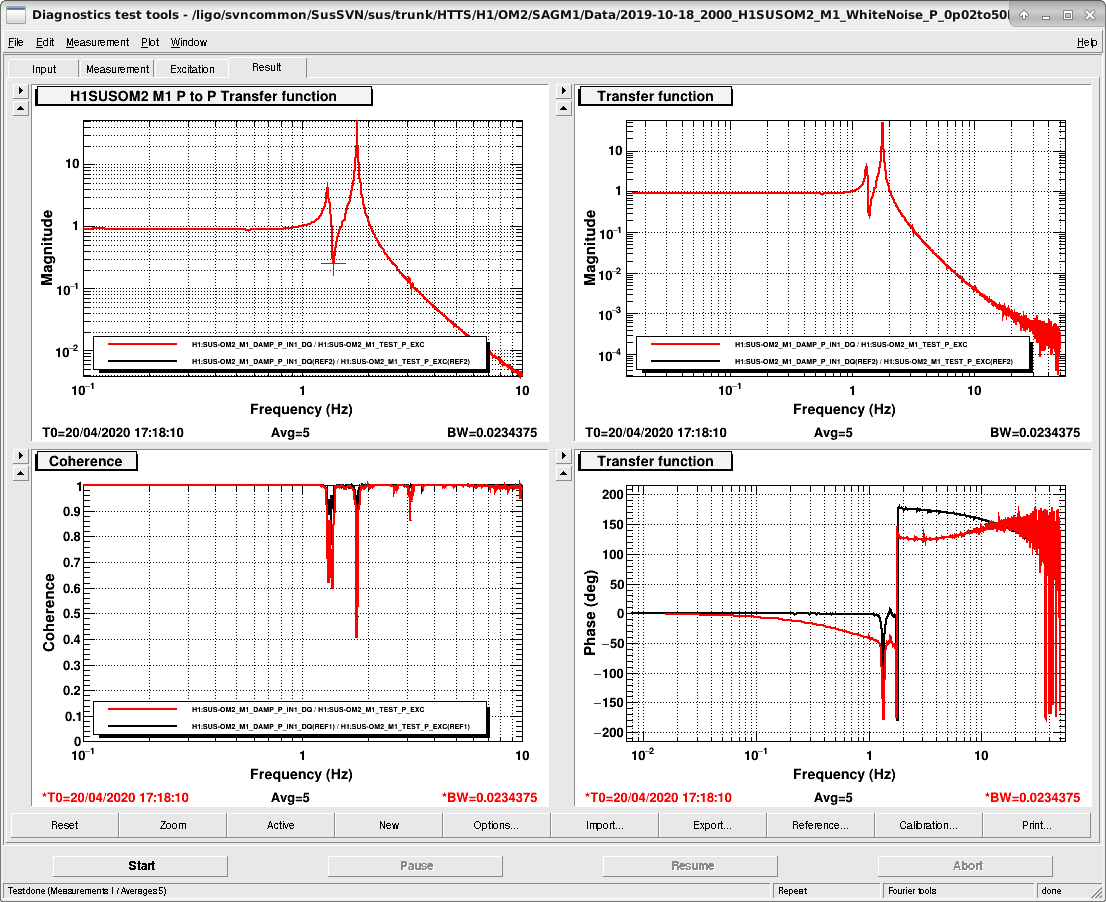
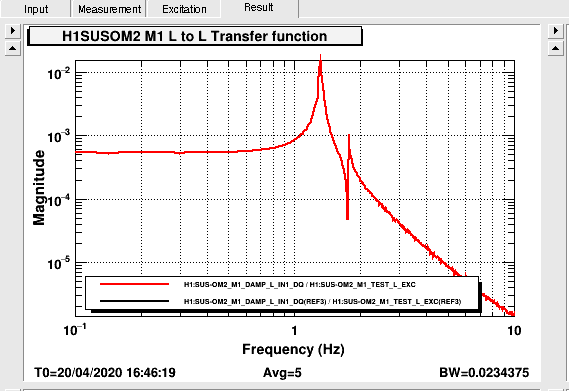
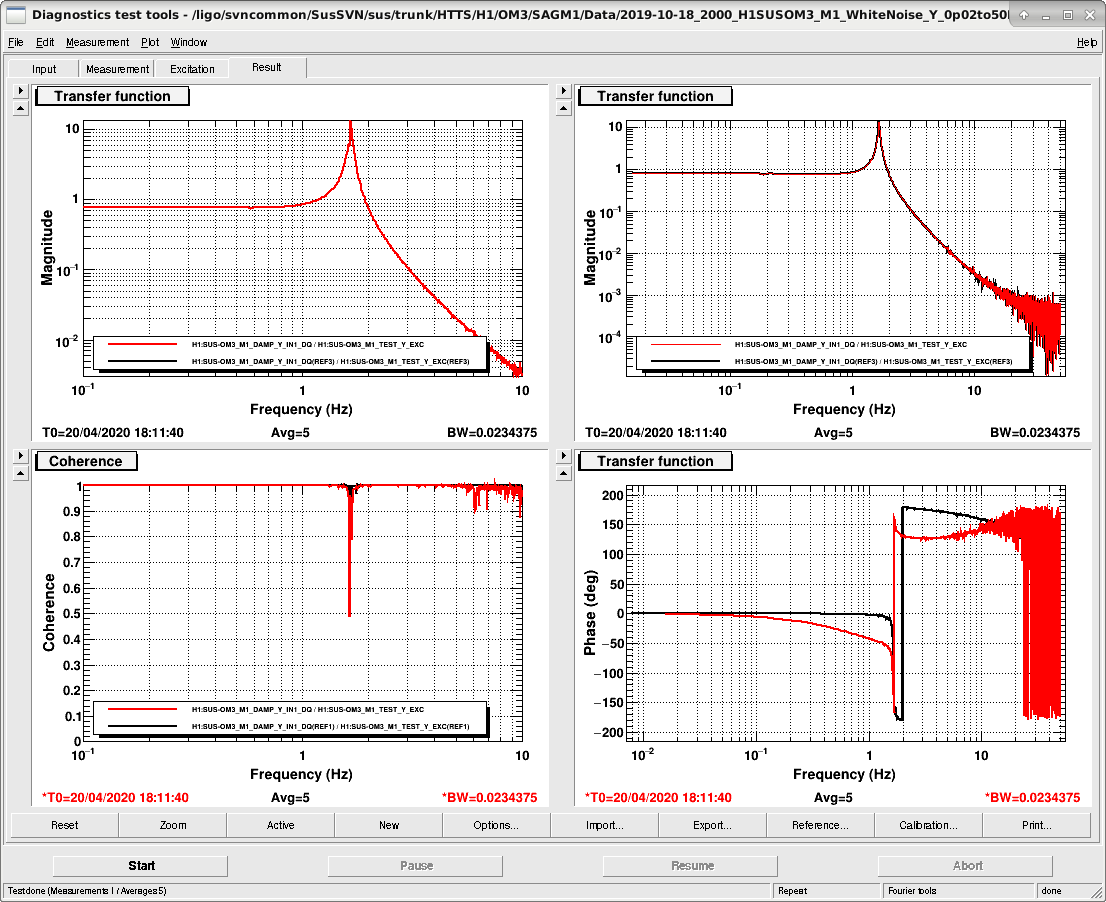
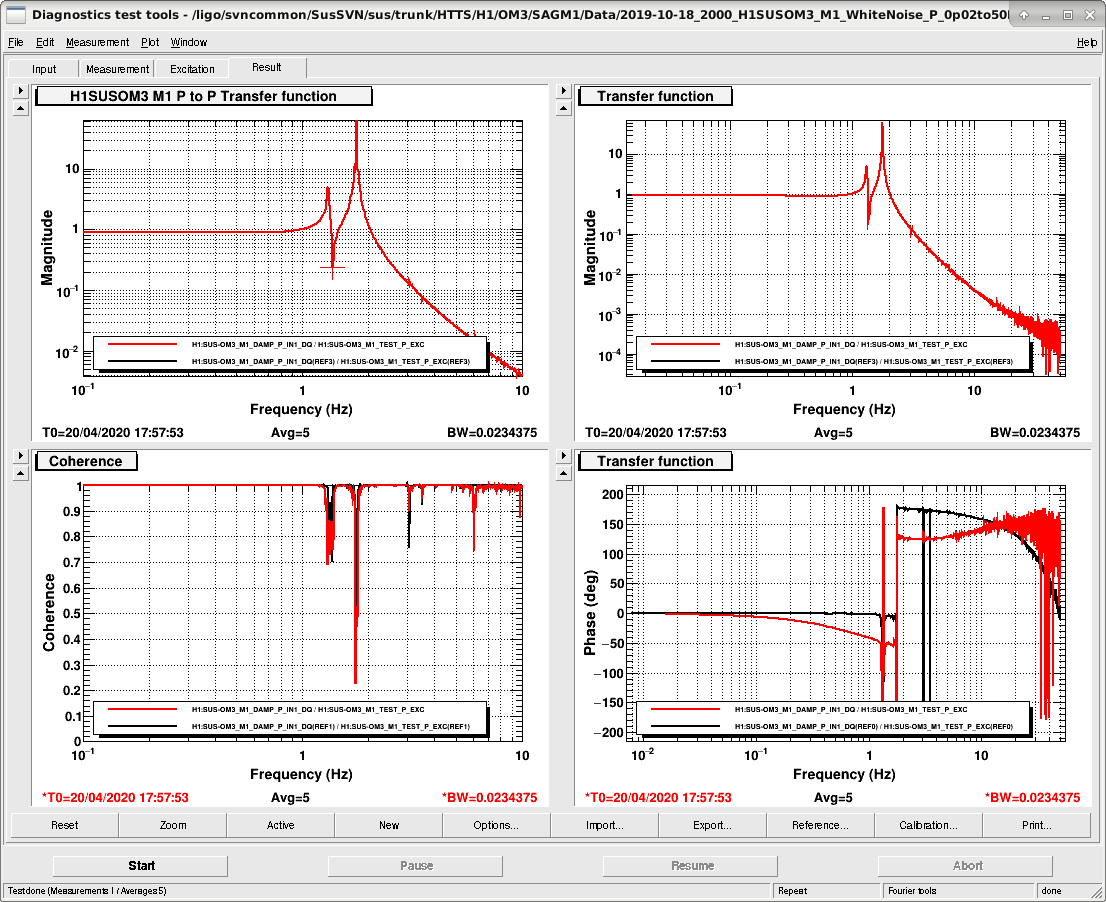
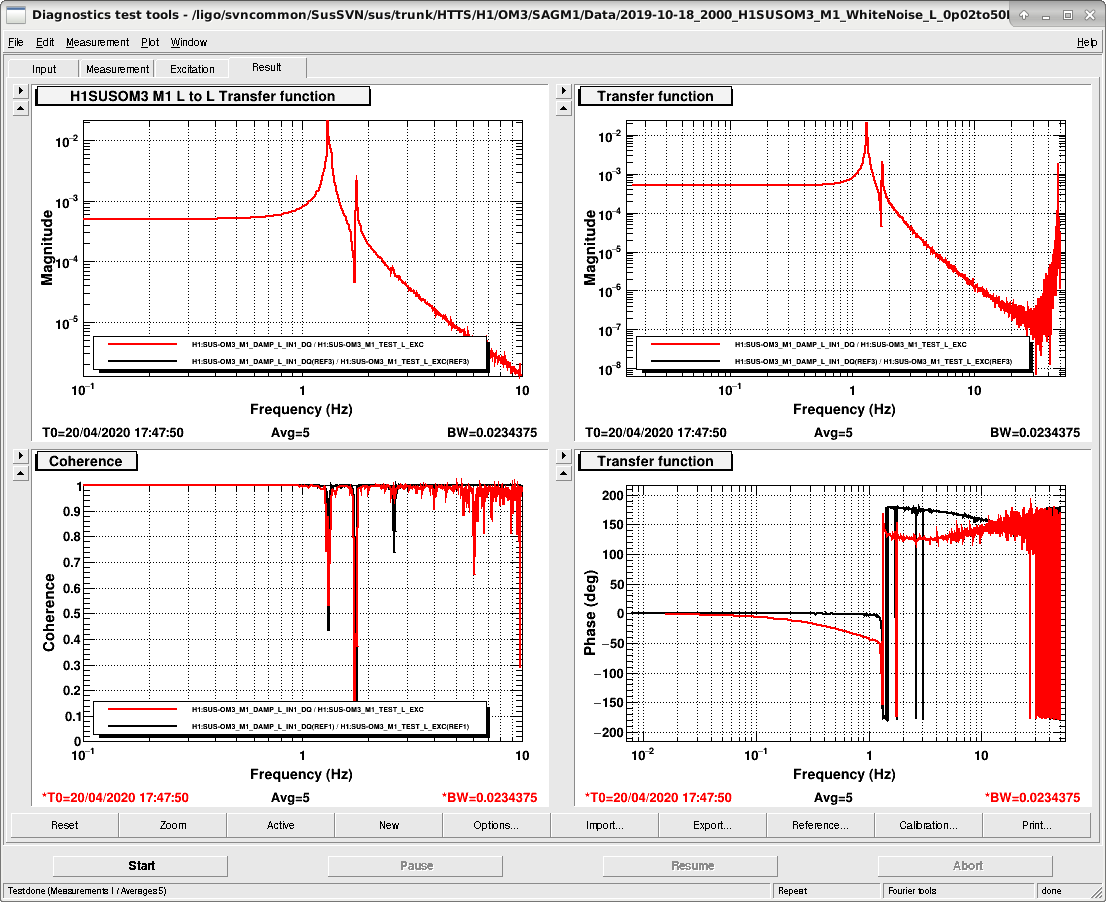
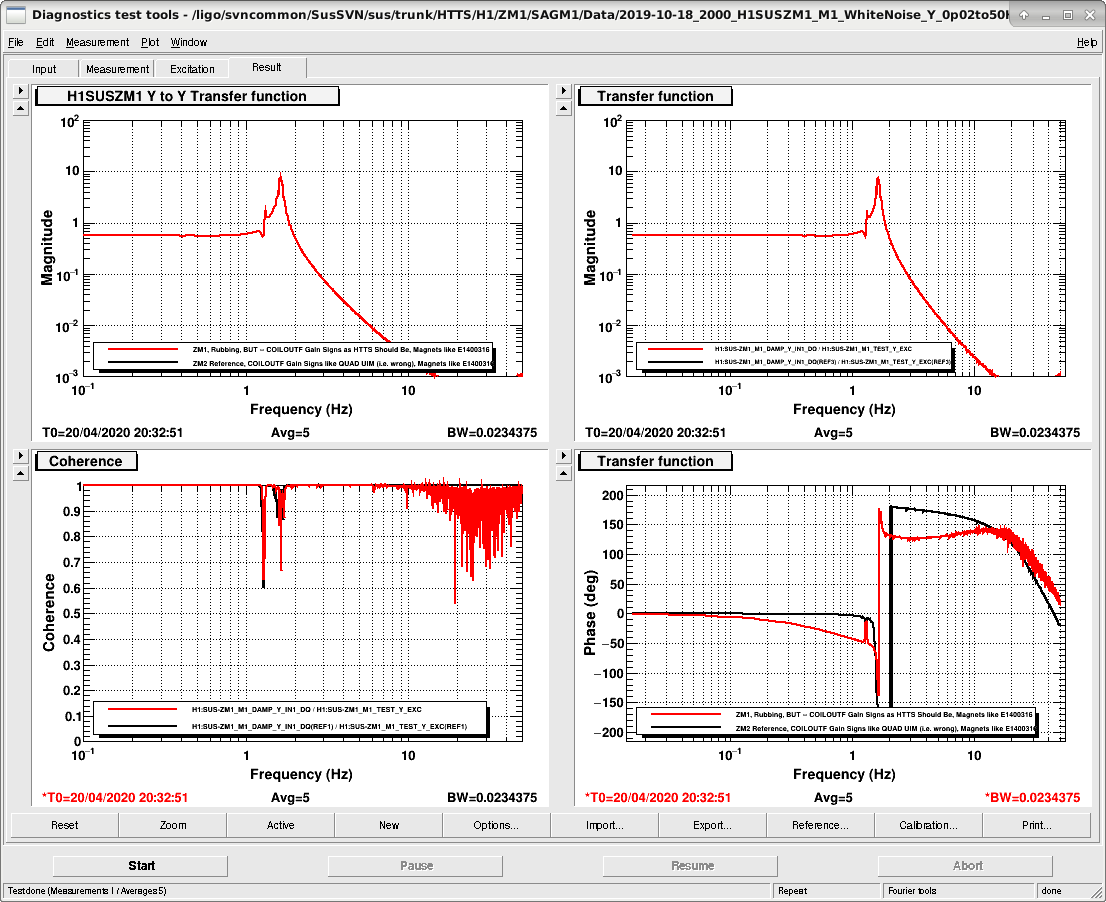
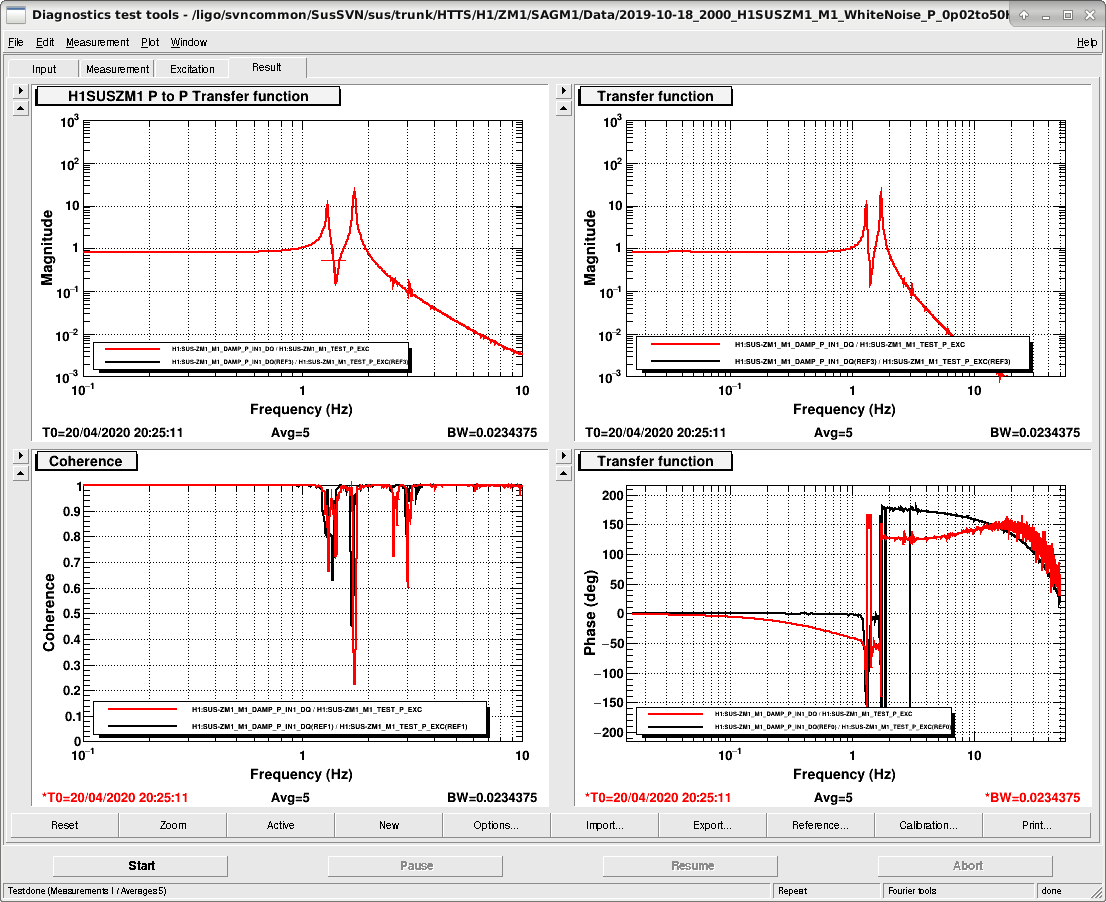
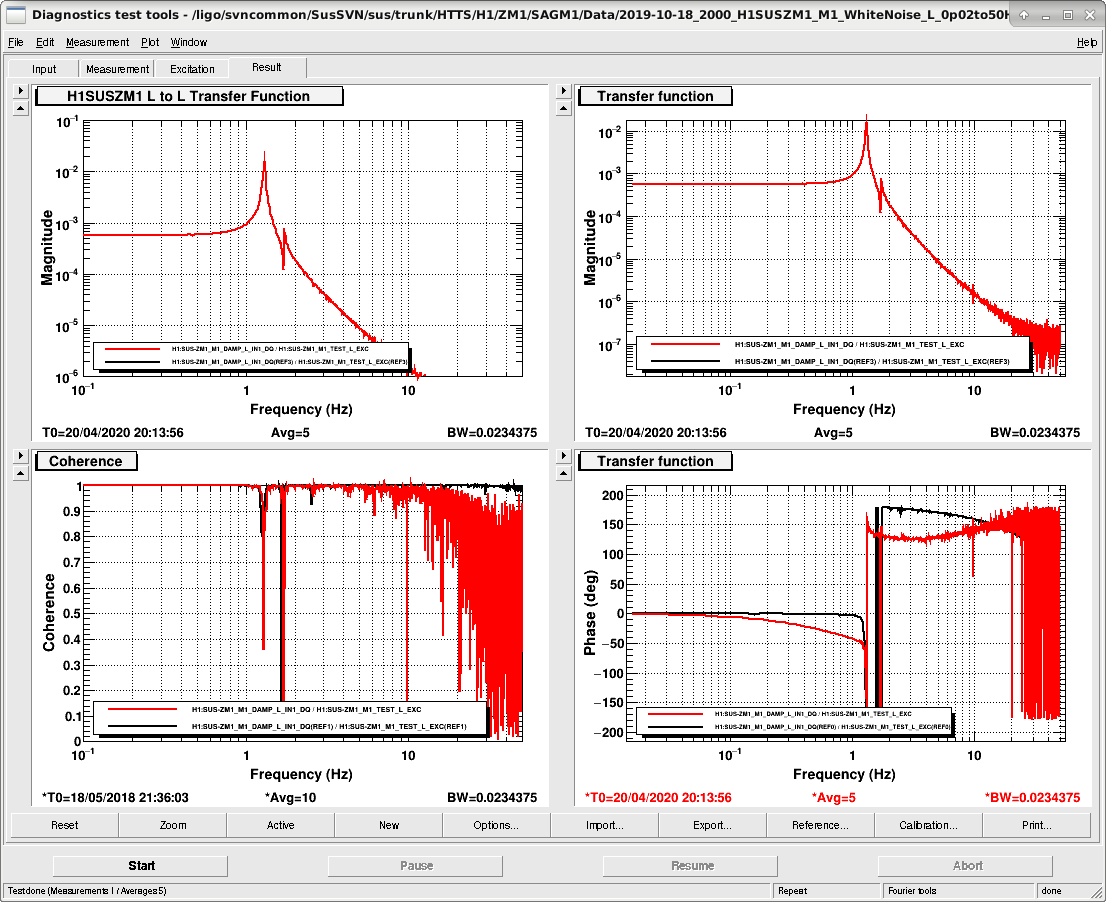
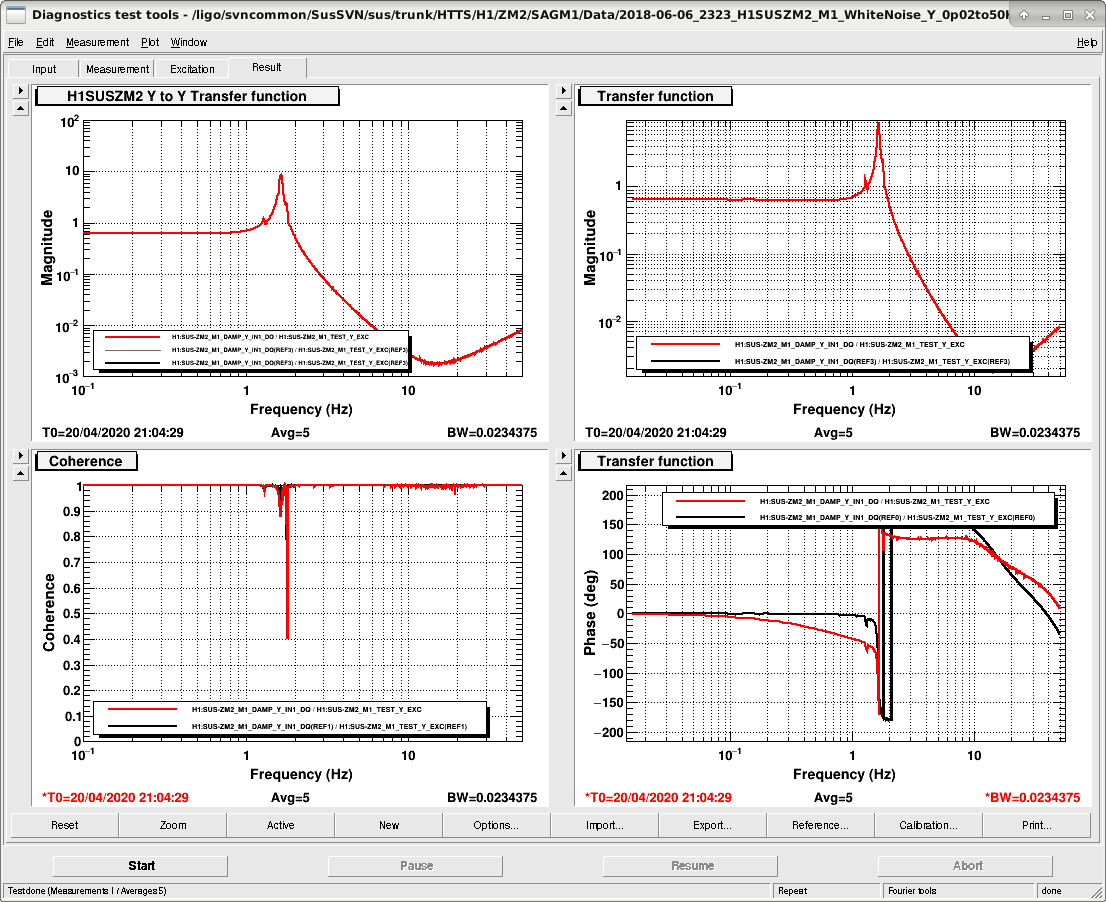
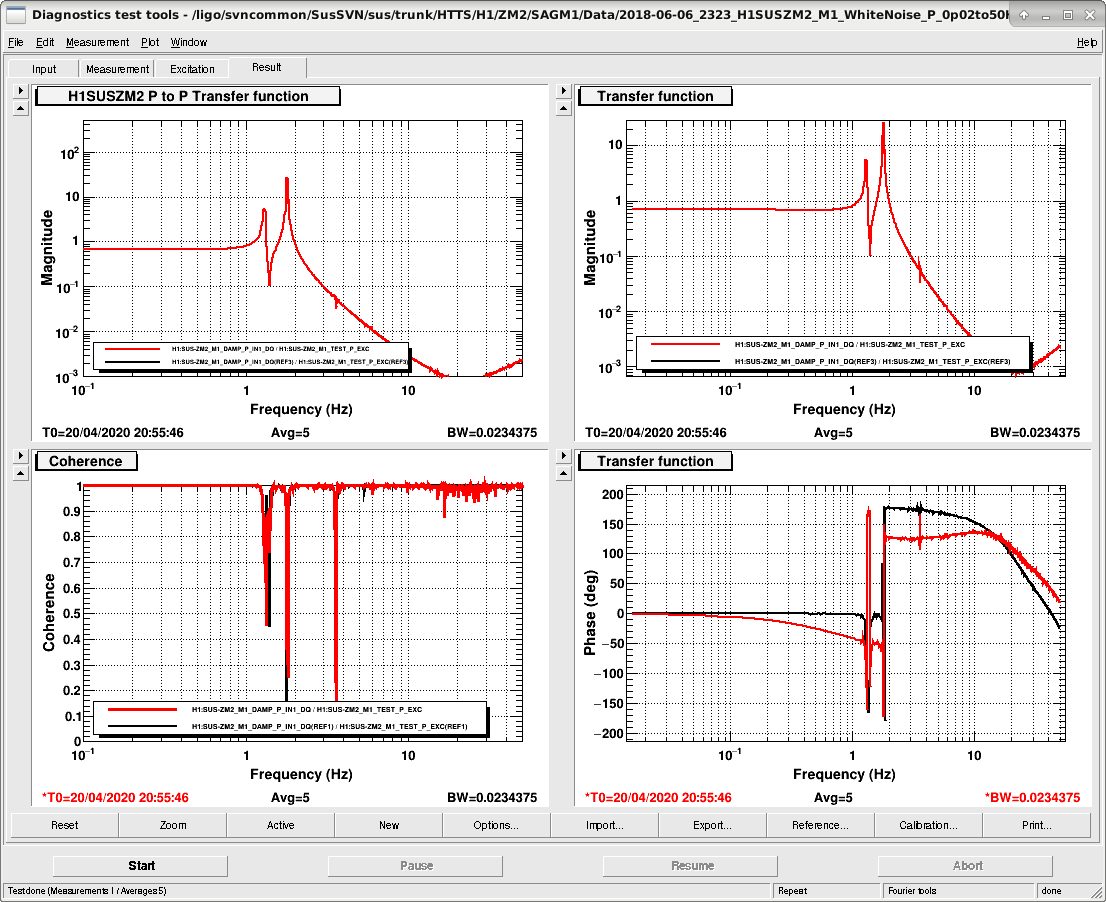
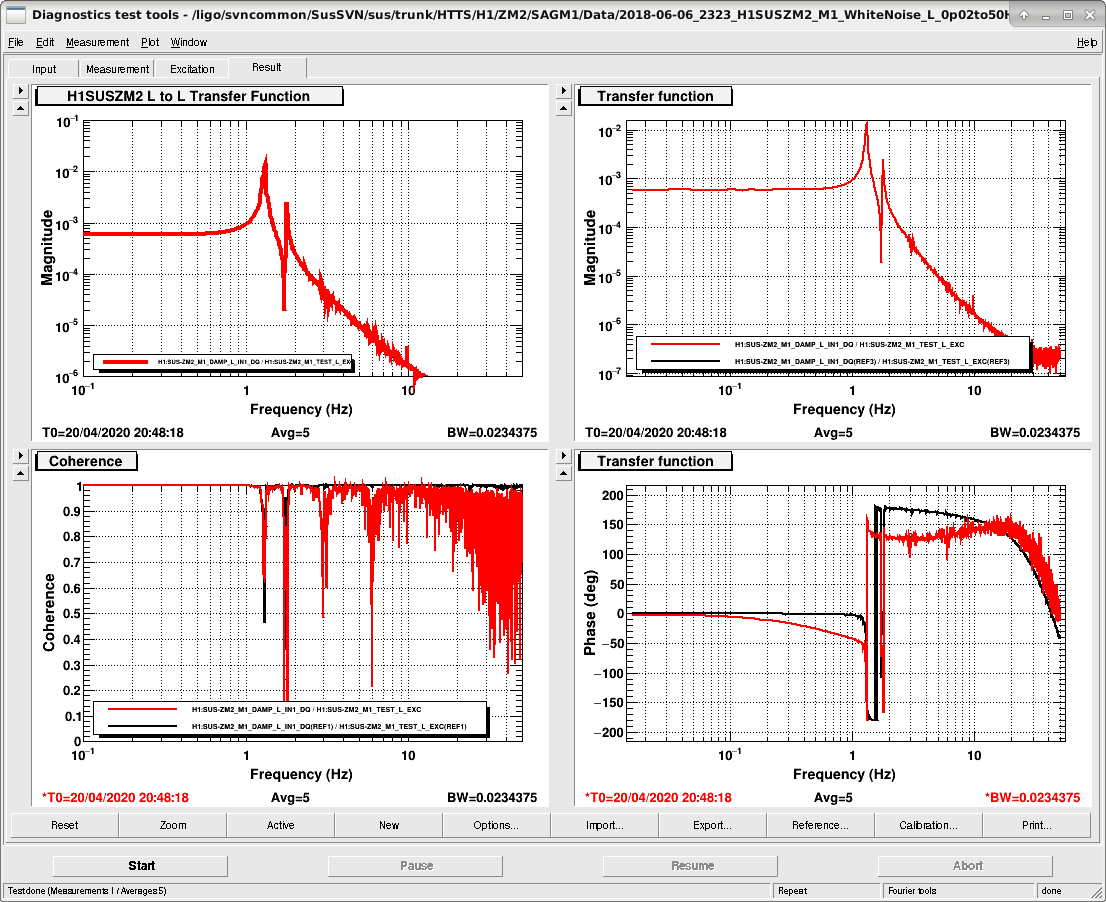
The transfer function measurements for single stage suspension: OM2, OM3, ZM1 and ZM2 shows that they are healthy and free of any rubbing. Attached below are the plots. The templates of these plots have been updated since the older version (2018) were mistakenly run using low pass ON (CD state): we ran it in low pass Off state. The latest templates are stored at the following locations.
/ligo/svncommon/SusSVN/sus/trunk/HTTS/H1/OM2/SAGM1/Data
2020-04-20_1500_H1SUSOM2_M1_WhiteNoise_L_0p02to50Hz.xml
2020-04-20_1500_H1SUSOM2_M1_WhiteNoise_P_0p02to50Hz.xml
2020-04-20_1500_H1SUSOM2_M1_WhiteNoise_Y_0p02to50Hz.xml
/ligo/svncommon/SusSVN/sus/trunk/HTTS/H1/OM3/SAGM1/Data
2020-04-20_1600_H1SUSOM3_M1_WhiteNoise_L_0p02to50Hz.xml
2020-04-20_1600_H1SUSOM3_M1_WhiteNoise_P_0p02to50Hz.xml
2020-04-20_1600_H1SUSOM3_M1_WhiteNoise_Y_0p02to50Hz.xml
/ligo/svncommon/SusSVN/sus/trunk/HTTS/H1/ZM1/SAGM1/Data
2020-04-20_1800_H1SUSZM1_M1_WhiteNoise_L_0p02to50Hz.xml
2020-04-20_1800_H1SUSZM1_M1_WhiteNoise_P_0p02to50Hz.xml
2020-04-20_1800_H1SUSZM1_M1_WhiteNoise_Y_0p02to50Hz.xml
/ligo/svncommon/SusSVN/sus/trunk/HTTS/H1/ZM2/SAGM1/Data
2020-04-20_2300_H1SUSZM2_M1_WhiteNoise_L_0p02to50Hz.xml
2020-04-20_2300_H1SUSZM2_M1_WhiteNoise_P_0p02to50Hz.xml
2020-04-20_2300_H1SUSZM2_M1_WhiteNoise_Y_0p02to50Hz.xml
Sorry, not upgrading HEPI to TwinCAT3. Using the machine that is currently running the IOC for the HEPI pump controller at end X to run scripts that convert TwinCAT2 libraries to TwinCAT3. No changes to the HEPI code.
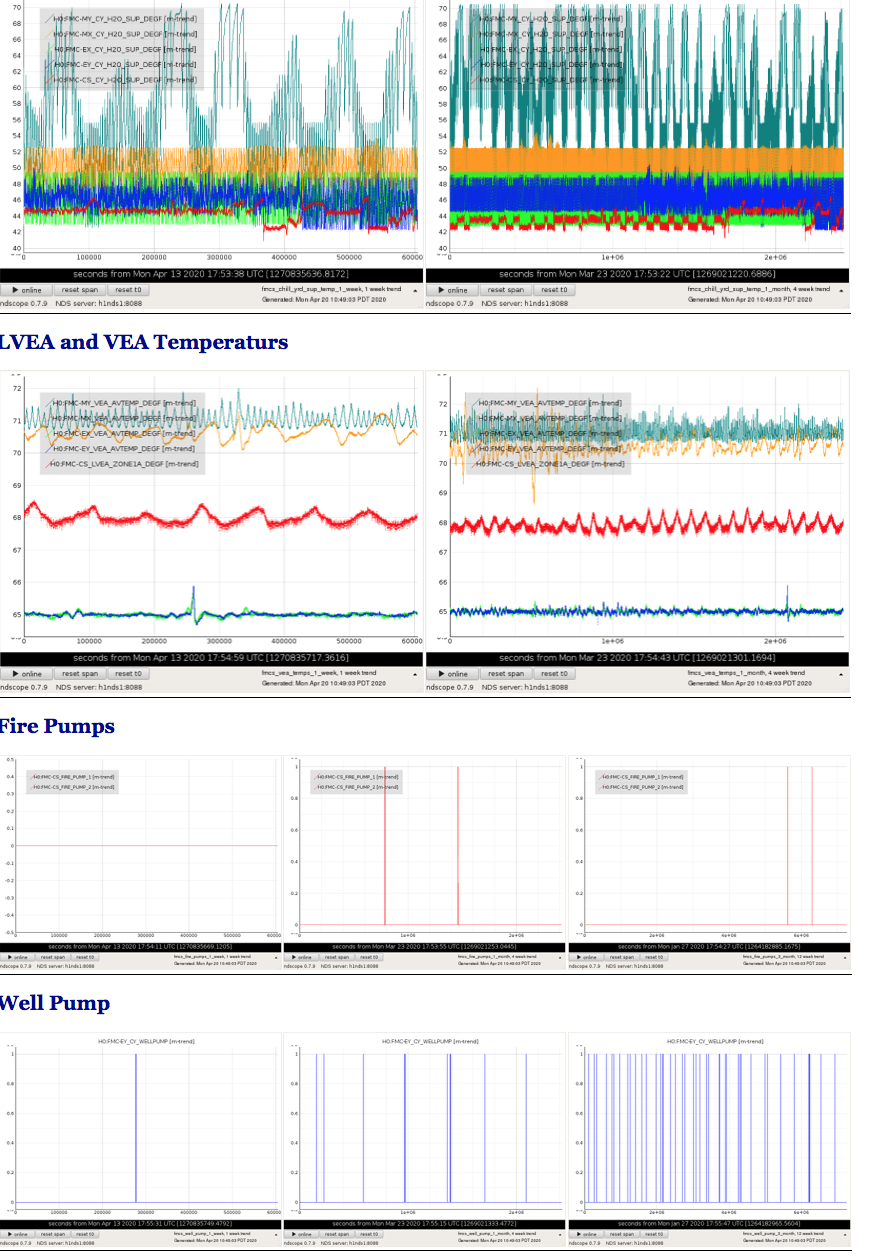
I've expanded ndshooter to gather FMCS long term trends for: chiller yard water supply temperatures, average LVEA/VEA temperatures, fire pumps run time and well pump run time.
I have created a new FMCS overview web page, linked to all CDS web pages through an FMCS entry in the sidebar.
Attachment shows the FMCS ndshooter trends. All the trends show 1 week and 1 month lookbacks, with fire and well pump runtimes also showing a 3 month lookback.
No this has nothing to do with the work Patrick did on the EX HEPI controller and IOC....no really...
Noticed the EX Pressure was not okay on the Operator Overview NUC. Patrick and JeffB confirm zero pressures and zero reback from the VFD. Patrick states that the pressures went to zero and the VFD readback zero'd at 1628utc Saturday. The pump station can sit in this state for days/weeks with little consequence. We don't know if the fluid level tripped the power or if the VFD had an overvoltage error. Historically, these are the only two scenerios bringing us here. Either way, will need to go to the end station to determine that and to reset things regardless of which. Patrick, has put the controller into a state ready for restarting, whenever that happens. Will open an FRS ticket.:https://services.ligo-la.caltech.edu/FRS/show_bug.cgi?id=14546
One of the main coupling sites for >1 Hz vibration (e.g. anthropogenic noise) at both LHO and LLO is at EY. While coupling was reduced by work on the p-cal periscopes, there appears to be a secondary source that dominated after the improvements.
I made a movie of the inside of the LHO EY test mass chamber while I was making end-of-run PEM injections (at full sensitivity), and noticed light from the cryo-baffle barrel flickering as I made impulse injections (see figure below, and movie clip: https://youtu.be/ZSNVuvWRpl0 ).
Most of the barrel, including the brightly lit region, is visible from the beam spot on the ETM (see beam spot view photos on first page of figure). In these beam spot view photos, there was a bright reflection on the barrel of the closed gate valve, so I did not notice that the barrel was also directly reflecting light from the flash, and thus that it might directly reflect light scattered from the beam spot on the test mass. The light is at grazing incidence in the barrel cylinder, so it is mainly the imperfections that would retro-reflect. Unfortunately, the imperfect fusion of the two pieces making the cylinder is right where the main beam is closest to the barrel, increasing the reflected light.
The second page of the figure shows that movie pixel value fluctuations increase during impulses and persist for a long time, like the noise in DARM. As a control for things like impulse-induced camera movement, I compared pixel variation in the barrel region of the movie to the ACB region of the movie, and found that the correlation with impulses was much better for the barrel region, suggesting that impulses cause the barrel to flicker more than other regions.
The evidence that the barrel is moving on wavelength-scales (producing visible flickering), when other surfaces aren’t, and that it has a high Q, like the noise in DARM, and that it has a bright spot on it that is visible from the test mass, all point to the barrel as being a strong candidate for our residual scattering noise at EY. The barrel may also be the source of EY scattering noise at LLO.
Extending the P-cal baffle piece to cover the barrel on the side where the beam is closest, might work to block the scattered light, but we should be careful that this doesn’t cause clipping noise. The high-Q of the baffle at relevant frequencies also means that it is a good candidate for damping, and that damping alone may make a significant improvement, as it did for the Swiss cheese baffle.
Cheryl, Rahul
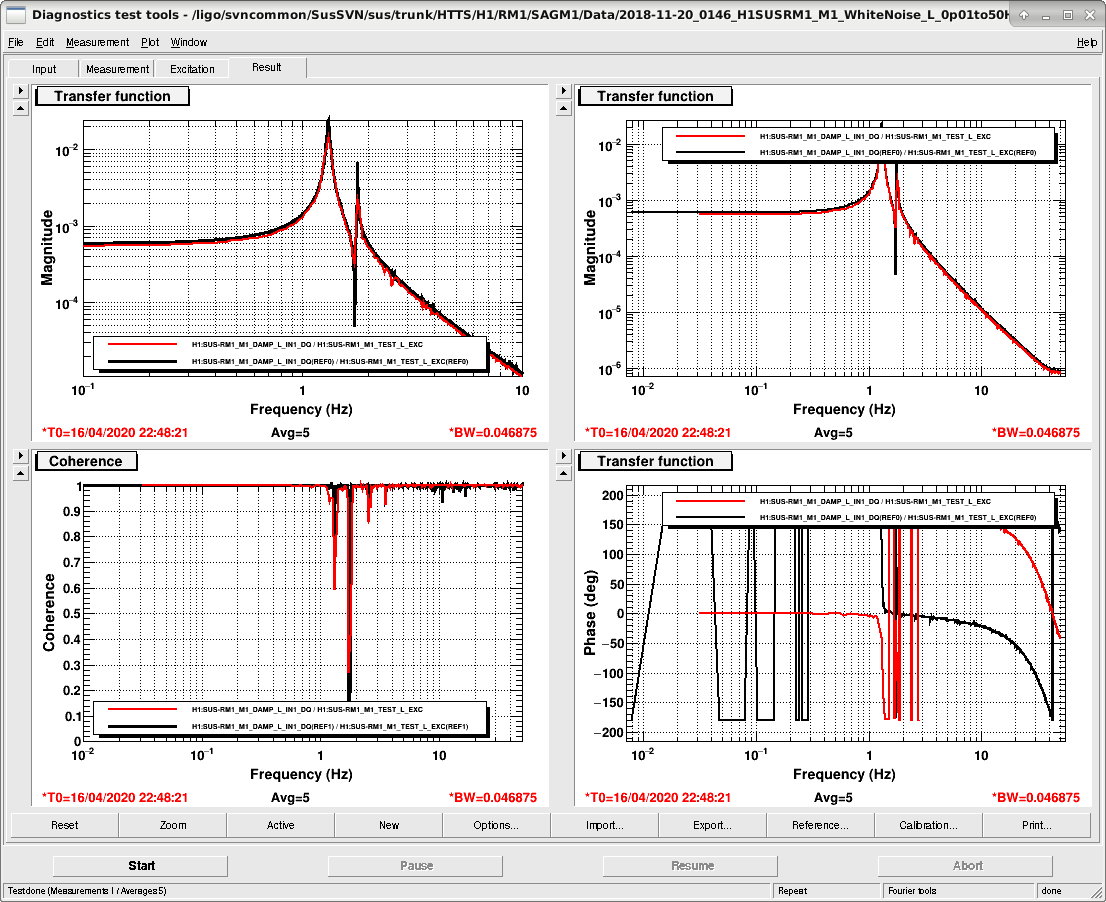
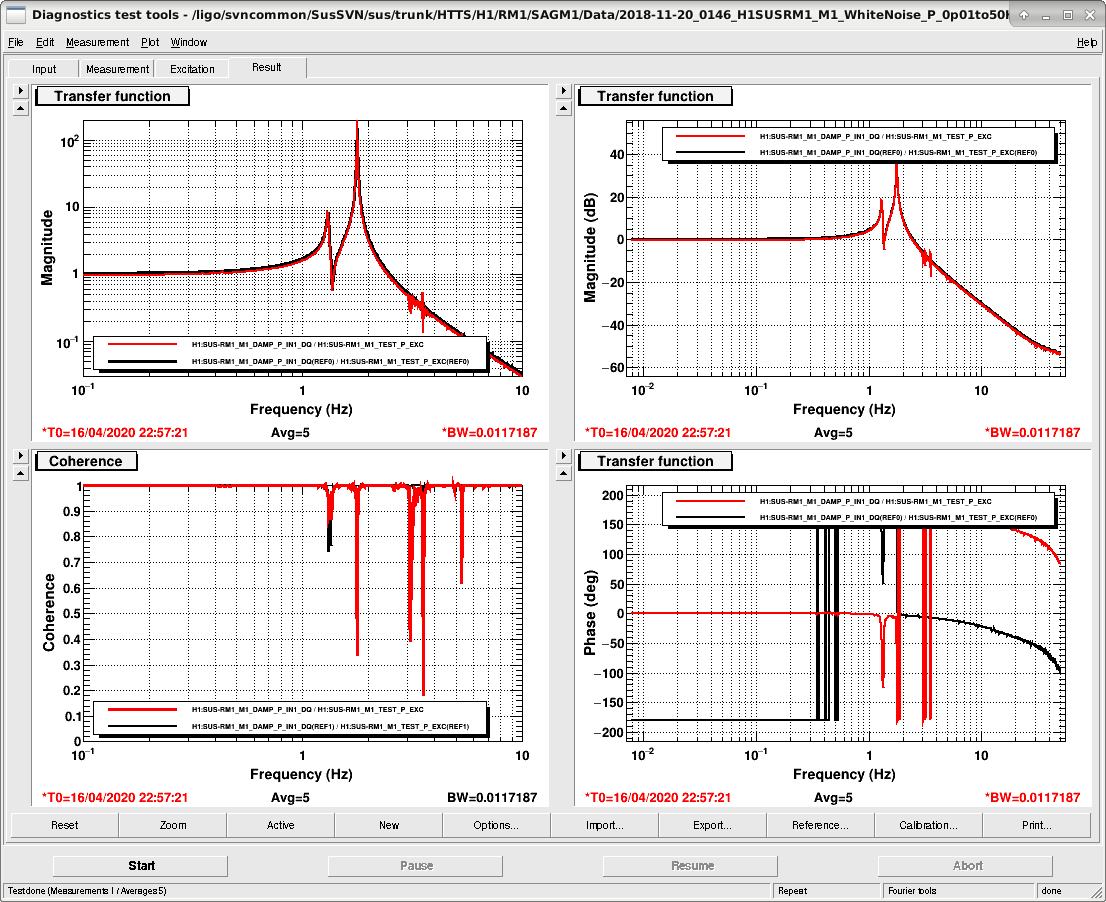
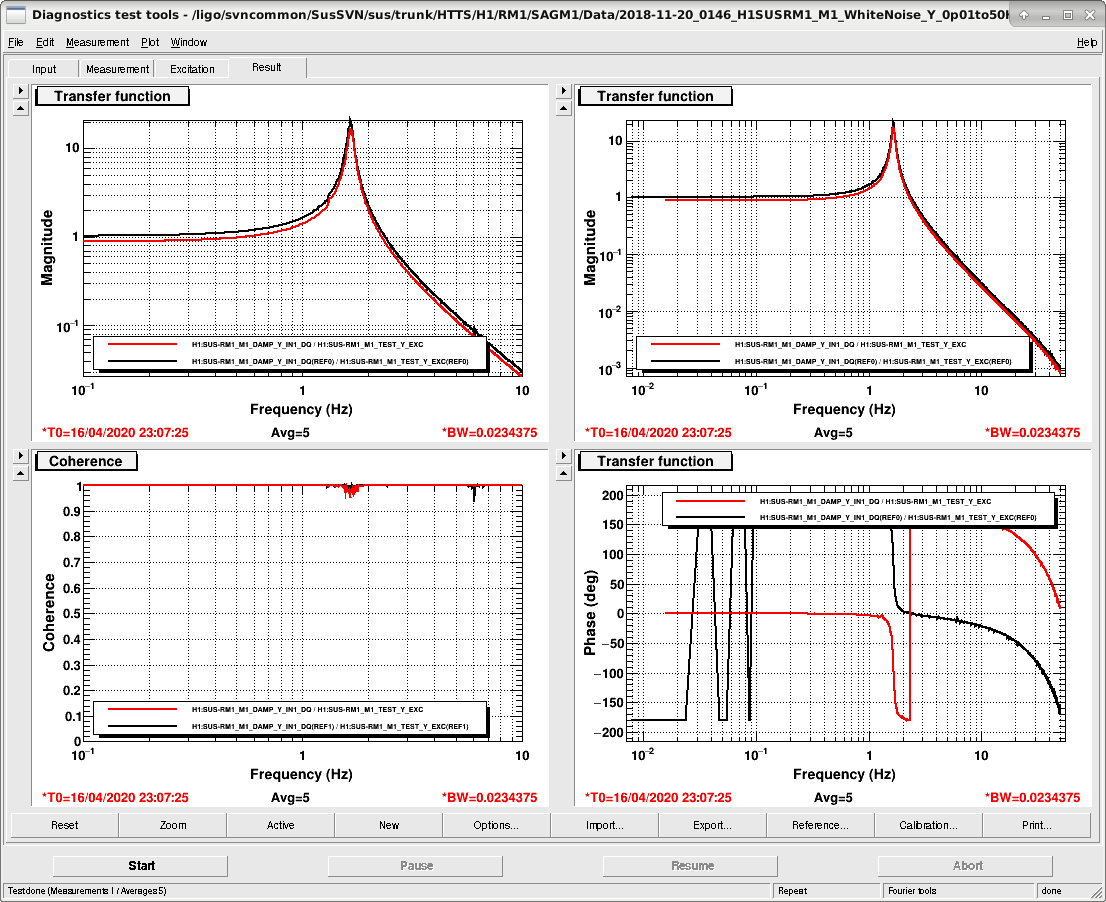
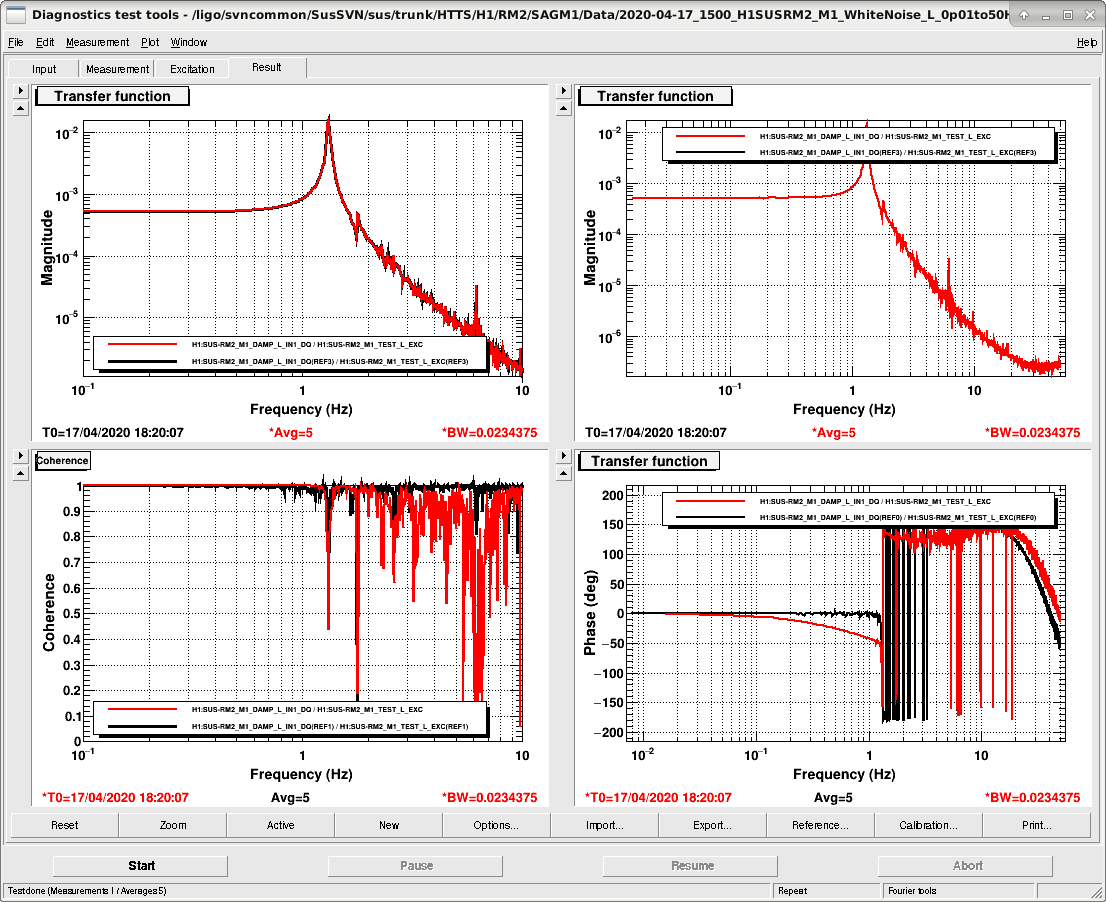
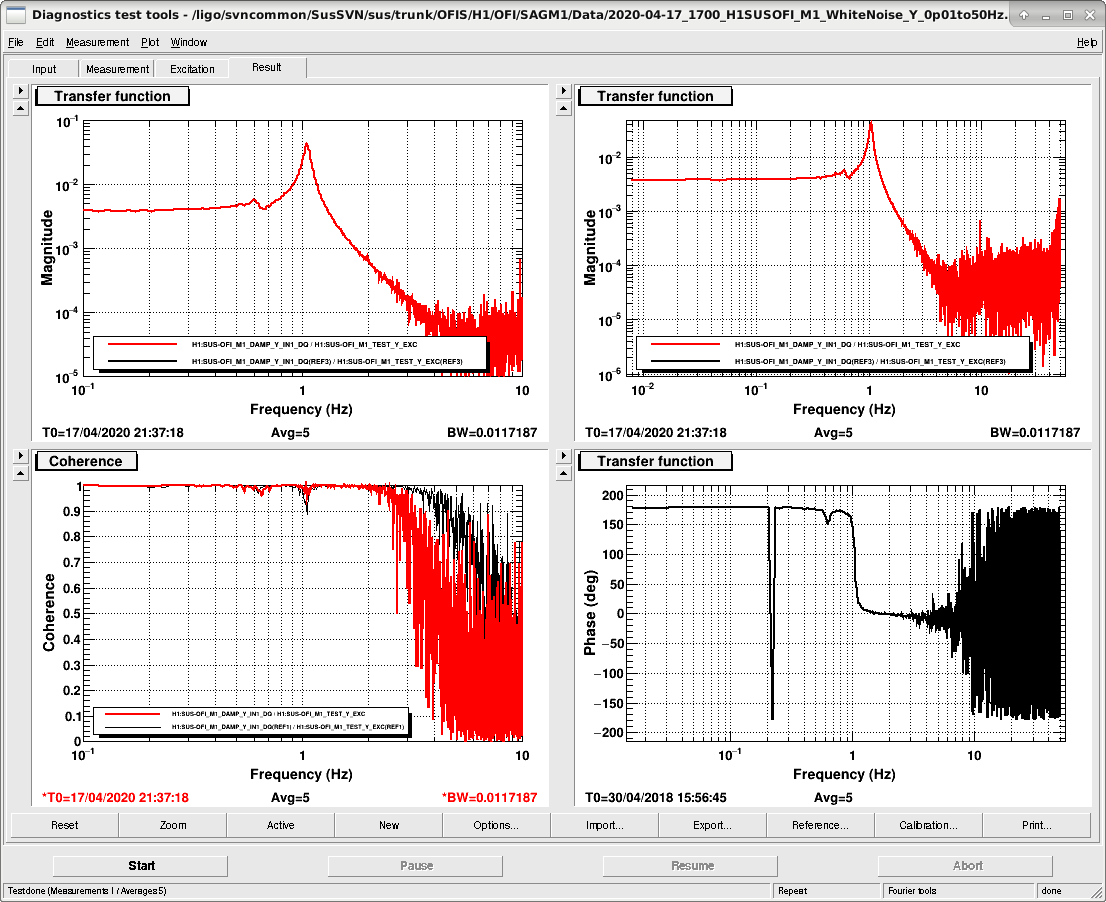
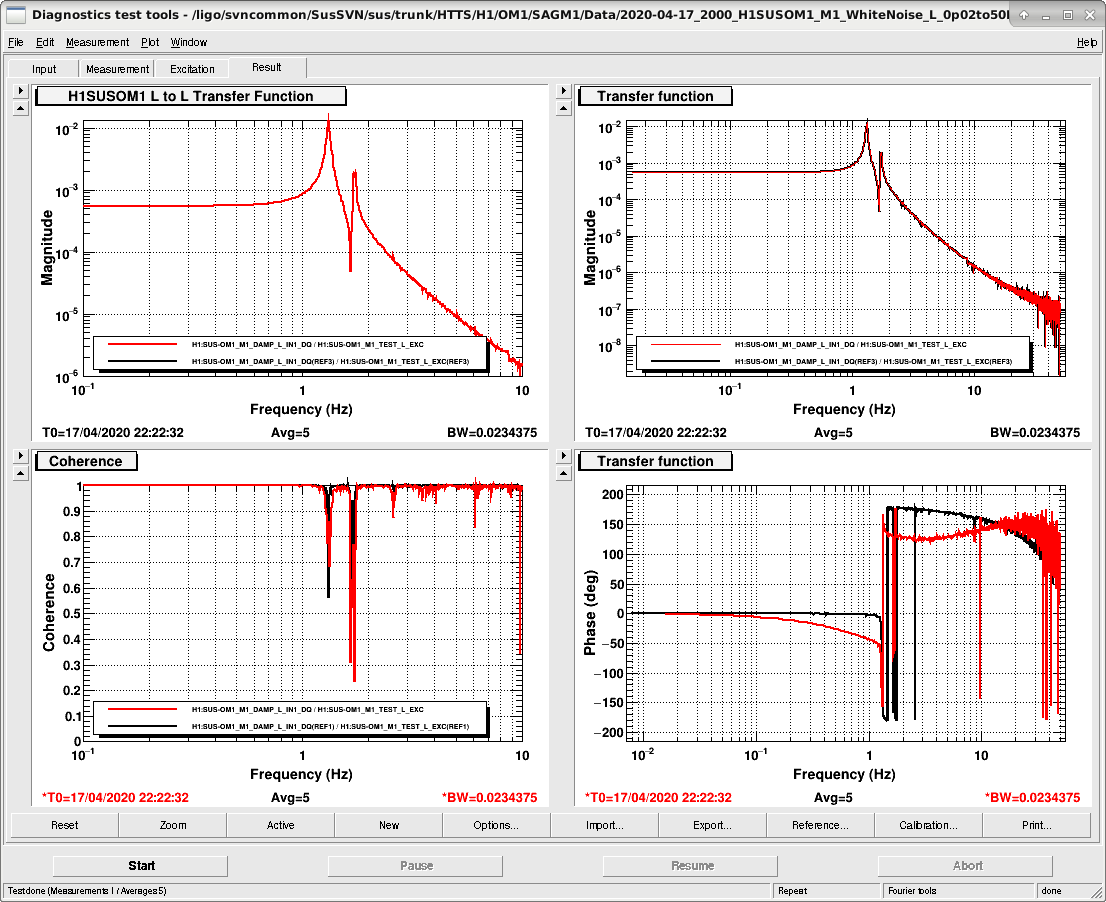
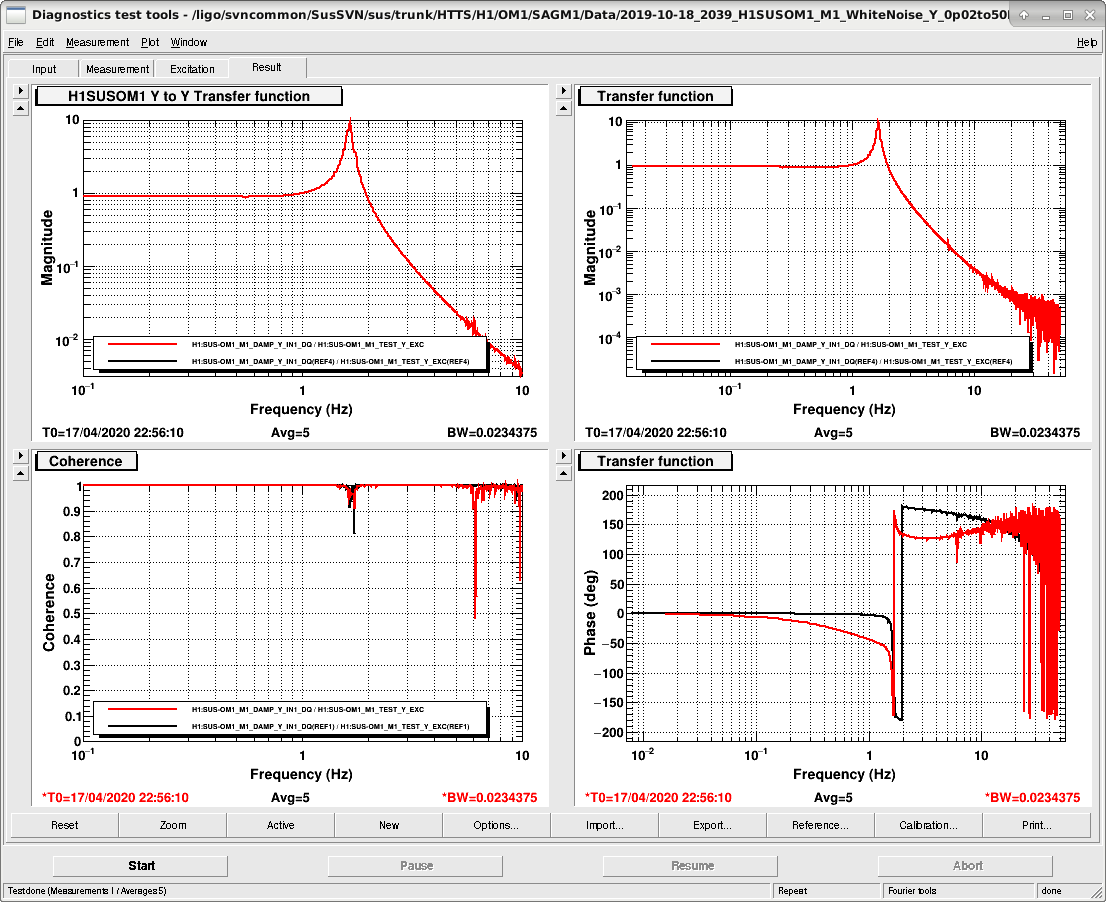
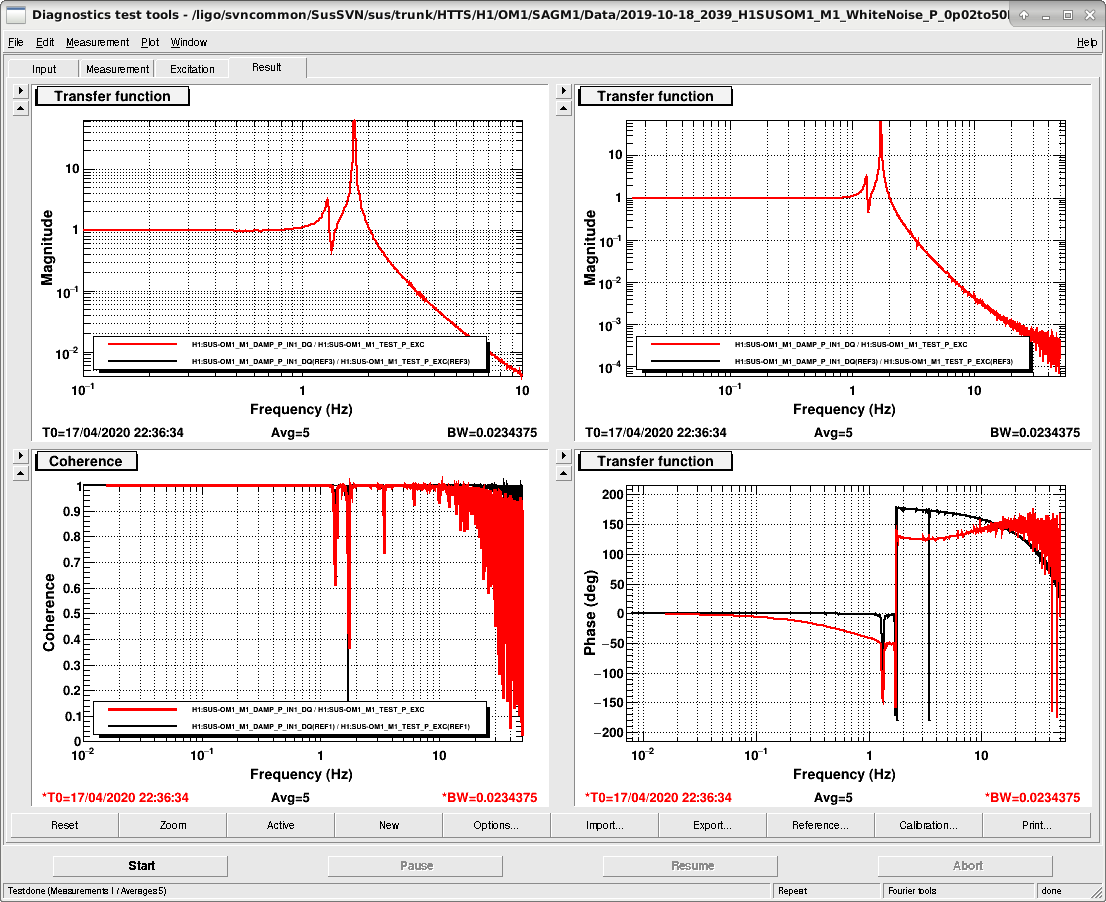
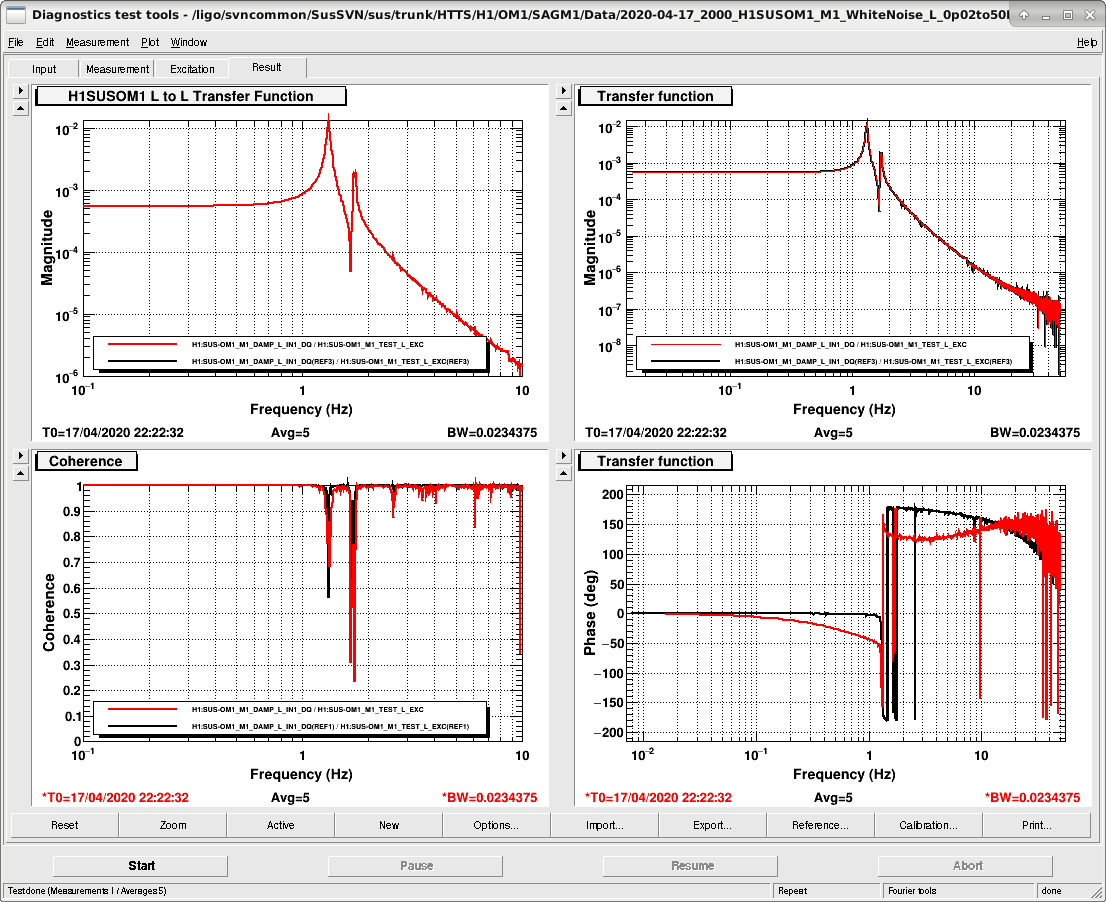
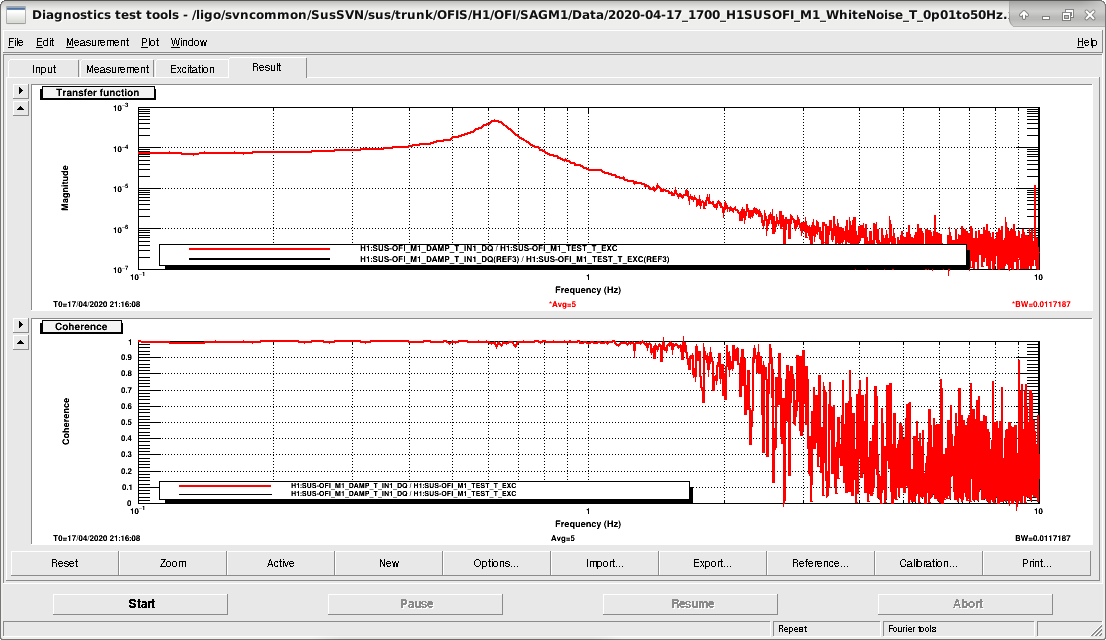
Attached below are the transfer function results for the 4 single stage suspension - RM1, RM2, OFI, OM1. They are all healthy and free of any rubbing.
The templates are stored at the following location.
/ligo/svncommon/SusSVN/sus/trunk/HTTS/H1/RM2/SAGM1/Data
2020-04-17_1500_H1SUSRM2_M1_WhiteNoise_L_0p01to50Hz.xml
2020-04-17_1500_H1SUSRM2_M1_WhiteNoise_P_0p01to50Hz.xml
2020-04-17_1500__H1SUSRM2_M1_WhiteNoise_Y_0p01to50Hz.xml
/ligo/svncommon/SusSVN/sus/trunk/HTTS/H1/RM1/SAGM1/Data
2020-04-17_1500_H1SUSRM1_M1_WhiteNoise_L_0p01to50Hz.xml
2020-04-17_1500_H1SUSRM1_M1_WhiteNoise_P_0p01to50Hz.xml
2020-04-17_1500_H1SUSRM1_M1_WhiteNoise_Y_0p01to50Hz.xml
/ligo/svncommon/SusSVN/sus/trunk/OFIS/H1/OFI/SAGM1/Data
2020-04-17_1700_H1SUSOFI_M1_WhiteNoise_L_0p01to50Hz.xml
2020-04-17_1700_H1SUSOFI_M1_WhiteNoise_T_0p01to50Hz.xml
2020-04-17_1700_H1SUSOFI_M1_WhiteNoise_Y_0p01to50Hz.xml
/ligo/svncommon/SusSVN/sus/trunk/HTTS/H1/OM1/SAGM1/Data
2020-04-17_2000_H1SUSOM1_M1_WhiteNoise_L_0p02to50Hz.xml
2020-04-17_2000_H1SUSOM1_M1_WhiteNoise_P_0p02to50Hz.xml
2020-04-17_2000_H1SUSOM1_M1_WhiteNoise_Y_0p02to50Hz.xml
"Remotely log in to the Beckhoff computer in the MSR that is running the IOC for the HEPI pump controller at end X. Delete the current broken svn checkout and check out a new copy in its place. The goal is to be able to use this as a platform for converting the ISC slow controls to TC3. Potential risk: The IOC and PLC code in svn may not match those currently running. If either needs to be restarted then the HEPI pump controller may need to be restarted. It may be possible that that risks dropping the fluid to the trip level or tripping the VFD. If those occur, someone might have to go on site to address them. This seems unlikely to me, but I don't know for sure." I had to restart the IOC. It does not appear that I tripped anything.
Cheryl, Rahul
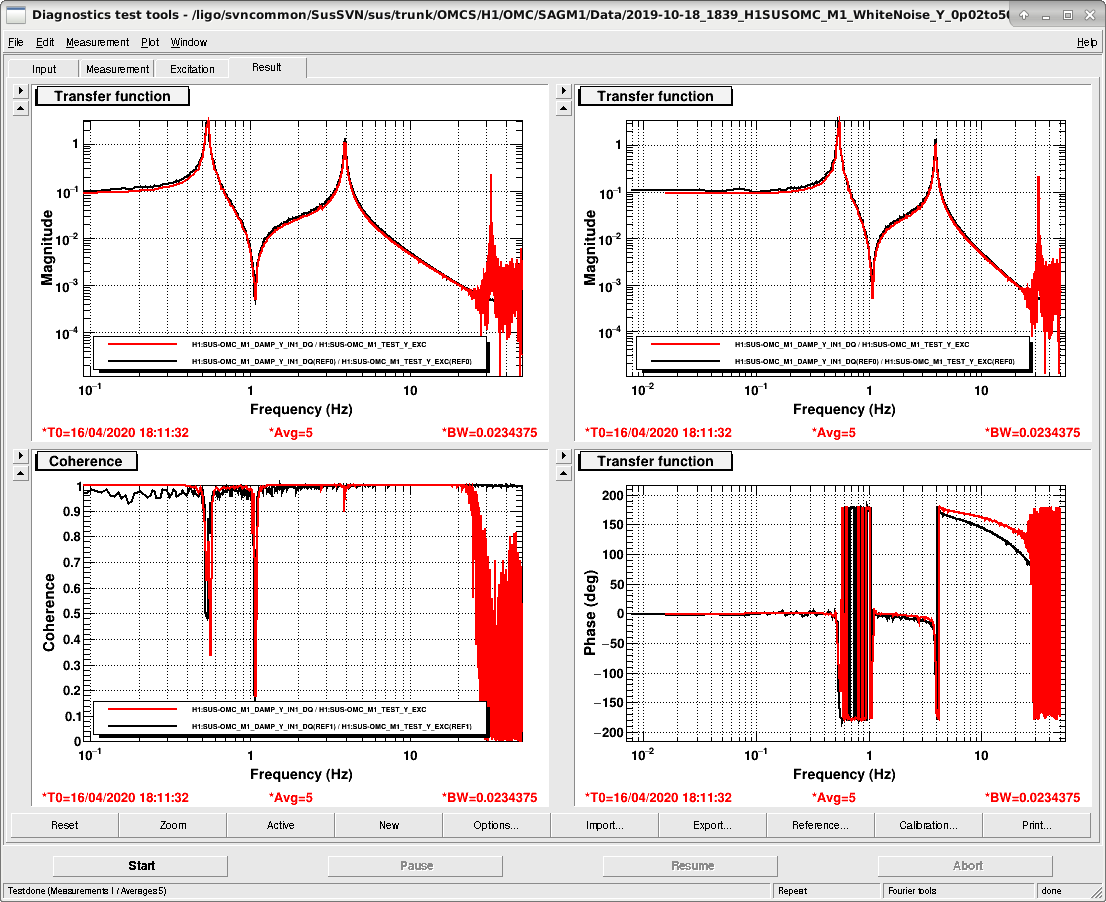
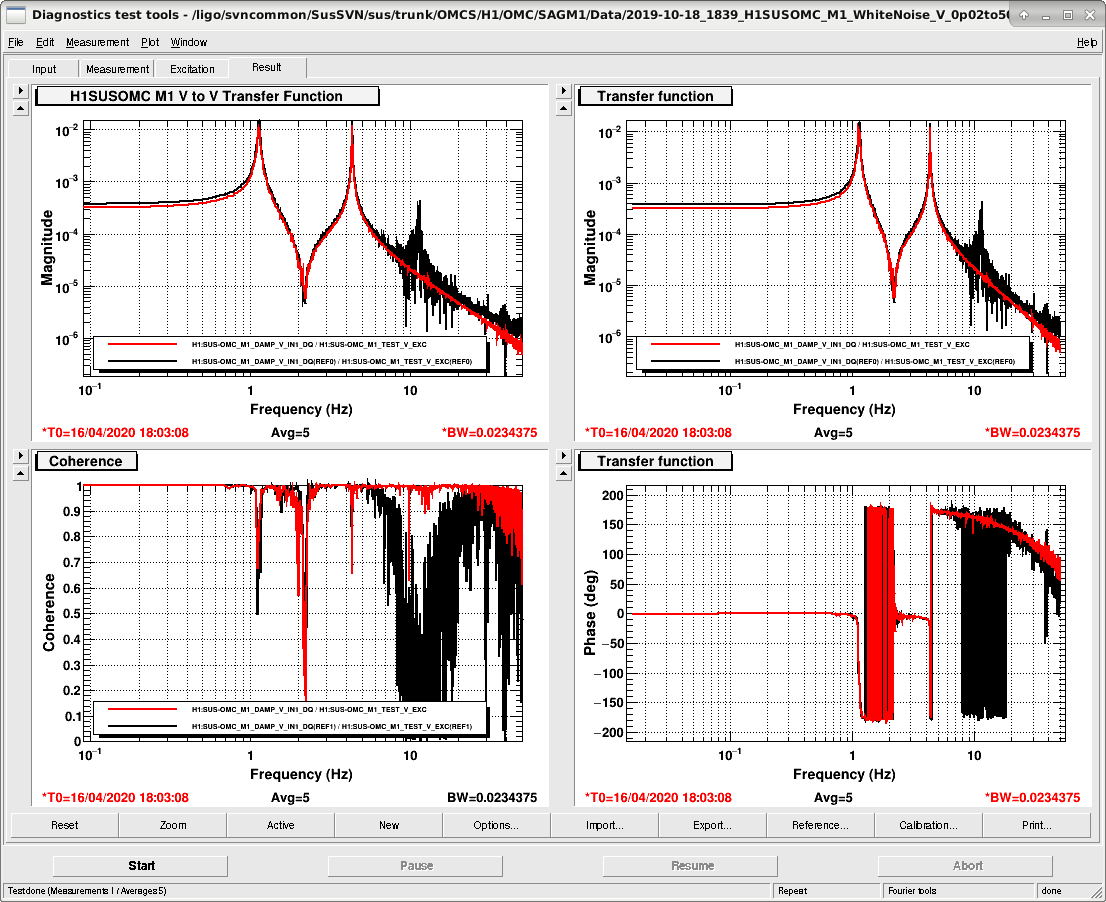
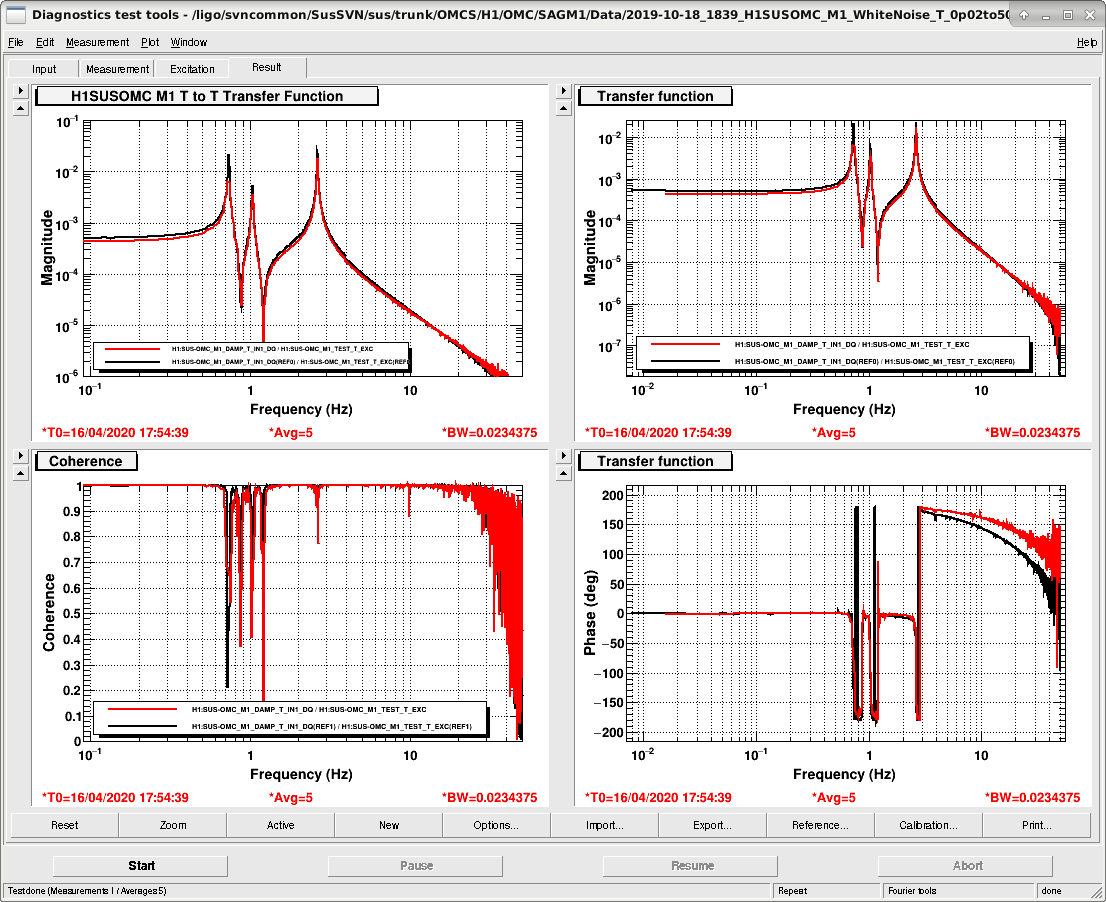
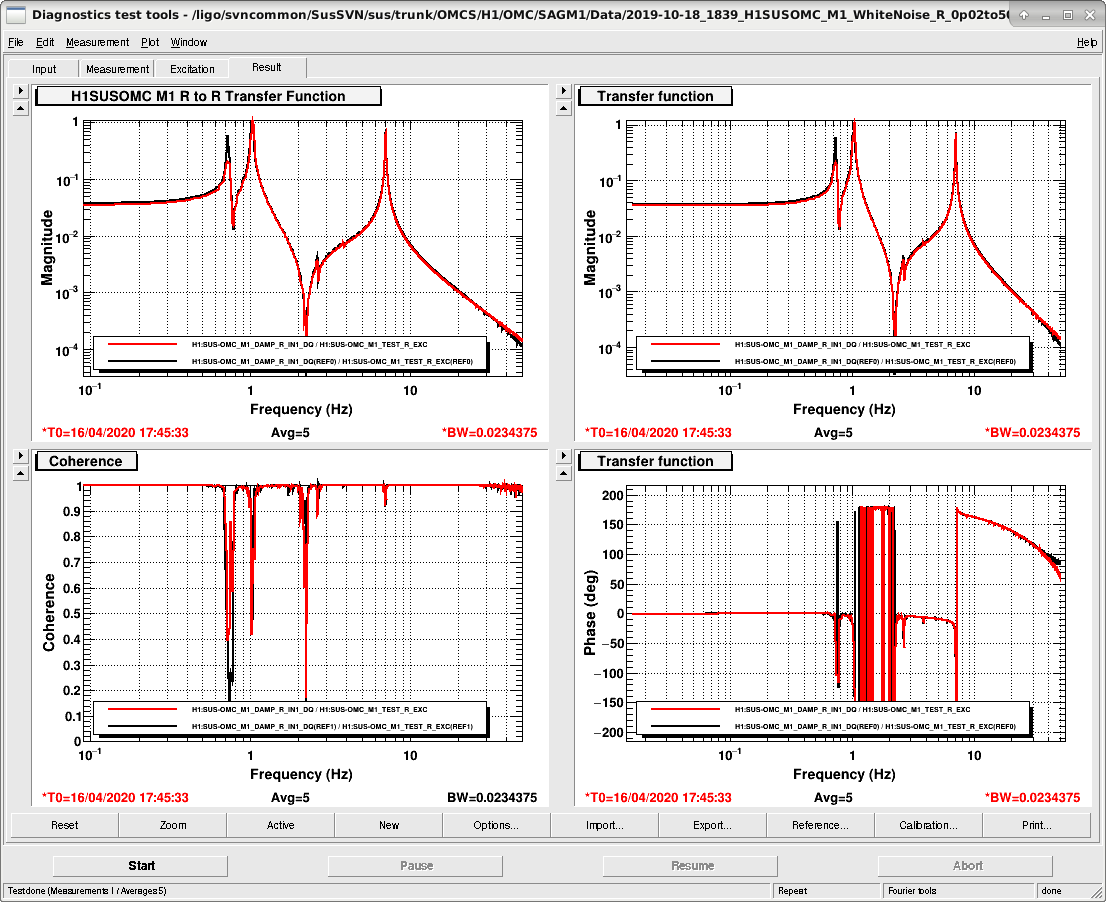
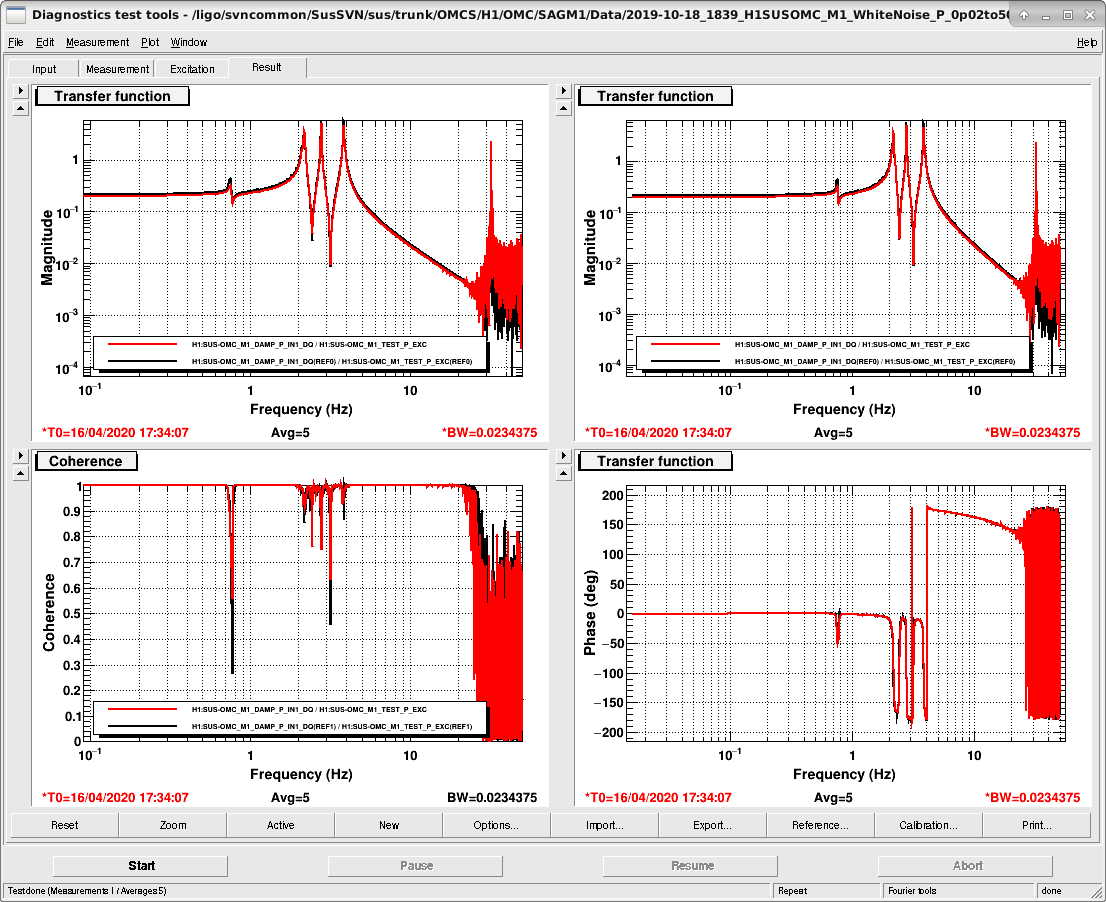
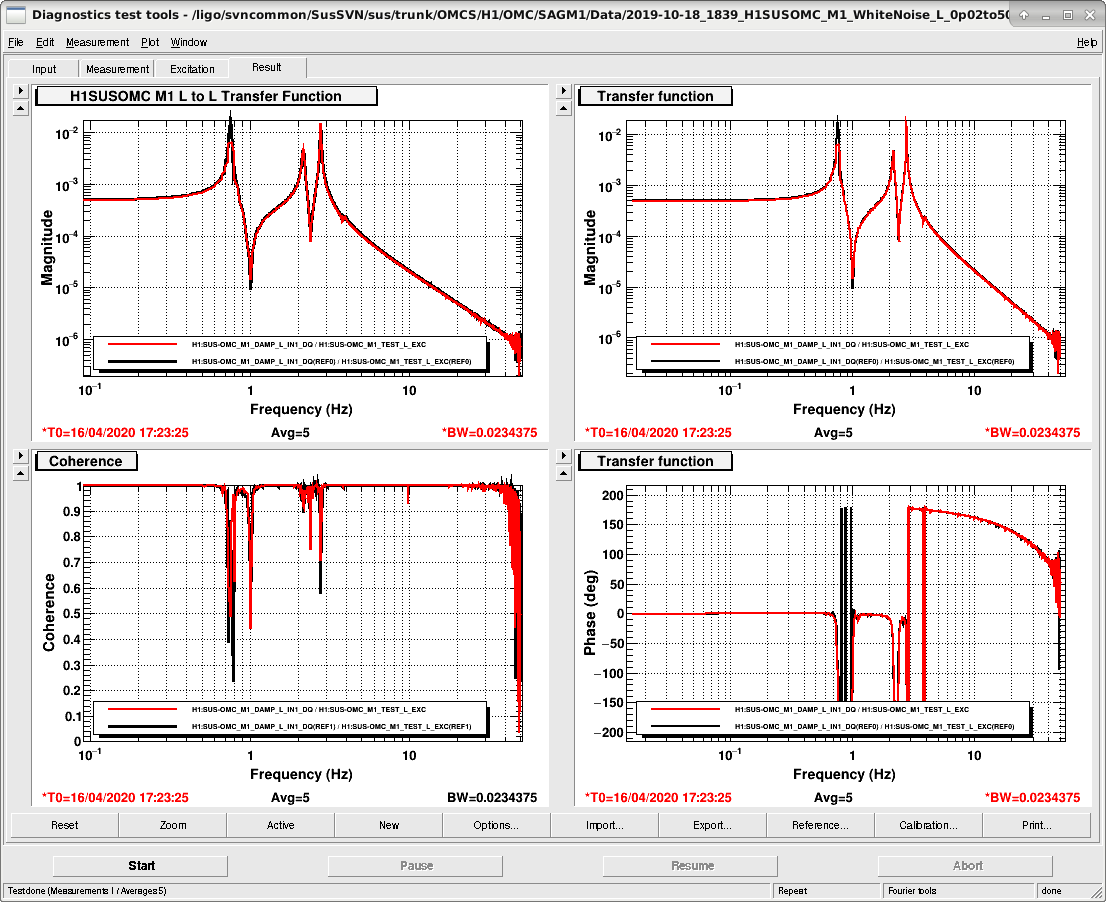
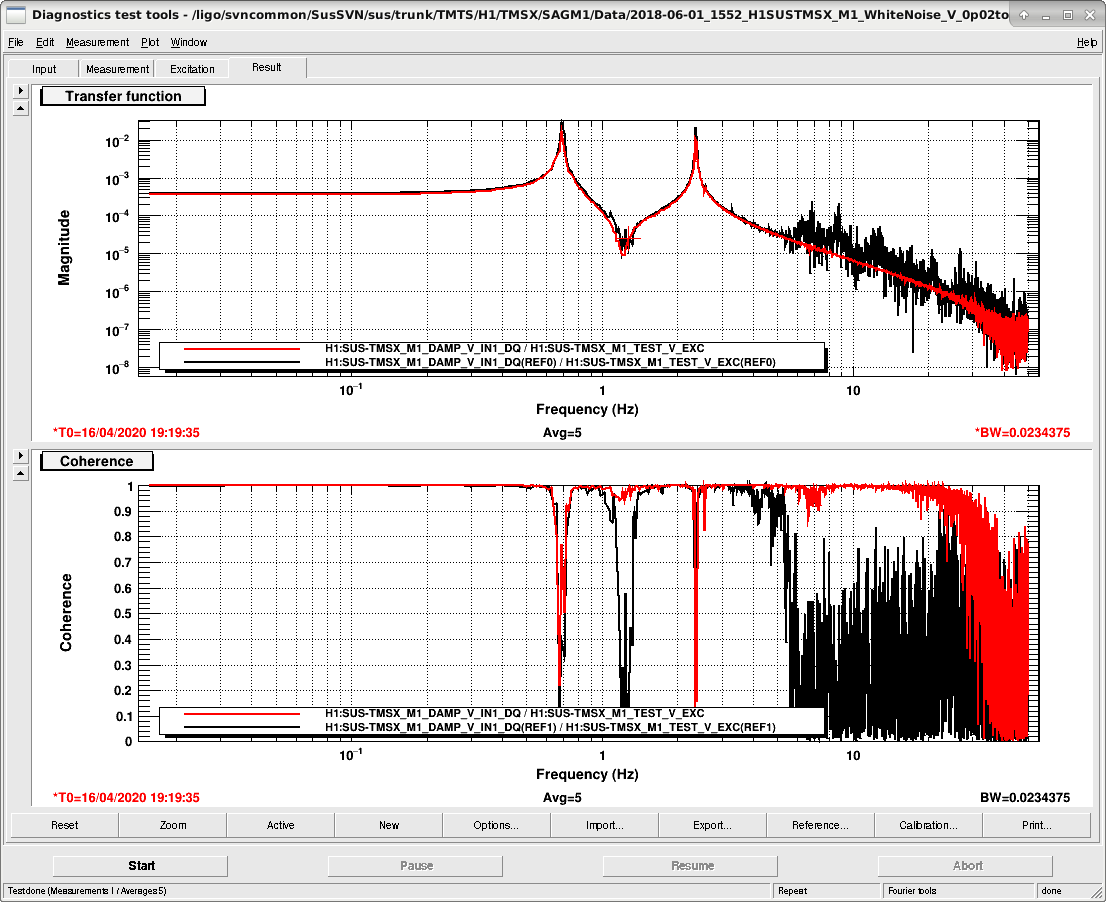
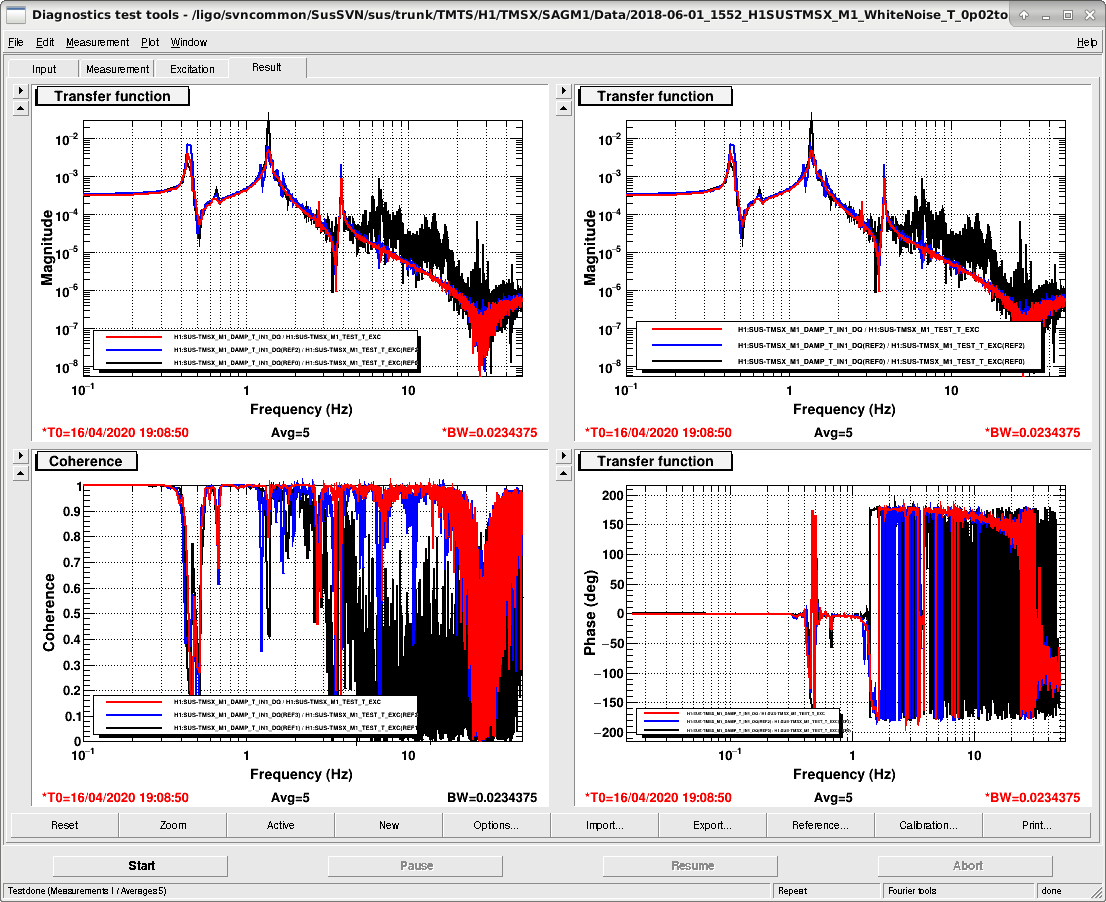
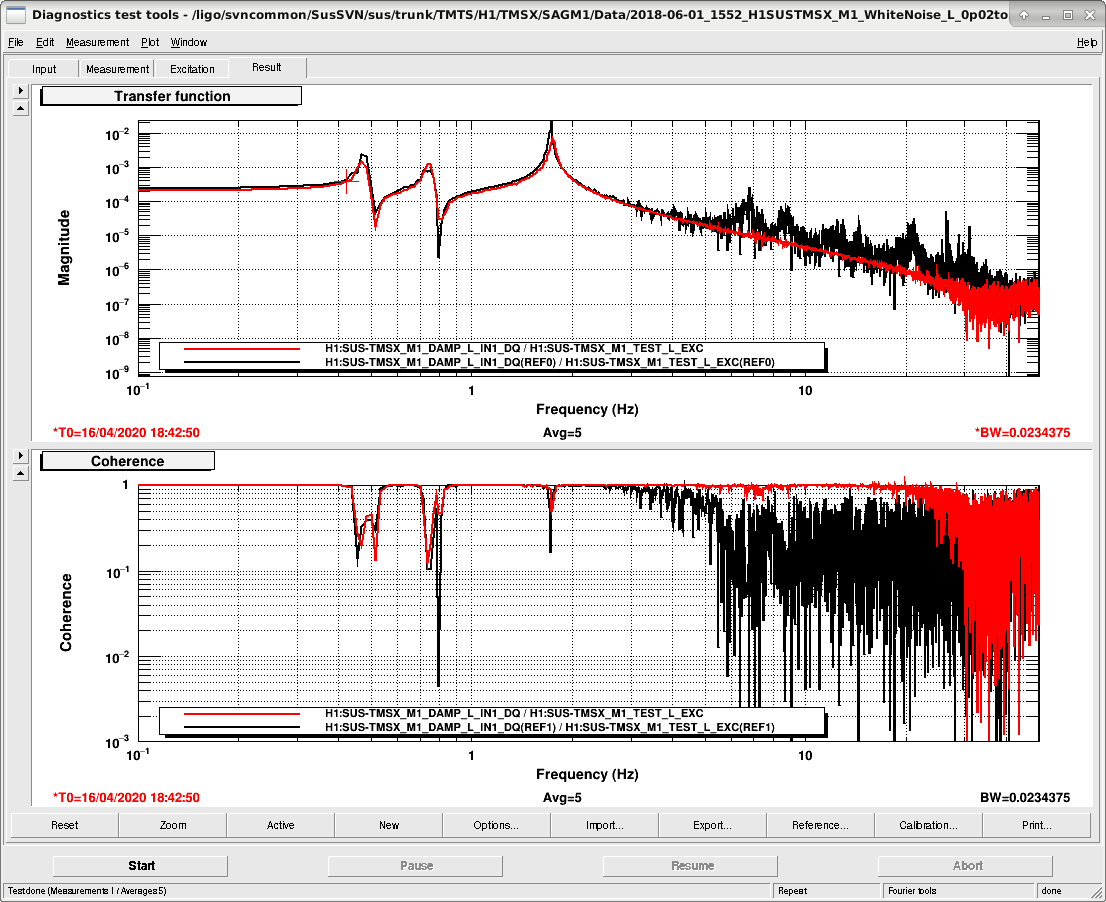
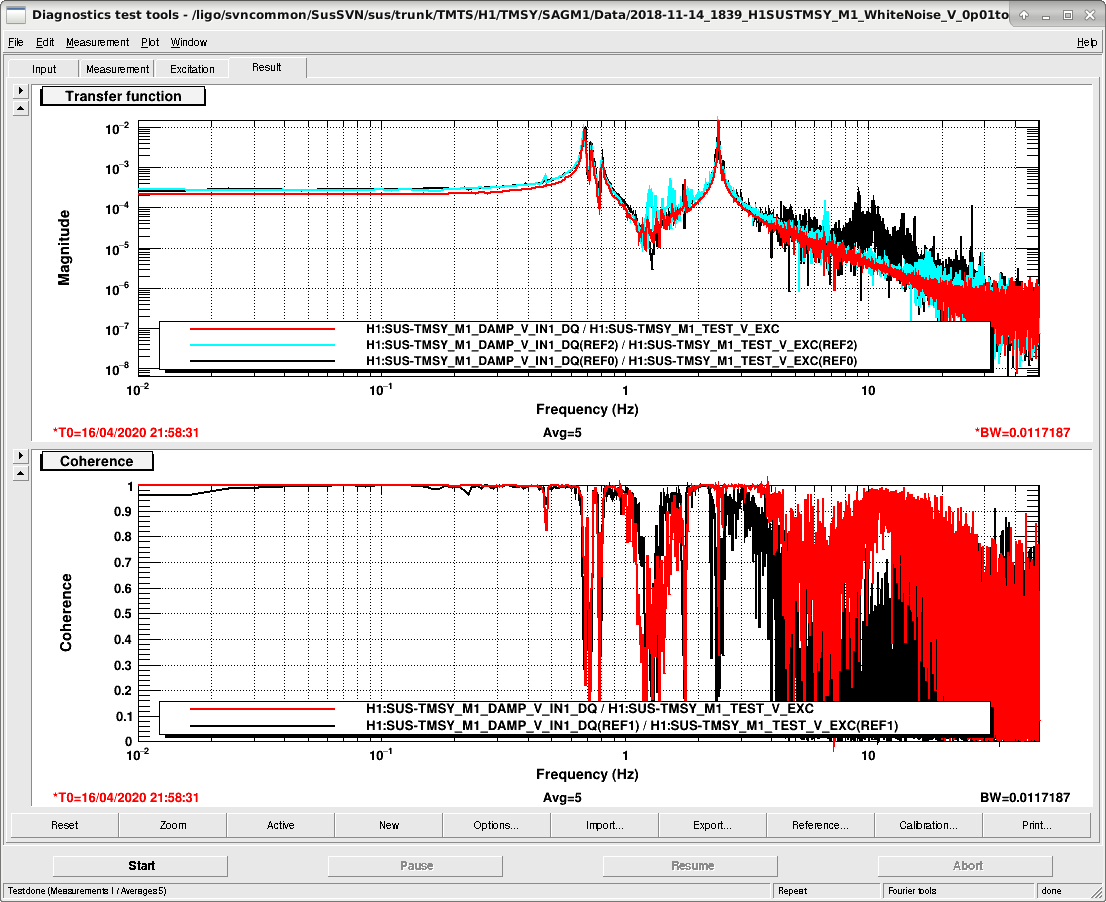
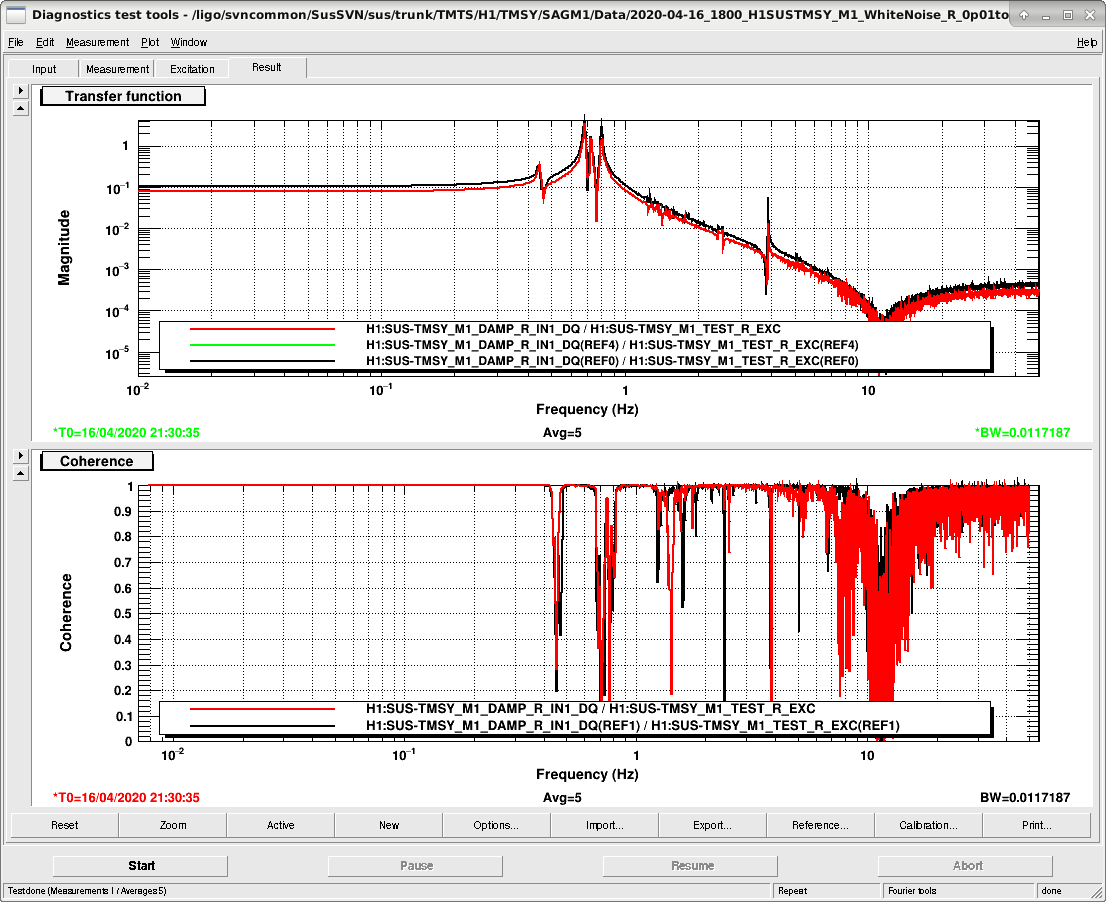
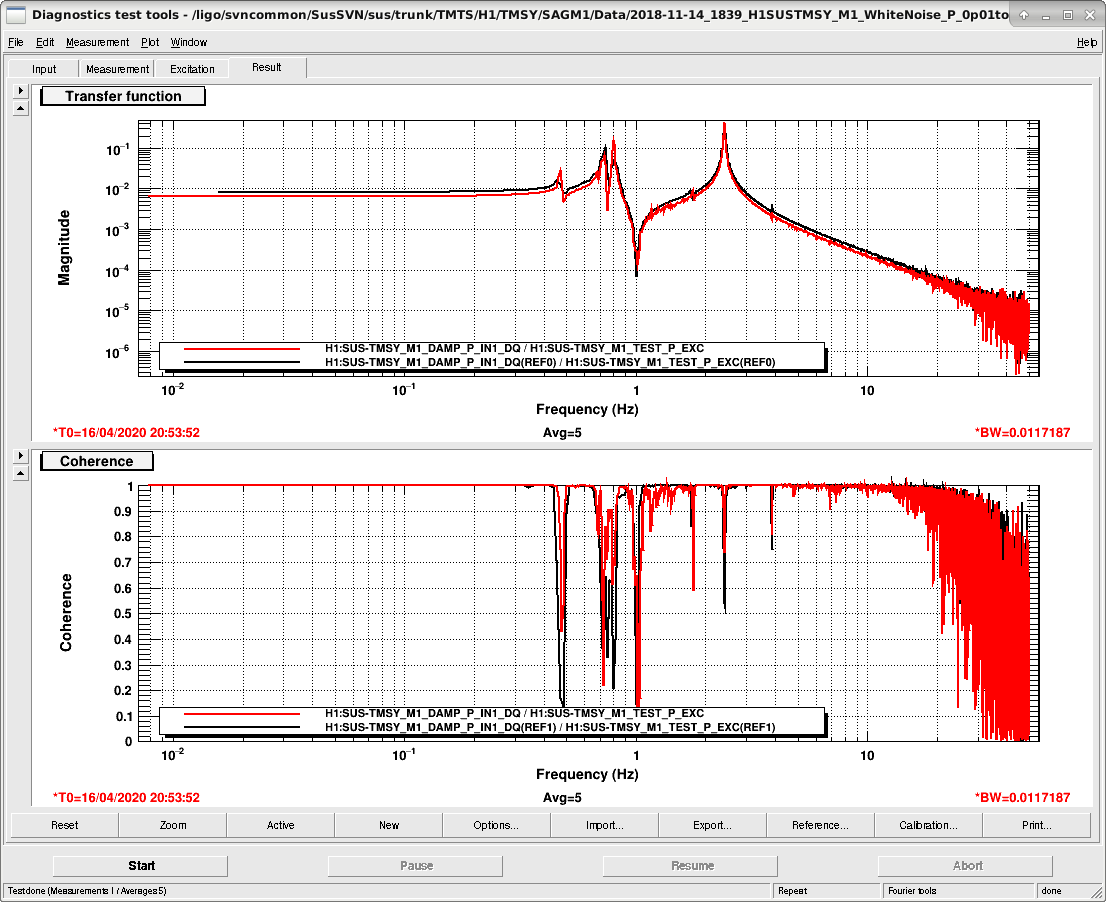
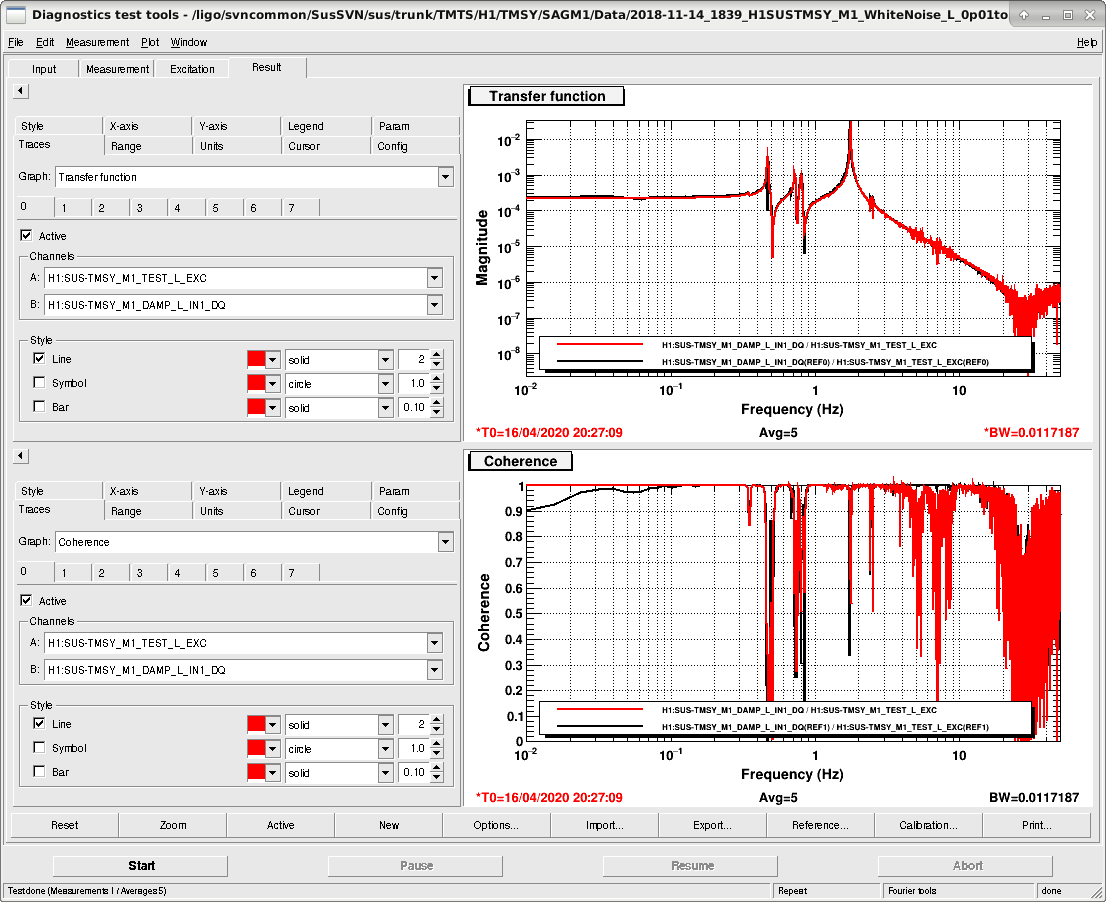
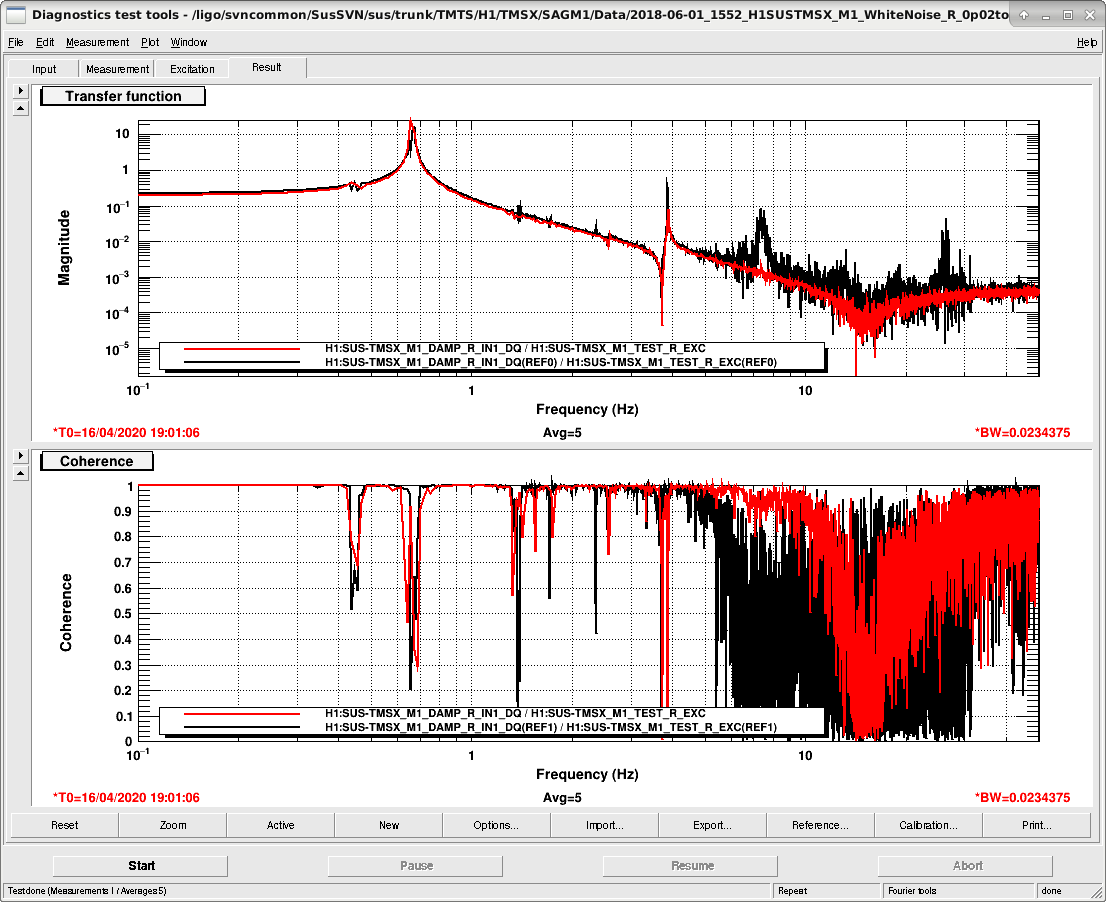
Attached below are the transfer function measurements for 3 double suspensions namely, OMC, TMSX and TMSY. They are healthy and clear of any rubbing. We also started with single suspensions and were allmost done with RM1 and RM2, however we found some issues in the reference plot. We will post RM1 and RM2 results tomorrow morning.
The templates are stored at the following locations,
2020-04-16_1500_H1SUSOMC_M1_WhiteNoise_L_0p02to50Hz.xml
2020-04-16_1500_H1SUSOMC_M1_WhiteNoise_P_0p02to50Hz.xml
2020-04-16_1500_H1SUSOMC_M1_WhiteNoise_R_0p02to50Hz.xml
2020-04-16_1500_H1SUSOMC_M1_WhiteNoise_T_0p02to50Hz.xml
2020-04-16_1500_H1SUSOMC_M1_WhiteNoise_V_0p02to50Hz.xml
2020-04-16_1500_H1SUSOMC_M1_WhiteNoise_Y_0p02to50Hz.xml
/ligo/svncommon/SusSVN/sus/trunk/TMTS/H1/TMSX/SAGM1/Data
2020-04-16_1500_H1SUSTMSX_M1_WhiteNoise_L_0p02to50Hz.xml
2020-04-16_1500_H1SUSTMSX_M1_WhiteNoise_P_0p02to50Hz.xml
2020-04-16_1500_H1SUSTMSX_M1_WhiteNoise_R_0p02to50Hz.xml
2020-04-16_1500_H1SUSTMSX_M1_WhiteNoise_T_0p02to50Hz.xml
2020-04-16_1500_H1SUSTMSX_M1_WhiteNoise_V_0p02to50Hz.xml
2020-04-16_1500_H1SUSTMSX_M1_WhiteNoise_Y_0p02to50Hz.xml
/ligo/svncommon/SusSVN/sus/trunk/TMTS/H1/TMSY/SAGM1/Data
2020-04-16_1800_H1SUSTMSY_M1_WhiteNoise_L_0p01to50Hz.xml
2020-04-16_1800_H1SUSTMSY_M1_WhiteNoise_P_0p01to50Hz.xml
2020-04-16_1800_H1SUSTMSY_M1_WhiteNoise_R_0p01to50Hz.xml
2020-04-16_1800_H1SUSTMSY_M1_WhiteNoise_T_0p01to50Hz.xml
2020-04-16_1800_H1SUSTMSY_M1_WhiteNoise_V_0p01to50Hz.xml
2020-04-16_1800_H1SUSTMSY_M1_WhiteNoise_Y_0p01to50Hz.xml
In the past we ran a program called stripshooter which captured StripTool images and posted them to the CDS web page. This could not back-fill its data and so could not practically be used to trend months of data.
I have now written its ndscope equivalent, ndshooter. For each YAML file in the userapps/cds/h1/ndshooter directory, the program runs ndscope to a virtual frame buffer and displays the minute trend plot for the look back time specified in the yaml file (minimum of 1 week).
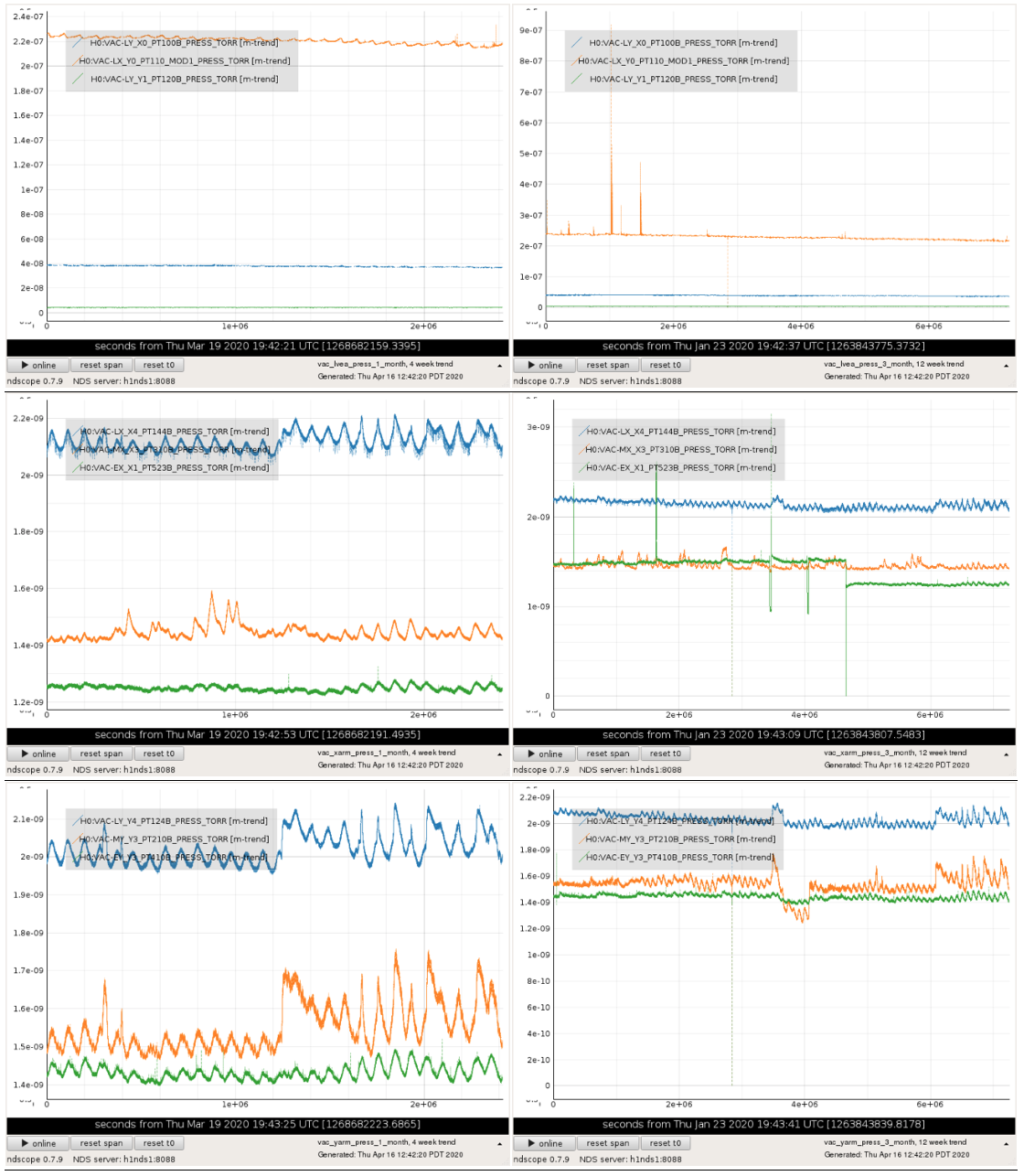
Chandra has requested this system trend certain critical vacuum channels. The attachments below show the trends for the vacuum pressure gauges and LN2 levels.
The vacuum pressure plots show 1 month and 3 month trends for certain LVEA, X-ARM and Y-ARM gauges.
The liquid nitrogen level plots show 1 week and 1 month trends for the cryopumps and external dewars (except CP4).
If other CDS channels should be trended in this way, please send me an email and I can add them to the system.
All of the current ndshooter trends are collated on the ndshooter.html web page (accessible from the LHO CDS main page). Currently only VAC and PEM-weather are being trended.
Cheryl, Rahul
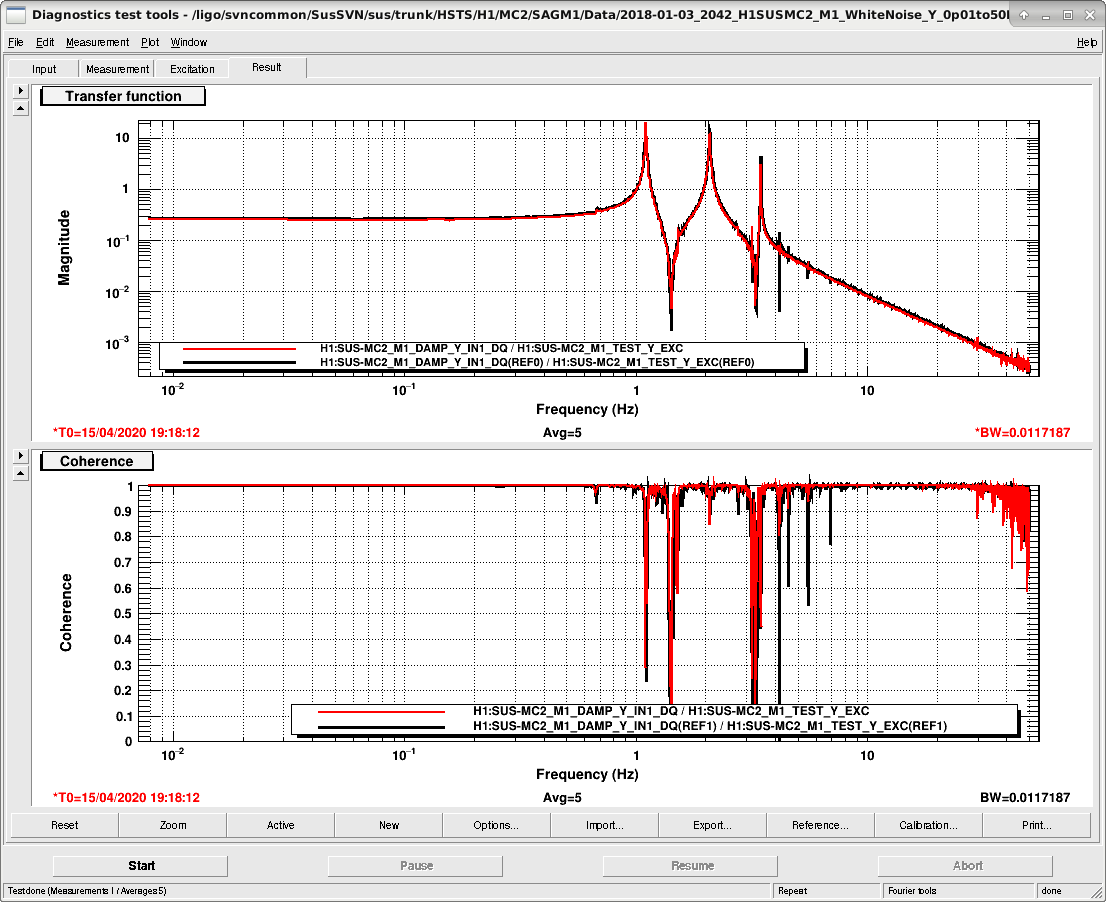
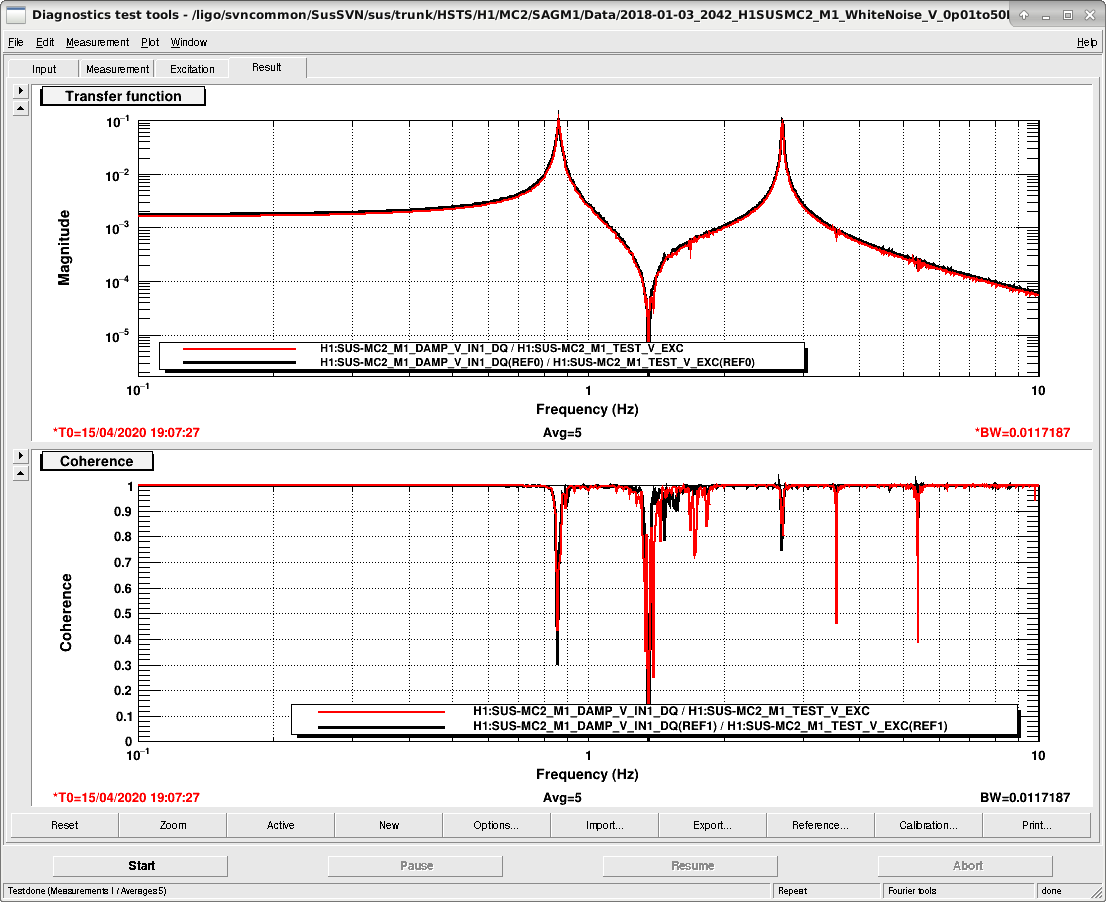
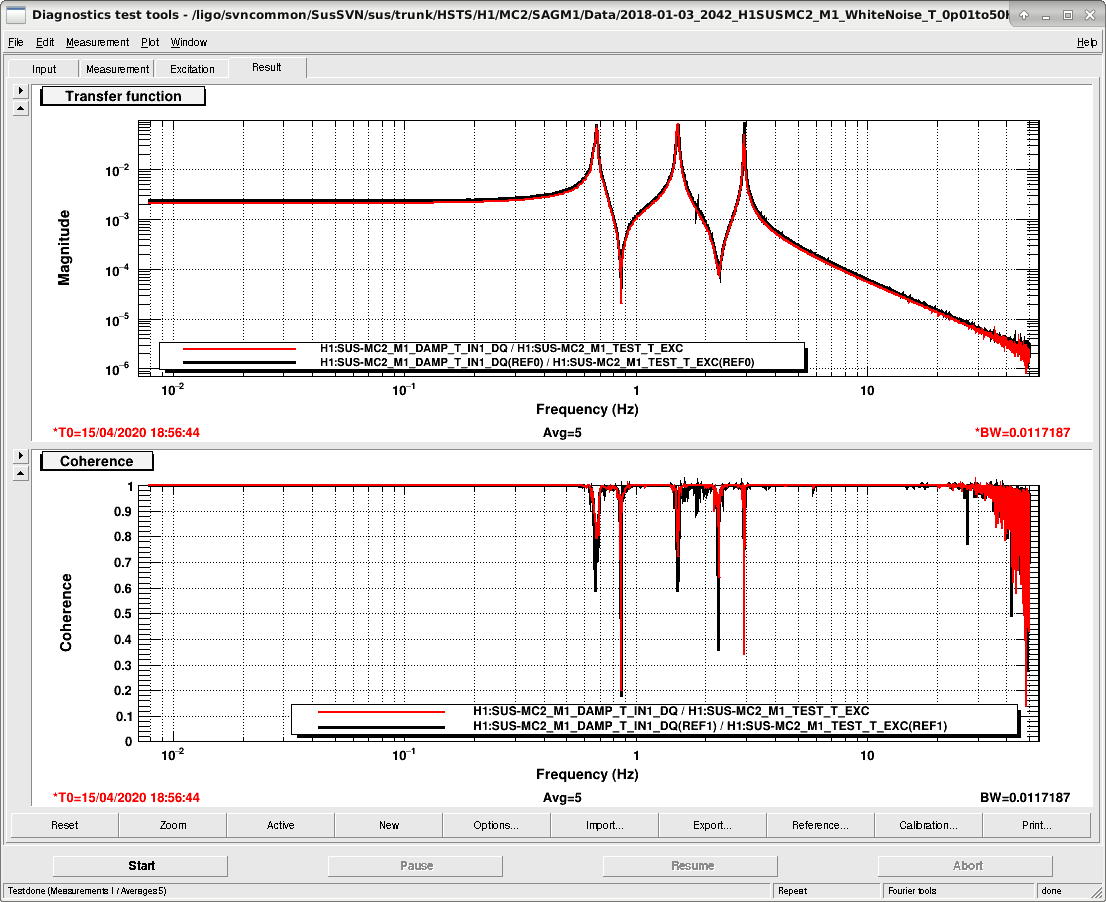
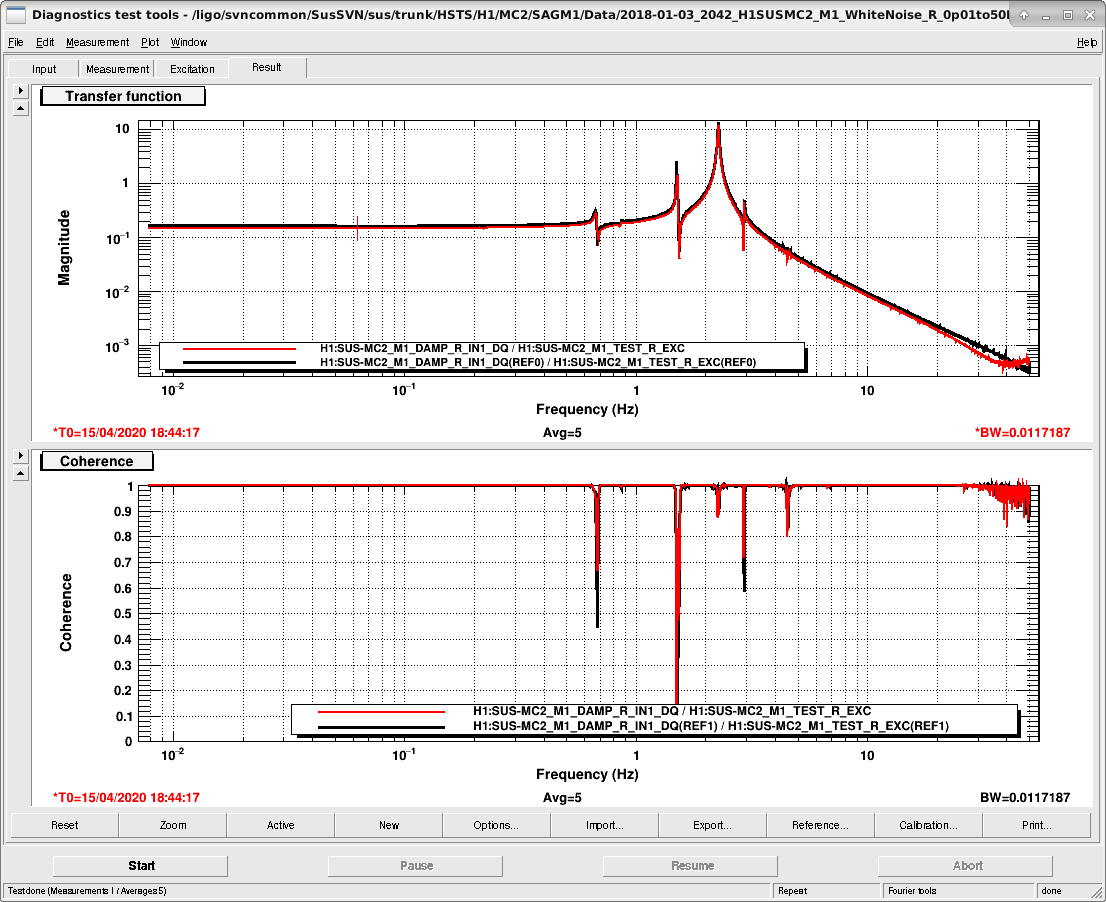
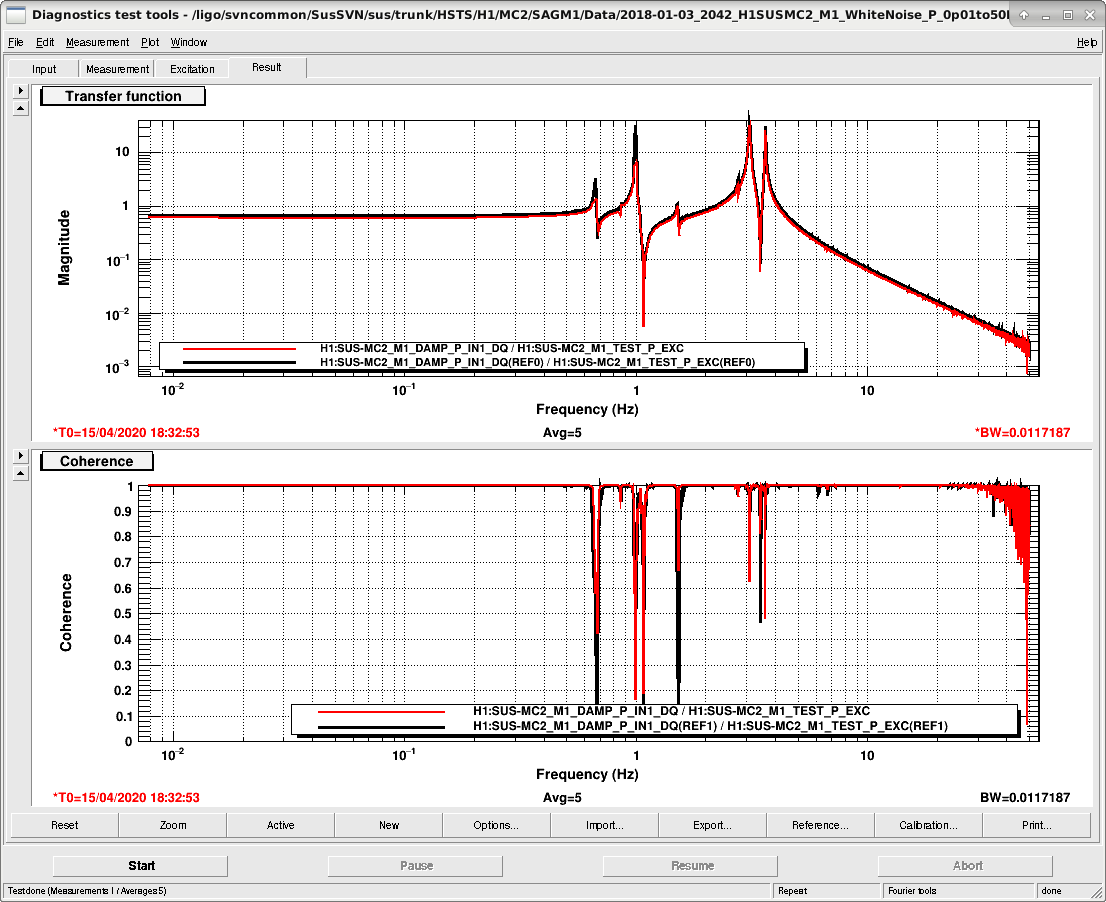
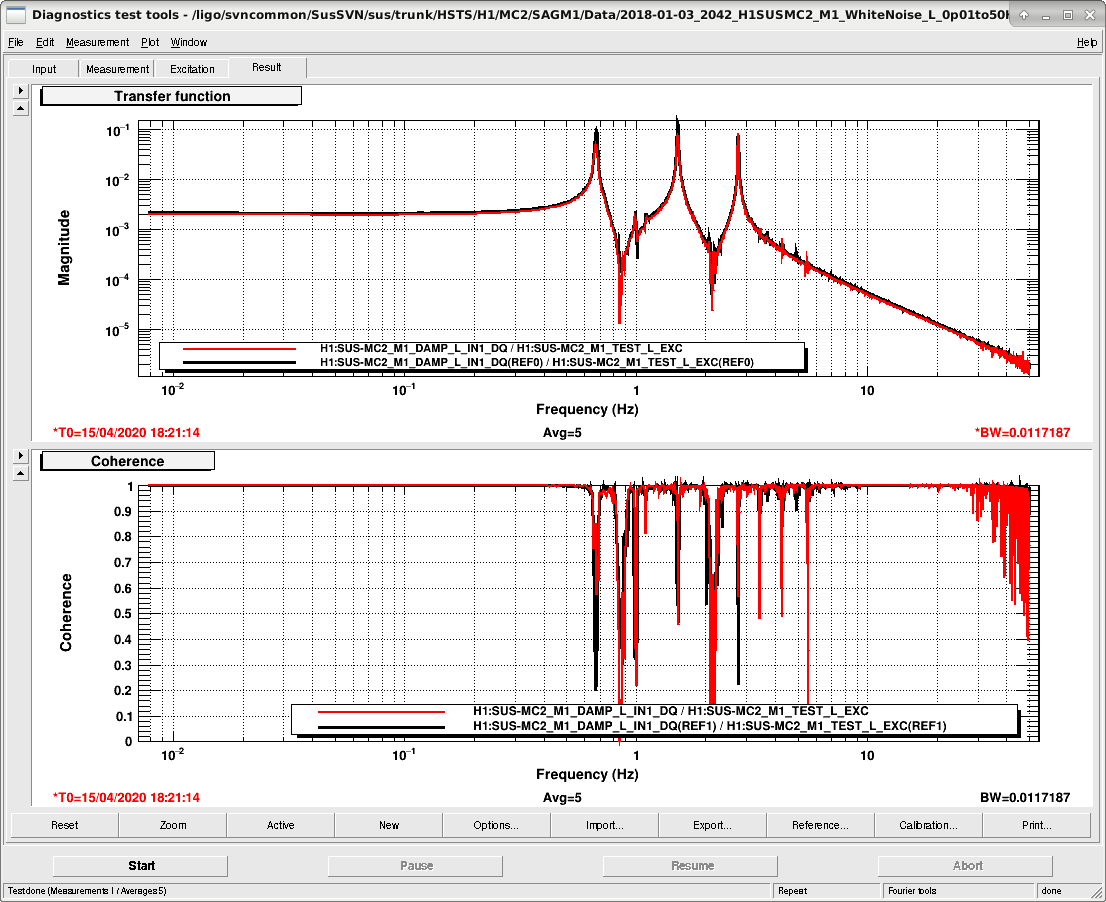
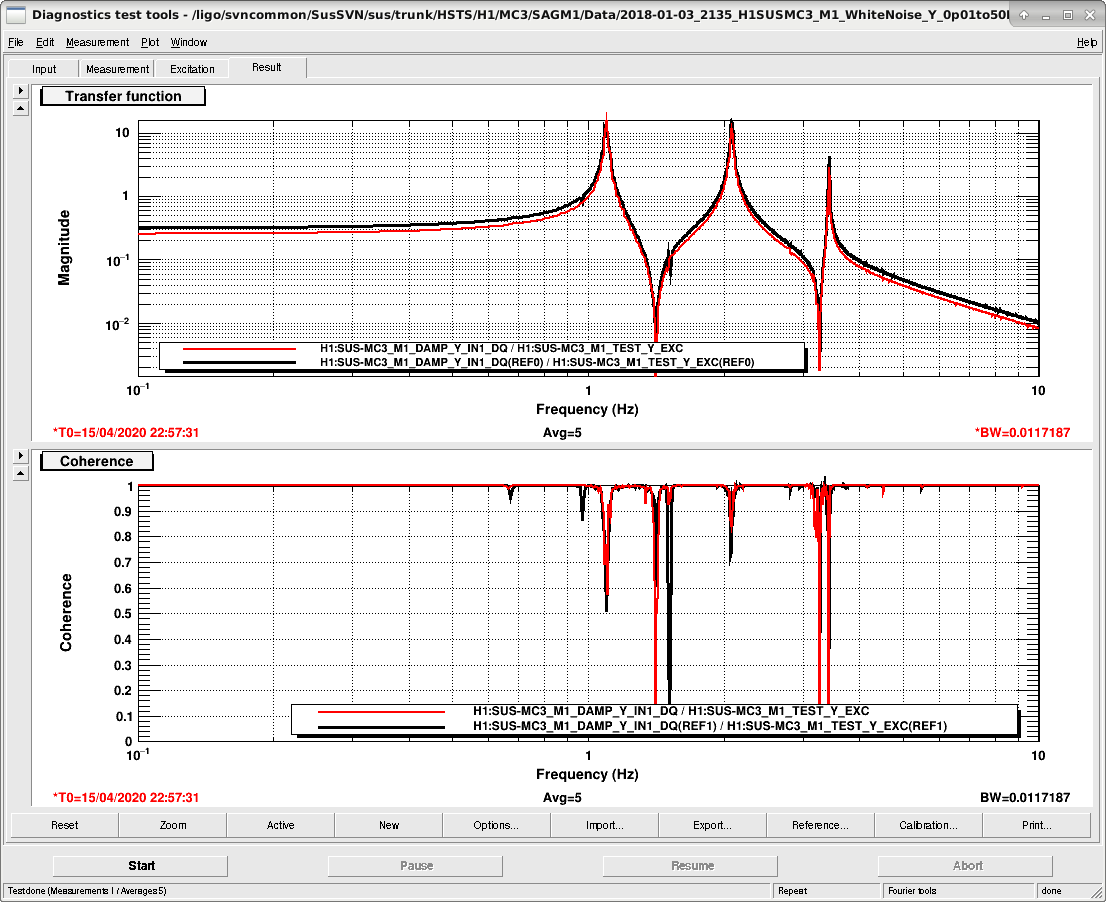
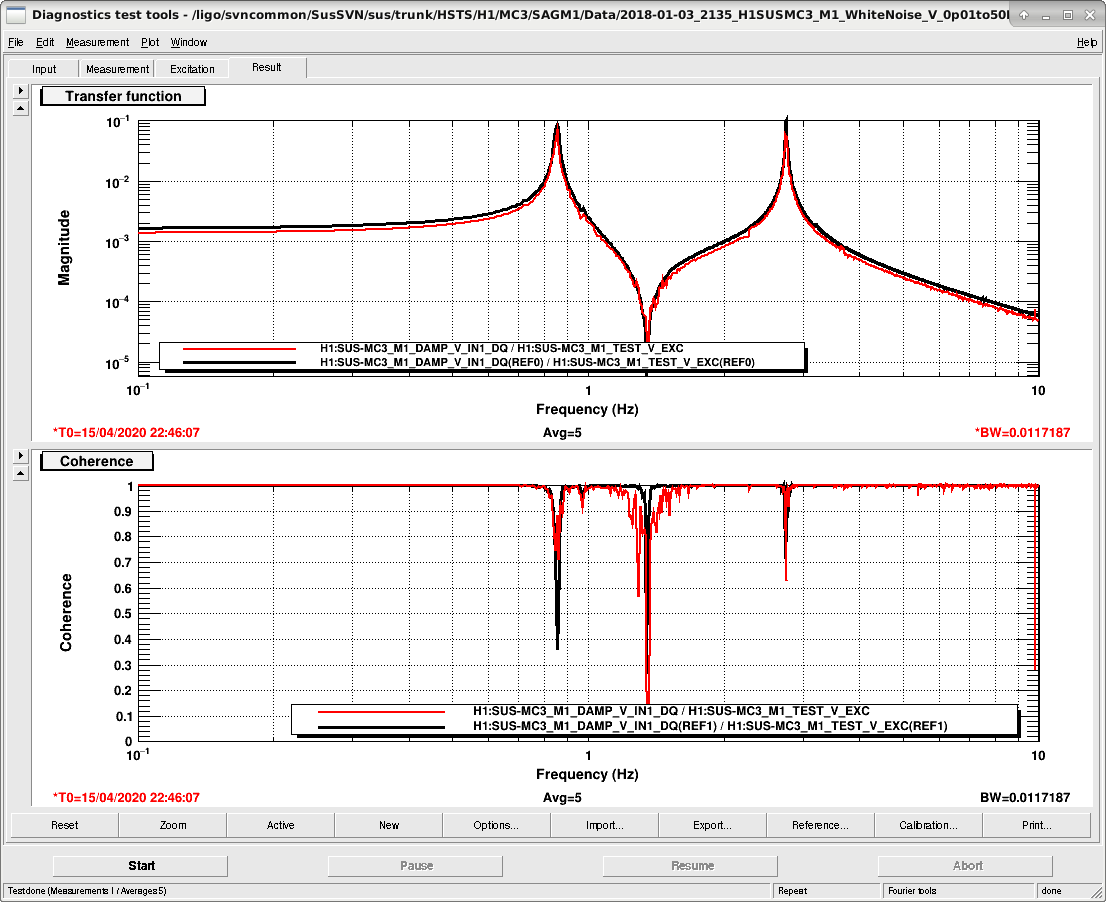
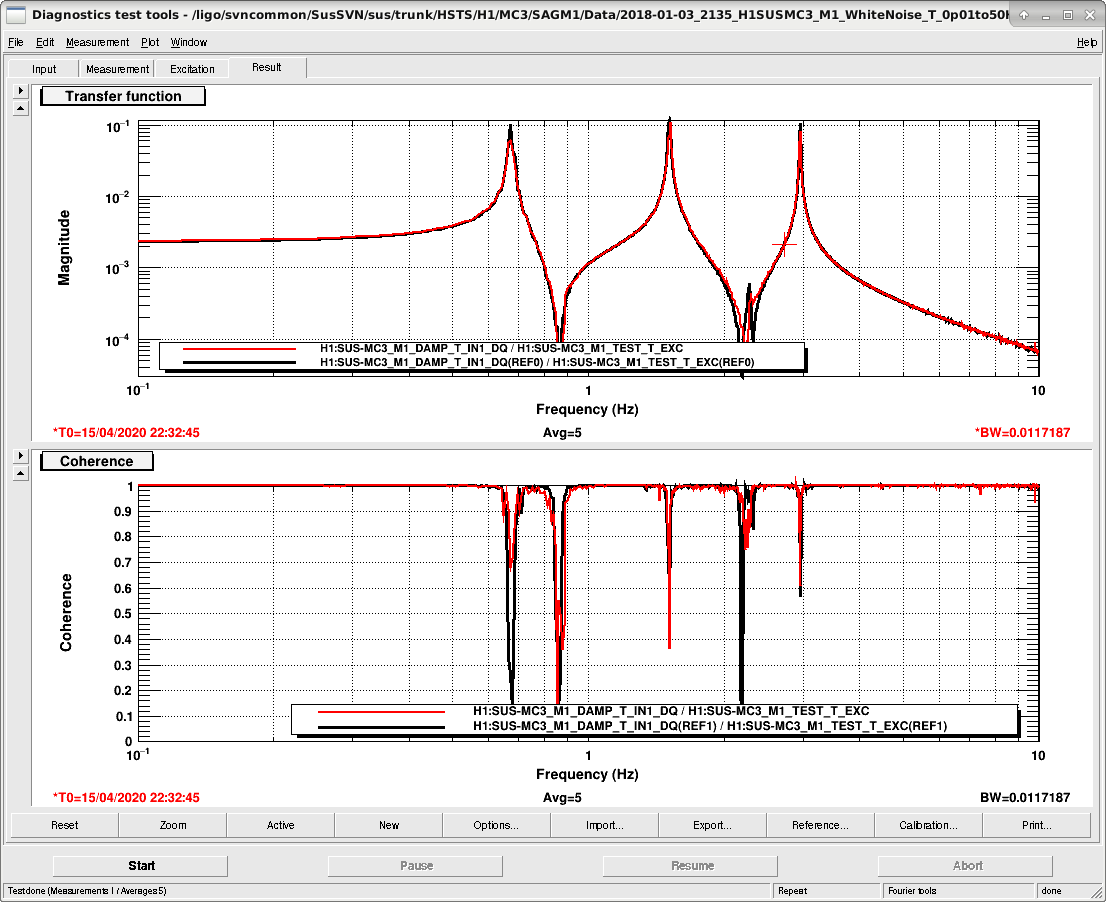
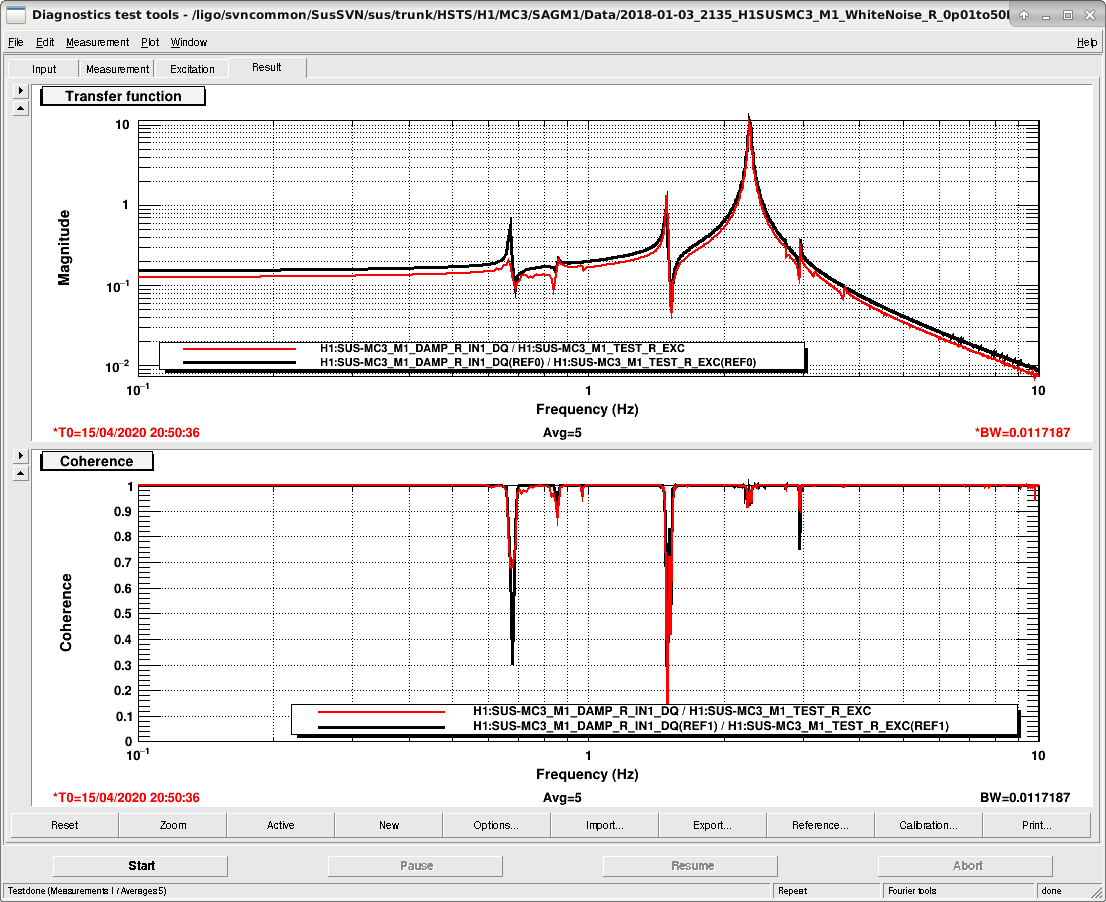
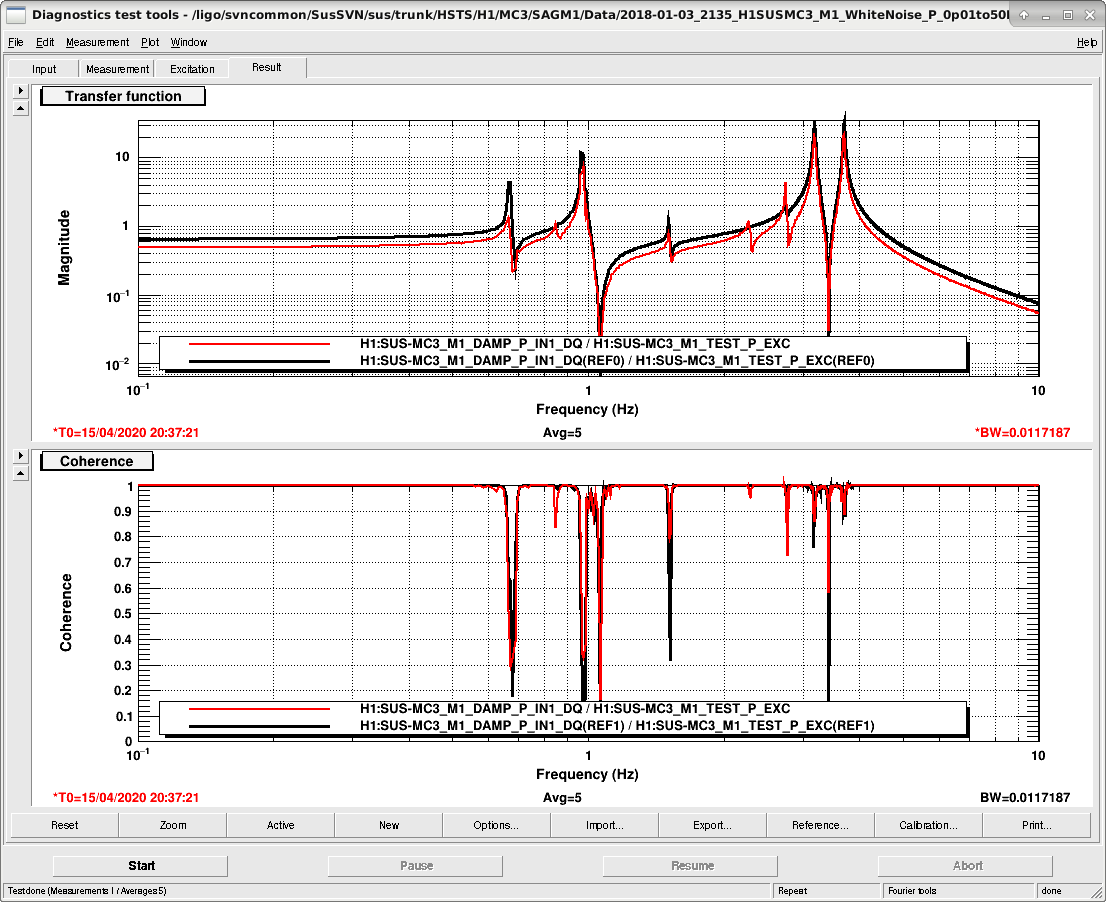
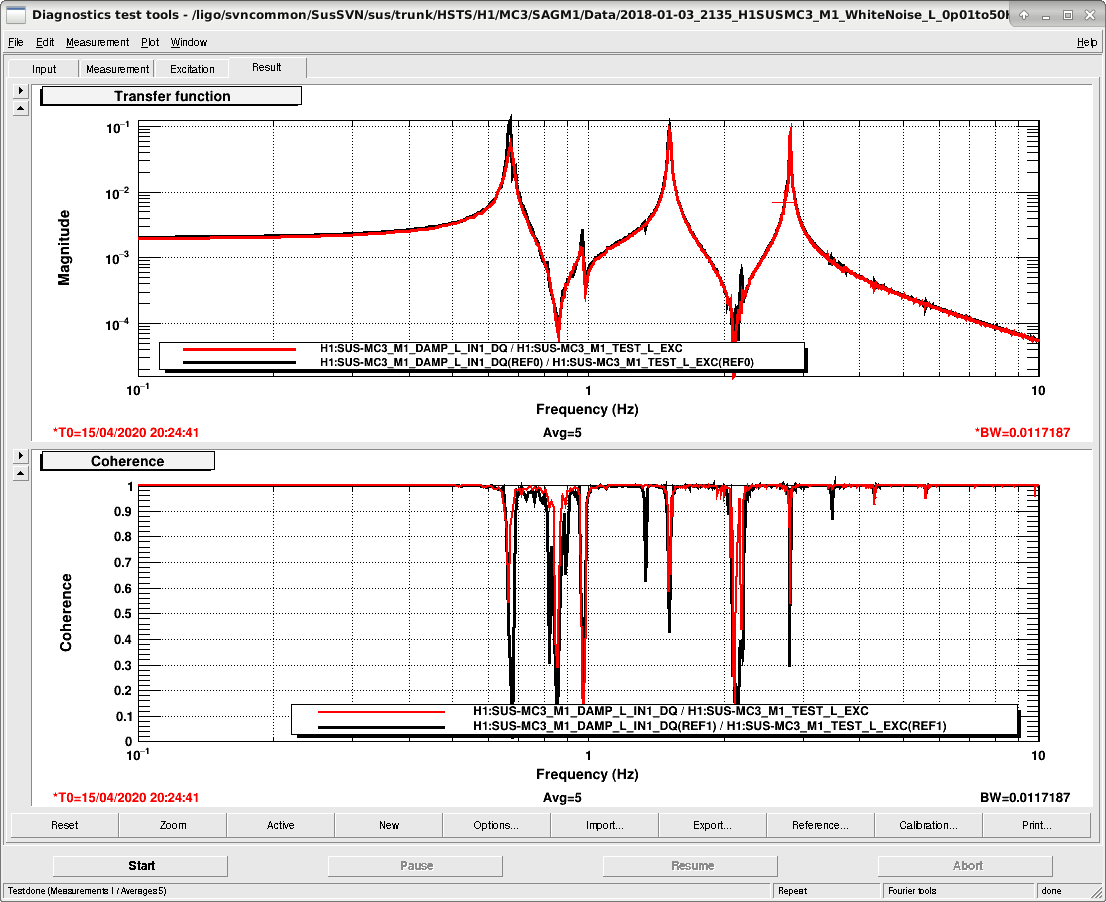
Transfer function results (all 6 dof) for MC2 and MC3 shows that they are healthy and free of any rubbing. The plots for each dof are attached below.
This completes tf measurements for 4 QUADS, BS and 9 triples (HSTS, HLTS, MC). Next in the line are doubles and single stage sus.
The dtt templates are stored at the following locations.
/ligo/svncommon/SusSVN/sus/trunk/HSTS/H1/MC2/SAGM1/Data
2020-04-15_1500_H1SUSMC2_M1_WhiteNoise_L_0p01to50Hz.xml
2020-04-15_1500_H1SUSMC2_M1_WhiteNoise_P_0p01to50Hz.xml
2020-04-15_1500_H1SUSMC2_M1_WhiteNoise_R_0p01to50Hz.xml
2020-04-15_1500_H1SUSMC2_M1_WhiteNoise_T_0p01to50Hz.xml
2020-04-15_1500_H1SUSMC2_M1_WhiteNoise_V_0p01to50Hz.xml
2020-04-15_1500_H1SUSMC2_M1_WhiteNoise_Y_0p01to50Hz.xml
/ligo/svncommon/SusSVN/sus/trunk/HSTS/H1/MC3/SAGM1/Data
2020-04-15_1600_H1SUSMC3_M1_WhiteNoise_L_0p01to50Hz.xml
2020-04-15_1600_H1SUSMC3_M1_WhiteNoise_P_0p01to50Hz.xml
2020-04-15_1600_H1SUSMC3_M1_WhiteNoise_R_0p01to50Hz.xml
2020-04-15_1600_H1SUSMC3_M1_WhiteNoise_T_0p01to50Hz.xml
2020-04-15_1600_H1SUSMC3_M1_WhiteNoise_V_0p01to50Hz.xml
2020-04-15_1600_H1SUSMC3_M1_WhiteNoise_Y_0p01to50Hz.xml
J. Kissel Finally exporting and processing this data for H1 SUS MC2, and along the way improving the templates, as I continuing the campaign to keep up librarianship with the history of all SUS (and today motivated by understanding the diversity in pitch mode frequencies among the builds). See attached first .pdf for "individual" comparison against the model, which includes cross-coupling and OSEM basis response. The second two attached .pdfs show comparison against all the recent history of this SUS, and a few other examples of the same type. I agree with the assessment that the SUS looked healthy at this time.
J. Kissel Finally exporting and processing this data for H1 SUS MC3, and along the way improving the templates, as I continuing the campaign to keep up librarianship with the history of all SUS (and today motivated by understanding the diversity in pitch mode frequencies among the builds). See attached first .pdf for "individual" comparison against the model, which includes cross-coupling and OSEM basis response. The second two attached .pdfs show comparison against all the recent history of this SUS, and a few other examples of the same type. The comparison between the 2018-01-03_2135 data (cyan), this 2020-04-15 data (green), and the much later and latest 2020-10-29_1530 (red) show that MC3 was *not* healthy during this time. Later investigations revealed that one leg of the differential analog output for the corresponding AI chassis that drove MC3's T3 coil had somehow gone bad between the O2 to O3 2018 and 2020 upgrades -- see documentation of the problem only after the 2020-10-29 data set in FRS Ticket 16116, and the most helpful / descriptive aLOG about it, LHO aLOG 57172. The last comment in the FRS Ticket and that LHO aLOG 57172 suggests that the problem was fixed. However, we did not take a confirmation set of transfer functions after the fix. We should get a new set of TFs at our earliest convenience. This failure mode will be a nice one for the https://awiki.ligo-wa.caltech.edu/wiki/TransferFunctionColoringBook.
Cheryl, Rahul
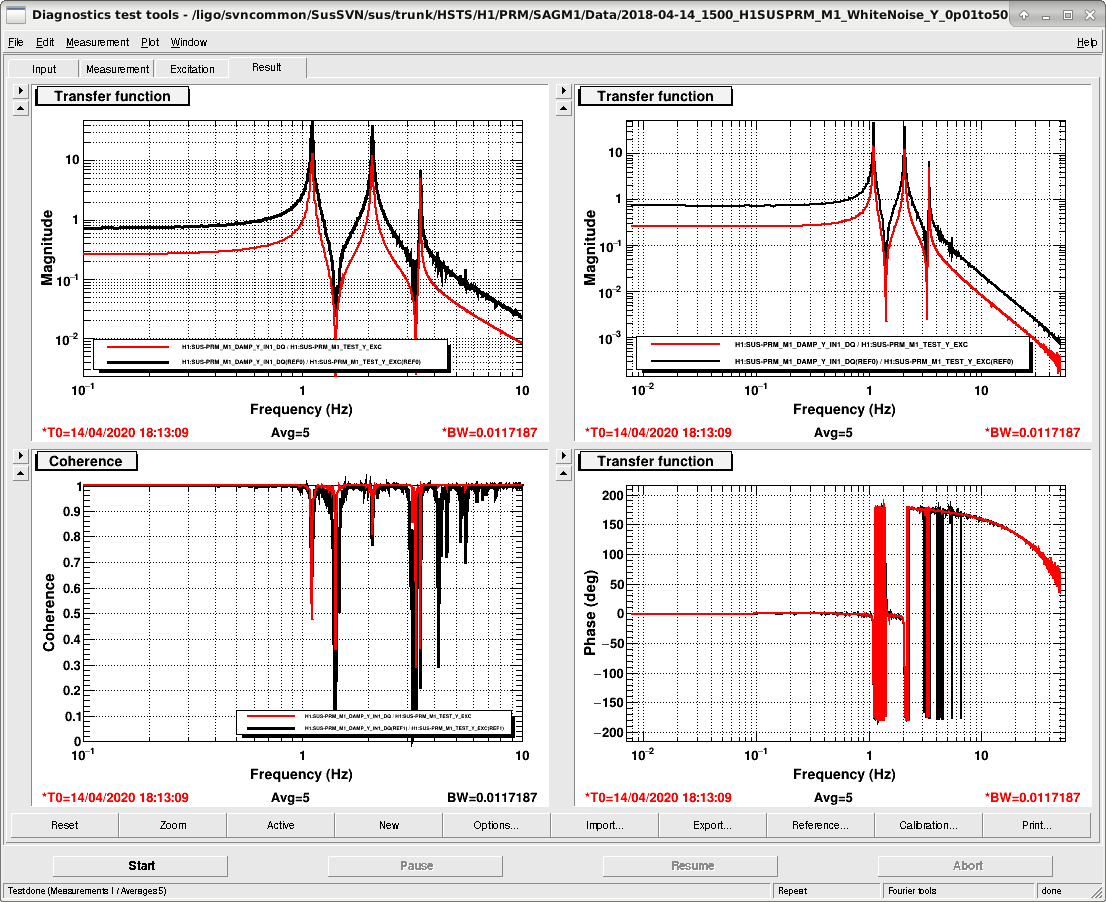
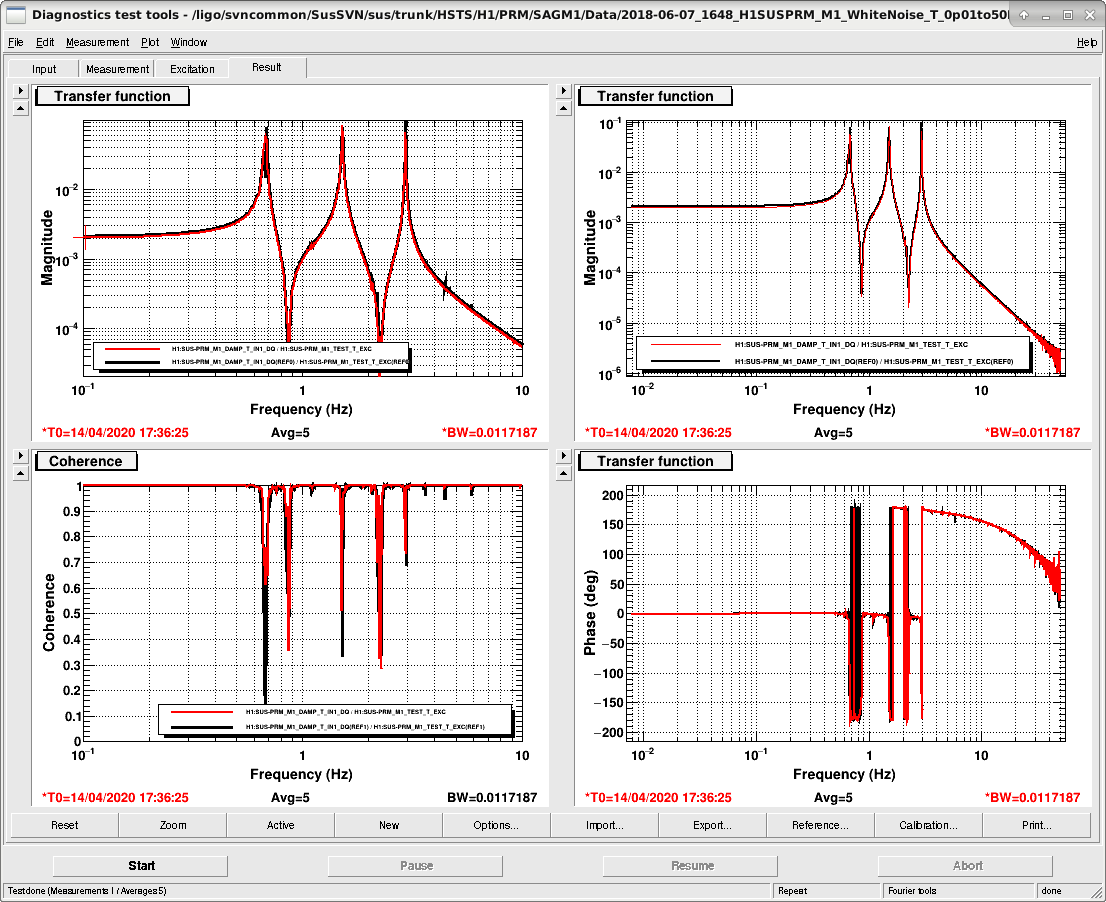
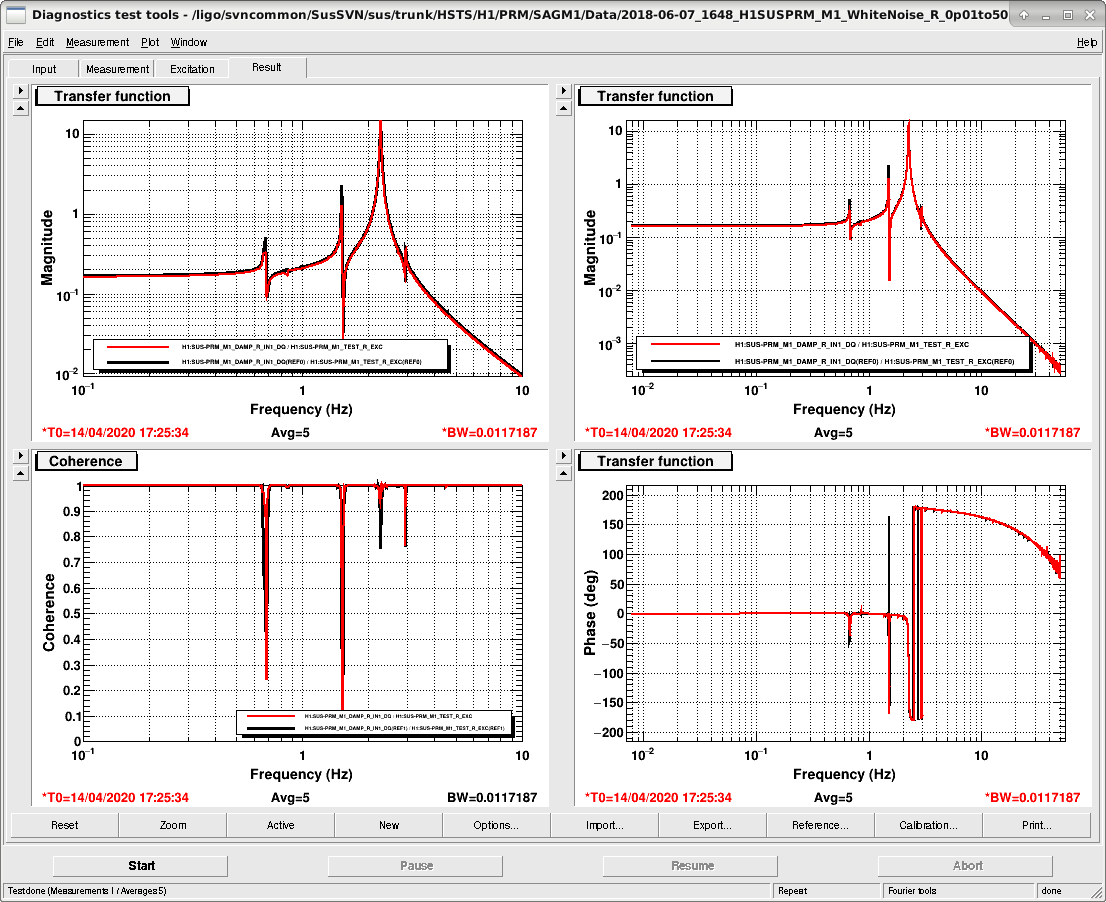
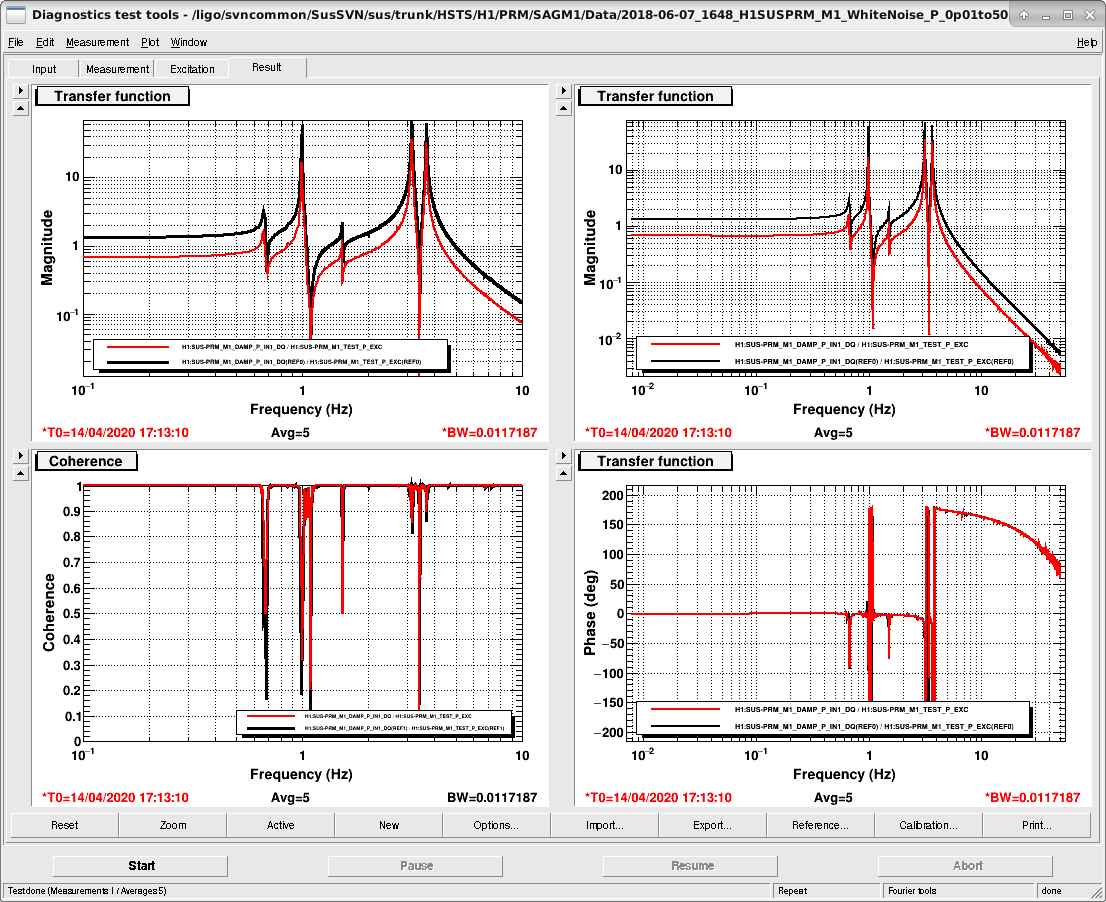
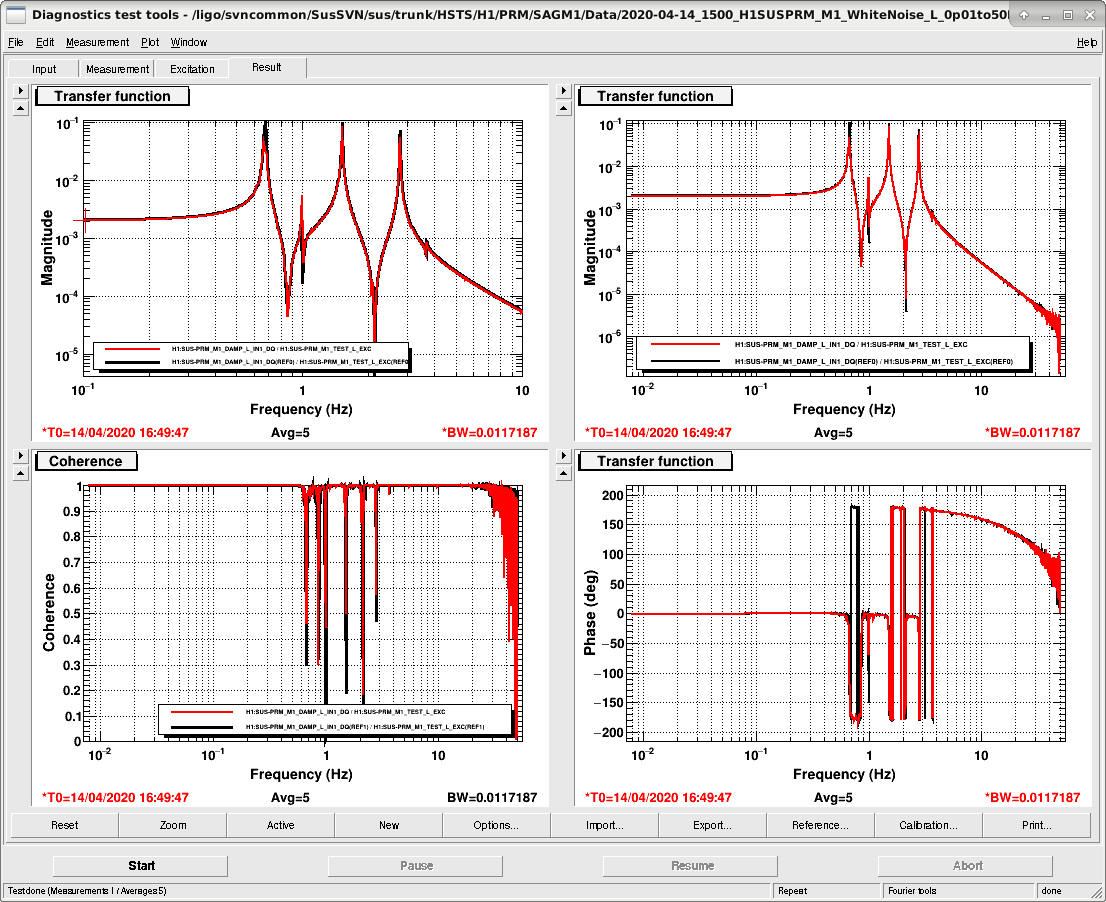
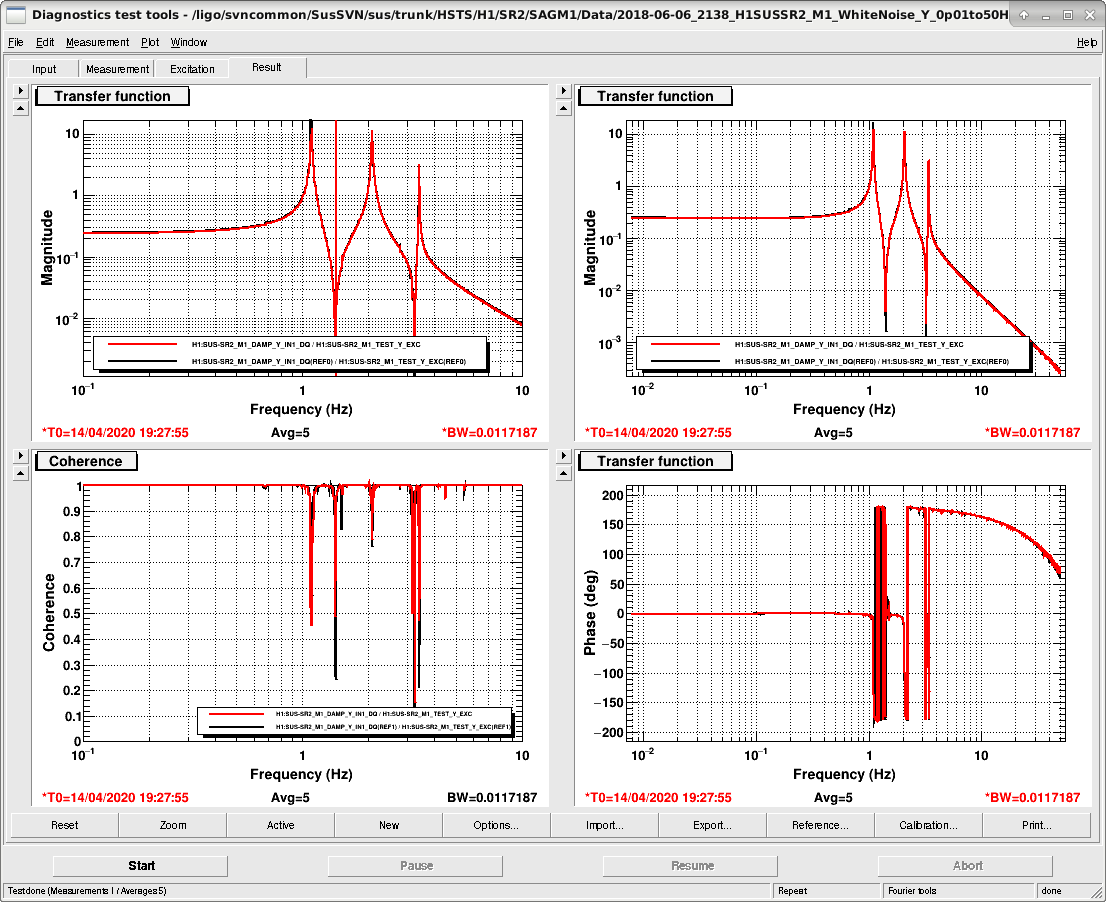
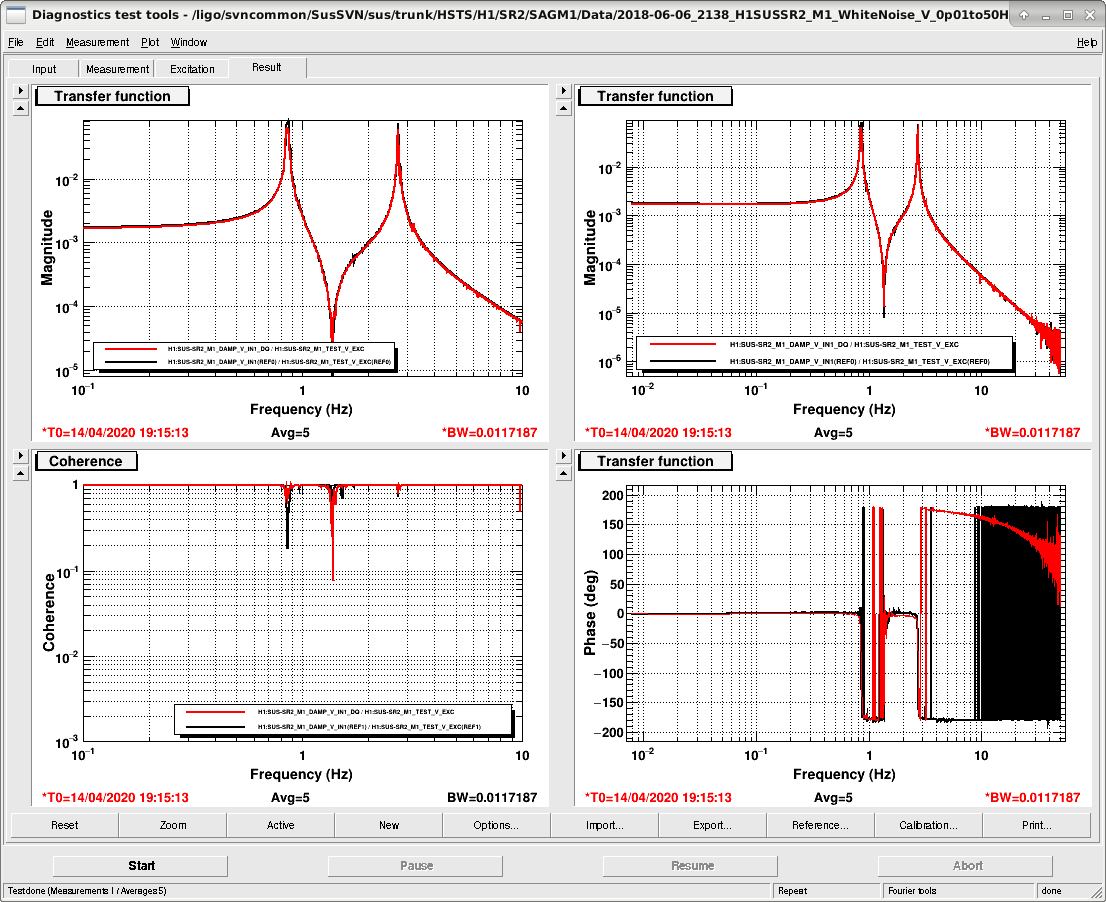
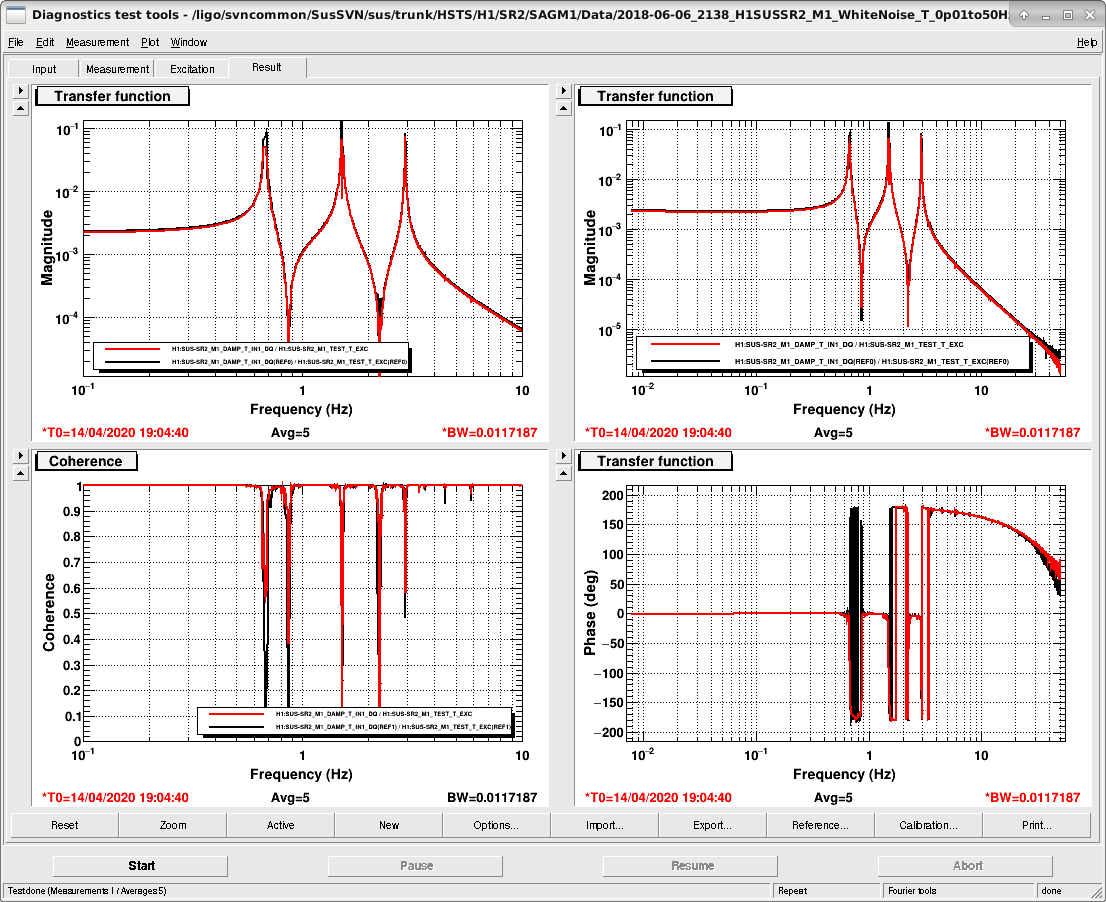
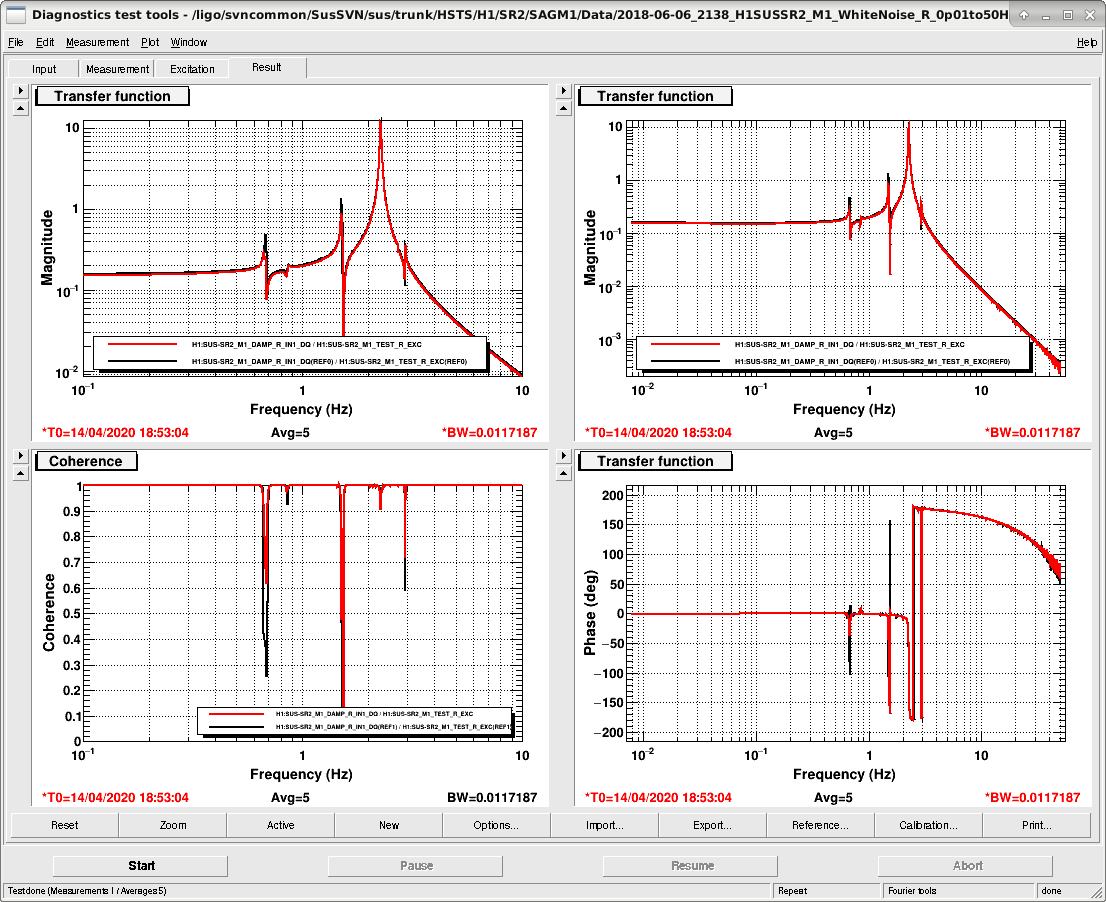
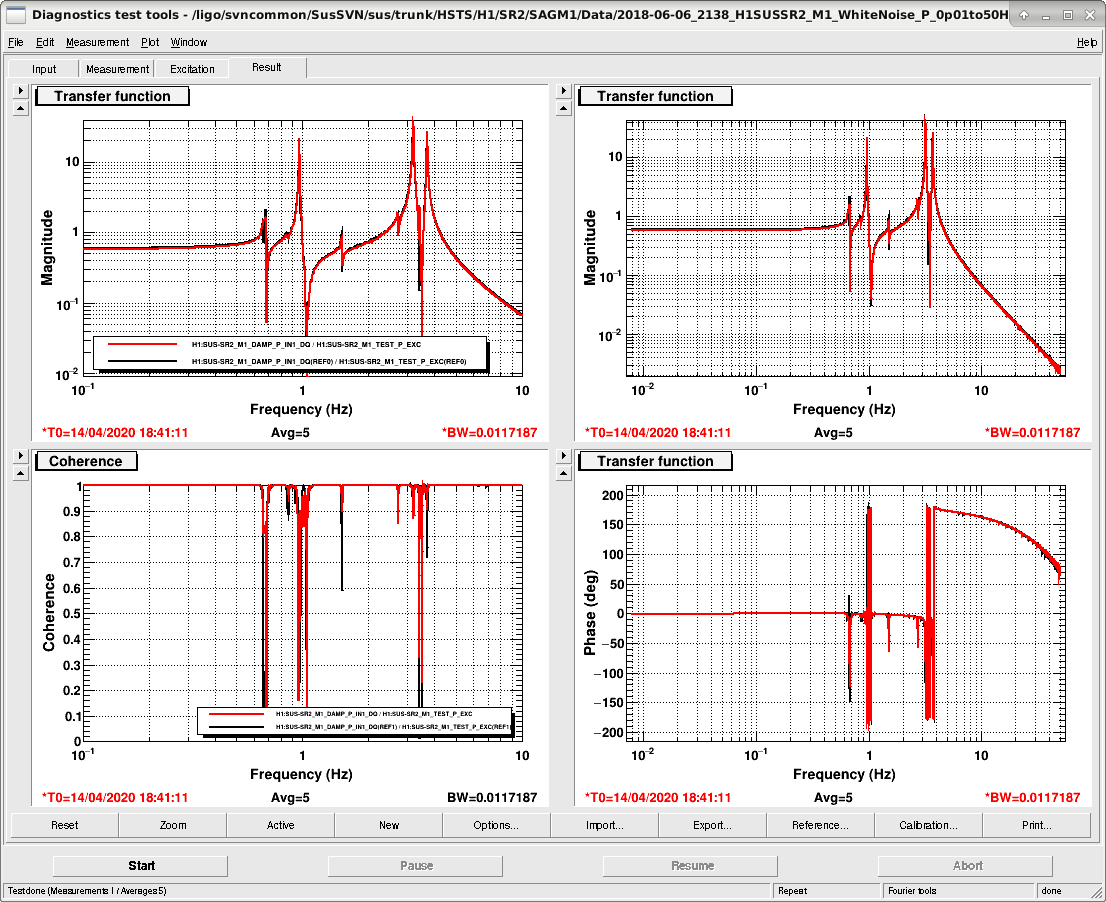
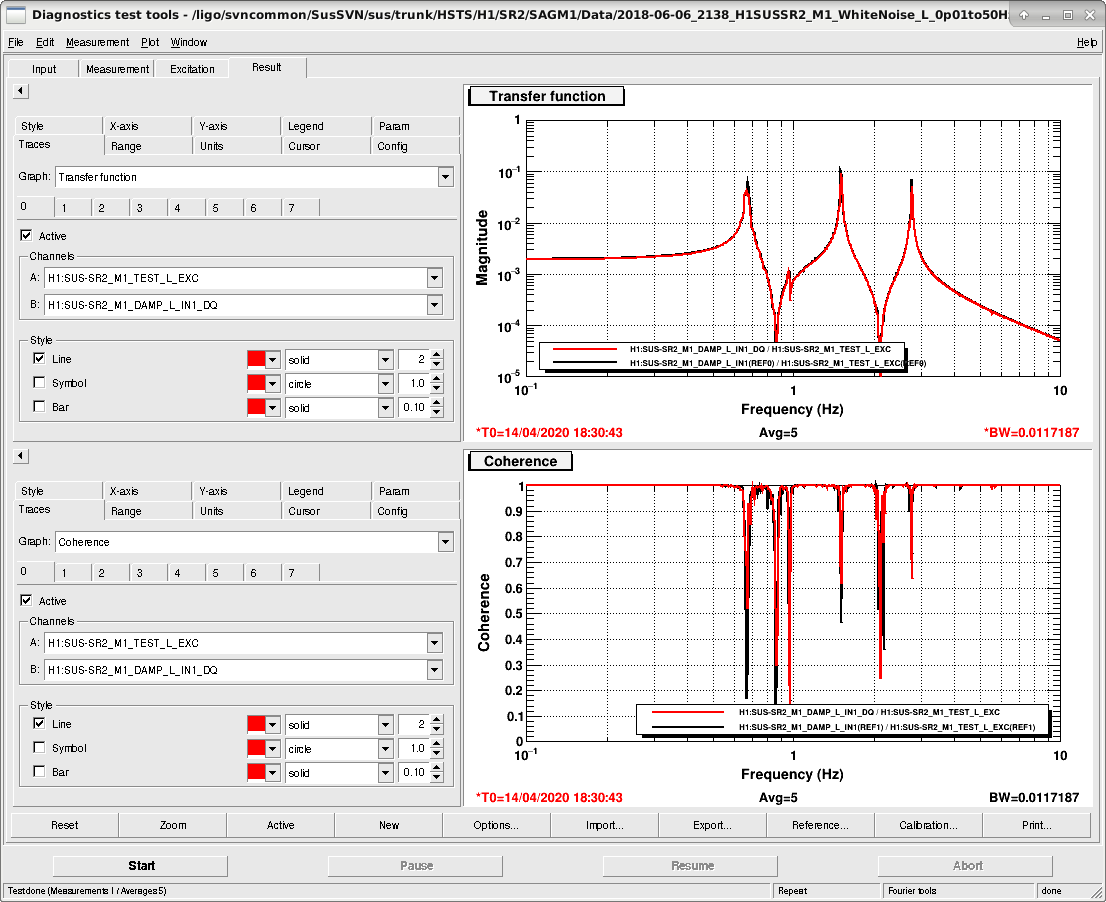
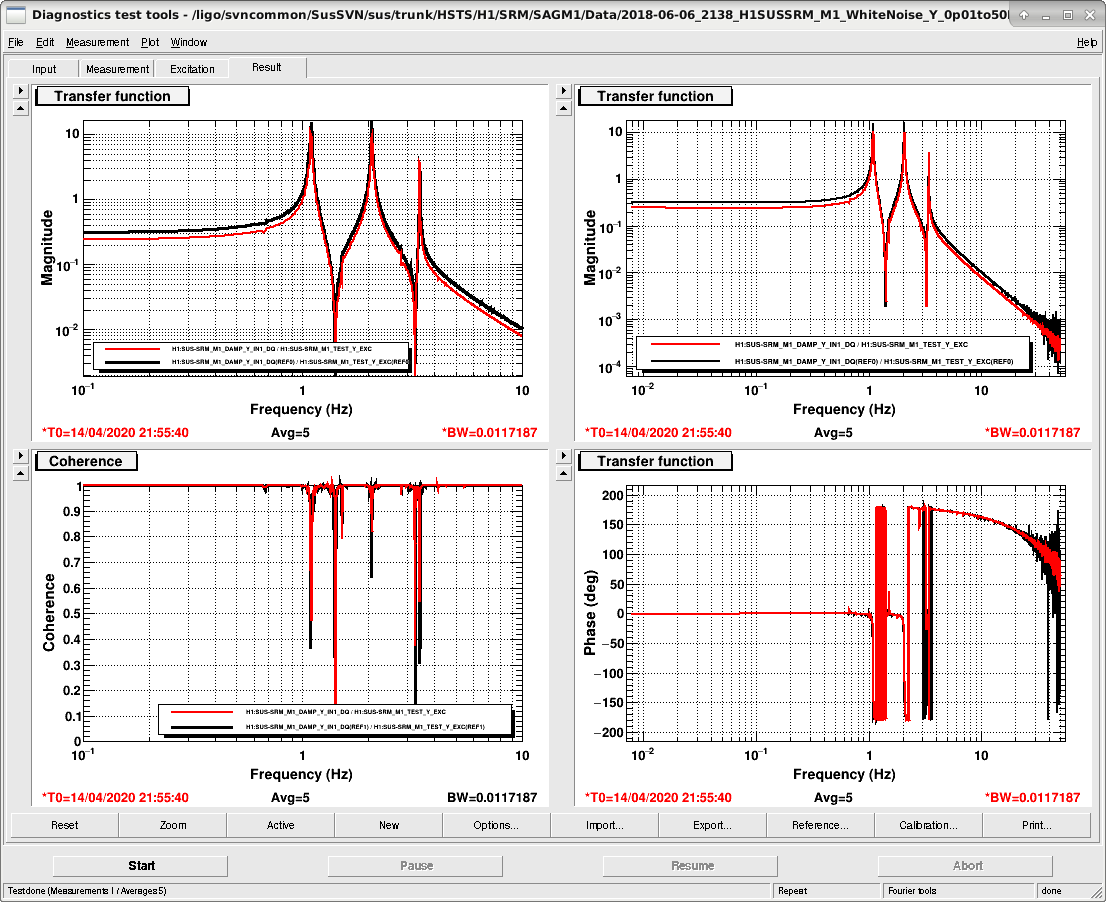
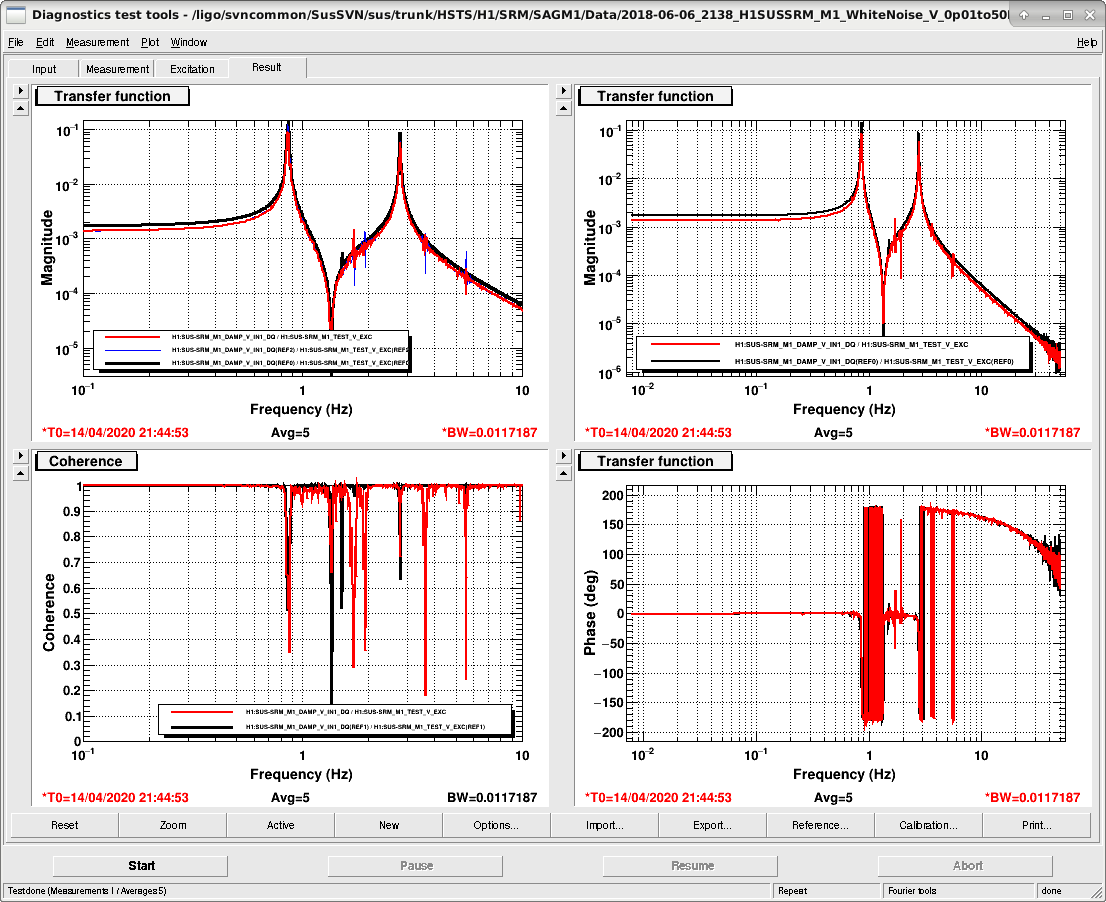
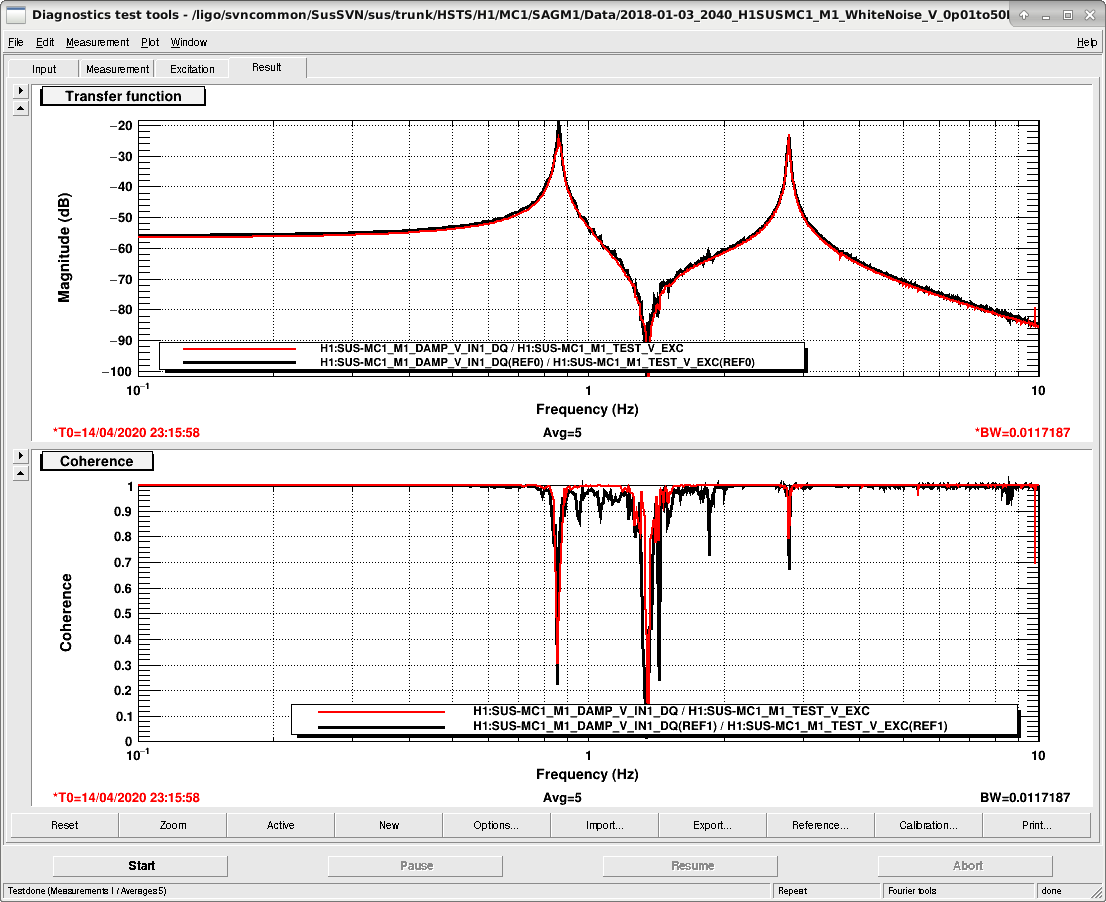
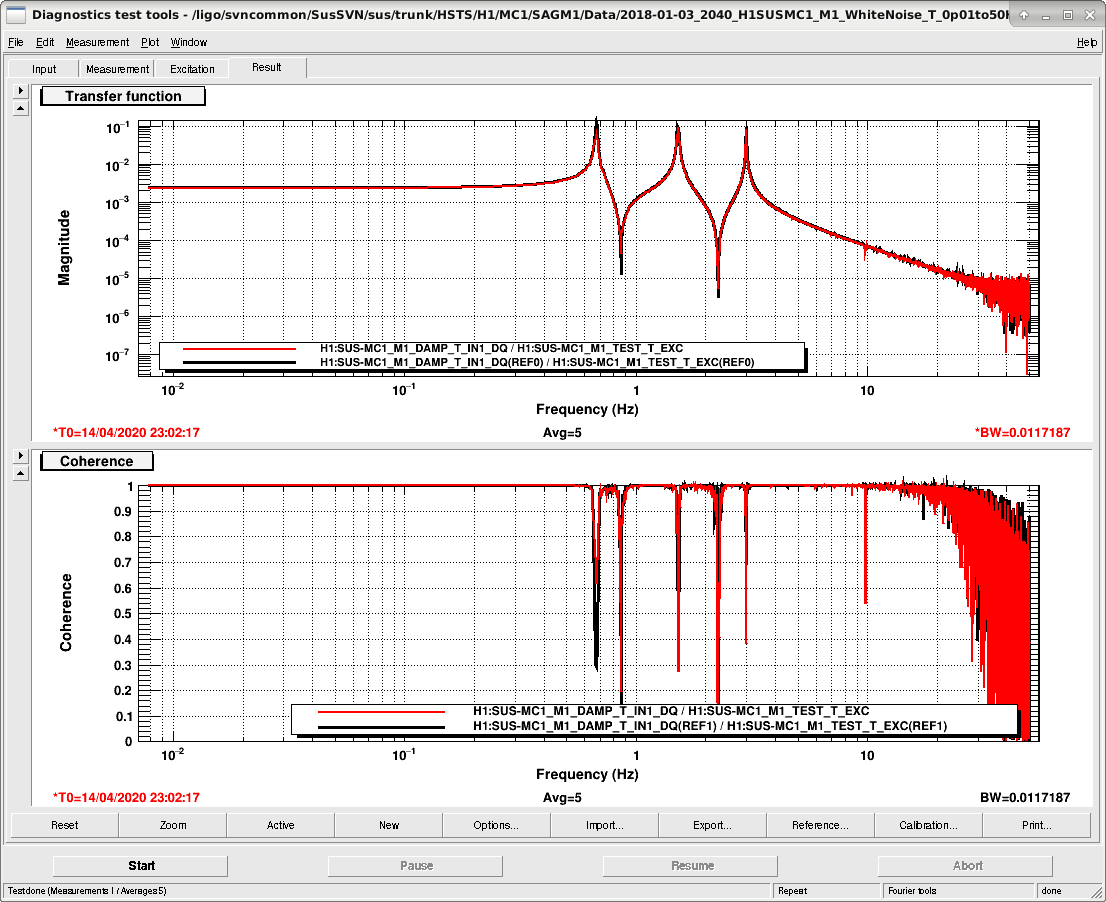
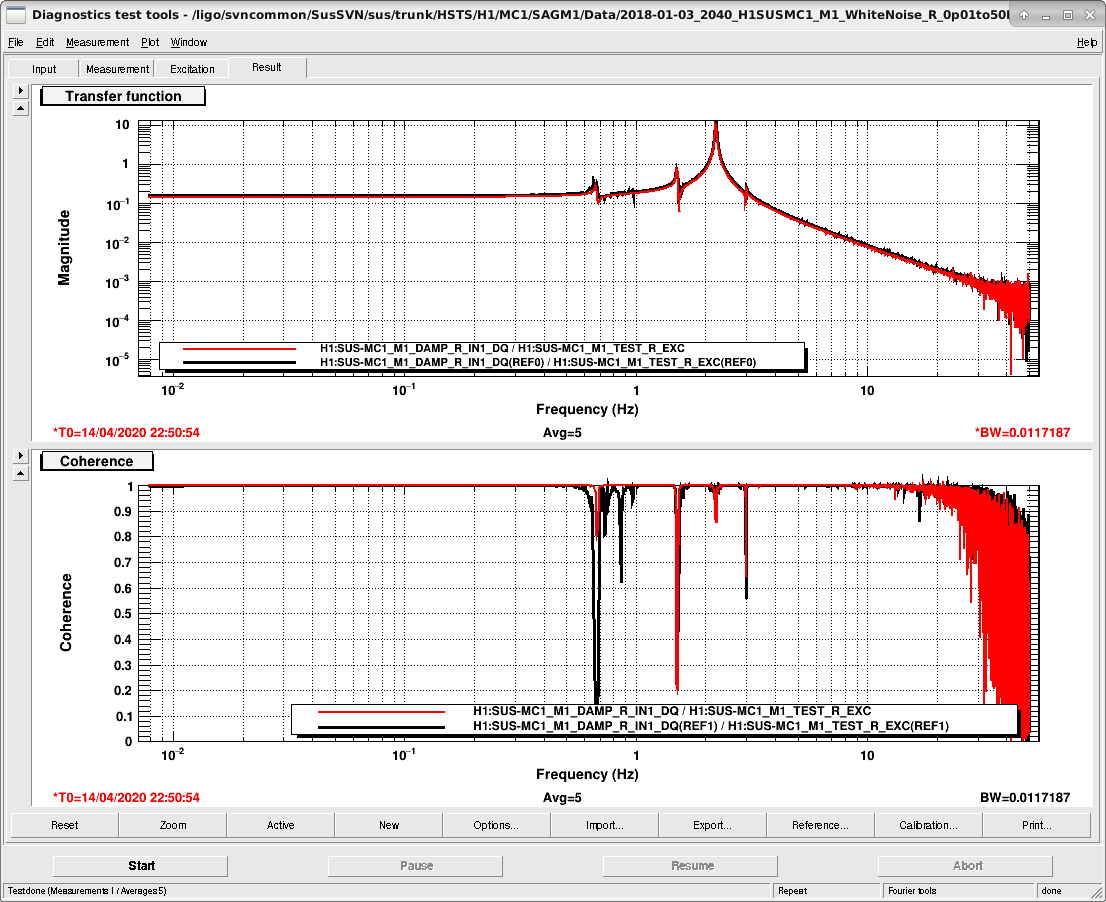
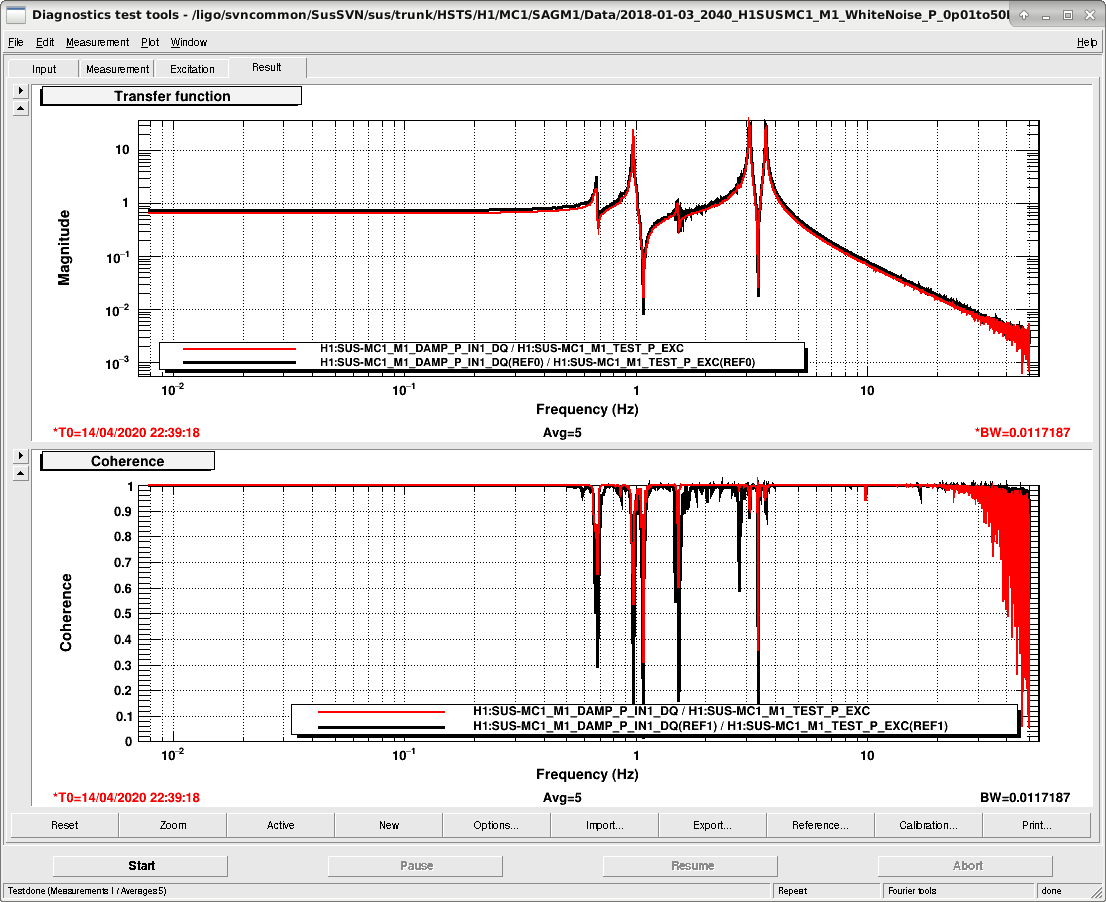
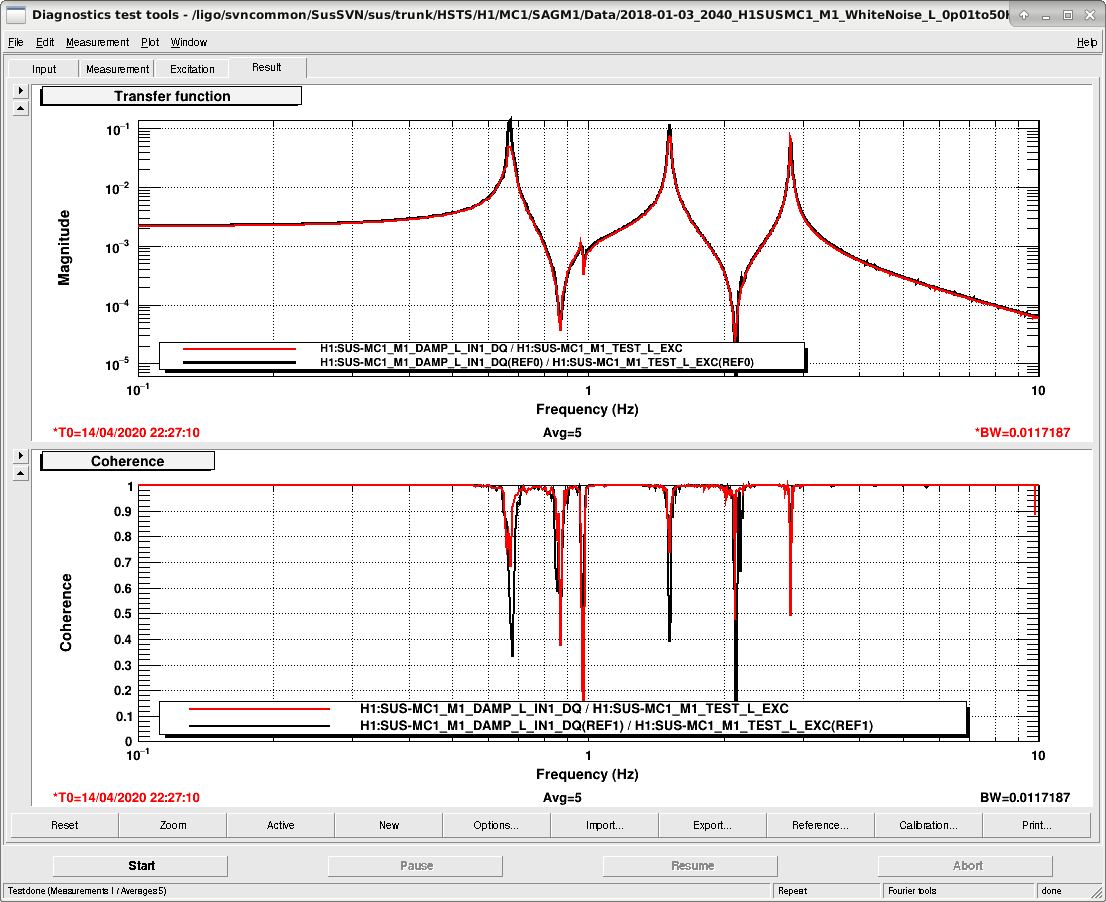
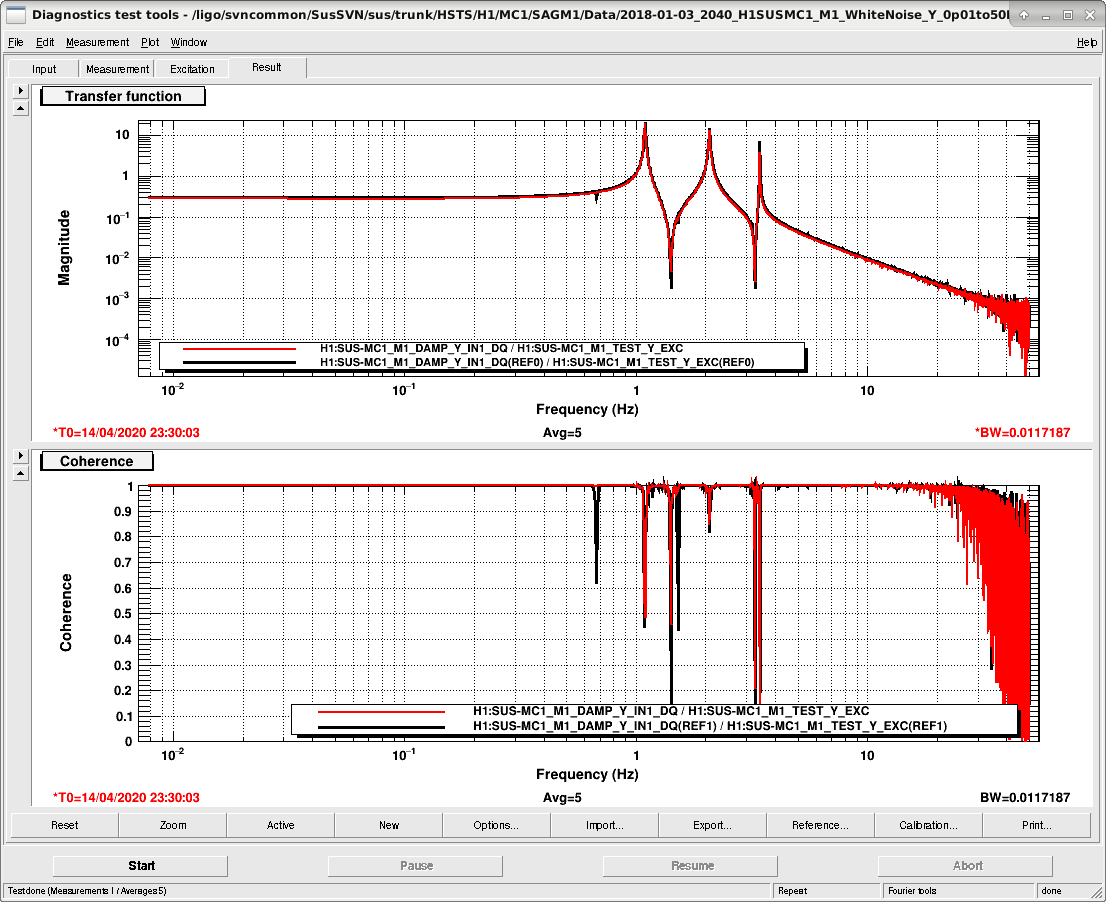
We have finished taking transfer function measuremnts for 4 triple suspensions today, namely: PRM, SR2, SRM and MC1. All the supensions looks healthy and free of rubbing. The magnitude of the tf for PRM pitch and yaw tf measurement looks lower than that of the template. The resonant peaks are at the right place hence we believe everything is fine with this suspension too.
The templates are stored at the following locations,
/ligo/svncommon/SusSVN/sus/trunk/HSTS/H1/PRM/SAGM1/Data
2020-04-14_1500_H1SUSPRM_M1_WhiteNoise_L_0p01to50Hz.xml
2020-04-14_1500_H1SUSPRM_M1_WhiteNoise_P_0p01to50Hz.xml
2020-04-14_1500_H1SUSPRM_M1_WhiteNoise_R_0p01to50Hz.xml
2020-04-14_1500_H1SUSPRM_M1_WhiteNoise_T_0p01to50Hz.xml
2020-04-14_1500_H1SUSPRM_M1_WhiteNoise_V_0p01to50Hz.xml
2020-04-14_1500_H1SUSPRM_M1_WhiteNoise_Y_0p01to50Hz.xml
/ligo/svncommon/SusSVN/sus/trunk/HSTS/H1/SR2/SAGM1/Data
2020-04-14_1800_H1SUSSR2_M1_WhiteNoise_L_0p01to50Hz.xml
2020-04-14_1800_H1SUSSR2_M1_WhiteNoise_P_0p01to50Hz.xml
2020-04-14_1800_H1SUSSR2_M1_WhiteNoise_R_0p01to50Hz.xml
2020-04-14_1800_H1SUSSR2_M1_WhiteNoise_T_0p01to50Hz.xml
2020-04-14_1800_H1SUSSR2_M1_WhiteNoise_V_0p01to50Hz.xml
2020-04-14_1800_H1SUSSR2_M1_WhiteNoise_Y_0p01to50Hz.xml
/ligo/svncommon/SusSVN/sus/trunk/HSTS/H1/SRM/SAGM1/Data
2020-04-14_2000_H1SUSSRM_M1_WhiteNoise_L_0p01to50Hz.xml
2020-04-14_2000_H1SUSSRM_M1_WhiteNoise_P_0p01to50Hz.xml
2020-04-14_2000_H1SUSSRM_M1_WhiteNoise_R_0p01to50Hz.xml
2020-04-14_2000_H1SUSSRM_M1_WhiteNoise_T_0p01to50Hz.xml
2020-04-14_2000_H1SUSSRM_M1_WhiteNoise_V_0p01to50Hz.xml
2020-04-14_2000_H1SUSSRM_M1_WhiteNoise_Y_0p01to50Hz.xml
/ligo/svncommon/SusSVN/sus/trunk/HSTS/H1/MC1/SAGM1/Data
2020-04-14_2100_H1SUSMC1_M1_WhiteNoise_L_0p01to50Hz.xml
2020-04-14_2100_H1SUSMC1_M1_WhiteNoise_P_0p01to50Hz.xml
2020-04-14_2100_H1SUSMC1_M1_WhiteNoise_R_0p01to50Hz.xml
2020-04-14_2100_H1SUSMC1_M1_WhiteNoise_T_0p01to50Hz.xml
2020-04-14_2100_H1SUSMC1_M1_WhiteNoise_V_0p01to50Hz.xml
2020-04-14_2100_H1SUSMC1_M1_WhiteNoise_Y_0p01to50Hz.xml
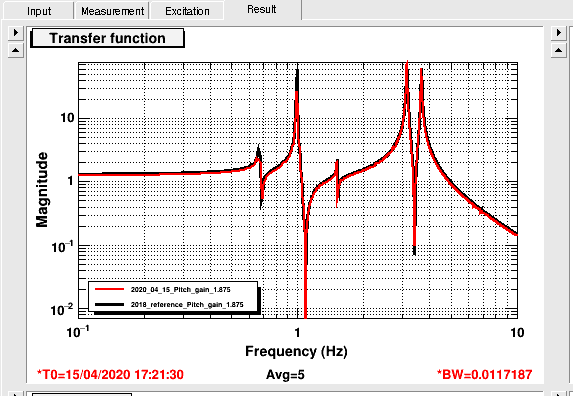
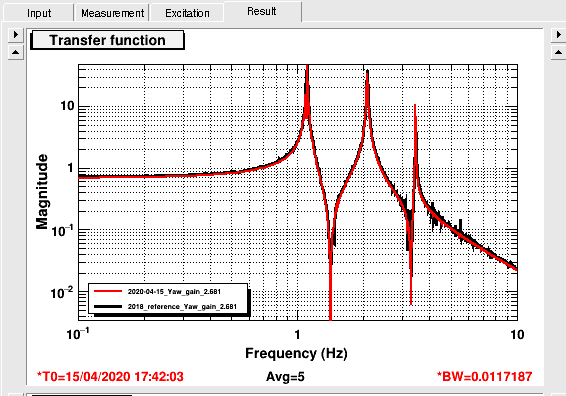
We did a re-check on the PRM by re-running the Pitch and Yaw dof. This time we did not change the gain in M1_Test for P and Y dof (typically we change them to unity before running the measurements). As a result, the measurement ties up well with the reference as shown in the plot attached below. To sum it up, PRM is also healthy and free of any rubbing.
The new templates are stored at the following location,
/ligo/svncommon/SusSVN/sus/trunk/HSTS/H1/PRM/SAGM1/Data
2020-04-15_1400_H1SUSPRM_M1_WhiteNoise_P_0p01to50Hz.xml
2020-04-15_1400_H1SUSPRM_M1_WhiteNoise_Y_0p01to50Hz.xml
In the dtt I have updated the reference to match the results with P and Y dof gain (in M1_Test filter bank) set to 1.0, given below is the correct template for future use.
2020-04-15_1500_H1SUSPRM_M1_WhiteNoise_P_reference_updated_0p01to50Hz.xml
2020-04-15_1500_H1SUSPRM_M1_WhiteNoise_Y_reference_updated_0p01to50Hz.xml
Finally exporting and processing this data for H1 SUS MC1, and along the way improving the templates, as I continuing the campaign to keep up librarianship with the history of all SUS (and today motivated by understanding the diversity in pitch mode frequencies among the builds). See attached .pdf for "individual" comparison against the model, which includes cross-coupling and OSEM basis response. (I agree with the assessment that the SUS looked healthy at this time.) To look in to the future of this SUS, see comments to LHO aLOG 57155, which compare this measurement against previous 2018 data and future 2020-10-29 data. In short -- they all look happily the same (because we haven't really touched this SUS since 2017).
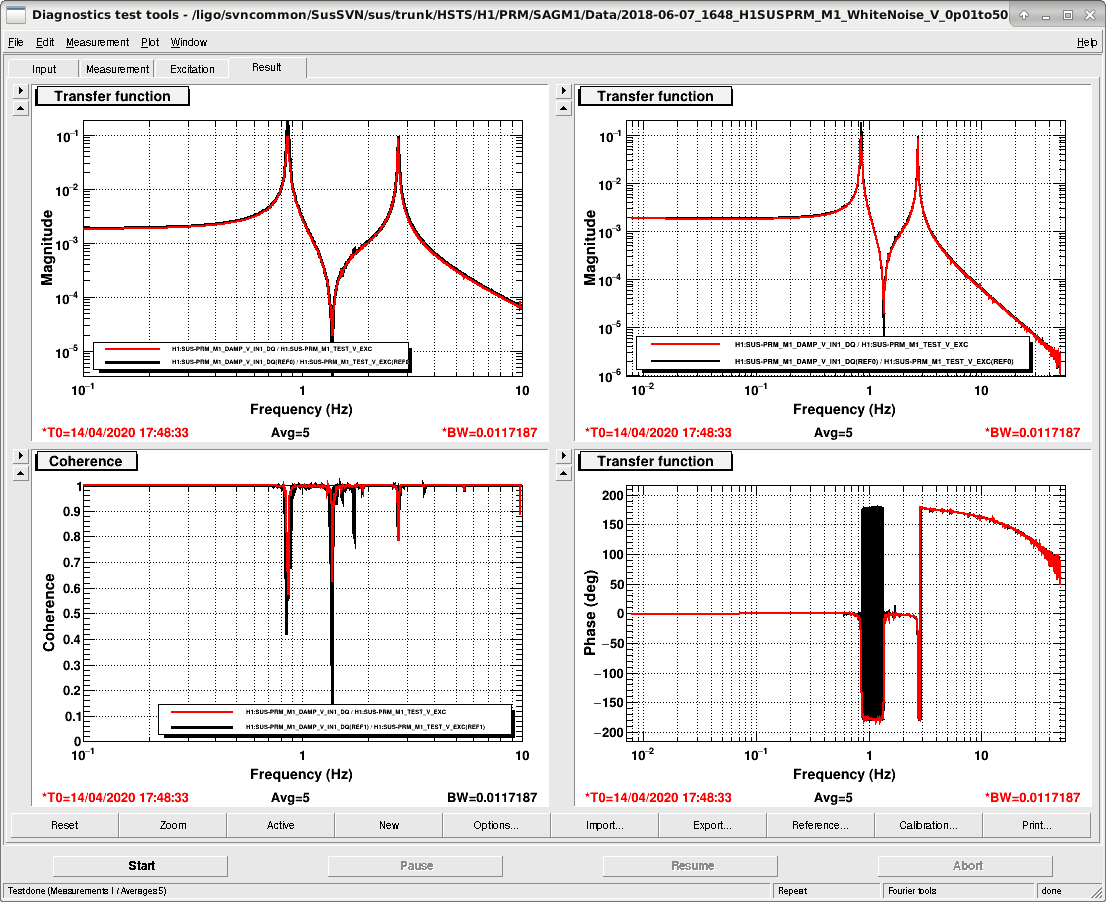
Finally processing this 2020-04-14_1500 data (as well as some 2018-06_07_1648 data that had been taken but never aLOGed) for H1SUSPRM. Note that both 2018-01-03_2138 and 2018-06_07_1648 data sets suffered from the confusion about accidentally leaving the misalignment offset calibration gains of 1.875 and 2.681 ON in the TEST P and TEST Y filter banks, hence the confusion leading in to the 2020-04-14_1500 data that tripped up Cheryl and Rahul mentioned in the above comment LHO:55920. As such -- although they report a healthy suspension otherwise, I don't show those errant data sets in the collection of PRM measurements attached here. The collection *does* however include a future measurement from 2020-10-29_1600 (LHO:57155) which is also healthy. PRM has been good for quite some time! Excellent!
Finally processing these 2020-04-14_1800 measurements for H1 SUS SR2. Only posting individual measurements here. Look for "2021-11-23_1530" for comparison against other measurements (spoiler: SR2 has looked healthy at least 2018-05-02!).
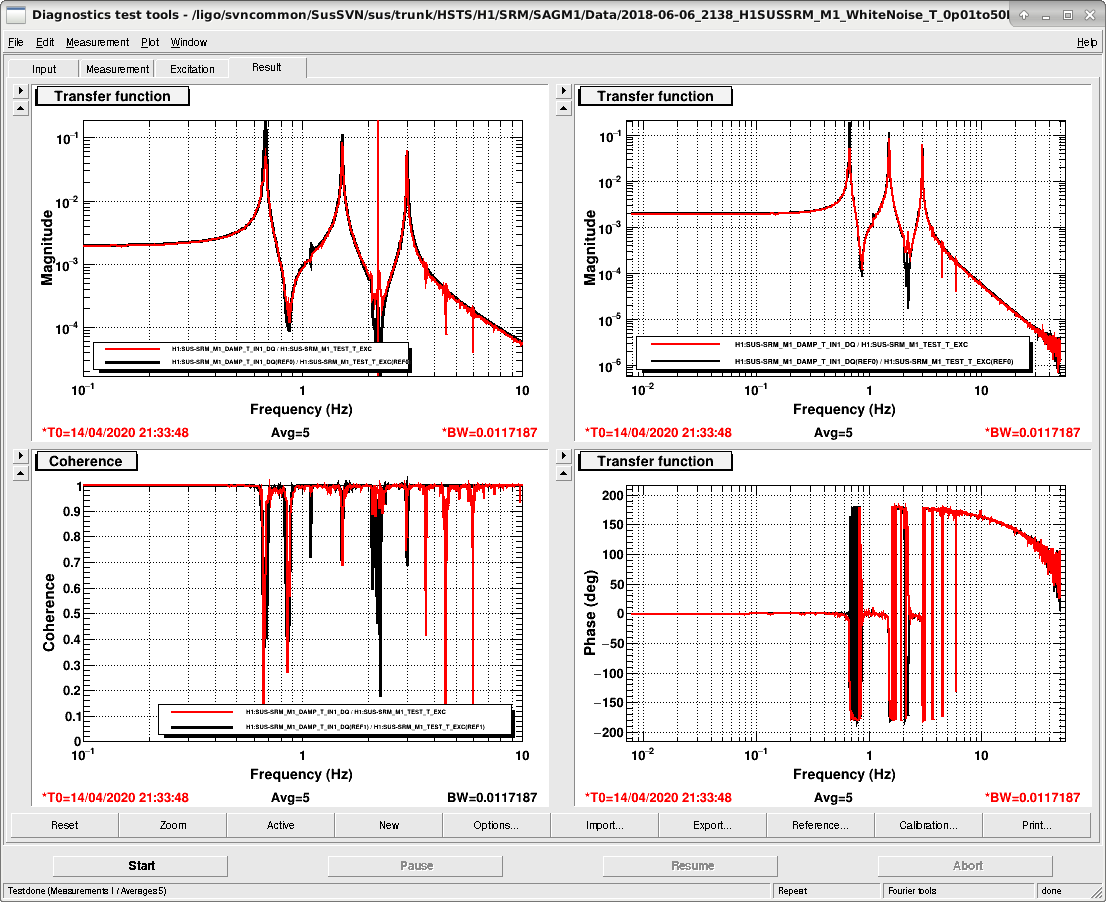
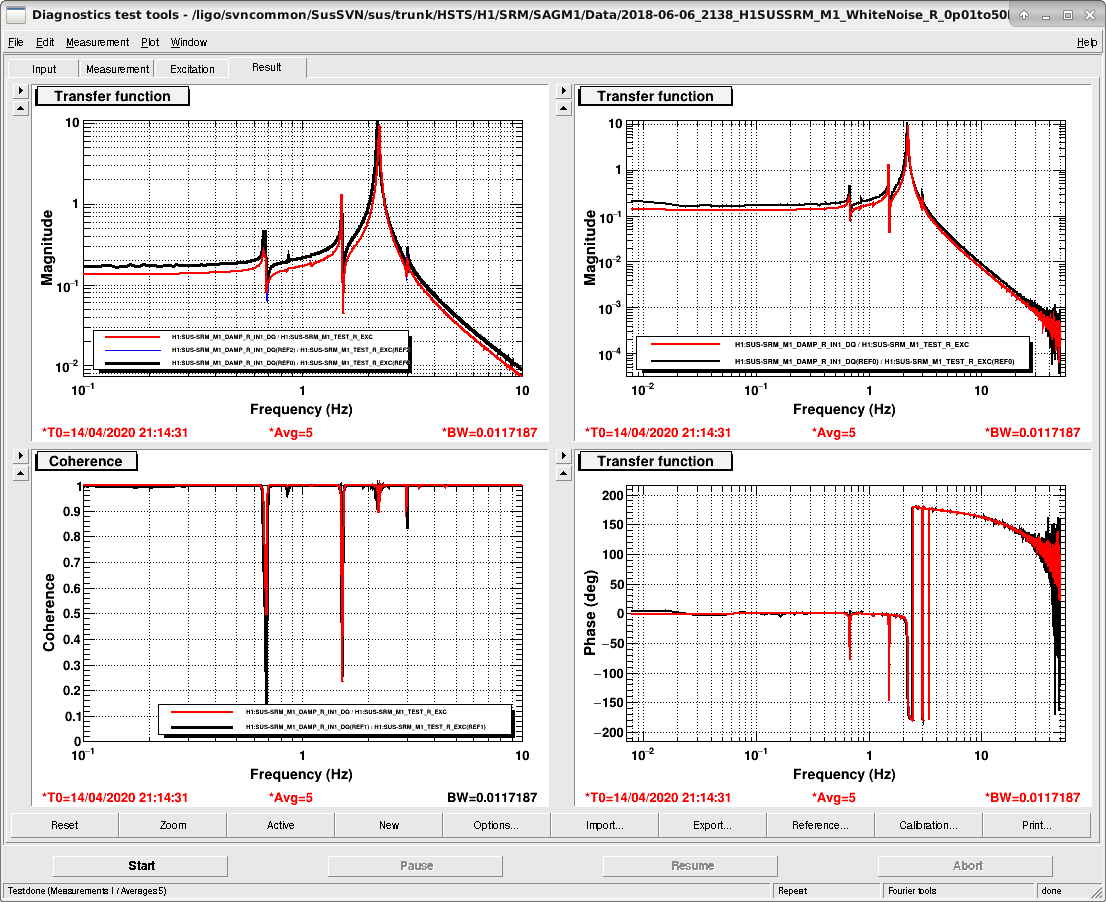
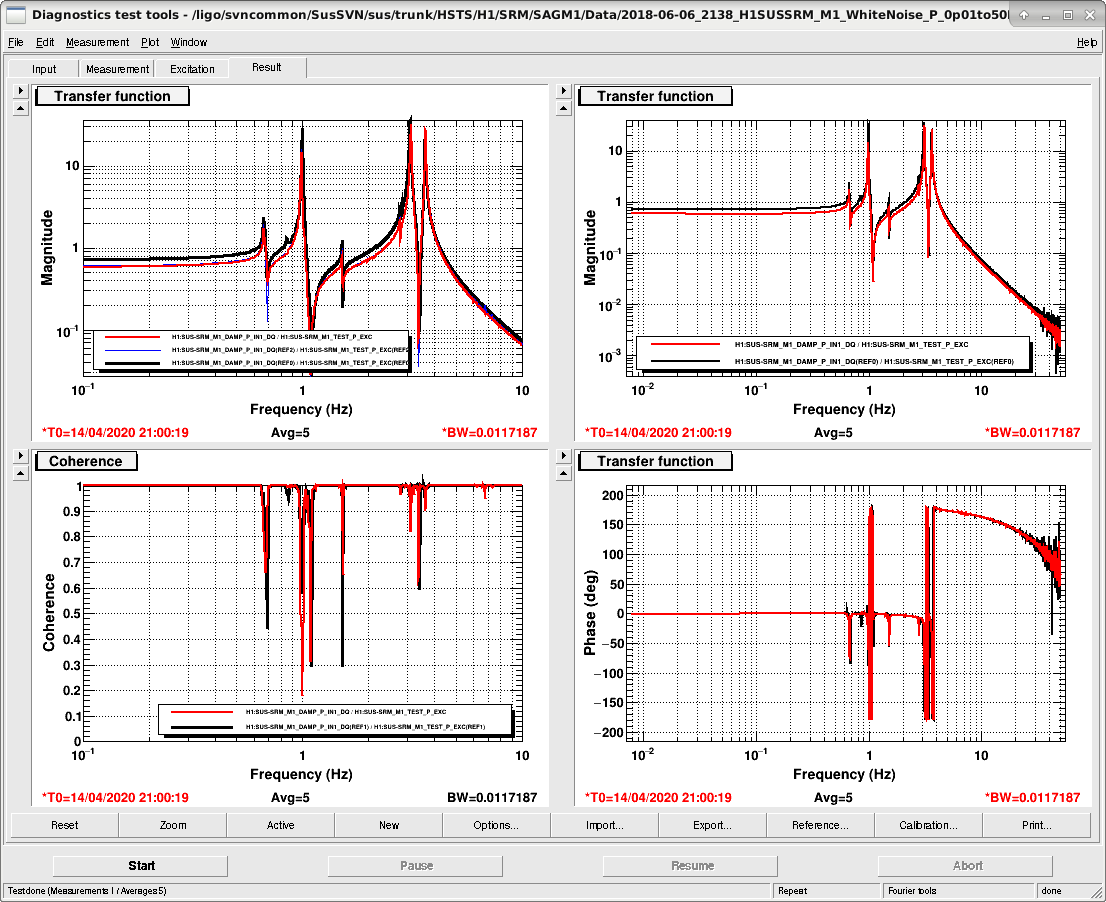
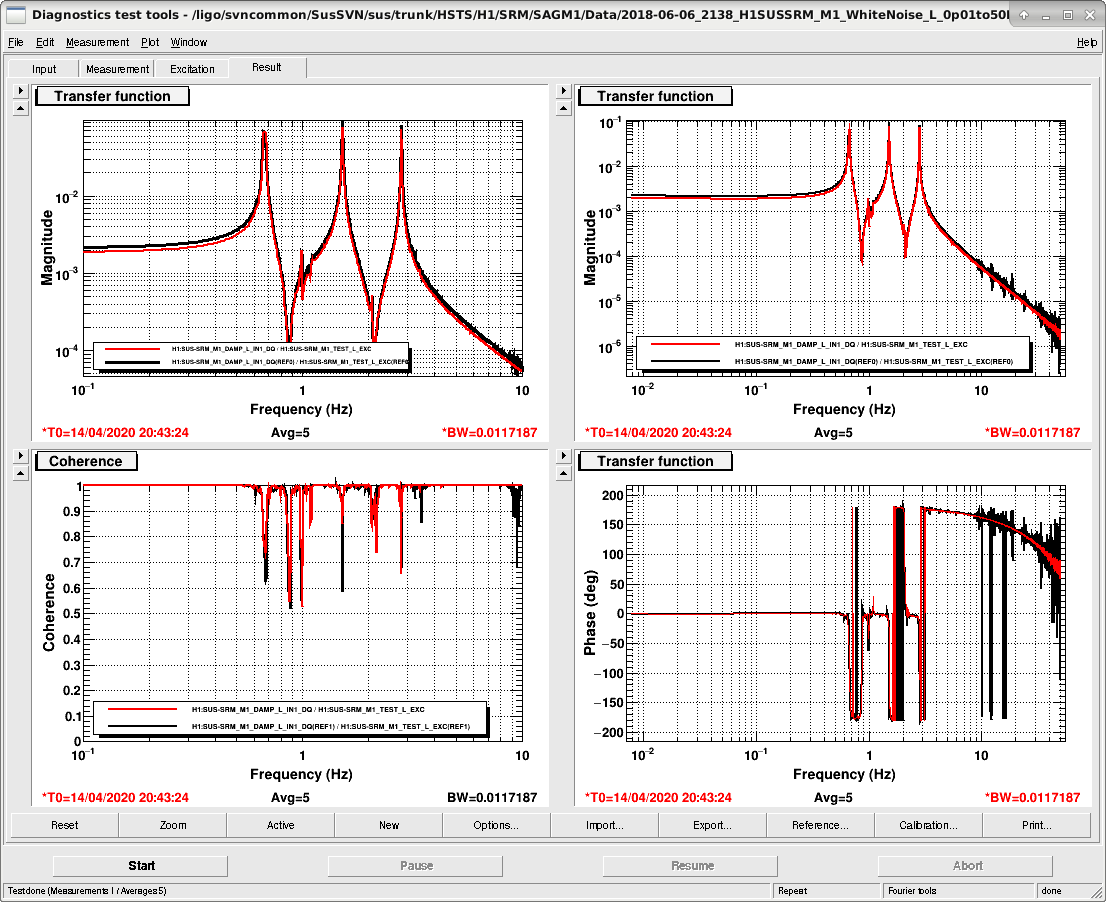
J. Kissel And to complete the analysis of this collection of data, I've processed the 2020-04-14_2000 data for H1SUSSRM. Individual data and comparison against its past and one other sus of the same type attached. I concur that the SUS is healthy and unchanged at this time. (The cross-coupling of the Second, 2.2 Hz Roll Mode in to the transverse DOF that appears in the 2019 and 2020 measurements is not alarming: these T and R DOFs are fundamentally cross-coupled, and this "extra" feature goes away when the SUS is damped. I see no other issues.)
At Jeff B.'s direction I added 200 ml of water which silenced the alarm. He will be in tomorrow, as normal, and will check.