Displaying reports 35001-35020 of 89220.Go to page Start 1747 1748 1749 1750 1751 1752 1753 1754 1755 End
Reports until 17:22, Thursday 02 April 2020
H1 SEI
jim.warner@LIGO.ORG - posted 17:22, Thursday 02 April 2020 (55855)
Added detail to sei WD_ALL screen

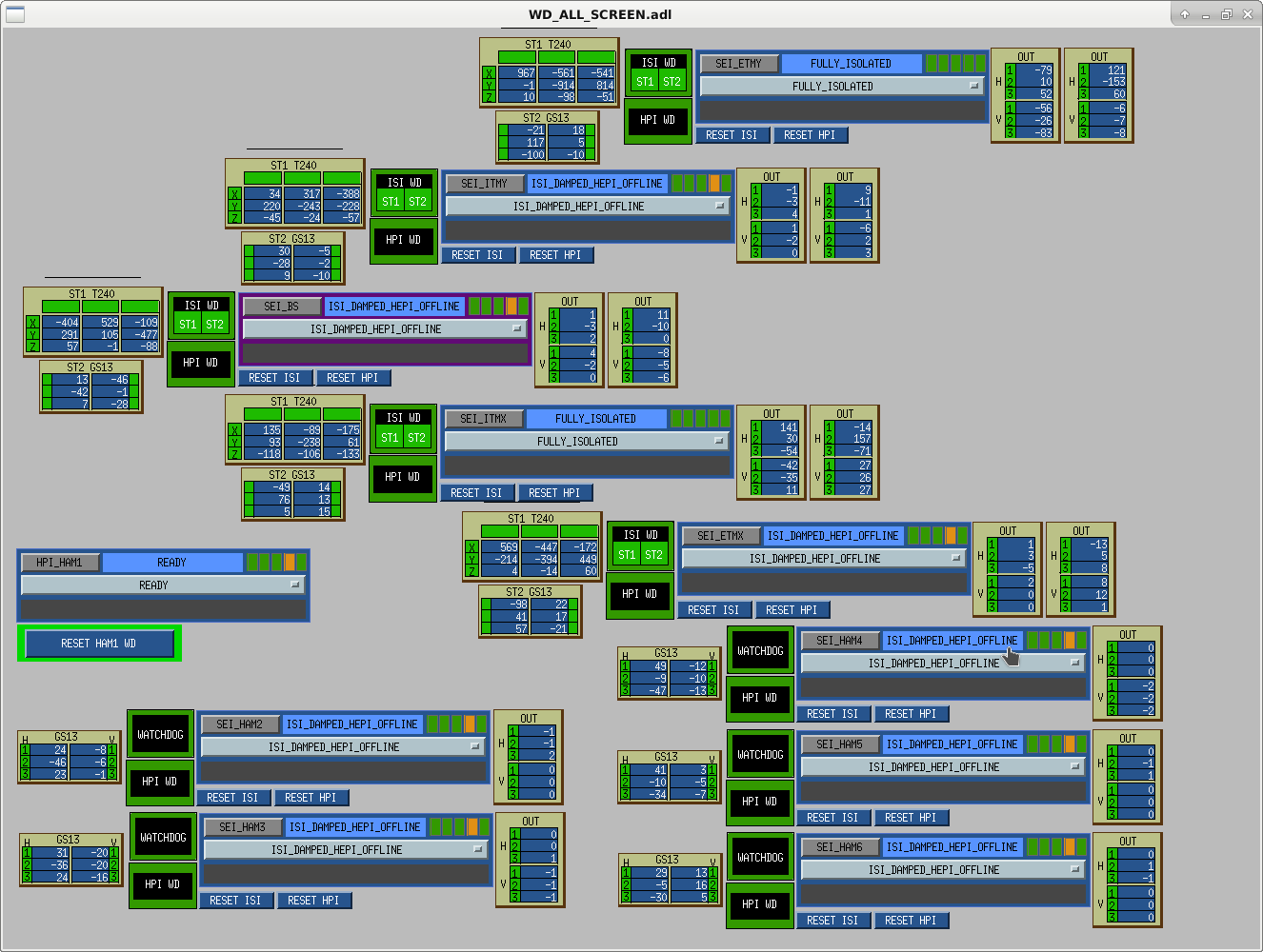
A long time ago I started a screen to make handling all of the SEI guardians and watchdogs easier. It can be found by going to SEI-> ISI SENSCOR CONFIG, then clicking the SEI WD SCREEN, in the upper left. It was pretty barebones, with just the medium chamber guardian overviews, buttons to reset watchdogs and lights for the ISI and HEPI watchdogs. I've been meaning to add more detail, to make it easier to see what seismometers and actuators were doing. The idea being to make it easier to see what all of the platforms are doing. Finally got around to that this week, my current version is attached below.

For each of the guardians, the relevant seismometers (St1 T240, St2 GS13s for BSCs, GS13s for the HAMs) are to the left, the actuator outputs are to the right. I imagine the layout looks a lot confusing, so I'm open to suggestions on better organization.

Images attached to this report
H1 CAL
jeffrey.kissel@LIGO.ORG - posted 16:39, Thursday 02 April 2020 - last comment - 16:39, Thursday 02 April 2020(55852)
H1 O3 B, C01 Chunk 1 Uncertainty Budget -- Still Disagrees with BB PCAL Injection
J. Kissel,

Now that we've got DCS C01 h(t) data for O3 B Chunk 1 (and other associated calibration data products like TDCFs) successfully produced, it's time to pick up where I've left off on producing an uncertainty budget for it. 
Chunk 1 is covering data from the start of O3 B, Nov 1 2019 15:00 UTC to Jan 14 2020 18:00 UTC.
Recall, the last time I touched this was on Feb 20 2020, when I was still confused as to why the broadband PCALY injection to h(t) disagreed with the estimated uncertainty envelope -- see LHO aLOG 55203.

The hope was that, with C01 data, the static model, and the time-dependent correction factors would be "super right," and it would adjust the *uncertainty budget's* predictions of median and 68% confidence interval envelope and it would all nicely line up, as has been true in the past (e.g. in LHO aLOG 52145).

Sadly, using C01 TDCFs made no difference in modifying the median or envelope. See attached .pdf.

In it, we see a bode plot of the measurement,
    /ligo/svncommon/CalSVN/aligocalibration/trunk/Runs/O3/H1/Results/GDS_BB_plots/H1_C00_over_CAL-PCALY_RX_PD_OUT_DQ_1262990871-153.txt

against the uncertainty budget produced in three ways ? each with the same input MCMC and GPR .hdf5 files, but requesting to use: 
	(a) No TDCFs (i.e. --version=ref --gpsTime=1261415486)
	(b) With C00 TDCFs (i.e. --version=C00 --gpsTime=1262998218 --GetData=GWPY)
	(c) With C01 TDCFs (i.e. --version=C01 --gpsTime=1262998218 --GetData=GWPY )
where the parenthetical statements are the differing arguments to our uncertainty budget code,
    /ligo/svncommon/CalSVN/aligocalibration/trunk/Common/pyDARM/RRNom.py

I'll add a comment below with the exact commands elucidating what other parameters were used, including the MCMC and GPR .hdf5 files. I'll at least say here, that I'm using measured sweep data collected for GPR analysis up to 2020-02-24, when we have 15 sensing function measurements, and 6 to 7 actuation function measurements, so we're in the region of diminishing returns.

You'll notice that all three uncertainty budgets, (a) through (c), look virtually identical. 
[EDIT] Lilli reminds me that the *uncertainty budget* is *unaffected* by the values of the TDCFs. 
    (i)We correct for "all" TDCFs (except for f_{s} and Q_{s}) in the live h(t) data, i.e. in the GDS/C00 and DCS/C01 data streams. That means that the TDCFs are *no longer* systematic error error. Thus, we *don't* include them in the systematic error budget. So, the only difference between C00 and C01 should be *the uncertainty* on the TDCFs, which doesn't change much at all, because the calibration lines which determine them are very loud. 
    (ii) Separately, during the reference time, we don't need to include any TDCFs, or, said differently, they are *defined* to not modify the data; all scalar TDCFs, the "kappas" are set to unity, and the frequency dependent TDCFs (of which, there's only one -- f_cc -- because we're excluding f_{s} and Q_{s}). That's because the detector is already behaving exactly as the reference time model. 

It's OK if you're confused by this, we're continually confused by it too, due to the way we construct these budgets being quite convoluted. We're finding this out as we try to explain what we're doing in the O3 A systematic error paper. C'est la vie. It'll be better in O4.
[/EDIT]
This indicates two things to me:
    (i) That the time dependent correction factors at 1262998218 (Jan 14 2020 00:50:00 UTC) -- which is much after the reference measurement time, 1261415486 (Dec 26 2019 17:11:08 UTC) -- are actually not correcting for much at all -- which means the detector at these two times were quite stable and reproducible. GREAT!
    (ii) The difference between TDCFs calculated in C00 and C01 are also, no different from each other. This is also unsurprising, and encouraging -- the time I'm using 1262998218 (Jan 14 2020 00:50:00 UTC) is in the observing segment *right* after the 2020-01-03 model was installed on 2020-01-13. So this confirms that C00 is *just as good* as C01 *after* 2020-01-13. GREAT!

However -- we're still *at* the drawing board with why these don't agree. We've got a few ideas from here:
    (1) Aaron had mentioned some (at the time) recently discovered issue with the TST driver, which he eluded to the day prior to my 2020-02-20 aLOG. The plot he showed us was this one, the description of which I repeat here for convenience:
    That plot shows the response function with (in blue) and without (in maroon) the systematic error present.
You could convince yourself that the discrepancy between the GDS measurement (which would have this TST flaw) and the uncertainty envelope is *about* what you see as the blue curve in that preliminary plot. But, stay tuned for the analysis to be done right -- applying the correction in "the right direction" and putting these things on the same plot.

    (2) We've really only compared this exact same measurement, every time, to the uncertainty budget. It's a small hope, but still a hope, that if we compare several times of BB injections -- as well as swept sine measurements -- like was done in LHO  aLOG 52145, then we might find that this measurement is just a weird, outlying measurement.
but I'm not super excited that we'll understand either quicky.

I'm *really* hoping that it's the PCAL / GDS measurement that's been processed in correctly, and/or it's an outlier.

Soooo -- yet again -- stay tuned.
Non-image files attached to this report
Comments related to this report
jeffrey.kissel@LIGO.ORG - 15:49, Thursday 02 April 2020 (55853)
Here're the highlights of how I've produced these uncertainty budgets. All details are recorded in T2000006-v5_notes_CalModelParameterSetGeneration_20190103.txt.

The .hdf5 files that contain posterior distributions of all model parameters determined by MCMC live here:
For A    
    /ligo/svncommon/CalSVN/aligocalibration/trunk/Runs/O3/H1/Results/Uncertainty/
        O3B_H1_A_MCMC_20200103Model_REF.hdf5
For C
/ligo/svncommon/CalSVN/aligocalibration/trunk/Runs/O3/H1/Results/Uncertainty/
        O3_H1_C_MCMC_2019-12-26_forreference_fmin20Hz.hdf5

These were produced by the following scripts, respectively,
    /ligo/svncommon/CalSVN/aligocalibration/trunk/Runs/O3/H1/Scripts/FullIFOActuationTFs/
        process_actuation_MCMC_model20200103_meas20190403_forreference.py
    /ligo/svncommon/CalSVN/aligocalibration/trunk/Runs/O3/H1/Scripts/FullIFOSensingTFs/
        process_sensingmeas_MCMC_model20200103_meas20191226_forreference.py

For the unknown frequency dependent error, the Gaussian process regression posterior distribution .hdf5 files are here:
For A
    /ligo/svncommon/CalSVN/aligocalibration/trunk/Runs/O3/H1/Results/Uncertainty/
        2020-02-24_GPR_Run_H1_A_O3B_meas20191204-20200224_collection_model20200103_NOPCALSYSERR_ALL_UIM_f7-250Hz_L0p1_PUM_f7-500Hz_L0p2_TST_f10-1000Hz_L0p5_posteriors.hdf5 
For C
    /ligo/svncommon/CalSVN/aligocalibration/trunk/Runs/O3/H1/Results/Uncertainty/
        2020-02-24_GPR_Run_H1_C_O3B_meas20191120-20200224_collection_model20200103_NOPCALSYSERR_nofsQcorr_MCMCfmin20Hz_GPRfmin20_lengthscale0p35_withPCALXHFdata_model20200103_posteriors.hdf5

These were produced by the following scripts, respectively,
    /ligo/svncommon/CalSVN/aligocalibration/trunk/Runs/O3/H1/Scripts/Uncertainty/
        process_allmeas_writeGPRHDF5_20200224_A_meas20191204-20200224_model20200103_NOPCALSYSERR.py
    /ligo/svncommon/CalSVN/aligocalibration/trunk/Runs/O3/H1/Scripts/Uncertainty/
        process_allmeas_writeGPRHDF5_20200224_C_meas20191120-20200224_model20200103_NOPCALSYSERR_withHF.py

(with a discussion of the RBF length scales I used for the GPR kernels are in LHO aLOG 55012)

Using the above mentioned .hdf5 files, the exact calls I used to create the uncertainty budgets are therefore:

(a) 
python /ligo/svncommon/CalSVN/aligocalibration/trunk/Common/pyDARM/RRNom.py --IFO=LHO --HDF5_A_MCMCresults=/ligo/svncommon/CalSVN/aligocalibration/trunk/Runs/O3/H1/Results/Uncertainty/O3B_H1_A_MCMC_20200103Model_REF.hdf5 --HDF5_A_GPRresults=/ligo/svncommon/CalSVN/aligocalibration/trunk/Runs/O3/H1/Results/Uncertainty/2020-02-24_GPR_Run_H1_A_O3B_meas20191204-20200224_collection_model20200103_NOPCALSYSERR_ALL_UIM_f7-250Hz_L0p1_PUM_f7-500Hz_L0p2_TST_f10-1000Hz_L0p5_posteriors.hdf5 --HDF5_C_MCMCresults=/ligo/svncommon/CalSVN/aligocalibration/trunk/Runs/O3/H1/Results/Uncertainty/O3_H1_C_MCMC_2019-12-26_forreference_fmin20Hz.hdf5 --HDF5_C_GPRresults=/ligo/svncommon/CalSVN/aligocalibration/trunk/Runs/O3/H1/Results/Uncertainty/2020-02-24_GPR_Run_H1_C_O3B_meas20191120-20200224_collection_model20200103_NOPCALSYSERR_nofsQcorr_MCMCfmin20Hz_GPRfmin20_lengthscale0p35_withPCALXHFdata_model20200103_posteriors.hdf5  --modelPath=/ligo/svncommon/CalSVN/aligocalibration/trunk/Runs/O3/H1/params/ --modelFilename=modelparams_H1_20200103 --IFOmodel=modelPars --sampleNumber=1000 --seed=1111 --version=ref --outDir=/ligo/svncommon/CalSVN/aligocalibration/trunk/Runs/O3/H1/Results/Uncertainty/  --plot1SigmaUncs --saveSummaries --gpsTime=1261415486

(b)
python /ligo/svncommon/CalSVN/aligocalibration/trunk/Common/pyDARM/RRNom.py --IFO=LHO --HDF5_A_MCMCresults=/ligo/svncommon/CalSVN/aligocalibration/trunk/Runs/O3/H1/Results/Uncertainty/O3B_H1_A_MCMC_20200103Model_REF.hdf5 --HDF5_A_GPRresults=/ligo/svncommon/CalSVN/aligocalibration/trunk/Runs/O3/H1/Results/Uncertainty/2020-02-24_GPR_Run_H1_A_O3B_meas20191204-20200224_collection_model20200103_NOPCALSYSERR_ALL_UIM_f7-250Hz_L0p1_PUM_f7-500Hz_L0p2_TST_f10-1000Hz_L0p5_posteriors.hdf5 --HDF5_C_MCMCresults=/ligo/svncommon/CalSVN/aligocalibration/trunk/Runs/O3/H1/Results/Uncertainty/O3_H1_C_MCMC_2019-12-26_forreference_fmin20Hz.hdf5 --HDF5_C_GPRresults=/ligo/svncommon/CalSVN/aligocalibration/trunk/Runs/O3/H1/Results/Uncertainty/2020-02-24_GPR_Run_H1_C_O3B_meas20191120-20200224_collection_model20200103_NOPCALSYSERR_nofsQcorr_MCMCfmin20Hz_GPRfmin20_lengthscale0p35_withPCALXHFdata_model20200103_posteriors.hdf5 --modelPath=/ligo/svncommon/CalSVN/aligocalibration/trunk/Runs/O3/H1/params/ --modelFilename=modelparams_H1_20200103 --IFOmodel=modelPars --sampleNumber=1000 --seed=1111 --version=C00 --outDir=/ligo/svncommon/CalSVN/aligocalibration/trunk/Runs/O3/H1/Results/Uncertainty/  --plot1SigmaUncs --saveSummaries --gpsTime=1262998218 --GetData=GWPY

(c)
python /ligo/svncommon/CalSVN/aligocalibration/trunk/Common/pyDARM/RRNom.py --IFO=LHO --HDF5_A_MCMCresults=/ligo/svncommon/CalSVN/aligocalibration/trunk/Runs/O3/H1/Results/Uncertainty/O3B_H1_A_MCMC_20200103Model_REF.hdf5 --HDF5_A_GPRresults=/ligo/svncommon/CalSVN/aligocalibration/trunk/Runs/O3/H1/Results/Uncertainty/2020-02-24_GPR_Run_H1_A_O3B_meas20191204-20200224_collection_model20200103_NOPCALSYSERR_ALL_UIM_f7-250Hz_L0p1_PUM_f7-500Hz_L0p2_TST_f10-1000Hz_L0p5_posteriors.hdf5 --HDF5_C_MCMCresults=/ligo/svncommon/CalSVN/aligocalibration/trunk/Runs/O3/H1/Results/Uncertainty/O3_H1_C_MCMC_2019-12-26_forreference_fmin20Hz.hdf5 --HDF5_C_GPRresults=/ligo/svncommon/CalSVN/aligocalibration/trunk/Runs/O3/H1/Results/Uncertainty/2020-02-24_GPR_Run_H1_C_O3B_meas20191120-20200224_collection_model20200103_NOPCALSYSERR_nofsQcorr_MCMCfmin20Hz_GPRfmin20_lengthscale0p35_withPCALXHFdata_model20200103_posteriors.hdf5 --modelPath=/ligo/svncommon/CalSVN/aligocalibration/trunk/Runs/O3/H1/params/ --modelFilename=modelparams_H1_20200103 --IFOmodel=modelPars --sampleNumber=1000 --seed=1111 --version=C01 --outDir=/ligo/svncommon/CalSVN/aligocalibration/trunk/Runs/O3/H1/Results/Uncertainty/  --plot1SigmaUncs --saveSummaries --gpsTime=1262998218 --GetData=GWPY

where for C00 and C01 data I've chosen 1262998218 (Jan 14 2020 00:50:00 UTC), because this is just after the start of the DMT-ANALYSIS_READY segment which resumed after we updated the model on 2020-01-13 between 21:50:08 UTC and 22:47:32 UTC.
H1 General
travis.sadecki@LIGO.ORG - posted 16:10, Thursday 02 April 2020 (55854)
Tumbleweed vaporization project, X arm

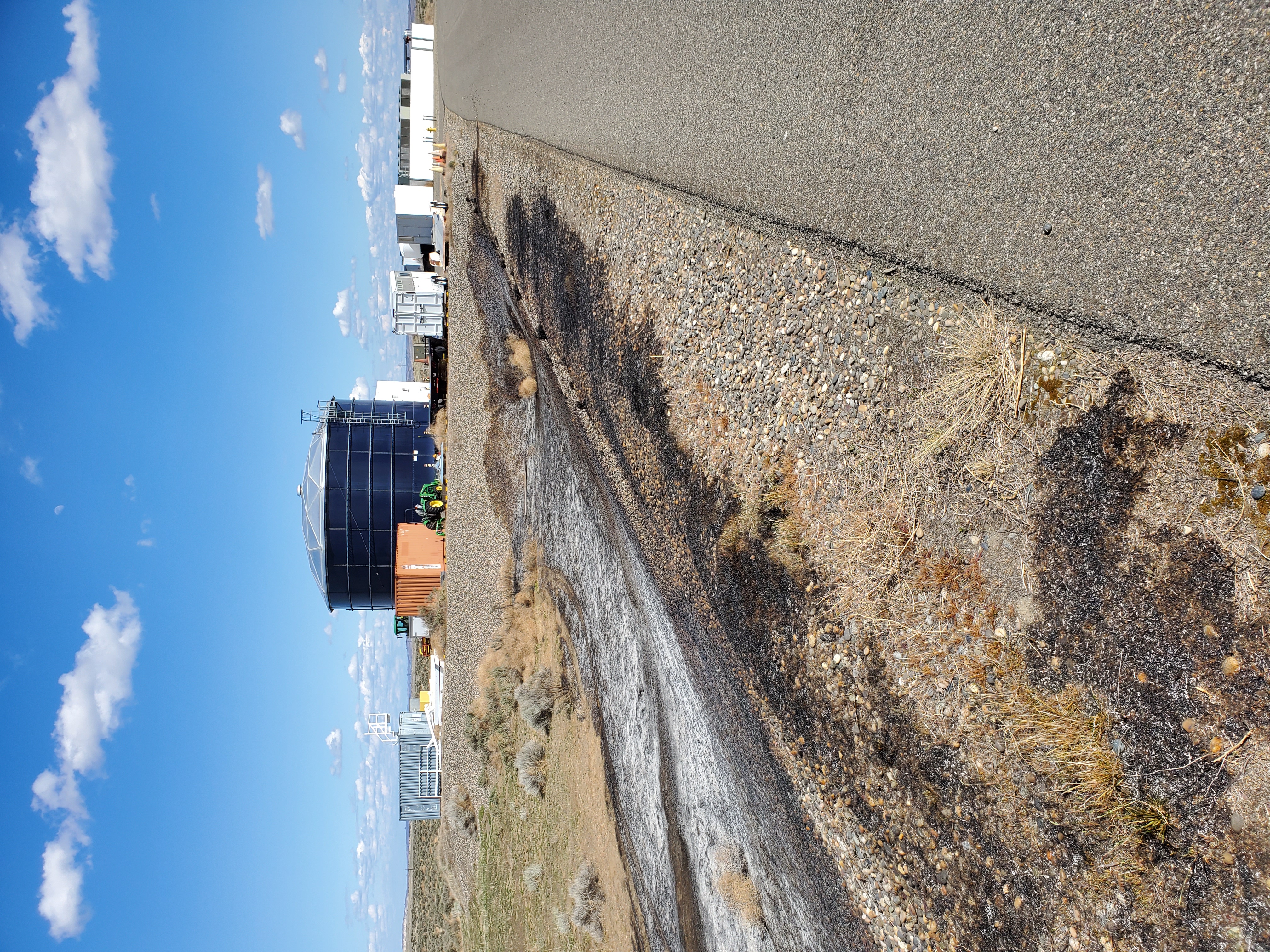
While on site briefly today, I took the opportunity to take some pics of the tumbleweed burning that happened along the X arm yesterday since people seemed interested during the Site Weekly meeting.  See attached pics showing the remnants of our tumbleweed stores along the east side of the X arm, starting near the corner station and proceeding to ~halfway to the mid-station (an estimate since I didn't go further than the overpass).

Images attached to this report
H1 CDS
david.barker@LIGO.ORG - posted 12:53, Thursday 02 April 2020 - last comment - 17:21, Thursday 02 April 2020(55849)
cdsadminctrl machine removal work ongoing

WP8578 decommission remote access central management machine (cdsadminctrl)

Jonathan, Dave:

We have started removing the reliance of remote login sessions from being monitored by the central cdsadminctrl computer, which is a single point failure for remote logins. Jonathan is removing the authentication system's reliance on this machine. We have stopped the EPICS IOC running on this machine and I have written python ioc code which will run on the two remote login machines directly (cdsssh and cdslogin).

While this work is proceding, you might notice RACCESS channels whitened on MEDMs and the EDC with a disconnect count.

cdsadminctrl also monitored login sessions to itself and h1hwinj1. We are no longer monitoring these systems, but to preserve their channels which are being acquired by the DAQ I am spoofing these channels on cdsssh. When we can restart the DAQ, I'll take these channels out of H1EPICS_RACCESS.ini and the IOC.

Comments related to this report
david.barker@LIGO.ORG - 17:21, Thursday 02 April 2020 (55856)

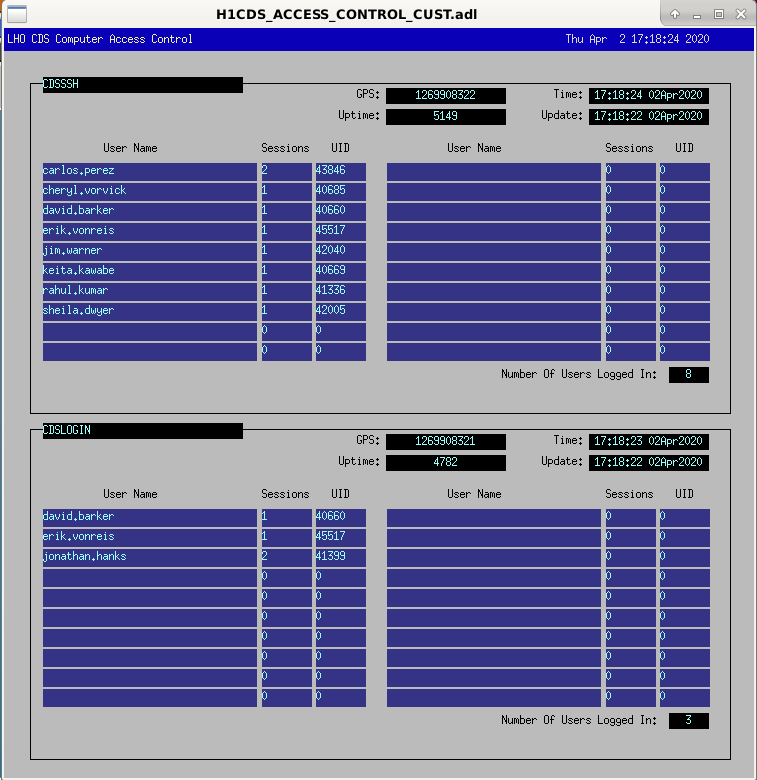
this work is now completed, cdsadminctrl has been turned off (was a VM). Local IOCs are now running on cdsssh and cdslogin, the legacy PVs are handled by IOCs runnig on zotws6 currently.

I've created a simplied RACCESS MEDM. In the new scheme, only the username, num_sessions and UID are stored per user. The IOC has additional diagnostics including GPS time, uptime, processing and updating times.

I'll write up the details in a wiki.

Images attached to this comment
H1 SUS (SUS)
cheryl.vorvick@LIGO.ORG - posted 11:18, Thursday 02 April 2020 - last comment - 14:14, Friday 10 April 2020(55848)
signal changes on ETMY suggest stage L2 is touching

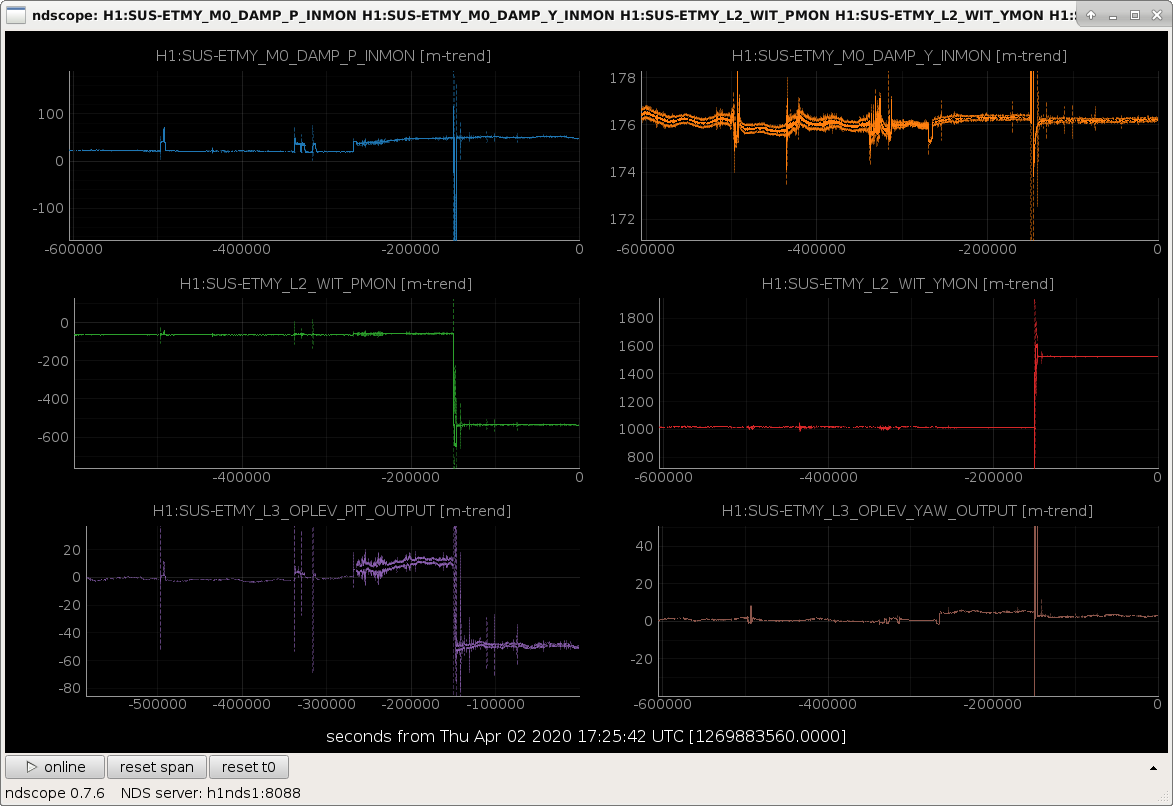
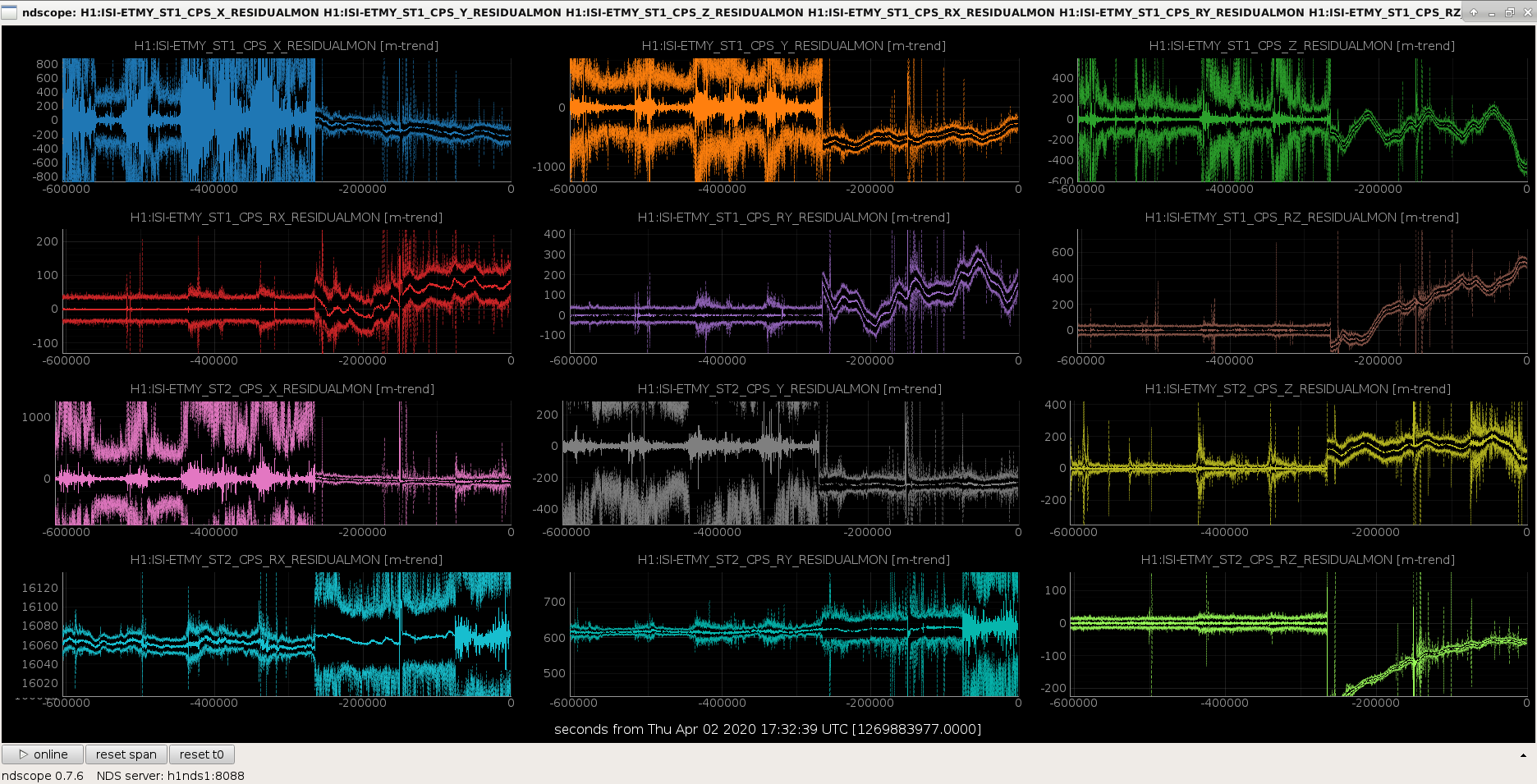
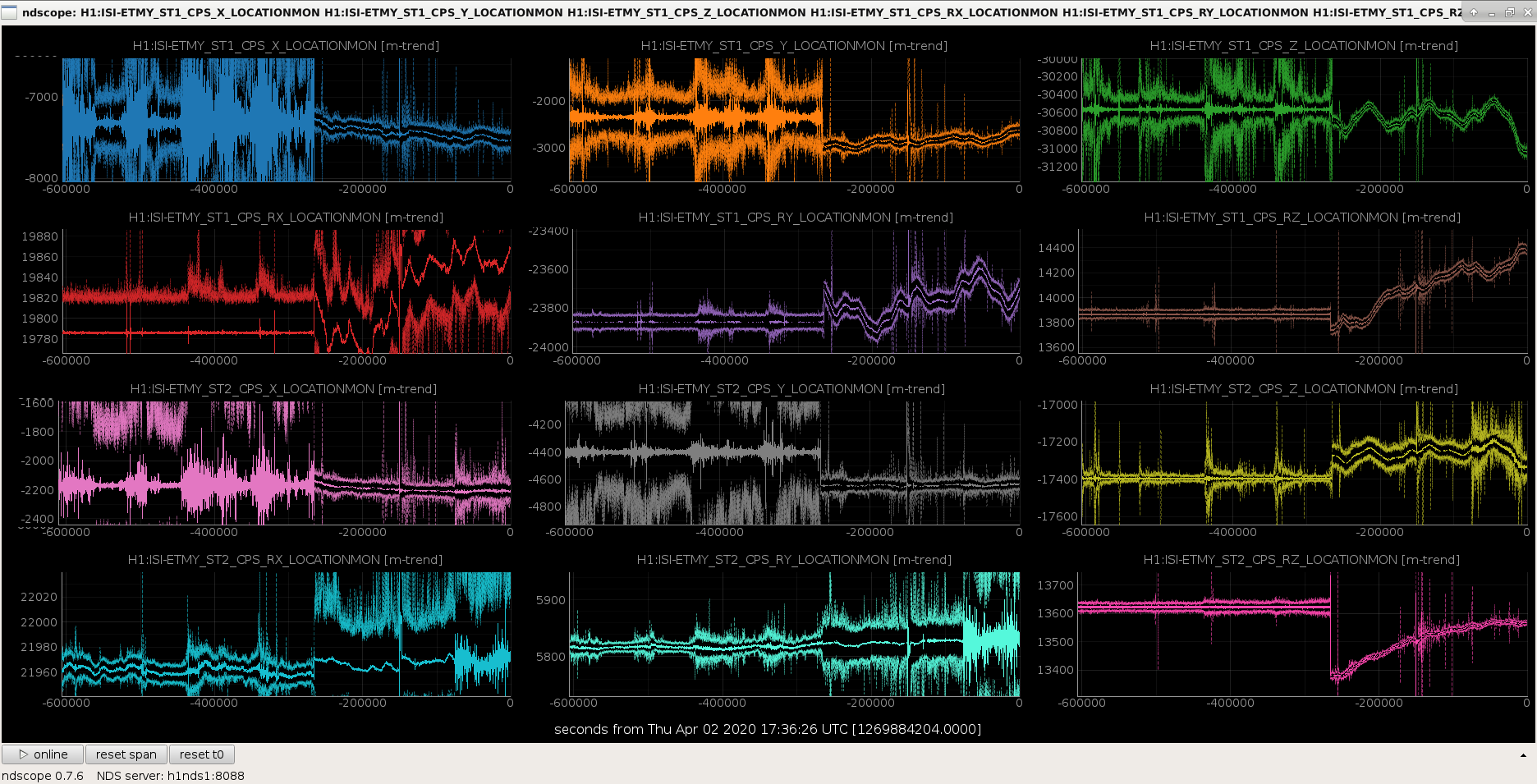
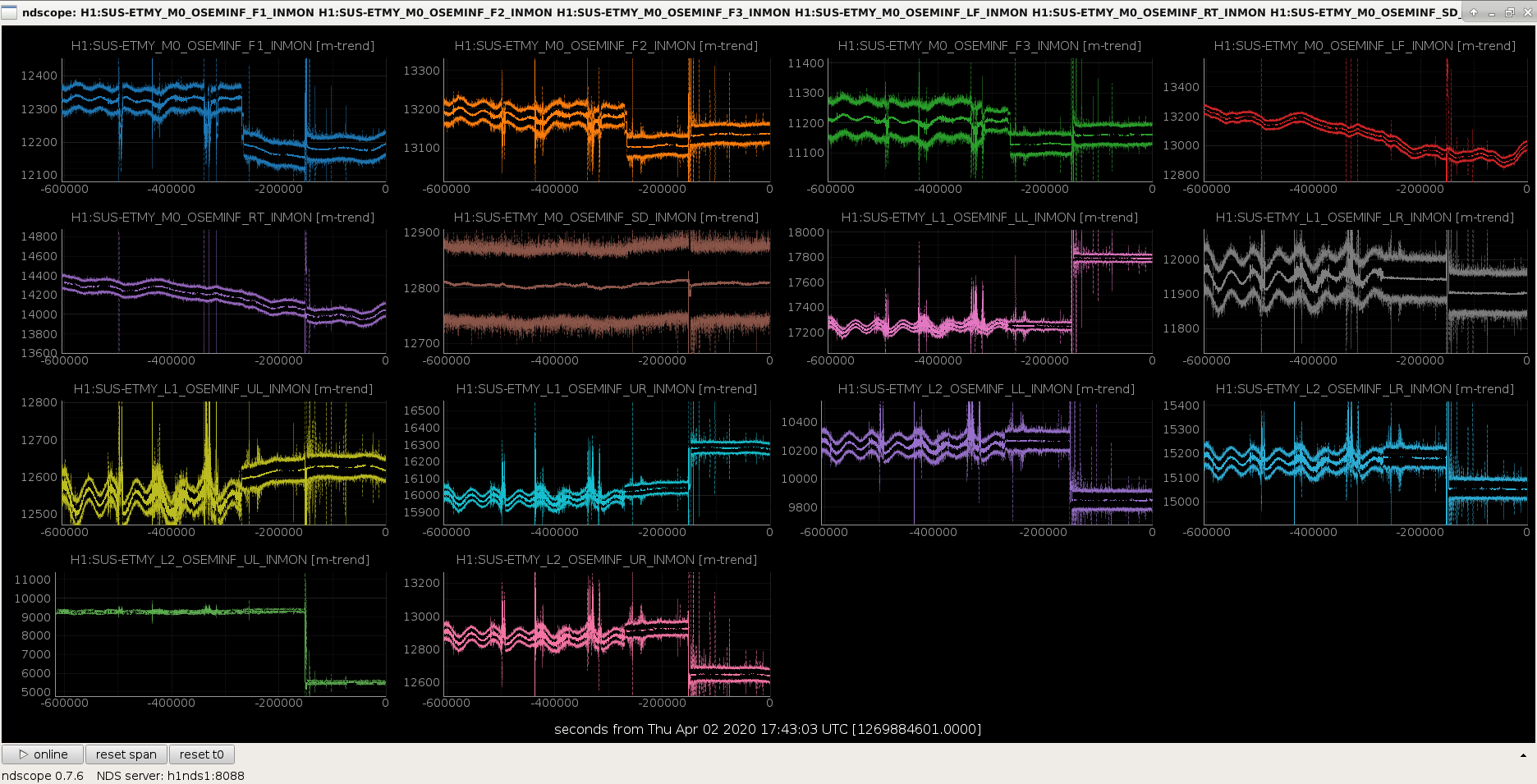
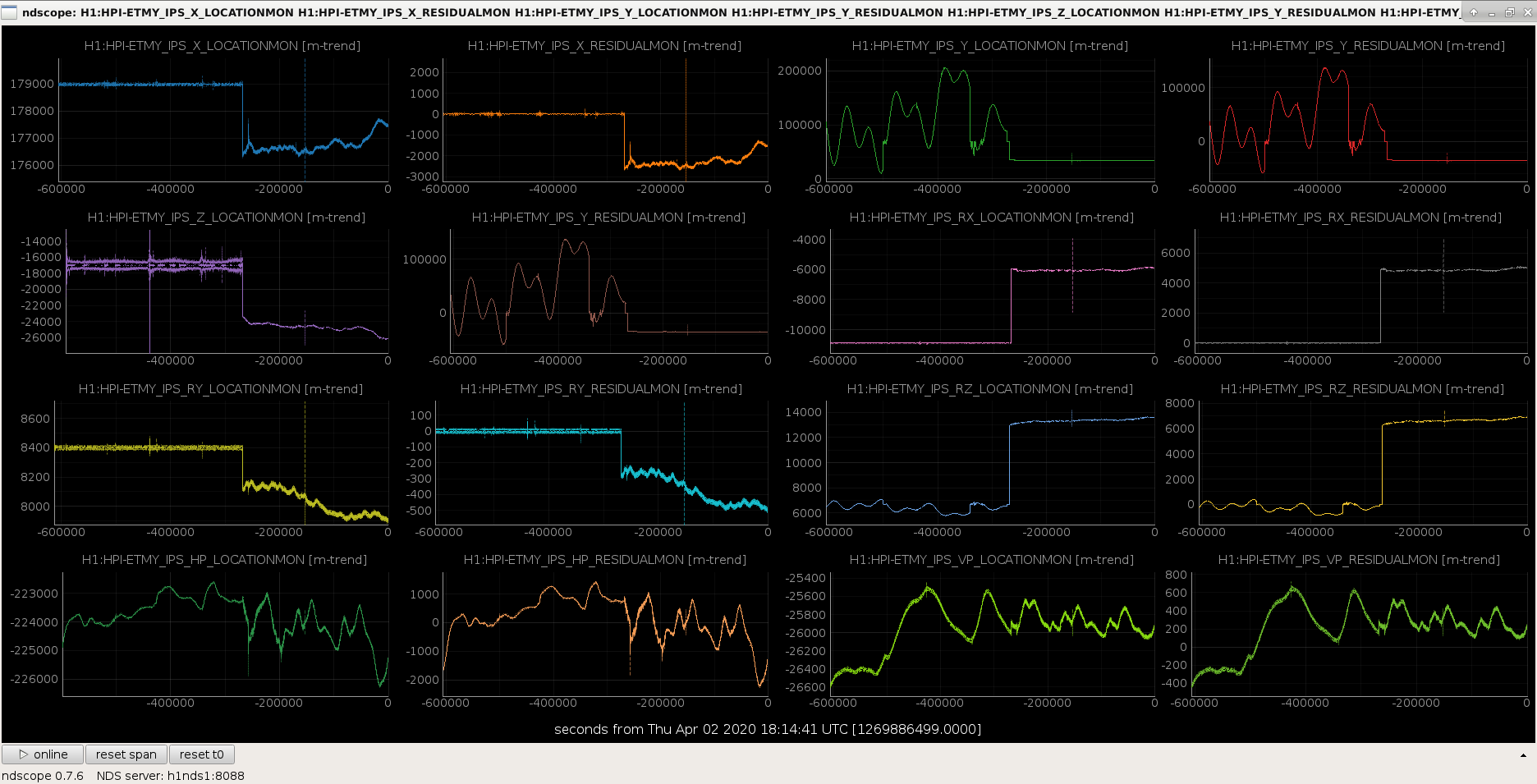
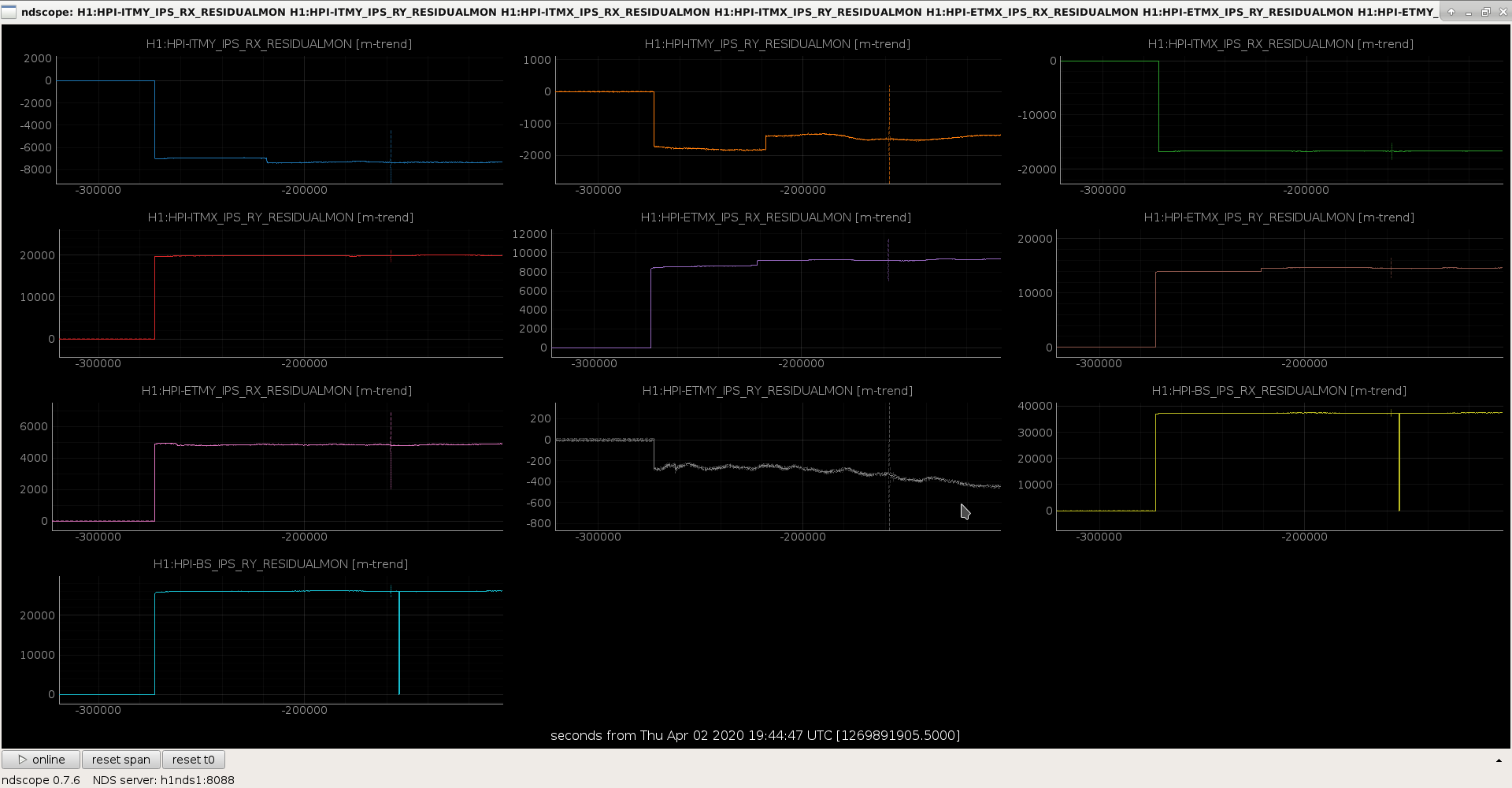
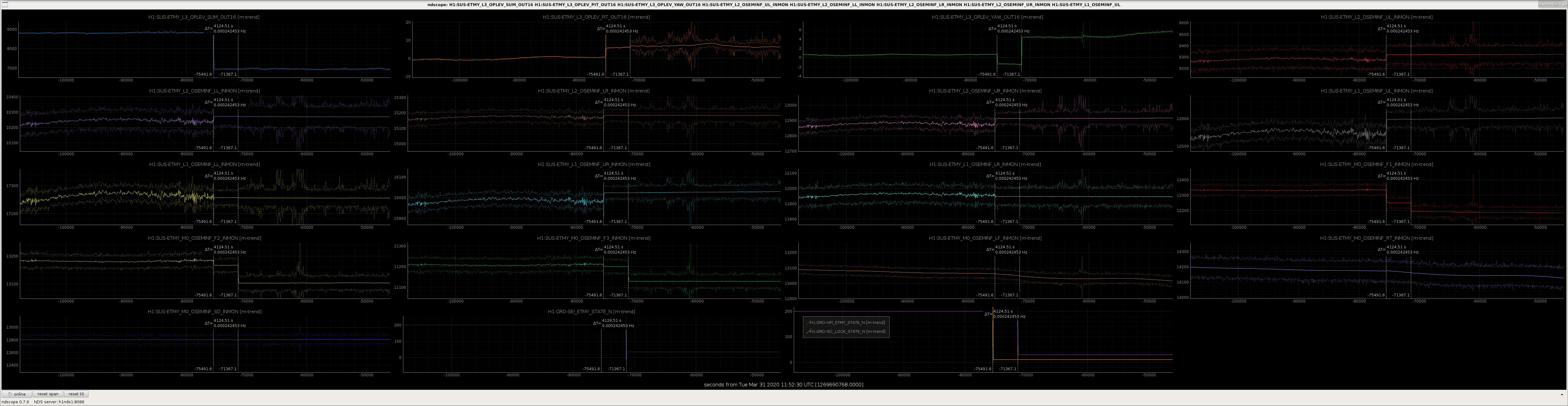
Attached are plots of ETMY OSEMS, pitch and yaw, ISI ST1 and ST2 location monitors and their residuals, and HEPI location monitors and their residuals.  In all plots, the first change (if present) is due to disengaging HEPI, and the second change (if present) is due to the Idaho M6.4 earthquake.

Plot 4 shows that ETMY L2 signals become very steady after the HEPI change, and shift after the EQ, and remain in the changed position, and remain very steady, which I believe suggests that L2 is touching.

Plots attached are in the order I created them, while looking into why the ETMY optical lever in pitch is now sitting at -50.

Images attached to this report
Comments related to this report
jim.warner@LIGO.ORG - 13:03, Thursday 02 April 2020 (55851)

Attaching the RX/RY residualmons for all the BSC HEPIs over a similar window. The biggest shifts are about 40 urad, on the BS, most are less than 20 though. The ETMY shift is relatively small, about 7 urad in RX, more or less pitch for that SUS. Do we have any idea of how much pitch is allowed by the given the clearance in the eq stops?

Images attached to this comment
jenne.driggers@LIGO.ORG - 14:14, Friday 10 April 2020 (55900)

Upon further zooming in, it looks like this effect is due to the IFO being unlocked (the first t-cursor in the attached plot), and not the HEPI state being changed (second t-cursor in the attached plot).

I suspect that much of the effect of the L2 OSEMS looking more 'staionary' is that we're no longer actuating the optic with angular control once we unlock.  I do also note that in the pitch oplev, we see that there is a shift when the IFO is unlocked, but not any real shift when the HEPI is taken offline (yaw sees a shift for both), but the motion as seen by the oplev is higher, becasue the seismic platform just isn't as isolated. 

Rahul is in process of taking TFs to confirm that even with the HEPI in READY we're not rubbing.  He'll post those in a separate alog.

Thank you, Arnaud, for suggesting we have another look at this.

Images attached to this comment
H1 CDS (DetChar, PEM)
david.barker@LIGO.ORG - posted 08:48, Thursday 02 April 2020 (55847)
h1pemmx front end crash

The h1pemmx system crashed at 13:27 UTC (06:27 PDT) this morning, Thursday 2nd April 2020. It does not respond to pings and will need to be power cycled to restore it. Talking with Richard, because this system reads out the Vault PEM signals, we will want to reboot this at the earliest opportunity, which could be next Tuesday when team-vacuum is onsite.

On the CDS Overview MEDM: h1ioppemmx and h1pemmx models are white, h1edc is not connecting to 17 channels for these models (9 for iop, 8 for pemmx) and the CDS Hardware status is RED with 'ioppemmx ADC error'.

If the downtime will be many days, I'll change these sytems to bypass pemmx to 'green them up'.

The sister system pemmy has been running for 561 days (since 19th September 2018, last RCG upgrade), presumably h1pemmx had the same uptime.

Fast channels missing while this system is down (tagging PEM and DetChar)

[H1:PEM-MX_ACC_BEAMTUBE_CRYO_Y_DQ]
[H1:PEM-MX_SEIS_VEA_FLOOR_QUAD_SUM_DQ]
[H1:PEM-MX_SEIS_VEA_FLOOR_X_DQ]
[H1:PEM-MX_SEIS_VEA_FLOOR_Y_DQ]
[H1:PEM-MX_SEIS_VEA_FLOOR_Z_DQ]
[H1:PEM-VAULT_MAG_1030X195Y_COIL_QUAD_SUM_DQ]
[H1:PEM-VAULT_MAG_1030X195Y_COIL_X_DQ]
[H1:PEM-VAULT_MAG_1030X195Y_COIL_Y_DQ]
[H1:PEM-VAULT_MAG_1030X195Y_COIL_Z_DQ]
[H1:PEM-VAULT_SEIS_1030X195Y_STS2_QUAD_SUM_DQ]
[H1:PEM-VAULT_SEIS_1030X195Y_STS2_X_DQ]
[H1:PEM-VAULT_SEIS_1030X195Y_STS2_Y_DQ]
[H1:PEM-VAULT_SEIS_1030X195Y_STS2_Z_DQ]
 

Images attached to this report
H1 GRD (ISC)
camilla.compton@LIGO.ORG - posted 16:49, Wednesday 01 April 2020 (55845)
Increased threshold in ALS_COMM for moving straight to FINE_TUNE_IR to avoid GRD getting stuck at NO_IR_FOUND
In an effort to reduce operator intervention at FIND_IR states:
In the FAST_SEARCH of ALS_COMM, GRD checks if IR power is above a threshold, and therefore "found", before moving any VCO controls. If above the threshold, ALS_COMM advances straight to FINE_TUNE_IR before adjusting any settings. Three times in the last couple of weeks IR power (H1:LSC-TR_X_NORM_INMON) has been just above this threshold for the check, advancing ALS_COMM straight to FINE_TUNE_IR where it has failed with "transmitted power too low", sending ALS_COMM to NO_IR_FOUND where it stays waiting for operator intervention.
I have increased the threshold from 0.1 to 0.15 so it will not move ahead until the power is higher. 
 
TJ changed the ISC_LOCK to let ALS_DIFF repeat it's search for IR last week (alog 55725), but I don't think it's necessary to do that with ALS_COMM.
It's possible that the frequencies we set the VCO for may need updating. I will look at more successful FIND_IR runs to see what is typical.
H1 TCS (TCS)
jeffrey.bartlett@LIGO.ORG - posted 12:33, Wednesday 01 April 2020 (55844)
Shut Down and Drain TCS Chillers
   This morning both TCS chillers were powered down. 

   The X & Y reservoirs were siphoned dry. Then wiped out with towels. The pump, supply and return lines were blown out, and the lines drained. Dry break fittings were left in the supply and return lines, leaving them open to atmosphere, so any moisture left in the system and evaporate.

   Went into the LVEA and drained both TCS tables. Both lines on both tables were vacuumed to draw remaining moisture out of the lines and equipment on the table. Left dry break fittings in both lines on both tables, opening the plumbing to the atmosphere so any moisture remaining in the system can evaporate. The line ends with the dry breaks were covered with clean wipes to prevent critters form getting in the lines. Next time I can get LVEA access will remove the dry breaks and seal the table plumbing.   

   Not sure how successful the internal drying was done. The tote with the fittings for the clean vacuum, which is used to evacuate moisture from the site chillers, is missing from the cleaning area. Had to jury rig a hose fitting.          

 
H1 PEM
jeffrey.bartlett@LIGO.ORG - posted 12:13, Wednesday 01 April 2020 (55843)
Bi-Monthly Dust Monitor Vacuum Pump Checks (FAMIS #13010)
Checked the dust monitor vacuum pump in the CS. 

   Temperatures were all normal. 

   Vacuum pressure was down to 16inHg. Should be around 18inHg. The air bleed valve is fully shut. Unless there is a degradation is the pump, there is a leak in the hose somewhere in the LVEA. The pump was overhauled a few months ago. At that time there was no indication of internal problems with the pump. It passed the post rebuild bench test.  

   Next time I can get into the LVEA need to check the vacuum hose for leaks. 

   Did not check the end stations due to COVID19 considerations

Closing FAMIS #13010
H1 SEI (SEI)
jeffrey.bartlett@LIGO.ORG - posted 12:03, Wednesday 01 April 2020 (55842)
Bi_weekly HEPI Fluid Check (FAMIS #13500)
   Checked the CS HEPI pump skid and fluid reservoir. 

   Fluid Level 6 3/16 - Down 1/16 from last check. Trip level is at 1/16. The fluid level was down by 1/16 on 03/24/20 as well. At this rate of loss, it will about two weeks before the CS HEPI shuts down. 
   
   Discussed with Hugh. 

   Dis not check the end stations due to COVID-19 considerations. 

Closing FAMIS #13500
H1 IOO
cheryl.vorvick@LIGO.ORG - posted 23:01, Tuesday 31 March 2020 (55839)
changed IM2 pitch

IMs were affected by HEPI being turned off.  I reduced the IM2 picth drive, so that all coil drives were reduced from 50K to 70K (yellow on SUS saturations) to all around 30K (all green on SUS saturations).   IM2 old pitch slider value was 17557, now 7557, yaw slider is unchanged.

H1 AOS
corey.gray@LIGO.ORG - posted 18:30, Tuesday 31 March 2020 - last comment - 12:58, Thursday 02 April 2020(55838)
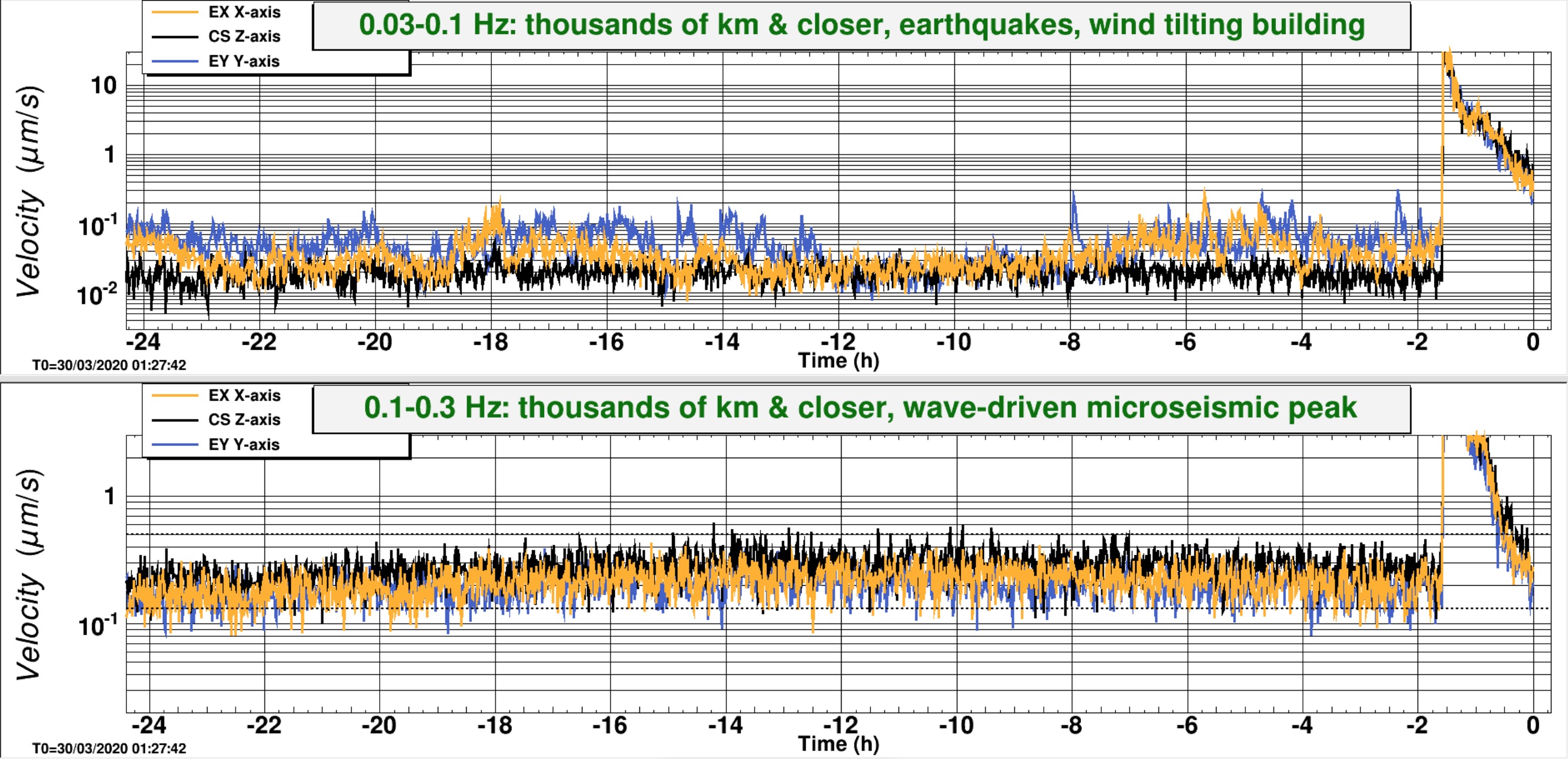
6.5 EQ Hits In Idaho & Trips Most SEI/SUS

(Corey, Jeff K, Jenne, Jim, Keita, Sheila)

I checked to see who was on Teamspeak and reached Keita & we chatted.  He sent out a group text to people and we started addressing H1 to bring everything to a "safer" state.  Jim said the SEI systems were in about as safe of a state as could be for this, so that's good.  We all then started damping SUS & SEI systems and returrned all systems to a state they were set to on Monday (took roughly from 5:48 - 6:04pm).

This is our first big seismic event since the Montana EQ and offers a good test to see how Watchdog changes handled the situation (a homework assignment for Jim or commissioners?).

Tornado SIDE NOTE:  A tornado touched down in West Richland just before the EQ rolled through!

Images attached to this report
Comments related to this report
camilla.compton@LIGO.ORG - 11:01, Wednesday 01 April 2020 (55840)

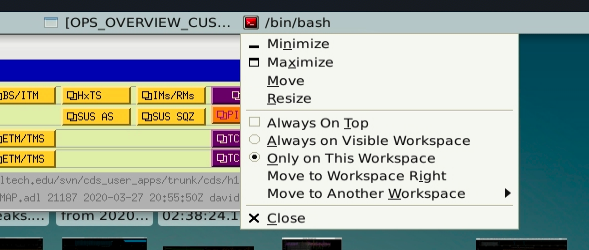
For the medm screens being hard to see. If you right click on the tabs along the top of the screen, you should get a "move" option, to let you drag the medm onto your screen. 

For a longer term fix, the medm can be moved onto the left screen by editing and saving from within the directory they are stored. I will do this for HEPI WD medm.
Done by opening them using the command: medm medm_file_name.adl, then changing their location using: edit > select display > should get a pop-up where you can change x-position and y-position to bring it to a better position on the screen. (0, 0) being top left corner.
Images attached to this comment
corey.gray@LIGO.ORG - 10:51, Wednesday 01 April 2020 (55841)

Just for a historical note on "local" earthquakes for LIGO.  The other big one which comes to mind is the 6.8-magnitude Nisqually earthquake

This earthquake did require us to vent and do work on suspensions.  We still have the "elog" but one needs to use the generic login to read entries:

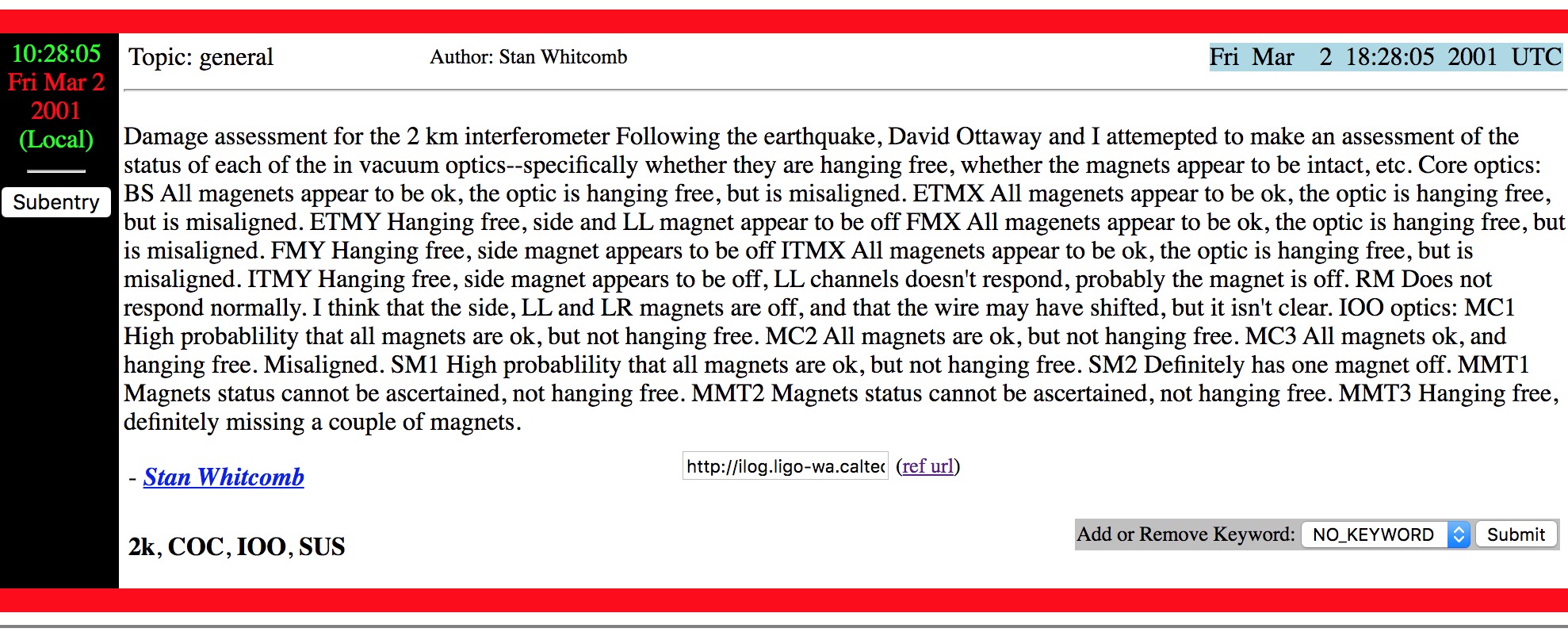
  • H2 SUS assessment by Stan from the Control Room:  Basically multiple test masses had magnets fall off.  RM had wire issue.  MC1, MC2, SM1, MMT1, MMT2, "not hanging free".  Attaching a screenshot, pardon the text...I don't think html formatting carries over for the old "elog".  But basically (lots of misaligned optics, some magnets broke off, and atleast one has wire issue.)
  • Overall it looks like March - May-ish, H2 had repair work done on several optics.  (I think H1 might have been in an installation state, so no damage really noted for it.)
Images attached to this comment
edmond.merilh@LIGO.ORG - 12:58, Thursday 02 April 2020 (55850)

The W Richland tornado seems to have been classified as a "landspout" due to the lack of the updraft needed for a regular tornado. Landspouts spin up from the ground rather than down from the sky. This is the first time I've ever heard that term used.

H1 SUS
rahul.kumar@LIGO.ORG - posted 17:17, Tuesday 17 March 2020 - last comment - 16:56, Tuesday 31 March 2020(55666)
ITMX (mode 2,3,4) damping filter change

Cheryl (over phone), Rahul

This morning we made changes to the damping filter for ITMX mode 2,3,4. We narrowed down the band pass filter and moved them away from Interfering from each other. Next we loaded the coefficients and made the gains to be zero on lscparam (followed by svn commit). Jeff. B then attempted to lock  the IFO and during this time I found a good gain settings for ITMX mode 3 (gain of -20) and was tinkering with IMTX mode 2 (with a very small gain of -0.1). We lost lock after some time hence I was not able to find a good value for mode 2. 

During the second attempt of locking, the modes were rung up and we lost lock very quickly. Next I reverted all the damping filter settings (including lscparams) back to how it was this morning at 8am. In the third attempt I requested Jeff. B to hold on at PREP_ASC_FOR_FULL_IFO, while I was manually damping the rung-up modes. We stayed at this state for an hour or so, and the rung up modes were damping well. Hence I requested Ed (who took over form Jeff. B) to start moving up the ISC lock state - here we lost the lock once again.

In the fourth attempt, the violins looked fine and we are currently locked and Observing (at 0:14 UTC).

Comments related to this report
cheryl.vorvick@LIGO.ORG - 08:39, Friday 20 March 2020 (55690)

Plots of the three attempts at reaching NLN that did not make it, which include the ITMX violin modes 2, 3, 4, 5, 6, and 7.  New filters were tested on modes 2, 3, and 4.  One unexpected event was that damping mode 4 caused mode 5 output to increase, suggesting modes 4 and 5 are the same fiber.  A couple of the lockloss events resulted in ITMX L2 DAMP pitch changing bu about 10urad, which doesn't seem to be the case for every lockloss, however the third lockloss can be attributed to violins, since some were rung up to a level where the RMS was 6.5 to 7.

  • pg1 - the first lock
  • pg 2 - the first lockloss
  • pg 3 - the second lock
  • pg 4- the second lockloss
  • pg 5- the third lock
  • pg 6 - the third lockloss - view 1
  • pg 7 - the third lockloss - view 2
Non-image files attached to this comment
cheryl.vorvick@LIGO.ORG - 09:10, Friday 20 March 2020 (55692)

Plot showing ITMX mode 5 ringing up.  This is about 60 seconds of data, showing damping on modes 2, 3, 5, and 7

Trends are color coded:

  • magenta = mode 3 damping on
  • green =  mode 5 damping on, mode 3 damping off
  • red = mode 5 damping off, mode 5 RMS jumps from 5.8 to 6.45, +0.65
    • mode 3 damping reduced the RMS, mode 5 damping increased the mode 3 RMS
Images attached to this comment
rahul.kumar@LIGO.ORG - 10:23, Monday 30 March 2020 (55820)

Phase plots of the old and new damping filter is attached below.

Images attached to this comment
rahul.kumar@LIGO.ORG - 16:56, Tuesday 31 March 2020 (55836)

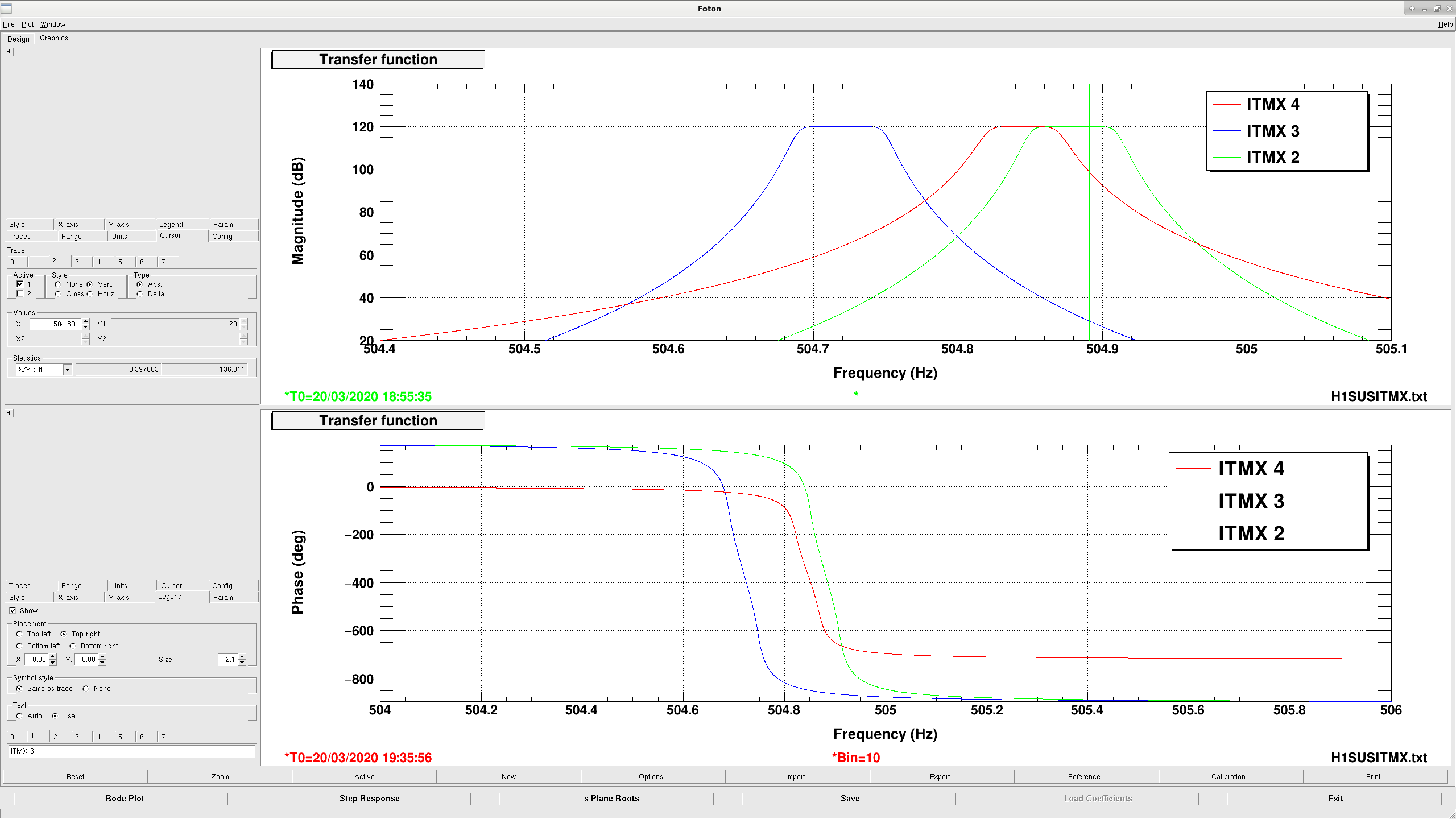
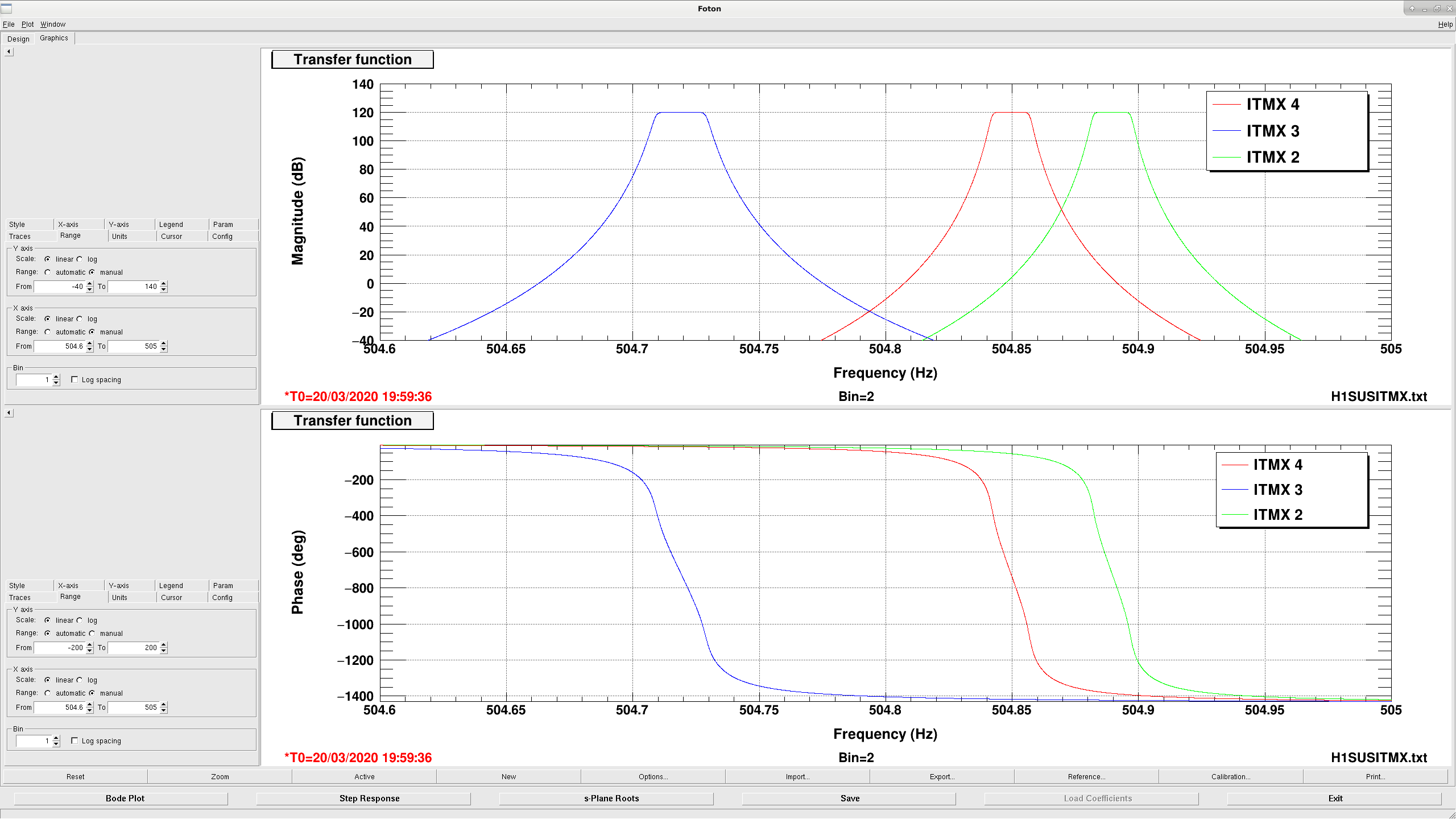
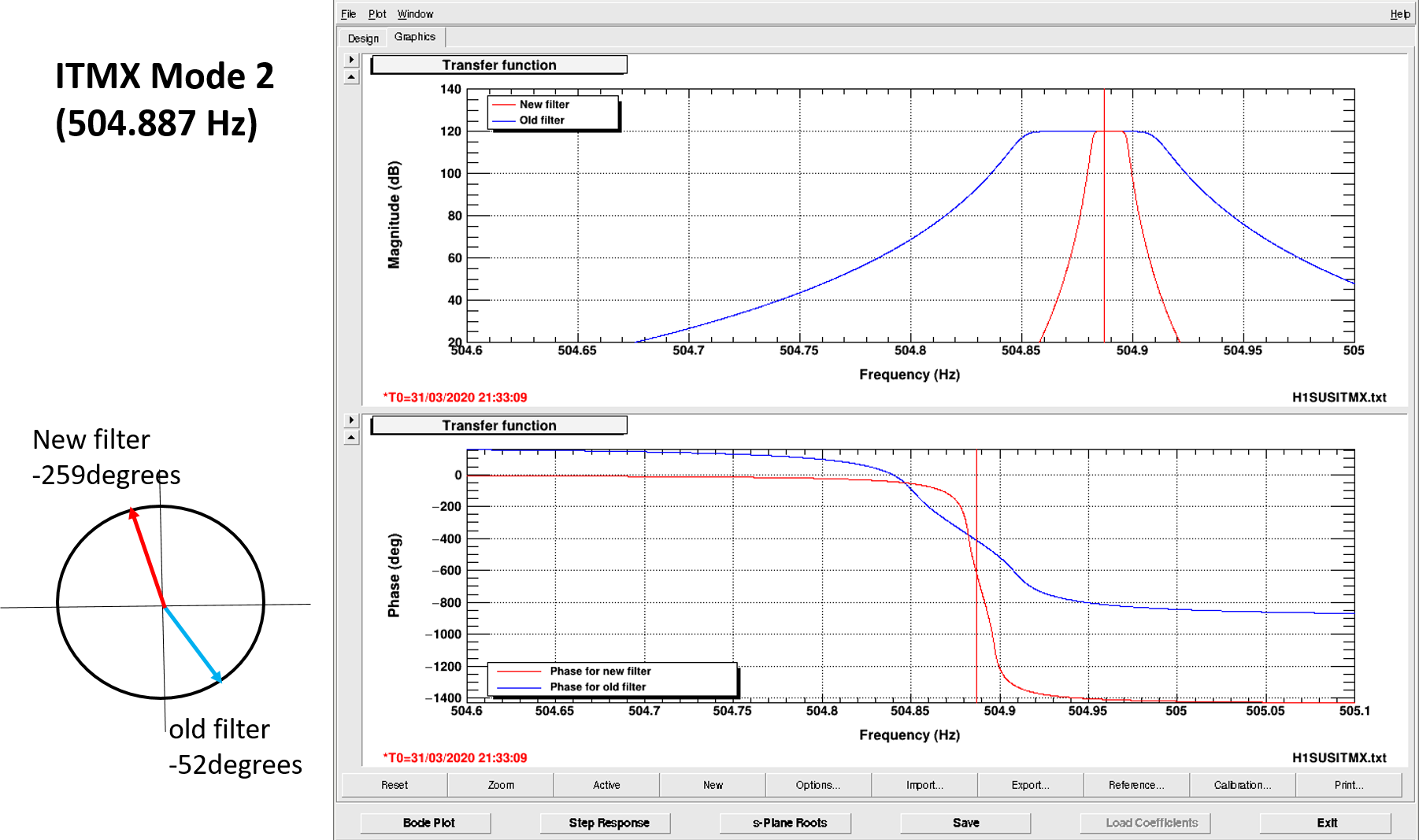
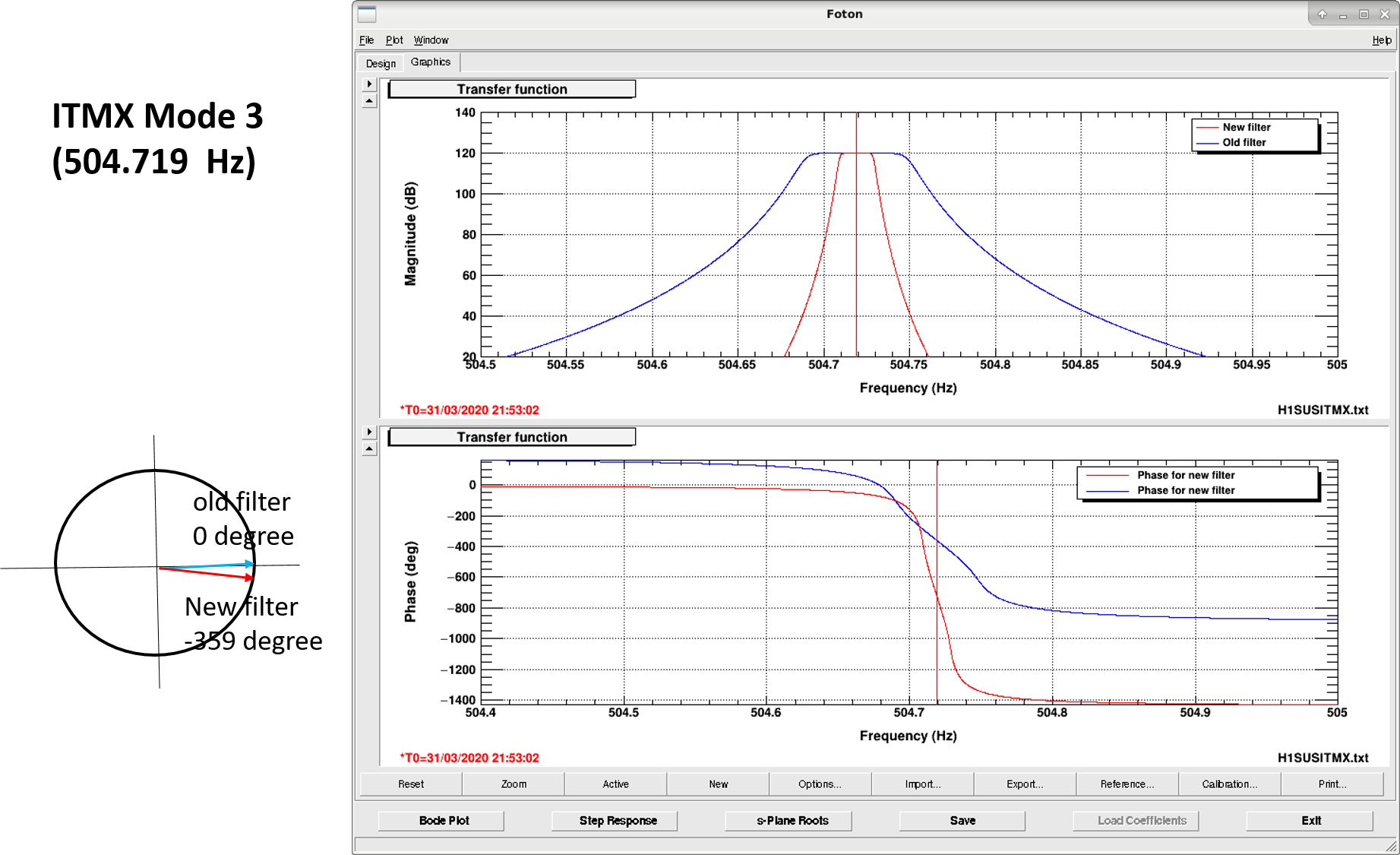
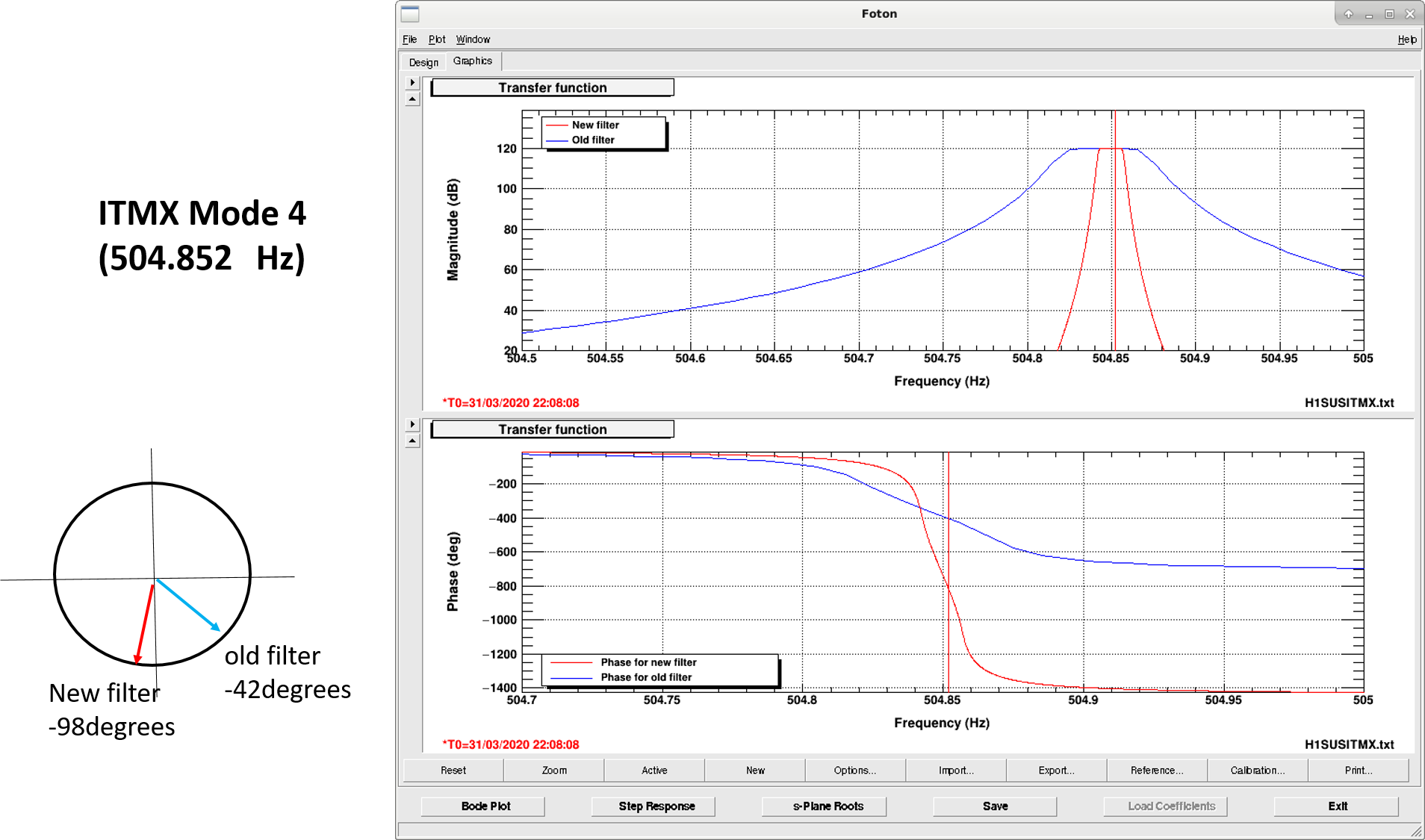
Given below are the phase information (old vs new) for the band pass filter designed for ITMX mode 2,3,4. I have also attached 3 figures which shows the bode plot from foton. One can compare the old and new filter design using these plots.

ITMX mode 2 (504.887 Hz)

Phase old: -412 (+360-412= -52 degrees)

Phase new: -619 (+360-619 = -259 degrees)

This filter has a Phase difference of -207 degrees, hence will require a sign change by 180 degrees.

ITMX mode 3 (504.719 Hz)

Phase old: -360 (+360-360 = 0 degrees)

Phase new: -719 (+360-719= -359 degrees)

This filter has a Phase difference of 1 degree, hence will not require any phase change.

ITMX mode 4 (504.852 Hz)

Phase old: -402 (+360-402= -42degrees)

Phase new: -818  (=360 – 818 = -458 degrees, i.e. -98degrees)

This filter has a Phase difference of -57 degrees, hence will require a sign change by -60 degrees.

Images attached to this comment
H1 General
corey.gray@LIGO.ORG - posted 07:21, Friday 13 March 2020 - last comment - 17:07, Tuesday 31 March 2020(55578)
H1 Range Drop, Lockloss, and then Back to OBSERVING

Summary:  At about 8:30utc, H1 took a 20Mpc drop in range & hovered there for ~4hrs until it dropped out of lock.  Cursory look didn't show anything obvious.  H1 was able to get back to NLN without intervention in under an hour and the range appears to be normal-ish so far.

Timeline:

Quick Check:

Did a quick check on a few items to see about reasons why H1 took the drop to 102Mpc, and looked at "usual suspects":

Comments related to this report
thomas.shaffer@LIGO.ORG - 09:16, Friday 13 March 2020 (55580)

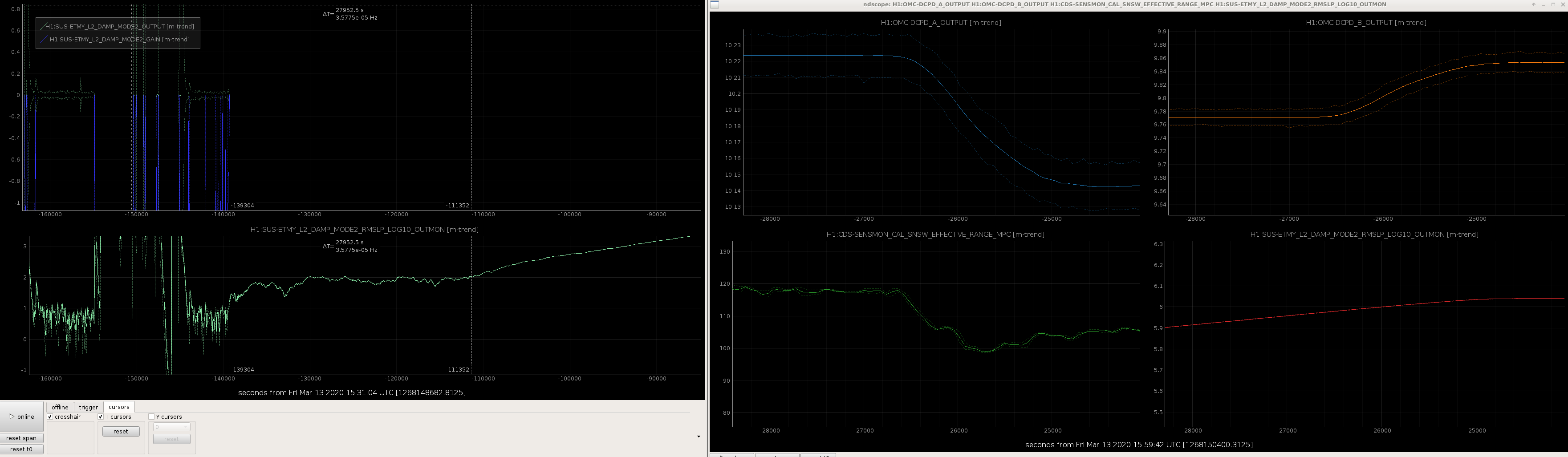
It looks like the issue was ETMY violin mode 2 (505.0794hz) started a very slow ringup until the DCPDs started to saturate and we began to lose range. This mode normally has a gain applied but the violin Guardian turned it off yesterday, March 12 00:49 UTC. The mode didn't increase for about 8 hours, but then started a slow increase around Mach 12 08:30 UTC. Why it changed and started to increase at this is still under investigation.

The irony here is that there was plan for Rahul to change the violin Gaurdian today to handle this exact situation. A day too late unfortunately.

Images attached to this comment
thomas.shaffer@LIGO.ORG - 09:29, Friday 13 March 2020 (55581)

Adding a better plot of when the DCPDs saturated.

Images attached to this comment
rahul.kumar@LIGO.ORG - 17:07, Tuesday 31 March 2020 (55837)

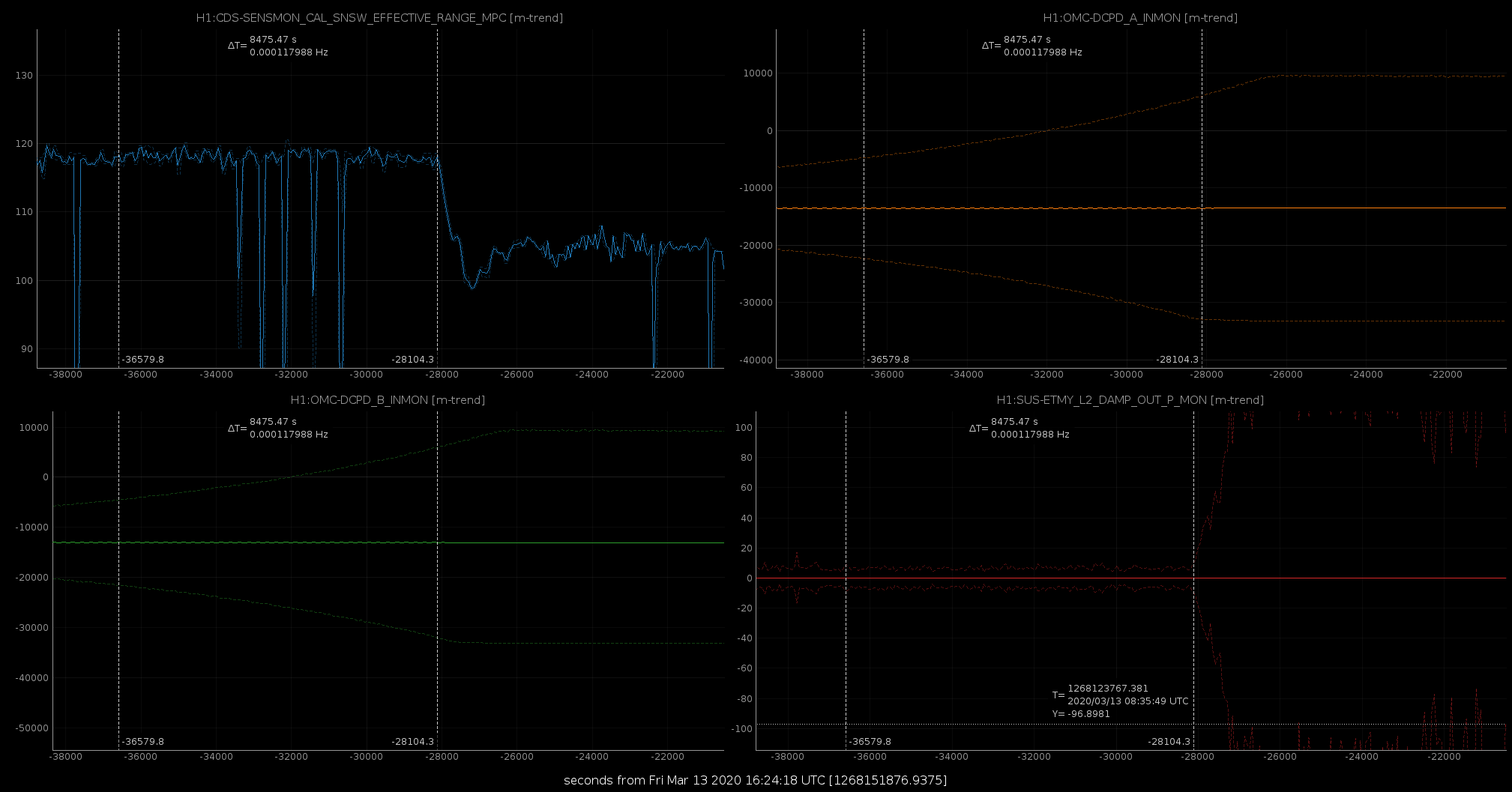
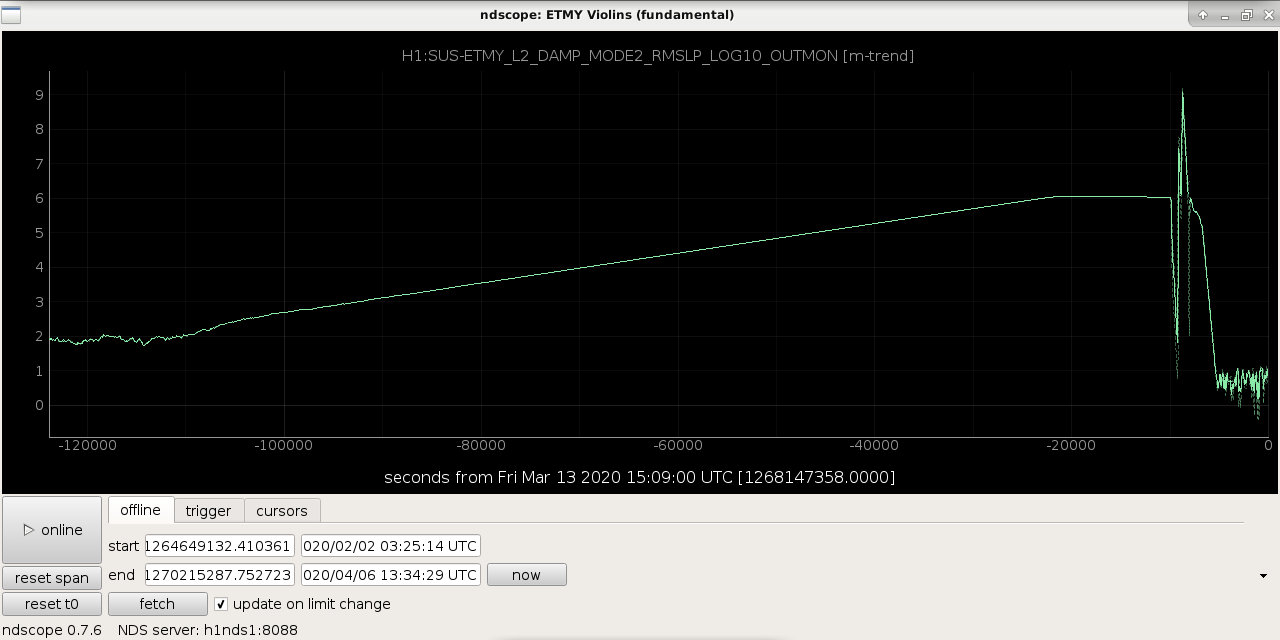
I am attaching the ndscope plot for ETMY mode 2 from March 13 - which resulted in DCPD lockloss. At the lockloss time the monitor level was around 6, if we go back 2 hrs in time then the monitor level was around 5.5. If we choose this value (monitor level 5.5) as a threshold for setting up a verbal alarm and IFO_NOTIFY, then operators will have 2 hours of advance warning, giving them some time to damp the mode manually.

Images attached to this comment
Displaying reports 35001-35020 of 89220.Go to page Start 1747 1748 1749 1750 1751 1752 1753 1754 1755 End