WP8554 senscor addition to HEPI and ISI models
Jim, Dave:
The SEI front end models were restarted in the following order:
2020_03_17 09:08 h1hpietmx
2020_03_17 09:08 h1hpietmy
2020_03_17 09:10 h1hpiham1
2020_03_17 09:10 h1hpiham2
2020_03_17 09:10 h1hpiham3
2020_03_17 09:10 h1isiham2
2020_03_17 09:11 h1hpiham4
2020_03_17 09:11 h1isiham3
2020_03_17 09:13 h1hpiham5
2020_03_17 09:13 h1hpiham6
2020_03_17 09:13 h1isiham4
2020_03_17 09:13 h1isiham5
2020_03_17 09:15 h1hpibs
2020_03_17 09:15 h1hpiitmy
2020_03_17 09:15 h1isiham6
2020_03_17 09:16 h1hpiitmx
In some cases the filter module file was slightly modified by a reordering of the header modules list (no actual filter change).
No DAQ restart was necessary.
I reset both PSL power watchdogs at 16:21 UTC (9:21 PDT). This completes FAMIS 10754.
Initial NOTES:
SUMMARY of H1 locking/recovery after lockloss:
H1 was having issues at CHECK MICH FRINGES and not locking PRMI.
8:12 Began an Initial Alignment.
1st locking attempt after Initial Alignment had lockloss at ENGAGE ASC FOR FULL IFO (looks like POP18 & PR Gain both drift down before lockloss; see attached screenshot).
NOTE: There was a 5.7 Chilean EQ inbound, but don't really see any reason this was the cause for the lockloss.
On to 2nd lock...
TITLE: 03/17 Eve Shift: 23:00-07:00 UTC (16:00-00:00 PST), all times posted in UTC
STATE of H1: Lock Acquisition
INCOMING OPERATOR: Corey
SHIFT SUMMARY: Lost lock, ending a 31h15 lock stretch
LOG:
Locked 28h20 at 120Mpc. Environment fine, microseism has crept up over the last 12 hours but still below the 90th percentile.
TITLE: 03/16 Eve Shift: 23:00-07:00 UTC (16:00-00:00 PST), all times posted in UTC
STATE of H1: Observing at 119Mpc
OUTGOING OPERATOR: Travis
CURRENT ENVIRONMENT:
SEI_CONF state: WINDY
Wind: 14mph Gusts, 10mph 5min avg
Primary useism: 0.04 μm/s
Secondary useism: 0.33 μm/s
QUICK SUMMARY: Locked 24 hours 15
TITLE: 03/16 Day Shift: 15:00-23:00 UTC (08:00-16:00 PST), all times posted in UTC
STATE of H1: Observing at 119Mpc
INCOMING OPERATOR: Camilla
SHIFT SUMMARY: One Superevent candidate. Otherwise, no issues to report. Lock is 24+ hours old.
LOG:
18:30 Out of Observe, JeffK starting CAL injections
20:02 Robert to EY to setup equipment
20:09 Kyle to MX
20:15 JeffK done with CAL, Robert starting PEM work at EY
21:12 Gerardo to MY to pick up equipment
21:18 Back to Observing. Robert done at EY. WAP turned off.
21:29 Gerardo back
21:54 Robert to EX
22:04 Robert recalled from EX due to Superevent candidate, on his way back
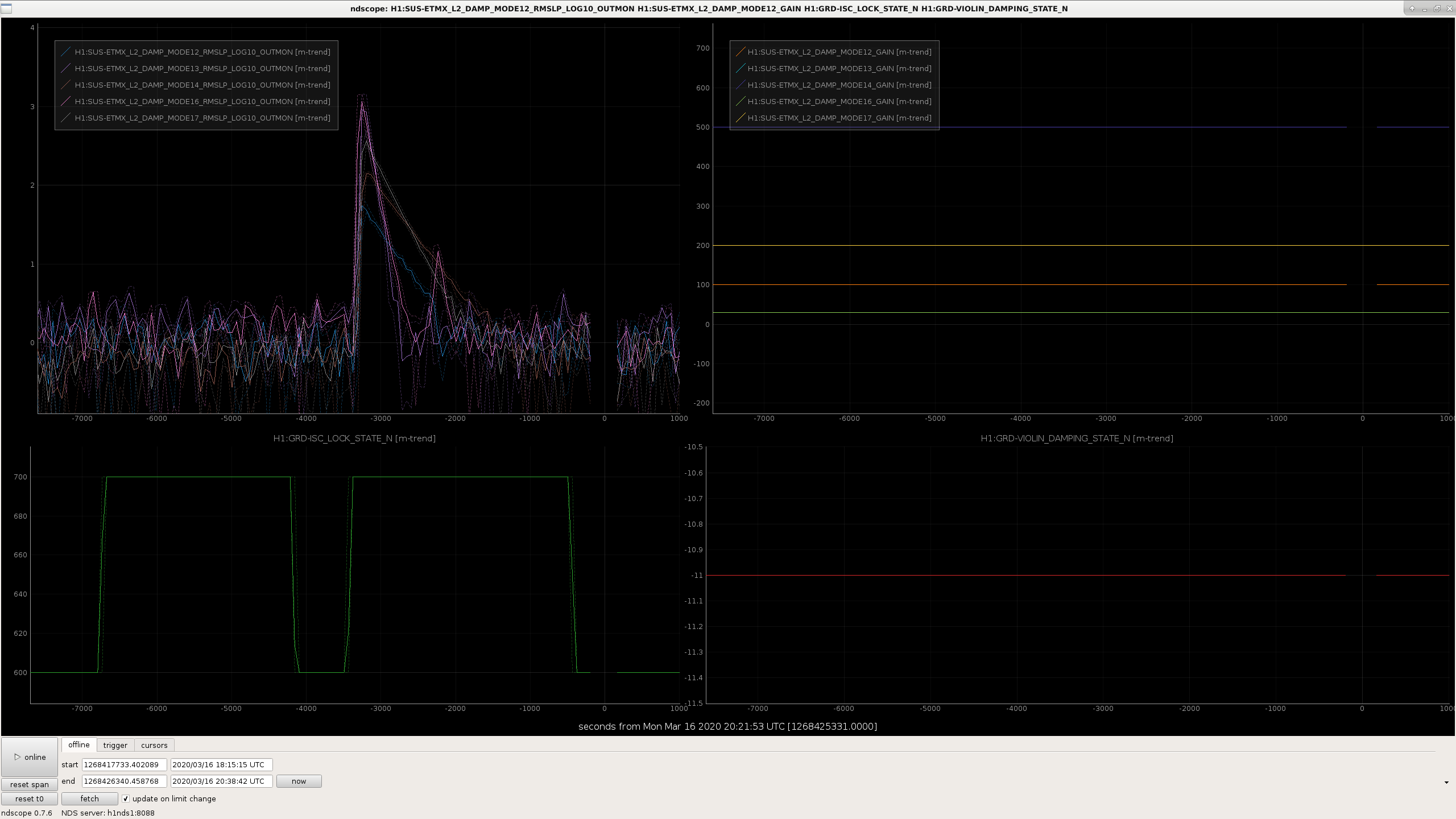
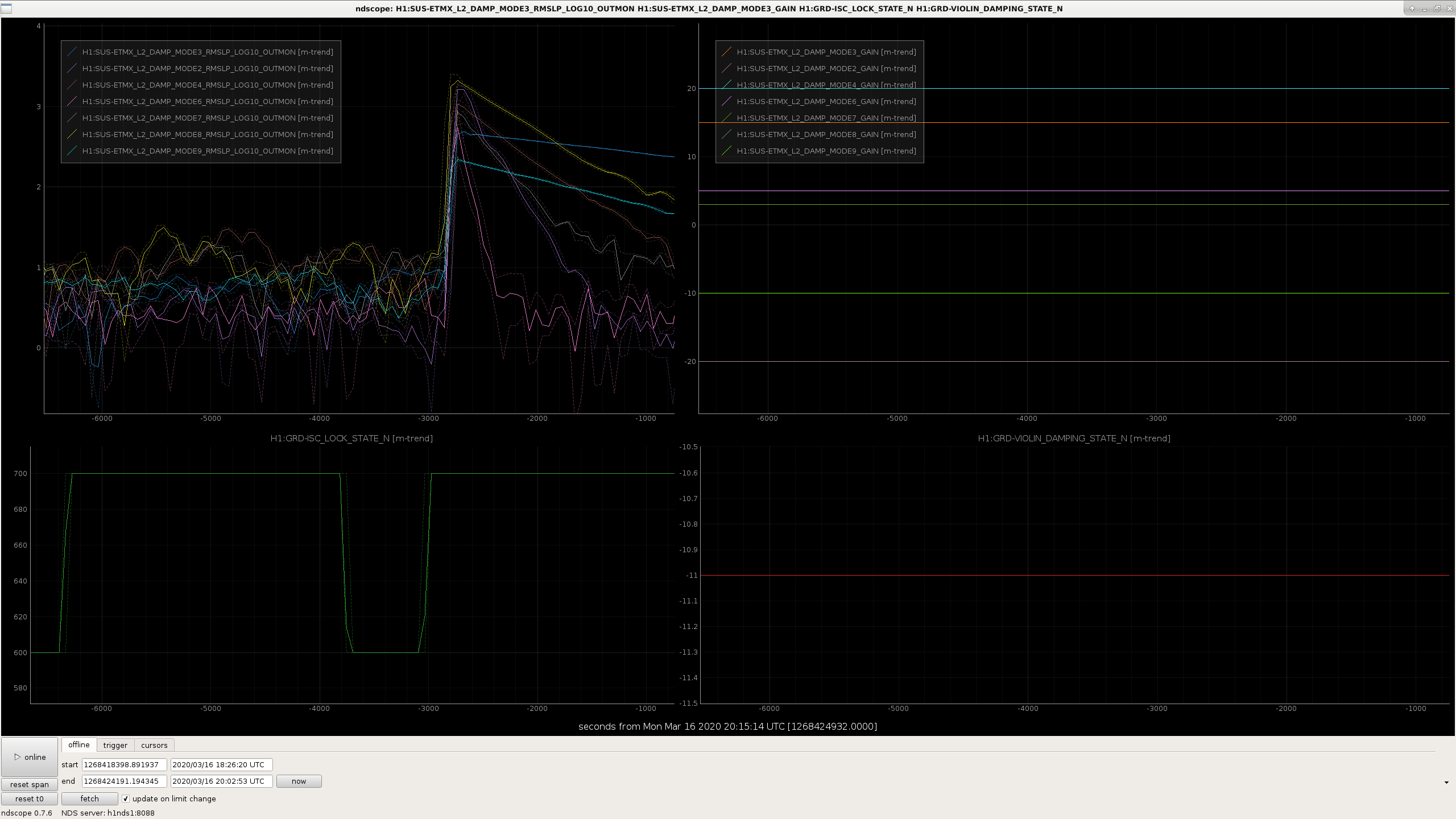
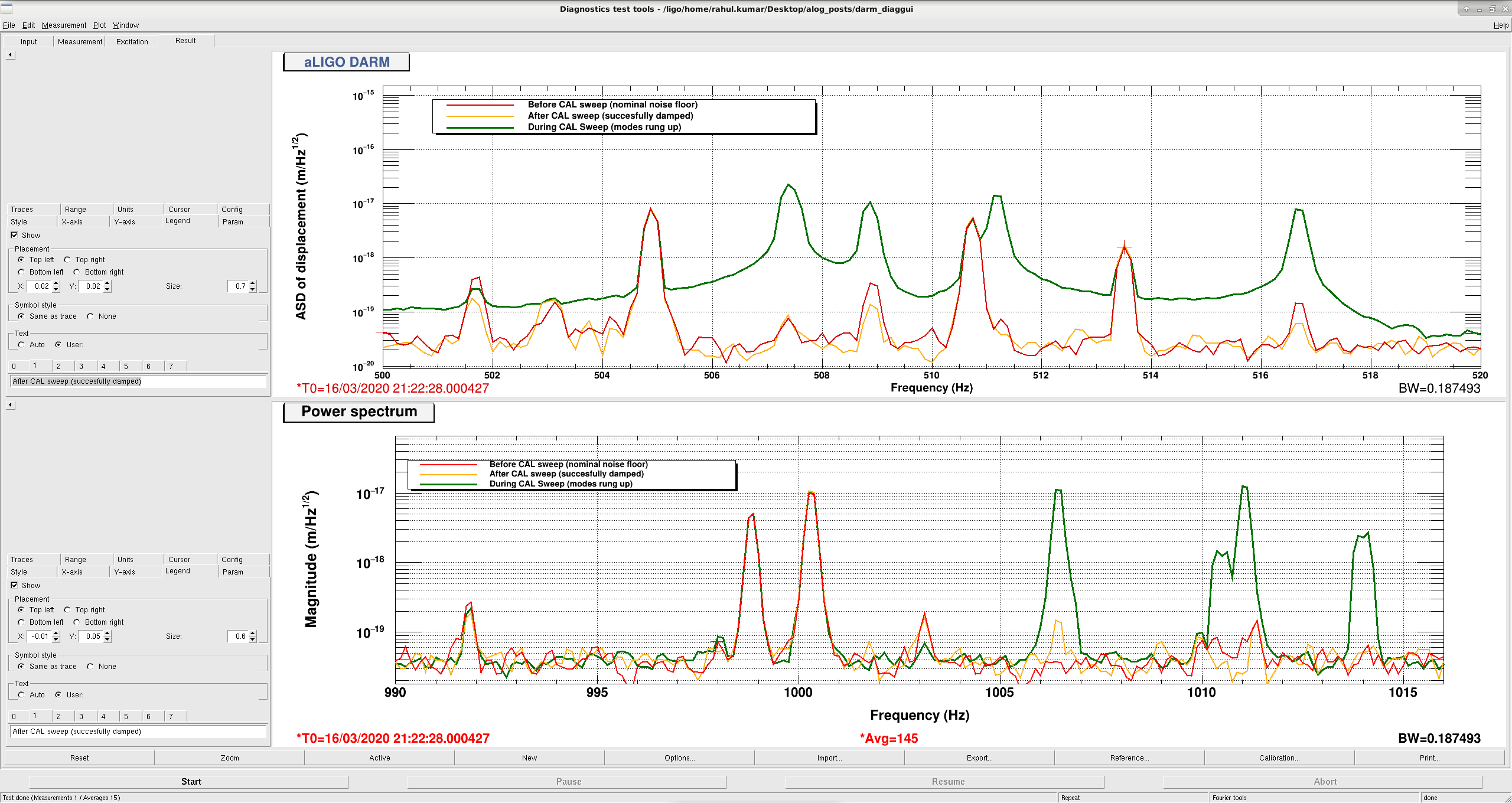
Today, during the CAL sweeps (ISC lock state 700) several modes (2, 3, 4, 6, 7, 8, 9 in the 1st harmonic and 12, 13, 14, 16, 17 in the 2nd harmonic) ) on the ETMX were rung up by 2-3 orders of magnitude in the monitor levels. During this time Guardian did not switch-off damping for the rung-up modes and this is due to the settings made last Friday. The rung-up modes rose to their peak amplitude while the CAL sweeps lasted and then Guardian was successfully able to damp each one of them.
I am attaching ndscope plots for the 1st and 2nd harmonic and the DARM spectrum from 3 different time today (a. before CAL sweeps started - which shows nominal noise floor, b. During CAL sweep: when the modes are rising, c. after CAL sweep when Guardian successfully damps them).
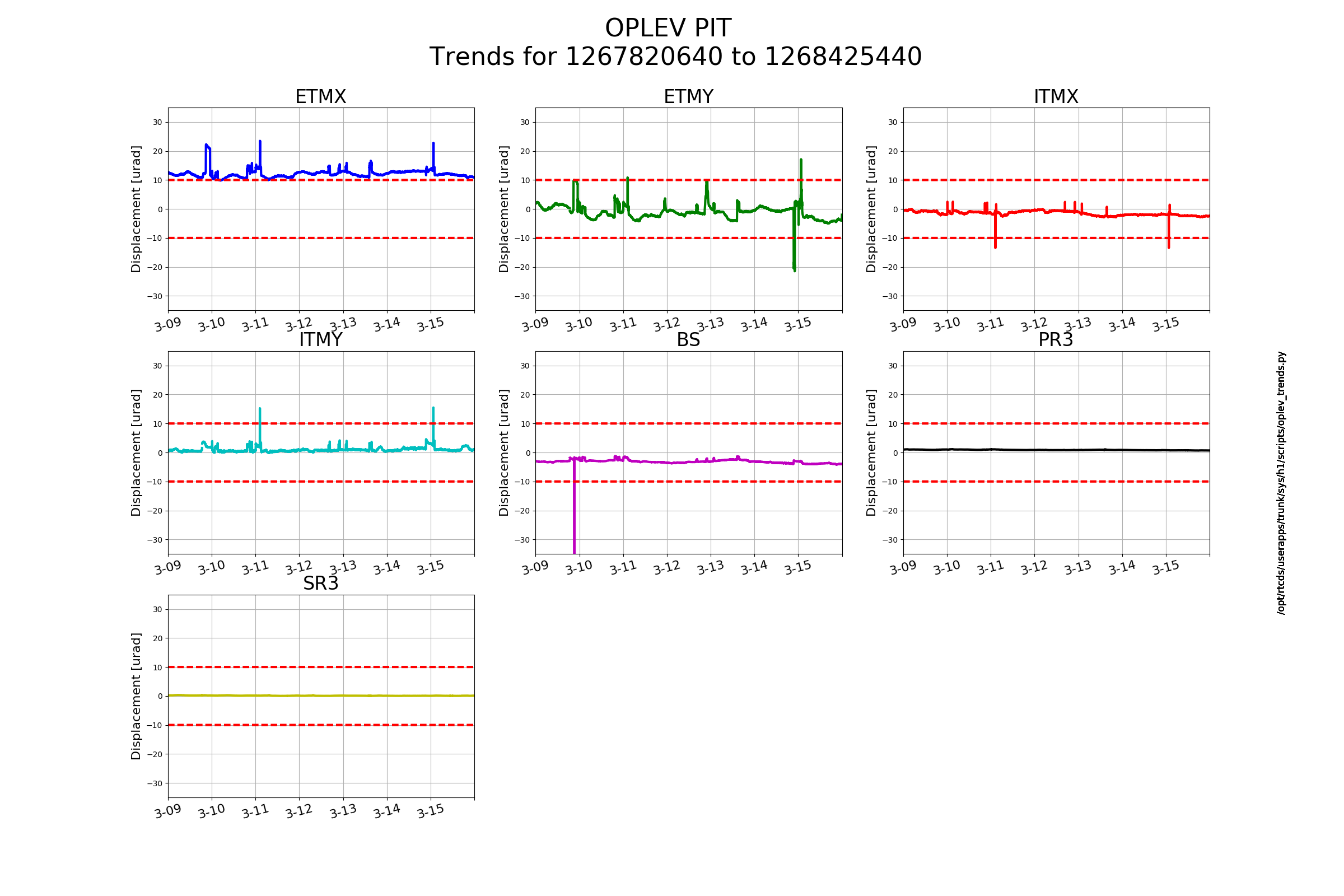
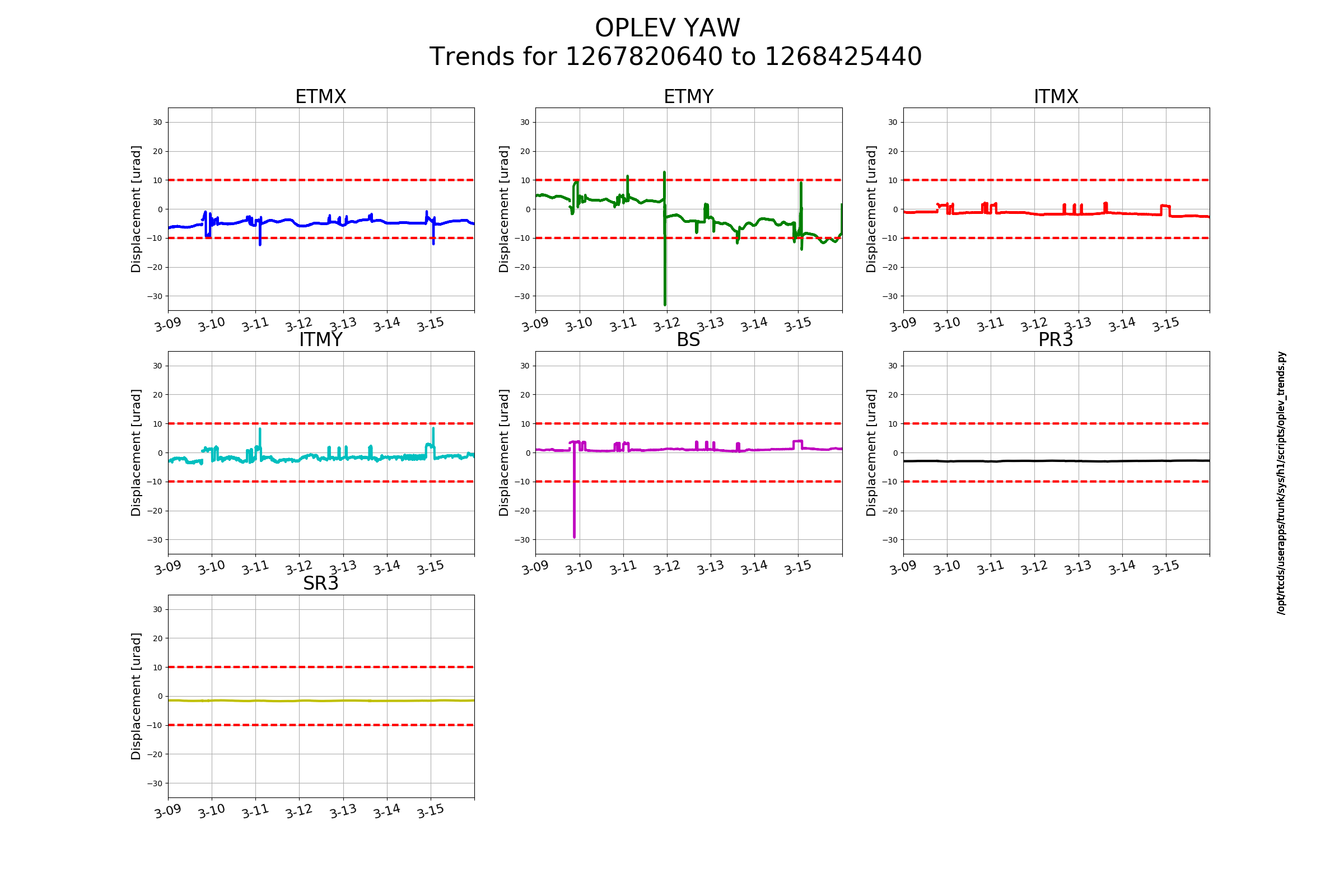
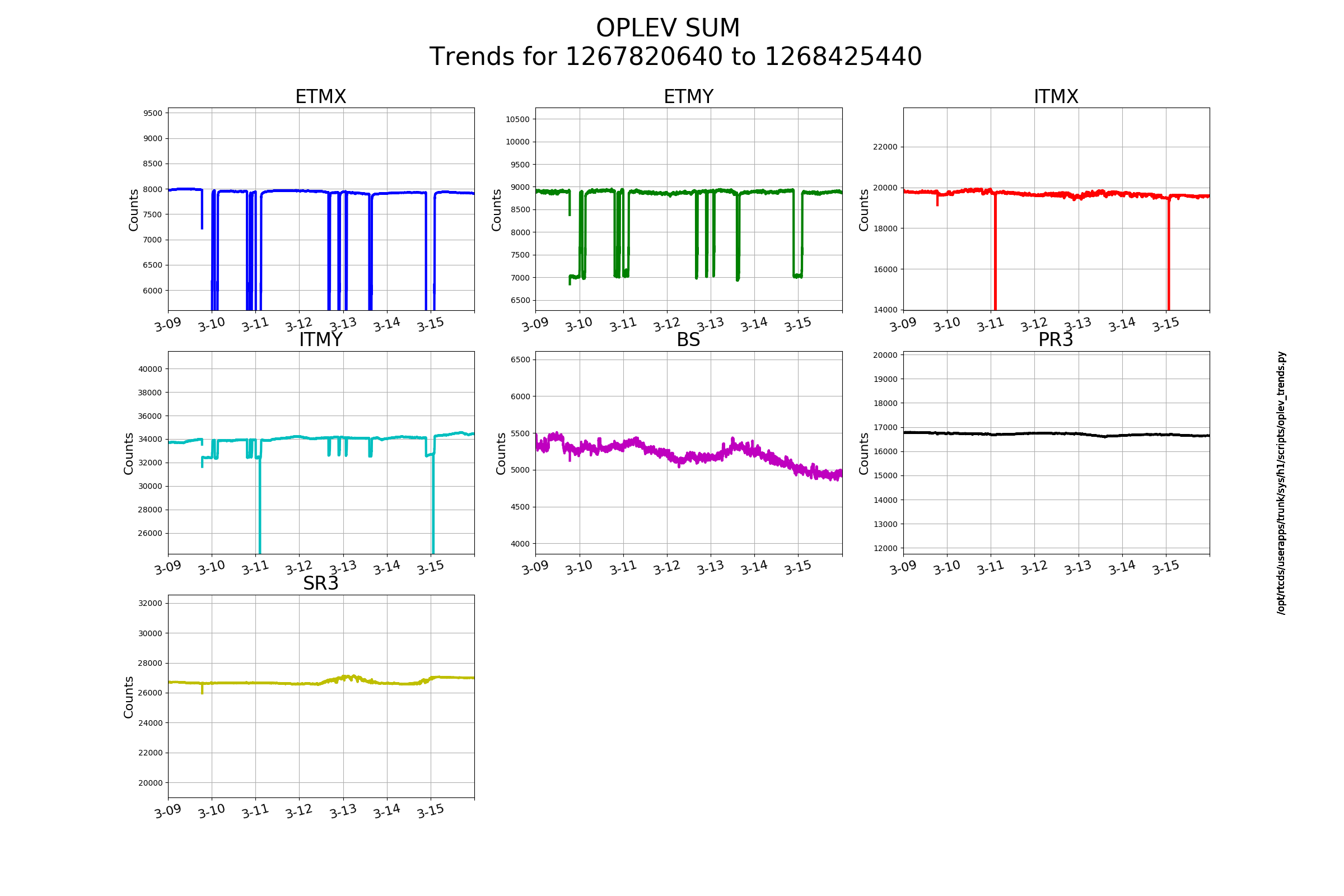
Attached are trends for oplevs.
NOTE:
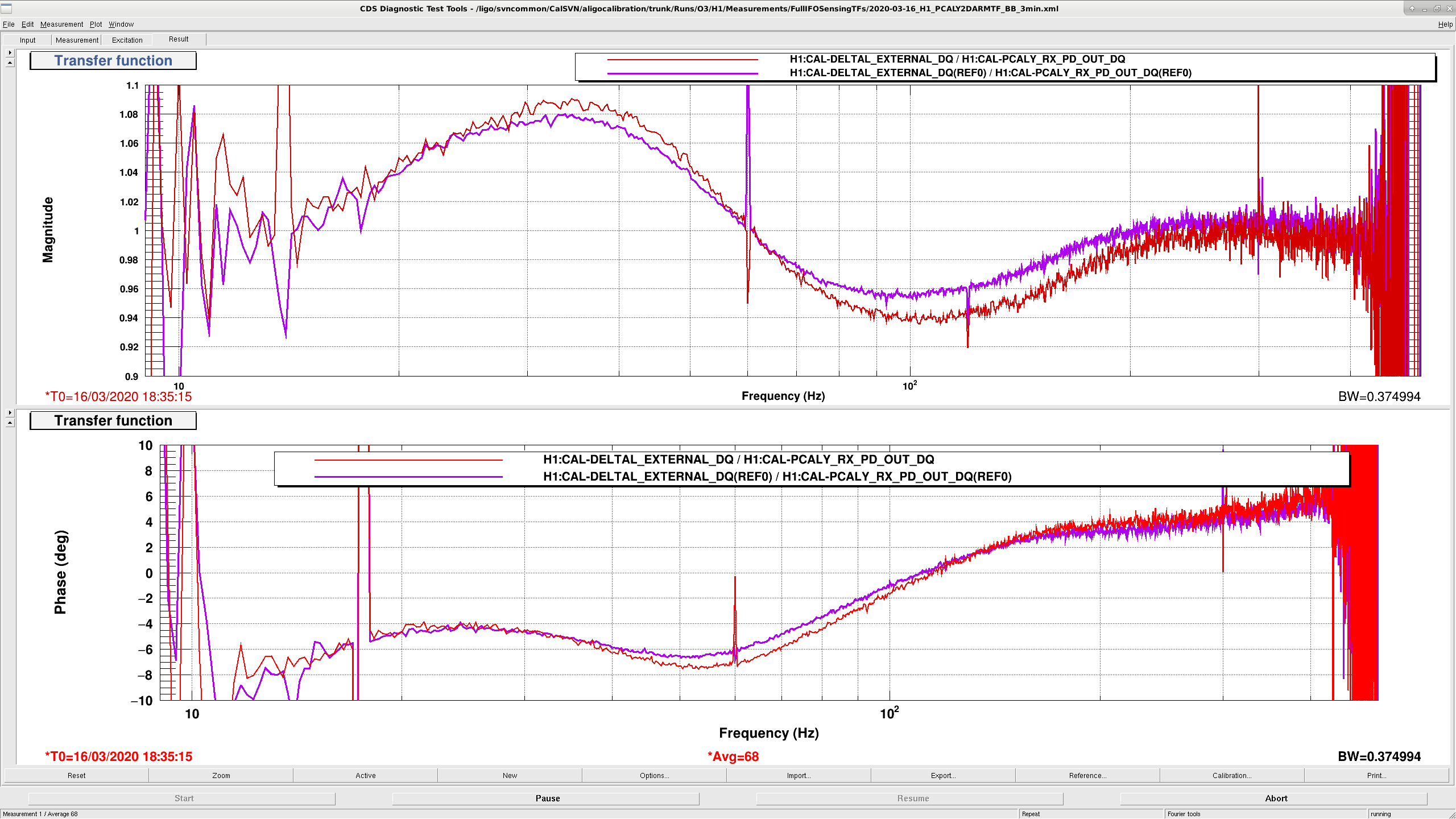
J. Kissel, J. Driggers More to come, but OMC Whitening Configuration change (using 1 whitening stage instead of 2 whitening stages and a low pass) is in testing now. Quick answer from PCAL to DELTAL EXTERNAL broaband TF shows ~1.0-1.5% frequency dependent addition systematic error with the new configuration. Magenta is nominal configuration (2 whitening stages and a low pass), and red is test configuration. Sweeping now...
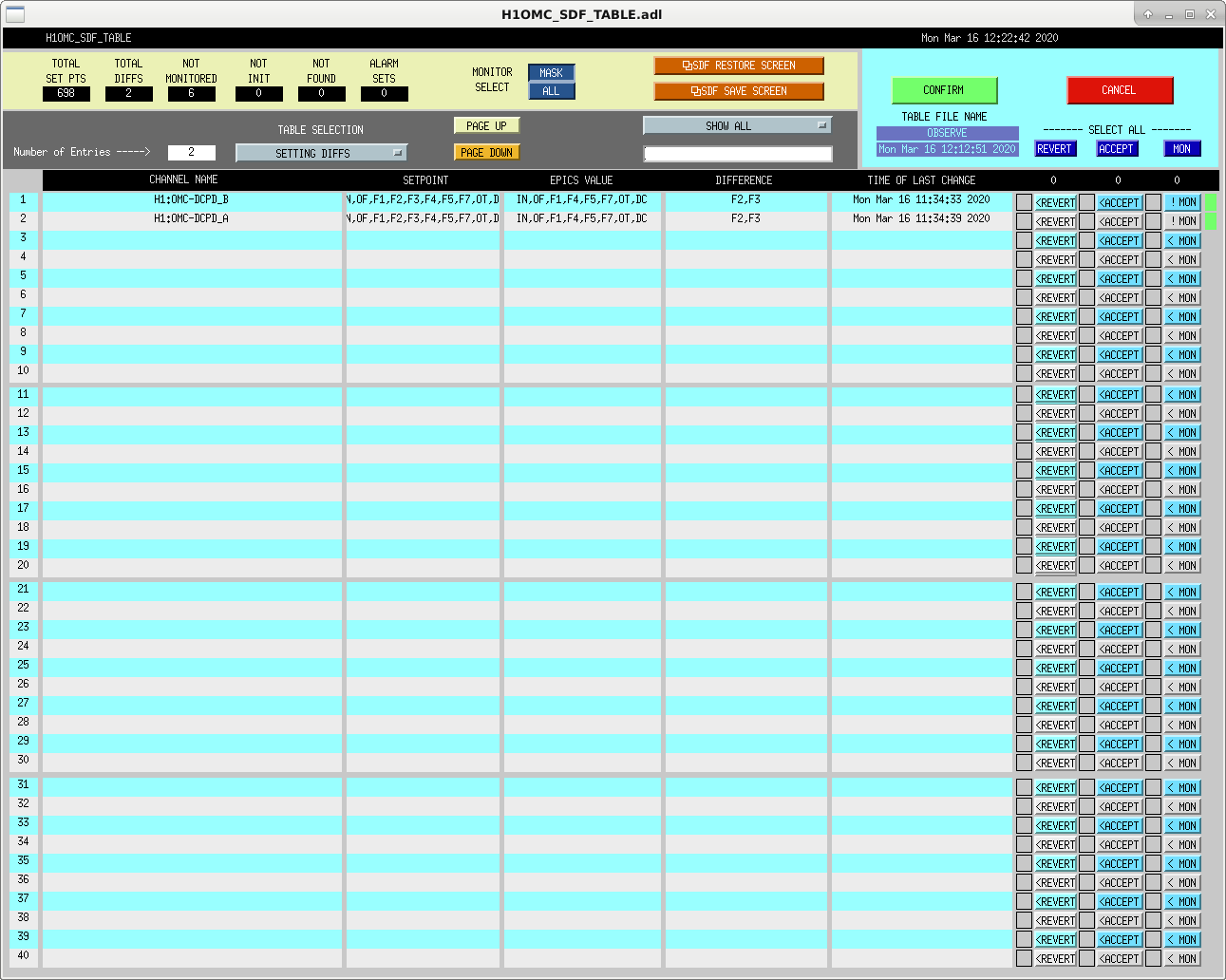
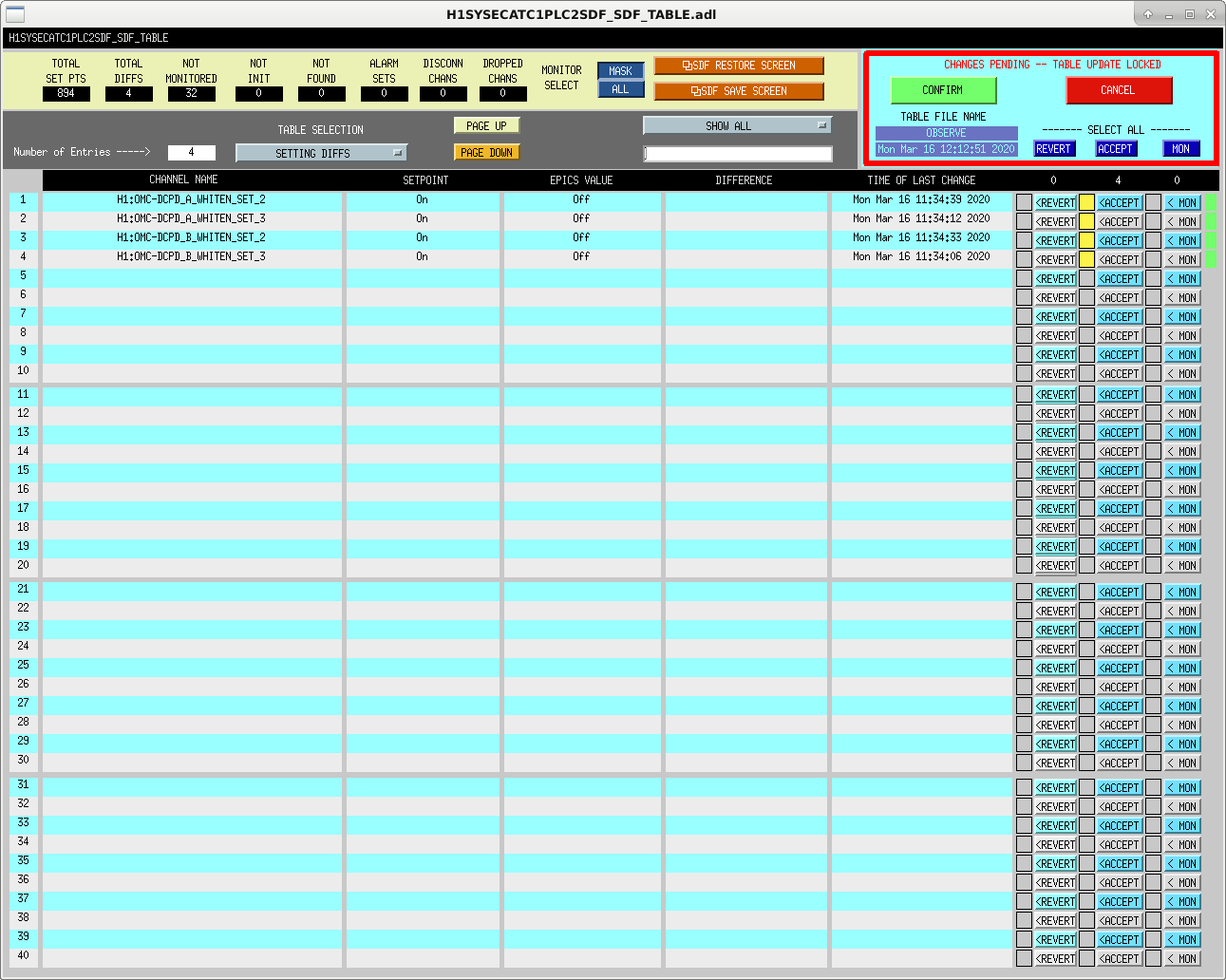
I have accepted in SDF the differences that this caused for the digital and analog filters (see screenshots of sdf files).
I have also modified the ISC_LOCK and OMC_LOCK guardians such that when we next acquire lock, it should come back to this state of only 1 stage of analog filtering.
Calibration measurement suite sweeps are complete, and we are back in nominal low noise, but Robert has taken over the IFO for commissioning. We are remaining in this 1 stage of whitening only configuration. We have resolved that it is not prudent to change the compensation filters, and/or update the calibration model parameter set, and we'll therefore just live with this increased systematic error in the low latency h(t). Eventually, after the systematic error is well quantified, we will create a new model parameter set, and re-calibrate the data -- starting at the next observation ready segment today. I'll post the official time as to when we've gone back in to observation ready, so as to clearly define the first observation ready segment with this new change.
The first observation ready segment that includes the above described OMC whitening chassis filter configuration change started at Mar 16 2020 21:18:54 UTC (GPS time 1268428752)
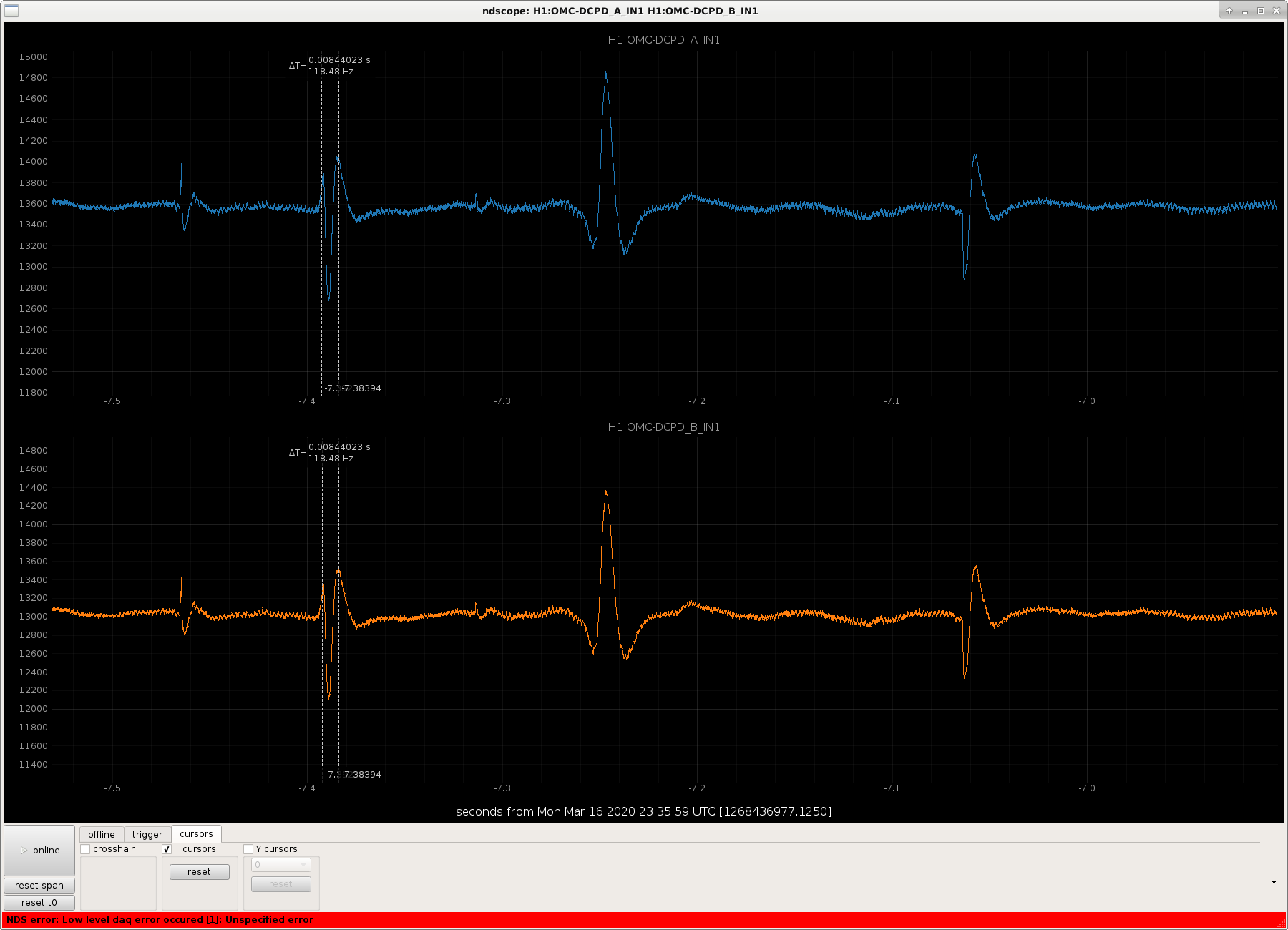
Not that there is anything profound here, but I caught a glitch. This is the first one that I've caught to grab a screenshot of after our change this morning of the OMC DCPD whitening filter configuration.
Note to self: compare the _OUT_DQ of this glitch with other glitches in the old nominal config that I have screenshots of, to (try to) see if these glitches were attenuated due to the new analog configuration.
The summary pages are reporting a significantly reduced range, but I'm not totally sure why.
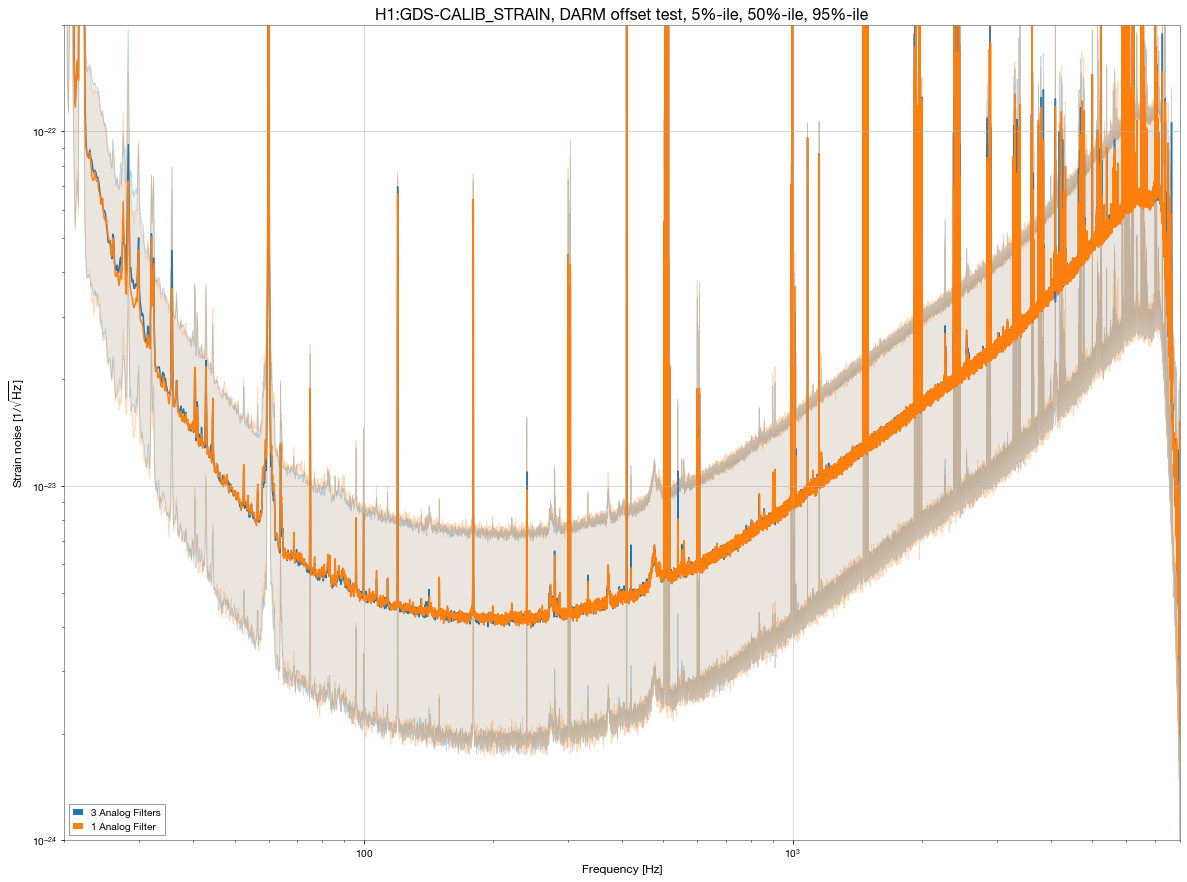
In the attachment, I've plotted ~an hour of data each for observing times this morning before we changed the whitening configuration, and for an observing segment after we made the change. This is H1:GDS-CALIB_STRAIN, so has time dependent correction factors applied (although, as Jeff points out earlier in this thread those won't fully account for the small frequency dependent change that we've acquired).
Blue is an old nominal (3 analog filters) time, starting at 16 Mar 2020 16:24:40 UTC. Orange is the new nominal (1 analog filter), starting at 16 Mar 2020 22:19:30 UTC. The darker lines are the 50th %-ile, and the shaded regions are the 5th and 95th %-iles. I can't tell much of a difference by eye. Also, when I calculate the range from these median spectra, I get less than a 0.5 Mpc difference. So, I'm not sure why the GDS range on the summary pages is so different now than it was this morning.
I've used measurements of this OMC whitening chassis from (Sunday!) 2019-03-03 to predict the systematic error that transpired as a result of this configuration change. See further discussion in "PART II" of G2000527. Making a *very* long story short, (a) the systematic error incurred on the final DCS C01 calibration amounts to (a frequency dependent, but at maximum) 0.5% and 0.25 deg error at 100 Hz and 50 Hz, respectively. (b) the error arises from - poor modeling of the super-Nyquist response of this chassis in the calibration pipeline, - previously poor understanding of the circuit resulting in a poorly informed fit of the measurements, and finally - the original data set only was taken down to 5 Hz, where the chassis (namely the first and third filters, which are the whitening stages) has response at 1 Hz and thus *any* fit (be it Stefan's original fit to update the compensation filters, or Lilli's fit for super-Nyquist poles) is fundamentally limited by the data. Attached is a comparison of - the ratio between the 2020-03-09 (pre-change) and 2020-03-16 (post-change) broad-band PCAL injections -- and thus the *measured* systematic error incurred by the change, and - the estimated systematic error derived from a re-fit to the original data. Again, for further explanation of how this modeled error estimate was derived, see "PART II" of G2000527. The script the accompanies the analysis for G2000527, from which all plots come, lives in /ligo/svncommon/CalSVN/aligocalibration/trunk/Common/Electronics/H1/Scripts/ fit_OMCDCPDWhiteningChassis_20190304_forG2000527.py
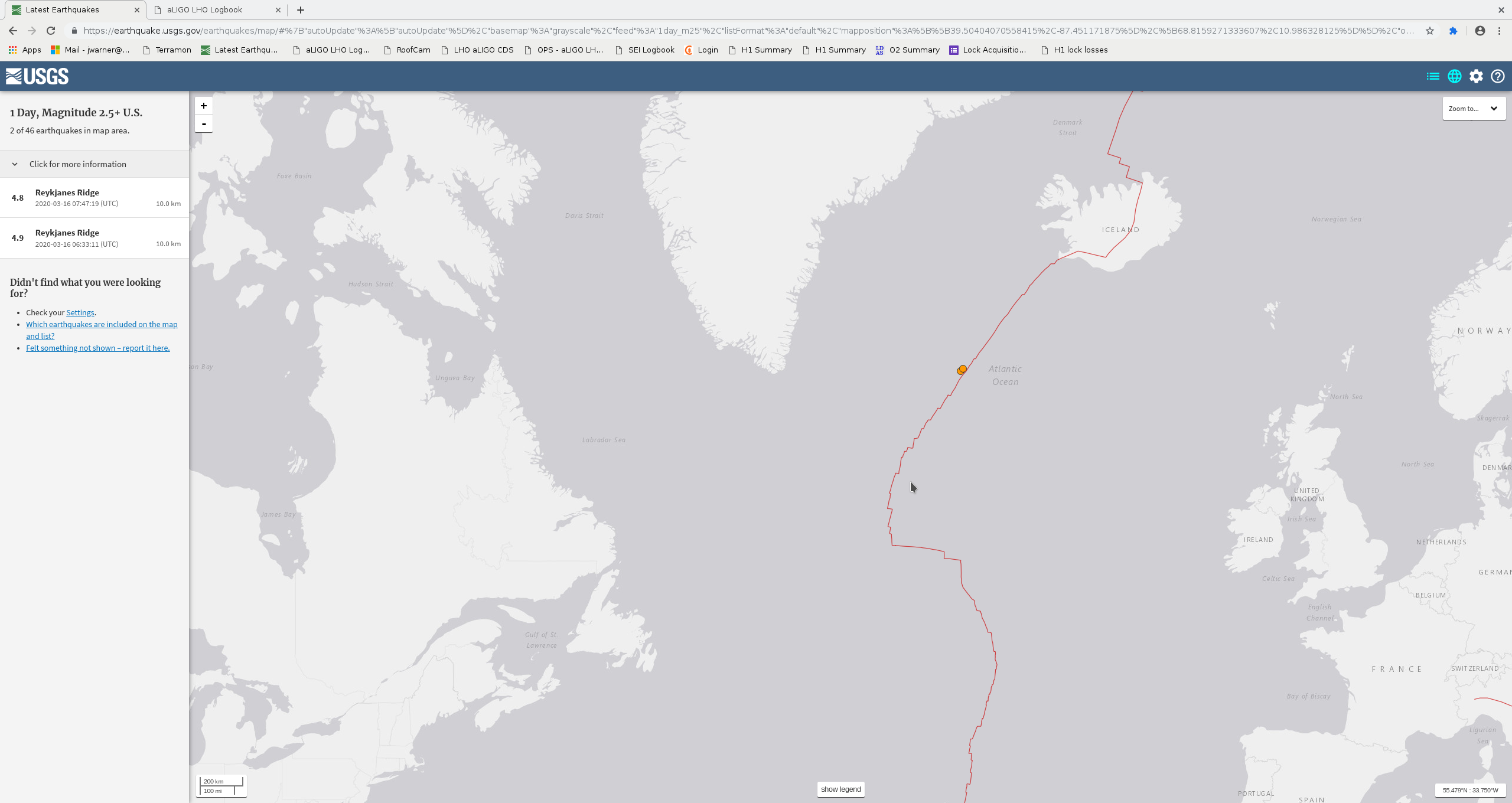
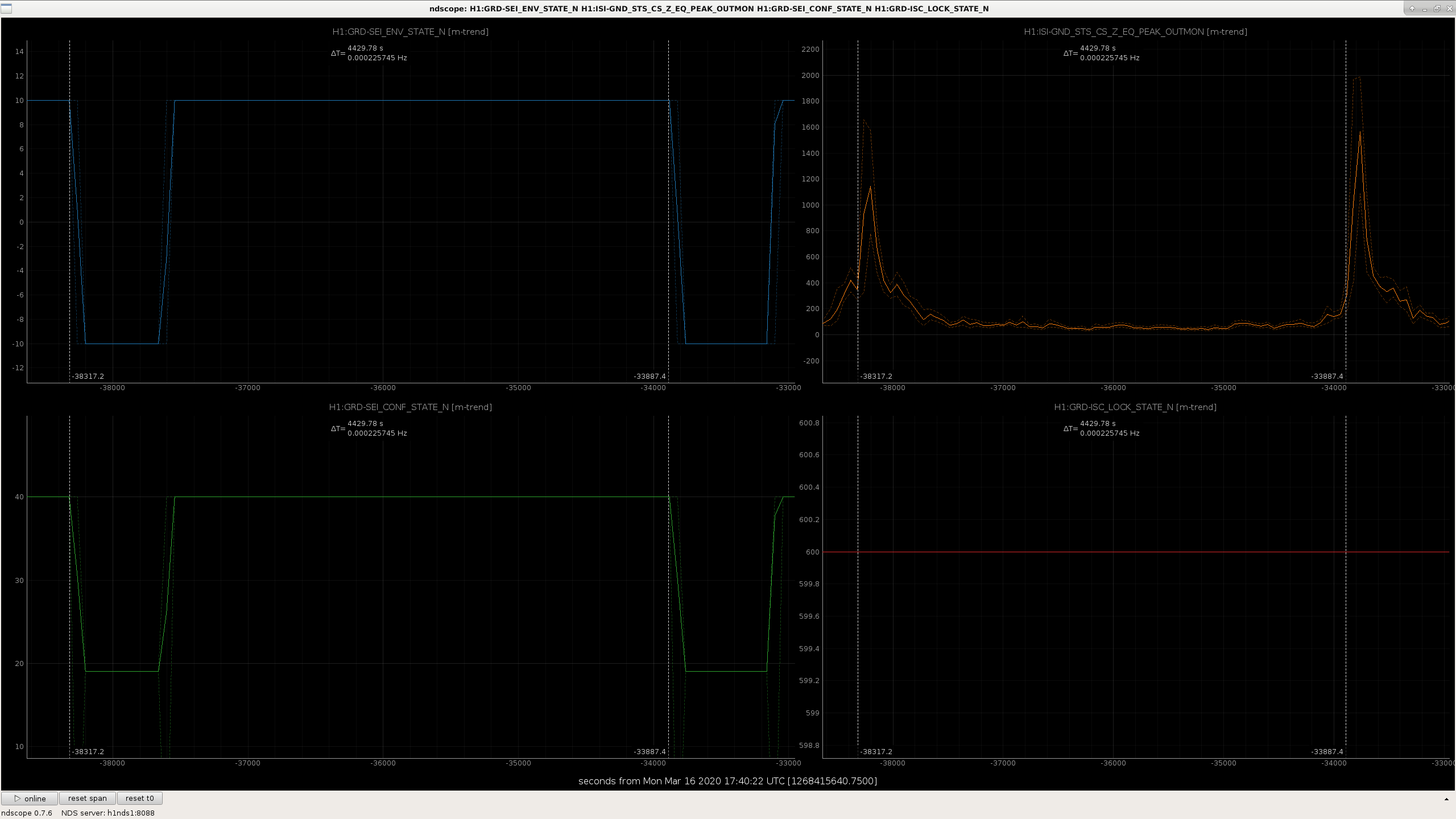
Cheryl noted last night that the seismic system transitioned to earthquake last night without warning. This actually happened twice last night, I think the two attached earthquakes from USGS were the culprits. They were far enough away that we should have gotten some warning (5600 km, the closest seismon will give us early warning for is about 2000 km), but maybe the fact they were out in the middle of the ocean delayed the USGS reports. The later one is still on seismon, and gets a deceptive eq response "score", falling well into the blue region, so a good reminder to be kind of skeptical about what the plot tells you. Still, SEI_ENV caught both earthquakes and transitioned properly, and we stayed locked for both earthquakes.
Second attached plot shows SEI_ENV (in blue) jumping from CALM (index 10) to EARTHQUAKE (index 20), as both earthquakes cross 1000 nm/s on peakmon (in yellow). SEI_CONF (green) goes from WINDY to EARTH_QUAKE both times, in the IFO stayed locked for both earthquakes. It's possible that we could have ridden both of these earthquakes out without doing anything, but these earthquakes were both on the top end of the kind of earthquakes we were able to ride out for O2 before we had an actual earthquake control scheme. Both of these earthquakes would have been a challenge for a person to first realize what was happening, then make the decision to switch the seismic system before the earthquakes had come and gone.
Great news! Well done SEI_ENV state!
Happened a third time: 2020-03-17 05:04:09 UTC. Still much reduced since the chiller swap.
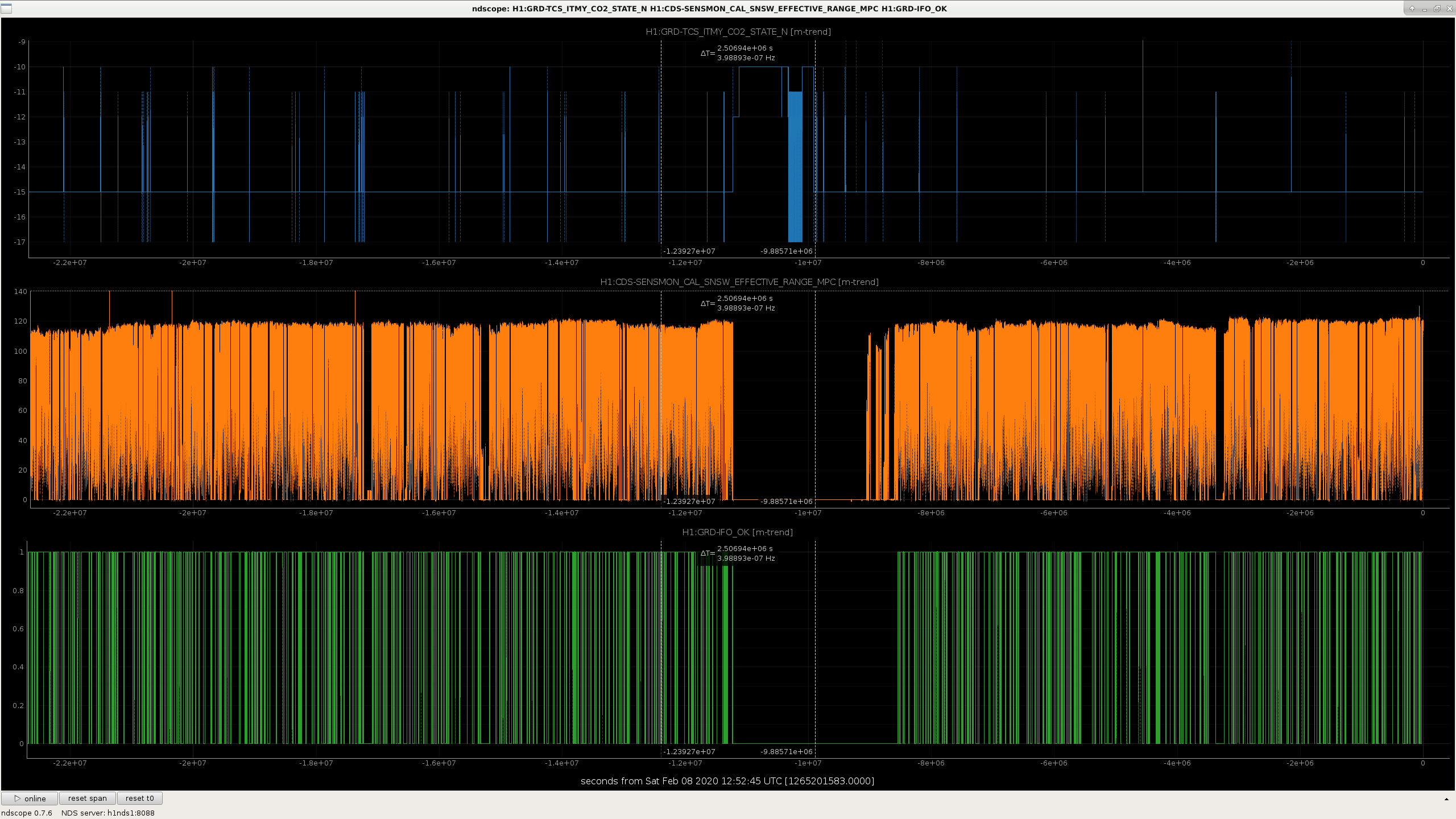
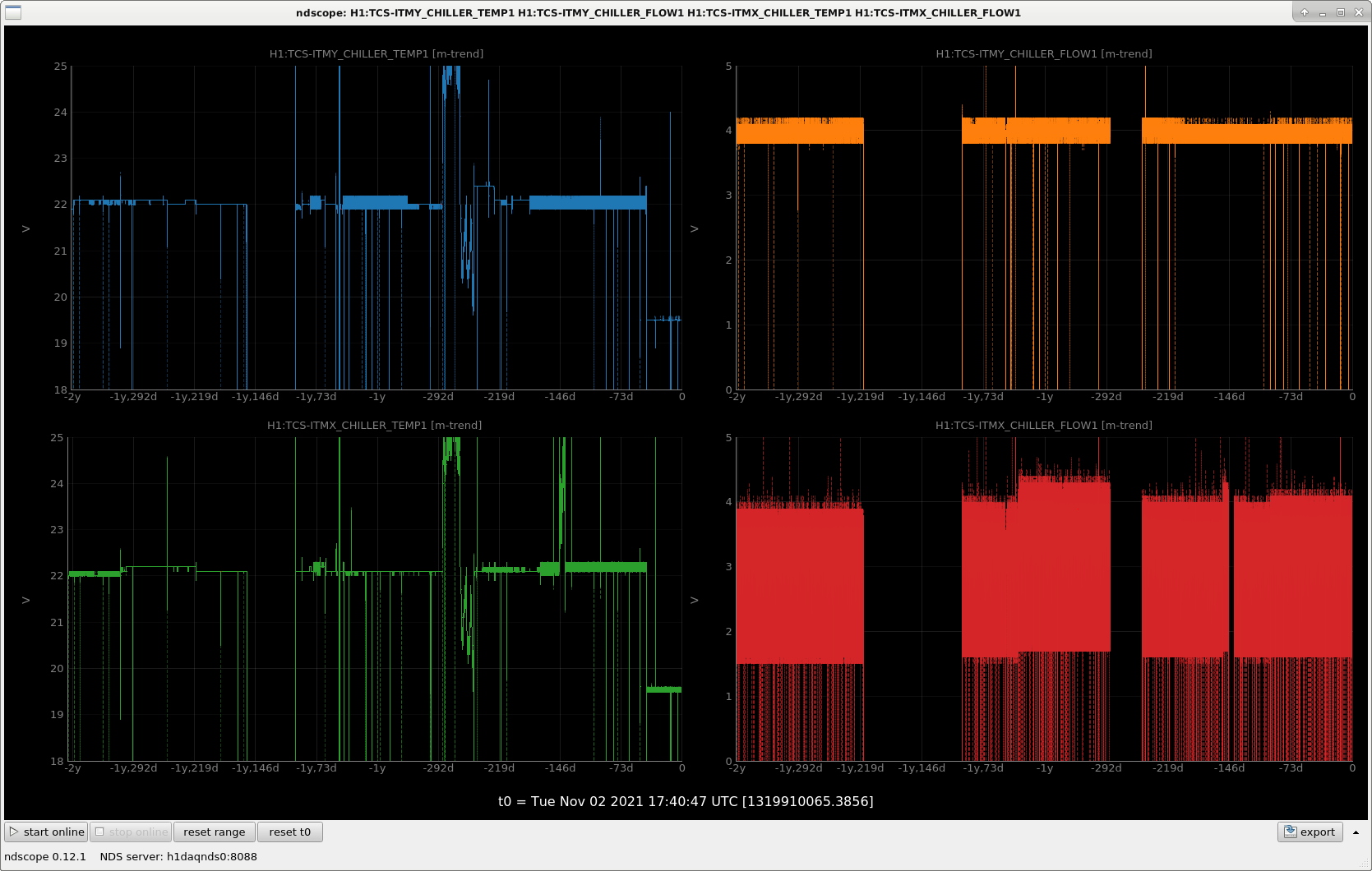
Looked back at this after TJ suggested we should check that both chillers are keeping constant temperatures and flow rates. Temperatures in ITMX and ITMY cCO2 chillers seems to be stable. See plot over last 2 years here. As the laser hasn't ben on recently we cannot check how stable it is.
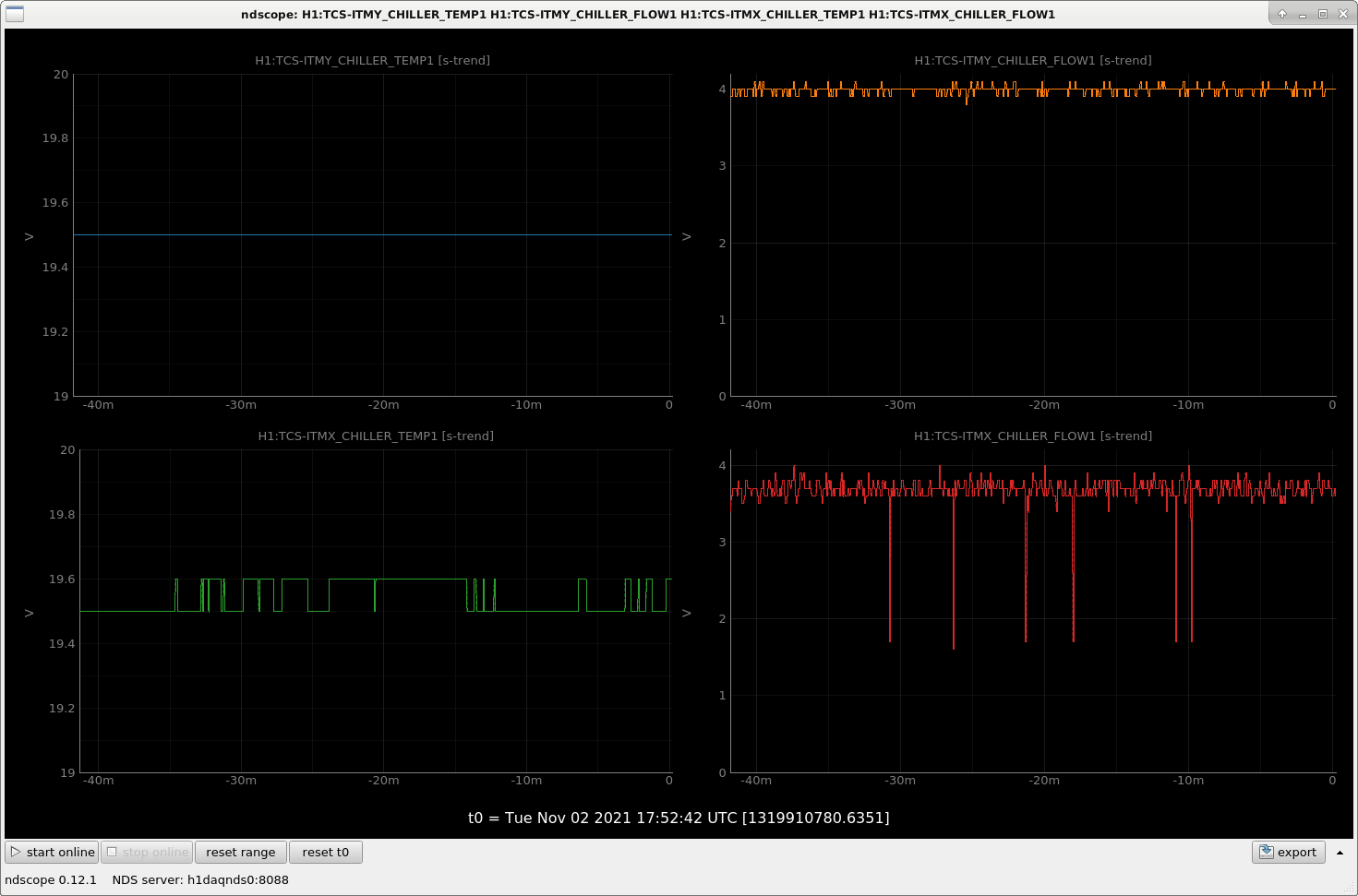
Flow rate reported by ITMX chiller seems to regularly drop from the nominal 3.8 to 2 GPM to up to 10 times an hour. However these drops only last one data point which doesn't effect the laser controller safety controls. See zoomed plot here. The chiller has been like for the past 3.5 years (as far back as I can easily see in EPICS).
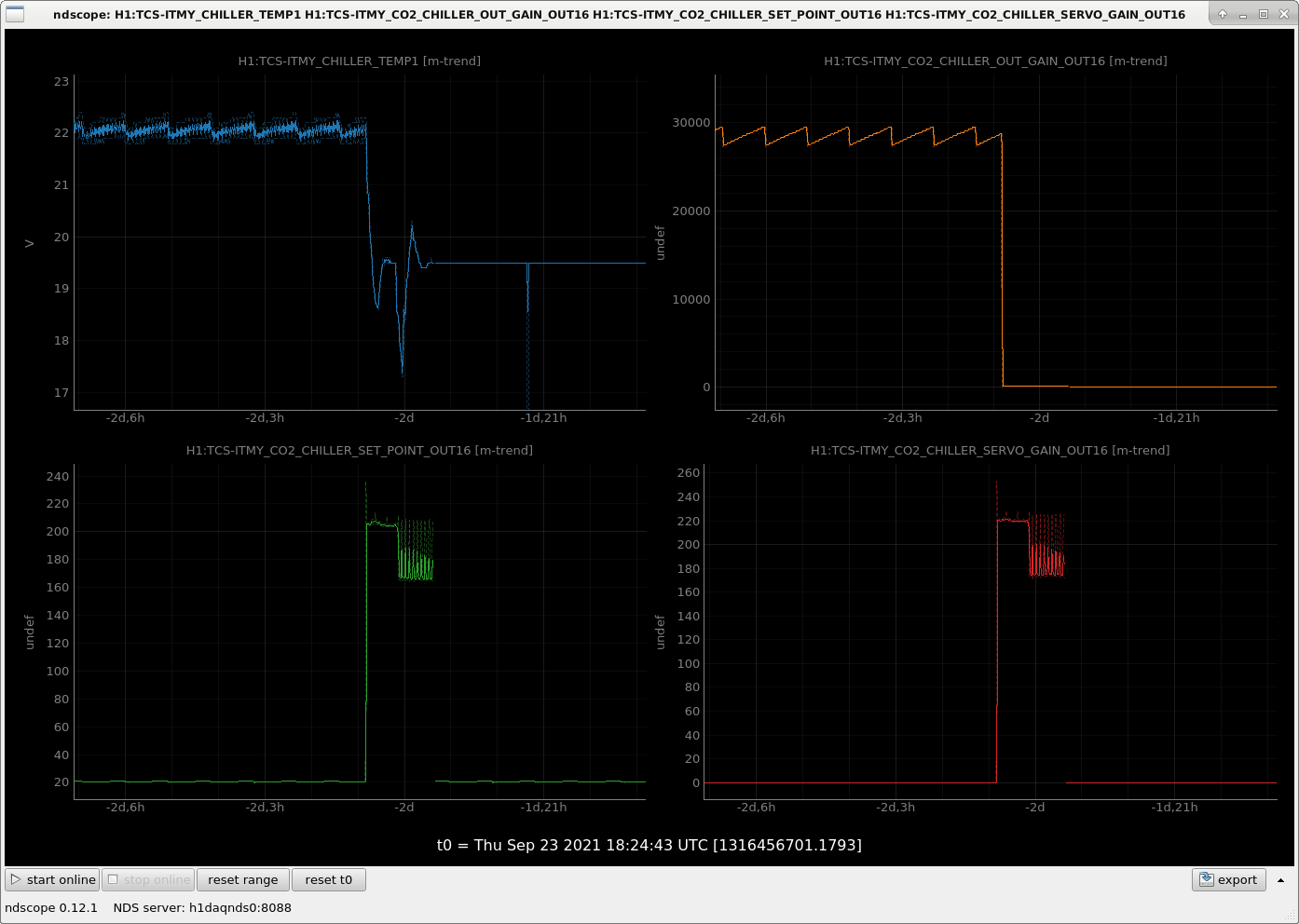
2021/09/21 Tuesday 17:30UTC Both ITMX and ITMY chiller temperatures decreased from 22 degC to 19.5 degC. The set point is still at 22degC but the channel H1:TCS-{ITMY/ITMX}_CO2_CHILLER_OUT_GAIN_OUT16 dropped to zero Simulink for h1tcscs . Ndscope trace here. This apears to be the day the h1tcscs model was installed on h1oaf0 - see alog 60002. Tagging cds.
ECR for upgrading the CO2 controller is here: https://dcc.ligo.org/E1600312
Latest concept for redesigning CO2 controller is attached. Project is stalled right now due to lack of manpower.
Daniel fixed this setpoint problem by finding the filters had been removed (see alog 60660).
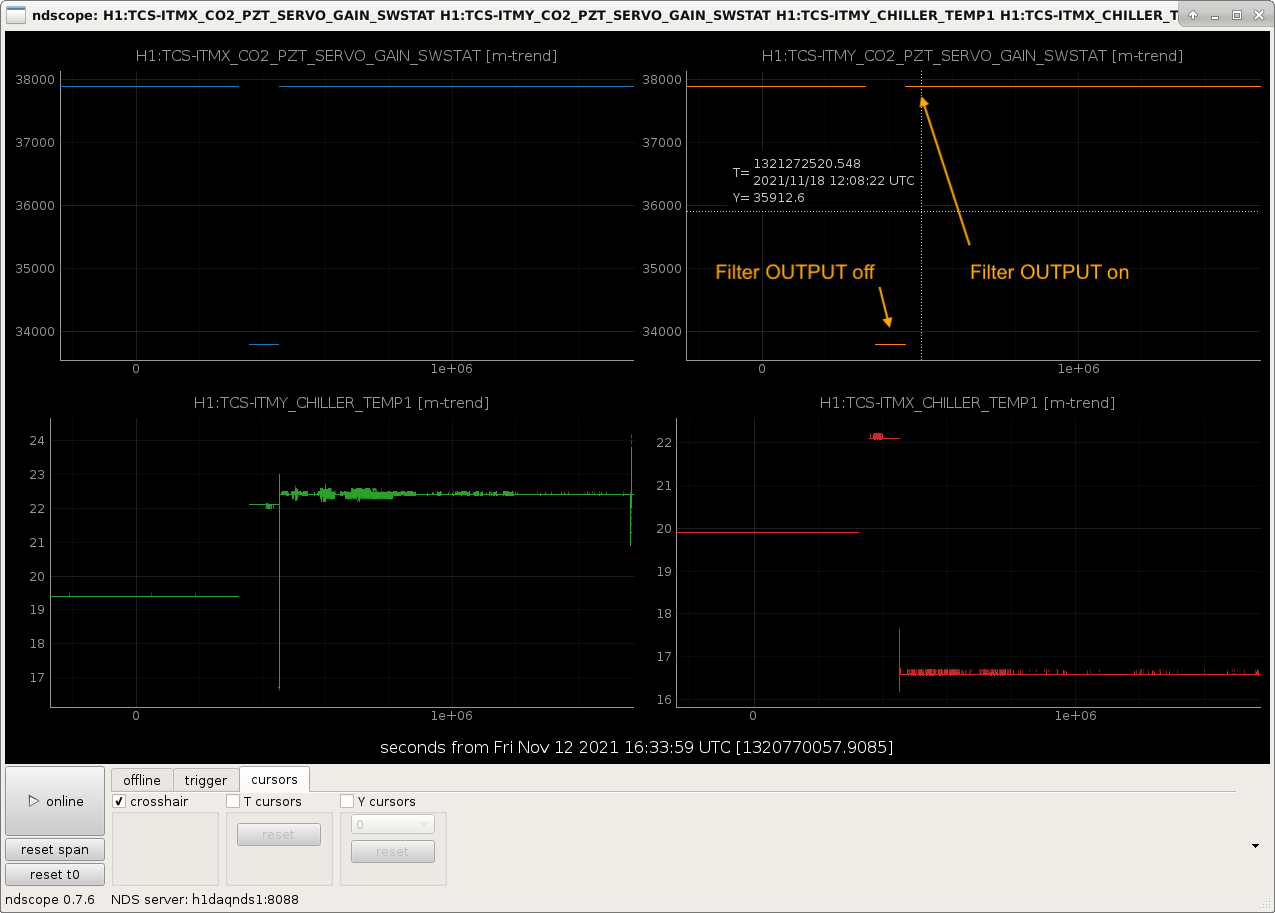
Once the filters were added back in ~19.15UTC 11/16/2021, the filters seems to be maxed out. Daniel turned off the laser power servo loop (sitemap > TCS > CO2{X/Y} > LASER > ON/OFF for PZT_SERVO_GAIN) and they behaved as expected. These values are not recorded in SDF. It doesn't make sence for the chillers to be tied to the laser when the laser is off so will investigate if the matrix changed.
The PZT_SERVO_GAIN OUTPUT we turned OFF 2021/11/16 20UTC must have not being svn saved and turned back on on 2021/11/17 22UTC. See attached trend.
The design is to stabilize the laser PZT error signal by controlling the chiller temperature (E1300233p20). When the laser is off this seems to break down and change the have the setpoint given to the chiller (CHILLER_SETPT1) far from the ~20deg setpoint offset H1:TCS-ITM{}_CO2_CHILLER_SET_POINT_OFFSET (seen in TCS CO2 LASER screen). See table below.
TJ and I are looking into these settings. Maybe the matrix gain values or PZT gains are incorrect or the loop should be switched off when the laser is off.
| Current values | CHILLER_SET_POINT_OFFSET | PZT_SERVO_GAIN | CHILLER_SETPT1 (setpoint sent to chiller) |
| CO2X | 20.6 | -111 | 16.6* |
| CO2Y | 20.5 | 55 | 22.4 |
*Documentation states it's important not to let the chillers be +/- 5deg from 20deg otherwise there may be condensation formed in the laser. The chillers have limits to shut off if they get outside this range but only compared to the CHILLER_SETPT1 value.
The PZT_SERVO_GAIN OUTPUT is turned off in the CO2 Guardian's DOWN state (well done guardian), running DOWN fixed the problem.
Now the lasers think the set point given to the chillers is 20deg but the chillers are receiving set point request of 22degC. So another issue to solve.
13:29 took H1 back to Observing for tne next 80min before Maintenance. (no intervention needed for the two lock attempts)
And since it's close to Maintenance, running the Revert script for my alerts.