Displaying reports 36801-36820 of 89199.Go to page Start 1837 1838 1839 1840 1841 1842 1843 1844 1845 End
Reports until 13:10, Thursday 19 December 2019
H1 CAL (CAL, DetChar)
evan.goetz@LIGO.ORG - posted 13:10, Thursday 19 December 2019 (53992)
Follow up study on NCal narrow line noise couplings
I had previously raised a preliminary concern about narrow line noise couplings to h(t) from the NCal electronics (see LHO aLOG 53666). Robert had suggested that I can use the temporary magnetometer left on the NCal encoder electronics, close to the NCal mechanism itself (much closer than the VEA magnetometer), and compare coherences between h(t) and the temporary magnetometer with h(t) and the VEA magnetometer.

Using the timeline that Timesh has left us (LHO aLOG 53629), I first selected the necessary segments using the following segment database queries:
$ ligolw_segment_query_dqsegdb --segment-url=https://segments.ligo.org --query-segments --include-segments=H1:DMT-ANALYSIS_READY -s 'lalapps_tconvert Nov 26 2019 14:00 PST' -e 'lalapps_tconvert Dec 4 2019 23:39:00 utc' | ligolw_print -t segment -c start_time -c end_time -d ' ' > segments_ncal_on.txt
$ ligolw_segment_query_dqsegdb --segment-url=https://segments.ligo.org --query-segments --include-segments=H1:DMT-ANALYSIS_READY -s 'lalapps_tconvert Dec 4 2019 23:39:00 utc' -e 'lalapps_tconvert now' | ligolw_print -t segment -c start_time -c end_time -d ' ' > segments_ncal_off.txt
Then I computed 1800 s long FFTs, Hann windowed and 50% overlapping for H1:GDS-CALIB_STRAIN, H1:PEM-EX_MAG_VEA_FLOOR_QUAD_SUM_DQ, and H1:PEM-EX_ADC_0_11_OUT_DQ for the two different periods, whether the NCal was ON or OFF. These were computed and averaged using standard LALSuite tools lalapps_MakeSFTDAG and lalapps_spec_avg_long. Finally, I used the coherenceFromSFTs.py script written by Greg and Kara to compute coherences over these two time periods for comparison. Attached is the result from 10 Hz to 1000 Hz, plotted in 100 Hz sub-bands. Each page has 3 figures: left shows the ratio of whitened h(t) ASD (ON/OFF), middle shows the coherence between the temporary magnetometer and h(t), right shows the coherence between the VEA magnetometer and h(t). The whitened ASD is computed with a running median across 101 frequency bins of the time-averaged spectra. This is the basis for Fscans and effectively removes slow variations in the spectrum over different time periods. I'm only concerned in this study with narrow artifacts, so this is ok to do. The ratio of normalized spectra show some line changes (excursions above 1 indicate worse lines), especially below 100 Hz, but we also see excursions below 1. I speculate that the lines have actually changed in frequency by more than 1 bin. I see this effect other times as well, so I don't believe this is coupled with the NCal being on or off. Most of the rest of the 100-1000 Hz spectra look unchanged. Since I don't see very much difference between coherence plots, I feel a bit more confident that the NCal electronics are ok, but I don't think we can quite put this to rest yet until we move the temporary magnetometer to sit very close to the NCal power electronics. Robert suggested that we could move this at the next lock-loss opportunity, pending permission of course. In any case, since the NCal is not essential IFO operations electronics, I'd suggest to leave them OFF and only turn on as-needed for measurements.
Non-image files attached to this report
H1 PSL
jeffrey.bartlett@LIGO.ORG - posted 11:15, Thursday 19 December 2019 (53991)
Backup PSL Chiller A/C Service
   Jeff B., Scott, Tyler, Chandra, Robert. 


   Coffey Refrigeration was on site to check the backup Chrystal chiller, which was not cooling. They found the system was 1lb low on R134A (out of a 1.75lb system). They put enough R134A to clear the bubbles from the sight glass and to get the compressor running. They put dye in the refrigerant system. 

   The plan is to run the chiller until at least next Monday. Coffey will come out on Tuesday to look for dye tags of a leak. Further repairs or service will depend on the results of the dye test. 

   I will ask the day shift operator to check the chiller once a day until Monday and give me a call if the chiller is not running. The front panel should show a temperature of 20c. I will be in for Evening shift starting on Monday and will take over checking the unit then. 

   Per Robert's input, we placed the chiller on rubber dampers to prevent the chiller noise from perturbing the IFO over the weekend.       
H1 General
camilla.compton@LIGO.ORG - posted 08:05, Thursday 19 December 2019 (53986)
Shift transition to DAY

TITLE: 12/19 Day Shift: 16:00-00:00 UTC (08:00-16:00 PST), all times posted in UTC
STATE of H1: Observing at 116Mpc
OUTGOING OPERATOR: Jim
CURRENT ENVIRONMENT:
    SEI_CONF state: WINDY
    Wind: 7mph Gusts, 4mph 5min avg
    Primary useism: 0.04 μm/s
    Secondary useism: 0.46 μm/s
QUICK SUMMARY: Locked for 16h30

H1 General
jim.warner@LIGO.ORG - posted 08:03, Thursday 19 December 2019 (53987)
Shift Summary

TITLE: 12/19 Owl Shift: 08:00-16:00 UTC (00:00-08:00 PST), all times posted in UTC
STATE of H1: Observing at 7Mpc
INCOMING OPERATOR: Camilla
SHIFT SUMMARY: Other than earthquakes, it was quiet
LOG:

12:00 Got several notifications for incoming earthquakes

12:43 Saw signals in IMC-f and EQ_PEAK so, transitioned to SEI_CONF to earthquake

13:33 Watching ground and ENV_STAT, went back to WINDY

H1 SEI
jim.warner@LIGO.ORG - posted 05:43, Thursday 19 December 2019 - last comment - 09:23, Thursday 19 December 2019(53985)
ENV_STAT guardian earthquake monitoring/automation looks promising

TJ and I have been working on a guardian that we hope will eventually automate at least some of the seismic configuration transitions. I think TJ has two tests in this guardian, one that just watches the EQ_PEAK channel to go above a certain threshold and one that triggers when SEISMON sees a new earthquake (based on the metric from my eq response plot). If an earthquake that we might care about shows up on SEISMON, the guardian goes to a holding state (SEISMON_ALERT), where it watches the EQ_PEAK channel to get above a certain threshold, then the ENV_STAT node goes to its earthquake state. I emphasize here that this guardian doesn't actually make any changes yet, this is just a test to see if automating is a crazy idea or not.

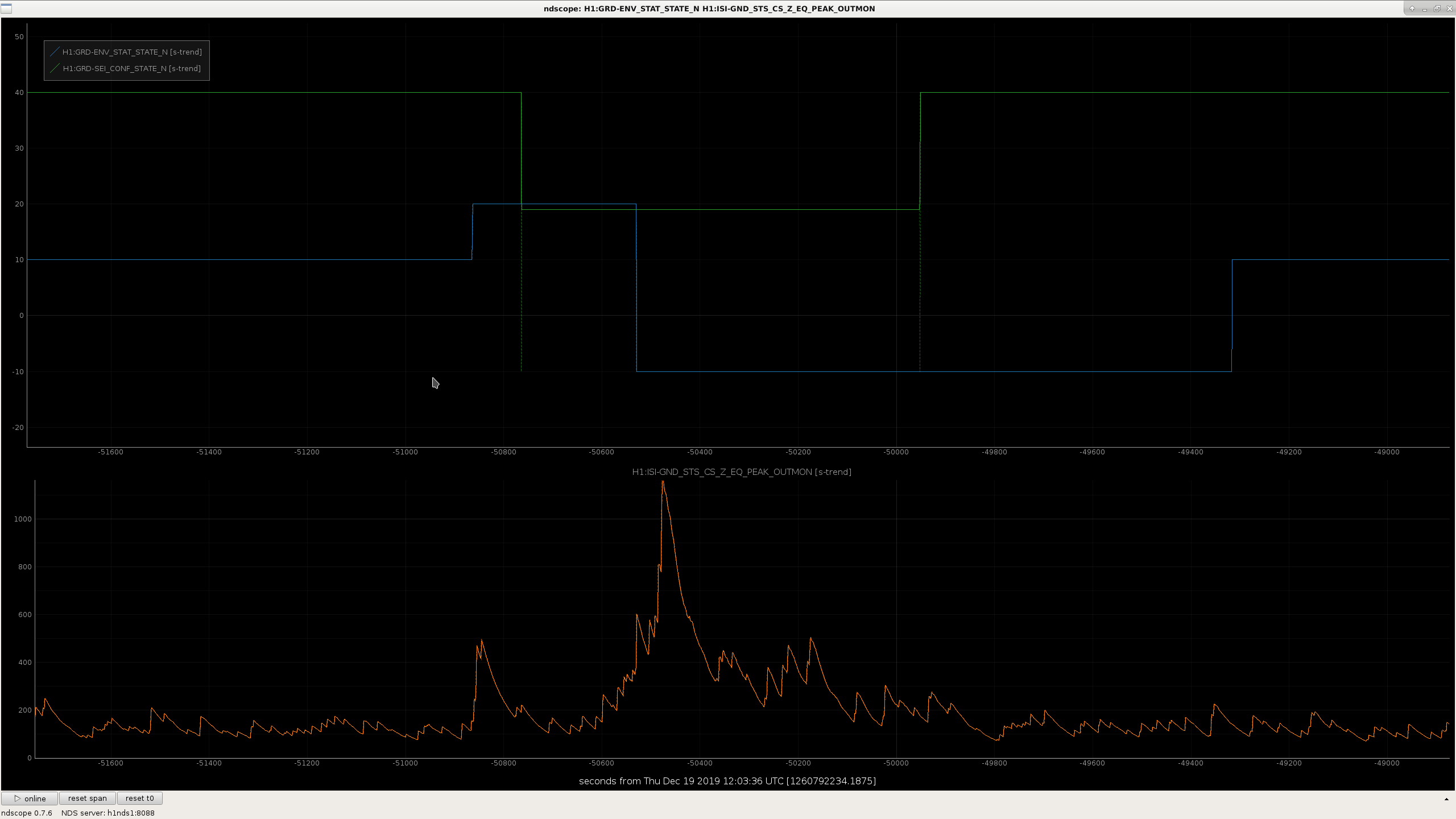
TJ had an earthquake yesterday where he got a SEISMON notification, and the earthquake was big enough to be an issue when it arrived on site, so he transitioned SEI_CONF to it's earthquake state. FIrst attached plot shows the state progress of SEI_CONF (green? I can't tell) and the ENV_STAT (blue) nodes on the top plot and the ground velocity EQ_PEAK monitor channel in yellow on the bottom. The green trace changing values is TJ deciding on his own when to change the SEI_CONF state (40 is the normal WINDY state, 19 is EARTHQUAKE), the blue trace is when the tests we've put into ENV_STAT suggest when we should be transitioning (20 for blue is the alert state, -10 is the earthquake state). I think the tests for ENV_STAT could use some tweaking, I don't think the difference between what TJ actually did and what ENV_STAT wanted to do are wildly different. Not saying did or didn't do the right thing (probably), but the new guardian isn't totally bonkers.

I think the biggest advantage of automating the seismic earthquake response will be forcing consistency so we can tell if we are actually doing the right thing. Looking over the run, I would believe that each of the operators has a different way of thinking  about whether or not to make the earthquake transition and when.

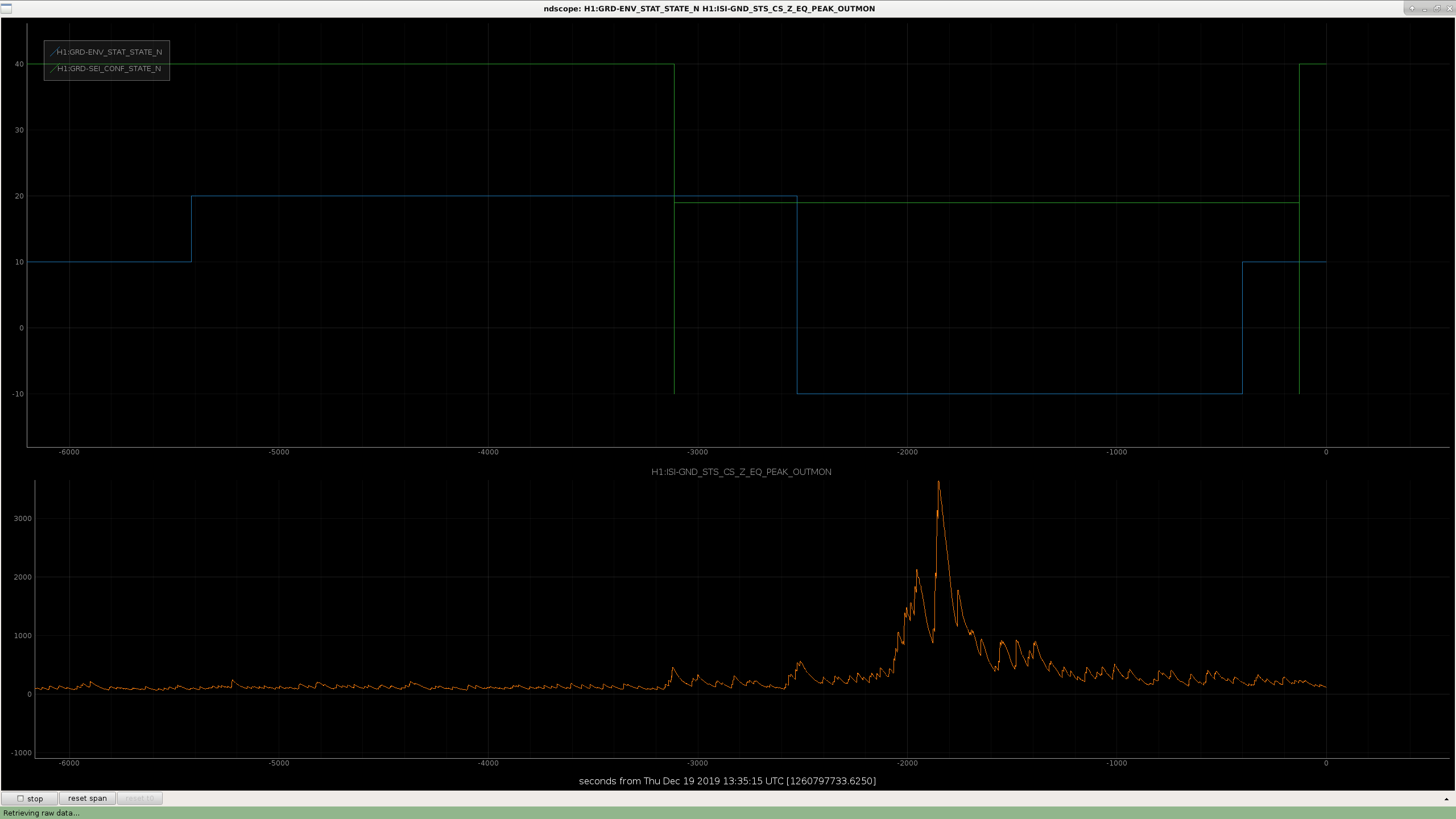
Currently watching a cluster of like 4 earthquakes from the Pacfic and Central America roll through, and again, the ENV_STAT doesn't seem totally crazy. Second plot is same as the first plot, but for my group of earthquakes this morning. I transitioned a bit before ENV_STAT wanted to, so maybe the "transition to earthquake " threshold should be lowered a bit.

Images attached to this report
Comments related to this report
jameson.rollins@LIGO.ORG - 09:23, Thursday 19 December 2019 (53988)

Very cool yes

LHO General
thomas.shaffer@LIGO.ORG - posted 00:04, Thursday 19 December 2019 (53981)
Ops Eve Shift Summary

TITLE: 12/19 Eve Shift: 00:00-08:00 UTC (16:00-00:00 PST), all times posted in UTC
STATE of H1: Observing at 115Mpc
INCOMING OPERATOR: Jim
SHIFT SUMMARY: useism is down and we have a 8 hour lock.
LOG:

H1 SUS
cheryl.vorvick@LIGO.ORG - posted 20:47, Wednesday 18 December 2019 (53984)
ETMY violin mode damping: damping Mode 6 for the first time

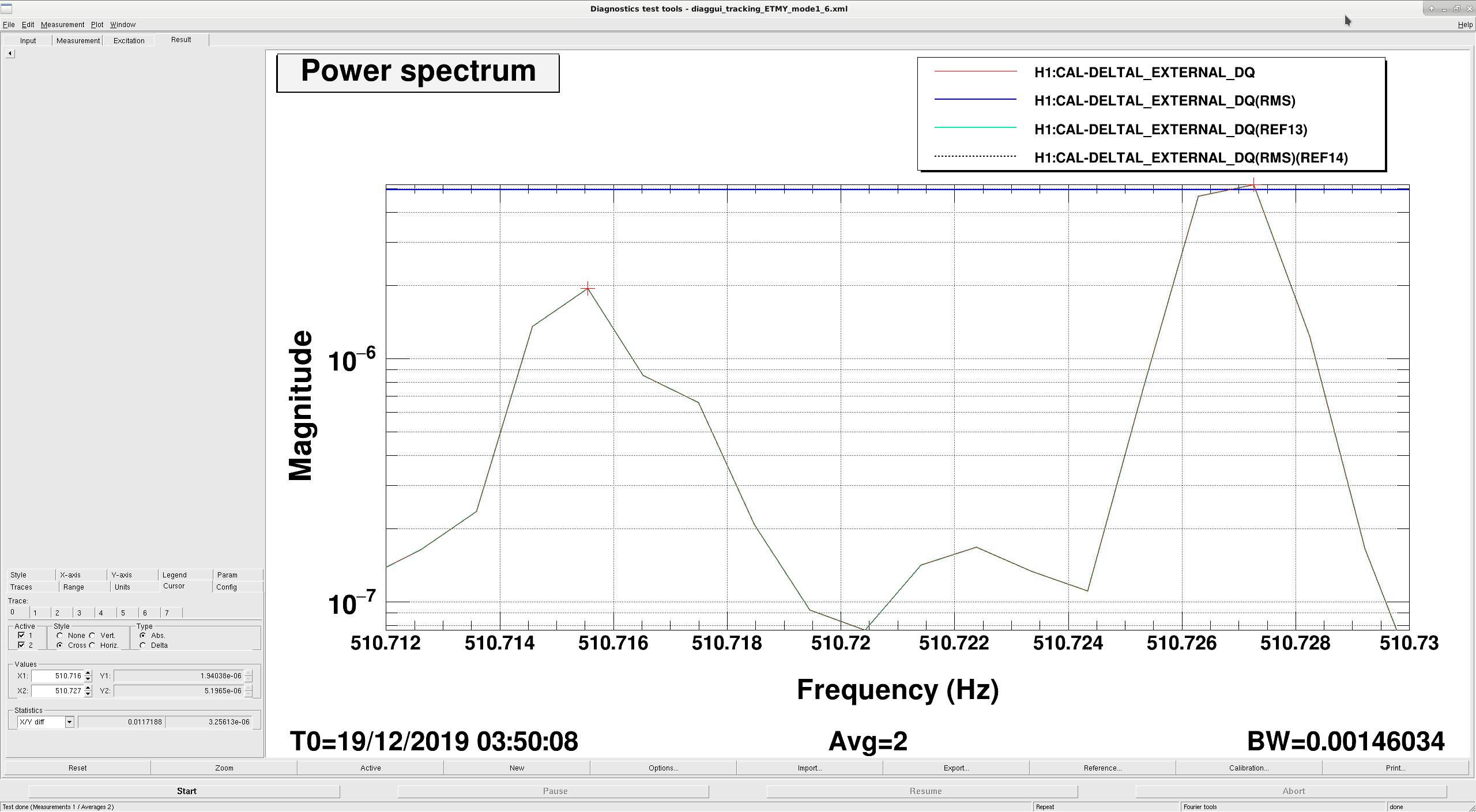
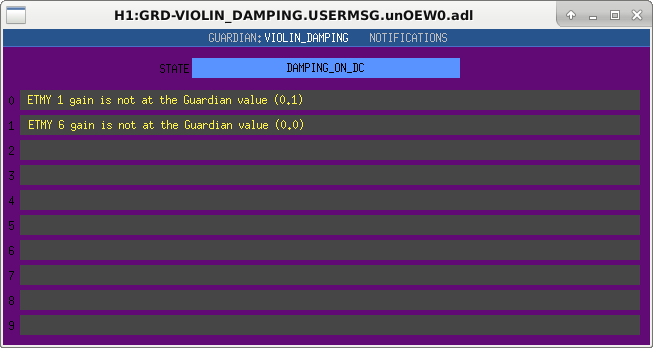
ETMY violin mode damping gains are set at nominal for all modes except modes 1 and 6.  Mode 1's peak is so small I've turned off the damping.  I've started damping mode 6.  Mode 6 started with a gain of -0.1, which was slowly ringing it up.  I switched to a gain of +0.1.  I'm leaving this gain on mode 6, and am requesting it be monitored overnight, by checking the peak height in the spectra in the diaggui file called diaggui_tracking_ETMY_mode1_6.xml, which is in my home directory (first attachment is a snapshot of this dtt).  The dtt file has a reference from tonight at04:32 UTC, and opens with the X axis zoomed in to show only ETMY modes 1 and 6. 

Monitor filters for these two peaks currently overlap, so the numbers and ndscopes do not reflect each peak, thus the need to use dtt.

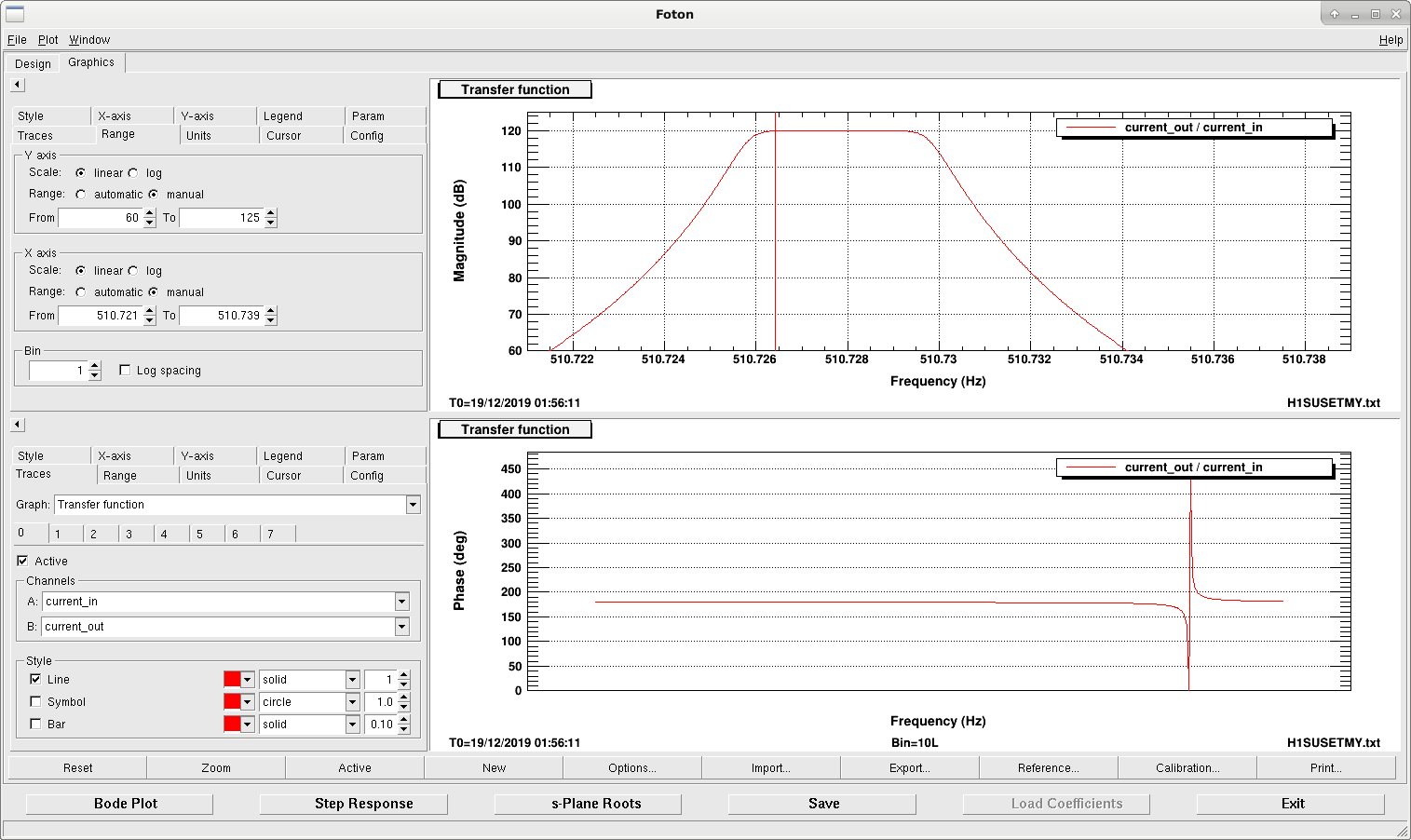
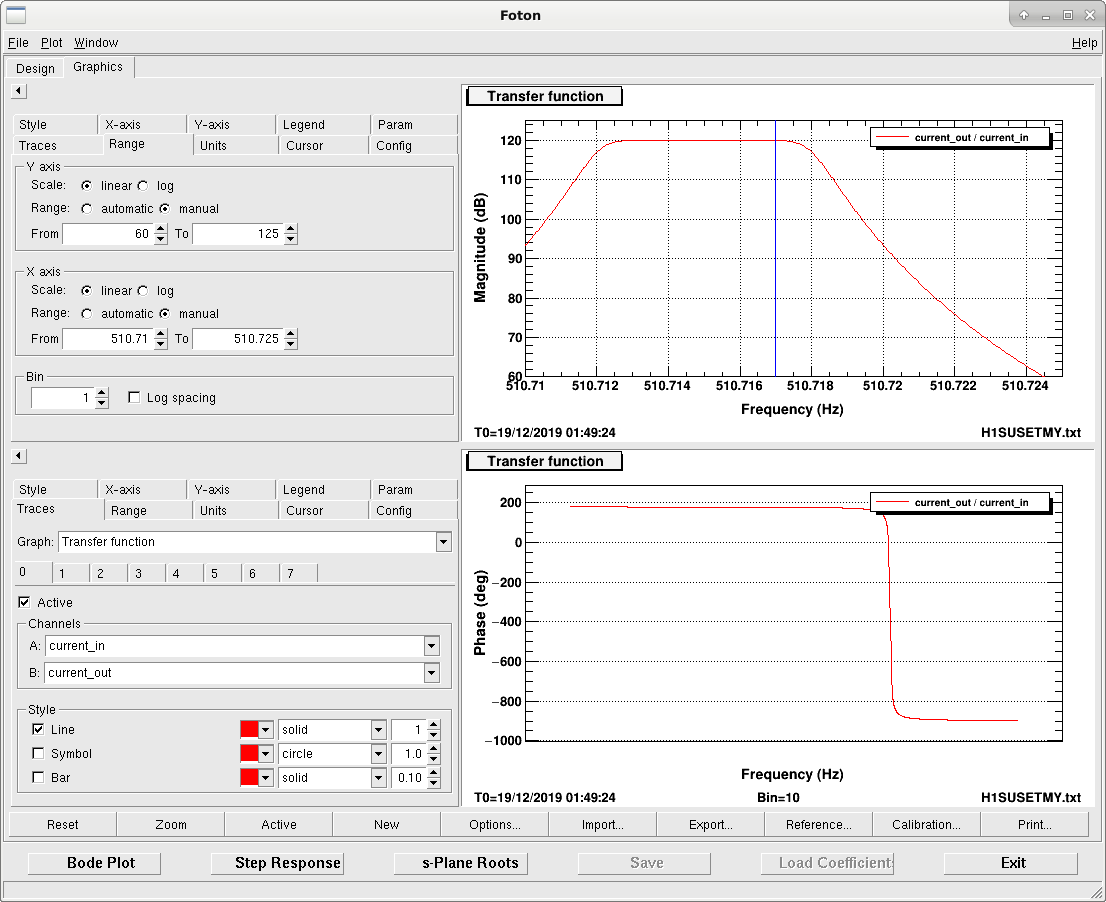
I updated the damping filter for mode 6.  As found, the mode 6 damping was biased toward the mode 1 peak, and I moved the filter up in frequency so that it's biased away from the mode 1 peak.  I've attached snapshots of the damping filters for modes 6 and 1, with vertical cursors showing the frequency of the peak each filter is damping.  Mode 1 damping filter is unchanged.

Images attached to this report
H1 General
thomas.shaffer@LIGO.ORG - posted 20:07, Wednesday 18 December 2019 (53983)
Ops Mid Shift Report

Locked for about 5 hours. We went back into observing at 0158 UTC.

H1 SQZ
sheila.dwyer@LIGO.ORG - posted 17:59, Wednesday 18 December 2019 (53979)
squeezing angle scan with higher nonlinear gain

Daniel, Sheila

We took a reference time with no squeezing from 1260747990 to 1260749058

We turned the fiber launch power up to 18.8mW, we have 1.7mW in reflection off the OPO, and the trans diode reads 2.6 (normally its normalized to 1), but the trans diode seems to be saturated, so we have turned off the green intensity stabilization.  We measured a nonlinear gain of 8.67.  

The OPO servo gain is reduced by 11dB, to -23dB In1 gain.  The CLF gain is reduced by 6dB to 0dB fast gain, and the LO gain is reduced by 8dB to to 0dB IN1 .  We then started a scan of the squeezing angle, which should finish around 1:10 UTC. 

We ran into trouble with the LO loop with these settings for CLF angles around 180deg, so we ended up resetting the LO loop gain to 12dB, which is 4dB higher than the nominal setting.  We restarted the scan after this.  We got another reference time with no squeezing from 1260754973 to 1260755635 

H1 CAL
jeffrey.kissel@LIGO.ORG - posted 17:30, Wednesday 18 December 2019 (53980)
Calibration Measurements: Most of a Full Suite Today Before EQ, Updates to Sensing Function
J. Kissel

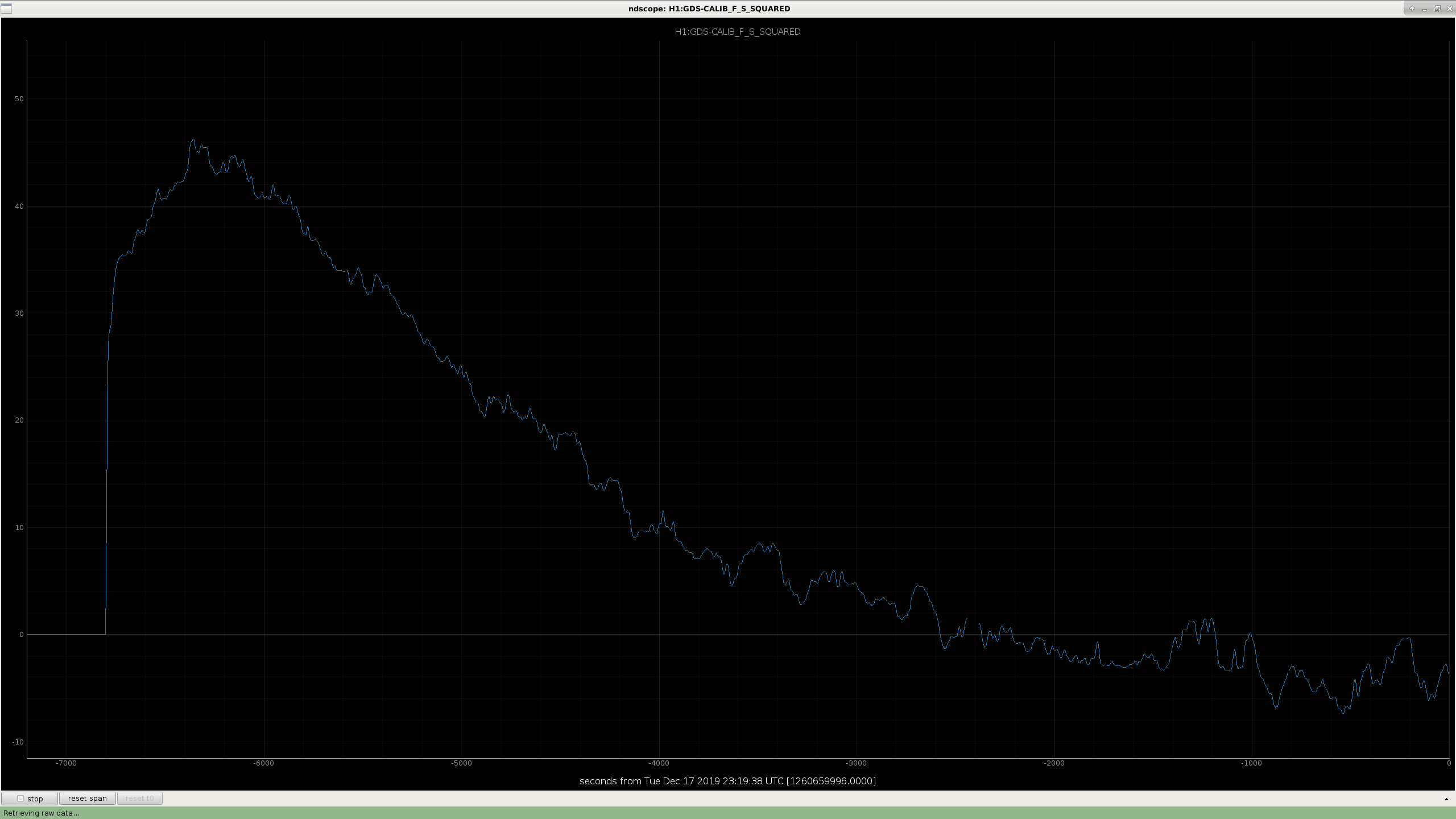
I've captured a standard sensing function suite, and was able to get in a full L3 and some on an L2 actuator sweep today. Attached are updates to the sensing function collection of measurements. These thermalized data sets are showing *pretty* consistent results. I'm working on getting more channels from the frames (PSL input power, temperature in the LVEA) to see if I can find other things that can predict the trends I see in f_s^2. One idea I had was that the steps between lock stretches are correlated to whether an initial alignment was run. I think I can conclude that there's no correlatino there. We're also working on backing out how bad things are *during* thermalization, with the data gathered yesterday (LHO aLOG 53951). 

Raw data from today:
Sensing Function:
/ligo/svncommon/CalSVN/aligocalibration/trunk/Runs/O3/H1/Measurements/FullIFOSensingTFs/
    2019-12-18_H1_DARM_OLGTF_LF_SS_5to1100Hz_15min.xml
    2019-12-18_H1_PCALY2DARMTF_LF_SS_5t1100Hz_10min.xml
    2019-12-18_H1_PCALY2DARMTF_BB_3min.xml

Actuation Function:
/ligo/svncommon/CalSVN/aligocalibration/trunk/Runs/O3/H1/Measurements/FullIFOActuationTFs/
    2019-12-18_H1SUSETMX_L3_iEXC2DARM_12min.xml
    2019-12-18_H1SUSETMX_L3_PCAL2DARM_6min.xml
    2019-12-18_H1SUSETMX_L2_iEXC2DARM_12min.xml
    2019-12-18_H1SUSETMX_L2_PCAL2DARM_6min.xml    << only half a measurement, because of the canadian EQ

As always -- more to come!
Non-image files attached to this report
LHO General
thomas.shaffer@LIGO.ORG - posted 16:06, Wednesday 18 December 2019 (53978)
Ops Eve Shift Transition

TITLE: 12/19 Eve Shift: 00:00-08:00 UTC (16:00-00:00 PST), all times posted in UTC
STATE of H1: Commissioning
OUTGOING OPERATOR: Corey
CURRENT ENVIRONMENT:
    SEI_CONF state: WINDY
    Wind: 8mph Gusts, 6mph 5min avg
    Primary useism: 0.03 μm/s
    Secondary useism: 0.44 μm/s
QUICK SUMMARY: Some commissioning time is scheduled for now, and we just recovered from a lock loss.

LHO General
corey.gray@LIGO.ORG - posted 16:02, Wednesday 18 December 2019 (53961)
DAY Operator Summary

TITLE: 12/18 Day Shift: 16:00-00:00 UTC (08:00-16:00 PST), all times posted in UTC
STATE of H1: Unknown
INCOMING OPERATOR: TJ
SHIFT SUMMARY:

LOG:

H1 CDS
david.barker@LIGO.ORG - posted 16:01, Wednesday 18 December 2019 - last comment - 16:04, Wednesday 18 December 2019(53975)
another h1susauxb123 ADC glitch

At 22:31 UTC (14:31 PST) we had another ADC glitch on h1susauxb123 (second for today, for 05:08 PST glitch see alog-53962)

To gather more diagnostics, I'm running a script on zotws6 which, once a minute, which checks for an ADC error, and if one is found issues a DIAG_RESET


Images attached to this report
Comments related to this report
david.barker@LIGO.ORG - 16:04, Wednesday 18 December 2019 (53976)
Non-image files attached to this comment
H1 SEI (OpsInfo)
jenne.driggers@LIGO.ORG - posted 13:37, Wednesday 18 December 2019 (53973)
SEI_CONF back to WINDY, CPS DIFF still off

At JeffK's suggestion, since the microseism has been coming down, we've transitioned back to our nominal WINDY seismic configuration.  However, the CPS DIFF is still off, since the microseism BLRMS is still above ~0.04 um/sec.  That seems to be about the level at which we started seeing glitches in Omicron.

So, if the microseism BLRMS is above 0.04 um/s (the units of the channels when viewed in ndscope is nm/s, so the value will be 400 nm/sec in ndscope for channels such as H1:ISI-GND_STS_ITMY_Z_BLRMS_100M_300M), let's keep CPS DIFF off.  If we go below that level, we can turn back on the CPS DIFF by setting

H1:ISI-DIFF_CONTROL_BIT to 1, or by opening the SEI DIFF controls screen and clicking ON in the lower righthand corner.  To get to that screen:

H1 AOS
vladimir.bossilkov@LIGO.ORG - posted 10:09, Wednesday 18 December 2019 - last comment - 16:05, Wednesday 18 December 2019(53967)
Propagation of UIM dynamics through to pyDARM code and foton filters complete

As a summary of my previous alog, which detailed a number of issue I had whilst propagating UIM dynamics recorded in another alog, with the early indication of of their relevance being alluded to in yet another alog.

One of the main things I found is that when you have a sufficiently complicated transfer function, Matlab appears to start breaking down in ways that vary in each Matlab version (see last comment in previous alog). I have written a script:

/ligo/svncommon/CalSVN/aligocalibration/trunk/Common/pyDARM/matlab_scripts/

sus_ss2zpk.py

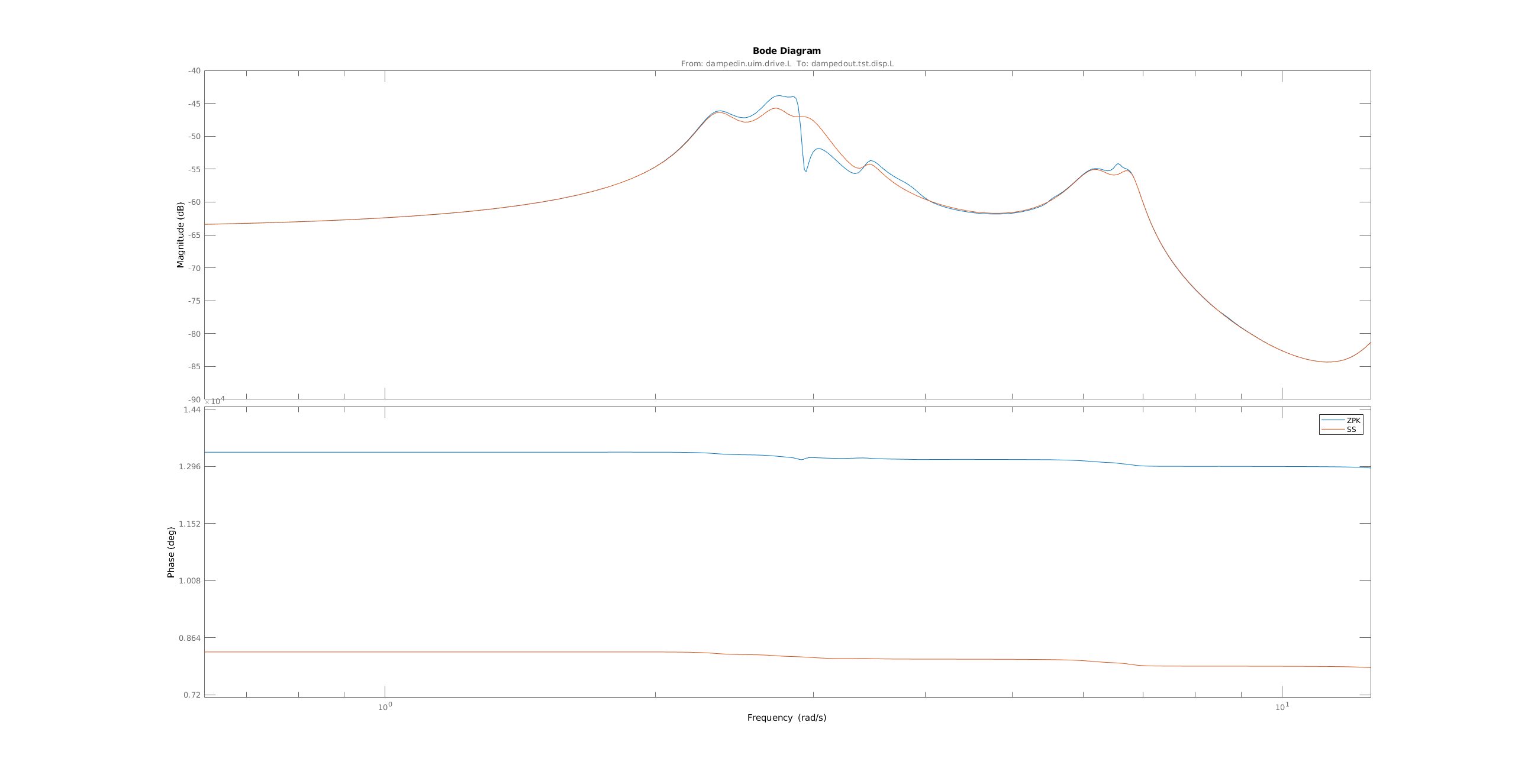
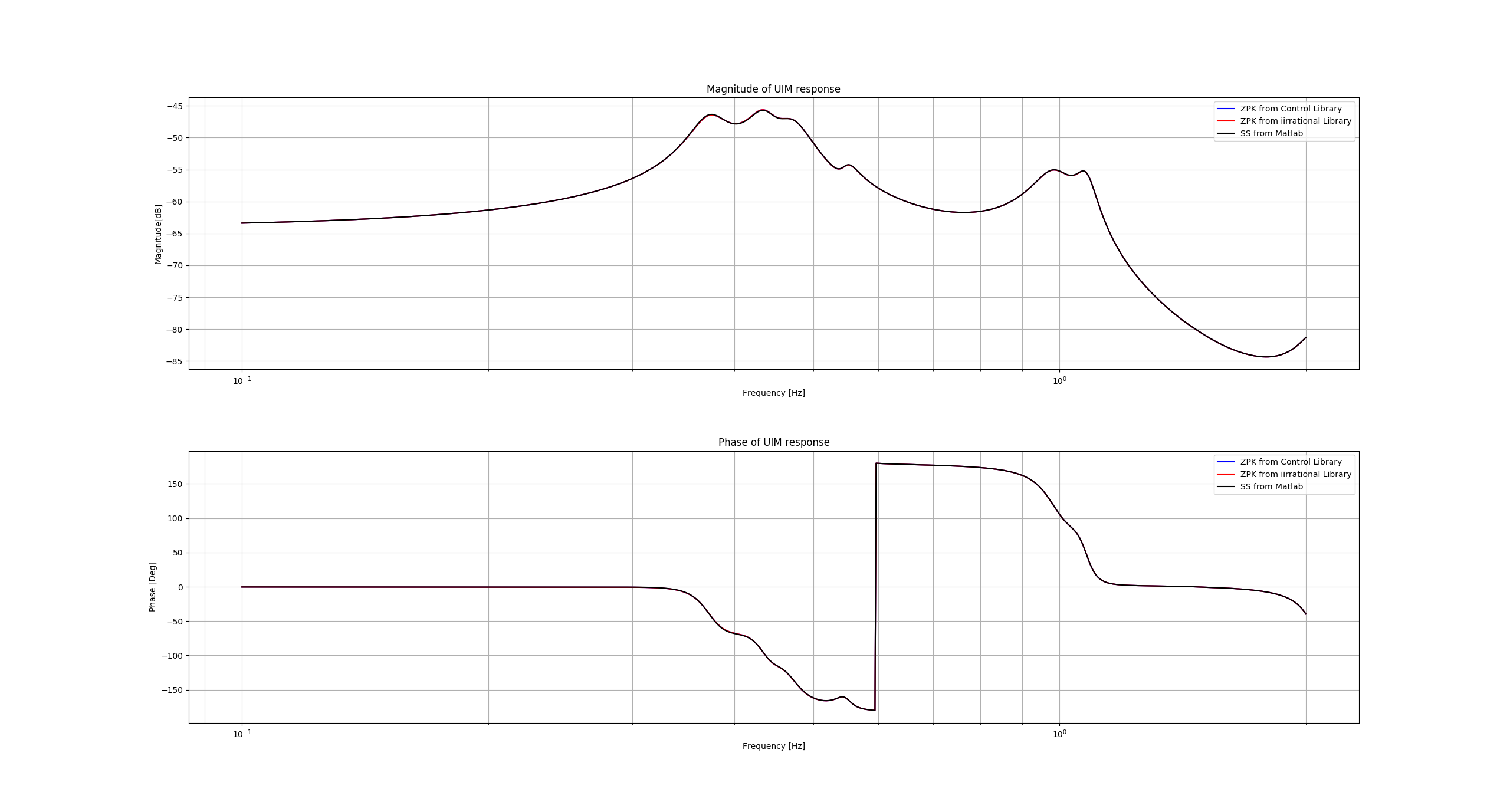
Which takes a Matlab SS model and converts it to ZPK. The comparison can be seen in pythzpk_vs_matlabss.png. Matlab appears to struggle to numerically resolve the TF after the 150Hz feature, giving rise to apparently large errors in the TF comparisons. In the version of the TF that didn't have the UIM dynamics in the range 45-150 Hz, this numerical error was happening at much higher frequencies. The main point is that the ss2zpk function in matlab is creating hugely spurious features at 0.5 Hz, and here we keep the error at that frequency at 1%. This may not be perfect, but it is a hell of a lot better than what Matlab is doing (Compare the magnitude error between this (matlab SS vs matlab zpk) and this (matlab SS vs python zpk)).


Having propagated this transfer function fully into pyDARM, with a new parameter model in:

/ligo/svncommon/CalSVN/aligocalibration/trunk/Runs/O3/H1/params/

modelparams_H1_20190909_UIMdyn.py

, using the fit (2019-11-20_H1SUSETMX_L1_LFMeas_vs_Fit.pdf), we can see the the effect on the DARM response: 2019-12-16_O3_H1_DARMLoopCritique_ContributionsToR_mag.pdf. In comparison to my first estimate on the impact of this update to the response (old alog), you can see the little blip created at 150Hz quite clearly in the 1/C curve.


The hope is that this will resolve the observed miscalibration at 150 Hz. I am working on regenerating that same plot to take into account this new dynamics factor to (hopefully) show that we can be correctly calibrated there as a result of this work.


Images attached to this report
Non-image files attached to this report
Comments related to this report
vladimir.bossilkov@LIGO.ORG - 16:05, Wednesday 18 December 2019 (53977)

I have calculated the change in response function R, with the new dynamics.

See the attached 2019-12-18_H1_Rold_over_Rnew.pdf compared against 2019-09-26_H1_deltaL_over_pcal.pdf

Looks like the change should improve H1's calibration at the 150Hz feature, as well as the 45Hz feature!

Non-image files attached to this comment
H1 CAL
jim.warner@LIGO.ORG - posted 03:32, Wednesday 18 December 2019 - last comment - 18:12, Wednesday 18 December 2019(53955)
INJ_CW_GAIN taking IFO out of Observe

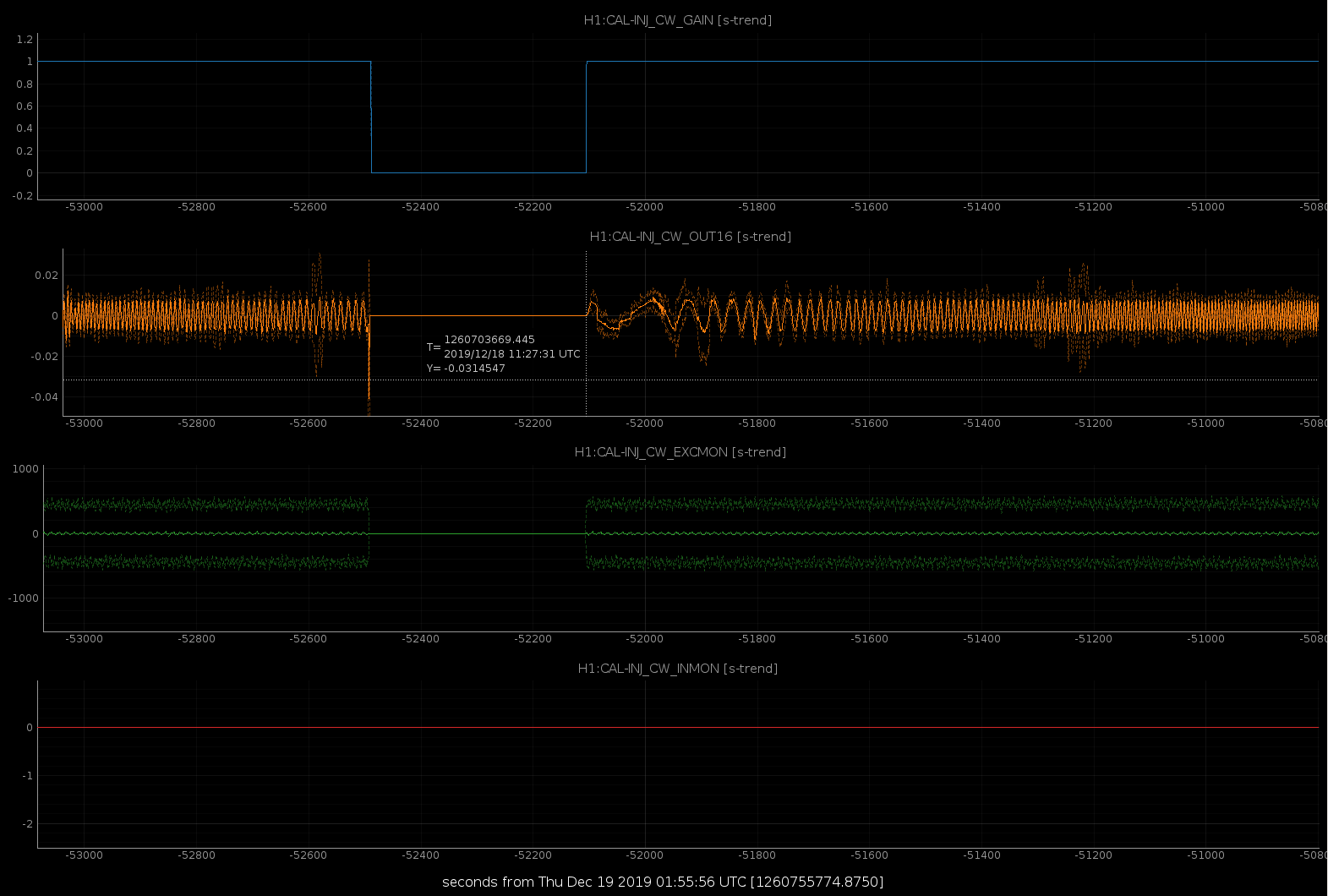
We were just knocked out of observe twice by something adjusting the CAL-INJ_CW_GAIN, the first time it was set to 0 at 11:21 utc, then again when it was set to 1 again at 11:27. I don't know if this was intentional, done by a guardian. The only remotely connected person I see is Keita, no one else is here. If this is being adjusted by some guardian should we unmonitor this gain?

Comments related to this report
thomas.shaffer@LIGO.ORG - 18:12, Wednesday 18 December 2019 (53982)CDS

I haven't found any guardians that turned off that gain, and trending the inputs and outputs just confused me. For some reason the frequency of the signal seems to be ramped up after the gain was turned back on. The gain has a tramp of 10seconds, and the frequency ramp seems to go on for minutes.

CDS, is this the inj machine restarting the injections?

Images attached to this comment
H1 CAL (DetChar, ISC, OpsInfo)
jeffrey.kissel@LIGO.ORG - posted 16:06, Tuesday 17 December 2019 - last comment - 09:52, Thursday 19 December 2019(53951)
Second Attempt at Time-Dependent CAL Line Comb
J. Kissel

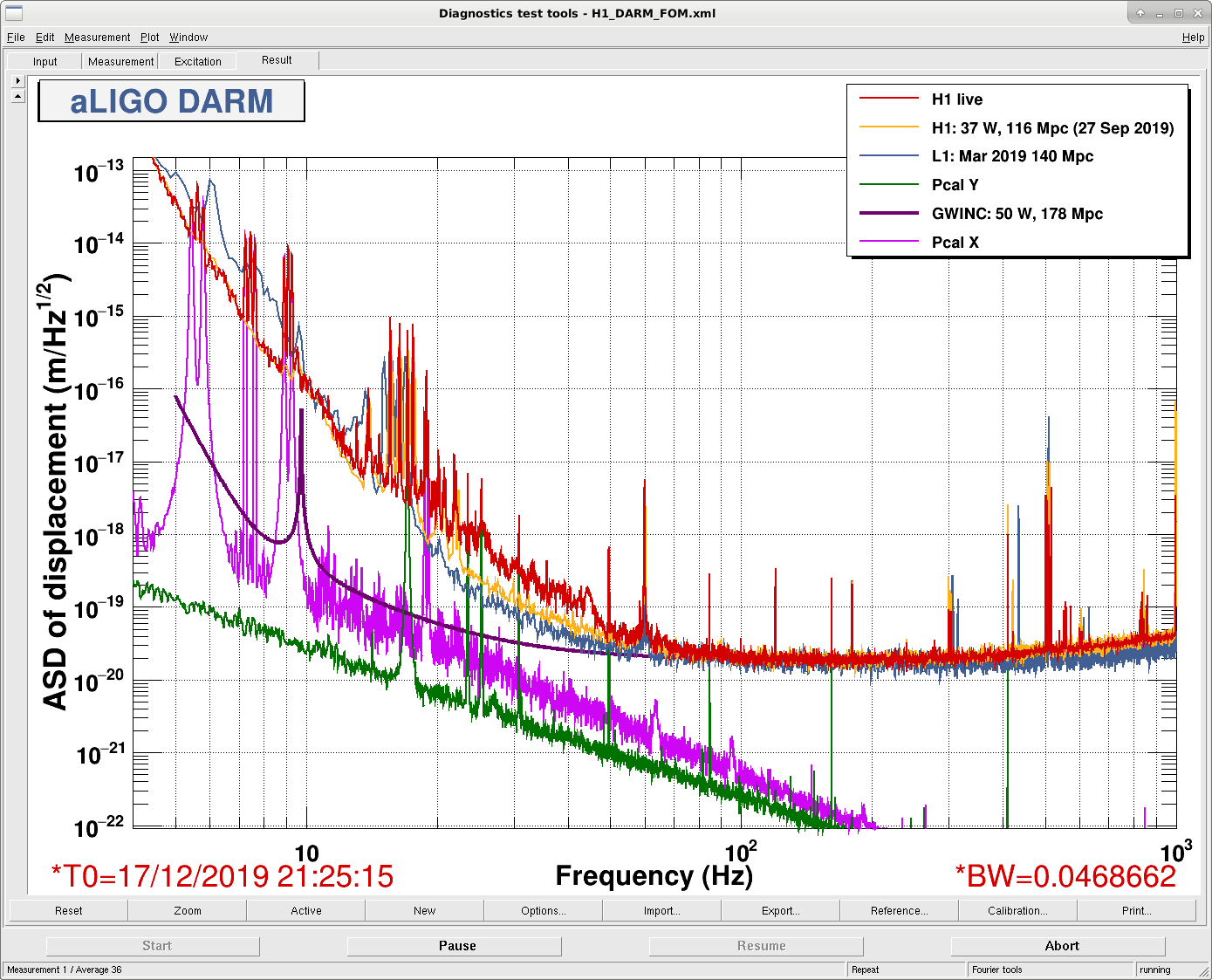
I've made a second, better attempt at tracking the long-time-scale thermalization of the IFO for the first few hours of a nominal low noise stretch -- originally attempted in LHO aLOG 53824. 

The data analysis will take some time, but here're are the measurement details. (All times are UTC on 2019-Dec-17)

    21:22 Test Start
    21:23 All lines on at conservative amplitude, SEI conf = USEISM, with SEI DIFF ON
    21:24 Hit Nominal Low Noise, all lines visible in DELTAL_EXT
    21:26:(15-30) Accidental brief turn off of (specifically) DARM lines
    21:40 Begin increase in line strength, and turn OFF of SEI DIFF
    22:03 Increase in some PCALY line heights to increase coherence
    23:20 All lines OFF, test done.

Hopefully, with all the changes in the lines during the measurement, the only effect will be that the coherence in the transfer function improves with time. During today's measurement, the microseism was well above the 90th percentile, in the ~1 um/sec range, so the 15 - 50 Hz data was rather glitchy, full of scattering arches.

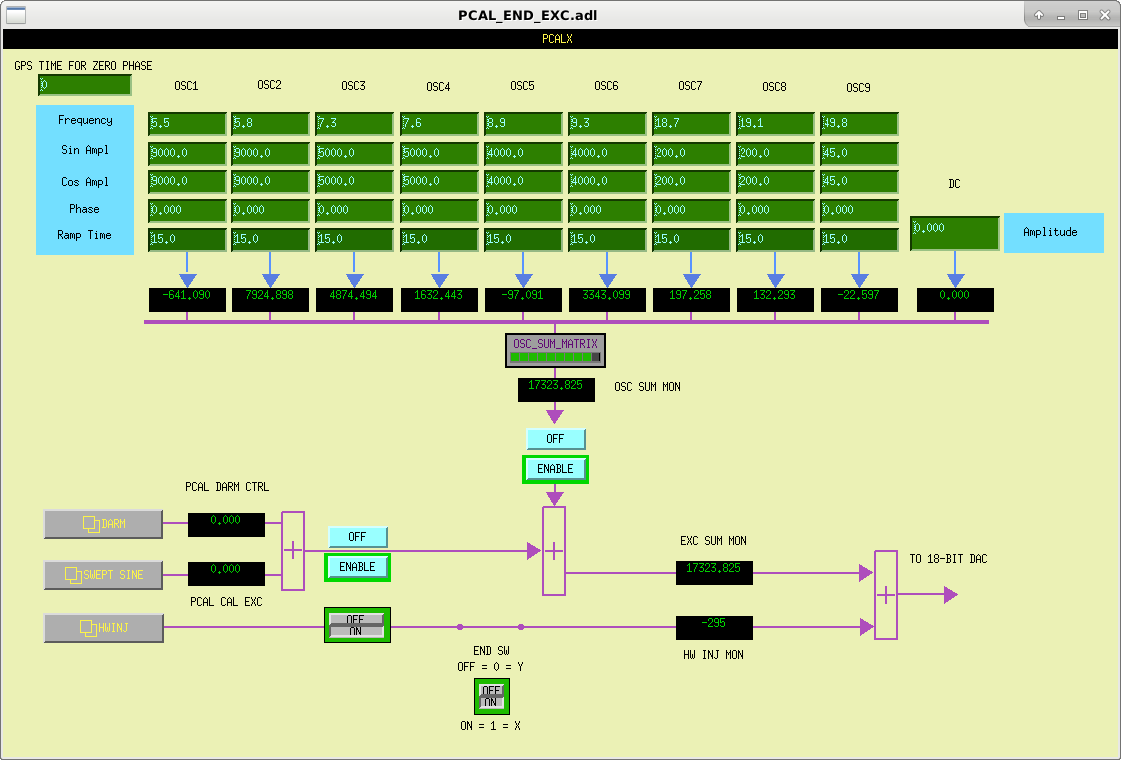
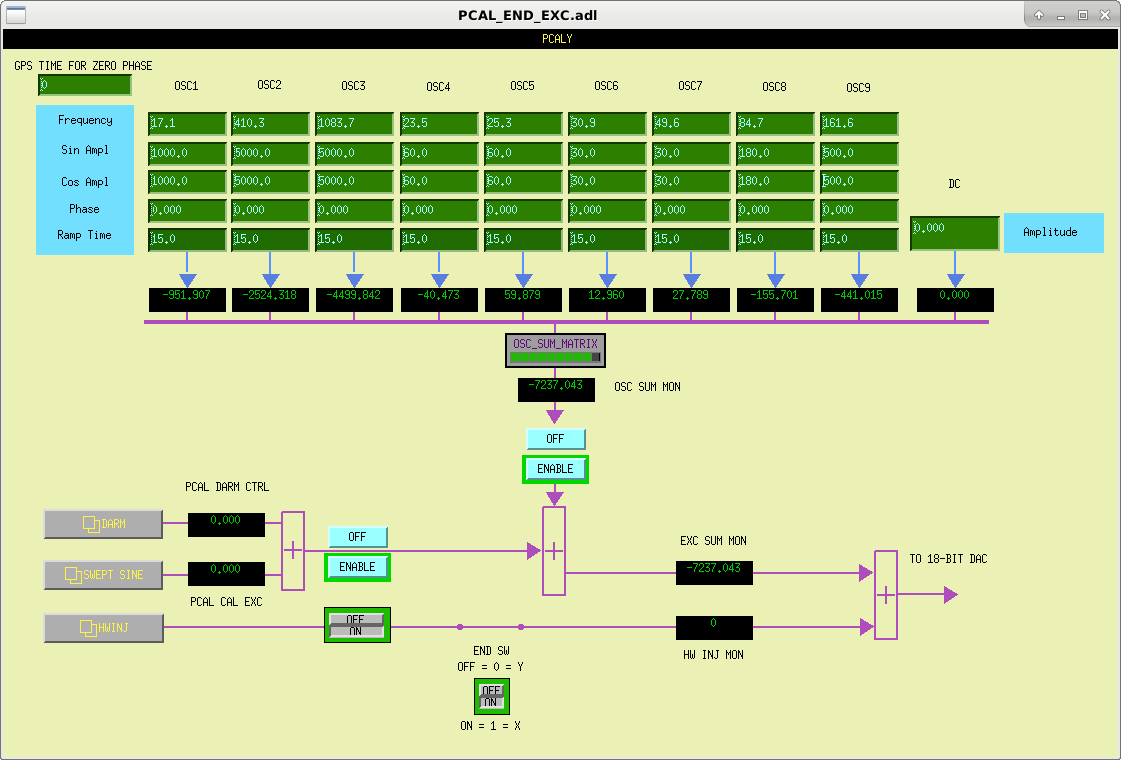
Here're the list of frequencies driven (exactly, in Hz, bold frequencies are standard calibration lines):
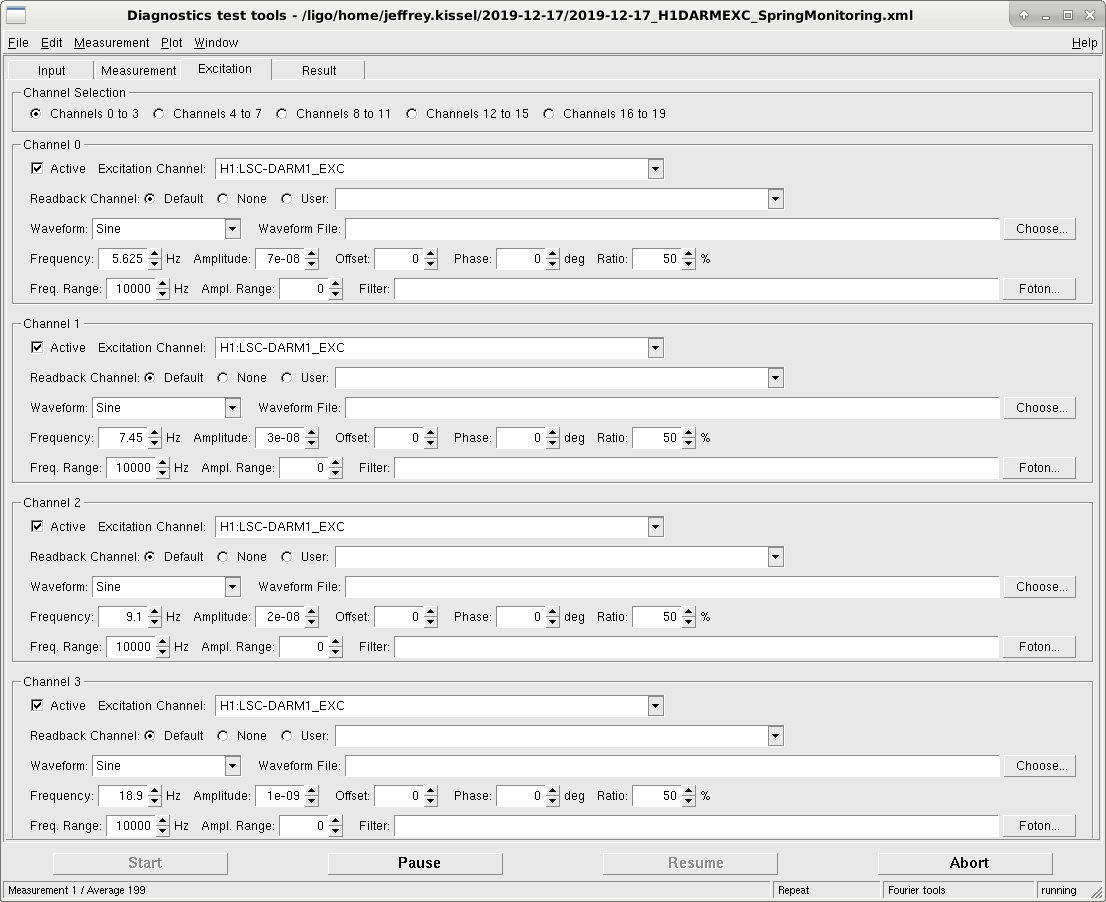
    freqlist_darmx = [5.625,    7.45,    9.1,   18.9]
    freqlist_pcalx = [  5.45,    5.8,   7.25,  7.625,    8.9,  9.275, 18.725,  19.1, 49.775]
    freqlist_pcaly = [17.100, 410.30, 1083.7, 23.525,   25.3,  30.85, 49.625, 84.65,161.625]

Script to turn on PCAL EXC lines:
    /ligo/svncommon/CalSVN/aligocalibration/trunk/Runs/O3/H1/Scripts/CALCS_FE/setup_sensingfunction_callinecombs.py

DTT template to turn on DARM EXC lines:
    /ligo/svncommon/CalSVN/aligocalibration/trunk/Runs/O3/H1/Measurements/FullIFOSensingTFs/2019-12-17_H1DARMEXC_SpringMonitoring.xml

(To turn off all the extra lines, I just hit Abort on the DTT template, and used SDF to revert all the PCAL settings. The only thing that *didn't* work for was the PCALX high frequency roaming line frequency, which I had to restore by hand at it's current sweep point, 3001.3 Hz).
Images attached to this report
Comments related to this report
evan.goetz@LIGO.ORG - 09:52, Thursday 19 December 2019 (53990)
The script to grab the data, and process it to compute the transfer functions for the individual lines is located at
aligocalibration/trunk/Runs/O3/H1/Scripts/FullIFOSensingTFs/process_sensing_20191217_darm_comb.py

The data is saved to these output files where columns are [GPS time] [TF mag] [TF phase (deg.)] [TF coherence] [TF relative uncertainty computed via coherence]:
aligocalibration/trunk/Runs/O3/H1/Results/FullIFOSensingTFs/2019-12-17_H1_sensing_comb_[1plusG_DARM,R_PCALX,R_PCALY]_[frequency]Hz.txt

Further analysis of the time series of transfer functions will need to happen in order to pull out the changes to the sensing and response function at the start of lock stretches, as the IFO thermalizes.
H1 CAL (CAL, DetChar)
jeffrey.kissel@LIGO.ORG - posted 14:28, Monday 02 December 2019 - last comment - 15:30, Tuesday 25 February 2020(53624)
O3B Summary of High-Frequency Roaming Calibration Line Start Times
J. Kissel,

As we've done in O3A (see LHO aLOG 51245), I hold this space for documenting start times of high-frequency roaming calibration line sweeps to be used for estimating the sensing function uncertainty above 1 kHz.

(All times UTC)
2019-11-01 16:55:02 HIGH_FREQ_LINES guardian reinitialized for the Start of O3B, starting at 4001.3
2019-11-12 18:35:25 data not found on ndscope while only shortly at last data point, 1001.3,  [CAL EX / EY front-end models restarted, and filter coefficients updated; see LHO aLOG 53188 LHO aLOG 53210]
resumes at
2019-11-12 18:38:37 re-started at 4001.3 Hz
2019-11-21 00:49:47 re-started at 4001.3 Hz
2019-11-29 14:40:20 re-started at 4001.3 Hz (and not yet finished)
Comments related to this report
sudarshan.karki@LIGO.ORG - 13:53, Wednesday 18 December 2019 (53974)CAL
 Start Date       Starttime        Endtime
2019-11-01      
1256662520       1257619135
2019-11-12       1257619135       1258332605
2019-11-21       1258332605       1259072078
2019-11-29       1259072078       1260382861
2019-12-14       1260382861       (not yet finished)
sudarshan.karki@LIGO.ORG - 16:09, Monday 06 January 2020 (54317)

Start Date       Starttime        Endtime
2019-11-01       
1256662520       1257619135

2019-11-12       1257619135       1258332605

2019-11-21       1258332605       1259072078

2019-11-29       1259072078       1260382861

2019-12-14       1260382861       1261341875    

2019-12-25       1261341875       1262275805

2020-01-05       1262275805       (not yet finished)

sudarshan.karki@LIGO.ORG - 11:03, Monday 10 February 2020 (55008)CAL

Start Date       Starttime        Endtime
2019-11-01       
1256662520       1257619135

2019-11-12       1257619135       1258332605

2019-11-21       1258332605       1259072078

2019-11-29       1259072078       1260382861

2019-12-14       1260382861       1261341875     

2019-12-25       1261341875       1262275805

2020-01-05       1262275805       1263263360

2020-01-17       1263263360       1264044992

2020-01-26       1264044992       1265150433

2020-02-07       1265150433       (not yet finished)

jeffrey.kissel@LIGO.ORG - 15:30, Tuesday 25 February 2020 (55298)
Start Date       Starttime        Endtime
2020-02-07       1265150433       1265939082

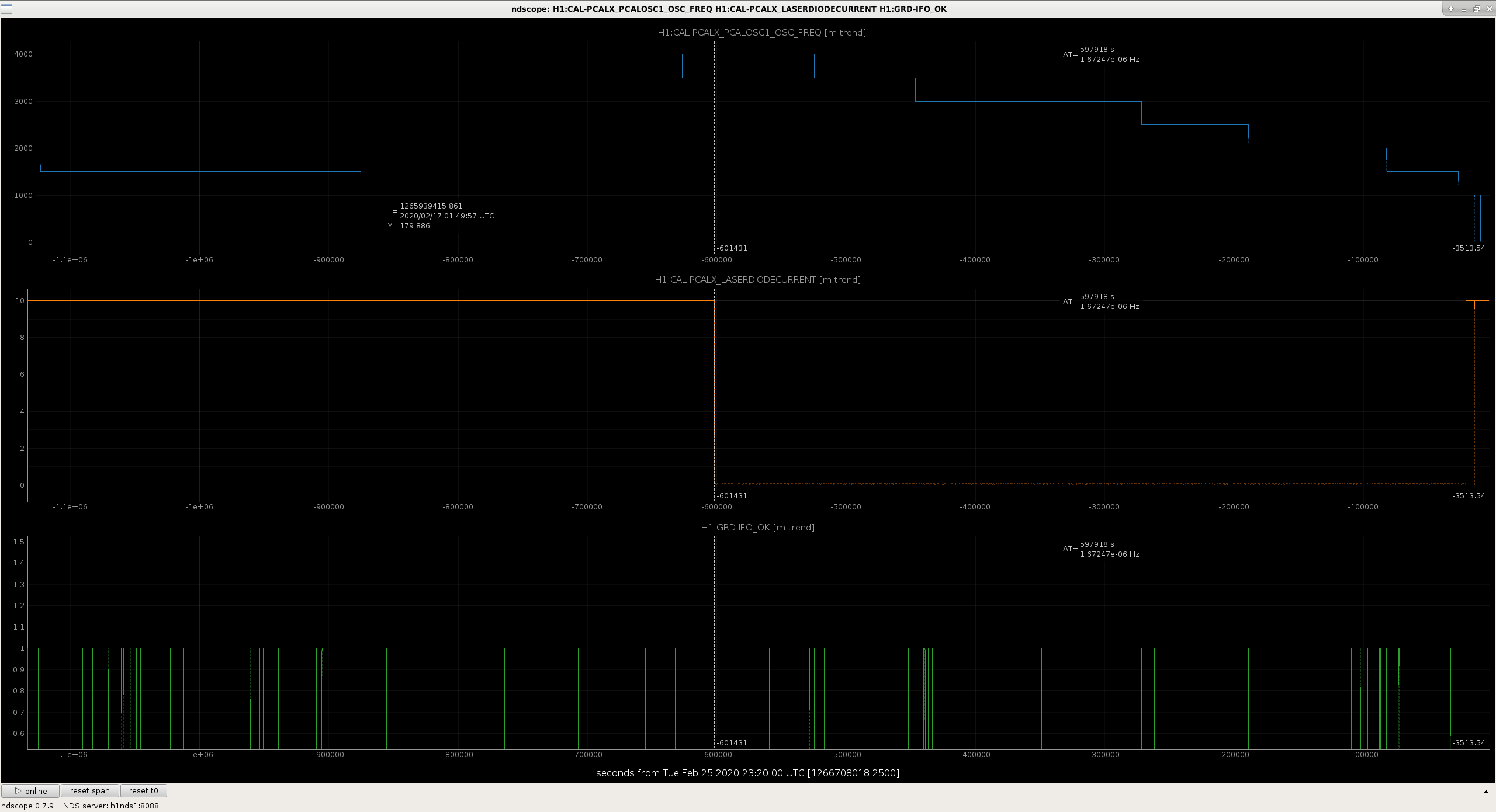
2020-02-17       1265939082       lost because PCALX interlock was inadvertently tripped during the majority of this sweep.

I *should* have restarted the sweep upon the fix of the problem today, but was distracted by trying to install a frequency comb and forgot to trend this before we hit OBSERVATION_READY. Had I, I probably would have re-initialized the HIG_FREQ_LINES guardian to restart a new sweep. Ah well. The first OBSERVATION_READY segment that PCALX returns to functionality is at 1266706798 (2020-02-25 22:59:40 UTC), with a frequency of 1001.3 Hz.
The guardian should take care of "restarting the sweep" at 4001.3 Hz on the next nominal low noise stretch.
Images attached to this comment
Displaying reports 36801-36820 of 89199.Go to page Start 1837 1838 1839 1840 1841 1842 1843 1844 1845 End