Summary: H1 was out from 7:58 - 9:45. Not totally clear when to Intervene due to repeating locklosses.
A minute before my shift started H1 lost lock. I immediately got set up to lock H1 with our new operator protocol (T1900725) of allowing H1 to lock as much as it can WITHOUT operator intervention. Still think there are some states/steps where we might want to change intervention thresholds.
To Intervene, Or Not Intervene
For example, there were several locklosses in a row which happened in odd states (several in a row while waiting for DRMI to acquire & one during FIND_IR)...I was fearing I was in a loop of locklosses at this point! And so, to prevent waisting time, on the 9th (!) lock, I threatened to run an alignment by opening up all the nodes needed to do that, and (wouldn't ya know it!) H1 then locked all the way up!! Ha!
As for actual intervention, it only happened on the very first lock (tweaking ETMy for y-arm green locking) & after that, I sat on my hands and noted where it dropped out.
H1:LSC-PRCLFF FM4 is OFF
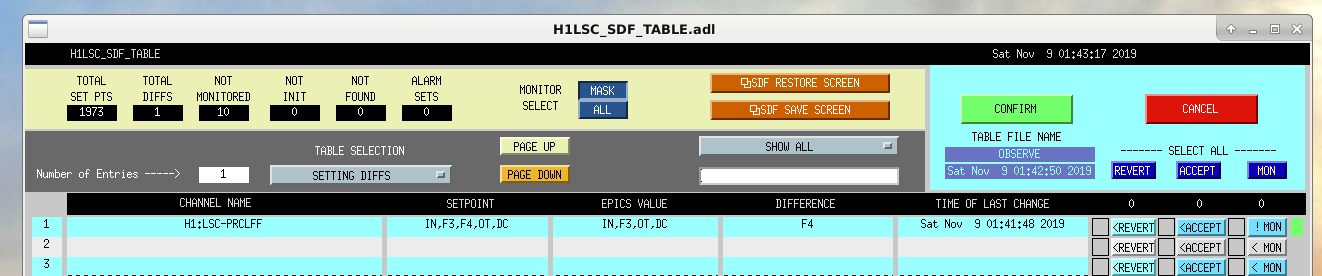
Looks like Guardian is taking us to the standard state of keeping PRCLFF's FM4 OFF, but with tests last night, there was an SDF diff for wanting it ON. I went back to Accepting FM4 OFF. Attached is a screenshot of the SDF diffs I observed and then ACCEPTED to get us back to OBSERVING.
Notes On Operator Intervention & Locking:
I had not put the PRCLFF FM4 into the guardian (I think I'm getting too used to these very long lock stretches that last for many days!), so it makes sense that it wasn't on. With Craig's plots showing that it maybe didn't really help things, and the range is quite good right now, I think leaving it off was the right call.
TITLE: 11/09 Eve Shift: 00:00-08:00 UTC (16:00-00:00 PST), all times posted in UTC
STATE of H1: Lock Acquisition
INCOMING OPERATOR: Corey
SHIFT SUMMARY: locked all shift until 7:58UTC, range was stable, Corey is relocking
LOG:
TITLE: 11/09 Owl Shift: 08:00-16:00 UTC (00:00-08:00 PST), all times posted in UTC
STATE of H1: Lock Acquisition
OUTGOING OPERATOR: Cheryl
CURRENT ENVIRONMENT:
SEI_CONF state: WINDY
Wind: 5mph Gusts, 3mph 5min avg
Primary useism: 0.02 μm/s
Secondary useism: 0.32 μm/s
QUICK SUMMARY:
We literally just lost lock 2min before my shift! So working on bringing H1 back (nothing looks crazy btw).
NOTE regarding Calibration Lines: Operators were asked to send an email to Aaron V./Maddy W. whenever H1 drops lock so they can restart Cal lines. Email was sent a few minutes ago.
Lock loss 1257321505
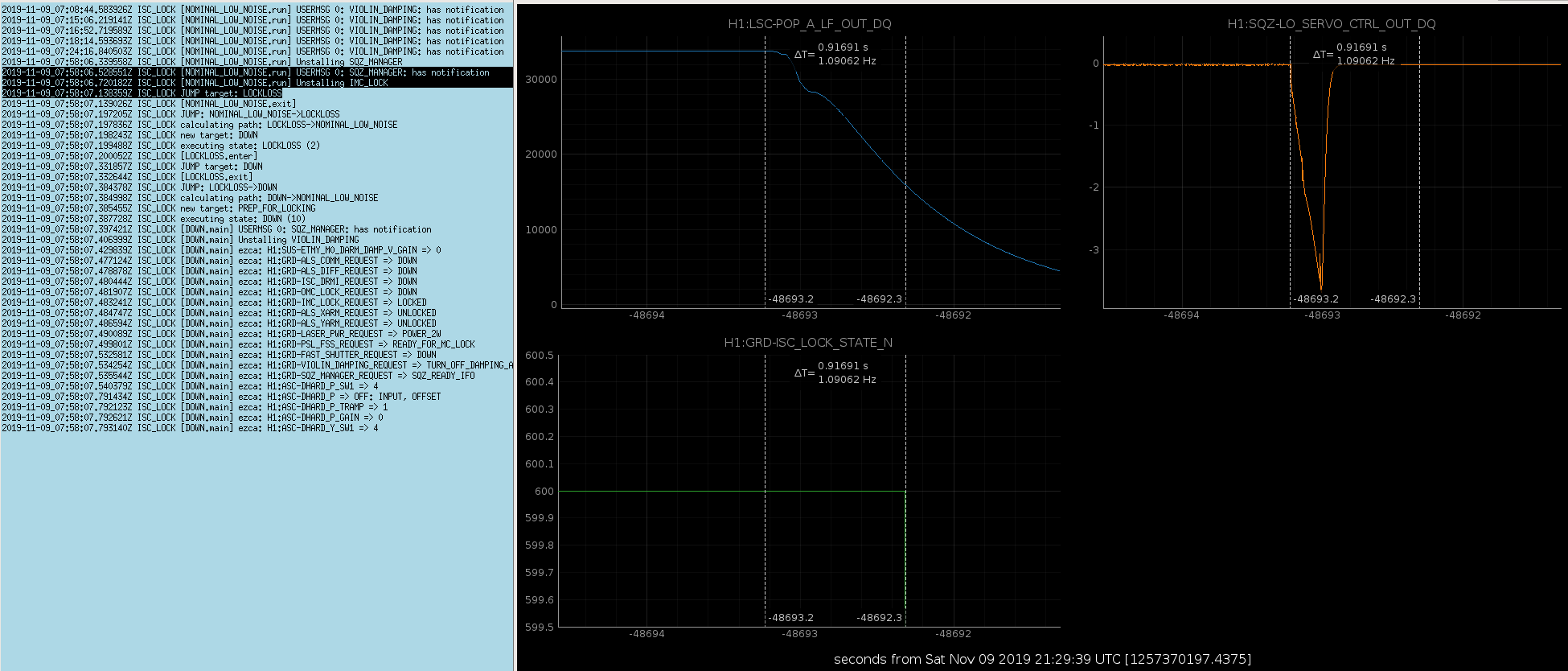
This looks like a very similar situation to the lock loss on Thursday (alog53069). The squeezer lost lock just before we see the LSC-POP_A_LF_OUT signal drop. This time though, the LO servo channel does not go as unstable. Instead, it drastically drops in power.
H1 remains locked, range is 115Mpc, two short exits from Observe for violin mode damping.
[Craig, Jenne]
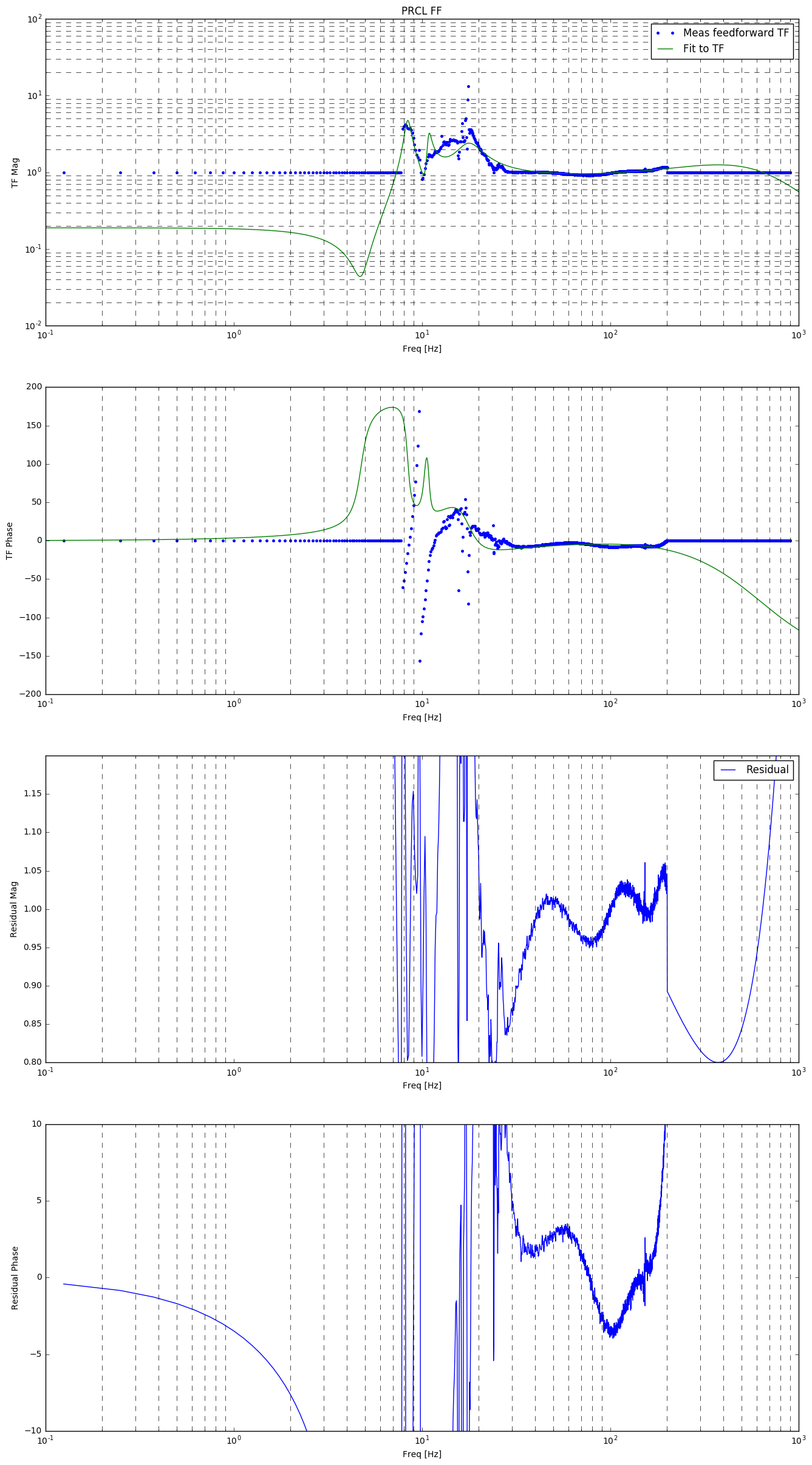
On Wednesday I took measurements for iterative update filters for the LSC feedforward. SRCL and MICH don't really look like their ideal update filters are very far from unity at frequecies we care about, so I'm not going to fit and implement them today. However PRCL has some updating that it could use. Note for the future, slightly stronger excitations may help to get better, easier-to-fit data.
In the attached figure, the blue points are the measured transfer function to fit, which will become the update filter in series with the current feedforward filter. Note that in this plot, data points that have poor coherence are set to 1, so the low and high frequency portions of this plot look funny. The fit is only considering data points with high coherence, so those points are ignored. The green trace is the fitted filter that will be put into Foton. If our original FF filters were perfect, these update filters would be unity everywhere. You can see that my fit doesn't match the measurement very well below ~15 Hz, but I'm going to accept that in hopes that we make improvements at higher frequencies where we're actually detecting GWs - hopefully this will be easier to fit with better data next time we take these 'update' measurements.
At around 00:32 (+/- 1 min) on 9 Nov 2019 UTC I turned on this new update filter. We were out of observe for a few tens of seconds during the transition, then I accepted the SDF diff (FM4 in LSC-PRCLFF) and put us back in Observe. Seems to have perhaps improved the range a bit.
At around 00:49 I turned the new filter back off. Again I accepted the SDF diff, and we were back in Observe within a few tens of seconds.
At around 1:03 I turned the new filter back on, accepted SDF, and we were back in Observe within a few tens of seconds. I think we'll leave it on for the weekend to see how it goes longer term.
Craig will post a comment with some plots showing that perhaps we're making a bit of an improvement.
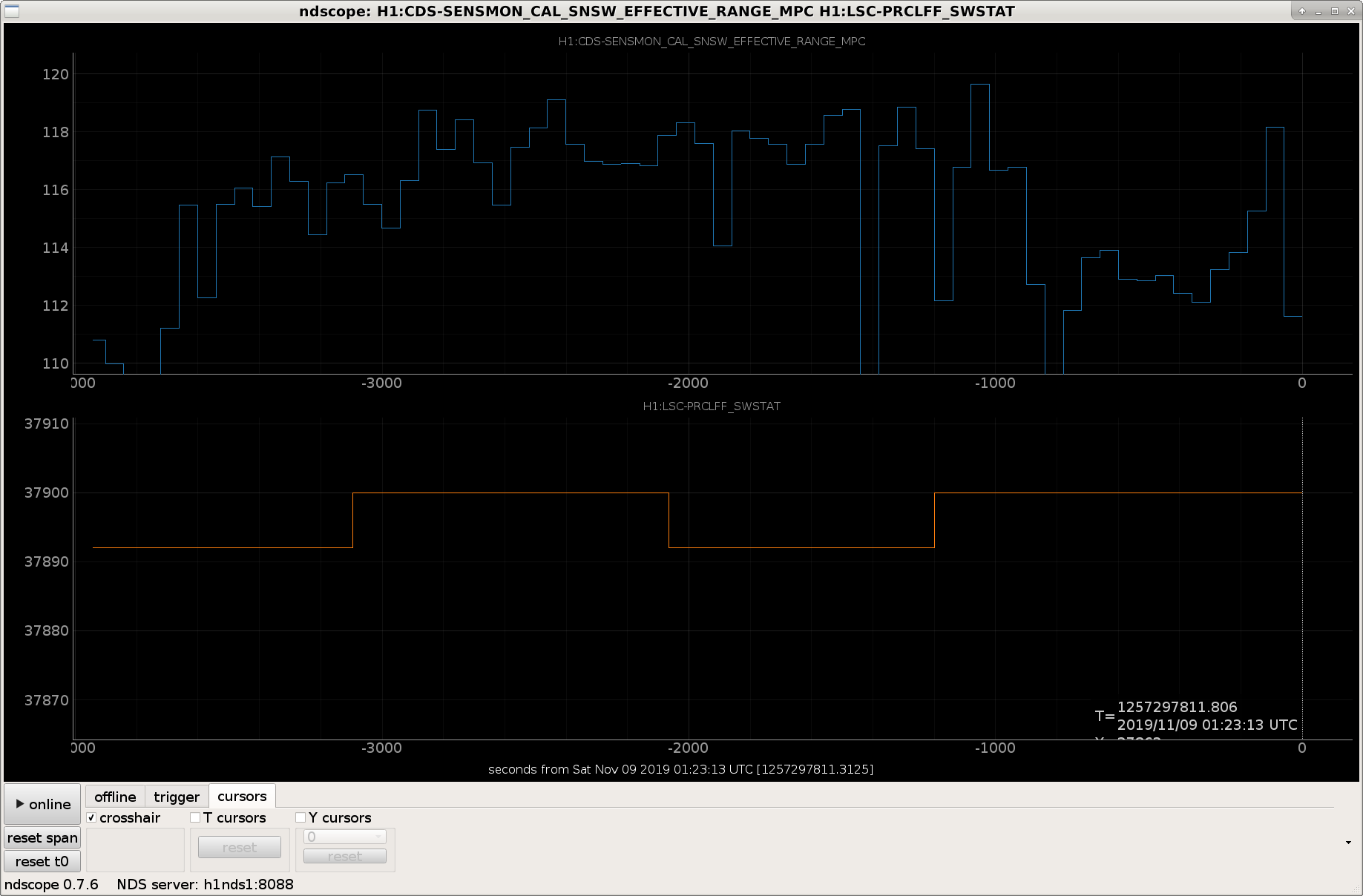
We did a on-off-on test with the PRCL iterative filter. Seems to have had no effect in the bucket. We definitely made things worse at ~10 Hz, likely because of a relatively poor TF fit. We have left this filter on because of the superevert that happened during this test. Does not seem to cause any additional noise in the bucket, so this should not matter for this weekend. There was a glitch during the 'off' time. I used median averaging to get the 'off' PSD. Unclear to me how close to the superevent the glitch was.
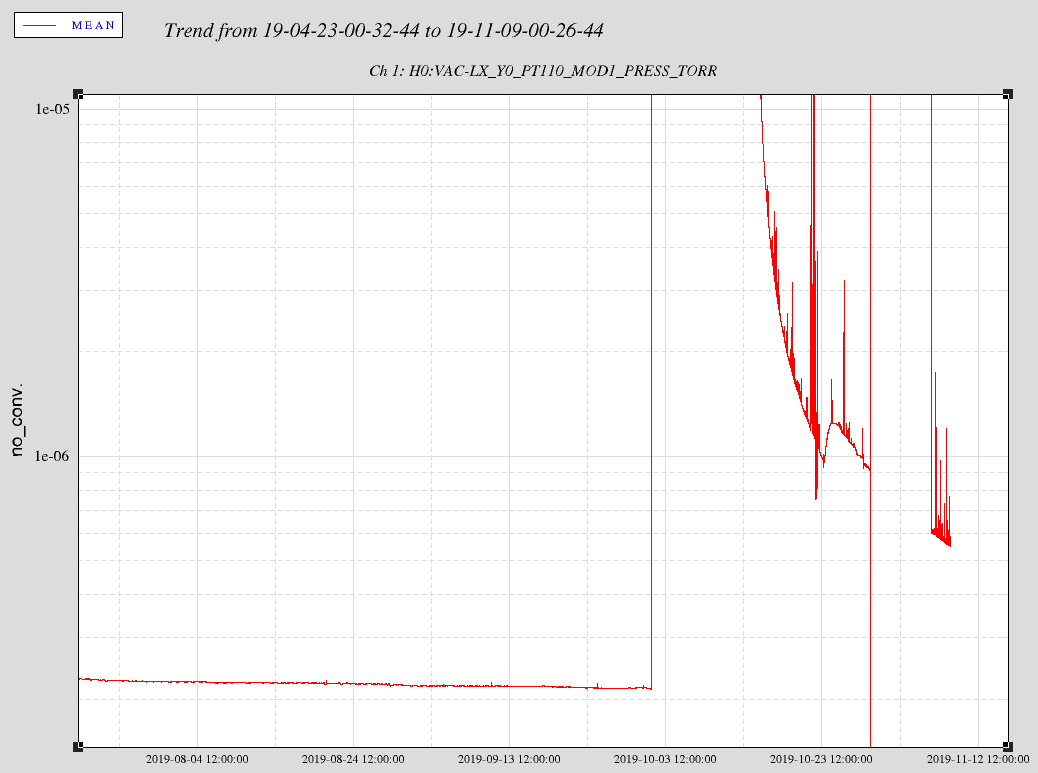
The pressure gauge on HAM6 was replaced due to noisy read back (spiked above high voltage pressure set point more than once causing fast shutter to close) and then gauge failure during troubleshooting (pirani or filament gone bad? - gauge sent back to manufacturer via RMA).
We replaced the entire gauge but the readback is still noisy. Suggest we leave the HV interlock on the new ion pump controller at HAM6 until we can trend gauge over longer period of time to confirm it won't spike above 1e-5 Torr. Not sure what is causing the spikes.
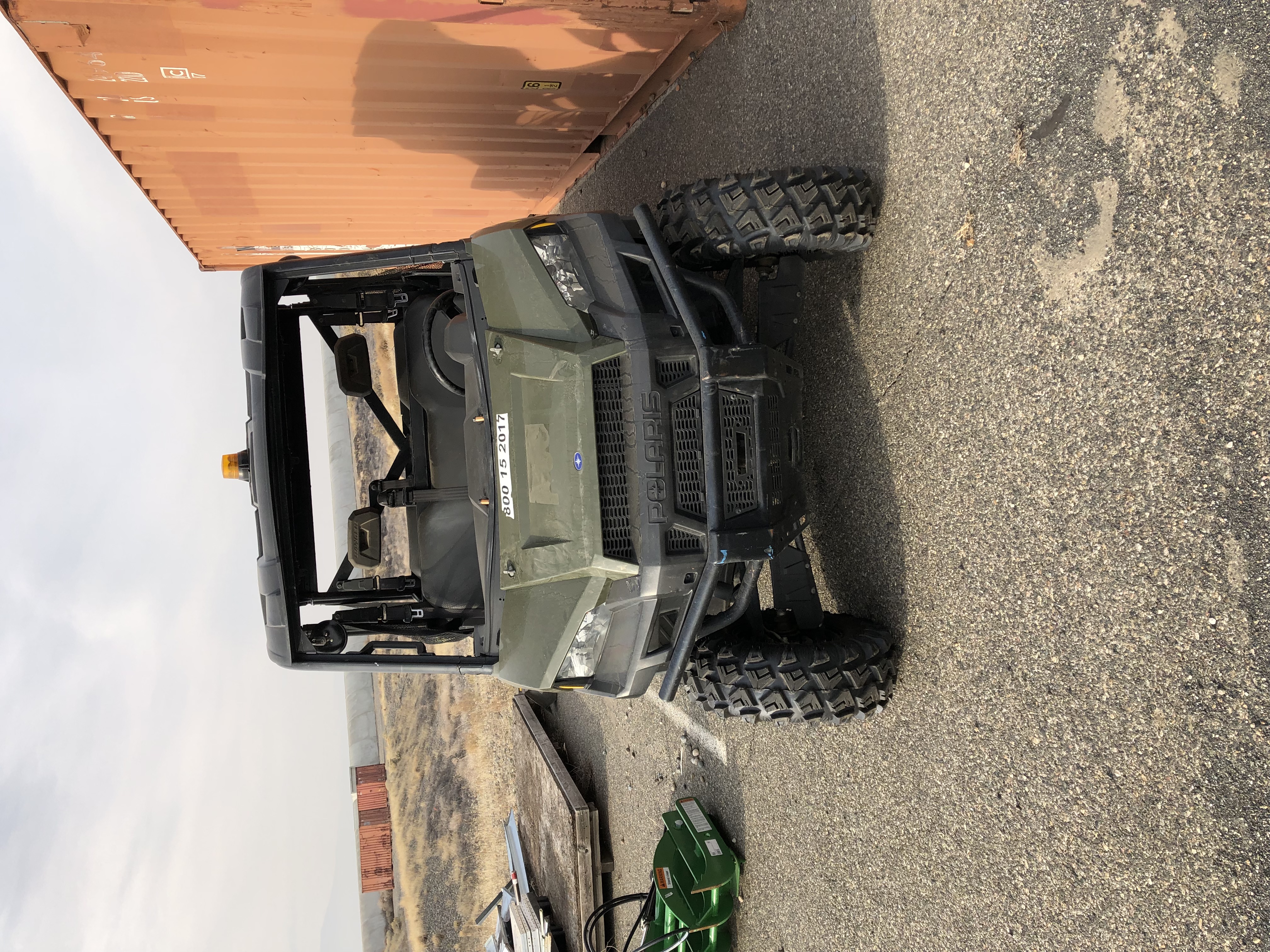
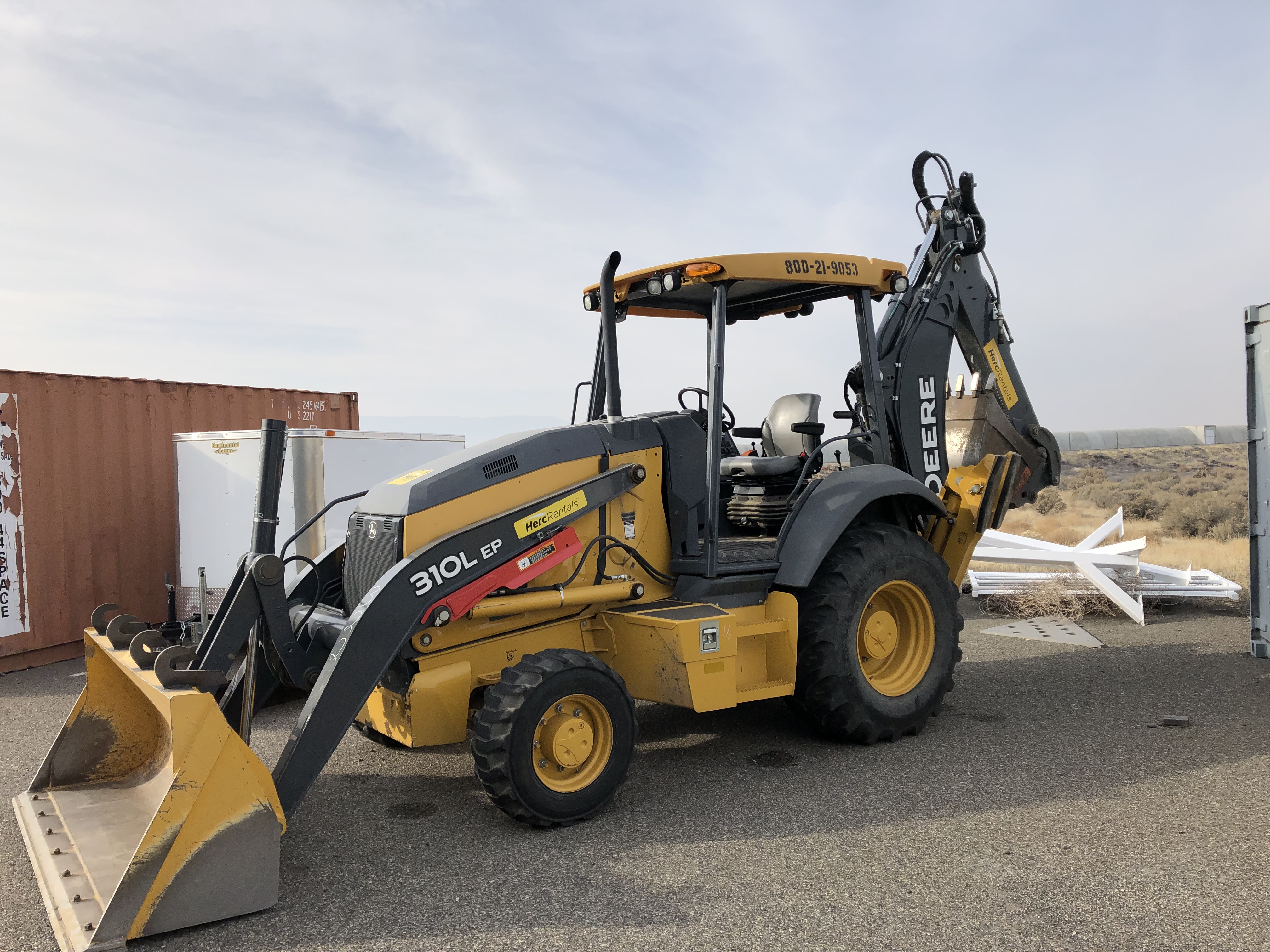
Four pieces of equipment were brought on site today in preparation for wind fence construction activity next Monday 11 Nov 2019: cart, backhoe, fork truck and crane truck. Those that were brought on a flatbed were offloaded outside the gate and slowly driven past the corner station to be parked for now near the fire water tank. Photos attached. Additionally, grout and rebar vendors visited for walkdowns and pre-activity discussions.
TITLE: 11/09 Eve Shift: 00:00-08:00 UTC (16:00-00:00 PST), all times posted in UTC
STATE of H1: Observing at 108Mpc
OUTGOING OPERATOR: Ed
CURRENT ENVIRONMENT:
SEI_CONF state: WINDY
Wind: 2mph Gusts, 1mph 5min avg
Primary useism: 0.02 μm/s
Secondary useism: 0.40 μm/s
QUICK SUMMARY: Locked in Observe, plans for some changes to filters, related to H1's wandering drop in range
Ed, Camilla
TITLE: 11/08 Day Shift: 16:00-00:00 UTC (08:00-16:00 PST), all times posted in UTC
STATE of H1: Observing at 107Mpc
INCOMING OPERATOR: Cheryl
SHIFT SUMMARY:
LOG:
Ed, Camilla
22:54 for about 15 seconds
Following Sheila's SQZ test ALOG
TEST 2
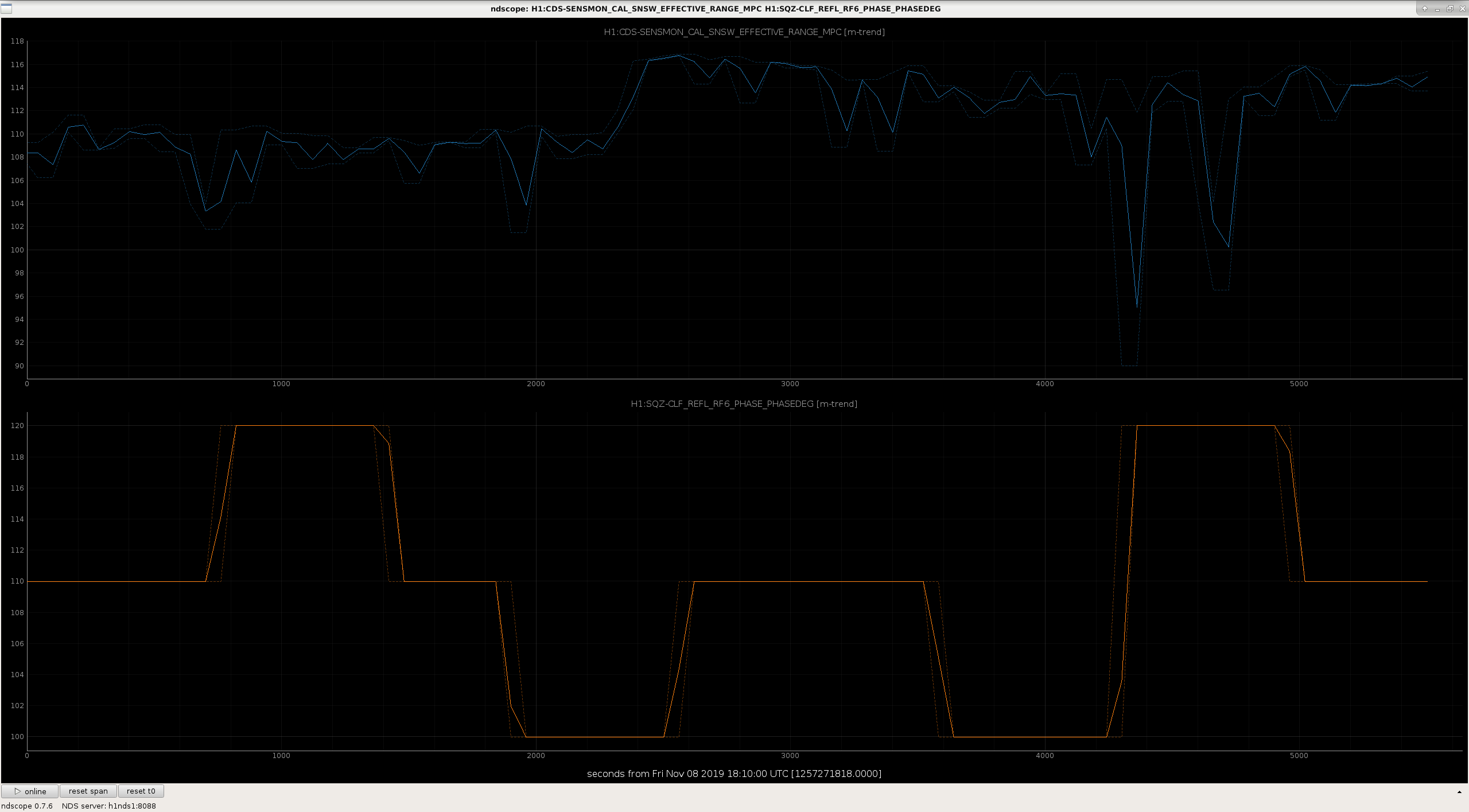
At 18:23-18:27UTC, H1 was inadvertently brought out of Observing due to some channels that were still monitored that were affected by the phase change experiment. Those channels are noted in the above alog.
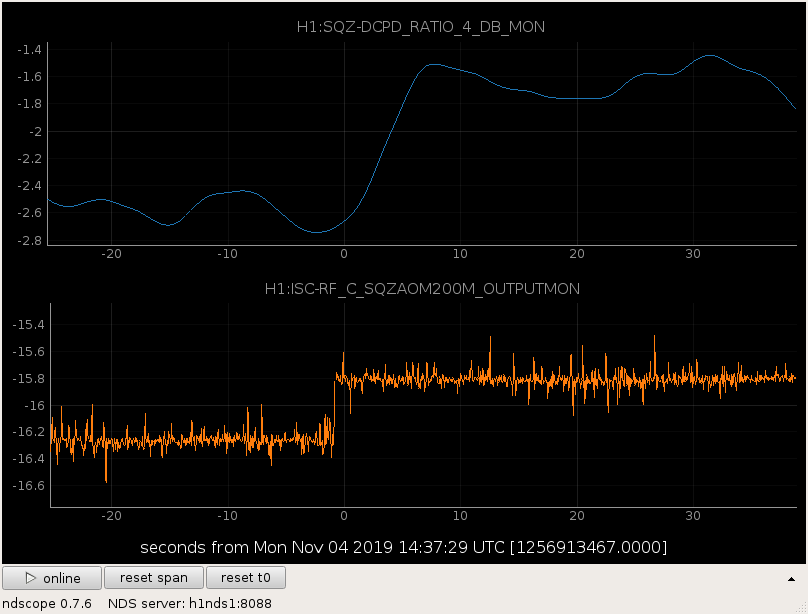
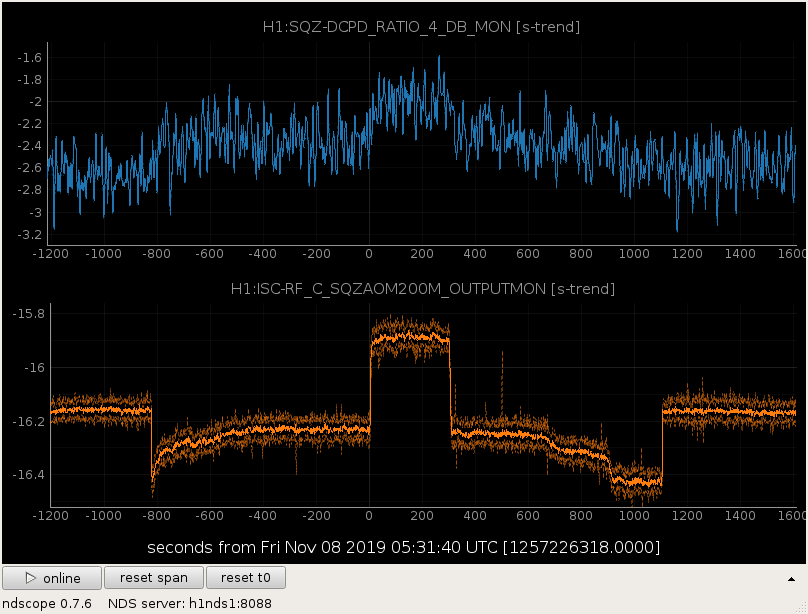
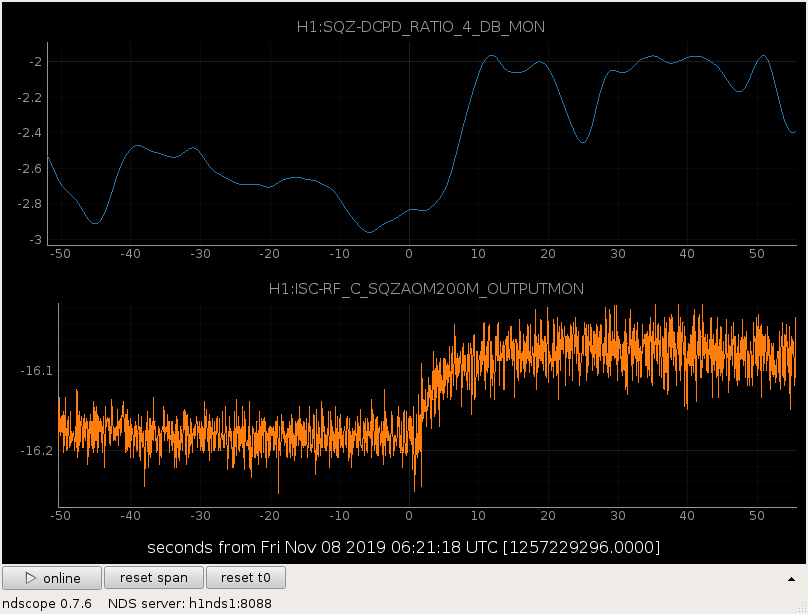
H1:ISC-RF_C_SQZAOM200M_OUTPUTMON correlates with range drops even on sub-second time scales.
Attached are plots for GPS
1256913467 (same drop as in alog 52979)
1257226318 (today)
1257229296 (today)
Note that the sharp drop in 1256913467 corresponds down to the second with the range drop in alog 52979.
H1:ISC-RF_C_SQZAOM200M_OUTPUTMON used to monitor the RF power level of the RF amplifier that drives the first AOM in the CLF path. This AOM driver has been replaced by a new AM modulated AOM driver. H1:ISC-RF_C_SQZAOM200M_OUTPUTMON is still connected to old RF amp that is now powered off. What this channel senses is very unclear.
This channel was also the most correlated result in the re-run lasso in my last comment here https://alog.ligo-wa.caltech.edu/aLOG/index.php?callRep=53091 and that entry lists other channels highly correlated with this channel.
Ed, Camilla
16:47UTC The large equpiment bearing truck that is currently parked on the road beyond the gate will unload a backhoe/frontloader and slowly drive it to the water tower area. I'll note more accurate times as this takes place for DetChar.
16:56 started moving (from frount vehicle gate)
17:04 Parked next to X arm fire tank.
Continuing from conclusion of aLOG.
I have sought to import SUS models into foton using the foton.py library linked in the last alog, which was written by Lee McCuller.
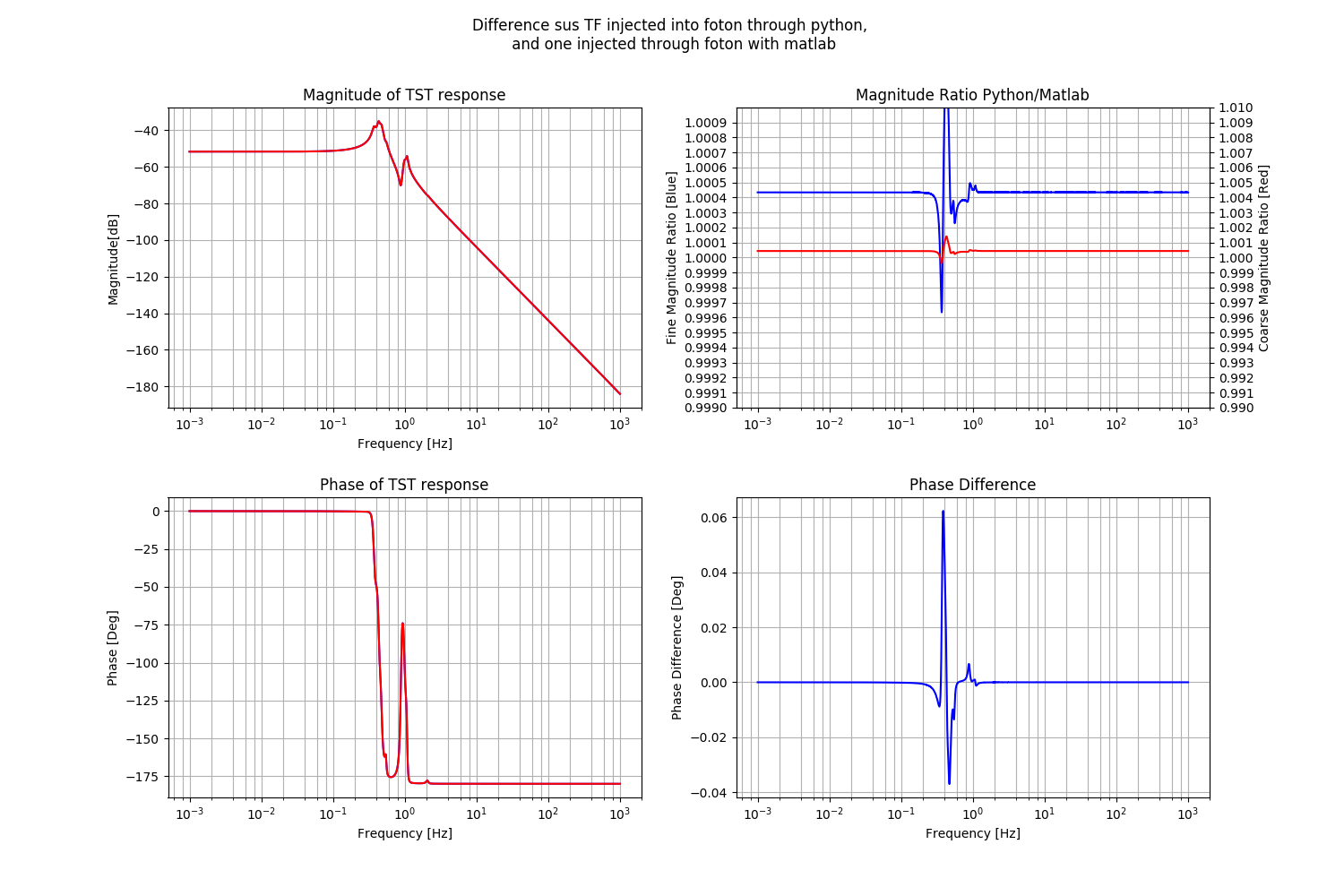
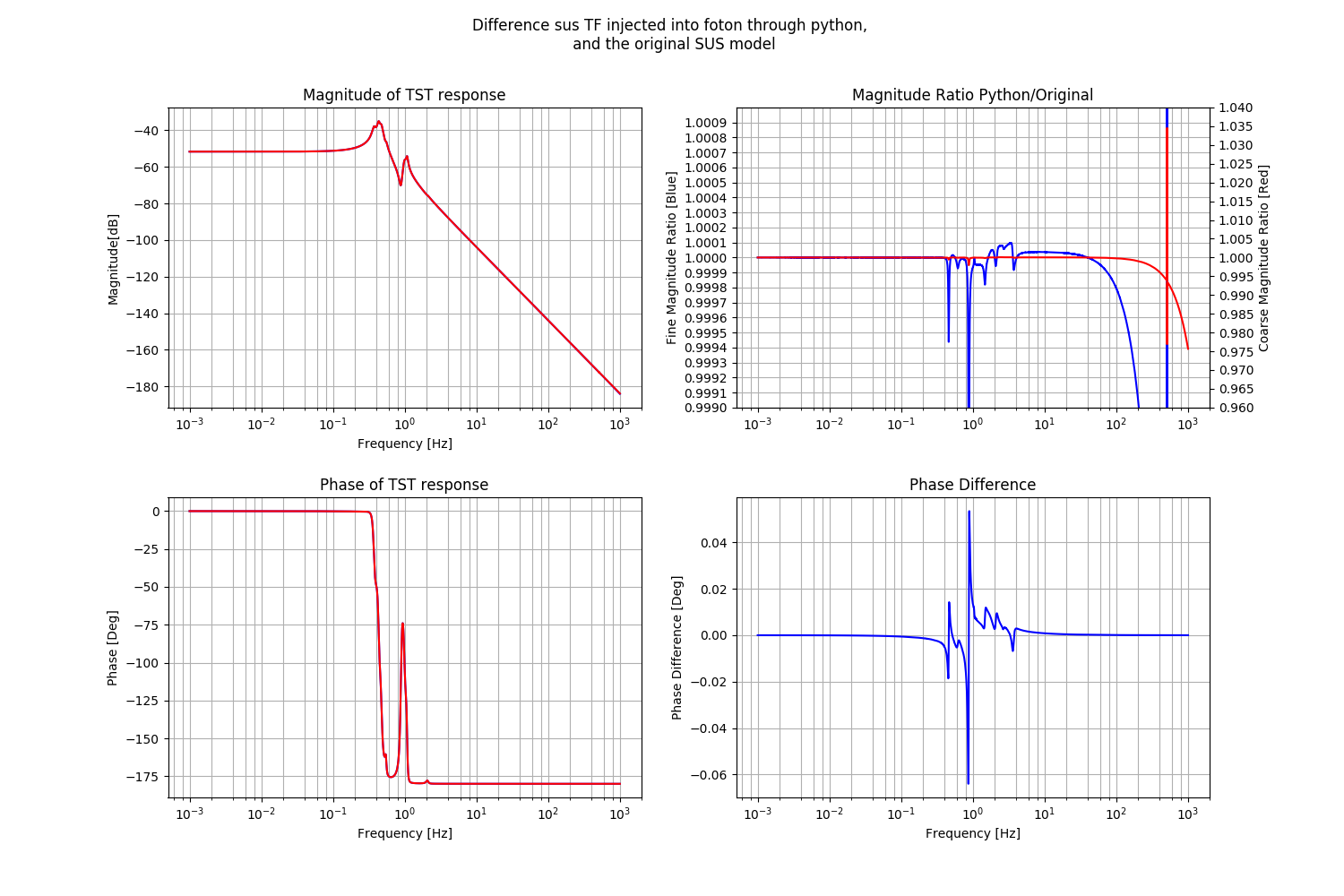
I have produced a script which takes the TST transfer function to update the foton filters for Pcal via a python script, avoiding the need to 'quack' the filter with matlab scripts.
The quack scripts have a lot of error handling so that filters are compatible with foton. Here I directly input the filters with foton, with all its built in error handling.
I produce a filter that is arguably more accurate than what matlab is putting into foton... since I handle the DC gain with more precision.
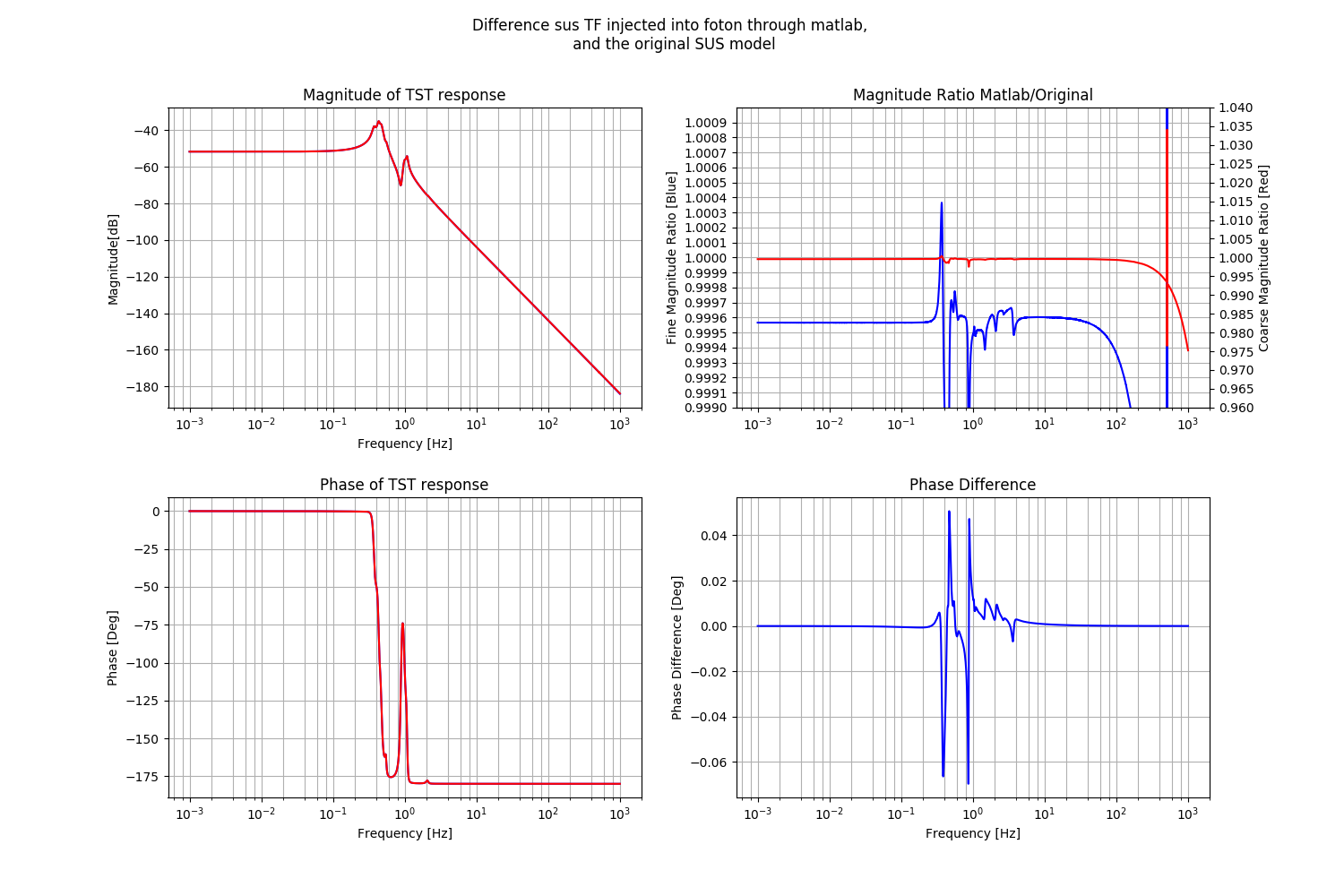
I compare how matlab and my script fare against the original intended TF, by comparing the TFs that foton sees the inputs to be. You will note that the TF's have a bit of an error in magnitude at high frequency, I suspect that is due to the fact that the 1/f^2 filter (titled '1:1') is built within foton, and there is some difference from the system modelled in matlab.
Caveats of this process:
Until there is an update to the python control library, there is no clean way of recovering to true DC gain of a ZPK TF, without importing the SS model generated by matlab. One also needs to import the ZPK model generated by matlab, because the python control library doesn't make the same changes to the SS to produce the ZPK, and I get a bit of a magnitude error at around 2 Hz.
Hence, I end up importing both the SS and ZPK models that matlab spits out, which is not great.
If you want to play with this, be concious that you must change paths to things.
I will be putting this in the relevant places in the CalSVN, and writing up some more robust documentation going forward.
Improved the main filter updating script - removed need for loading the SS TF using a bit of code from pyDARM, for which I fixed some python3 related bug. Added some more comments and removed unneeded comments.
Nutsinee, Daniel, Sheila
We have some requests for the operators to try some tests next time the range drops to around 110Mpc. We'd ask you to try each of these tests, which you can do by copying and pasting the lines below into a terminal. Waiting 10-15 minutes between each one would make sure we what happens. If any of these appear to fix the problem (or the range goes back to normal on its own) obviously you can stop the test.
Keita has OK'd staying in observe, so before starting this go into SDF and unmonitor these channels, and remonitor them when you are done. If there is a problem with this and we are out of observing momentarily that's sort of OK, although we would like to avoid it if possible. Also, please alog carefully and include times when you do this. Thank you.
1) increase SHG gain by 20dB
2)H1:SQZ-CLF_REFL_RF6_PHASE_PHASEDEG move up and down by 10 degrees, wait 10-15 minutes between moves.
3)lower CLF ISS gain
Sheila/Keita: I'm catching up on emails/alogs. Couple questions regarding this:
1) Is there a preference for when we should run these tests with regards to the other detectors? Would we want to do it when L1 is out of Observing? Or does that matter?
2) I tried to get set up to UNMONITOR some channels, but I wasn't quite able to; here are notes on the channels:
H1:SQZ-SHG_SERVO_IN1GAIN: This does not come up when I Sort On Substring for it. So does that mean SDF already does not care about it?
H1:SQZ-CLF_REFL_RF6_PHASE_PHASEDEG: This channel also does not come up. There is a H1:SQZ-CLF_REFL_RF6_PHASE_D (& _R) which comes up though.
H1:SQZ-CLF_ISS_GAIN: This also does not come up. There are channels for _CTRL_GAIN & _ERR_GAIN though.
Anyway, we have been at 110Mpc for the last 8hrs spanning two different locks. If L1, breaks lock, maybe I'll give it a go, but right now they are up.
H1:SQZ-SHG_SERVO_IN1GAIN, H1:SQZ-CLF_REFL_RF6_PHASE_PHASED, and H1:SQZ-CLF_ISS_GAIN are found under H1SYSECATC1PLC4 (CS_ECAT_PLC4 button on SDF overview screen). I didn't know that that was the case, but was able to find it once I saw that these things are all analog board settings.
Settings for analog boards (common mode boards, delay line phase shifters, whitening amplifiers etc.) are typically controlled using ethercat (there are exceptions e.g. SUS BIO and some of PSL boards) so you'll find those in one of ethercat SDFs.
14:43:10 Tried CLF_ISS_GAIN to 10dB
14:48:10 Back to 16dB
14:53:30 Tried CLF_SERVO_IN2GAIN to -15dB
15:00:00 Back to -9dB
15:27:30 CLF_ISS_SERVO off
15:34:00 CLF_ISS_SERVO on
15:40:16 CLF_ISS SERVO off
15:45:16 CLF_ISS_SERVO on
No change with any of the above attempts.
Nutsinee Daniel
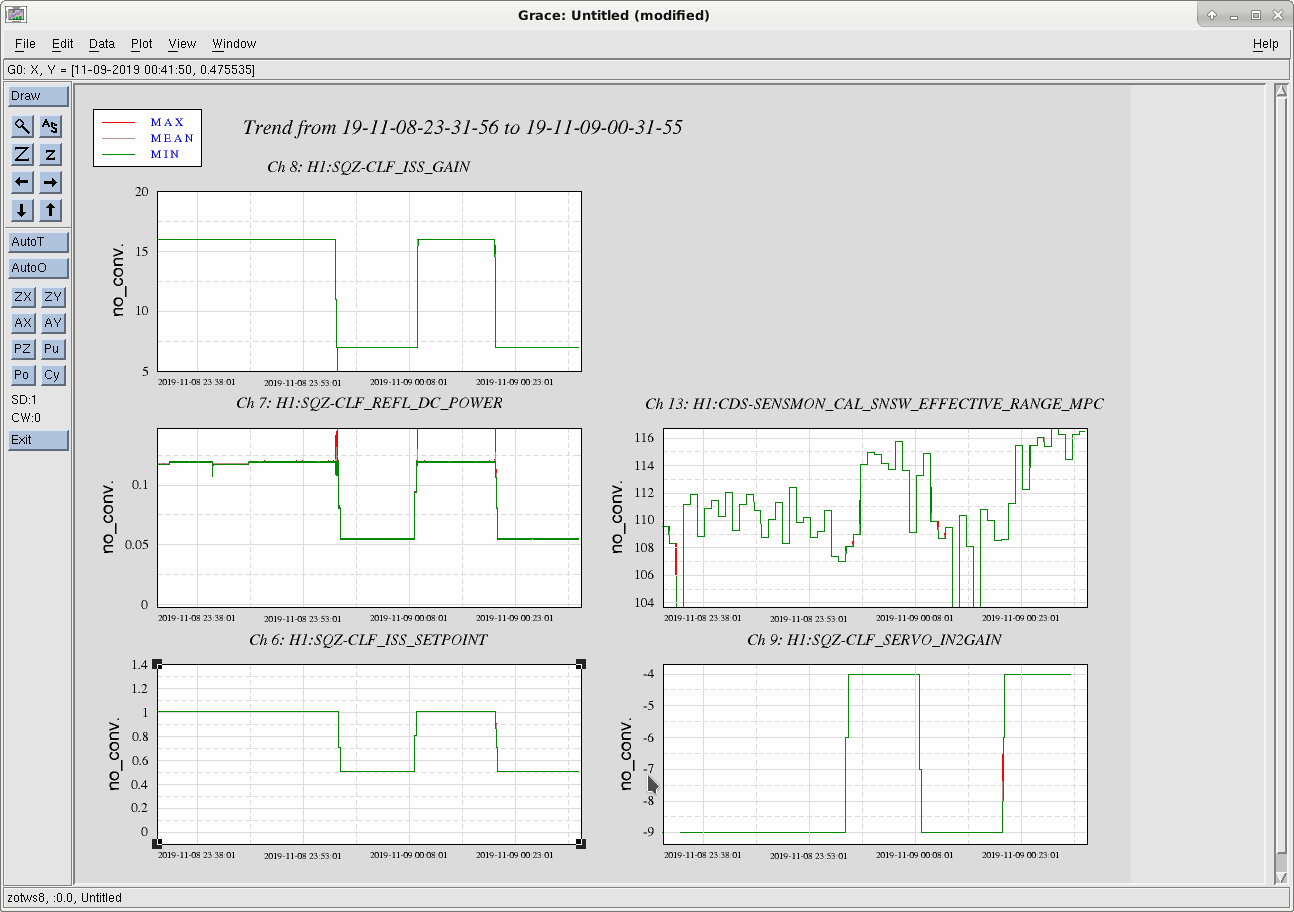
CLF power change
We changed the CLF power from 120µW to 55µW and it correlated with the range!
| 120µW | 55µW | |
|---|---|---|
| H1:SQZ-CLF_ISS_SETPOINT | 1.01 | 0.51 |
| H1:SQZ-CLF_ISS_GAIN | 16 | 7 |
| H1:SQZ-CLF_SERVO_IN2GAIN | –9 | –4 |
Times:
We accpeted the new settings in SDF and leave it as the new nominal over the weekend.