TITLE: 11/07 Eve Shift: 00:00-08:00 UTC (16:00-00:00 PST), all times posted in UTC
STATE of H1: Observing at 117Mpc
INCOMING OPERATOR: Patrick
SHIFT SUMMARY: Not much
LOG:
Commissioning was just finishing up when I came in, Nutsinee resolved some SDF, been locked and observing ever since.
TITLE: 11/07 Day Shift: 16:00-00:00 UTC (08:00-16:00 PST), all times posted in UTC
STATE of H1: Commissioning
INCOMING OPERATOR: Jim
SHIFT SUMMARY:
LOG:
17:10 Vlad out to Optics Lab
17:20 Brian O'Reilly from Livingston called about an event from yesterday
17:47 Superevent S191105e (repeat from yesterday) was recieved. Brian O'Reilly called with the "heads up". THe Phone call came in as well.
18:47 Dan Brown out to OpticsLab
21:00 H1 out of Observing for Commissioning in conjunction with LLO.
15:45 H1 will remain in commissioning until ~16:00
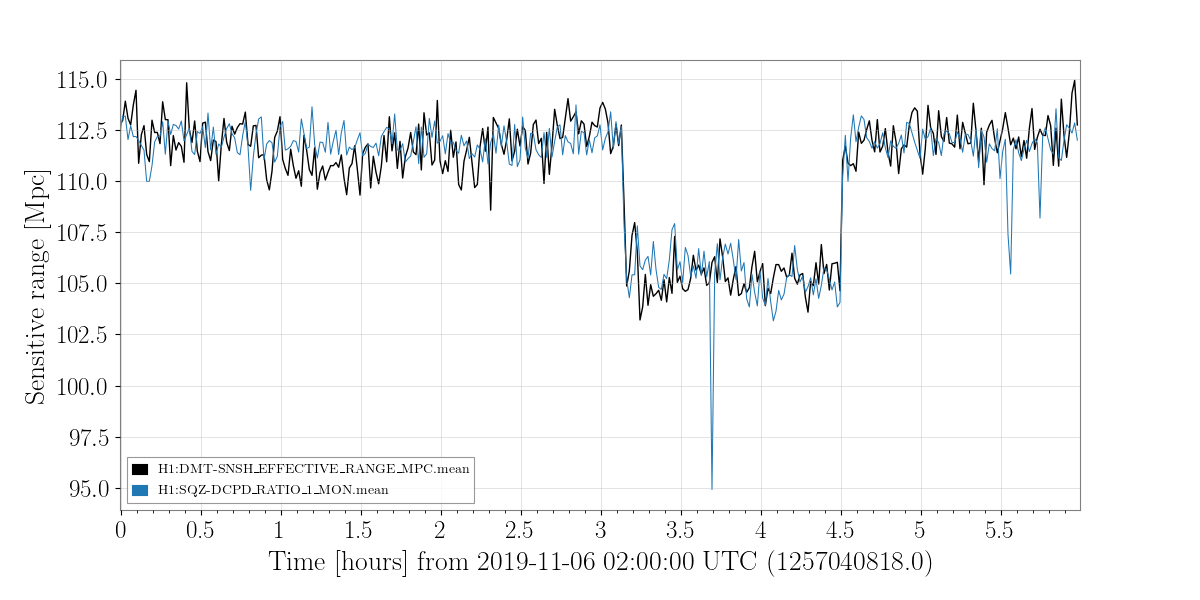
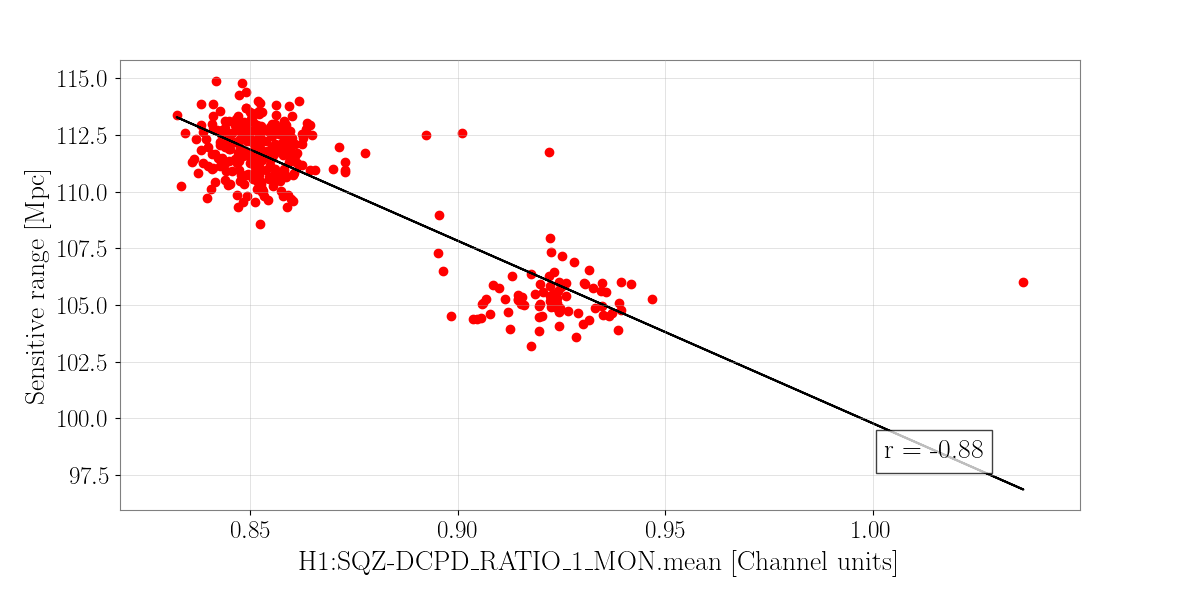
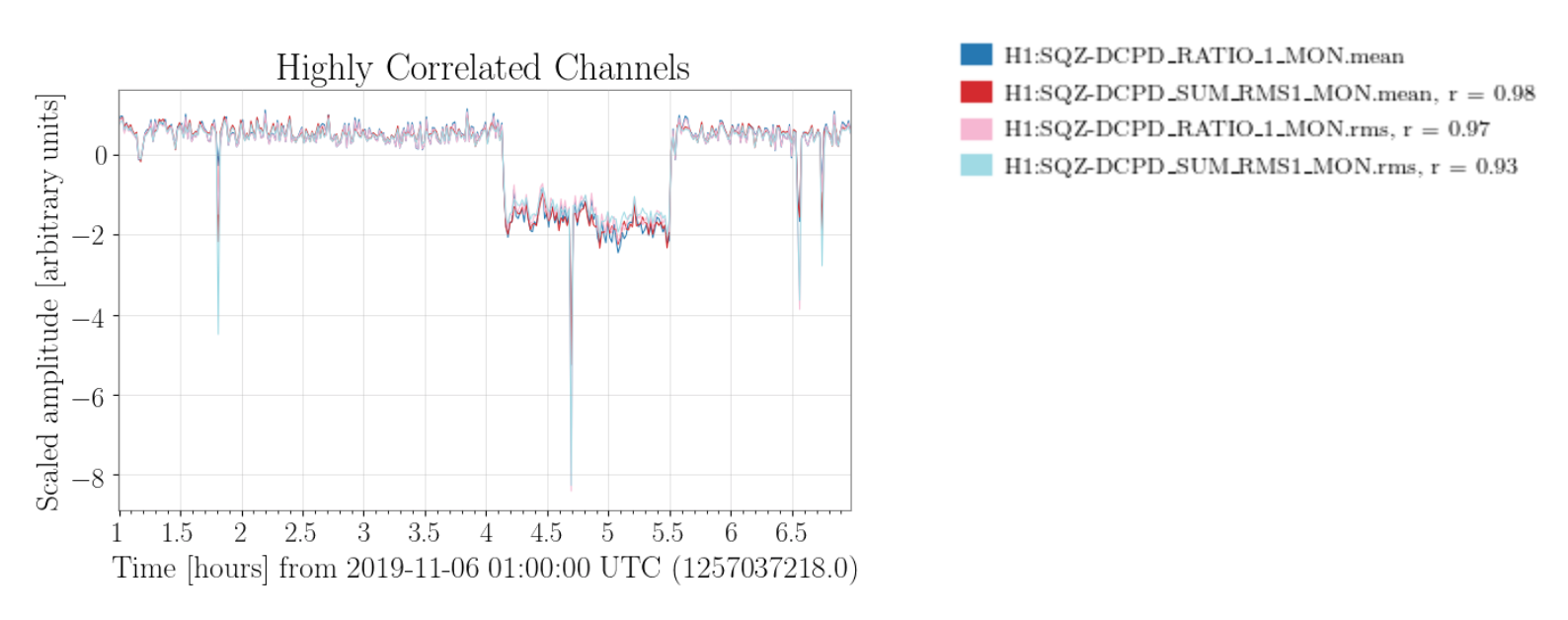
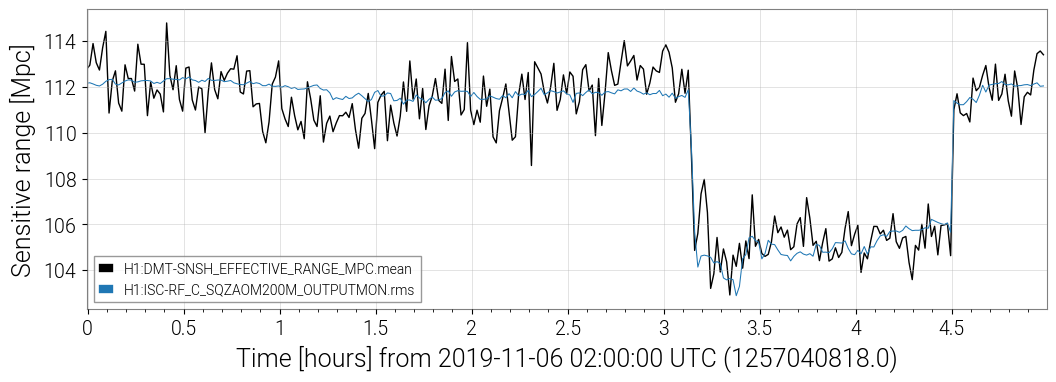
Following up on work by Beverly, I ran a short Lasso run on today's range drop. The run spans 2019-11-06 02:00-07:00. Clearly very highly correlated channels are as follows:
Channel "Pearson Coefficient" 0.9799929848627831 H1:SQZ-DCPD_SUM_RMS1_MON.mean 0.9725502574463882 H1:SQZ-DCPD_RATIO_1_MON.rms 0.9312747855964804 H1:SQZ-DCPD_SUM_RMS1_MON.rms
The full page output is at https://ldas-jobs.ligo-wa.caltech.edu/~jrsmith/detchar/O3b/lasso-Nov-6-2019-2/ (updated using the fancy new python 3 version)
Figures below show:
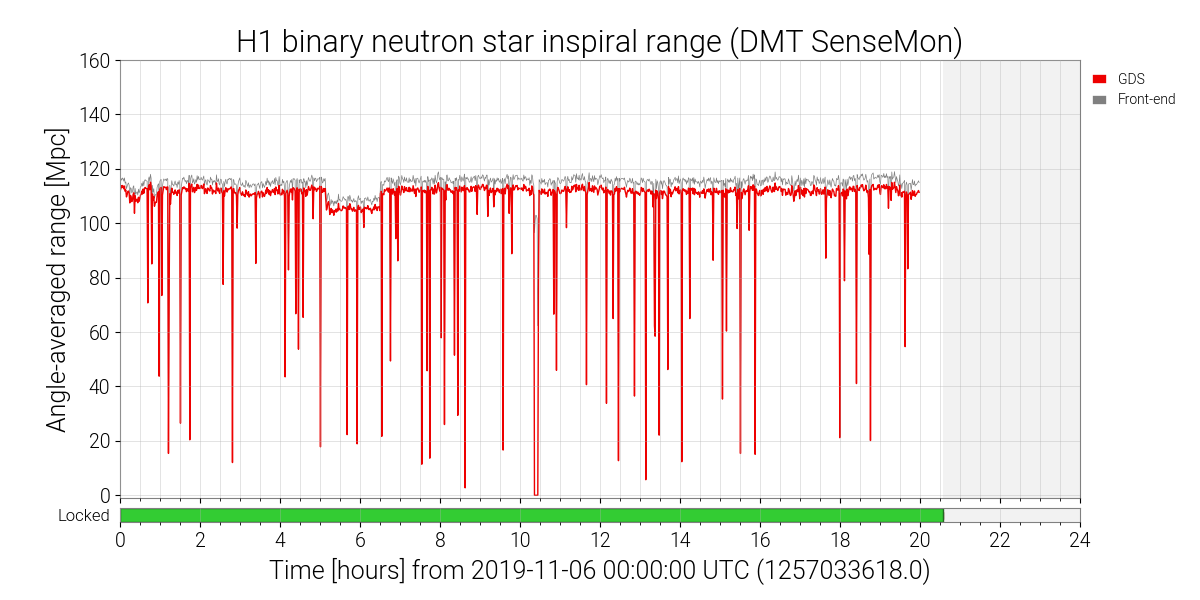
1) The range drop from the summary pages.
2) The range and scaled SQZ DCPD channel
3) A scatter plot of range vs SQZ values
4) The other channels that are duplicate of the SQZ winner
I think not much new from what Beverly reported so far. Happy to follow up with further inquiries.
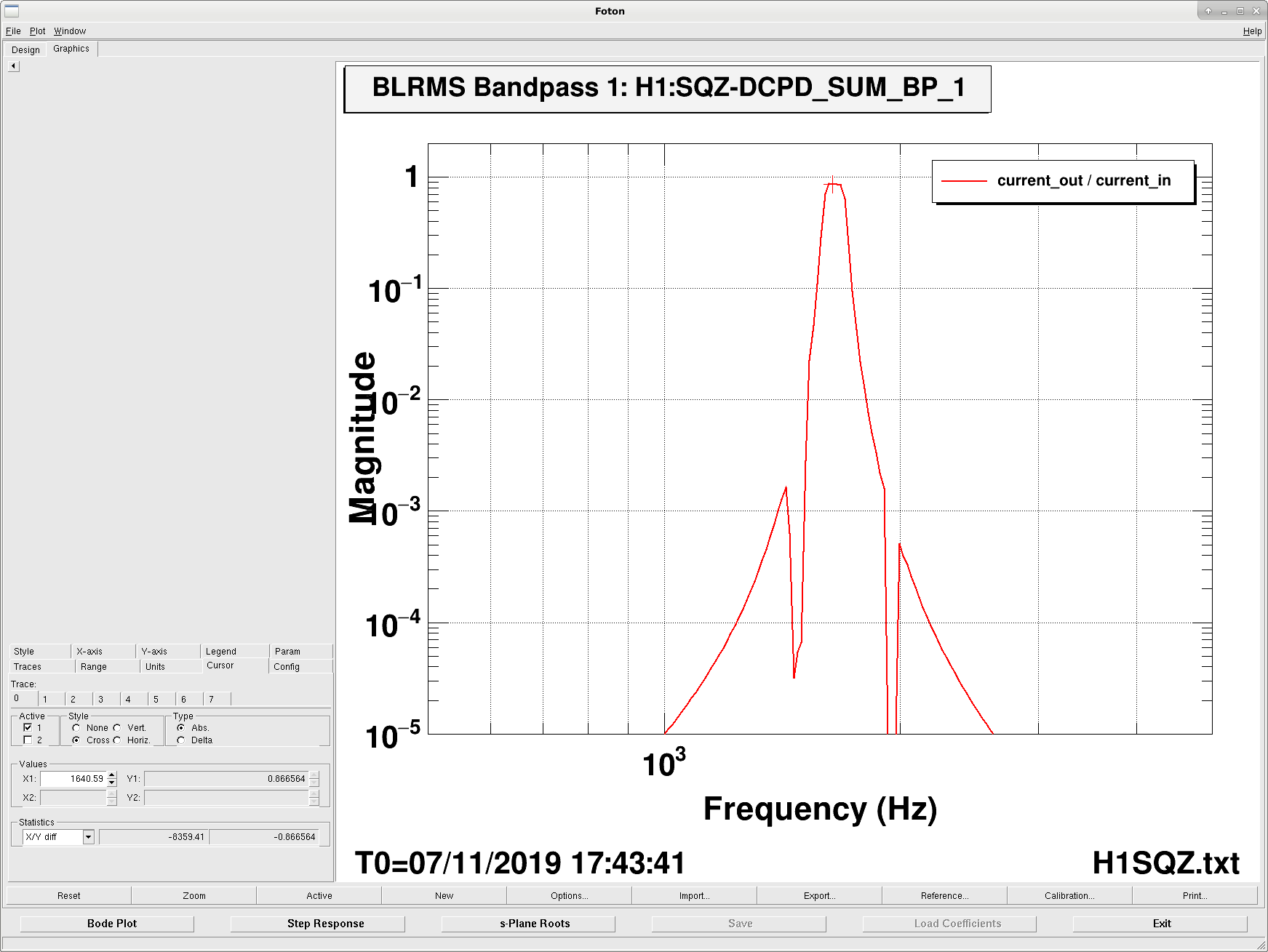
@DetChar -- these channels contain DARM / DELTAL / h(t) in them. They're BLRMS monitor channels comparing the squeezer performance (SQZ; via the NULL stream [the "difference" between OMC DCPDA and B]) against the OMC's DCPD SUM (i.e. the gravitational wave detecting photodiodes, and the DARM loop error signal). The first band (i.e. what eventually forms H1:SQZ-DCPD_SUM_RMS1_MON, and then H1:SQZ-DCPD_RATIO_1_MON), is a tight band pass around 1640 Hz -- the frequency region simply chosen to be a region we believe to be "shot/quantum noise dominated with no features." There are 4 of these BLRMS data streams, and they should probably just be considered "unsafe" as copies of the gravitational wave channels. H1:SQZ-DCPD_NULL_BP_1_INMON (**and other associated EPICs records on similar name, but with the standard filter module suffixes; OUTMON, EXCMON, OFFSET, etc.) H1:SQZ-DCPD_NULL_BP_2_INMON ** H1:SQZ-DCPD_NULL_BP_3_INMON ** H1:SQZ-DCPD_NULL_BP_4_INMON ** H1:SQZ-DCPD_NULL_LP_1_INMON ** H1:SQZ-DCPD_NULL_LP_2_INMON ** H1:SQZ-DCPD_NULL_LP_3_INMON ** H1:SQZ-DCPD_NULL_LP_4_INMON ** H1:SQZ-DCPD_NULL_RMS1_MON H1:SQZ-DCPD_NULL_RMS2_MON H1:SQZ-DCPD_NULL_RMS3_MON H1:SQZ-DCPD_NULL_RMS4_MON H1:SQZ-DCPD_RATIO_1_DB_MON H1:SQZ-DCPD_RATIO_1_MON H1:SQZ-DCPD_RATIO_2_DB_MON H1:SQZ-DCPD_RATIO_2_MON H1:SQZ-DCPD_RATIO_3_DB_MON H1:SQZ-DCPD_RATIO_3_MON H1:SQZ-DCPD_RATIO_4_DB_MON H1:SQZ-DCPD_RATIO_4_MON H1:SQZ-DCPD_SUM_BP_1_INMON ** H1:SQZ-DCPD_SUM_BP_2_INMON ** H1:SQZ-DCPD_SUM_BP_3_INMON ** H1:SQZ-DCPD_SUM_BP_4_INMON ** H1:SQZ-DCPD_SUM_LP_1_INMON ** H1:SQZ-DCPD_SUM_LP_2_INMON ** H1:SQZ-DCPD_SUM_LP_3_INMON ** H1:SQZ-DCPD_SUM_LP_4_INMON ** H1:SQZ-DCPD_SUM_RMS1_MON H1:SQZ-DCPD_SUM_RMS2_MON H1:SQZ-DCPD_SUM_RMS3_MON H1:SQZ-DCPD_SUM_RMS4_MON
Thank you very much Jeff. We have taken steps to remove all {IFO}:SQZ-DCPD_ channels for future lasso runs. However, it also occured to me that lasso was updated to by default not consider channels that don't change in the first ten minutes of its run. This is not a good way to catch changes in the middle of a segment. So I generated a full channel list by hand using:
(ligo-summary-3.7) [joshua.smith@ldas-pcdev1 lasso-Nov-6-2019-4]$ gw_data_find -o H -t H1_T -u file -s 1257040818 -e 1257040918 -n | xargs FrChannels | egrep -v "OAF-RANGE|CDS-SENSEMON|CAL-CS_DARM|SQZ-DCPD_|SUS-*TM*MODE*" | egrep ".mean|.rms" | cut -d\ -f1 > chans.txt
and ran lasso on this much longer channel list.
(ligo-summary-3.7) [joshua.smith@ldas-pcdev1 lasso-Nov-6-2019-4]$ nohup gwdetchar-lasso-correlation -i H1 -f chans.txt -T minute -a 0.2 -O 2.5 -J 16 -j 16 1257040818 1257058818 &
The results are here: https://ldas-jobs.ligo-wa.caltech.edu/~jrsmith/detchar/O3b/lasso-Nov-6-2019-4/
Conclusion: This points to H1:ISC-RF_C_SQZAOM200M_OUTPUTMON as the most highly correlated. But also has a list of channels highly correlated to that one, which I've pasted below. I am posting this hastily, as I have to run, so I am sorry, again I have not investigated these channels as a follow up yet, but I thought it could be helpful for commissioners to see the updated list.
|
Channel |
Pearson Coefficient |
|
-0.9999996566205920 |
H1:ISC-RF_C_SQZAOM200M_OUTPUTMON.mean |
|
-0.9330572847583630 |
H1:OMC-LSC_I_OUT_DQ.rms |
|
0.8875620058071610 |
H1:ASC-OMCR_B_PIT_OUT_DQ.mean |
|
0.887557437214179 |
H1:ASC-OMCR_B_MTRX_P_OUTMON.mean |
|
0.8875548329386750 |
H1:ASC-OMCR_B_PIT_OUT16.mean |
|
0.8875269357613680 |
H1:ASC-OMCR_B_PIT_INMON.mean |
|
0.8875269357613680 |
H1:ASC-OMCR_B_PIT_OUTPUT.mean |
|
-0.8867419443426080 |
H1:OMC-ASC_Y2_X_SIN_OUT16.rms |
|
-0.8818601017037520 |
H1:SYS-TIMING_C_FO_A_PORT_5_SLAVE_VCXOCTRL.mean |
|
-0.8818600988445600 |
H1:SYS-TIMING_C_FO_A_PORT_5_SLAVE_VCXOCTRL.rms |
|
-0.8750126151025700 |
H1:OMC-ASC_P1_X_COS_OUT16.rms |
|
-0.8673301041530260 |
H1:OMC-ASC_P2_X_SIN_OUT16.rms |
|
-0.8642192268464130 |
H1:ISI-BS_ST2_BLND_RZ_GS13_CUR_IN1_DQ.rms |
|
-0.8627117825481380 |
H1:OMC-ASC_Y2_X_COS_OUT16.rms |
|
-0.861022683603709 |
H1:PEM-C_SUP_RACK1_TEMPERATURE.rms |
|
-0.8610220968306960 |
H1:PEM-C_SUP_RACK1_TEMPERATURE.mean |
|
0.858408671078947 |
H1:IOP-ASC0_ADC_DT_OUT16.mean |
|
0.8573914259079220 |
H1:IOP-ASC0_ADC_DT_OUT16.rms |
|
-0.8571425309954690 |
H1:HPI-ITMY_BLRMS_VP_30M.rms |
|
-0.8571423785897070 |
H1:HPI-ITMY_BLRMS_VP_30M.mean |
|
-0.856700860825061 |
H1:OMC-ASC_Y1_X_COS_OUT16.rms |
|
-0.856420367475446 |
H1:HPI-ITMY_BLRMS_LOG_VP_30M.rms |
|
-0.8564203318837560 |
H1:HPI-ITMY_BLRMS_LOG_VP_30M.mean |
|
-0.8527525850009830 |
H1:IMC-TRANS_IN1_DQ.mean |
|
-0.8527518540230320 |
H1:IMC-TRANS_OUT_DQ.mean |
|
-0.8527496025226880 |
H1:IMC-TRANS_OUT_DQ.rms |
|
-0.8527473701532360 |
H1:IMC-TRANS_OUT16.rms |
|
-0.8527470948451950 |
H1:IMC-TRANS_OUT16.mean |
|
-0.8527326142606620 |
H1:IMC-TRANS_IN1_DQ.rms |
|
-0.8523469401317910 |
H1:OMC-ASC_P1_X_SIN_OUT16.rms |
|
-0.850131863101939 |
H1:OMC-LSC_Q_OUTPUT.rms |
|
-0.850131863101939 |
H1:OMC-LSC_Q_INMON.rms |
In conjunction with Livingston, we willgo to TOO commissioning for a period of ~2.5 hours.
Laser Status:
Front End Power is 32.41W (should be around 30 W)
70W Output Power is 70.1W
Front End Watch is GREEN
70W Watch is GREEN
PMC:
It has been locked 1 days, 1 hr 18 minutes (should be days/weeks)
Reflected power = 11.43Watts
Transmitted power = 52.63Watts
PowerSum = 64.06Watts.
FSS:
It has been locked for 0 days 21 hr and 54 min (should be days/weeks)
TPD[V] = 4.754V (min 0.9V)
ISS:
The diffracted power is around 2.5%
Last saturation event was 0 days 23 hours and 25 minutes ago (should be days/weeks)
Possible Issues:
- Grace DB show that this alert is from 14:19UTC. Treating it as ignore. H1 is in nominal Observing and INJ_TRANS is non-functional at this time.
Ethan, Adrian, Sheila
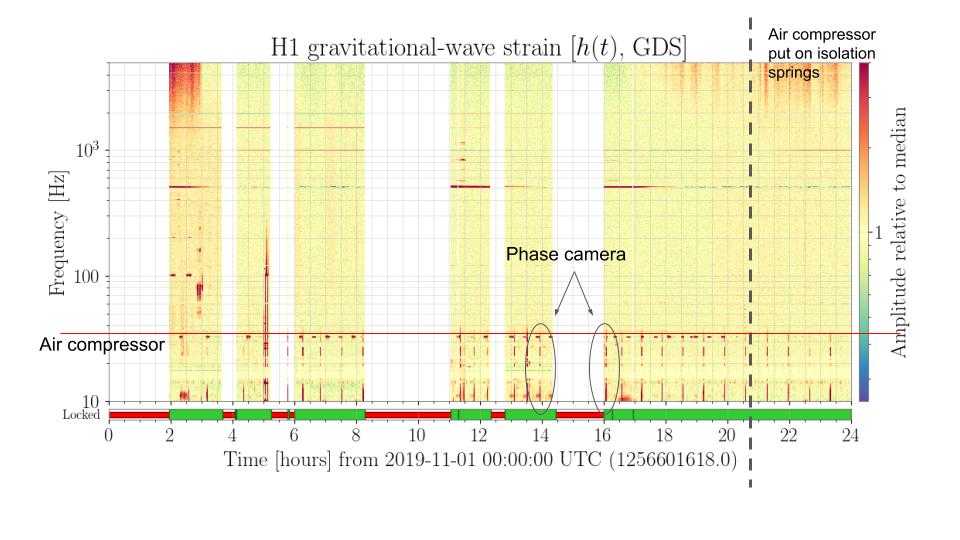
A few minutes before Nov 01 2019 20:41:42 UTC, the instrument air compressor was put on isolation springs in order to mitigate scattering in DARM at 35 Hz (see alog 52879). The first attached plot shows when the compressor was placed on springs. The horizontal red line in the figure it set slightly above 35 Hz.
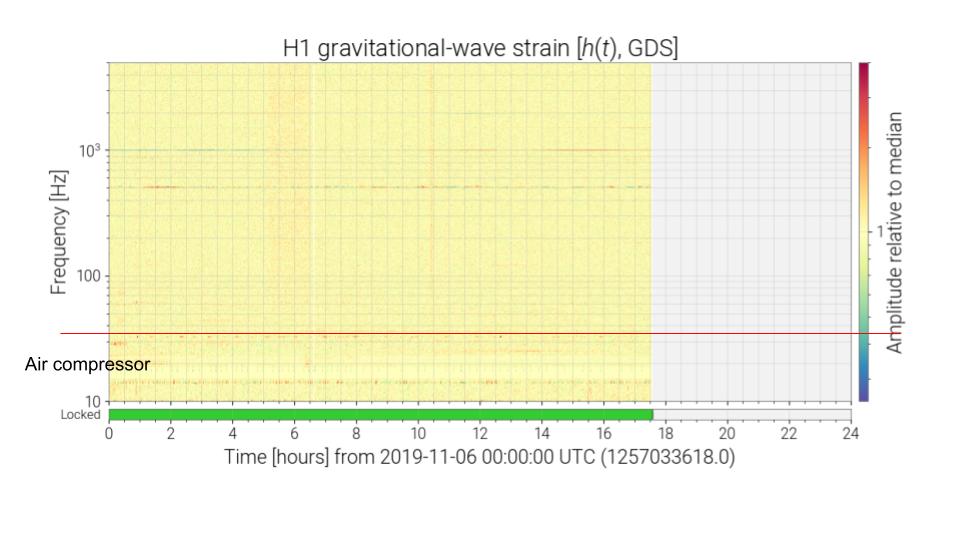
Following up on this a few days later (Nov 6), we see there is still some scattering at 35 Hz that is consistent with the behaviour of the air compressor. This seen in the second attached figure.
Some work could be undertaken to better isolate the compressor and/or locate the coupling site.
[Gavin, Jenne]
As part of a study on Acoustic Modal Loss Tomography of the Test Masses I created a python port of the Matlab script used to analyse the Q of the 10.430 kHz PI mode (alog 50550). This script has been generalised for any resonant mode as two functions which can be imported to any python script. The motivation behind this change was in large part to add the functionality of Python to this analysis.
The ringdown function will analyse the H1:OMC-PI_DCPD_64KHZ_AHF_DQ channel and evaluate the Q of the resonant mode at the date, time and bandpass frequencies specified. The ringdown_RMS function will analyse any H1:SUS-PI_PROC_COMPUTE_MODE#_RMSMON channel and evaluate the Q of the resonant mode for the date, time and RMS mode channel specified.
These functions should allow fast, easy analysis of PI Q measurements conducted in the future for any resonant modes of interest chosen.
FAMIS11516
Added 150mL to TCSX, 100mL to TCSY.
The TCSX filter will need replacement soon, it is getting very green.
TITLE: 11/06 Owl Shift: 08:00-16:00 UTC (00:00-08:00 PST), all times posted in UTC STATE of H1: Observing at 116Mpc INCOMING OPERATOR: Ed SHIFT SUMMARY: Briefly taken out of observing by squeezer. Two GRBs. No other issues. LOG: 10:22 UTC Taken out of observing by squeezer 10:26 UTC Squeezer stuck at LOCK_CLF. Hit INIT on SQZ_MANAGER. Squeezer relocked. 10:28 UTC Back to observing 11:31 UTC SubGRB E354051, Latency 9763.140000 sec. Ignore. ~14:03 - 14:11 UTC Set units for PT110 to Torr in Beckhoff, turned on trip points 14:19 UTC GRB-Short E354055 Swift Trigger duration 0.512 Stand Down 16:00 UTC Set INJ_TRANS to INJECT_SUCCESS
TITLE: 11/06 Day Shift: 16:00-00:00 UTC (08:00-16:00 PST), all times posted in UTC
STATE of H1: Observing at 115Mpc
OUTGOING OPERATOR: Patrick
CURRENT ENVIRONMENT:
SEI_CONF state: WINDY
Wind: 4mph Gusts, 3mph 5min avg
Primary useism: 0.01 μm/s
Secondary useism: 0.09 μm/s
QUICK SUMMARY:
Knocked out observing once by squeezer. No other issues.
I've written a mid-level library of functions I always use to quickly get and plot data from nds2 in python 3. It's called nds2utils.
If you'd like to use it and provide feedback, I'd welcome it at https://git.ligo.org/craig-cahillane/nds2utils. There are 11 examples.
It's on PyPi, so you can pip install it in your favorite virtual environment.
pip install nds2utils
Tagging @CDS and @DetChar -- maybe we can make this a part of standard CDS workstation environments? Perhaps add it to the RemoteAccess collection of utilities for the LSC?
TITLE: 11/06 Owl Shift: 08:00-16:00 UTC (00:00-08:00 PST), all times posted in UTC
STATE of H1: Observing at 115Mpc
OUTGOING OPERATOR: Jim
CURRENT ENVIRONMENT:
SEI_CONF state: WINDY
Wind: 6mph Gusts, 4mph 5min avg
Primary useism: 0.02 μm/s
Secondary useism: 0.11 μm/s
QUICK SUMMARY: No issues.
TITLE: 11/06 Eve Shift: 00:00-08:00 UTC (16:00-00:00 PST), all times posted in UTC
STATE of H1: Observing at 116Mpc
INCOMING OPERATOR: Patrick
SHIFT SUMMARY: Multiple earthquakes, but not much else
LOG:
0:00 IFO was locked, but ther was an earthquake coming in, TJ put sei in EQ mode and it stayed ther for next couple hours
1:54 Back to windy
6:20 I noticed asc looking decidedly earthquake-y, so I took sei to eq again, after a couple minutes seismon picked up a 5.0 in Guatemala
6:34 Back to windy
6:45 or so Dave called and said there was a timing error, he's put in an alog, but if anything range is better, the time he puts as the timing for some chassis going bad roughly correlates with an *increase* in range. huh.
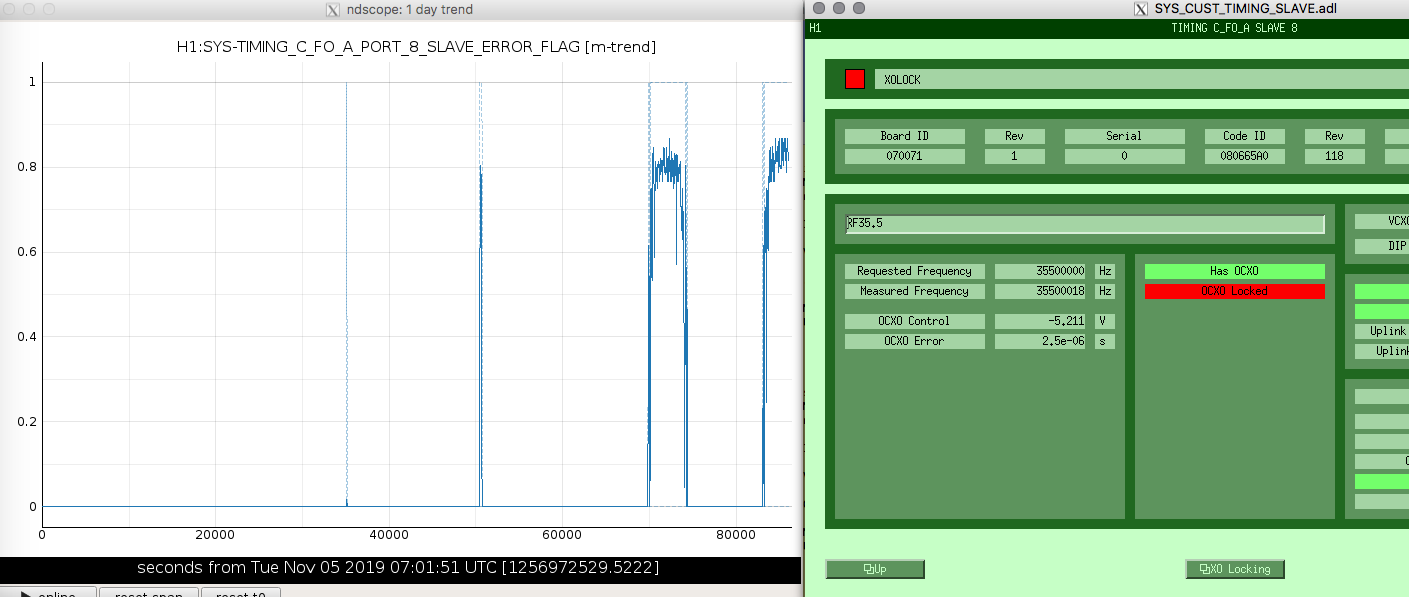
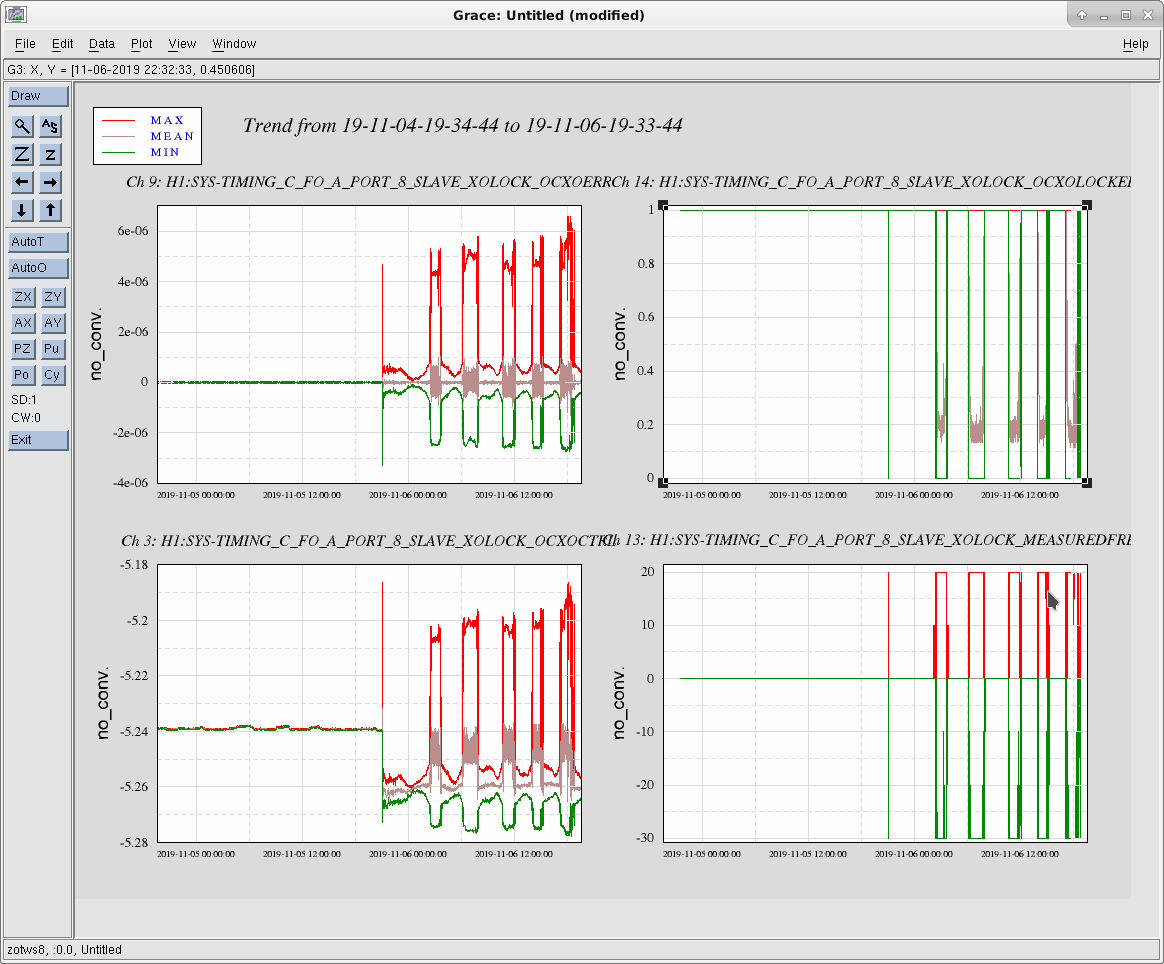
I just noticed an intermittent timing error on the CDS overview. The RF Amp attached to port 8 of CER fanout-A has been showing a locking error on the oven controlled crystal oscillator. Image shows a 24 hour trend of the error signal alongside the Amp MEDM at a time when the system was in error. First error showed around 08:40 PST this morning, the large error stretches in the plot are roughly between 18:30 to 19:30, and from 22:15 to now (23:00).
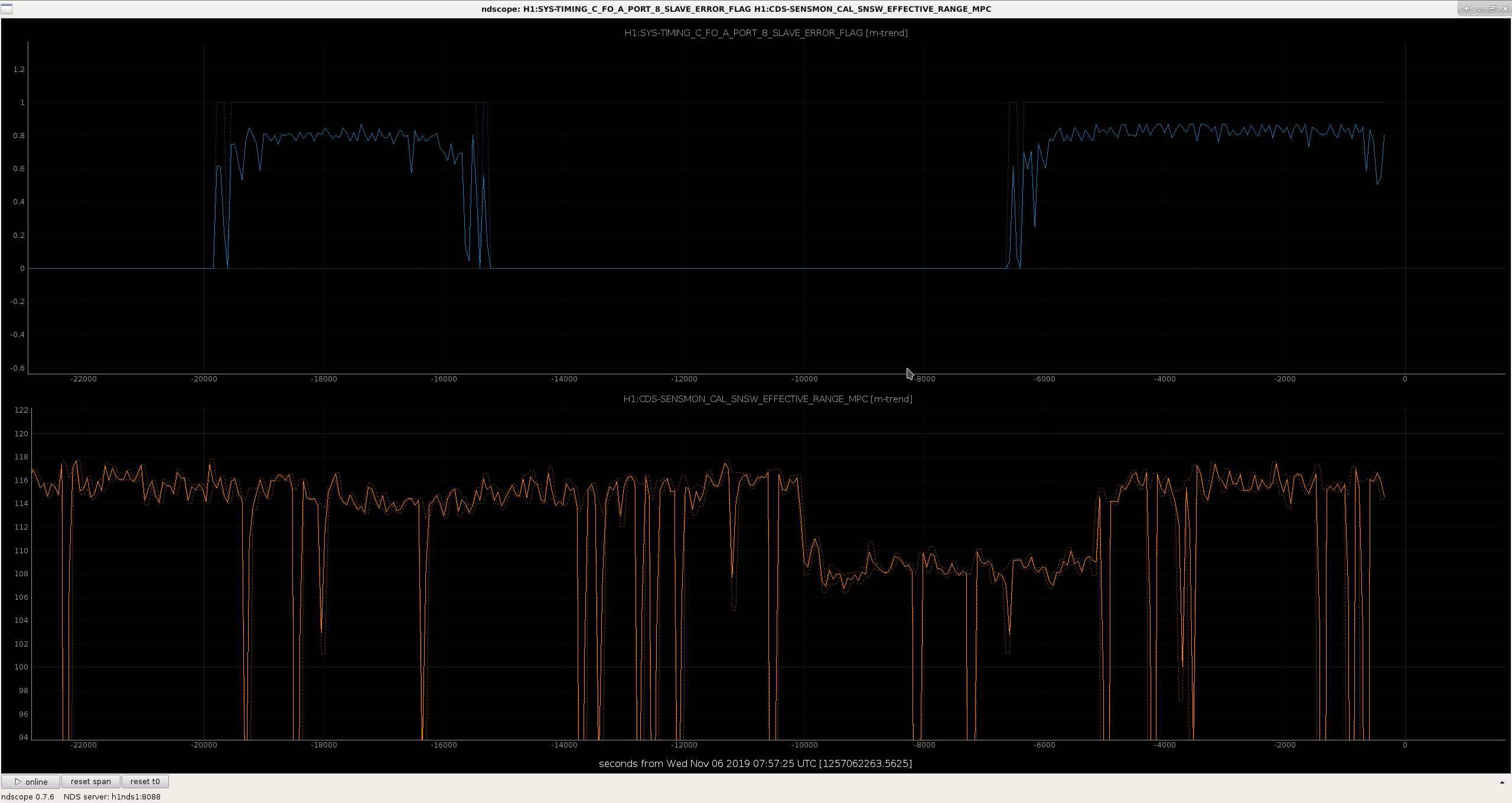
I had thought that the times Dave gave me over the phone almost lined up with increases in range, but maybe not. Attached screenshot shows the last several hours of his error flag (blue) and the sensmon range (yellow), doesn't really seem to be a relationship.
This oscillator source started going wonky around 11/5/2019 21:03 UTC
Tagging @Detchar, in case they can add more to the impact of these channels (and just in case they've also found this as an idea for correlation with the range drops).
{Gerardo, Chandra}
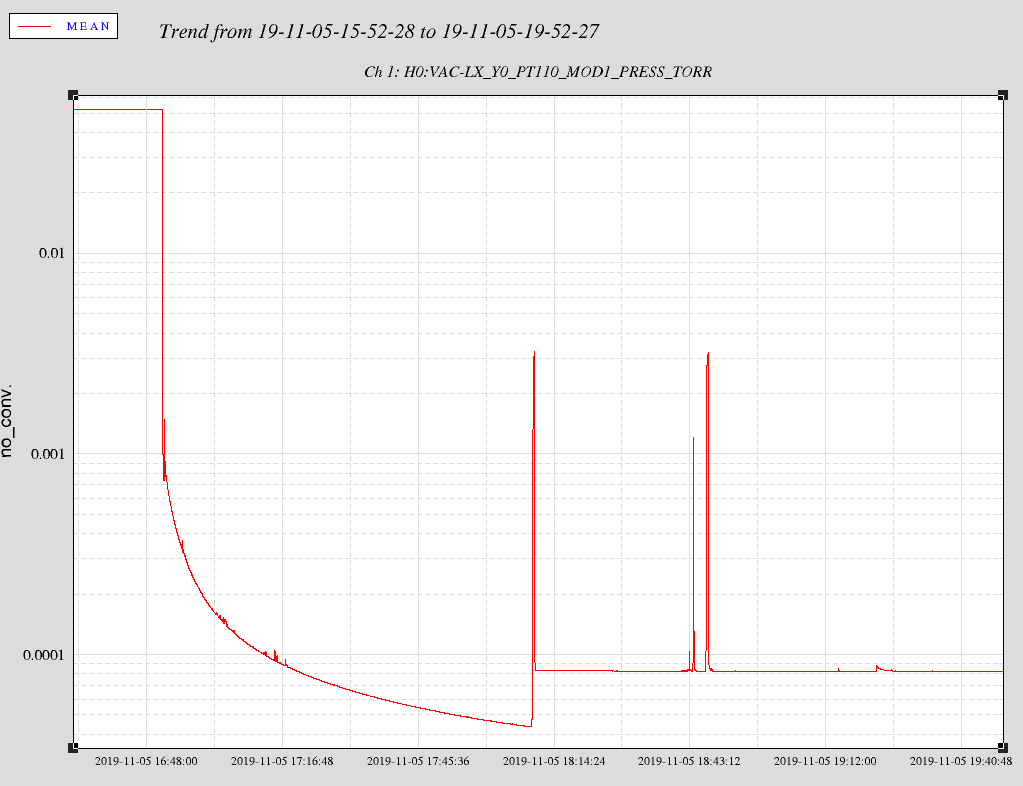
Replaced faulty PT-110 pressure gauge (SN 217) on HAM6 today with SN 214; however, the hot filament will not come on after some pressure transitions. I've asked Patrick to try to force it on through software when he is on shift tonight. Here is what we did:
Gauge is Inficon BCG450-SE and was tested on pump cart prior to installation. IP14 and small 10 l/s IP on RGA both remain stable.
In order to connect the pump cart, I had to temporarily move the PEM Vibration Table sitting on 16.5" flange set on top of HAM6.
I set the units for the gauge to Torr. It is now reading around 6E-7.
Thank you, Patrick!!