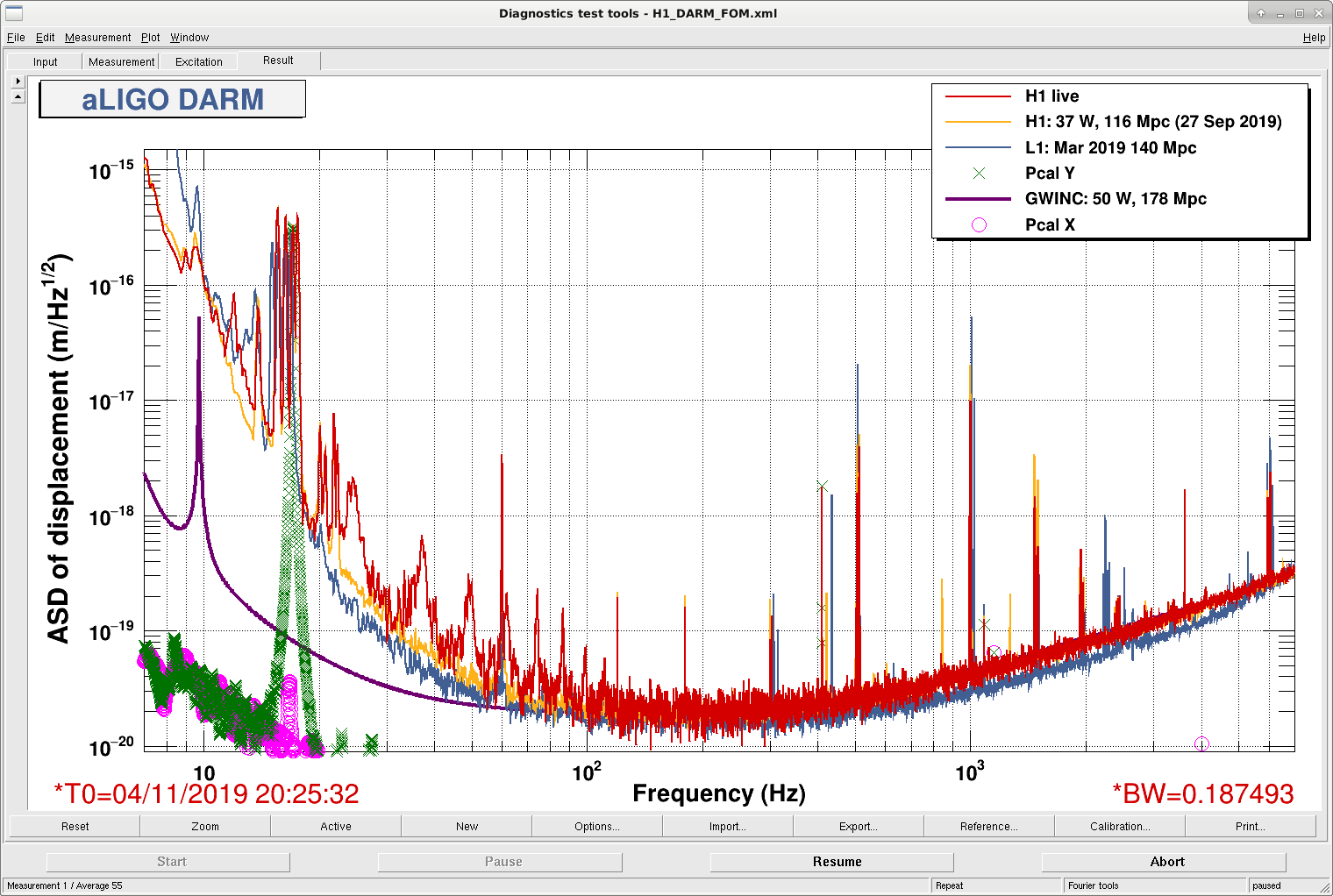
62.5hours lock, calm environment. We are still unsure of why our range drops, but there is ongoing investigations.
Sheila and I just saw this scattering feature appear in DARM, image attached and was happening around 1256934350. It lasted ~10s and you could see smaller and shorter versions of this leading up to what is shown in the screenshot.
We both thought we saw similar features last week, but this was when Robert was out in the LVEA so we assumed it was intentional.
Business/safety items:
IFO recap:
Tuesday Maintenance Activities:
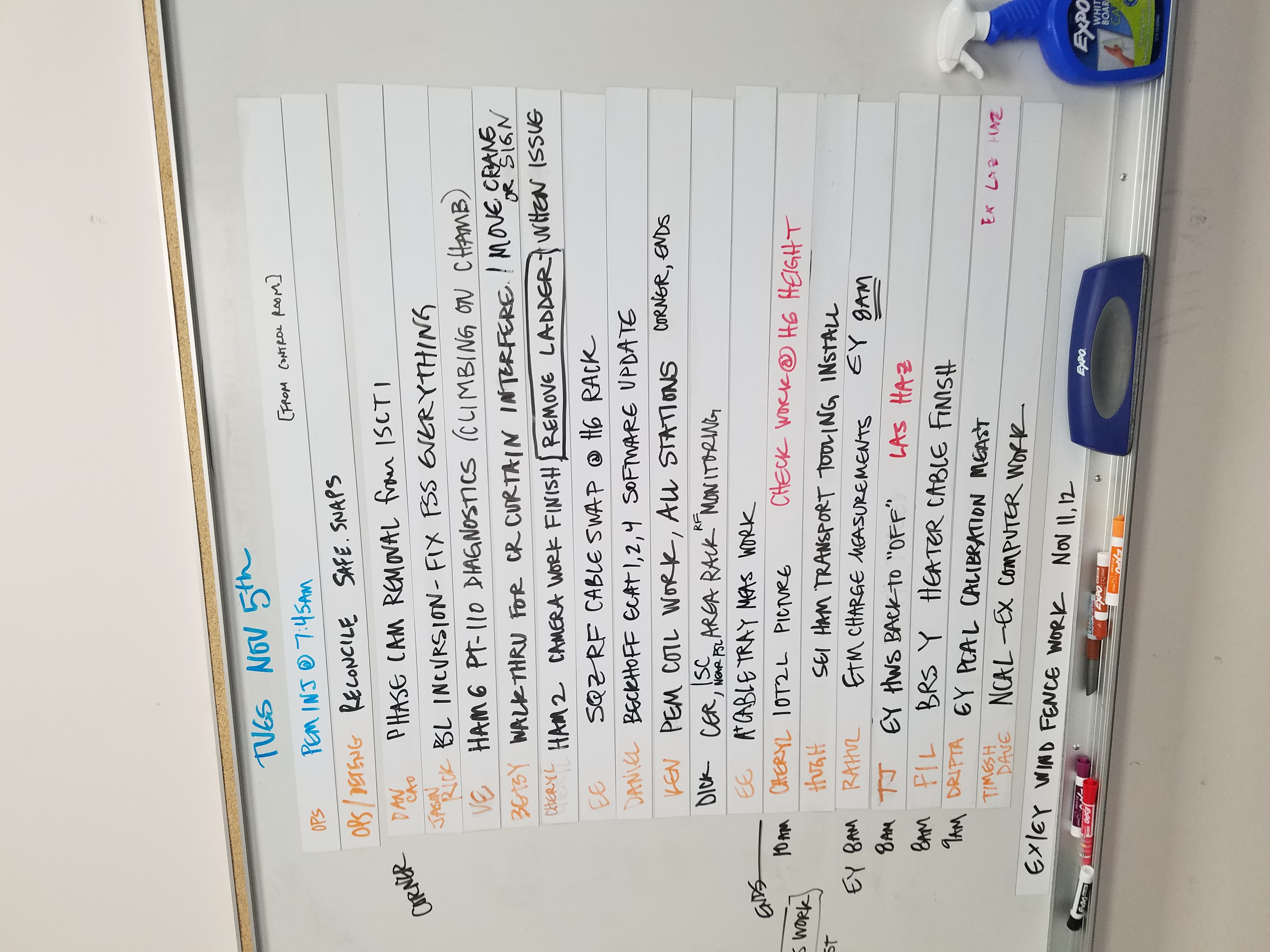
See the attachment for a picture of the whiteboard
Pressure trend of PT-120B on BSC2 in corner over seven days shows small diurnal fluctuations likely due to hydrogen outgassing as beamtube heats up during day.
Corner station is operating with 2500 l/s x 2 less pump speed from loss of IP 5,6 after decoupling H2 and capping BSC 7,8.
The SR3_CAGE_SERVO node was found in the state, SR3_CAGE_SERVO_RUNNING this morning. The nominal state for this node is CAGE_SERVO_OFF, and it was changed on Oct. 23. Cecking in with Jeff and Sheila, this was left on accidentally and we will need to revert it on a lock loss.
Please being this back to CAGE_SERVO_OFF on next lock loss.
To be a bit more clear, in this SR3_CAGE_SERVO running state, the node is continually servoing H1:SUS-SR3_M1_DITHER_P_OFFSET.
TITLE: 11/04 Day Shift: 16:00-00:00 UTC (08:00-16:00 PST), all times posted in UTC
STATE of H1: Observing at 108Mpc
OUTGOING OPERATOR: Jeff
CURRENT ENVIRONMENT:
SEI_CONF state: WINDY
Wind: 4mph Gusts, 3mph 5min avg
Primary useism: 0.01 μm/s
Secondary useism: 0.10 μm/s
QUICK SUMMARY: There is still a ~10Mpc drop in range that we are trying to determine. Other than that, we have been locked for 58hours.
15:37 (07:37) Fermi GRB alert E353966. Latency is 41.35 seconds, Trigger Duration is 0.016 seconds. LLO is down, Virgo is up. 15:38 (07:38) Stopped injection for 15 minute stand down. 15:42 DCPD Glitch 15:55 (07:55) Restart injections
Good observing shift so far. Environmental conditions are favorable. Range at 117.7Mpc. No issues or problems to report. Two GRB events during the first half of the shift.
10:49 (02:49) GRB Alert Fermi #E353954. Latency: 24.7sec, Trigger duration: 0.064. Spoke with LLO. Stop injections and enter 15-minute stand down. 11:03 (03:03) Glitch at End-X 11:05 (03:05) Start injections and end 15-minute stand down.
Fermi GRB alert at 09:18 (01:18). Latency is 20.5 seconds and Trigger Duration is 0.064. Spoke to LLO. Entered INJECT_KILL state and will stand down for at least 15 minutes.
09:38 (01:38) Turn injections back on. End stand down.
TITLE: 11/03 Eve Shift: 00:00-08:00 UTC (16:00-00:00 PST), all times posted in UTC STATE of H1: Observing at 114Mpc INCOMING OPERATOR: Jeff SHIFT SUMMARY: Remained locked and in observing the entire shift. Three GRB alerts. ITMY mode 12 may eventually need to be damped. LOG: 01:21 UTC GRB E353927 Fermi 594523229 TRIGGER_DUR: 0.016 [sec] -> Stand Down 01:25 UTC Set INJ_TRANS to INJECT_KILL 02:54 UTC GRB E353930 Fermi 594528816 TRIGGER_DUR: 0.016 [sec] -> Stand Down Confirmed with LLO 06:38 UTC GRB E353940 Swift Trigger duration: 0.032 Stand Down Confirmed with LLO 07:40 UTC Set INJ_TRANS to INJECT_SUCCESS
Have remained locked and in observing. Two GRB alerts. No issues.
Philippe, Robert
Summary: We found no evidence of an overall reduction in coupling at the septum, associated with replacement of the main window. This could be because the window was not angled to retro-reflect light from the beam, so additional angling made no improvement. Another possibility is that scattering coupling was not dominated by the window. We found a candidate for the latter explanation: a beam spot on the HAM5 side of the septum. The septum moves more than the ground and is a better reflector than other parts of the vacuum enclosure, so we may want to consider shrouding it.
Figure 1 shows a comparison of coupling before and after the break. Some frequencies look better by factors of 2 or 3, others look worse by similar factors. We don’t know how much of this is due to differences associated with the scaffolding. The average of “before” and “after” coupling factors is about the same. On the whole, I think we can say that any improvement was less than a factor of 2.
We had hoped for more of an improvement, so we checked for other problems by redoing the other measurements that had led us to the septum before the break (none led specifically to the septum window). Figure 2 shows that both the arrival time and the DARM amplitude for impulse injections are still most consistent with coupling near to the septum accelerometer. And, the frequency structure in the signal from the septum accelerometer is still the best match to the frequency structure in DARM.
In addition, we tried the new beating-shakers technique, and preliminary results are also consistent with coupling at the septum.
We photographed the spot on the new septum window. Figure 3 shows the new and old spots and scattering centers on the window. The brightness at 3 degrees was roughly similar to what I had photographed before the window replacement, as determined by camera settings used to capture it.
One possible explanation for un-improved scattering coupling is that we weren’t getting a specular reflection off of the window, so angling it did not help, and the improvement in window quality or cleanliness did not change the scattering by much.
Another possibility is that there is/was another beam on the septum that dominates the scattering from the septum. So, we looked again for other beams on the septum. We found one on the HAM5 side of the septum near the central port (Figure 4) that I had not noticed before. I’m not sure whether or not this beam spot was present before the break because I could only see it from the very edge of one view port and from the illuminator port, which I had not used previously. I’m not sure of the origin of the beam spot on the septum. According to camera settings it is quite bright, requiring about the same camera settings as the beam spot from the window, but at a much larger angle than 3 degrees.
Unfortunately, the presence of the spot on the septum makes it difficult to conclude whether or not we must remove the window in order to make further reductions in coupling. I think that one thing we have learned is that we should consider a scheme to shroud the septum further since it moves more than the ground, is highly reflective, and is normal to the beam path.
Tagging @SYS, in case they can help us identify /confirm from where this beam comes. Is it coming from the OFI on its way to the OPO? Is it the ghost beam that's coming from the OFI that nominally should be dumped and is no longer dumped?
TITLE: 11/04 Day Shift: 16:00-00:00 UTC (08:00-16:00 PST), all times posted in UTC
STATE of H1: Observing at 115Mpc
INCOMING OPERATOR: Patrick
SHIFT SUMMARY: H1 in Observe, instrument air pumps for LVEA are working, SQZ just fixed itself, causing an increase in range
LOG:
VACUUM:
SQZ:
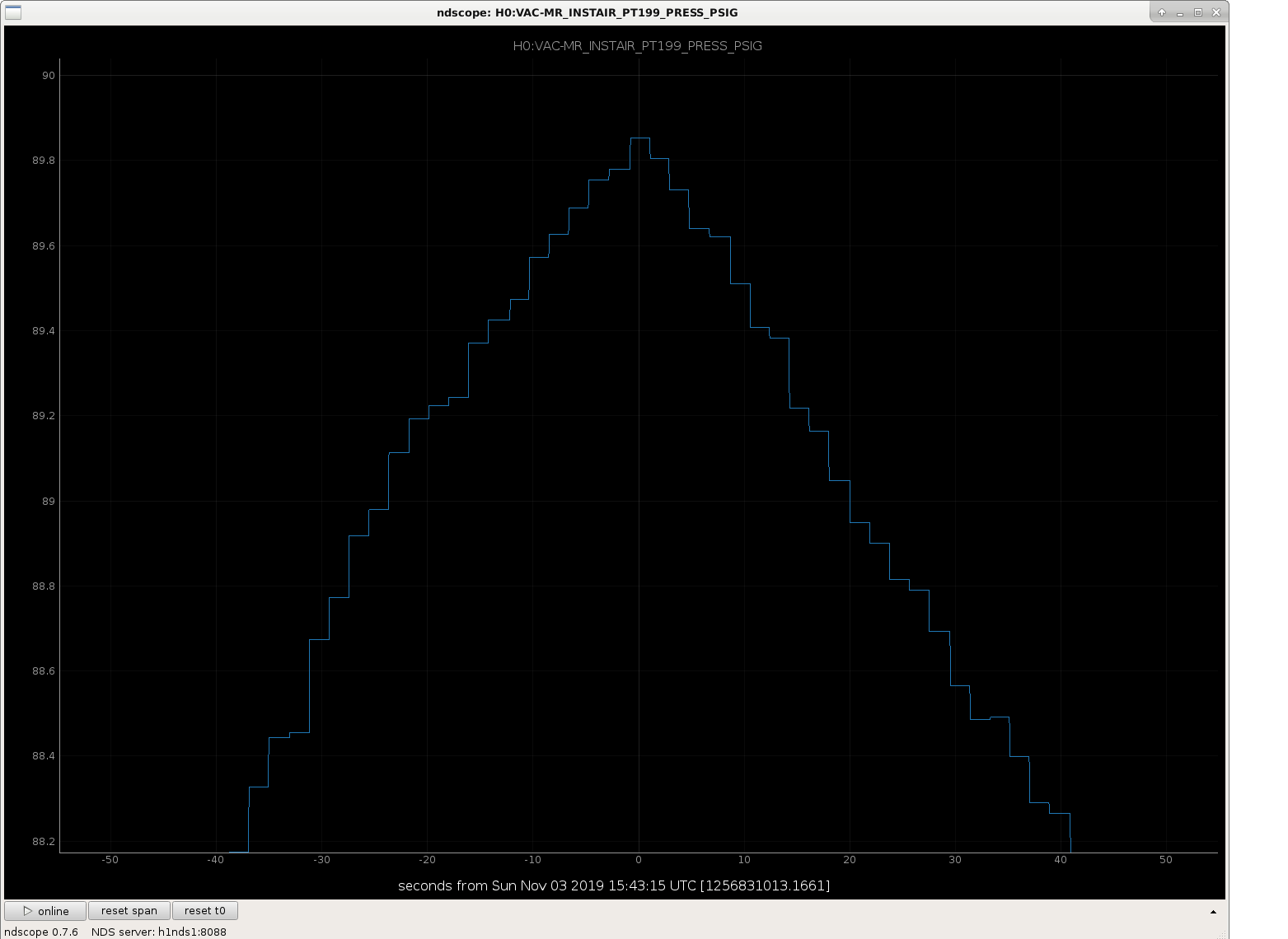
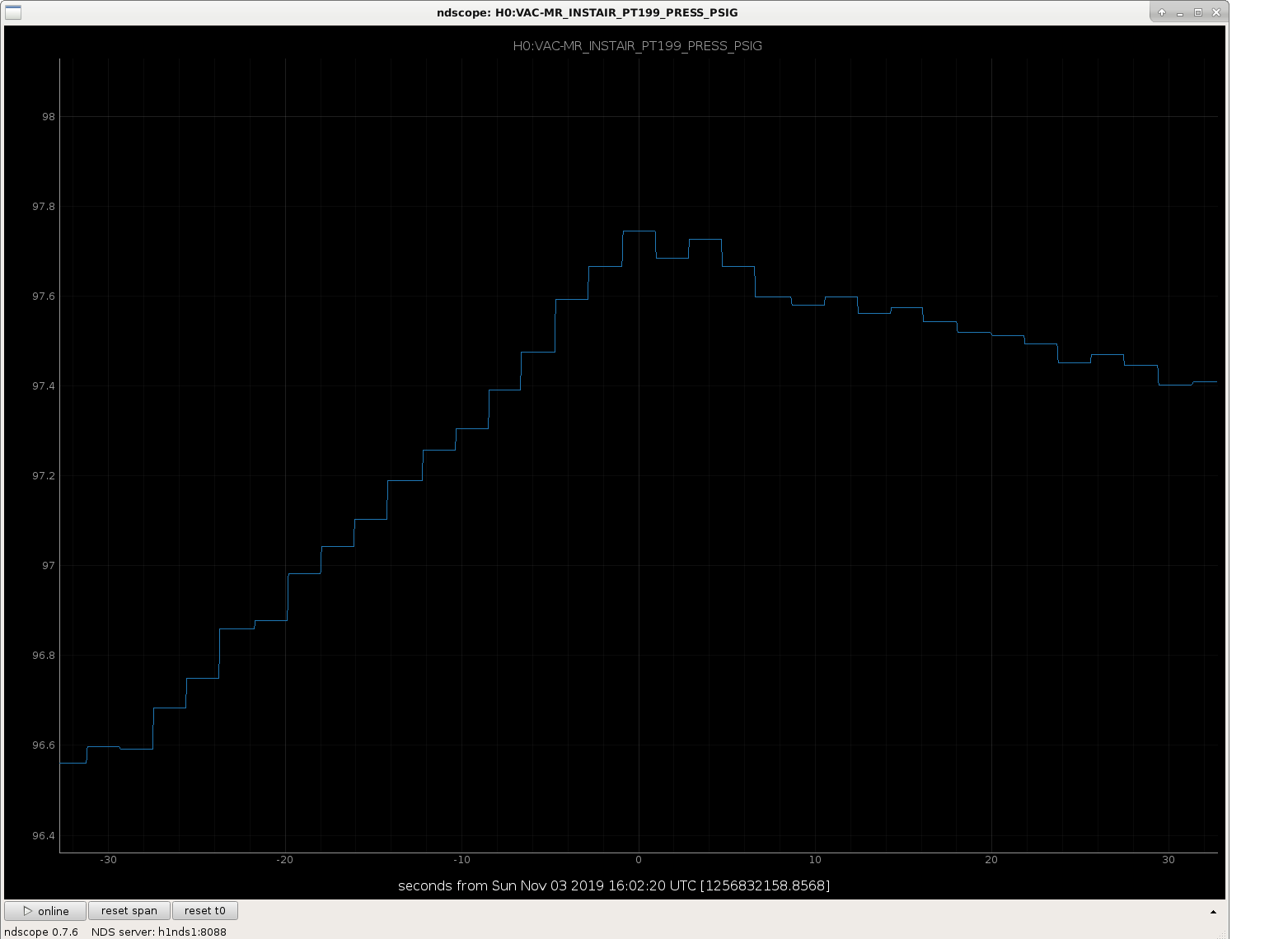
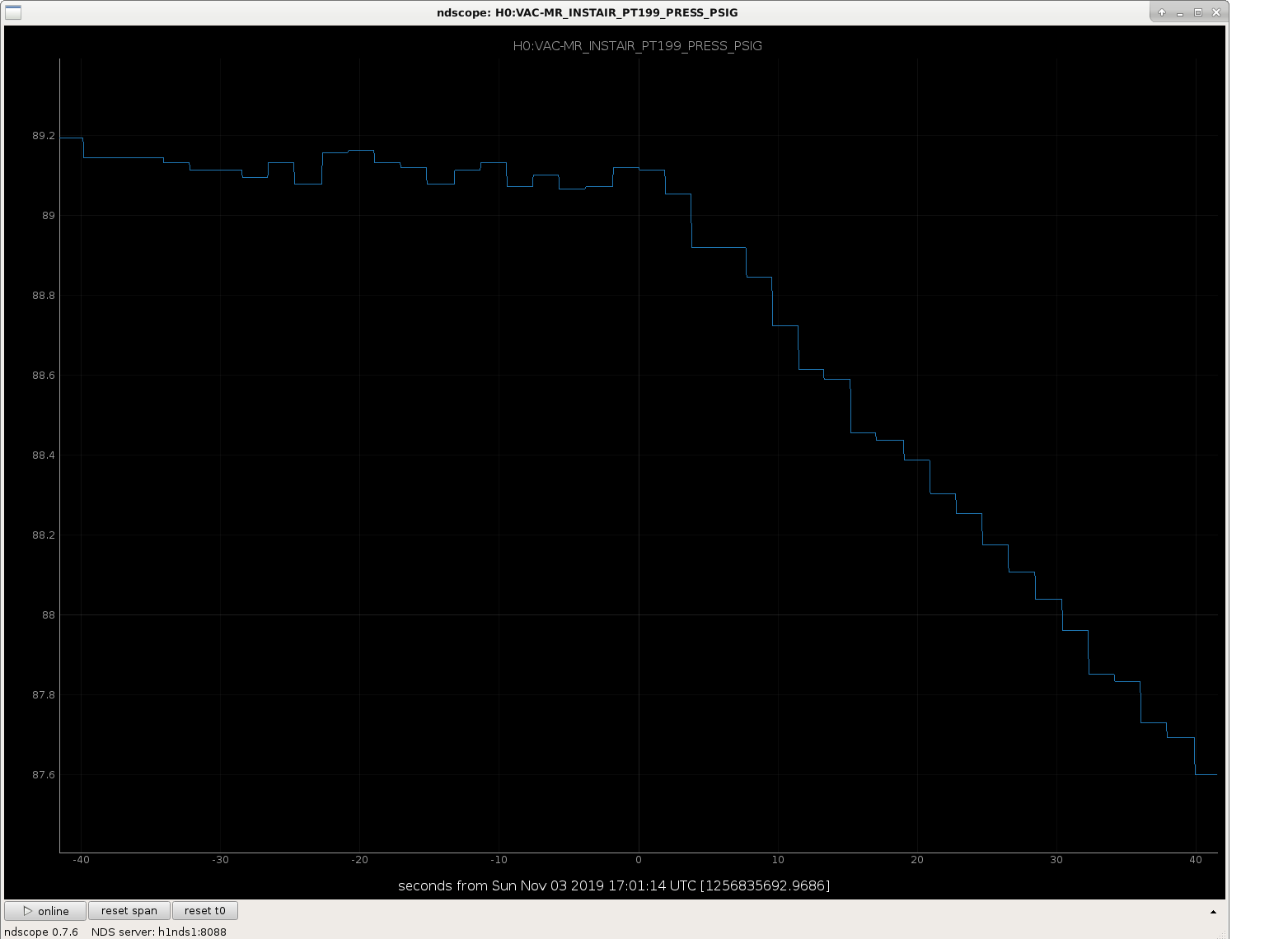
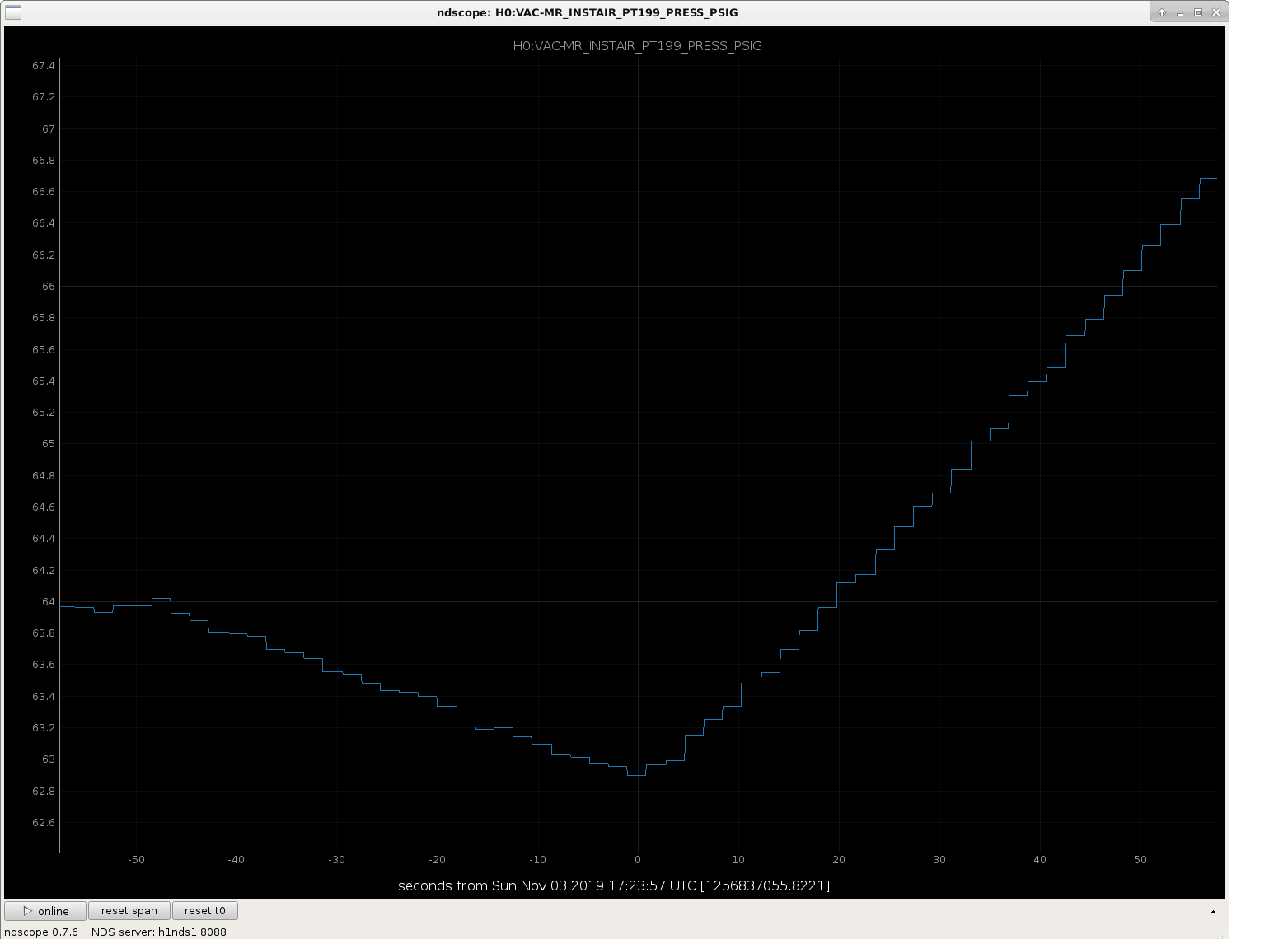
Images that go with the PT199 timeline:
An interesting plot showing an alignment change in ZM2 yaw that coincides with the increase in H1 Range.
Tagging @DetChar on this one -- these distinct range changes are still a mystery to the on-site team. Perhaps comparing BRUCO's (looking for linear coherence) or LASSO's (looking for slow changes that correlate to the times of distinct change) around these times might reveal some smoking guns? Any help is appreciated!
The LASSO results for 4 Nov (see https://ldas-jobs.ligo-wa.caltech.edu/~detchar/summary/day/20191104/detchar/lasso/) show a strong correlation between SQZ channels (perhaps excited by seismic motion) and the range drop. Similar results exist for 1 Nov, the most recent prior day with a long lock crossing the range drop.