Displaying reports 39281-39300 of 89041.Go to page Start 1961 1962 1963 1964 1965 1966 1967 1968 1969 End
Reports until 18:29, Wednesday 14 August 2019
H1 ISC (DetChar, ISC, OpsInfo)
jeffrey.kissel@LIGO.ORG - posted 18:29, Wednesday 14 August 2019 (51280)
ALS DIFF Troubles -- Adjusting Beatnote PD alignment on ISCT1, Added Check to ALS_DIFF Guardian
J. Driggers, S. Dwyer, J. Kissel, E. Merilh, K. Merfeld

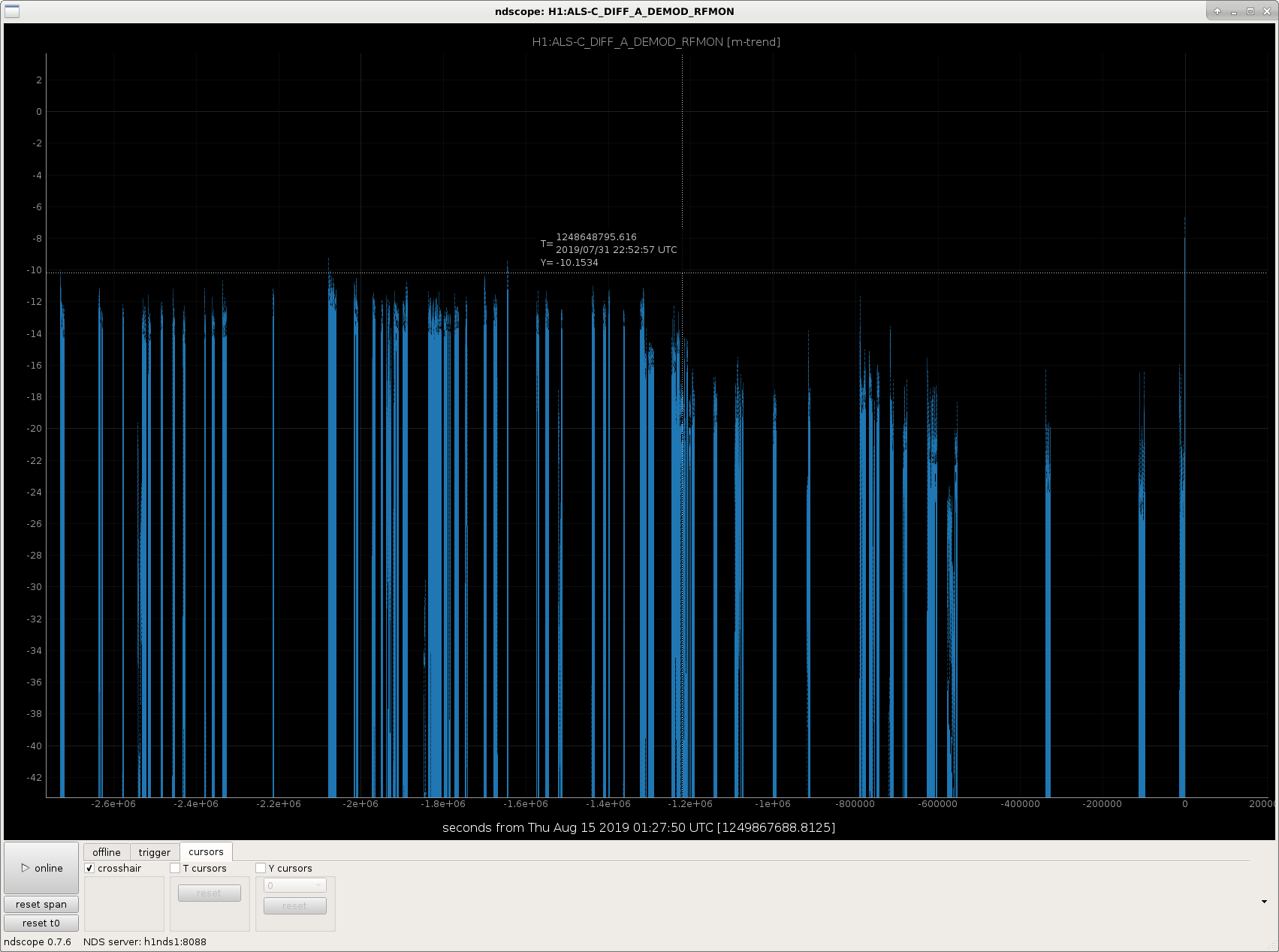
After the EQ, we've been having a lot of trouble even getting past the ALS of lock acquistion. We think we might have traced the problem down to the DIFF beatnote (H1:ALS-C_DIFF_A_DEMOD_RFMON) being too low. 
How did we come to this conclusion? A trend of the DIFF beat note over the past many moons revealed that on July 31 / Aug 1 -- when we changed the global alignment -- the trend of the DIFF beatnote consistently dropped from -10 dBm to -25/-26 dBm. Suspecting that 
    (a) this is yet another knock-on effect of the new global alignment position, and 
    (b) that we've just been Aerosmithing our way through life (living on the edge) the past few weeks,
and confirming improvement by adjusting the beam splitter alignment just after an initial alignment (3 urad! in yaw) to regain ~5 dBm of power, we've taken the following actions:

    (1) [After restoring the beam splitter alignment] we've gone out to ISCT1 and adjusted the alignment on to the DIFF beatnote PD.
    (2) Added a check to the ALS_DIFF guardian in the "run" part of its PREPARE state to spew out a notification (sadly only at the ALS_DIFF guardian level) and loaded it. We set the threshold to -26 (dBm).

Images attached to this report
H1 SQZ
jason.oberling@LIGO.ORG - posted 16:41, Wednesday 14 August 2019 - last comment - 14:46, Thursday 15 August 2019(51278)
Initial Output Power Measurement for SQZ NPRO SN 8552

I measured the output power of the recently-removed SQZ NPRO laser SN 8552.  The laser settings were found as last set by the SQZ team:

I set the laser settings to those specified in the original data sheet; the set value for the NPRO Crystal temp is slightly different from the actual value, and the power supply reports both numbers so I recorded the actual crystal temp as well.

I allowed the laser to warm up for ~5 minutes before taking the first power measurement.  For the measurement I used an Ophir VEGA power meter with an Ophir PD300-3W head.  After the intial reading, the power was slowly increasing, so I waited until it stabilized, noting the power measured a few times over the duration:

The data sheet reports an output power of 1.05 W using the initial settings, so this laser seems fine from an output power standpoint.  I took one last reading of the laser settings to see if things had changed since I started; they had, albeight slightly:

Since the NPRO only had a couple hours to acclimatize to the optics lab environment, I'll let it sit overnight and repeat these measurements tomorrow to make sure everything is unchanged.  As of right now though, the power out of the NPRO matches the original data sheet.

Comments related to this report
jason.oberling@LIGO.ORG - 14:46, Thursday 15 August 2019 (51301)

Tested again this morning at the same factory settings and after a 5 minute warm-up period, and saw similar results:

  • Inital measurement, t0: 0.924 W
  • t0 + 10 min: 1.035 W
  • t0 + 20 min: 1.051 W

At factory settings the output power of the laser meets the specs, but for some reason is unstable at the temperature/frequency required for SQZ (which lead to its replacement).

H1 ISC (AOS, CAL, DetChar, ISC, OpsInfo, TCS)
jeffrey.kissel@LIGO.ORG - posted 16:23, Wednesday 14 August 2019 (51275)
Spot Position Move -- Transitioning from Early Aug Position to Prior-to-July 31 O3 Position
J. Driggers, S. Dwyer, J. Kissel, T. Sadecki

We were able to successfully move the spot position on ITMY this afternoon, while in otherwise Nominal Low Noise at 37W, in order to make progress toward reverting the global alignment position to prior to the position found to work on July 30 / 31, as part of the plan to fix several problems that have arisen because of the new position (see LHO aLOG 51262). 

Progress was stalled then halted due to a GW event candidate (yay!), and 30 minutes later a lockloss from an earthquake in Mexico (boo!).

Here's a mid-adventure report so there's less to talk about later.

The path for the spot position move was to swing *around* the point absorber. As such, Jenne and Sheila did the following:
    - Increased the gains on the ADS YAW 3 loop (from 1.0 to 10.0) and the SRC1 PIT / YAW loops (from 12 to 18, and from 4 to 6, respectively)
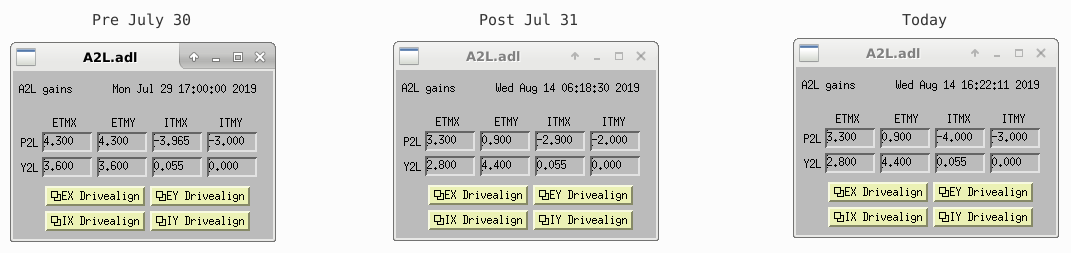
    - slowly adjusted the A2L gains on ITMY (H1:SUS-ITMY_L2_DRIVEALIGN_P2L_SPOT_GAIN and H1:SUS-ITMY_L2_DRIVEALIGN_Y2L_SPOT_GAIN) 
        - first swinging "out wide" in YAW, increasing the gain from 0.0 to 3.5
        - then restoring the PIT position / gain to the Prior-to-July values (from -2.0 to -3.0)
        - then restoring the YAW position / gain from 3.5 to 0.0
        - then changing the ITMX PIT and YAW positions to minimize the coupling to DARM (the ITMX position and ITMY position are closely coupled by the ASC system, but we don't use the ADS system to servo the spot position on ITMX to the same place.)
Notably, we were discussing a path forward when the GW candidate came through, so we had not yet moved the spot positions on the ETMs before we lost lock.

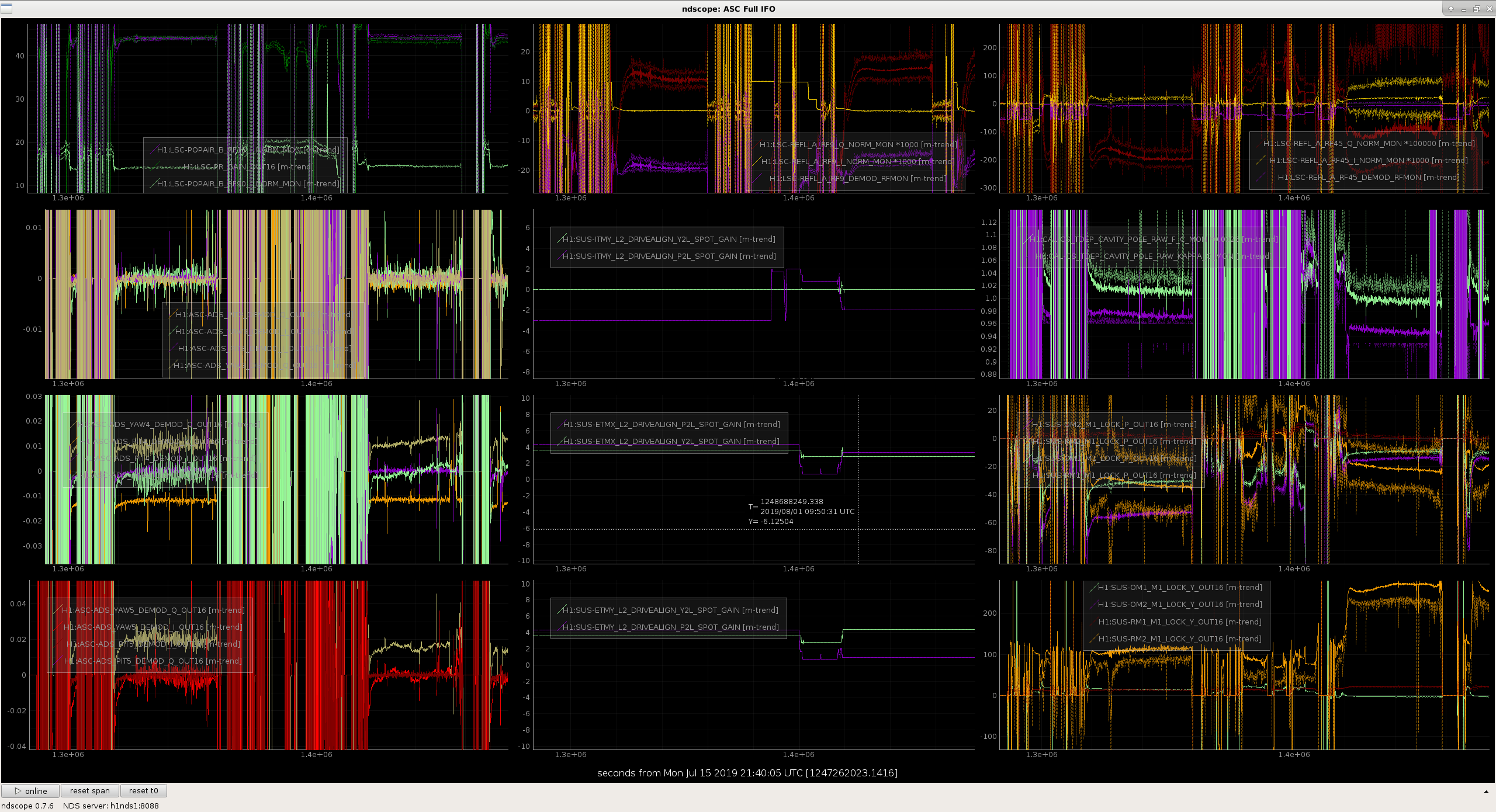
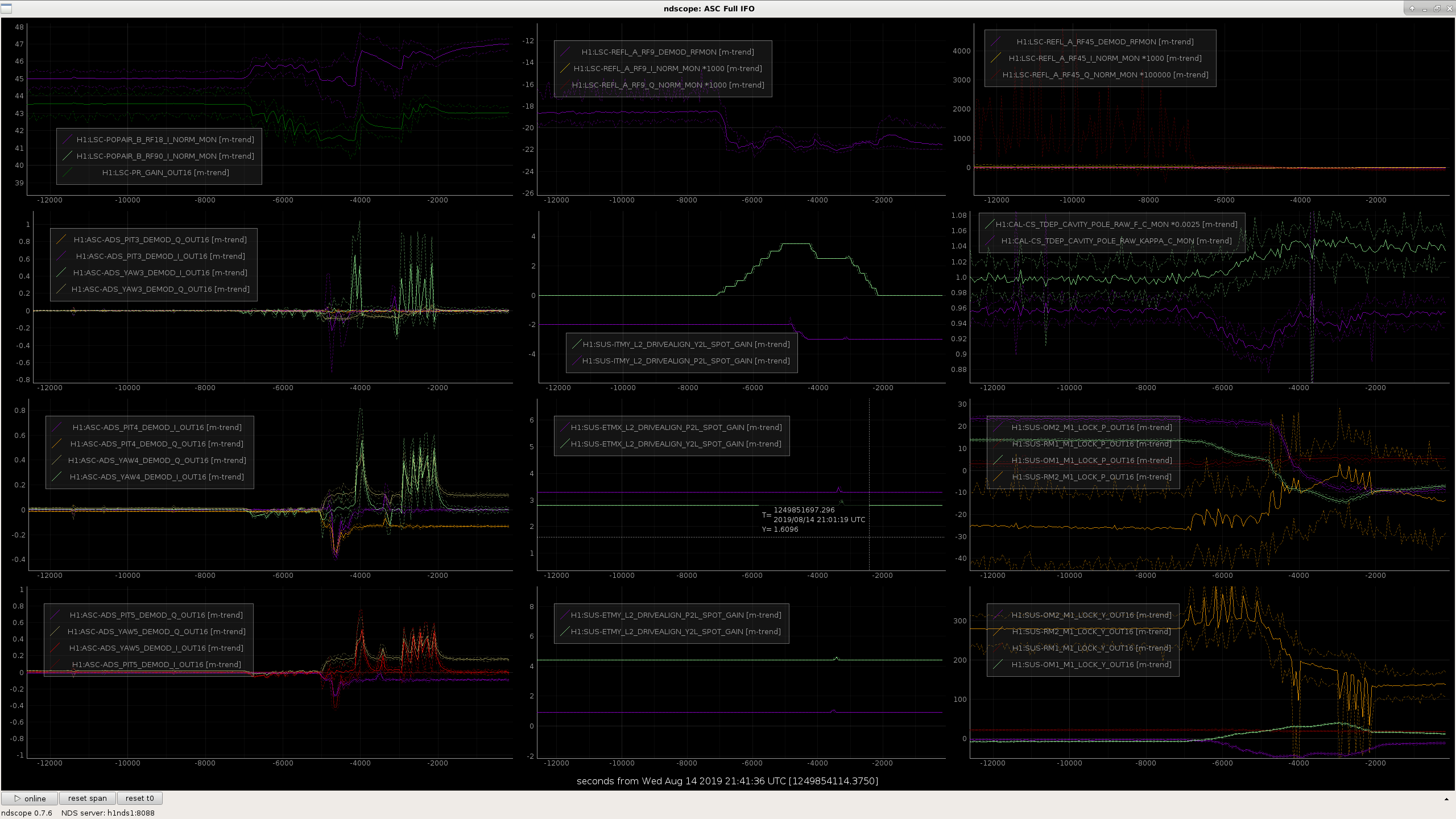
We noticed several things along our journey and about our end positions -- to see these conclusions, check out the trends of relevant channels during the spot moves today (2019-08-14_DuringSpotMove_After.png), and just before we moved them on July 31 (2019-07-31_DuringSpotMove_Before.png):
    (1) [Row 0, Column 2] RF45 Noise has returned to July-level noise -- drastically reduced. Great! (as displayed by H1:LSC-REFL_A_RF45_DEMOD_RFMON) 
    (2) [Row 0, Column 0] The POP18 build up is actually a bit *higher* than July-level. Great! (as displayed by H1:LSC-POPAIR_B_RF18_I_NORM_MON)
    (3) [Row 1, Column 3] The DARM coupled cavity appears to be a bit higher than the July-level. Great! (as displayed by H1:CAL-CS_TDEP_CAVITY_POLE_RAW_F_C_MON / 400 Hz) 
    (4) [Row 0, Column 0] PRC gain is roughly the same. Good. (as displayed by H1:LSC-PR_GAIN_OUT16)
    (5) [Row 1, Column 3] The DARM loop optical gain (\kappa_C) is a bit lower,  but we haven't tuned up the OMC ASC alignment offsets yet. OK. (as displayed by H1:CAL-CS_TDEP_CAVITY_POLE_KAPPA_C_MON)

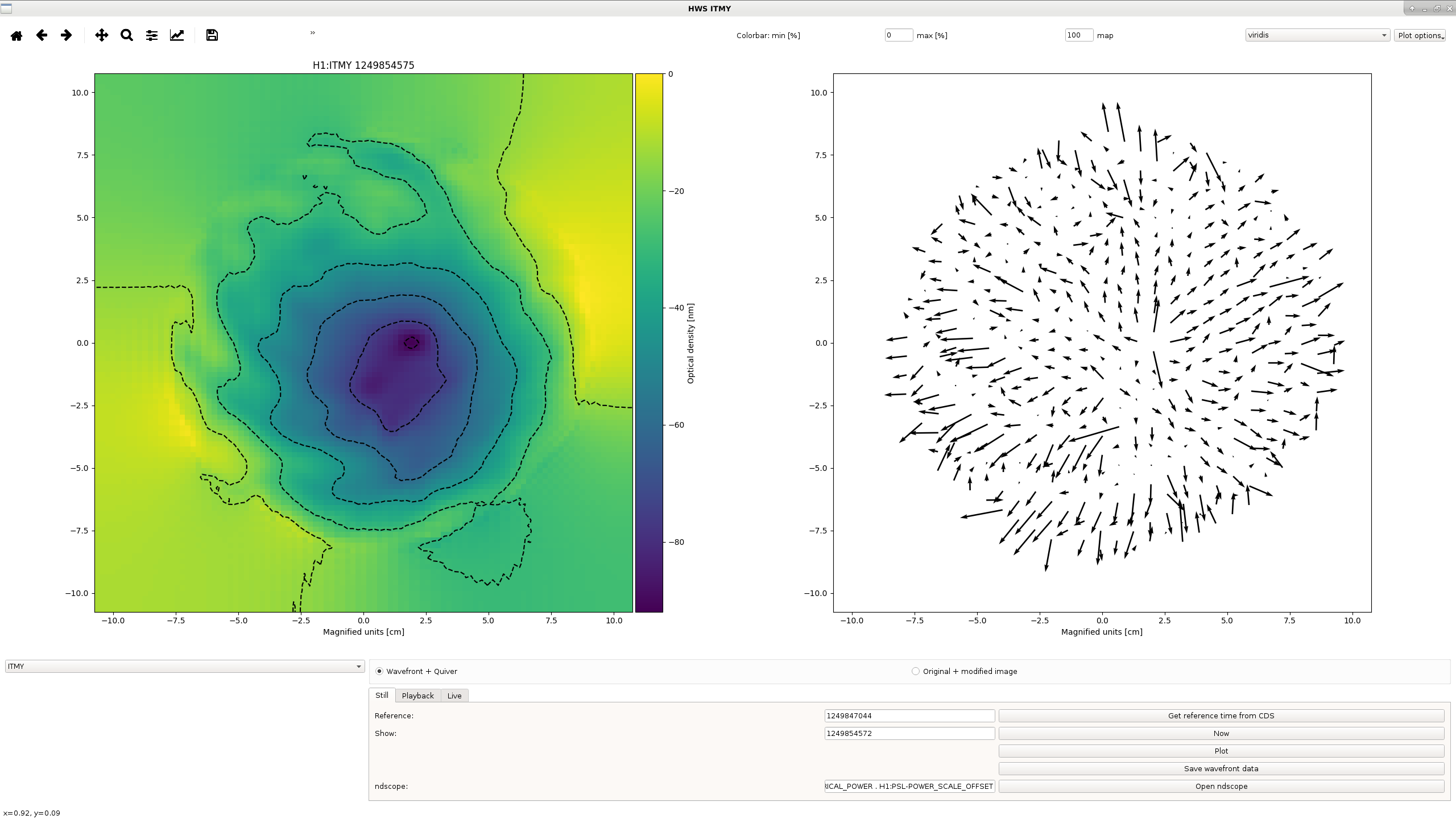
Also note that a before vs. after spot position move drastically cools the HWS image around the point absorber -- consistent with the fact that the new positions no longer heat up the point absorber (see 2019-08-14_H1HWSData_FromReferenceToHoldPoint_2.png).

These effects lead us to believe that we're doing the right thing by going back toward the pre-July spot positions. Indeed, we are even considering *not* moving the ETM spot positions, because the cavity pole and DRMI power / POP18 buildups are a bit better than before. Jenne remind us that the ETM spot positions were chosen *solely* because they were the former positions that had the highest buildups back in the late Apr / May, so we're not married to them.


However, since all this was half-way through our goals for the day, we now have the following ideas/plans forward if we relock quickly:
    (a) Re-lock the IFO without doing any initial alignment -- hoping that our work will not have gotten lost with the EQ.
    (b) Re-acquire all the way to DC readout at 2W (i.e. after full IFO alignment, and SOFT LOOPS have been engaged).
    (c) Gather/Record initial alignment references at both centered spot positions (all zero A2L gains) as well as either today's new positions (IY and IX restored, but with ETMs still at Early Aug values) or Pre-July positions. 
        >> decision point at this time unknown -- to which do we set the initial alignment offsets -- centered, Pre-July, or New?
    (d) Head up to full 37W.
    (e) Tune up OMC ASC alignment loop offsets to regain as much DARM loop optical gain as possible
    (f) Remeasure sensing function.

We'll see how far we get. We're still formulating a plan for "what if we don't get even past (b)" for the operator corp to do overnight.

For future reference, I also attach a more detailed but more rough diary of the afternoon's activity (2019-08-14_SpotMove_Diary.txt).
I also attach a screenshot of the spot positions I reference in this aLOG: Pre-July 30/31, Post July 31, and Today. (2019-08-14_H1TM_SpotPositions.png)
Images attached to this report
Non-image files attached to this report
H1 AOS
edmond.merilh@LIGO.ORG - posted 16:20, Wednesday 14 August 2019 (51277)
Shift Transition - Eve

TITLE: 08/14 Eve Shift: 23:00-07:00 UTC (16:00-00:00 PST), all times posted in UTC
STATE of H1: Lock Acquisition
OUTGOING OPERATOR: Travis
CURRENT ENVIRONMENT:
    Wind: 14mph Gusts, 12mph 5min avg
    Primary useism: 0.07 μm/s
    Secondary useism: 0.14 μm/s
QUICK SUMMARY:

Still struggling with the lock as a result of beam pointing changes. EM follow up channel still abuzz with Superevent chatter from S190814bv.

H1 General
travis.sadecki@LIGO.ORG - posted 16:00, Wednesday 14 August 2019 (51263)
Ops Day Shift Summary

TITLE: 08/14 Day Shift: 15:00-23:00 UTC (08:00-16:00 PST), all times posted in UTC
STATE of H1: Lock Acquisition
INCOMING OPERATOR: Ed
SHIFT SUMMARY:  Currently relocking after EQ.  Commissioners will continue with spot moving after reacquisition. 
LOG:

16:01 Set to Calibration mode for calibration measurements

16:49 Back to Observing

19:44 Commissioning mode for spot move work

20:05 GRB alert. Trigger duration too long.  Carrying on with commissioning.

20:08 Ethan to optics lab

20:35 Peter to optics lab

20:46 Ethan out

21:12 Superevent candidate S190814bv

21:43 Jason to optics lab

21:51 Lockloss due to Mexico EQ

21:55 Peter out


H1 SQZ
daniel.sigg@LIGO.ORG - posted 15:25, Wednesday 14 August 2019 (51276)
SHG power peaked

Used the downtime from the earthquake to optimioze the steering into the SHG using the pico motors. Gain about 3% of green power.

Also added the green AOM to the squeezer overview screen.

H1 SQZ
daniel.sigg@LIGO.ORG - posted 13:20, Wednesday 14 August 2019 - last comment - 11:08, Thursday 15 August 2019(51270)
CLF power jumps

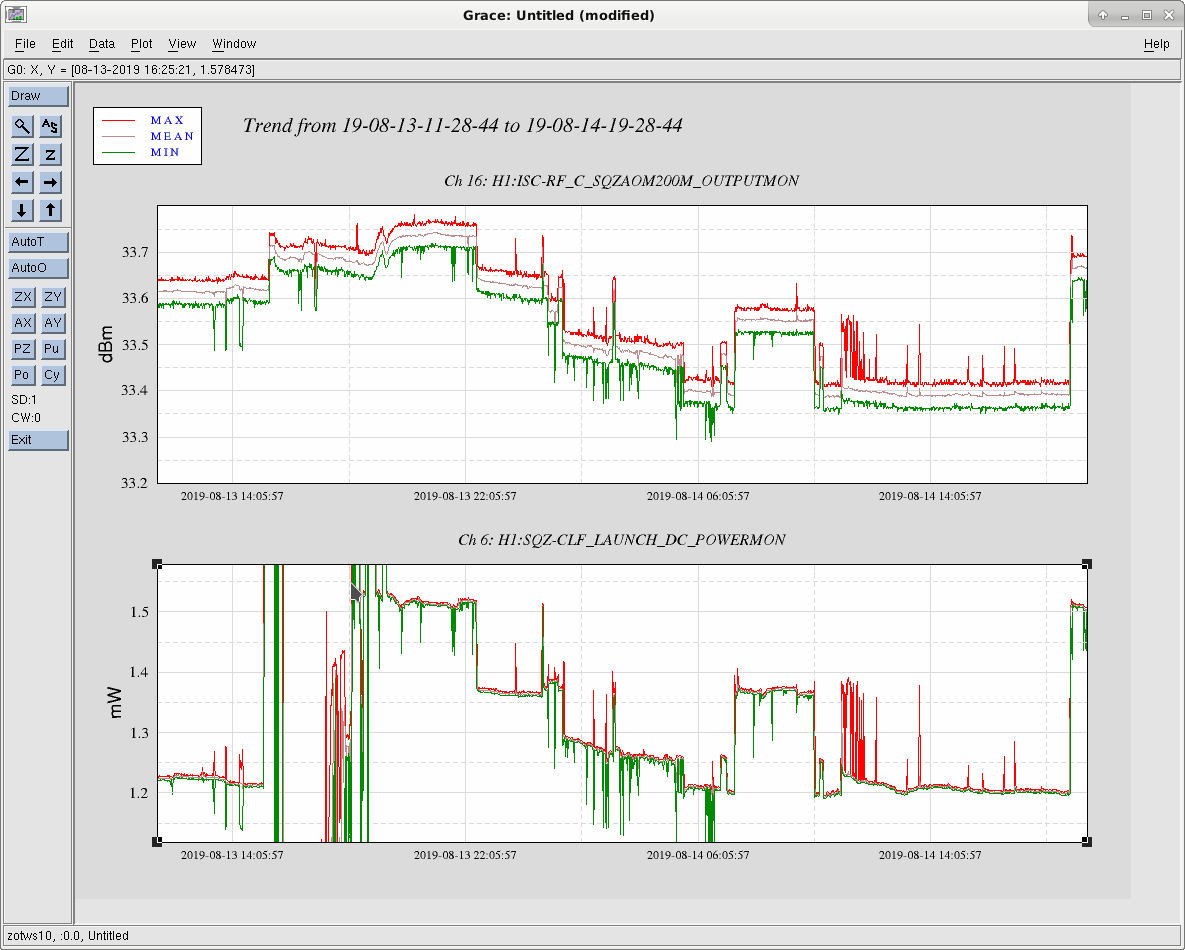
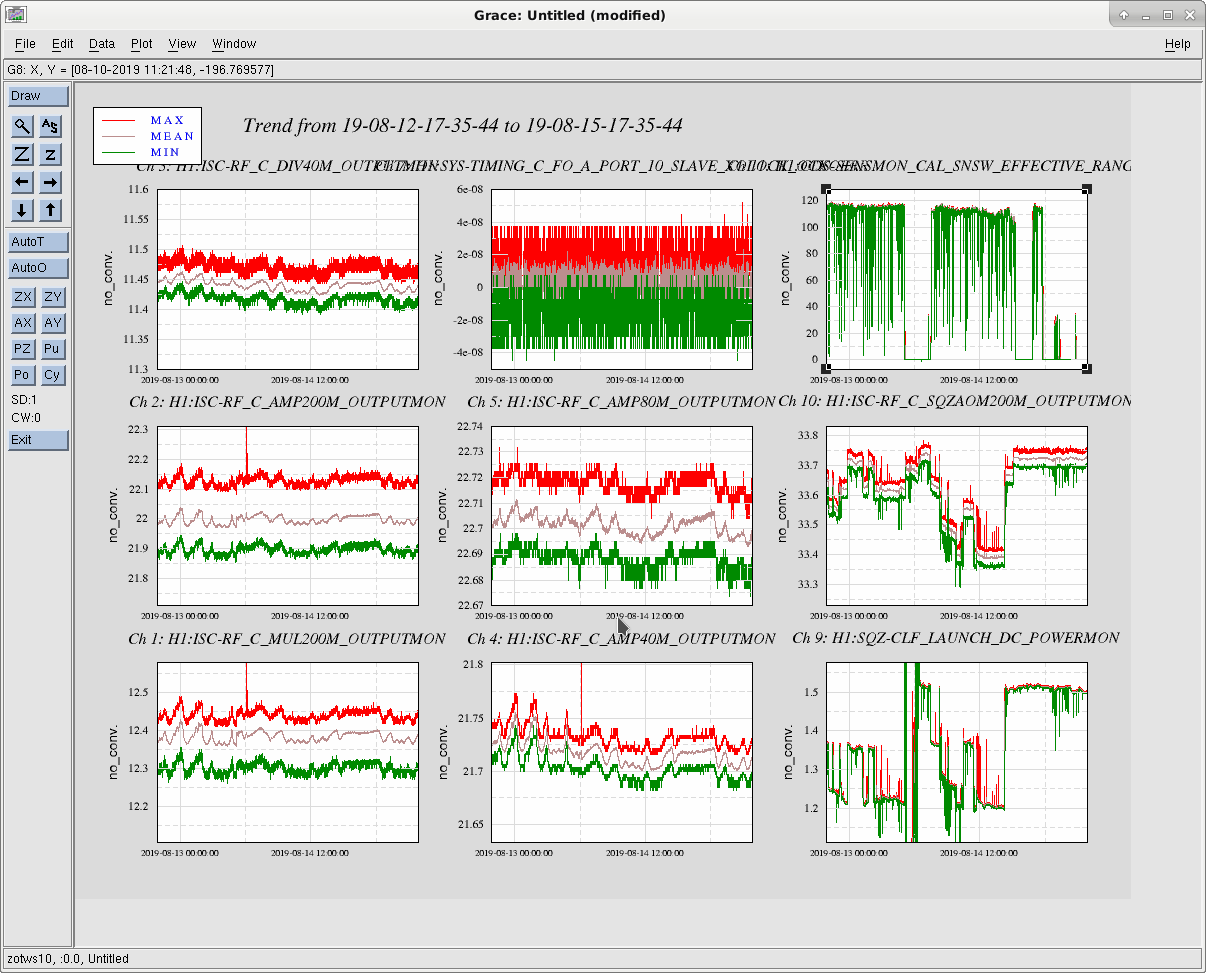
We noticed some curious jumps in the CLF power as measured by the CLF REFL PD. These jumps are also visible in CLF launch and rejected monitors. They are not visible in any of the other PDs on ISCT6 that are not associated with the CLF. See attached plot 1. We see coherent jumps in the RF output power readback of the 200MHz AOM driver. See plot 2.

The jumps in the CLF power are as large as 20%, whereas the RF power to the AOM only jumps by 5% or less.

Images attached to this report
Comments related to this report
daniel.sigg@LIGO.ORG - 11:08, Thursday 15 August 2019 (51296)

These jumps are not visible in the RF chain of generating the 200MHz signal and leading to the green AOM driver. In any case, the observed RF power jumps cannot explain the observed light power changes.

80MHz RF source -►
     80 MHz distribution amp -►
          40 MHz divider -►
               40 MHz distribution amp -►
                    200 MHz multiplier -►
                         200 MHz distribution amp -►
                              Green AOM driver

Images attached to this comment
H1 CAL (CAL)
travis.sadecki@LIGO.ORG - posted 13:01, Wednesday 14 August 2019 - last comment - 13:09, Wednesday 14 August 2019(51269)
PCal X issues

JeffK noticed that the PCal X was glitching and corrupting the DARM spectrum.  We had a quick look at the PCal MEDM screen and nothing seems awry.  Perhaps more investigation should be done to find the cause of the new glitchiness?

Comments related to this report
travis.sadecki@LIGO.ORG - 13:09, Wednesday 14 August 2019 (51271)

This glitching occured at approximately 20:00 UTC.

H1 PSL
travis.sadecki@LIGO.ORG - posted 11:02, Wednesday 14 August 2019 (51266)
Weekly PSL Chiller Reservoir Top-Off

Both chillers were full and required 0 additional water.  Both filters look good. FAMIS 10522.

H1 CAL (ISC)
jeffrey.kissel@LIGO.ORG - posted 10:23, Wednesday 14 August 2019 (51265)
Calibration Measurements: One more Sensing Function Sweep in Current TM Spot Position
J. Kissel

I wanted to get one last (a third) measurement of the sensing function in the current spot positions before we make the change back to the pre-July 31st positions (see plans in LHO aLOG 51262), such that we can confirm th pattern we've seen that -- in this spot position -- the low frequency response is consistent and casual.

I've successfully completed the measurements, and the data looks good [I even added a few more data points at low frequency to better resolve the feature, since our MCMC fitting algorithm continues to be quite confused by it]. Processed results to come later, but at first glance they indeed confirm that the low frequency response is quite similar.

Data lives and has been committed here: 
2019-08-14_H1_DARM_OLGTF_LF_SS_5to1100Hz_15min.xml
2019-08-14_H1_PCALY2DARMTF_LF_SS_5t1100Hz_10min.xml
2019-08-14_H1_PCALX2DARMTF_LF_SS_5t1100Hz_10min.xml
2019-08-14_H1_OMCDCPDSUM_to_DARMIN1.xml
2019-08-14_H1_PCALX2DARMTF_BB.xml
2019-08-14_H1_PCALY2DARMTF_BB.xml
H1 AOS
jeffrey.bartlett@LIGO.ORG - posted 09:28, Wednesday 14 August 2019 (51264)
Check TCS Chiller Water Levels (FAMIS #11504)
The water level for the TSC-X chiller is good. No additional water added.
Added 200ml water to the TCS-X chiller. 
All else with the chillers looks good. 

  Closing FAMIS 11504. 
H1 ISC (CAL, DetChar, ISC, Lockloss, OpsInfo)
jeffrey.kissel@LIGO.ORG - posted 08:56, Wednesday 14 August 2019 (51262)
Commissioning Plans Today: Attempt to Move Spot Positions Back
J. Kissel, K. Kawabe, D. Sigg, J. Driggers, S. Dwyer

This is just a heads up for folks off site, and for historical record of motivations: The commissioning team plans to restore IFO beam spot positions on Test Masses today.

The major reasons cited for "why"
    - RF build-ups are poor LHO aLOG 51175
    - ITMY spot position is on top of the point absorber LHO aLOG 51225
    - Lock acquisition vs. initial alignment has been a bear, e.g. from LHO aLOG 50952 to LHO aLOG 51112
    - New low-frequency glitching LHO aLOG 50973

So the plan is to remeasure the DARM loop sensing function (which has been stable and more physical in this position) one last time before the spot move (at ~9a local), then break the lock (at ~12-12:30p local), and move the spot positions at 2W.
H1 General
travis.sadecki@LIGO.ORG - posted 08:03, Wednesday 14 August 2019 (51261)
Ops Day Shift Transition

TITLE: 08/14 Day Shift: 15:00-23:00 UTC (08:00-16:00 PST), all times posted in UTC
STATE of H1: Observing at 99Mpc
OUTGOING OPERATOR: Corey
CURRENT ENVIRONMENT:
    Wind: 5mph Gusts, 3mph 5min avg
    Primary useism: 0.02 μm/s
    Secondary useism: 0.17 μm/s
QUICK SUMMARY:  Lock is 16.5 hours old.  No issues to report.

H1 General (DetChar)
corey.gray@LIGO.ORG - posted 04:45, Wednesday 14 August 2019 - last comment - 02:33, Thursday 15 August 2019(51255)
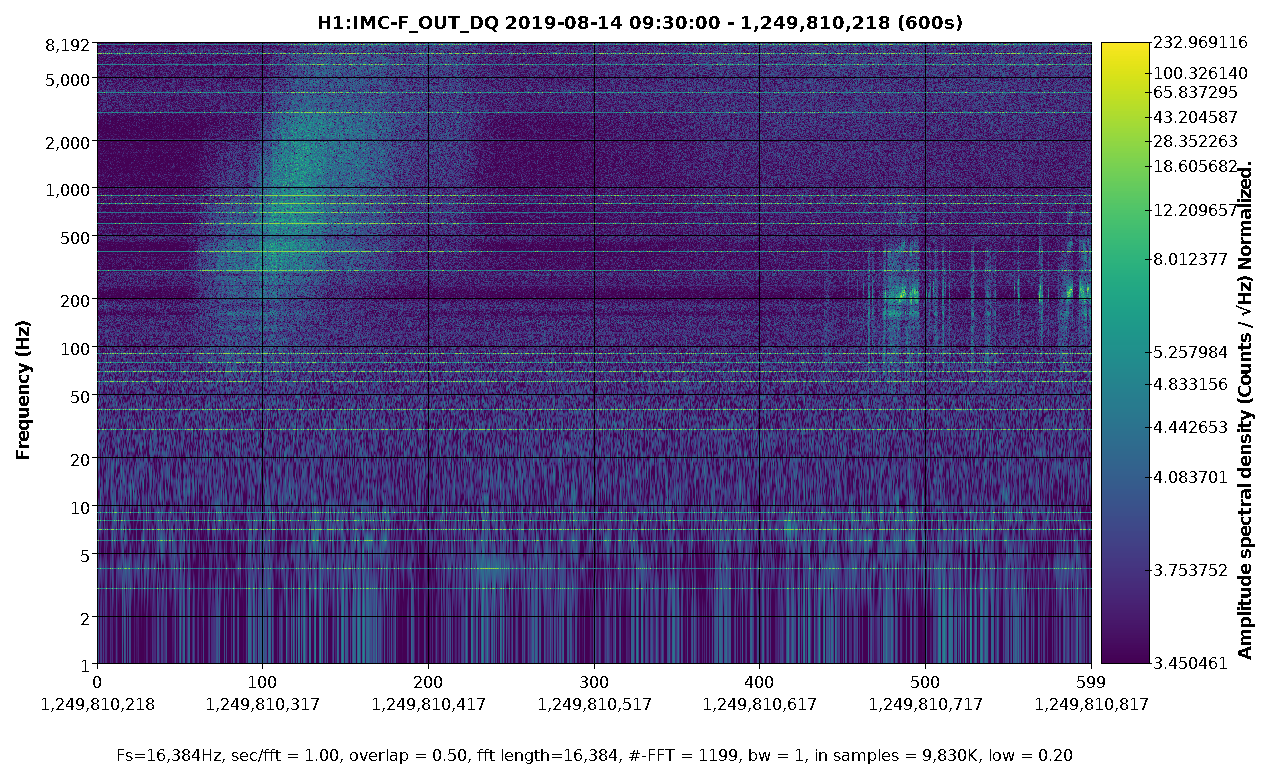
High Freq 500 to over 7kHz) Noise Observed Over 45min

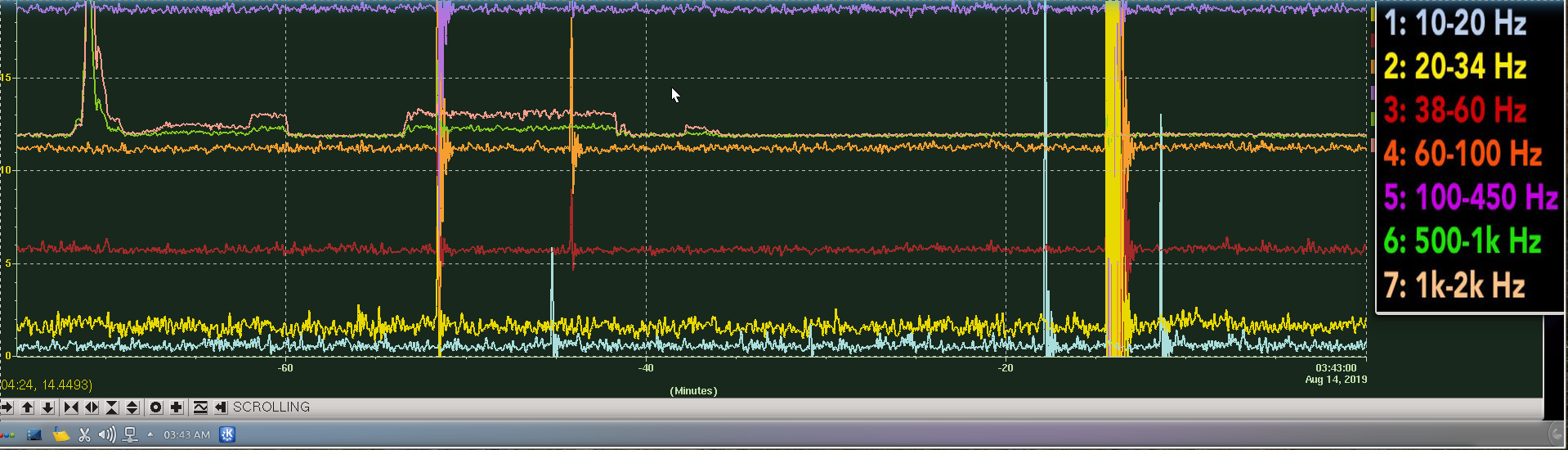
Starting at ~9:31 utc have noticed elevated levels for DARM BLRMS bands:

The noise went off and on for 45 min (so far) and looks to start/stop suddenly and then last on the order of a minute and over 10mins (attachment#1 is the DARM blrms where you can see the steps up in noise over most of the 45min.  Time periods for some of these are about:

NOTE:  H1 range did not take a hit during this time.  It's been almost 2hrs since this noisy period last occurred.

Images attached to this report
Comments related to this report
thomas.massinger@LIGO.ORG - 05:17, Wednesday 14 August 2019 (51260)DetChar

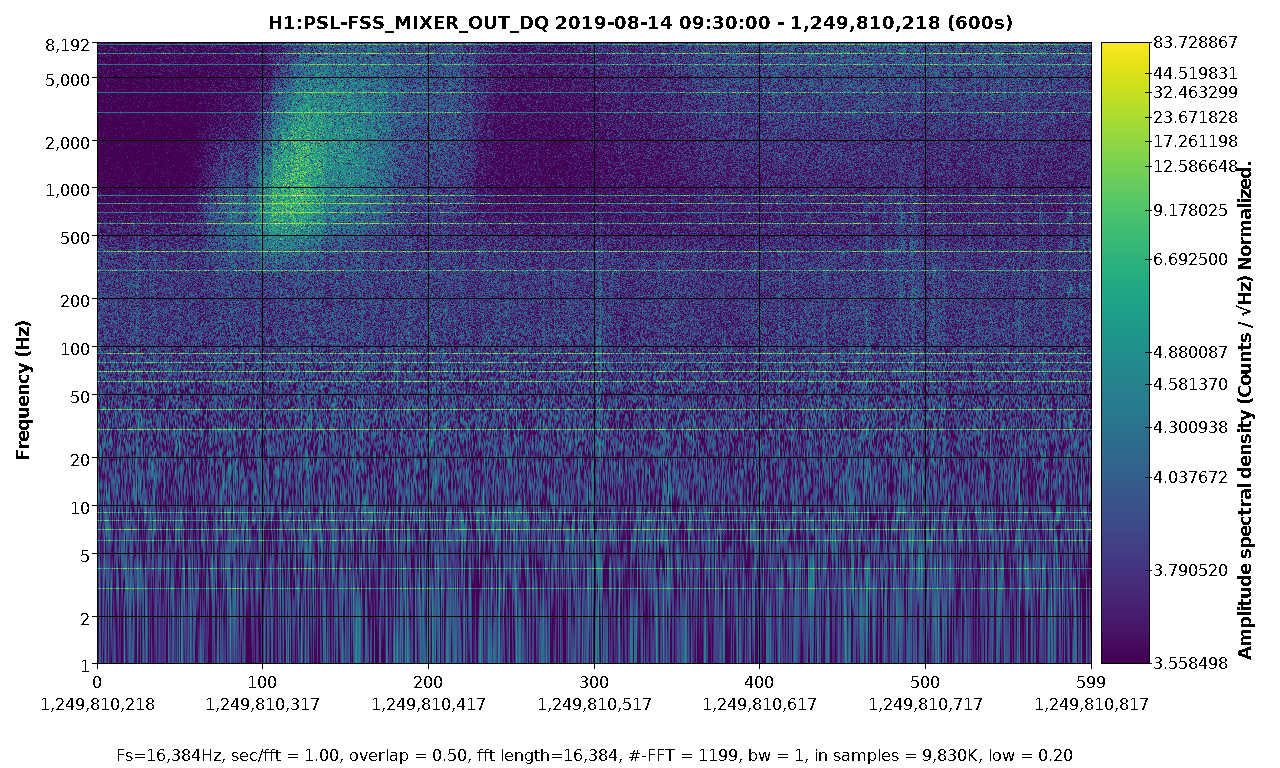
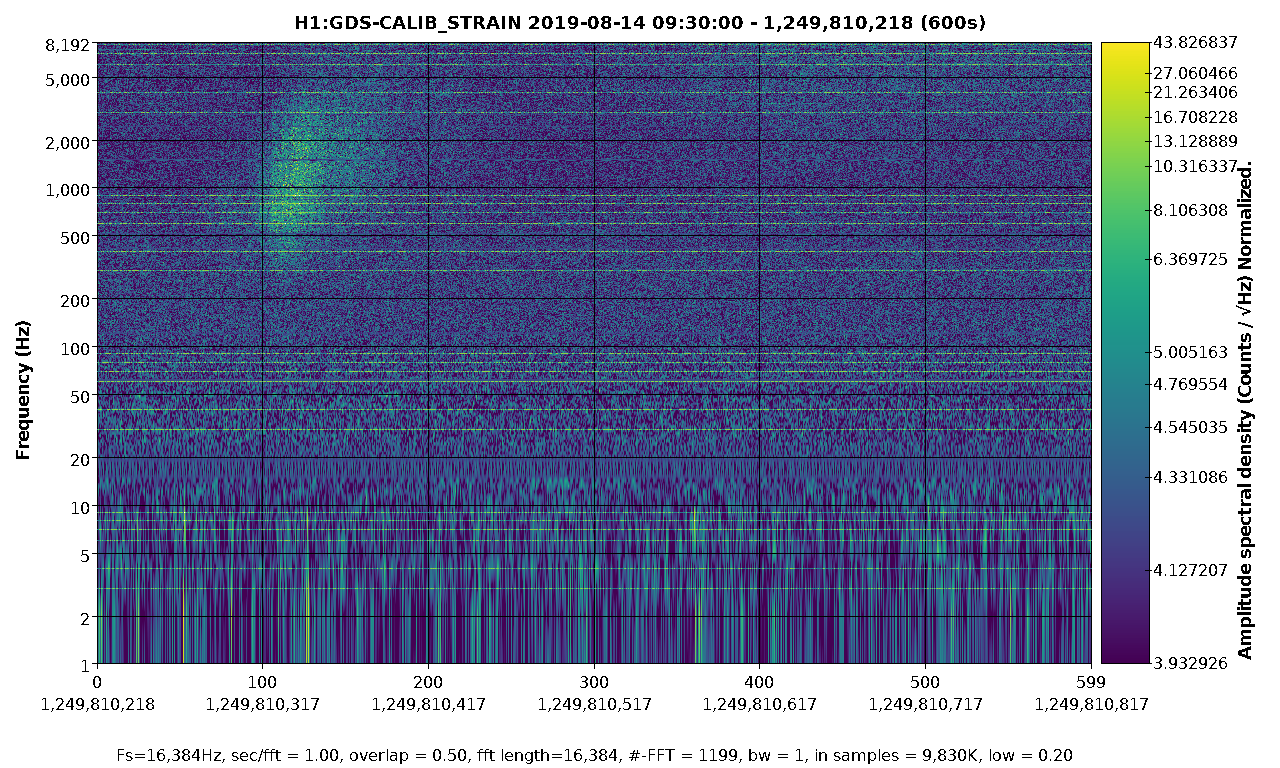
This high frequency noise is also visible in the FSS mixer and IMC-F, see attached spectrograms.

Images attached to this comment
andrew.lundgren@LIGO.ORG - 13:46, Wednesday 14 August 2019 (51272)DetChar, ISC, PSL
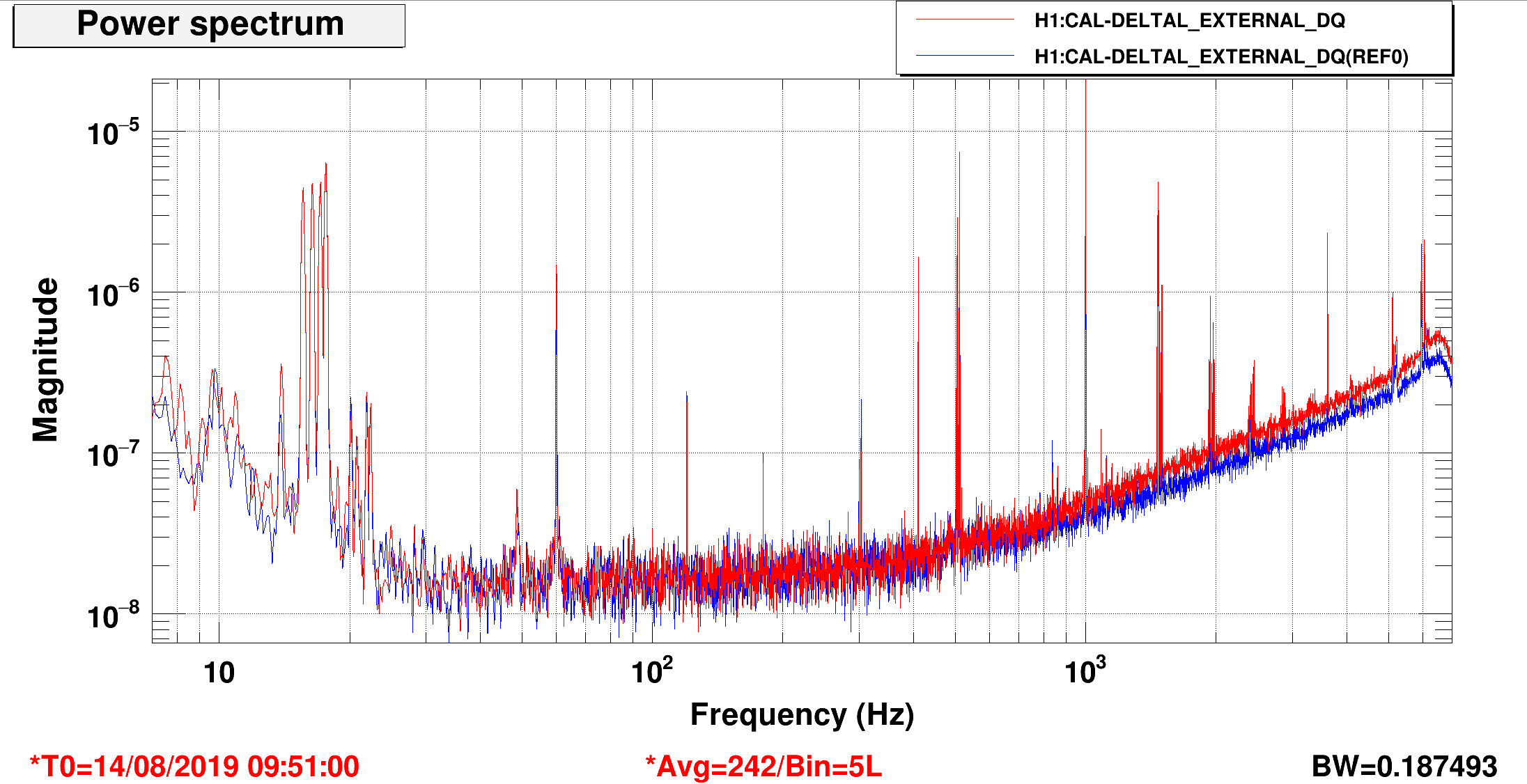
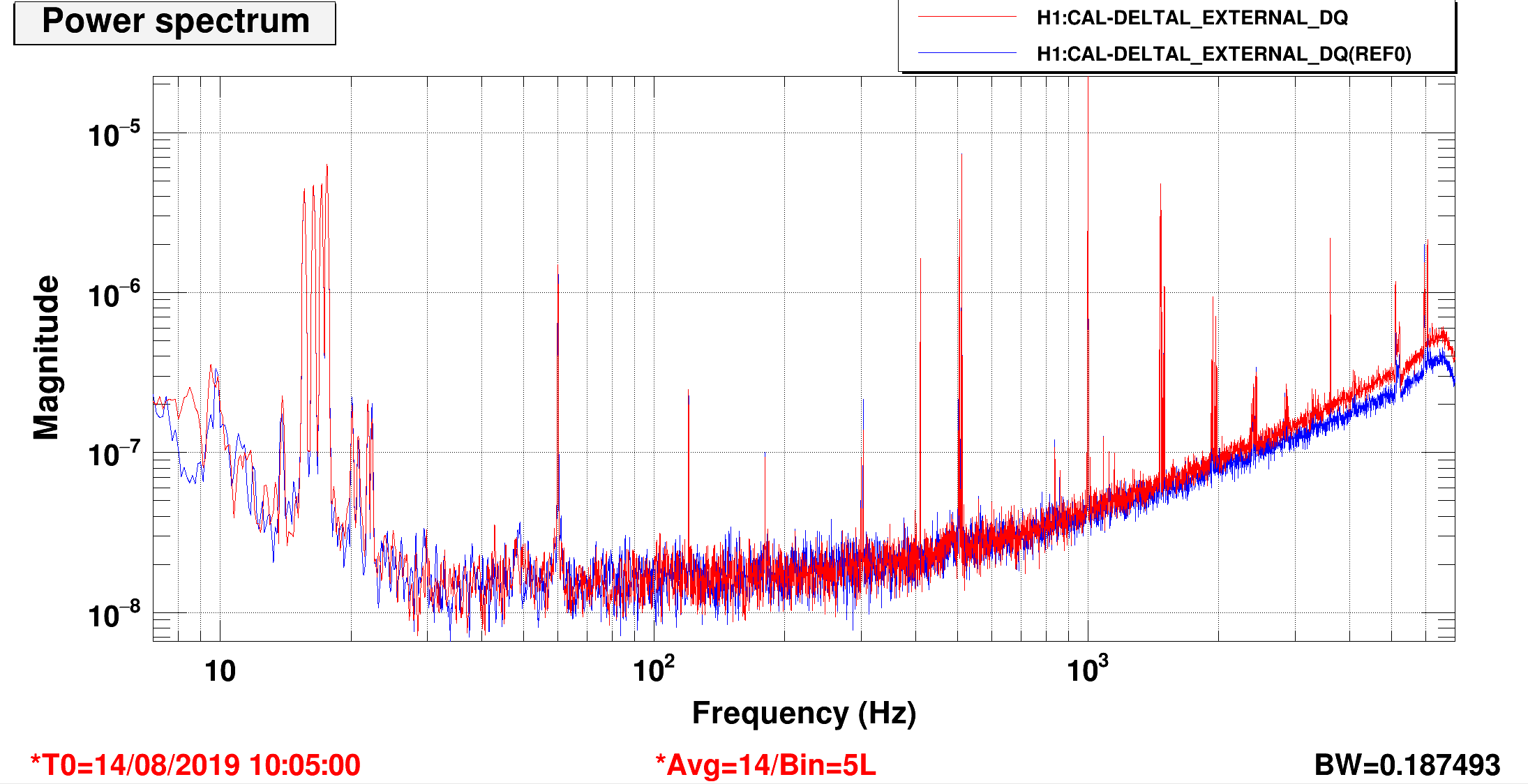
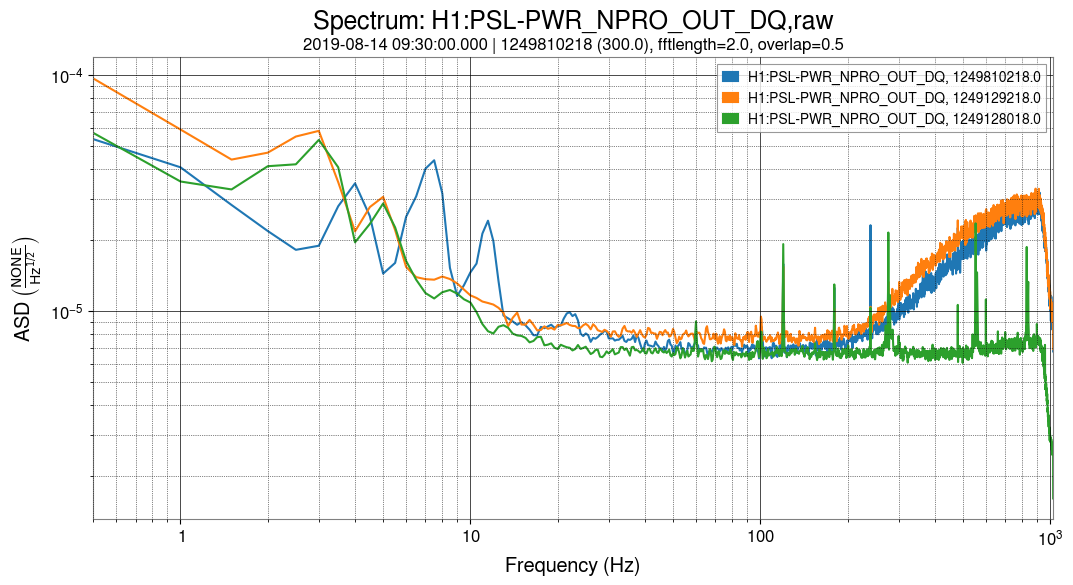
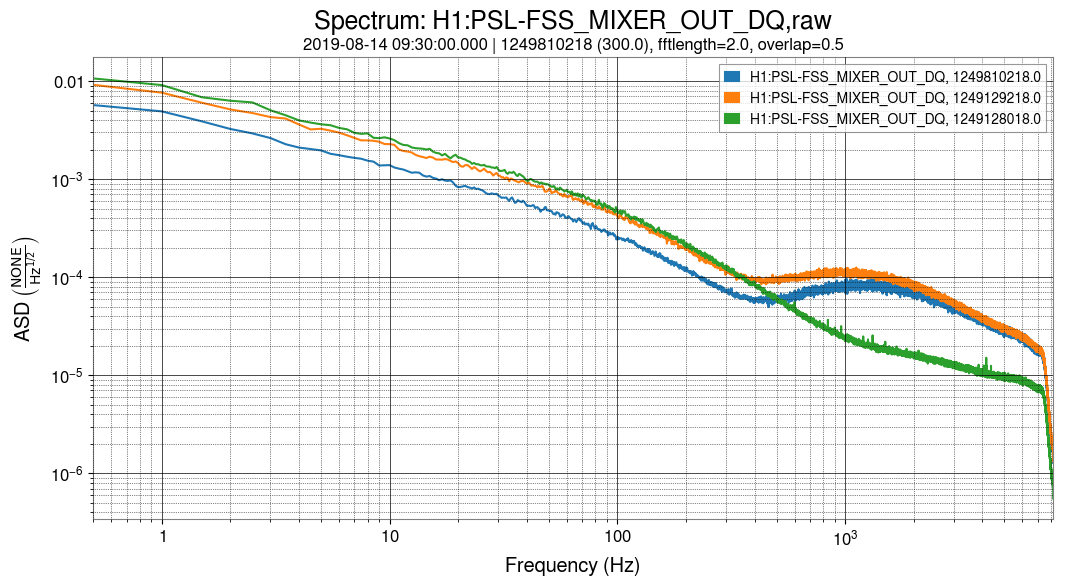
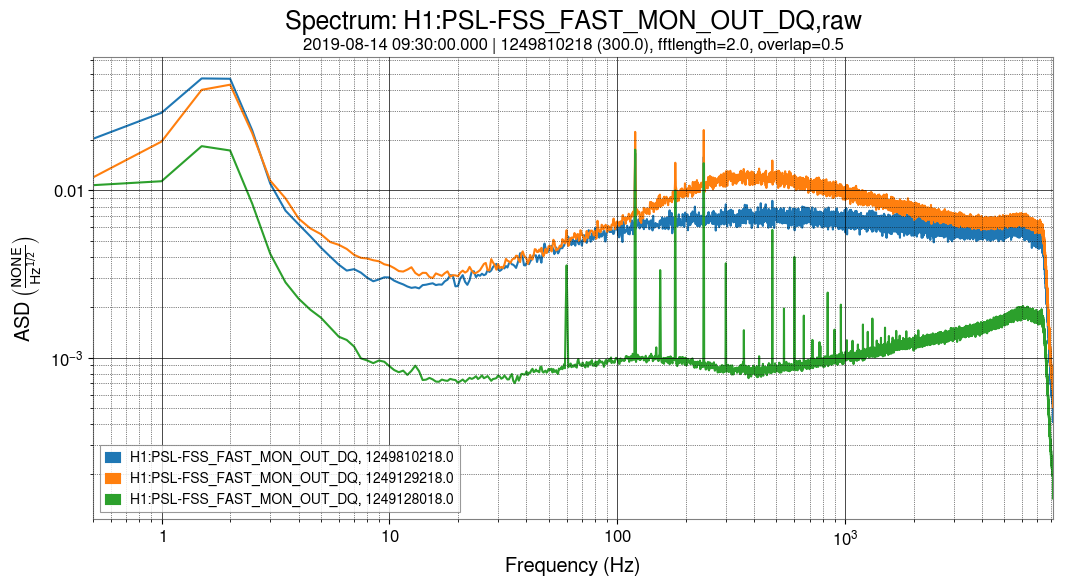
To answer Jeff's question in 51268, yes this is the same kind of noise in 51053. The spectra in the NPRO and the FSS are very similar. See the attached plots (green is a reference, blue the recent noise, and orange the previous occurrence). It's hard to tell is the NPRO is the cause or if it's just feedback from the FSS.
Images attached to this comment
jason.oberling@LIGO.ORG - 14:22, Wednesday 14 August 2019 (51274)DetChar, PSL

Andy/DetChar, could this be related to the high frequency noise seen at the end of May (first documented here; looking at DARM plots it already looks different to me...)?  If so, there is a temporary solution until I can get into the enclosure to tweak up the FSS RefCav (as done back in May).  The FSS RefCav TPD took a dive over the weekend (a storm system passed through) and I was unable to recover much of it yesterday; low RefCav TPD has been linked to high-frequency noise in the past.  If it's not related, then this is something new.

andrew.lundgren@LIGO.ORG - 02:33, Thursday 15 August 2019 (51291)DetChar, ISC, PSL
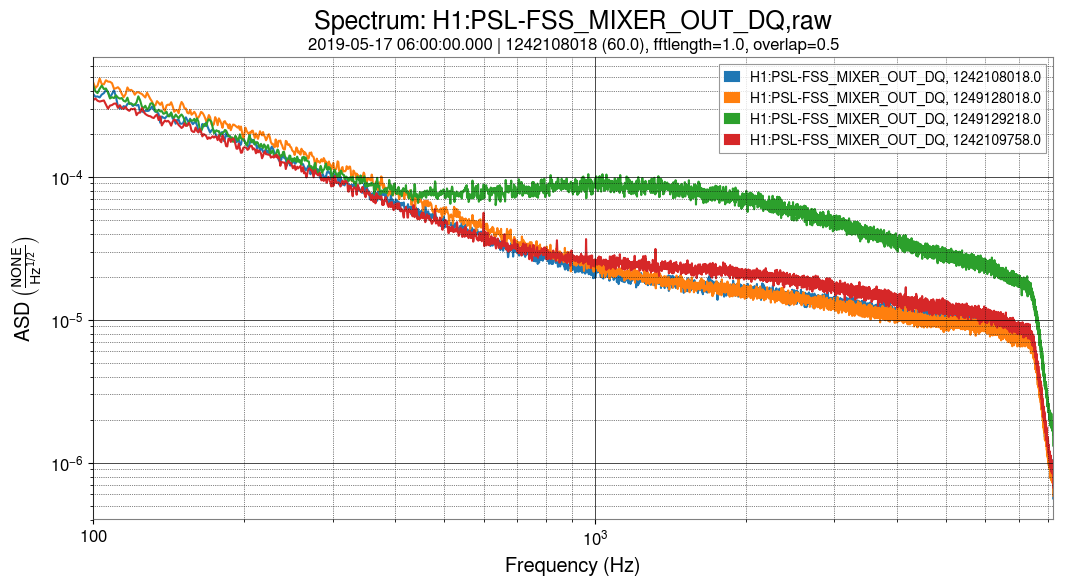
Jason - It doesn't really look the same, unless it's a much weaker version of what we're seeing now. There's no real excess on the NPRO, and the noise on the FSS is much less. The attached spectrum has the FSS mixer signal for the May noisy time in red and the August noisy time in green. The reference time for May and August are almost identical.

The first instances of the new noise were on Aug 5 and 6, before the RefCav TPD started to drop. So there's not a direct connection. Still, it could be worth changing the FSS gain next time this happens, if the run manager agrees.

I think the best diagnostics of this noise are a 3 to 10 times broadband increase in FSS fast, or a bubble above a few hundred Hz in FSS mixer. Keita has suggested running the following DTT template when the noise is recognized:

/ligo/home/keita.kawabe/Templates/FSS_highfreq.xml
Images attached to this comment
H1 SQZ
sheila.dwyer@LIGO.ORG - posted 17:08, Tuesday 13 August 2019 - last comment - 11:05, Wednesday 14 August 2019(51221)
estimate of RF squeezing angle flucuations

Summary: I've an estimate of the squeezing angle fluctations caused by phase noise at the OMC DCPDs from the interferometer control sidebands(~6mrad rms), which is far too small (~6mrad) to explain our apparently high level of phase noise infered from squeezing and anti-squeezing measurements (on the order of 100mrad).  There are several assumptions that go into this, but for reasonable values of the sideband imbalance, sideband power at the AS port or contrast defect won't result in 100mrad phase noise.  However, if the power at the AS port is mostly in a higher order mode for the sidebands, and that higher order mode has a larger transmission through the OMC than what I have used, we could potentially generate much higher levels of RF phase noise.  At LHO we have seen evidence of a 9th order 9MHz mode being transmitted through the OMC, so it may be worth using the information from a OMC scan with Koji's model of OMC transmission for higher order modes to check how much sideband higher order mode we could have at the AS port.

Details:

Power percentages at AS port: 19.4% carrier, 74.3% 45 MHz, 6.3% 9 MHz alog 48595  The 9MHz power for L1 could be much smaller, we don't understand the 9MHz power levels in H1.

OMC transmission: Finesse 390 FSR 264.8MHz (T1000276).  Power transmission of 00 mode for 9 MHz 3.53e-4; power transmission for 45 MHz 2.08e-5

Power on DCPDs

Contrast defect:

Sideband imbalance:

The rms phase noise due to contrast defect light is given by eqn 5.60 here the phase noise due to sideband imbalance is given by 5.62, although there is a factor of 2 in 5.62 that I don't understand (think could be wrong) and am leaving out here. With the assumptions above I estimate:

coupling to phase quadrature: from 45 MHz: (mrad rms) from 9 MHz: (mrad rms)
contrast defect 3.7 4.4
sideband imbalance 0.4 1.3

The quadrature sum of these contributions is 6 mrad, which is enough to have an impact on our total budgeted phase noise, but not nearly enough to help explain the large excess of aparent phase noise based on measured squeezing and anti-squeezing.


Non-image files attached to this report
Comments related to this report
daniel.sigg@LIGO.ORG - 11:05, Wednesday 14 August 2019 (51267)

About 50% of the carrier light at the AS port is in higher order modes which doesn't transmit through the OMC. If one uses the total carrier power at the AS port (before the OMC), the amount of RF sidebands are roughly doubled.

H1 ISC (DetChar)
corey.gray@LIGO.ORG - posted 05:45, Tuesday 06 August 2019 - last comment - 12:40, Wednesday 14 August 2019(51053)
12:14 New Broadband Noise (500-3000Hz) Observed on DARM Spectra & BLRMS

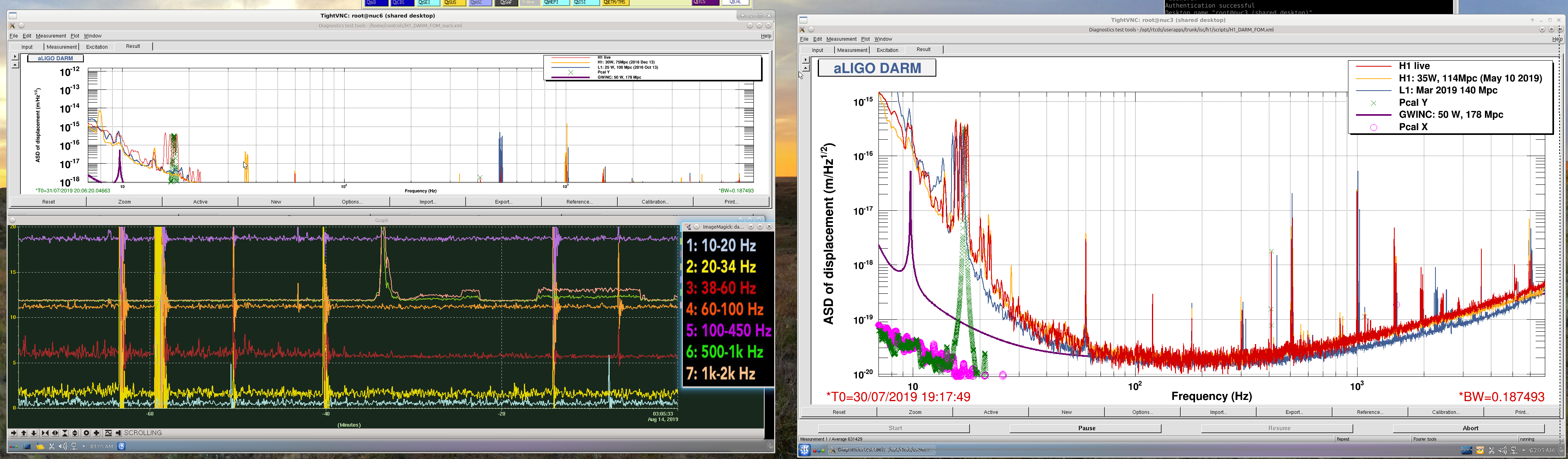
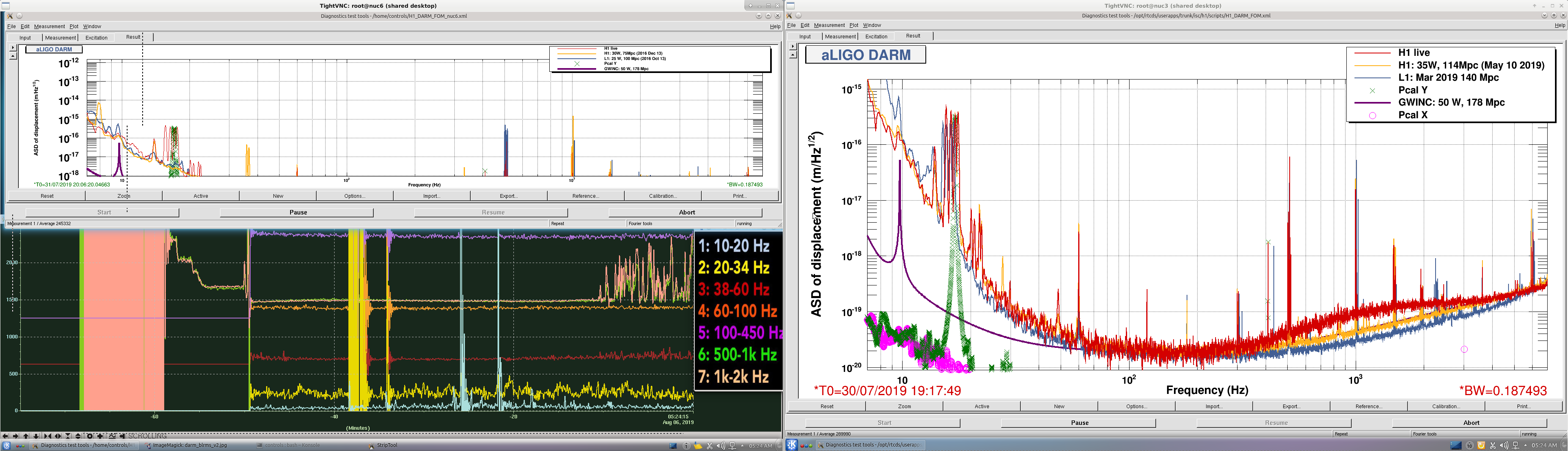
During the current lock and after being at NOMINAL LOW NOISE on the order of 45 min, all of a sudden have begun to see a broadband bump on DARM (attached is a screenshot showing instance where the bump is seen on the DARM spectrum & you can also see how often it is occurring on the DARM BLRMS striptool).  It is also seen on DMT Omega.  The range has only taken a small hit of about 5Mpc (down to 112 Mpc from 117Mpc).

Only difference I accepted for this lock was the enabled filter for ASC PRC1_P FM1 (-20dB). 

Will start taking a look at the H1 Summary Pages to see if I can glean anything from them.

Note: 

Images attached to this report
Comments related to this report
andrew.lundgren@LIGO.ORG - 06:30, Tuesday 06 August 2019 (51054)DetChar, ISC
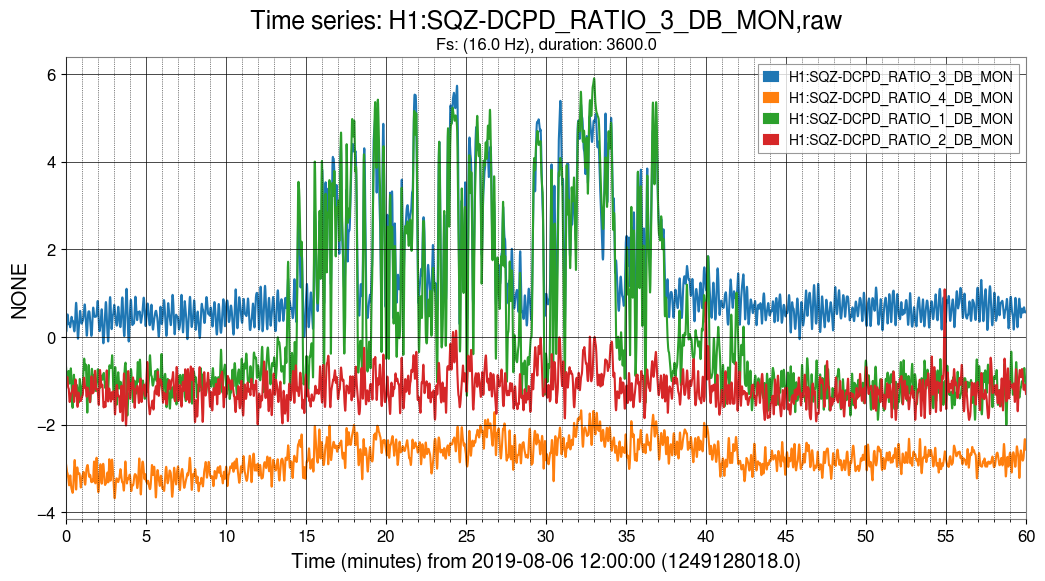
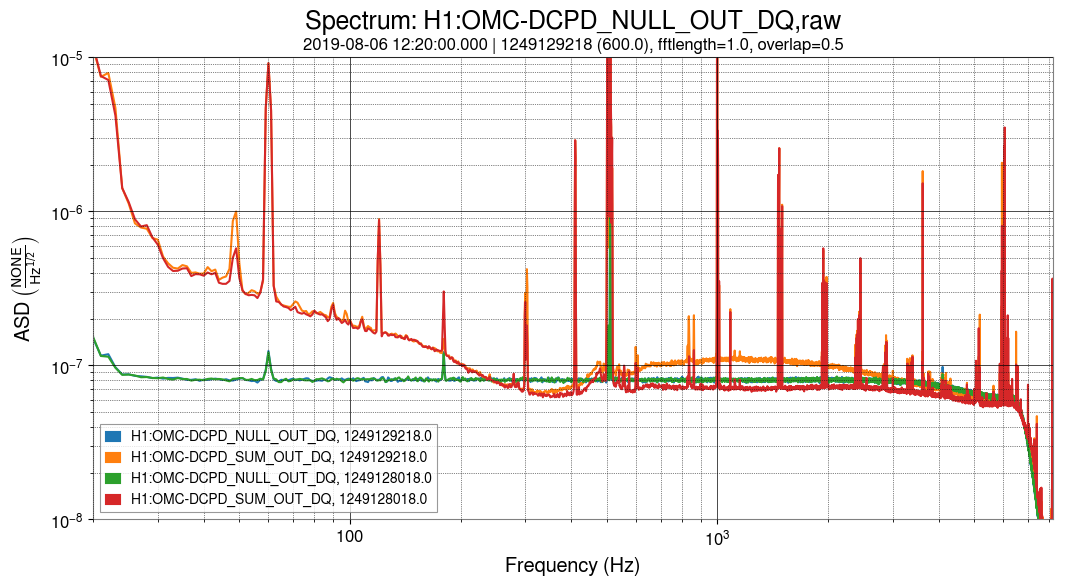
The DCPD sum-to-null ratio calculated as a squeezing diagnostic jumps up in these bands at the time of the noise, then goes back down. Attached is a timeseries, with the excess noise period from 12:14 to 12:37. Also a spectrum of DCPD sum and null. This seems like it could be an error in squeezing angle.

There was also a half-hour period yesterday at 1:30 UTC where the same kind of noise happened. Jake Slutsky suggests that this could be tested by shuttering the squeezer. If the noise comes back, you could try going out of observing and closing the shutter for a few minutes (if this wouldn't break anything).
Images attached to this comment
corey.gray@LIGO.ORG - 06:53, Tuesday 06 August 2019 (51055)

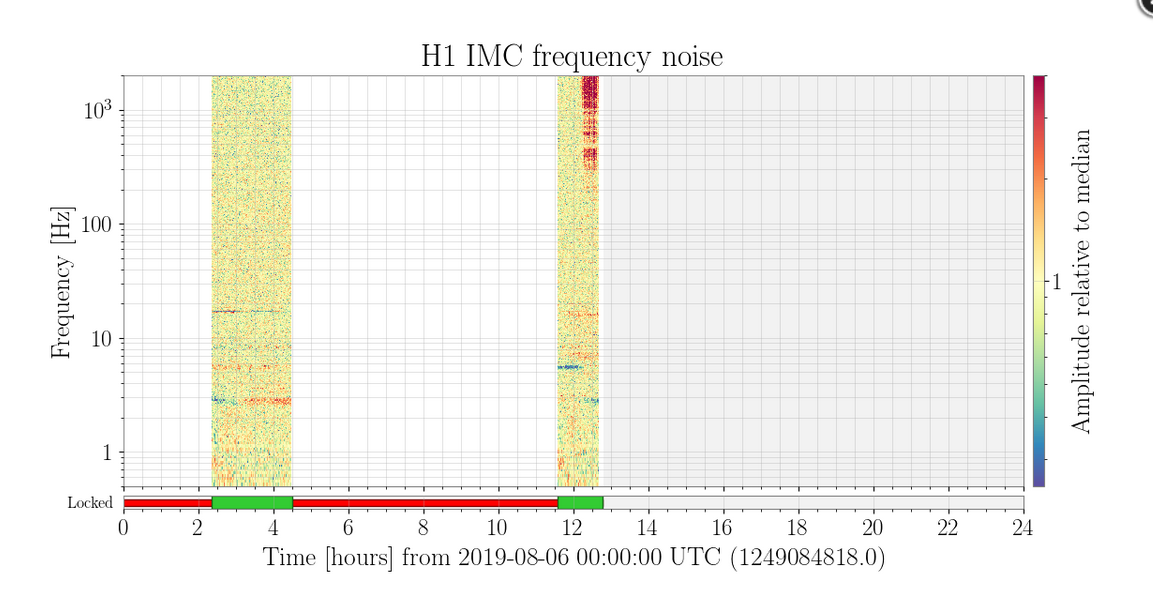
Thank you for the quick response, Andy!  (I tried looking at the Summary Pages, but many didn't have recent data posted (I did see this noise for IMC Freq Noise...see attachment #1).)

Attachment #2 is a plot showing how this period of noise has stopped *knock on wood*.

What To Do When It Returns

I've actually not had experience with closing a Squeezer shutter (guardian generally handles all things Squeezer for us).  But after snooping around, I see that there is a "SQZT6 CLF" Shutter on our Shutter Summary medm window (see attachment#3 for a screenshot showing this shutter).  I wonder if this is the shutter one would use to close a Squeezer Shutter when investigating this noise.

Images attached to this comment
andrew.lundgren@LIGO.ORG - 08:02, Tuesday 06 August 2019 (51058)DetChar, ISC, PSL
After checking many more things, I find that there's a lot of noise in the FSS. Attached is a spectrogram of FSS fast, and spectra of that and the FSS mixer channel. There's a much smaller increase in ISS noise.

This seems more likely to be the cause that either the IMC or the squeezer, since it's upstream of both of them. So I would suggest checking the health of the FSS loops (and maybe nearby things like PMC) before trying anything else. That's assuming this noise returns.
Images attached to this comment
keita.kawabe@LIGO.ORG - 11:52, Tuesday 06 August 2019 (51068)

Seems like something was going on out of the band in FSS (look at PC MON, yellow) though we cannot say if it was from FSS servo itself or laser.

Noise eater (H1:PSL-MIS_NPRO_RRO_OUTPUT) was within its nominal range of -5852+-50, ISS was OK, these two are exonerated.

Tidal was not railing anywhere.

Next time this happens, please run the dtt template here: /ligo/home/keita.kawabe/Templates/FSS_highfreq.xml

This looks at IOP channels, we can only see things up to ~30kHz so the chances of seeing something is not that high but it's better than nothing.

Images attached to this comment
jeffrey.kissel@LIGO.ORG - 12:40, Wednesday 14 August 2019 (51268)DetChar
@DetChar & TJ Massinger -- can you plot the same spectrograms of PSL-FSS_MIXER_OUT_DQ and IMC-F as you did for LHO aLOG 51260?

Leading question: are these two aLOGs (51260 and 51053) documenting a similar noise problem?
H1 ISC (ISC)
craig.cahillane@LIGO.ORG - posted 05:43, Friday 07 December 2018 - last comment - 14:07, Wednesday 14 August 2019(45753)
DARM offset calibration
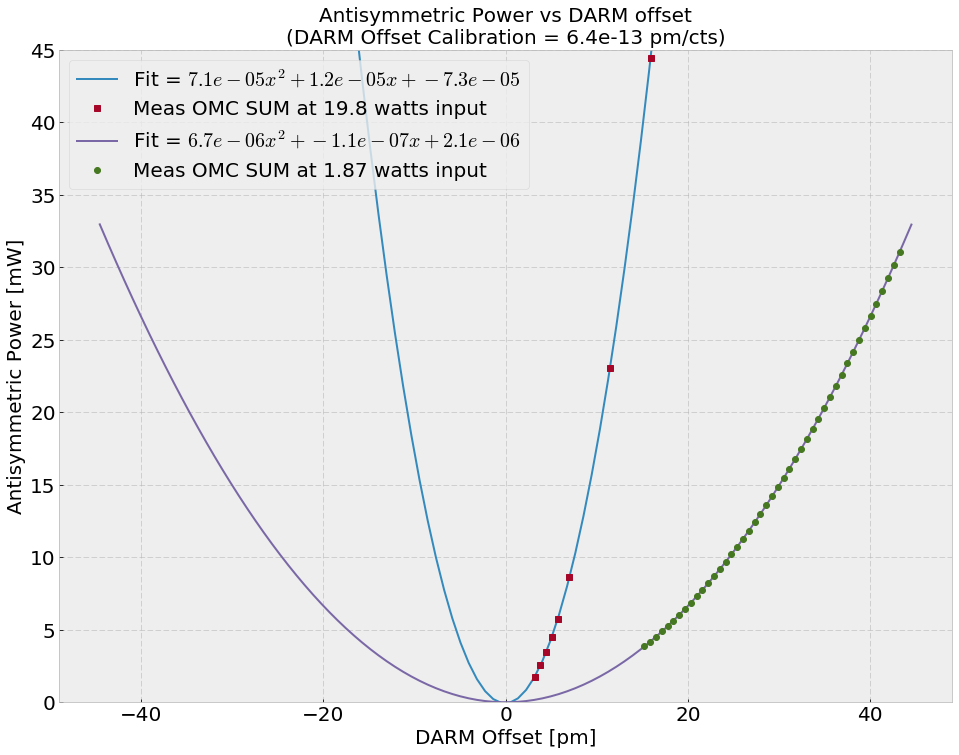
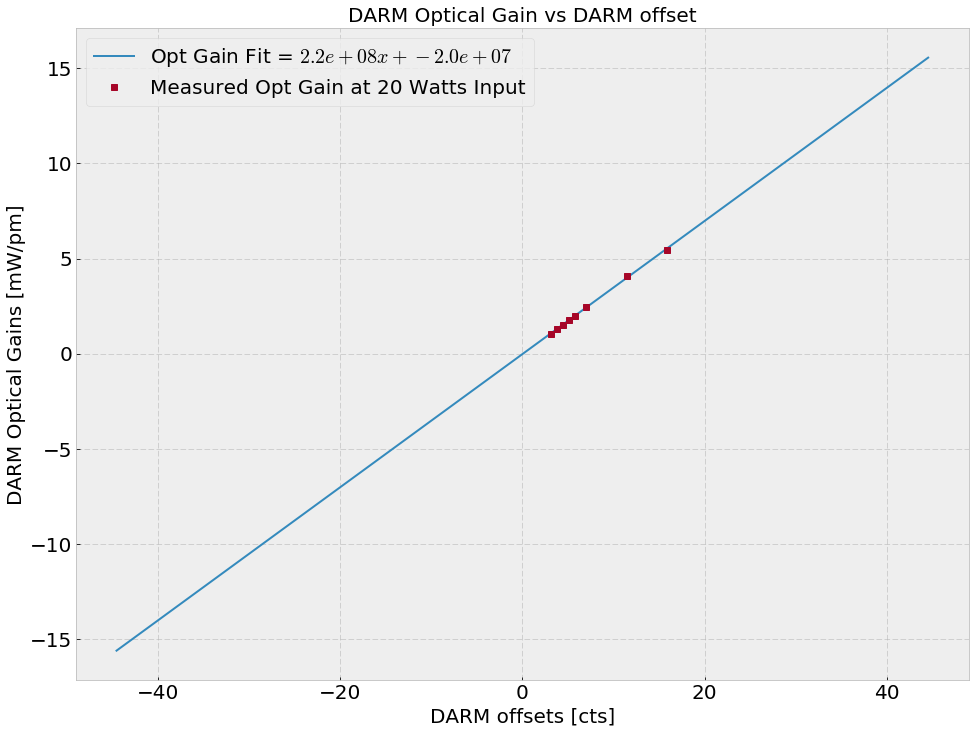
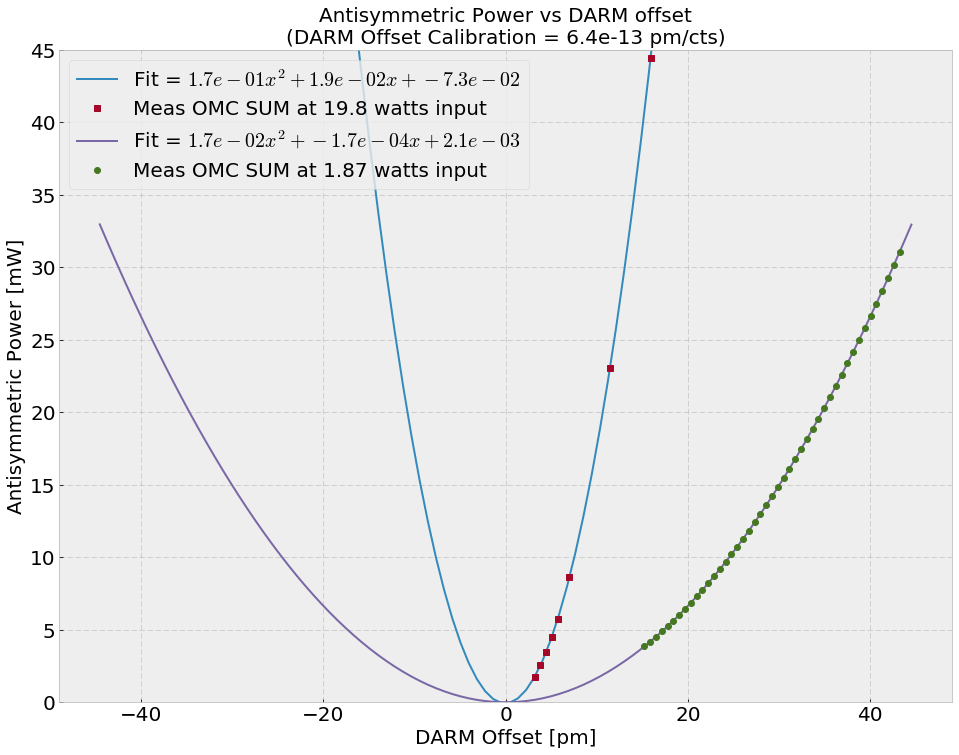
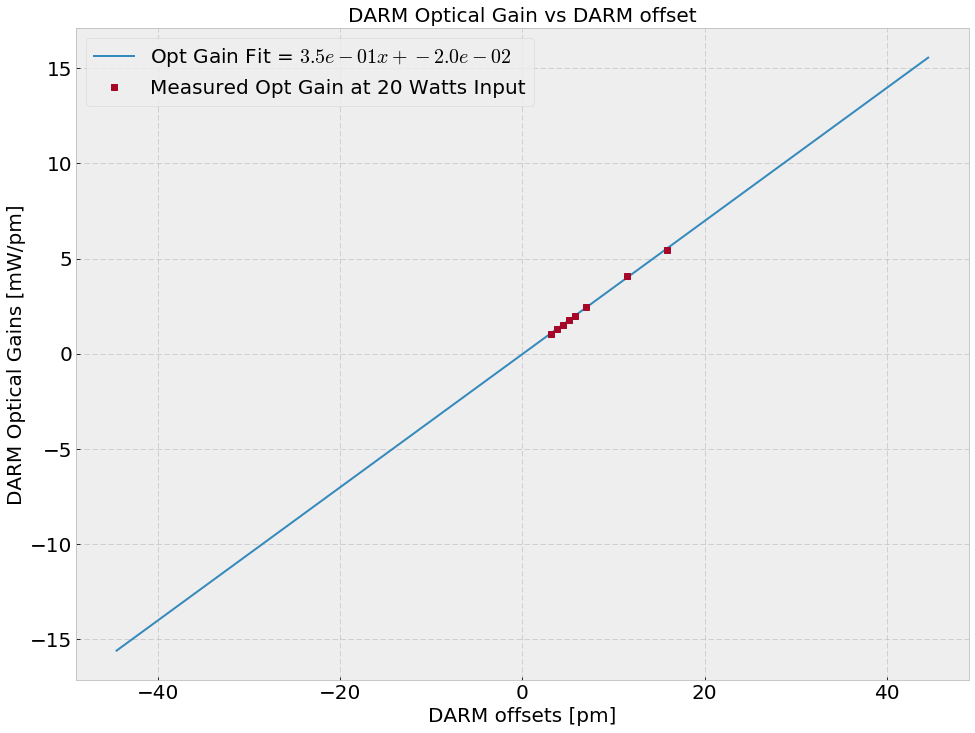
I calibrated the DARM offset at 20 watts input power.  The calibration of the H1:OMC-READOUT_X0_OFFSET channel counts into picometers is 0.636 pm/cts.  

I did so using the antisymmetric power on the OMC DCPDs [mA] compared to the DARM optical gain [W/m] as calculated by the ratio of the 331 Hz PCAL line [m] and OMC SUM [mA] response at the same frequency.  The math looks the same as here but I have accounted for the slight drop in response from the DARM pole.


Numbers used:
-------------------------------
DCPD Responsivity = 0.858 A/W
DCPD Quantum Efficiency = 0.98
DARM pole = 421 Hz
PCAL Line Frequency = 331.8 Hz


Plot 1 is the antisymmetric power vs the DARM offset.  (I also did this at 2 W.)  Things here are consistent with very little contrast defect light in full lock, we'll have to lock RF DARM and the OMC to carrier to see what our actual contrast defect is.
Plot 2 is the DARM optical gain vs the DARM offset.

I put this calibration into the H1:OMC-READOUT_X0 filter module but did not engage it.

---------------------------------------------------------------------------------------

What's interesting here is that if you work out Kiwamu's theoretical calculations from page 8, eq 11 of here, things don't line up at all (~factor of 4 difference in calculated DARM offsets).  I'll need to think more deeply on this, because we could learn something about the state of the IFO (signal recycling gain, arm reflectivity derivatives).  In the real IFO there are some power losses here and there (OFI trans, OMC trans, OMC mode match, etc) that could confuse us as well, we can use 20 W vs 2 W to eliminate those.
Images attached to this report
Comments related to this report
daniel.sigg@LIGO.ORG - 10:27, Friday 07 December 2018 (45757)

This fit doesn't work for me: e.g., use x=40 in 6.7E-6 x^2 - 1.1E-7 x + 2.1E-6 and you get 10.7E-3 rather than ~27E-3.

craig.cahillane@LIGO.ORG - 16:35, Friday 07 December 2018 (45763)
Soz, the fits in the first plot was calibrated into W/(cts^n), where n is 0, 1, or 2, and the fits in the second were in W/(m*cts^k) where k is 0 or 1.

Attached are the new plots with fixed x-axis labels and appropriately calibrated units for the fits (so if you put in x = 10 pm, you'll get mW of antisymmetric power or mW/pm of DARM optical gain)
Images attached to this comment
craig.cahillane@LIGO.ORG - 14:07, Wednesday 14 August 2019 (51273)
From the 20 W measurements of OMC Sum vs Opt Gain, I estimate the total contrast defect light to be 1.71 ? 0.24 mW, or ~85 ppm.

This is a different method than the DARM offset sweep done at 2 W (alog 46142).
Repeat of EH alog 30573.
Also attached is the 20 W data shown in the plot.
Code located in /craig.cahillane/Git/IFO/FULL_IFO/DARMoffset.ipynb
Non-image files attached to this comment
Displaying reports 39281-39300 of 89041.Go to page Start 1961 1962 1963 1964 1965 1966 1967 1968 1969 End