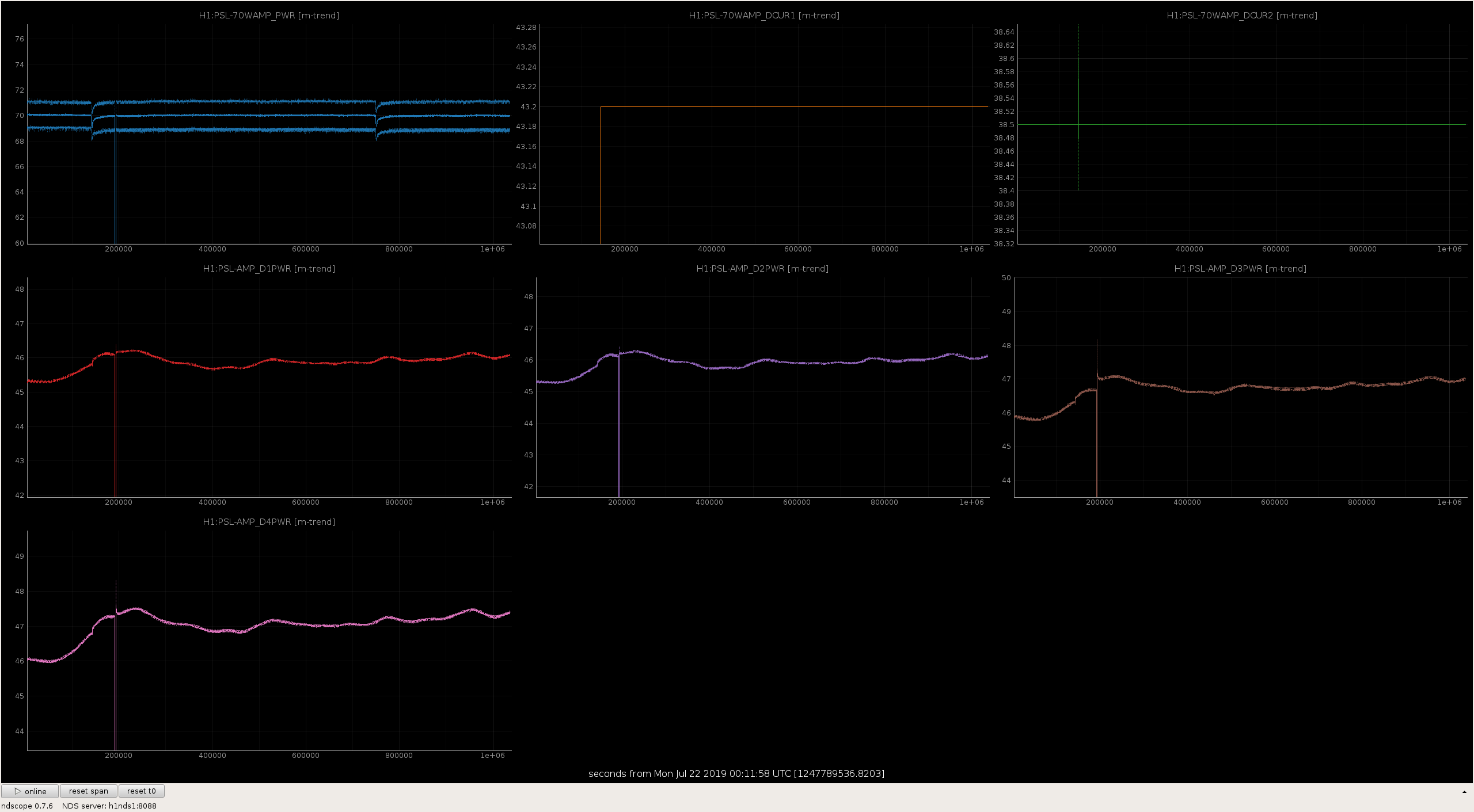
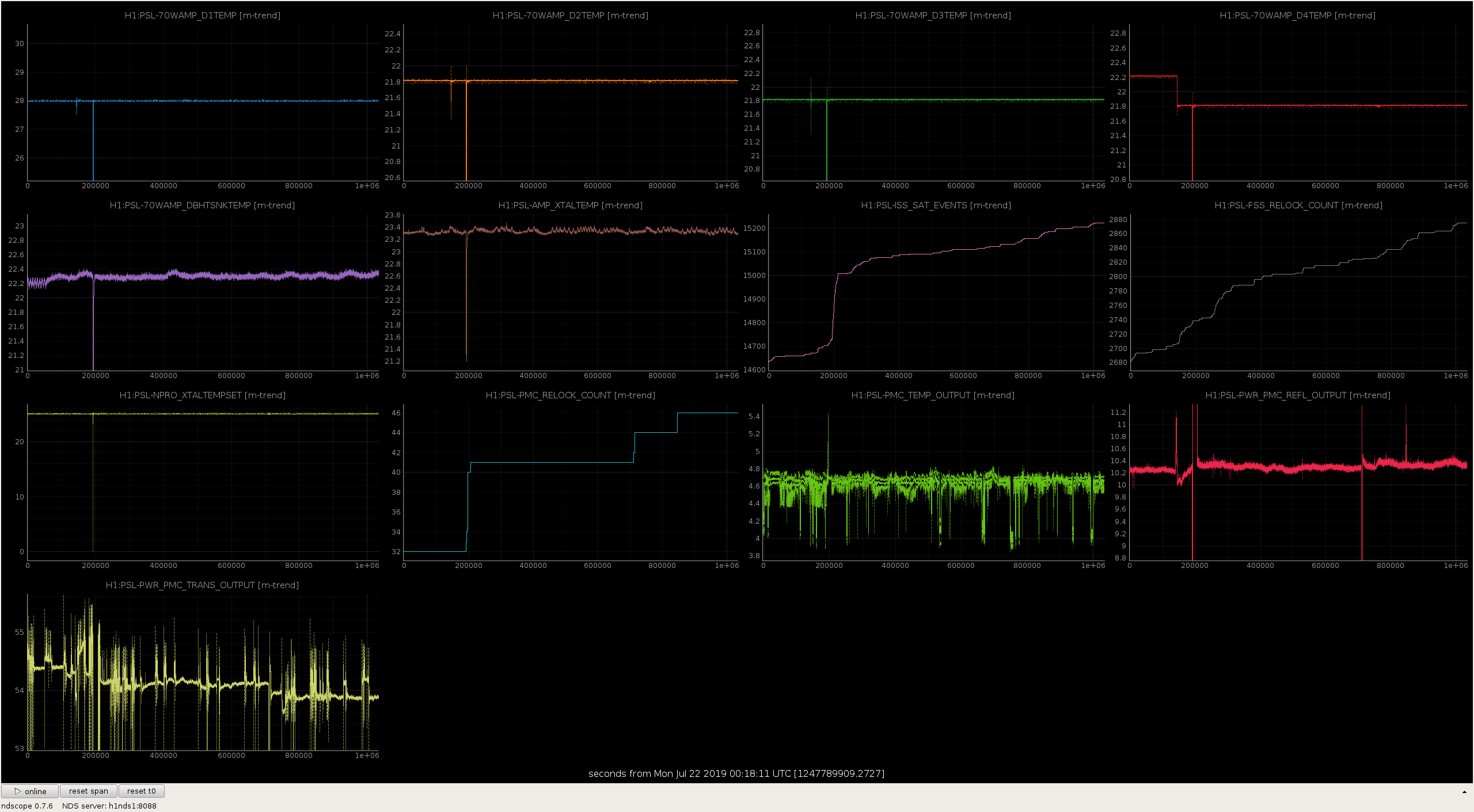
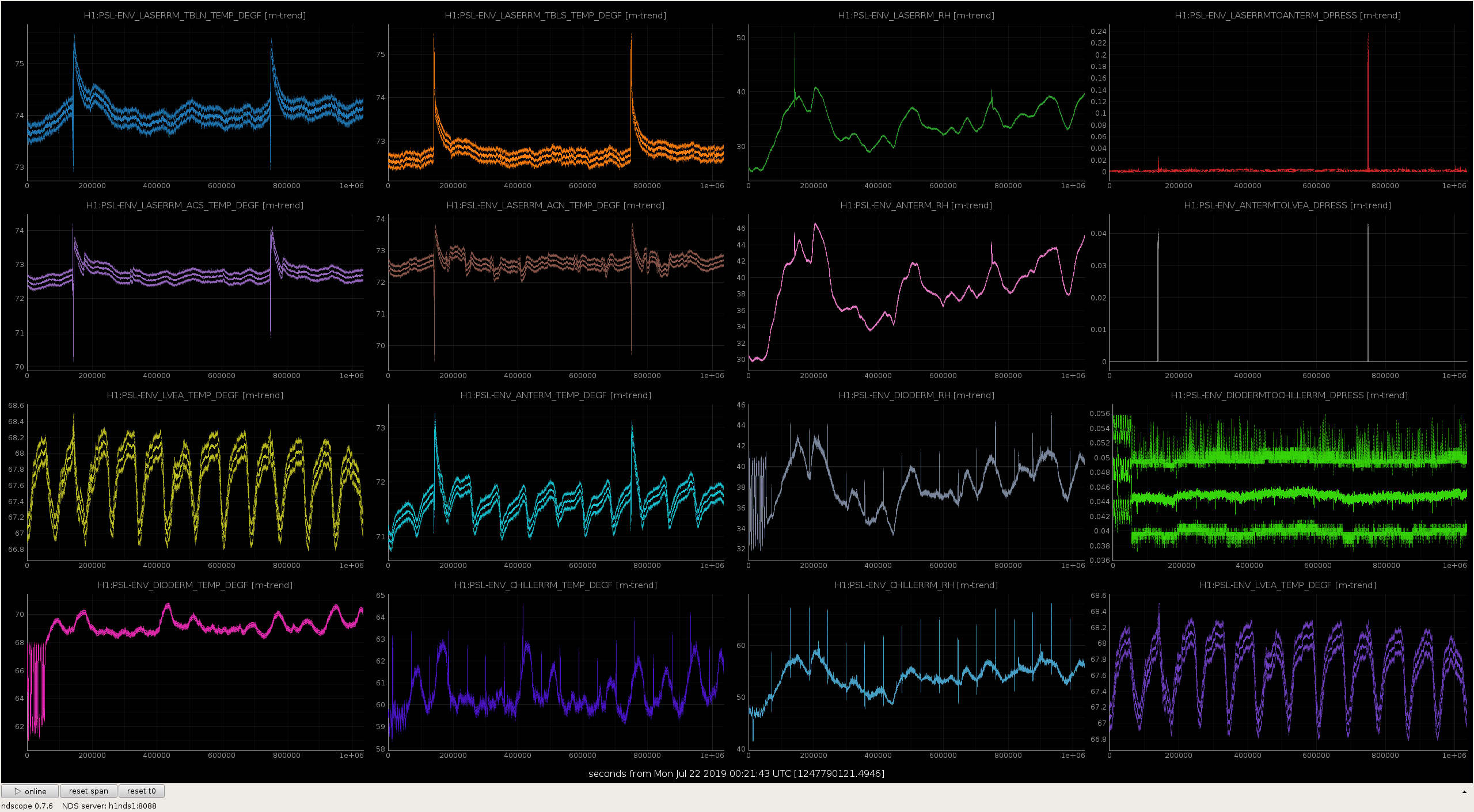
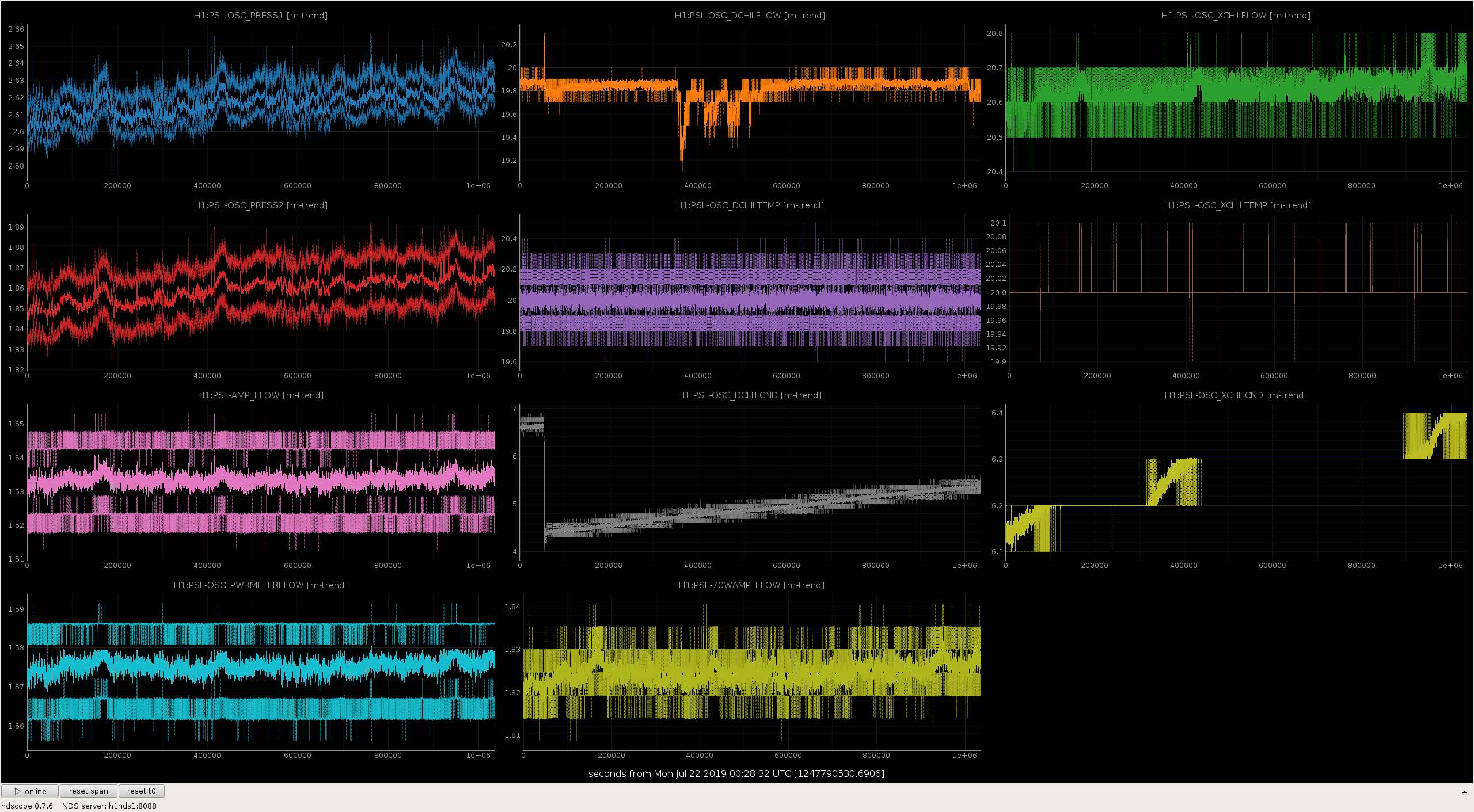
Squeezer WFS ASC switch setpoint changed from on to Off. The SQZ_MANAGER rectified the issue automagically
01:15 H1 back to Observing
Nothing strange here.
b>TITLE: 08/02 Eve Shift: 23:00-07:00 UTC (16:00-00:00 PST), all times posted in UTC
STATE of H1: Observing at 114Mpc
OUTGOING OPERATOR: TJ
CURRENT ENVIRONMENT:
Wind: 17mph Gusts, 13mph 5min avg
Primary useism: 0.04 μm/s
Secondary useism: 0.06 μm/s
QUICK SUMMARY:
Steady as she goes @ 116Mpc
TITLE: 08/02 Day Shift: 15:00-23:00 UTC (08:00-16:00 PST), all times posted in UTC
STATE of H1: Observing at 115Mpc
INCOMING OPERATOR: Ed
SHIFT SUMMARY: After the initial alignment that Travis handed me, the machine relocked autonomously and we have been observing for 7 hours.
LOG:
Since we are planning to mitigate wind with a linear fence, it seemed like I should look at our trends to make sure the fence would actually stop our wind.
Our original plan was developed using the historic wind from the Pasco airport, see page 5 of G1800148 (BTL); wind tends to be regional and those results fit our local qualitative observations. And there had been some lingering suspicion about the quality of the PEM directional data hence a reluctance to believe it. But those concerns have mostly been relieved now, see 28445 for direction sense, and most of the sensors have been replaced in the last few years.
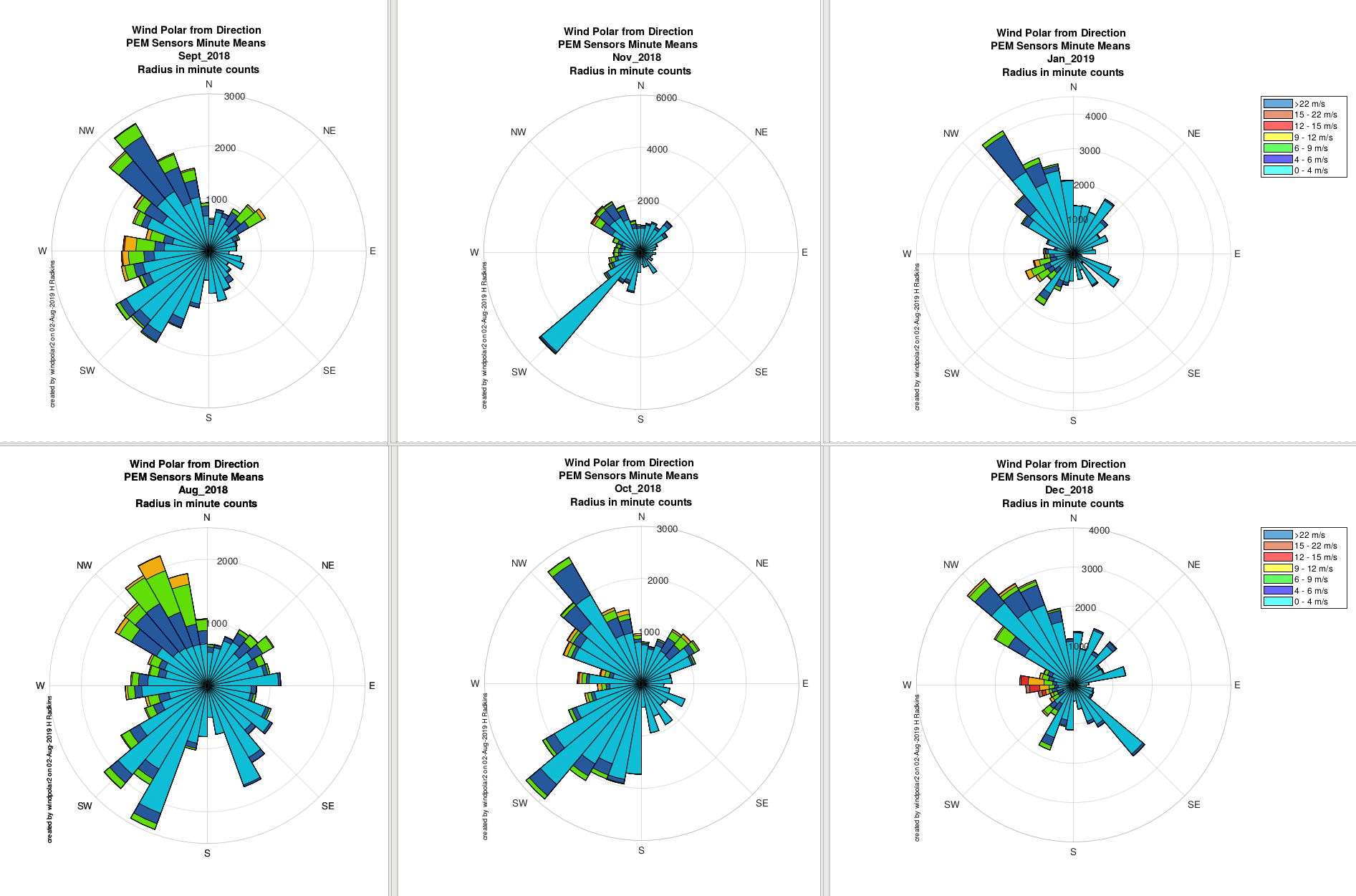
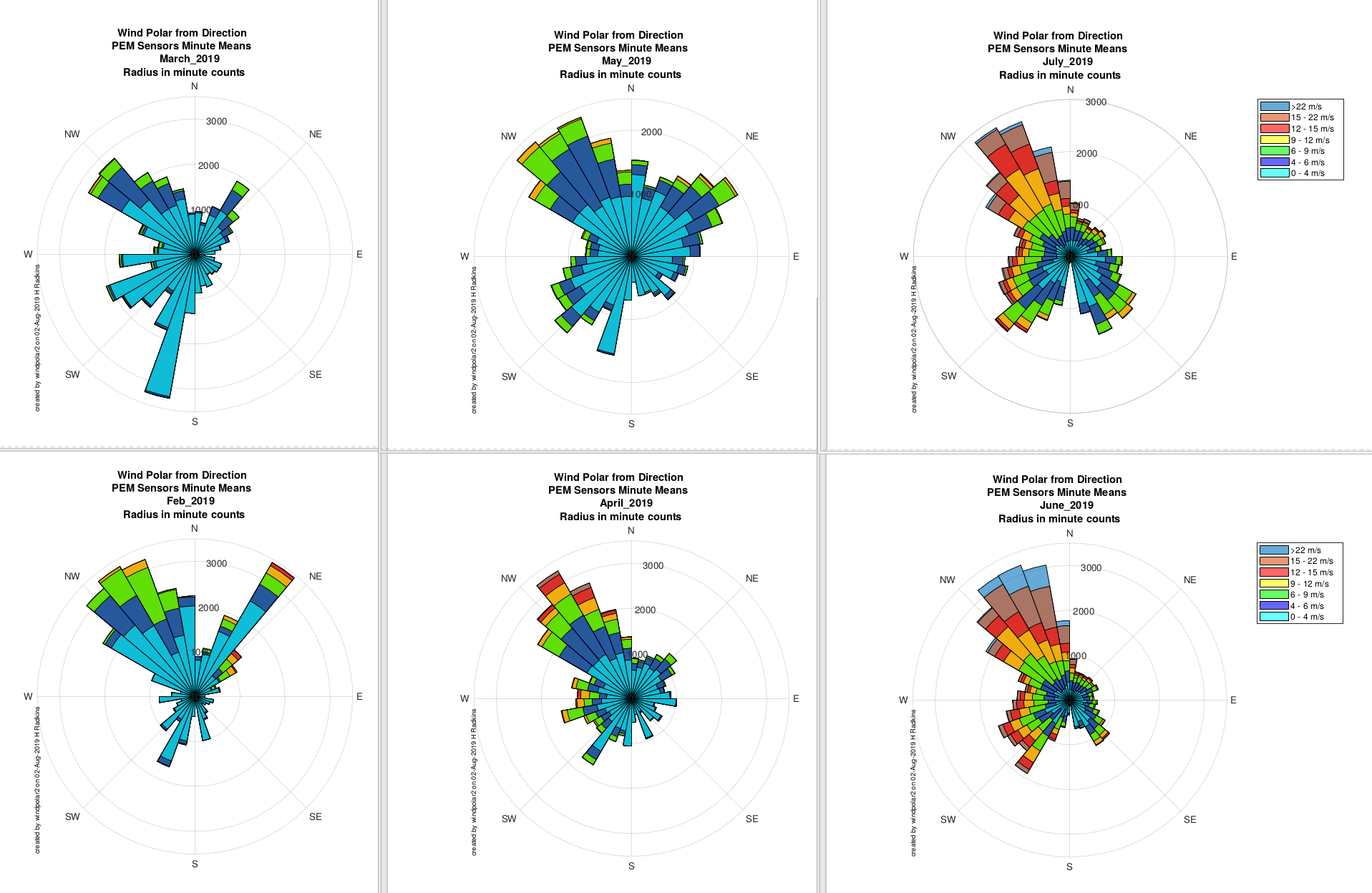
The two attachments show the past 12 monthly wind polarhistograms of minute means from the EndX PEM sensors; the colors are velocity bands (see legend) and the radial axis is minute counts. I'm not sure I like this depiction as the most useful but still working on an alternative. The directions here are Crane direction rather than true; that is 'N' is +X and 'W' is +Y. The quick conclusions I'll report are that the majority of winds come from the NW (+Y, +X) followed by the SW and then the NE. The NW direction by far produces the majority of the strongest winds with SW, W, and NE following in that order. Other than the small percentages of stronger winds coming from the NE, the current wind fence plan will address our biggest wind problems and this data is not inconsistant with the Pasco Airport data.
Caveat on the sensors, the PEM anemometers are ~6' above the roof top and the directions and velocities may be strongly influenced by the building itself. I'll repeat this with the Wind Fence sensors farther afield but we've had a few failures so the data may be more patchy.
Mostly this is a note to myself to remind me to track this down, but if DetChar has a chance to jump in and help identify where this is coming from, that would be great.
Flipping through the summary pages, it looks like we have historically had a bit of noise show up in DARM as a broad lump around 480 Hz (it's in light red on the summary pages, so it's there sometimes but not constantly). However, the last 2 days look like it's there much more consistently. I feel like this is something that we had found and resolved a few months ago, but we need to look into it again with the new IFO alignment.
Its likely to be jitter noise from the turning mirror just upstream of the power control, but this should be checked by measuring coherence with H1:PEM-CS_ACC_PSL_TABLE1_Y_DQ
Locked and observing for 3 hours. The wind is consistently around 20mph, with some gusts around 30mph. The wind is forcasted to get worse this afternoon.
TCSY chiller was at max, did not fill. TCSX chiller was 8.8, filled with 200 mL to get it to 10.1 (previous log says it was left at 9.2, so it really just lost 0.4).
Travis handed me a good initial alignment, from there the machine went to DRMI then did a PRMI, then went to CARM_ON_TR before it lost lock. The second time around it went all the way to low noise without operator intervention. There were no SDFs!!!
TITLE: 08/02 Day Shift: 15:00-23:00 UTC (08:00-16:00 PST), all times posted in UTC
STATE of H1: Earthquake
OUTGOING OPERATOR: Travis
CURRENT ENVIRONMENT:
Wind: 26mph Gusts, 22mph 5min avg
Primary useism: 0.06 μm/s
Secondary useism: 0.06 μm/s
QUICK SUMMARY: Travis just finished an initial alignment after the earthquake rang down, now starting to relock.
Forgot to mention that the wind is picking up, gusts in the high 20's/low 30's.
TITLE: 08/02 Owl Shift: 07:00-15:00 UTC (00:00-08:00 PST), all times posted in UTC
STATE of H1: Earthquake
INCOMING OPERATOR: TJ
SHIFT SUMMARY: Rough night.
LOG:
10:08-11:43 Initial alignment issues: Could not get PRX to lock. Followed Jenne's troubleshooting document and adjusted RMs to previous alignment. Inputs to ASC-DC1 and ASC-DC2 were too high after returning to previous values, so tweaked their alignment while watching DC PD SUMs. Still no luck. Skipped PRC ALIGN. Moved on to MICH. Would not lock MICH BRIGHT. Gave up on IA altogether since ALSY was the main reason I started IA in the first place. Attempting full lock.
11:52 PRMI will not lock and looks terrible. Going to try IA again.
12:08 Incoming 7.0 EQ from Christmas Island.
12:12 Steered PRM to increase the power on H1:AQSC-POP_A_NSUM_OUTPUT. This did the trick for PRC ALIGN.
12:29-14:11 Took IFO to DOWN and SEI CONFIG to LARGE EQ for arrival of Christmas Island EQ
14:11 Back to WINDY. Trying IA again.
14:40 Starting to troubleshoot SRC ALIGN now.
15:00 Moving through SRC ALIGN now. Handing off to TJ.
A pair of DCPD saturation alarms preceded the lockloss. No apparent environmental cause.
I had a quick look at the lockloss tool and it looks like ~10 seconds before the lockloss there is a glitch that saturates the DCPDs, then the ASC runs away perhaps because the ADS lines got drowned out? Maybe we need to set something up such that if there is a glitch the master gain of the ADS gets turned to zero for a second?
TITLE: 08/02 Owl Shift: 07:00-15:00 UTC (00:00-08:00 PST), all times posted in UTC
STATE of H1: Observing at 114Mpc
OUTGOING OPERATOR: Patrick
CURRENT ENVIRONMENT:
Wind: 9mph Gusts, 7mph 5min avg
Primary useism: 0.14 μm/s
Secondary useism: 0.06 μm/s
QUICK SUMMARY: Currently riding through the remnants of an EQ. Otherwise, no issues to report.
TITLE: 08/02 Eve Shift: 23:00-07:00 UTC (16:00-00:00 PST), all times posted in UTC STATE of H1: Observing at 112Mpc INCOMING OPERATOR: Travis SHIFT SUMMARY: Remained locked and in observing entire shift. No issues. LOG: 23:22 UTC Observing 23:48 UTC Timesh to optics lab 01:27 UTC Timesh out of optics lab
Have remained locked and in observing. No issues.
J. Kissel Since we've finalized our initial alignment settings to match the new global alignment with test mass spot positions set for 37W (LHO aLOG 50967), Jenne did a touch-up of the OMC ASC's QPD offsets in order to recover some optical gain (see LHO aLOG 50973). Since we have a new "more physical" shape to sensing function / optical plant in this new global alignment location (as reported in this morning's measurement LHO aLOG 50966), I wanted to get a further set of full sweeps to confirm these changes (since they'll also now be permanent). Attached are the results, and comparison between the this morning's pre-tuned OMC ASC, and post-tuned OMC ASC. As with all other tests of IFO parameter change (a previous spot-position move test, and an temporary 1.5x increase of DHARD PIT or YAW gains), we see that the low frequency feature only changes in the DARM Open Loop Gain transfer function, and the PCAL2DARMIN1 transfer function does not report it. Raw data templates /ligo/svncommon/CalSVN/aligocalibration/trunk/Runs/O3/H1/Measurements/FullIFOSensingTFs/ 2019-08-01_H1_OMCASCOffsetTuneUp_DARM_OLGTF_LF_SS_5to1100Hz_15min.xml 2019-08-01_H1_OMCASCOffsetTuneUp_PCALY2DARMTF_LF_SS_5t1100Hz_10min.xml 2019-08-01_H1_OMCASCOffsetTuneUp_PCALY2DARMTF_BB.xml Processing script /ligo/svncommon/CalSVN/aligocalibration/trunk/Runs/O3/H1/Scripts/FullIFOSensingTFs/ process_sensingmeas_20190801_OMCASCOffsetTuneUp.py process_sensingmeas_collection_20190801_omcasctuneup.py
Sheila, Georgia
Yesterday we re-ran the noise budget templates for the following noises:
Only the frequency noise changed dramatically since the old noise budget, it is significantly lower now - presumably due to the increase in CO2_X power.
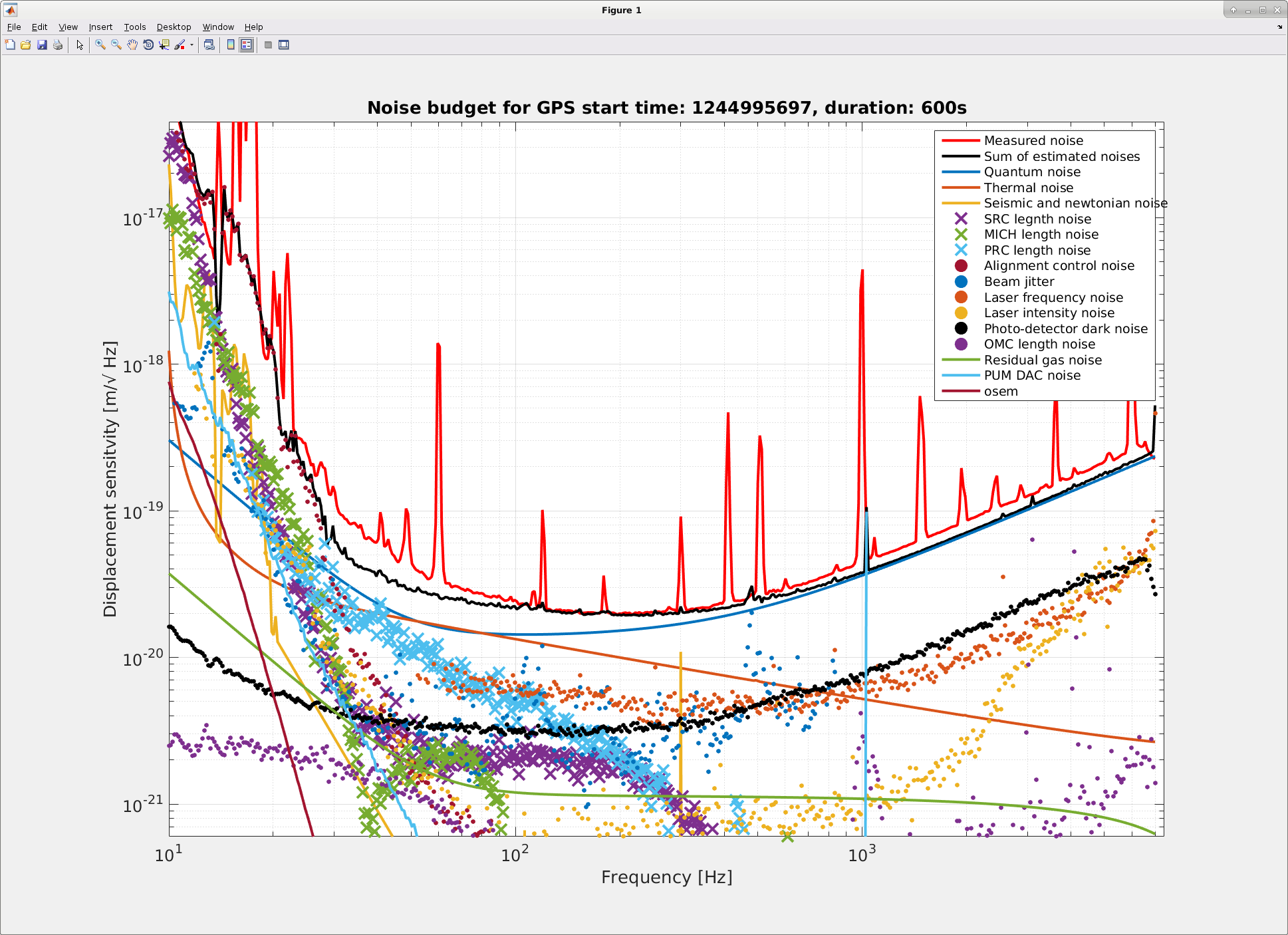
The updated noise budget, for a time when squeezing is injected, is shown in the first attachment. We are clearly underestimating our shot noise above a few hundred Hz, though between 10 and 300 Hz we estimate the noise well.
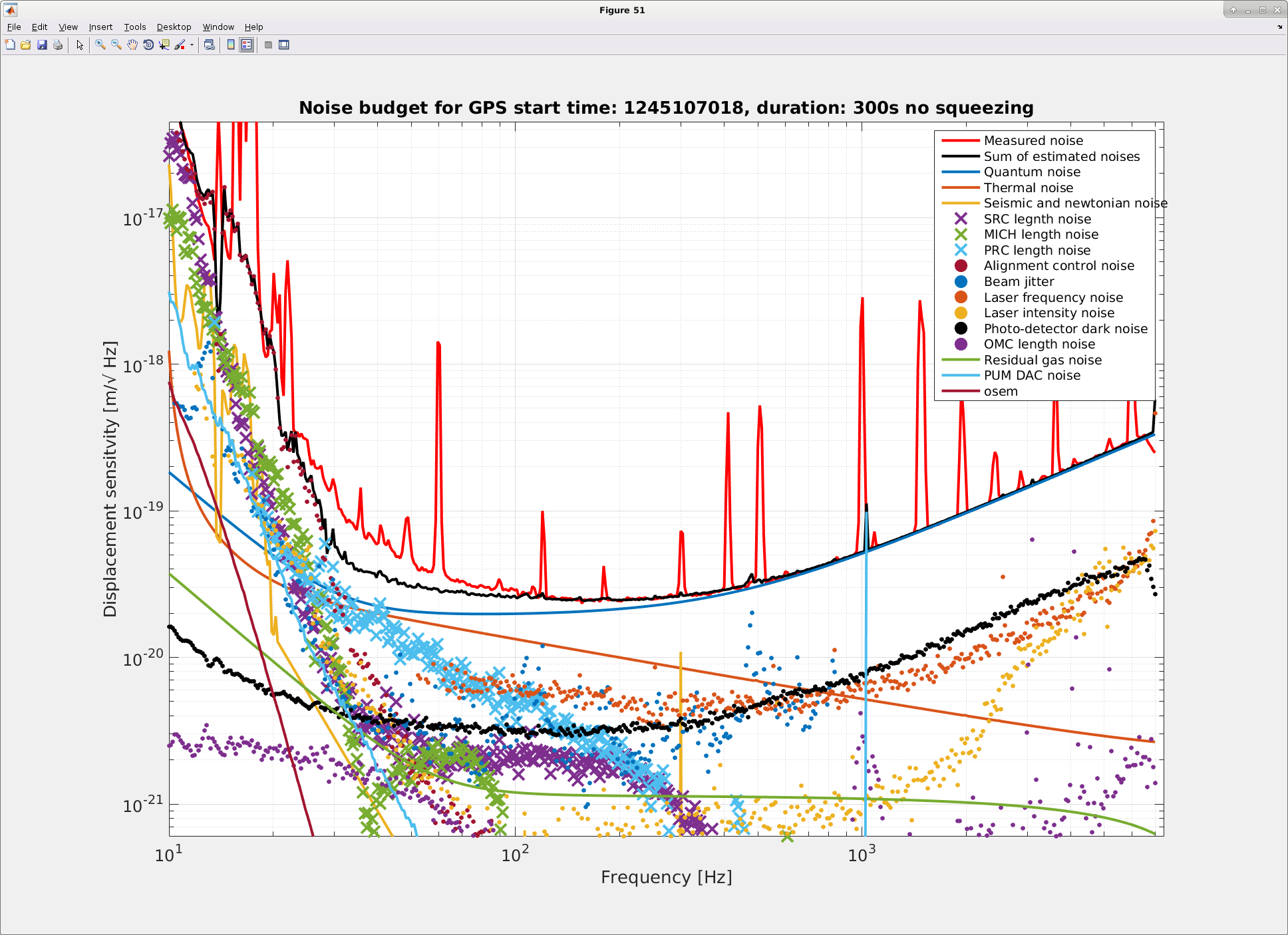
To look further into shot noise, today we let the ifo run for 10 mins without injecting squeezing. The noise budget for this time is shown in the second attachment. Without squeezing on our shot noise is correct at all frequencies.
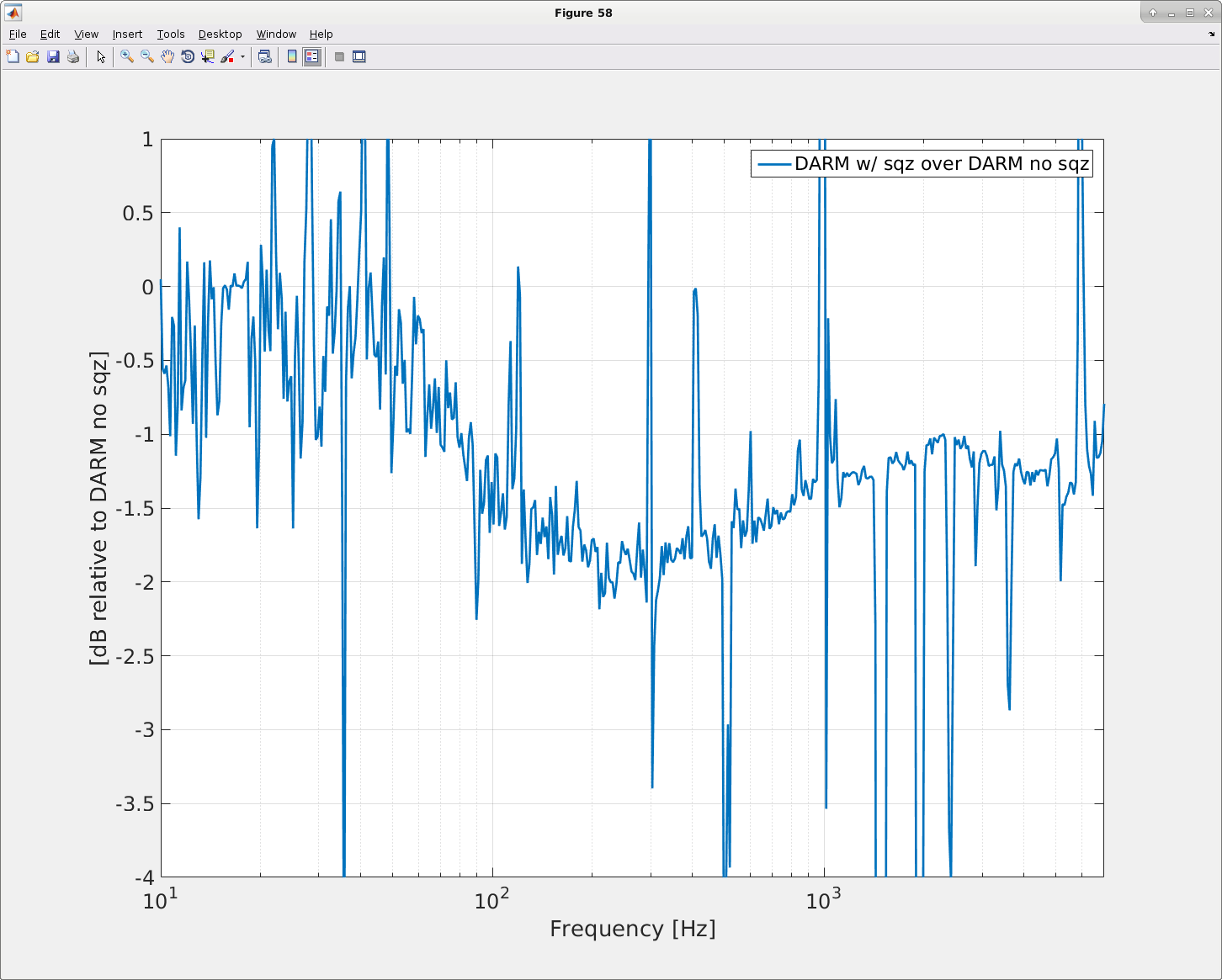
In the first noise budget we assume a constant (frequency independent) squeezing level, calculated from the DCPD BLRMS, which reported 2.9 dB of squeezing. The third attachment compares DARM with squeezing and DARM without squeezing. Squeezed-DARM sits ~2dB below normal shot noise at 200Hz, but only 1dB at 2kHz. This frequency-dependence was attributed to bad frequency noise in the past, but is still present with improved frequency noise. Perhaps we need to look at whether we have a SRCL offset?
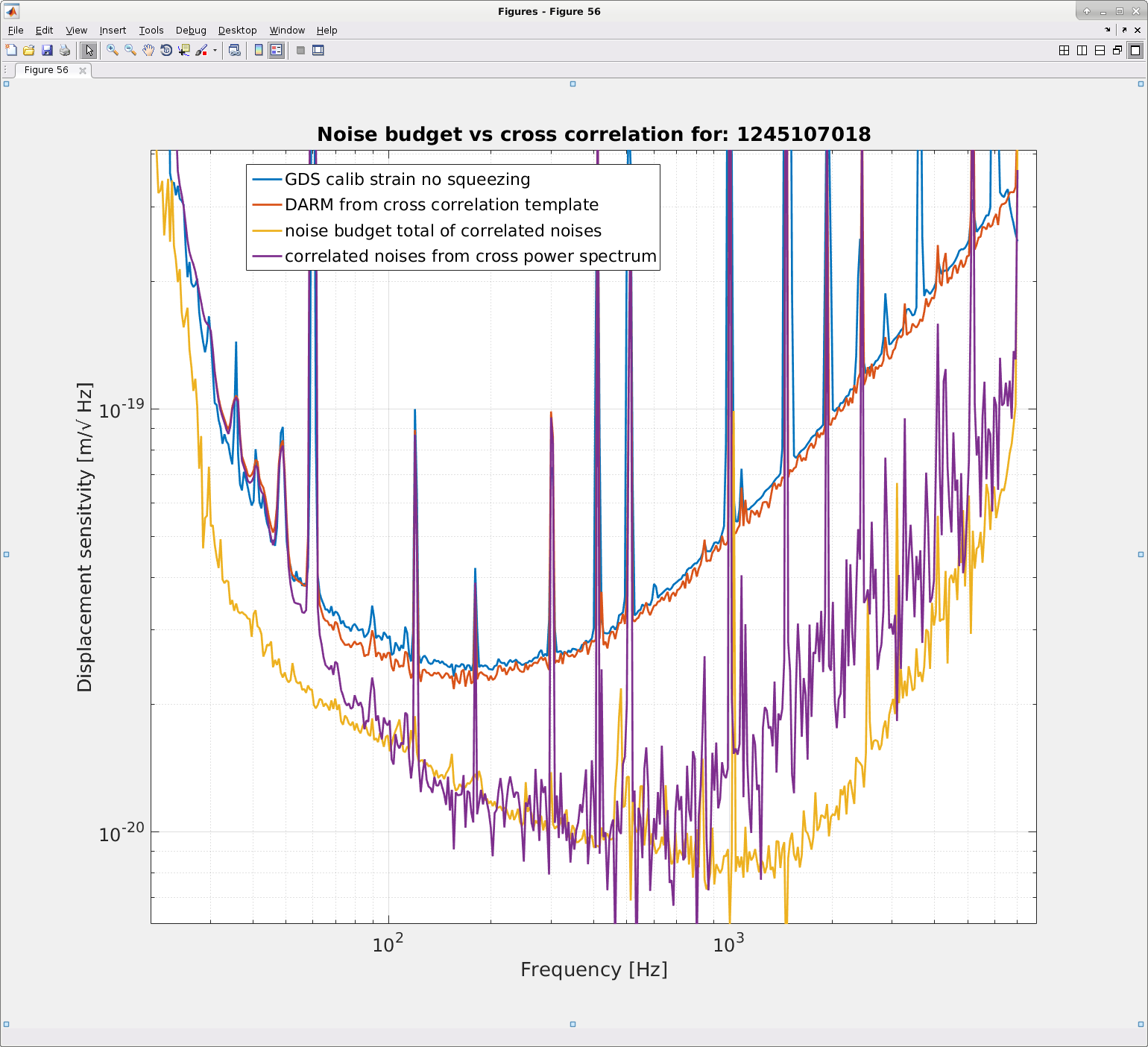
We ran the DCPD cross-correlation template during our time without squeezing, to see if this worse sensitivity at high frequency is due to classical noise that is not in the noise budget. The fourth attachment shows correlated noise based on the noise budget (removing the shot noise and dark noise from the unsqueezed noise budget) in yellow, and the correlated noise from the DCPD cross correlation template in purple. We seem to be under-estimated our cross correlated noise by a factor of ~2 at 2kHz. (The discrapancy between DARM from the noise budget and DARM from the cross-correlation template is the difference between the GDS calibration and the CAL-DELTAL_EXTERNAL calibration). This is not enough to explain our mismatched shot noise.
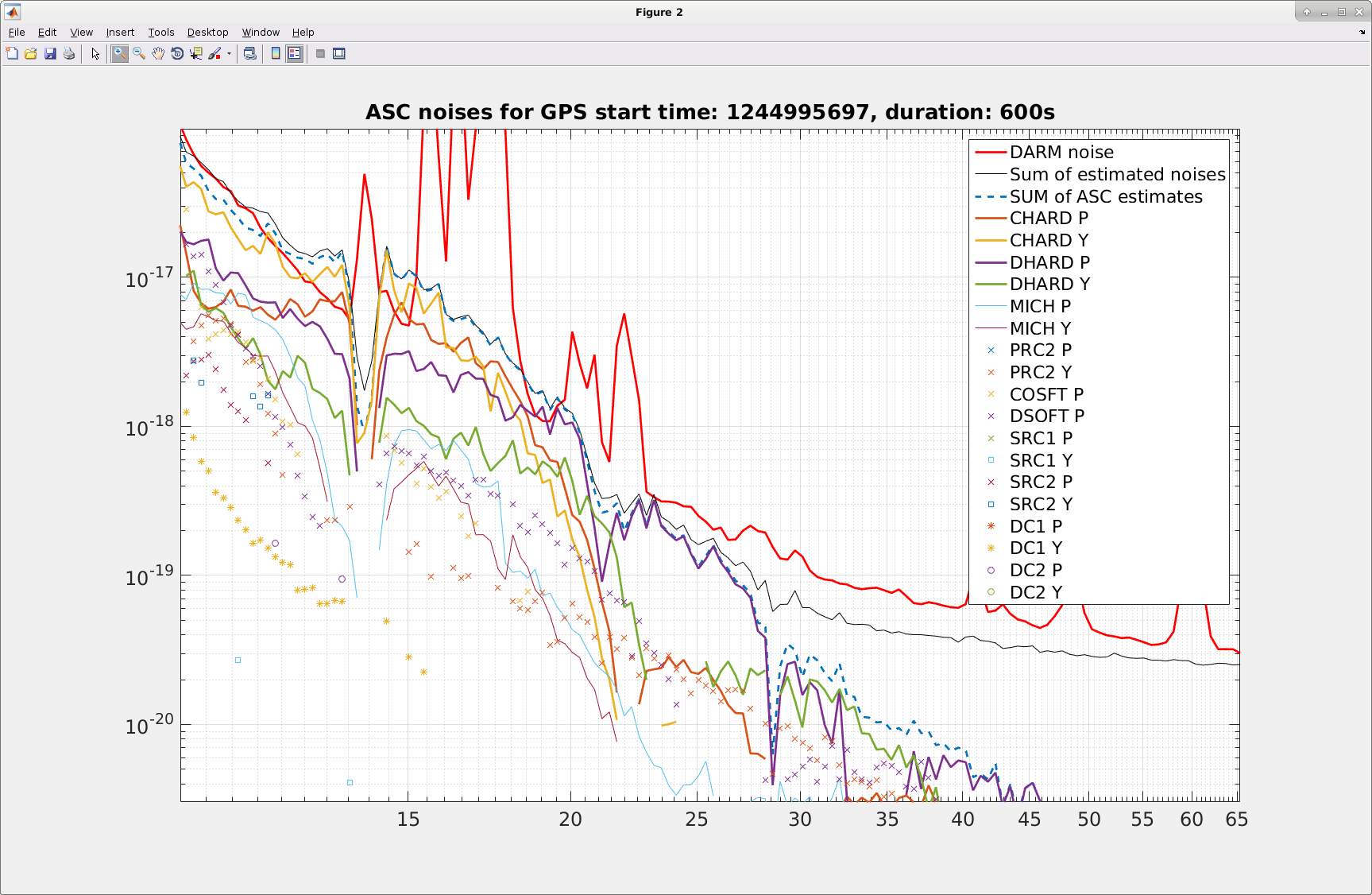
The fifth attachment is the updated ASC noise budget. We are over estimating our noise a bit between 10 and 20 Hz, one explanation could be that the noise budget templates we use to measure coupling functions were run yesterday when the wind was high, while the Measured Noise trace is from the previous lock, which had lower ground motion. We also want to check the PUM DAC noise.
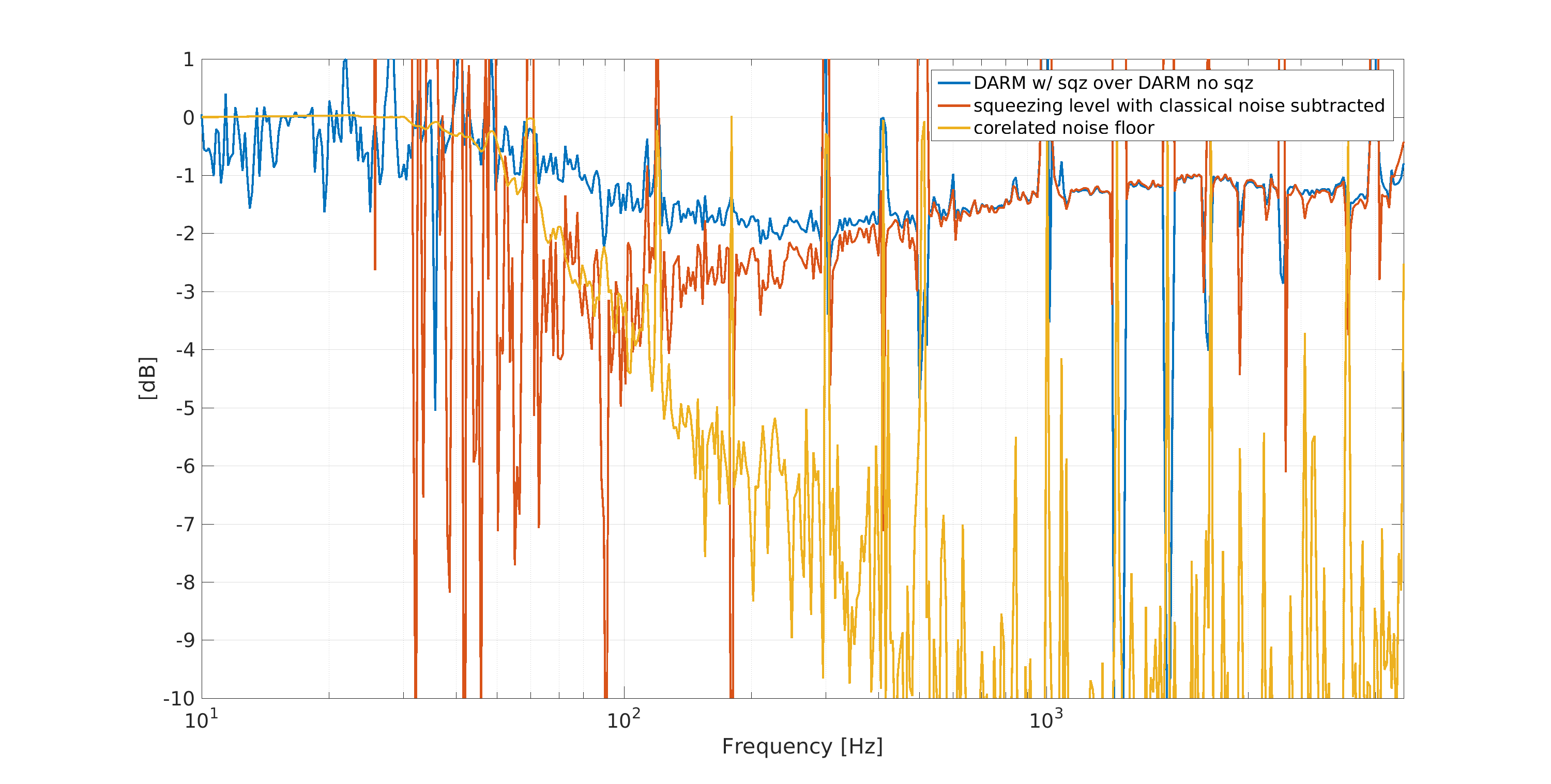
I'm attaching a couple of other figure that were generated when Georgia ran this noise budget that might be useful for reference. The first is the same as Georgia's third plot, but also shows the frqeuency dependence with an attempt at subtracting the correlated noise. This is the correlated noise from the online cross correlation, so the calibration issue shown in Georgia's 4th plot is impacting the subtraction. We did some follow up measurements for this frequency dependence that are shown in 50591 there I did the cross correlation offline which should avoid the calibration issues (or, would have a different calibration issue, in the offline one the subtraction will be limited by the accuracy of the DARM loop model, not by the discrepancies between the online and offline calibration).
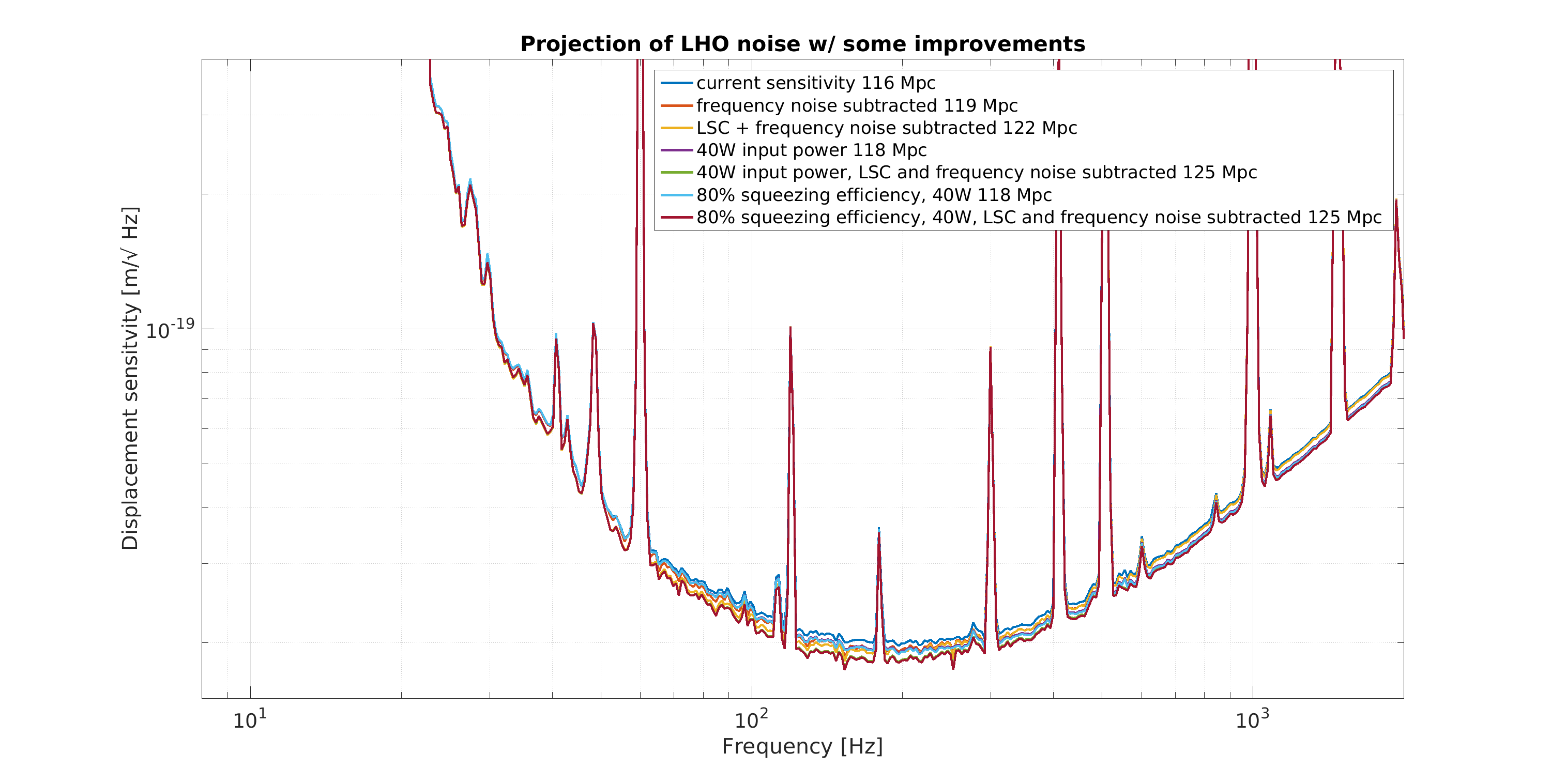
The second attachment shows some projections, the ones that involve squeezing should be interpreted with caution.
/ligo/gitcommon/NoiseBudget/simple-noise-budget/restructured_nb/
Seems like SHG PZT voltage hit zero, thus no green into chamber. The guardian seems to have taken care of that.