[JeffK, Jenne]
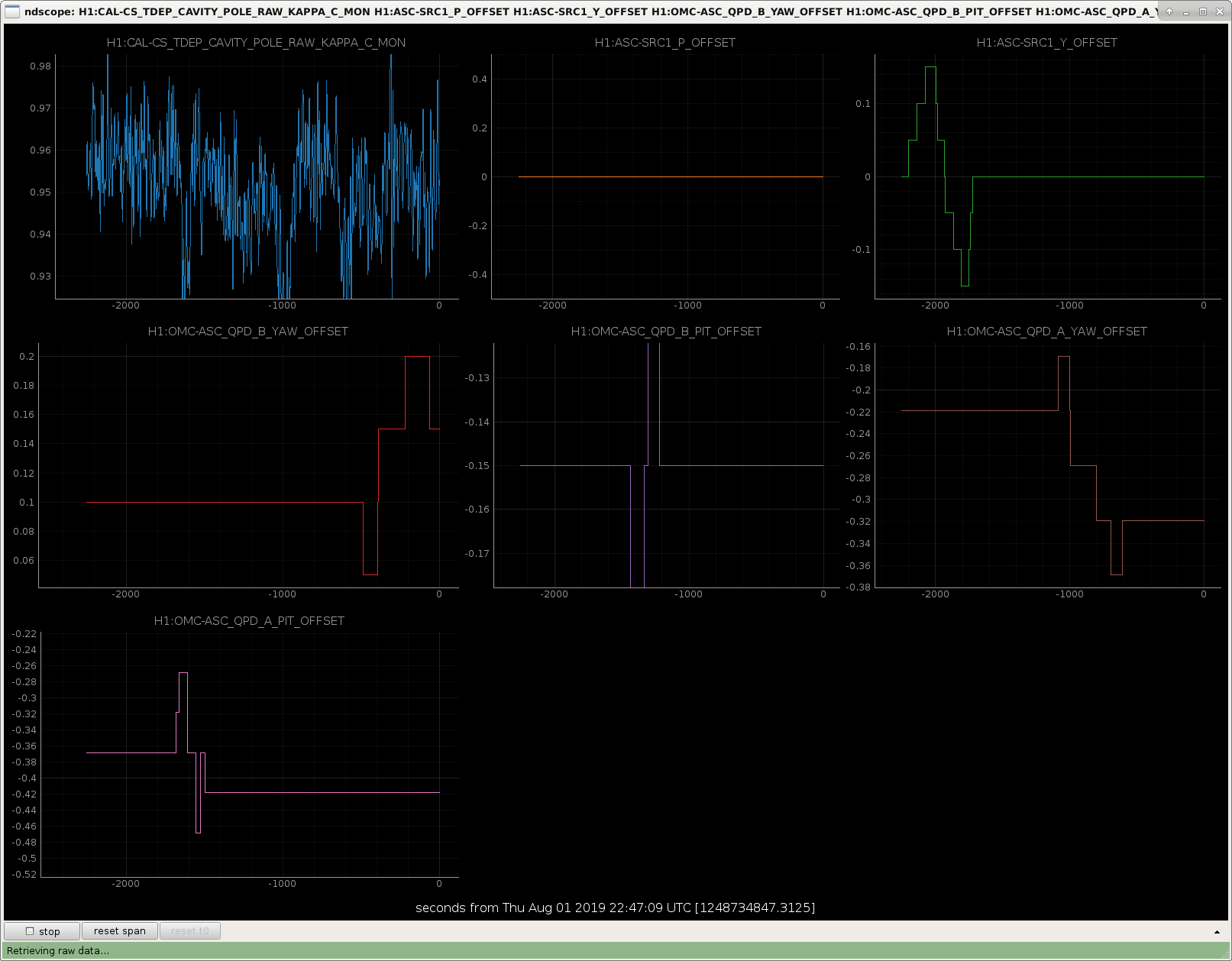
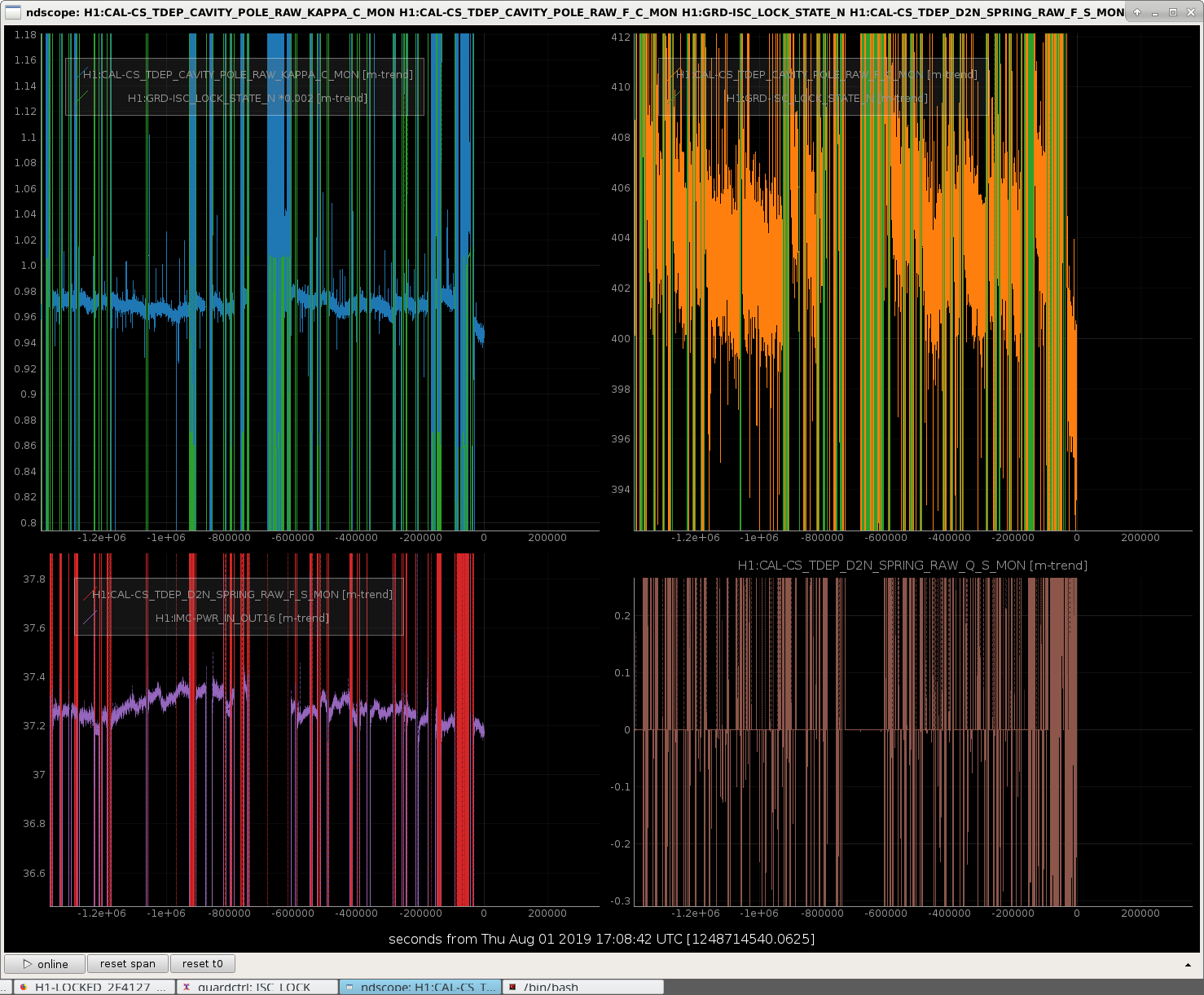
After Jeff noted that last night's lock had a somewhat low optical gain (kappa_C value of ~0.93), we moved the offsets in the OMC ASC QPDs to try to maximize optical gain. The attachment shows the moving that we did. It's possible that we could get a bit more if we were able to move in the direction that saturates the OMC SUS, but I'm not 100% sure about that, and to get it we'd have to pico the AS WFS so that we can move OM1 and OM2 to offload some of the alignment move.
We were able to convice the optical gain to come back to a value of 0.96ish, which is closer to what we've been having at 37W injected power for the last several weeks of O3. The offsets aren't very different from what they had been - for the most part the optical gain was happier where the alignment had been.
@DetChar -- This change in OMC alignment position appears to coincide with the drastic increase in glitches (below ~15 Hz, as reported by DMT Omega and Omicron) since Aug 1 2019.
You can confirm this by looking at trends of offsets in the OMC ASC system, under
H1:OMC-ASC_QPD_A_PIT_OFFSET
H1:OMC-ASC_QPD_A_YAW_OFFSET
H1:OMC-ASC_QPD_B_PIT_OFFSET
H1:OMC-ASC_QPD_B_YAW_OFFSET
We had changed these offsets to increase the DARM optical gain, but at the time we'd not considered that this position may be worse for things like coupling of seismic / acoustic noise, alignment jitter, scattered light, etc.
We'll bring this up at today's commissioning meeting and see if we can address it *and* improve the optical gain.
After the spot moves yesterday, I did a coarse job of setting the ITMX A2L gains. Today I did a somewhat more careful job by turning on ITMX oscillators and changing the A2L gains to minimize the line in DARM. The Y2L value didn't change, but the P2L value changed a small amount.
Attached are the A2L values after this change.
Side note, after redoing the PUM drivealign matrices in the suspensions, we need to update Gabriele's A2L script to match the new channel names.
TITLE: 08/01 Eve Shift: 23:00-07:00 UTC (16:00-00:00 PST), all times posted in UTC
STATE of H1: Corrective Maintenance
OUTGOING OPERATOR: Niko
CURRENT ENVIRONMENT:
Wind: 13mph Gusts, 10mph 5min avg
Primary useism: 0.03 μm/s
Secondary useism: 0.05 μm/s
QUICK SUMMARY: Jeff K. is taking measurements at NLN_CAL_MEAS.
23:22 UTC Observing
[Jeff Kissel, Rick Savage, Timesh Mistry]
Overview:
This is a summary of progress so far on the hardware side of things as well as the lab test conducted on 20170731, a full log can be found in the text file 'NCAL_LabTest_PEM_20190731.txt' attached to this alog.
The plan was to collect PEM measurements (accelerometer and magnetometer) of the NCAL before fully dis-assembling the NCAL unit. We tripped the wall sockets multiple times when trying to set up additional equipment for PEM measurements. We discovered a wobble when running the NCAL at ~10Hz, worse that what we have seen when previously running the NCAL as well as a bad screw in the back plate of the NCAL the is attached to the main flywheel.
a) Old Plan Plan (as of 29th July 2019):
a) It is a metric M5 screw
b) It is a bad quality imperial 10-32 3/8 cap screw
I consulted with Chandra and Rick and the overall conclusion was that it is a bad 10-32. This is because:
1) After 1 1/2 turns with the offending screw would 'bind' (increase resistance) when tested in other 10-32 holes in the NCAL and when testing in a screw pitch gauge.
2) When putting the offending screw into the metric M5 screw pitch gauge, it would fit but would wobble (strike one for metric theory)
3) When comparing the threads of the offending screw to a 10-32 tap and other 10-32 screws, the threads match (strike two for metric theory).
4) There are no marking on the top of the head of the screw as this is typical of metric screws (strike three for metric theory).
What I suspect is that a longer 10-32 has been cut down to the required size (I think 3-8) and has not been done properly. I am going to order more 10-32 3/8 screws and replace the bad one. In addition I have already cleaned up the threads with a wire brush as Isopropanol.I have also clean the mating surfaces of the NCAL and the back plate with alcohol wipes and cleaned the threads of the remaining good screws.
When trying to power the spectrum analyser, we tripped the wall socket (Serial Number: 168RP1-17). fter resetting the wall socket, tediosly, we tried each plug one by one on the wall and did not trip the wall. We found that using the we could apply no more than 3 plugs to the wall before it tripped. It did not matter if we used a power extension or directly into wall.
To get around this issue, we used a extension from anther wall socket (Series Number: 168RP1-20) in combination with the wall socket in this combination:
Socket 168RP1-20 : Spectrum Analyser, DC power supply, Oscilloscope, PC Monitor
Socket 168RP1-17 : Beckhoff motor controller
When using the power stip, we found we could only use 3 slots as plugging in a 4th plug would trip the wall socket.
TITLE: 08/01 Day Shift 15:00 – 23:00 (08:00-16:00), all times posted in UTC
STATE of H1: Corrective Maintenance
INCOMING OPERATOR: Patrick
SHIFT SUMMARY: Started shift in Observing and was eventually knocked out of lock by a 6.6 EQ in Chile, which took about 3 hours to ring down. Went through the locking process without initial alignment, managed to get to NLN. Commissioners are currently driving.
LOG:
15:00 (08:00) Start of shift
15:06 (08:06) Ethan, Timesh to Optics Lab
15:12 (08:12) Timesh out of Optics Lab
15:17 (08:17) Karen to Optics Lab
15:38 (08:38) Ethan out Optics Lab
15:42 (08:42) Karen out of Optics Lab
17:30 (10:30) Out of Observing for calibration measurement
17:47 (10:47) Laurence, Dripta to Optics Lab
18:17 (11:17) Calibration measurement complete, going back to Observing
18:33 (11:33) Switching to EQ config for 6.5 in Chile
18:44 (11:44) Laurence out of Optics Lab
18:52 (11:52) Lockloss from EQ
20:09 (13:09) Dripta out of Optics Lab
21:02 (14:02) Ethan to Optics Lab
21:05 (14:05) Timesh to Optics Lab
21:08 (14:08) Timesh out of Optics Lab
21:14 (14:14) Ethan out of Optics Lab
22:03 (15:03) At NLN, holding there for corrective maintenance
23:00 (16:00) End of shift
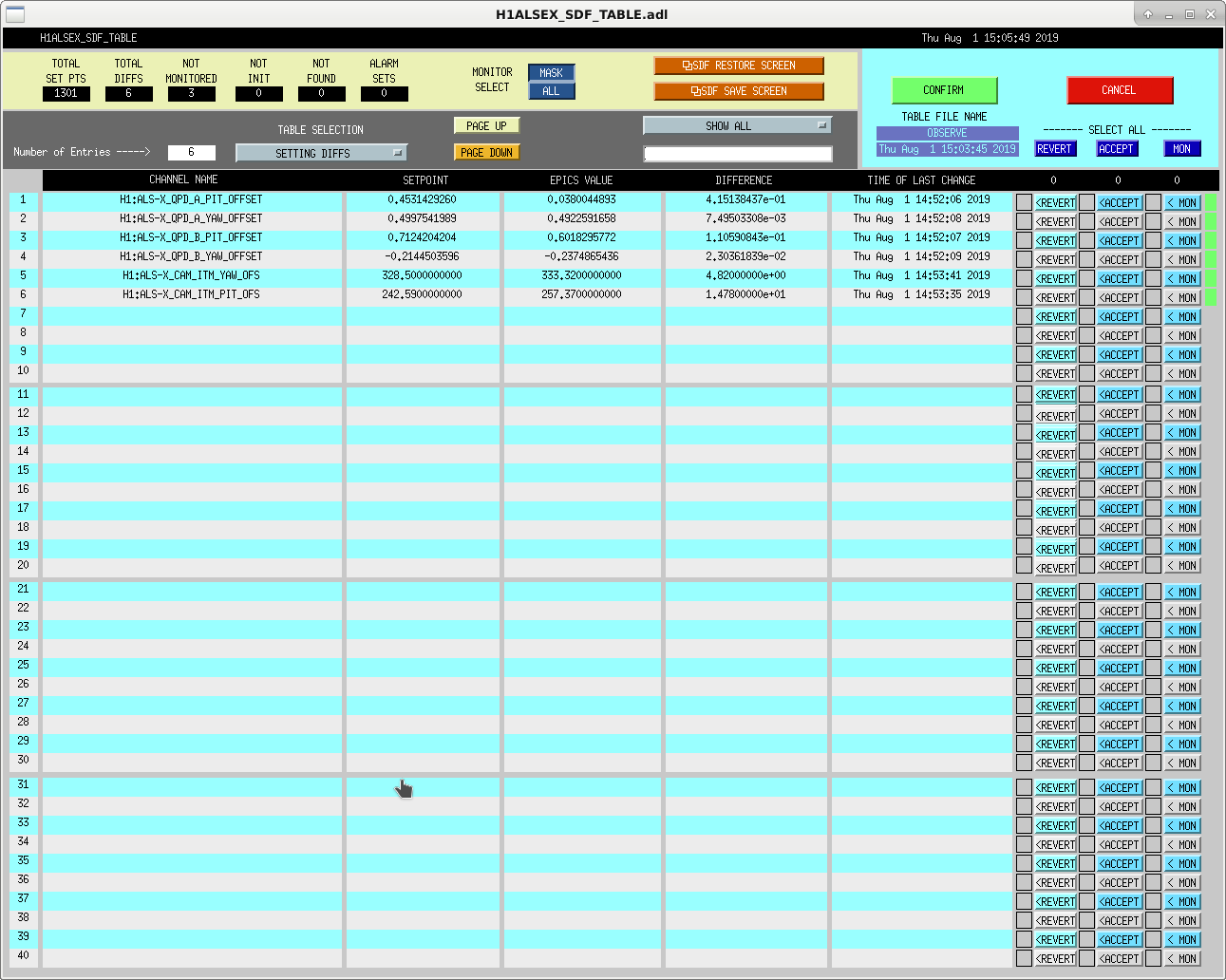
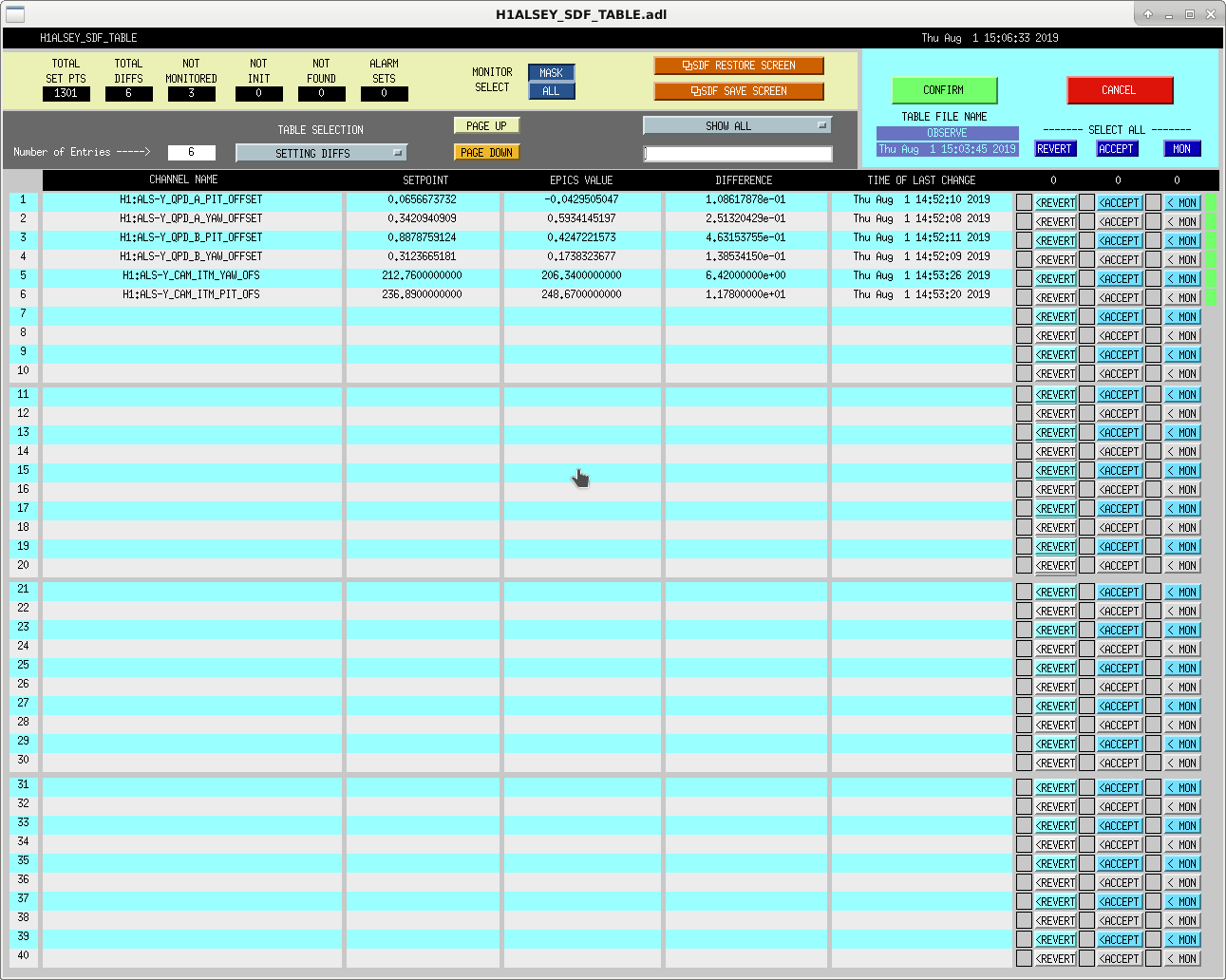
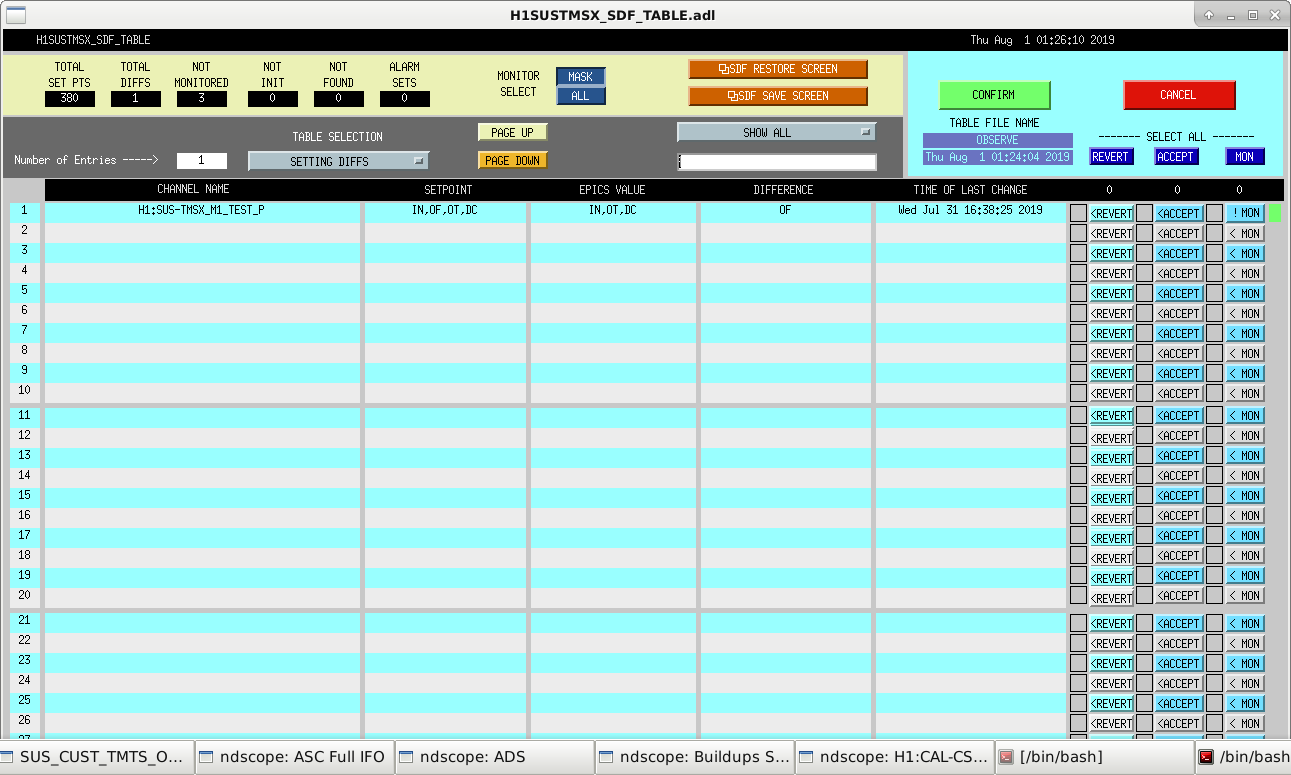
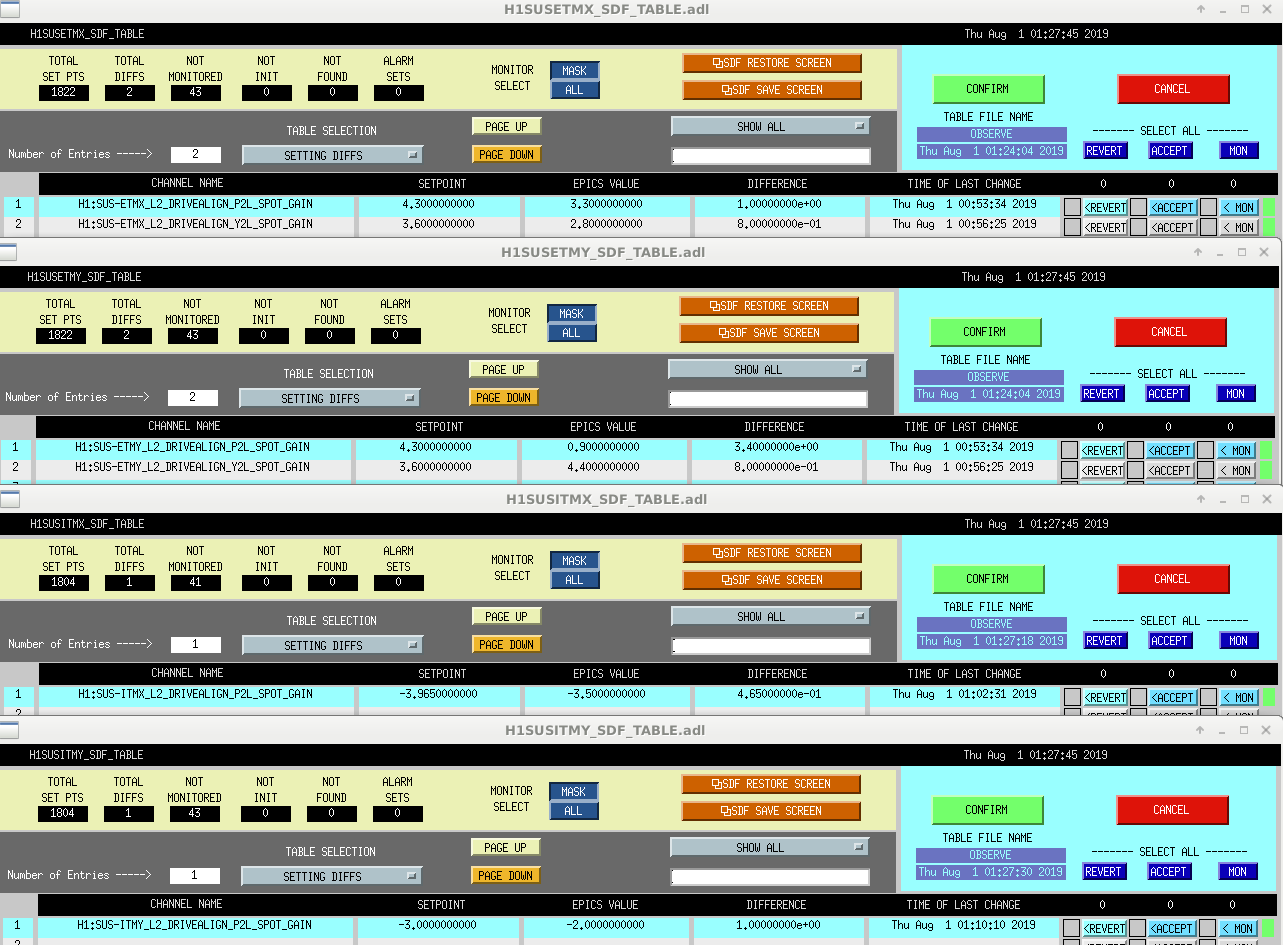
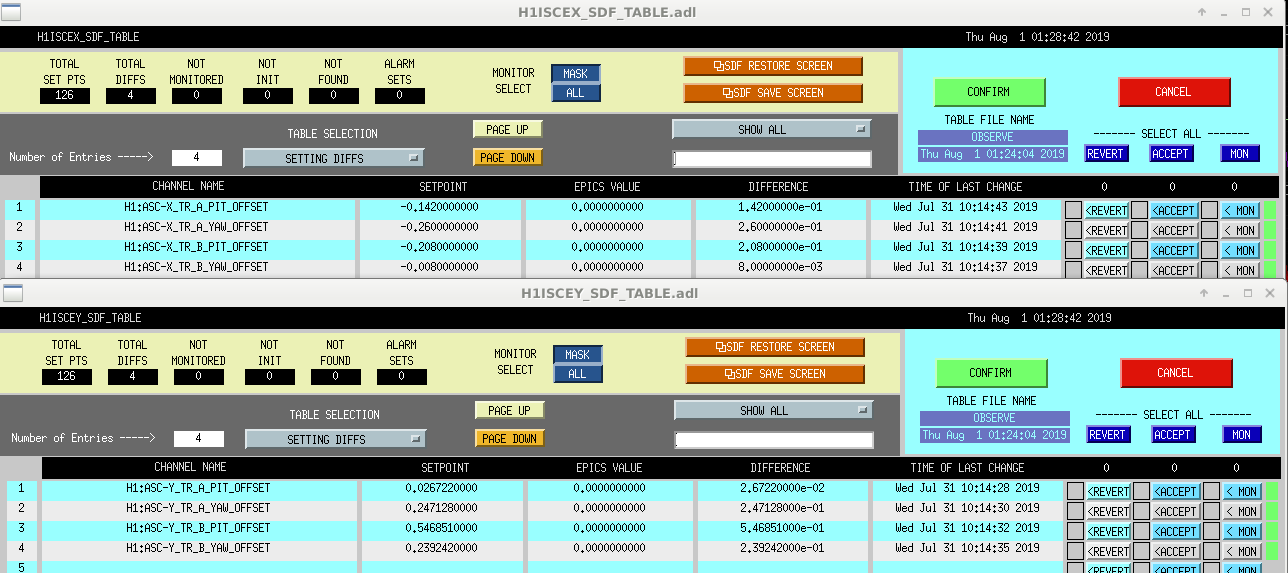
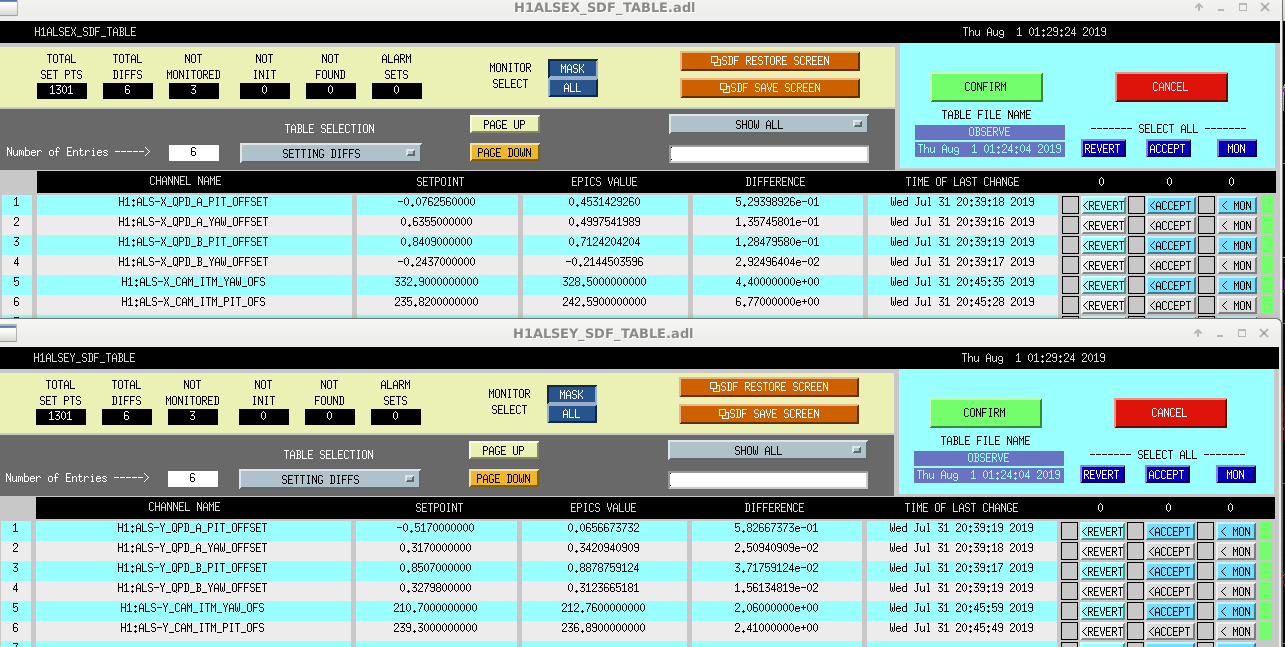
Back to NLN, Jenne and Jeff have updated ALS references, SDF diffs in attached screenshots.
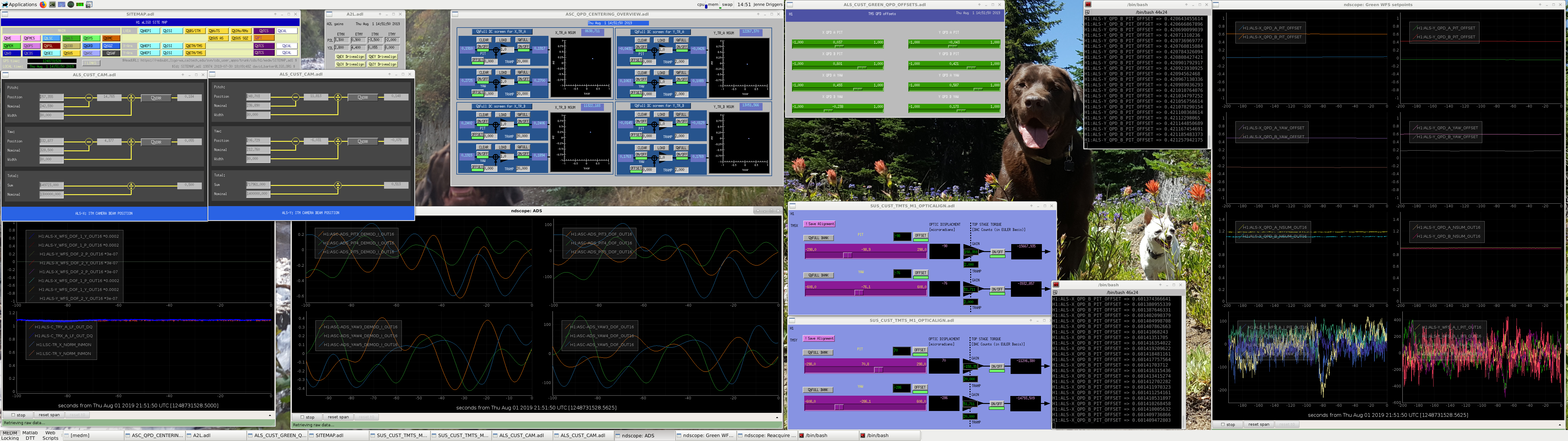
JeffK noted that we don't have a good all in one place how-to on setting the initial alignment offsets. So, here's an attempt at it. This assumes that the QPDs are all close enough to center (or can be made to be so by moving TMS) that you do not need to use the picomotors. Using the picos requires more thought and care.
The attachment is my desktop when I'm doing this, so you can see all of the windows that I'm looking at.
Process for each arm (can be done in parallel since each arm is independant of the other for this work):
If you must pico, I'd recommend only pico-ing the IR QPDs since they're much easier to think about and independent of other beams. I'd start the green QPD setpoint scripts to make the green QPDs follow your movement. Then I'd make a small step in TMS alignment in the direction that will put the green QPD offsets closer to zero, and then pico the IR steering picos to get the IR QPDs closer to zero.
I've edited the code that sets the green QPD offsets (/opt/rtcds/userapps/trunk/als/h1/scripts/setEndGreenQPDOffsets_XARM.py and setEndGreenQPDOffsets_YARM.py) -- check out LHO aLOG 51476 for further commentary.
This procedure needs to be modified because we are now setting green references with our spots centered on the optics. We would like to center the IR on the IR QPDs once we have our spots in their final positions, however, not necessarily with the spots centered.
Since Craig added in the TMS servoing to center the IR QPD, we should still be able to follow this procedure at DC readout. At DC readout, in the current situation, we are servoing the spots to the centers of all 4 test masses at 2W input power. This is the position we want to set the initial alignment references to.
Later in the acquisition sequence the power is increased to 10W, and then the beam spots are moved to their final high power positions, then we further increase the power and continue on to NomLowNoise.
Before setting the green camera references, we should remember to check that the camera image is good and that any mask applied is appropriate. We can check this by opening up the digital camera screen and taking a snapshot, then finding the snapshot in /ligo/data/camera
J. Kissel
Given that we now see evidence for an even lower optical gain (via the calibration lines) with the IFO's new global alignment position, and we haven't been able to take a sensing function measurement since Jul 17th, I "snuck" in a sensing function measurement suite this morning (thankfully just before the giant chilean EQ that knocked us out of lock).
The processed data is attached, and I've added it to the collection of data we've been gathering to help inform us of for what we'll eventually need to correct for in offline analysis and recalibration of h(t).
The message: in this new global alignment position,
- the optical gain is indeed lower (3.029e+06 ct/m), and consistent with the reported \kappa_C of 0.93 (given the reference model optical gain is 3.25e+06 ct/m)
- the cavity pole remains at 410 Hz (though this number has been bouncing around quite a bit in O3).
- the low frequency response (whether it be from parasitic L2A2L coupling or SRC cavity detuning), appears to now align with the physical model of a pro-spring, with f_s = 7.103 Hz (well, an f_s^2 = -50.453 Hz^2), and a Q_s of 11.67.
In order to confirm that this is an optical spring (now) as opposed to parasitic L2A2L coupling, we'd have to run the gamut of tests that we've run in order to decide that *previously* the low-frequency response was dominated by parasitic L2A2L (see a summary in G1901353).
I've at least run the now normal PCALX vs. PCALY comparison, to confirm that the low frequency response is still not a PCAL spot-position torque issue. (the fact that the magnitude is ~0.5% different between the two has been brought to the PCAL team's attention and is now under investigation.)
I also attach the now standard plot which shows the MCMC fit values for the sensing function parameters over the entire run. We still have yet to compare these against the calibration-line-determined TDCFs. If we're going to be sticking with this global alignment, today's lock stretch will likely define thestart of a new epoch (and we already know that 2019-Jun-11 defined the start of the 2nd epoch in O3 when we powered up from 35W to 37 W.).
Raw data files live here:
/ligo/svncommon/CalSVN/aligocalibration/trunk/Runs/O3/H1/Measurements/FullIFOSensingTFs
2019-08-01_H1_DARM_OLGTF_LF_SS_5to1100Hz_15min.xml
2019-08-01_H1_PCALY2DARMTF_LF_SS_5t1100Hz_10min.xml
2019-08-01_H1_PCALX2DARMTF_LF_SS_5t1100Hz_10min.xml
2019-08-01_H1_PCALY2DARMTF_BB.xml 2019-08-01 18:10:22
2019-08-01_H1_PCALX2DARMTF_BB.xml 2019-08-01 18:12:40
2019-08-01_H1_OMCDCPDSUM_to_DARMIN1.xml
Scripts to produce the attached plots:
/ligo/svncommon/CalSVN/aligocalibration/trunk/trunk/Common/pyDARM/src/sensing.py rev 8127
/ligo/svncommon/CalSVN/aligocalibration/trunk/Runs/O3/H1/Scripts/FullIFOSensingTFs/
process_sensingmeas_20190801.py
plotMCMC_vs_GDSTDCFs.py
process_sensingmeas_manydates_wPCALX.py
An update to alog 50841.
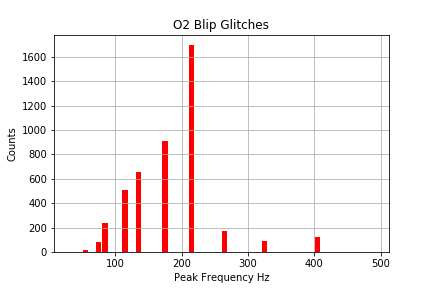
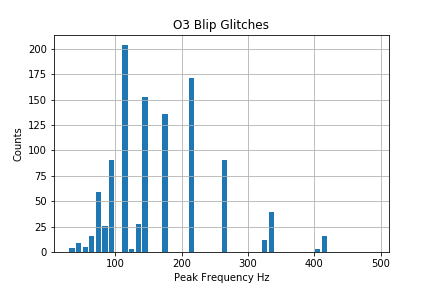
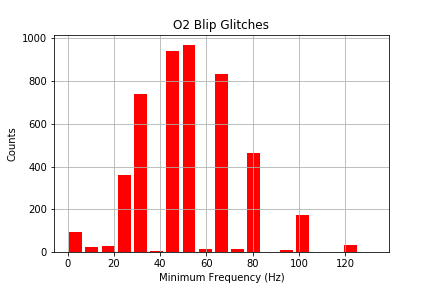
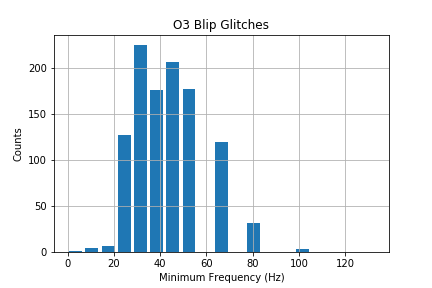
Glitch DB now has Hanford data up to the end of July 2019. Instead of the ~200 events we were looking at previously, there is now data from over 1000 blip glitches from O3.
The median peak frequency has definitely dropped between runs, as seen in figures 1 and 2. However, there is a clear bimodality, with a large population in the most common peak frequency bin from O2. In addition, a higher proportion of events occupy the high-peak frequency tail of the distribution.
The medium minimum frequency has dropped by ~15 Hz, as shown in figures 3 and 4.
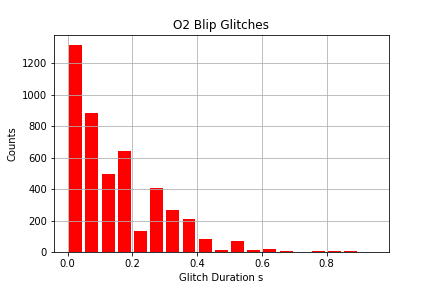
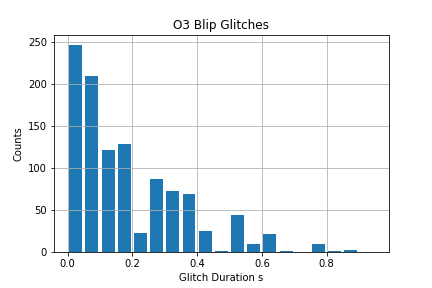
The quality factor, time between blip glitches and SNR have not changed appreciably, but it seems as if the distribution of the duration of glitches falls off slower in O3 than in O2, as shown in figures 5 and 6.
Here is a quick summary of our spot positions on the test masses. One column is the positions that we had been using before this week's Tuesday maintenance camera bump, one column is the spots that gave good buildups at 2W yesterday which is also the set of positions that the initial alignment is currently set for, and the final column is the spots that were better at 37W yesterday.
For the most part, we are closer to the center of our optics at the current 37W positions than our previous 37W positions.
| Pre-Tuesday 2W and 37W | 2W Post-Tuesday | 37W Post-Tuesday | Displacement change at 37W Pre- vs. Post-Tuesday | |
| ITMX pit | P2L = -3.965 -> 21.7 mm | P2L = -0.1 -> 4.4 mm | P2L = -3.5 -> 19.6 mm | 2.1 mm closer to center |
| ITMY pit | P2L = -3.0 -> 17.4 mm | P2L = 0.8 -> 0.3 mm | P2L = -2.0 -> 12.9 mm | 4.5 mm closer to center |
| ETMX pit | P2L = 4.3 -> -15.7 mm | P2L = 0.7 -> 0.8 mm | P2L = 3.3 -> -11.1 mm | 4.6 mm closer to center |
| ETMY pit | P2L = 4.3 -> -15.7 mm | P2L = 0.7 -> 0.8 mm | P2L = 0.9 -> -0.2 mm | 15.5 mm closer to center |
| ITMX yaw | Y2L = 0.055 -> 0.2 mm | Y2L = 0.055 -> 0.2 mm | Y2L = 0.055 -> 0.2 mm | No change |
| ITMY yaw | Y2L = 0.0 -> 0 mm | Y2L = 0.0 -> 0 mm | Y2L = 0.0 -> 0 mm | No change |
| ETMX yaw | Y2L = 3.6 -> 13.2 mm | Y2L = 2.8 -> 10.3 mm | Y2L = 2.8 -> 10.3 mm | 2.9 mm closer to center |
| ETMY yaw | Y2L = 3.6 -> 13.2 mm | Y2L = 2.8 -> 10.3 mm | Y2L = 4.4 -> 16.2 mm | 3 mm away from center |
Following last Friday's meeting regarding IFO relocking, one action item for CDS was to report on the current status of the SDF reference snapshot files.
In the attached text file, for each model, the status of the safe.snap, down.snap (if used) and OBSERVE.snap are shown. If the reference file exists, its modification date is shown. If the reference points to a different state's file, that state's name is shown.
I've ommitted non-control models (e.g. IOP and SUSAUX).
This list can be generated by running the command
sdf_files_report
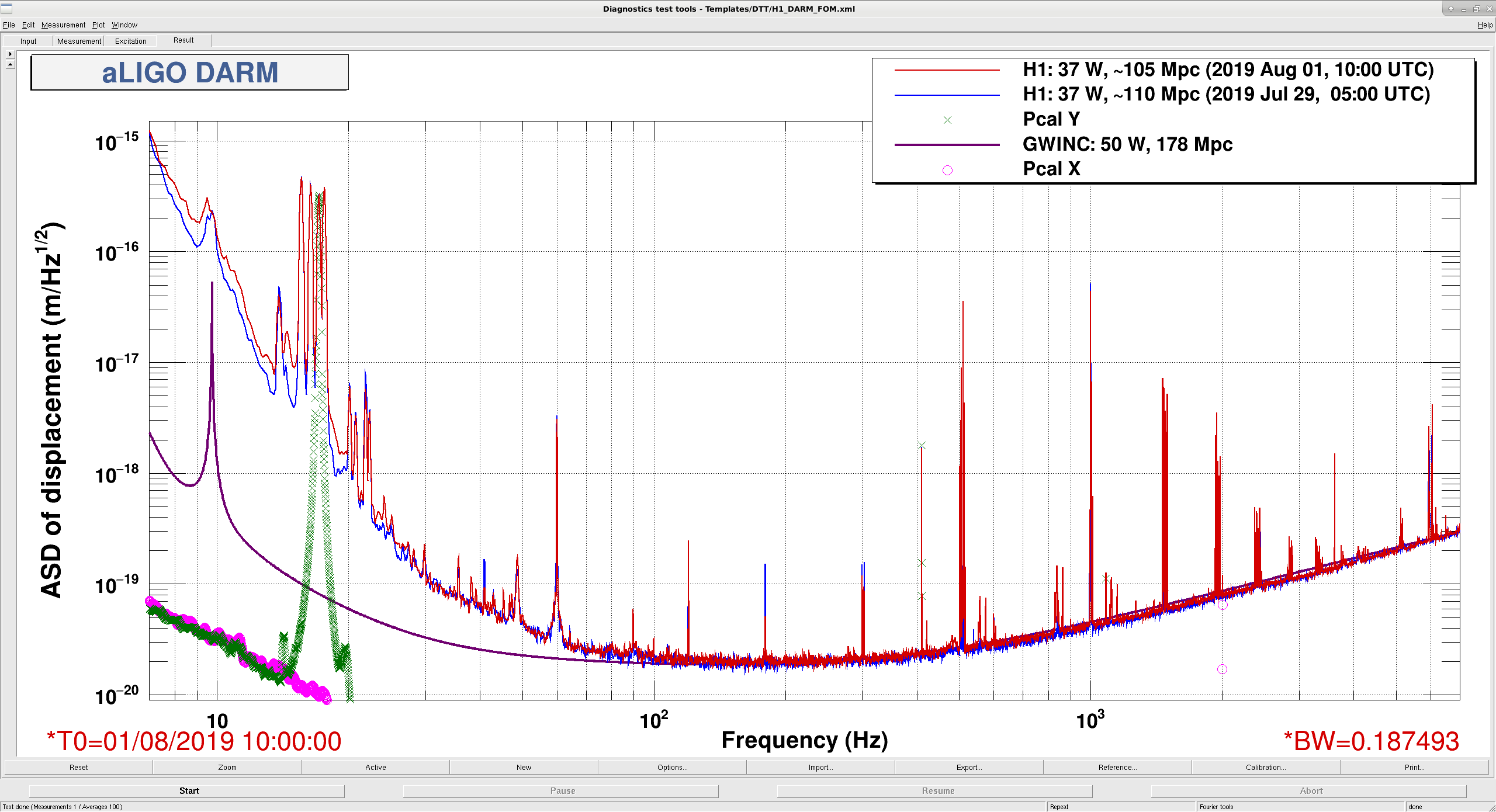
J. Kissel A sincere applause to the heroic efforts of all whom have help us get back to an observation ready detector! Picking up where Jenne left off at ~2am last night (see LHO aLOG 50954), I post a simple comparison between the ASDs of DELTAL EXTERNAL before the alignment shift (Monday, 2019-07-29 05:00 UTC) and after the alignment shift (Today, 2019-08-01 10:00 UTC). GDS-CALIB_STRAIN reports our range is consistently ~5 Mpc lower than prior, so I was curious as to where we were different / losing out. It appears to be a collection of minor things (no surprise). We'll of course be doing more thorough investigations, but I thought people might wanna start here. Since we still can't obtain GDS-CALIB_STRAIN from DTT, I attach a proxy -- DELTAL_EXTERNAL (uncorrected for time-dependence / optical plant changes) -- for your perusal. I also attach a few-day trend of the time-dependent correction factors. It shoulds that our optical gain has dropped further (was 0.97 because we haven't yet corrected for the 35W to 37W power up), and the cavity pole is lower (now 398 Hz, as opposed to 405 Hz). I'll be measuring the optical plant in full later today.
Ops Shift Transition: 08/01/2019, Day Shift 15:00 – 23:00 (08:00-16:00) - UTC (PT)
State of H1: Locked
Intent Bit: Observing
Weather: 0-3mph wind
Primary 0.03 – 0.1Hz: 0.01 um/s
Secondary 0.1 – 0.3Hz: 0.1 um/s
Outgoing Operator: Jeff
Quick Summary: Been locked and Observing for 6.5 hours
IFO is locked and observing with 112.5Mpc of range. Environmental is calm. With luck the second half of the shift will go as smoothly as the first.
[Jenne, JeffK, Patrick, Kara, Niko, JeffB]
As Jeff noted in his earlier alog 50952, I think that the Yarm alignment that was arrived at yesterday was such that the IR beam came into resonance with the beam spot on the other side of the ITMY point absorber than we usually sit at. When all the ADS loops were closed except for PIT3 (which moves PRM to set the spot position on ITMY in pitch) and we couldn't move the PRM to get the ADS error signal close to zero without causing DHARD and other ASC loops to oscillate, I thought I'd try moving the ITMY P2L gain to get a rough idea of what value would zero the PIT3 ADS line. It turned out that a value of +2 (which corresponds to a spot position of -5.2mm in pitch) was pretty good. This is quite different from our old nominal ITMY P2L value of -3.0 (which corresponds to a spot position of +17.4mm in pitch).
While at 2W I moved all of the A2L values of the test masses to move the spots and try to improve the buildups. Recall that ITMX isn't used in-loop, but needs to be adjusted to reduce angular noise in DARM that drowns out the other A2L lines. I was able to get a power recycling gain of 48 with a POP18 value in the high 60s, which is much better than we usually do at 2W. I reset the green initial alignment setpoints to match these spot positions. When we increased power to 20W, buildups still looked good, so we went ahead and increased further to the full 37W input power but this caused all of our buildups to drop quickly. Also, the OMC ASC was saturating the OMC suspension(true with the usual QPDs and when I tried to switch over to the dither. Haven't tried deacon.). I had the OMC ASC loops open, and I had just started moving the spots around a bit, and we lost lock. To prevent this, next lock I will try to move spots a bit while we are still at 20W, where the OMC SUS didn't saturate.
Upon trying to reacquire, Patrick noted that the ALS COMM beatnote was lower than normal, around -14dBm (we've been running at about -10dBm, but it really ought to be higher than that.). We do not usually move PR3, but since the alignment of the IFO changed drastically today Patrick paused the INIT_ALIGN guardian when it was working on the green alignment and moved PR3 to get the COMM beatnote up to -3dBm. This caused the Xarm IR portion of initial aligment to not catch lock, so I hand-moved PR2 and IM4 to compensate for the PR3 pitch move and then let the ASC take over once the Xarm caught lock.
Earlier today we were losing lock at CARM_TO_TR because there wasn't enough light on the Yarm QPD_B. I temporarily had put in CARM_TO_TR to move the carm offset closer to zero than normal, which allowed enough light to hit the Y QPD_B that we could make the transition. But, after Patrick's recent initial alignment, that was moving us too close to zero so I have once again removed it and the carm offset reduction sequence is back to its normal settings.
Next lock we went to DC readout, and saw that again the POP18 and PR gain buildups were good. We then went to 20W where I tried for a while to improve the buildups, but was not cery successful. I did a bit, but not back to our 2W place. And, these moves put us much closer to the locations that we had been on our test masses. Kind of disappointing. I went to 37W and tried a bit more spot moving, but no real changes there. With these new spots and a small extra OMC QPD offset I was able to leave the OMC ASC engaged on the QPDs without saturating the suspension. At this point, I am beat. The IFO is at NomLowNoise, kind of okay range, so we can come back and address remaining issues tomorrow.
Some SDF snapshots:
A few more notes and words on Kara and my work earlier today on moving the TMSX (mentioned in JeffK's alog 50952): When the IFO was pretty well aligned (Jeff and Niko had moved the arms in soft to get the ADS error signals except PIT3 small), Kara and I noted that both the IR and green QPDs on the TMS were quite far off center in pitch. So, we pitched the TMS slowly to get the IR QPDs a little better centered, and in parallel moved the green QPD offsets to keep the ALS WFS error signals small. At some point when we were pretty close, we started running the Kiwamu script that changes the green QPD offsets automatically. It happens that when the IFO was pretty well aligned, the IR QPDs on TMSY were reasonably well centered, so we left TMSY alone and just reset the Y green QPD offsets. Thankfully the offsets were happy to go closer to the center of the QPDs, so we avoided having to do any picoing today.
After moving TMSX to recenter the IR QPDs, I have commented out the step in increase_power that put an offset into TMSX pitch alignment.
JeffB has just put us into Observing for the night. We can work to finish fine tuning the IFO tomorrow. For tonight, commissioners out.
I have now propagated these SDF diffs also to the safe / down snapshots.