
thomas.shaffer@LIGO.ORG - posted 18:35, Wednesday 12 June 2019 (49872)
Back to Observing at 0012 UTC
Commissioning work finished up at 0012UTC and we are back to observing.
Commissioning work finished up at 0012UTC and we are back to observing.
[Rick, Dripta, Laurence, Niko]
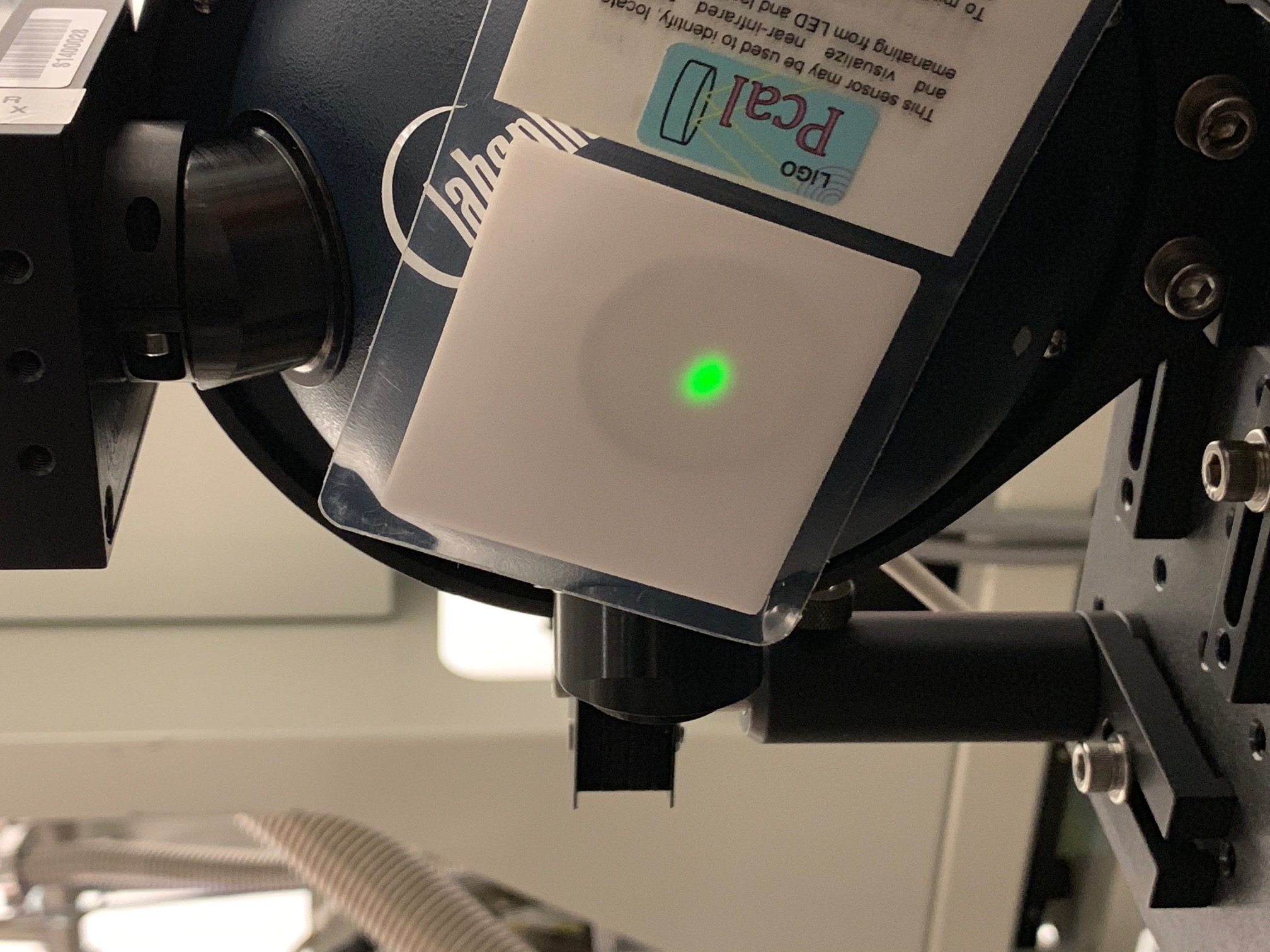
We performed an end station calibration at EX yesterday. The measurement procedure/log is attached, beam alignment photo will be attached in a comment and data quality analysis will follow.
Beam alignment at RX integrating sphere aperture
[Niko, Laurence, Rick, Dripta]
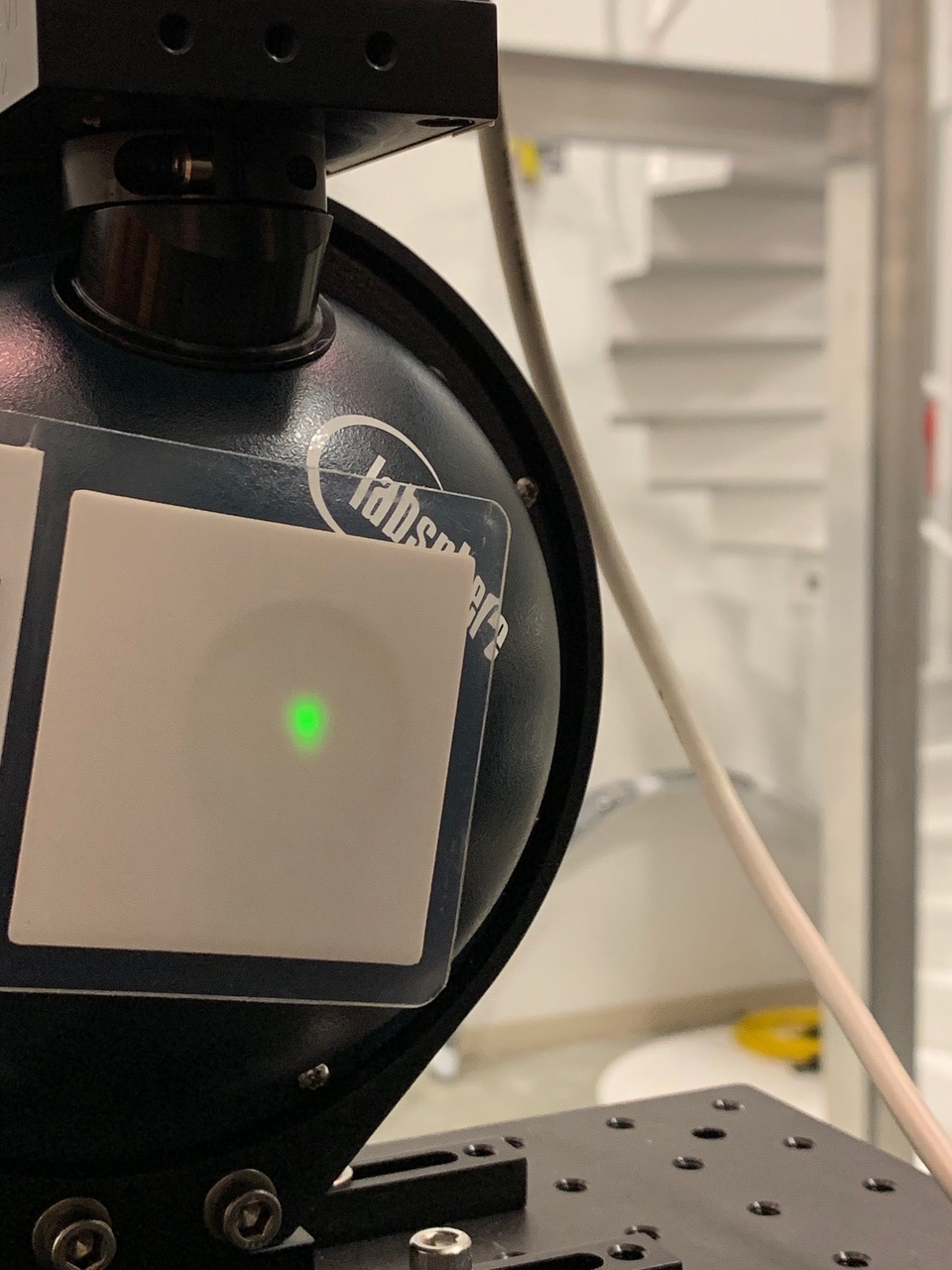
Last Tuesday we went down to EY and performed an end station calibration (apologies for the late status report). The measurement procedure/log and a picture of the beam alignment on the RX integrating sphere aperture are attached. Data quality analysis will follow.
J. Kissel

Dave have recently found that there are a small collection of EPICs settings that are both NOT touched by Guardian and NOT monitored in the SDF system (see O3SDFReview in the CDS wiki). Today, during the commissioning period, I reviewed and either monitored or justified why to leave them unmonitored for those channels in the CAL models. In summary -- very little change, some channels that should be monitored are now monitored, and others are known that they should be not monitored.


CAL INJ
    Now monitored
        H1:FEC-42_BURT_RESTORE     (button to demand a burt restore of safe.snap during start up. shouldn't be changing, and isn't even available to change on GDSTP screen. Should be monitored)
        H1:FEC-42_DACDT_ENABLE     (button to switch on the DAC doutone readback in to the 31st channel of the ADC )

    Leaving unmonitored
        H1:CAL-INJ_TINJ_$(ENDED/PAUSE/START/STATE/TYPE)      (actually readbacks written to by TINJ guardian node about injection information. should remain unmonitored.)
        H1:CAL-INJ_TRANSIENT_$(GAIN/TRAMP)                   (used to turn OFF hardware injections, which happens during a GRB alert, and potentially during observe)
        H1:CAL-INJ_TINJ_ENABLE                               (used to turn OFF hardware injections, which happens during a GRB alert, and potentially during observe)

CAL CS
    Now Monitored
        H1:CAL-CS_TDEP_SUS_$(L1,L2,L3)_LINE_END_SW           (toggle switch that determines which ETM is being used to inject calibration lines. Should not be changing and should be monitored.)
J. Kissel

Dave have recently found that there are a small collection of EPICs settings that are both NOT touched by Guardian and NOT monitored in the SDF system (see O3SDFReview in the CDS wiki). Today, during the commissioning period, I reviewed and either monitored or justified why to leave them unmonitored for those channels in the SUS models. Below are detailed notes, but the grand summary is that most of those channels can be monitored and were not, to-date, because they were
    - old defunct channels that are no longer in use and don't impact the IFO,
    - controlled by another settings channel via the front-end filter modules with control, or
    - changing them would not affect the IFO in any substantial way.
The remaining channels that I'm leaving unmonitored are
    - the OPTICALIGN_$(P/Y)_OFFSET channels which are used for alignment and will necessarily be different from lock stretch to lock stretch
    - the HWWD_STATE channels on the QUADs which are actually readbacks not settings, and are known to be glitchy
    - the violin mode damping filter settings, which can be tuned during observation.

SUS TMSX/Y
    Now monitored.
        H1:SUS-TMSX/Y_COMMISH_$(MESSAGE/STATUS)    (old defunct dummy EPICs variables to indicate that the suspension was in used for aLIGO install testing and commissioning. Doesn't matter at all, so we'll monitor it just to make this check happy.)
        H1:SUS-TMSX/Y_M1_OPTICALIGN_P/Y_TRAMP      (won't affect anything if changed, but shouldn't be changing, Monitor it just to make the check happy.)
        H1:SUS-TMSX/Y_M1_TEST_P/Y_TRAMP            (won't affect anything if changed, but shouldn't be changing, Monitor it just to make the check happy.)
    Leaving unmonitored
        H1:SUS-TMSY_M1_OPTICALIGN_P/Y_OFFSET       (continually changes from observe stretch to observe stretch for optical alignment tuning)

SUS SR2
    Now monitored.
        H1:SUS-SR2_BIO_M3_$(OSEMDOF)_CTENABLE     (switches the inputs to coil drivers from DAC request to analog input. We ALWAYS want these ON.)
        H1:SUS-SR2_BIO_M3_$(OSEMDOF)_MSDELAYOFF   (addes a delay to the digital compensation half of turning OFF coil driver switchable frequency response. We want these fixed and monitored.)
        H1:SUS-SR2_BIO_M3_$(OSEMDOF)_MSDELAYON    (same as above, but for turning ON the coil driver switchable frequency response.)
        H1:SUS-SR2_BIO_M3_$(OSEMDOF)_STATEREQ     (master control variable for switching the coil driver frequency response. We want these fixed and monitored.)
        H1:SUS-SR2_COMMISH_MESSAGE                (old defunct dummy EPICs variable to indicate that the suspension was in used for aLIGO install testing and commissioning. Doesn't matter at all, so we'll monitor it just to make this check happy.)
        H1:SUS-SR2_M3_EUL2OSEM_TRAMP              (ramp time for the M3 EUL2OSEM matrix. wouldn't affect anything to have it change, but monitor it just to make this check happy.)
        H1:SUS-SR2_M1_LOCK_P/Y_SW1S_INPT          (formerly guardian controlled filter module in filter bank, but shouldn't be changing when in observe, so we want monitored. )
        H1:SUS-SR2_M3_EUL2OSEM_SETTING_$(ROW)_$(COLUMN)  (M3 EUL2OSEM matrix values *to be loaded if load was hit*. Should be fixed in observe anyway, so we want monitored.)
    Leaving unmonitored
        H1:SUS-SR2_M1_OPTICALIGN_P/Y_OFFSET (continually changes from observe stretch to observe stretch for optical alignment tuning)


SUS PR3
    Leaving unmonitored
        H1:SUS-PR3_M1_OPTICALIGN_P/Y_OFFSET       (continually changes from observe stretch to observe stretch for optical alignment tuning)

SUS OMC
    Now Monitored
        H1:SUS-OM3_M1_TEST_P/Y_SW1S_OFFS          (generally unused and off. Would be used for misalignment offsets. Monitor it just to make the check happy.)

SUS MC2
    Now Monitored
        H1:SUS-MC2_BIO_M3_$(OSEMDOF)_CTENABLE     (switches the inputs to coil drivers from DAC request to analog input. We ALWAYS want these ON.)
        H1:SUS-MC2_BIO_M3_$(OSEMDOF)_MSDELAYOFF   (addes a delay to the digital compensation half of turning OFF coil driver switchable frequency response. We want these fixed and monitored.)
        H1:SUS-MC2_BIO_M3_$(OSEMDOF)_MSDELAYON    (same as above, but for turning ON the coil driver switchable frequency response.)
        H1:SUS-MC2_BIO_M3_$(OSEMDOF)_STATEREQ     (master control variable for switching the coil driver frequency response. We want these fixed and monitored.)
        H1:SUS-MC2_M3_EUL2OSEM_SETTING_$(ROW)_$(COLUMN)  (M3 EUL2OSEM matrix values *to be loaded if load was hit*. Should be fixed in observe anyway, so we want monitored.)
    Leaving unmonitored
        H1:SUS-MC2_M1_OPTICALIGN_P/Y_OFFSET (continually changes from observe stretch to observe stretch for optical alignment tuning)

SUS ITMY
    Now Monitored
        H1:SUS-ITMY_L2_DRIVEALIGN_$(P/Y)2L_GAIN    (A2L gains. shouldn't be changing during observe anymore, a relic of when we weren't constantly controlling the spot positions on the test masses. Also, not replaced by $(P/Y)2L_SPOT_GAIN, which is already monitored.)
        H1:SUS-ITMY_$(L1/L2/L3)_CAL_LINE_$(CLKGAIN,COSGAIN,SINGAIN,FREQ,TRAMP) (parameters for calibration line injection points. For ITMs we want these OFF and monitored.)
        H1:SUS-ITMY_BIO_L3_$(OSEMDOF)_SW           (Master switch for ESD driver state. Should be monitored.)

        H1:SUS-ITMY_BIO_L3_MSDELAYOFF              (same as SR2 and MC2.)
        H1:SUS-ITMY_BIO_L3_MSDELAYON
        H1:SUS-ITMY_BIO_L3_STATEREQ

    Leaving unmonitored
        H1:SUS-ITMY_HWWD_STATE  (glitchy channel reflecting the status of the HWWD. If monitored, will constantly and errantly kick us out of observing)
        H1:SUS-ITMY_M1_OPTICALIGN_P/Y_OFFSET (continually changes from observe stretch to observe stretch for optical alignment tuning)
        H1:SUS-ITMY_L2_DAMP_MODE??_$(GAIN,TRAMP) (violin mode damping filter settings, continually played with by guardian during observe.)

    Still under question (why isn't this touched by the guardian?):
        H1:SUS-ITMY_L2_DAMP_MODE16_SW1S            (filters for control of MODE16 violin mode damping filter. Maybe this mode is no longer in used, or not touched by guardian? Seems like it should be,)

SUS ITMX
    Now Monitored
        H1:SUS-ITMX_M0_LOCK_$(P/Y)_TRAMP           (won't affect anything if changed, Monitor it just to make the check happy.)
        H1:SUS-ITMX_L2_DRIVEALIGN_$(P/Y)2L_GAIN    (A2L gains. shouldn't be changing during observe anymore, a relic of when we weren't constantly controlling the spot positions on the test masses. Also, not replaced by $(P/Y)2L_SPOT_GAIN, which is already monitored.)
        H1:SUS-ITMX_$(L1/L2/L3)_CAL_LINE_$(CLKGAIN,COSGAIN,SINGAIN,FREQ,TRAMP) (parameters for calibration line injection points. For ITMs we want these OFF and monitored.)
        H1:SUS-ITMX_BIO_L3_$(OSEMDOF)_SW           (Master switch for ESD driver state. Should be monitored.)
        H1:SUS-ITMX_BIO_L3_MSDELAYOFF              (same as SR2, MC2, and ITMY.)
        H1:SUS-ITMX_BIO_L3_MSDELAYON
        H1:SUS-ITMX_BIO_L3_STATEREQ

    Leaving unmonitored
        H1:SUS-ITMX_HWWD_STATE                     (glitchy channel reflecting the status of the HWWD. If monitored, will constantly and errantly kick us out of observing)
        H1:SUS-ITMX_L2_DAMP_MODE??_$(GAIN,TRAMP) (violin mode damping filter settings, continually played with by guardian during observe.)

SUS IM
    Now Monitored
        H1:SUS-IM$(1-4)_COMMISH_MESSAGE            (old defunct dummy EPICs variable to indicate that the suspension was in used for aLIGO install testing and commissioning. Doesn't matter at all, so we'll monitor it just to make this check happy.)

    Leaving unmonitored
        H1:SUS-IM4_M1_OPTICALIGN_P/Y_OFFSET        (continually changes from observe stretch to observe stretch for optical alignment tuning)

SUS HTTS
    Now Monitored
        H1:SUS-RM$(1/2)_COMMISH_MESSAGE           (old defunct dummy EPICs variable to indicate that the suspension was in used for aLIGO install testing and commissioning. Doesn't matter at all, so we'll monitor it just to make this check happy.)

    Leaving Unmonitored
        H1:SUS-RM1_M1_OPTICALIGN_P_OFFSET          (continually changes from observe stretch to observe stretch for optical alignment tuning)

SUS ETMY
    Now Monitored
        H1:SUS-ETMY_L2_COILOUTF_$(OSEMDOF)_TRAMP   (won't affect anything if changed, but shouldn't be changing, Monitor it just to make the check happy.)
        H1:SUS-ETMX_L2_DRIVEALIGN_$(P/Y)2L_GAIN    (A2L gains. shouldn't be changing during observe anymore, a relic of when we weren't constantly controlling the spot positions on the test masses. Also, not replaced by $(P/Y)2L_SPOT_GAIN, which is already monitored.)

    Leaving unmonitored
        H1:SUS-ETMY_HWWD_STATE                     (glitchy channel reflecting the status of the HWWD. If monitored, will constantly and errantly kick us out of observing)
        H1:SUS-ETMY_L2_DAMP_MODE??_$(GAIN,TRAMP)   (violin mode damping filter settings, continually played with by guardian during observe.)

SUS ETMX
    Now Monitored
        H1:SUS-ETMX_L2_CAL_LINE_TRAMP              (won't affect anything if changed, but shouldn't be changing, Monitor it just to make the check happy.)

    Leaving Unmonitored
        H1:SUS-ITMX_L2_DAMP_MODE??_$(GAIN,TRAMP)   (violin mode damping filter settings, continually played with by guardian during observe.)

SUS BS
    Now monitored
        H1:SUS-BS_COMMISH_MESSAGE                 (old defunct dummy EPICs variable to indicate that the suspension was in used for aLIGO install testing and commissioning. Doesn't matter at all, so we'll monitor it just to make this check happy.)

    Leaving unmonitored
        H1:SUS-BS_M1_OPTICALIGN_P/Y_OFFSET         (continually changes from observe stretch to observe stretch for optical alignment tuning)
The Pcal reciever-side photodiode at EX is showing unwanted spikes at various frequencies. Jeff helpfully pointed out that these changes started after we performed an end station calibration during maintenance yesterday. Looking at the spectra of the transmitter-side photodiode and reciever-side photodiode before and after maintenance (pcalx_spec.pdf), we can see that there is indeed a significant difference, and the fact that we see it in both photodiodes tells us that these changes are happening inside the transmitter module.
Looking average time series of both photodiodes before and after maintenance (pcalx_trends.png) shows that the voltage output of these sensors is much less stable after we perform the end station calibration.
Given that the voltage on the photodiodes (and hence the laser power) appears to to be unstable and larger than before, I would hazard a guess that the issue is with the Optical Follower Servo and not with the laser dying. However, I'm not sure how our work yesterday would have caused this. We will continue to investigate.
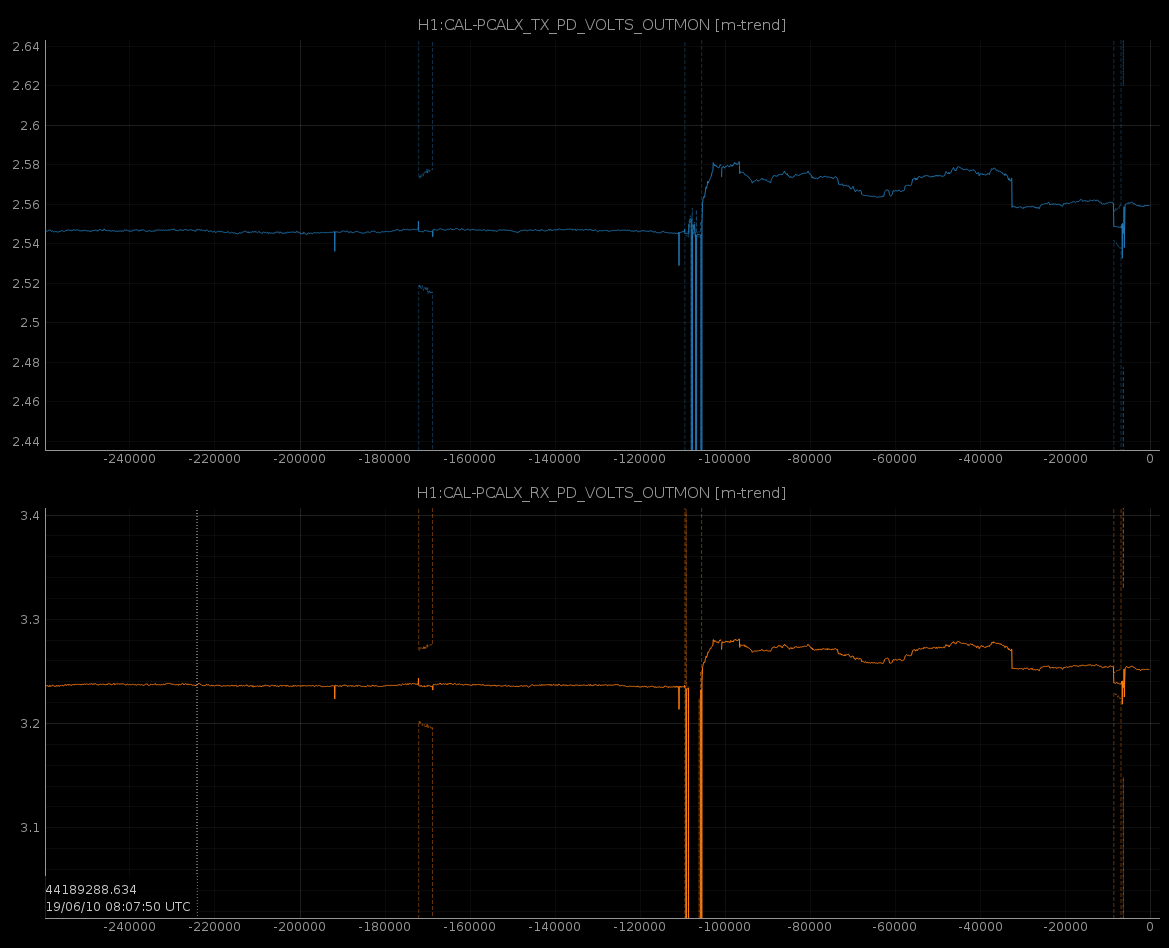
Reduced offset on PCALX medm screen from 3.7 to 3.1, the excitations were saturating the OFS. This seems to have solved the issue for now.
Now associated with FRS 13112.
TITLE: 06/12 Eve Shift: 23:00-07:00 UTC (16:00-00:00 PST), all times posted in UTC
STATE of H1: Commissioning
OUTGOING OPERATOR: Corey
CURRENT ENVIRONMENT:
Wind: 10mph Gusts, 6mph 5min avg
Primary useism: 0.03 μm/s
Secondary useism: 0.08 μm/s
QUICK SUMMARY: Commissioning efforts currently ongoing. Calm environment should help.
PT524 is still in error, this is a known issue.
Noticing that I did not post my DAY Shift Summary, so here it is (thought I'd just hop onto TJ's EVE transition):
TITLE: 06/12 Day Shift: 15:00-23:00 UTC (08:00-16:00 PST), all times posted in UTC
STATE of H1: Corrective Maintenance
INCOMING OPERATOR: TJ
SHIFT SUMMARY:
First 90min of shift was for Beckhoff recovery. Then it was fairly normal business afterwards.
LOG:
TITLE: 06/12 Day Shift: 15:00-23:00 UTC (08:00-16:00 PST), all times posted in UTC
STATE of H1: Corrective Maintenance
INCOMING OPERATOR: TJ
SHIFT SUMMARY:
First 90min of shift was for Beckhoff recovery. Then it was fairly normal business afterwards. Dropped out of Observing for Weekly Wed Calibration measurement followed by Commissioning which is still ongoing.
LOG:
~22:03 Seismon: Jenne noticed DIAG_MAIN gave note about "Seismon system not updating"
Open/Close FRS 13108---DaveB, can we reduce or elliminate these freezes?
C. Gray, J. Kissel

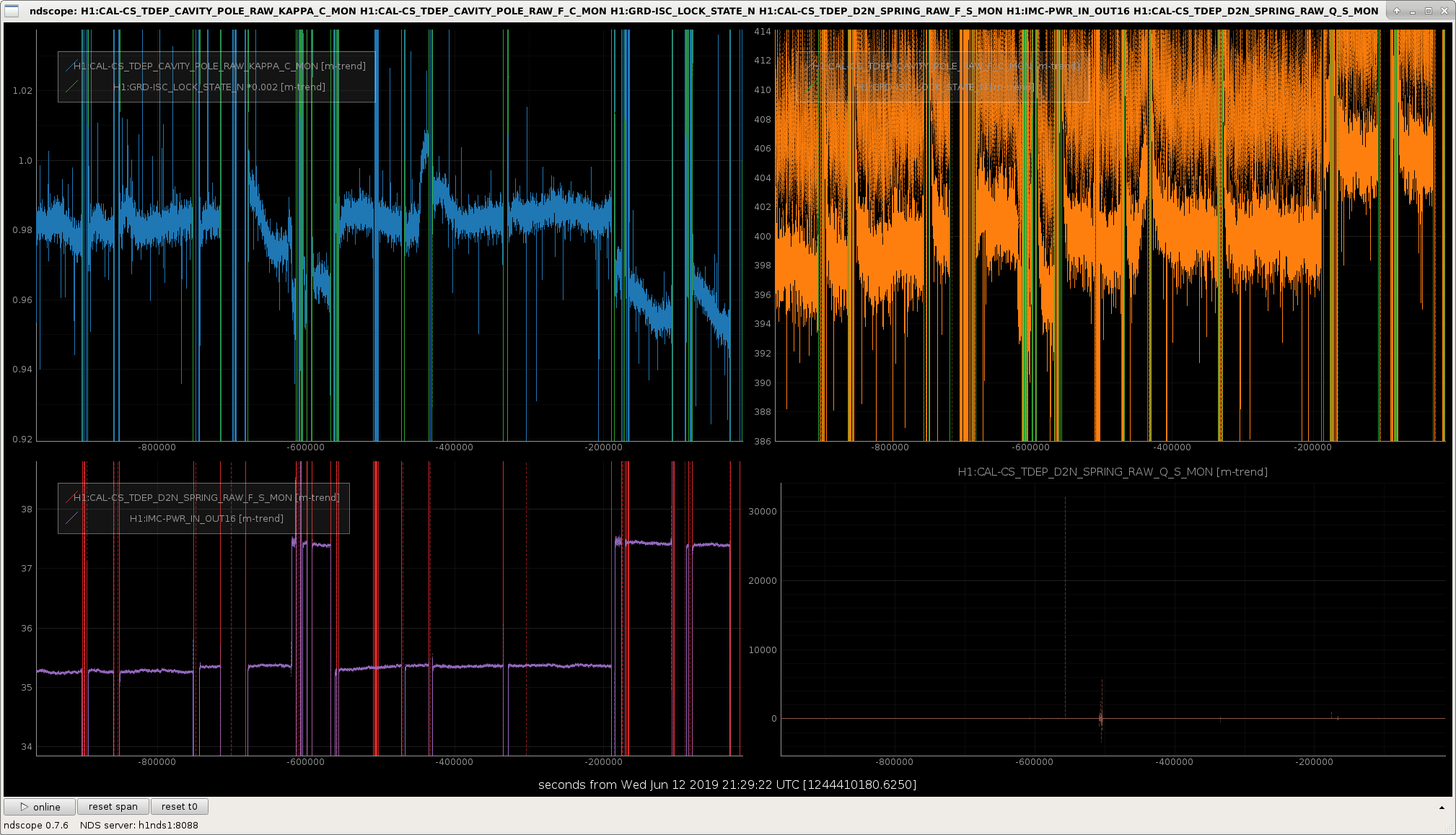
With Corey's help, we gathered regular calibration measurements of the sensing function today. This is the second sensing function measurement since we've (now permanently) powered up from ~35 W to ~37 W input into the IFO (see LHO aLOG 49783). Time dependent correction factors for the optical plant have shown a corresponding change -- namely that the optical gain has dropped from 0.98 to 0.96 the reference time w.r.t. to the optical gain at the reference time. The cavity pole appears to have improved a bit, changing from ~400 to 406, though this may have more to do with spot position change that corresponded to the power up than the power-up itself. (Both of these, compared against the input laser power, are shown in the attached ~1 week trend. Where the data is noisy, we are not observing, so mentally filter those out when you read the plot.)

Also, to continue the investigation as to whether the apparent acausality of detuned spring frequency response is nonsense or not (i.e. if its a result of L2A2L coupling in the actuator, rather than anything representative of what's really happening the with sensing function), we took the standard sensing function measurement set, a DARM OLG TF and a PCAL to DARM_IN1 sweep. But -- we gathered the PCAL sweep both with what we've been using as reference -- PCAL Y -- and also a sweep with PCAL X. The idea being, that if the PCAL spots are differently centered with respect to the IFO beam between the two PCAL excitations, the reported interferometer response may be different. This is not as good, but necessarily easier than moving the interferometer spot positions. For future analysis, it should be known that the A2L_SPOT position gains are identical for EX and EY, corresponding to a physical offsets of -16 mm in PIT (down, -Vertical) and 13 mm in YAW (in the +Trans direction).

Today's data was gathered by Corey, using instructions from LHO aLOG 49165, and he's saved those standard measurements are here:
/ligo/svncommon/CalSVN/aligocalibration/trunk/Runs/O3/H1/Measurements/FullIFOSensingTFs/
    2019-06-12_H1_DARM_OLGTF_LF_SS_5to1100Hz_15min.xml      # 1 / (1+G)
    2019-06-12_H1_PCALY2DARMTF_LF_SS_5t1100Hz_10min.xml     # C / (1+G) as measured by PCAL Y

The bonus measurements I grabbed are as follows:
    2019-06-12_H1_OMCDCPDSUM_to_DARMIN1.xml   # For converting from DARM_IN1 counts to mA on the DCPDs (roughly)
    2019-06-12_H1_PCALY2DARMTF_BB.xml         # For comparison with GDS

    2019-06-12_H1_PCALX2DARMTF_LF_SS_5t1100Hz_10min.xml     # C / (1+G) as measured by PCAL X
    2019-06-12_H1_PCALX2DARMTF_BB.xml         # for comparison with GDS

Leading up to today, here are the observation intent / analysis ready segments that are at 37W instead of 35W:
    2019-Jun-06 01:24:34 UTC to 08:16:22 UTC   -=- Brief observation segment at 37 W
    2019-Jun-10 23:55:38 UTC onward            -=- Start of continuous operation at 37 W

Note that we don't simply increase the laser power -- we also tune the angular and thermal control systems to account to compensate for this new amount of power in the IFO. Although we do not need to make any explicit changes to the DARM control loop, there will be cross-couplings and frequency response changes -- especially in the sensing function -- that will be impacted by these changes. The most obvious are what's mentioned above -- the 2% change in optical gain, and the slight increase in cavity pole frequency. In real time, we're sort of flying blind regarding the detuned SRC optical spring frequency, but analysis of these measurements should hopefully reveal interesting changes there as well.

Data processing and analysis to come.
To convert A2L_SPOT gains, e.g. H1:SUS-ETMX_L2_DRIVEALIGN_P2L_SPOT_GAIN, in to physical position, use the following simple matlab script
    /opt/rtcds/userapps/release/isc/common/scripts/decoup/BeamPosition/a2l_lookup.m
Time line of measurements for later comparison of broad band injections against GDS (all times on 2019-06-12 and UTC):
    20:01:03     DARM OLGTF
    20:17:07     PCAL Y SS
    20:28:28     PCAL Y BB
    20:30:33     PCAL X SS
    20:41:34     PCAL X BB
    20:44:38     Nominal Low Noise
    20:57:00     calibration done, commissioning starts.
Wednesday 24apr2019 - Monday 29apr2019: No restarts
Tuesday 30apr2019:
2019_04_30 11:50 h1broadcast0
Maintenance, updating DMT broadcaster channel list
Wednesday 01may2019 - Sunday 05may2019: No restarts
Monday 06may2019:
2019_05_06 13:54 h1nds1
2019_05_06 15:37 h1edc
2019_05_06 16:46 h1ascimc
2019_05_06 16:48 h1dc0
2019_05_06 16:48 h1fw0
2019_05_06 16:48 h1fw2
2019_05_06 16:48 h1nds0
2019_05_06 16:48 h1tw0
2019_05_06 16:48 h1tw3
2019_05_06 16:50 h1broadcast0
2019_05_06 16:50 h1fw1
2019_05_06 16:50 h1nds1
2019_05_06 16:50 h1tw1
2019_05_06 17:47 h1sysecatc1plc2sdf
2019_05_06 17:49 h1sysecatc1plc4sdf
Early maintenance. h1nds1 data offloading started, new h1ascimc model, code change to h1edc to stop disk access, associated DAQ restart, restarted stuck slow-controls-sdf.
Tuesday 07may2019: No restarts
Wednesday 08may2019:
Early morning corner station Dolphin crash. All corner station models restarts.
Thursday 09may2019:
2019_05_09 11:23 h1sysecatc1plc4sdf
2019_05_09 12:11 h1nds1
2019_05_09 12:12 h1nds1
Completed h1nds1 data offload. restarted another stuck slow-controls-sdf
Friday 10may2019 - Monday 03jun2019: No restarts
Tuesday 04jun2019:
2019_06_04 11:15 h1dc0
2019_06_04 11:15 h1edc
2019_06_04 11:16 h1broadcast0
2019_06_04 11:16 h1fw0
2019_06_04 11:16 h1fw1
2019_06_04 11:16 h1fw2
2019_06_04 11:16 h1nds0
2019_06_04 11:16 h1nds1
2019_06_04 11:16 h1tw0
2019_06_04 11:16 h1tw1
2019_06_04 11:16 h1tw3
2019_06_04 11:56 h1hpipumpctrlsdf
2019_06_04 11:58 h1sysecatc1plc1sdf
2019_06_04 11:58 h1sysecatc1plc2sdf
2019_06_04 12:00 h1sysecatc1plc3sdf
2019_06_04 12:00 h1sysecatx1plc1sdf
2019_06_04 12:02 h1sysecatx1plc2sdf
2019_06_04 12:02 h1sysecatx1plc3sdf
2019_06_04 12:02 h1sysecaty1plc1sdf
2019_06_04 12:03 h1sysecaty1plc2sdf
2019_06_04 12:03 h1sysecaty1plc3sdf
2019_06_04 12:07 h1pslopcsdf
2019_06_04 12:11 h1sysecatc1plc4sdf
2019_06_04 12:14 h1sysecatx1plc2sdf
2019_06_04 12:14 h1sysecaty1plc2sdf
2019_06_04 12:47 h1hpipumpctrlsdf
2019_06_04 15:49 h1hpipumpctrlsdf
Maintenance. DMT broadcaster channel update, new slow controls code, slow-controls-sdf updates, associated daq restart
Wednesday 05jun2019 - Monday 10jun2019: No restarts
Tuesday 11jun2019:
2019_06_11 10:07 h1iopsush2a
2019_06_11 10:07 h1susmc1
2019_06_11 10:07 h1susmc3
2019_06_11 10:08 h1suspr3
2019_06_11 10:08 h1susprm
2019_06_11 10:20 h1susitmx
2019_06_11 10:20 h1susitmy
2019_06_11 10:44 h1susitmx
2019_06_11 10:44 h1susitmy
2019_06_11 10:52 h1susetmy
2019_06_11 11:20 h1susetmx
2019_06_11 11:25 h1broadcast0
2019_06_11 11:25 h1dc0
2019_06_11 11:25 h1fw0
2019_06_11 11:25 h1fw1
2019_06_11 11:25 h1fw2
2019_06_11 11:25 h1nds0
2019_06_11 11:25 h1nds1
2019_06_11 11:25 h1tw0
2019_06_11 11:25 h1tw1
2019_06_11 11:25 h1tw3
Mainteance. recover h1sush2a from crash. New quad sus models, associated DAQ restart.
Arnaud, Saravanan
Hanford (H1) HAM4-5 ISI contributions to suspoint length (DOF)
This alog is the extension of the study we have carried out on L1 data for "HAM4-5 ISI contributions to length suspoint motion" (46407 & 46470). We could conclude for L1 suspensions that, below (300mHz) suspoint length motion is limited by horizontal motion of the platform ('Y' DOF) during day and night times. But above that frequency, motion is limited by 'Rx' (tilt) motion during night times, and limited by 'Y' (horizontal motion) during day times.
We ended with, in order to improve the suspoint length motion >1Hz, we would need to both improve the Y and Rx motion of the platform.
Similar study on H1 data shows that at low frequencies (<300mHz) suspoint length motion is limited by horizontal motion in 'Y' DOF (as L1) but above that the motion is only limited by 'Rx' (tilt) (day & night). Only for SR2 we have seen some contribution of 'Rz' from 3-5Hz from HAM4. Refer attached pdf1, pdf2 and pdf3 for SR2, SR3 & SRM suspensions.
For this study we have considered data during low & high anthropogenic noise (30th May 1:00 A.M PT & 1st June 1:00 P.M PT) and also considered transformation matrices (cart2eul) from H1-HAM-ISI's (HAM4 & HAM5). Time epochs for this data show considerable variations in seismic bands (summary pages quiet & noisy) during day & night times, hence used for analysis.


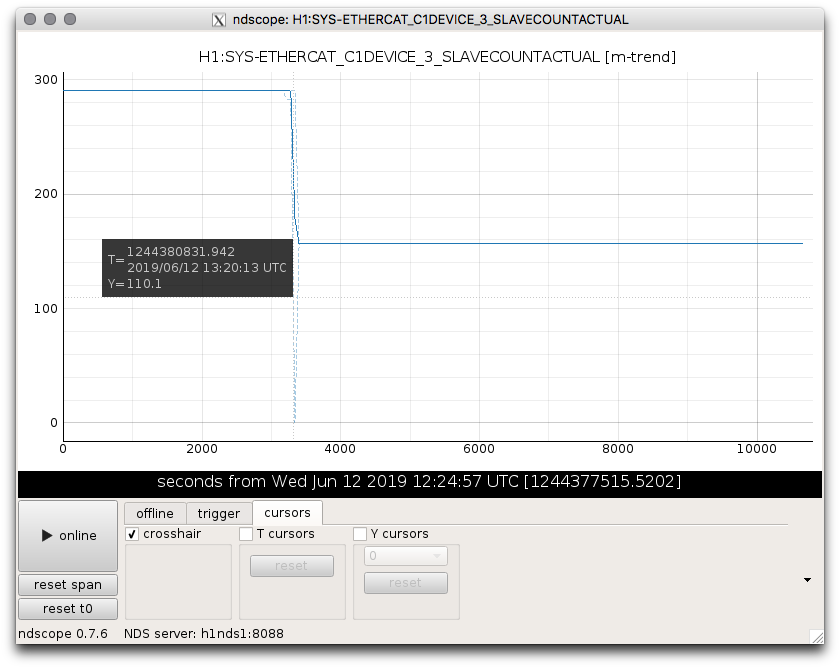
h1ecatc1 C1_PLC1_Device3 is under reporting its slave count (actual = 156, configured = 291).

We lost the units around 13:20 UTC (06:20 PDT)
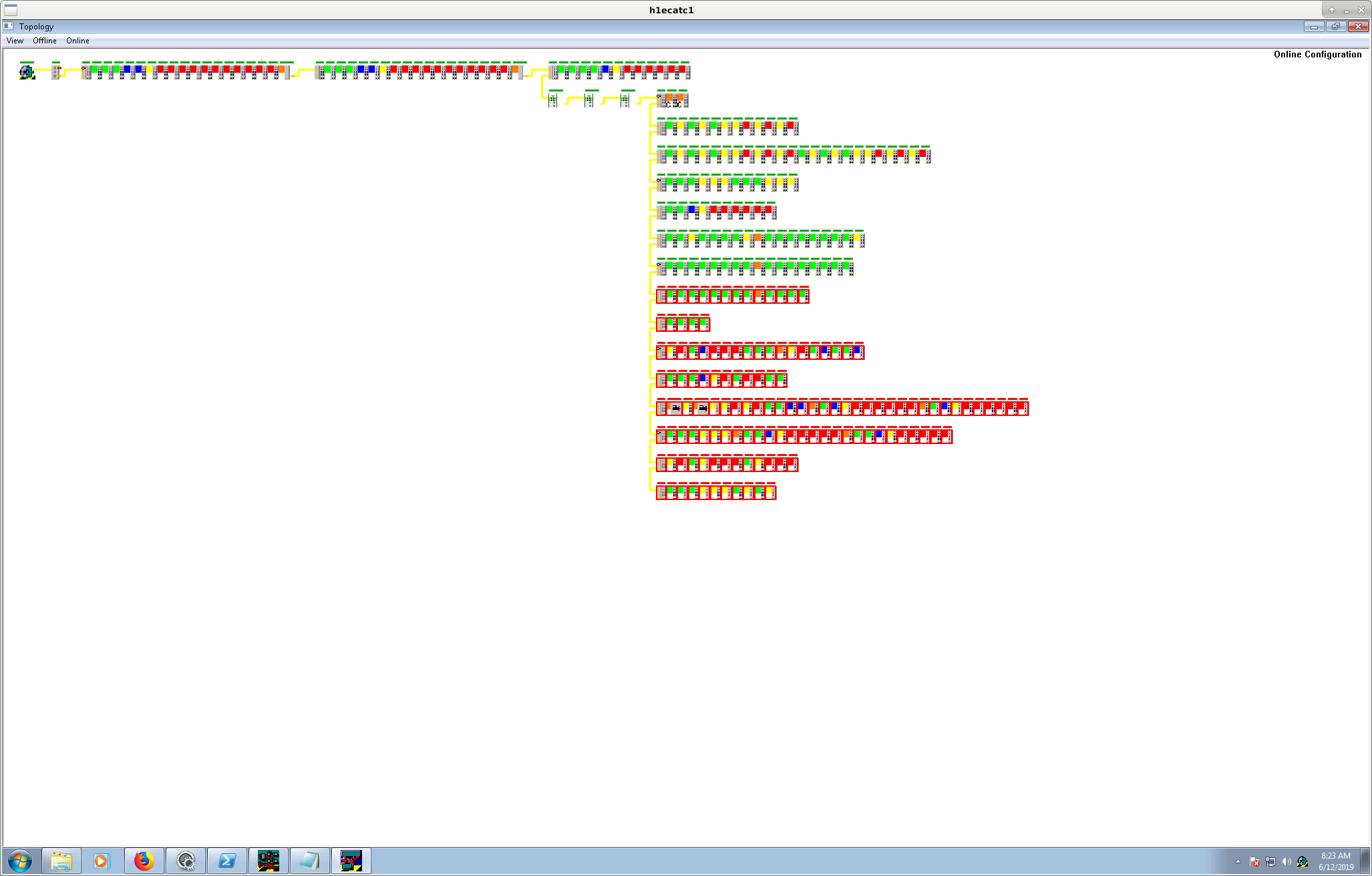
Connection between corner chassis 4 L0 and M0 has failed. The first red block in the topology screenshot is corner chassis 4 M0 (EK1100).
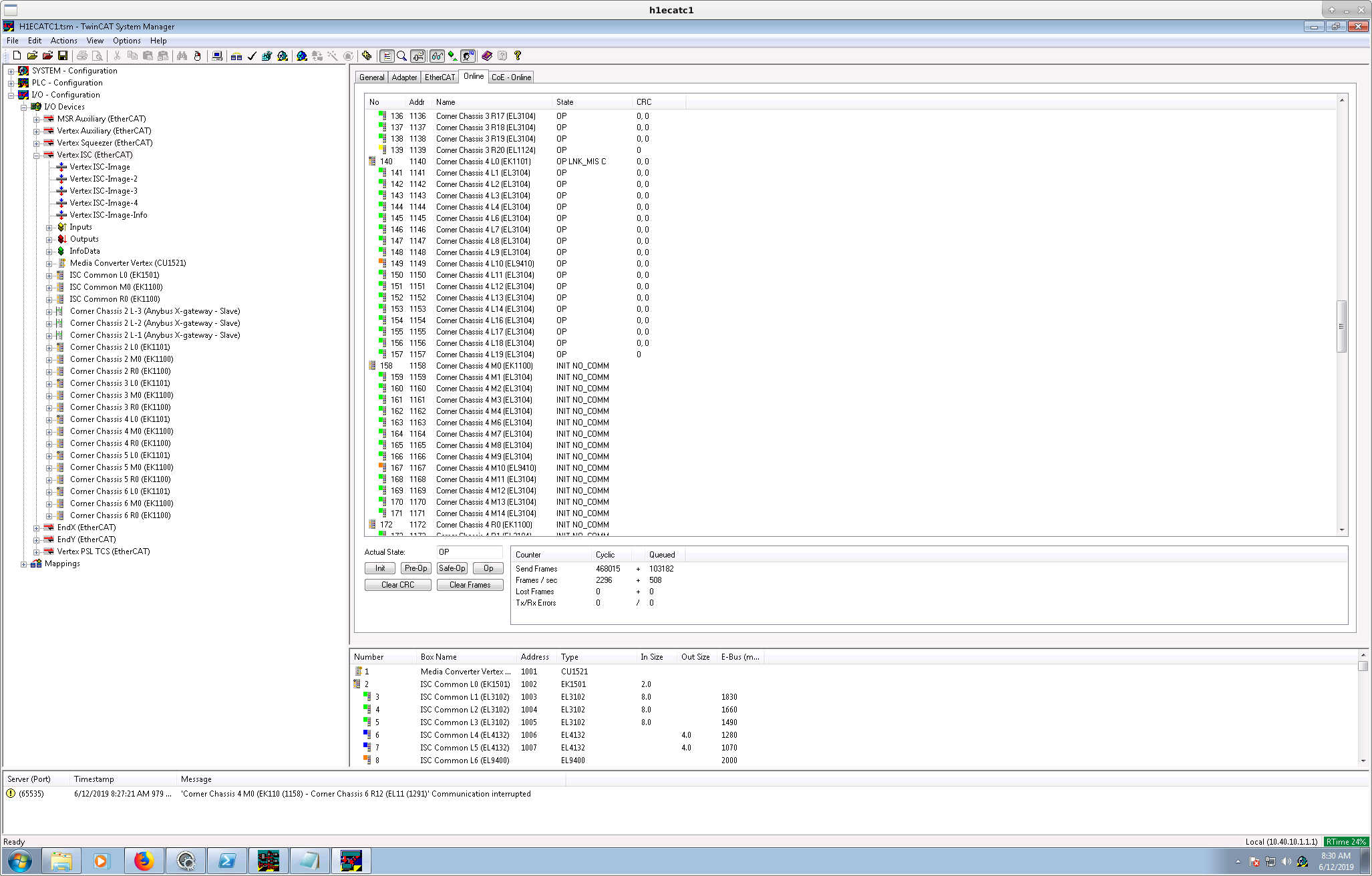
Patrick and Corey are working the problem.
The time for the error Dave mentions above coincides with the H1 Lockloss (and issues with IMC) at 13:21utc (6:21amPDT).
Patrick has tracked this down to the Corner Chasis 4 in the CER and says this may need to get pulled. Fil has been notified and will work with Patrick.
For something like this which might have taken H1 down, should this be a Verbal Alarm? (only way an operator would know about this issue is to happen to catch the red box on the CDS Overview (which we both didn't notice).
[Attached is the RED box on the CDS Overview.]
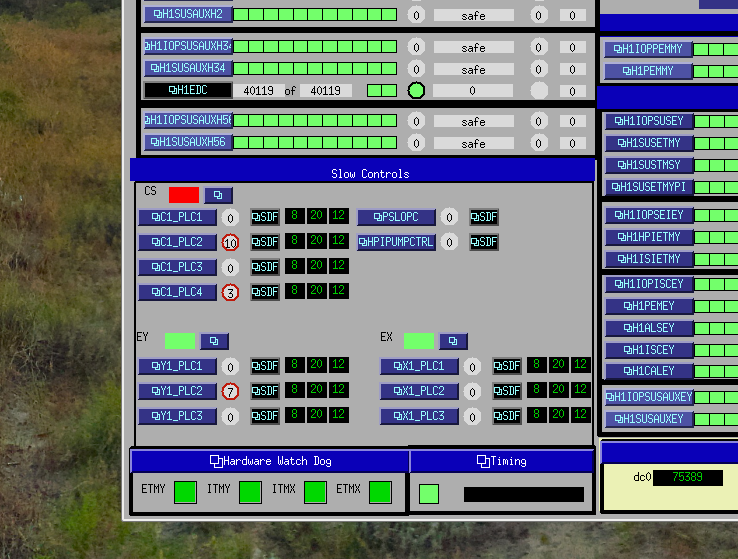
FRS Ticket submitted: #13049.
https://services.ligo-la.caltech.edu/FRS/show_bug.cgi?id=13049
So far down time is 3.5hrs, but now I need to try locking.
Side Note: Alog would not let me link the FRS ticket to the text of "13049" above. 
EK1100 EtherCAT Coupler failed and replaced. Unit was scanned and communication errors have cleared.

We did noticed a buzzing sound coming from one of the terminals. Tried various combinations of powering off different components to isolate noisy terminal(s), but decided to reinstall unit to get IFO back up.

Corner 4 Slow Controls Chassis S1107450

F. Clara, P. Thomas
On the CDS Overview MEDM, if there is a Beckhoff hardware error the slow controls banner will turn RED for better visibility. I simulated a C1PLC1 error to demonstrate (see attachment).
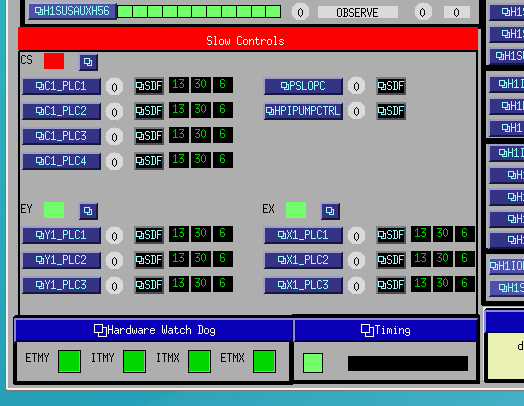
All in all this cost us about 5 hours. See e.g. https://ldas-jobs.ligo.caltech.edu/~detchar/summary/day/20190612/ .
This FRS ticket (13049) is now CLOSED/RESOLVED.
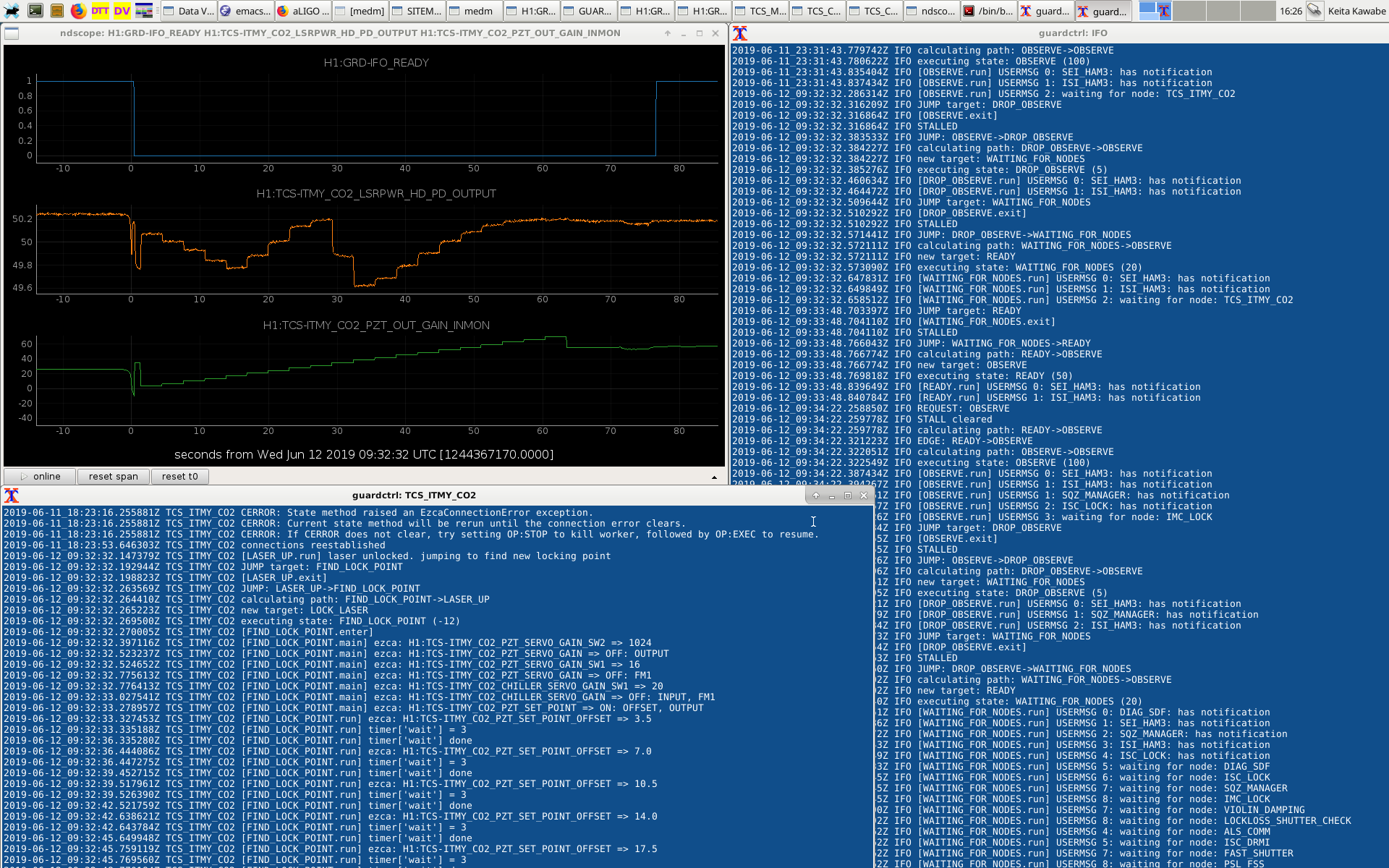
We were just knocked out of observing by some SDF difference in TCS. Not sure what it was, I can't find the link to the screen on the SDF overview and it resolved itself before I could get any where.
TCSY CO2 ISS unlocked and the guardian did its auto-relocking thing.
Summary: IFO running at 37 W PSL input. ETM ring heaters increased to avoid PI ring ups (so far, successful). LSC FF measurements done. CAL sensing function measurements done. (Note: New feedforward filters are not installed, I've just taken measurements for the fits).
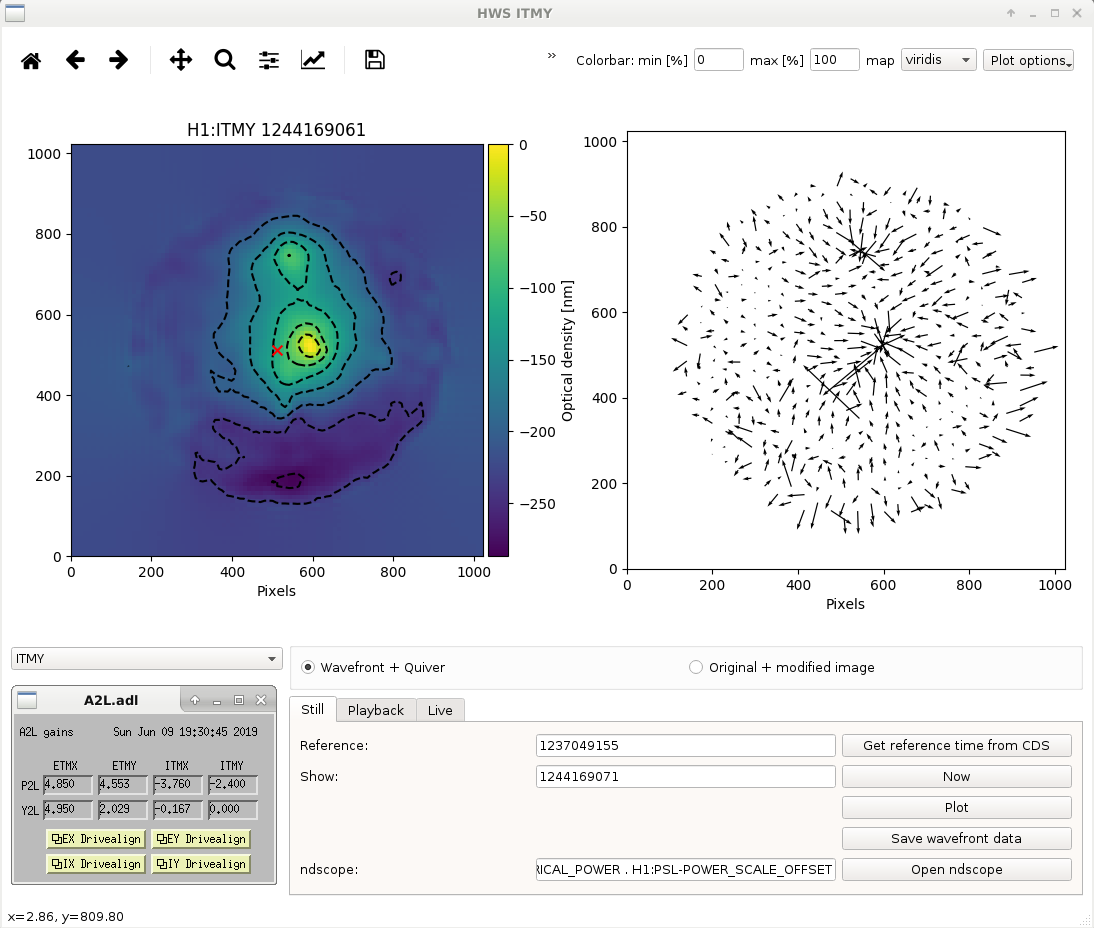
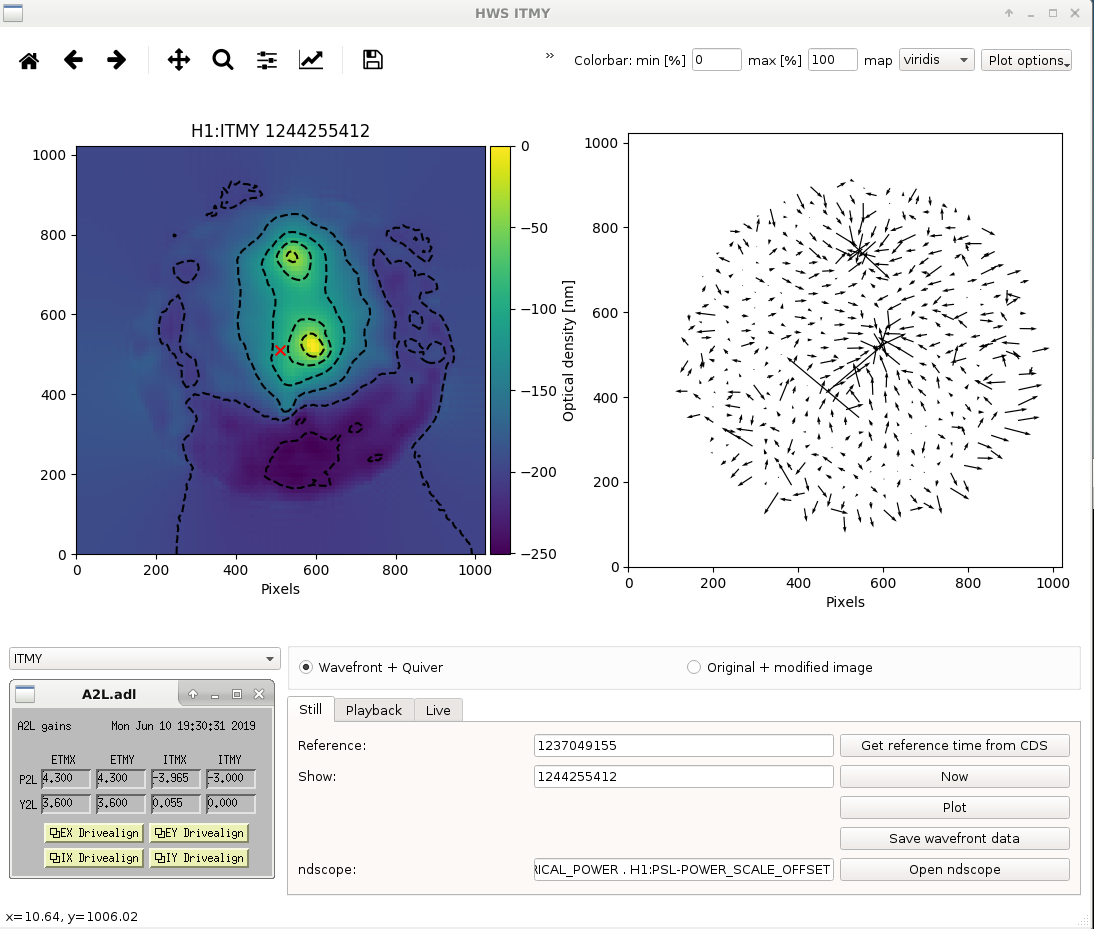
I took a quick look at the ITMY HWS, comparing last night's lock (first attachment) and today's lock (second attachment). Last night we had 35W input power, today we have 37W and new spot positions (A2L gains shown in the attachments).
The two point absorbers are clearly visible in the contour and quiver plots. It looks like with the updated spot positions we might have moved further from the main absorber and are sitting between it and the smaller absorber above it. This seems consistent with the ITMY P2L gain being further from zero.
The other Hartmanns are not as clear as ITMY.
Sensing function measurements have been saved and committed to here:
    /ligo/svncommon/CalSVN/aligocalibration/trunk/Runs/O3/H1/Measurements/FullIFOSensingTFs/
        2019-06-10_H1_DARM_OLGTF_LF_SS_5to1100Hz_15min.xml
        2019-06-10_H1_PCAL2DARMTF_LF_SS_5t1100Hz_10min.xml
