Displaying reports 40801-40820 of 88905.Go to page Start 2037 2038 2039 2040 2041 2042 2043 2044 2045 End
Reports until 12:12, Friday 31 May 2019
H1 ISC
sheila.dwyer@LIGO.ORG - posted 12:12, Friday 31 May 2019 - last comment - 18:24, Tuesday 04 June 2019(49581)
offloading green WFS in each lock

Yesterday Jenne changed the normal path we take for the ALS ARM guardians so that green WFS are run to both TMS and the ETM in the normal locking sequence.  

Today while Jenne and Georgia are working on the ISS 2nd loop AC coupling, I made some states that can offload the alinment from the WFS to the sliders after the green WFS run.  I've tested it a few times for both arms, and it seems to work well, so I've changed the request in LOCKING_ARMS_GREEN to offload this alignment.  This will make LOCKING_ARM_GREEN take a bit longer, but it should help us to be better able to relock the arms after a lockloss, since we will keep the green alignment that worked in the previous acquisition sequence.  

This can be reverted by changing lines 628 and 629 in ISC_LOCK to:

        nodes['ALS_XARM']  = 'LOCKED_SLOW_WFS_ETM_TMS' 
        nodes['ALS_YARM']  = 'LOCKED_SLOW_WFS_ETM_TMS'

Note:  I've reverted this, because the guardian was moving on too quickly and trying to offload before the WFS had really run.  We added a convergence check, but haven't put the offloading back in the normal path yet.
Comments related to this report
sheila.dwyer@LIGO.ORG - 18:24, Tuesday 04 June 2019 (49663)

This is now working.  

H1 SEI
yannick.lecoeuche@LIGO.ORG - posted 09:50, Friday 31 May 2019 (49577)
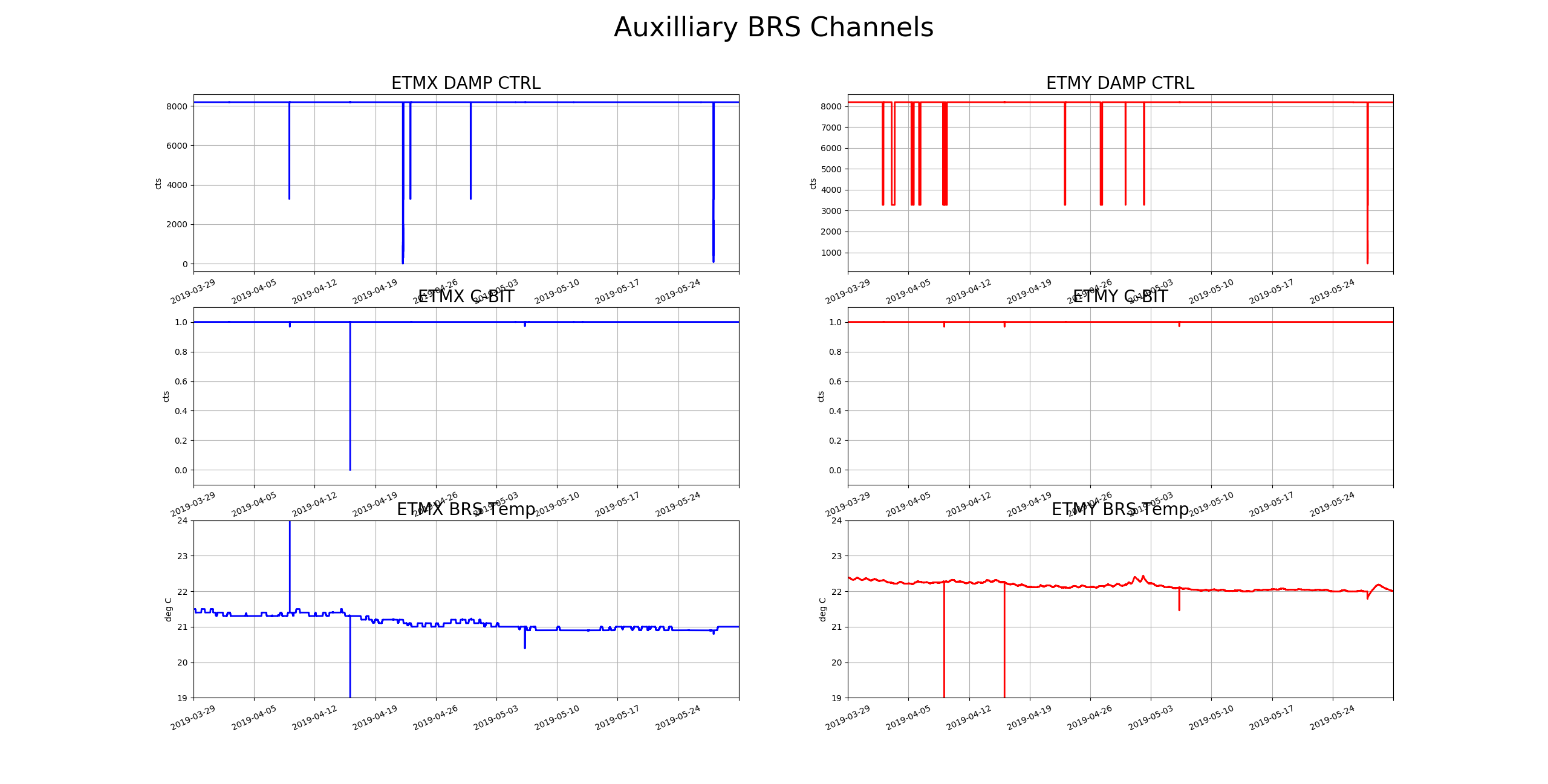
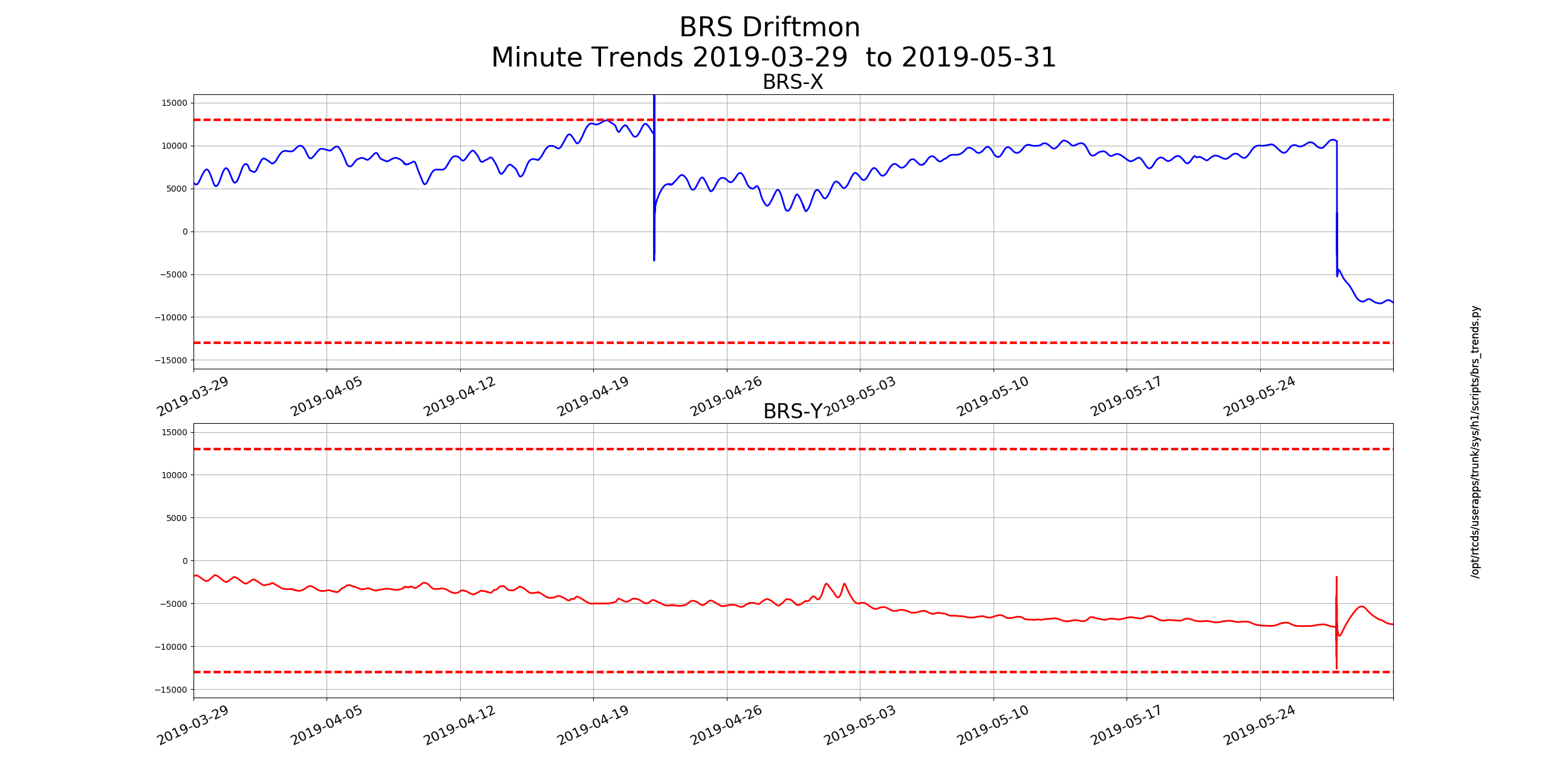
BRS Trends

Despite an adjustment on Tuesday, neither of the BRS's look like they are centered that much better. However, both are safely within the warning thresholds.

Images attached to this report
H1 General
yannick.lecoeuche@LIGO.ORG - posted 08:54, Friday 31 May 2019 (49574)
Ops Day Shift Transition

Ops Shift Transition: 05/31/2019, Day Shift 15:00 – 23:00 (08:00-16:00) - UTC (PT)

State of H1: Locked

Intent Bit: Observing

Weather: Low wind, clear sky

Primary 0.03 – 0.1Hz: 0.01 um/s

Secondary 0.1 – 0.3Hz: 0.1 um/s

Outgoing Operator: Travis

Quick Summary: Locked and Observing for 5.5 hours, through some strong EQ's. Not much seismic activity/wind currently

H1 General
travis.sadecki@LIGO.ORG - posted 08:00, Friday 31 May 2019 - last comment - 10:07, Monday 17 June 2019(49570)
Ops Owl Shift Summary

TITLE: 05/31 Owl Shift: 07:00-15:00 UTC (00:00-08:00 PST), all times posted in UTC
STATE of H1: Observing at 111Mpc
INCOMING OPERATOR: Niko
SHIFT SUMMARY:  No issues to report after relocking.  Rode through several EQs without issue.
LOG:

7:29 GRB alert but we were unlocked at the time

7:50 Started initial alignment.  Relocking seemed to be going well after the lockloss, getting past DRMI a couple of times, then things started to walk off.

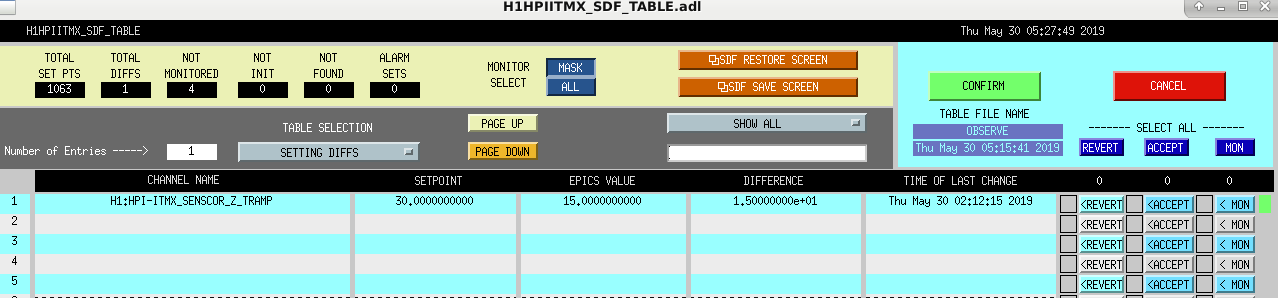
9:41 Back to Observing

10:23 SEI_CONF taken to EARTHQUAKE in response to 6.1 Mag EQ in Palau

11:57 5.8 Mag EQ in Mexico.  We were still in EARTHQUAKE mode for SEI, so we survived.  LLO did not.

12:02 GRB alert

13:01 GRB alert

13:38 GRB alert

14:00 SEI_CONF returned to WINDY

Comments related to this report
jeffrey.kissel@LIGO.ORG - 10:07, Monday 17 June 2019 (49983)DetChar, SEI
Tagging @DetChar and SEI for data in seismic's sensor correction configuration transition studies.
H1 General
travis.sadecki@LIGO.ORG - posted 02:42, Friday 31 May 2019 (49571)
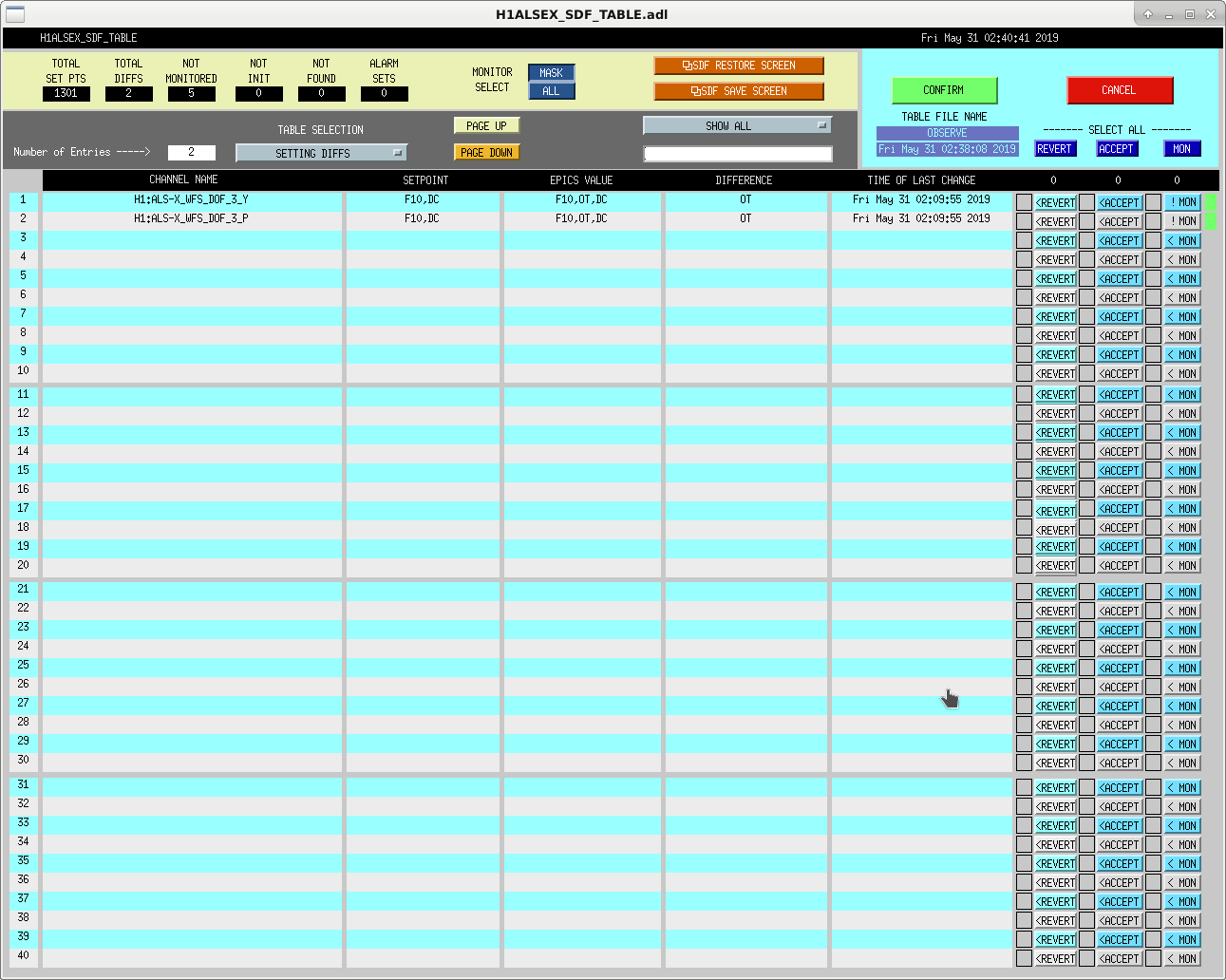
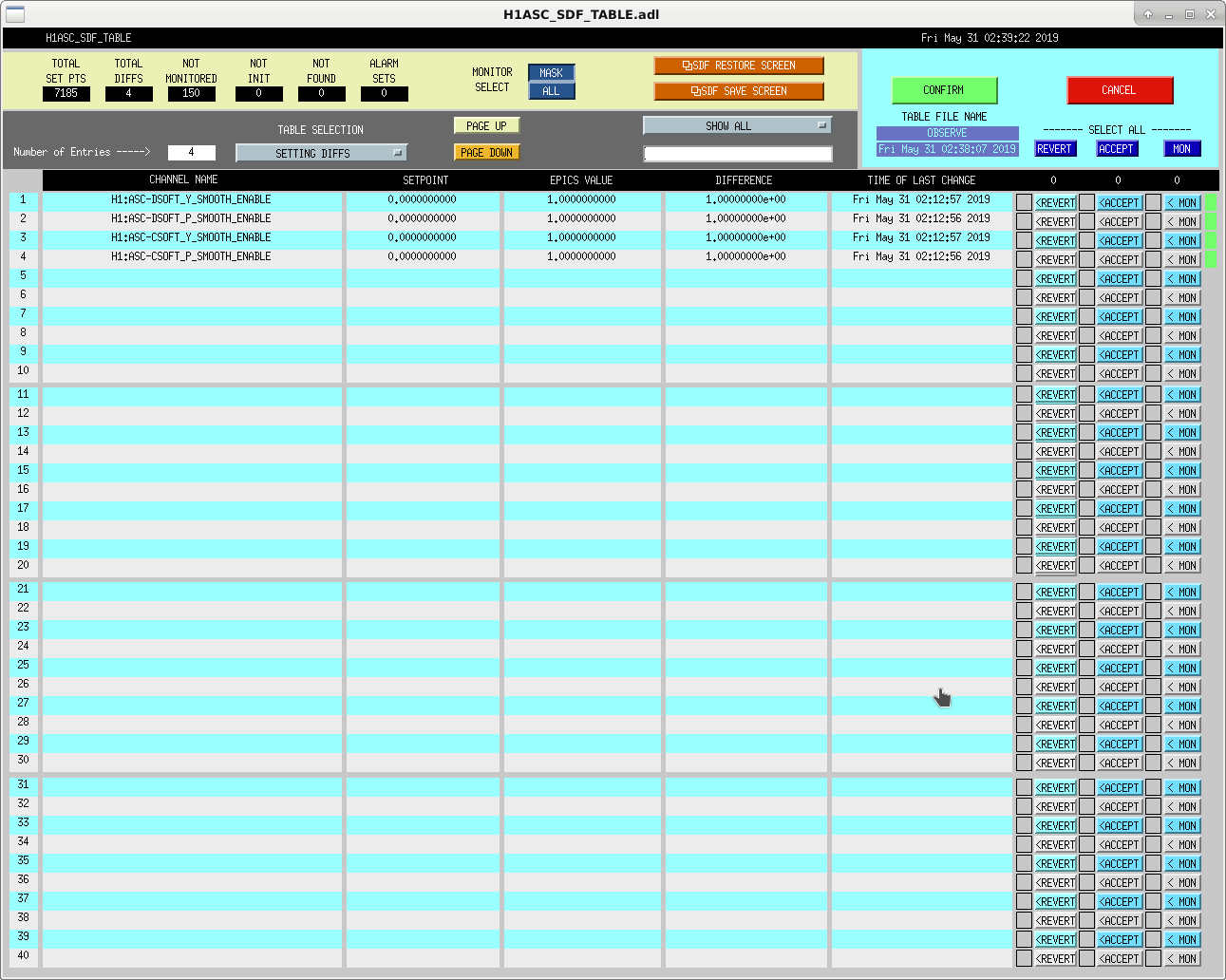
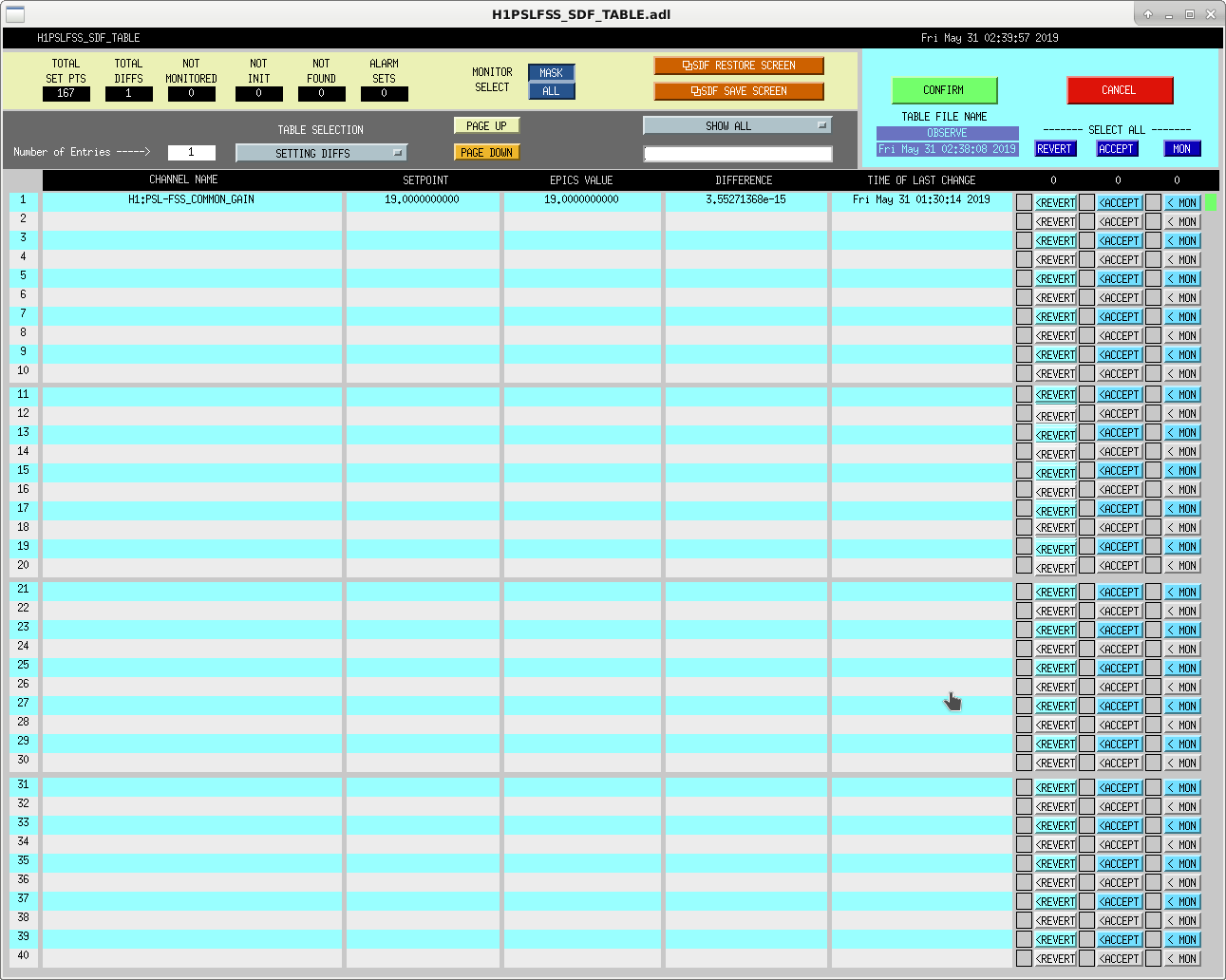
Observing at 9:41 UTC

Relocking took longer than usual, mostly waiting for various stages of ASC and SOFT loops to converge (some of them were WAY out).  Screenshots of SDF diffs accepted attached.

Images attached to this report
H1 General
travis.sadecki@LIGO.ORG - posted 00:03, Friday 31 May 2019 - last comment - 00:26, Friday 31 May 2019(49567)
Ops Owl Shift Transition

TITLE: 05/31 Owl Shift: 07:00-15:00 UTC (00:00-08:00 PST), all times posted in UTC
STATE of H1: Lock Acquisition
OUTGOING OPERATOR: Patrick
CURRENT ENVIRONMENT:
    Wind: 9mph Gusts, 7mph 5min avg
    Primary useism: 0.01 μm/s
    Secondary useism: 0.11 μm/s
QUICK SUMMARY:

Lockloss 1 minute before my shift actually started.  Cause unknown. 


Comments related to this report
travis.sadecki@LIGO.ORG - 00:26, Friday 31 May 2019 (49569)

Porcupine and baby spotted nibbling on the rose bushes near the back patio.

Images attached to this comment
LHO General
patrick.thomas@LIGO.ORG - posted 00:03, Friday 31 May 2019 (49568)
Ops Eve Shift Summary
TITLE: 05/30 Eve Shift: 23:00-07:00 UTC (16:00-00:00 PST), all times posted in UTC
STATE of H1: Lock Acquisition
INCOMING OPERATOR: Travis
SHIFT SUMMARY: Lock loss at very end of shift. Cause not apparent. Briefly taken out of observing by squeezer near end of shift. SQZ_MANAGER then had user message: 'green power stabilization railed'. Log had it printed at 06:15 UTC. Dust alarm in vacuum prep lab near start of shift. 
LOG:

22:54 UTC Kyle back from mid Y
06:14 UTC Knocked out of observing by squeezer
06:16 UTC Squeezer automatically relocked. Back to observing.
06:58 UTC Lock loss
LHO General
patrick.thomas@LIGO.ORG - posted 20:00, Thursday 30 May 2019 (49566)
Ops Eve Mid Shift Status
Have remained locked and in observing. No issues.
H1 PSL (ISC, PSL)
georgia.mansell@LIGO.ORG - posted 18:44, Thursday 30 May 2019 - last comment - 13:32, Friday 31 May 2019(49564)
Why can't we AC couple the ISS in lock?

Keita, Georgia, Jenne, Sheila

We spent a bit of time today investigating the lockloss which occurred when we tried to re-AC couple the ISS second loop. During lock acquisition the second loop is engaged with its AC coupling servo on. Then in LASER_NOISE_SUPPRESSION we DC couple it, by holding the output of the AC coupling servo. In order to increase the input power to the IFO once we've already reached nominal low noise, we need to be able to re-engage the AC coupling servo, which it turns out is very fiddley.

In December last year Stefan cleaned up a guardian state to do this, it worked then when he tried it with the IMC. What this state actually does is:

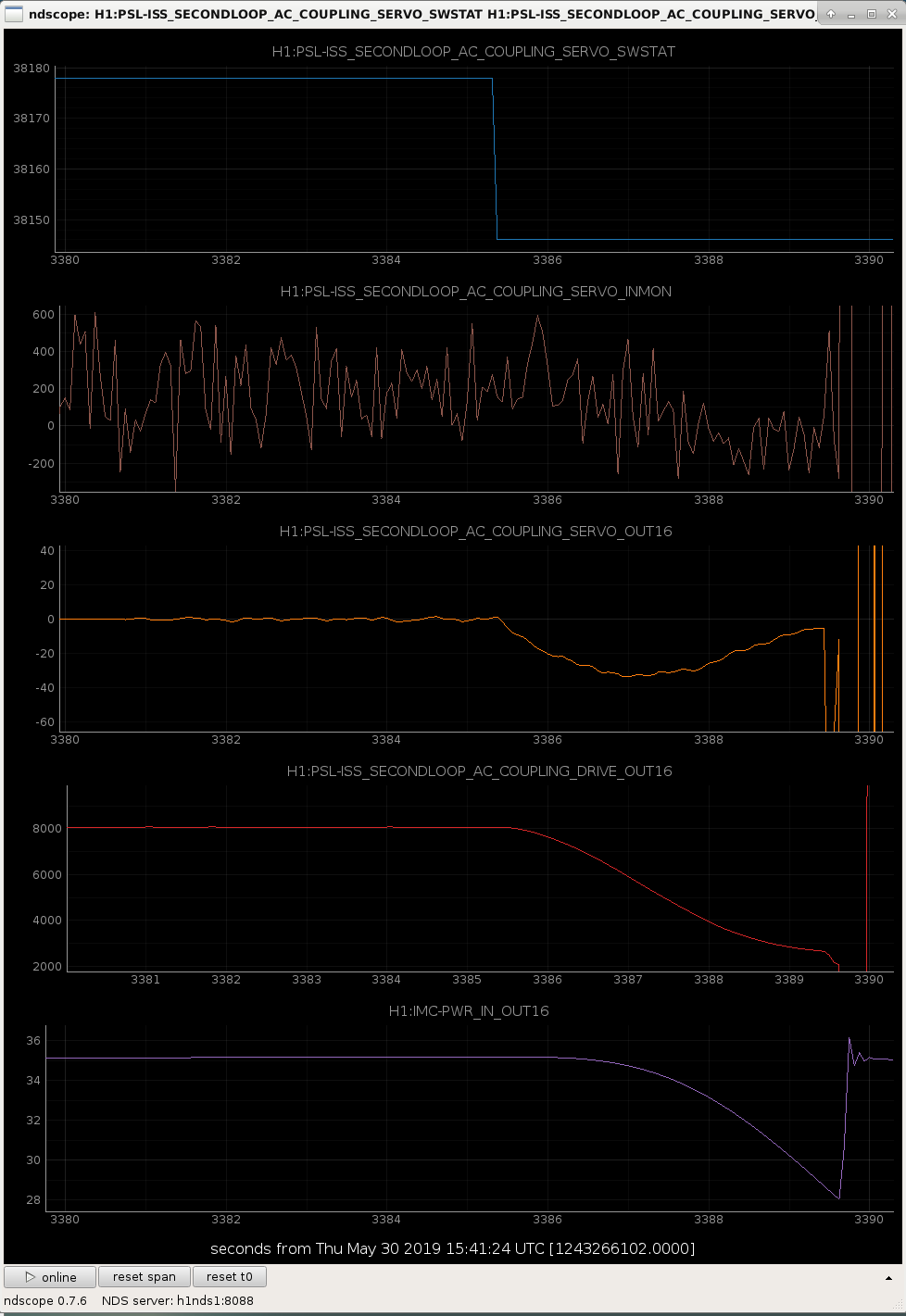
Checking out the guardian log (first attachment), today we survived the first 3 steps, but lost lock straight after the 4th step of turning off FM6 to actually AC couple the loop. Keita did some sleuthing and found out why. There appears to be an offset on the input to the AC_COUPLING_SERVO (brown trace in second attachment). When we turn off FM6 (blue trace shows the switch stat), the output of this servo (orange) is changes to make the input zero. Unfortunately this drive to the AC couple servo causes a large change in the output of the AC coupling drive (red), and coupled to the ISS first loop, driving the IFO input power down.

Tomorrow we want to step through the guardian state by hand and manually add offsets (eg to the SECONDLOOP_EXCITATION_OFFSET channel) to bring the AC_COUPLING_SERVO input closer to zero before turning off FM6. If that works by hand we can add another adding-offsets-to-drive-something-to-zero type servo to the guardian.

Images attached to this report
Comments related to this report
daniel.sigg@LIGO.ORG - 09:08, Friday 31 May 2019 (49575)

I seem to remember there is also an output offset which depends on the gain slider.

jenne.driggers@LIGO.ORG - 10:55, Friday 31 May 2019 (49579)

It looks like we do increase the second loop's output gain slider when we DC couple / do the LASER_NOISE_SUPPRESSION state, so we should bring that back down by 5dB to be the same settings as when we originally did the DC coupling.

Images attached to this comment
jenne.driggers@LIGO.ORG - 13:32, Friday 31 May 2019 (49583)

[Georgia, Jenne]

We tried to run the AC coupling state as Georgia writes above, doing each step by hand, including reverting the output gain slider as Daniel suggests.  This time, turning off the FM6 worked fine, but we lost lock when we turned the reference servo back on. We realized that when the ISS gets DC coupled, the reference servo's gain is significantly increased, by changing the value of the input matrix from 0.5 to 125.  So, when we were re-engaging this servo but the ISS was AC coupled, this reference servo had 200x too much gain.  We now have the gain set back to the lower value in the AC coupling state, and have been able to successfully go back and forth between DC and AC coupling in an IMC-only state at 35W. 

We also noticed that there was a 20 second sleep between turning off FM6 (which has a 15 sec ramp time) and engaging the reference servo, and during this time the diffracted power was going concerningly close to zero.  It seems that this wait should be non-zero, but not that long.  We tried once with a 5 second wait, and that seemed better, so we've shortened it down to 1 second. 

We believe that we should be able to re-AC couple the ISS once at full power now.  (Although, we've thought that before....)

H1 General
yannick.lecoeuche@LIGO.ORG - posted 16:12, Thursday 30 May 2019 (49563)
Shift Summary - Day

TITLE: 05/30 Day Shift 15:00 – 23:00 (08:00-16:00), all times posted in UTC

STATE of H1: Observing

INCOMING OPERATOR: Patrick

SHIFT SUMMARY: Lost lock around 16:00 UTC trying to get to a state where we can raise the power to 40W. Relocked and went to 40W but saw an ADS line starting to drift away from 0 and went back to 35W. Transitioned to Observing, and have been so for 4 hours.

LOG:

15:00 (08:00) Start of shift

15:29 (08:29) Richard, contractors to MX, maybe outside EX

16:09 (09:09) Lockloss trying to get to a state where we can raise power to 40W

16:44 (09:44) Pep to E-bay -- move magnetometers

16:51 (09:51) Pep back from E-bay

17:02 (10:02) Sheila to LVEA -- check frequency plugin

17:12 (10:12) Kyle to MY -- measuring hole locations

17:31 (10:31) Vanessa to MX

18:31 (11:31) Kyle back from MY

19:14 (12:14) Going into Observing

20:37 (13:37) Kyle to MY -- continue work

21:28 (14:28) Jason and Ed to MY

21:52 (14:52) Jason and Ed back from MY

23:00 (15:00) End of shift

LHO General
patrick.thomas@LIGO.ORG - posted 16:08, Thursday 30 May 2019 (49562)
Ops Eve Shift Transition
TITLE: 05/30 Eve Shift: 23:00-07:00 UTC (16:00-00:00 PST), all times posted in UTC
STATE of H1: Observing at 109Mpc
OUTGOING OPERATOR: Niko
CURRENT ENVIRONMENT:
    Wind: 16mph Gusts, 13mph 5min avg
    Primary useism: 0.02 μm/s
    Secondary useism: 0.09 μm/s 
QUICK SUMMARY:

No immediate issues.
H1 PEM (SEI, SYS)
laurence.datrier@LIGO.ORG - posted 15:28, Thursday 30 May 2019 - last comment - 15:19, Wednesday 05 June 2019(49542)
H1 down time due to wind

Laurence Datrier, Sheila Dwyer


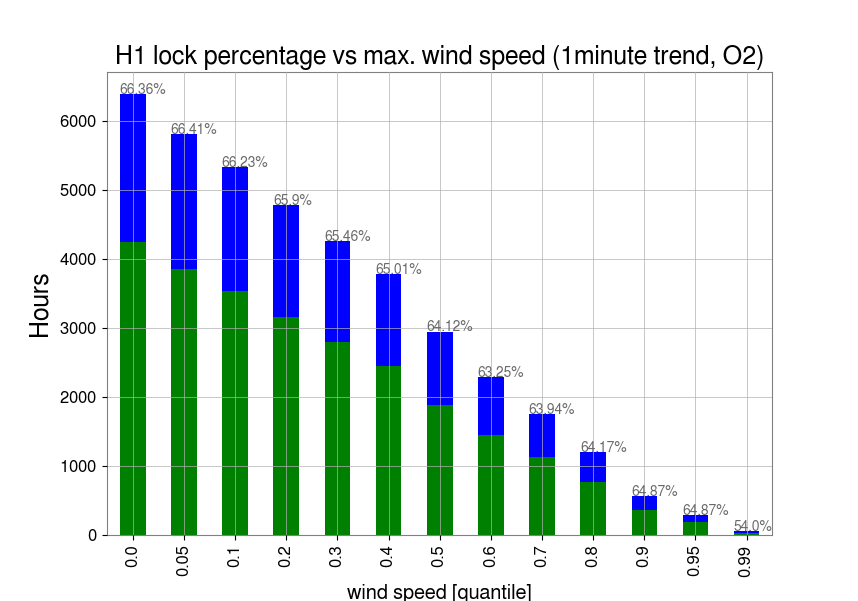
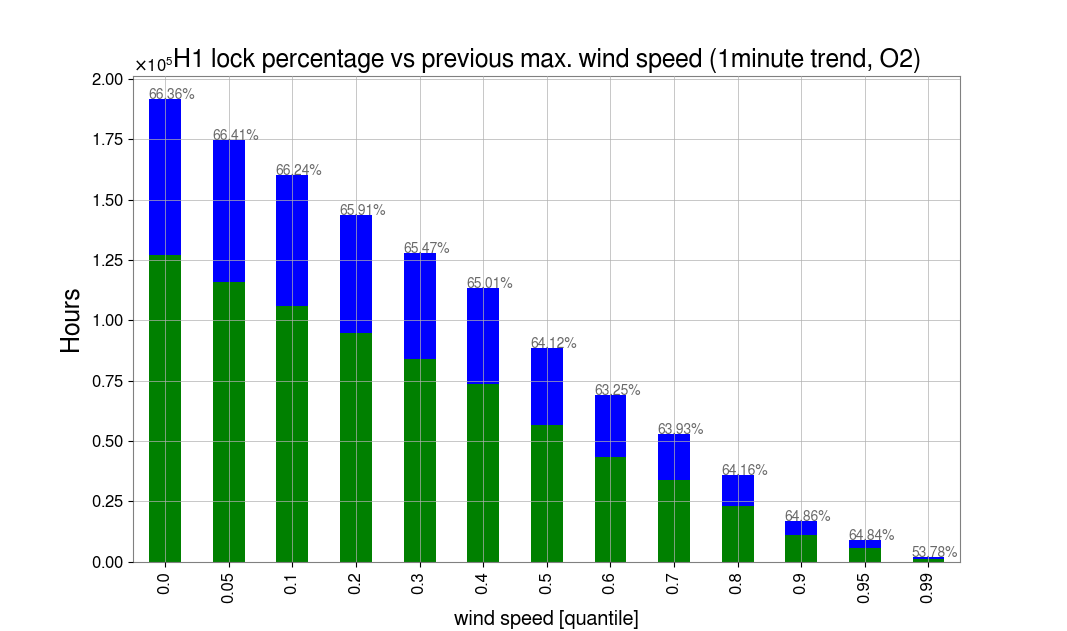
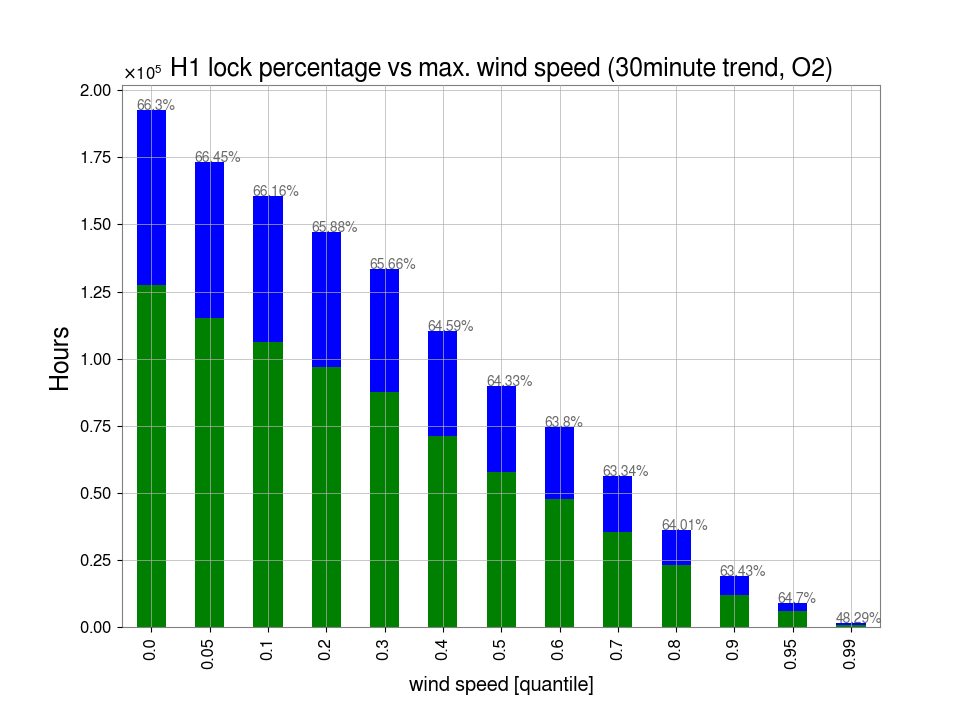
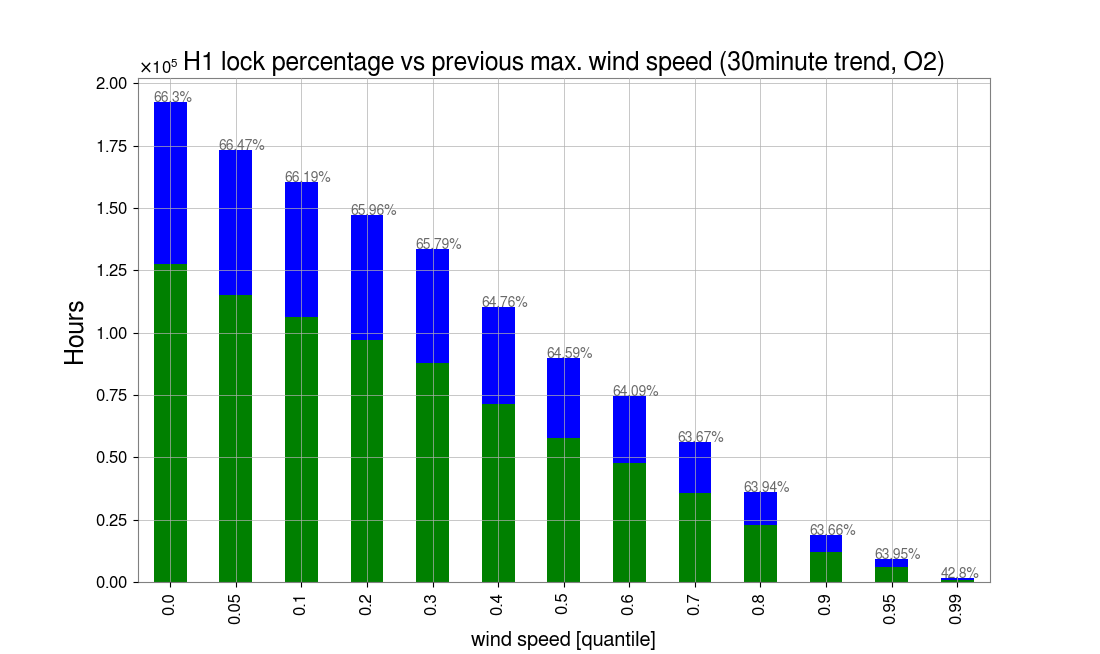
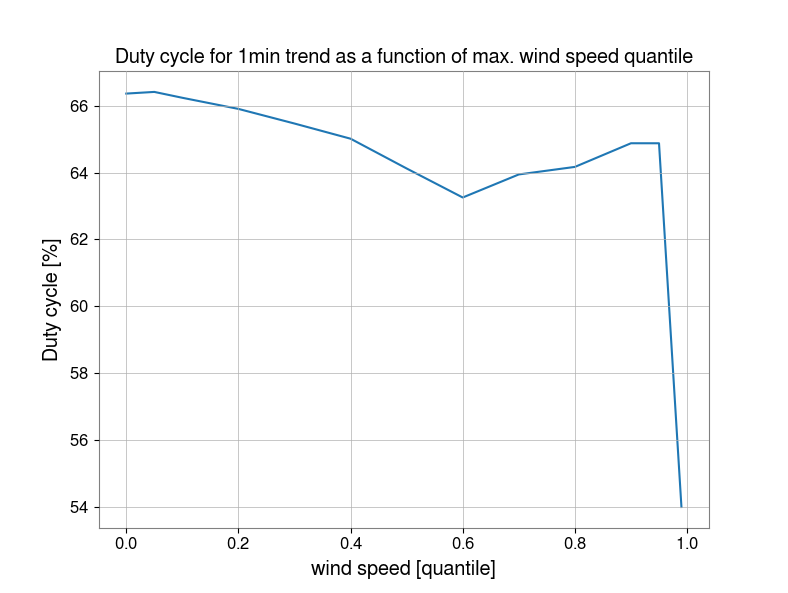
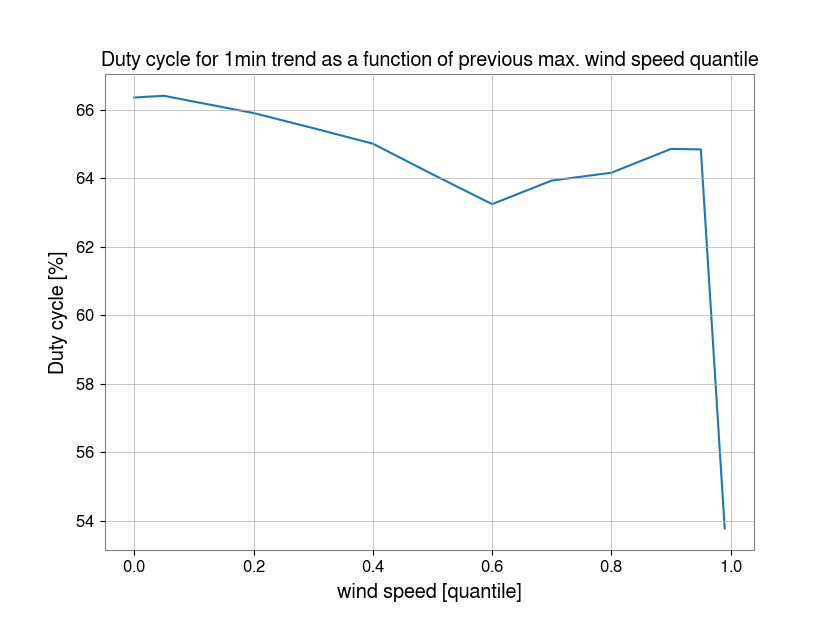
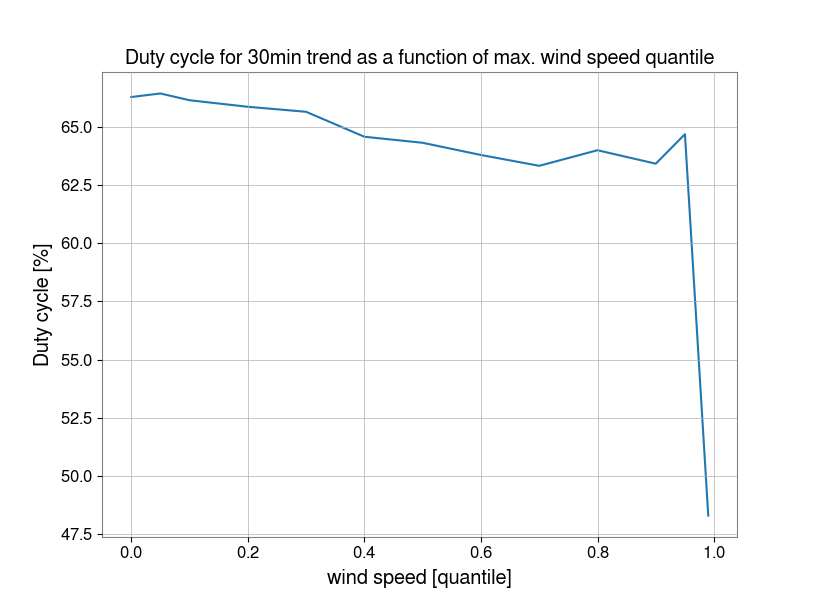
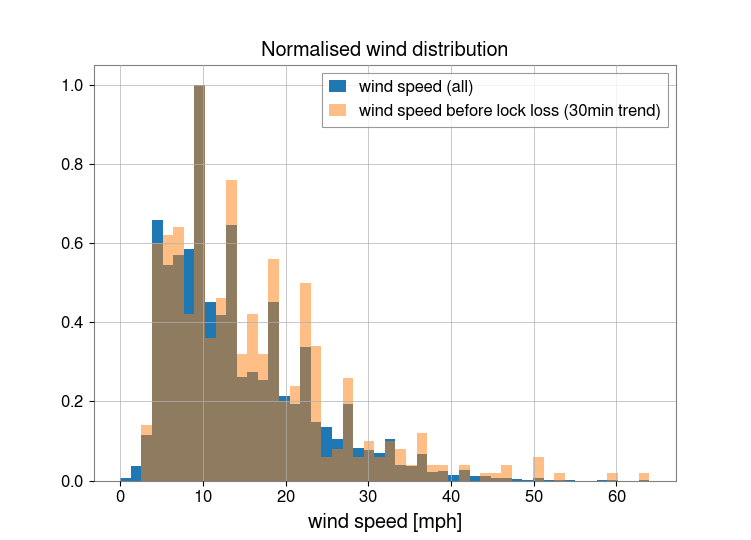
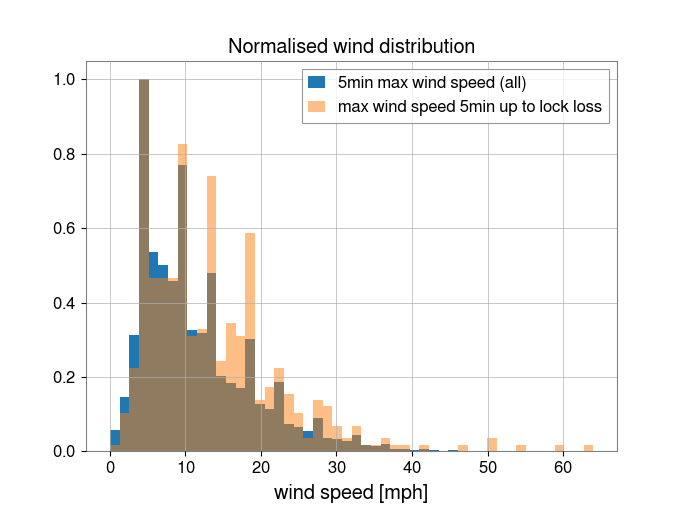
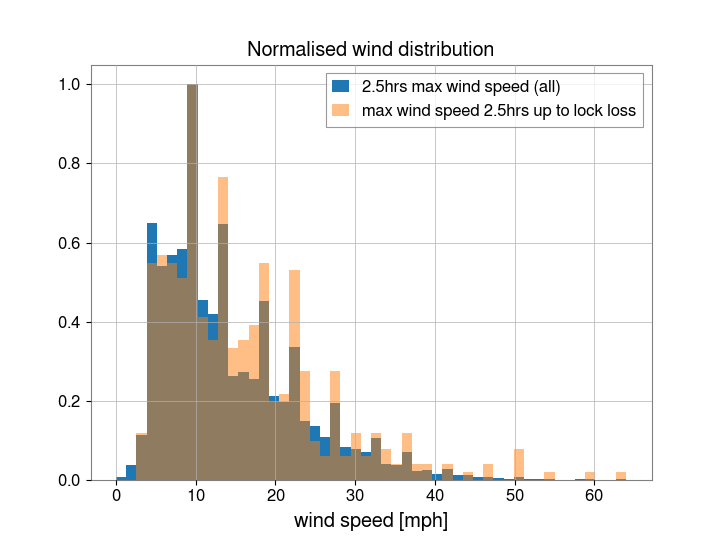
We looked at O2 data for H1 to get an estimate of down time due to wind. We used the maximum wind speed of the three max. 1min and 30min trends for the H1 EX, EY, CS wind channels, for all of O2.

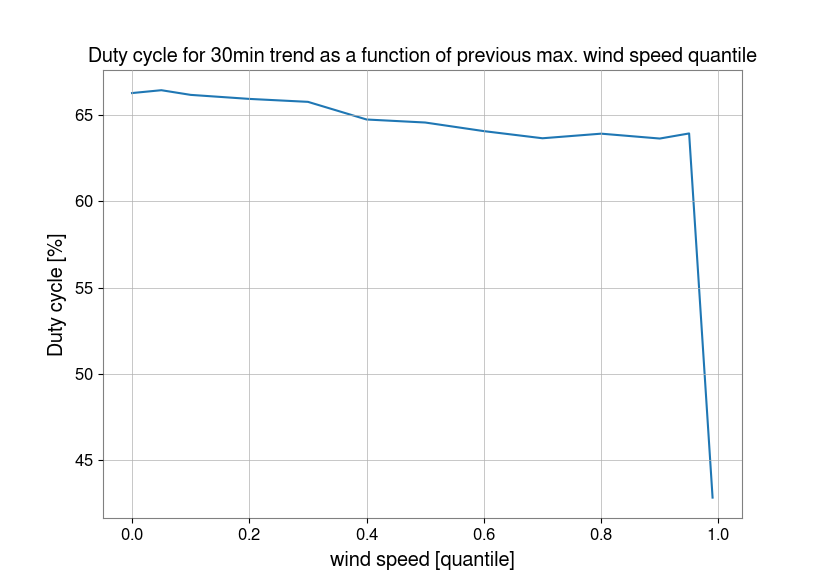
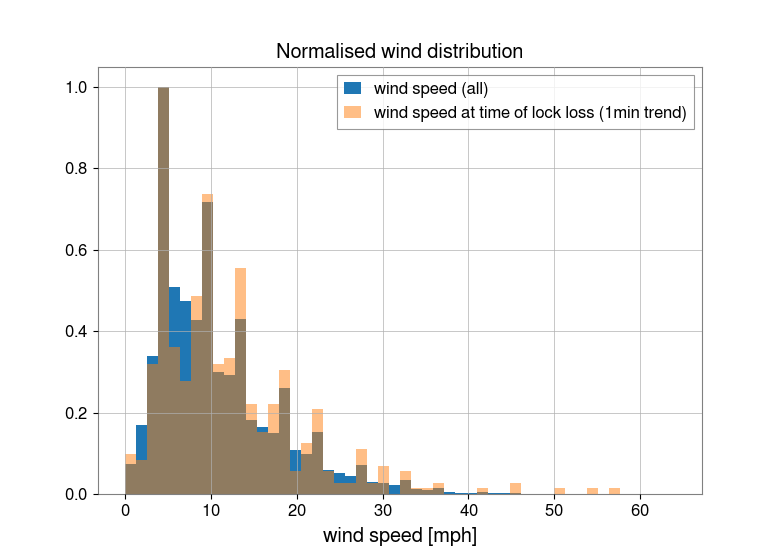
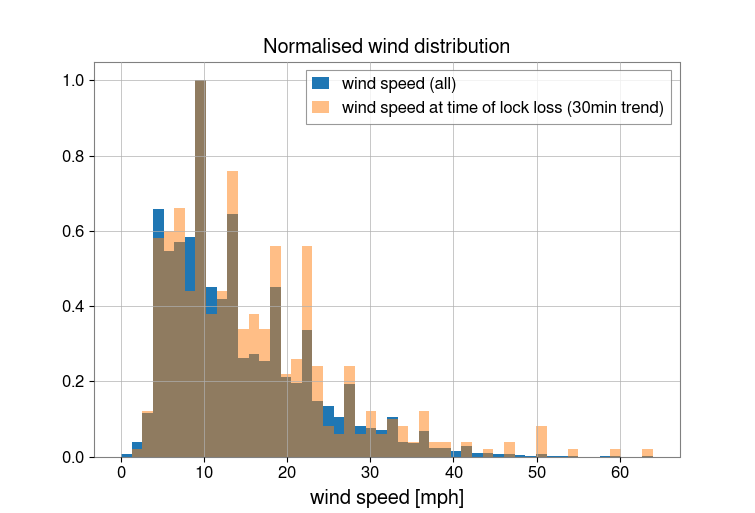
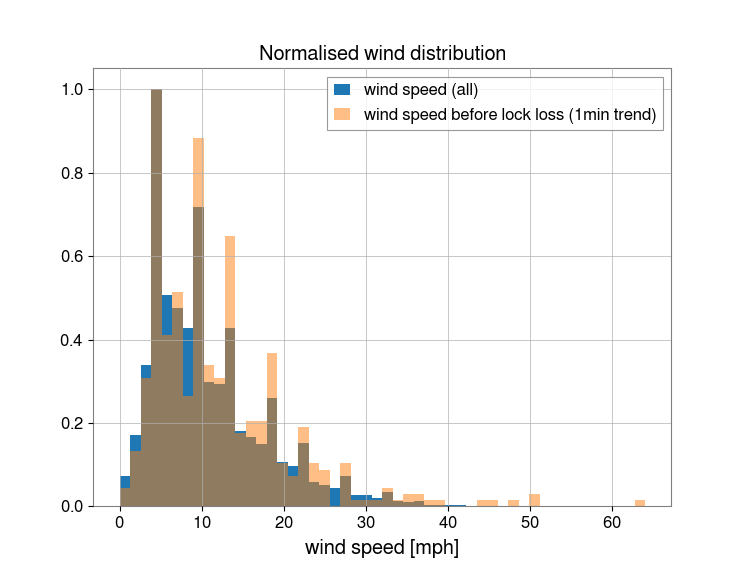
The first histograms and trend line show duty cycle vs wind speed percentiles, for wind speed vs lock status and previous wind speed (max. of previous 1 or 30 min) vs lock status. Looking at the previous wind speed shows more down time due to high winds. Percentiles and wind speed values are (in mph):

percentile 5 10 20 30 40 50 60 70 80 90 95 99
1min trend wind speed [mph] 3 4 5 6 7 9 11 13 16 21 25 33
30min trend wind speed [mph] 5 6 7 8 10 12 14 17 21 26 31 41


The following histograms are the normalised distributions for wind speed at:

Compared to the normalised distribution at all times (blue). A significant tail appears in the distribution for wind speed at time of lock loss for winds >~35mph.

Images attached to this report
Comments related to this report
dennis.coyne@LIGO.ORG - 15:54, Thursday 30 May 2019 (49561)

Interesting. Is this consistent with the histogram of 8 years of wind speed data in this log:

https://alog.ligo-wa.caltech.edu/aLOG/index.php?callRep=12996

and the O2 locking vs wind speed in Figure 16 of this paper?

https://dcc.ligo.org/LIGO-P1800038

It would also be useful to calculate the correlation of BNS range with wind speed. We may be able to maintain lock at higher wind speeds than in the past, but does the range suffer?

dennis.coyne@LIGO.ORG - 19:19, Thursday 30 May 2019 (49565)

I used the wind wind speed histogram from 8 years of data at LHO:
https://alog.ligo-wa.caltech.edu/aLOG/index.php?callRep=12996

to calculate a wind probability density function. I then convolved it with a fit (approximation) of the O2 duty cycle vs wind speed from figure 16 in:
https://dcc.ligo.org/LIGO-P1800038
If interferometer locking was completely independent of wind speed, then only a 1.6% improvement in duty cycle would result.

However the BNS & BBH range *may* decrease at higher wind speeds.

Non-image files attached to this comment
sheila.dwyer@LIGO.ORG - 09:26, Friday 31 May 2019 (49576)

Based on the table that Laurence posted, these wind speed percentiles are fairly consistent with Margarita's 8 year histograms in 12996.  Margarita finds that the hourly maximum of the wind speed is about 31.3 mph 4.8% of the time, Laurence finds that the 30 minute maximum exceeds 31 mph 5% of the time.  

Note that Laurence is plotting duty cycle for all the times with wind speeds above a certain quantile, while Krishna plots duty cycle vs wind speed in P1800038 , so they aren't directly comparable. The best comparison to Figure 16 would be to Laurence's 5th attachment, which is quite similar, the duty cycle is between 60-70% for wind speeds less than ~32 mph in P1800038, and less than the 99th percentile for the minute trend in Laurence's plot, which is 33mph. 

I believe that the duty cycle vs wind speed plot in Figure 16 of P1800038 is based on minute trends of the wind speed, although I'm not completely certain of that.  If it is based on minute trends, it makes most sense to convolve the wind speed vs duty cycle plot from P1800038 with a wind speed distribution based on the first line in Laurence's table, based on minute trends.  (Or, to use wind speed vs duty cycle based on hour maximum instead). 


dennis.coyne@LIGO.ORG - 10:44, Friday 31 May 2019 (49578)

The detailed O2 time accounting for H1 states that the interferometer was only down for wind 0.3% of the time:

https://ldas-jobs.ligo.caltech.edu/~detchar/summary/1164556817-1187733618/time_accounting/lho/

As Daniel point outs, wind might be responsible for some fraction of the time spent trying to re-lock.

Curiously the O2 accounting for L1 states that wind caused 2.7% downtime:

https://ldas-jobs.ligo.caltech.edu/~detchar/summary/1164556817-1187733618/time_accounting/llo/

brian.lantz@LIGO.ORG - 16:22, Monday 03 June 2019 (49624)

I think it would be useful to run this again for O3 so far. A quick look indicates that the detector is rather more sensitive to wind now than at the end of O2. I went poking though the DetChar pages looking for impact of high wind - and one can see that for speeds of ~10 meters/sec one can often see dips in the range, and when the speed passes that LHO often looses lock. I counted up 15 days in the first 2 months where there seemed to be a clear correlation-by-eye between (wind vs. range) or (wind vs. operation). I expect there are many reasons why the detector is more sensitive, and hopefully we can get back to the sort of robustness that was achieved at the end of O2, but I think that, were there a wind break in place now, things would be easier to run.

Non-image files attached to this comment
laurence.datrier@LIGO.ORG - 15:19, Wednesday 05 June 2019 (49683)

I've posted an alog for the same analysis for O3, along with a look at the BNS range as a function of wind speed.

H1 General
jeffrey.bartlett@LIGO.ORG - posted 05:34, Thursday 30 May 2019 - last comment - 12:10, Friday 31 May 2019(49551)
Accept SDF Differences after Relocking
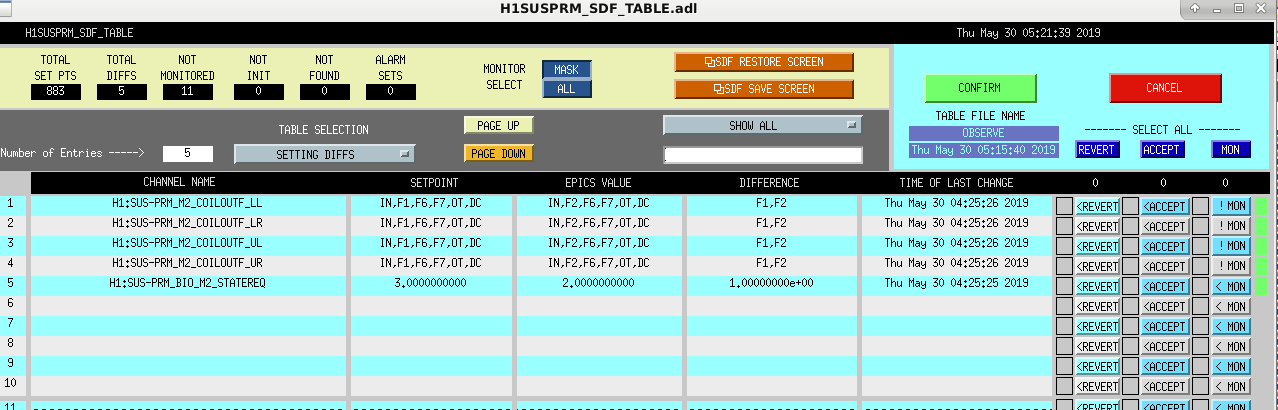
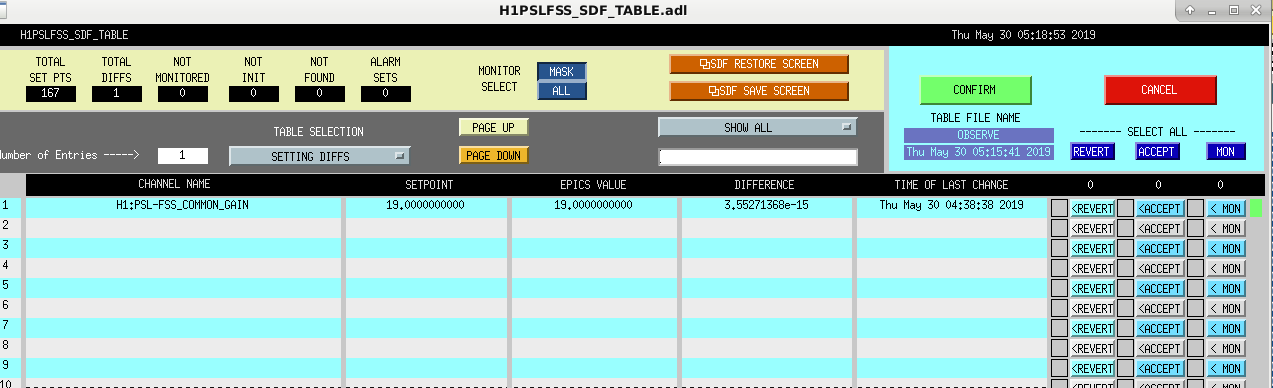
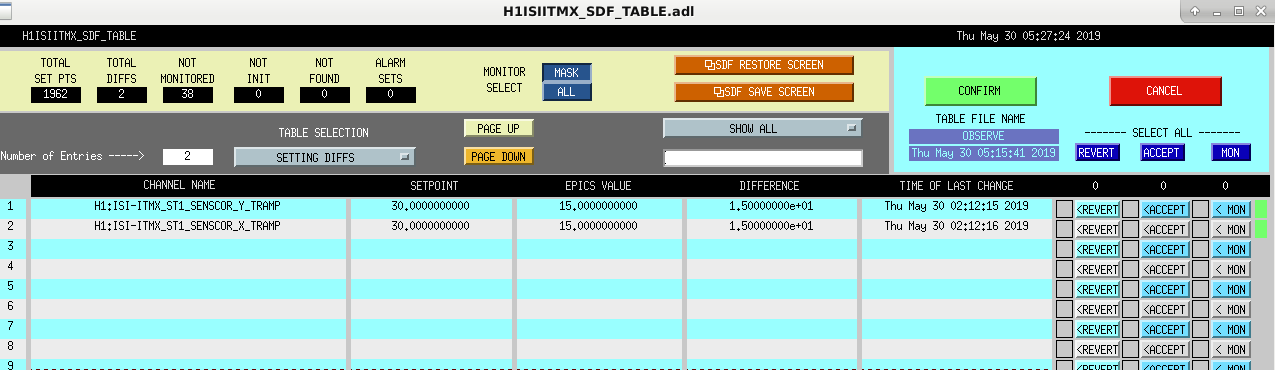
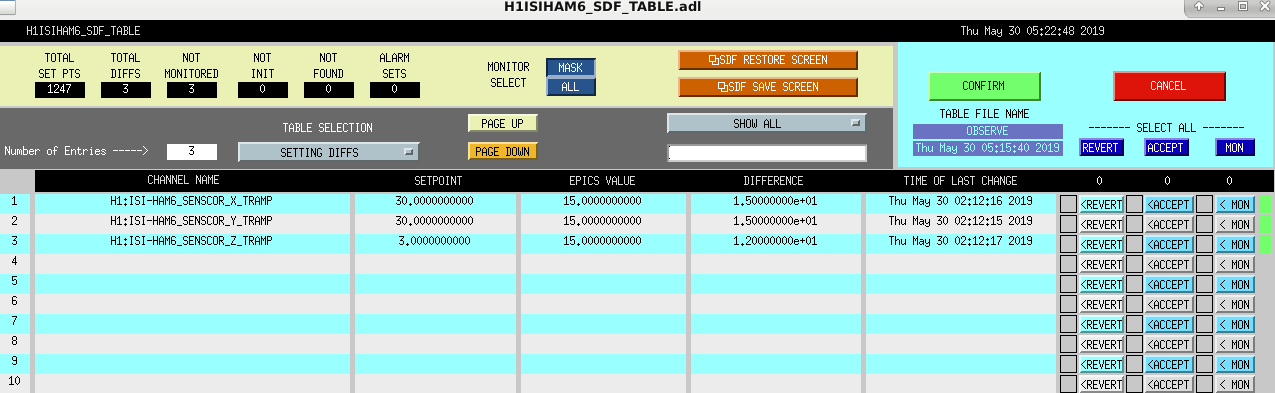
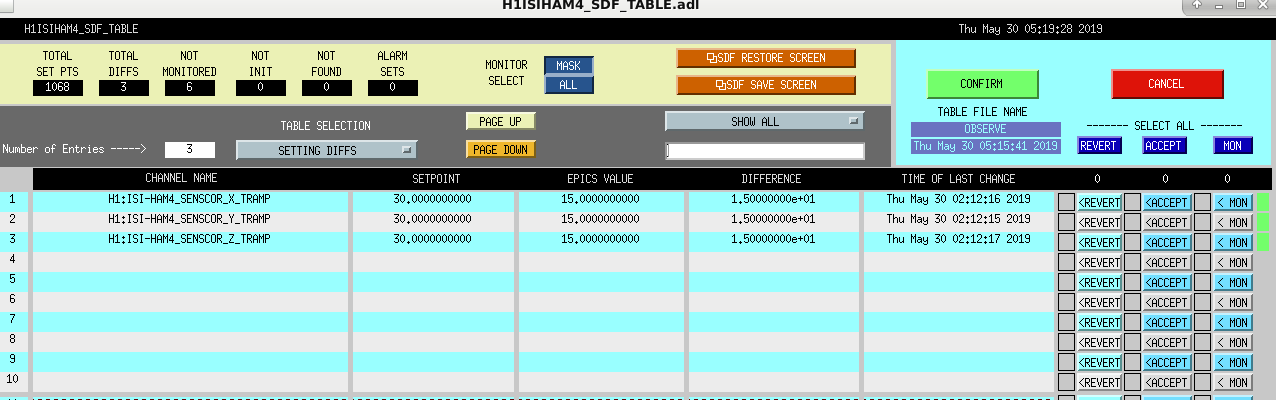
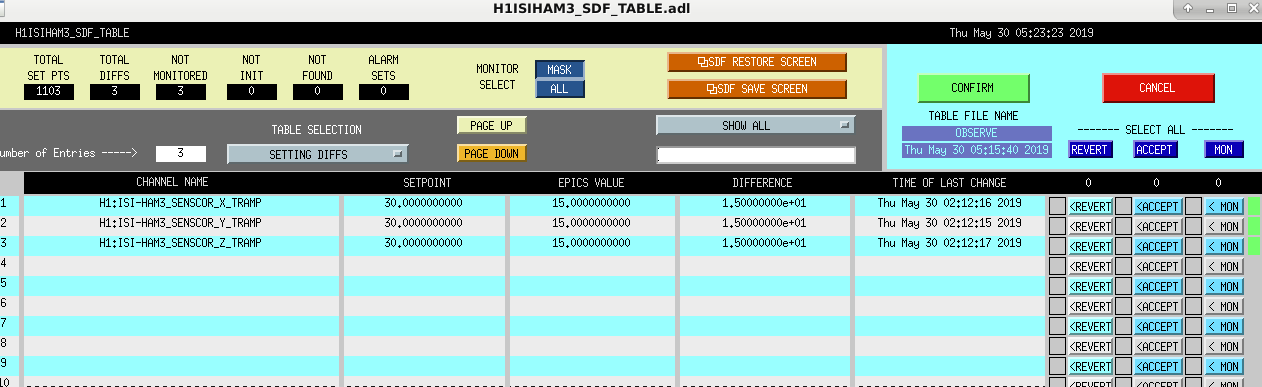
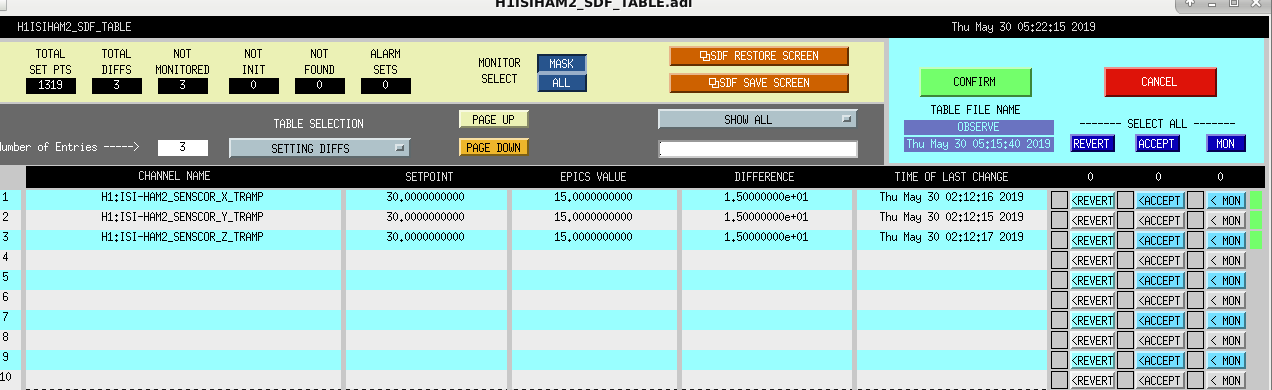
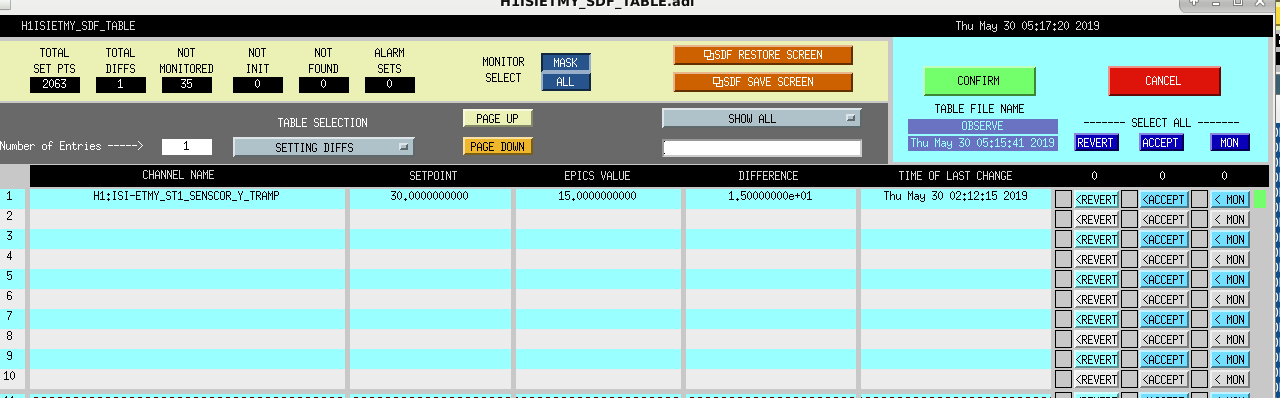
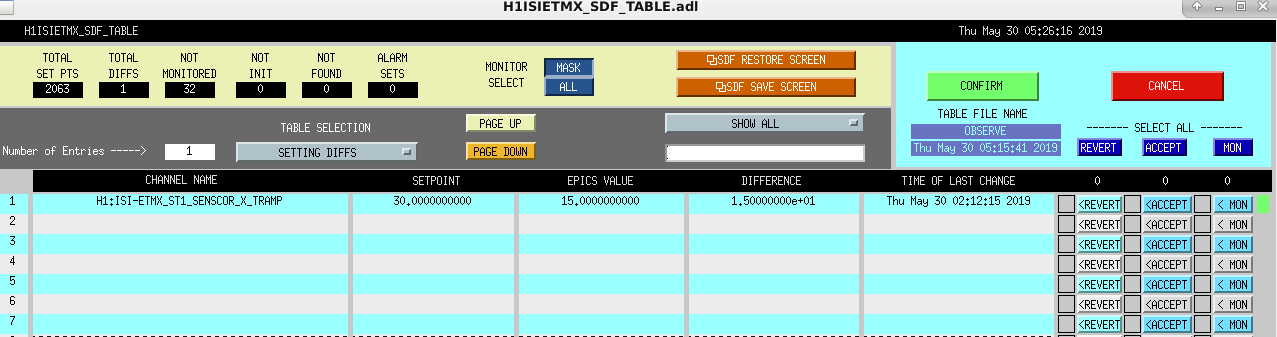
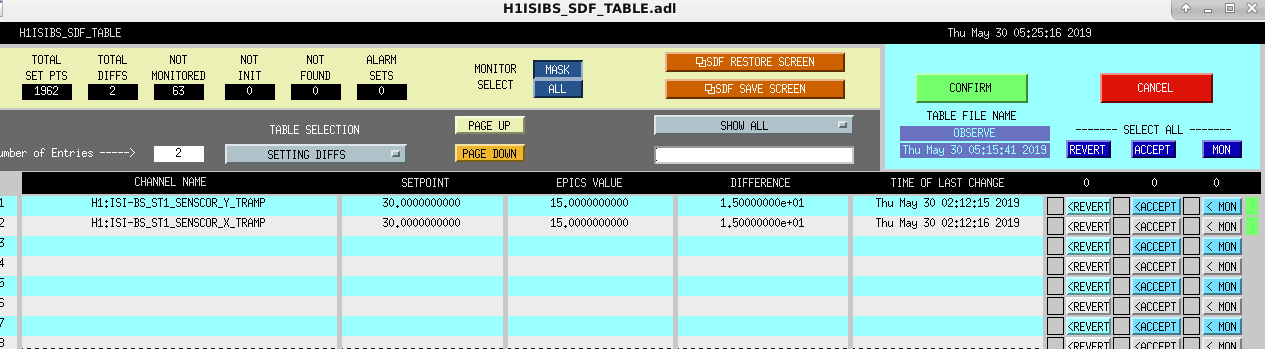
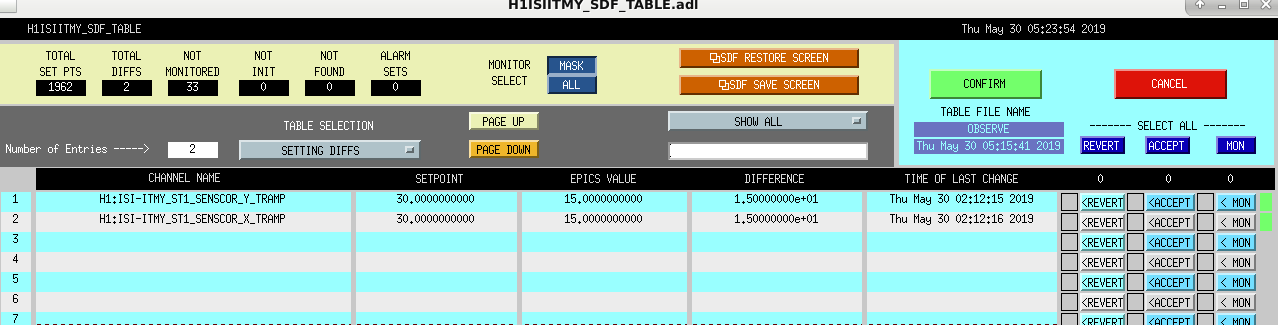
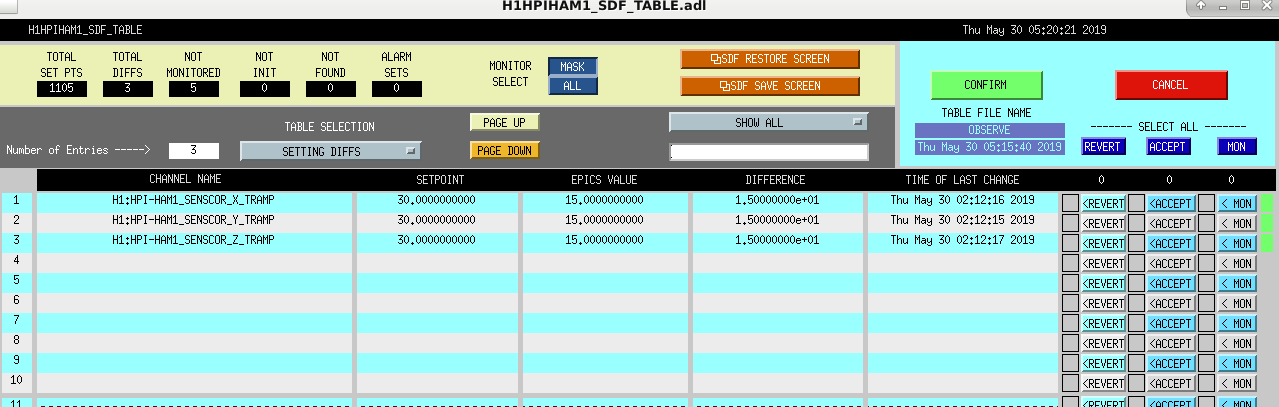
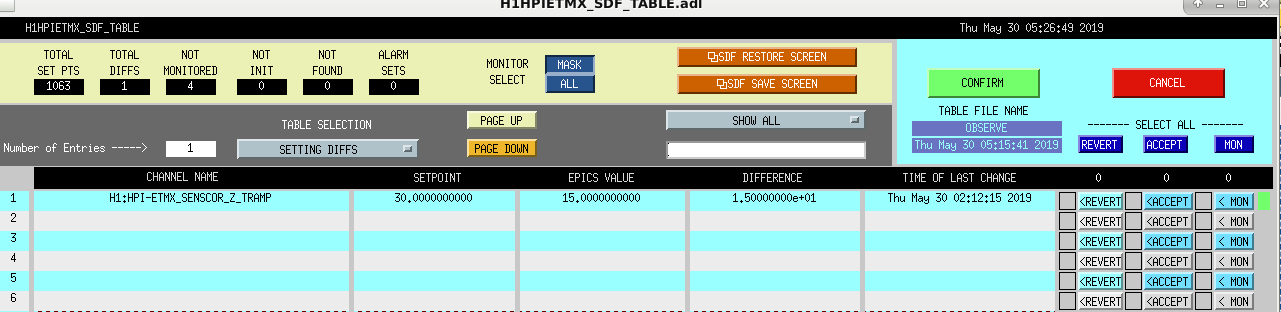
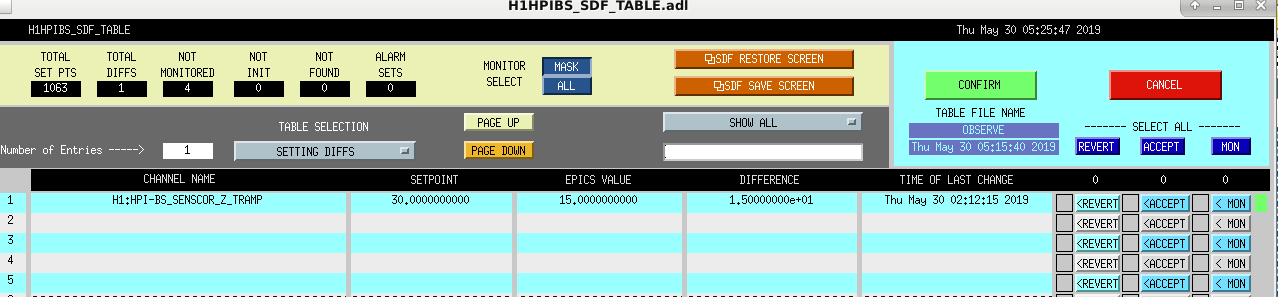
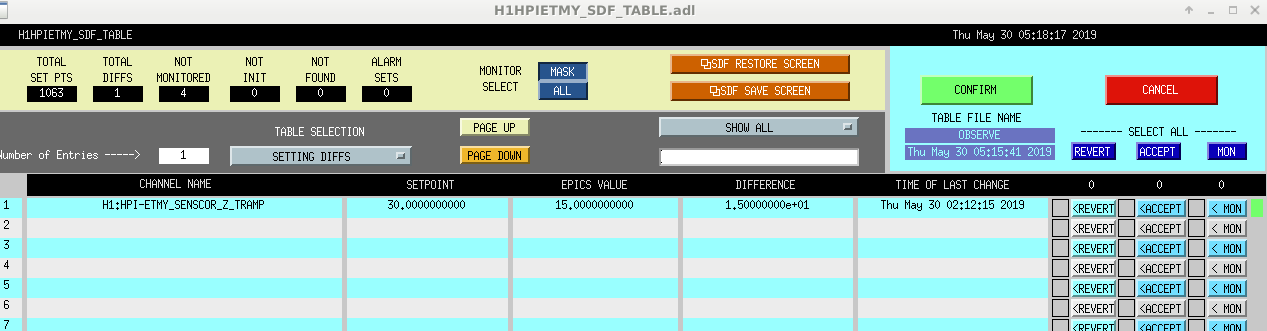
   Accepted the following SDF differences upon relocking after the El Salvador earthquake. 
Images attached to this report
Comments related to this report
sheila.dwyer@LIGO.ORG - 07:45, Friday 31 May 2019 (49573)

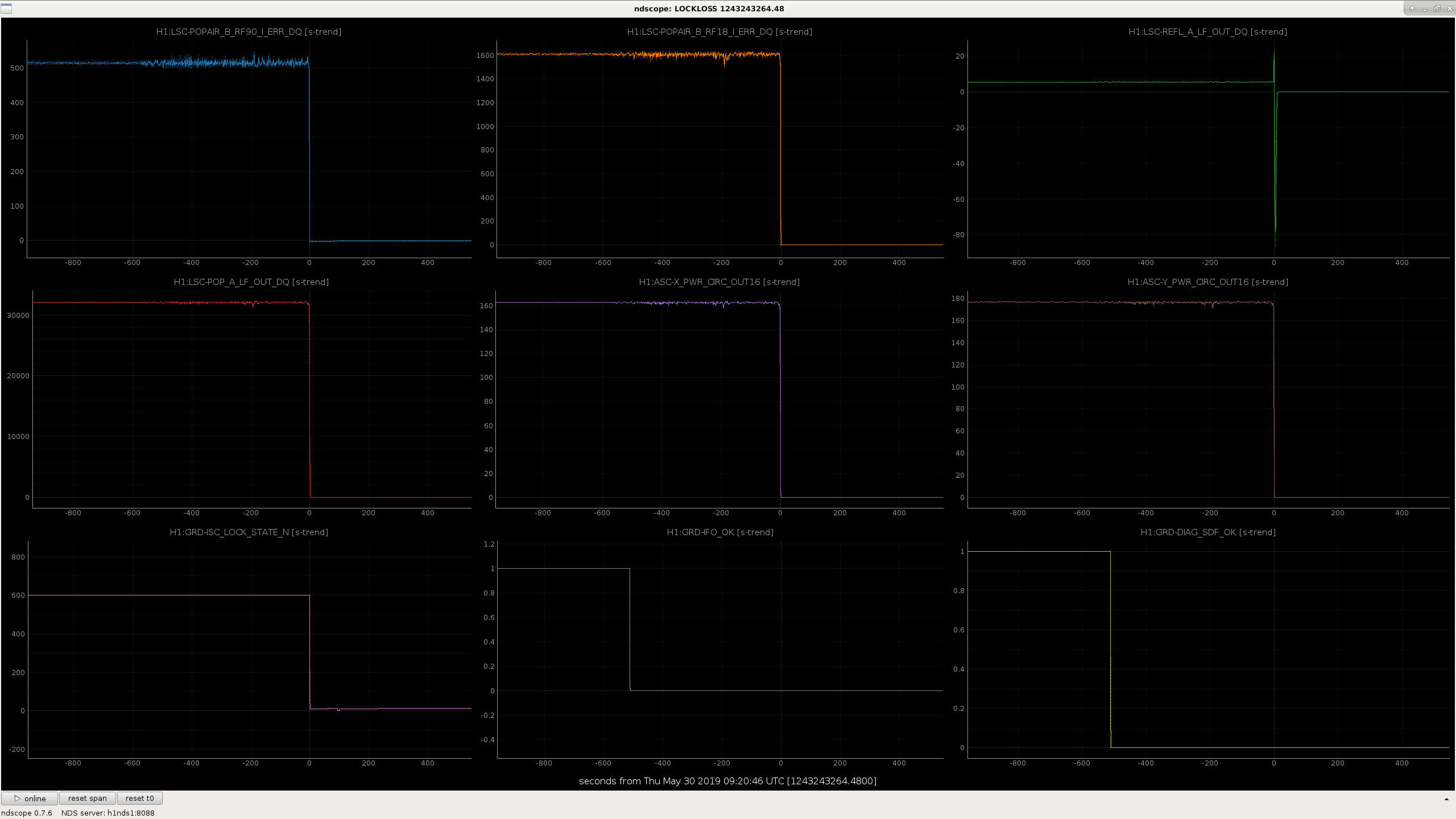
In the lockloss before this, 1243243265 Jeff tried to transition the IFO to EQ mode.  The attached screenshot shows that this took us out of observing, which it is not supposed to. These sensor correction TRAMP SDF differences are probably the reason we were taken out of observe.  Travis says that he also took the IFO to EQ mode early this morning and it stayed in observe. 

The PRM differences here are strange. 

Images attached to this comment
jim.warner@LIGO.ORG - 12:10, Friday 31 May 2019 (49580)

After the lockloss a couple of days ago for a small earthquake, I increased the ramp times for the senscor "fade" switching to 30 seconds. Because the composition of the ground feedforward signal isn't the same (local gnd sensor vs (local gnd - site common gnd)) the outputs can differ by several microns. It looks like the senscor guardians must be resetting this value for some reason? I also don't understand why ETMY ISI only shows diffs for 1 dof, and the other BSC isi's show 2. Should be the same.

Displaying reports 40801-40820 of 88905.Go to page Start 2037 2038 2039 2040 2041 2042 2043 2044 2045 End