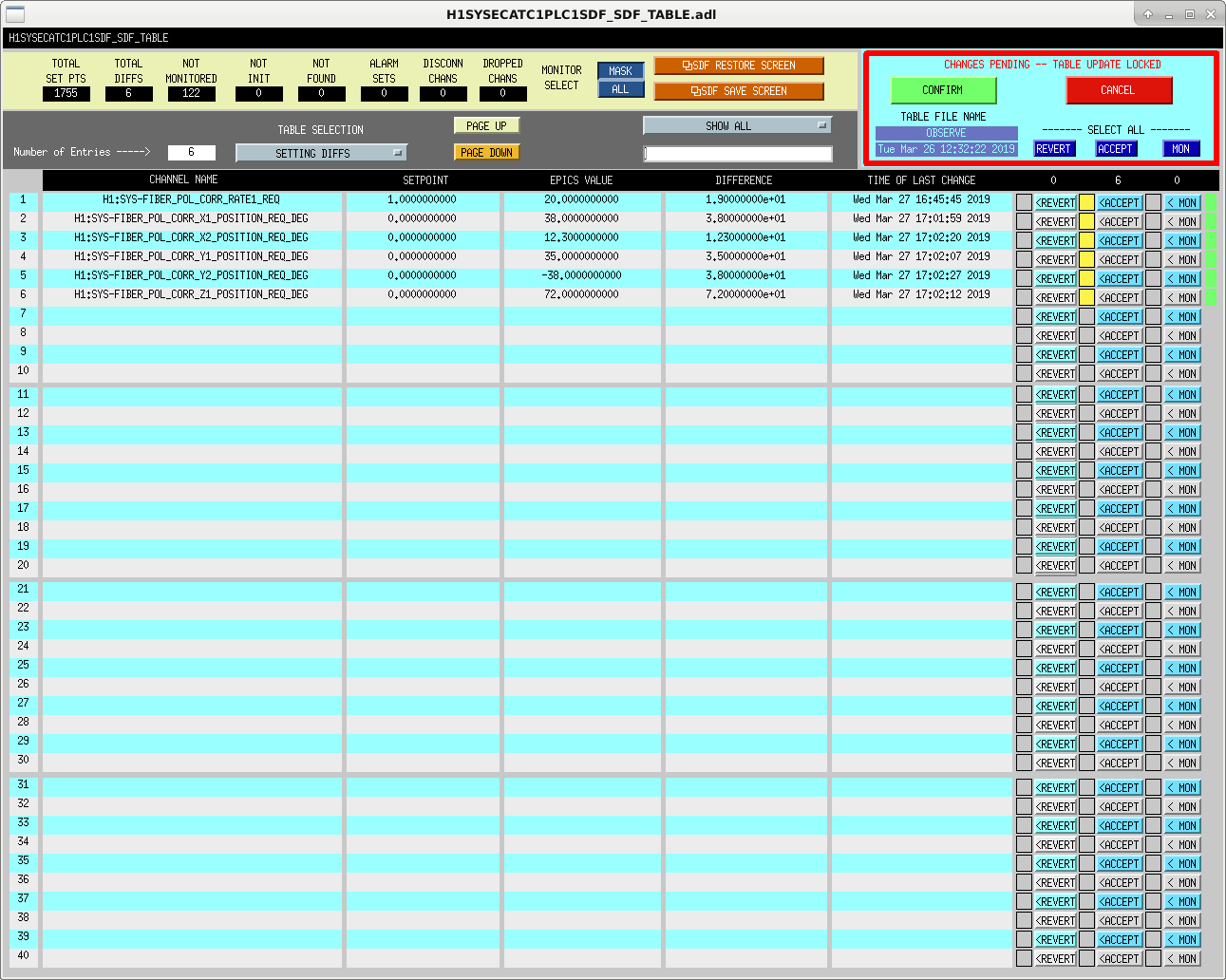
TITLE: 03/27 Eve Shift: 23:00-07:00 UTC (16:00-00:00 PST), all times posted in UTC STATE of H1: Observing at 116Mpc INCOMING OPERATOR: Jeff LOG: 23:00 UTC Relocking 23:13 UTC Chandra to mid Y 23:28 UTC Restarted video0 23:29 UTC Restarted video3 23:45 UTC Started adjusting ALS fiber polarization 23:59 UTC Chandra and Kyle done running scroll pump at mid Y (alog 47944) 00:02 UTC Done adjusting ALS fiber polarization. Could not get the X arm ALS fiber polarization error less than 15%. It is odd that it could go to greater than 100%. 00:34 UTC Jeff K. discovered that the ETMX L2 LEN to YAW filters had a gain of +1, should have been -1. Explains previous two locklosses from LOWNOISE_ESD_ETMX. Jeff K. fixed. 01:03 UTC NLN. Accepted SDF differences from adjusting ALS fiber polarization. (alog 47947) 01:09 UTC Set observatory mode to calibration. 01:22 UTC Lock loss. 4.2 Hz ASC oscillation. (alog 47949) 01:30 UTC Starting initial alignment 01:54 UTC ITMY camera has died 01:56 UTC Powercycled h1digivideo2. Everything back except h1cam23. 02:04 UTC Realized I forgot to set observatory mode to aligning. Did so. 02:42 UTC Initial alignment done. Had to intervene for SRM. 03:24 UTC NLN 04:07 UTC Observing (alog 47957) 05:03 UTC Dropped out of observing by TCS ITMY CO2 guardian. Seemed to recover itself. Went back to observing. 06:16 UTC Started Jenne's IMC VCO sweep script (alog 47954) 06:24 UTC Reloaded INJ_TRANS guardian per Adam's request (alog 47942, 47943)
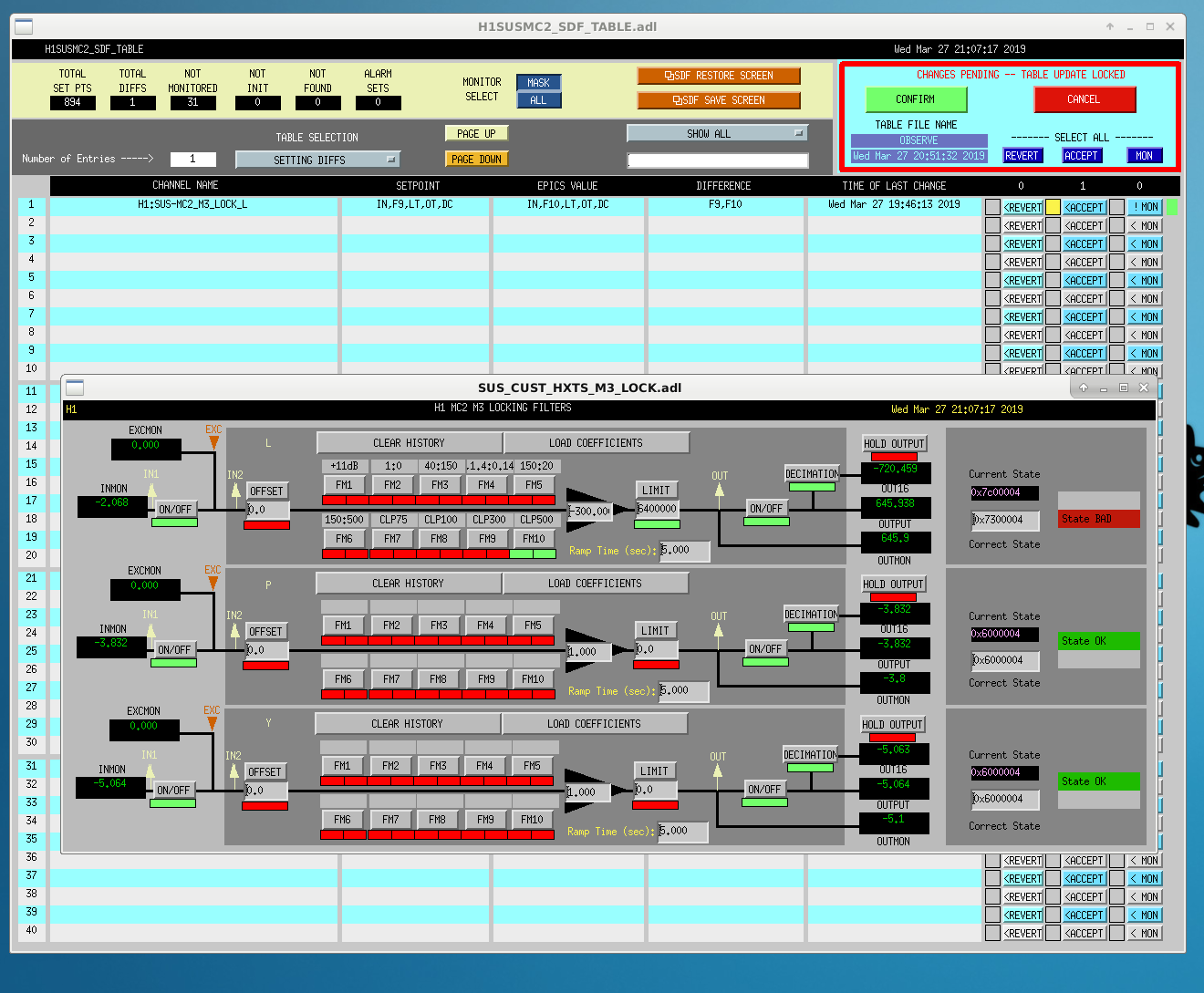
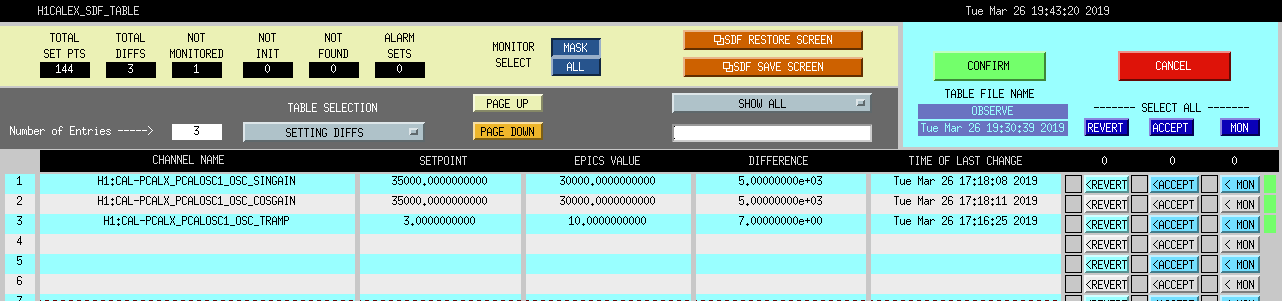
Set to observing at 04:07 UTC. Accepted the unknown SDF difference in the attached screenshot. It is the difference between FM9 (CLP300) and FM10 (CLP500) in the top filter bank (L) in the screenshot.
J. Kissel
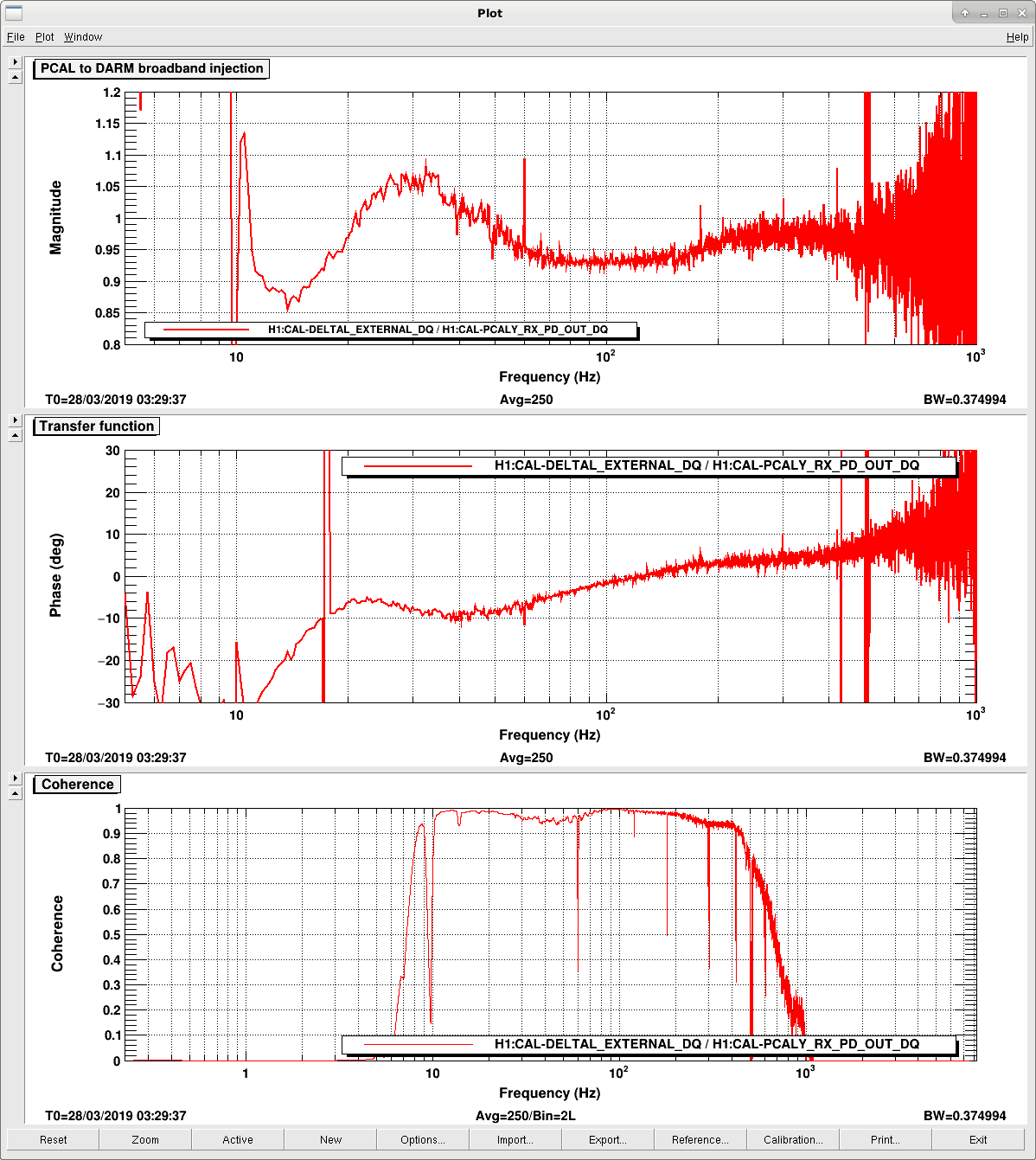
At 2019-03-28 03:29:37 UTC, for about 5 minutes, I took a broad band PCAL injection to test the quality of the updates we did to the CAL-CS. This time can also be used to test GDS (but they've not yet updated anything from the new model parameters yet).
There's still some systematic error left over in the detection band -- a frequency dependent error, with excursions at the level of +/- 7% and -10 deg.
We've still got work to do:
- This data was taken at the very beginning of a lock stretch, unlike the reference data we took which was well into the thermalized realm.
- We know that the relative delay between the paths is above half a 16 kHz clock cycle wrong
- We know that the PUM and Sensing Function still has some level of systematic error, but they should all be impactful only below 20 Hz.
Also -- looking at the time dependent correction factors, the actuator kappa's are all over the place.
More tomorrow...
Broadband injection template is here:
/ligo/svncommon/CalSVN/aligocalibration/trunk/Runs/O3/H1/Measurements/FullIFOSensingTFs
2019-03-28_H1_PCAL2DARMTF_BB_postCALCSupdate.xml
Back to NLN. Calibration measurements to continue.
As suggested by alog 47939, I've written a script that will slowly sweep the IMC VCO while we're in Observe. Patrick has instructions on how to run it, and he (or the Owl operator) will alog the times that the sweep has run.
06:16 UTC Started script as controls on zotws3.
The VCO Sweep ended on 03/28/2019 at 10:22:05.349809 (UTC), 03:22:05.349809 (PT).
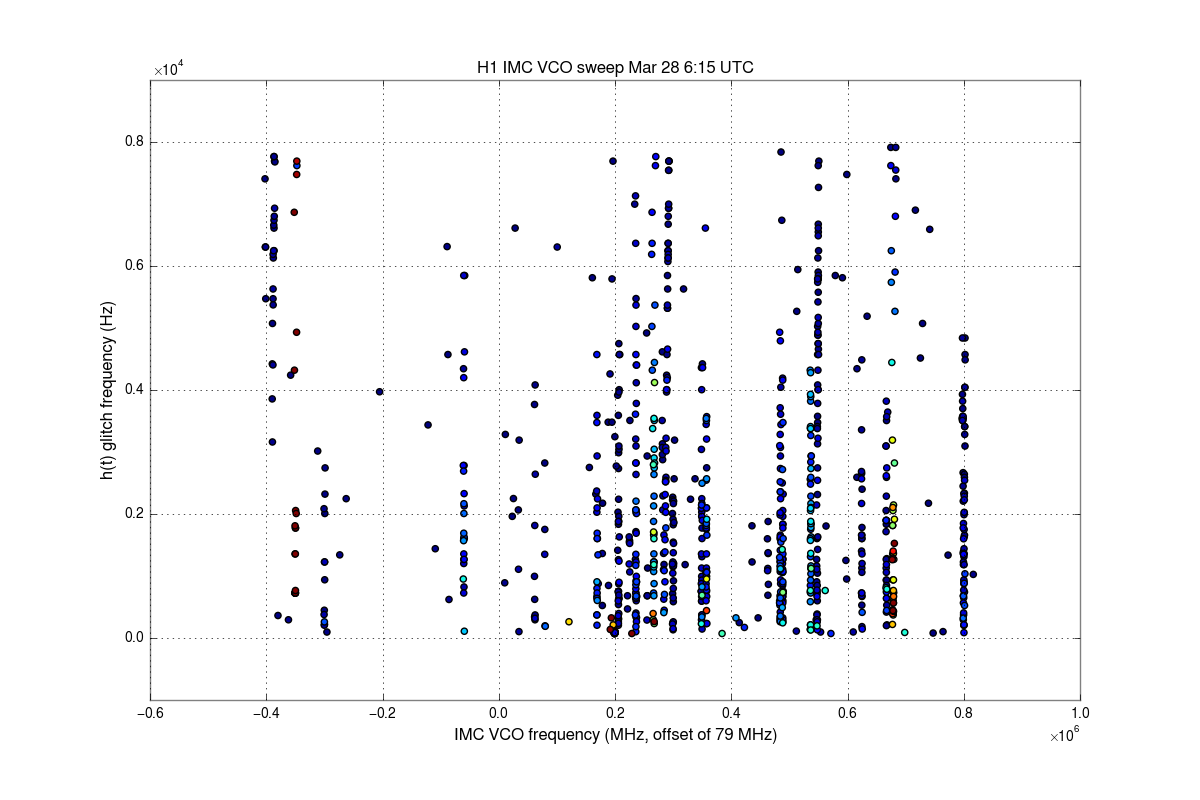
Here's a quick analysis, we'll do a more thorough one later. The attached plot shows glitches in DARM as a function of VCO frequency. There are many different lines that give beatnotes. The widest clean area is around 78.8 Mhz, with 79.75 MHz second best. It would be best to spend another hour doing more restricted sweeps over any proposed areas we plan to use. If the calibration from the VCO tuning offset to the frequency is needed, Detchar can fit this data and provide that. (Edit: New plot uploaded without the axis labels cut of.)
Exact sweep times for the ramp from +5V to -5V:
Plot 1 shows Frequency against tune voltage. The VCO frequency is offset by 79.2 MHz.
Plot 2 shows a histogram of the VCO frequencies during ramping in 5 kHz bins. Looks like we covered the full range.
The VCO frequency can be estimated by VCO frequency = 79.2 MHz – 44 kHz + v 140.3 kHz – v3 0.4447 kHz, with v the tune voltage.
For 78.8 MHz we get –2.59 V, and for 79.75 MHz we get +4.53 V. The full range of this VCO is from 77.9 MHz to 80.4 MHz. With the full tune voltage range of ±10 V, we can access frequencies from ~78.0 MHz to ~80.3 MHz.
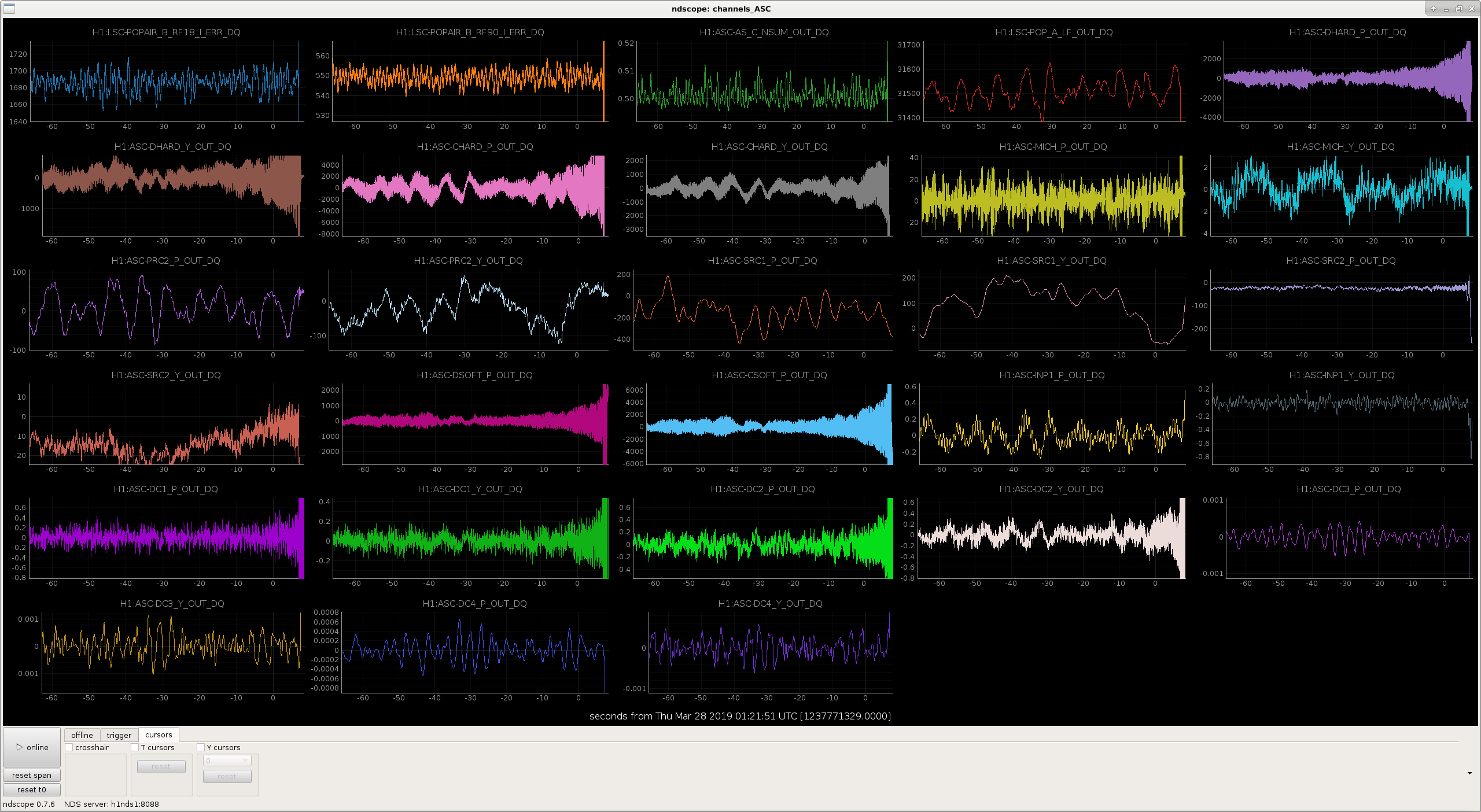
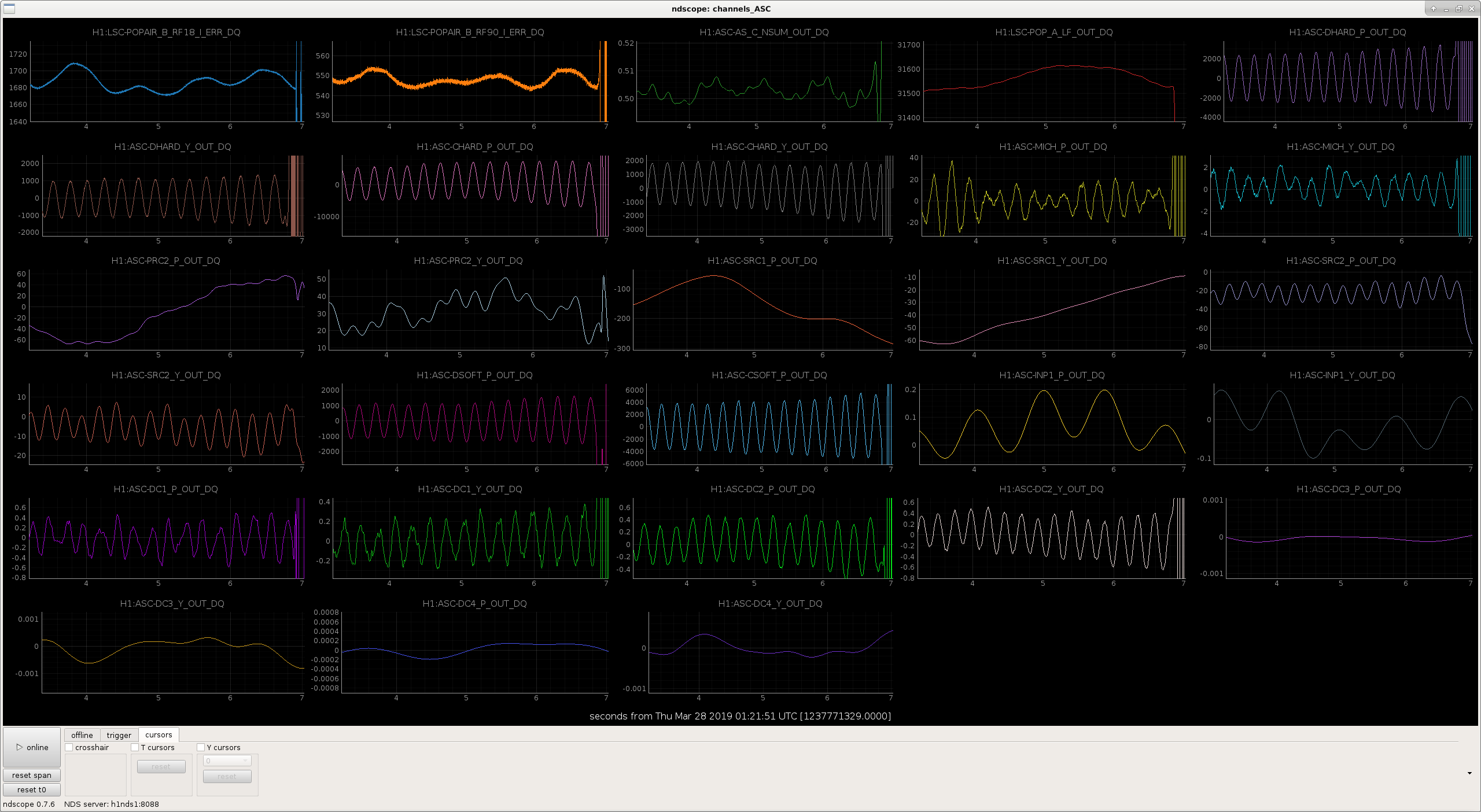
We had thought and had been crossing our fingers that the 4.2 Hz problem was gone, but it just caused a lockloss from NomLowNoise. ADS wasn't very well converged, but was most of the way there - all error signal values were at or below 0.02, although it's much nicer when they get below 0.005.
The 2 attached figures are the same data, one is zoomed in close to the lockloss time.
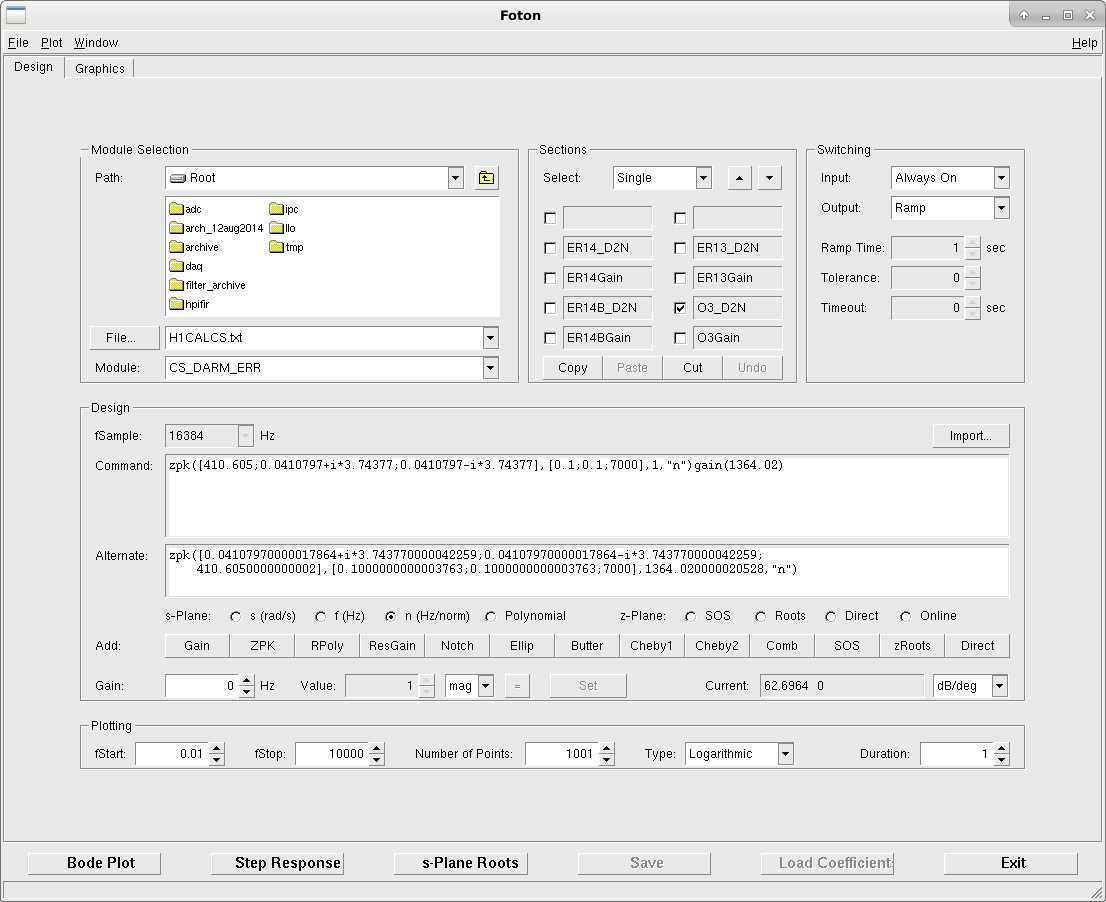
J. Driggers, S. Dwyer, J. Kissel, L. Sun We have measured the full suite of calibration measurements today. After processing, they look of excellent quality, and we believe we understand all of the systematic error that we see. This systematic error is small enough, and impacting the overall response function uncertainty in various frequency regions in such a way that we are comfortable pushing this results to the front-end and updating the calibration. Said again in less words: we are ready to update the front-end calibration (CAL-CS, CAL_DELTAL_EXTERNAL, etc.) with the results quoted below. Status of systematic error - We have a prominent detuning below 20 Hz, and it's pro-spring. The fit to and implementation of compensation for a pro-spring is still in it's infancy, so it is under-reporting the frequency -- it's measured to be about 6.5 Hz, but the fit claims 3.7 Hz. The systematic error induced by this flaw is small above 20 Hz. - The TST actuator stage is modeled quite perfectly. Little to no systematic error. - The PUM actuator systematic error remains below 20 Hz. We've identified that it's parasitic length drive not accounted for through L2A / A2L. This is prominent because the IFO spot positions on ETMX are -18 +/- 0.2 mm in pitch (-vertical) and 18 mm +/- 0.2 in yaw (+transverse) off from the center. (note for PCAL team -- ETMY spot positions: -17 +/- 0.2 mm (-vertical) and 7.5 +/- 0.2 mm (+transverse)) - The UIM actuator systematic error starts to creep in around 50 Hz. This is understood to be the high frequency dynamics of the UIM BOSEM actuators, and we have measurements in the can to fix this, we just haven't yet had the time. As it stands, the impact of this error is smaller than other things, so it remains low on the priority list. Lilli is working on estimating the overall uncertainty and systematic error that would result from these residual systematic errors from each stage -- see the start of this in LHO aLOG 47926. Here're the values we will use to update CAL-CS today. Sensing Function Optical Plant: Optical gain, H_c (ct/m) | 3.254e+06 (+3253,-2286) or (+0.09994%,-0.07023%) Optical gain, H_c (mA/pm) | 4.345 (+0.004343,-0.003052) or (+0.09994%,-0.07023%) Cavity pole, f_cc (Hz) | 410.5 (+1.156,-1.314) or (+0.2816%,-0.3202%) Detuned SRC spring frequency, f_s (Hz) | 3.744 (+0.0717,-0.07096) or (+1.915%,-1.895%) Detuned SRC spring quality factor, Q_s | 45.57 (+77.6,-123.2) or (+58.72%,-36.99%) Residual time delay, tau_c (usec) | 1.434 (+0.8076,-0.9042) or (+56.32%,-63.06%) The code spits out (filters for go in the H1:CAL-CS_DARM_ERR_Name08): Inverse Sensing FOTON values: [NB: SRCD2N zpk gain based on sensing sign in parameters file] SRCD2N: zpk([410.6047;0.0000+3.7096j;0.0000-3.7887j],[0.1;0.1;7000],1,"n")gain(1405.76) Gain: gain(3.073e-07) Inverse Sensing without cavity pole FOTON values for CFTD path: [NB: SRCD2N zpk gain based on sensing sign in parameters file] SRCD2N: zpk([0.0000+3.7096j;0.0000-3.7887j],[0.1;0.1],1,"n")gain(1405.76) Gain: gain(3.073e-07) But these values (a) are unphysical, (b) incorrectly calculating the zeros for an anti-spring (a la LHO aLOG 31693), and (c) normalizing the gain of the filter at 500 Hz instead of 100 Hz. We'll fix this later. For now, we've just manually crafted the filter in foton, which has a complex zero at 3.744 Hz with a Q of 45.57, Normal Path -- SRCD2N: zpk([410.6047;0.0411+i*3.7438;0.0411-i*3.7438],[0.1;0.1;7000],1,"n")gain(1364.02) CFTD Path -- SRCD2N: zpk([0.0411+i*3.7438;0.0411-i*3.7438],[0.1;0.1],1,"n")gain(1364.02) These will be installed into H1:CAL-CS_DARM_ERR and H1:CAL-CS_DARM_CFTD_ERR filter banks in modules titled "O3_D2N" and "O3Gain". Actuator UIM Actuator gain, H_c (N/ct) | 7.699e-08 (+2.588e-11,-2.585e-11) or (+0.03362%,-0.03357%) Residual time delay, tau_A (usec) | 64.69 (+1.52,-1.513) or (+2.35%,-2.339%) PUM Actuator gain, H_c (N/ct) | 6.118e-10 (+1.677e-13,-1.686e-13) or (+0.02742%,-0.02756%) Residual time delay, tau_A (usec) | 2.088 (+0.9309,-0.9287) or (+44.57%,-44.47%) TST Actuator gain, H_c (N/ct) | 4.739e-12 (+1.36e-15,-1.368e-15) or (+0.02869%,-0.02886%) Residual time delay, tau_A (usec) | 7.474 (+0.542,-0.5453) or (+7.252%,-7.297%) These gains will be installed into the H1:CAL-CS_DARM_ANALOG_ETMX_[L1, L2, L3] banks, in modules titled "Npct_O3" The pyDARM model parameters for this data set live here: ^/trunk/Runs/O3/H1/params/modelparams_H1_20190327.py I'll post more details about processing scripts and where the data lives in a comment below.
I've exported the above inverse sensing function (the CAL-CS_DARM_ERR filter bank, module FM9 "O3_D2N") for the GDS pipeline to correct for foton's IIR warping of the 7000 Hz, high-frequency roll-off pole.
It now lives in
/ligo/svncommon/CalSVN/aligocalibration/trunk/Runs/O3/H1/Measurements/Foton/2019-03-27_H1CALCS_InverseSensingFunction_Foton_SRCD-2N_Gain_tf.txt
I've updated and commited the 20190327 model file to read in this new export.
/ligo/svncommon/CalSVN/aligocalibration/trunk/Runs/O3/H1/params/modelparams_H1_20190327.py
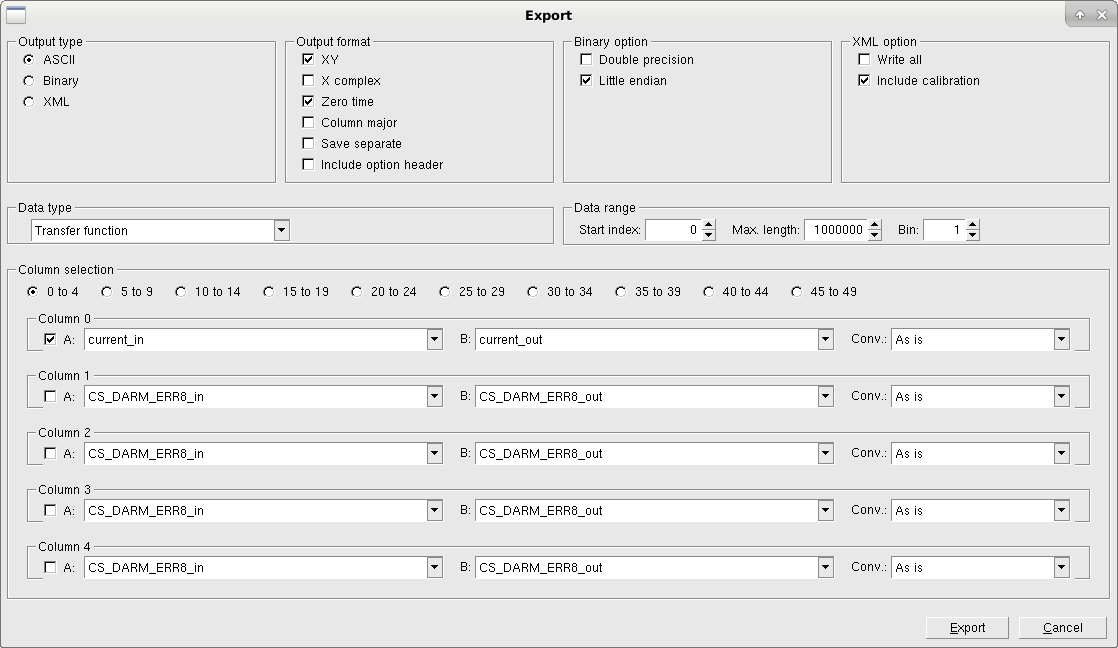
Because we always ask ourselves how these are exported:
(1) Open the H1CALCS.txt file in foton
(2) On the "design" tab, select the appropriate D2N filter (in this case "O3_D2N")
(3) Under "plotting" make fStart = 0.01, and fStop = 10000 and Number of Points = 1001. Leave all other parameters as their default.
(4) Hit Bode Plot
(5) Either "File > Export" or hit the "Export" button.
(6) Select data type Transfer Function, select Column 0, and export A: current_in and B: current_out, with Conv. "as is."
Then save the file to the above mentioned Measurements/Foton/ directory with an appropriate date.
This should produce a 1000 line text file, with three columns: frequency, real part, imaginary part.
On the to-do list: automate this.
Remember -- we actually have to have *foton* process the transfer function coefficients because (of course) it has a different pre-warping algorithm than matlab or python. See G1801581.
Data templates taken to support this entry
Sensing Function:
/ligo/svncommon/CalSVN/aligocalibration/trunk/Runs/O3/H1/Measurements/FullIFOSensingTFs
2019-03-27_H1DARM_OLGTF_5to1100Hz_30min.xml
2019-03-27_H1_PCAL2DARM_TF_5t1100Hz_15min.xml
2019-03-27_H1_OMCDCPDSUM_to_DARMIN1.xml
2019-03-27_H1DARM_OLGTF_BB.xml
2019-03-27_H1_PCAL2DARMTF_BB.xml
Actuation Function:
/ligo/svncommon/CalSVN/aligocalibration/trunk/Runs/O3/H1/Measurements/FullIFOActuationTFs/
2019-03-27_H1SUSETMX_L1_iEXC2DARM_25min.xml
2019-03-27_H1SUSETMX_L1_PCAL2DARM_8min.xml
2019-03-27_H1SUSETMX_L2_iEXC2DARM_17min.xml
2019-03-27_H1SUSETMX_L2_PCAL2DARM_8min.xml
2019-03-27_H1SUSETMX_L3_iEXC2DARM_8min.xml
2019-03-27_H1SUSETMX_L3_PCAL2DARM_8min.xml
Scripts that process the data
Sensing Function:
/ligo/svncommon/CalSVN/aligocalibration/trunk/Runs/O3/H1/Scripts/FullIFOSensingTFs
process_sensingmeas_20190327.py
Actuation Function:
/ligo/svncommon/CalSVN/aligocalibration/trunk/Runs/O3/H1/Scripts/FullIFOActuationTFs
process_actuationmeas_20190327.py
These parameters are now in the filter modules that Jeff quotes, and I have accepted in both the safe.snap and OBSERVE.snap to be using the filter modules with "O3" in the name. For the last while (days?weeks?) we've been putting things in the filter modules with "ER14" in the name. Those still exist, but aren't in use anymore.
Also, the gain of H1:CAL-CS_DARM_ERR_GAIN had been reverted (likely on Tuesday?) to the value of 1.03. I have again put it to the nominal value of 1.00 and accepted this in SDF.
I've processed the DARM open loop gain transfer function, and computed the relative delay between the Actuation and Sensing Paths.
The systematic error in the DARM open loop gain transfer function below 30 Hz is understood based on the results discussed above, and for now, we must tolerate them.
However, for the first time, we appear to have an appreciable, non-integer 16 kHz clock-cycle delay between the Actuation and Sensing paths: 7.653 clock cycles.
Sounds like it's finally time for me to import the thiran filter delay technology from LLO.
Scripts to produce these plots:
/ligo/svncommon/CalSVN/aligocalibration/trunk/Runs/O3/H1/Scripts/DARMOLGTFs/
process_darmolg_20190327.py
/ligo/svncommon/CalSVN/aligocalibration/trunk/Runs/O3/H1/Scripts/CALCS_FE/
compute_relativedelay_AvsC_20190327.py
I've used the above mentioned model to write new reference model parameters for the computation of time dependent correction factors, a.k.a. "the" EPICs records.
Script to create the records:
/ligo/svncommon/CalSVN/aligocalibration/trunk/Runs/O3/H1/Scripts/CALCS_FE
createEPICS_for_20190327.py
Location of generated EPICs records:
/ligo/svncommon/CalSVN/aligocalibration/trunk/Runs/O3/H1/Results/CALCS_FE/
epicsrecords_model-H1_20190327_created-20190327.txt
Model file used:
/ligo/svncommon/CalSVN/aligocalibration/trunk/Runs/O3/H1/params
modelparams_H1_20190327.py
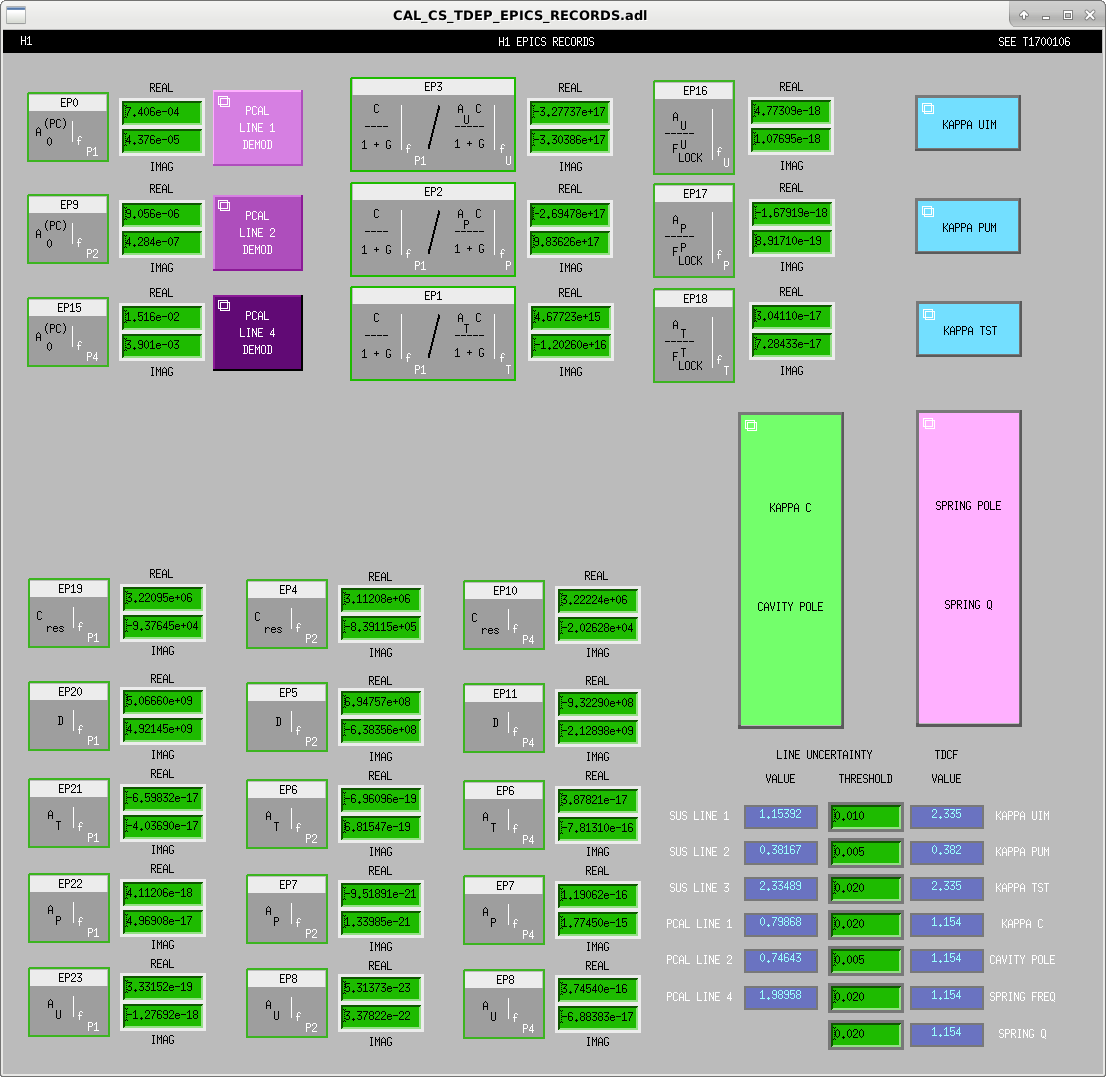
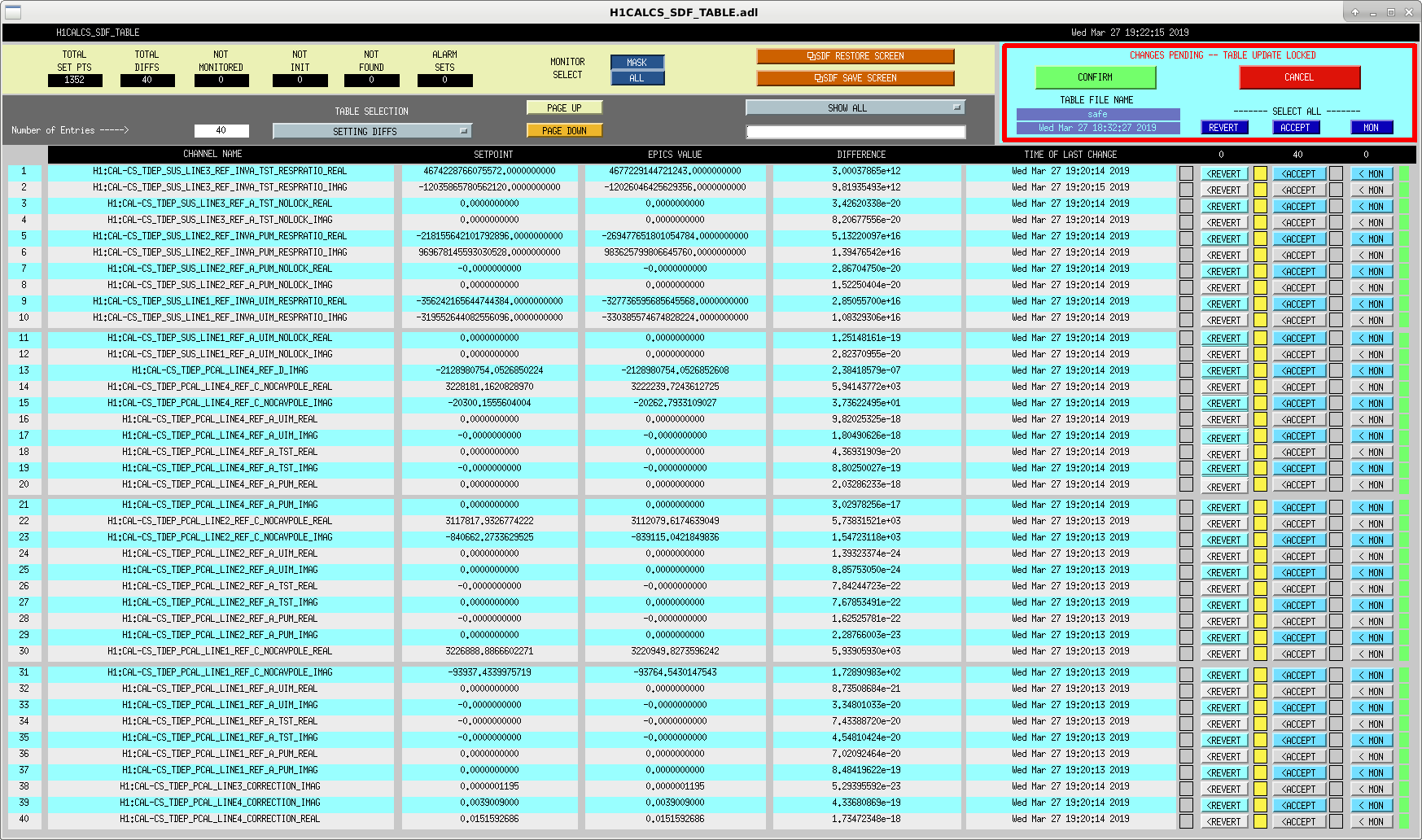
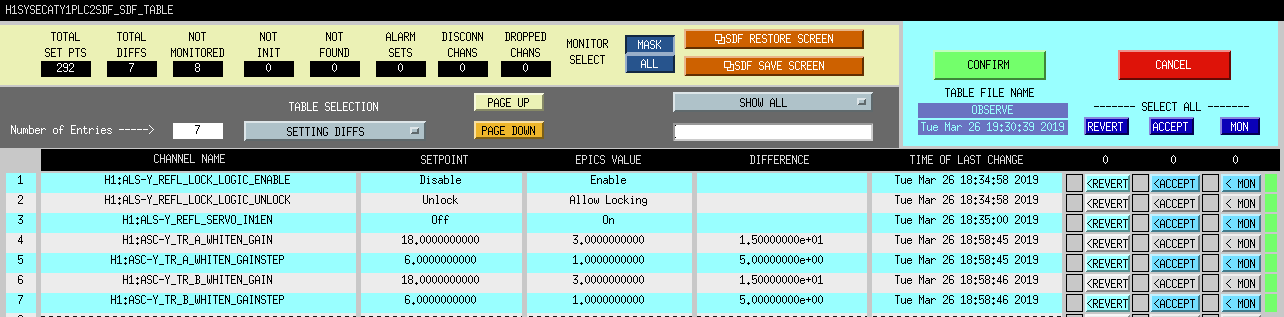
Attached are screenshots of the corresponding MEDM screen and SDF acceptance *after* the EPICs records were pushed.
H1 control room matlab (matlab2015b) was too old to be able to use autoquack, but joeb was able to do that for us using matlab2018.
cd /ligo/svncommon/CalSVN/aligocalibration/trunk/Runs/PostO2/L1/Scripts/CAL_FE_DELAY
fs=2^14
ts=1/fs
td=7.653*ts
populate_cal_fe_delay('H1', td)
Took the diff with the original filter in the control room and it only has one filter "delay" defined in CS_DARM_CTRL_DELAY, everything else is the same.
diff /opt/rtcds/lho/h1/chans/H1CALCS.txt ~/H1CALCS.txt
780a781,787
> # DESIGN CS_DARM_CTRL_DELAY 0 zpk([-3495.762131159507+i*542.3606112515328;-3495.762131159507-i*542.3606112515328;
> # -3679.520087768798+i*1130.184746679708;-3679.520087768798-i*1130.184746679708;
> # -4186.607279464874-i*1784.0262722568;-4186.607279464874+i*1784.0262722568;-3445.944679249666;
> # -6825.617444279973],[3495.762131159505+i*542.3606112515323;3495.762131159505-i*542.3606112515323;
> # 3679.520087768799+i*1130.184746679708;3679.520087768799-i*1130.184746679708;
> # 4186.607279464874+i*1784.0262722568;4186.607279464874-i*1784.026272256801;3445.944679249668;
> # 6825.617444279969],-1.000000000000004,"n")
781a789,792
> CS_DARM_CTRL_DELAY 0 21 4 0 0 delay -1.546135588596514307051190e-06 -0.2162350800222442 0.0174983720374032 3.6925487491949833 20.2756341393376971
> -0.0968548102303960 0.0247770268878642 -3.9090569933487744 40.3599675023881517
> 0.1821175467962750 0.0493202823215208 -12.3574398555497709 57.1481734336473011
> 0.4517859341185633 -0.0723061411729160 -6.2482373805309441 -13.8300839151207331
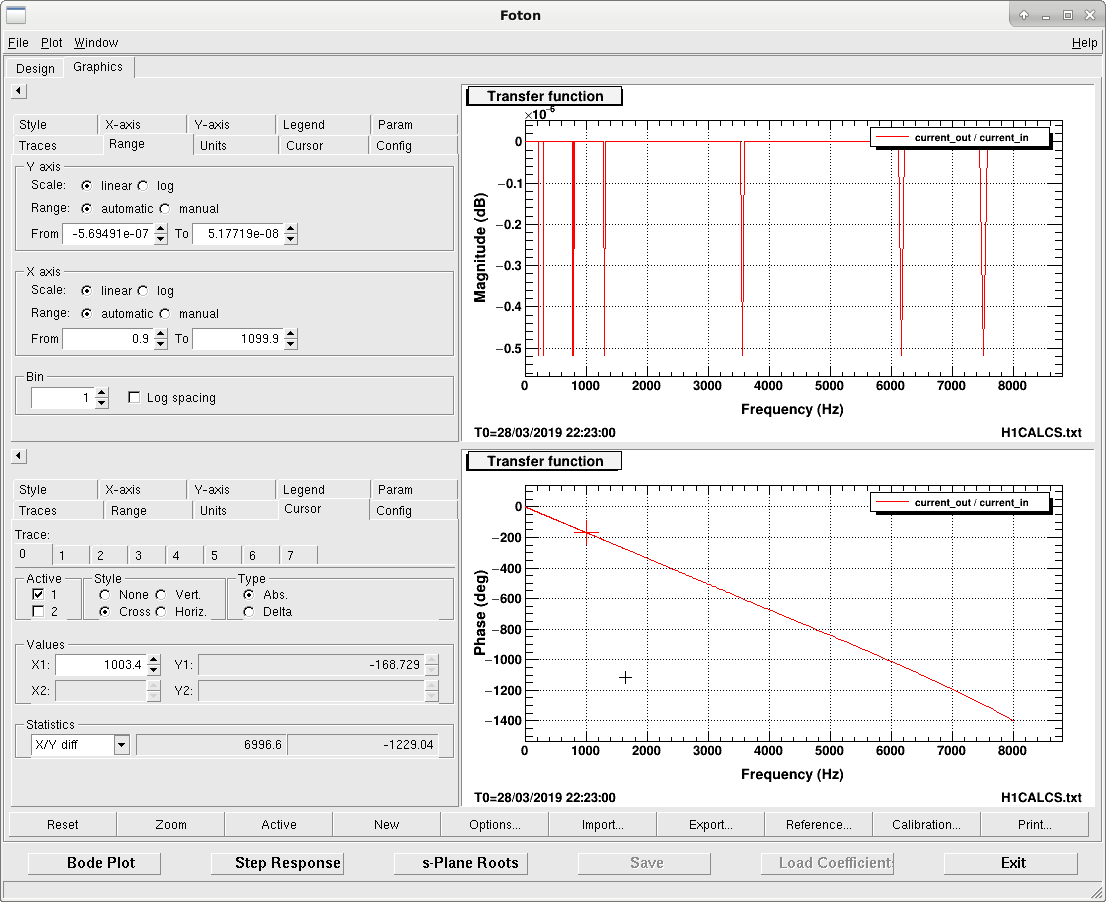
The delay filter has about the right delay (attached, -168.729deg @ 1kHz ~7.68 clock cycles for 2^14Hz sampling).
The new file was installed, the new filter loaded.
A series of DetChar safety injections is scheduled to go into LHO at 05:00:00 PDT tomorrow morning (28 March 2018). The injection file starts at 05:00:00 PDT, lasts for 91 seconds, and the first actual injection should go in at 05:00:10 PDT.
The schedule file and waveforms have been uploaded to the h1hwinj1 machine and I asked Gary (at LLO) to ask Patrick to reload the INJ TRANS guardian.
Reload completed.
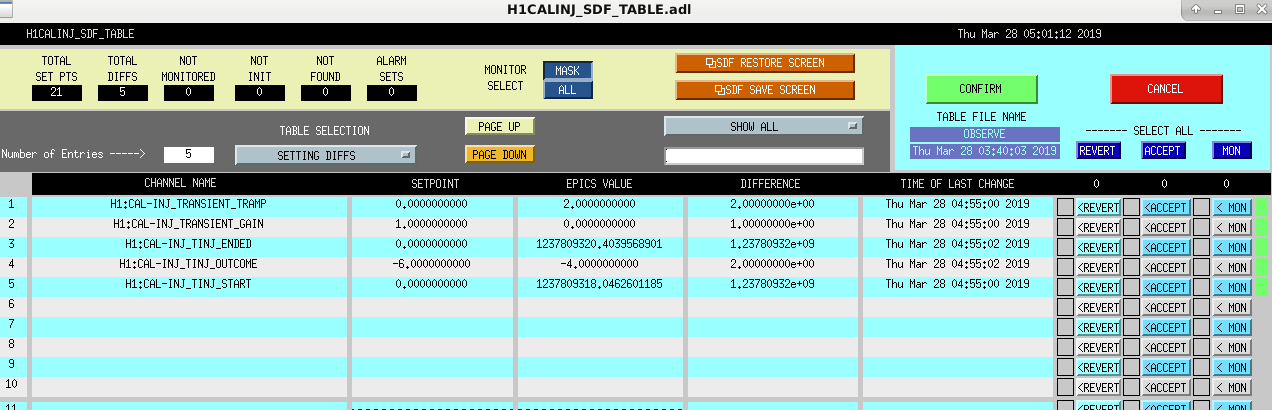
At 11:55 (04:55) IFO dropped out of Observing due to SDF Difss with CALINJ SDF Diffs. At 12:01 (05:01) Accepted SDF Diffs and put IFO back into Observing Mode. It may be unrelated but lostlock at 12:04 (05:04).
It would be better to un-monitor these channels in the SDF as they change when we carry out hardware injections. The injections should have finished at 5:01:30 PDT, which doesn't quite match up with the lockloss at 5:04.
These injections do not appear to have been successful in as much as H1:DMT-INJECTION_DETCHAR:1 was not active during any of the injection times. We're re-scheduling these for the morning of Fri March 29, 2019.
To un-monitor the channels open the SDF screen for CAL-INJ (while in Observe), set the "TABLE SELECTION" to "FULL TABLE", set "MONITOR SELECT" to "ALL" (this part may not me necessary). Channels with the final green tab lit up are currently being monitored. To un-monitor a channel click on the "MON" tab and hit the "CONFIRM" button. A list of the channels that we want the monitoring removed are shown in this screenshot (the ones with the yellow box in front of MON).
A series of DetChar safety injections is scheduled to go into LHO at 23:00:00 PDT this evening (27 March 2018). The injection file starts at 23:00:00 PDT, lasts for 91 seconds, and the first actual injection should go in at 23:00:10 PDT.
I'm sorry, I got distracted and didn't get around to uploading the schedule file and waveforms in time for these first set of injections. Hopefully, the next set will go through.
These injections do not appear to have been successful in as much as H1:DMT-INJECTION_DETCHAR:1 was not active during any of the injection times. We're re-scheduling these for the morning of Fri March 29, 2019.
Finished calibration measurements for the night. Just went into observing. Georgia will make ring heater measurements.