TITLE: 03/21 Owl Shift: 07:00-15:00 UTC (00:00-08:00 PST), all times posted in UTC
STATE of H1: Commissioning
OUTGOING OPERATOR: Travis
CURRENT ENVIRONMENT:
Wind: 6mph Gusts, 5mph 5min avg
Primary useism: 0.02 μm/s
Secondary useism: 0.22 μm/s
QUICK SUMMARY: Issues with stable locks at low noise, but Craig and Georgia are here investigating.
TITLE: 03/21 Eve Shift: 23:00-07:00 UTC (16:00-00:00 PST), all times posted in UTC
STATE of H1: Commissioning
INCOMING OPERATOR: TJ
SHIFT SUMMARY: Unable to make it to NLN long enough to clear all SDF diffs before losing lock. Commissioners debating cause of locklosses.
LOG: See previous aLogs.
Georgia, Daniel, Sheila
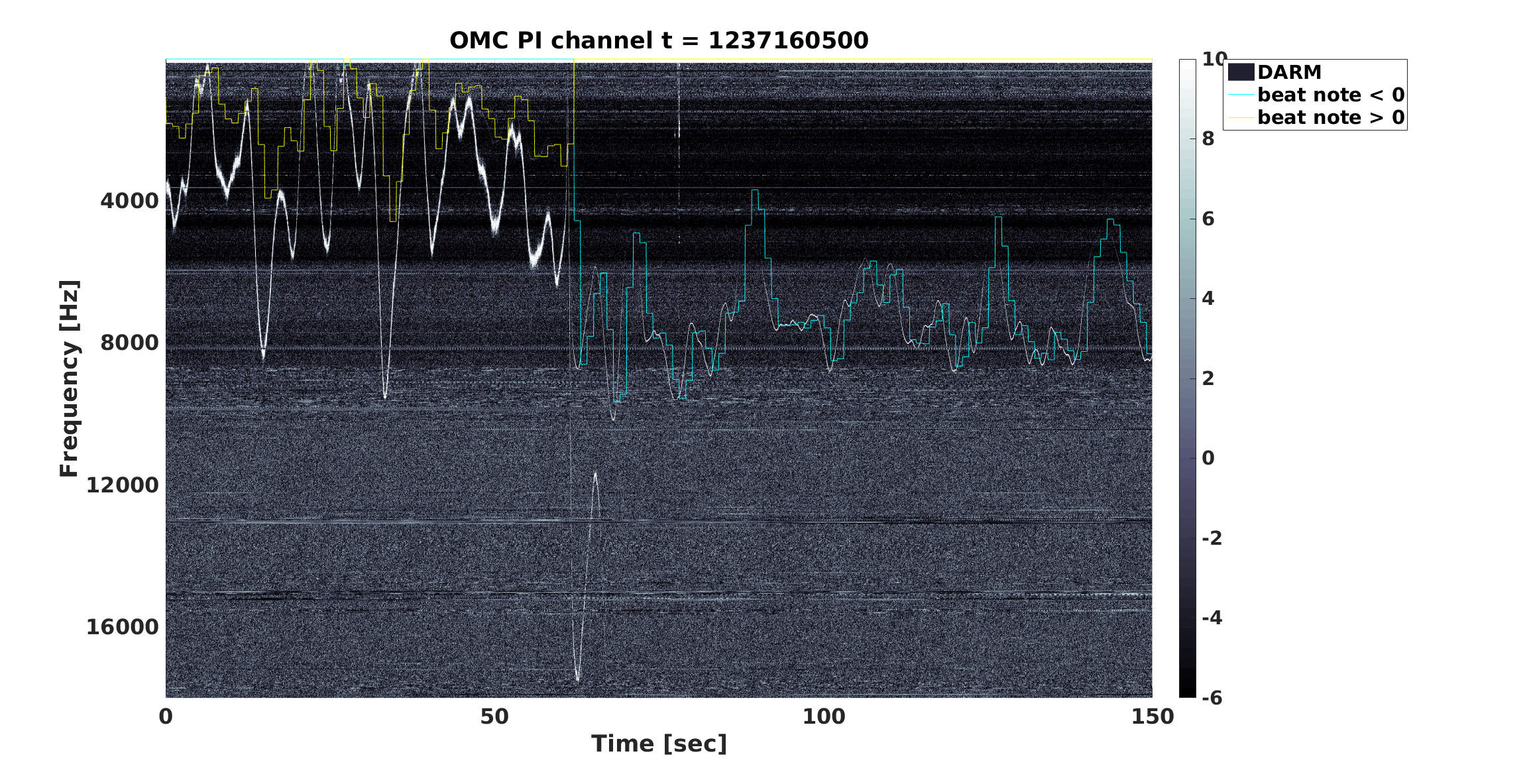
Since Daniel got the IMC VCO feedforward to the squeezer working (47675) we repeated the test we tried the other night of unlocking the LO loop to look for backscatter and seeding peaks. This was a follow up on the acoustic coupling investigations in 47551. This is similar to the test done at LLO 43881. Here, the pick off for the squeezer laser locking fiber is from the ref cav path (shifted by 2*IMC VCO frequency from IFO carrier), while LLO gets the pick for the squeezer laser locking from somewhere else that is at the same frequency as the light injected into the IMC. Even with the feedforward from the IMC VCO to the squeezer VCO our squeezer laser is still moving relative to the IFO carrier, so Georgia made some spectrograms with the frequency H1:SQZ-FREQ_SQZBEATVSDOUBLEPSLVCO overlaid on it. (Second attachment).
Power estimates:
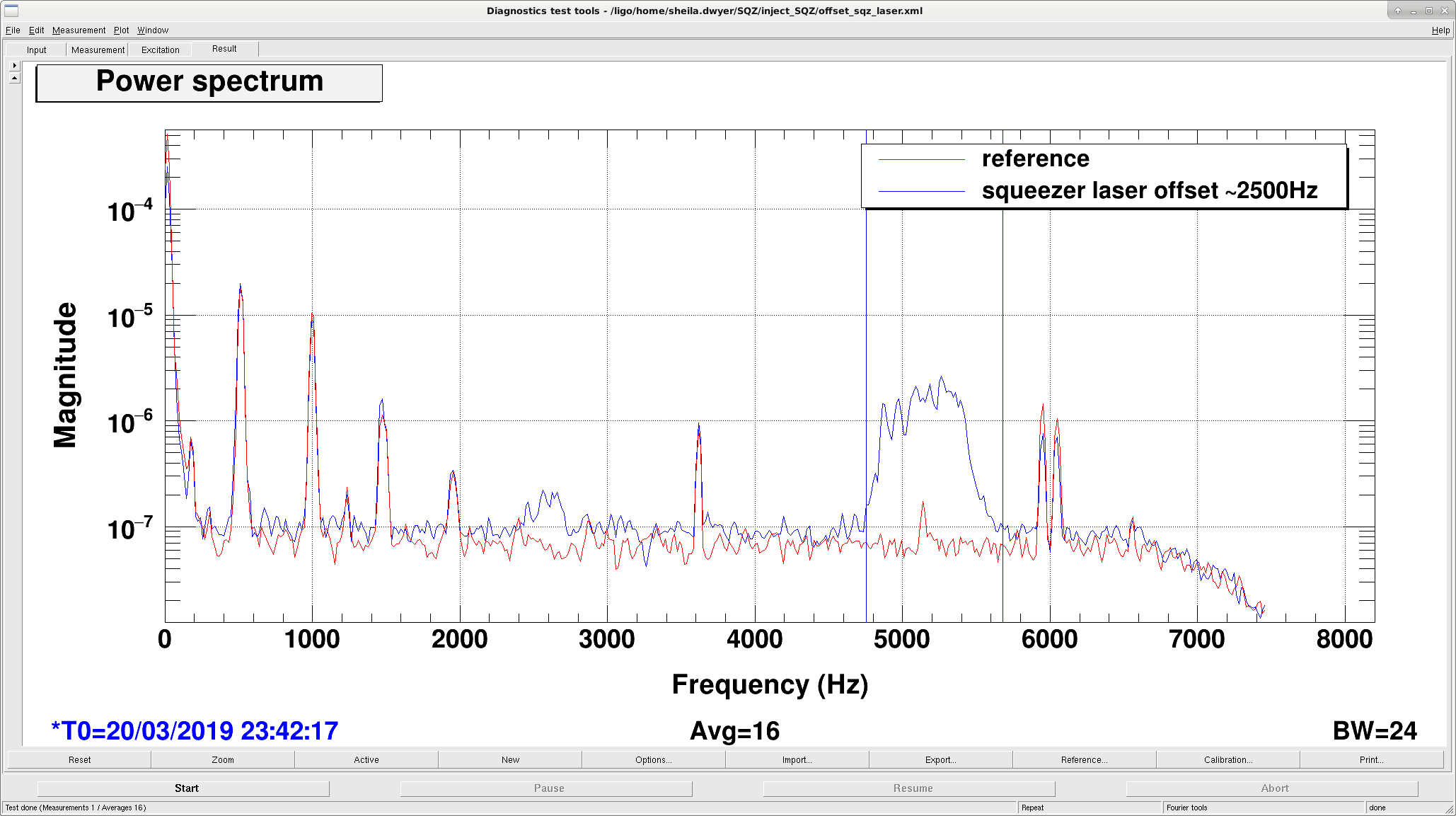
The first attached screenshot shows the two lumps in the DCPD spectrum caused by seeding (the smaller peak at the laser frequency offset) and the larger peak is the idler generated at the difference frequency between the green pump at twice the squeezer laser frequency and the interferometer carrier scattered into the OPO. The rms area in the backscatter lump is 39nA, while the area of the reference in this frequency band is 2.2nA, considering the 20mA carrier on the DCPDs and the responsivity of 0.858A/W this means that we had 89 fW of backscattered idler reaching the DCPDs. The ratio of the amplitude of the idler to IFO carrier is x, which is 1-1/sqrt(nonlinear gain) (page 189) , since we have a non linear gain of ~2.3, we should have ~770 fW of scattered light from the OPO reaching the DCPDs at the interferometer carrier frequency.
We collected measurements that can be used to predict the amount of scattered power reaching the OPO in 46099, we can expect about 23nW of carrier to reach the OPO, so the power reflectivity of the OPO is roughly 3.3e-5. This is similar to what Sheon Chua measured, which was 41dB of backscatter isolation. The amount of scattered light power we are seeing is roughly consistent with our expectations.
The seeding peak is much smaller; the rms area of the peak with the reference subtracted in quadrature is 2.6nA, which implies 0.4 fW of seeding power reaching the DCPDs.
Noise coupling paths:
Although the amount of scattered light is about what we expected, the acoustic noise coupling that we saw from ISCT6 in 47551 is too close to DARM. We thought about three coupling mechanisms:
Aside about frequencies reported on the squeezer frequency screen (screenshot attached):
Sharan Banagiri, Anamaria Effler, Kara Merfeld, Philippe Nguyen, Robert Schofield
18:45 - 22:20 UTC
1:15 - 4:00 UTC
We completed acoustic injections at EX and made a magnetic injection at the CS. We are a little behind; today we were slowed down by a 3V DAC offset, losses of lock, and by trouble-shooting a magnetometer.
I measured the DARM sensing plant again today. Seems that we are prospring detuned again. Dan Brown did some last minute tuning, but I don't think he logged all of his changes. This alog is an attempt to recover the TCS situation.
With the loss of TVo and Dan Brown, we are hurting for thermal compensators at a time where the importance of thermal compensation tuning is at an all-time high, since we did not see a range improvement from increasing the power from 30 to 35 W.
Fortunately Danny VH will be returning after the LVC, but in the meantime we will do our best to tune TCS.
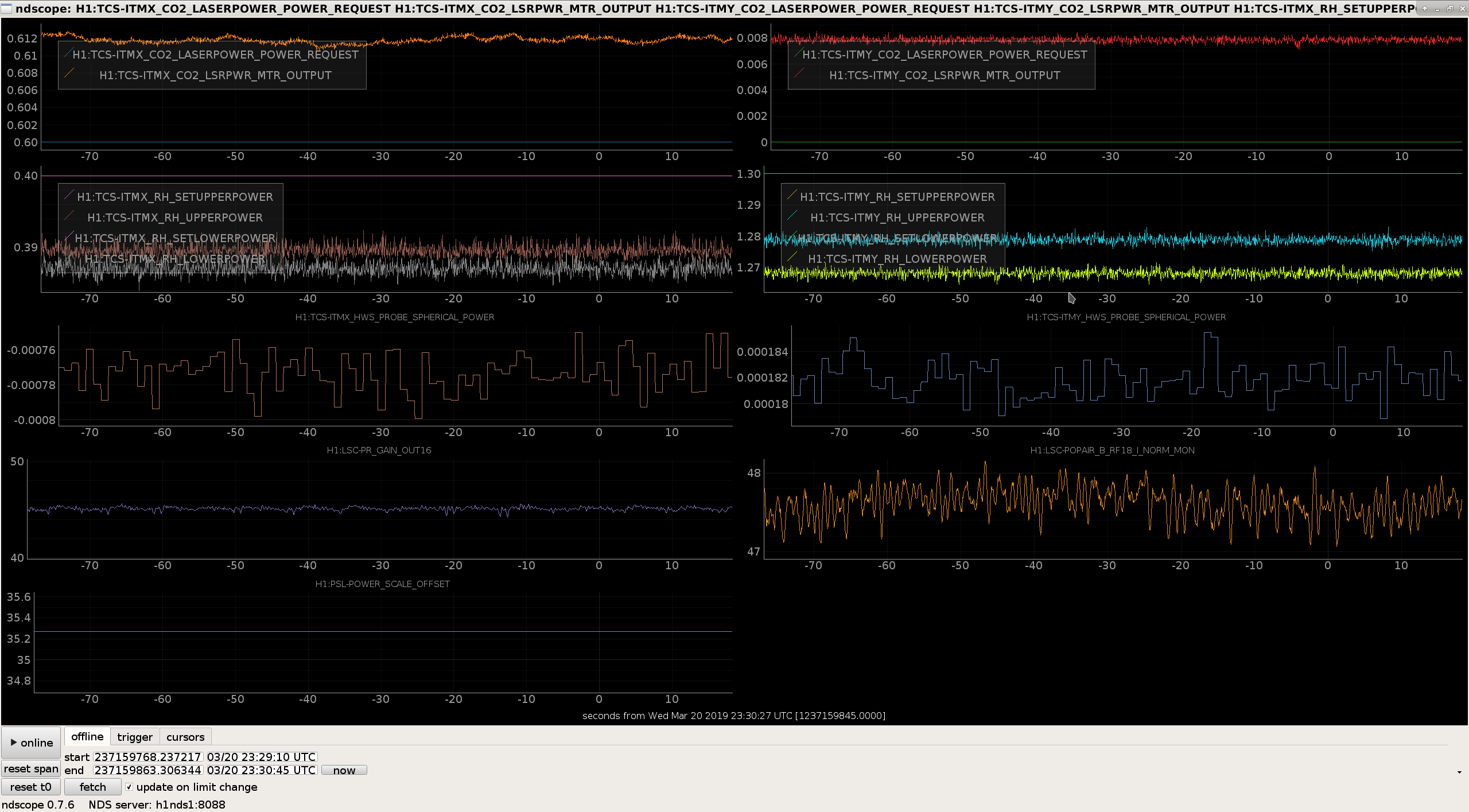
As best as I can tell, here is the current TCS situation at the time of this DARM measurement (~2 hours into a lock):
H1:TCS-ITMX_RH_SETUPPERPOWER 0.4 # W, ITMX ringheater
H1:TCS-ITMX_RH_SETLOWERPOWER 0.4 # W
H1:TCS-ITMY_RH_SETUPPERPOWER 1.3 # W, ITMY ringheater
H1:TCS-ITMY_RH_SETLOWERPOWER 1.3 # W
H1:TCS-ETMX_RH_SETUPPERPOWER 0.2 # W, ETMX ringheater
H1:TCS-ETMX_RH_SETLOWERPOWER 0.2 # W
H1:TCS-ETMY_RH_SETUPPERPOWER 0.2 # W, ETMY ringheater
H1:TCS-ETMY_RH_SETLOWERPOWER 0.2 # W
H1:AWC-SR3_HEATER_POWER_SET 5 # W, SR3 disk heater
H1:TCS-ITMX_CO2_LSRPWR_MTR_OUTPUT 0.6696 # W, ITMX CO2 power
H1:GRD-TCS_CO2X_MASKS_REQUEST CENTRAL
H1:TCS-ITMY_CO2_LSRPWR_MTR_OUTPUT 0.0778 # W, ITMY CO2 power
H1:GRD-TCS_CO2Y_MASKS_REQUEST CENTRAL
H1:TCS-ITMX_HWS_PROBE_SPHERICAL_POWER -0.000772 # diopters
H1:TCS-ITMY_HWS_PROBE_SPHERICAL_POWER 0.000193 # diopters
H1:LSC-POPAIR_B_RF18_I_NORM_MON 47.3192 # cts
H1:LSC-POPAIR_B_RF90_I_NORM_MON 15.1798 # cts
H1:PSL-POWER_SCALE_OFFSET 35.29 # W input power
H1:LSC-PR_GAIN_OUT16 45.0906
X Arm Power 175 # kW
Y Arm Power 192 # kW
It is hard to resolve the exact level of detuning with the current injections. The PCAL has limited actuation range, and we want enough power at high frequency to resolve the DARM pole, but also need to inject hard at low frequency to rise above the noise.
With prospring detuning we have to be careful not to inject too much at the spring resonance, which is difficult as it's exactly what we're trying to measure.
Our best bet is probably some bandlimited BB sweep from high to low frequency with appropriate notching at bounce and roll modes.
PEM injections?
Currently relocking after losing lock a couple of times due to Cal injections. PEM will be starting injections when we get back to NLN, but will likely prevent us from going to Observing.
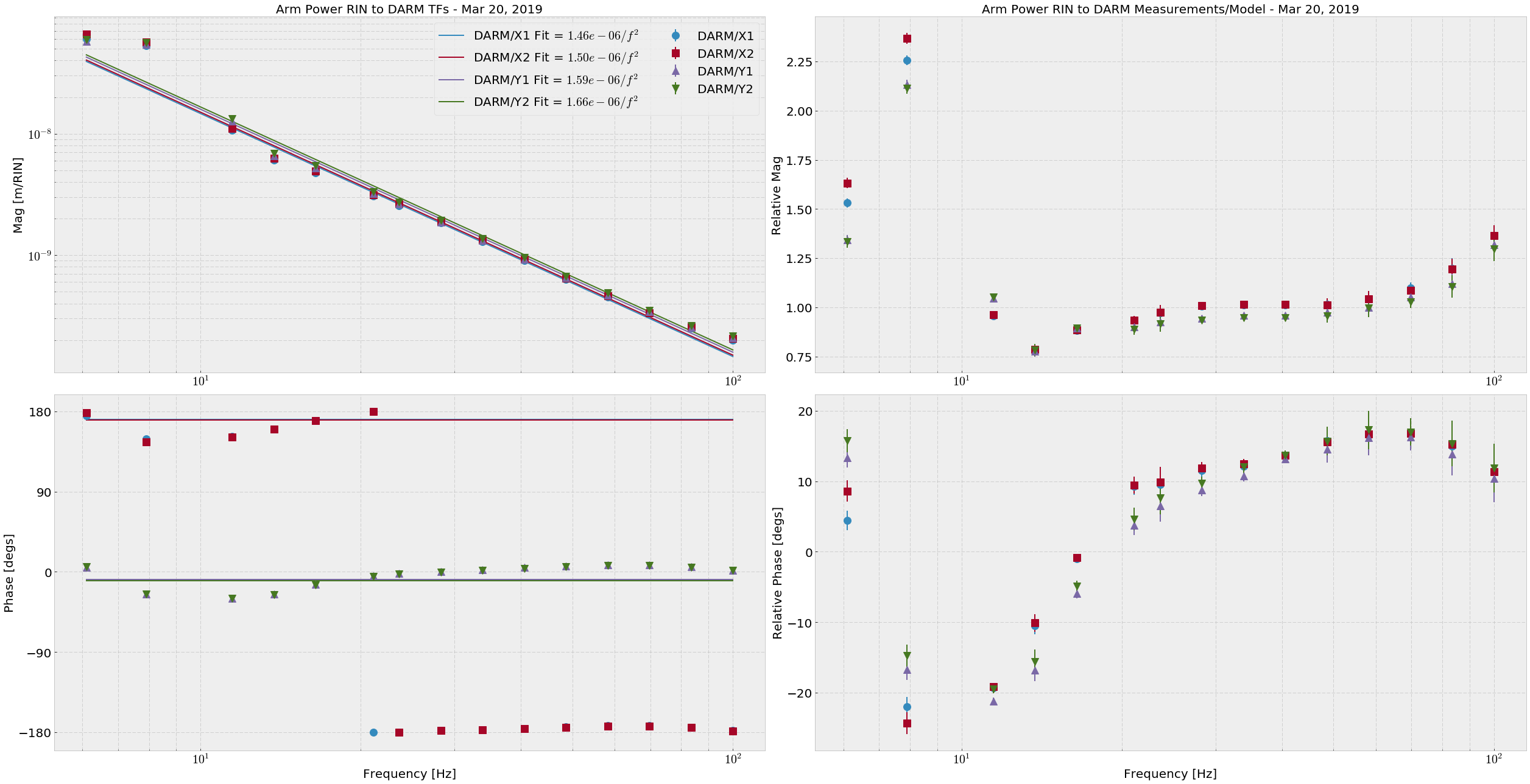
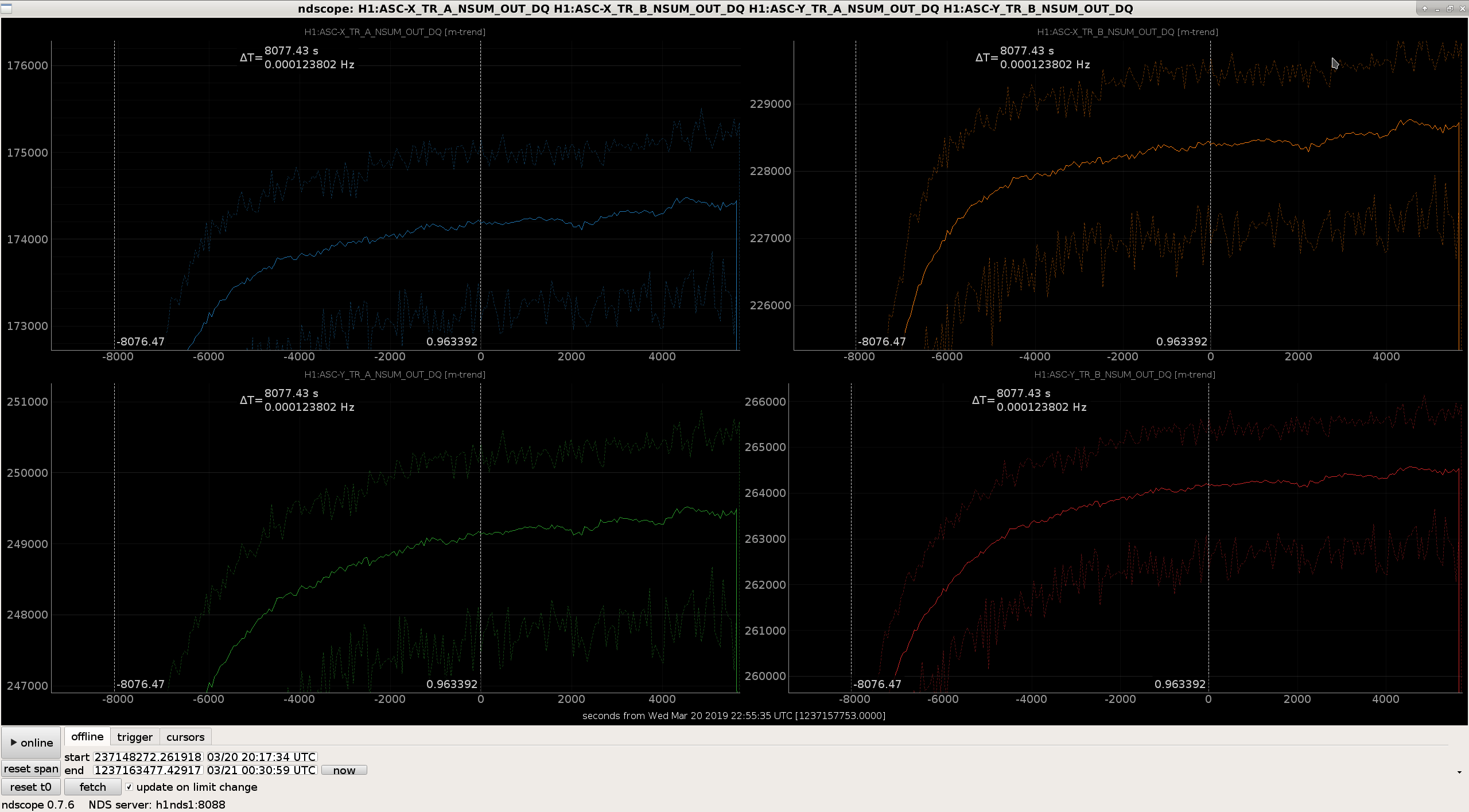
We reran the SRCL dither arm power measurement for our new 35 W input power setting. This was taken two hours into a lock, so the IFO was relatively thermalized (QPD powers increased by ~0.1% after this measurement, see attachment two).
Results
Arm QPD Gain [DARM m/RIN] Arm Power Inferred [kW]
------------------------------------------------------------------
XA 1.46e-6 173
XB 1.50e-6 178
YA 1.59e-6 188
YB 1.66e-6 196
X Arm Power = 175 kW
Y Arm Power = 192 kW
Mean Arm Power = 184 kW +- 9.0 kW
Ratio Y/X Arm Power = 1.095
Estimated Arm Power from Input Power and PRG
True input power = 31.2 W
PRG = 44.2
Theoretical Arm Gain = 280
Estimated Arm Power = 193.1 kW
So we have 184/193 = 95% of our total expected arm power.
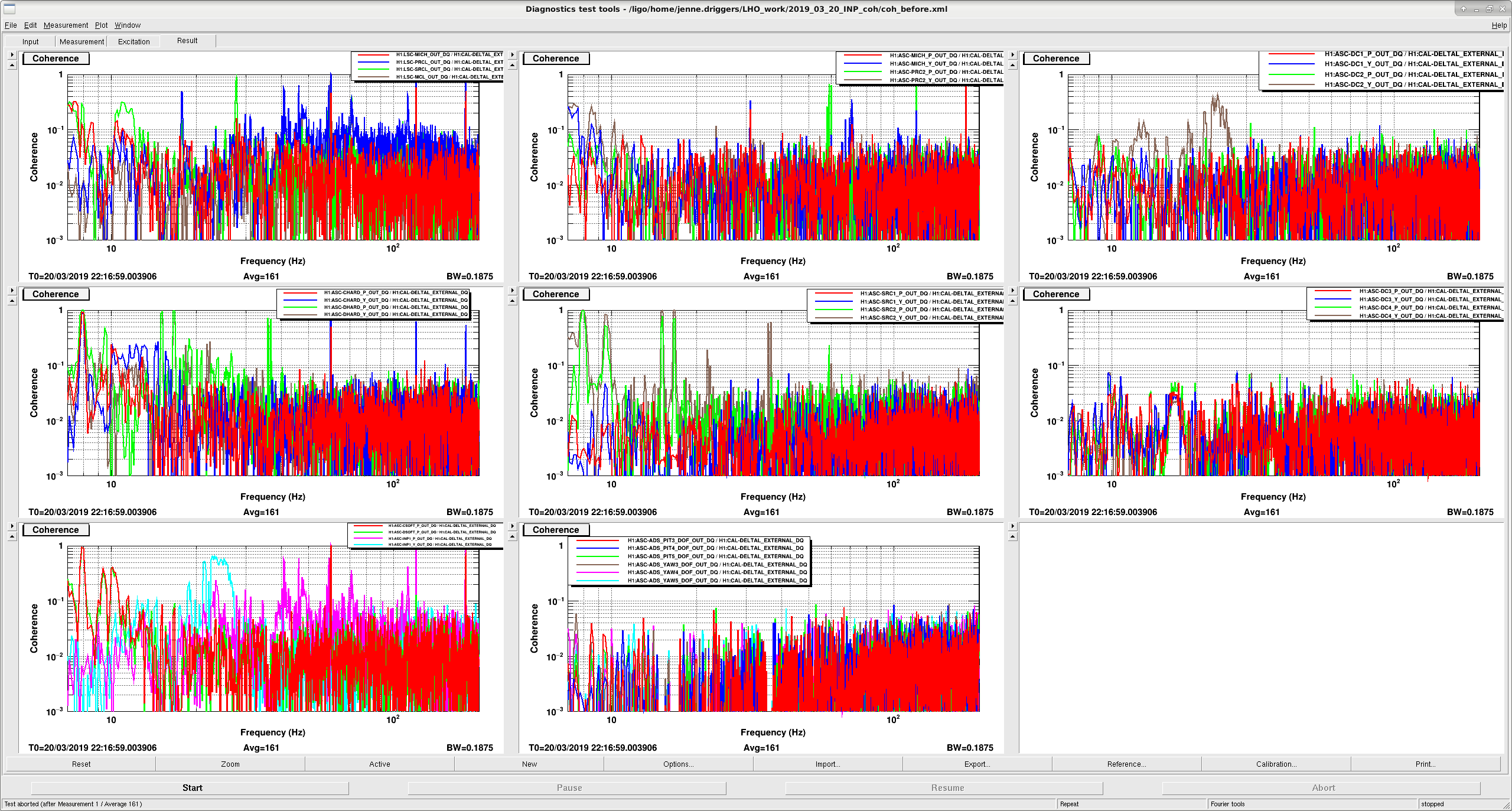
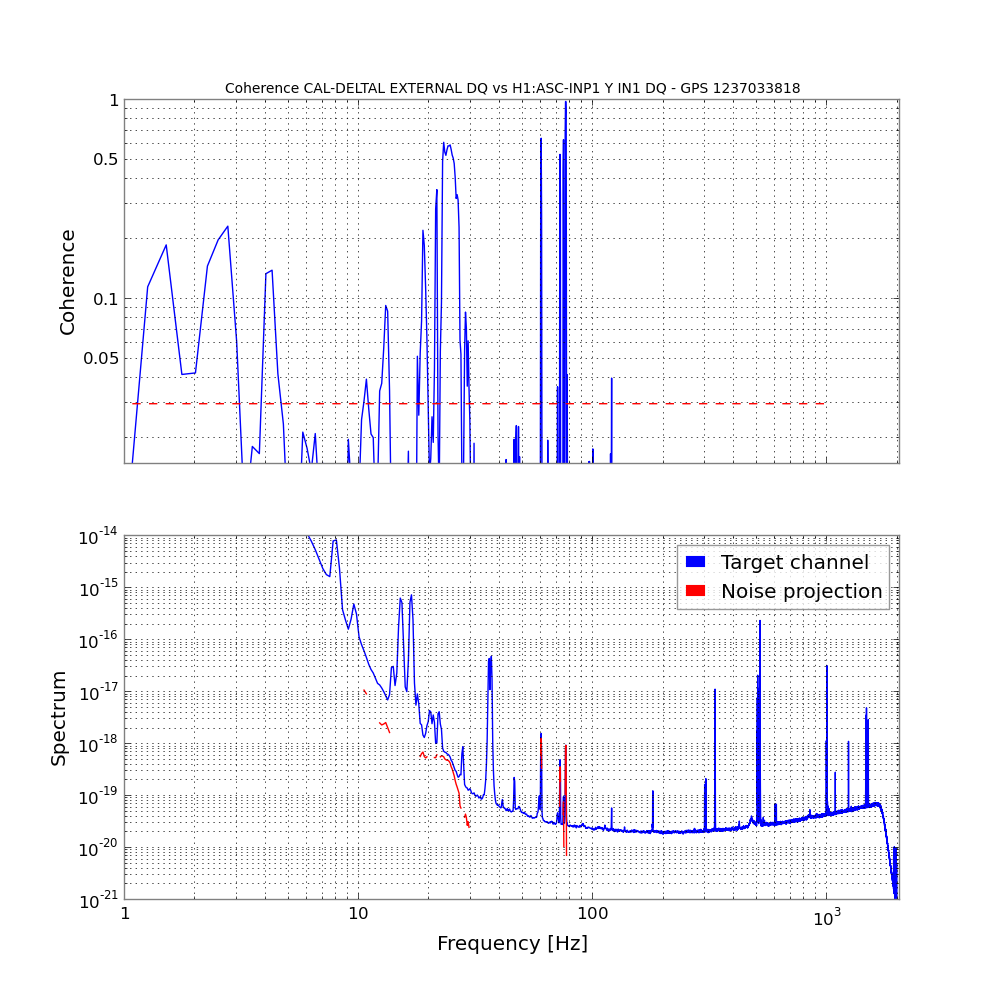
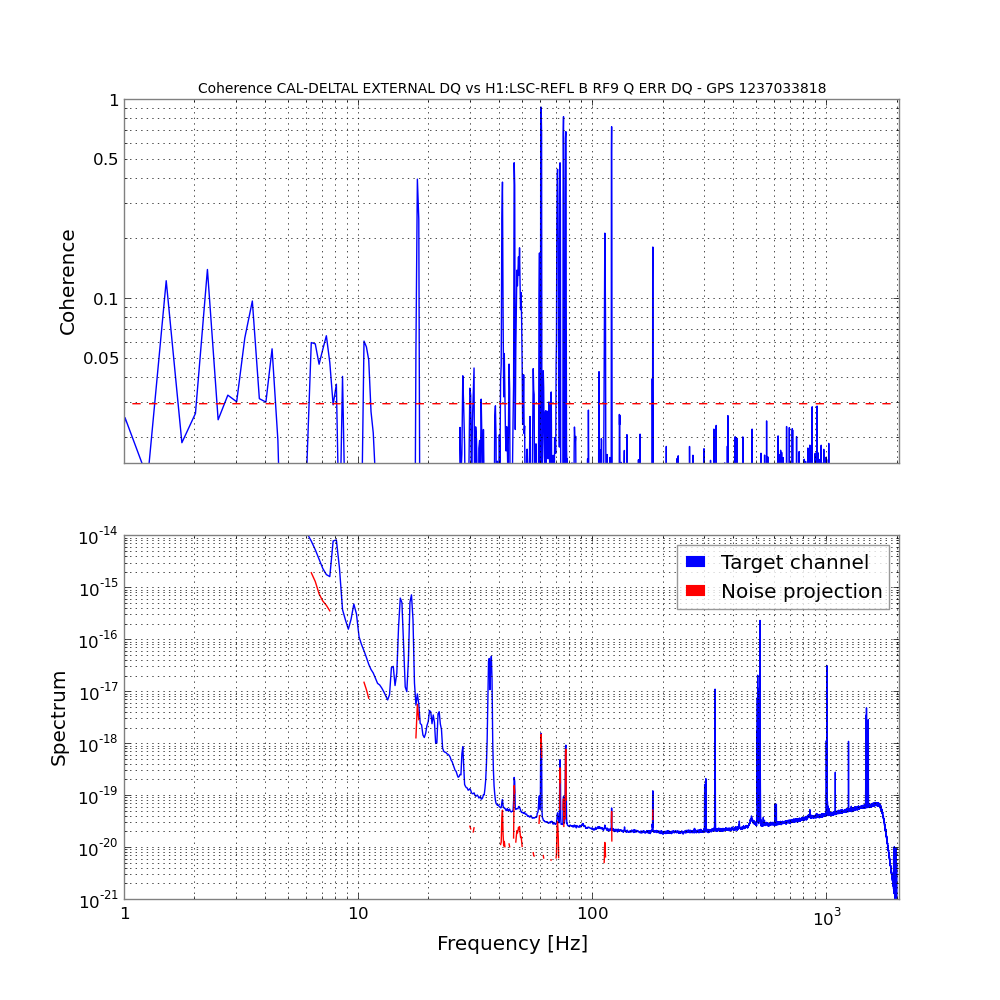
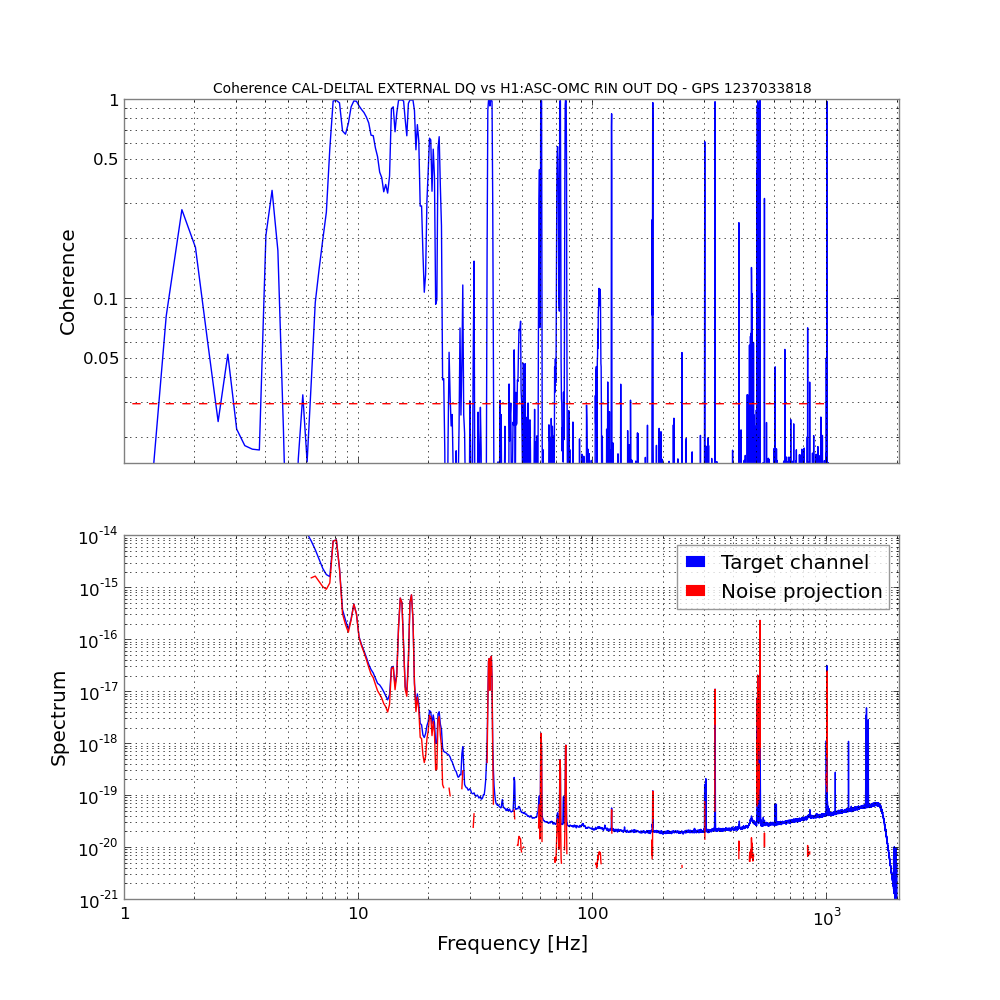
I've looked a bit more at the regions that Gabriele identified in alog 47656, due to INP1. At least for several of our 35W locks, we have had consistent coherence with INP1Y and DC2Y.
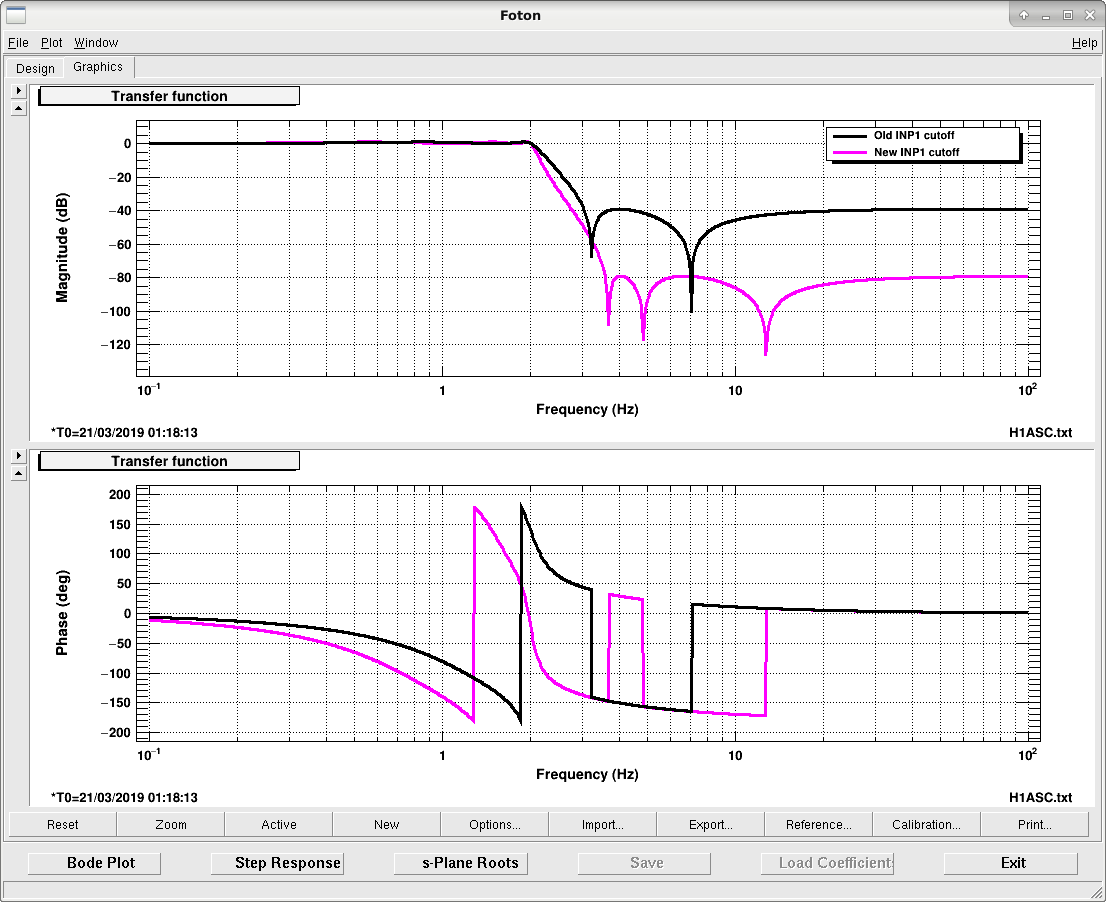
I made the 2Hz cutoff in the INP1 loops more aggressive, after determining that the loop gain at 0.2 Hz was already -15dB, so stuff around a few Hz is well above the UGF. This removed the coherence with INP1, but did not make any change in the coherence with DC2Y.
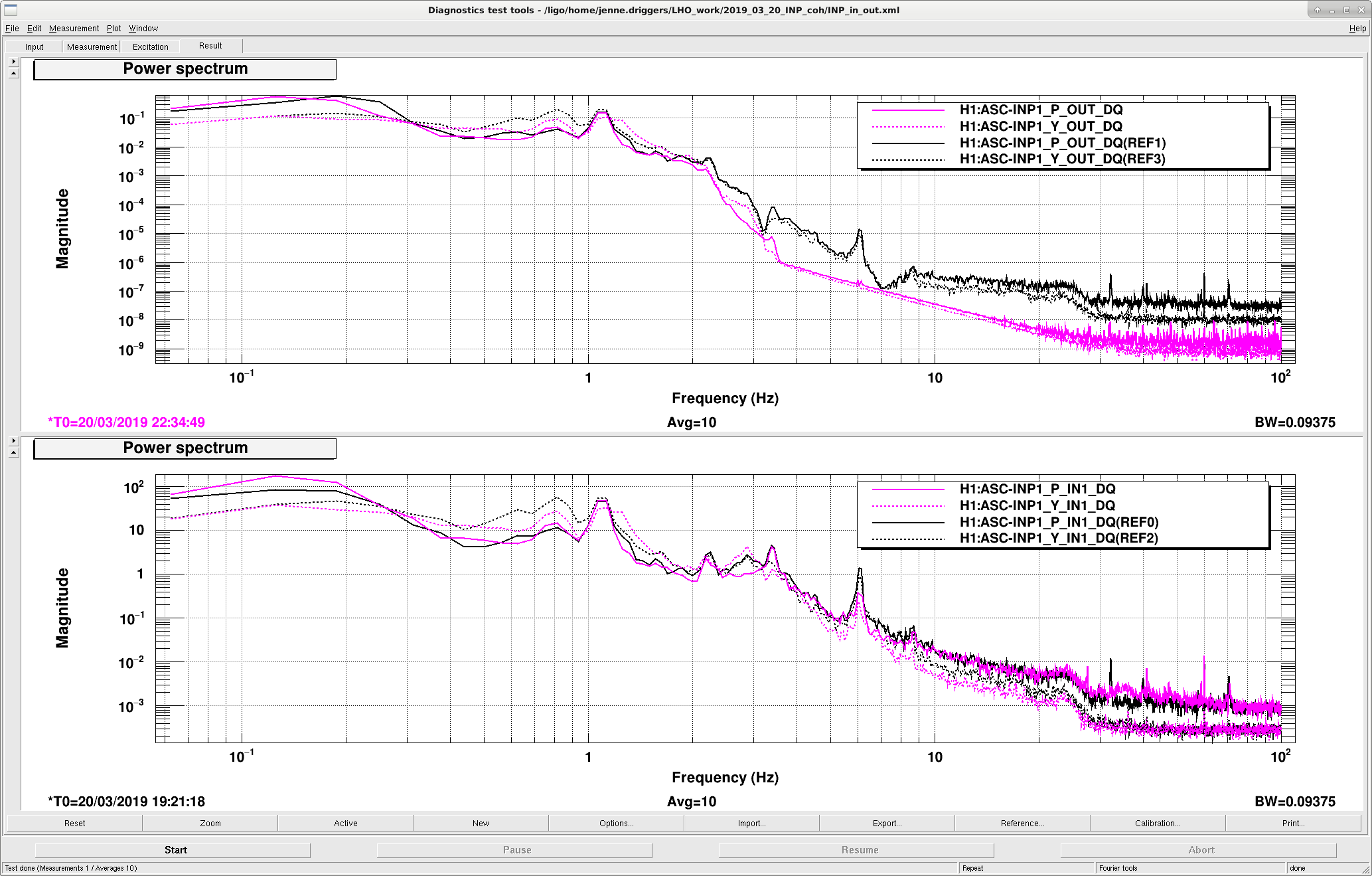
The first two attachments show a lot of coherences with DARM both before, and then after, I change the cutoff. The third attachment shows how the INP1 input and outputs change with this more aggressive cutoff. In this third attachment, dashed lines are yaw, solid lines are pitch. Black is the before reference, pink is the after. Both pitch and yaw outputs are reduced, but the yaw input motion is also reduced in a band between 4Hz - 25Hz.
The fourth attachment compares the old and new cutoff filters.
Georgia is going to make a DC2Y noise budget injection, so that we can see how much it matters, but I suspect that we'll want to lower the bandwidth, or apply more cutoffs, to DC1 and DC2. Recall that we recently lowered the bandwidths of the AS WFS centering loops DC3 and DC4, but didn't change DC1 and DC2.
A list of commissioning tasks still to do:
We lost lock at around 0:30 UTC because of the lowest frequency points in the DARM OLG measurement. This is actually the second time we've lost lock in the last ~week or so running this measurement, so I've reduce the amplitudes of the points below 7Hz.
We got a notification of a 6.2 earthquake in Vanuatu this morning. When we started seeing effects in the ASC, we switched SEI_CONF to the EARTHQUAKE state, even though my plot put this earthquake barely into the LARGE_EQ state, the EARTHQUAKE state was the right response, I'll adjust this a bit. This knocked us out of observe, and we got some glitching in DARM below 100hz, so Jenne turned off the ADS. We may want to do this for future transitions to make the lock more robust, but it's unclear how it should be handled, that probably should knock us out of Observe. Eventually we lost lock, probably from some Sheila doing test on ETMX HEPI.
The SDF diffs that knocked us out of lock were HAM ISI sencor next chans, BSC ISI ST1 Z blend cur and next fms, and HEPI senscor next chans, Z only for the BSCs, X Y & Z for HAM1. I'll try to unmonitor these, so future transitions don't knock us out.
Also, the BS ST1 blend guardian didn't initially change the Z blend successfully, I had to init that guardian to get it to try again. It complained that it hadn't successfully switched, but didn't seem to be doing anything.
Re-requesting the state should force it into the correct configuration. Running INIT in an unknown configuration would just bring the node to a DOWN state because it doesn't know where to go. If this didn't work, please let me know.
M. Wade, A. Viets
I have created a new .ini file and a new filters file for the GDS calibration pipeline to go along with the gstlal-calibration-1.2.9 release. I restarted the production and redundant pipelines with this new configuration file around GPS time 1237083343. The new configuration file is located in the calibration SVN:
aligocalibration/trunk/Runs/ER14/GDSFilters/H1GDS_1236979074.ini
The changes to the configuration include:
This configuration file also points to new a filters file, also located in the SVN:
aligocalibration/trunk/Runs/ER14/GDSFilters/H1GDS_1236979074.npz
This filters file points to the most recent modelparams file:
aligocalibration/trunk/Runs/O3/H1/params/modelparams_H1_20190316.py
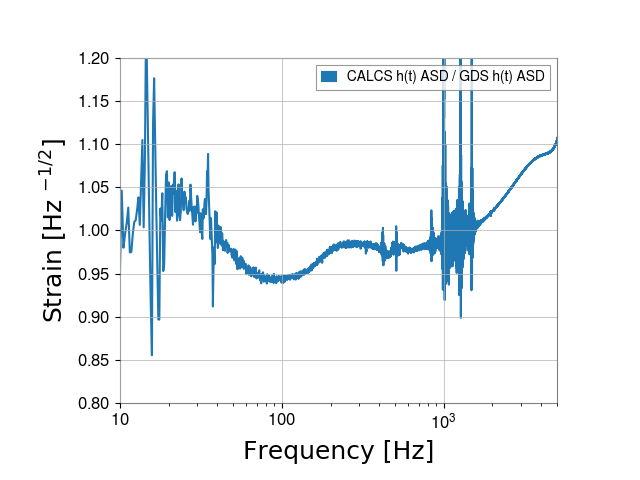
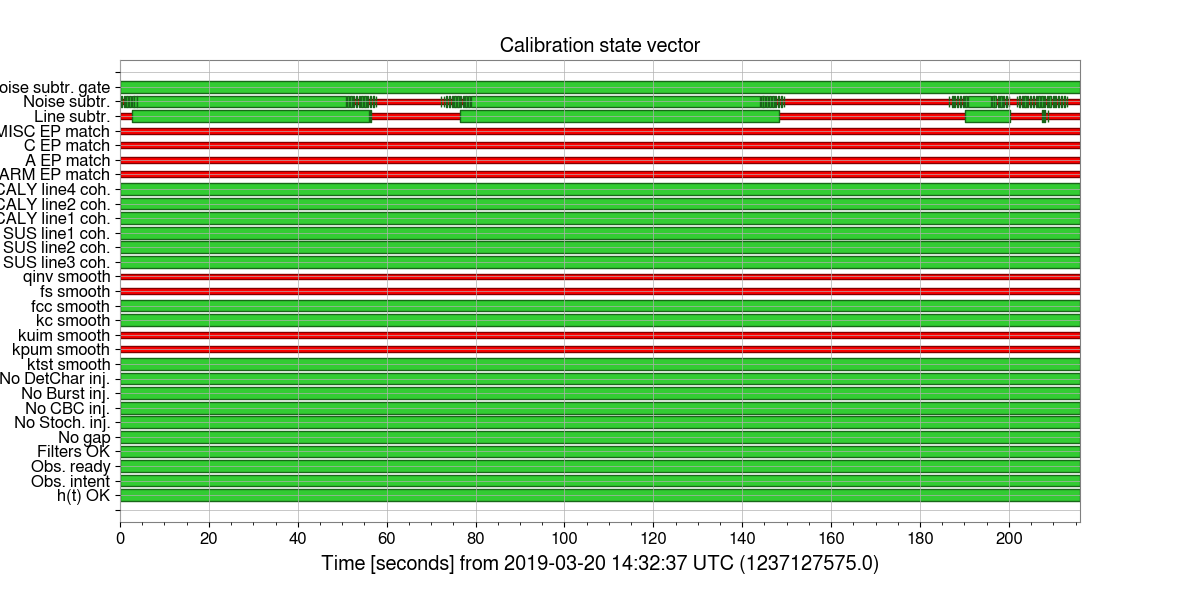
I've attached some plots of data calibrated with these filters. The first plot is a comparison of the ASD produced from the GDS calibration pipeline using these filters and an ASD produced from the CAL-DELTAL_EXTERNAL channel. The second plot is a ratio of these two ASDs. The third plot is a plot of the statevector for this time period.
Anamaria, Robert
The plot shows that several peaks are more visible in DARM after the power increase. Most obvious are 483 Hz (turning mirror before rotation stage – was damped), 820 Hz (possibly the optic right after the PMC – hasn’t been damped yet), and two un-identified peaks that had become visible after the recent sensitivity improvements, and that increased in amplitude with the power increase, at about 59 and 70 Hz. We will start looking for the sources of these latter peaks.
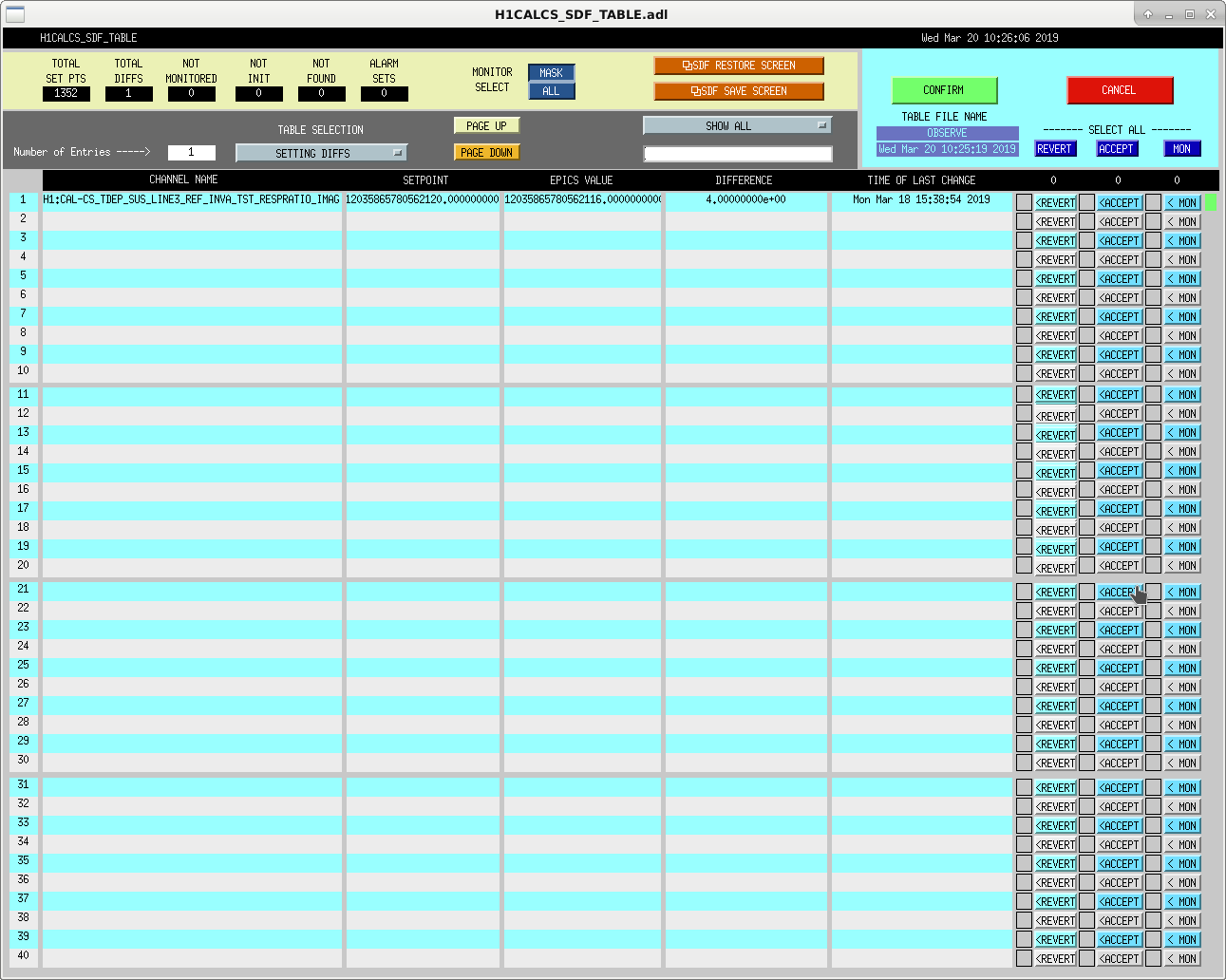
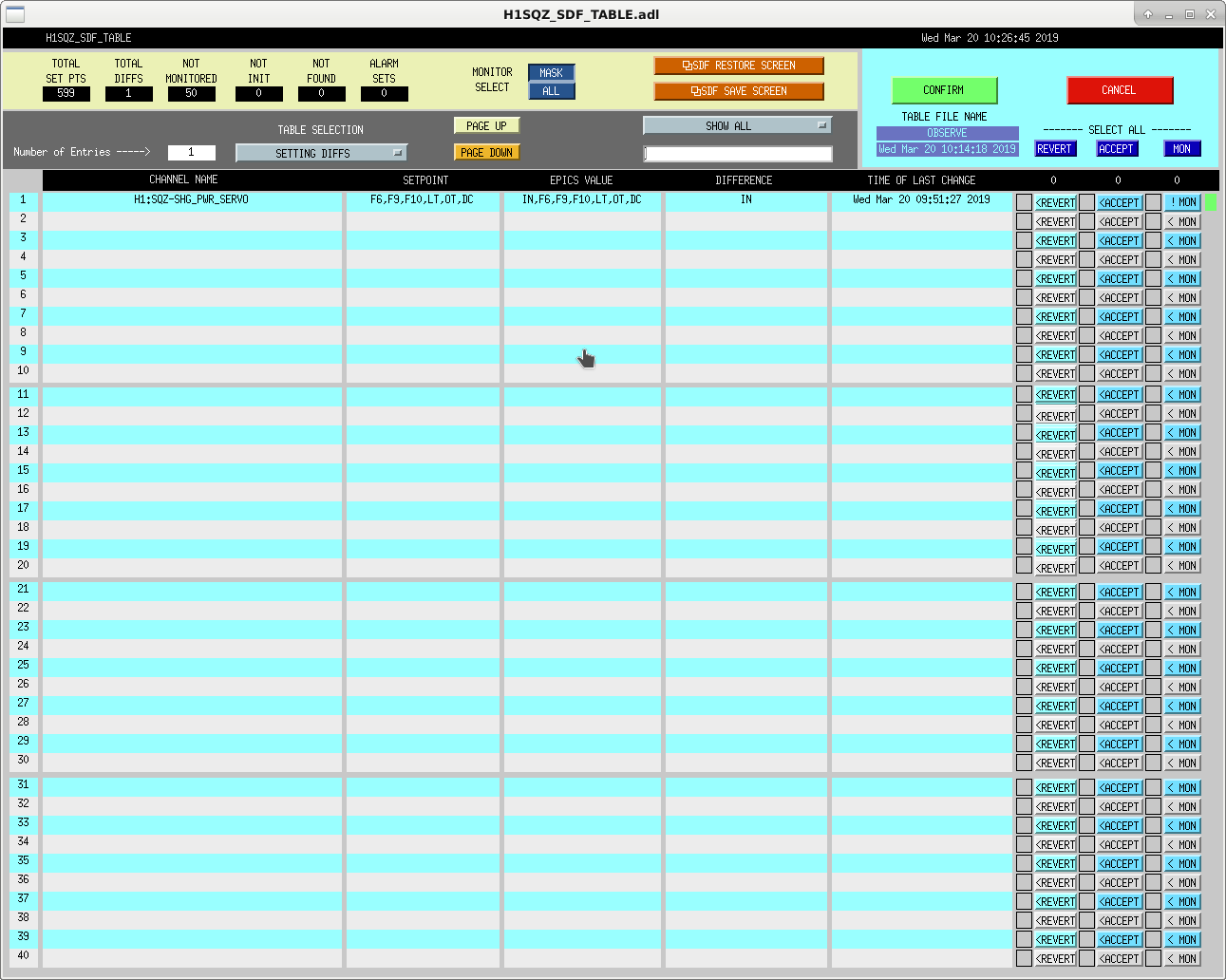
Just finished relocking after a measurement likely broke the previous lock. There were some SDF diffs that came up, shown in attached screenshots. One is a cal diff, first image, whose name is indecipherable to me. There were a bunch of other cal diffs, but they were all tiny, so I just accepted them. The other is the input of some SHG POWER being off in the SQZ guardian. I've accepted both, to get into Observe.
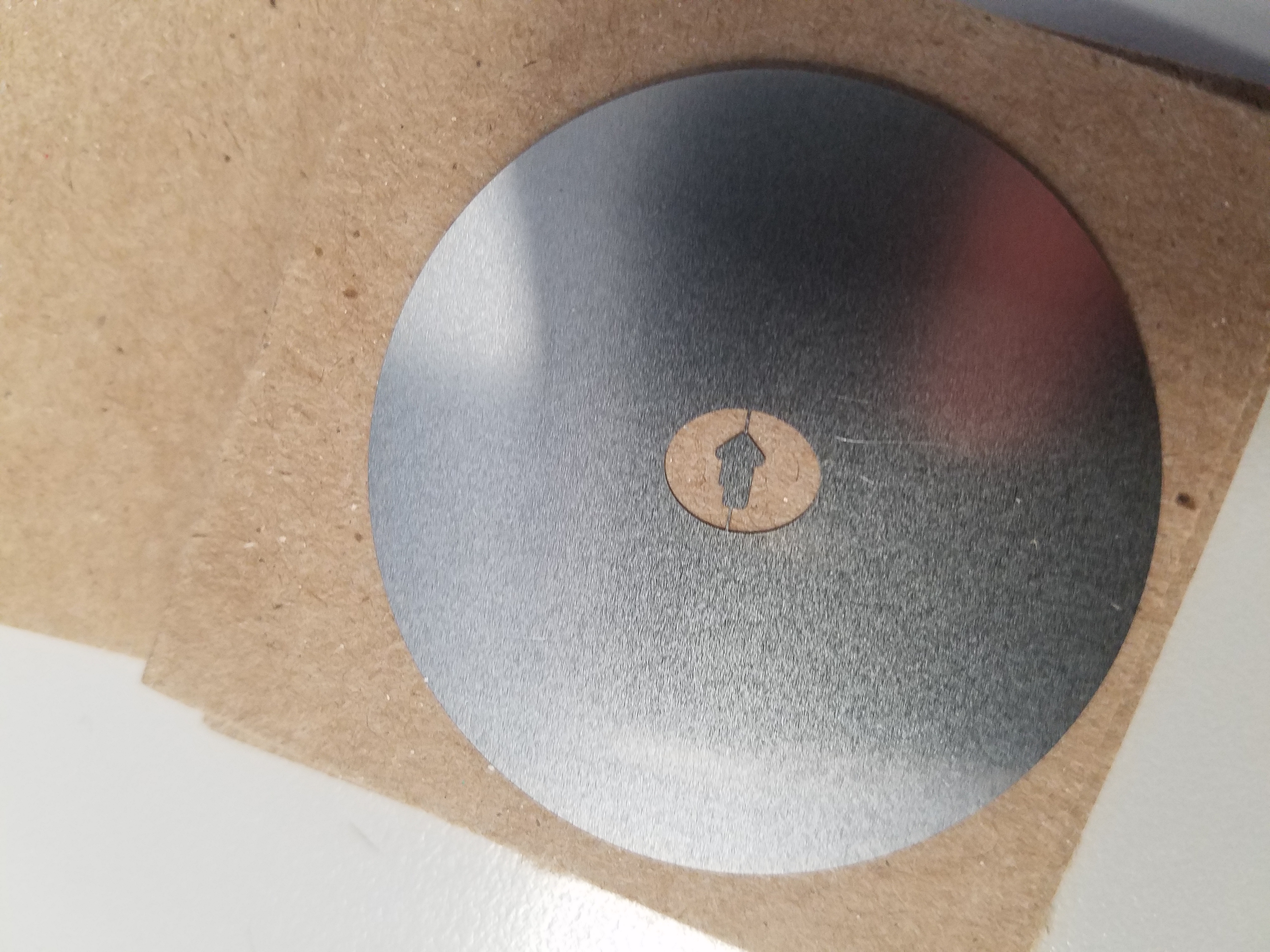
Yet to be installed, but here is a picture.
TITLE: 03/20 Owl Shift: 07:00-15:00 UTC (00:00-08:00 PST), all times posted in UTC
STATE of H1: Observing at 101Mpc
INCOMING OPERATOR: Jim
SHIFT SUMMARY: Lock loss halfway through shift and then a bit of a struggle to get back from some lines that were left on.
LOG:
0719 Observing
0823 CO2Y 0.0W -> 0.1W
0923 CO2Y 0.1W -> 0.2W
1024 CO2Y 0.2W -> 0.3W
1107 CO2Y 0.3W -> 0.2W
1120 Out of Observing to try and revert some of the ETMX L2 P2L and Y2L changes made by commissioners.
1125 Lockloss
1429 Observing
1456 Hanford Fire on site to check on pump room.
1429 Back to Observing after struggling to relock due to the AWG_LINES guardian not turning off the lines. Jenne came to the rescue and immediately recognized the issue.
Dan Brown has created a script which starts and stops the frequency and intensity noise lines 47636. Unfortunately, with this script the rest of the commissioning team did not have control over the lines. Today I made a guardian called AWG_LINES out of his script. It's in/opt/rtcds/userapps/trunk/isc/h1/guardian/AWG_LINES.py. All it does is turn off and on the lines while correctly starting, stopping, and clearing the injection testpoints. There are two states that matter: IDLE and INJECTING. IDLE is nominal, no injections are enabled, and this is the start this guardian should be in during observing. INJECTING should have all the lines enabled, and is good for our commissioning tasks right now.I will set up ISC_LOCK such that the lines are turned on in NOMINAL_LOW_NOISE. This will have to be changed for the run.I haven't had a chance to properly vet this guardian so I am leaving it out for now.More lines can be added to the SET_UP_INJECTIONS state if desired. EDIT: I just tested this guardian, it works as expected. Now ISC_LOCK requests 'INJECTING' every time it reaches NOMINAL_LOW_NOISE.
The injections were still going as TJ was trying to lock after his lockloss. For now, I have turned off the excitation enable buttons, but the guardian is still trying to send in the lines.
The AWG_LINES guardian didn't go through its STOP_INJECTING state when we lost lock, although TJ has checked that the loaded version of the ISC_LOCK guardian should have requested it to do so.
I forced the AWG_LINES guardian to go through STOP_INJECTING a few times, and it looks like it was happy to clear the LSC output matrix element (it also should have turned off some enable buttons, but I already had those off). I ask it to log what awgs it thinks it is running, and it thinks that there are no lines left alive. However, there certainly are lines still alive.
For now, with the excitation inputs disabled, we should be okay. I have also commented out of NomLowNoise the command to have the new guardian start sending in lines. We need this guardian to be checked, including the stopping of injections, before we let it back in to ISC_LOCK.
Operators - If you are having trouble locking, the symptom of these injections is that you can lock DRMI fine, but you can't get to RF_DARM. If that's true, copy the following 3 lines into a terminal:
cdsutils write LSC-MOD_RF9_AM_EXCITATIONEN 0cdsutils write LSC-REFL_SERVO_COMEXCEN 0cdsutils write PSL-ISS_SECONDLOOP_EXCITATION_GAIN 0The problem is with reloading this guardian. I had reloaded in the INJECTING state, which dumped our global variable containing the open awgs. Then STOP_INJECTING was run, but did nothing because the awgs variable was empty. I am working with Jaime to solve this issue. In the meantime, use Jenne's commands above to mitigate the lines, or rerun IDLE -> SET_UP_INJECTIONS -> INJECTING every time there's a reload. (this will reset the testpoints)
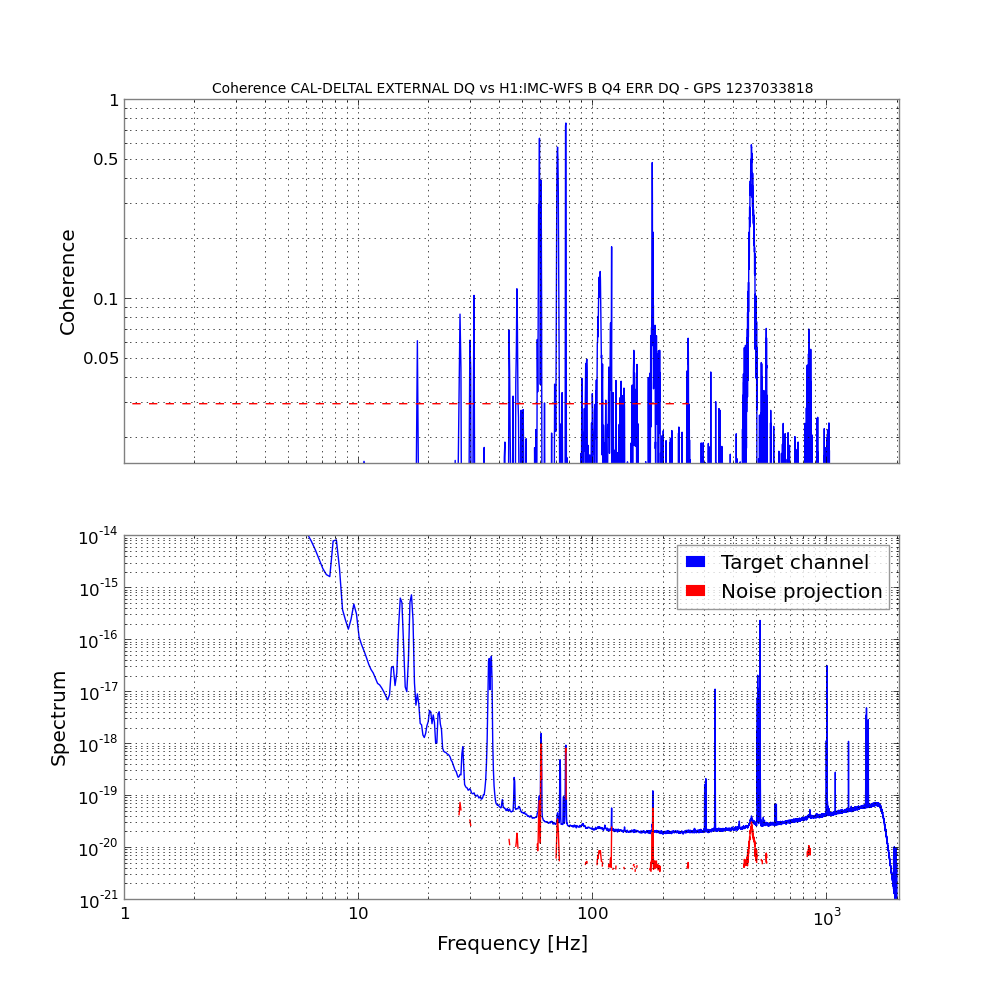
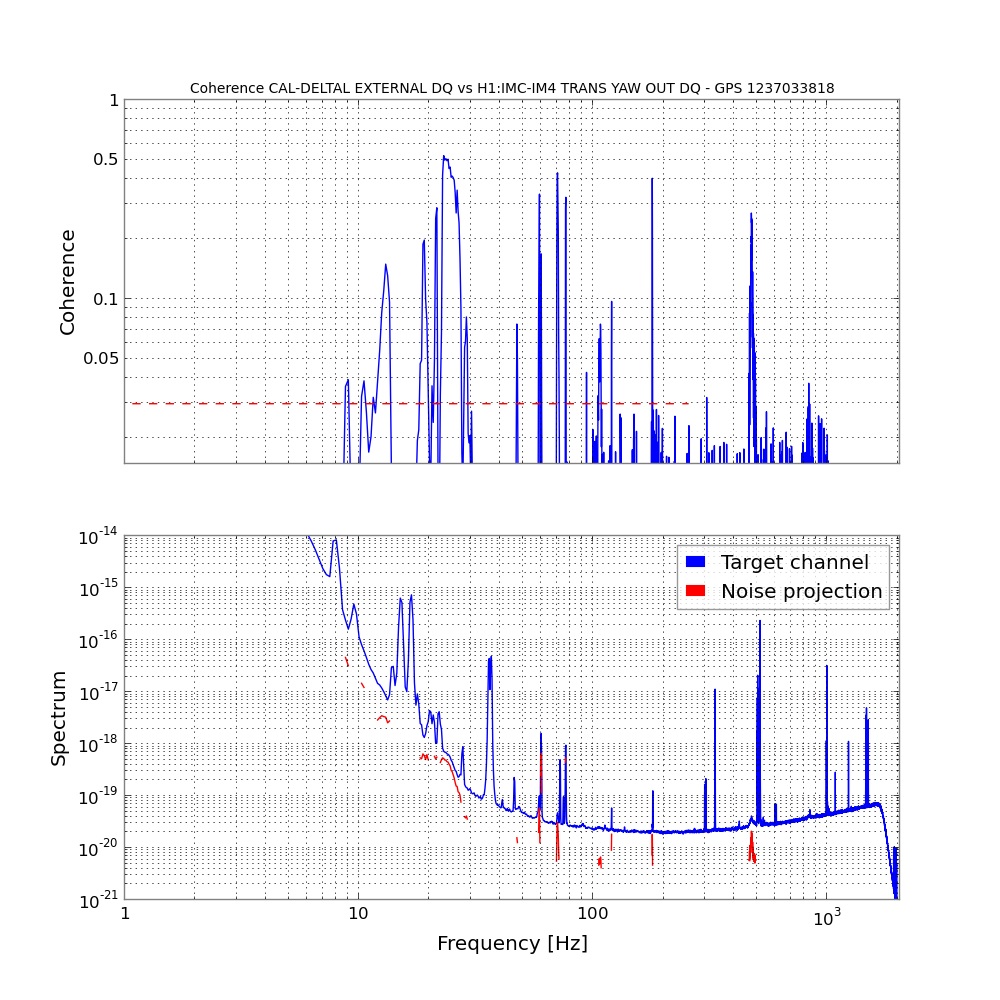
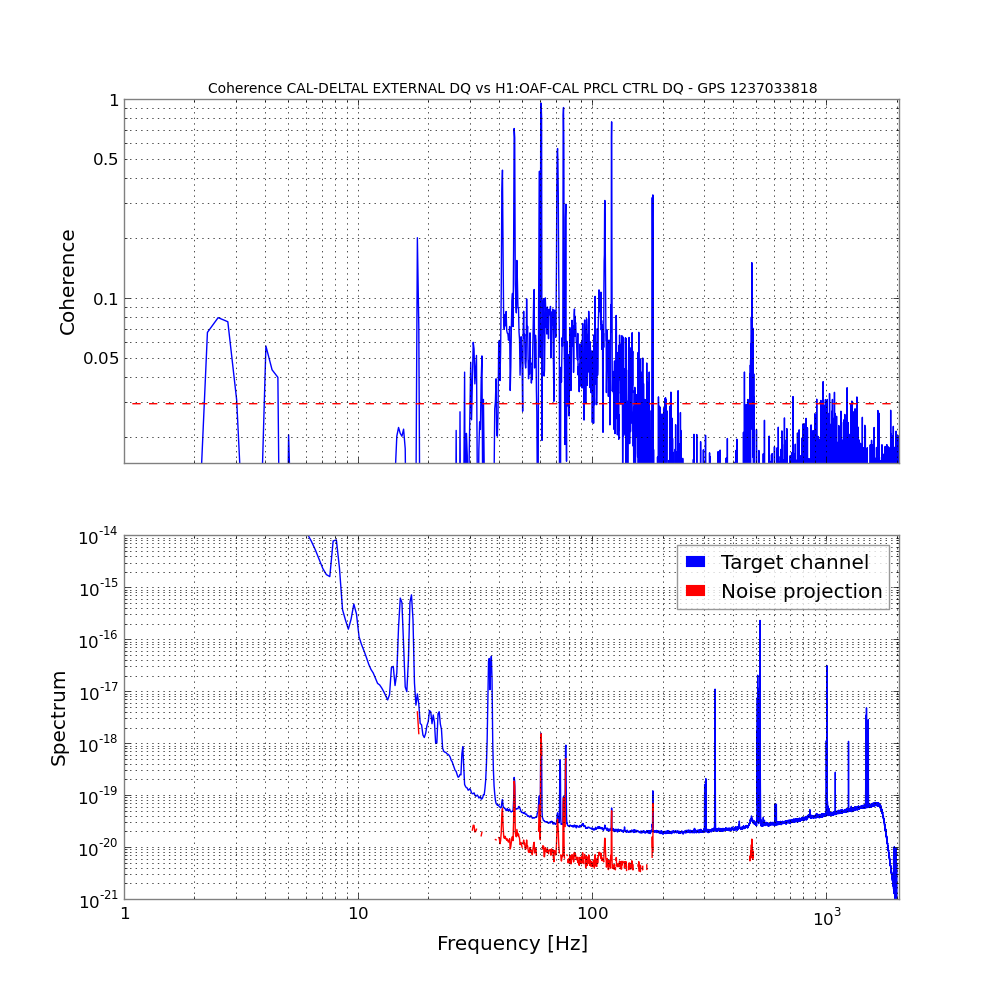
BruCo scan here for last night lock: https://ldas-jobs.ligo.caltech.edu/~gabriele.vajente/bruco_lho_1237033818/
Some highlights:
We should check in on this again for our next lock, before we try any TCS tuning, but for at least one lock from yesterday afternoon, there is much less coherence with INP1.
DanB points out that this time is right near a TCS CO2 power change, and the IFO was cooling down a bit, so perhaps the ASC was following in a weird way. On the other hand, I've been suspicious about that particular frequency region for a while - some locks it seems high, while other locks it seems low.
There is a 2Hz cutoff in the INP1 ASC loops, but at higher frequency the suppression is only 40dB. So, probably we should take a quick measurement of these loops and add some more aggressive cutoffs just in case.
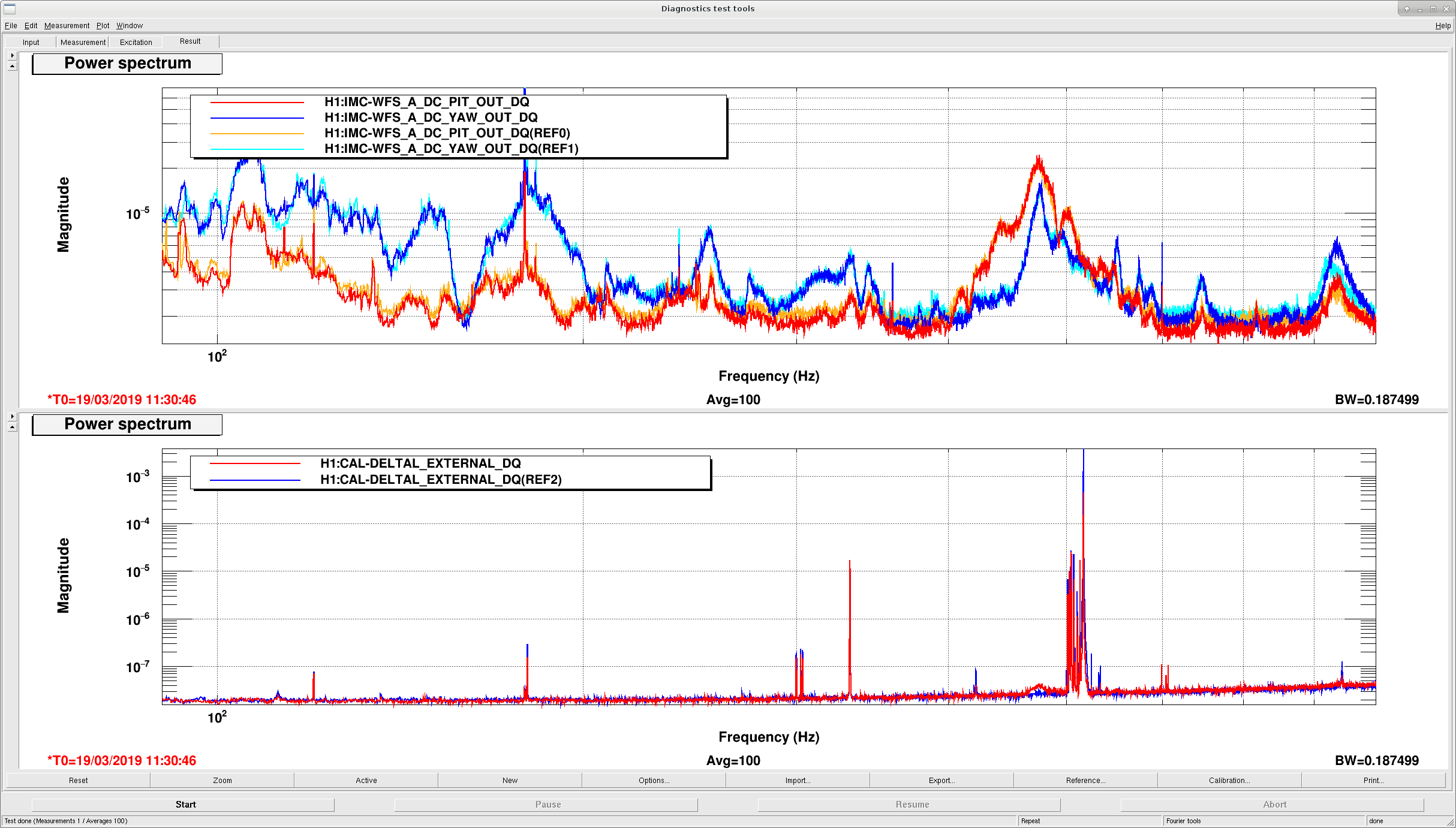
The 480 Hz is a jitter peak (ID'd by Robert here and damped here); the WFS are our best witness of jitter. I had a look at a non peak time (16/03 18:00) and a peak time (19/03 11:30) and the WFS see no difference in the 476 Hz peak, suggesting a coupling change.
Maybe I take my statement about lower coherence with INP1 back. For several locks, even in the absence of any TCS work, we have modest coherence with INP1. I have modified the cutoffs, see alog 47726.