Displaying reports 68161-68180 of 85875.Go to page Start 3405 3406 3407 3408 3409 3410 3411 3412 3413 End
Reports until 06:31, Sunday 03 May 2015
H1 DetChar (DetChar, PEM)
andrew.lundgren@LIGO.ORG - posted 06:31, Sunday 03 May 2015 - last comment - 15:36, Sunday 03 May 2015(18193)
Range-wind correlation for some locks during mini-run
To answer Jeff's question about the wind, I looked at the ten hour lock, and the three hour lock starting about 23:30 UTC (ignoring the stochastic injection). I wrote a custom script to make the plots, since I couldn't get sensemon range from NDS. I've done a 3-minute median filter on the wind and range minute trends to smooth them out a bit.

The first plot shows the wind and range for the first lock. Around 12:30 UTC, the spectrogram (second plot) shows a big increase in the noise, and there's a corresponding decrease in the range. I think this is unrelated to the wind, and will be investigated elsewhere, so I've cut this lock off about 320 minutes in (third plot). The fourth plot is the scatter of the wind versus the range. A simple fit gives a value of 8.4 Mpc at zero with an 0.03 Mpc decrease per MPH of wind. The fifth and sixth plots are this repeated for the other lock, starting after the stochastic injection ends. The fit is 9.0 Mpc at zero with an 0.01 Mpc decrease per Mpc of wind.

I've attched the script I used. It needs a cache file for data of type H-SenseMonitor_CAL_H1_M called snsw.lcf. There's some values hard-coded, but it should be obvious what to change.
Images attached to this report
Non-image files attached to this report
Comments related to this report
jeffrey.kissel@LIGO.ORG - 15:36, Sunday 03 May 2015 (18196)DetChar, ISC, PEM, SEI
Sweet set of plots, thanks! Can you (and/or @DetChar, collectively) make a similar assessment of wind vs. omicron glitchiness?
H1 General
nutsinee.kijbunchoo@LIGO.ORG - posted 00:42, Sunday 03 May 2015 (18192)
Mini run Saturday evening shift Summary

16:24 Jim left the interferometer locked. Intent bit switched to Undisturbed.

19:48 Lock loss. PSL tripped ("Epics Alarm" went red). The guardian didn't switch off the undistrubed intent bit. I switched it off few minutes later.

20:40 PSL recovered (Thank you Peter K!) but IMC wasn't. I waited at least 5 minutes but it doesn't seem to lock itself. I trended and adjusted the MC1, MC2, and MC3 pitch back to where it was before it lost lock.

21:22 IMC locked. Redid initial alignment for the first time today.

22:18 Locked at LOWNOISE_ESD_ETMY (~11Mpc)

22:28 Intent bit switched to Undisturbed

22:50 Undistrubed intent bit turned off. Attempted to damp the violine modes.

22:55 Intent bit switched to Undistrubed. Jeff Kissel suggested I leave the violin modes alone.

23:01 Lock loss. PSL tripped AGAIN ("Interlock OK" went red).

23:09 PSL recovered

23:47 I realigned IMC again. It seems to me that IMC optics read off the bad alingment from somewhere and didn't go back to where it was when the ifo was locked. I was able to bring the IMC reflected light down to 52 counts (It was 53 during the previous lock). The alignment is saved. AS Air flashing at none 0,0 mode. Redid the initial alignment (didn't take too long. The ALS was already good).

           ALIGN_IFO stays on MICH_DARK_LOCKED for a very long time even though AS AIR was ~0. I moved on to SRC ALIGN before the panel was green.

00:17 Lock loss at ANALOG_CARM. IMC locked itself this time.

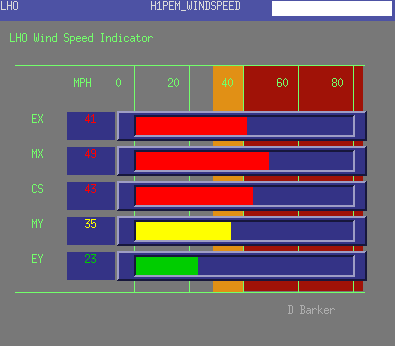
00:34 Locking again at LOWNOISE_ESD_ETMY (~10 Mpc). Intent bit switched to Undisturbed. Leaving the interferometer at this state. Wind slowly picking up speed.


A few notes before I leave the chair:

- As Jeff K. has requested, it would be nice if a Detcharian out there could plot the BNS inspiral range vs. wind speed during lock segments. I'm unable to do ligo-proxy-init from the control room computer and don't know of other way to get the BNS range data.

- Guardian does not switch off the Undisturbed intent bit when lock lost.

- IMC lock does not recover on its own after both PSL trips, but recovered just fine after a lock loss that doesn't cause by a PSL trips.

- We have a total lock time of ~20 hours during this 40-hour mini run (started Friday 8AM, ended Sunday at midnight - locking 50% of the time). 


I guess that is it for the Mini run. Enjoy the data!

Images attached to this report
H1 General (DetChar)
nutsinee.kijbunchoo@LIGO.ORG - posted 19:50, Saturday 02 May 2015 - last comment - 23:05, Saturday 02 May 2015(18187)
Lock Loss 19:48

Since the initial alignment hasn't been done since last night. I'm redoing the initial alignment. Wind speed looks good so hopefully I can get it back up again soon.

Comments related to this report
nutsinee.kijbunchoo@LIGO.ORG - 19:52, Saturday 02 May 2015 (18188)

Okay maybe not too soon. PSL just tripped....

nutsinee.kijbunchoo@LIGO.ORG - 20:50, Saturday 02 May 2015 (18189)

20:40 PSL untripped but having trouble locking IMC. I cleared all the IMC WFS history but that didn't help. Still working on it.

nutsinee.kijbunchoo@LIGO.ORG - 22:20, Saturday 02 May 2015 (18190)

22:18 Locking again on LOWNOISE_ESD_ETMY at ~11 Mpc. I had to tweak all the IMC optics to get IMC to lock again after PSL tripped. Intent bit switched to Undisturbed at 22:28.

nutsinee.kijbunchoo@LIGO.ORG - 23:05, Saturday 02 May 2015 (18191)

23:01 Lock loss. PSL tripped AGAIN.

H1 CAL (DetChar, INJ, ISC)
jeffrey.kissel@LIGO.ORG - posted 18:57, Saturday 02 May 2015 - last comment - 16:13, Monday 04 May 2015(18186)
DARM Coupled Cavity Pole is now at 355 [Hz], ESD Pole is actually 2.2 [kHz], OLGTF Model Frequency Dependence Matches Data from 10 [Hz] - 2 [kHz] to within 2.5% and 1 [deg], but CAL-CS & GDS/DMT/LAL h(t) Pipelines Does Not
J. Kissel

Having processed the last two DARM open loop gains -- the first measurements out to 5 [kHz], and the first measurements after we've tuned up the ASC loops to give us a consistent recycling gain of 35-40 -- I can now make the following statements:
- The DARM Coupled Cavity Pole (CCP) frequency is now consistently much closer to the "as designed" value. The measurements are consistent with a model of the DARM loop using a CCP of 355 [Hz].
- The ETMY ESD's driver pole frequency is 2.2 [kHz], not the colloquially thrown about 2 [kHz].
- I've added the violin modes to the model of the QUAD suspension, and they have no appreciable effect, but I'll leave them in for completeness.

On what these measurements and changes to the model mean for the uncertainty (precision and accuracy):
- The modeled unknown time delay remains at 0 +/- 5 [us].
- The frequency dependent uncertainty in the calibration model remains at +/- 2.5% in magnitude and 1 [deg], but I've data to back up that this extends out to the entire required* frequency band 10 and 2000 [Hz]. See attachment 2015-05-02_FittedCCP_H1DARMOLGTF.pdf (* OK, what *used* to be the requirement. The requirements are now extended albiet inflated out to 5 [kHz]; see T1300950)
- Over these last two measurements, the scale factor used to match the model against measurement has only varied by 3%. Indeed, if you cluster the eight measurements, grouping by CCP, then the standard deviations of the three, three, and two measurements are 7%, 41%, and 3%. However, the total standard deviation of all measurements is 22%, and the latter two measurements are only 1 day apart. From the data I have, I'm still not confident in decreasing the scale-factor uncertainty below 22%; perhaps PCAL can make a better statement on this (but I fear the current Mini-Run noise is too high for the low-frequency PCAL line). See 
2015-05-02_upto5kHzOnly_FittedCCP_H1DARMOLGTF.pdf
- The current calibration installed in the CAL-CS model is incorrect, both in frequency dependence and scale factor. 
    - Frequency dependence: The CAL-CS filters assume a DARM CCP of 389 [Hz] in the sensing path, and an ESD Driver Pole (ESDP) of 2.2 [kHz] in the actuation path. For the latest lock stretches, that inflates the uncertainty of CAL-DELTAL_EXTERNAL_DQ with a known, systematic error of 
      current / correct = ( 1 / (current CCP / correct CCP) + (current ESDP / correct ESDP) ) / (properly normalized)
                        = ( 1/zpk(-2*pi*389,-2*pi*355,355/389) + zpk(-2*pi*2e3,-2*pi*2.2e3,2.2e3/2e3) ) / 2
      which translates to as much as a 7% magnitude error at 1 [kHz], and 1.8 [deg] swing in phase surrounding 1 [kHz].
      This is demonstrated in 2015-05-02_H1CAL-CS_Systematic.pdf,
      This is also reflected in the statistical uncertainty estimate. All comparisons are shown if a 389 Hz CCP and 2 kHz ESDP were used in 2015-05-02_389HzCCP_2p0kHzESDPole_H1DARMOLGTF.pdf.
    - Scale Factor: this depends on whether we want to use 22% or 3% for our scale factor uncertainty. If 22%, then the last two lock stretches still fall within the 1.1e6 +/ 22% [ct/m]. But, if the scale factor is 1.2725e6 (the mean of the last two scale factors), then that indeed falls outside of 1.1e6 +/-3%
    - We *still* have not implemented any compensation for the analog or digital, AA or AI filters. 
- The GDS/DMT produced calibration is off just as much as the CAL-CS produced calibration, because GDS/DMT calibration is using the same filters.

------------------
All parameter files have been committed (with updated ESD driver poles, and fitted DARM coupled cavity poles) here:
/ligo/svncommon/CalSVN/aligocalibration/trunk/Runs/PreER7/H1/Scripts/
H1DARMparams_1109994128.m
H1DARMparams_1111998876.m
H1DARMparams_1112399129.m
H1DARMparams_1112933759.m
H1DARMparams_1112942996.m
H1DARMparams_1113119652.m
H1DARMparams_1114541595.m
H1DARMparams_1114634170.m

Which are processed by the DARM model function here:
/ligo/svncommon/CalSVN/aligocalibration/trunk/Runs/PreER7/H1/Scripts/H1DARMmodel_preER7.m

And then compared with the script here:
/ligo/svncommon/CalSVN/aligocalibration/trunk/Runs/PreER7/H1/Scripts/CompareDARMOLGTFs.m
Non-image files attached to this report
Comments related to this report
jeffrey.kissel@LIGO.ORG - 16:13, Monday 04 May 2015 (18213)DetChar, ISC
J. Kissel

At the requested of Gabriele, I've isolated/highlighted the change in measurements' cavity pole frequency in the attachment below. In it, I
(pg 1) have divided the open loop gain transfer function *measurement* by all components of the *model* for each measurement *except* for the frequency response of the IFO (which we have modeled as a single pole filter at the designated frequency). That includes
     - The entire actuation function, A
     - The entire control filter and gain, D
     - The sensing function's non-ifo frequency dependence from the AA (both digital and analog) filters and the uncompensated OMC DCPD whitening poles
     - The DC optical gain
(pg 2) Remind people that I've filtered out every data point but the most ridiculously coherent (coh = 0.99, nAvgs = 20), such that we can be certain that all frequency points used have sqrt( (1 - 0.99) / (2 * 20 * 0.99) ) = 1.6% uncertainty. Indeed, as shown by the historgram, and the vast majority have greater than 0.999 coherence, i.e. sqrt( (1 - 0.999) / (2 * 20 * 0.999) ) = 0.5% uncertainty.
Non-image files attached to this comment
H1 INJ (CAL, DetChar, ISC)
jeffrey.kissel@LIGO.ORG - posted 16:36, Saturday 02 May 2015 - last comment - 17:17, Saturday 02 May 2015(18184)
Stochastic Hardware Injection Started with 0.1x Amp at 23:29 UTC
J. Kissel, E. Daw

In this current lock stretch, I've begun Ed's Stochastic Injection (LHO aLOG 18161) starting at 23:29 UTC. Scared of breaking the lock, I've started with multiplying the whole injection by a scale factor of 0.1. Out of habit, this has gone through the H1:CAL-INJ_TRANSIENT bank instead of the H1:CAL-INJ_CW bank, but signals arising from both banks should result in identical DARM CTRL [ct]. It should last ~10 minutes. The observation intent bit is on.
Images attached to this report
Comments related to this report
jeffrey.kissel@LIGO.ORG - 17:17, Saturday 02 May 2015 (18185)
This injection completed as scheduled. It also reduced our inspiral range by 3 [Mpc]. I'm glad I decreased the amplitude by a factor of 10!

Details:
I ran the following command from the 
/ligo/home/jeffrey.kissel/2015-05-02/
directory on the hardware injection machine, h1hwinj1:
awgstream H1:CAL-INJ_TRANSIENT_EXC 16384 inj10mins.txt 0.1 -d -d > 2015-05-02_2327UTC_InjectionTest_x0p1.log

Here're the exact start and stop times:
Channel = H1:CAL-INJ_TRANSIENT_EXC
File    = /ligo/home/jeffrey.kissel/2015-05-02/inj10mins.txt
Scale   =          0.100000
Start   = 1114644525.000000
End     = 1114645111.000000
Duration= 586 [sec]

I attach the output of the .log file (renamed to .txt because the aLOG can't handle the ".log" extension).

Non-image files attached to this comment
H1 CAL (CAL, DetChar, ISC)
jeffrey.kissel@LIGO.ORG - posted 14:35, Saturday 02 May 2015 (18181)
5 to 5000 [Hz] DARM OLG TF, Take two
J. Kissel,

Early signs from yesterday's measurement: The DARM coupled cavity pole is now up at 355 [Hz], much closer to the designed/ideal/predicted LLO value of 389 [Hz] (LLO aLOG 15923). Hopefully it stays consistent with today's measurement (or is higher!). Also -- since I'm getting great coherence out to several [kHz], I can expose and refine the precision the ESD driver pole frequency (nominally at 2 [kHz]; T1000220, specifically, pg. 6 of 'ESD_PA95_circuit_diags_comp_overlays_1_of_6.pdf'; preliminary results are pointing to that it's actually 2.2 [kHz]). 

I'll post full analysis of both measurements compared against all prior measurements in a bit, but this DARM OLG TF I just took lives here:
/ligo/svncommon/CalSVN/aligocalibration/trunk/Runs/PreER7/H1/Measurements/DARMOLGTFs/2015-05-02_H1_DARM_OLGTF_LHOaLOG18181.xml
For this measurement, I 
- decreased the frequency range to *actually* 5 to 5000 [Hz] (because getting down to yesterday's 3 [Hz] took too long). The measurement now takes 25 minutes.
- decreased the drive envelope's amplitude above 1 [kHz] by 2, to make sure (a) I don'tneed to turn of the ETMY L3 stage digital limiters, and (b) I'm sure it's not me ringing up the violin modes
- increased the drive envelope's amplitude below 10 [Hz] by 2, in attempts to get better coherence in the 5 to 15 [Hz] region. It didn't work, will try to drive harder there next time.

Relevant loop gain information also attached.
Images attached to this report
Non-image files attached to this report
H1 DetChar
jim.warner@LIGO.ORG - posted 13:37, Saturday 02 May 2015 - last comment - 14:00, Saturday 02 May 2015(18179)
Intent bit turned off, DARM OLG measurement starting

Jeff wants to take a DARM OLG measurement, so I've turned off the intent bit. Service will resume when he's done.

Comments related to this report
jim.warner@LIGO.ORG - 14:00, Saturday 02 May 2015 (18180)

Jeff's measurement is done. Intent bit set to undisturbed.

H1 DetChar (DetChar, ISC)
andrew.lundgren@LIGO.ORG - posted 11:51, Saturday 02 May 2015 (18176)
Excess noise / glitches coming from ASAIR_A_RF45_Q?
From looking at a few of the loudest Omega scans in the recent lock, i.e. scan 1 and scan 2, I noticed that ASAIR_A_RF45_Q is glitching in a similar way. There's about a one minute period of excess glitching in DARM (first plot). A coherence spectrogram of ASAIR_A_RF45_Q with DARM shows high coherence in the right frequency band, 20 to 500 Hz, only during this time (second plot). There's only excess noise in this AS45Q channel during this time (third plot). There's no excess coherence of MICH, PRCL, or SRCL with DARM during this time (fourth through sixth plots).

I'm not quite sure what this indicates - maybe an excess of junk light, or intensity fluctuations onto the OMC? There's no indication that the coupling to DARM is changing, since the AS45Q channel itself starts glitching at the same time DARM does. We got some loud CBC injections at the start of the lock, so we can hopefully use those to check whether this channel is safe.
Images attached to this report
H1 SEI (DetChar, ISC, SUS)
jeffrey.kissel@LIGO.ORG - posted 11:30, Saturday 02 May 2015 (18175)
HAM6 IOP / SWWD Trips Because OMCS T3 and LF OSEMs Get Excited
J. Kissel, J. Warner, D. Barker

HAM6 Software / IOP Watchdog, which is triggered on the TOP OSEMs of the OMC SUS, tripped at 
May 02 2015 18:15:50 UTC or 1114625766
shutting down the entire HAM6 SEI system, HEPI and ISI. As soon as the SEI system was shut off, the BLRMS of the OSEMs that were upset went down.

The offending OMCS OSEMs were T3 and LF, which are sensing unrelated DOFs.

@DetChar what happened here?
Images attached to this report
H1 AOS
jeffrey.kissel@LIGO.ORG - posted 10:47, Saturday 02 May 2015 - last comment - 12:15, Saturday 02 May 2015(18173)
H1 DARM 8 [Hz] Oscillations After Beginning to DC_READOUT_TRANSITION
J. Kissel, J. Warner

We're trying to recover the IFO after the epic 10.5 [hr] lock stretch, but we're having trouble getting past the DC READOUT transition. I attach the last four lock losses,  
2015-05-02 16:36:53.342000  ISC_LOCK  LOWNOISE_ESD_ETMY -> LOCKLOSS
2015-05-02 16:56:35.161000  ISC_LOCK  DC_READOUT -> LOCKLOSS
2015-05-02 17:10:12.335000  ISC_LOCK  DC_READOUT_TRANSITION -> LOCKLOSS
2015-05-02 17:36:44.730000  ISC_LOCK  DC_READOUT_TRANSITION -> LOCKLOSS
in which all but the first (which is the end of the 10.5 [hr] stretch) show a ring up of some 8 [Hz] oscillation. In the DARM ASD this appears as a sharp non-stationarity at 6-8 [Hz] with harmonics at 12 and 18 that show up as soon as the OMC starts to look for the carrier. Is this back scattter? Is this the DARM offset being incorrect? I don't know... we'll keep lookin'; any help is appreciated.

Images attached to this report
Comments related to this report
jeffrey.kissel@LIGO.ORG - 12:15, Saturday 02 May 2015 (18177)DetChar
J. Kissel, J. Warner

Another example. This time we were able to hold in DC_READOUT_TRANSITION, but after ~10 minutes the 6-8 [Hz] non stationary would keep popping up, and eventually we lost it. I tried the following:
- Reducing the DARM gain from 600 to 500 (perhaps because the IFO optical is different/better/worse the loop is on the edge of stability) -- no effect
- Reducing the OMC's input ASC QPD servo gain from 0.2 down in 0.025 increments (the DCPD camera shows angular fluctuations, the ASAIR camera looks pretty solid) -- no effect

Maybe this is something to do with some new back-scattering? The non-stationarity only begins to appear once I start to engage the OMC locking, but I don't really understand why locking the OMC would have an effect, given that it should all be back-reflection from the OMC's input coupling mirror...
Images attached to this comment
H1 General
nutsinee.kijbunchoo@LIGO.ORG - posted 09:38, Saturday 02 May 2015 - last comment - 15:28, Saturday 02 May 2015(18171)
Lock broke, 9:38 local. Long live the lock.

Not Nutsinee, this is Jim. Didn't see I was still logged in as her.

Comments related to this report
jim.warner@LIGO.ORG - 11:03, Saturday 02 May 2015 (18174)

We are still having difficulty acquiring lock, I've switched the intent bit, I'll revert when we re-acquire.

jim.warner@LIGO.ORG - 12:38, Saturday 02 May 2015 (18178)

Lock back up at 12:35 local. Jeff spent the last couple of hours changing DARM gains and trying other fixes, but we've reverted everything now and the lock came right back. No idea. Range is even a little better, it was 8-is when I came in, it's now a solid 10.

I should add, we did change the end station beam direction ISI St1 blends from 90 to 45 mhz blends.

jim.warner@LIGO.ORG - 15:28, Saturday 02 May 2015 (18183)

Another lock loss at 15:05 local, so about 2.5 hours for that lock.

Displaying reports 68161-68180 of 85875.Go to page Start 3405 3406 3407 3408 3409 3410 3411 3412 3413 End