TITLE: 10/29 Day Shift: 1430-2330 UTC (0730-1630 PST), all times posted in UTC
STATE of H1: Corrective Maintenance
INCOMING OPERATOR: Ibrahim
SHIFT SUMMARY: Currently trying to relock and at PRMI after a productive maintenance day and finishing up of PSL work.
LOG:
22:48 Started manual initial alignment
22:59 Manual initial alignment done, relocking
| Start Time | System | Name | Location | Lazer_Haz | Task | Time End |
|---|---|---|---|---|---|---|
| 14:56 | FAC | Karen | OPTLab/VacPrep | n | Tech clean | 15:08 |
| 14:56 | FAC | Kim | EX | n | Tech clean | 16:40 |
| 15:09 | FAC | Karen | LVEA | n | Restocking supplies | 15:31 |
| 15:09 | FAC | Chris | Mid-/End-Stations | n | FAMIS tasks | 17:09 |
| 15:19 | HWS | TJ, Camilla | EX | n | HWS collimater swap | 16:43 |
| 15:32 | FAC | Karen | EY | n | Tech clean | 16:54 |
| 15:37 | Christina | OSB Receiving | n | Moving equipment | 16:30 | |
| 15:47 | FAC | Nelly | HAM Shack | n | Tech clean | 16:36 |
| 15:52 | Tour | Jackie | MechRoom, LVEA | n | Tour | 16:51 |
| 15:55 | PSL | RyanS, Jason | PSL Encl | y(local) | PSL work | 20:15 |
| 16:27 | Mitchell | LVEA | n | Checking stuff visually | 18:02 | |
| 16:45 | VAC | Gerardo | FCES | n | Vac work | 17:57 |
| 17:16 | TJ | LVEA | n | Looking for screws | 17:24 | |
| 17:32 | FAC | Kim | LVEA | n | Tech clean | 18:39 |
| 17:34 | FAC | Karen | LVEA | n | Tech clean | 18:32 |
| 17:39 | FAC | Chris | LVEA | n | FAMIS | 18:34 |
| 18:15 | TCS | TJ | LVEA | n | Moving old CO2Y laser | 18:25 |
| 18:29 | - | TJ | LVEA | n | Sweep | 18:51 |
| 18:34 | FAC | Chris | n | Moving Forklift WT -> VPW -> Staging | 19:21 | |
| 19:01 | VAC | Gerardo, Jordan | EX | n | Vacuum things | 19:31 |
| 19:03 | 3IFO | Tyler | LVEA | n | 3IFO checks | 19:10 |
| 20:53 | Laser | Vicky, Daniel | LVEA, EX, EY | n | Adjusting temperature offsets for ALS, SQZ lasers | 21:45 |
| 21:11 | FIT | Francisco, Neil | EY | n | Running very far | 22:01 |
| 22:14 | PSL | Jason | LVEA | n | Switch NoiseEater switch | 22:21 |
| 23:05 | Vicky, Oli | LVEA, CER | n | Turn lights off/put laptops back | 23:10 |
TITLE: 10/29 Eve Shift: 2330-0500 UTC (1630-2200 PST), all times posted in UTC
STATE of H1: Corrective Maintenance
OUTGOING OPERATOR: Oli
CURRENT ENVIRONMENT:
SEI_ENV state: CALM
Wind: 14mph Gusts, 9mph 3min avg
Primary useism: 0.02 μm/s
Secondary useism: 0.23 μm/s
QUICK SUMMARY:
IFO is LOCKING at PRMI
PSL Maintenance was ongoing throughout the day with PSL work finished (for now).
We've gone through a manual initial alignment and are now locking, which is apparently optimistic.
Daniel noted that the new NPRO is almost certainly at a different frequency than the previous one. Also, since the PSL has been the most 'fussy' lately, we don't want to change it away from it's manufacturer-recommended settings (if we can help it), and instead want to change the other 3 lasers to match the new PSL frequency.
In the attachment, the top row is SQZ laser, the middle row is ALSX, and the bottom row is ALSY. The leftmost column is the beatnote frequency between the given laser and the PSL, the middle column is the CrystalFrequency offset that we can provide, and the right column is the amplitude of the RF beatnote.
To figure out "where to go", Daniel put in a set of steps (eg, using ezcastep) to the CrystalFrequency channels. You can see that he started with the SQZ laser, but wasn't finding it by using a positive frequency offset. He then found (using ALSY) that putting in a negative frequency offset of a little over 4 GHz (the CrystalFrequency numerical value is in units of MHz) brought the RFMON up, and the PLL loop was able to engage and bring the beat frequency to the right spot. Once the RF mon started increasing, he Ctrl-C'd to stop the stepping of values. Knowing that all 3 of these aux lasers at one point were matched to the PSL, he then set the SQZ laser and the ALSX laser to search around that -4 GHz value. In order to have the PLL loops engage and not complain, Daniel set the H1:ALS-X_FIBR_LOCK_TEMPERATURECONTROLS_HIGH and _LOW settings for all 3 lasers to be a wide acceptable window (eg, +/- 6000 MHz, rather than a normal +/- 600 MHz).
Once all 3 lasers had their PLLs locked, Daniel and Vicky went out to each laser to adjust the nominal temp such that the CrystalFreq offset can be closer to zero. My understanding of the procedure is that they will (with the PLL locked using the big offset) take a look at the current temp of the laser, according to the little LCD display on the front panel of the laser controller. They will unlock the PLL and set the CrystalFrequency offset to 0, and then adjust the analog knob on the laser controller such that the temperature is back at the temp it was with the PLL locked with big offset. They'll then allow the PLL to relock, hopefully not needing a very big CrystalFrequency offset. While at each laser, they will also check that the laser is not in a mode hopping region with this new temperature.
After this is done, and once the PSL tune-ups are done for the day, we'll be able to start locking!
Daniel, Vicky - adjusted temperatures on the ALS and SQZ lasers: 1) Noted the laser temp when TTFSS was running (> 4GHz off). This is the "nominal" new temperature. 2) Turned off TTFSS and set crystal frequency to 0 MHz. 3) Moved laser temperature knob to bring it to the "nominal" temperature. 4) Check TTFSS locks well. If needed, further adjust laser temperature knob to bring the crystal frequency is 0 MHz when TTFSS is running. 5) Check for mode-hopping.
To check for mode-hopping with laser temperature on the controller set at the new nominal, we turned off TTFSS and stepped the laser frequency +/- 200 (SQZ) or +/- 100 (ALS X/Y) MHz, then checked the beat note strength and frequencies made sense. All looked good at the new nominal laser temps. To make up the ~4 GHz laser frequency difference, we expected to change temperatures by like (-4.4 GHz / -3000 MHz/V) ~1.47 C, which is similar to what we did.
Laser temps changed as follows:
After the SQZ laser temperature was changed by ~4.4 GHz to meet the new PSL laser frequency, we had to change the OPO TEC temperature setpoint from 31.207 C --> 31.477 C. This is a bigger change than usual, but we had to adjust the temp to find and lock the OPO in dual-resonance (at first, there was almost no CLF6 beatnote, started out with RFMON around -40 when it should be around -11. By contrast the OPO locked fine yesterday).
At 31.477 C, we used the temperature to maximize NLG with seed light: amplified=0.133, de-amplified=0.0027, un-amplified=0.0087. NLG = amplified /unamplified ~ 15.25. Then H1:SQZ-CLF_REFL_RF6_DEMOD_RFMON = -10.9.
Our frequency noise and contrast defect (measured at the OMC) are lower than they ever have been in O4 (contrast defect, frequency noise). As a part of trying to track down what may have caused this reduction, I tracked the coherence of DARM with the LSC REFL A RIN, using that as a witness to frequency noise, as it was used in OAF for online frequency noise cleaning in O4a (source: 72276 and poking around the OAF screens).
I tried to pick times that were a few hours into the lock to avoid thermalization confusion. I also used only observing data.
There are a couple ideas about what could have caused this improvement. A short list:
These are the times I used. All of these times were at the same 60 W input power from the PSL:
Dec 10 2023: O4a time, no WFS offset in use, EY ring heater set to 1 W (1386244818)
Apr 11 2024: O4b time, before the OFI problems, WFS offset in use, EY ring heater set to 1 W (1396950886)
Jul 10 2024: O4b time, just before OFI repair vent, WFS offset in use, EY ring heater set to 1 W (1404656647)
Sept 14 2024: O4b, after OFI repair, WFS offset in use, EY ring heater set to 1 W (1410432000)
Sept 20 2024: O4b, after OFI repair, WFS offset set OFF, EY ring heater set to 1 W (1410855190)
Oct 22 2024: O4b, after OFI repair, WFS offset set OFF, EY ring heater set to 1.1 W (1413635762)
Here are some notes for the comparison of these times:
All of these O4 times show less coherence than the O4a time. Based on this data, it seems like the WFS offset did have an impact on the frequency noise. It also seems like the various vents with output port changes could affect the frequency noise, but the overall beam alignment in the arms could have changed during the vent. For example, we did adjust the camera offsets/ADS gains during the vent commissioning times. The change in frequency noise during the OFI problems (between April and July) could have a similar source, since we had to change a lot of alignment during that time. I'm not sure if any arm alignment was significantly changed though. Finally, it seems like this small ring heater change had no effect on the frequency noise.
Just a quick look at how the input jitter coherence has changed with these changes as well. For estimating input jitter, we generally use the IMC WFS A DC pitch and yaw channels, both for the noise budget and for jitter cleaning.
I used the exact same times as the freqeuency noise traces for ease, and I matched the colors too for easy comparison. Note: I used coherence with a channel that has no jitter subtraction to also avoid confusion.
This first plot compares the jitter coherence with DARM from all the times across the whole band in pitch and yaw. It's a bit hard to read. To make this easier, I'll break down the trace comparisons:
The most interesting point here (in my opinion) is that the improvement in frequency noise from the brown trace to the pink trace, that is, when we turned off the WFS offset, is opposite to the effect on the jitter noise. We've seen this before: improvements to frequency noise worsen jitter coupling and vice versa. I still don't understand that mechanism.
These are saved in the same template as the frequency noise plot: /ligo/home/elenna.capote/freq_noise_coherence_compare.xml
Daniel rightfully pointed out to me that REFL A RIN is a better measure of intensity noise than frequency noise. In the process of thinking about this, I realized that we found that PRCL had some offset present that increased DARM coherence to LSC REFL RIN. We first fixed this by applying a digital offset, and then Sheila rephased POP9 which had the same effect of reducing the coupling to REFL RIN and increasing power in the PRC. The digital offset was applied to PRCL from March 30 to May 6, and then again applied from Sept 16 until Sheila rephased POP 9 on Sept 23.
Since the PRCL offset/POP9 rephasing effects the coherence of DARM and REFL RIN, and to better ensure I am capturing frequency noise, I reran these measurements using coherence with the REFL SERVO CTRL channel.
Figure 1 We see similar improvement and worsening between O4a, Apr 12 O4b and Jun 10 O4b. Then, the three traces after the OFI vent show the same coherence, Figure 2. This indicates that the improvement between the brown (Sept 14) and pink (Sept 20) trace in the REFL RIN plot (original alog) is likely due to the changes in PRCL and not due to changes in frequency noise. In fact, the frequency noise coherence since the vent for these three times looks about the same.
This leads to the conclusion that the something about the OFI vent itself changed the frequency noise. We might be able to attribute it to an alignment change, but my sense is that whatever alignment change that occurred is small compared to the significant change in the output mode matching. I still don't full see how this then couples back to frequency noise, but it's worth some thinking and modeling.
I have updated the plotallhlts_tfs_M1.m matlab script to allow the user to plot any potential cross-coupling. There is a newly-added boolean near the top called plotOffDiagonalTFs that can be set depending on whether you want to see the off-diagonal plots or not, and there is also a coupling matrix that can be changed depending on what coupling you want to see. The plots get appended to the end of the regular transfer function pdf file, allhltss_*_ALL_TFs.pdf. Attached is an example of how the cross-coupling plots are laid out. The script has been committed to svn as part of revision 12063.
I preemptively swept the LVEA since it seems like the PSL work will complete soon. The only things of note are I ended up unplugging 5 unused extension chords.
The last remaining items are: PSL in Science mode, wifi off, LVEA lights off, PSL phone unplugged in 163.
The remaining checks from the LVEA sweep have been done.
Looking at the CO2 ISS PD trends (qty 2 on each table labeled IN and OUT of loop), as the CIT CHETA setup that uses this PD is still getting confusing results (e.g. CIT#481). Each PD as an AC and DC mon output, from the DB9 of the PD preamp board D1201111.
Inially the DC signals look as expected, dropping to zero when laser is off (CO2X plot / CO2Y plot). CO2X stays within 1% when the laser is stable (CO2X plot). Though the CO2Y plots looks worse, only staying within 5% when the laser is stable (CO2Y plot).
If you pay attention to the ~hour region once the laser is first turned on in both lasers (worse in CO2Y, see plot) the ISS PDs show power signal varying much more than the CO2 power head PD does. I don't understand why that would be, but this could explain the issues we've seen at CIT where the laser is always ina less stable state as is fan cooled rather than water cooled.
CO2Y_IN shipped to CIT in 80883.
After suggestion from Keita, I have added trends of the thermal QPD NSUMs, which also shows this 9 minute oscillation but on a much smaller scale (less than 1% wobble). Plot here
The laser head reported power is in-loop (i.e. it's output is stabilized via the laser PZT), So it makes sense that it's very flat. There seems to be not much in this feedback loop, as laser power set point a PZT set point and a 0.5Hz integrator. Also the signal seems to go straight to the chiller with a ~1 hour integrator, I'm not sure if this really makes sense, but it seems to work.
I'm still unsure why the ISS QPDs see such a big change at the start of turn on. To check if the PDs or Laser warming up cause this, I turned the CO2Y laser off then quickly (~5 seconds) on again. This seemed to decrease the time of wobbles, plot attached.
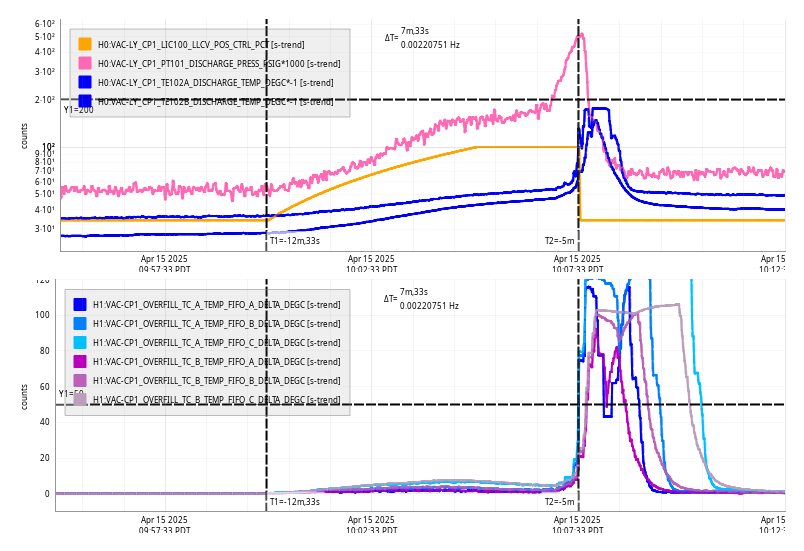
Tue Oct 29 10:08:04 2024 INFO: Fill completed in 8min 0secs
Gerardo confirmed a good fill curbside.
Eric is running the fire pumps this morning for maintenance. This is a good opportunity to test CDS reporting and alarms. Attached MEDM shows CDS Overview with a red fire pumps button, it opens the FMCS overview (also shown). I let the first three cell phone alarm texts to proceed and then bypassed this alarm for the remainder of this morning.
Bypass will expire:
Tue Oct 29 08:41:08 PM PDT 2024
For channel(s):
H0:FMC-CS_FIRE_PUMP_1
H0:FMC-CS_FIRE_PUMP_2
Bypass has been removed
FAMIS Link: 26015
Only CPS channels which look higher at high frequencies (see attached) would be the following (which have been like this on the order of weeks):
In 80171, we noted that the incorrect coil driver strength had been in use for getting the calibration in plotTMTS_dtttfs.m. We corrected this value and last week I was able to take transfer function measurements of the TMTs, which we wanted to take just so we could verify that the updated calibration was more accurate to the models, and also just because it had been four and two years since taking measurements for TMSX and TMSY, respectively.
I've attached the pdfs for their individual analyses (TMSX, TMSY), as well as comparisons between the most recent and previous measurements (TMSX, TMSY). The corrected coil driver strengths do shift the measurement traces up closer to the model traces.
TITLE: 10/29 Day Shift: 1430-2330 UTC (0730-1630 PST), all times posted in UTC
STATE of H1: Corrective Maintenance
OUTGOING OPERATOR: Corey
CURRENT ENVIRONMENT:
SEI_ENV state: CALM
Wind: 6mph Gusts, 4mph 3min avg
Primary useism: 0.02 μm/s
Secondary useism: 0.25 μm/s
QUICK SUMMARY:
Maintenance day today
Workstations were updated and rebooted. This was an OS packages update. No conda packages were updated.
STATE of H1: Corrective Maintenance
SHIFT SUMMARY: PSL team made major progress and was able to get the second amplifier to output 140W! They will continue work tomorrow to wrap it up.
LOG:
| Start Time | System | Name | Location | Lazer_Haz | Task | Time End |
|---|---|---|---|---|---|---|
| 16:34 | SAF | LVEA | LVEA | Y | LVEA is LASER HAZRD | 23:50 |
| 14:57 | TCS | Camilla | Mech room | N | Chillers check | 15:01 |
| 15:02 | FAC | Karen | Optics lab, vac prep | N | Tech clean | 15:33 |
| 15:51 | FAC | Karen | Garb room/LVEA | Y | Tech clean | 16:24 |
| 16:14 | FAC | Kim | MidX | N | Tech clean, back 16:55 | 17:27 |
| 16:29 | FAC | Karen | EndY | N | Tech clean | 17:27 |
| 16:47 | EE | Marc, Fernando | PSL racks / CER | N | Investigate racks | 17:00 |
| 16:50 | PSL | Jason, RyanS | PSL room | Y | NPRO swap, AMP1 | 20:11 |
| 21:31 | PSL | Jason, Ryan | PSL encl. | local | NPRO swap, AMP2 | 00:06 |
| 21:34 | CDS | Fernando, Marc | CER | Y | Powering 35Mhz back up | 21:40 |
| 22:49 | SQZ | Camilla, Vicky | LVEA | YES | SQZT0 table work | 23:22 |
Continuing on from Jenne's observation that there are still glitches in the new NPRO, I've tried to make a plot we can use to compare the glitch rate in the new and old NPROs, using the NPRO_PWR channel instead of the FSS channel which isn't available for the new NPRO.
I've used a 3 hour stretch of observing time for the old NPRO, and a three hour stretch before the time when Jenne made a plot in 80837. The ISS is not on for the new NPRO time, which is probably why the intensity is flcutuating and making it harder to see the small steps in power that are the glitches we are looking for. In the second panel, I've plotted the data high passed with a 0.05 Hz butterworth, this helps to show the glitches, although not perfectly (in either case). Based on this, the glitches look to be happening at a roughly similar rate, although somewhat less with the new NPRO.
This script in in sheila.dwyer/DutyCycle)4/dutycycleplots/PSL_glitches.py
Attaching another plot, showing that comparing our old NPRO to LLO during an observing stretch that started at midnight UTC time on Oct7th, LLO has no similar glitches.
Here's the same plot, but using a time from last night when the PSL environmental controls were off. There are still gltiches, but fewer.
These plot tiles show runs of Sheila's code looking for PSL power glitches on several days before / after the suspect date around Sept 12.
There's not a clear correlation between the glitches and locklosses. While maybe there's more glitches after Sept 12 (bottom row), the glitches don't consistently correlate with locklosses? Sept 14 is a good example of this: lots of glitches, the IFO stays locked through many of them.
2nd plot here shows overnight again with the swapped new laser. There are still glitches (though potentially less).
The PSL-PWR_NPRO_OUT_DQ channel seems to not be connected at LLO, which explains why the comparison plot a few comments above makes it look like L1 PSL is so much quieter than H1.
Adding screenshot of the NPRO power glitches over the past day. There are still glitches with the new laser -- not all glitches correspond to locklosses, but some do.
Vicky, Sheila
Summary: Today we learned that frequency independent anti-squeezing is a very good way to determine which sign the homodyne angle is.
Background: I've been working on using code from Vicky's repo and the noise budget repo to do some checks of a quantum noise model, this is in a new repo here.
Details about how this model is made:
The first attached plot illustrates how these models and plots are made. It starts with a no squeezing time, and an esitmate of non quantum noises from the noise budget, (dark gray, this one is from Elenna's recent run of the noise budget: 80603 ) and an estimate of the arm circulating power along with other parameters set in a quantum parameters file in the same format that is used by the noise budget. It fits the readout losses by adding a gwinc model of quantum noise with the noise budget estimate of other noises, and adjusting the readout losses of the gwinc model, this is done from 1.5-1.8kHz in this case.
Based on this readoutlosses we get a model of quantum noise without squeezing, and subtract that from the no squeezing trace to get an estimate of the non-quantum noise. This is enough different from the noise budget one that I've used that as the estimate of the non-quantum noise for the rest of the traces.
By subtracting this subtraction estimate of the non-quantum noise, it estimates squeezing in dB, and finds a median level of dB from 1.5-1.8kHz for anti-squeezing and squeezing. This should be the same with and without the filter cavity, but in this data set there is slightly more anti-squeezing in the time without the filter cavity, so I've used FIS and FIAS to estimate the nonlinear gain and total efficiency for squeezing. The nonlinear gain is translated into generated squeezing for gwinc, and the injection losses for squeezing are set so that the injection efficiency* readout efficiency = total squeezing efficieny.
With this information we can generate models for anti-squeezing and squeezing traces, but fitting the squeezing angle to minimize or maximize quantum noise. Then for the mid angle traces, the squeezing angle is fit to minimize the residual between the data and the quadrature sum of the subtraction estimate of non quantum noise and the model. We can then look at these plots and try manually changing parameter in the quantum parameter file.
Homodyne angle:
We've been stumped for a while about the excess noise we see with low frequency anti-squeezing, in 79775 I went through old alogs and see that we've had this mismatch of model with our data for a long time. Today we tried flipping the sign of the homodyne angle and see that low frequency anti-squeezing is much closer to fit both with and without the filter cavity. Compare the 2nd and 3rd attachments to see this.
We still have more work to do on this model, including adding in the additional traces near squeezing and near anti-squeezing that Camilla took, and checking if it can give us any information about arm power (it doesn't seem very useful for that), or the mode mismatches.
I neglected to mention that this is based on the nice data set that Camilla collected here: 80664, and that three is more work to be done with this, checking SRC detuning, mode mismatch, and including the +/- 10 deg data.
Sumary: seems the current (+) side of DARM is better for FDS, although it is opposite of our previous quantum noise models. But given the current sign is actually better for DARM, the model error doesn't really matter, and it's not really worth changing signs.
The wrong HD angle sign seems to be why none of our quantum noise models, despite fitting all other SQZ angles well, have ever fit FIAS properly. We will update our quantum noise models for the noise budget. Attached are some quantum noise models and DARM plots for Camilla's recent SQZ dataset lho80664.
Plots with optimal FDS (optimal fc detuning) for both signs of the homodyne angle: showing 1st just the quantum noise models without adding back non-quantum noise (NQN), and 2nd showing QN models + NQN.
Third attachment (3rd) shows a wider range of homodyne angles, from +15 deg to -10 deg. So far the code for these plots is living here.
---------------------------------------------------------------------------------------------------------------------------------------------------------------------------------------------------
Altogether this is making progress on the quantum noise models for the noise budget!
Summarizing updates and what we're learning:
Vicky, Sheila
Based on the fit of total squeezing efficiency and nonlinear gain (which is based on subtracted SQZ and ASQZ from 1.5-1.8kHz), and known losses from loss google sheet, we can infer some possible maximum and minimum arm powers using the no squeezing data.
The first attachment shows the same plot as above, but with the latest jitter noise measured by Elenna in 80808 We noticed this afternoon that there is a problem with the way these jitter noises are being added in quadrature by the noise budget, but we haven't fixed that yet. In this data set, we have 15.1dB of anti-squeezing and 5.1dB of squeezing from 1.5-1.8kHz, we can use the Aoki equations to solve for nonlinear gain of 14.6 and total efficiency eta for squeezing of 73%. Since the known readoutlosses are 7.3% and the known squeezer injection losses are 8.8%, this gives us a minimum readout efficency of (eta/(1-known injection loss) = 79% and a maximum of 1-known readout loss = 91.2%. Using the level of noise between 1.5-1.8kHz with no squeezing (and an estimate of the non quantum noise) we can use these max and min readout efficencies to find min and max circulating powers in the arms.
These arm power limits will be impacted by our estimate of the non-quantum noise, the homodyne angle, and the SRC detuning. With 0 SRC detuning, and a homodyne angle of 7 degrees, this resutls in a range of arm powers of 324-375kW. the estimate of non-quantum noise is the most important of these factors, while SRC detunings large engouh to change these estimates significantly seem outside the range that is allowed by other squeezing mesurements.
I've run the comparison of the model to different squeezing configurations for the low and high range and the nominal parameters (0 SRC, 7 degrees homodyne angle). Frequency independent squeezing and both types of mid squeezing are sensitive to the arm power from 50-100Hz, this comparison shows that the low end of the arm power range seems to have slightly too little arm power and the high range slightly too much. However these frequencies are also sensitive to homodyne angle and SRC detuning.