TITLE: 08/19 Day Shift: 1430-2330 UTC (0730-1630 PST), all times posted in UTC
STATE of H1: Corrective Maintenance
INCOMING OPERATOR: Tony-ish
SHIFT SUMMARY: HAM5 and 6 got unlocked today.
LOG:
14:30 In Corrective maintanence
16:00 HAM5/6 HEPI unlocked
| Start Time | System | Name | Location | Lazer_Haz | Task | Time End |
|---|---|---|---|---|---|---|
| 15:18 | VAC | Jordan | LVEA | n | Pump checks | 15:28 |
| 15:23 | FAC | Karen, Kim | LVEA | n | Tech clean | 16:20 |
| 15:52 | SEI | Jim | LVEA | n | Unlocking HAM5/6 | 16:20 |
| 16:52 | FAC | Karen | EY | n | Tech clean | 17:31 |
| 19:35 | FAC | Kim | LVEA Receiving | n | Moving stuff | 19:57 |
| 19:45 | VAC | Janos | LVEA | n | Replacing gauge | 19:57 |
| 20:22 | SEI | Jim, Mitchell | LVEA | n | Taking HEPI pump stations down | 21:32 |
| 20:40 | PSL | RyanS, Fil | CR,LVEA | n | Shutting down PSL to get rid of comb | 21:04 |
| 20:53 | VAC | Jordan, Travis, Gerardo | LVEA | n | Swapping gauge (Travis out 22:34) | 22:40 |
| 20:59 | VAC | Janos | LVEA | n | Helping swap gauge | 22:28 |
| 21:09 | PEM | Genevieve, Sam | EX, EY | n | Taking photos o fPEM equipment | 22:42 |
| 23:10 | PCAL | Francisco, Miriam | EX | YES | Transitioning to LasHaz & centering beam spot for tomorrow | ongoing |
Camilla, Oli
We looked into the weird results we were seeing in the ITMX In-Lock SUS charge measurements. The coherence when the bias is on for both the bias and length drives is always good, but the coherences are bad (usually below 0.09) for both bias and length drives when the excitations run with the bias off.
I compared the differences in the coherence value outputs in the python script versus the matlab script(screenshot), and although the values are calculated slightly differently and are not exactly the same, they are resonably close enough that we can say that there is not an issue with how we are calculating the coherences.
Next, we used ndscope to look at the latest excitations and measurements from July 09th (ndscope-bais on, ndscope-bias off). Plotting L3_LOCK_BIAS_OUTPUT, L3_DRIVEALIGN_L2L_OUTPUT, L3_LVESDAMON_UL_OUT_DQ, and L3_ESDAMON_DC_OUT_DQ for both ITMX and ITMY, if there was an issue with the excitations not going through, we would expect to see nothing on the ESDAMON and LVESDAMON channels, but we do see them on ITMX.
We were still confused as to why we would see the excitations go through the ESDAMON channels but still have such low coherence, so we compared the ITMX measurements to ITMY on dtt for the July 09th measurements looking at how each excitation showed up in DARM and what the coherence was. When the bias was on, both the bias drive and Length drive measurements look as we expect, with the drive in their respective channels, a peak seen in DARM at that frequency, and a coherence of 1 at that frequency(bias_drive_bias_on, length_drive_bias_on). However, in the comparisons with the bias off, we can see the excitations in their channels for both ITMX and ITMY, but while ITMY has the peak in DARM like the bias on measurements, ITMX is missing this peak in DARM(bias_drive_bias_off, length_drive_bias_off). The coherence between DARM and the excitation channel is also not 1 on ITMX.
We showed these results to Sheila and she said that these results for ITMX with the bias off make sense if there is no charge built up on the ITM, which would be the first time this has been the case! So there are no issues with the excitations or script thankfully.
We will be making changes to the analysis script to still run the analysis even if the coherence is low, and will be adding a note explaining what that means.
Hey LHO, the in lock charge measurement script is another script, other than A2L scripts and calibration scripts, that I overhauled last year due to my deep dissatisfaction with the existing code.
I'll point you to the aLog when I ran it: [68310].
Among the huge amount of behaviors that I correct I implemented many lessons I learned in implementing simuLines for LHO: your DARM units are a very small number and you must explicitly cast DARM data to np.float64 in order to have the TFs and coherences (in particular coherences) calculate correctly. I've had to repeat this lesson to lat least 4 people writing code for LHO now in the calibration group because it trips up people again and again and it is not an obvious thing to do, and something I solved through sheer brute force (took Louis a lot to convince since he initially refused to believe it).
In particular inside the ''digestData" function of the "/ligo/svncommon/SusSVN/sus/trunk/QUAD/L1/Common/Scripts/InLockChargeMeasurements/process_single_measurement.py" you will see me casting the gwpy data to float64 on lines 50 and 51; followed by some sampling rate tricks to get coherence to calculate correctly with gwpy's coherence call as well as gwpy handles average_fft calls.
Hope it helps!
Thanks Vlad, we'll have a look at that.
While looking at these measurements we realized that we were not using the same bias setting for all the quads (ITMY around half bias). We want to change this using the attached code but first will run the charge measurements to directly compare before and post vent.
I've combined the existing Python and MATLAB scripts that are used for calibrating the PSL rotation stage into one cohesive, cleaner Python script: /opt/rtcds/userapps/release/psl/h1/scripts/RotationStage/CalibRotStage.py
The script takes two arguments to run the full process of sweeping the stage and running the calibration fitting: python CalibRotStage.py -m -c
To skip the rotation stage sweep or calibration fitting steps, simply omit the -m or -c arguments, respectively.
The full process for running a PSL rotation stage calibration now goes as follows:
J. Kissel IIET Ticket 31266 Conversations are still brewing about what to do about DuoTone timing signals showing up in DARM -- presumably through the OMC DCPD's ADC card (see LHO:77579). Recall that we've narrowed down the coupling mechanism to direct channel-to-channel cross coupling within the ADC (see LHO:78238). As such, one of the options on the table is to reduce the amplitude of the DuoTone timing signal, which is using 1/4 of the ADC channel's range at 5 [V_pp], rather loud, IMHO (see LHO:78218). Daniel and Erik did a whole bunch of work at the start of O4 to get the front-end-code computed ADC timing measure more accurately reporting and answer with a better algorithm in the front-end (see LHO:67693 and LHO:67545), so I figured I show the trend of a few important front-end's answers, since I haven't seen such a trend: (1) the h1omc0 segregated IO chassis which houses the GW DCPDs, (2) the h1lsc0 computer which *used* to house the DCPDs prior to O4. (3 & 4) the two end-station ISC computers which house, among other things, the PCAL systems. The answers from the long-term trend: (1) 0.12 +/- 0.035 or +/- 0.08 [usec] (2) 7.05 +/- 0.031 or +/- 0.06 [usec] (3) 61.6 +/- 0.15 or +/- 0.31 [usec] (4) 61.6 +/- 0.15 or +/- 0.31 [usec] where I'm eye-balling (via y-cursor at least) the long-term trend of the mean, the middle of the max/min excursions, and the worst of the max/min excursions. These answers (the means) are all expected, but it's good to have some numbers on the max / min excursions, which are, presumably, noise. Zoom in closer, one can see on the minute time scale trend of a gravitational wave event, the estimation of the timing error is about as precise.
R. Short, F. Clara
In the ongoing effort to mitigate the 9.5Hz comb recently found to be coming from the PSL flow meters (alog79533), this afternoon Fil put the PSL control box in the LVEA PSL racks on its own, separate 24V bench-top power supply. Once I shut down the PSL in a controlled manner (in order of ISS, FSS, PMC, AMP2, AMP1, NPRO, chiller), Fil switched CB1 to the separate power supply, then I brought the system back up without any issues. I'm leaving the ISS off for now while the system warms back up. I'm leaving WP12051 open for now until enough data can be collected to say whether this separate supply helps the 9.5Hz comb or not.
Please be aware of the new power supply cable running from under the table outside the PSL enclosure to behind the racks; Fil placed a cone here to warn of the potential trip hazard.
This looks promising! I have attached a comparison with a high-resolution daily spectrum from July (orange) vs yesterday (black), zoomed in on a strong peak of the 9.5 Hz comb triplet. Note that the markers tag the approximate average peak position of the combs from O4a, so they are a couple of bins off from the actual positions of the July peaks.
FAMIS 21224
pH of PSL chiller water was measured to be just above 10.0 according to the color of the test strip.
FAMIS 21188
The PSL was taken down last Tuesday as part of Jason and Fil's comb hunt (alog79533), which shows in basically every trend six days ago.
The ISS was not turned back on when the PSL was brought back up last week, so Jason enabled it this morning, which explains the lower PMC transmitted power over the past week or so. However, even with the ISS now on, the PMC is putting out ~1.6W less power compared to before it was unlocked last week.
The FSS TPD has been trending down over the past several weeks and alignment looks poor on the camera, so sometime today or tomorrow I'll touch up the RefCav alignment.
About a week ago the PSL enclosure main-room Axis camera image froze mid-frame twice over two days in a row on the LVEA FOM machine (lveapslfom) but not on the control room FOM (nuc21).
Last night both the enclosure anti-room and main-room images on the control room FOM froze mid-frame but the LVEA FOM was fine.
In all cases I remote-desktopped to the machine and reloaded the web page to clear the error.
Mon Aug 19 08:09:15 2024 INFO: Fill completed in 9min 11secs
TITLE: 08/19 Day Shift: 1430-2330 UTC (0730-1630 PST), all times posted in UTC
STATE of H1: Corrective Maintenance
OUTGOING OPERATOR: None
CURRENT ENVIRONMENT:
SEI_ENV state: MAINTENANCE
Wind: 4mph Gusts, 1mph 5min avg
Primary useism: 0.01 μm/s
Secondary useism: 0.07 μm/s
QUICK SUMMARY:
Vacuum pressure in BSC3 around 2.04e-07 (need to be around 8.8e-8), so probably no gate valves today. Over the weekend an earthquake from Japan tripped the ISI watchdogs for ITMY, BS, ETMX, and ETMY. Those have been untripped by TJ.
FAMIS26004
Same as for the last time this was run (alog79474), the following seem elevated:
FAMIS26283
Laser Status:
NPRO output power is 1.831W (nominal ~2W)
AMP1 output power is 64.55W (nominal ~70W)
AMP2 output power is 138.3W (nominal 135-140W)
NPRO watchdog is GREEN
AMP1 watchdog is GREEN
AMP2 watchdog is GREEN
PDWD watchdog is GREEN
PMC:
It has been locked 5 days, 20 hr 28 minutes
Reflected power = 20.62W
Transmitted power = 105.1W
PowerSum = 125.8W
FSS:
It has been locked for 1 days 19 hr and 20 min
TPD[V] = 0.5346V
ISS:
The diffracted power is around 3.1%
Last saturation event was 0 days 0 hours and 0 minutes ago
Possible Issues:
AMP1 power is low
PMC reflected power is high
FSS TPD is low
ISS diffracted power is high
I've lowered the alarm level for PT120B (BSC2) from 2.0e-06 to 2.0e-07. Two day trend of PT120 attached shows last nights excursion
Config:
Channel name="H0:VAC-LY_Y1_PT120B_PRESS_TORR" low="1.0e-10" high="2.0e-07" description="VE gauge, PT120B BSC2 CC"
Sun Aug 18 08:08:47 2024 INFO: Fill completed in 8min 43secs
(Richard M., Dave B, Gerardo M.)
While at home I Noticed that the pressure trend for PT120 (BSC2 pressure gauge) had a sudden rise on pressure, see trend. Called Richard M. and we tried to diagnose the system from of site, instead I decided to drive over to the site and diagnose the situation. I found two turbos off, and the scroll pump for the turbo at XBM ("X" beam manifold) was still running, the other one (YBM) was off. Closed the isolation gate valves for both systems, then proceeded to do a restart for both units, no issues encountered during restart, both of the turbo pumps reached full speed very quick, and after waiting for some time, 15 minutes, set points were set, then the system was valved in to the main volume.
Checked all other turbo pumps, output mode cleaner tube, HAM6 and HAM7, they were all running and doing good.
We have 4 aux carts pumping on different systems and they were good too.
I checked all ion pump controllers and they were good.
Still we do not know what caused the two turbos to power off, we will look further into it.
Leaving site now.
Sat Aug 17 08:09:27 2024 INFO: Fill completed in 9min 23secs
TITLE: 08/16 Day Shift: 1430-2330 UTC (0730-1630 PST), all times posted in UTC
STATE of H1: Corrective Maintenance
INCOMING OPERATOR: None
SHIFT SUMMARY: Got the ion pumps pumping today, so the pressure has gone down quite a bit. Also did a quick check of AS_C and the fast shutter using single bounce (79575). The IMC is LOCKED, and ITMs are MISALIGNED.
LOG:
14:30 In Corrective maintanence, IMC in OFFLINE
- I adjusted the OPTICALIGN OFFSET values for MC1,MC2, and MC3 until the driftmon values were back to what they had been yesterday before the computer crash. Then I took IMC_LOCK to LOCKED and it caught easily.
16:30 Ion pumps turned on
18:00 - 19:00 Single bounce measurement
| Start Time | System | Name | Location | Lazer_Haz | Task | Time End |
|---|---|---|---|---|---|---|
| 16:32 | VAC | Gerardo, Travis | LVEA | n | Possibly turning on ion pumps | 17:02 |
| 16:55 | SUS | RyanC | CR | N | OPLEV charge measurements, EX & EY | 18:23 |
| 17:03 | Betsy | LVEA | n | Going around HAM7 (in @ 16:50) | 17:03 | |
| 18:21 | VAC | Gerardo, Fil | MY | n | Putting down cable and picking up cable (allegedly different cables) | 18:55 |
| 19:05 | VAC | Gerardo, Travis | LVEA | n | Adding another ion pump | 19:13 |
| 20:51 | TOUR | Genevieve+1 | LVEA | n | tour | 21:41 |
| 22:25 | VAC | Gerardo | EY | n | Taking a photo | 22:57 |
| 22:57 | VAC | Gerardo | LVEA | n | A check before he leaves | 23:57 |
Evan Goetz, Alan Knee, Ansel Neunzert (on behalf of line list contributors, see LIGO-T2400204) Summary: Version 1 of the lines and combs list of non-astrophysical artifacts yields insights into the O4a H1 data about long duration narrow spectral artifacts. In summary, H1 data has nearly 7x more of these artifacts than L1, mostly due to the much higher proliferation of comb artifacts. H1 data also suffers from a large number of narrow artifacts in the ~100 Hz bands near test mass violin resonance harmonics, usually during times of rung up violin resonances. Without careful handling of the data in frequency bands near the violin modes, nearly 18% of the 10 Hz - 2 kHz band is contaminated, though more careful handling results in about 6% of the band being contaminated (roughly equivalent to L1). The L1 detector does not suffer from these same artifacts. Details: After compiling a list of vetted, non-astrophysical artifacts into the version 1 lines and combs list for O4a, we extracted some statistics for each detector in order to compare and contrast the data quality from this perspective, and to determine which of the artifacts are most problematic for long duration narrowband searches (CW or narrowband directed stochastic searches). New for this observing run, we have two new features for the lines list: 1) artifacts with known time variation (turn on/turn off) where we can establish reasonable metrics for their presence in the data we also provide a segment list for times those artifacts are present; 2) a new type 3 artifact that is not simply a narrow frequency band for a single artifact, but rather a band (typically 1 Hz or larger) with many narrow artifacts degrading the data quality within the band. Type H1 L1 ----------------------------------------- Total number of artifacts 1721 251 Number of vetted combs 26 16 Comb lines 1510 168 Type 3 artifacts 29 0 Vetoed band percentage (excl. type 3 artifacts) 5.8% 6.3% Vetoed band percentage (incl. type 3 artifacts) 17.9% 6.3% Most problematic H1 artifacts: 1) Type 3 artifacts: non-stationary line artifacts impacting ~100 Hz bands around TM violin resonances - partial understanding of some of these artifacts due to calibration line mixing with violin resonances (future aLOG), but not all artifacts are understood 2) 9.5 Hz comb triplet: comb of line triplets present from 10 Hz to 2000 Hz (seen weakly at L1) - potential cause identified in PSL flow sensors (LHO aLOG 79533) 3) ~11.11 Hz comb seen in both H1 and L1 - not understood. It was also seen at H1 in O3. 4) ~11.9 Hz comb seen in both H1 and L1 - not understood. See also checks on different changes. Seen also in O3 H1 data. H1 artifacts that have been mitigated: 1) Hartmann wavefront sensor (HWS) comb mitigated near 1 Hz, near 5 Hz, and near 7 Hz combs 2) OM2 heater driver comb mitigated ~1.66 Hz comb (also 1.1086 Hz briefly appearing) Ongoing detailed analysis (future aLOG) of the violin mode region contamination indicates that at least some of the lines are calibration line + violin mode mixing. We are not yet sure whether this explains all the contaminated time periods in O4a, nor to all the contaminated lines, and we have not done a systematic comparison with L1. However, at the overview level, the mixing of calibration lines and violin resonances seems much worse in H1 than in L1. Perhaps this is somehow related to the new signal readout chain installed ahead of O4 that is different from the readout at L1. The number of lines also should instill some caution into further efforts to put additional calibration monitoring lines into the DARM control loop as the added lines would greatly increase the number of artifacts in the spectrum. This needs to be solved before further lines are added. We anticipate further understanding of the O4a data with continued investigation, so the number of artifacts known to be non-astrophysical may go up.
Late entry from yesterday: - The controllers of IP1, IP2, IP3, and IP14 ion pumps were replaced with the old rebuilt Varian controllers, in order to prepare for valving the ion pumps in (IP4 still has its original Varian controller). This is the reason why these Ion pumps turned red in the vacuum MEDM screen - The new instrument air scroll compressor came online: it was valved in, and the Kobelco was valved out. Huge kudos for Tyler and Eric and the FAC team! Today's activities: - The large Ion pumps were valved in. At first IP1 and IP2 - these pumps have Chevron baffles, so the immediate gas rush was somewhat mitigated by valving these 2 in first. Then IP3 and IP4. Then, after a few hours IP14 (HAM6) - The pressure immediately went down from 3.7E-7 to 1.7E-7, and it is dropping. The ion current in the IPs has not started to go down just yet - The Kobelco was switched off The pressures: - Corner (PT-120): 1.6E-7 Torr - HAM6: 3.4E-7 Torr - HAM7: 9.4E-8 Torr As soon as the pressure according to PT-120 reaches 8E-8 Torr, the gate valves will be opened. HAM7 and the filter cavity will follow after a few hours. Huge congratulations to Gerardo and Travis, and everyone who helped the vacuum team to achieve this fast pumpdown, and that the plan of opening up on Monday (19th) is still on.
Oli P, TJ S
Single Bounce AS_C level
To check that we can get light through to HAM6, we brought the IFO to the same alignment as in alog79193, where they also had HAM5,6 HEPI locked. We started with the fast shutter closed. With alignments the same we went into a single bounce configuration with ITMY aligned and went up to 10W. There was no light on AS_C initally, so Oli had to move SR2 about 200urads before there was light on the sensor. SR2 moved about 60urads to center on AS_C. With AS_C centered, H1:ASC-AS_C_SUM_OUTPUT was at 0.0078 vs the 0.0045 reported on July 17 reported in the linked alog above (73% increase). We ran into some P motion when we turned sensor correction on, but maybe this is expected while we have some HEPIs locked. The AS Air camera had the slightest bit of a spot on the top left corner of it when we were centered.
| Aug 16 | July 17 | May 7 | April 17 | |
| AS_C_SUM_OUTPUT | 0.0078 | 0.0045 | ||
| AS_C_NSUM_OUT | 0.0230 | .017 | .0226 | 0.0227 |
Fast Shutter Test
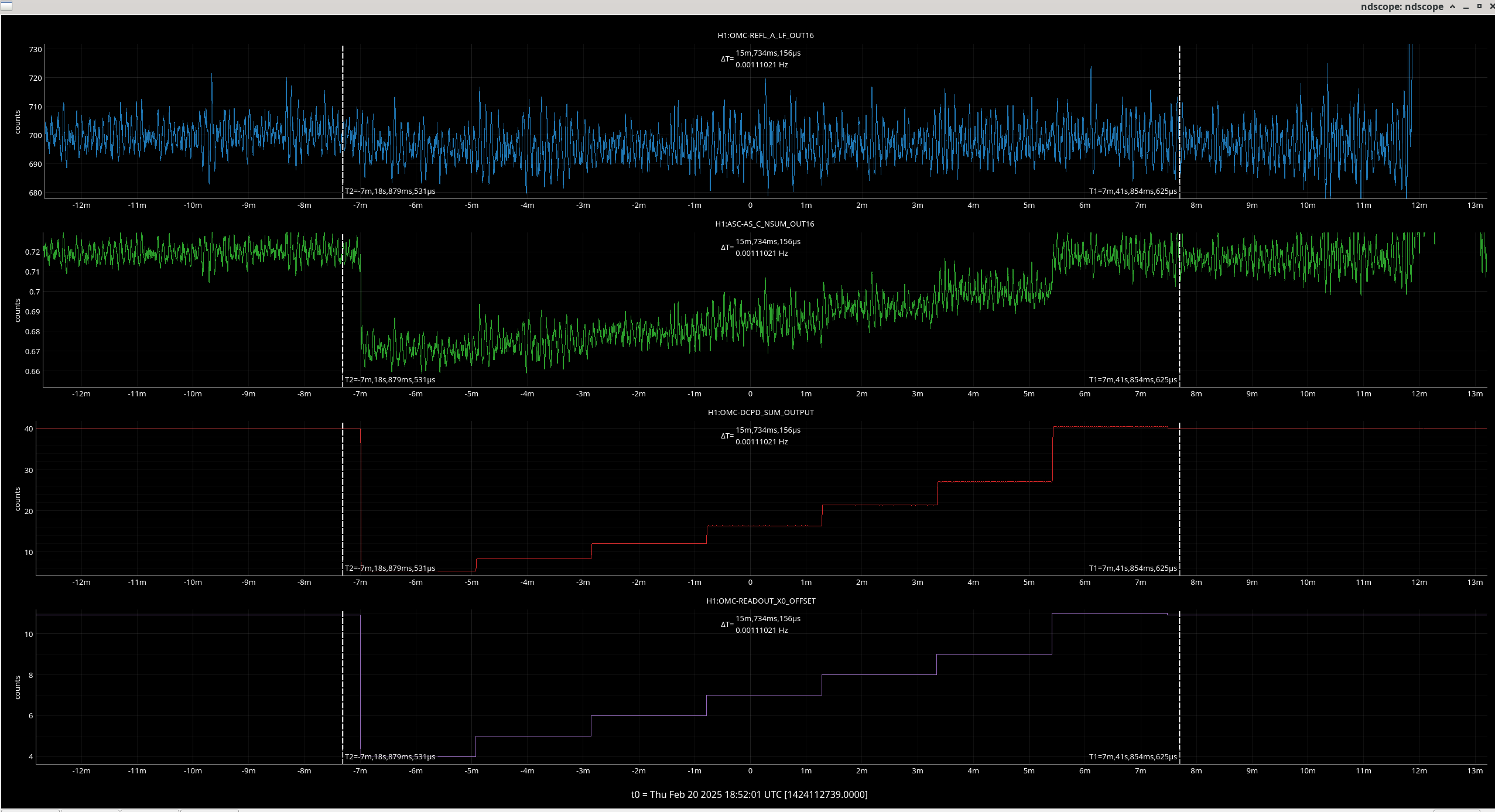
While centered on AS_C we opened the fast shutter. We immediately saw light on AS_A and AS_B (1600 and 2000 counts respectively). We closed the shutter and it went away. 1st attachment
The fast shutter still exhibits a bounce when closing, as discussed in alog79397. On this particular instance, after the fast shutter initially blocked the beam, 37ms later it allowed light through for 10ms more, before closing for 38ms, then it lets one more bit of light through for 5ms - 2nd attachment shows it better. AS_C also seems to see some of this, perhaps from scattered light.