TITLE: 11/16 Day Shift: 1530-0030 UTC (0730-1630 PST), all times posted in UTC
STATE of H1: Observing at 164Mpc
OUTGOING OPERATOR: TJ
CURRENT ENVIRONMENT:
SEI_ENV state: CALM
Wind: 12mph Gusts, 9mph 3min avg
Primary useism: 0.02 μm/s
Secondary useism: 0.20 μm/s
QUICK SUMMARY:
IFO is in NLN and OBSERVING as of 05:34 UTC (10 hr lock!)
TITLE: 11/16 Eve Shift: 0030-0600 UTC (1630-2200 PST), all times posted in UTC
STATE of H1: Aligning
INCOMING OPERATOR: TJ
SHIFT SUMMARY:
Most of the meat of the shift has already been posted earlier.
Had a return of the FSS/IMC glitches this afternoon/evening. Have made it back to Observing at the end of the shift though.
For the night we are set for locking for the OWL. But if locking becomes an issue that lasts over 2hrs, plan is to take ISC LOCK to IDLE for the night.
LOG:
Had about 20hrs with no IMC/FSS glitches from 9pm Thurs night until about 340pmPT Fri afternoon. But have now had several for the last 5hrs.
Also for one ~60min stretch, H1 almost made it to NLN, but had rung up violins which kept us at OMC Whitening for 20min until the next IMC glitch.
Here are some running notes for the rough 5hrs filled with glitches (currently have H1 in IDLE).
Notes During Return of IMC/FSS Glitch Locklosses
2340utc (340pmPT) LOCKLOSS with IMC tag was the beginning of IMC/FSS glitch locklosses (where we went almost 20hrs since the last glitch around 5utc (9pmPT).
0111-0208: OBSERVING
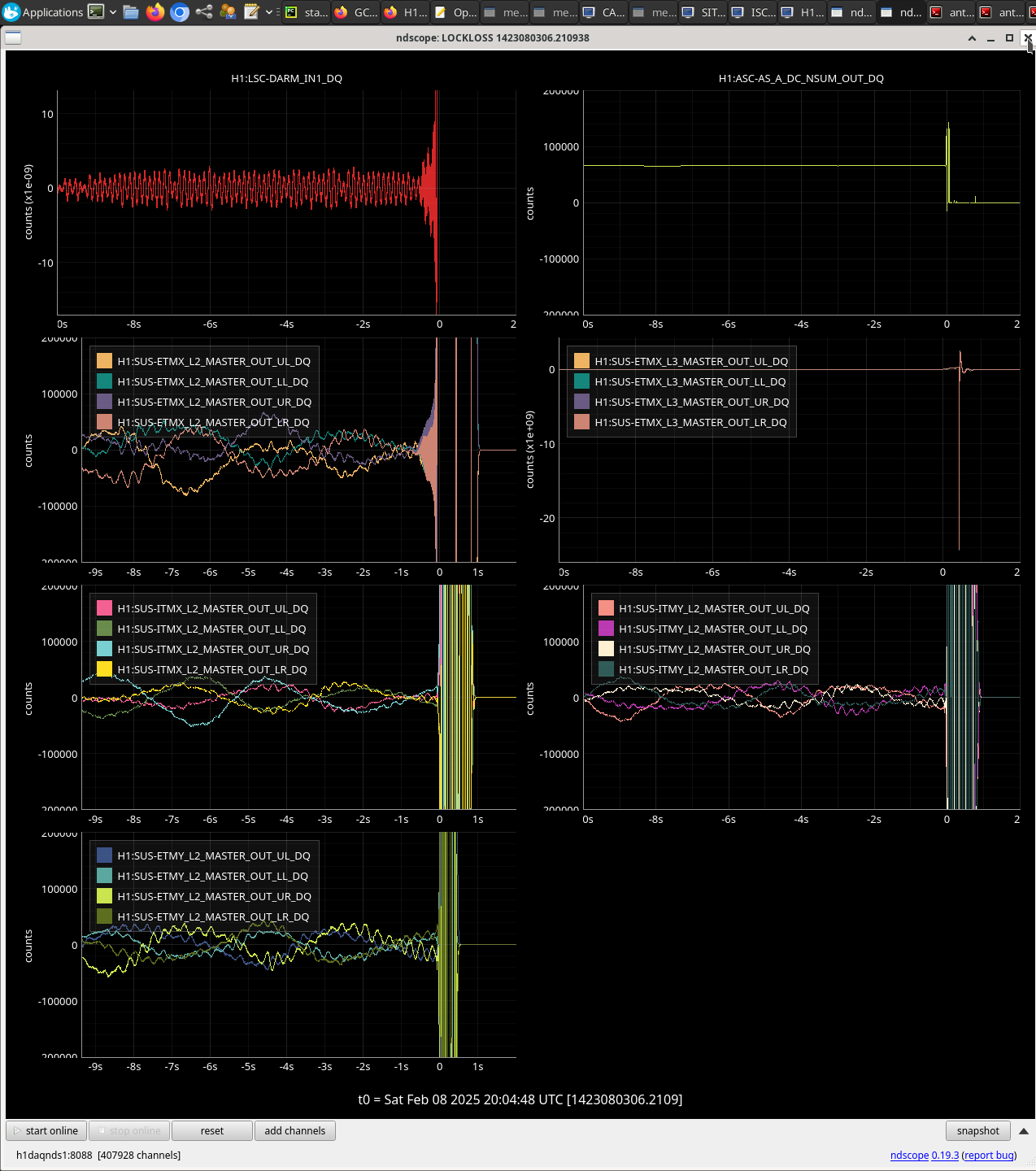
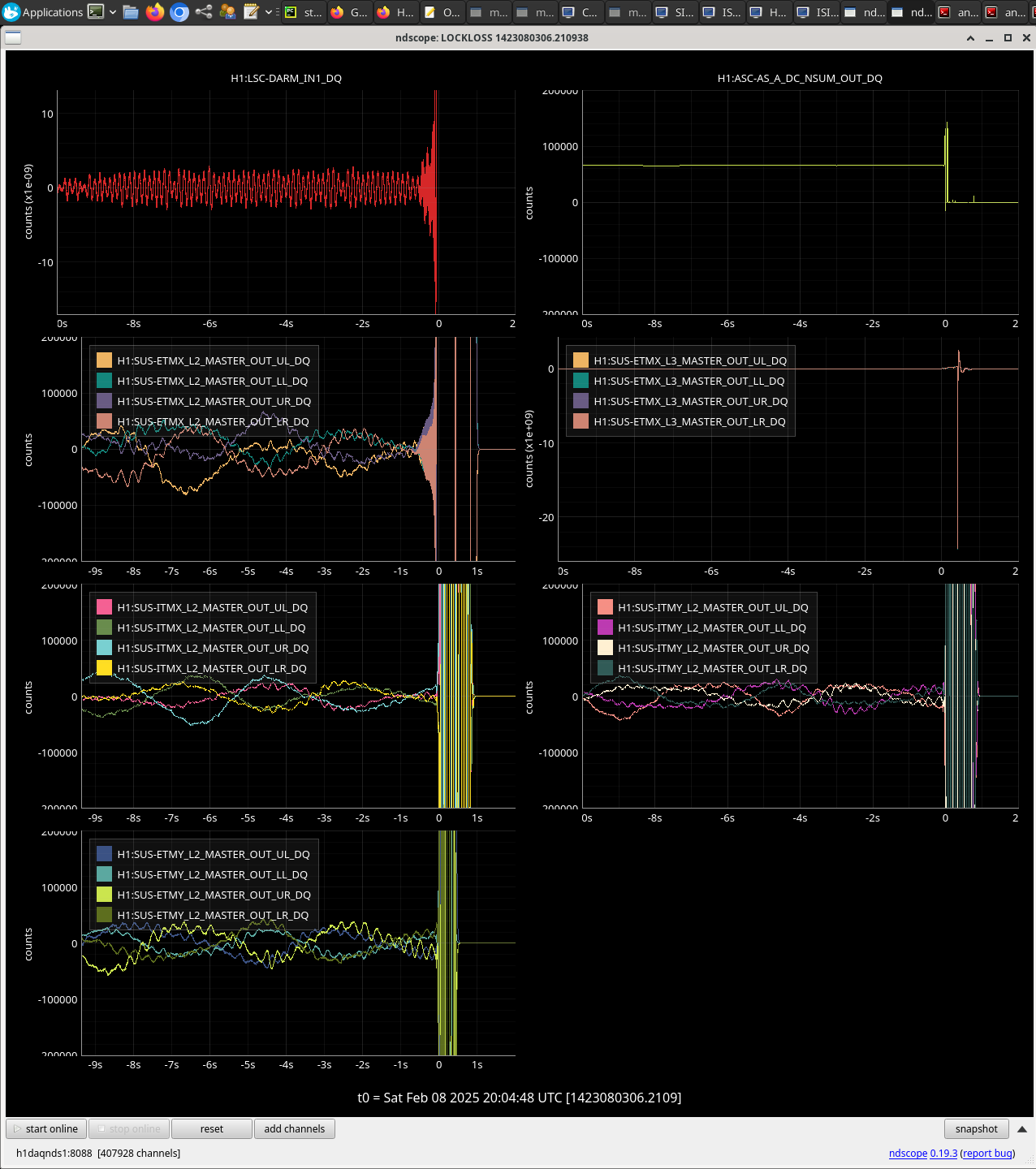
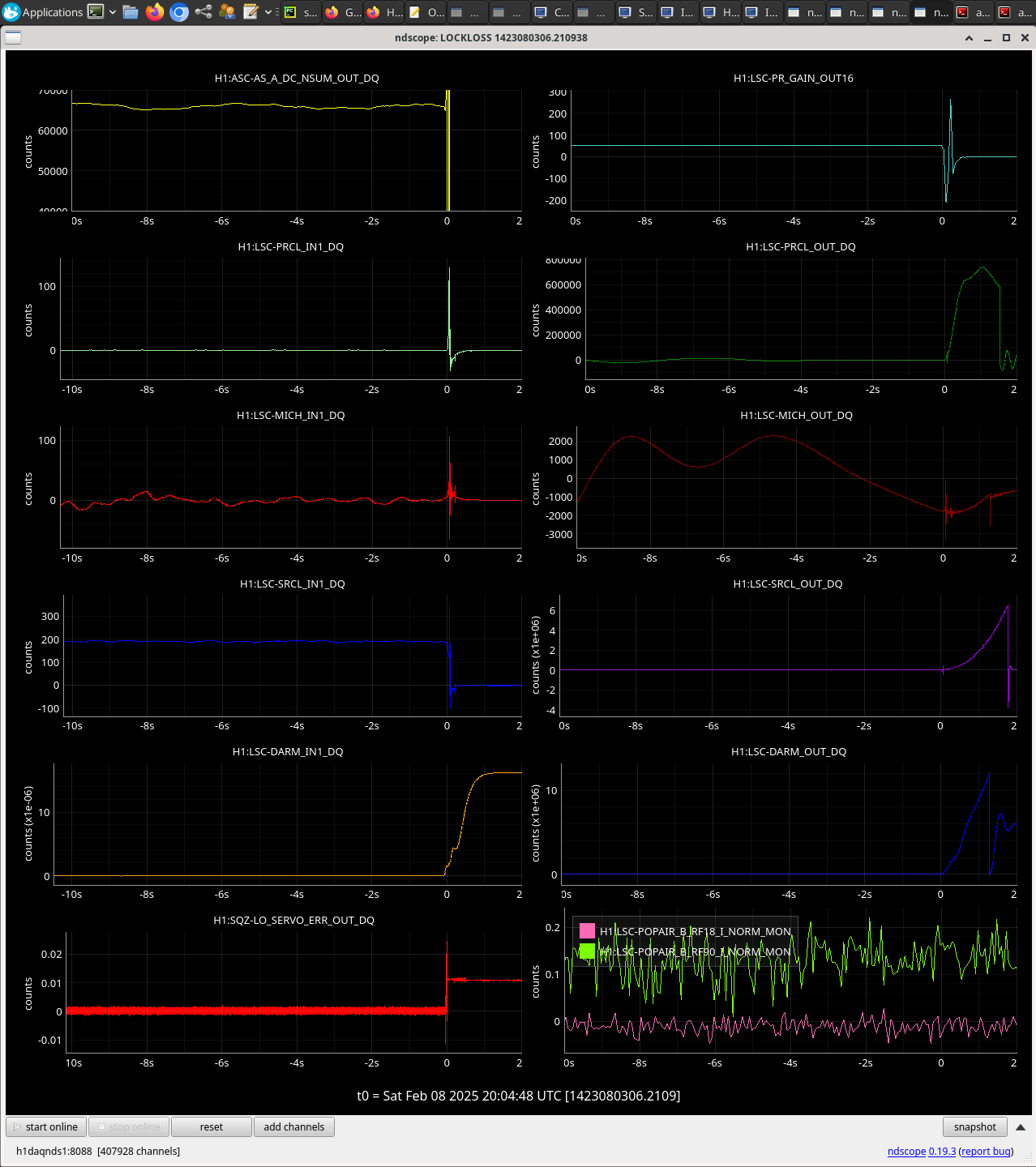
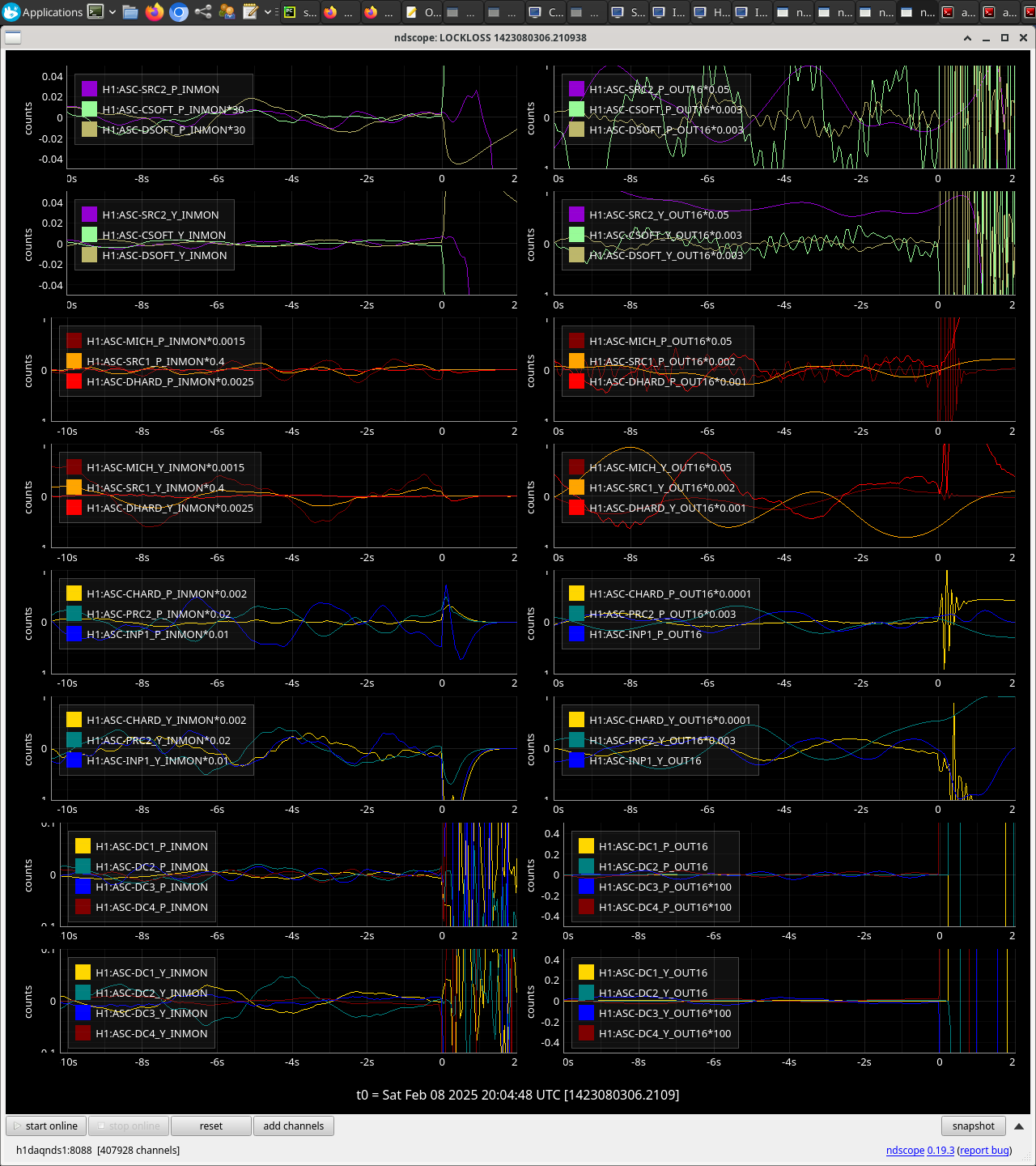
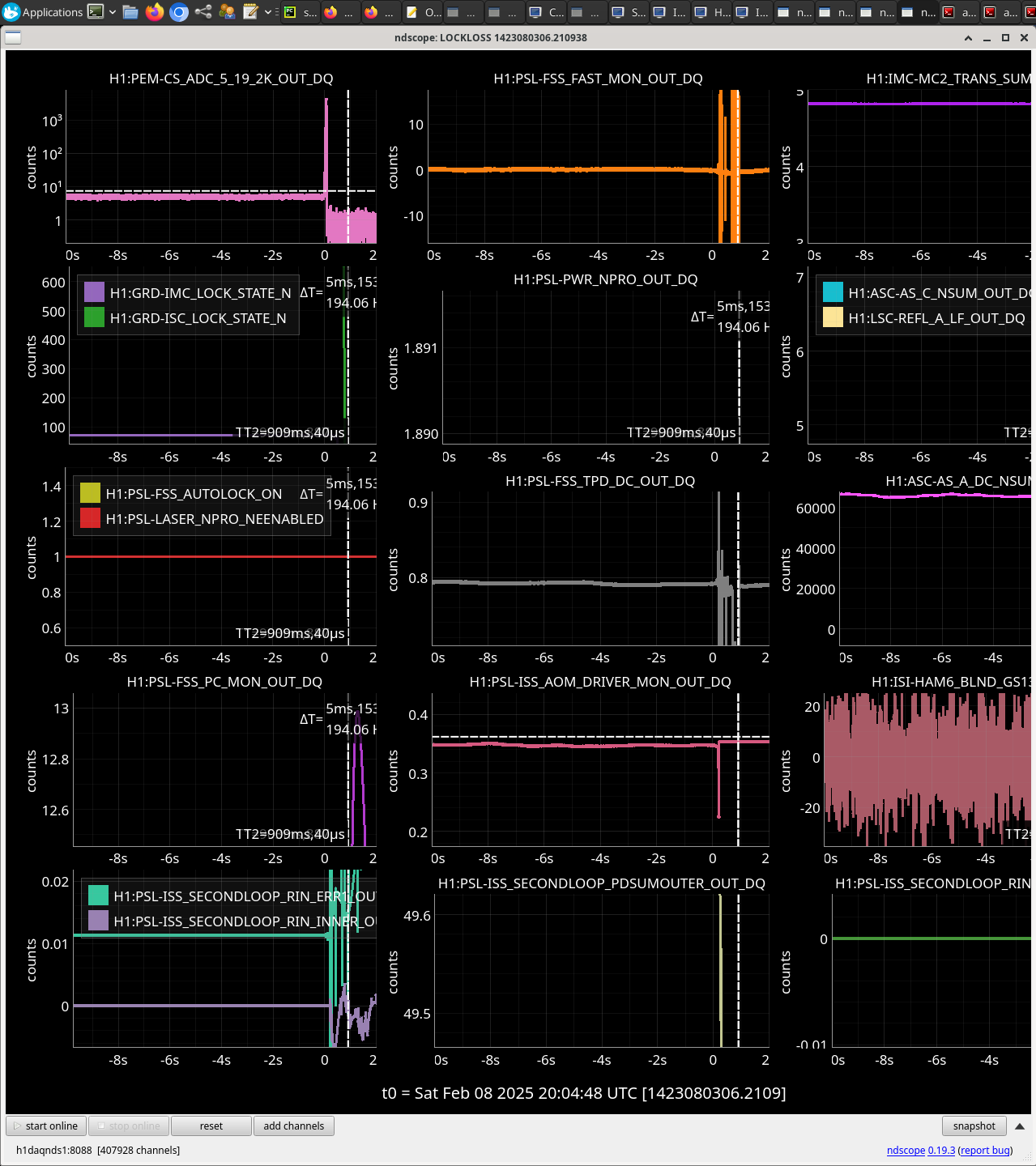
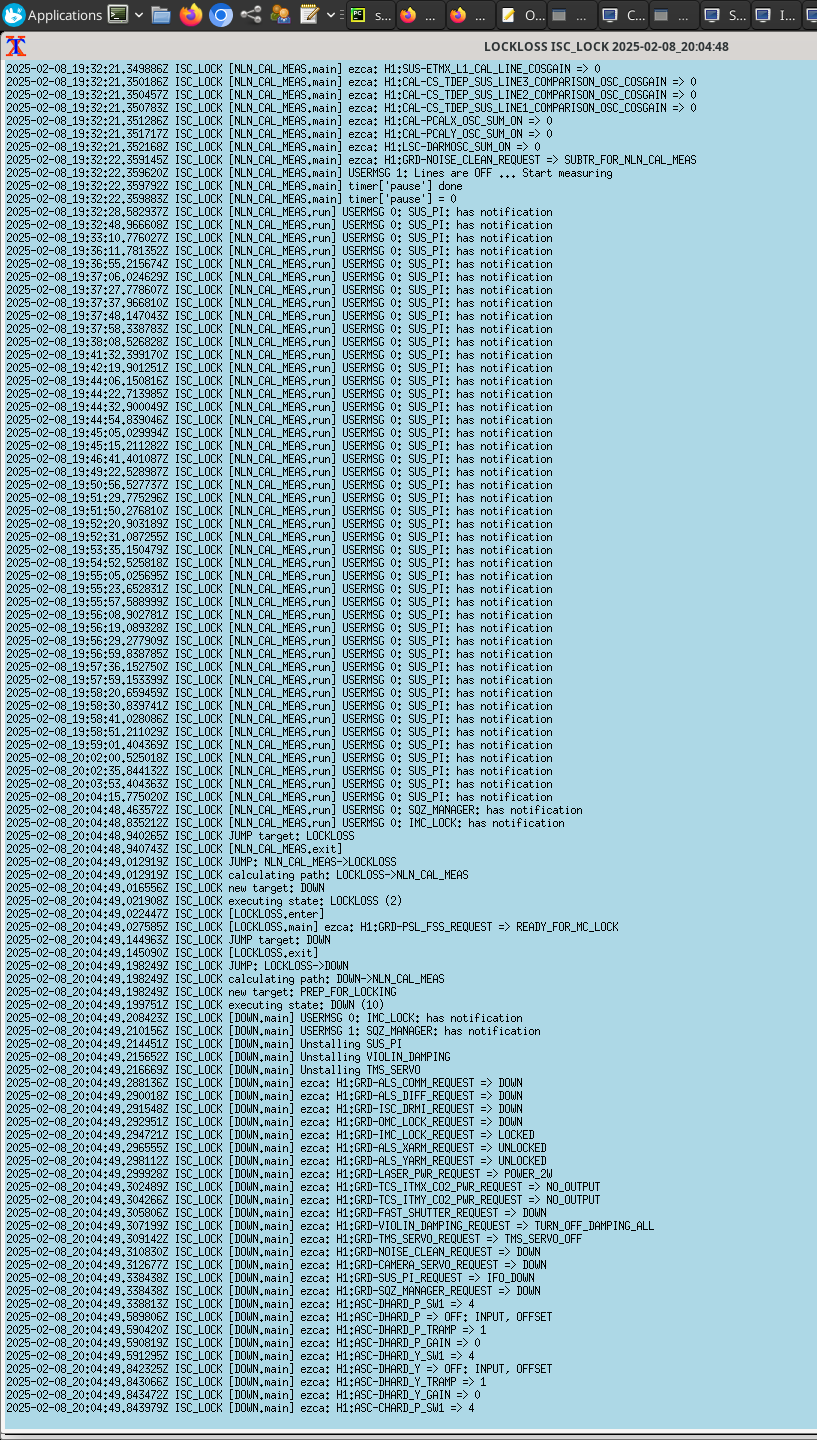
0208utc (608pmPT): Attached screenshot shows a coincident glitch lockloss seen on FSS & IMC. Here is the LOCKLOSS page also tagged with IMC glitch.
Starting an FRS Ticket to mark the DOWNTIME (FRS-32644) for 3.5hrs of DOWNTIME so far. Where there was notable part of downtime due to IMC not locking easily.
VIOLINS Rung Up A Bit: (haven't had this since my shift on Tues night!) So were stuck at OMC WHITENING for over 20min before H1 had....
So for the last 3hrs:
Not sure what is more useful. Keep having ISC LOCK continue to locking, or to leave it in IDLE for IMC/PMC/FSS monitoring....
For FAMIS #26340: All looks well for the last week for all site HVAC fans (see attached trends).
TITLE: 11/16 Day Shift: 1530-0030 UTC (0730-1630 PST), all times posted in UTC
STATE of H1: Aligning
INCOMING OPERATOR: Corey
SHIFT SUMMARY:
IFO is LOCKING in ENGAGE_ASC_FOR_FULL_IFO
Just had a lockloss and trying to get back to observing. IFO has been quite well behaved today. Both lock acquisitions were fully automatic with H1 needing no intervention.
That being said, we did have two locklosses.
Lockloss 1: ETM glitch caused.
Lockloss 2: IMC caused.
LOG:
None
TITLE: 11/16 Eve Shift: 0030-0600 UTC (1630-2200 PST), all times posted in UTC
STATE of H1: Aligning
OUTGOING OPERATOR: Ibrahim
CURRENT ENVIRONMENT:
SEI_ENV state: CALM
Wind: 14mph Gusts, 11mph 3min avg
Primary useism: 0.03 μm/s
Secondary useism: 0.28 μm/s
QUICK SUMMARY:
Walked in to a locking h1, which then has moved on to INITIAL ALIGNMENT. Ibrahim shared how H1 has had a better time--so am cautiously optimistic for the night---with the goal of OBSERVING!
Environmentally we are becoming quieter with µseism dropping below the 95th percentile and winds not too breezy.
Ibrahim, Ryan S
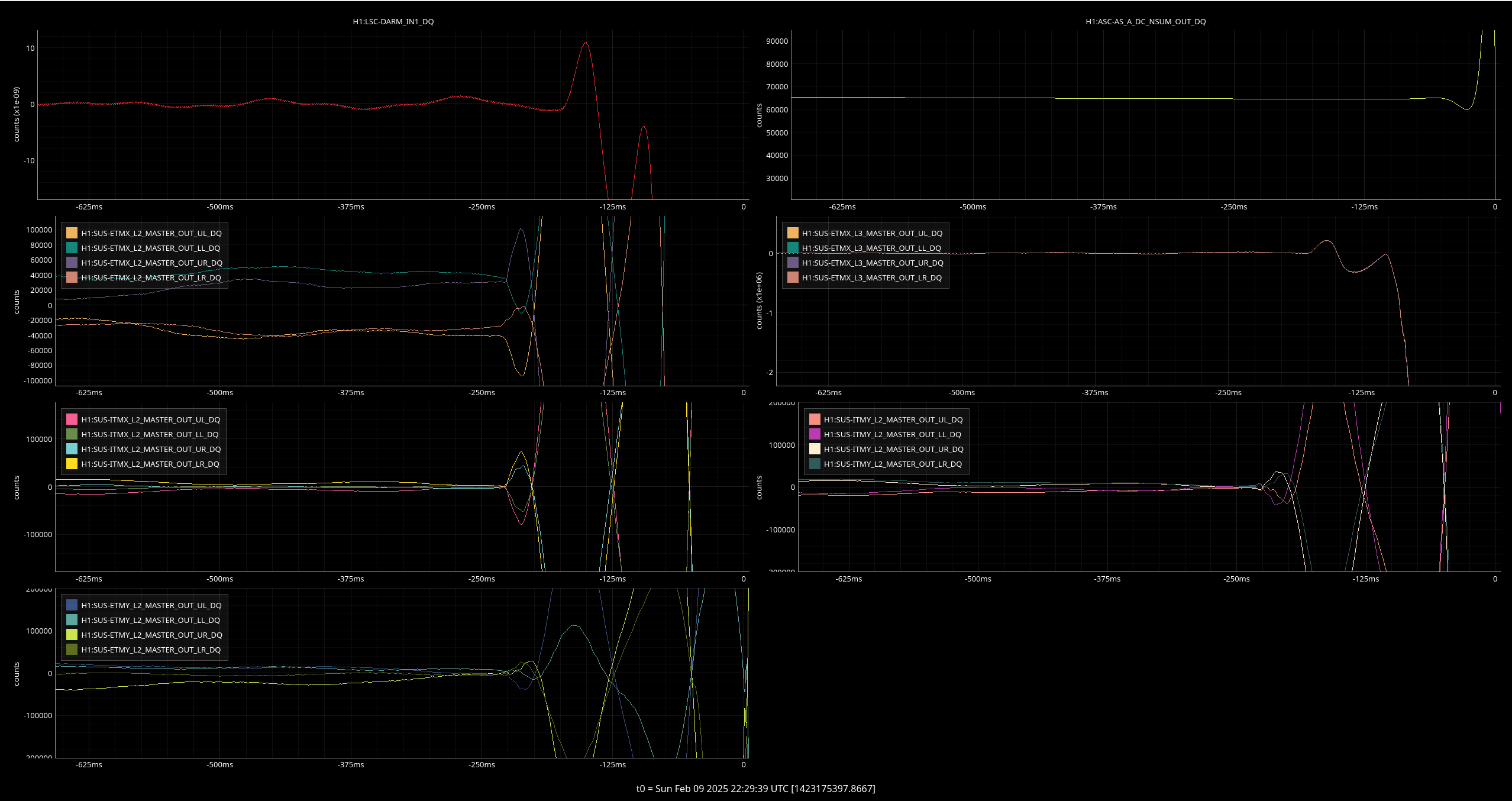
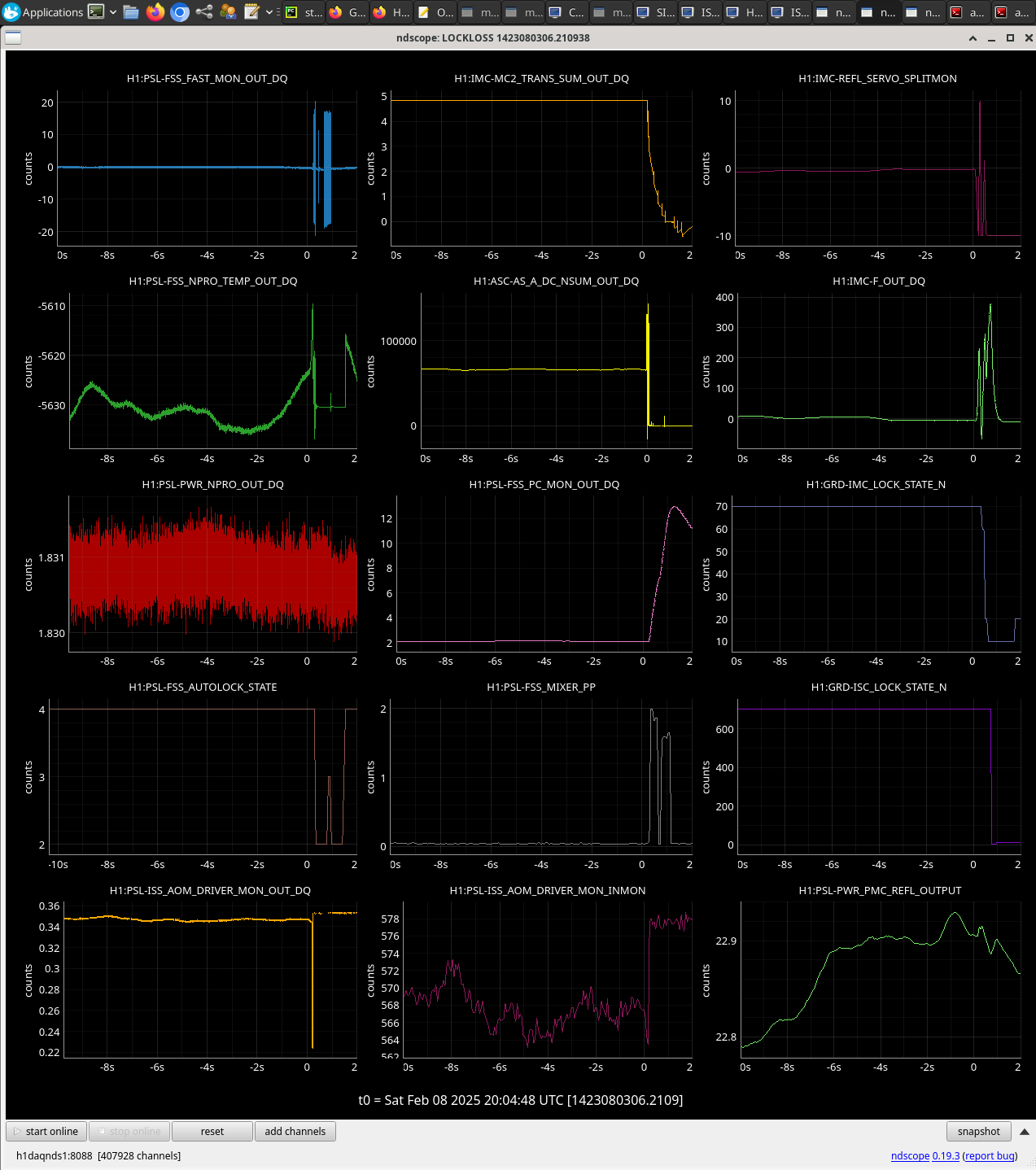
Seems like an IMC lockloss. Interestingly, there was no obviously glitchy behavior (as previously observed) before or after the lockloss. Attached screenshot of ASC and IMC losing lock.
Adding more channels for the sake of investigation. As Ibrahim mentions, no glitchy behavior was seen leading up to this IMC lockloss, so this was either a large fast glitch out of nowhere or something else giving out. Seemingly all at once (or at least very close to each other), the FSS_FASTMON, RefCav trans, NPRO power, PMC high voltage, PMC mixer, and all IMC signals quickly change, so it's hard to tell which is truly happening first as there is lots of feedback between these signals.
Sheila, Vicky.
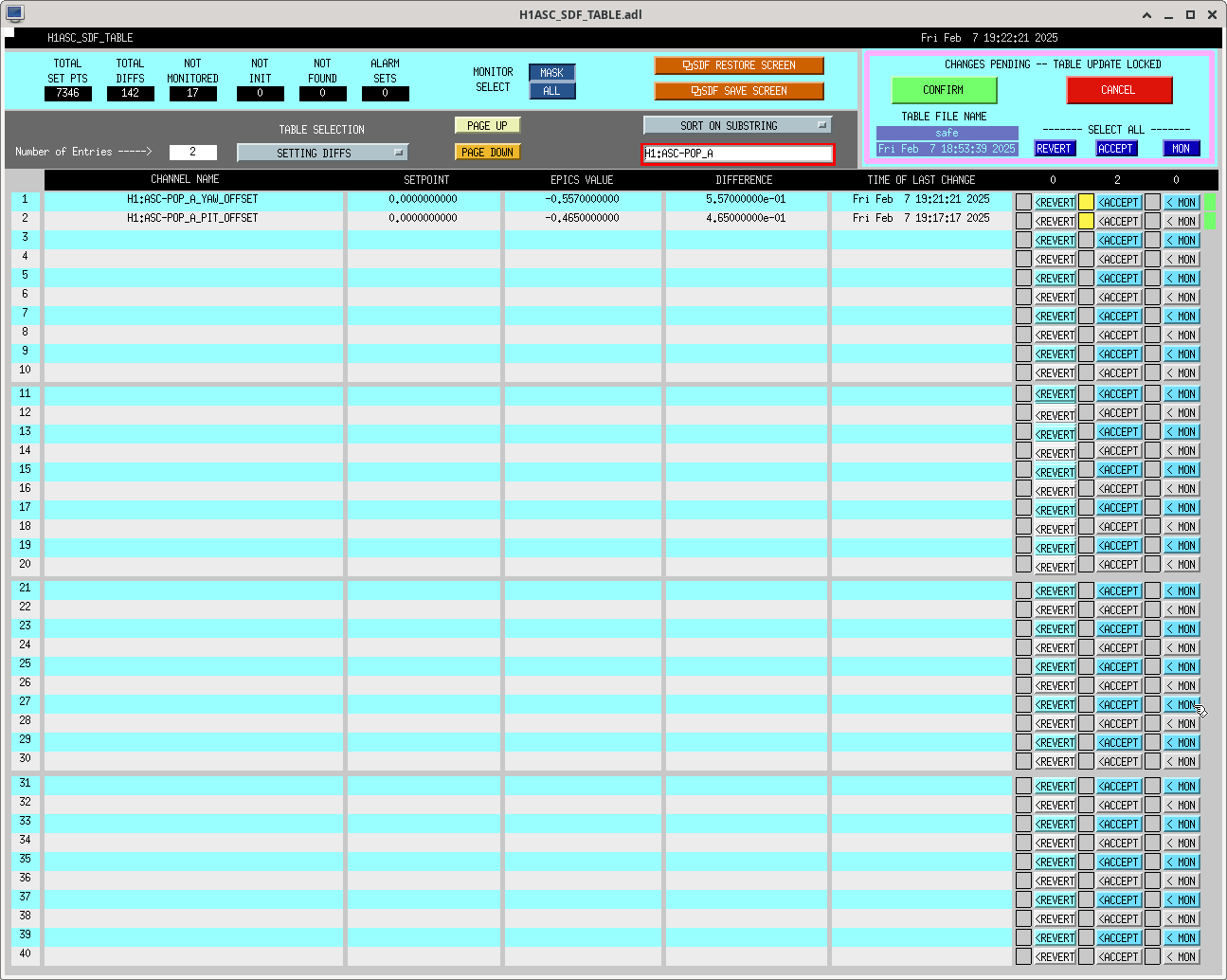
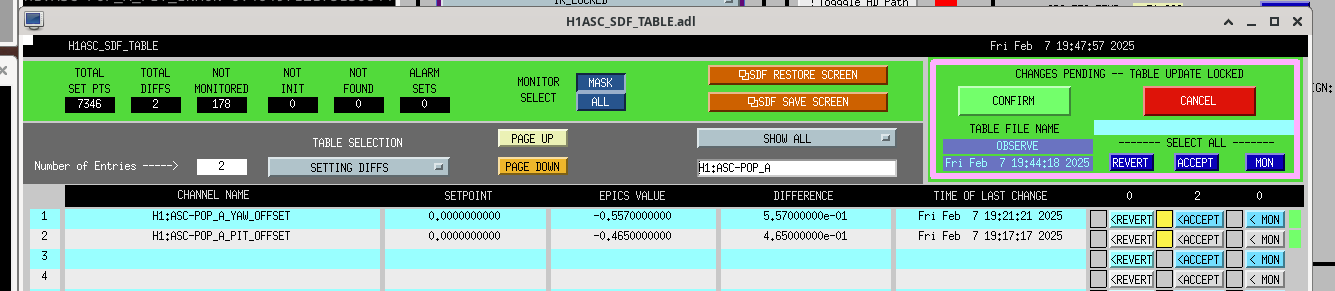
We changed the low pass filtering on the ADF SQZ angle servo to be lower, going from 1 Hz low pass to 0.1 Hz low pass on the ADF I/Q demod filter banks. I think this reduced the sqz angle readback noise a bit (trends before/after). It didn't make a huge impact on the control signal that goes to the CLF_RF6 demod phase (bottom purple trace), and it might be worth considering low pass filtering that control signal too. I accepted the SDFs for this filter bank LPF change.
Ibrahim, Sheila, Ryan S
Ibrahim noticed that the guardian was in a loop of locking PRMI something like 20 times overnight.
What happened was that PRMI was poorly aligned (POP18 and 90 I ERR both below 20 counts), but PRMI was able to grab lock for a couple of seconds, but would not hold lock as the guardian engaged the top mass offloading, adjsuted gains and filters. Eventually this hit the timer in H1 manager to do an initial alignmemt, after just over an hour.
There is also a timer in ISC that checks if PRMI hasn't locked in 10 minutes it should move onto MICH fringes. This didn't happen in this case because of the very short locks. Ryan and I read through the ISC_LOCK AQUIRE_PRMI state, and realized that it had a check (line 1371) for DRMI arrived (in the state PRMI locked), which didn't include a check for the state being done, which would return true in ISC LOCK before ISC_DRMI finished the final steps in PRMI locked . In the second, zoomed screenshot, you can see that as soon as the DRMI guardian enters state 35 (PRMI locked), ISC lock moves on immediately from state 50 (ACQUIRE PRMI) to 51 and 52 (PRMI ASC), which resets the timer so that we never went to MICH fringes.
We added a check for the ISC_DRMI state to be both arrived and done in PRMI locked, so that PRMI will have to survive the offloading and boost engagement for the timer to be reset. Ibrahim has now reloaded this. We think that if this situation came up again, now we would only spend 10 minutes relocking PRMI, before going to MICH fringes. If H1 is under the manager control, it would run initial alignment if running MICH fringes didn't help.
I ran the range_compare script using the 10-12 minute low range stretch from the most recent lock and some time before it of the same lock where the range was better, the construction crew by staging was also seen moving large equipment around this time on the cameras.
To produce this figure I ran "python3 /ligo/gitcommon/ops_tools/rangeComparison/range_compare.py --span 600 1415725641 1415728983", I only did 600 seconds of data. The range drop looks to be from low frequency noise, mostly below ~300Hz, the most obvious peak difference looks to be at 46/47 (mostly on sensmon), 36 (mostly on sensmon), and 60Hz (both sensmon and DARM) for the low range stretch. The lines are hard to see, but if you open the pdf in LibreOffice (linux default pdf viewer) and right-click -> Arrange -> Behind Object, then you can hover your cursor over the curves and it will be much easier to see the differences.
The SQZ blrms didn't really change during this time either.
Ryan S, Ibrahim
Unexpected lockloss being investigated but confirmed not the IMC nor the environment. Ryan S is seeing that it is looking like the ETM Glitch.
Does not look like an IMC/PSL lockloss; trends attached. The NPRO temp has been glitching this morning, not drastically, which has been causing the EOM drive to be higher in general, but these glitches were not happening at the time of this lockloss. The shape of of the signal on AS_A is indicative of an arms lockloss and happens before the IMC loses lock according to MC2_TRANS. Additionally, the lockloss tool shows glitches on ETMX starting up to second before the lockloss, although the ETM_GLITCH tag was not applied in this case as the glitches did not meet the required threshold.
(The ndscope template I'm using lives in my home directory ~/templates/psl_glitch_hunting.yaml)
FAMIS 31059
Late entry; these are trends taken on Monday as usual but I neglected to post them until now.
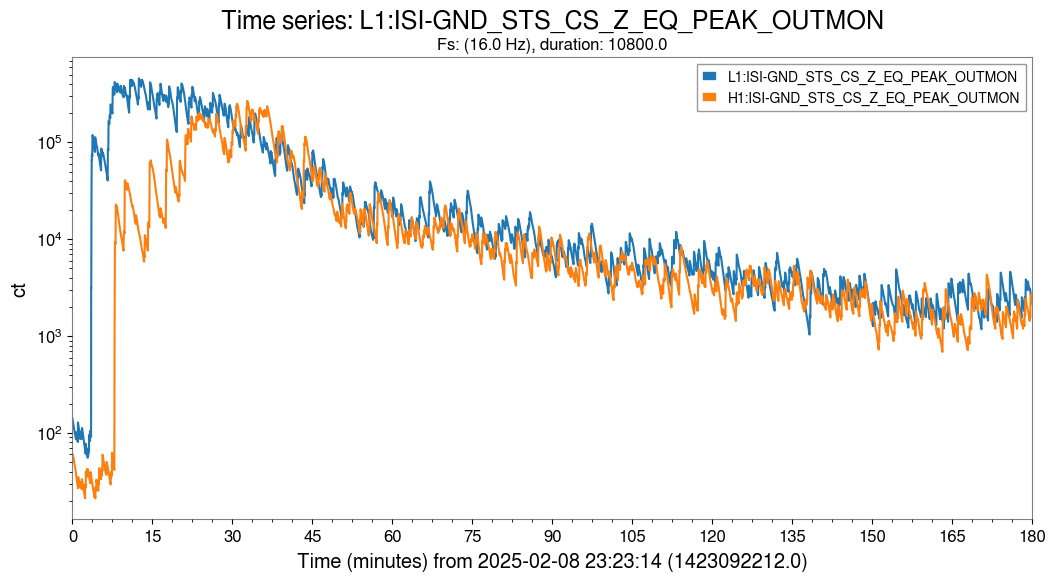
Since troubleshooting of laser glitches is still ongoing, several things in the PSL have been changing more than usual, including enclosure incursions, temperature changes, and ISS diffracted power increases. The only unexpected thing of note is that PMC reflected power seems to have been rising slowly over the past few days, but I think it's too soon to tell if this is a similar increase to what we were seeing here pre-NPRO swap or if it's related to laser troubleshooting. Will certainly be keeping an eye on this.
Fri Nov 15 10:12:59 2024 INFO: Fill completed in 12min 55secs
TITLE: 11/15 Day Shift: 1530-0030 UTC (0730-1630 PST), all times posted in UTC
STATE of H1: Lock Acquisition
OUTGOING OPERATOR: TJ
CURRENT ENVIRONMENT:
SEI_ENV state: CALM
Wind: 2mph Gusts, 1mph 3min avg
Primary useism: 0.03 μm/s
Secondary useism: 0.35 μm/s
QUICK SUMMARY:
IFO is LOCKING at PRMI_ASC
I arrived and guardian has recently finished an initial alignment and was at CHECK_IR. Microseism is much lower than last few days.
Locklosses overnight:
1415716992 not a PSL/IMC problem, the IMC losses lock 260ms after the IFO, from observing, not sure what it was
1415703738 also not a PSL/IMC problem, the IMC losses lock 240ms after the IFO, from observing, not sure what caused it
1415697803 not a PSL/IMC problem, there was a small earthquake while we were in the ESD transitions. This lockloss is listed as being from state 558 (the one that Elenna increased a ramp time in to avoid locklosses 81260), however the lockloss actually happened in the state before when DARM was still controled by the ITMX ESD. This is just a less robust state to large ground motion.
Ibrahim looked at the long time between the earthquake and relocking, about an hour of that was waiting in ready for the ground motion to come down (which the guardian does independently now), then Ibrahim saw that there were 20 something PRMI locklosses in a row, all about 2 seconds after PRMI locked. (We will look into this more)
We also looked back at Corey's shift, and think that lockloss during the ETM transitions at 2:05 was not a PSL/IMC glitch (noted as LOCK #2 in Corey's alog). So this means we think that we have had 17 hours or so without a lockloss due to the PSL. We will wait and see how today and the weekend goes.
As a reminder, we saw FSS glitches yesterday morning, then did several things before this 17 hour stretch without glitch locklosses.
After tonight's Initial Alignment, H1's been fairly good with getting through the bulk of ISC_LOCK, but have had 2 consecutive locklosses a couple of states after MAX POWER:
Locking Notes:
0003-0043 INITIAL ALIGNMENT (w/ ALSy needing touch up by hand)
0044 LOCK#1
LOCK #2: DRMI looked its ugly self. Needed to run CHECK MICH FRINGES and the BS was definitely the culprit for the nasty alignment and was fixed. PRMI & DRMI both locked immediately.
Will continue locking for the next 2.5-3hrs, and then take H1 to IDLE and leave FSS & PMC -ON- for the night.
But if H1 makes it to NLN, will contact Louis or Joe B for a ~15min calibration check.
Vicky, Ryan, Sheila
Zooming in on this 2:05 UTC lockloss, MC2 trans dropped about 150ms after the IFO lost lock, so we think this was not due to the usual PSL/IMC issue, even though there was a glitch in the FSS right before the lockloss.
Ryan, Jason, Patrick, Filiberto As part of troubleshooting the PSL we hardware power cycled the PSL Beckhoff computer in the diode room this morning, along with all of the associated diode power supplies and a chassis in the LVEA. I had guessed that everything would autostart, but I was wrong, so I took the opportunity to set it up to do so. This required putting a shortcut to the EPICS IOC startup script in the C:\TwinCAT\3.1\Target\StartUp directory (see attached screenshots), and selecting an option in the TwinCAT Visual Studio project to autostart the TwinCAT runtime. We software restarted the computer again to test this, and after logging in, the Beckhoff runtime and PLC code started, along with the EPICS IOC, but the visualization did not. I found documentation that pointed to the location of the executable that starts the visualization, and added a shortcut to that to the startup directory as well. We didn't have time to restart the computer again to see if that would autostart correctly. For some reason there seemed to be issues with processes reconnecting to the EPICS IOC channels. I tested running caget on the Beckhoff computer itself and got a message about connecting to two different instances of the channel, and a couple of pop up windows related I think to allowing network access, which I said to allow. caget worked, although it gave a blank space for the value, so I tried it again with an invalid channel name, which it correctly gave an error for. On the Linux workstation we were using, the MEDM screens were not reconnecting, even after closing and reopening them, but again caget worked. We had to restart the entire medm process for it to reconnect. The EDCU and SDF also had issues reconnecting, and they had to be restarted too.
As Patrick mentioned, channel access clients which had been connected to the IOC on h1pslctrl0 would not reconnect after its restart.
The EDC stayed in its disconnect state for almost an hour, even though cagets on h1susauxb123 itself were connecting, albeit with "duplicate list entry" warnings:
(diskless)controls@h1susauxb123:~$ caget H1:SYS-ETHERCAT_PSL_INFO_TPY_TIME_HOUR
Warning: Duplicate EPICS CA Address list entry "10.101.0.255:5064" discarded
H1:SYS-ETHERCAT_PSL_INFO_TPY_TIME_HOUR 18
The restart of the DAQ EDC did not go smoothly, I had added a missing channel to H1EPICS_CDSRFM.ini (WP12195) in preparation for next Tuesday maintenance and so the EDC came back with a different channel list to that of the rest of the DAQ. I reverted this file change and a second EDC restart was successful.
11:38:35 h1susauxb123 h1edc[DAQ]
11:46:17 h1susauxb123 h1edc[DAQ]
The slow controls h1pslopcsdf system was also unable to reconnect to the 4 PSL WD channels it monitors. This was restarted at 12:08 14nov2024 PST.
Erik found that MEDM on some workstations would continue to show white-screen for h1pslctrl0 channels and a full restart of MEDM was needed to resolve this.