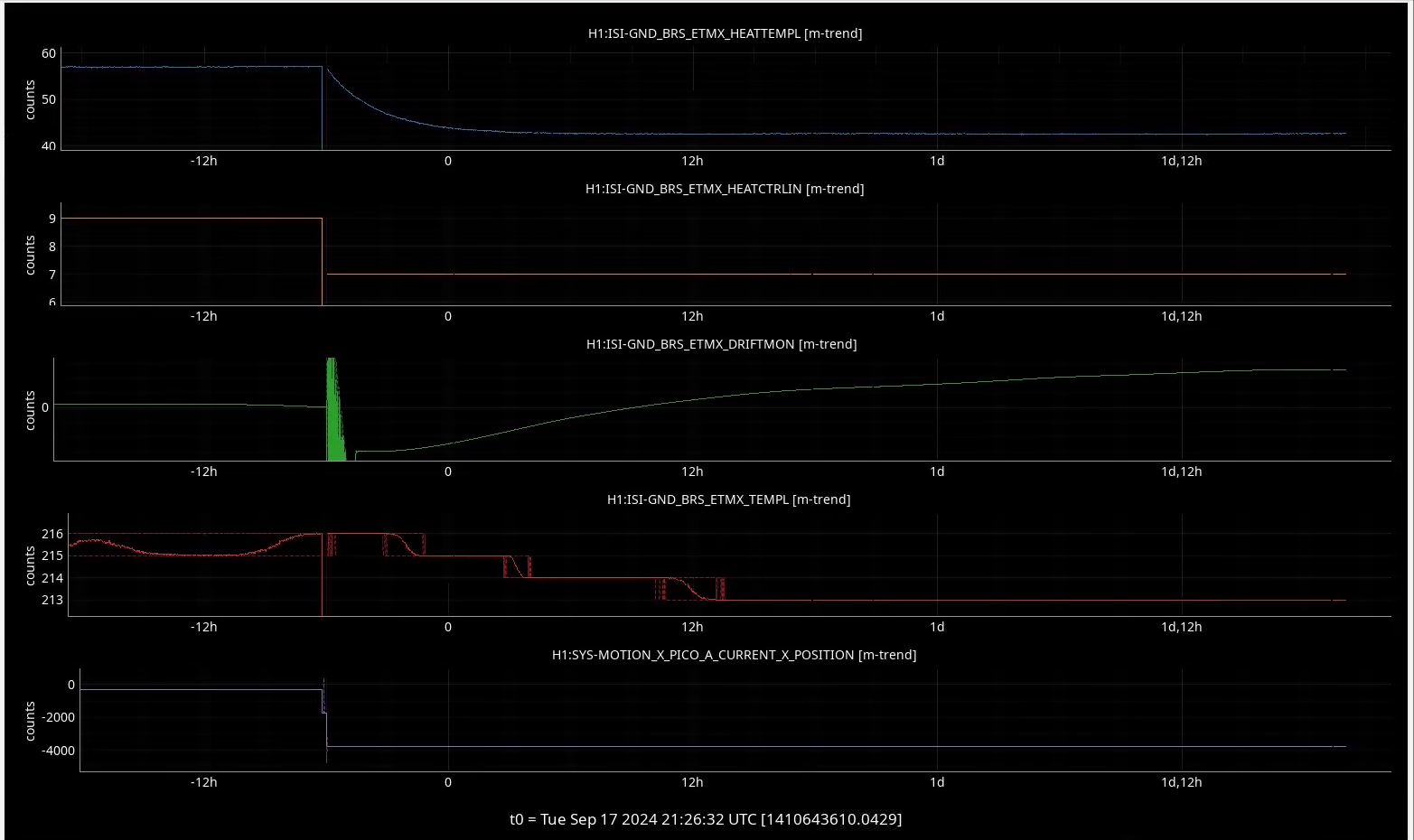
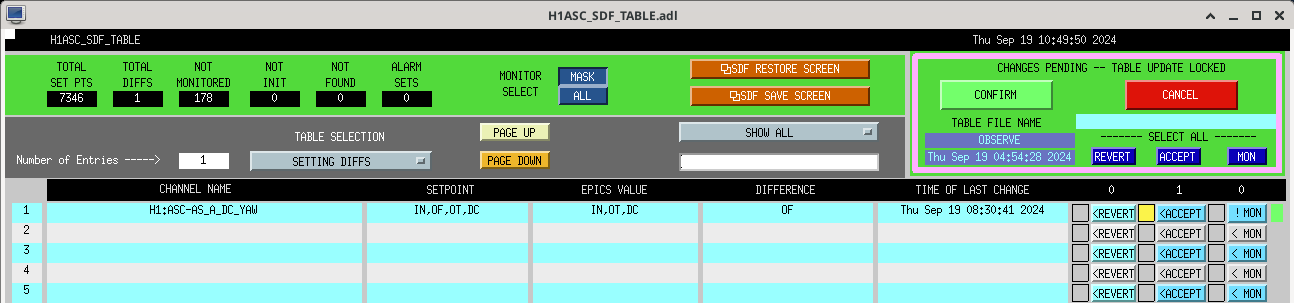
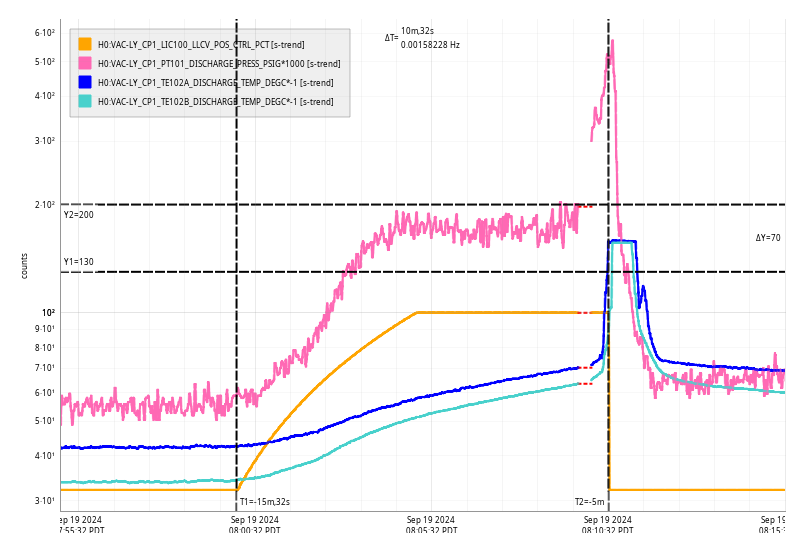
Thu May 02 10:15:33 2024 INFO: Fill completed in 15min 29secs
Gerardo confirmed a good fill curbside.
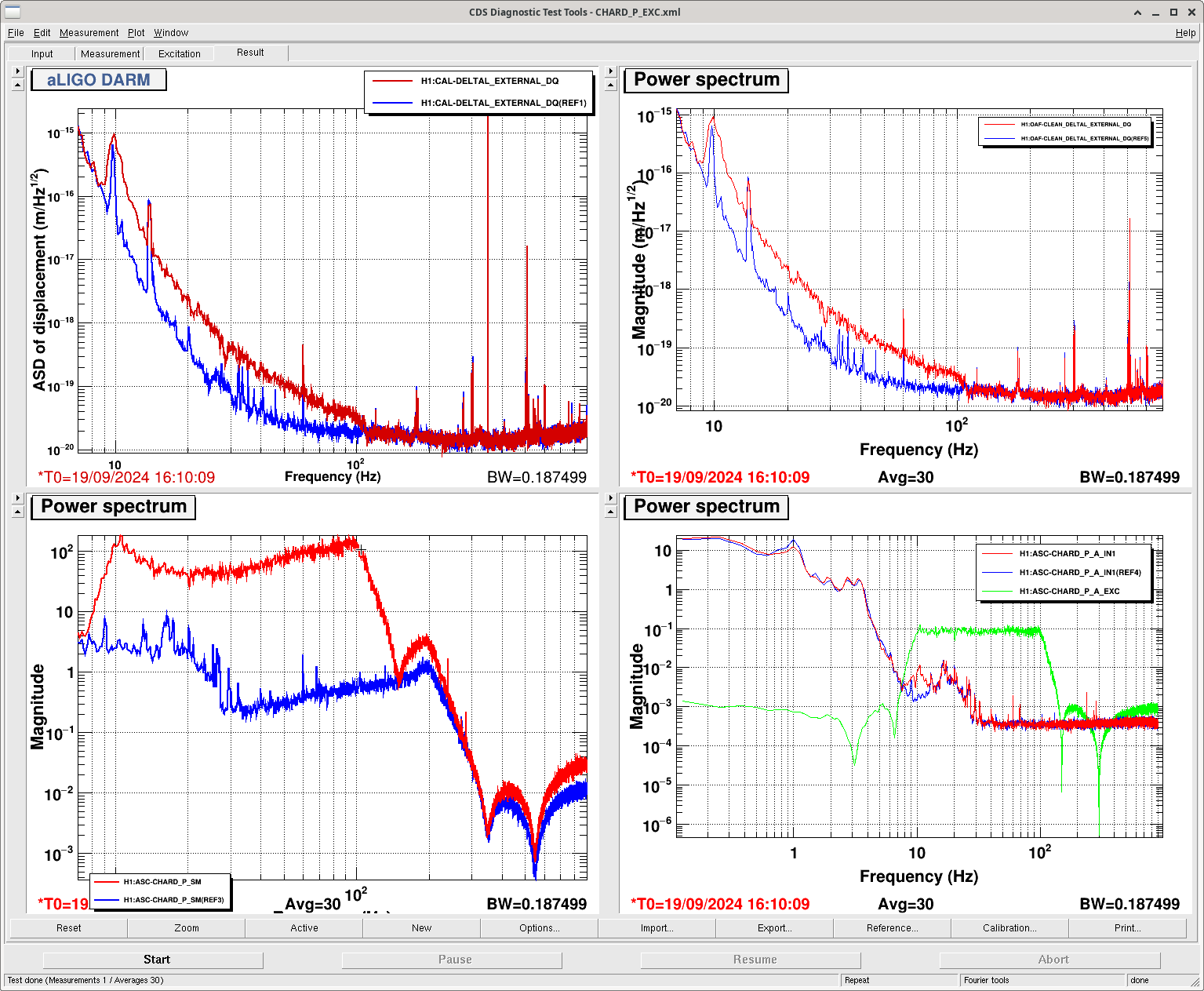
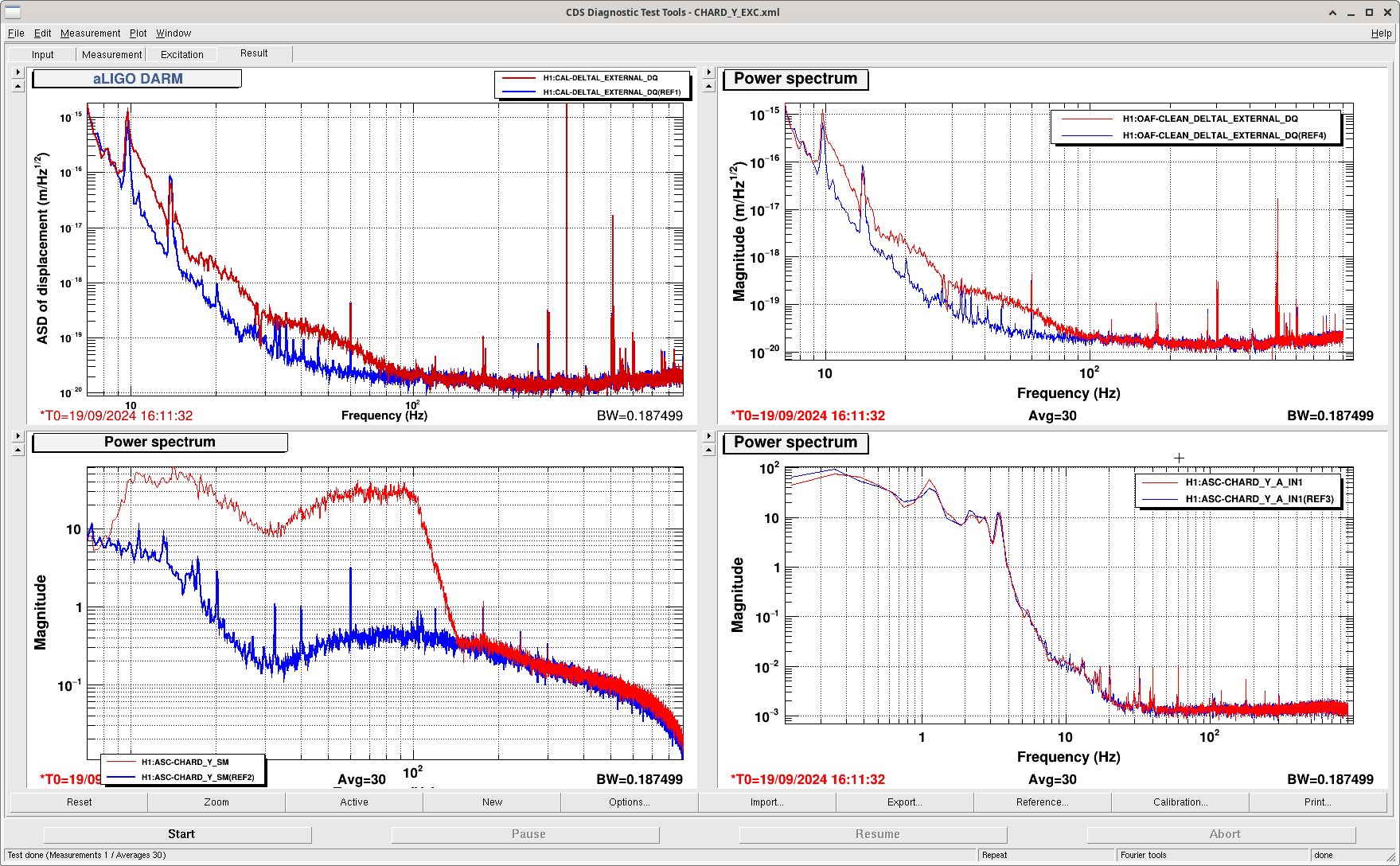
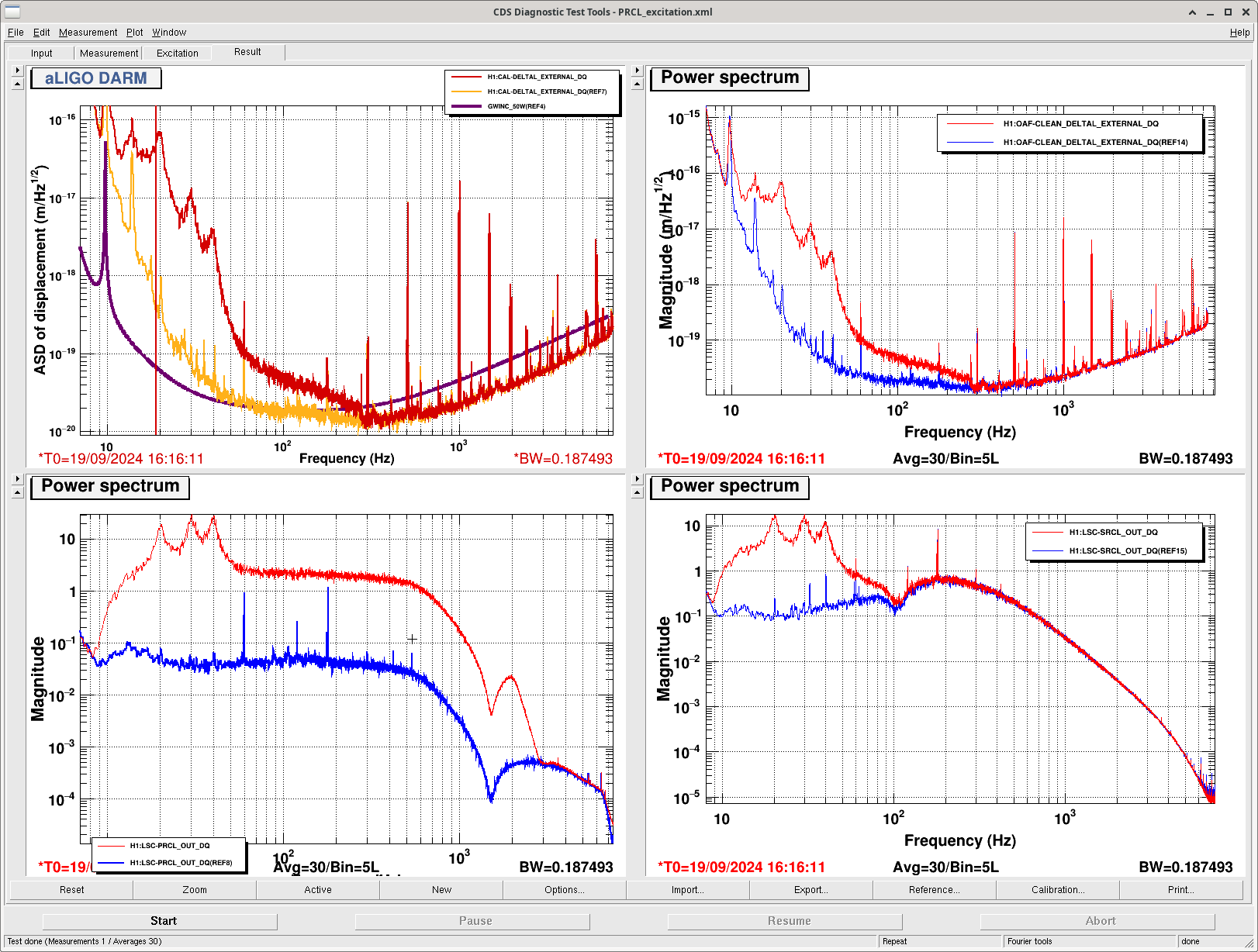
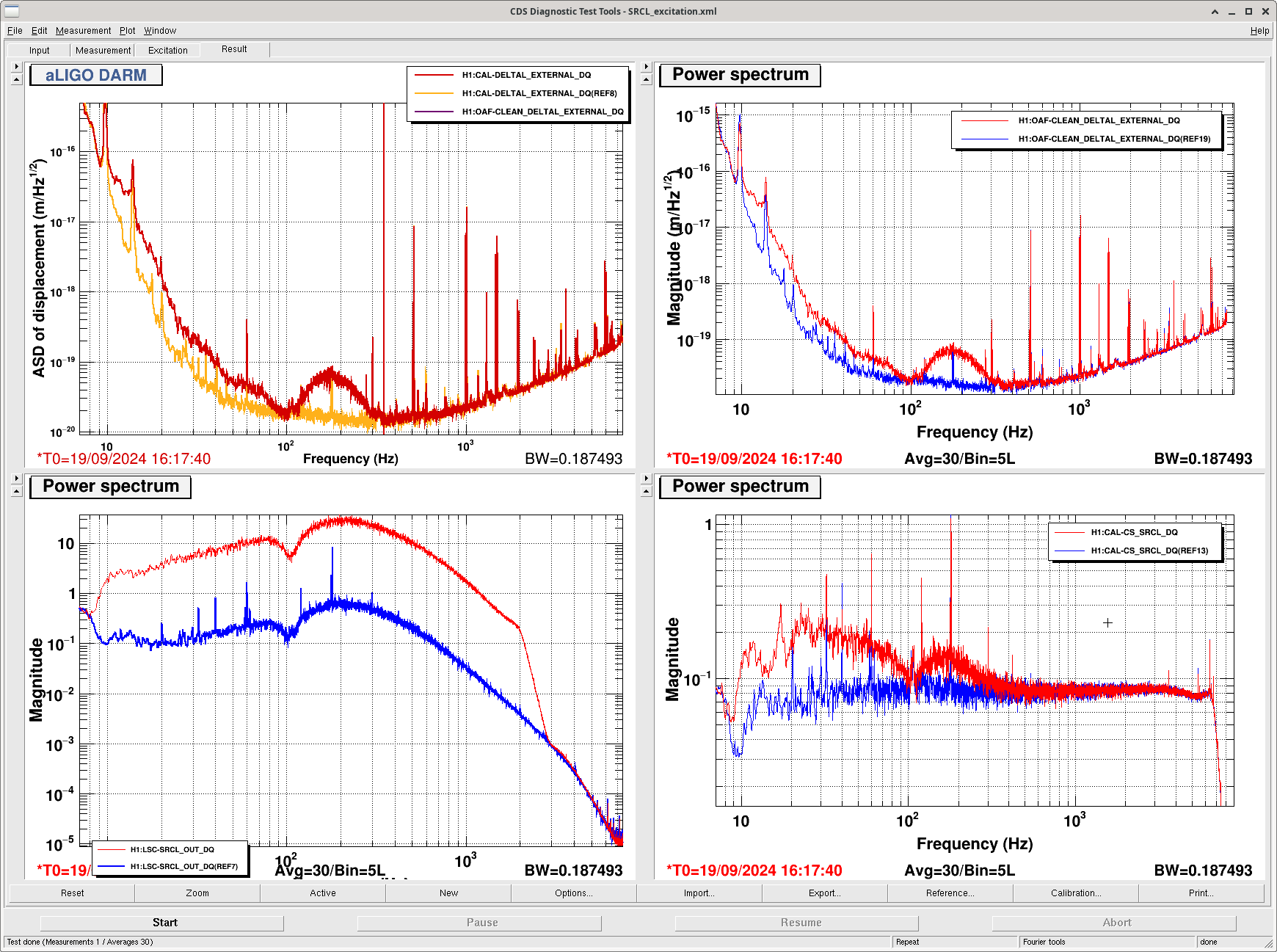
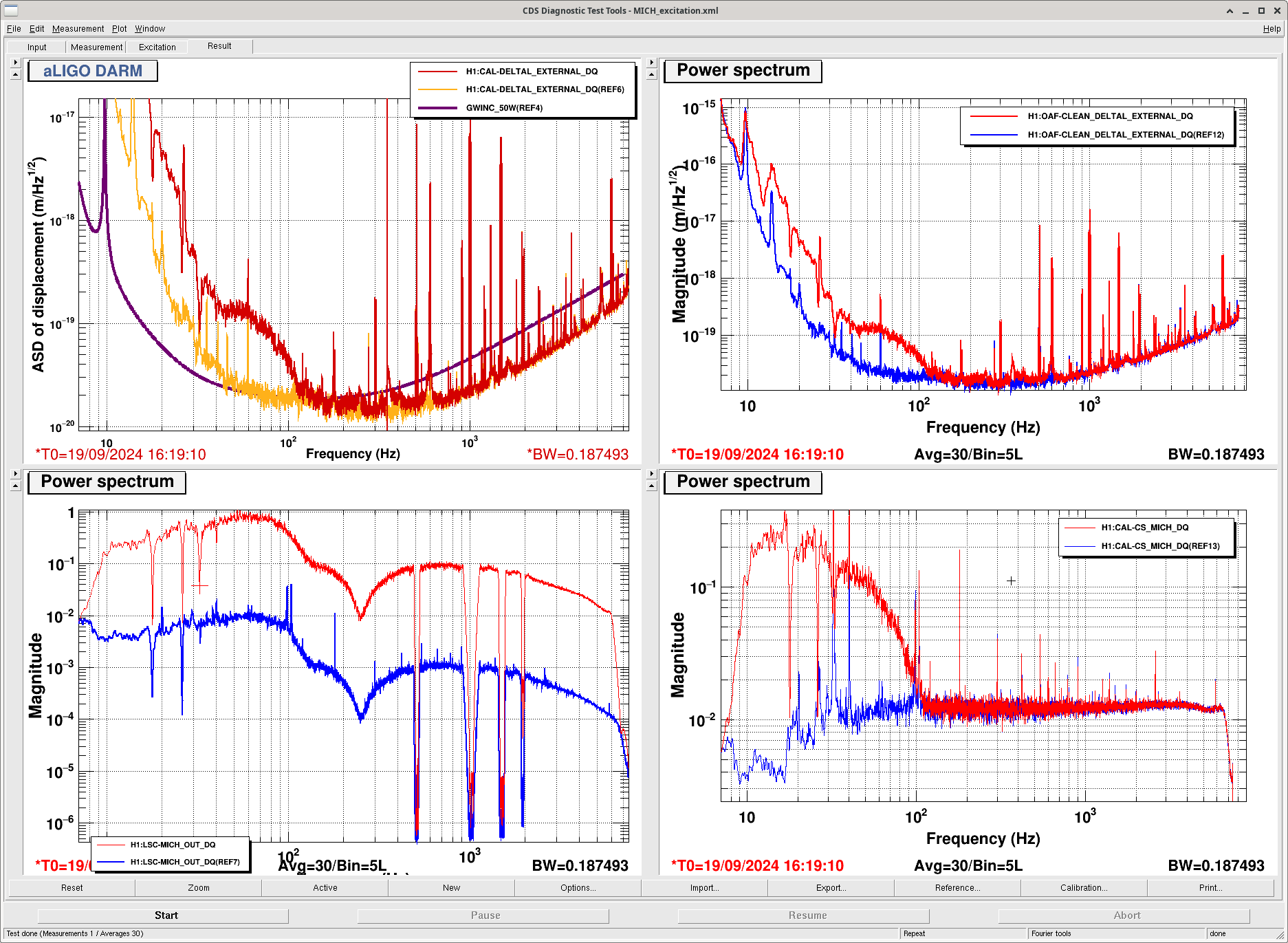
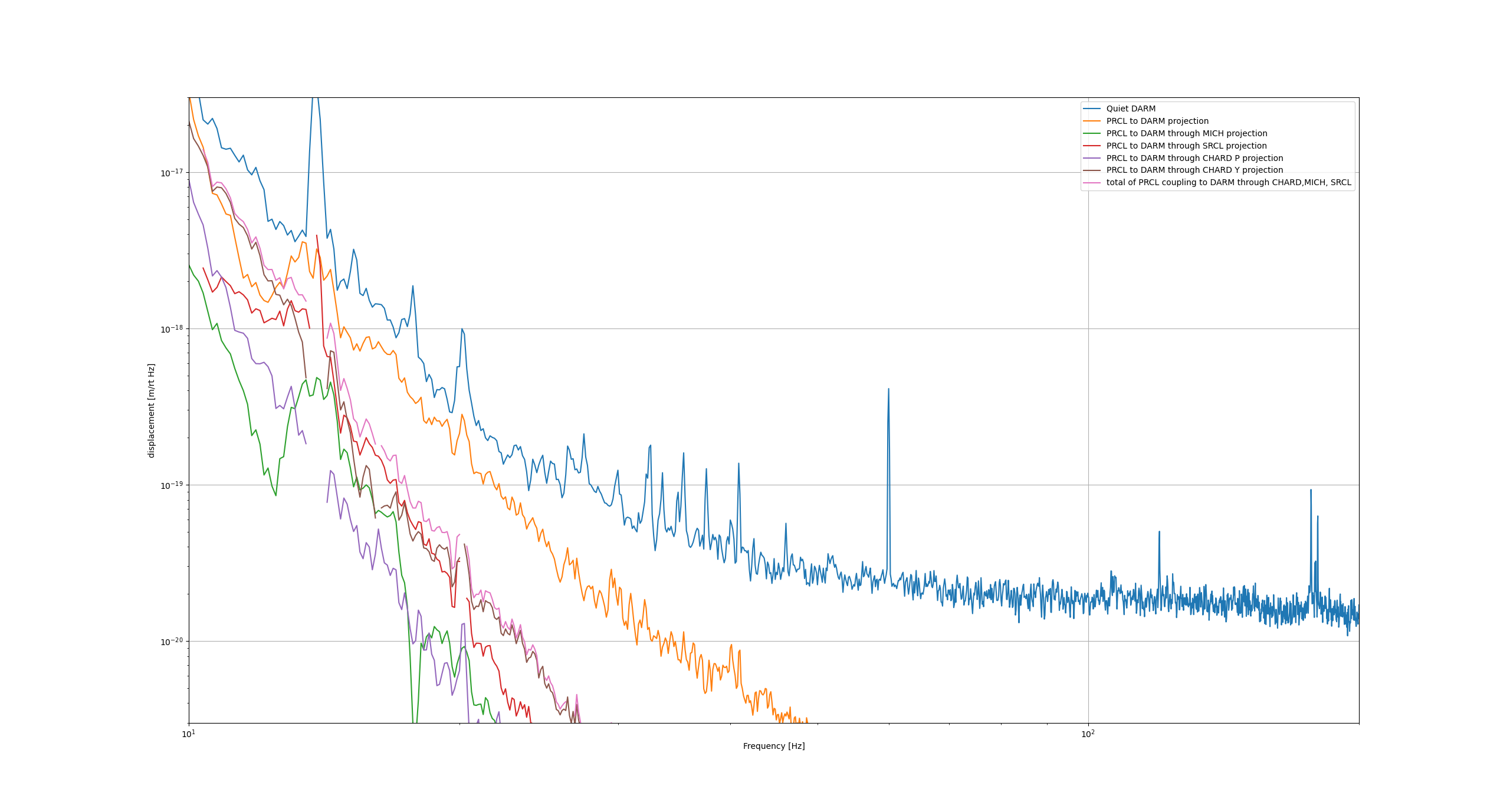
We've started comissioning which will run from 16:00 - 19:00 UTC (9am - 12pm PST). Some of the plans include, SQZ tuning, PEM injections, SRCL FF, and Y2L.
TITLE: 05/02 Day Shift: 15:00-23:00 UTC (08:00-16:00 PST), all times posted in UTC
STATE of H1: Observing at 153Mpc
OUTGOING OPERATOR: Corey
CURRENT ENVIRONMENT:
SEI_ENV state: CALM
Wind: 5mph Gusts, 4mph 5min avg
Primary useism: 0.01 μm/s
Secondary useism: 0.09 μm/s
QUICK SUMMARY:
TITLE: 05/02 Eve Shift: 23:00-07:00 UTC (16:00-00:00 PST), all times posted in UTC
STATE of H1: Observing at 151Mpc
INCOMING OPERATOR: Corey
SHIFT SUMMARY: During relocking we were able to catch DRMI without needing to go through PRMI, but had locklosses from ENGAGE_DRMI_ASC and TURN_ON_BS_STAGE2 before I started an initial alignment. During initial alignment we couldn't get past WFS_CENTERING_SRY, so I just took us out of IA and started relocking. LVEA is still in LASER HAZARD.
LOG:
22:49 Detector Locked for 2 hours
00:10 Dropped Observing to run SQZ and regular calibrations
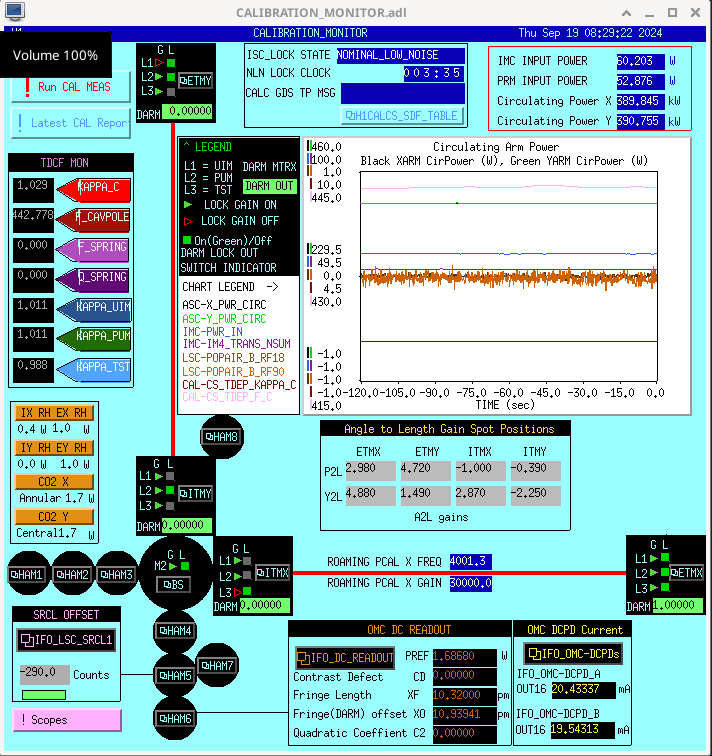
00:19 Went to NLN_CAL_MEAS for calibration measurements
00:30 Earthquake mode activated
00:50 Back to NOMINAL_LOW_NOISE and Observing
01:00 Seismic to CALM
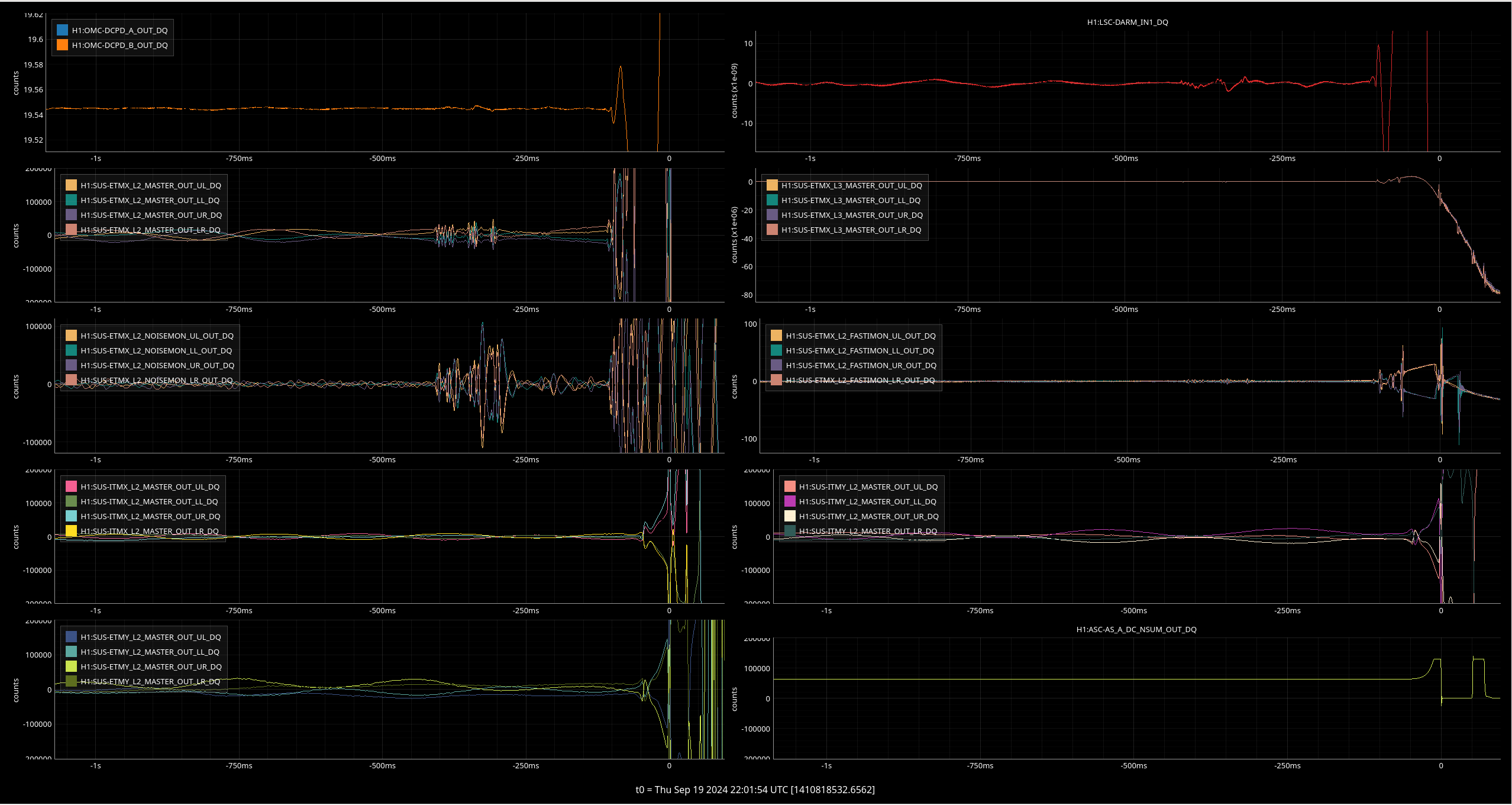
04:59 Lockloss
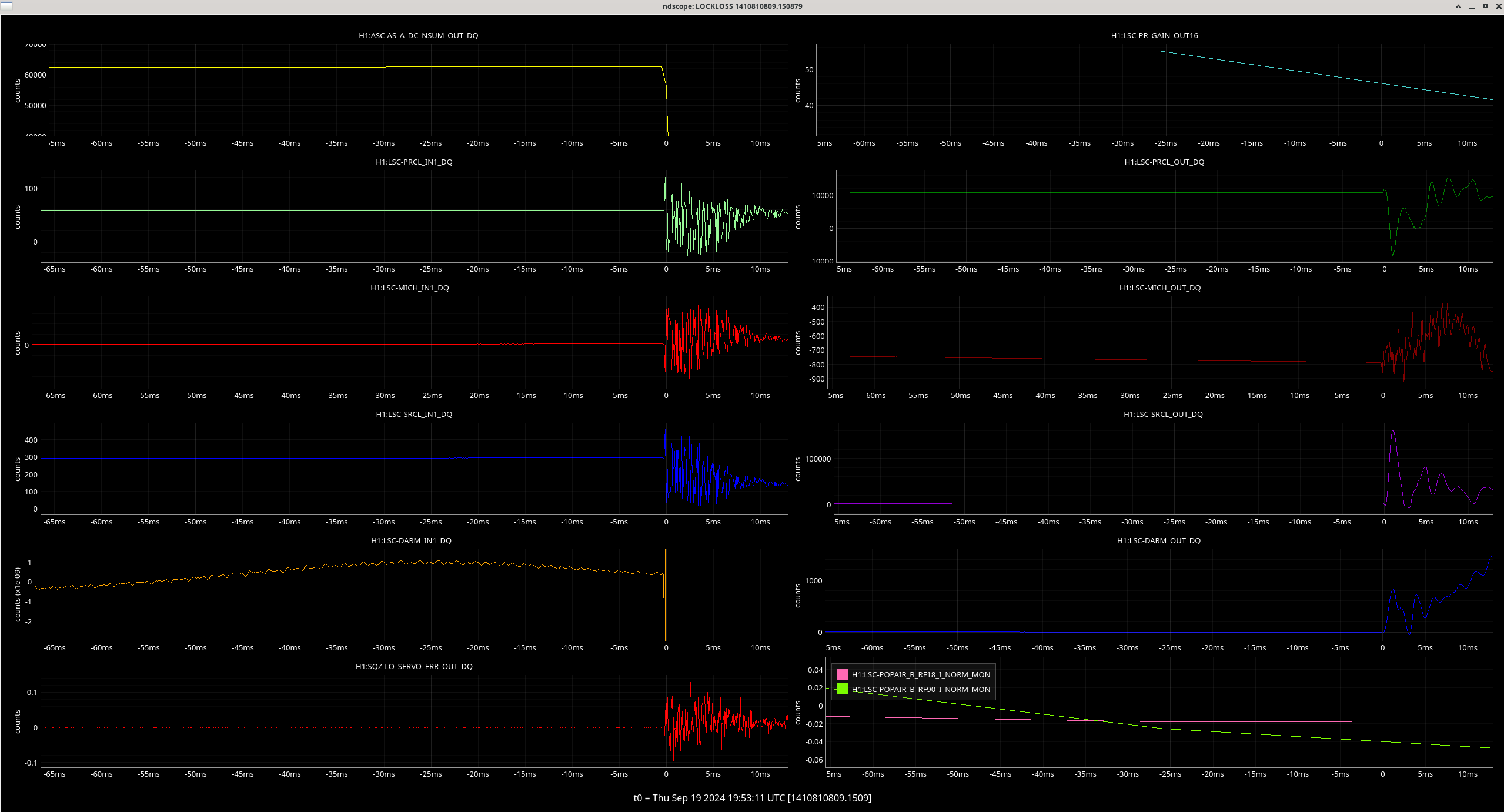
05:10 Lockloss from ENGAGE_DRMI_ASC
05:18 Lockloss from TURN_ON_BS_STAGE2 - started an initial alignment
05:37 - 05:45 Stuck at SRC alignment
- Constant SRM, IFO_OUT, SQUEEZE_OUT saturations
- We weren't able to get past WFS_CENTERING_SRY, so I took us to DOWN
- Backed out of initial alignment and started relocking
06:27 NOMINAL_LOW_NOISE
06:30 Observing
| Start Time | System | Name | Location | Lazer_Haz | Task | Time End |
|---|---|---|---|---|---|---|
| 21:25 | SQZ | Terry, Camilla | Opt Lab | Local | SHG work, new CO2 test | 23:51 |
| 22:09 | PCAL | Rick, Fransisco | PCAL lab | local | PCAL tasks | 00:09 |
| 23:16 | VAC | Janos, Jordan | MY | n | Turn off CP3 pump | 23:31 |
06:30 UTC Observing
Currently Observing and have now been locked for 6 hours. Wind is calming down
Ran bb calibration measurements and simulines between 05/02/2024 00:10 and 00:50 UTC. *Earthquake mode was activated at 00:30UTC and stayed activated through the rest of the measurements, but I presume should have no effect?
Broadband
Started: 2024/05/02 00:20:20UTC
Output file: /ligo/groups/cal/H1/measurements/PCALY2DARM_BB/PCALY2DARM_BB_20240502T002020Z.xml
Simulines
Started: 2024/05/02 00:27:28UTC
Output files:
/ligo/groups/cal/H1/measurements/DARMOLG_SS/DARMOLG_SS_20240502T002728Z.hdf5
/ligo/groups/cal/H1/measurements/PCALY2DARM_SS/PCALY2DARM_SS_20240502T002728Z.hdf5
/ligo/groups/cal/H1/measurements/SUSETMX_L1_SS/SUSETMX_L1_SS_20240502T002728Z.hdf5
/ligo/groups/cal/H1/measurements/SUSETMX_L2_SS/SUSETMX_L2_SS_20240502T002728Z.hdf5
/ligo/groups/cal/H1/measurements/SUSETMX_L3_SS/SUSETMX_L3_SS_20240502T002728Z.hdf5
Robert, Anamaria
Yesterday we opened the viewports of the oplevs for both ITMX and ITMY to find the alignment of the CP's.
The procedure relies on the fact that the optics are not coated for red so we can see all four surfaces. The separation between the beams at this distance (~34m) is about 10cm due to the wedges (in the table below from the galaxy page). The test mass has a vertical wedge, thick down, so the AR beam will show up directly below. The CP is supposed to be perfectly parallel to the back surface so the closest surface of the CP (CP1) would land essentially right on top of the ITM AR beam. Then the CP has a similar size wedge, but horizontal, so the second CP surface would hit at the same level as CP1 and ITM AR but to the left or right, depending which ITM.
The first plot attached shows the nominal view of these beams as seen at the oplev viewport on the white page. The yellow pages were attached to the lexand covering the viewport and the beams were marked. The full view of all the beams no longer fits through the viewport due to the addition of nozzle baffles so we had to walk the oplev sender to find all the beams. For the ITMX we lucked out and the ITM AR beam was visible at the top gap of the baffle at the same time as the second AR reflection and the CP beam were visible in the aperture. As such we are able to scale the misalignments to the wedge value. We verified the CP beams by moving the CPs, and we scanned to find the second CP surface (CP2) horizontally at about the right distance from CP1.
| wedge ITM/CP | misalignment | |
| CP-X | 0.07/0.07 deg | 1.7 mrad down |
| CP-Y | 0.08/0.07 deg | 0.55 mrad down |
By down I mean they are further pitched down towards the arm.
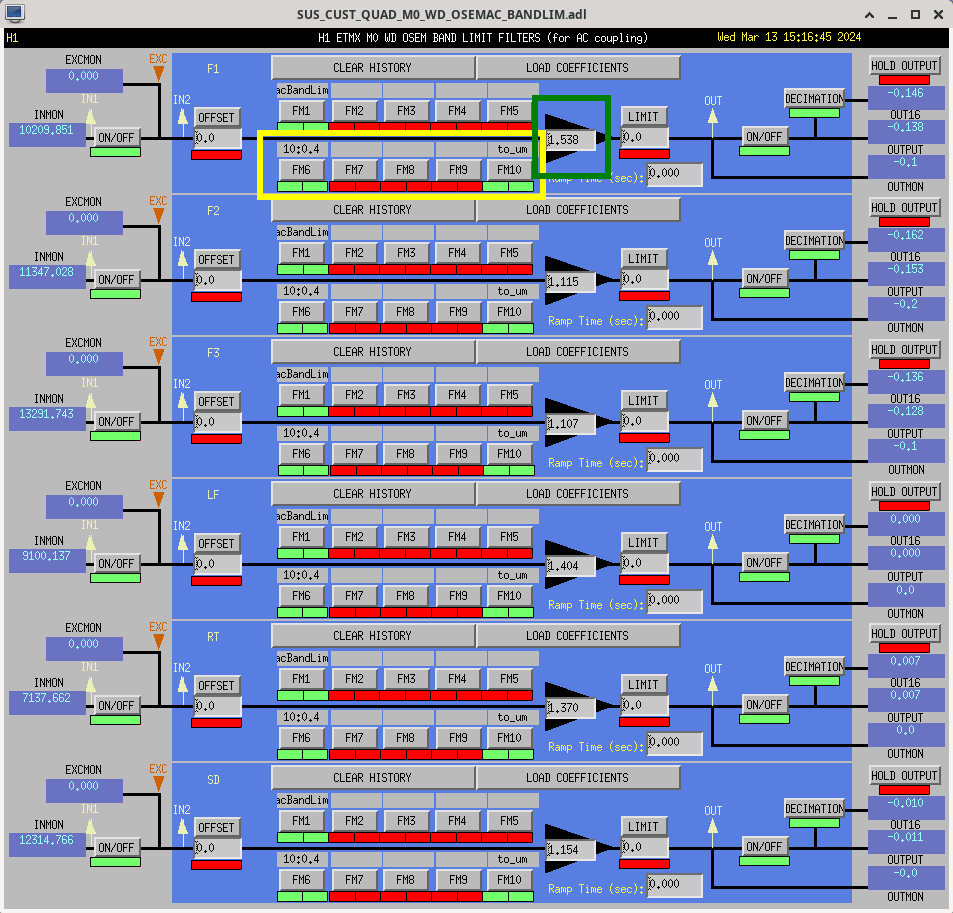
One would think that we have +/- 440 urad range in pitch on the R0, but it seems its range is much less than advertised. Even stranger, this was also found to be the case at L1, on both ITM R0. When we moved CPY, with respect to this calibration it only moves ~230 urad. So we cannot make it back to the nominal position of overlapping the ITM AR beam. For yaw we did a smaller step so more error on it, but it's about 60% of slider value. More on this later.
(CPY is the one that Robert found to modulate the noise from the MC tube baffle.) Speaking of the L1 experience, we even had to vent back in 2016 to fix one of these CP misalignments, which was too close to HR actually. The interesting thing to me, looking back, is that L1 still has a similar misalignment for CPX to the H1 CPY and we don't see as high noise coupling at the IMC tube.
CPX is very misaligned by comparison, but not linked to the MC tube scatter. Alena has agreed to help us track where these ghost beams land at P/SR3 and the scraper baffles, now that we know their exact orientation.
+Peter, Jeff
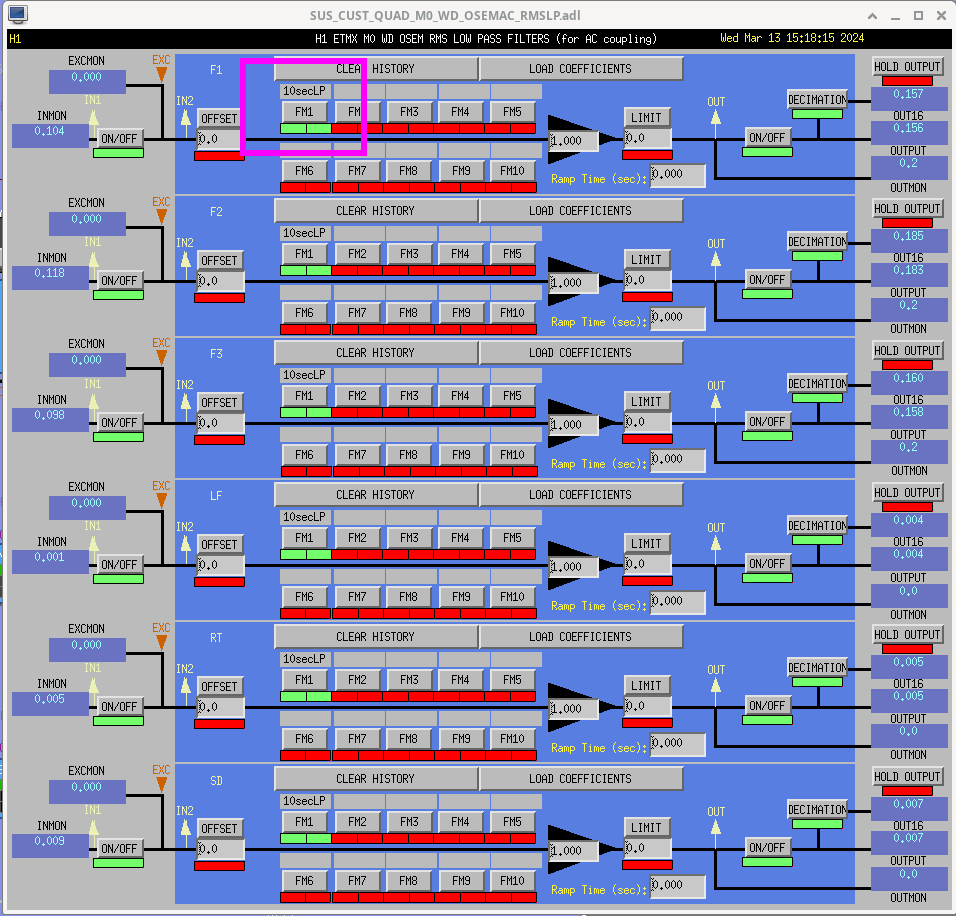
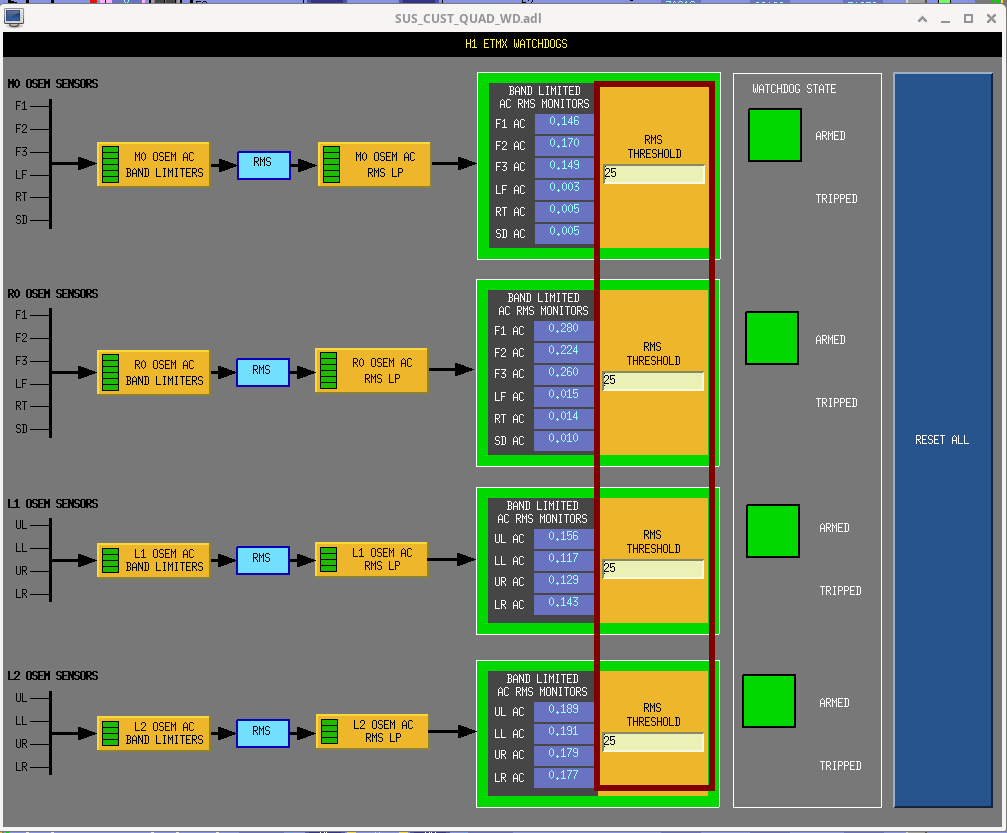
Regarding the reduced range of CPY R0, we checked what the BOSEMs and the coil current monitors had to say about the range during our optical measurement. Jeff kindly calibrated the RMSMONs so we could see what the current really is. The data is in the attached screenshot. We did not check the CPX but, as I mention above, we found this to be the case at LLO as well. For pitch I show F1, which gets the largest drive, for yaw I show one of F2/F3 which get identical drives. In terms of range, I define it as how far from 0 we can go, so half range technically, but it's max DAC output and current. If we want more range we have to decide if we can afford more than ~45mA on the BOSEMs.
| CPY | Slider [urad] | range [%] | OSEM readback [urad] | Oplev meas [urad] | Coil current [mA] |
| PIT | 440 | 100 | 1130 | 230 | 45 |
| YAW | 200 | 33 | 160 | 120 | 16 |
I ran the SCAN_ALIGNMENT with new OMC alignment in 77543 after 3 hours into lock.
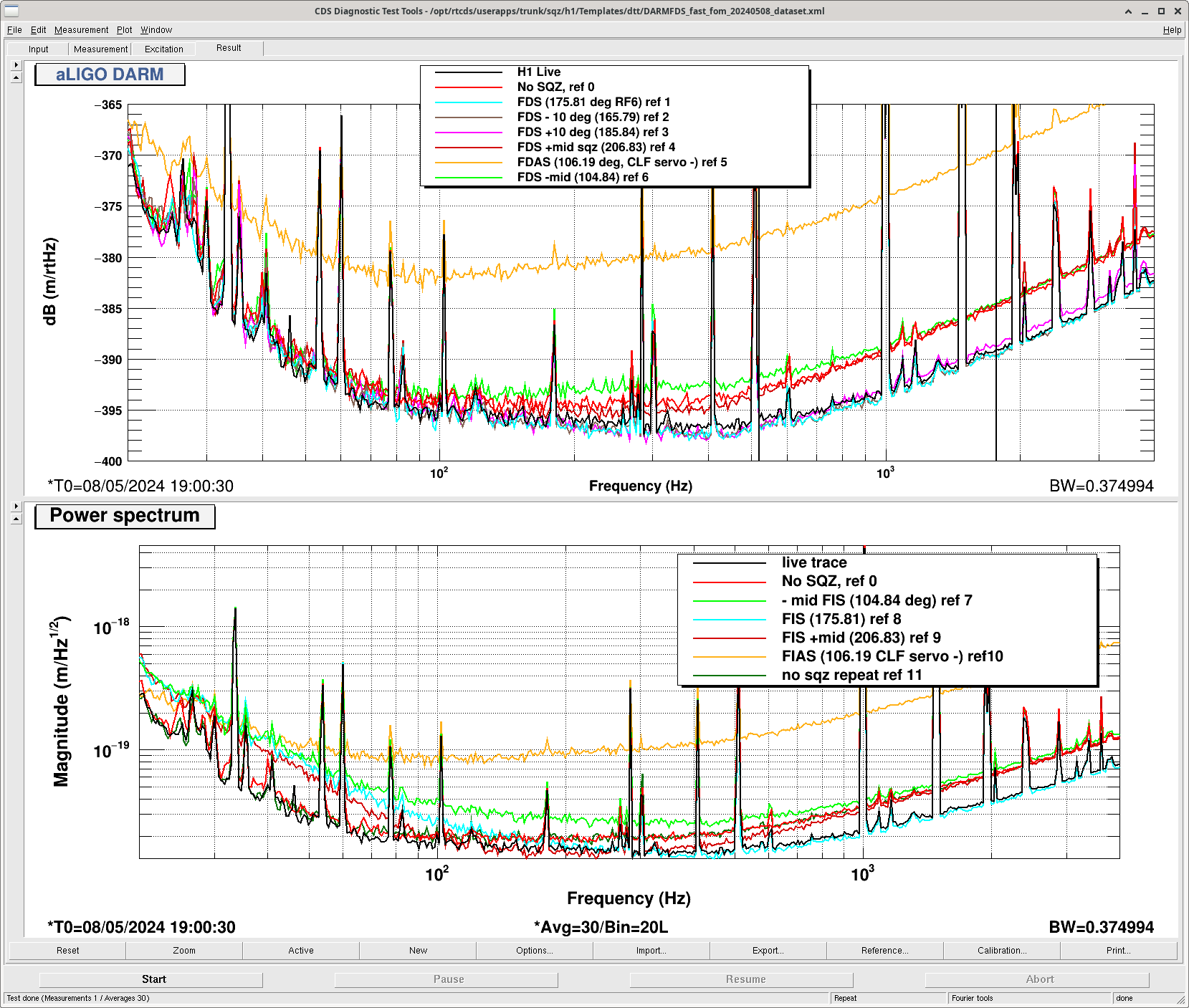
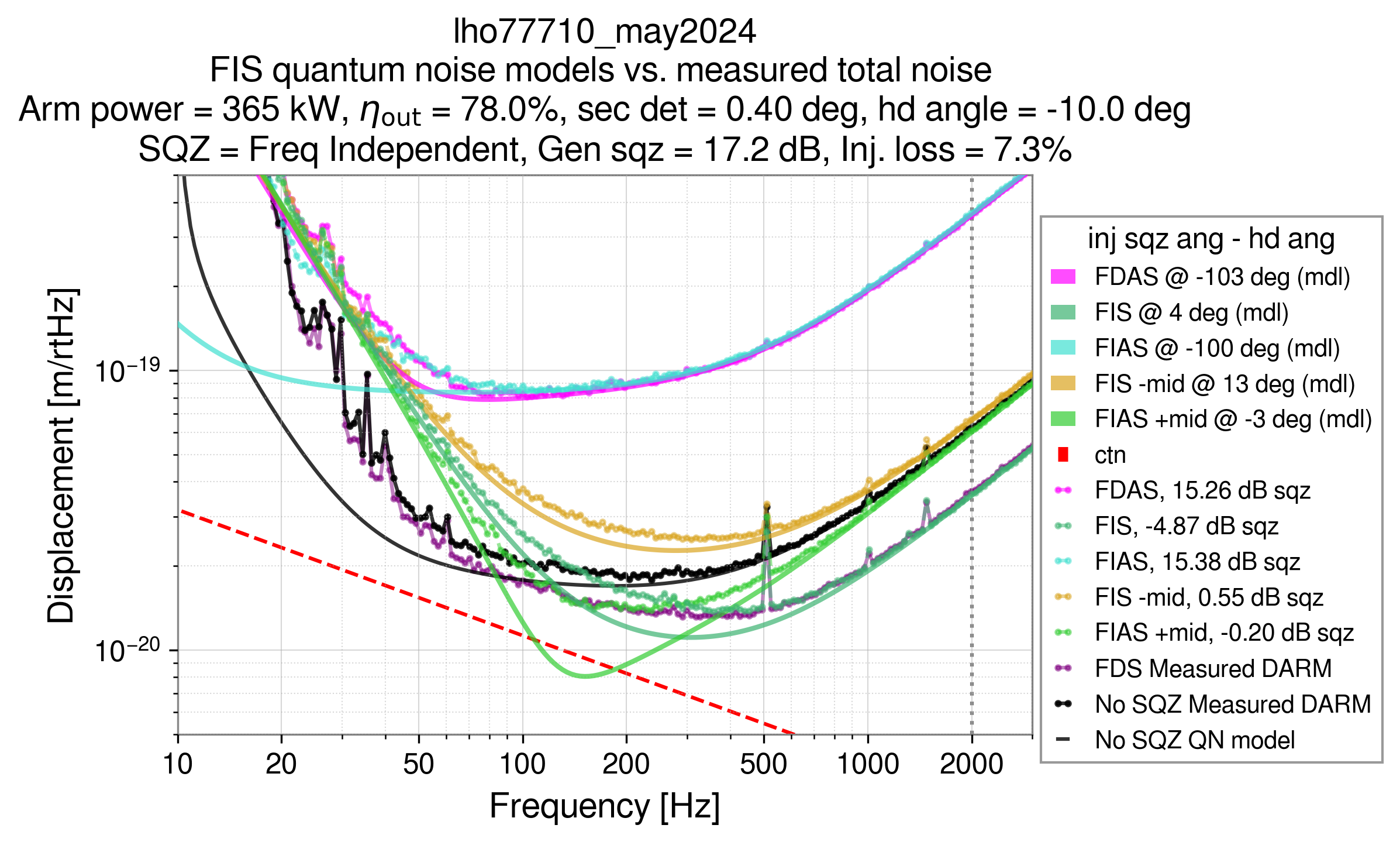
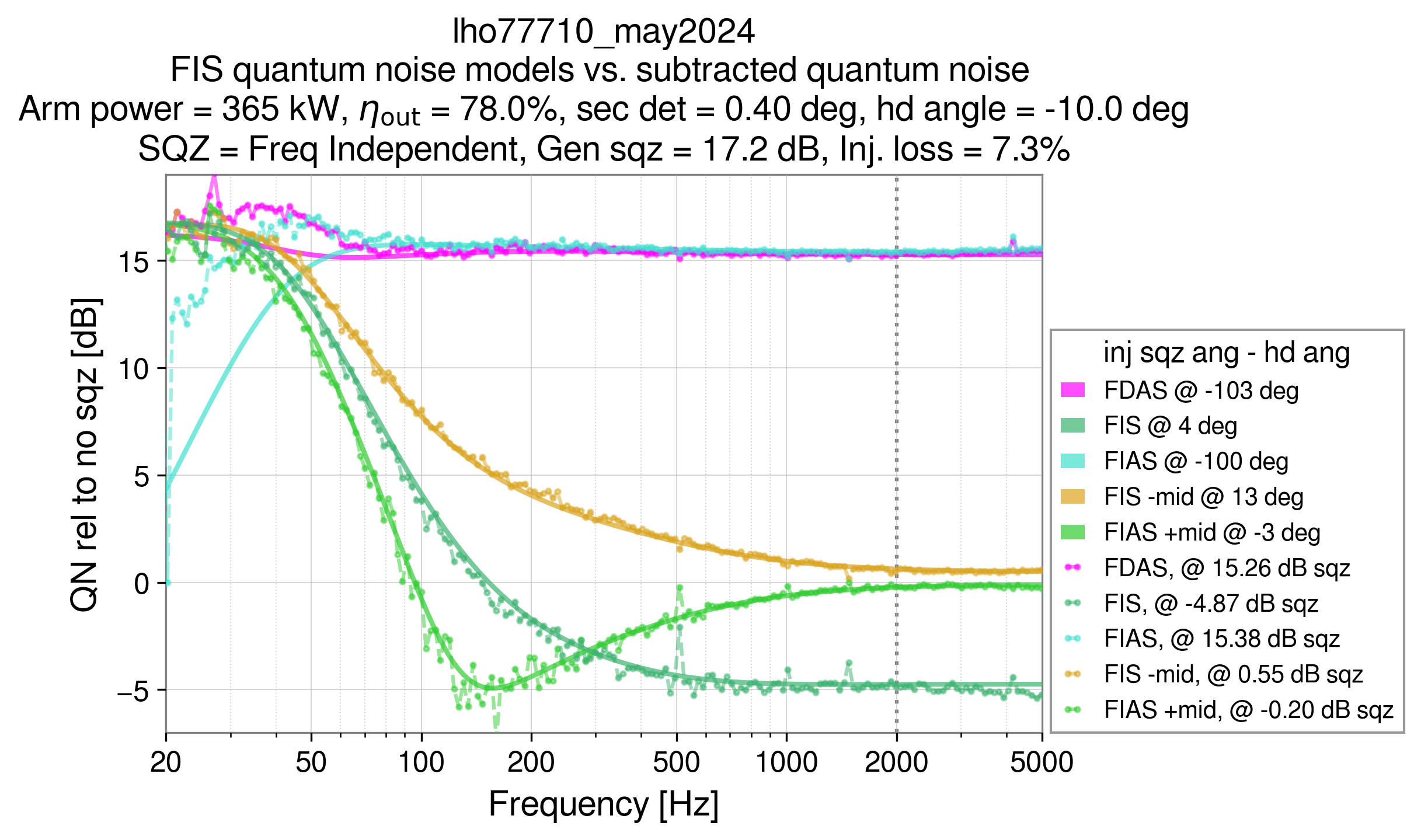
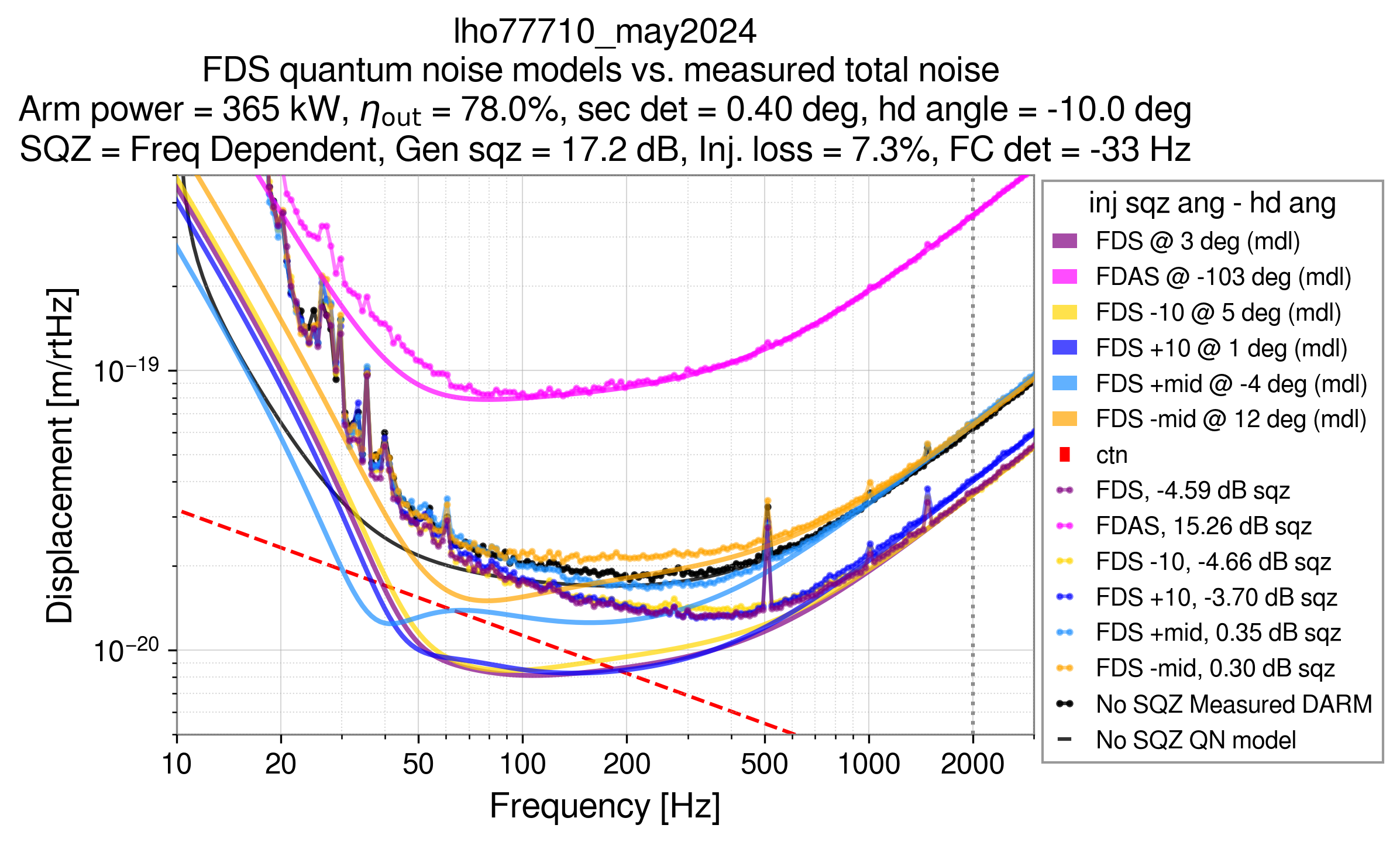
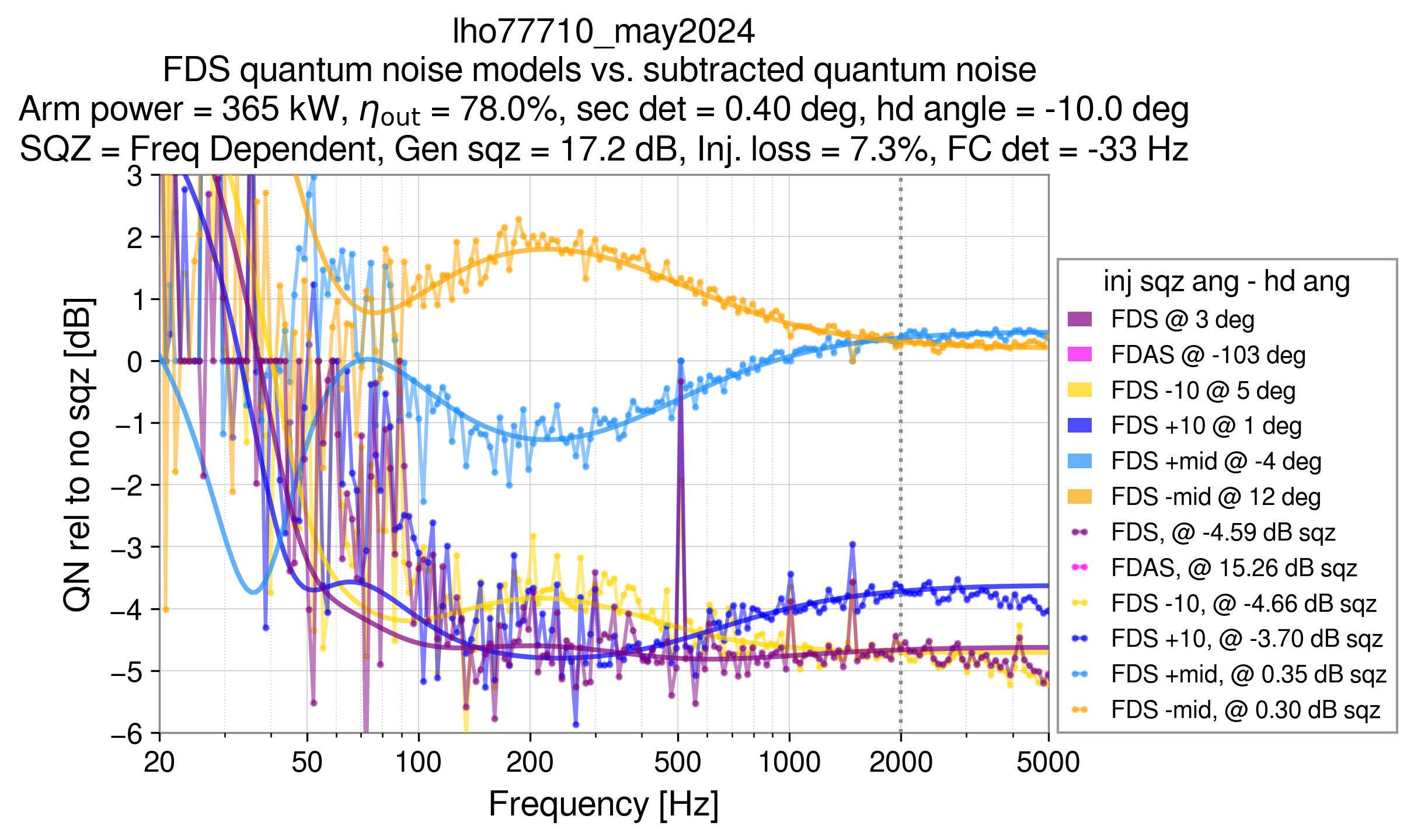
Then I ran the SCAN_SQZANG. Compared with the reference in NUC33, the squeezing in the bucket is similar, but the high frequency squeezing is a bit worse with new OMC alignment.
May 02 00:10UTC We just went into Commissioning to run our normal calibration sweep and calibrate sqz
00:50 Back to NOMINAL_LOW_NOISE and Observing
TITLE: 05/01 Eve Shift: 23:00-07:00 UTC (16:00-00:00 PST), all times posted in UTC
STATE of H1: Observing at 148Mpc
OUTGOING OPERATOR: TJ
CURRENT ENVIRONMENT:
SEI_ENV state: CALM
Wind: 21mph Gusts, 19mph 5min avg
Primary useism: 0.03 μm/s
Secondary useism: 0.11 μm/s
QUICK SUMMARY:
We are Observing and have been Locked for 2 hours. wind is around 25mph but going down.
TITLE: 05/01 Day Shift: 15:00-23:00 UTC (08:00-16:00 PST), all times posted in UTC
STATE of H1: Observing at 152Mpc
INCOMING OPERATOR: Oli
SHIFT SUMMARY: Three lock losses and some commissioning time this moring. We plan to go out of Observing in an hour or two once we are thermalized to tune squeezer and take the calibration measurement that we couldn't run this morning.
LOG:
| Start Time | System | Name | Location | Lazer_Haz | Task | Time End |
|---|---|---|---|---|---|---|
| 15:11 | SAF | LASER HAZARD | LVEA | YES | LVEA is LASER HAZARD | |
| 15:37 | PEM | Robert | LVEA | N | Turn on amps | 17:36 |
| 15:58 | FAC | Eric | FCES | N | Investigate a fan | 16:16 |
| 16:00 | VAC | Janos | MidY | N | Dewar pump | 16:31 |
| 17:27 | FAC | Karen | Woodshop, fire pump | N | Tech clean | 18:12 |
| 17:39 | PEM | Robert, Anamaria | EndX, Y | N | PEM tests | 19:35 |
| 18:13 | VAC | Travis | MX | N | Turbo pump pictures | 18:25 |
| 18:35 | PCAL | Rick | PCAL lab, Mech room | - | Looking for equipment | 20:19 |
| 20:20 | FAC | Chris | Mids | n | FAMIS checks | 21:00 |
| 21:25 | SQZ | Terry, Camilla | Opt Lab | Local | SHG work, new CO2 test | ongoing |
| 22:09 | PCAL | Rick, Fransisco | PCAL lab | local | PCAL tasks | ongoing |
Jim, Ryan C, TJ
The picket fence station NEW had a large transient that put us into earthquake mode during observing. The code did not register this transient as a glich at first which caused the SEI_ENV mode transition. Looking to the picket fence code it looks like we might be able to tune the glitch settings a bit, but we would have to try out some values over a period of time. It might be worth checking with picket fence experts before we play with this code too much.
This isn't the first time we've seen this, but perhaps the first time we've aloged it. After the 10minute cool down period SEI_ENV returned back to a CALM mode.
The transient impulse happened a 2nd time shortly after from the same NEW station over by Spokane. It reached the glitch threshold about 5 minutes after the first impulse. Could there be work ongoing on this seismometer?
Gabeiele, Sheila, Camilla
Here's an analysis of those injections. In brief, the coil and mechanical responses are the same for ETMX and ETMY as expected. The differences are all due to filters in the L2 LOCK and DRIVEALIGN filter banks.
First plot shows a comparison of the L2 LOCK L EXC to CAL-DELTAL transfer functions for ETMX and ETMY: they look different.
In the second plot I plot the filter chain from the L2 LOCK EXC to the COILOUT. They are different, probably because ETMX is used for DARM control, and ETMY is in some legacy configuration (note that Camilla turned off the LPL2L3 filter). The third plot shows the ratio of the ETMY / ETMX transfer functions as measured, and what we expect from the different filters that are engaged. They match very well.
If we compensate the EXC to CAL-DELTAL transfer functions with the LOCK and DRIVEALIGN filter, and take the ratio, we get a transfer function pretty much at 1, as shown in the fourth plot.
Finally, I calibrated CAL-DELTAL_EXTERNAL in meters using Louis' file from /ligo/groups/cal/H1/reports/ and the fifth plot shows that the DARM / COIL transfer functions are pretty much the expected 1/f^2, with only a sign difference between X and Y.
In conclusion, there isn't anything wrong with ETMY PUM drive. More thinking is needed to understand why the LSC FF have a phase rotation much that is much larger at LHO than LLO, and how to better tackle that problem.