Displaying reports 12041-12060 of 86580.Go to page Start 599 600 601 602 603 604 605 606 607 End
Reports until 16:04, Thursday 28 March 2024
LHO General
corey.gray@LIGO.ORG - posted 16:04, Thursday 28 March 2024 (76765)
Thurs DAY Ops Summary

TITLE: 03/28 Day Shift: 15:00-23:00 UTC (08:00-16:00 PST), all times posted in UTC
STATE of H1: Observing at 152Mpc
INCOMING OPERATOR: Ryan C
SHIFT SUMMARY:

Most of today was for Commissioning and then PEM Injection prep/measurements. 

H1 was locked for a good part of the shift, with (2) locklosses.  Able to relock after 20+hr lock without needing an alignment (but definitely needed to correct lots of pitch misalignment. 

Had a high winds storm pass through during the last hour of the shift, highest wind value from our wind sensors was 57mph from the Corner Station (see attached).

LOG:

Images attached to this report
H1 ISC
sheila.dwyer@LIGO.ORG - posted 14:50, Thursday 28 March 2024 - last comment - 10:28, Thursday 04 April 2024(76768)
range comparison plots

Kevin and Vicky helped to get the old range comparison plots from the noise budget working with some updates to the noise budget.  The first plots show the spectra, range integand and the cumulative range for a comparison between O4a and a few days ago.  This is range calculated by gwinc, the sensmon range is shown in the legend. 

Looking at the darm spectra and the range difference plot here, you can see that we gained about 15Mpc of range from low frequency improvements including DARM offloading.  Above 40Hz our recent sensitivity has been worse, we lose 15 Mpc from the decreased sensitivity beween 40-100 Hz and another 7 or so from the worse sensitivity above 100Hz. 

Last night we had slightly better BNS range after the squeezer alignment work 76757 , the same comparison of O4a to last night shows that we are loosing less range from 65-300 Hz, as shown in this plot as well. 

I've also made this comparison for no squeezing, using times from 76537 and 76540: here.  This shows that without squeezing the mid frequency sensitivity (30-70Hz) has gotten worse which is costing roughly 10Mpc of range.

Elenna's sensitivity comparison from a few weeks ago contains helpful links to recent changes: 76449

Images attached to this report
Comments related to this report
sheila.dwyer@LIGO.ORG - 10:28, Thursday 04 April 2024 (76935)

first of all, apologies that the axis labels were switched in the above plots.

Second, instructions if you'd like to make these plots yourself for your own times:

cd /ligo/gitcommon/NoiseBudget/aligoNB/production_code/

conda activate aligoNB

open gps_reference_times.yml and either chooose some times from the list or add your own time dictonary.  If you add a time, please add it below the LHO and LHO_NO_SQZ entries (those are the ones that the noise budget uses), and add a helpful comment describing your time.

open H1/darm_integral_compare.py and edit lines 85 and 91 (after_gps_dict = gps_dict['LHO_ER16_April4'] and   b4_gps_dict = gps_dict['LHO_O4a_postvent']) so that it will plot your chosen tmes.

python H1/darm_intergal_compare.py

Your plots will be saved in /ligo/gitcommon/NoiseBudget/aligoNB/out/H1/darm_intergal_compare/


H1 SQZ
daniel.sigg@LIGO.ORG - posted 11:38, Thursday 28 March 2024 (76772)
ADF gain reduced

Adding a 20dB attenuator at the output of the ADF CLF reduced the ADF signal strength by approximately a factor of 10.

H1 ISC
jennifer.wright@LIGO.ORG - posted 11:16, Thursday 28 March 2024 (76770)
CAM 1 and CAM 2 offset test ran last night

Camilla, Jennie W


Camilla and I reran the camera offset tests yesterday while in observing. There is a clear effect from yaw offset changes in the build-ups but not so clear with pitch changes.

See this image for the CAM2 servo steps and this image for the CAM1 servo steps.

CAM 2 YAW

The lowest yaw offset gives highest circulating power and highest power on POP A, B and REFL A PDs and the highest yaw offset gives the lowest power values. The lowest offsets give a dip in the range, as does the highest yaw offset. The best offsets for range seem to be close to nominal, the second highest offset step (-414 counts).

KAPPA C is highest at the lowest yaw offset, which makes sense as this is when we have the best build-ups.

CAM 2 PITCH

For the pitch as mentioned above the steps are not obvious in the circulating power plot or the POP A/B / REFL A plots. There is maybe a correlation between the lowest offset and the lowest power build-up, and the second highest offset and the highest power build-up but no clear correlation with the range or KAPPA C.

CAM1

This has similar trends to CAM2 however I think thye pitch is correlated the opposite way from 1 whihc makes me think that the motion the pitch causes is just some swaying f the alignment as the camera offsets change and it doesn't particularly matter which way we change them in pitch. The yaw offset change though shows peaks at lowest offset, troughs at highest offset and best range near nominal offset and highest KAPPA C (optical gain) at highest yaw offset.

Images attached to this report
LHO VE
david.barker@LIGO.ORG - posted 10:18, Thursday 28 March 2024 (76769)
Thu CP1 Fill

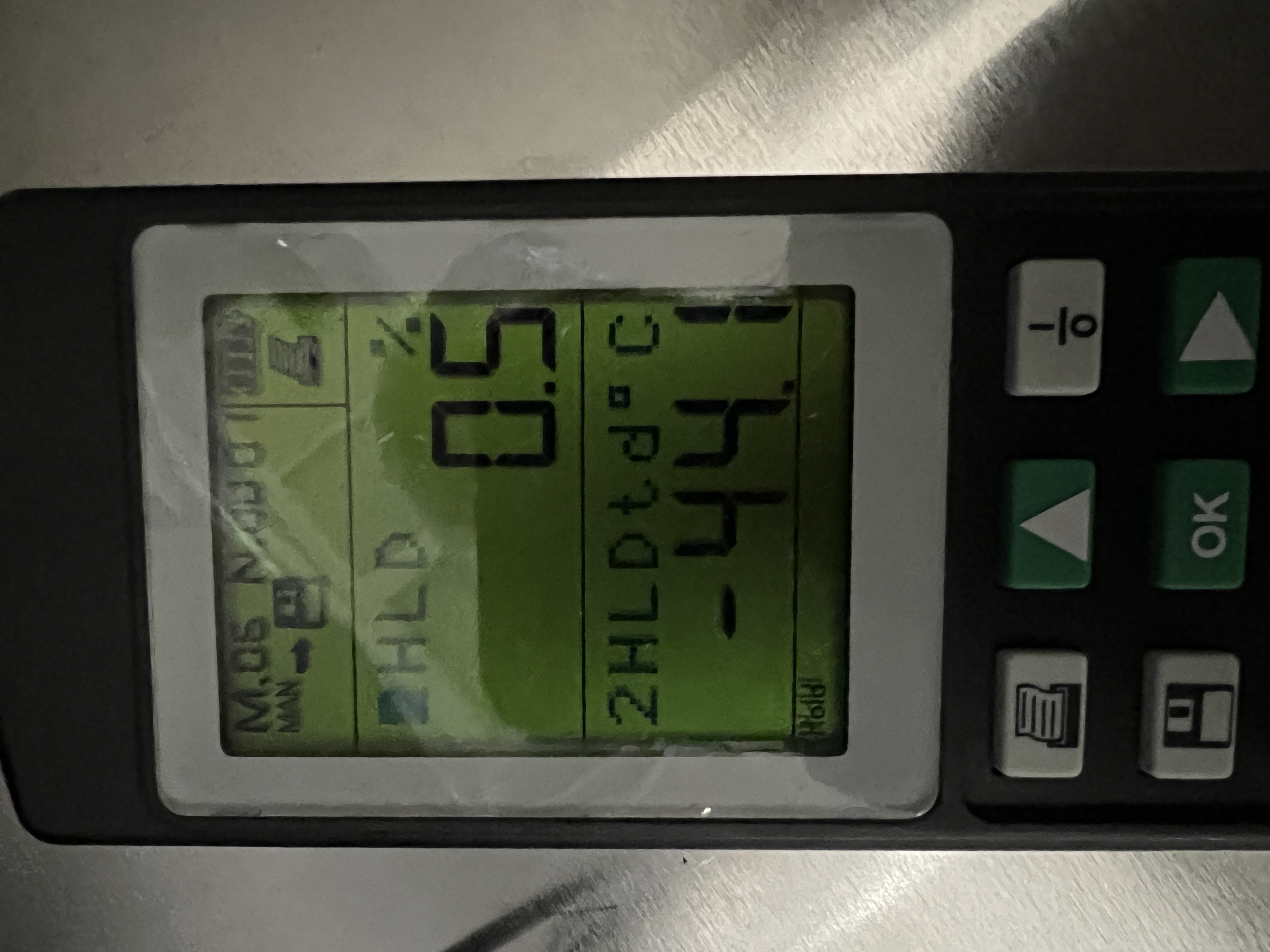
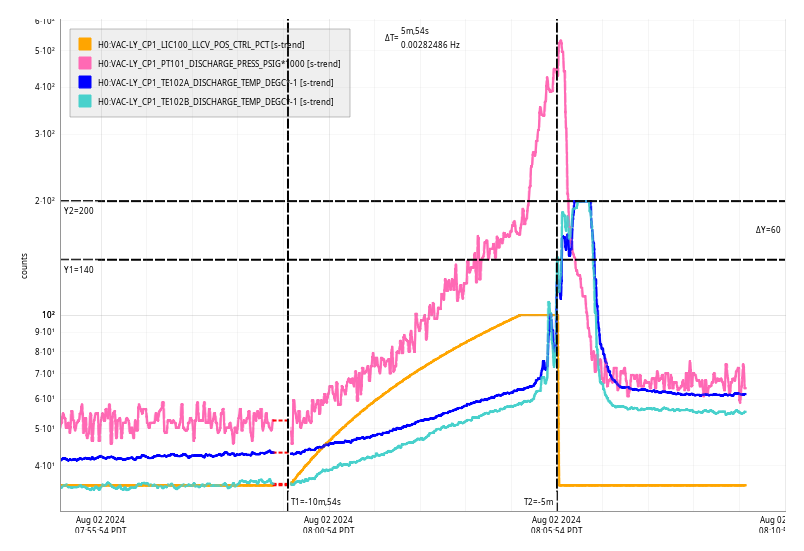
Thu Mar 28 10:13:28 2024 INFO: Fill completed in 13min 23secs

Gerardo confirmed a good fill curbside.

Images attached to this report
H1 ISC
gabriele.vajente@LIGO.ORG - posted 08:23, Thursday 28 March 2024 (76766)
Coherences

Here's a BruCo scan for last night: https://ldas-jobs.ligo-wa.caltech.edu/~gabriele.vajente/bruco_1395660903_GDS_CALIB/ using GDS-CALIB_STRAIN_CLEAN

Some observations on the low frequency range (<50 Hz):

  1. there is coherence with PRCL, MICH and SRCL. My guess is that PRCL couples through MICH and SRCL, since there is some coherence MICH vs PRCL and SRCL vs PRCL.
  2. however, similar coherence pattern is visible with REFL_RIN, and I'm not sure what to make of that
  3. there is coherence with CHARD_Y and lower with DHARD_Y. There is also coherence with HAM1 motion, that's probably due to the known HAM1 to CHARD coupling
  4. below 20 Hz it looks like there is high coherence with IMC angular yaw signals, so maybe we're limited by low frequency jitter there?

It looks like we could try to improve the low frequency by:

  1. doing A2L again to fix CHARD_Y
  2. see if that improves PRCL coherence, if not
  3. redo MICH FF and SRCL FF, hopefully that will reduce PRCL too. If not
  4. investigate the interesting fact that PRCL and REFL_RIN seem to show the same coherence with DARM
Images attached to this report
LHO General
corey.gray@LIGO.ORG - posted 08:10, Thursday 28 March 2024 (76764)
Thurs DAY Ops Transition

TITLE: 03/28 Day Shift: 15:00-23:00 UTC (08:00-16:00 PST), all times posted in UTC
STATE of H1: Observing at 152Mpc
OUTGOING OPERATOR: None
CURRENT ENVIRONMENT:
    SEI_ENV state: CALM
    Wind: 9mph Gusts, 8mph 5min avg
    Primary useism: 0.03 μm/s
    Secondary useism: 0.52 μm/s
QUICK SUMMARY:

H1's been locked 20.75hrs and is currently in OBSERVING at a range just under 160Mpc.

Robert mentioning needing to fix some accelerometers at an End Station and then start PEM injections (he also mentioned commissioning work possibly going on while he looks at the accelerometers).

H1 General
oli.patane@LIGO.ORG - posted 00:01, Thursday 28 March 2024 (76763)
Ops EVE Shift End

TITLE: 03/28 Eve Shift: 23:00-07:00 UTC (16:00-00:00 PST), all times posted in UTC
STATE of H1: Observing at 151Mpc
INCOMING OPERATOR: None
SHIFT SUMMARY: We're Observing and have been Locked for over 12.5 hours now. Very quiet night!
LOG:

2300UTC Detector locked for 4.5 hours, commissioning wrapping up

2308 Into Observing

H1 SEI
oli.patane@LIGO.ORG - posted 21:06, Wednesday 27 March 2024 (76761)
H1 ISI CPS Noise Spectra Check FAMIS

Closes FAMIS#25984, last checked in 76634

They all look very similar to at least the last few weeks of checks. The only thing that stood out to me was ITMY stage 2 V2 around 100Hz and 170Hz - the spikes there are slightly thicker than all the other stage 2 higher frequency spikes.

Non-image files attached to this report
H1 General
oli.patane@LIGO.ORG - posted 20:37, Wednesday 27 March 2024 (76760)
Ops Eve Midshift Status

We've now been Locked for over 9 hours and are Observing.

H1 SQZ
naoki.aritomi@LIGO.ORG - posted 16:33, Wednesday 27 March 2024 - last comment - 12:27, Saturday 30 March 2024(76757)
ZM alignment guardian

Vicky, Naoki, Nutsinee

To scan the ZM alignment, we copied the SCAN_ALIGNMENT state in SQZ_MANAGER guardian in LLO. After some debugging, we successfully ran this state. The result is saved in here.

https://lhocds.ligo-wa.caltech.edu/exports/SQZ/GRD/ZM_SCAN/

This state scans the ZM4/ZM6 COM and DIF P/Y. We need the proper diagonalization to define the COM and DIF, but we have not done it today. The state fits the BLRMS6 at 1.7kHz and finds the optimal ZM slider value for minimizing the BLRMS6 as shown in the first attachment. After each ZM scan, the SQZ angle is also scanned and the optimal SQZ angle is found as shown in the second attachment.

The third attachment shows the BLRMS. The T1 cursor shows when the sqz-optimized scan was done. After the scan, the BLRMS6 looked good, but the BLRMS3 (yellow) was not so good and the BNS range was below 150 Mpc. So we tweaked the sqz angle and the BNS range reached more than 150 Mpc.

The original SCAN_ALIGNMENT tries to find the minimum of squeezing, but we modified it so that it can also try to find the maximum of anti squeezing. The T2 cursor in the third attachment shows when the asqz-optimized scan was done. The result is saved here.

sqz-optimized: https://lhocds.ligo-wa.caltech.edu/exports/SQZ/GRD/ZM_SCAN/240327132206/

asqz-optimized: https://lhocds.ligo-wa.caltech.edu/exports/SQZ/GRD/ZM_SCAN/240327144407/

The fourth attachment shows the ZM slider after the sqz-optimized and asqz-optimized scan. The ZM4 Y is almost the same, but other ZM alignment is different by 10-20 counts between the sqz-optimized and asqz-optimized scan. The proper diagonalization of ZM4/6 would resolve it.

Since the SCAN_ALIGNMENT touches the TRAMP of ZM slider, we reverted it after the scan as shown in the fifth attachment.

Images attached to this report
Comments related to this report
victoriaa.xu@LIGO.ORG - 18:49, Wednesday 27 March 2024 (76759)

Screenshot of the SCAN_ALIGNMENT_FDS (105) guardian state maximizing anti-sqz, just like Masayuki's LLO:64903. This update to SQZ_MANAGER is committed to svn revision 27339.

Images attached to this comment
gabriele.vajente@LIGO.ORG - 09:26, Thursday 28 March 2024 (76767)

It looks like this tuning improved the noise in the bucket. Maybe reducing the misterious excess broadband noise?

Images attached to this comment
gabriele.vajente@LIGO.ORG - 12:27, Saturday 30 March 2024 (76816)

This also reduces the "excess noise" as estimated using Artem's method (computing the difference between the PSD now and in O4a).

Images attached to this comment
H1 ISC
camilla.compton@LIGO.ORG - posted 16:26, Wednesday 27 March 2024 (76756)
Camera servo offset stepper tests set to run overnight

Jennie and I started the camera_servo_offset_stepper.py script to run for CAM2 (at 23:18UTC - 3:28UTC) should finish by 8:18pm and scheduled CAM1 for 8:30 to 12:30pm (3:30 to 7:30UTC). These didn't run yesterday 76732 as the IFO was unlocked. 

LHO General
thomas.shaffer@LIGO.ORG - posted 16:11, Wednesday 27 March 2024 (76745)
Ops Day Shift End

TITLE: 03/27 Day Shift: 15:00-23:00 UTC (08:00-16:00 PST), all times posted in UTC
STATE of H1: Observing
INCOMING OPERATOR: Oli
SHIFT SUMMARY: We've been locked for over 4.5 hours and have just transitioned back to Observing for the rest of the evening. The one lock loss we had was possibly cuased by work on the floor. Relocking was straight forward, I ended up moving PRM to lock PRMI in an attempt to avoid an initial alignment. It took 57 min to relock.

LOG:

Start Time System Name Location Lazer_Haz Task Time End
16:09 VAC Gerardo site n Forklifting septum from woodshop to LSB receiving 16:39
16:09 ISC Sheila, Artem CR n ESD bias change 18:09
16:26 ISC Daniel LVEA n Look at PSL racks 16:45
16:46 FAC Kim H2 n Tech clean 18:46
17:11 SQZ Julian OptLab yes SHG work 19:32
20:09 ISC Sheila LVEA n Checking on PSL racks 20:29
22:12 PEM Robert LVEA n Turn off amps, clean up 22:17
22:19 PEM Robert EX n Shaker meas 23:14
H1 General
oli.patane@LIGO.ORG - posted 16:03, Wednesday 27 March 2024 (76755)
Ops Eve Shift Start

TITLE: 03/27 Eve Shift: 23:00-07:00 UTC (16:00-00:00 PST), all times posted in UTC
STATE of H1: Commissioning
OUTGOING OPERATOR: TJ
CURRENT ENVIRONMENT:
    SEI_ENV state: CALM
    Wind: 13mph Gusts, 11mph 5min avg
    Primary useism: 0.03 μm/s
    Secondary useism: 0.27 μm/s
QUICK SUMMARY:

Detector has been Locked for 4.5 hours and commissioning is wrapping up.

H1 ISC
sheila.dwyer@LIGO.ORG - posted 13:57, Wednesday 27 March 2024 - last comment - 14:35, Wednesday 27 March 2024(76751)
CARM OLG

Daniel plugged in the SR785 into the common mode board this morning. 

I've followed the instructions in 64204, and 67214 summarized here:

make sure the excitation A is enabled on the common mode board, the 785 is plugged in.

cd /ligo/gitcommon/psl_measurements/templates
conda activate /ligo/home/craig.cahillane/.conda/envs/psl
python ../code/SRmeasure.py carm_olg_template.yml

The plot options in the template don't work.

to find your data go to: /ligo/gitcommon/psl_measurements/data/carm_olg and try ls -lrtp to find the most recent file 

To make a plot:

python ../code/quick_tf_plot.py /ligo/gitcommon/psl_measurements/data/carm_olg/CARM_OLG_27-03-2024_131841.txt

The CARM olg right now is something like 17 kHz, consistent with 76448  but a little higher than 70920 and 65676 and 67584.  These all look fine according to the loop stability, but we could try reducing the CARM gain a bit to be more similar to O4a.

I reduced the gain by 3dB on both inputs 1 and 2, resulting in the second attachment.  I've lowered the gain setting in laser noise supression to 3dB from 6dB as well so that we will run like this.

Non-image files attached to this report
Comments related to this report
sheila.dwyer@LIGO.ORG - 14:35, Wednesday 27 March 2024 (76753)

The IMC OLG is just above 60kHz, see the attachment.  In the past it has been closer to 70 kHz (76448 and 67253 )

Non-image files attached to this comment
H1 General (Lockloss)
camilla.compton@LIGO.ORG - posted 14:47, Thursday 21 March 2024 - last comment - 21:32, Wednesday 27 March 2024(76604)
Lockloss at 21:15UTC from In-lock charge Measurements

We tried the in-lock charge measurements but forgot about the New-DARM configuration so caused a lockloss in the SWAP_TO_ITMX state.

Images attached to this report
Comments related to this report
artem.basalaev@LIGO.ORG - 14:19, Friday 22 March 2024 (76637)
It seems also that only ETMY was ever moved during the part of the test that did run (I'd expect everything but ETMX measured, because the last one requires switching control to the other TM which caused lock loss). In the measurement last week, it seems excitation was applied on all masses as it should be. Attached are plots from this week and last week.
Images attached to this comment
oli.patane@LIGO.ORG - 21:32, Wednesday 27 March 2024 (76762)

I've attached the plots for ETMY, since that's the only one that had the excitations this last week.

Images attached to this comment
H1 SQZ (SQZ)
nutsinee.kijbunchoo@LIGO.ORG - posted 18:12, Wednesday 20 March 2024 - last comment - 11:35, Thursday 28 March 2024(76574)
High CLF in the IFO

Naoki, Daniel, Nutsinee

Today we increased RF6  from -22dBm to -13 dBm and 8 dBm. We saw excess noise at 8 dBm above 300Hz but no excess noise at -13dBm. REF 12 is the squeezing at -22dB before we started the test. Using the time from alog76553. REF9 and REF10 both show squeezing at -13dBm RF6 at different squeeze angle where one has a better sensitivity at low frequency bucket. REF13 shows squeezing at 8dBm RF6. The excess noise above 300Hz cannot be improved with squeeze angle. Investigation is required.

We turned off ADF sqz angle servo during the test. We readjusted the ADF squeeze angle demod phase and accepted the new value in the SDF.

We are parking RF6 at -12dBm. Since Daniel didn't like the unlucky number 13.


Loop Was (-22dBm RF6) Now (-12 dBm RF6)
CLF gain 10 0
LO gain -7 -12
FC LSC gain -2.6 -0.86
FC ASC gain 0.1 0.03
Images attached to this report
Comments related to this report
naoki.aritomi@LIGO.ORG - 18:32, Wednesday 20 March 2024 (76576)

The -22dBm, -12dBm, 8dBm RF6 correspond to 9 uW, 28 uW, 420 uW CLF REFL power.

camilla.compton@LIGO.ORG - 11:26, Thursday 21 March 2024 (76595)

We rechecked the FDS -22dBm time as the time in the above plot wasn't sqz opitmized to the bucket. Can see in attached plot, CLF at -22dBm and -13dBm have the same SQZ in the bucket, as expected.

Images attached to this comment
nutsinee.kijbunchoo@LIGO.ORG - 12:27, Monday 25 March 2024 (76686)

Looking back at the past data it seems we may not have adjusted the CLF ISS gain properly during the test causing our sqz level to be stuck at 3dB at kHz region. CLF_REFL_DC was oscillating when RF6 was at -13 dBm and at 8 dBm. This looks like an easy fix and we should try again at some point.

Images attached to this comment
nutsinee.kijbunchoo@LIGO.ORG - 10:11, Wednesday 27 March 2024 (76743)

Daniel Nutsinee

Reducing the gain didn't seem to fix the oscillation. We cranked up the CLF power so the RF6 read 6dBm and went out to look at the signal on the scope. We saw 60kHz beat note on the OPO refl and a crooked 105kHz sinewave on the CLF refl. We don't know where the 60kHz beat on the OPO refl came from. We couldn't make any improvement by changing the CLF ISS gain.

After some investigation we realized the oscillation disappeared when we unplugged the RLF. The oscillation came back when the RLF was plugged back in. The oscillation associated with the RLF seemed obvious only when we operated at high power. Next time we try high CLF power again we should attenuate the RLF RF output to the AOM.


The funny thing was PMC refl saw this oscillation as well. We hope this was just an electronics cross talk.

Images attached to this comment
daniel.sigg@LIGO.ORG - 11:35, Thursday 28 March 2024 (76771)

For even higher CLF power with +6dBm at the RF6 demod, we set the CLF servo IN2 gain to-18dB (from 0dB), the CLF ISS gain to 0dB (from 17dB), and the ISS input set point to 2.037 (from 0.347).

H1 SQZ
sheila.dwyer@LIGO.ORG - posted 12:35, Wednesday 20 March 2024 - last comment - 08:23, Thursday 28 March 2024(76540)
SQZ data set

Camilla, Nutsinee, Sheila

Screenshot of different sqz angles attached.  Nutsinee's final attachment compares sqz with two different CLF servo signs.

Images attached to this report
Comments related to this report
camilla.compton@LIGO.ORG - 12:40, Wednesday 20 March 2024 (76547)

We offloaded IFO ASC and used "Save ZMs IFO" script to save the ZM settings that we found.

camilla.compton@LIGO.ORG - 14:51, Wednesday 20 March 2024 (76553)
Naoki and I just saw 5.4dB @ 2kHz and 5.2dB @1kHz with the IFO just locked (<10 minutes at NLN) with this new ZM5/6 alignment.
This might be our best ever SQZ, but we often have better SQZ at the start of a lock before the IFO has thermalized.

We moved the ADF back to 1.3kHZ as think the 322Hz ADF we used eariler is impacting the range.

Images attached to this comment
victoriaa.xu@LIGO.ORG - 08:23, Thursday 28 March 2024 (76734)ISC, SQZ

Attachment 1 - looking for freq-dep SQZ loss/rotations. Here we fit a common model of frequency-dependent losses and rotations to all squeeze angle spectra simultaneously. FIS data would probably clean this up at low-frequencies, maybe removing the ~20 Hz anti-sqz bump.

  • Top plot - SQZ dBs after subtraction of non-quantum noise. Note: after subtraction, we see worse squeezing now at 100 Hz vs. kHz, unlike before in O4a/O3.
  • Middle plot  - fitted frequency-dependent losses (1 - \eta(\Omega)). Note: now estimating ~10-15% more loss at 100 Hz than kHz; only few% loss difference between 1-3 kHz. This was the opposite in O3 e.g. Fig. 3 mid-right plot of the quantum response paper (P2100050shows ~20% less loss at 100 Hz.
  • Bottom plot - fitted sqz angle rotation (\theta(\Omega)), in addition to the sqz angle used for each trace (\phi_0). That is, each frequency bin corresponds to a sqz angle at \phi_0 + \theta(\Omega).

Dots + thick lines = subtracted sqz data, with a moving average for clarity. Thin line = common fit model. Equations in the plot title. For each frequency bin \Omega, we fit the loss(\Omega) and the sqz angle offset theta(\Omega) given the \phi_0 for the dataset. The fit to all sqz angle spectra is done independently for each frequency bin.

This dataset suggest higher freq-dep losses at low frequencies in-band, but before we typically we had lower freq-dep losses below darm pole, e.g. Fig. 3 of the O3 quantum response paper (P2100050). I'm not really sure yet how to interpret this, and don't think there's a clear expectation for one way or another. As a basic sanity check, I compared another time with anti-sqz from March 17 LHO:76434 (which had different PSAMS settings) - there, evidence for frequency-dependent losses at lower frequencies is weaker, but there is still some evidence for it.

-------------------------------------------------------------------------------------------------------------------------------------------------------------------------------------------------------------------------------------------------------------------------------------------------

Attachment 2 - squeezing-related DARM comparison, O4a vs. pre-O4b. Blue/yellow = O4a. Purple/pink = pre-O4b. Interesting things (from a sqz perspective):

  • Above the DARM pole, SQZ is mostly loss-limited, notice purple better than blue -- DARM is slightly better now than O4a. For NO SQZ, optical gain looks slightly higher now. For SQZ, there's now more high freq SQZ, aka reduced SQZ losses.

    For reference, in O4a we saw up to [-4.5, -4.8] dB with/without subtracting non-quantum noise. Now pre-O4b, we've seen up to -5.4 dB without subtraction at the starts of locks when technical noise is lower, and can see 4.5 dB thermalized. Tracking losses in the gsheet

    From the OMC replacement plan G2302156 - the old OMC003 was estimated ~90% throughput, the new OMC001 was estimated ~96% prior to install.
    (O4a OMC loss inferences in e.g. 73873 and 74022 suggested 89-91% omc003 tem00 efficiency. See T1500060 for OMC specs.)
     
    • pre-O4b: Inferring losses from 15.8 dB anti-sqz && -5.4 dB sqz w/o subtraction {NLG = 17.3, 25mrad phase noise, in this thread 76553}
      --> pre-O4b: inferred losses ~ 22-25%, of which we expect ~16% (if new OMC001 ~3.6% loss), leaving ~12-13% excess loss. Mode-matching status unknown.
       
    • O4a: NLG sweep on DARM after crystal move, Oct 2023, see LHO:74318. This is consistent with O4a SQZ angle datasets: 74935 - Dec 2023 - cold OM2, and 73621 - Oct 2023 - hot OM2.
      --> O4a: inferred losses ~30-32%, of which we expected ~22% (if old OMC003 was 10% loss), leaving ~12-14% excess loss. Mode-matching attempted, railed PSAMS actuators, ran out of range to continue.
       
    • The higher squeezing pre-O4b (-5.4 dB vs. -4.5 dB) seems consistent with a 5-6% reduction of SQZ losses. This improvement is plausibly consistent with the expected OMC loss reduction.
       
    • On the other hand - while we see some squeezing improvement consistent with expected loss reductions, this actually suggests that the 10-13% excess sqz losses from O4a remain untouched. In O4a, based on 8dB homodyne SQZ (73562), these 10% excess losses were not "injection losses" i.e. they were after HAM7. 
       
    • May be worth considering more closely the conversion from NLG to generated squeezing level, since that factors into these loss estimates. These loss estimates are based on a model for a linear OPO. Dhruva's ADF paper P2200041 does some more math on the conversion from NLG to generated squeezing level for a bowtie OPO, like as the observatories have. I believe the same NLG corresponds to a slightly lower generated squeezing level than expected for a linear OPO.
    • Mode-matching gains from the break TBD. The sqz alignment scripts will be helpful to fully explore PSAMS optimizations. Naoki has started this in LHO:76757, bringing in Masayuki's work from e.g. LLO:64903LLO:64458.
       
  • Below the DARM pole, notice blue better than purple -- it's interesting that both no-sqz and sqz are worse, especially considering the above evidence for higher freq-dep losses below the darm pole. Attachment 1 top plot - we see worse squeezing now at 100 Hz than we used to in O4a, even after subtracting non-quantum noises.

A comment regarding the excess noise - it seems clear that the excess mid-band DARM noise is not caused by / related to squeezing, because it's there even without squeezing injected. That said, squeezing seems to be having its own issues at these lower frequencies, below the DARM pole. Not clear how the worse low-frequency squeezing (after subtraction) could be a consequence of whatever causes the excess noise without squeezing. Likely different issues / things to be optimized happening at the same time/frequencies.

After PSAMS optimization with alignment scripts, it could be interesting to try a similar SQZ dataset with FIS.

Images attached to this comment
Displaying reports 12041-12060 of 86580.Go to page Start 599 600 601 602 603 604 605 606 607 End