Displaying reports 12141-12160 of 86546.Go to page Start 604 605 606 607 608 609 610 611 612 End
Reports until 15:31, Friday 22 March 2024
H1 ISC (OpsInfo)
camilla.compton@LIGO.ORG - posted 15:31, Friday 22 March 2024 - last comment - 14:13, Sunday 24 March 2024(76630)
A2L stepper scripts to run over the weekend, ETMY 6am tomorrow

Code located in /ligo/gitcommon/labutils/beam_spot_raster/a2l_gain_stepper.py

Current spot positions (e.g. H1:SUS-ITMX_L2_DRIVEALIGN_P2L_SPOT_GAIN):

Optic P2L Y2L
ITMX -0.8 2.1
ITMY 0 -1.9
ETMX 4 4.4
ETMY 4.6 3.2

It will step the nominal values up and down 0.4 in 0.2 steps / 15 minutes. e.g. starting a2l + [-0.2, -0.4, -0.2, 0, 0.2, 0.4, 0.2, 0]

I've set up a script to run this on ETMY at 6am to 10am tomorrow (23rd) in a tmux session on cdsws26, will only run if the IFO is at NLN (>=600)  at 6am.

Ryan S will try to find times (4 hours each) to run this on the other optics ITMX and ETMX over the weekend, command below. We don't have beam spot control on ITMY so can skip that.

>> python /ligo/gitcommon/labutils/beam_spot_raster/a2l_gain_stepper.py ETMY --start 'now'

Comments related to this report
ryan.short@LIGO.ORG - 15:22, Saturday 23 March 2024 (76656)ISC, OpsInfo

The ETMY A2L stepper script made it about 3/4 of the way through today; output in alog76655. We can find a time to re-run this if we need the full sweep.

Since there won't be time today before the end of commissioning allotment, I've set the A2L script to run for ETMX tomorrow morning at 06:00 PDT in the same tmux session on cdsws26.

ryan.short@LIGO.ORG - 14:13, Sunday 24 March 2024 (76665)ISC

Today I ran the A2L gain stepper scripts for ETMX and ITMX. The ETMX steps ran from 13:00 to 17:00 UTC and the ITMX steps ran from 17:03 to 21:03 UTC.

Images attached to this comment
H1 SQZ
sheila.dwyer@LIGO.ORG - posted 13:36, Friday 22 March 2024 (76619)
SQZ guardian changes/issues

Sheila, Camilla, Naoki, remote converations with Vicky

Overnight the squeezing was not injected because of some guardian issues.   The OPO failed to lock, we will look into that separately.

After that the filter cavity did not find IR.  Looking at the logic in SQZ manager, it didn't make sense to me.  We were requesting the filter cavity to IR_FOUND without first locking the OPO or the CLF, but the filter cavity can't find IR until after both the IR and the CLF are locked.  This might have been done to save some time, but it sets up a race condition where we are relying on the filter cavity green locking to be slower than the OPO and CLF locking.  If the filter cavity failed in it's search, then it would stay in FIND_IR and not try again.   I separated the lock OPO and lock cilter cavity states, and rearranged the graph so that the filter cavity isn't requested to lock until after the CLF is requested to lock.  This will take slightly longer but not much longer, and this happens in parallel with IFO locking. We loaded this change and excerised it.

While I was looking at SQZ_MANAGER, I noticed some things that seem potentially confusing and could cause some difficulties with using it.  Several of these related to using the same states for frequency dependent and frequency independent squeezing.  The SQZ manager was looking at the state of the FC guardian to determine if FIS or FDS is desired, in many places.  I changed this so that FIS has a separate path from FDS after the CLF is locked.  This allows simplifying states like OPEN_BDIV (we now have two versions, one for FDS one for FIS).  Some states like LOCK_LO and SQZ_ASC are the same in the two paths, so I've used a generator to make sure that the same code is used in both paths.  Naoki and I checked this, going from DOWN to FDS, FDS to FIS, DOWN TO FIS, and FDS and FIS to no squeezing.  The previous version of the guardian had a path from FDS to FIS, but there was not code to do that so we've now eliminated the path. We made the changes needed to ISC_LOCK, and laoded them.

The guardian before these changes is 27284

The FC_LOCKED checker only checks that the FC gaurdian isn't in IDLE, but it seems to be used througout SQZ_MANAGER as though it was checking the filter cavity is locked.


Images attached to this report
H1 SEI (SEI)
corey.gray@LIGO.ORG - posted 13:21, Friday 22 March 2024 (76634)
H1 ISI CPS Noise Spectra Check - Weekly (Famis 25983)

FAMIS Link:  25983

Only CPS which looks higher at high frequencies would be ETMy Stage 1, H2 (although the terminal did not list it as "high").  (see attached plots).

Non-image files attached to this report
H1 PSL
ryan.short@LIGO.ORG - posted 12:59, Friday 22 March 2024 (76632)
PSL Status Report - Weekly

FAMIS 26236

Laser Status:
    NPRO output power is 1.819W (nominal ~2W)
    AMP1 output power is 67.15W (nominal ~70W)
    AMP2 output power is 138.3W (nominal 135-140W)
    NPRO watchdog is GREEN
    AMP1 watchdog is GREEN
    AMP2 watchdog is GREEN

PMC:
    It has been locked 21 days, 21 hr 9 minutes
    Reflected power = 16.84W
    Transmitted power = 109.0W
    PowerSum = 125.9W

FSS:
    It has been locked for 0 days 11 hr and 41 min
    TPD[V] = 0.8342V

ISS:
    The diffracted power is around 2.3%
    Last saturation event was 0 days 11 hours and 41 minutes ago


Possible Issues: None reported

H1 ISC
camilla.compton@LIGO.ORG - posted 12:59, Friday 22 March 2024 (76629)
CARM control just on REFL B 17:39 to 18:58UTC

After the 76623 frequency noise injections, we left CARM control just on REFL B (H1:LSC-REFL_SERVO_IN1GAIN = 12dB) rather than the nominal  6dB on both REFL A and B. Kept the REFL B only config from 17:39UTC to 18:58UTC.

Plan to look for coherence between DARM and REFL A to check for frequency noise on REFL B (when REFL A is out of loop, acting only as a witness). Plot attached shows no coherence in 100Hz to 1kHz region above 0.04.

Test was maybe redundant after Francisco's 76533.

Images attached to this report
H1 ISC
camilla.compton@LIGO.ORG - posted 11:11, Friday 22 March 2024 (76623)
aligoNB Jitter and Frequency Injections Taken

Sheila, Jennie, Camilla. Following 70642.  Intensity noise measured in 76323.

Plot of laser noise budget attached First conclusions: Frequency noise lower, Input Beam jitter slightly higher. Compare to O4a plot (Aug 20 data?) 74943 which is a factor of ~2 worse than Aug 10th 72140.

Jitter noise excitation gain, reduced from frequency range from10,000 to 2000, didn't mean to but reverted the templates and it doesn't matter.

Frequency_excitation.xml adjusted bandstop for dither lock from 4000-4200 to 4090-4290Hz (from 76587).

template: Frequency_excitation.xml

Adjusting  70642 for Switch CARM control from REFL A+B to REFL B only from 60W:

Instead of bringing back CARM control to REFL A and B, from 17:39UTC we left CARM control on REFL B only  to look for some coherence.

Images attached to this report
LHO VE
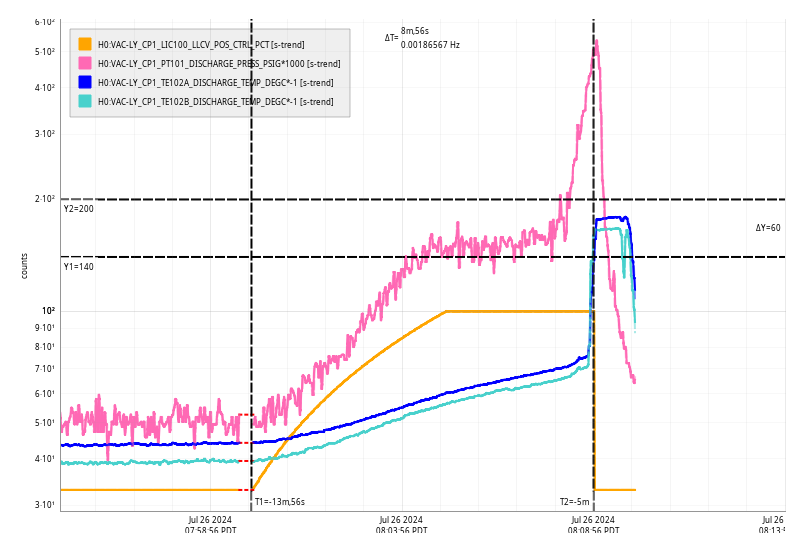
david.barker@LIGO.ORG - posted 10:42, Friday 22 March 2024 (76626)
Fri CP1 Fill

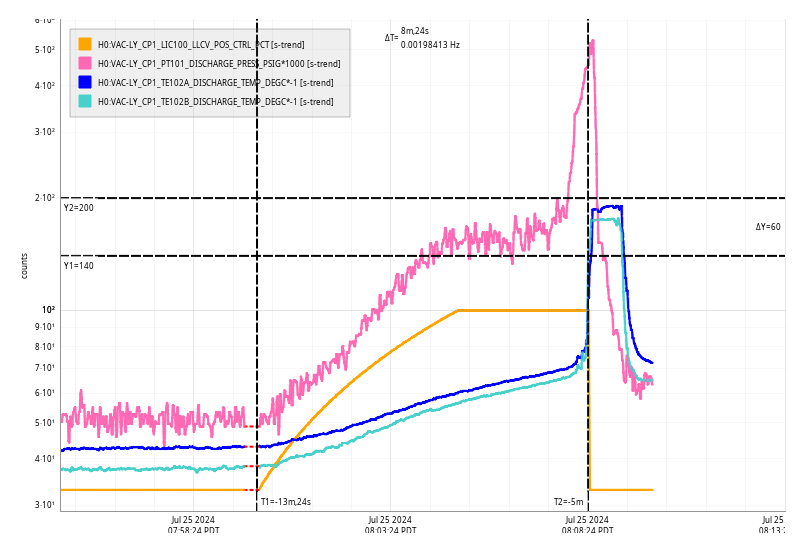
Fri Mar 22 10:12:54 2024 INFO: Fill completed in 12min 50secs

Gerardo confirmed a good fill curbside.

Images attached to this report
H1 SQZ (SQZ)
jennifer.wright@LIGO.ORG - posted 10:07, Friday 22 March 2024 - last comment - 10:26, Friday 22 March 2024(76622)
ADF angle test in thermalised IFO

Camilla, Sheila, Jennie W

After we restarted the SQZ MANAGER this morning we took the SQZ angle test to see how the squeezing changes with a thermalised IFO if we step through optimum  squeezing through tuning the ADF phase. This ran into some problems when we tried to start at 85 and 90 degrees as the loop seemed to run through a really wide range of phases (we think the loop was diverging). Camilla manually changed the ADF phase to 110 degrees and we restarted the test so it stpped up in steps of 3 degrees every 2 minutes. We changed this halfway through to have a longer time between steps for the loop to follow. The test was stopped at 161 degrees.


We stepped SQZ-ADF_OMC_TRANS_PHASE 

GPS 1395157776  PHASE = 110

H1:SQZ-ADF_OMC_TRANS_PHASE = 113
H1:SQZ-ADF_OMC_TRANS_PHASE = 116
H1:SQZ-ADF_OMC_TRANS_PHASE = 119

H1:SQZ-ADF_OMC_TRANS_PHASE = 122
H1:SQZ-ADF_OMC_TRANS_PHASE = 125
H1:SQZ-ADF_OMC_TRANS_PHASE = 128
H1:SQZ-ADF_OMC_TRANS_PHASE = 131
H1:SQZ-ADF_OMC_TRANS_PHASE = 134
H1:SQZ-ADF_OMC_TRANS_PHASE = 137
H1:SQZ-ADF_OMC_TRANS_PHASE = 140
H1:SQZ-ADF_OMC_TRANS_PHASE = 143
H1:SQZ-ADF_OMC_TRANS_PHASE = 146
H1:SQZ-ADF_OMC_TRANS_PHASE = 149
H1:SQZ-ADF_OMC_TRANS_PHASE = 152
H1:SQZ-ADF_OMC_TRANS_PHASE = 155
H1:SQZ-ADF_OMC_TRANS_PHASE = 158
H1:SQZ-ADF_OMC_TRANS_PHASE = 161
 

Phase was put back to 130 degrees after the test at GPS 1395160576.

First image shows the SQZ BLRMS that show how squeezing gets better and worse during the test, calibrated in dBs. Then below this the CLF phase, the OMC trans phase which we are changing and the range at the bottom.

Second image attached shows the same BLRMS (in counts before and just after the test on the bottom left) and the CLF phase and OMC trans phase on the bottom right. From the blue trace just before the test you can see the sign flip when we tried to start the test at 100.

NB: we had been locked for over 6 hours when we started but squeezing wasn't injected until around 20 minutes before the test started.

Images attached to this report
Comments related to this report
ryan.short@LIGO.ORG - 10:26, Friday 22 March 2024 (76625)

I've accepted the new ADF phase value of 130 in the SQZ OBSERVE.snap SDF table.

Images attached to this comment
LHO General
ryan.short@LIGO.ORG - posted 08:00, Friday 22 March 2024 (76617)
Ops Day Shift Start

TITLE: 03/22 Day Shift: 15:00-23:00 UTC (08:00-16:00 PST), all times posted in UTC
STATE of H1: Lock Acquisition
OUTGOING OPERATOR: None
CURRENT ENVIRONMENT:
    SEI_ENV state: CALM
    Wind: 4mph Gusts, 3mph 5min avg
    Primary useism: 0.02 μm/s
    Secondary useism: 0.23 μm/s
QUICK SUMMARY: H1 has been locked at NLN for 6 hours, but it appears that there has been no SQZ (and thus, no observing) since the previous lock acquisition. Sheila and Jennie are debugging.

LHO General
corey.gray@LIGO.ORG - posted 23:59, Thursday 21 March 2024 (76609)
Thurs EVE Ops Summary

TITLE: 03/21 Eve Shift: 23:00-07:00 UTC (16:00-00:00 PST), all times posted in UTC
STATE of H1: Aligning
INCOMING OPERATOR: None
SHIFT SUMMARY:

H1's been having issues staying locked for more than 45-90 minutes in the last day.  Acquisition is decent, although most lock attempts I have proactively went to CHECKMICHFRINGES + PRMI.  LOCK CLOCK is not working. Automatic Operation appeared to not work once, but for other couple of attempts it worked.
LOG:

H1 CDS
corey.gray@LIGO.ORG - posted 20:51, Thursday 21 March 2024 - last comment - 08:37, Friday 22 March 2024(76615)
Lock Clock/Lock Status Are Only Showing

For the first lock of tonight's shift, noticed that the Lock Clock (or Lock Status) on nuc28would only go to "0:01" and stop during the entirety of the (45min lock).  I tried running the Lock Status script on my local computer and it would do the same thing....so this is why I did not restart nuc28.

(Later I also noticed that for the next lock, when I set GRD_IFO to Automatic Operation, this node did not take H1 to OBSERVING.)

Comments related to this report
ryan.short@LIGO.ORG - 08:37, Friday 22 March 2024 (76618)CDS

The lock clock issue seems to be stemming from an issue with the LLA system, which appears to have crashed sometime yesterday (LLA medm screenshot attached, tagging CDS)

Images attached to this comment
H1 SQZ
naoki.aritomi@LIGO.ORG - posted 18:08, Thursday 21 March 2024 - last comment - 17:10, Tuesday 26 March 2024(76612)
Beam spot control is turned on

As shown in the attachment, I turned on the beam spot control. The flag of the beam spot control in sqzparams is set to True. The beam spot control seems working well, but I feel the yaw was too slow so I removed the -20dB gain (FM7 in INJ_ANG_Y). I will tune the green QPD offset with FC2 dither tomorrow.

Images attached to this report
Comments related to this report
naoki.aritomi@LIGO.ORG - 12:08, Friday 22 March 2024 (76628)

I tuned the green QPD offset as shown in the attachment. The FC IR trans is 0.1 with -12dBm CLF6 now, but it was 0.1 with -26dBm CLF6 in O4a so it is better to align the IR trans PD.

Images attached to this comment
naoki.aritomi@LIGO.ORG - 17:10, Tuesday 26 March 2024 (76731)

I tuned the green QPD offset a bit.

Images attached to this comment
H1 ISC
gabriele.vajente@LIGO.ORG - posted 17:39, Thursday 21 March 2024 - last comment - 09:55, Friday 22 March 2024(76607)
Trying again to move the input beam, lock loss when moving yaw

[Jennie, Gabriele]

We tried again to move the input beam.

For pitch, we directly ramped IM1, IM3, IM4, PRM and PR2 with sliders deltas measured from the test yesterday. IM1 and IM3 were the mirrors we move yesterday, while the other were moved by ASC loops. Today with the ramp we helped the ASC loops by moving those mirrors in the right direction too. We first diod one step 1/10th of the target step, then 2/10th and then the remaining 7/10th. All went well: IM4_TRANS increased, but we did not see much change in POP_LF. However ASC-POP_B dropped near the end of the ramp, while ASC-POP_A didn't, so maybe we were moving near the edge of B.

We then started a  motion in yaw (both IM1 and IM3 negative). This seems a very good direction, and both IM4 and POP_LF got better quickly. However, right after we started the second step, we lost lock. This is similar to what happened in the previous test. We should probably move more slowly in yaw, but it worth repeating the test, since we are gaining power in POP_LF and arms.

Images attached to this report
Non-image files attached to this report
Comments related to this report
gabriele.vajente@LIGO.ORG - 07:20, Friday 22 March 2024 (76616)

During a previous alignment test aimed at reducing jitter (76461) we observed that a yaw input beam PZT excitation had the largest coupling to DARM. This is consistent with the observation here that a yaw motion of the input beam has a large effect on build-ups. We might have a yaw misalignment of the input beam. 
I think we normally use a pitch IMC signal to subtract jitter, but both yaw and pitch IMC signals are coherent with DARM, so probably that's not telling us much and it is still consistent with a yaw misalignment.

gabriele.vajente@LIGO.ORG - 09:55, Friday 22 March 2024 (76624)

During the pitch beam motion, we noticed that the PRM camera servo seems to overshoot the optimal buildups: so we might have to retune the camera offset once we find a better input beam aligment

H1 ISC
francisco.llamas@LIGO.ORG - posted 15:40, Thursday 21 March 2024 - last comment - 16:41, Saturday 23 March 2024(76605)
Measured lsc olg

EvanH, FranciscoL

Because we've been loosing lock for unknown reasons, we measured OLG transfer function of MICH, SRLC, and PRLC. The UGF for each one is (see attached figures for reference) roughly

MICH: 10 Hz

SRCL: 12 Hz

PRCL: 35 Hz

We may want to lower the MICH UGF to avoid cross coupling with the SRCL loop.

Images attached to this report
Comments related to this report
evan.hall@LIGO.ORG - 13:48, Friday 22 March 2024 (76631)

The Michelson loop is probably showing a cross-coupling with either PRCL or SRCL. The attachment shows a hump in the OLTF around 60 Hz that scales nonlinearly with overall loop gain changes. Green is the current situation, with the UGF close to 10 Hz, which is also where the SRCL UGF is.

Recall that we had previously reduced the Michelson UGF and applied some antiboosting, but this was reverted during higher-power operation. I am now more or less restoring this reduced UGF operation (UGF 5.5 Hz, antiboosting that amounts to 6 dB less gain below 1 Hz). This uses LSC-MICH1 FM8. The new OLTF is pink in the attachment.

Images attached to this comment
Non-image files attached to this comment
ryan.short@LIGO.ORG - 14:14, Friday 22 March 2024 (76636)

SDFs in OBSERVE.snap table on the LSC model following Evan's work. New filter and gain accepted, ramp time reverted.

Images attached to this comment
evan.hall@LIGO.ORG - 15:33, Friday 22 March 2024 (76639)

On/off testing shows some mild improvement in the 18–23 Hz region, possibly because of less drive around the BS bounce mode. We may want to re-engage the bounce/roll notches in this length loop.

Also, it seems like the drive to the BS coils above 10 Hz is actually dominated by pitch drive. Someone may want to redo the plant inversion for the ASC-MICH_P loop, as it appears to be much more aggressive than the yaw loop.

Images attached to this comment
Non-image files attached to this comment
elenna.capote@LIGO.ORG - 16:41, Saturday 23 March 2024 (76657)

Regarding the ASC MICH P drive, I was looking into updating the filter and realized there is a sneaky 17 Hz low pass filter on BS M2 Lock P and Y. Gabriele and I did not take this filter into account when redesigning the MICH ASC filters (69370). Just adding this additional filter into the model shows quite a bit of gain peaking around 3 Hz. I'm not sure if that's actually the big problem here, but clearly this could use a redesign. I'll work on it, and also check the MICH Y control design.


Edit: actually, that might not be that much of a problem after all. We could probably improve some low frequency suppression, but I don't know how much we can reduce the pitch drive above 10 Hz. After correcting the model according to my measurement in 72117, there is not much gain peaking and a good amount of phase and gain margin. Yes, the plant inversion is aggressive, but it seems to be working. Attached a screenshot from Gabriele's loop designer code, where I have implemented the BS M2 pitch model, BS M2 locking filters, and current ASC MICH P control design. Black dots/stars in the top left plot are the Zs/Ps of the plant model and locking filters, red dots/stars are the Zs/Ps of the control loop filters. The UGF is around 1 Hz as I measured, and there is 5 dB of gain peaking at 2 Hz (top right plot).

Images attached to this comment
H1 General (Lockloss)
camilla.compton@LIGO.ORG - posted 14:47, Thursday 21 March 2024 - last comment - 21:32, Wednesday 27 March 2024(76604)
Lockloss at 21:15UTC from In-lock charge Measurements

We tried the in-lock charge measurements but forgot about the New-DARM configuration so caused a lockloss in the SWAP_TO_ITMX state.

Images attached to this report
Comments related to this report
artem.basalaev@LIGO.ORG - 14:19, Friday 22 March 2024 (76637)
It seems also that only ETMY was ever moved during the part of the test that did run (I'd expect everything but ETMX measured, because the last one requires switching control to the other TM which caused lock loss). In the measurement last week, it seems excitation was applied on all masses as it should be. Attached are plots from this week and last week.
Images attached to this comment
oli.patane@LIGO.ORG - 21:32, Wednesday 27 March 2024 (76762)

I've attached the plots for ETMY, since that's the only one that had the excitations this last week.

Images attached to this comment
H1 ISC
gabriele.vajente@LIGO.ORG - posted 12:59, Thursday 21 March 2024 - last comment - 09:22, Friday 22 March 2024(76601)
Lot of low frequency coherence

Looking at last night lock stretch [1395051437, 1800 seconds]

https://ldas-jobs.ligo-wa.caltech.edu/~gabriele.vajente/bruco_1395051437_GDS_CALIB/

Lot of coherence with CHARD_Y, maybe a consequence of 76541

Lot of coherence with MICH and PRCL. and SRCL. What changed in the feed forward?

Images attached to this report
Comments related to this report
gabriele.vajente@LIGO.ORG - 09:22, Friday 22 March 2024 (76620)

Another BruCo using last night Observing mode period: https://ldas-jobs.ligo-wa.caltech.edu/~gabriele.vajente/bruco_1395052218_GDS_CALIB/

Results are similar, so it was not due to some bad period. There is high coherence with PRCL too: either that's due to MICH cross coupling, or as Elenna suggests there might be something wrong with PRCL that also increases the CHARD noise (we saw in the past that CHARD noise increased when PRCL optical gain dropped)

H1 ISC (SQZ)
artem.basalaev@LIGO.ORG - posted 13:40, Wednesday 20 March 2024 - last comment - 12:31, Saturday 30 March 2024(76537)
Excess noise in DARM: relation to squeezing
Artem, Jennie W., Gabriele

Following up on alog 76516.

We compared DARM for following configurations:
* No squeezing O4a, 12/20/2023 18:10-18:20
* With squeezing O4a, 01/12/2024 01:35:15-01:45:15 
* No squeezing now, 03/17/2024 04:45:31-04:55:31
* With squeezing now, 03/17/2024 08:18:46-08:28:46

Specifically, following ASDs were calculated: sqrt(abs(no_sqeezing_now^2 - no_squeezing_o4a^2)), and sqrt(abs(squeezing_now^2 - squeezing_o4a^2)). These are shown as blue and red traces on the attached plot. The original DARM traces are shown in gray.

Our preliminary conclusion from this is that it appears that excess noise is ~same with and without squeezing.

We'll make this plot with longer time series and do some more tests.

Jupyter notebook is available here.
Images attached to this report
Comments related to this report
jennifer.wright@LIGO.ORG - 09:35, Friday 22 March 2024 (76621)

Here is my plot which is just binning calibrated CAL-DELTAL_EXTERNAL_DQ and then excluding all the ASD values where the noise now is better than the noise in 04a (these are at low frequency and this is where our noise has improved due to ASC control noise improvements and new DARM configuration).

Then I use the same maths as Artaem to get:

excess noise with no squeezing = sqrt( (ASD with no squeezing now)^2 + (ASD with no squeezing in 04a)^2)

excess noise with no squeezing = sqrt( (ASD with squeezing now)^2 + (ASD with squeezing in 04a)^2)

These also seem to be the same in my plot, which implies that the excess noise is indeed due to some correlated noise (i.e. non-quantum).

Images attached to this comment
gabriele.vajente@LIGO.ORG - 12:31, Saturday 30 March 2024 (76817)

See evolution and reduction with ZM alignment: 76757

Displaying reports 12141-12160 of 86546.Go to page Start 604 605 606 607 608 609 610 611 612 End