WP11766 Shorten SWWD SUS-EY trip time
Dave:
The h1iopsusey model was changed to reduce the SWWD SUS timer from 900s to 600s. This means that the SUS DACKILL time to trip is shortened from 20mins to 15mins and is no longer coincident with the HWWD tripping.
This IOP restart required the restart of all the models on h1susey, and was done in conjuction with the restart of h1susetmy.
After all the models had been running again for a few minutes, h1susey locked up. It was not on the network (no ping, ssh). We fenced it from Dolphin and power cycled it via its IPMI management port.
WP11743 SUS DACKILL Removal
Jeff, Oli, Jim, Dave:
Today we removed the SUS DACKILL from the end station models h1susetmx and h1susetmy. The dolphin ipc receiving models h1isietmx, h1isietmy were modified to replicate a good ipc receiver.
In addition the h1susetmxpi and h1susetmypi models also needed replicated receivers.
Unfortunately I got the ERR replication value incorrect, it should be 0 and not 1. The receiver models were restarted with the correct values.
The first round of restarts required a DAQ restart, the subsequent changes only needed model restarts.
The TMS models were modified later, requiring a second DAQ restart.
WP11761 sw-fces-cds0 Firmware Upgrade
Jonathan:
The firmware on the FCES switch sw-fces-cds0 was upgraded.
WP11765 DMT Upgrade and Reboots
Dan:
This action was canceled for today and will be scheduled for a later maintenance period.
DAQ Restart
Jonathan, Erik, Dave:
The DAQ was restarted partially once, completely twice for the above model changes.
The first restart (partial 0-leg only) at 12:30 highlighted that the PI models were showing IPC Rx errors due to a removed SUS SHMEM channel.
The second full restart at 13:06/13:12 was in support of the SUS-ETM, SUS-ETM-PI and ISI-ETM model changes.
the third full restart at 14:47/14:52 was in support of the SUS-TMS model changes.
There were no major issues with the DAQ restarts, just the usual GDS second restarts for channel
list synchronization.
Restart/Reboot Log
Tue12Mar2024
LOC TIME HOSTNAME MODEL/REBOOT
12:14:27 h1seiex h1isietmx <<< SUS-ETM and ISI-ETM model restarts
12:14:58 h1susex h1susetmx
12:15:32 h1seiey h1isietmy
12:16:47 h1susey h1iopsusey <<< EY IOP and all Models restarts
12:17:04 h1susey h1susetmy
12:17:18 h1susey h1sustmsy
12:17:32 h1susey h1susetmypi
12:24:21 h1susey ***REBOOT*** <<< h1susey locked up, needed a reboot
12:26:25 h1susey h1iopsusey
12:26:38 h1susey h1susetmy
12:26:51 h1susey h1sustmsy
12:27:04 h1susey h1susetmypi
12:30:40 h1daqdc0 [DAQ] <<< Partial 0-leg restart
12:30:49 h1daqfw0 [DAQ]
12:30:49 h1daqtw0 [DAQ]
12:30:50 h1daqnds0 [DAQ]
12:30:58 h1daqgds0 [DAQ]
12:34:33 h1daqgds0 [DAQ]
12:50:53 h1susex h1susetmxpi <<< PI model change, remove IPC Rx
12:55:45 h1susey h1susetmypi
13:06:50 h1daqdc0 [DAQ] <<< Full DAQ restart for susetm, susetmpi, isietm models
13:07:01 h1daqfw0 [DAQ]
13:07:01 h1daqtw0 [DAQ]
13:07:02 h1daqnds0 [DAQ]
13:07:10 h1daqgds0 [DAQ]
13:08:42 h1susey h1susetmypi <<< Problem is etmypi build (install too quick), rebuild and install.
13:12:08 h1daqdc1 [DAQ]
13:12:20 h1daqfw1 [DAQ]
13:12:20 h1daqtw1 [DAQ]
13:12:22 h1daqnds1 [DAQ]
13:12:30 h1daqgds1 [DAQ]
13:12:56 h1daqgds1 [DAQ]
13:49:38 h1seiex h1isietmx << Fix the replicated IPC ERR=0
13:55:49 h1seiey h1isietmy
13:58:35 h1susex h1susetmxpi
14:01:46 h1susey h1susetmypi
14:43:40 h1susex h1sustmsx <<< New TMS models
14:44:06 h1susey h1sustmsy
14:47:04 h1daqdc0 [DAQ] <<< DAQ restart for TMS model changes
14:47:15 h1daqfw0 [DAQ]
14:47:16 h1daqnds0 [DAQ]
14:47:16 h1daqtw0 [DAQ]
14:47:24 h1daqgds0 [DAQ]
14:47:50 h1daqgds0 [DAQ]
14:52:21 h1daqdc1 [DAQ]
14:52:33 h1daqfw1 [DAQ]
14:52:33 h1daqtw1 [DAQ]
14:52:34 h1daqnds1 [DAQ]
14:52:42 h1daqgds1 [DAQ]
Sheila, Camilla, Jennie W, Keita remote
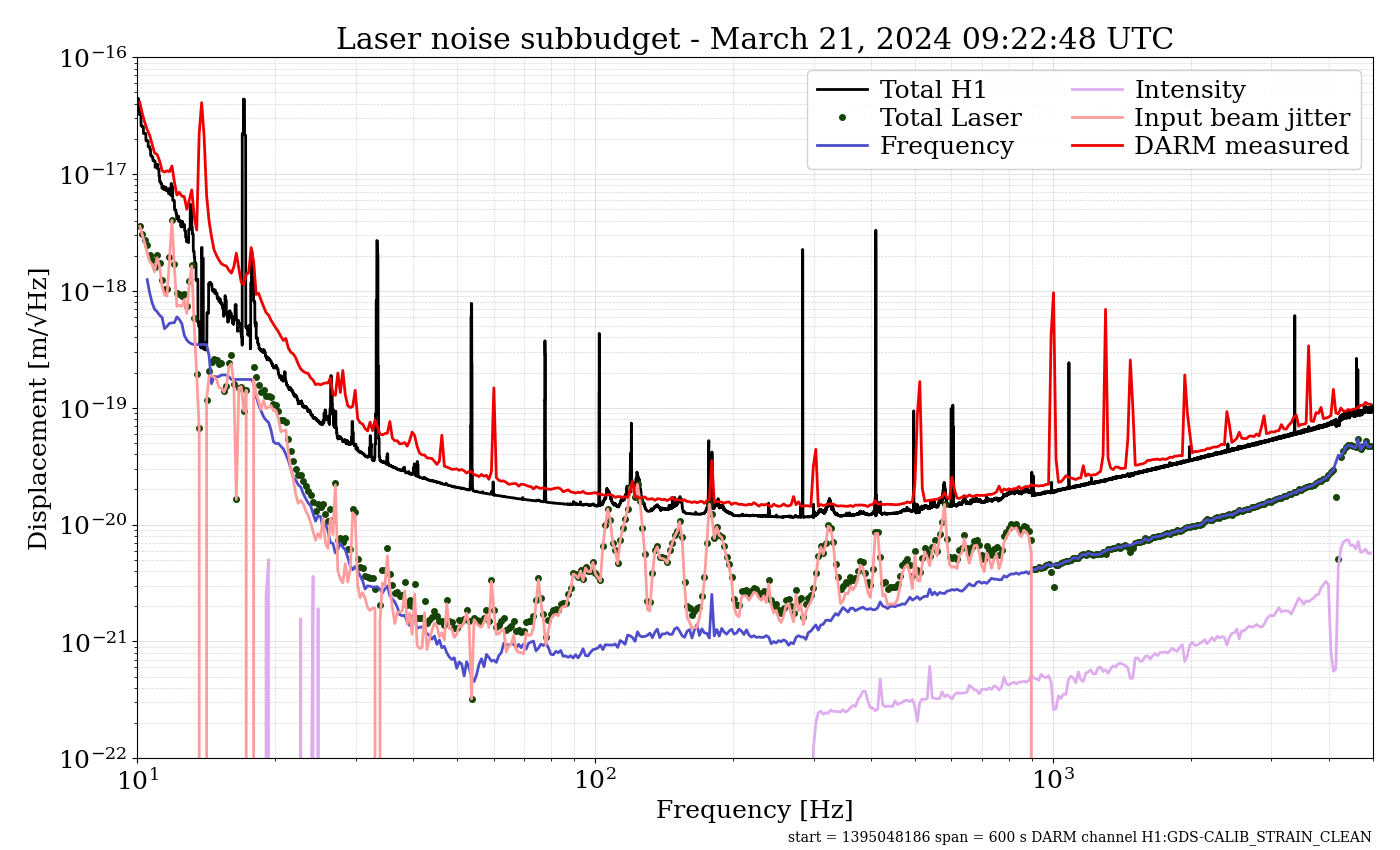
Stefan and Daniel suspect that our excess noise around 100 Hz might be due to intensity noise, and we did have a large shift in alignment of the beam transmitted through IM4 (76291) 76241. I moved pico 1, first to center the beam on the ISS QPD, which made the power on the ISS array PDs drop, and didn't improve the spectrum of the ISS Sum inner or outer channels (we did this with the loop open). We reverted this, then looked at the QPD position in O4a when we had 60W input power, went to 60W input power and pico'd to bring the beam to the same location as O4a. This also didn't improve the spectrum, so we brought the pico back to where we started.
Sheila asked me to compare the ISS second loop outputs with from our recent NLN lock last night to that during O4a. The spectra doesn't show much difference in the noise (top left plot shows Jan 14th lock in cyan and yellow, last night's one in pink and brown).
The other three plots shows the coherence of ISS output with all three GS13s on the HAM2 optical table. There only seems to be coherence at the power lines.
So maybe the ISS is not causing intensity noise to couple into DARM differently pre and post vent.
Images 2 and 3 attached shows the ndscope fro all channels I used around the two times I took spectra.
Time 1 = 2024-01-14 22:05:27 UTC
Time 2 = 2024-03-12 12:53:24 UTC
Channels for ISS:
H1:PSL-ISS_SECONDLOOP_PDSUMINNER_OUT_DQ
H1:PSL-ISS_SECONDLOOP_PDSUMOUTER_OUT_DQ
Channels for GS13s:
H1:ISI-HAM2_BLND_GS13X_IN1_DQ
H1:ISI-HAM2_BLND_GS13Y_IN1_DQ
H1:ISI-HAM2_BLND_GS13Z_IN1_DQ
I looked at the pointing of the IMs and MCs from the start of a lock 16th Janary to now. As previously found, nothing seems to have changed much, IM1 P changed by ~100 counts, more than the other IMs, but it's unclear what these counts are calibrated to.
Daniel, Naoki, Nutsinee
We installed a new VCO that allows us to increase the gain in the CLF loop (was 4kHz with 20 degree phase margin with the old VCXO). The box sits in the left SQZ rack U35. Below is the old VCO. CLF is now running at ~13kHz UGF with 40 degree phase margin. VCXO interface isn't working quite right but that doesn't stop us from locking the CLF. The "ON" switch is the excitation switch at the moment. The VCO control currently has a wrong sign and can't be turned on but it can be tuned by hand. CLF common mode board is now operating at -16dB common path gain with all three boosts on (no compensation). All relevant changes has been accepted in the SDF.
A quick look at the CLF noise (QMON) at 10 kHz tells us that we are now a factor of 5 better than last year. The Vpp calibration is 5V/rad.
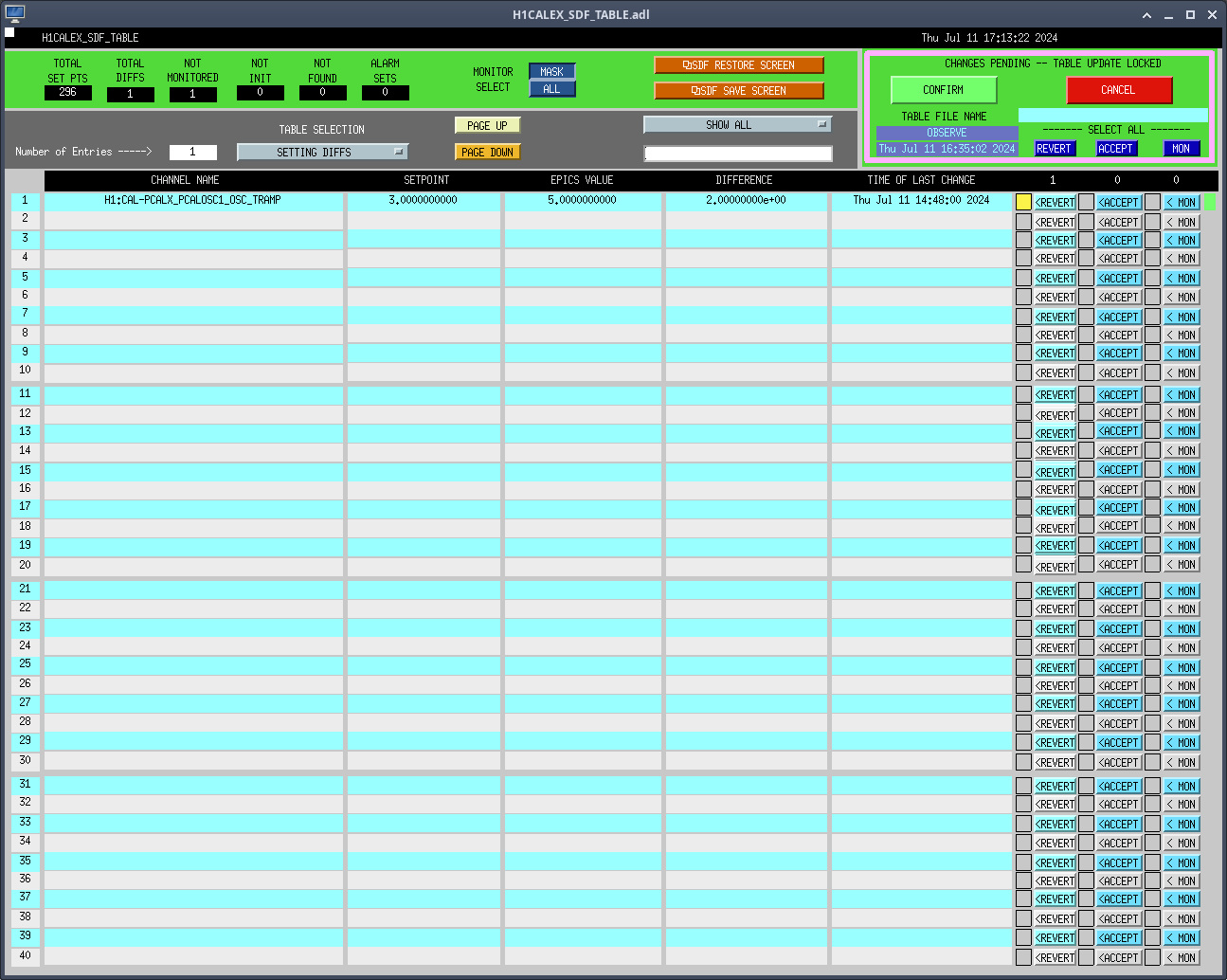
Unrelated to this work we commented out OPO common gain in the guardian and have SDF take care of the gain value instead. We also accepted the PMC trans nominal value.
I updated the CPS cal filters for all of the ISIs this morning. This was to fix a slight, long standing error in the filters, as described in FRS 30428. Shouldn't really have any impact on the IFO. LLO was done a while ago, we can close the ticket.
A new VCO for the CLF was installed. This VCO has a higher modulation bandwidth compared to the previous VCXO at the cost of more low frequency phase noise.
The SSB phase noise according to the data sheets:
| Frequency | New VCO | Old VCXO |
|---|---|---|
| 100Hz | -103 dBc | |
| 1kHz | -110 dBc | -133 dBc |
| 10kHz | -132 dBc | -148 dBc |
| 100kHz | -150 dBc | -158 dBc |
Sorry I made a duplicate alog. More details here
Lights turned off.
Noting but left alone as commissioning work is still ongoing :
Cabling on the HAM5 D3 flange was redressed. Cables routed behind the cross beam. This required cables for the HAM5 DCPD and the OFI TEC/THERMISTORS to be disconnected. D. Sigg disabled the servo for the OFI TEC. Servo enabled after cable work was completed.
A few days ago Jenne mentioned that our IM4 Trans NSUM diode was reading lower than before, because it was badly pitched down on the QPD. IM4 TRANS is used as our PRG calculator, so we would like make sure it's a trustworthy readback of our input power. This morning I adjusted IM1, IM2, and IM3 such that the alignment onto IM4 Trans is repaired. This brought the IM4 Trans NSUM estimated power incident on PRM from 1.8 to 1.9 W. We are now back to similar levels on IM4 TRANS / IMC PWR IN we were at at the beginning of the run:Current IM4 TRANS / IMC PWR IN ratio = 0.96 Ratio on August 8, 2023 = 0.95I was never able to find an alignment which 1) maximized our detected power and 2) properly brought our YAW on IM4 TRANS back to zero. Right now, IM4 TRANS YAW is sitting at 0.4. Because of max power/YAW discrepancy, I walked significantly in a bunch of directions (IM1 + IM3, IM2 + IM3) to check for clipping on the IFI or the post IM4 path. I did not find anything obvious, so I suspect we are okay where we sit. Still, we should be prepared to have to massively adjust the input alignment using IM4 when locking later today. If we need to, we can revert to the IM alignments from 8 am this morning, and simply pico on the IM4 TRANS path like we did in alog 64446.alogs: August 2022 Picoing onto IM4 Trans alog 64446 July 2022 IM4 TRANS calibration alog 63812EDIT: After this, because we were more worried about locking, I restored the sliders to their original locations, then further restored all of the IMs OSEMs to close to their original locations from before the vent. Somehow, we are still falling off IM4 TRANS. Additionally, Daniel advised to look at the ISS QPD, seems like we are not falling off that one yet, but are significantly yawed, not pitched. I believe that this actually makes sense, and that ISS QPD was 90 degrees rotated compared to the other QPDs. I'm now in the process of checking the IMC OSEMs. EDIT 2: Mode cleaner OSEMs seem close to their original values from before the vent. It's very hard to tell what changed about our input alignment, if the IMC and IMs OSEMs are at the same values. In any case, I've left it at the same slider values we had this morning, with the loose plan of slowly aligning IM4 TRANS during full lock with the input alignment loops on.
Tue Mar 12 10:15:18 2024 INFO: Fill completed in 15min 14secs
Gerardo confirmed a good fill curbside.
Today I updated the firmware of sw-fces-cds0 to match the other icx 7150 units. Due to the age of the firmware it was a two step process which involved 2 restarts of the switch. This was done completely remotely. After the upgrade I reviewed the configuration, make some changes to update how the spanning-tree was done and recorded the config. The first restart of the switch took about 3 1/2 minutes, the second tool about 5 1/4 minutes. Adjusting the spanning tree took some minor outages while the spanning tree was re-discovered. The command sequence for the upgrade was: copy tftp system-manifest 10.20.0.85 fastiron_08080f/FI08080f_Manifest.txt all-images-primary boot system flash pri copy tftp system-manifest 10.20.0.85 fastiron_0895g/FI08095g_Manifest.txt primary boot system flash pri copy tftp system-manifest 10.20.0.85 fastiron_0895g/FI08095g_Manifest.txt secondary
TJ, Trent, Matt, Georgia, Craig
This morning we went to ISCT1 with the goal of touching up the ALS DIFF beat note (currently sitting at around -13dBm), and investigating the clipping on the ALS Y transmission path, since there visible clipping on the ALSY camera and low-ish transmitted power on ALS-C_TRY.
Second and third attached photos show locations where we might be clipping.
Fourth and fifth attached photos show overviews of the ALS Y and Diff paths.
Sixth photo shows what the beam splitting prism looks like at the moment.
It appears that after a reboot of the h1guardian computer a week or so ago, the PEM_MAG_INJ node was requested to INJECTIONS_COMPLETE, meaning that at 14:20 UTC (07:20 PDT) this morning while H1 was locked at low noise, the injection suite ran for the following 20 minutes. This seems to have gone without issue, and the log lives in the normal injection directory, /ligo/www/www/exports/pem/WeeklyMagneticInjection/logs/
The magnetic injections do NOT appear to correspond with the lockloss at 14:45 UTC (the suite had finished 4-5 minutes prior). It's also worth noting that the in-lock SUS charge measurements did not run this morning, which would normally start at 07:45 local time, so that isn't the cause of the lockloss either.
I'll leave the magnetic injection suite set to run automatically on Tuesday mornings unless people have objections to it (it will not run unless the IFO is locked at low noise anyway).
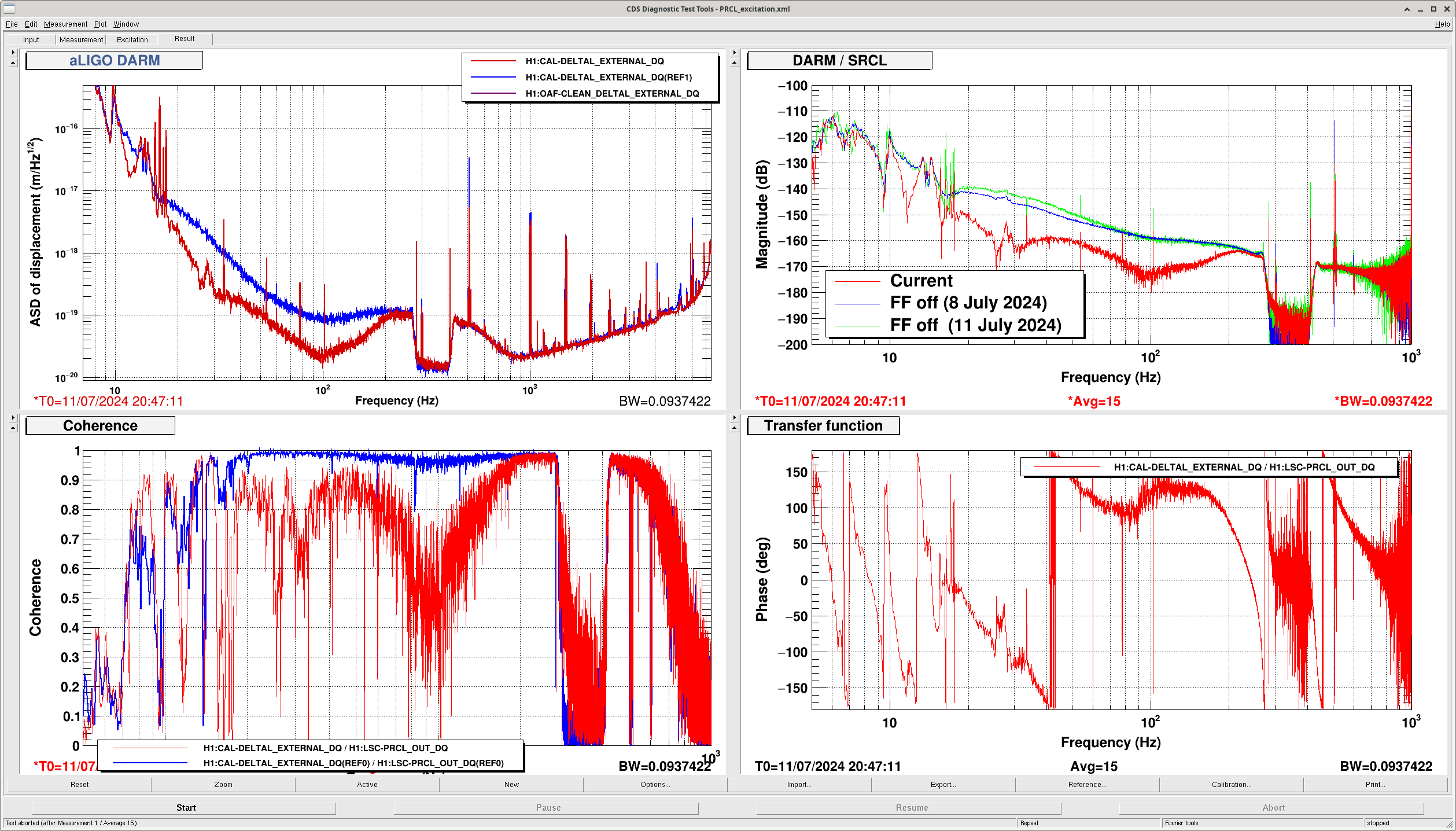
E. Hall, S. Pandey, S. Dwyer, L. Dartez We took another look at the new DARM configuration this evening. Evan had a suggestion for a new test: move intoNLN_ETMY, pause here before switching back to ETMX in the new configuration (but after all the new filters have been put into place) to take measurements of the new ETMX OLG before activating it. I took us intoNLN_ETMYusing the guardian then manually ran the instructions inNEW_DARMto set up the ETMX locking filters but paused before switching arms (so we were still locked with ETMY, notably without the MICH feedforward which remained inactive for the rest of our testing). We measuredH1:SUS-ETMX_L3_LOCK_L_IN1 / H1:SUS-ETMX_L3_LOCK_L_IN2andH1:SUS-ETMY_L3_LOCK_L_IN1 / H1:SUS-ETMY_L3_LOCK_L_IN2(DTT template paths are below) to isolate the OLG for the new DARM path on the x-arm. Some post-processing of the data is needed to do this. We'll follow up with that. Finishing the Transition to the new state: After the measurements above (but before we had a chance to look at the data) we tried slowly bringing up ETMX slowly starting with an L3 LOCK gain of 0.01 (and an ETMY L3 LOCK gain of 1). We immediately lost lock. This indicates that there is something severely wrong with the new DARM configuration as it's currently installed. Most likely, this is not something as subtle as an instability. We'll need to walk through these steps more carefully next time. DTT Templates:H1:SUS-ETMX_L3_LOCK_L_IN1 / H1:SUS-ETMX_L3_LOCK_L_IN2:/ligo/home/louis.dartez/projects/20240311_new_darm_investigations/SUSETMX_L3_SS_new_darm.xmlH1:SUS-ETMY_L3_LOCK_L_IN1 / H1:SUS-ETMY_L3_LOCK_L_IN2:/ligo/home/louis.dartez/projects/20240311_new_darm_investigations/SUSETMY_L3_SS_new_darm.xmlRelevant logs: - Old Matlab model revived (LHO:75584) - Unsuccessful attempts in early 2024 (LHO:75308) - Times spent successfully in new DARM state (LHO:75631) - Calibration attempts in new DARM state (LHO:74977)
We went home after we lost lock but I forgot to request NLN on the way back up. The IFO relocked itself into NLN_ETMY and got stuck there. I tried going to DARM recover but overlooked that it'd try to go through new DARM to get there. This resulted in another lockloss, after which I requested NLN.
It turns out that last night's lockloss wasn't all bad; the IFO didn't lose lock while in the New DARM state (state 711)...it actually went down from state 712 which isRETURN_TO_NLN_ETMY.RETURN_TO_NLN_ETMYisn't particularly well-tested nor necessarily expected to work. The good news here is that we successfully transitioned into theNEW_DARMstate last night. This is great news! But we're not out of the woods yet. The transition resulted in a pretty hard kick (see NEW_DARM_worked.png) that we'd like to mitigate in future tests. We also only sat atNEW_DARMfor about 52 seconds because I requestedRECOVER_DARM, which took us in and out ofNEW_DARMbefore losing lock. Lockloss Link: 1394259161 For next steps, we have integrators on the L1 and L2 LOCK banks that we're thinking of separating from their current filters and ramping them on after the initial transition. It's not clear yet if this will work.
Quiet time between
PDT: 2024-03-11 19:11:02.319941 PDT
UTC: 2024-03-12 02:11:02.319941 UTC
GPS: 1394244680.319941
and
PDT: 2024-03-11 19:21:42.276196 PDT
UTC: 2024-03-12 02:21:42.276196 UTC
GPS: 1394245320.276196
Used this time to run BruCo: https://ldas-jobs.ligo-wa.caltech.edu/~gabriele.vajente/bruco_1394244680_STRAIN_CLEAN/
Notable coherences:
OMC-REFL_A_LF shows low-ish but broadband coherence with DARM above 30 Hz, and this is suggestive of the excess noise we see now w.r.t. O4a. Evan suggests that this could be 45 MHz sidebands amplitude noise, that dominates the OMC reflection, and has a small transmission through the OMC
comparing OMC_REFL with CLF to now
Atttached is a plot of the power spectrum of OMC-REFL during:
-- blue: REFL 45 O4a ( Janurary 15th 02:25 UTC )
--green: REFL 45 now (March 12th 12:30 UTC )
--brown: REFL 45 with CLF closed ( March 12th 00:24 UTC )
--red: REFL 45 with CLF open (March 12th 01:54 UTC )
Clearly, during O4a, the noise in OMC-REFL 45 was better compared to now. It seems from this is that the noise level does not change with the modulation depth (only looking at a 2 minute stretch); however, the source of the noise difference between CLF open and closed is not known. The noise level also seems to vary over the recent locks, which we cannot explain yet.
I ran a quick bruco on the OMC-REFL_A_LF channel itself, https://ldas-jobs.ligo-wa.caltech.edu/~elenna.capote/brucos/OMC_REFL/
J. Kissel, L. Dartez Jeff ran the calibration measurement suite. We processed it according to the instructions here. I then updated theCAL_DELTAL_EXTERNALcalibration using the new report at/ligo/groups/cal/H1/reports/20240311T214031Z.
Attaching the cal report. Optical gain: 2024-03-12: 3.322e+06 [DARM ERROR counts / meter] 2023-10-27: 3.34e+06 [DARM ERROR counts / meter] KappaC at the end of O4a: 1.006 Optical gain at end of O4a: 3.336e6 [DARM ERROR counts / meter] So the current optical gain is differs from what we had at the end of O4a by about 0.4%.
The calibration from this report has now been added to the LDAS cluster archive such that it shows up in the official infrastructure.
It's location is
https://ldas-jobs.ligo-wa.caltech.edu/~cal/?report=20240311T214031Z
It was tagged as "valid" and "exported" as follows:
On a local control room workstation (or on whichever computer system the report was created)
$ cd /ligo/groups/cal/H1/reports
$ touch 20240311T214031Z/tags/exported
$ touch 20240311T214031Z/tags/tags
$ arx commit 20240311T214031Z
Matt, Stefan, Jennie W
Overall: We adjusted the OMC input matrix resulting in a factor of ten reduction in the OMC suspension drive.
The procedure is as follows:
1) Start by calculating the sensing matrix which maps OM3 and OMC degrees of freedom to QPD A and B changes for one of the suspension degrees of freedom (pitch or yaw).
2) Calculate the inverse of the sensing matrix, which will give you a possible input matrix, mapping QPDA and B changes to OM3 and OMC changes which we use for feedback. The first row of the matrix maps only to OM3, for example, which we chose to be our primary degree of freedom with the higher bandwidth. The trouble we were finding before is that the inverse of our sensing matrix yields a strong degeneracy between the two degrees of freedom, and so we push our second row in the direction that cancels most of the noise in the error signal, and also reduces the degeneracy between the error signals.
This procedure can then be repeated for the other degree of freedom (pitch or yaw).
The results of the noise reduction can be seen in the time domain as well.
Jennie, Craig Today we reran the mod-depth up down tests. We are not fully trusting these numbers because we suspect we are clipping a bit on IM4_TRANS, which might artificially raise all of our estimated PRGs, including those for RF9 and RF45. Additionally, there was obvious thermalization still happening during the measurement. Still, the first pass measurement is useful for up to 10% estimates? We should rerun after we recenter on IM4. PRGs 9 MHz PRG = 85.6 45 MHz PRG = 36.6 Carrier PRG = 50.4 REFL ratios 9 MHz reflection ratio = 0.309 45 MHz reflection ratio = 0.268 Carrier reflection ratio = 0.055 Table of relative powers
| Channels | 9 MHz | 45 MHz | Carrier |
|---|---|---|---|
| H1:IMC-PWR_IN_OUT16 | 0.013 | 0.015 | 0.972 |
| H1:IMC-IM4_TRANS_NSUM_OUT16 | 0.013 | 0.015 | 0.972 |
| H1:LSC-REFL_A_LF_OUT16 | 0.065 | 0.065 | 0.870 |
| H1:LSC-REFL_B_LF_OUT16 | 0.063 | 0.062 | 0.874 |
| H1:LSC-POP_A_LF_OUT16 | 0.022 | 0.011 | 0.967 |
| H1:ASC-POP_A_NSUM_OUT16 | 0.021 | 0.011 | 0.968 |
| H1:ASC-POP_B_NSUM_OUT16 | 0.021 | 0.011 | 0.968 |
| H1:ASC-AS_C_NSUM_OUT16 | 0.181 | 0.521 | 0.298 |
| H1:ASC-OMC_A_NSUM_OUT16 | 0.174 | 0.637 | 0.189 |
| H1:ASC-OMC_B_NSUM_OUT16 | 0.180 | 0.565 | 0.255 |
| H1:ASC-X_TR_A_NSUM_OUT16 | 0.008 | 0.009 | 0.983 |
| H1:ASC-X_TR_B_NSUM_OUT16 | 0.008 | 0.009 | 0.983 |
| H1:ASC-Y_TR_A_NSUM_OUT16 | 0.009 | 0.009 | 0.983 |
| H1:ASC-Y_TR_B_NSUM_OUT16 | 0.009 | 0.009 | 0.983 |
For the 9 MHz PRG of 85.6 the nominal level on POPAIR_B_RF18 I phase PD is 1577 counts.
For the 45 MHz PRG of 36.6 the nominal level on POPAIR_B_RF90 I phase PD is 399 counts.
We successfully balanced the BRS with the remote mass adjuster for the first time this morning. The process was relatively painless. We used a windows machine to drive the picomotor and a separate laptop to monitor the BRS readouts. The BRS is still equilibrating and will drift more into range over the next few days.
Total movement today: -60k steps
Coupling/decoupling move: 1.25k steps
Maximum: +- 140k steps
Be careful: +-100k steps
Log:
-2.5k steps
-2.5k steps
+1.25k steps
-1.25k steps
-2.5k steps
+1.25k steps
-1.25k steps
-10k steps
+1.25k steps
-1.25k steps
-10k steps
+1.25k steps
-1.25k steps
-5k steps
+1.25k steps
-1.25k steps
-2.5k steps
+1.25k steps
-1.25k steps
-2.5k steps
+1.25k steps
-1.25k steps
-5k steps
+1.25k steps
-1.25k steps
-10k steps
+1.25k steps
-1.25k steps
-2k steps
+1.25k steps
-1.25k steps
-1.25k steps
+1.25k steps
-1.25k steps
-2.5k steps
+1.25k steps
-1.25k steps
-2.5k steps
+1.25k steps
Finally adding the pictures to this alog.
And a link to the Google doc for making the BRS changes.
https://docs.google.com/document/d/1XBH-TVwQ3JC8rjLGXUg-LDZKzHxaTuKBC3_-B_fWWAk/edit#heading=h.7b9gxgqfvsr0