Displaying reports 12921-12940 of 86441.Go to page Start 643 644 645 646 647 648 649 650 651 End
Reports until 10:27, Saturday 03 February 2024
H1 CDS
david.barker@LIGO.ORG - posted 10:27, Saturday 03 February 2024 - last comment - 14:29, Monday 05 February 2024(75722)
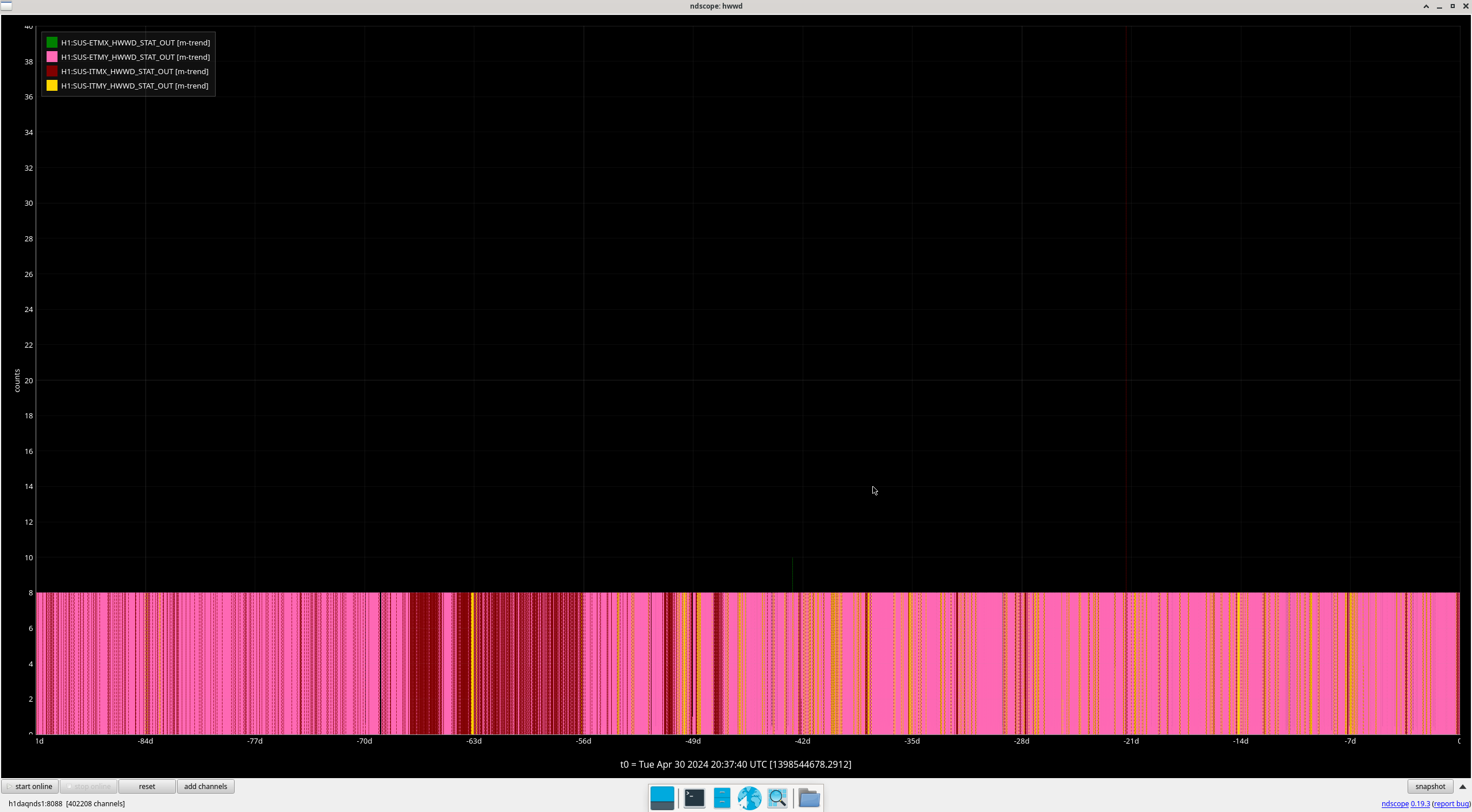
CDS Status: HWSEY and PicketFence down

Two systems stopped running overnight:

HWS-EY: computer crashed at 03:07 Sat 03feb2024 PST. This is the cause of the EDC's 86 disconnected channels. h1hwsey is not pingable, but its IPMI port is working.

Picket Fence: the server on nuc5 stopped updating at 21:53 Fri 02Feb2024 PST, the IOC continues to run with flatlined channels.

Both can wait till Monday for restarts and investigations.

Comments related to this report
erik.vonreis@LIGO.ORG - 14:29, Monday 05 February 2024 (75733)

h1hwsey suffered a kernel crash.  Photo of the console including stack trace is below.  I rebooted the server and it came back up ok.

Images attached to this comment
LHO VE
david.barker@LIGO.ORG - posted 10:19, Saturday 03 February 2024 (75721)
Sat CP1 Fill

Sat Feb 03 10:05:48 2024 INFO: Fill completed in 5min 44secs

Images attached to this report
LHO VE (VE)
gerardo.moreno@LIGO.ORG - posted 04:17, Saturday 03 February 2024 - last comment - 13:39, Saturday 03 February 2024(75718)
HAM7 Purge Air Increased

Before heading home yesterday, I checked the open chambers, and noted that the C3 covers were not billowing out as per the usual "weekend setting", HAM6 looked good.  I spoke to Keita K., Vicky X. and Betsy W. about the lack of purge air.  I was given the green light to increase the purge air in HAM7.

Comments related to this report
victoriaa.xu@LIGO.ORG - 13:39, Saturday 03 February 2024 (75723)SQZ

Tagging SQZ. If the SQZ dither lock is very sensitive next week, could try turning down the purge air if needed.

Noting this here because during HAM7 alignment checks this week 75686, the sqz beam sometimes unlocked when touching things on table. So, the higher purge air is probably fine for HAM6 sqz beam alignments, but might be less stable for HAM7 sqz beam alignment checks.

LHO VE
janos.csizmazia@LIGO.ORG - posted 19:36, Friday 02 February 2024 - last comment - 04:33, Saturday 03 February 2024(75717)
2-2 vent vacuum diary
Today's activities:
- HAM3 Y+ door was reinstalled. No issues during the process, however, some scratches have been found - see pics.
- After the door was reinstalled, the Annulus volume is being pumped
- The Gate Valve for the 1000 amu RGA was installed on the Y-mainfold, with an additional angle valve
- 2 out of 3 16.5" 3IFO feedthrus were removed from BSC8 - at the north side. A very scratchy conflat was found, see pic. To mitigate the risk, Technetics-Helicoflex-type CF seal repair gaskets will be ordered. At the south-side of the chamber, the unnecessary cable trays were removed, in preparation for the 3rd feedthru removal
- EX pumpdown status: it is already at ~2E-7
Images attached to this report
Comments related to this report
gerardo.moreno@LIGO.ORG - 04:15, Saturday 03 February 2024 (75719)VE

(Jordan V., Gerardo M.)

Installed a gate valve at the YBM (Y beam manifold) to be used for the new 1000 amu RGA.  A zero length reducer with a metal seal right angle valve were added to facilitate the addition of parts in a near future.  No issues were encountered during the installation.

Images attached to this comment
gerardo.moreno@LIGO.ORG - 04:33, Saturday 03 February 2024 (75720)VE

EX pumpdown curve.  The two spikes noted on 2/1/2024 were turbo pump isolation valve cycles, the gate valve was opened and closed to perform leak tests of the conflats/ports disturbed on this vacuum envelope, more on this aLOG.

Images attached to this comment
H1 TCS
thomas.shaffer@LIGO.ORG - posted 16:25, Friday 02 February 2024 (75715)
TCSX chiller line water tested

Camilla, Jason, Oli, TJ

With a successful air test over Wednesday night (alog75657), and the stop work cleared, we started the process of testing the chiller lines with water. Jason and Camilla ran the X&Y chillers on a closed loop within themselves and adjusted the chiller settings to hopefully stop an overpressure in the future. The H1:TCS-ITM{X,Y}_CO2_CHILLER_SERVO_GAIN was also changed from 1 to 0 to stop the temperature setpiont being too low, but we will change this back later.

(values in psi) Previous New
High pressure warning 100 75
High pressure fault 105 80

After the chillers had lower settings and had run for a bit, we bypassed the TCSX table by connecting the supply to the return next to the table. Jason and Oli were prepped at the chiller, Camilla was at the bypass, and I was watching the expansion joints. Even though the TCSX chiller was just ran, when the chiller lines were hooked up, it introduced enough air into the pump that it needed to be primed again. This was not done easily, so we swapped TCSX and Y chillers. The new chiller was started immediately when plugged into the lines and then started flowing. Jason and Oli filled the reservoir with around 3-4gal as the air came out of the system. We let the chiller run for ~15 min and observed no leaks.

At this point we decided to call it a day and keep both chillers off over the weekend. The TCSX chiller lines have water in them, but the chiller is not running. Next week we will need to reprime the TCSX chiller and test the TCSY water lines.

LHO General
austin.jennings@LIGO.ORG - posted 16:00, Friday 02 February 2024 (75690)
Friday Operator Summary

TITLE: 02/02 Day Shift: 16:00-00:00 UTC (08:00-16:00 PST), all times posted in UTC
STATE of H1: Planned Engineering
INCOMING OPERATOR: None
SHIFT SUMMARY:

- HAM 3 door is back on and chamber is closed out

- SUS/SQZ crew continue to hash out the PSAMS adjustments, which will continue into next week.

- VAC conflat work ongoing, EX continues pump down

- DM 10 has been going off intermittently throughout the day

LVEA is Laser SAFE.
LOG:                                                                   

Start Time System Name Location Lazer_Haz Task Time End
00:21 LASER SITE LVEA YES LVEA IS LASER HAZARD 15:58
16:18 FAC Karen/Kim LVEA N Tech clean 17:19
16:34 SUS Rahul Remote N Closeout TFs HAM 3 (PR2/MC2) 17:40
16:34 VAC Jordan LVEA N Pure air measurement 16:43
17:11 FAC Tyler HAM 3 N Prep for door crew 17:22
17:40 EE Marc HAM 3 N Ground loop checks 18:16
17:41 FARO Jason LVEA N FARO checks 18:06
17:43 FAC Tyler/Travis/Betsy/Jordan/Gerardo HAM 3 N Door installation 20:04
17:51 FAC Karen H2 N Tech clean 18:12
17:52 ISC Robert HAM 3 N Baffle install 18:45
18:29 SUS Rahul/Camille HAM 7 N ZM5 PSAMS adjustment 19:51
19:11 PCAL Tony/Dripta PCAL Lab Y (LOCAL) Measurements 21:14
19:15 SQZ Camilla/Vicky/Naoki SQZ tables N Parts search 19:24
20:52 FAC Chris EY N Wind fence work 21:14
20:58 VAC Travis/Janos LVEA N Conflats work ??
21:18 ISC Keita HAM 6 N Electronics check 22:21
21:19 VAC Jordan/Gerardo Y beam manifold N Gate valve 23:35
21:19 EE Marc FCES N Install accelerometers 22:21
21:40 PCAL Tony/Dripta PCAL Lab Y (LOCAL) Measurements 22:22
21:57 FAC Mitch HAM 3 N Bag and tag parts 22:15
22:20 TCS Jason/Camilla/TJ/Oli Mech room/LVEA N Turn on chillers 23:54
23:07 OPS Betsy LVEA N Walkaround 23:30
H1 SYS
betsy.weaver@LIGO.ORG - posted 14:36, Friday 02 February 2024 (75701)
O4 Break Vent/Commissioning Status

As of COB WEEK 3 of the Vent/Commissioning Break, the following items have been completed or are a WIP:

1) DONE - Corner Vented, HAM7 Vented, Relay Tube Vented and removed, EX Vented, HAM6, HAM7 and HAM3 chambers opened (Team VAC, Randy, Tyler)

2) 90% COMPLETE - HAM6 OMC Swap, realignment of paths (Koji, Keita, Rahul, Betsy, some helpers)

3) DONE - EX Cryo-Baffle Damper install, Vac port retreival for 3IFO feedthrus, Pumping started (Robert, Mitchel, Team VAC)

4) DONE - HAM3 SLiC Baffle rework (Both large MC baffles) and install (17 nozzle baffles and 1 McGuyver baffle) in the MC Tube and inside of HAM3 door, SUS/SEI Closeout, Door back on (Robert, Mitchell, TJ, Corey, Tony)

5) STARTED - HAM7 ZM Piezo adjustment and subsequent realignment (Rahul, Camilla, Sheila, some helpers)

6) 50% COMPLETE - IAS FARO Mapping of LVEA (Jason, RyanC, Tyler)

7) 50% COMPLETE - TCS Laser swap (TJ, Camilla, Jason)

8) 75% COMPLETE - BSC8 Vac port retrieval for 3IFO feedthrus (Team VAC)

9) STARTED - EY Wind Fence Repair (Jim, Mitchell, Randy, plus 1, slow start due to weather and staff availability)

10) STARTED - PCAL Maintenance both Ends (Tony, Rick, Dripta)

11) COMING UP - NCAL, BRS Work at EX (Jim, Tony, M.Ross, Neil)

12) COMING UP - Closeout of HAM6 and Corner Pump down (EE/SUS/SEI, Team VAC)

13) COMING UP - Closeout of HAM7, Pump down, Install Relay tube and pump down (EE/SUS/SEI, Team VAC)

14) COMING UP - In-Air PMC Install on SQZT0 (Daniel, Nutsinee, team SQZ)

15) COMING UP - CDS Network Core work (Team CDS)

16) STARTED - 3IFO hardware retreival in LVEA (Team TBD)

17) COMING UP - Crane inspections - all detector VEAs (Tyler, Eric)

18) COMING UP - HAM8 SEI Sensor troubleshooting/swap (Jim, Mitchell, Team VAC) 

19) DEFERRED - Fire Dept tumbleweed burning along X-arm COMING UP - HAM8 SEI Sensor troubleshooting/swap (Jim, Mitchell, Team VAC)

Many other interlaced activities by others of course, as well as background progress with ongoing projects and support of the controlroom/controls.  Good job everyone.

H1 PEM (PEM)
marc.pirello@LIGO.ORG - posted 14:29, Friday 02 February 2024 (75713)
FCES Accelerometer Chassis Installed

Continued from previous ALOG75592

Replaced Pico Accelerometer Power Conditioner with LIGO Accelerometer Power Conditioner. WP11653
S2300071 installed, all signals attached and powered up.

To Do:
MX and MY power adapter cable install and signals transferred from Endevco boxes to the LIGO units.

H1 SUS (SQZ, SUS)
rahul.kumar@LIGO.ORG - posted 13:40, Friday 02 February 2024 - last comment - 14:04, Friday 02 February 2024(75709)
ZM5 suspension's optic in HAM7 chamber offloaded to 47 in lbs.

Camille (CIT), Rahul

Just like ZM4 (see LHO alog 75677) we have offloaded ZM5 (P-SAMs) in HAM7 chamber to 47 in lbs. as per E2300463_V1. We followed the same procedure as described in alog 75677. Camille will post all the relevant pictures.

Post work transfer function measurements showed that the suspension is healthy.

Next we will work with Sheila et al on beam alignment in HAM7 chamber and mechanically offload the alignment sliders for both the suspension.

Comments related to this report
camille.makarem@LIGO.ORG - 14:04, Friday 02 February 2024 (75711)
1st image: PSAMS secured to Fixture Plate
2nd image: PSAMS preloader being adjusted with torque wrench
3rd image: Dial indicator on torque wrench showing torque that was applied to preloader (47 in lbs)
Images attached to this comment
H1 SUS (SUS)
marc.pirello@LIGO.ORG - posted 10:54, Friday 02 February 2024 (75705)
HAM3 Ground Loop Checks

D1000599
E2100504
T1200131

HAM3 ground checking complete.

Description       Box          Location       Notes
PR2 Top           SB-137       SUS-R2         Tested ok
PR2 Middle        SB-008       SUS-R2         Tested ok
PR2 Bottom        SB-002       SUS-R2         Tested ok
MC2 Top/PR2 Top   SB-0         SUS-R2         Tested ok
MC2 Top           SB-004       SUS-R2         Tested ok
MC2 Middle        SB-088       SUS-R2         Tested ok
MC2 Bottom        SB-119       SUS-R2         Tested ok

H1 SQZ (SUS)
camilla.compton@LIGO.ORG - posted 17:58, Thursday 01 February 2024 - last comment - 14:00, Saturday 03 February 2024(75686)
Checked SQZ beam alignment in HAM7 after ZM4 PSAMs offloading.

Julian, Sheila, Vicky, Camilla. After today's alog 75677 ZM4 PSAMs offloading. WP11666

Started with ZM4 sliders at Pit  -362, Yaw -273. Our beam off the OPOS was good, centered on both HAM7 QPDs with nsum 150 to 160.

The beam was off mainly in yaw, centered on irises by moving sliders to Pit -521, Yaw -1213. This was with PSAMS at 200V. There is still loads of range on the sliders, DAC counts up to 27,000 out of 500,000.

We watched the beam and ramped PSAMS from 200V to 0V over 30s, the beam may have moved slightly higher. 

Leaving both ZM4 and ZM5 PSAMS at 0V for tomorrows work.

Comments related to this report
rahul.kumar@LIGO.ORG - 09:54, Friday 02 February 2024 (75703)SUS

ZM4 has a 16bit DAC and hence we will need to mechanically relieve it in both pitch and yaw.

victoriaa.xu@LIGO.ORG - 14:00, Saturday 03 February 2024 (75724)

For the ZM4-5-6 alignment check after offloading PSAMS on ZM4 (75677) and ZM5 (75709) -- reminder that as-is, ZM6 is almost railed. Ideally none of ZM 4-5-6 are saturating.

So, before mechanically offloading ZM 4-5, can also check alignments with ZM6 sliders set ~0. For example, we brainstormed next steps like:

(i) use ZM5 sliders to center ZM4-5 alignment on HAM7 irises. SQZ beam should then naturally hit AS_C.

(ii) zero the ZM6 sliders, then use ZM4-5 sliders to recover the beam on AS_C. Then could offload if needed.

H1 CDS (CDS, ISC)
keita.kawabe@LIGO.ORG - posted 17:42, Thursday 01 February 2024 - last comment - 17:52, Friday 02 February 2024(75684)
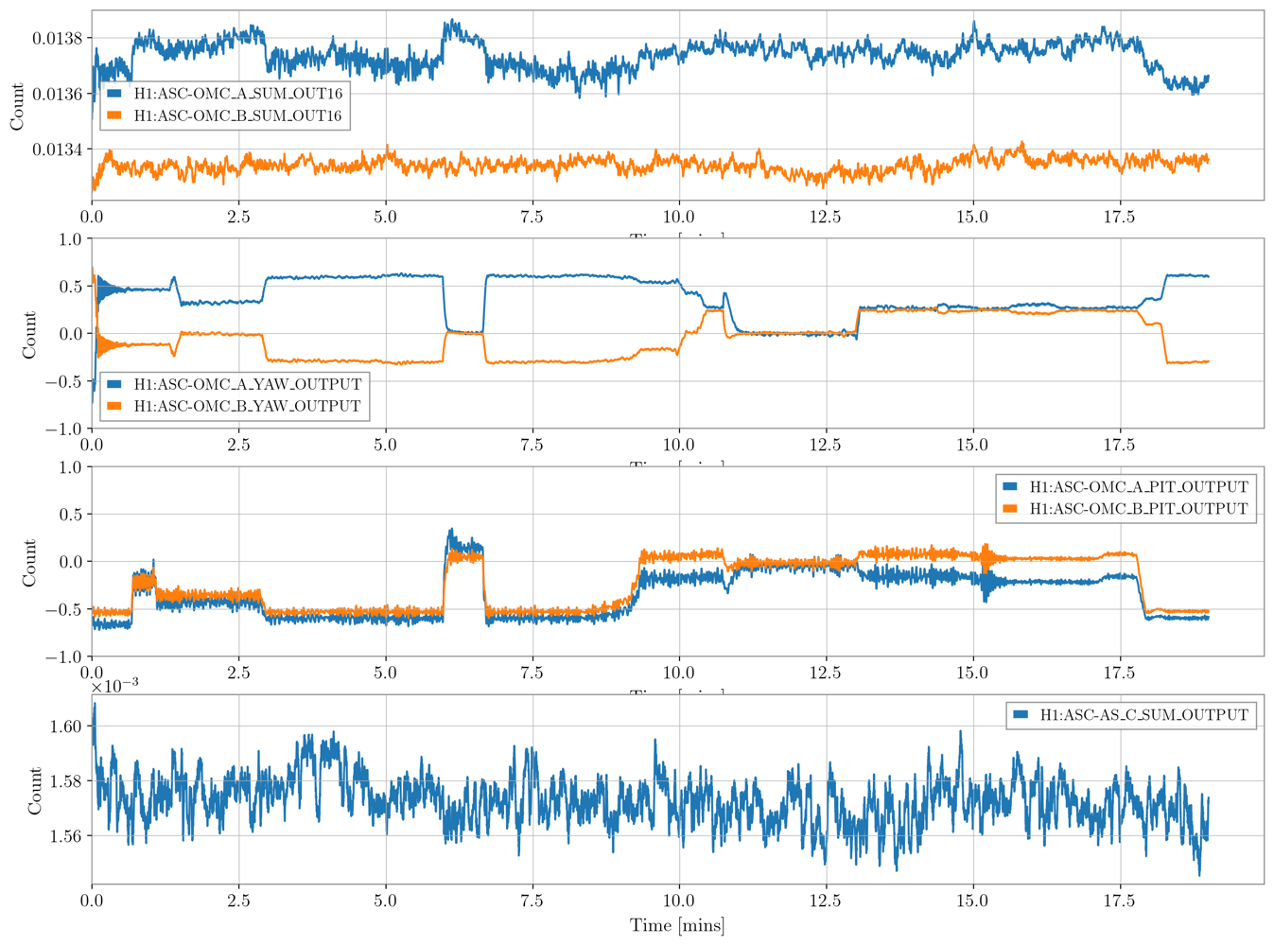
HAM6 electronics and ground check part 1: OMC DCPD/QPD/PZT chain has never been healthier. ASC-AS_C has a grounding issue.

Summary:

OMC DCPD/QPDs/PZTs are good without caveat for the first time in LHO history.

OM2 heater and thermistors are good.

ASC-AS_C has a grounding issue which should be fixed in chamber at some point.

Didn't check grounding of the beam diverter and picos (confirmed that picos move, didn't test BDV).

For flange layout, see D1002877 (but note that LHO uses D6-F4 for OMCR diode, not D6-F6).

For in-air wiring, see D2200215 (OMC DCPD), D1300589 (OMC PZTs), D1002283 (OMC QPDs, OMCR DCPD also uses one channel of the QPD interface), D2000212 (T-SAMS heater/thermistor).

New OMC seems to have eliminated the source of headaches in the past.

The new OMC (1st attachment left) has a PEEK connector bracket on top of the OMC breadboard instead of an aluminum bracket (1st attachment right). In the past this aluminum bracket caused many, many headaches. Now that it's gone, OMC DCPD/QPD/PZT chain makes sense w/o caveat.

D6-F1 (DCPD/Preamp)

At the feedthgough, I disconnected the D6-F1 DB25 (for OMC DCPD/Preamp) and used a breakoutboard on the feedthrough to check grounding. No pin including pin13 (that is used for shield) is connected to the chamber. Pin 13 is only connected to signal GND pins of the in-vac preamp (pin 10/15/16/19/20/23).

Inside the chamber on the in-vac preamp, the DB25 shell is connected to the preamp body (which is isolated from the ISI via PEEK spacer). At first DB25 shell and the preamp body was shorted to the ISI table, but this turns out to be via 3MHz cable ultimately connected to the in-air chassis. As soon as both of the 3MHz cables were discunnected from the in-air chassis, preamp body as well as the DB25 shell weren't conducting to the ISI table any more.
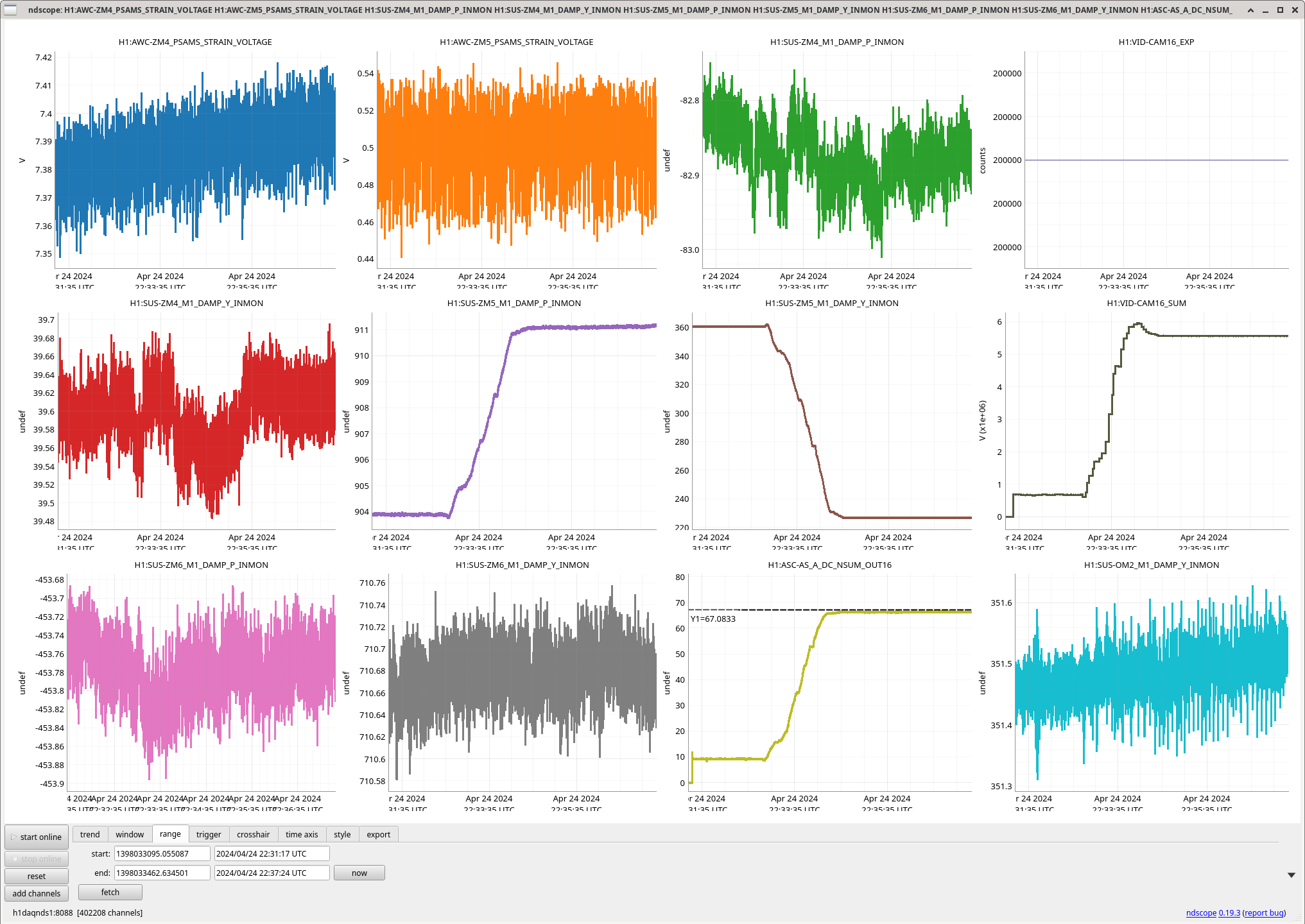
 D6-F1 and 3MHz connection.

D6-F2 (PZT)

Disconnected D6-F2 (PZTs) at the feedthrough, used a breakout board. Discharged the PZTs. Measured capacitance: HZ PZT (pin1-14) was 373nF, LV PZT (pin2-15) 392nF, these include in-chamber cables. Nominally these are 380nF and the measured numbers are good.

Pin 13 is not connected to any pins nor the chamber. No short circuiting between LV and HV path.

Restored D6-F2 connection.

D6-F3 (QPDs)

Disconnected D6-F3 (OMC QPDs) at the feedthrough, used a breakout board.

Pin 13 is not connected to any pins nor chamber. Diode connection from QPD1 anode 1/2/3/4 (pin 15/2/14/1) to QPD1 cathode (pin 16). Diode connection from QPD2 anode 1/2/3/4 (pin 18/5/17/4) to QPD cathode (pin 19). No connection from QPD1 to QPD2 and vice versa.

Restored D6-F3.

OMCR diode is good

Disconnected D6-F4 to check. Pin 13 is not connected to chamber nor any pins. Restored D6-F4.

ASC-AS_C has a grounding issue

Disconnected D6-F5 to check. Pin 13 is connected to the chamber. Restored D6-F5.

T-SAMS heater/thermistors are good

Disconnected D6-F9 to check.

Pin 13 is not connected to chamber nor any pins.

Pin 1-14 (heater) is 104 Ohm, which is good.

Pin 11-24 (thermistor 2) and pin 12-25 were both 11.7kOhm, sounds about right. No cross-connection between thermistor 1 and 2.

Things that weren't checked

Will check grounding:

Pico (checked that both WFSA and B pico moved).

WFS (DC).

Suspensions. Will leave it to Fil.

Won't recheck grounding:

Beam diverter (will check that it moves). Known in-chamber grounding, this was dealt with in air in the past, no reason it changed.

WFS (RF, interface). Coax, no reason to worry.

DCPD 3MHz. Coax, no reason to worry.

Images attached to this report
Comments related to this report
corey.gray@LIGO.ORG - 08:45, Friday 02 February 2024 (75697)EPO

Tagging with EPO for OMC mass comparison.

keita.kawabe@LIGO.ORG - 17:52, Friday 02 February 2024 (75716)

Added later: WFS (DC), Picos, and Fast Shutter are good.

D6-F7 (pico):

See D1100326 for pin connections. Disconnected the DB25 at the feedthrough and used a breakout board.

No pin (incl. pin 13) is connected to the chamber ground. Pin 13 is not connected to any other pins.

WFSA and WFSB DC:

See D1300467 for pin connections. These are on D3-2C1 and 2C2, but they're almost impossible to access, so I disconnected the DB15 from the front panel of the WFS interface, attached DB15 breakout board to the cable and checked.  (Note that they use special DB25-DB15 cable to make a connection between the feedthrough and the interface.)

For both of the cables, DB15 connector shell is only connected to pin 14 and 15 (signal ground for in-vac WFS board), not connected to the rack ground.

Fast Shutter:

See D1400225 for pin connections. This is on D3-3 but it's almost impossible to access, so I disabled the HV for the FS driver, disconnected the 6-pin HV connector from the front panel and checked the connection betweein the cable pins.

No pin is connected to the rack ground. No cross connection between positive drive, negative drive and continuity check pins.

H1 SUS (SUS)
rahul.kumar@LIGO.ORG - posted 14:01, Thursday 01 February 2024 - last comment - 13:41, Friday 02 February 2024(75677)
ZM4 (P-SAMS in HAM7) preload adjusted to change the radius of curvature of the mirror

Camille (CIT), Austin , Rahul

This morning we went to HAM7 chamber and changed the preload on ZM4 (P-SAMS) suspension as per the document E2300463_V1. This changed the RoC of ZM4 mirror without the PZT actuation. Given below are the details of our work - Camille will add pictures later on.

- After setting ZM4 into SAFE state we locked all three stages of the suspension. We had already taken healthy TF measurements before starting our work.

- The bottom mass cable was disconnected and carefully re-routed so that it stays away from the fixture plate.

- four add-on masses (basically 1/4-20 screws with washers) attached to the bottom mass was then removed.

- bottom mass Fixture plate (D2100121) was attached to the structure using six 8-32 screws.

- The bottom mass (already locked using EQ stops) was then further clamped using four 1/4-20 screws through the fixture plate. We had to adjust the height of the bottom mass to the align the threads with the holes on the fixture plate.

- Once the bottom mass was securely clamped, we removed the three set screws on the preloader.

- Using a torque wrench we increased the preload on the bottom mass by ~29 in.lb. (Total preload from torque after increase was 75 in.lb).

- We then followed all the above steps backwards (i.e set screws, add on mass put back, fixture plate removed, cable re-connected and the suspension set free).

- Once all done, we started damping the suspension and checked for any BOSEM flag changes - looked all fine.

- We took the transfer function measurements and ZM4 looked healthy.

Hence we took all the tools out and put the curtains back on HAM7 chamber.

Next, we will go into laser hazard with SQZ team and check for any changes in beam alignment and make adjustments as required.

Comments related to this report
camille.makarem@LIGO.ORG - 14:42, Thursday 01 February 2024 (75679)AWC
1st image: PSAMS locked in place with EQ stops.
2nd image: PSAMS locked with bottom mass fixture plate.
3rd image: Removal of set screws.
4th image: Preload adjustment with torque wrench.
5th image: Preload adjustment with torque wrench.
6th image: Torque wrench dial with the blue needle showing the total torque on the preloader (75 in lbs.)
Images attached to this comment
michael.zucker@LIGO.ORG - 08:21, Friday 02 February 2024 (75692)

Excellent! 

rahul.kumar@LIGO.ORG - 13:41, Friday 02 February 2024 (75710)SQZ, SUS

ZM5 offloaded as well, see LHO alog 75709.

H1 AOS
jason.oberling@LIGO.ORG - posted 12:15, Thursday 01 February 2024 - last comment - 10:54, Friday 02 February 2024(75669)
FARO Progress So Far

J. Oberling, R. Crouch, T. Guidry

Update on FARO progress so far.  Warning, incoming wall of text.

There have been issues accurately aligning to the LHO global coordinate system to the accuracy necessary for IAS work, specifically in getting good alignment to the global Z axis.  This is somewhat of a repeat of the struggles when prepping the FARO for the FCT (Filter Cavity Tube) install work; while we were able to get an alignment good enough to be well within the FCT installation tolerances, the tolerances for optic alignment are more stringent (+/-1.0 mm positional tolerance) so we have to get a better alignment to our global coordinate system.  To date we have worked in 2 areas: aligning to the global coordinate system, and accurately moving the FARO around the West Bay.  For reference, monument name and coordinate information can be found on the DCC at D1100291.

Global Coordinate System Alignment

To start, we began by following our WIP procedure for global coordinate alignment.  Part of this is to refine said procedure, since I quickly threw this document together (almost 2 years ago now) after a phone call with PolyWorks tech support; we now have a red lined copy that I will use to update the WIP procedure.  Due to line of sight issues and monument shape (BTVE monuments are domes, not flat; direct line of sight to PSI-6 is blocked) we use a sphere fit rod to probe the monuments (place the point of the rod in the monument punch and trace out a sphere as best we can while keeping the rod point firmly in the punch (the monument punch limits how much of a sphere we can trace, and therefore the accuracy of Polyworks' sphere fit); the Polyworks software then fits the data to a sphere).  In this way we can enter the coordinates of our alignment monuments as the center point of a sphere, then use the sphere fit rod to probe the monument (useful for ones that are out of direct line of sight, like PSI-6, or ones that are not flat, like BTVE-1).  We have 2 sizes of sphere fit rod, a 3" and a 5".  We first used the 5" rod, as it's the same we used for FCT install setup, and the results of that alignment are shown in the 1st picture.  As can be seen, not very good (one can ignore the diameter measurement on this picture and all the ones that follow, the error there is a result of the limited sphere shape we can trace with the sphere fit rod; PolyWorks told us back in 2022 that the alignment algorithms do no consider this data, only X, Y, and Z).  We then used the 3" rod and repeated the alignment procedure, results shown in the 2nd picture.  This is seemingly a good bit better, but the issues arise when we then try to measure a known monument.  Unfortunately, due to a lack of known monuments in the LVEA West Bay, we don't have any independent monuments we can measure against that have an associated Z axis coordinate, so we have to use the same monuments we use to perform the alignment (i.e. BTVE-1, PSI-1, PSI-2, and PSI-6).  In addition, we can't use PSI-6 (located in the biergarten), because the SUS electronics rack closest to WBSC2 sits directly over it and blocks direct line of sight (we can see it when using a sphere fit rod, but not with a regular SMR nest).  When looking at the 3 available monuments we have, the FARO reports their coordinates as ~1.5mm higher than our documentation says they are; this is consistent across all 3 monuments, indicating a systemic error somewhere (or maybe the documentation is wrong?).  X and Y are accurate to <0.1 mm across all monuments measured.

This launched us on trying to find this 1.5mm error.  The first thing we tried is reading up on PolyWorks' alignment algorithms to see if there's something in the setup we're missing (PolyWorks' included reference guide is a wealth of information on the software).  From this we learned that the alignment algorithms are updateable after the fact (including adding and removing alignment features/monuments), and the software will then apply that update across all alignments in the project.  This includes adding and removing alignment targets on the fly, and changing how the routine considers the available data (weighting different monuments over others, which axes to use, etc.).  Part of our alignment procedure is to first align to X, Y, and axis tilt, then perform another alignment routine to align to the Z axis.  We noticed that the portion of the alignment routine that aligns to X, Y, and tilt was also considering Z, when it shouldn't be; the portion that aligned to Z was considering X and Y when it shouldn't be.  We can make these corrections on the fly, without having to re-measure anything, so we did.  The update changed the X and Y axis deviations, but caused no change in the Z axis deviations; the results of this correction are shown in the 3rd picture.  The X deviation for PSI-2 got a little worse but improved for the other 3 monuments, Y is practically the same across all 4, and Z was unchanged as expected.  But we still see the +1.5mm Z axis error when directly measuring these monuments (X and Y remain accurate to <0.1mm).

The next thing we considered is the difference between the monument surface and the monument punch.  The sphere fit rod measures to the point of the rod, which sits at the bottom of the punch while we use it to probe the monument location.  However, the Z axis coordinate for these monuments is registered to the surface of the monument, not the bottom of the punch.  Therefore in this setup the FARO is actually measuring the bottom of the punch, which then adds error to the coordinate system alignment.  Using our Center Punch Nest (an SMR nest with an included punch for marking monuments, abbreviated CPN from here on out) and a depth gauge we measured the difference between the monument surface and the bottom of the punch for each of our 4 alignment monuments (the punch portion of the nest only depresses as far as the punch can go, so we can measure the difference between the surface and the monument punch based on how far the nest punch can travel).  The results, assuming the surface of the monument is 0:

This means that when we use a sphere fit rod to probe these monuments we have to correct the global coordinate by the above amounts so we're measuring the correct point on the monument.  For example, the global Z axis coordiante for BTVE-1 is -1057.2mm, but when using a sphere fit rod we need to enter the corrected coordinate of -1058.0mm (-1057.2 - 0.8) into PolyWorks.

Tyler suggested we also check the local difference in the Z axis between our alignment monuments, using BTVE-1 as the origin.  We have a local coordinate survey from the late 90s for the PSI and BTVE monuments in the LVEA (the last time this was done); this data is available at D970210 in the file Rogers_LHO_PSIMonumentsAs-Built.pdf on page 2, and again in D1100291 in the file LHO_PSI_Monument_Z_Corr_MEZ220406a.xlsx, in Column C.  We used the FARO to check this, using a blank project so the FARO was not aligned to our global coordinate system.  Setup again in the West Bay in the same position we've been using to probe our alignment monuments, we oriented the FARO to local gravity (the FARO levels and then orients itself to the local gravity at its current location), then used an SMR with our CPN set over each monument punch to measure the difference in Z for each monument (deltaZPSI-X = ZBTVE - ZPSI-X); we're essentially using the FARO as an autolevel to perform a differential height survey.  Since we don't have direct line of sight to PSI-6 we set the CPN roughly inline with PSI-6 in X but set against the SUS rack so the FARO can see it (roughly 300mm +Y from the monument); this put the SMR on the vinyl floor, which we measured to be ~2mm thick using a set of calipers.  This could add some error, as we're not directly over PSI-6 and therefore cannot account for any height difference between our location and the monument (such as variations in the surface height of the concrete), but it's the best we have given our line of sight restrictions (the West Bay is crowded, but it's the only place where we have a collection of monuments with a registered Z axis coordinate).  Results and deltaZ from the old Rogers survey, all units in mm:

  Rogers As-Built Survey, 1997 FARO, 2024 Difference between Rogers/FARO
deltaZPSI-1 -826.3 -825.1 +1.2
deltaZPSI-2 -827.5 -826.4 +1.1
deltaZPSI-6 -822.4 -821.0 +1.4

So the FARO indicates that the Rogers As-Built survey from 1997 was not correct, so we adjusted the global Z axis coordinates for our 3 PSI monuments using the above FARO data.  We then further adjusted the Z axis coordinates using the difference between the punch depth and the monument surface.  This gives us the following global Z axis coordinates for our alignment monuments, all units in mm:

  New global Z using FARO height Global Z for bottom of monument punch
BTVE-1 -1057.2 (unchanged) -1058.0
PSI-1 -1880.8 -1881.9
PSI-2 -1877.7 -1878.4
PSI-6 -1876.2 -1876.8

We then used these new global Z axis coordinates for the bottom of the monument punch to align the FARO to our global coordinate system, results shown in the 4th picture.  We created points based on the global Z of the monuments themselves, and performed a Build/Inspect operation to get our deviations in X, Y, and Z (again using the CPN to place the SMR over the monument punch; the CPN registers to the monument surface); these results are shown in the final picture.  As can be seen, the reported X and Y axis measurements are good to better than 0.05mm, but we still have some significant error in Z.  It's much better than the ~1.5mm we were seeing previously, but nowhere near as good as X and Y.

We also noticed from the FARO's position that we could see height monument 903 (information in T1100187); this height mark is registered to the local LVEA coordinate system, and is on a metal post.  Using a autolevel we placed a temporary magnetic SMR nest in line with the height mark.  From this we could get X and Y coordinates for a spot very close, but not exactly on, the height mark (X is right on it, but Y is roughly 1" +Y).  With these X and Y coordinates we can transform the registered local Z coordinate to a global one (see T0900340) and compare to what the FARO says (the ~1" offset in Y is not an issue, as the Y axis tilt is very small at 12.5µrad, which causes a 0.3µm error in the global Z (yes, that's micrometers)).  We did this very quickly with a cell phone calculator, and did not get a screenshot or picture of the results (my fault), but the FARO thinks that height mark 903 is ~4.2mm higher than we would expect after converting its local Z to a global Z.  We have no other height marks we can place a nest by to do this same measurement, so we currently have no way to know if this error is in the height mark itself or something with the FARO (or a combo of the 2).  Will have to move the FARO around (which we can do accurately, see next section) to find something else to look at.

What's causing this error?  At this point in time we are not sure.  Some thoughts:

Moving FARO

We were able to move the FARO into the biergarten area using a collection of glued nests (set during FCT install) and magnetic nests.  This was done independently of our gloabl coordinate alignment work.  We were aligned to our global coordinate system (although we're still questioning the accuracy), but only looking at how accurately we could move the FARO (device target deviations between moves and device positional uncertainty at each location), which does not depend on being accurately aligned to any set coordinate system.  When doing a move you want a minimum of 3 targets, but PolyWorks support has repeatedly told us that you really want at least 6.  While the software will use 3, using 6 or more greatly increases the accuracy of the move.  We were able to use roughly 8 targets to move into the biergarten area and back out near the Test Stand.  In total we did 3 device moves for a total of 4 device positions: position 1 at our intial setup point, position 2 closer to the FCT to have better line of sight into the biergarten, position 3 in the biergarten area but outside of the cleanroom, and position 4 back in the West Bay near the test stand.  The largest target deviation we saw between device positions was ~0.2mm.  In addition, PolyWorks has a routine to calculate the positional uncertainty of the FARO.  This routine reported a positional uncertainty of <0.05mm for each device position, indicating that we can accuratly move the FARO around.  This was good to confirm, as we're going to have to move the FARO around the LVEA to find other monuments with known global Z axis coordinates to test our global coordinate system alignment.

Next Steps

Images attached to this report
Comments related to this report
michael.zucker@LIGO.ORG - 08:20, Friday 02 February 2024 (75691)

Outstanding progress, agree the discrepancies are puzzling. I might suggest picking up the factory scribe lines on BSC, manifold and gate valve large flanges, if you can see them (might need a water hose level between the sides to correct for clocking).  True, these will have cumulative installation error (spec potentially ± 2mm radially, though recall none that bad). And they could just as well be referred to faulty historic survey (!) But, at the end of the day, we may want to just follow the chambers anyway, wherever they have wandered...

jason.oberling@LIGO.ORG - 10:54, Friday 02 February 2024 (75706)

Yesterday, Ryan and I went out and tried a couple of things.  First, I used the 3" sphere fit rod to probe the monuments in a test of how much probing technique could potentially change the alignment results.  Turns out, a good bit.  We changed nothing in our alignment procedure except I probed the alignment monuments using the 3" sphere fit rod while Ryan drove the computer.  The results of the alignment routine and the subsequent Build/Inspect on our monuments are shown in the first two pictures.  As can be seen, a good bit different from our previous attempt with Ryan probing the monuments.  While not surprising, this shows that probing technique with the sphere fit rod potentially has a large effect on the accuracy of the alignment.

We next repeated this process, except we changed monuments PSI-1 and PSI-2 from spheres to points.  We can only do this for these 2 monuments, as the top of BTVE-1 is dome shaped and we do not have direct line of sight to PSI-6.  We had to offset the Z axis coordinate for PSI-1 and PSI-2 by +50.8mm to account for the CPN we used to probe these monuments, hence the diffferent Z axis coordinates (the software does not automatically compensate for the nest offset when doing a simple probe operation, but it does do this compensation with a Build/Inspect operation).  Nothing else in the process changed.  Results are shown in the final 2 pictures.  As can be seen, some alignment deviations became worse and some became better, but the Build/Inspect results were all better across the board (but still not within the aLIGO monument placement tolerance of +/- 0.2mm).

What does this mean?  As stated previously, due to the lack of known monuments in the West Bay and lack of line of sight to other known monuments we currently can't tell if this error is in the FARO setup or in our monument coordinates.  But what this does tell me is that we need to get away from using the sphere fit rods as much as we can.  This won't be possible for BTVE-1 due to its dome shape, but I think we can do this for PSI-6.  The PolyWorks alignment routines are updatable on the fly and after the fact (meaning we can add an alignment monument to the routine after we've already performed said alignment routine).  From reading the reference guide, it seems to me that we could use BTVE-1, PSI-1, and PSI-2 to do an initial alignment to the global coordinate system, move the FARO to a location with direct line of sight to PSI-6, then probe PSI-6 as a point instead of a sphere and add it to the alignment routine; it's our hope that this allows us to get a more accurate shot at PSI-6 and therefore a better alignment to our global coordiante system.  This is the next thing we want to test, and will also look into Mike's suggestion of the chamber door flange scribes (these can be a little difficult, as the blue HEPI support piers make the line of sight to these scribes pretty narrow).  The ultimate goal here is to get a good alignment for the FARO and then map out the LVEA monuments, adding more where and when we need to; the hope is that we can then use those monuments to align the FARO from anywhere in the LVEA without having to constantly resort to this intial alignment routine (and therefore getting away from using the sphere fit rods entirely).

Another potential issue we noticed, is there is now a running clean room next to our FARO setup, set over the mechanical test stand (to be used, I think, for sorting 3IFO SUS parts from a large ISI storage container into individual SUS storage containers).  Proper coordination was done in advance and we didn't expect this to be an issue, but this week we have had problems probing monument PSI-6 that we did not have in the prior 2 weeks.  While it's not confirmed the clean room is the cause, air temperature gradients and air currents can affect the accuracy of the FARO so this could also be influencing our results.  Will also try doing these alignment tests with the clean room off and see if we get better results.

Images attached to this comment
H1 TCS
thomas.shaffer@LIGO.ORG - posted 19:09, Wednesday 31 January 2024 - last comment - 16:09, Friday 02 February 2024(75657)
TCS chiller line leak testing and expansion joint swap

Summary: WP11663 & WP11664 Today Camilla, Jason, Chris S, and I confirmed the leak location in the TCSX supply line on the rubber portion of the expansion joint. We then replaced all 4 expansion joints and then pressurized the lines with air to test for leaks overnight.

Longer version: Last week while swapping the TCSX laser we sprang a leak in the TCSX supply line (alog75550). After regrouping and planning how to proceed, we planned to first confirm that the leak was actually coming from the expansion joint, replace all of these joints if necessary since the rubber has a lifespan of ~5-10 years and it was installed in 2013/2014, then retest before adding water to the system to ensure no leaks. Today, we did a gravity drain of all of the lines and disconnected the lines from both tables, then bagged the expansion joint where the suspected leak was, and then with Chris S's help, added a bit of air to the system. We started with a low 20psi injected with a blow gun attachment pushed onto the quick connect at the chiller end of the line. We couldn't see, hear, or feel any air so we started upping the pressure in steps. We added some soapy water to the joint in hopes of making bubbles. Eventually at ~80psi I was able to see a brief bubble form before the soap was then sucked into the crack that we suspected the leak came from, presumably from a Bernoulli effect with the air flowing through the pipe. We did it again and got the same results. Leak confirmed Attachment 1

We then replaced the 4 expansion joints with new ones (Spear mfg EJ21-010SR). One of the four was slightly shorter, maybe 8mm, but we were able to find slack in the system to make up for it. Previously the joints were at a slight angle, so we added some pool noodle in the wall feedthrough tube to raise the pipe on the mechanical room side of the joint slightly (Attachment 2). This seemed to help straighten the lines and hopefully put less strain on the lines or joint (Attachment 3 Attachment 4). There is still some sagging over the pipe bridge, but we will find a solution for that another day (Attachment 5).

With the four joints replaced we needed to test them. After conferring with Richard, we rewrapped the joints with a thick plastic and secured with Kapton tape (Attachment 6), then fired the compressor up again at 50psi output and added a bit of air to one line with the dry connect still connected. Once we confirmed that it would hold the bit of air we put in, we put in the full 50psi. We did this for all 4 sections - X & Y supply and return. We let it sit for 30 minutes and then confirmed that the lines were still pressurized. While the lines all felt equally pressurized when we release the pressure, we noticed a single drop of water in the plastic that was wrapped around the joints. We were not sure if this was coming out of the line, or just a spot we missed while replacing them. Seeing through the for water residue is challenging. So, we repressurized the lines and will leave them overnight like this. On our way out Jason and I saw a drop of water in the bag but in a different place. And again, we aren't sure if this is new water or just from a hidden spot we didn't dry. The pressure test overnight might give us some more clues.

Images attached to this report
Comments related to this report
corey.gray@LIGO.ORG - 09:12, Thursday 01 February 2024 (75662)EPO

Tagging EPO for TCS photos.

thomas.shaffer@LIGO.ORG - 16:09, Friday 02 February 2024 (75714)

[Late log, forgot to hit post yesterday]

On Thursday morning the lines were found to all still have air pressure. Since we didn't have a pressure gauge hooked up, I would just push on the dry quick connect release to let air escape. TCSX return line had the least amount of air come out based on this very inaccurate measure, but I might not have put as much in this line to begin with. Again, all lines still had air pressure in them, so our next steps would be to test with water when cleared.

H1 ISC
sheila.dwyer@LIGO.ORG - posted 15:22, Wednesday 31 January 2024 - last comment - 14:12, Friday 02 February 2024(75584)
matlab model of DARM loop for comparison to pyDARM

While Louis and I were working on the DARM loop transitions, we revived an old matlab model I had of the DARM loop, in parallel with Louis using pyDARM to produce plots of the loop cross overs.   This imports filters from CALCS for the sensing and actuation functions, and the suspension filters, and makes some plots of the loop.  For some history about this effort to change the DARM loop, see 74790, and for similar plots made using the pyDARM model of the DARM loop, see 74771.

Here are some plots produced by this model for reference.  The first two attachments show the DARM configuration used in O4a and the proposed configuration (New DARM) tested in 74887 (which has different UIM filters than the configuration documented in 747790) Both of these show a DARM OLG measurement with black x's.  In both cases there is a discrepancy between the model and the measurement, especially visible in the phase around 200Hz. Louis exported a model of the sensing function from pyDARM which we tried substituting for the CALCS sensing function model shown in these plots, this actually made the phase discrepancy worse.  I was able to match the measurement better by adding a delay of 250microseconds to the sensing function, but this is not shown in the plots here.  This discrepancy doesn't cause me too much concern: the model seems accurate enough to evaluate the loop stability, and the pyDARM model which is used for calibration does reproduce this OLG accurately.  By flipping between these two plots, you can see that the NEW_DARM configuration has more low frequency gain (which probably isn't needed), more gain in the PUM around a few Hz (which was our goal, to reduce RMS drive on the ESD), and also a better roll off of the UIM so that the UIM gain is not visible on the plot around 150 Hz.  This feature of our current DARM loop has been a complication for calibration, so we are happy about this change.

The third plot shows the model and measurements of the crossovers. To see Louis's write up of how we are evaluting the stability of cross overs see T2300436. In particular, we are refering to the measurement L2_LOCK_L_IN1/L2_LOCK_L_IN1 as G_pum, and the measurement L1_LOCK_L_IN1/L1_LOCK_L_IN2 as G_uim.  To have a stable crossover we need G_pum and G_uim to not be +1.  We made a measurement of G_pum in the new configuration, which matches this model well.  (It didn't match well in 74771)  We had difficulty making this L2 LOCK measurement in the old DARM configuration, as discussed in 74226.  The plot also shows a measurement made at L1 lock in the O4 configuration, we never took this measurement in the new configuration.  While there are some discrepancies with the UIM measurement, these both agree well enough to confirm that the model is fairly correct.

The next two plots show comparisons of the new and old DARM loops, first the OLGs then the distrubution to actuators .  The new loop leaves the PUM/ESD crossover just below 20Hz where it has been, but has a steeper offloading with less phase margin for the PUM. 

We also plotted and looked at the closed loop response to distubances, for the over all loop and for disturbances at the injection points L2 LOCK (1/(1-G_pum)) and at L1 LOCK (1/(1-G_uim)) to look for gain peaking.  This does indicate that the new model has very slightly more gain peaking for the PUM crossover around the frequencies where we are having trouble (2.5-3.5Hz) than the old loop.

This model is in sheila.dwyer/LSC/DARM/DARM_model/DARM_loop_model_Dec2023.m  and attached here. 


Non-image files attached to this report
Comments related to this report
louis.dartez@LIGO.ORG - 14:12, Friday 02 February 2024 (75712)
Minor correction: G_pum is L2_LOCK_L_IN1/L2_LOCK_L_IN2.
Displaying reports 12921-12940 of 86441.Go to page Start 643 644 645 646 647 648 649 650 651 End