Displaying reports 14441-14460 of 86353.Go to page Start 719 720 721 722 723 724 725 726 727 End
Reports until 14:03, Tuesday 07 November 2023
H1 ISC
keita.kawabe@LIGO.ORG - posted 14:03, Tuesday 07 November 2023 - last comment - 17:22, Wednesday 08 November 2023(74070)
Disabled ASC-SOMETHINGSOMETHING_SUM LPF

I disabled 1Hz LPF which was somehow present in the SUM (not NSUM) of the QPDs and WFS DCs that are used for normalization of PIT and YAW. These LPFs ruin the rejection of the intensity noise for QPDs and WFS DCs even at 1Hz.

Here's a list of the filter modules where the 1Hz LPF (all FM1) was disabled: H1:ASC-OMC_[AB]_SUM, H1:ASC-REFL_[AB]_DC_SUM, H1:ASC-AS_[AB]_DC_SUM, H1:ASC-AS_C_SUM, H1:ASC-POP_[AB]_SUM, H1:ASC-[XY]_TR_[AB]_SUM.

Note: Without LPF, when large clipping action is going on and SUM goes very small, I can imagine that PIT and YAW become somehow worse than with LPF. If that ever becomes a problem, enable 1Hz LPF.

Note 2: Green WFS DCs and QPDs don't have the BPF for SUM.


Comments related to this report
keita.kawabe@LIGO.ORG - 14:43, Tuesday 07 November 2023 (74073)DetChar, ISC

Turns out that disabling the LPF for PIT and YAW normalization has a side effect of making RIN channels 1 (one, unity), but only for ASC-OMC_[AB]. Others don't seem to have RIN channel.

I don't see this as an urgent problem, but if this RIN function is needed, we have to add a dedicated filter module just for RIN normalization purpose.

Also, this will make the sensitivity of ASC-OMC_RIN to the detchar safety injections go away, but this is just an unintended side effect of the change in the normalization.  (See alog 74056.)

Images attached to this comment
keita.kawabe@LIGO.ORG - 17:22, Wednesday 08 November 2023 (74099)

Well, turns out that H1:ASC-[XY]_TR_[AB]_SUM setting was reverted back right after I changed it, but the rest stood (1st attachment). I might turn the LPF for the TR sensors off later, but not now.

Anyway, 2nd attachment shows that disabling the LPF for OMC QPD SUM for normalization made a big reduction in AM to ASC leakage (2nd attachment right column, though only OMC_A is shown here). NSUM is calibrated to RIN. Current traces are from last night after the LPFs were disabled (Nov/08/2023 10:00:00 UTC), and references are before (Nov/07/2023 02:30:00 UTC), both in nominal low noise. As you can see, disabling LPF reduced the intensity noise coupling to OMC ASC by a large amount especially for f>10Hz. (I'm sure that the coupling was reduced at lower frequency too but it's hard to see the effect w/o injection.)
3rd and 4th attachment show similar plots for ASC-AS_[ABC], ASC-REFL and in-vac POP. I haven't done any deep analysis but there doesn't seem to be much improvement if any. In general, the larger the centering offset is, the bigger the intensity noise coupling is with LPF on, so it's understandable that the OMC qpds show the obvious improvements (because they have crazy centering offsets and the coupling was high with the LPF ON).

Images attached to this comment
H1 CDS
jonathan.hanks@LIGO.ORG - posted 13:56, Tuesday 07 November 2023 (74069)
WP11515 Moved a network switch out of the MSR to the test stand
I moved a 48 port fiber switch out of the MSR back into the test stand per WP11515.  The switch had been put in the MSR for a short term host for the file servers, but that did not work out.  The switch has been empty since then.  It is needed in the test stand to help test some high bandwidth optics.
H1 SQZ
naoki.aritomi@LIGO.ORG - posted 13:50, Tuesday 07 November 2023 - last comment - 16:01, Friday 17 November 2023(74068)
FC GR SUS/VCO crossover

I checked the FC GR SUS/VCO crossover as shown in the attached figure. The crossover is about 60 Hz which is much larger than the blue reference on December 2022. This higher GR SUS gain could cause the instability during the transition from GR to IR. I reduced the GR SUS gain from 1 to 0.5 and the crossover became similar to the blue reference. I updated the SQZ_FC guardian to change this gain. Let's see if this helps the recent failure of FC GR to IR transition. 

Images attached to this report
Comments related to this report
naoki.aritomi@LIGO.ORG - 14:23, Wednesday 15 November 2023 (74229)

The green sus gain was defined in GR_SUS_LOCKING state of SQZ_FC guardian as follows.

ezca['SQZ-FC_LSC_INMTRX_SETTING_1_6'] = 0.5

In the previous alog, I changed the green sus gain by changing this line, but I think it is more convenient to define it in sqzparams. So I modified this line as follows.

self.GR_GAIN = sqzparams.fc_green_sus_gain
ezca['SQZ-FC_LSC_INMTRX_SETTING_1_6'] = self.GR_GAIN

And I defined fc_green_sus_gain = 0.5 in sqzparams.

naoki.aritomi@LIGO.ORG - 16:01, Friday 17 November 2023 (74248)

I defined self.GR_GAIN = sqzparams.fc_green_sus_gain also in TRANSITION_IR_LOCKING state.

H1 SQZ
sheila.dwyer@LIGO.ORG - posted 13:44, Tuesday 07 November 2023 (74059)
some sqz trends from the last month

Sheila, Vicky, Naoki

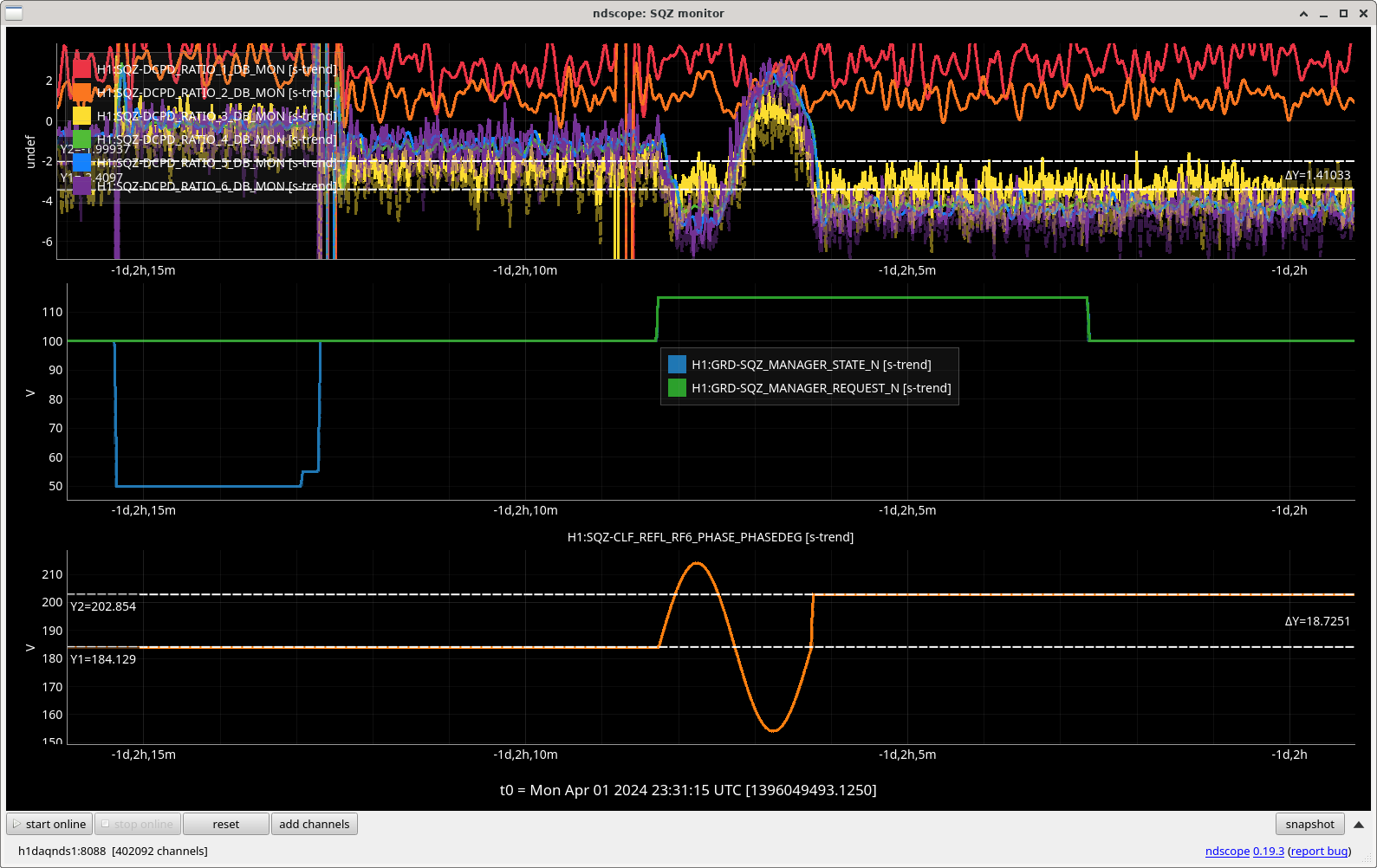
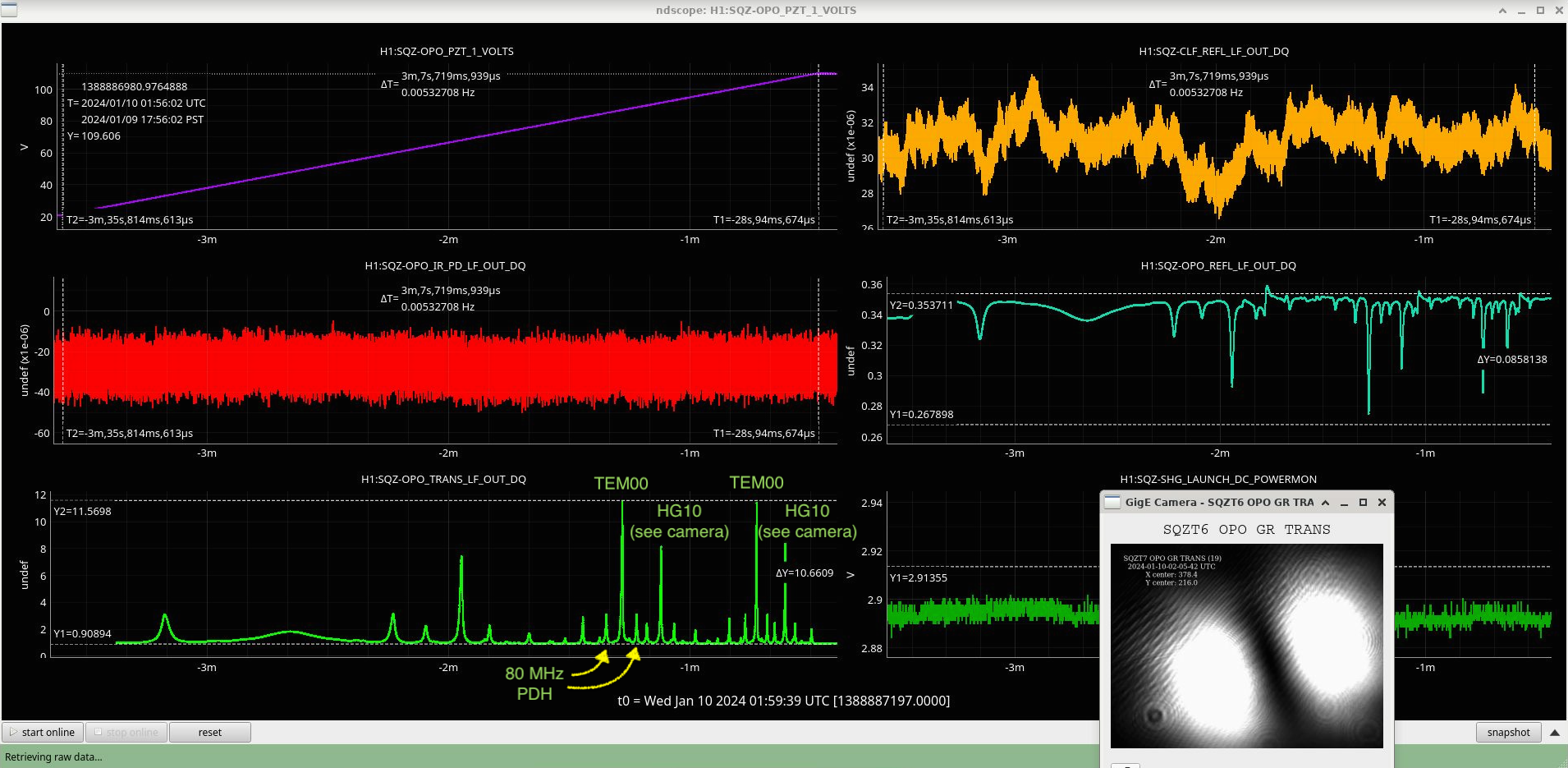
Summary:  The sqz blrms at 80 Hz became worse October 27th and we may be able to improve the sensitivity in that band by adjusting the FC detuning.  We do not know exactly why the high frequency squeezing was restored to a better and more stable level last night.  

The first attachment is a set of SQZ BLRMs trends from the last month.  Focusing on the blue line (1.7kHz BLRMS) you can see that the crystal move on Oct 17th increased the level of squeezing available, but also caused the squeezing level to be less stable. This frequency band doesn't contribute much to the range, but you can see that the squeezing level at 1.7kHz seems to correlate with the range, presumably because it tracks the mid frequency squeezing level.  

On October 27th, Naoki centered the beam on FC2 73777, and the 80 Hz BLRMS (red trace) jumped up to +1.5dB, indicating that the squeezer is degrading the low frequency sensitivity of the IFO.  We would like to try adjusting the FC detuning to see if we can get back to the earlier performance. 

Looking at the second attachment, (again focusing on 1.7kHz blue sqz BLRMS), you can see that since the crystal move the squeezing level has drfited as the crystal changes.  The CLF_REFL_RF6 power slowly drops over time, meaning that there is less of the generated 3MHz sideband (and less nonlinear gain).  Every time the OPO temperature is adjusted, the RF6 level steps up as the nonlinear gain is restored.  The bottom left trace shows the RLF transmitted by the filter cavity, which also increases each time the temperature is readjusted, because the generated RLF sideband is increased as the nonlinear gain is restored.  In last night's lock, the FC transmission was larger than it has been in the past month, although the CLF 6MHz wasn't especially large.  We don't know why this is, but it's interesting that it corresponds with the restored (and seemingly stable) 4.5dB of squeezing.  Other things that we've looked at to explain last night's squeezing level were AM4 alignment (shifted a few days ago and doesn't seem directly related to the improved squeezing), and the OPO PZT voltage which jumped up this morning after the IFO was no longer locked to near 100V.  

Images attached to this report
H1 SQZ (ISC, SEI, SQZ)
jeffrey.kissel@LIGO.ORG - posted 13:43, Tuesday 07 November 2023 (74066)
SQZ Laser Frequency/Phase Stabilization (SQZ-LO) Loop Servo Fast Path's VCO Calibration Turned ON
S. Dwyer, J. Kissel, D. Sigg

While finding out the best effective frequency noise estimate on the SQZ side of things, we found a VCO calibration in FM3 available on the fast path of the SQZ LO frequency servo (H1:SQZ-LO_SERVO_CTRL), which turns that out-of-loop, pick-off path into a diagnostic effective frequency noise estimate (in lambda = 1064e-09 [m] "red" light). See attached screenshot for how to find this filter bank.

While we can't quickly find any documentation/aLOG on this calibration, it makes sense to us that it has the same frequency response (a zero at ~40 Hz, and a pole at ~1.6 Hz) and roughly the same gain as the primary CARM / IMC Common Mode board servo's fast path (~237000 [Hz/V]).


    IMC VCO calibration     FM3 "VCO"   zpk([40],[1.6],237000,"n")         LHO:65175 (Updated Sept 2022)
    SQZ LO VCO calibration  FM3 "VCO"   zpk([39.72],[1.5292],260000,"n")   (Installed O3 era, we think)

I've accepted the VCO, FM3 filter as ON in the H1SQZ safe.snap SDF, and confirmed that it's either ignored or by default *also* saved to the OBSERVE.snap. 
Images attached to this report
H1 DAQ
david.barker@LIGO.ORG - posted 13:40, Tuesday 07 November 2023 (74067)
DAQ Changes Summary

DAQ Channel Changes:

Num Fast Channels Added 2*
Num Fast Channels Removed 2*
Num Slow Channels Added 226
Num Slow Channels Removed 124

* Fast channels were renamed (name, bytes, rate):

new H1:SQZ-SHG_TRANS_RF24_I_NORM_DQ 4 16384
new H1:SQZ-SHG_TRANS_RF24_Q_NORM_DQ 4 2048
old H1:SQZ-SHG_TRANS_RF35_I_NORM_DQ 4 16384
old H1:SQZ-SHG_TRANS_RF35_Q_NORM_DQ 4 2048
 

GDS Channel Changes:

The fast channels were also being sent to DMT from the GDS machines. They were renamed from RF35 to RF24.


H1 ISC (OpsInfo)
thomas.shaffer@LIGO.ORG - posted 13:39, Tuesday 07 November 2023 (74065)
Adjusted COMM beatnote on table

The COMM beatnote has been a bit low lately, and coupled with higher microseism and temperature changes, it has caused us some locking troubles. So today Sheila and I brought PR3 back to a time that had a good top mass osem alignment around 20 days ago, then we went to ISCT1 to get a better buildup by adjusting the two beam splitters circled on the table layout attached while trying to maximize H1:ALS-C_COMM_A_DEMOD_RFMON. I mainly had to move in yaw, walking a bit with both optics.
In the end we ended up with the beatnote around +3dBm.

Images attached to this report
H1 CDS
david.barker@LIGO.ORG - posted 13:20, Tuesday 07 November 2023 - last comment - 13:27, Tuesday 07 November 2023(74062)
CDS Maintenance Summary: Tuesday 7th November 2023

WP11510 h1hwsey IOC simulation

Dave:

I am running a simulation HWS-ETMY EPICS IOC on cdsioc0. This is a python pcaspy file, h1hwsetmy_dummy_ioc.py. Its channel list is a combination of those in the EDC and in the slow controls SDF. For those SDF entries with non-zero set points, the IOC sets its epics to those values to zero the difference counter.

I have undone the temporary changes made while HWS-ETMY was unavailable: green EDC with 86 disconnected channels, set tcshwssdf OBSERVE.snap values to zero.

WP11506 SQZ Beckhoff Slow Controls Code Change

Daniel, Dave:

Daniel's Beckhoff changes resulted in changes to H1EPICS_ECATSQZCS.ini and h1syscssqzsdf monitor.req files. I generated the new H1EDC.ini ready for a DAQ restart. I restarted the h1syscssqzsdf node on h1ecatmon0.

Move CDS WIFI WAP control IOC from opslogin0 to cdsioc0

Dave:

I finally got round to moving the h1_unifi_ioc code from its 'temporary' location on opslogin0 to its permanent location on cdsioc0. This was in response to some issues with nomachine which slowed my restarting this service this morning. h1_unifi_ioc runs under systemd control on cdsioc0 as user ioc, its configuration if under puppet control.

WP11514 h1sqz model changes

Daniel, Jonathan, Dave:

We installed Daniel's latest h1sqz model. This added some slow channels, and renamed two fast channels. DAQ restart was required. We discovered the two fast channels were in the GDS configuation.

DAQ Restart

Jonathan, Dave:

The DAQ and EDC were restarted for the model and Beckhoff changes above.

gds0 had an extended downtime when we found that the renamed RF35->RF24 channels were in the GDS channel list. Once we had resolved that on gds0 and gds1 the restart proceeded with no issues.


Comments related to this report
david.barker@LIGO.ORG - 13:27, Tuesday 07 November 2023 (74063)

Tue07Nov2023
LOC TIME HOSTNAME     MODEL/REBOOT
11:55:32 h1lsc0       h1sqz       <<< model restart, new DAQ INI


11:57:11 h1daqdc0     [DAQ] <<< 0-leg restart
11:57:23 h1daqfw0     [DAQ]
11:57:24 h1daqnds0    [DAQ]
11:57:24 h1daqtw0     [DAQ]
11:57:32 h1daqgds0    [DAQ]


11:58:50 h1susauxb123 h1edc[DAQ] <<< EDC restart, Beckhoff SQZ


12:08:53 h1daqgds0    [DAQ] <<< GDS got going with fixed channel list


12:11:06 h1daqdc1     [DAQ] <<< 1-leg restart
12:11:18 h1daqfw1     [DAQ]
12:11:18 h1daqtw1     [DAQ]
12:11:19 h1daqnds1    [DAQ]
12:11:27 h1daqgds1    [DAQ] <<< note, no 2nd restart needed today.
 

H1 General
thomas.shaffer@LIGO.ORG - posted 13:09, Tuesday 07 November 2023 (74061)
Ops Day Mid Shift Report

Initial alignment - For Input alignment I needed to trend IM4 and PR2 top mass osems back to where they were at the beginning of the last lock acquisition, then move PR2 a bit to get good flashes down the X arm. I also bumped up the LSC-XARM gain from 0.04 to 0.06 to help catch.

The rest of initial alignment went smooth and we will begin the main locking sequence now, with some code tests on the way up.

H1 SQZ
daniel.sigg@LIGO.ORG - posted 12:35, Tuesday 07 November 2023 (74060)
FC green delay line

The cable for the 40MHz delay line used to lock the green filter cavity, ISC_SQ_498, was moved from sqz chassis 4 slot 13 to the new sqz chassis 5 slot 10.

H1 General
camilla.compton@LIGO.ORG - posted 12:16, Tuesday 07 November 2023 (74058)
LVEA Swept

LVEA Swept following T1500386. WAP off. Noticed nothing other than what Oli noted in 73244. I thought I heard a louder fan noise in the computer HV mezzanine but Fil checked that it was just the usual noise.

Robert was still in LVEA entrance, clearing up with lights on but will turn lights off.

H1 AOS (DetChar)
geoffrey.mo@LIGO.ORG - posted 11:37, Tuesday 07 November 2023 (74056)
New O(100 Hz) coupling from h(t) to ASC-OMC
From the safety injections on 2023-10-24 it seems like three channels (not in the usual H1 channel list) have gained a coupling to h(t) in the frequencies around 100 Hz since the 2023-07-26 injections. The low-frequency coupling is not new. Here are the channels: H1:ASC-OMC_RIN_OUT_DQ, H1:ASC-OMC_B_NSUM_OUT_DQ, and H1:ASC-OMC_A_NSUM_OUT_DQ. 

Channel | Omegascans 2023-07-26 | Omegascan 2023-10-24

H1:ASC-OMC_RIN_OUT_DQ | https://ldas-jobs.ligo.caltech.edu/~geoffrey.mo/hwinj/o4/H1_20230726/omegascans/H1:ASC-OMC_RIN_OUT_DQ.png | https://ldas-jobs.ligo.caltech.edu/~geoffrey.mo/hwinj/o4/H1_20231024/omegascans/H1:ASC-OMC_RIN_OUT_DQ.png
H1:ASC-OMC_B_NSUM_OUT_DQ | https://ldas-jobs.ligo.caltech.edu/~geoffrey.mo/hwinj/o4/H1_20230726/omegascans/H1:ASC-OMC_B_NSUM_OUT_DQ.png | https://ldas-jobs.ligo.caltech.edu/~geoffrey.mo/hwinj/o4/H1_20231024/omegascans/H1:ASC-OMC_B_NSUM_OUT_DQ.png
H1:ASC-OMC_A_NSUM_OUT_DQ | https://ldas-jobs.ligo.caltech.edu/~geoffrey.mo/hwinj/o4/H1_20230726/omegascans/H1:ASC-OMC_A_NSUM_OUT_DQ.png | https://ldas-jobs.ligo.caltech.edu/~geoffrey.mo/hwinj/o4/H1_20231024/omegascans/H1:ASC-OMC_A_NSUM_OUT_DQ.png

Not sure if this is expected or worrying, but I thought I'd report it.
H1 SQZ
daniel.sigg@LIGO.ORG - posted 11:08, Tuesday 07 November 2023 - last comment - 14:29, Tuesday 07 November 2023(74053)
SHG TRANS

As part of the preparation to add a PMC to the squeezer, a new squeezer EtherCAT chassis 5 was installed. As a side effect, the RF channels with prefix H1:SQZ-SHG_TRANS_RF35 have changed to prefix H1:SQZ-SHG_TRANS_RF24, but only in the slow controls.

The slow controls for the squeezer also got a new H1:SQZ-PMC subsystem that is in an error state due to the fact that the the new chassis is not connected to the field chassis yet.

Comments related to this report
daniel.sigg@LIGO.ORG - 12:09, Tuesday 07 November 2023 (74057)

A new h1sqz model with updated channel names for SHG_TRANS_RF24 was also installed.

filiberto.clara@LIGO.ORG - 14:29, Tuesday 07 November 2023 (74072)

The EtherCAT Squeezer 5 (PMC) installed in SQZ-C1 U slots 1-3.

Serial Number: S2300256

H1 TCS
camilla.compton@LIGO.ORG - posted 09:27, Tuesday 07 November 2023 - last comment - 15:12, Tuesday 07 November 2023(74044)
CO2 rotation Stage Calibration

TJ, Camilla. After we found both CO2 output powers have been changing since the timing master swap 74025, we recalibrated the CO2 rotation stages this morning ~ 16:20UTC. Last done in September 72961

Followed the README.txt file in /opt/rtcds/userapps/release/tcs/h1/scripts/RS_calibration/. We did this with annular masks in. I'd previously tried this without using the matlab fitting code and hadn't been able to make a good fit. 

Accepted new calibration in sdf* and adjusted lscparams to request the actual values (rather than the central to annular conversion we had been doing).
tcs_nom_annular_pwr = {'X': 1.7,
                     'Y': 1.7}
Will edit the CO2_PWR guardians out_of_range checker and reload, currently TJ is looking at adding bootstrapping code to this guardian now.
 
*sdf acted a little strangely, I clicked accept on the new calibrations, realized they didn't exactly give us the correct 1.7W out so adjusted the H1:TCS-ITM{X,Y}_CO2_LASERPOWER_POWER_IN channels, these didn't show up in sdf, see attached, until I accepted the original values, then the new changes appeared. Maybe this is due to the way slow controls interacts with sdf.
Images attached to this report
Comments related to this report
camilla.compton@LIGO.ORG - 11:21, Tuesday 07 November 2023 (74055)

Maximum power measured out of each laser:

  Annular Mask Central Mask
CO2X 6.6W 3.8W
CO2Y 5.5W 3.7W

Plot attached, Aidan noted that we expect to get more power through the central mask than annular. We plan to check the mode matching going into the masks in the next couple of weeks.

Images attached to this comment
camilla.compton@LIGO.ORG - 15:01, Tuesday 07 November 2023 (74074)

TJ noticed some strangeness with the CO2X rotation stage not going back to the same place, over ~minutes. Turned H1:TCS-ITM{X,Y}_CO2_LASERPOWER_FINEADJUST to False, as PSL RS uses. And re-tuned the attached calibration, this could do with more work but will leave alone as we are relocking.

Images attached to this comment
thomas.shaffer@LIGO.ORG - 15:12, Tuesday 07 November 2023 (74075)

I've added some bootstrapping to the CO2 power guardians to approximate the adjusted power request after it reaches the initial request. This will only bootstrap on the way up, not when finding minimum power. Something that should be added is to not bootstrap if close enough, we've noticed the rotation stage will do some odd moves when very small angle changes are requested.

adjusted power request = (initial request)^2 / current power

Images attached to this comment
H1 General
oli.patane@LIGO.ORG - posted 08:01, Tuesday 07 November 2023 - last comment - 11:08, Tuesday 07 November 2023(74043)
Ops DAY Shift Start

TITLE: 11/07 Day Shift: 16:00-00:00 UTC (08:00-16:00 PST), all times posted in UTC
STATE of H1: Wind
OUTGOING OPERATOR: Ibrahim
CURRENT ENVIRONMENT:
    SEI_ENV state: MAINTENANCE
    Wind: 17mph Gusts, 8mph 5min avg
    Primary useism: 0.06 μm/s
    Secondary useism: 0.37 μm/s
QUICK SUMMARY:

Detector is DOWN and in WINDY due to high wind. Taking us to Preventative Maintanance for today's maintanence.

Comments related to this report
oli.patane@LIGO.ORG - 08:25, Tuesday 07 November 2023 (74045)

Looks like at 14:32UTC the wifi at LVEA, EX, and EY went down and haven't come back. Waiting on a CDS person to start looking into it.

Logs:

Could not connect to CDS-WAP_LVEA_STATUS  (Nov 7 14:32:24 UTC)
Could not connect to CDS-WAP_EX_STATUS  (Nov 7 14:32:24 UTC)
Could not connect to CDS-WAP_EY_STATUS  (Nov 7 14:32:24 UTC)
david.barker@LIGO.ORG - 11:08, Tuesday 07 November 2023 (74054)

Sorry I was slow getting the WAP IOC running again on opslogin0 this morning. This has prompted me to move this EPICS IOC from opslogin0 to the main cdscds0 server so it will run continuously.

H1 ISC (CSWG, PSL, SEI)
jeffrey.kissel@LIGO.ORG - posted 19:16, Friday 03 November 2023 - last comment - 14:23, Tuesday 07 November 2023(73976)
PSL Frequency Noise as measured by IMC down to 0.01 Hz; Two IFO Configs and Compared with ISI GS13 Projection of CARM
J. Kissel (encouraged by S. Dywer, D. Sigg)

Continuing along with the plan of building up a complete picture of the PSL frequency noise as a part of understanding the future *effective* frequency noise delivered via fiber to a seismic platform IFO for longitudinal control (aka SPI L, started elsewhere using the PMC LHO:73905), today I switch tactics and look at the main IFO's frequency stabilization servo. 

Today's primary metric is "IMC_F," i.e. the demodulated output of the PD in reflection of the input of the input mode cleaner, a.k.a the IMC REFL PD, which is a part of the global frequency stabilization servo (FSS) for the detector's pre-stabilized laser (PSL) frequency. For more details on how the global frequency stabilization works, check out the most recent published info on it from Craig Cahillane's paper P2100219 and Chapter 3 section 4 of his thesis P1800022. In short, it's a cascaded set of loops that use 
   - the in-vac, rigid-body ~1 m, reference cavity within the PSL, 
   - the suspended in-vac ~16 m input mode cleaner, then 
   - the common motion of the suspended in-vac 4 km arm cavities themselves 
as frequency reference, with ~300 kHz, ~60 kHz, and ~20 kHz UGF, respectively.

This IMC REFL PD's output is converted into a control signal to be pushed to the PSL laser frequency with the IMC "common mode board" analog servo. The output of that analog control filter is digitized and converted into Hz. Because the FSS + IMC + CARM bandwidths are all above 20 kHz and I'm looking at the PD's output below 1 kHz, we're very much in the "infinite gain" region of the control signal. Thus -- assuming we know the frequency actuator calibration (i.e. the voltage-controlled oscillator drive chain) -- then this control signal can be scaled directly to frequency noise without knowledge of the loop. I didn't do anything here, I'm taking advantage of the filtering that's already in place from the original 2013 characterization / calibration -- see LHO:5945 for details. I'm just reading out the channel H1:IMC-F_OUT_DQ, which is actually calibrated into kHz, and multiplying by 1e3 [Hz/kHz].

I look at this metric in two different states of the detector: 
    2023-11-03 10:53 UTC -- Reference Cavity and IMC are stability locked vs.
    2023-11-03 10:27 UTC -- just prior, when the IFO is in nominal low noise, i.e. FSS and IMC and CARM are locked

As a reference, since folks are not typically used to looking at the frequency noise of the stabilized PSL below 10 Hz, I also show the cartoon trace of the canonical frequency noise of a "free running" NPRO, 100 Hz/rtHz at 100 Hz, and falling proportionally with frequency, i.e.
    df = 100 [Hz/rtHz] * ( 100 [Hz] / freq )

This puts the "free running" PSL NPRO frequency noise, if it weren't stabilized at all, at 1e5 [Hz/rtHz] at 0.1 Hz -- i.e. the microseism.

OK, so, to the attachments. I attach four cascading plots of frequency noise where I'm adding more and more traces to the same plot as the plot number increases. Open them all up in tabs, and then walk through them slowly as follows:
(I) 2023-11-03_H1IMC_F_FrequencyNoise_01.png -- this shows IMC F stabilized with just the RevCav+IMC used as reference in blue. This is our starting point for building up an understanding, and I keep the NPRO free-running frequency noise in dashed sea-green. In this attachment you can already kind of guess what's happening.
    (1) Above 10 Hz, there's some noise that falls as (1/f). Littered throughout that noise, are some acoustic peaks scattered throughout. BUT
    (2) Below 10 Hz -- and particularly around 0.1 Hz we see a quite familiar shape -- that of ground motion around the microseism.

(II) 2023-11-03_H1IMC_F_FrequencyNoise_02.png -- this shows IMC F in nominal low noise, stabilized against with RevCav, IMC, and CARM used as reference. The changes actually help further ellucidate and validate the story:
    (3) Above 10 Hz, the (1/f) noise doesn't change. Fine.
    (4) Below 10 Hz, the part of the spectrum we thought was seismic is indeed changed dramatically:
        (a) The 0.5 to 10 Hz region looks to convert 
             (i) from a noisy-ish displacement noise -- that looks a lot like the shape of 0.5 to 10 Hz noise budgets from HAM2-HAM3 optic motion -- dominated by the HSTS MC1, MC2, and MC3 OSEM sensor noise re-injected through the damping loops
             (ii) to better displacement noise of optics quadruply suspended from a collection of BSC-ISIs
            retaining the the shape of first two quad longitudinal resonances at 0.43 Hz and 1.0 Hz, and then falling into the ever present (1/f) noise -- now "earlier" / lower in frequency at around 2 Hz.
        (b) Below the 0.15 Hz microseism peak, we see kinda also what we expect -- that the BSC-ISIs are re-injecting a lot of local tilt into the local longitudinal motion of each of the test masses, and is creating common longitudinal noise in CARM -- increasing the spectral density by a factor 50x, but the RMS only by a factor of 2x because the 0.15 Hz microseism peak dominates the RMS.

To further re-enforce that this is real seismic motion -- I recall that we've done a lot of work converting all ISI's GS13s -- include those of the BSC-ISIs suspended the QUADs -- into local suspension point motion -- and then even further converting those local suspension point motions into the basis of the IFO cavities.
    H1:OAF-SUSPOINT_CARM_OUT_DQ
is that ISI GS13s for the QUADs converted into local Sus. Point and then to CARM all coherently. So, if we convert this to frequency noise, via 
    >> c = 2.9989e8;
    >> L = 3995;
    >> lambda = 1064e-9;
    >> (c / (lambda*L))
        ans =
            7.0551e+10 [Hz/m]

and because the all GS13s are calibrated into nano-meters, we get the final "frequency noise" calibration of these channels as 
    >> 1e-9 * (c / (lambda*L))
        ans =
            70.551 [Hz/nm]

then we land on the black trace in 
(III) 2023-11-03_H1IMC_F_FrequencyNoise_03.png 
    I'm not gunna lie, I'm *delighted* at how well this matches up with what I expect!
    (a) in the 0.5 to 10 Hz region, comparing black to red, we confirm that the QUAD modes are amplifying the ST2 motion on resonance at 0.43 Hz and 1 Hz --and maybe 2.7 and 5 Hz.
    (b) but look at how identically matched the motion is from 0.1 to 0.2 Hz! WOW Wow wow.
    (c) We can tell though, that the GS13s themselves are not reporting real motion below 0.1 Hz -- they're are either "tilt dominated" or "self noise" dominated or something.

But, for me, this confirms without-a-doubt the thing that Daniel and Sheila "knew all along" that "at the microseism, the laser PSL frequency is just following the ARMs."
Maybe someone has plotted this up before for, but I couldn't find it. Anyways, very convincing, and very enlightening.

Finally, 
(IV) 2023-11-03_H1IMC_F_FrequencyNoise_04.png compares this BLUE and RED answer against our bigger picture question -- how does this relate to what we need for SPI L? It looks like it may meet our "bare minimum" needs, but will become interesting if we're trying to push the performance of the SPI.
     Very interesting indeed....

Anyways, just for another point of reference, I also show the ground motion at all stations in X and Y -- since this is another thing that folks are used to looking at (rather than the SUSPOINT CARM). This gives you the feel that this measurement is during a "medium" microseism day, with little-to-no wind. 
Images attached to this report
Comments related to this report
jeffrey.kissel@LIGO.ORG - 14:23, Tuesday 07 November 2023 (74071)CSWG, ISC, SEI
Attached are the data from this aLOG, exported from the DTT template:
    RED: IMC_F when Full IFO was locked, 10:27 UTC freqnoise_IMCF_FullIFO_kHz_per_rtHz_ASD.txt
    Blue Trace: IMC_F when only IMC and FSS were locked, 10:53 UTC freqnoise_IMCF_IMCFSSOnly_kHz_per_rtHz_ASD.txt
    Black Trace: OAF CARM when Full IFO was locked, 10:27 UTC freqnoise_OAFCARM_FullIFO_m_per_rtHz_ASD_use70p551Hzperm.txt

Note these data are *not* calibrated, or rather, they carry with them the calibration that came with the channel rather than the addition steps it took to get them in the same Hz/rtHz units. Once you load in the data,
- Multiply the IMCF ASDs by 1000 [Hz/kHz]
- Multiple the OAF CARM by 70.551 [Hz/m]

To recreate the DTT plot with matlab and these attached text files:
>> imcf.fullifo.kHz_per_rtHz = load('freqnoise_IMCF_FullIFO_kHz_per_rtHz_ASD.txt');
>> imcf.imcfssonly.kHz_per_rtHz = load('freqnoise_IMCF_IMCFSSOnly_kHz_per_rtHz_ASD.txt');
>> oafcarm.fullifo.m_per_rtHz = load('freqnoise_OAFCARM_FullIFO_m_per_rtHz_ASD_use70p551Hzperm.txt');
>> loglog(imcf.fullifo.kHz_per_rtHz(:,1),imcf.fullifo.kHz_per_rtHz(:,2)*1000,...
          imcf.imcfssonly.kHz_per_rtHz(:,1),imcf.imcfssonly.kHz_per_rtHz(:,2)*1000,...
          oafcarm.fullifo.m_per_rtHz(:,1),oafcarm.fullifo.m_per_rtHz(:,2)*70.551);
>> legend('IMC F, Full IFO 2023-11-03 10:27 UTC',...
          'IMC F, IMC+FSS Only 2023-11-03 10:53 UTC',...
          'OAF CARM, Full IFO 2023-11-03 10:27 UTC')
>> xlabel('Frequency (Hz)')
>> ylabel('Frequency Noise (Hz/rtHz)')

(and you can add the free running NPRO noise model, SPI requirement, and SPI goal traces to the plot by loading in the files as they are, since I generated them by hand and did so in [Hz/rtHz]. These are also attached for your convenience.)

The DTT template and this data are also committed to the SeiSVN here:
    /ligo/svncommon/SeiSVN/seismic/Common/SPI/Results/
Non-image files attached to this comment
Displaying reports 14441-14460 of 86353.Go to page Start 719 720 721 722 723 724 725 726 727 End