TITLE: 03/23 Eve Shift: 23:00-07:00 UTC (16:00-00:00 PST), all times posted in UTC
STATE of H1: Observing at 133Mpc
CURRENT ENVIRONMENT:
SEI_ENV state: CALM
Wind: 15mph Gusts, 13mph 5min avg
Primary useism: 0.05 μm/s
Secondary useism: 0.23 μm/s
QUICK SUMMARY:
Verbals still funny every hour on the hour. Great comedic timing.
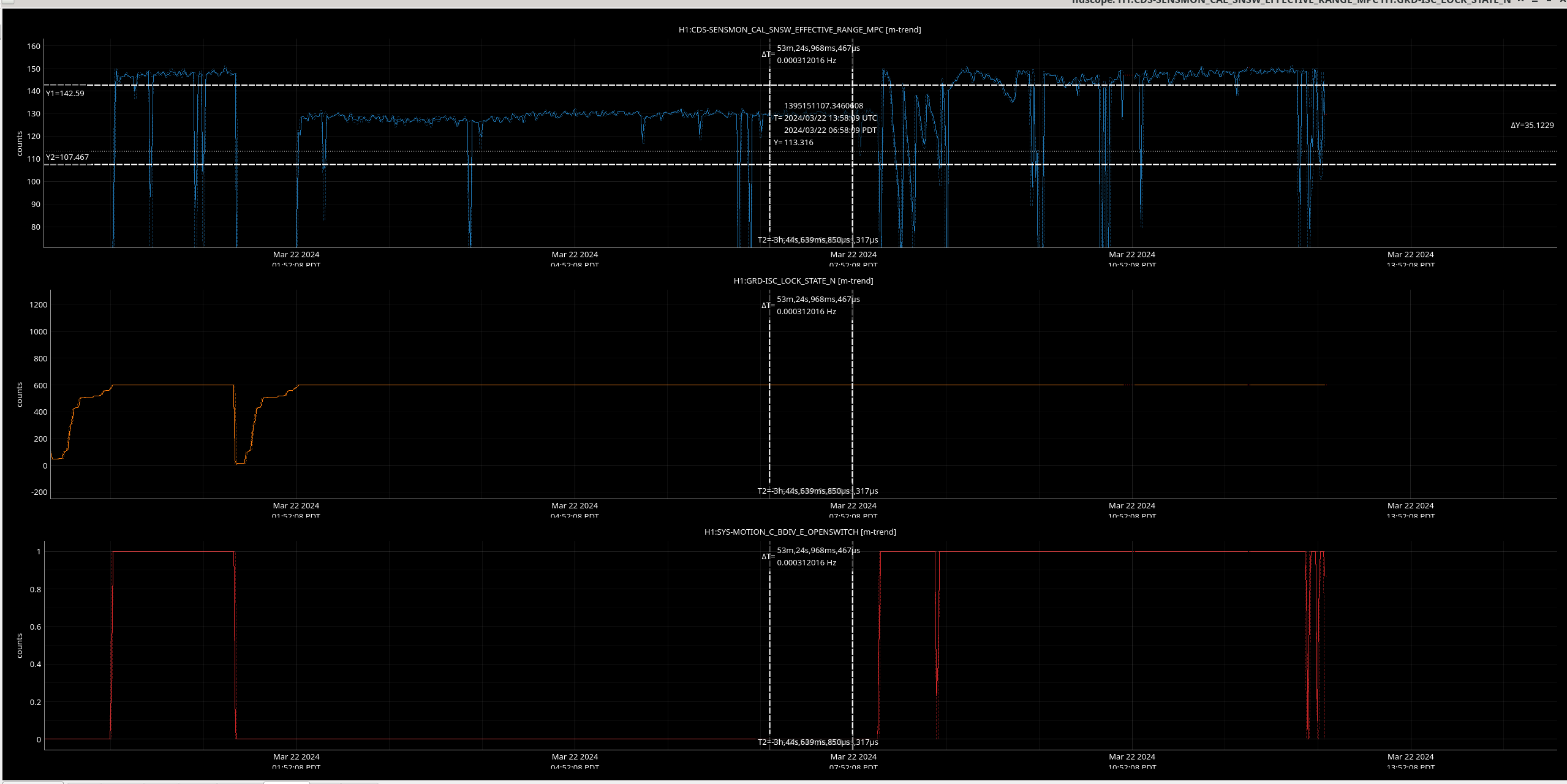
Lockloss : 2:36 UTC (GPStime: 1395196594)
The Lockloss select tool does not bring up the latest lockloss.
The newest lockloss the lockloss select tool has availible is 2024-03-21_21:15 (GPStime 1395090968)
Relocking:
Initial Alignment: I touched up ETMY in Yaw for Green arms
NOMINAL_LOW_NOISE reach at 4:09 UTC
Observing reached at 4:14 UTC
TITLE: 03/23 Eve Shift: 23:00-07:00 UTC (16:00-00:00 PST), all times posted in UTC
STATE of H1: Observing at 150Mpc
CURRENT ENVIRONMENT:
SEI_ENV state: CALM
Wind: 15mph Gusts, 12mph 5min avg
Primary useism: 0.04 μm/s
Secondary useism: 0.18 μm/s
QUICK SUMMARY:
H1 Is currently locked and OBSERVING for over 16 hours now.
Verbals is telling me jokes at the start of every hour now, which is fun. I'm not sure if this is going to continue all night or if someone is waiting for this to hit the Alogs, but I love it.
Current time: (Mar 23 0000 UTC)
The time is... joke time: My pet mouse 'Elvis' died last night. He was caught in a trap.. (Mar 23 0000 UTC)
Current time: (Mar 23 0100 UTC)
The time is... joke time: I really want to buy one of those supermarket checkout dividers, but the cashier keeps putting it back. (Mar 23 0100 UTC)
But over all everything is going fine, well except for poor Elvis.
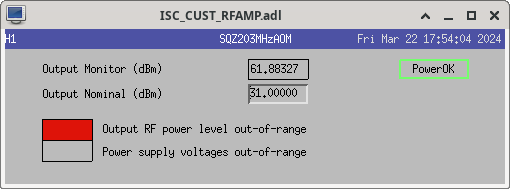
As shown in the attachment, the output of CLF second AOM is 61dBm while the nominal is 31dBm. The output increased 10 days ago when new CLF VCO is installed in 76297.
This readback is part of the CLF VCXO chassis. The new VCO doesn't have this feature, so the value is bogus.
Naoki, Sheila, Nutsinee, Daniel
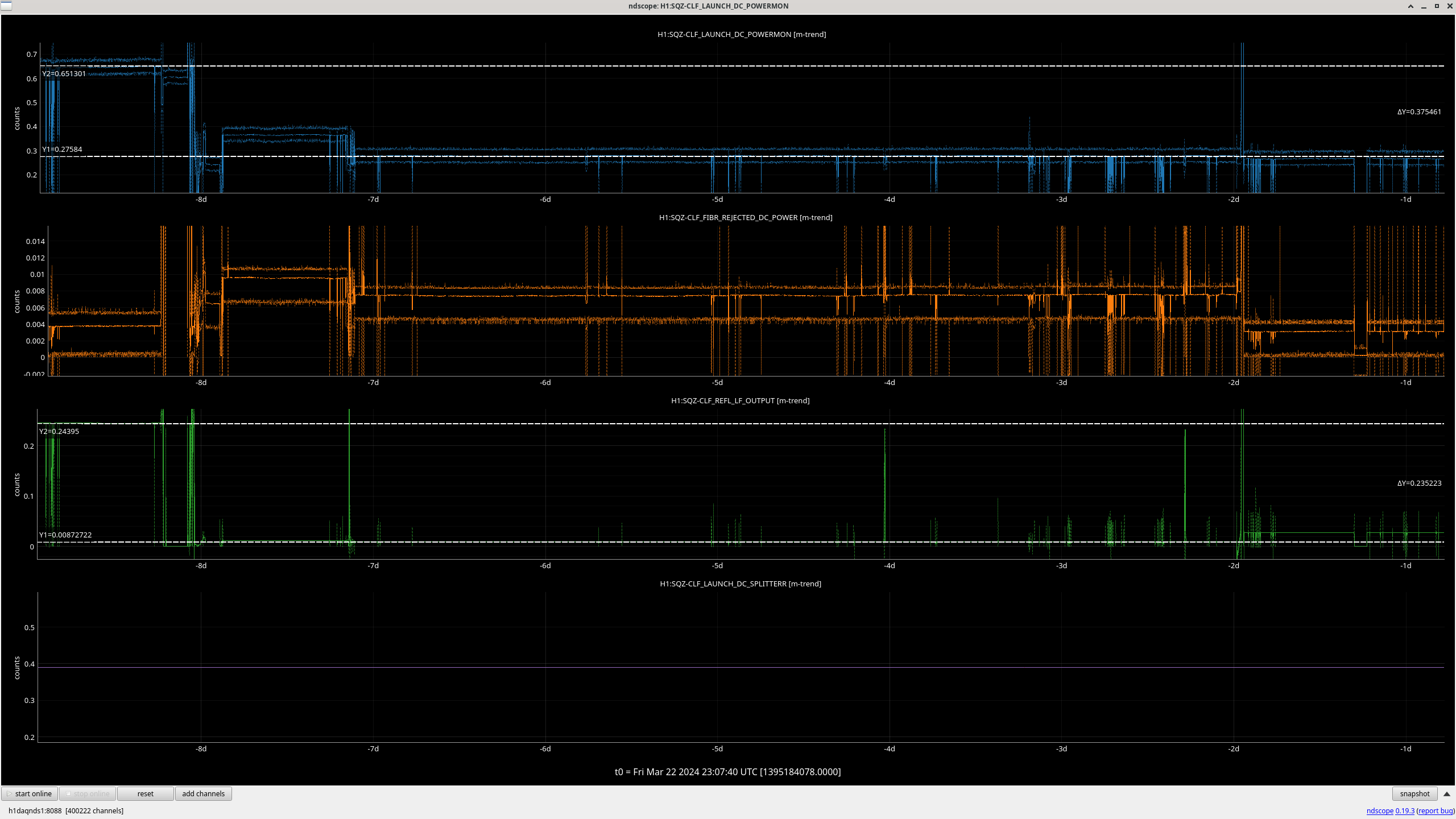
Today we found that the CLF_LAUNCH_DC_POWERMON was 270uW and the CLF_REFL_LF_OUTPUT was 30uW, which means the CLF fiber coupling is only 10%. First we thought the fiber coupling got worse so we went to SQZT0 and tried to align the CLF fiber. However, we could not improve the alignment and found that the CLF power before the fiber is 75uW, which should be 270uW according to the CLF_LAUNCH_DC_POWERMON. So the fiber coupling is 40%, which is OK, but the calibration of CLF launch PD has changed. We calibrated the CLF_LAUNCH_DC_POWERMON to 75uW as shown in the first attachment.
The second attachment shows that the CLF launch power was 650uW and the CLF REFL power was 245uW 8 days ago. We reduced the CLF power 8 days ago in 76405 and after that, the CLF launch power was 270uW and the CLF REFL power was 10uW.
Daniel pointed out it is due to the polarization contamination. The CLF launch light might have some p-pol from the imperfect PBS for CLF rejected and it is a fixed proportion of the light incident to the PBS. Since the reflectivity of BS before the CLF launch PD is different for p/s-pol, when we reduced the CLF power, the p/s-pol ratio increased and effectively changed the calibration of the CLF launch PD.
Daniel, Nutsinee
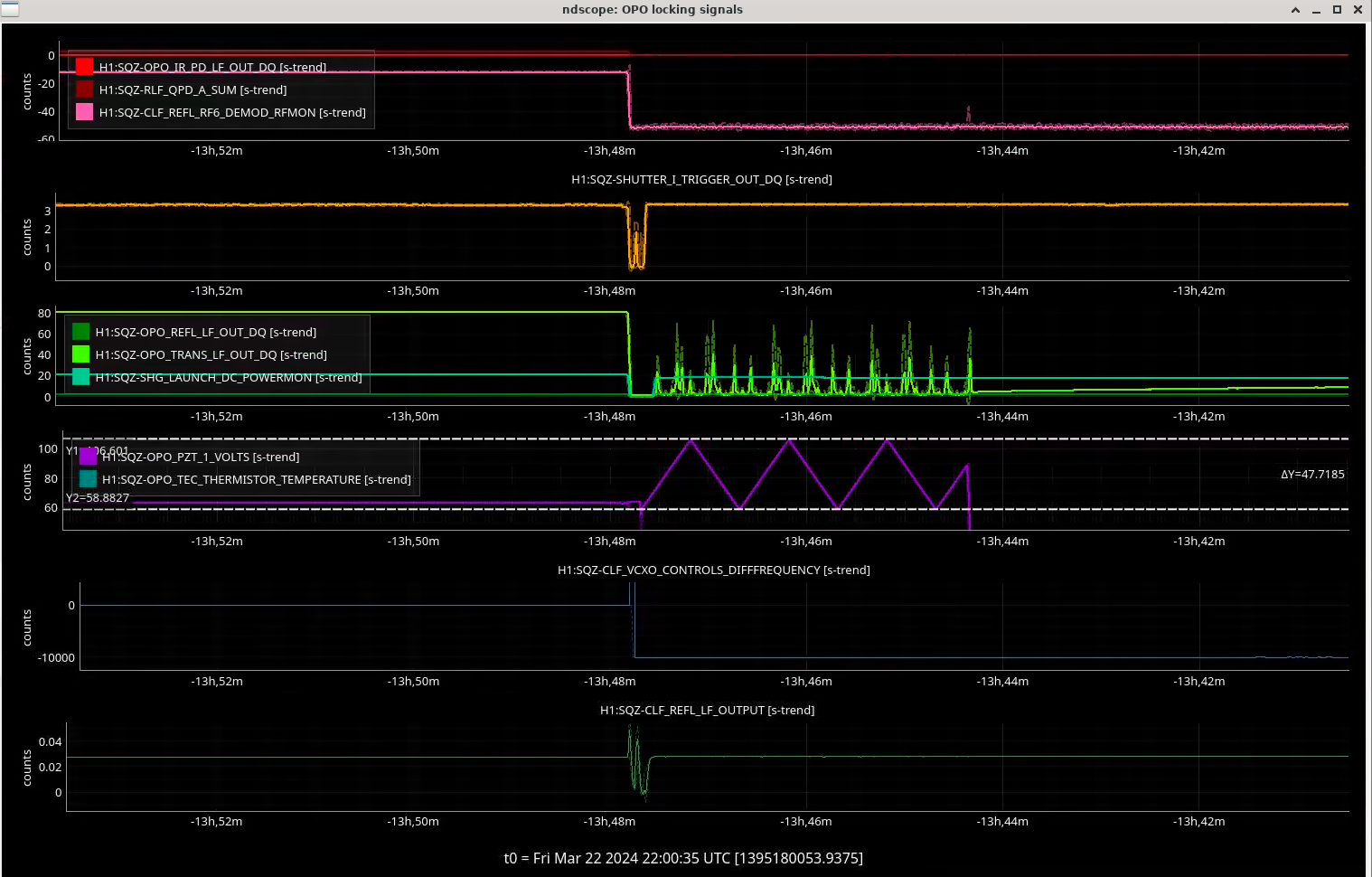
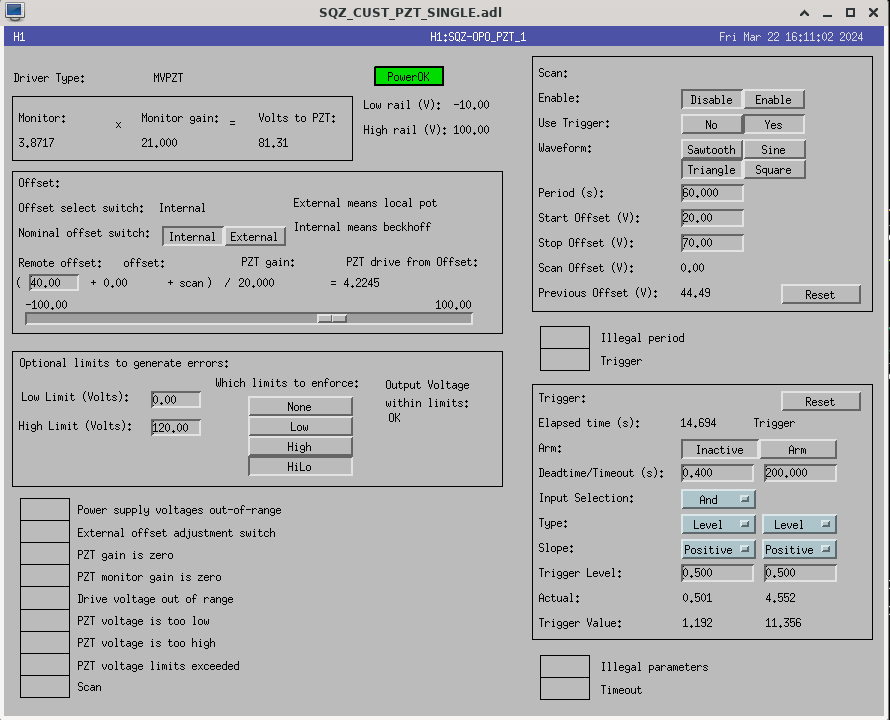
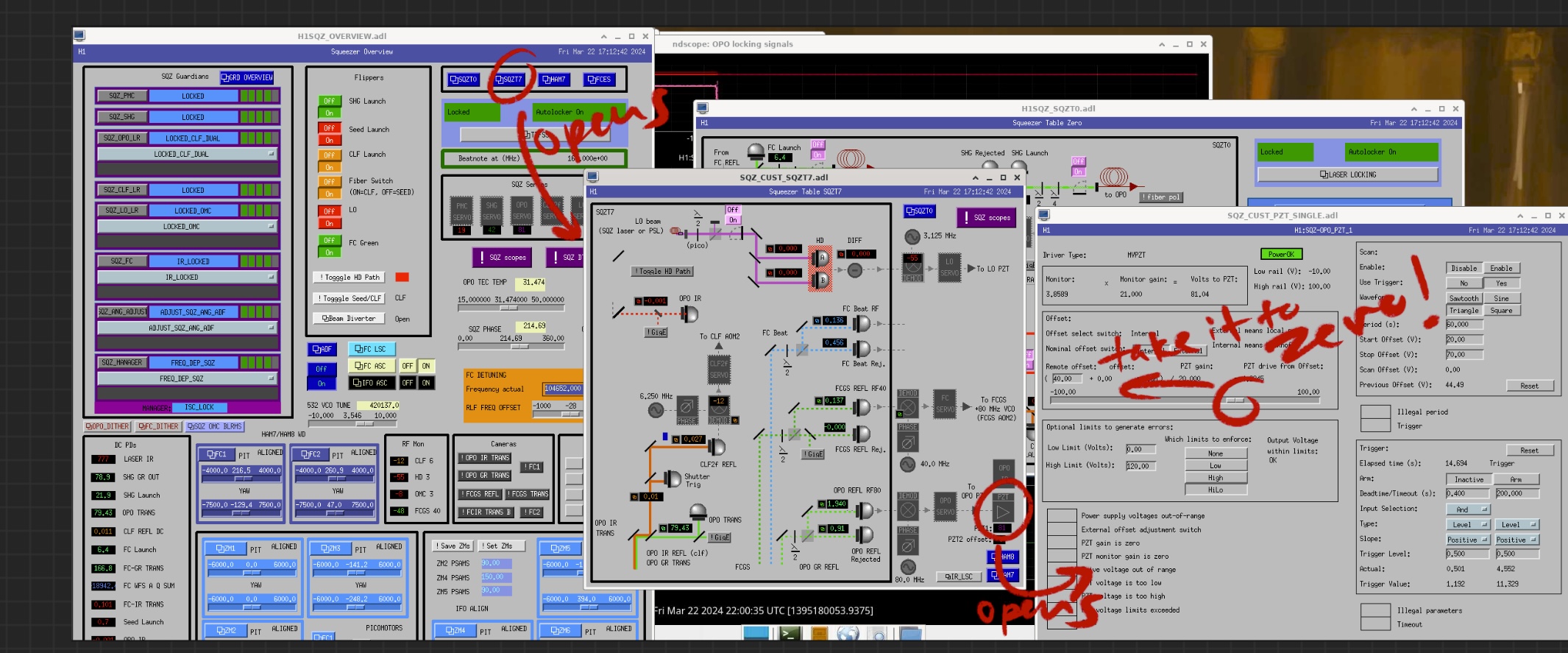
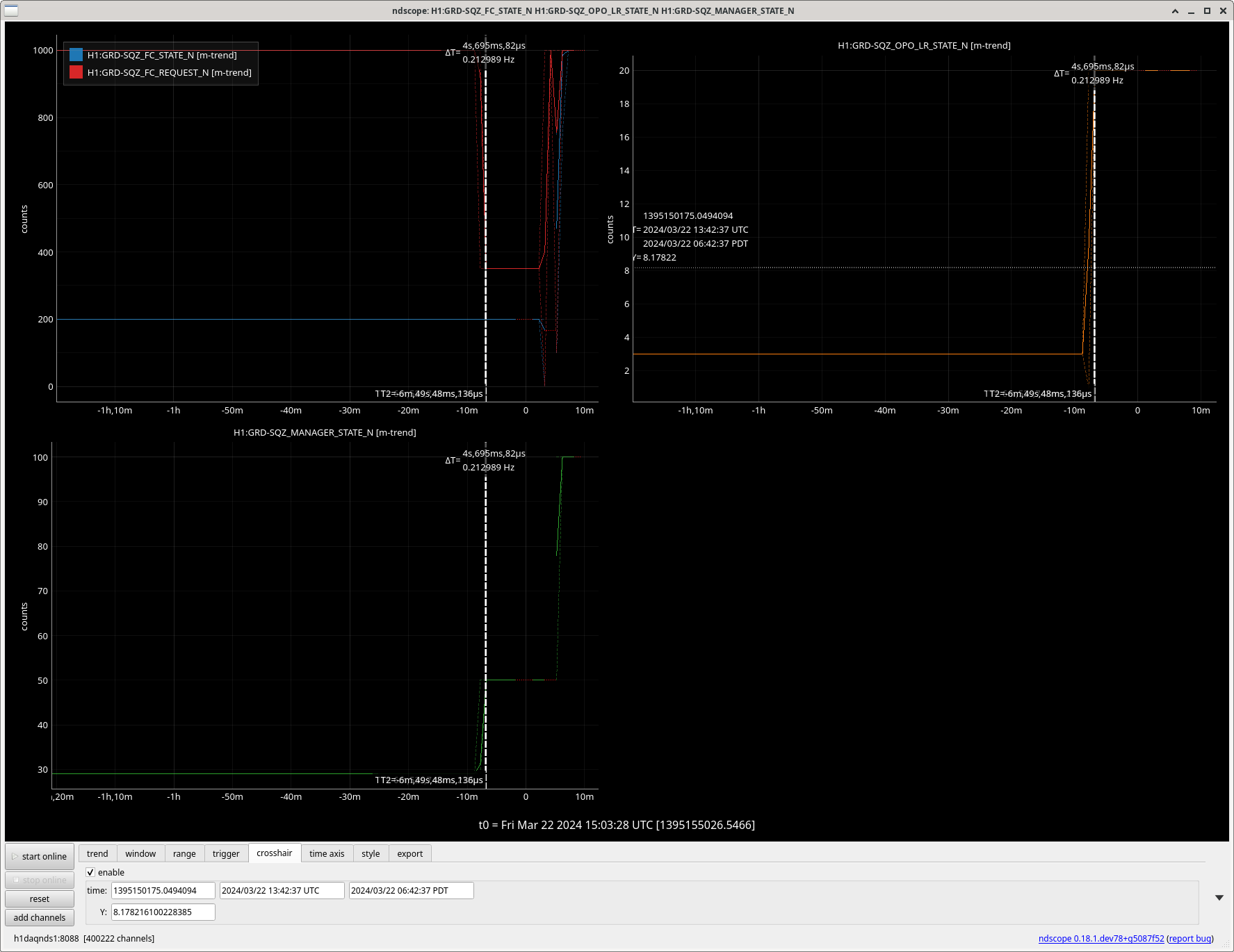
OPO didn't lock last night because it couldn't find a dual resonance. The OPO scan starts from 60V to 110V but it should have been 20 to 70V. The lock point prior to down time the dual resonance was found at 64V. We started scanning too close to the lower threshold. After several failures the OPO guardian went to idle and stopped trying for the rest of the night.
An instruction to ops:
Next time the IFO loses lock, please go to sitemap > SQZ OVERVIEW > SQZT7 > OPO PZT and drag the PZT offset slider bar to 0. See screenshot attached.
TITLE: 03/22 Eve Shift: 23:00-07:00 UTC (16:00-00:00 PST), all times posted in UTC
STATE of H1: Observing at 147Mpc
OUTGOING OPERATOR: Ryan S
CURRENT ENVIRONMENT:
SEI_ENV state: CALM
Wind: 12mph Gusts, 9mph 5min avg
Primary useism: 0.04 μm/s
Secondary useism: 0.21 μm/s
QUICK SUMMARY:
IFO was in NOMINAL_LOW_NOISE when I arrived and shortly after H1 was in OBSERVING.
The Lockclock should not be trusted for the duration of this lock because it was restarted 6 hours ago.
The Current Lock has been in NLN and above for over 14 Hours and 30 minutes.
Everything else looks good and is currently running smoothly.
Dust Monitor has the following Error:
H1:PEM-CS_DUST_PSL101 Error: data set contains 'not-a-number' (NaN) entries
TITLE: 03/22 Day Shift: 15:00-23:00 UTC (08:00-16:00 PST), all times posted in UTC
STATE of H1: Observing
INCOMING OPERATOR: Tony
SHIFT SUMMARY: H1 remained locked all shift, current stretch is at 14 hours (lock clock in control room is inaccurate for this lock), which made for lots of commissioning opportunities.
LOG:
| Start Time | System | Name | Location | Lazer_Haz | Task | Time End |
|---|---|---|---|---|---|---|
| 16:38 | SQZ | Julian | Opt Lab | Local | SHG measurements | 17:40 |
| 16:50 | ISC | Camilla, Jennie | CR | - | Noise budget injections | 18:14 |
| 17:25 | ISC | Sheila, Jennie | LVEA | - | Plugging in freq injection cable | 17:38 |
| 20:01 | SQZ | Julian | Opt Lab | Local | SHG measurements | 22:54 |
| 21:06 | VAC | Gerardo | MX | - | Picking up cable trays | 22:10 |
| 21:48 | SQZ | Sheila, Naoki | LVEA - SQZT0 | Local | Realign CLF fiber on-table | 22:20 |
| 21:50 | CAL | Francisco | PCal Lab | - | Dropping off parts | 22:03 |
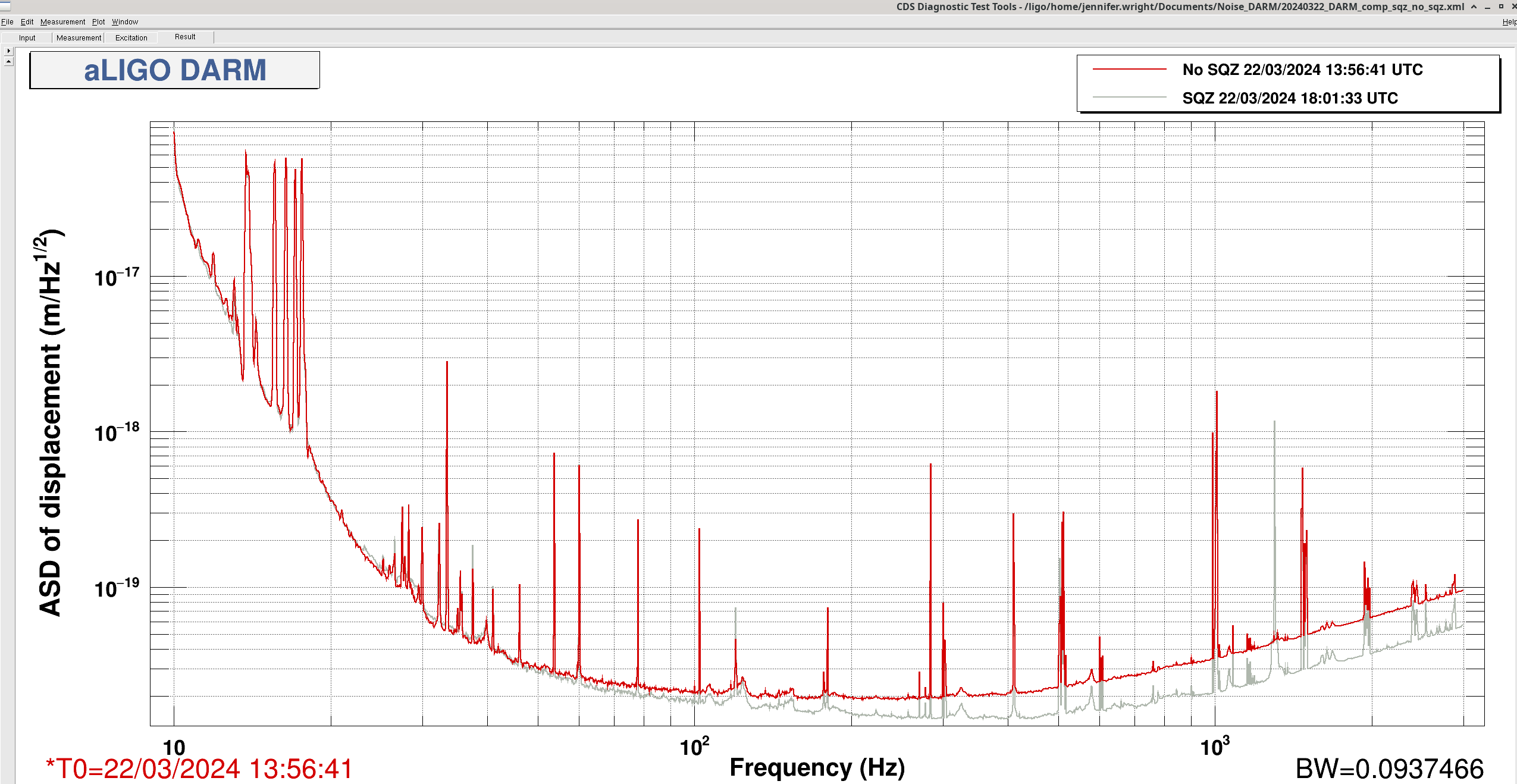
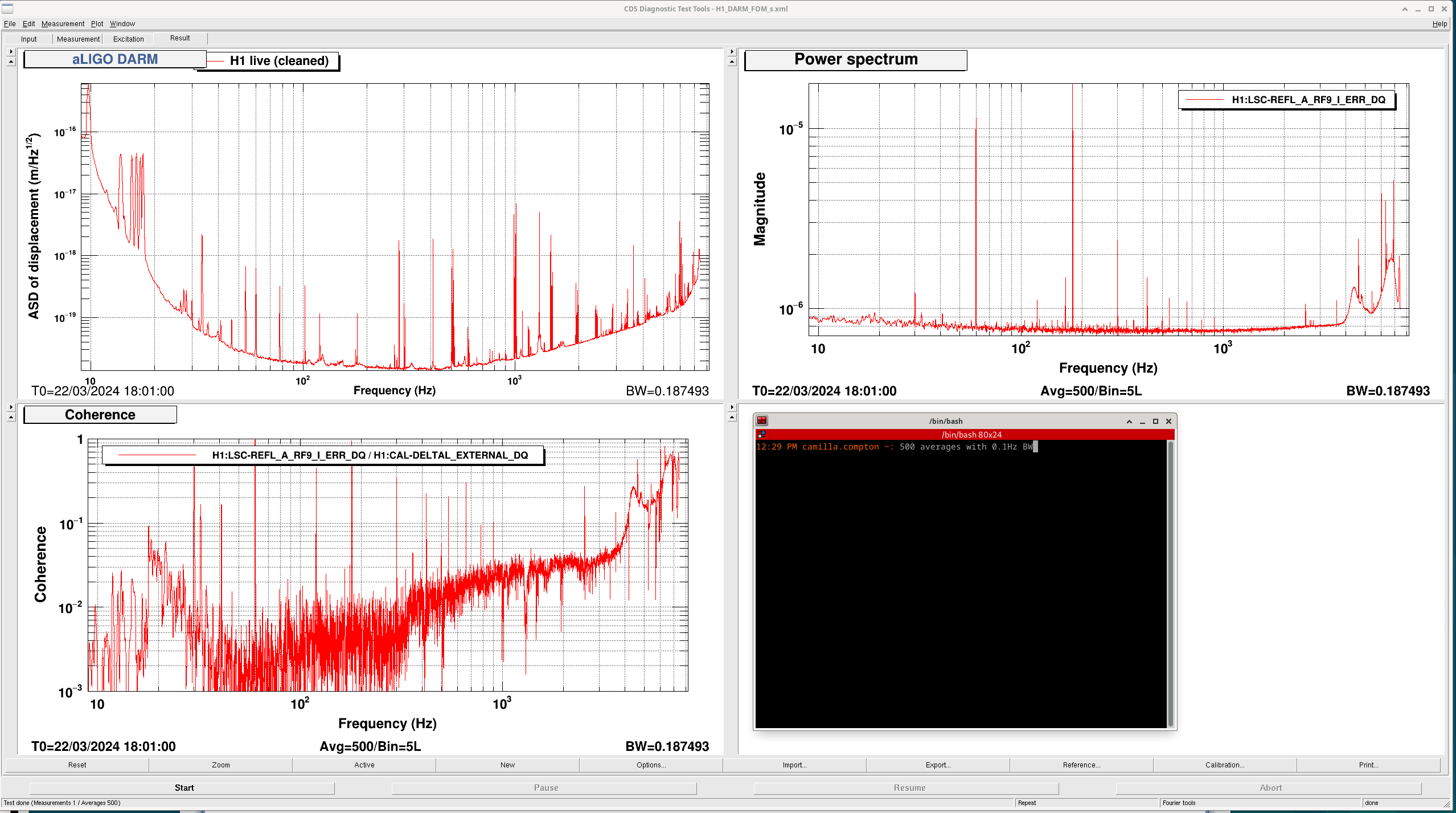
Last night due to some SQZ MANAGER issues, we had a long period without squeezing on. For future reference here is a list of NO SQZ quiet times with no glitches:
First 10 mins of a lock at NLN: GPS 1395133005
then 1395134044 - 1395139295 GPS for thermalisation period of 1 hr 28 mins with no glitches.
Then period 1395139667 to 1395146035 is 1 hr 44 mins about 2 hours into lock.
Then best thermalised period is GPS 1395151019 for 53 mins. (third image).
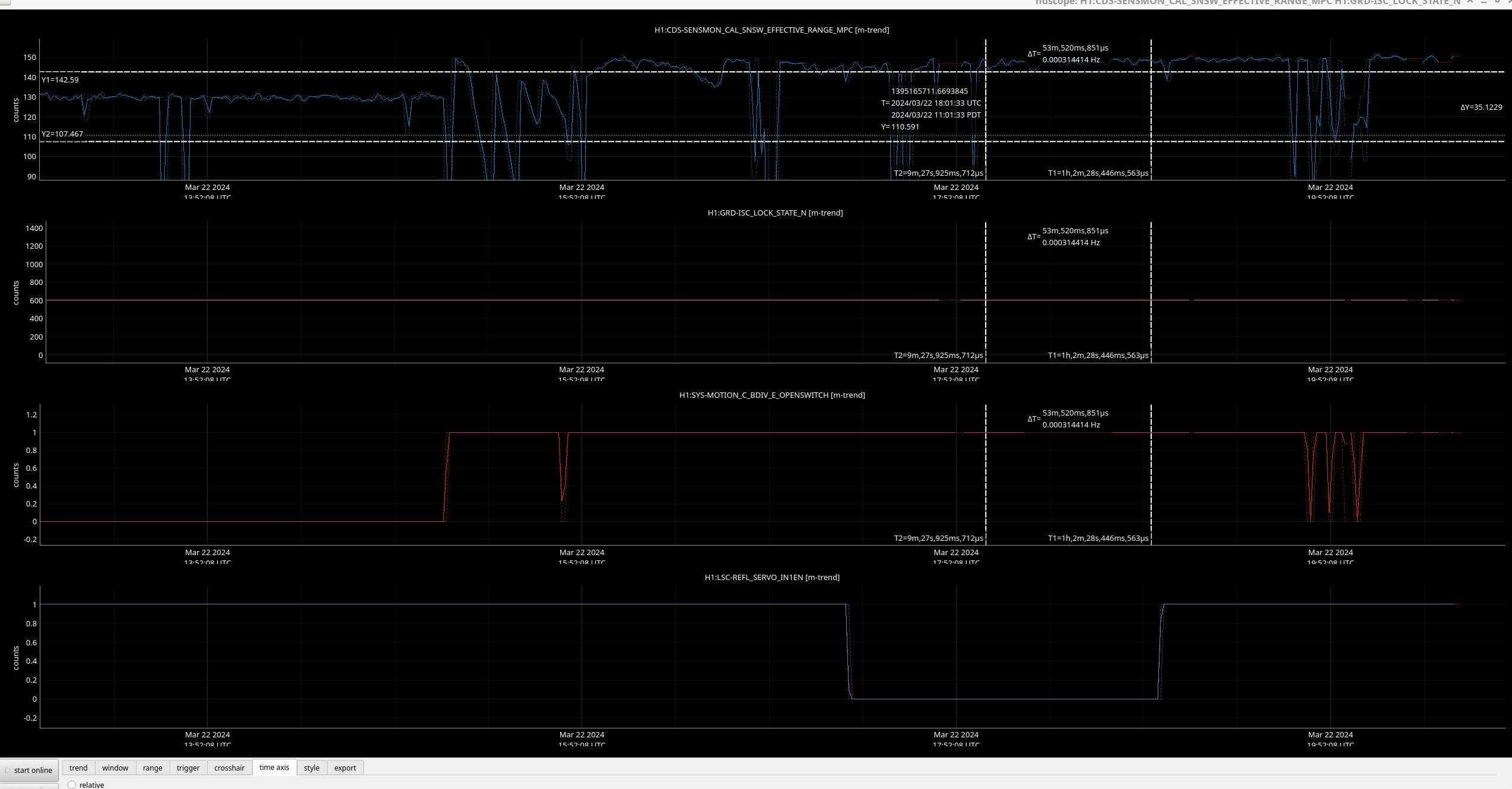
SQZ time starts at 1395165711 GPS for 53 mins on 22nd March. This was while we were doing our REFLB off test but it should be fine range-wise. (second image)
Calibrated measurement of DARM is shown in first image.
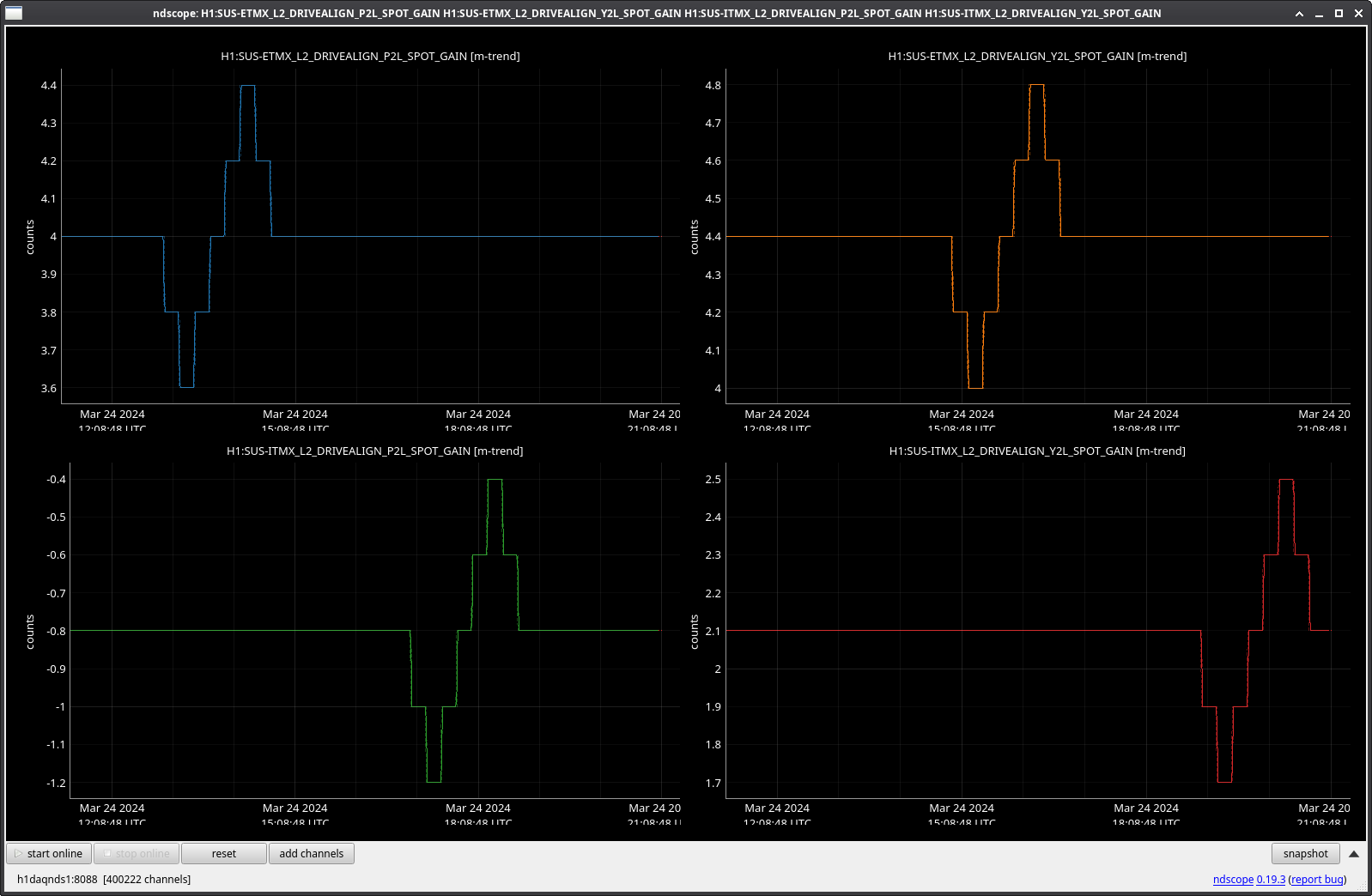
Code located in /ligo/gitcommon/labutils/beam_spot_raster/a2l_gain_stepper.py
Current spot positions (e.g. H1:SUS-ITMX_L2_DRIVEALIGN_P2L_SPOT_GAIN):
| Optic | P2L | Y2L |
| ITMX | -0.8 | 2.1 |
| ITMY | 0 | -1.9 |
| ETMX | 4 | 4.4 |
| ETMY | 4.6 | 3.2 |
It will step the nominal values up and down 0.4 in 0.2 steps / 15 minutes. e.g. starting a2l + [-0.2, -0.4, -0.2, 0, 0.2, 0.4, 0.2, 0]
I've set up a script to run this on ETMY at 6am to 10am tomorrow (23rd) in a tmux session on cdsws26, will only run if the IFO is at NLN (>=600) at 6am.
Ryan S will try to find times (4 hours each) to run this on the other optics ITMX and ETMX over the weekend, command below. We don't have beam spot control on ITMY so can skip that.
>> python /ligo/gitcommon/labutils/beam_spot_raster/a2l_gain_stepper.py ETMY --start 'now'
The ETMY A2L stepper script made it about 3/4 of the way through today; output in alog76655. We can find a time to re-run this if we need the full sweep.
Since there won't be time today before the end of commissioning allotment, I've set the A2L script to run for ETMX tomorrow morning at 06:00 PDT in the same tmux session on cdsws26.
Today I ran the A2L gain stepper scripts for ETMX and ITMX. The ETMX steps ran from 13:00 to 17:00 UTC and the ITMX steps ran from 17:03 to 21:03 UTC.
Sheila, Camilla, Naoki, remote converations with Vicky
Overnight the squeezing was not injected because of some guardian issues. The OPO failed to lock, we will look into that separately.
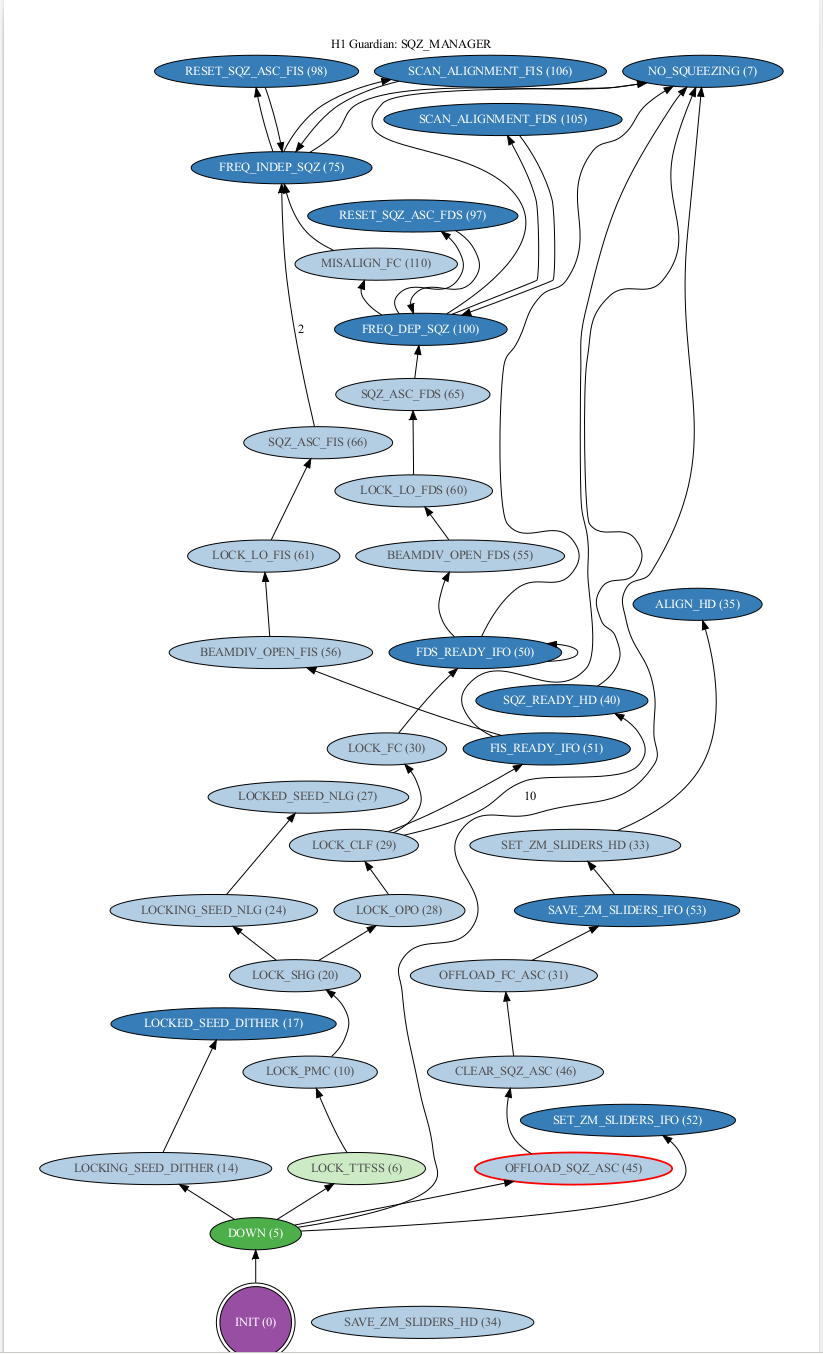
After that the filter cavity did not find IR. Looking at the logic in SQZ manager, it didn't make sense to me. We were requesting the filter cavity to IR_FOUND without first locking the OPO or the CLF, but the filter cavity can't find IR until after both the IR and the CLF are locked. This might have been done to save some time, but it sets up a race condition where we are relying on the filter cavity green locking to be slower than the OPO and CLF locking. If the filter cavity failed in it's search, then it would stay in FIND_IR and not try again. I separated the lock OPO and lock cilter cavity states, and rearranged the graph so that the filter cavity isn't requested to lock until after the CLF is requested to lock. This will take slightly longer but not much longer, and this happens in parallel with IFO locking. We loaded this change and excerised it.
While I was looking at SQZ_MANAGER, I noticed some things that seem potentially confusing and could cause some difficulties with using it. Several of these related to using the same states for frequency dependent and frequency independent squeezing. The SQZ manager was looking at the state of the FC guardian to determine if FIS or FDS is desired, in many places. I changed this so that FIS has a separate path from FDS after the CLF is locked. This allows simplifying states like OPEN_BDIV (we now have two versions, one for FDS one for FIS). Some states like LOCK_LO and SQZ_ASC are the same in the two paths, so I've used a generator to make sure that the same code is used in both paths. Naoki and I checked this, going from DOWN to FDS, FDS to FIS, DOWN TO FIS, and FDS and FIS to no squeezing. The previous version of the guardian had a path from FDS to FIS, but there was not code to do that so we've now eliminated the path. We made the changes needed to ISC_LOCK, and laoded them.
The guardian before these changes is 27284
The FC_LOCKED checker only checks that the FC gaurdian isn't in IDLE, but it seems to be used througout SQZ_MANAGER as though it was checking the filter cavity is locked.
FAMIS Link: 25983
Only CPS which looks higher at high frequencies would be ETMy Stage 1, H2 (although the terminal did not list it as "high"). (see attached plots).
FAMIS 26236
Laser Status:
NPRO output power is 1.819W (nominal ~2W)
AMP1 output power is 67.15W (nominal ~70W)
AMP2 output power is 138.3W (nominal 135-140W)
NPRO watchdog is GREEN
AMP1 watchdog is GREEN
AMP2 watchdog is GREEN
PMC:
It has been locked 21 days, 21 hr 9 minutes
Reflected power = 16.84W
Transmitted power = 109.0W
PowerSum = 125.9W
FSS:
It has been locked for 0 days 11 hr and 41 min
TPD[V] = 0.8342V
ISS:
The diffracted power is around 2.3%
Last saturation event was 0 days 11 hours and 41 minutes ago
Possible Issues: None reported
After the 76623 frequency noise injections, we left CARM control just on REFL B (H1:LSC-REFL_SERVO_IN1GAIN = 12dB) rather than the nominal 6dB on both REFL A and B. Kept the REFL B only config from 17:39UTC to 18:58UTC.
Plan to look for coherence between DARM and REFL A to check for frequency noise on REFL B (when REFL A is out of loop, acting only as a witness). Plot attached shows no coherence in 100Hz to 1kHz region above 0.04.
Test was maybe redundant after Francisco's 76533.
As shown in the attachment, I turned on the beam spot control. The flag of the beam spot control in sqzparams is set to True. The beam spot control seems working well, but I feel the yaw was too slow so I removed the -20dB gain (FM7 in INJ_ANG_Y). I will tune the green QPD offset with FC2 dither tomorrow.
I tuned the green QPD offset as shown in the attachment. The FC IR trans is 0.1 with -12dBm CLF6 now, but it was 0.1 with -26dBm CLF6 in O4a so it is better to align the IR trans PD.
I tuned the green QPD offset a bit.
EvanH, FranciscoL
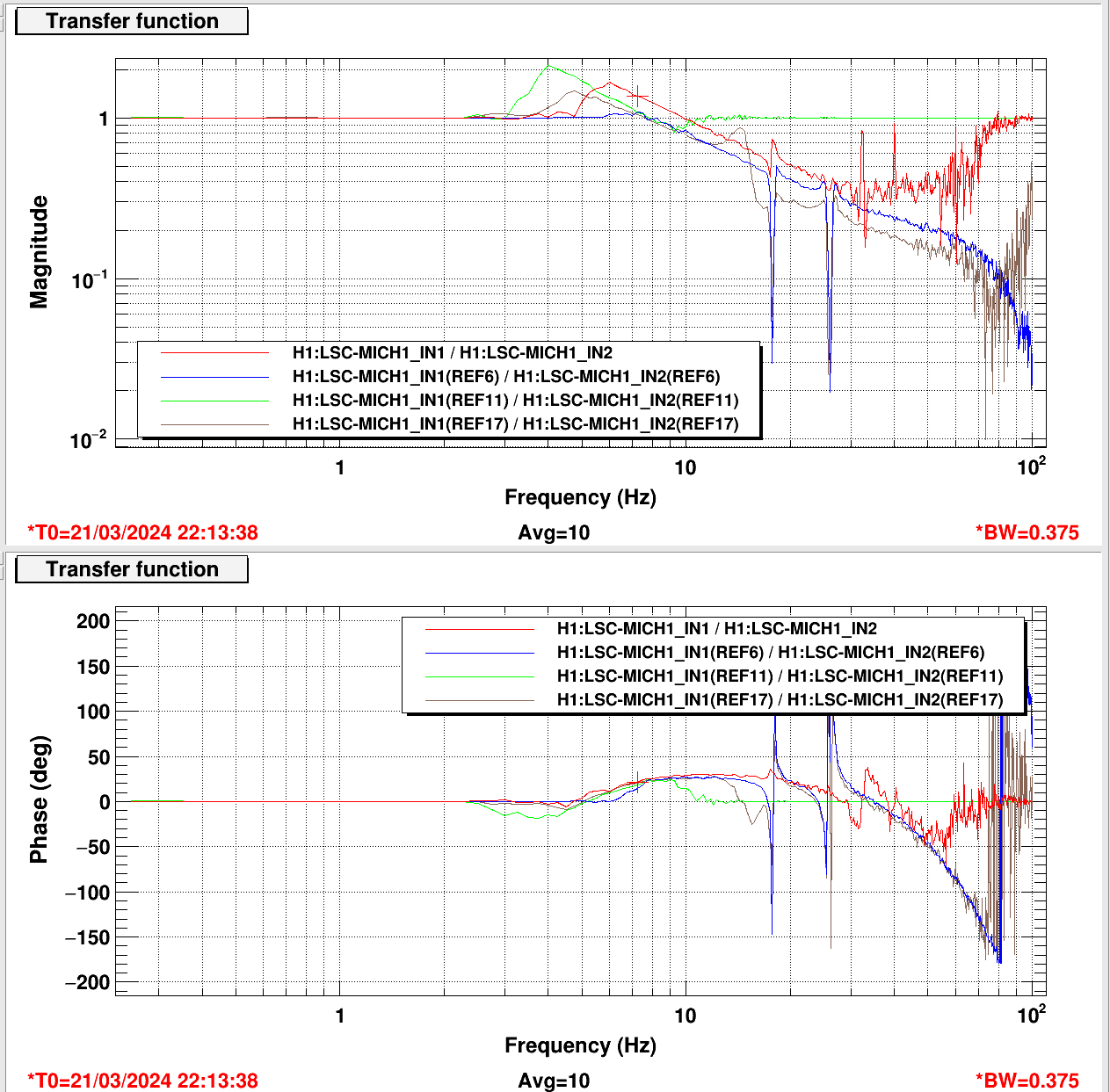
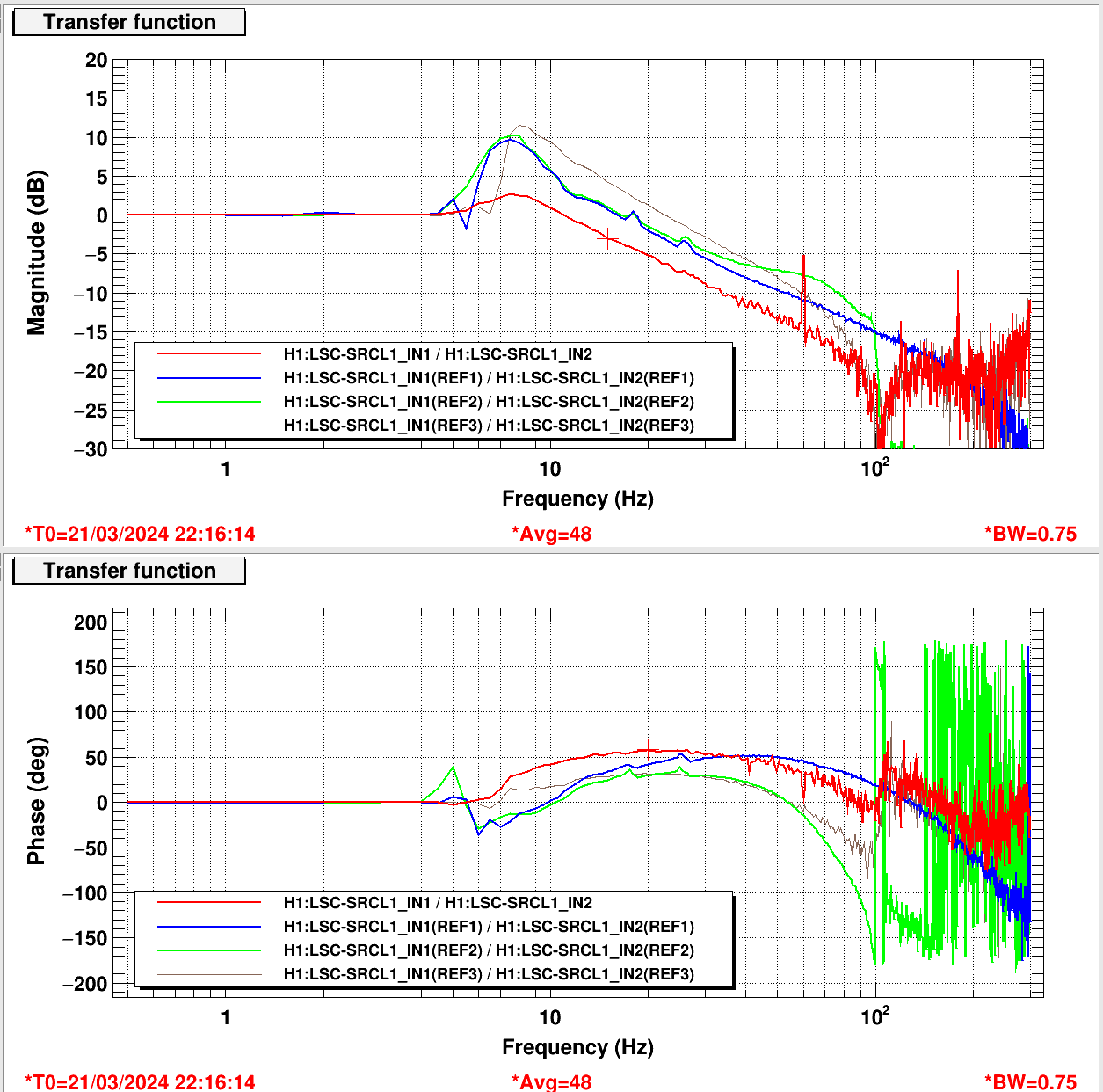
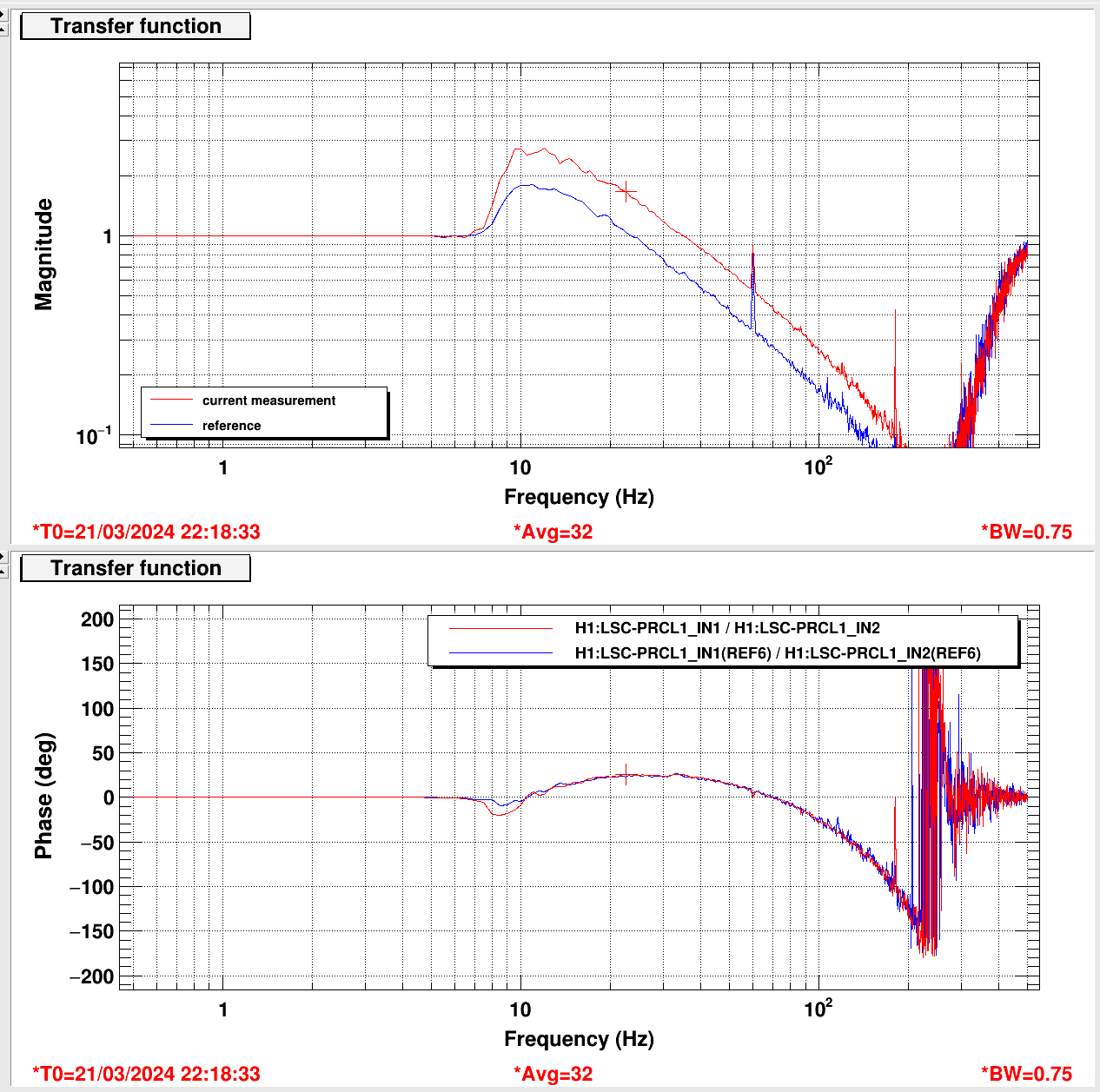
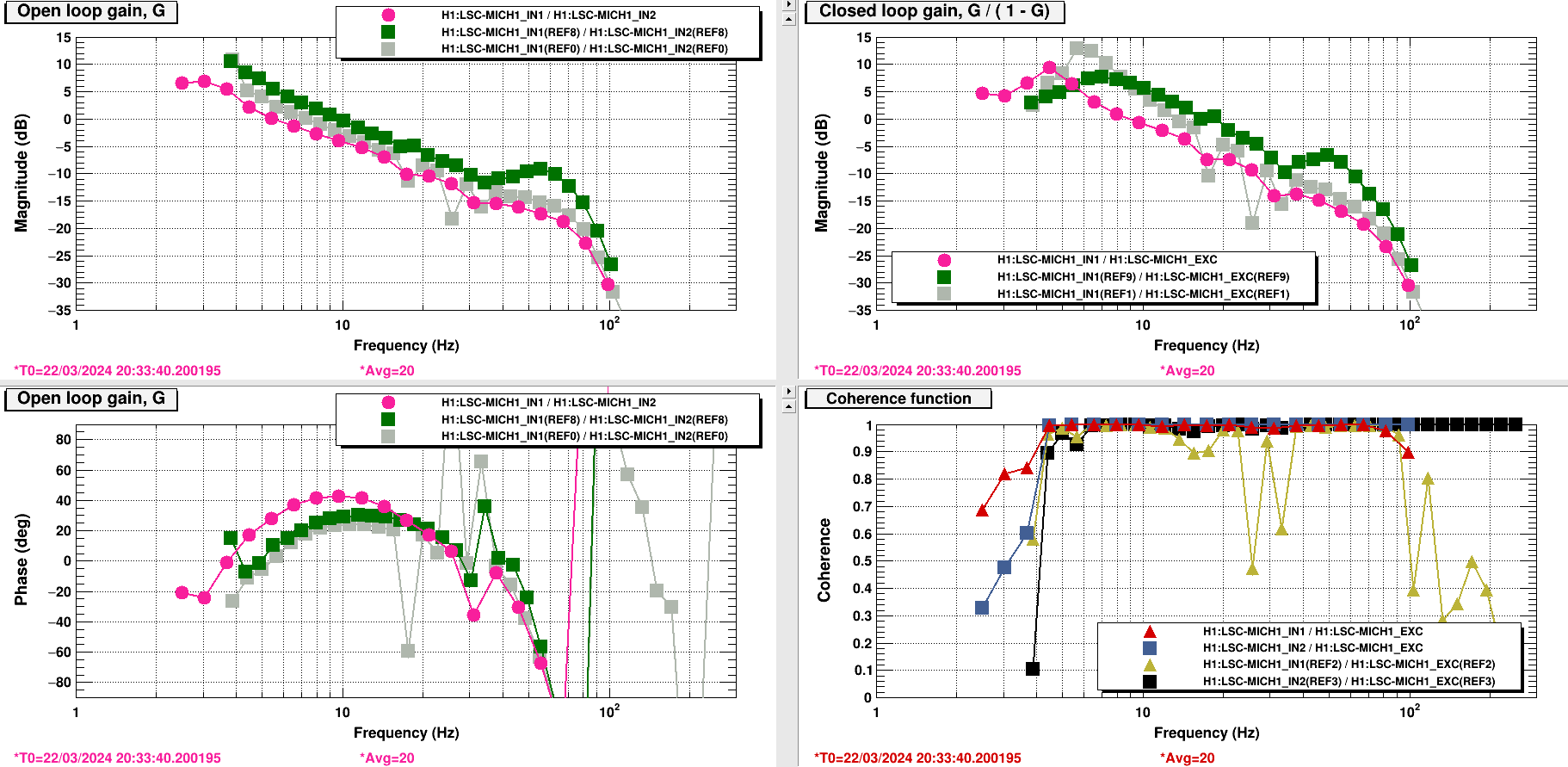
Because we've been loosing lock for unknown reasons, we measured OLG transfer function of MICH, SRLC, and PRLC. The UGF for each one is (see attached figures for reference) roughly
MICH: 10 Hz
SRCL: 12 Hz
PRCL: 35 Hz
We may want to lower the MICH UGF to avoid cross coupling with the SRCL loop.
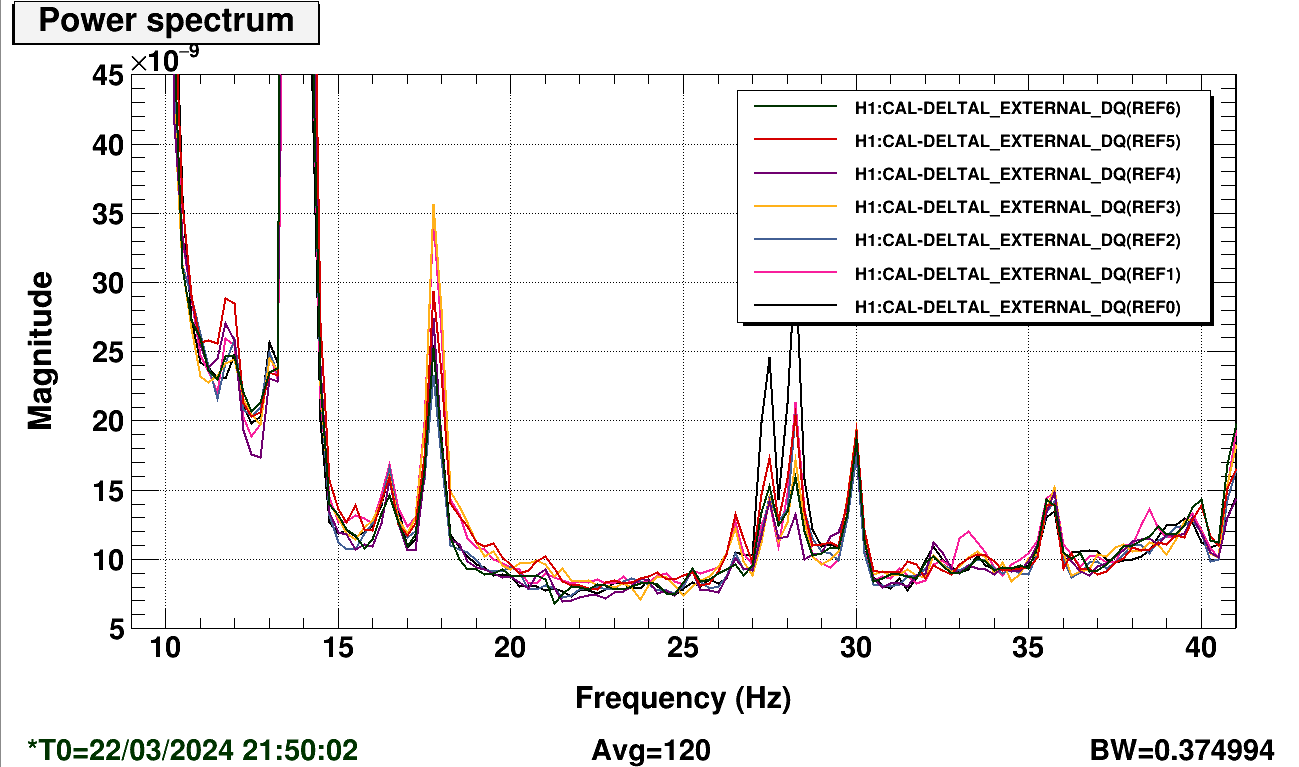
The Michelson loop is probably showing a cross-coupling with either PRCL or SRCL. The attachment shows a hump in the OLTF around 60 Hz that scales nonlinearly with overall loop gain changes. Green is the current situation, with the UGF close to 10 Hz, which is also where the SRCL UGF is.
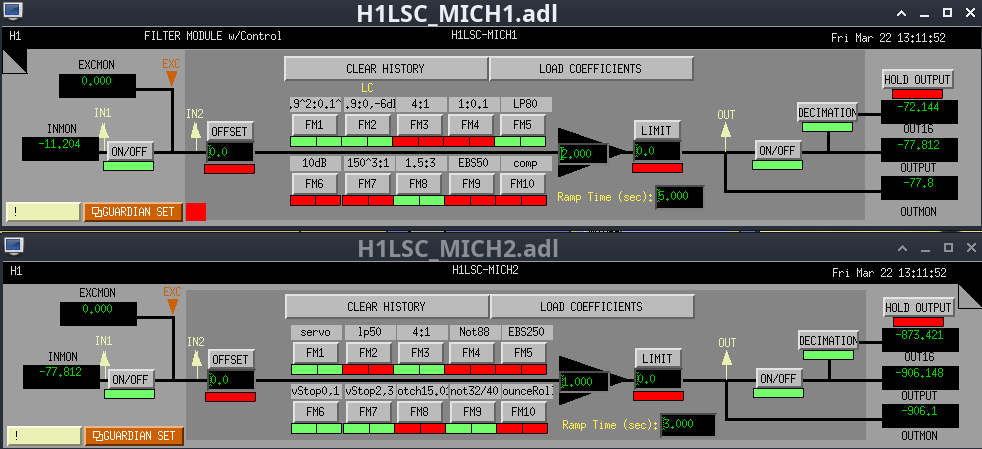
Recall that we had previously reduced the Michelson UGF and applied some antiboosting, but this was reverted during higher-power operation. I am now more or less restoring this reduced UGF operation (UGF 5.5 Hz, antiboosting that amounts to 6 dB less gain below 1 Hz). This uses LSC-MICH1 FM8. The new OLTF is pink in the attachment.
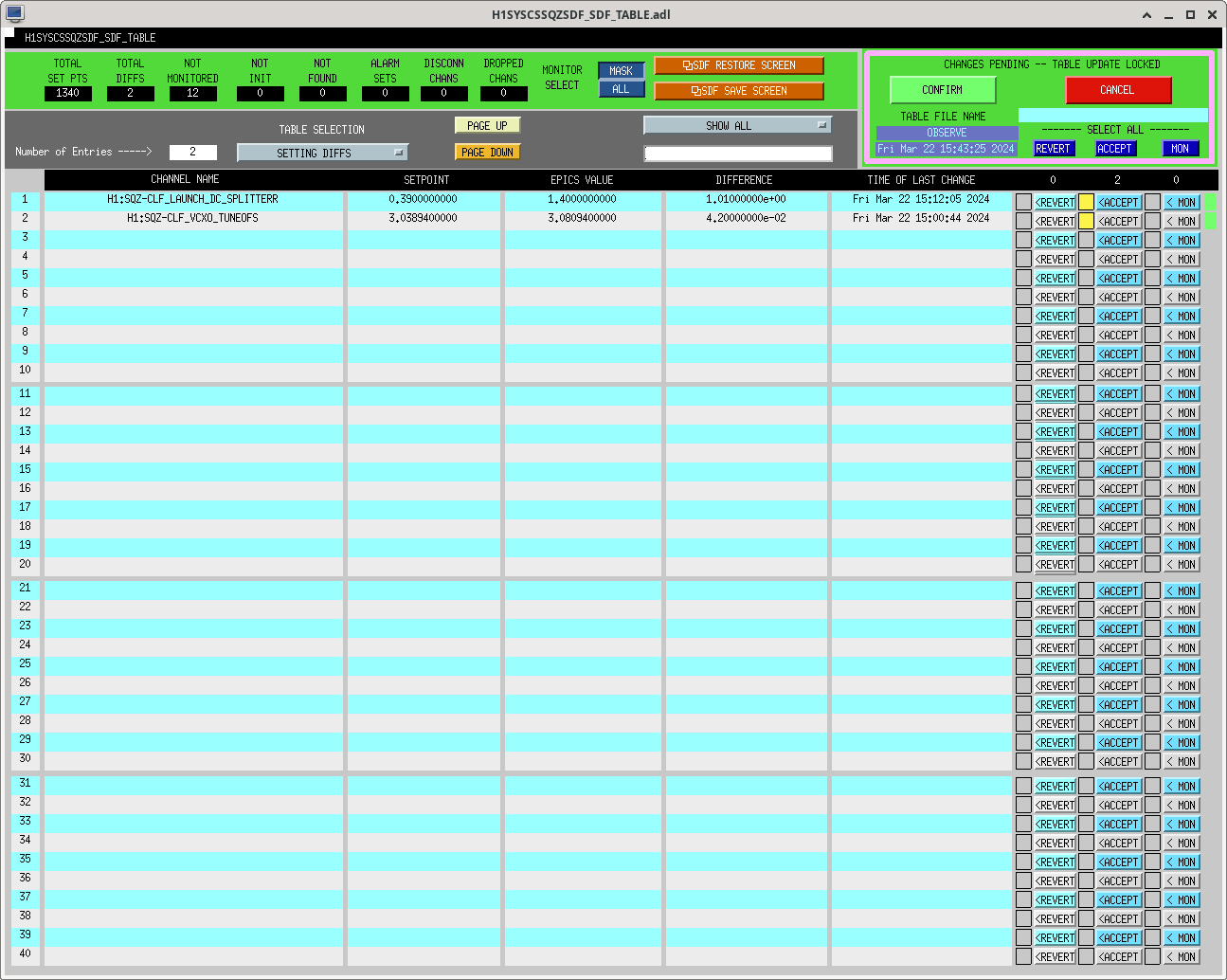
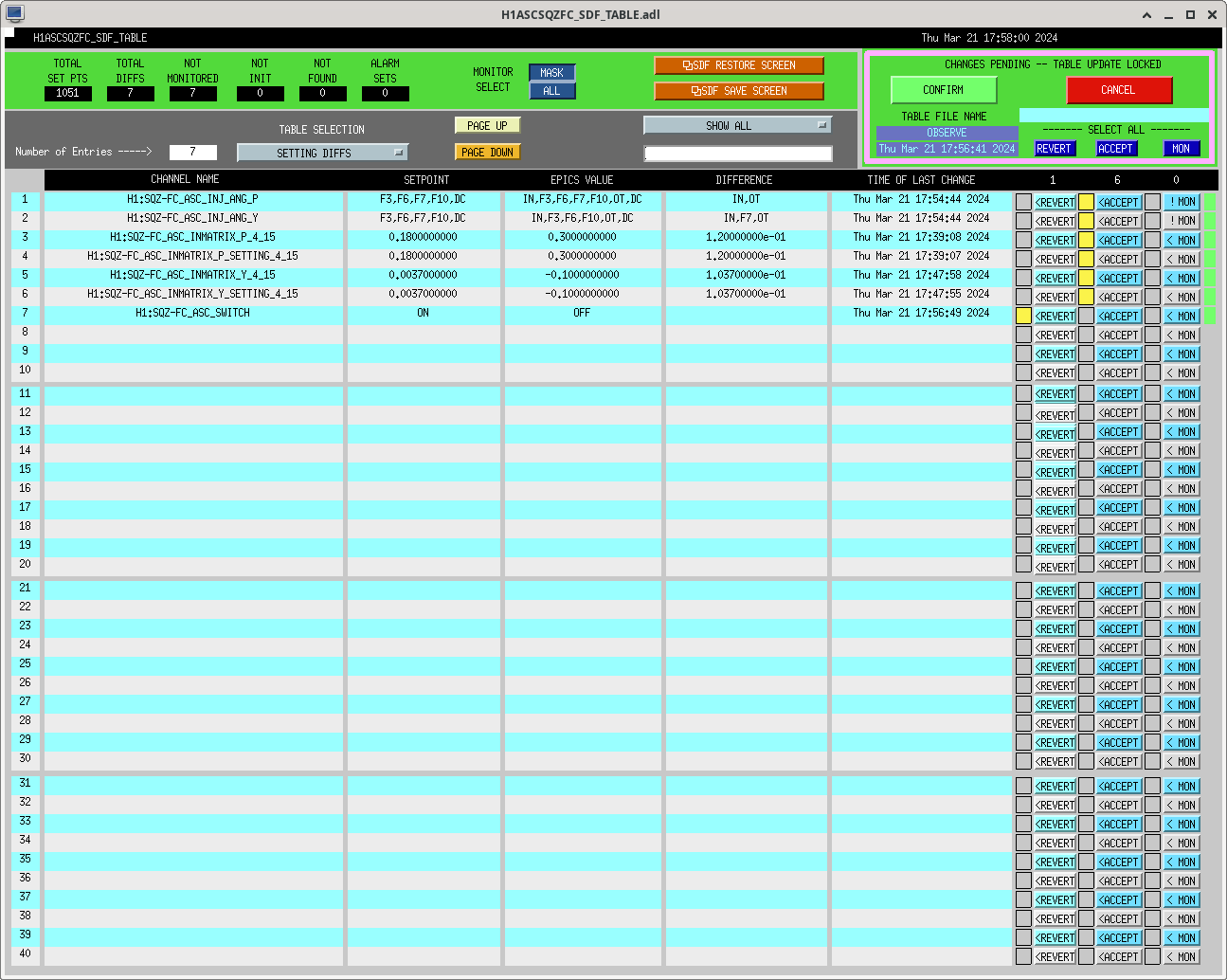
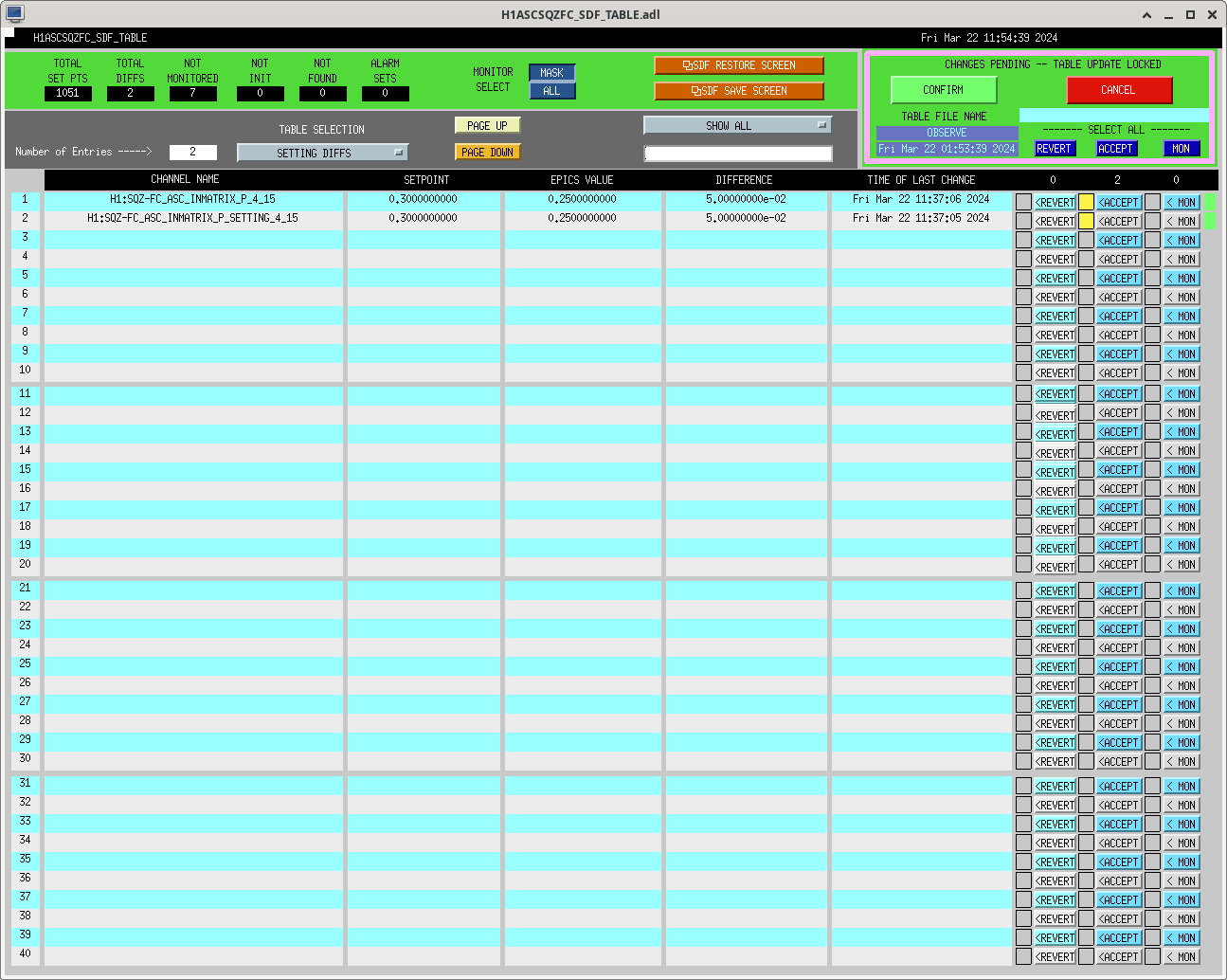
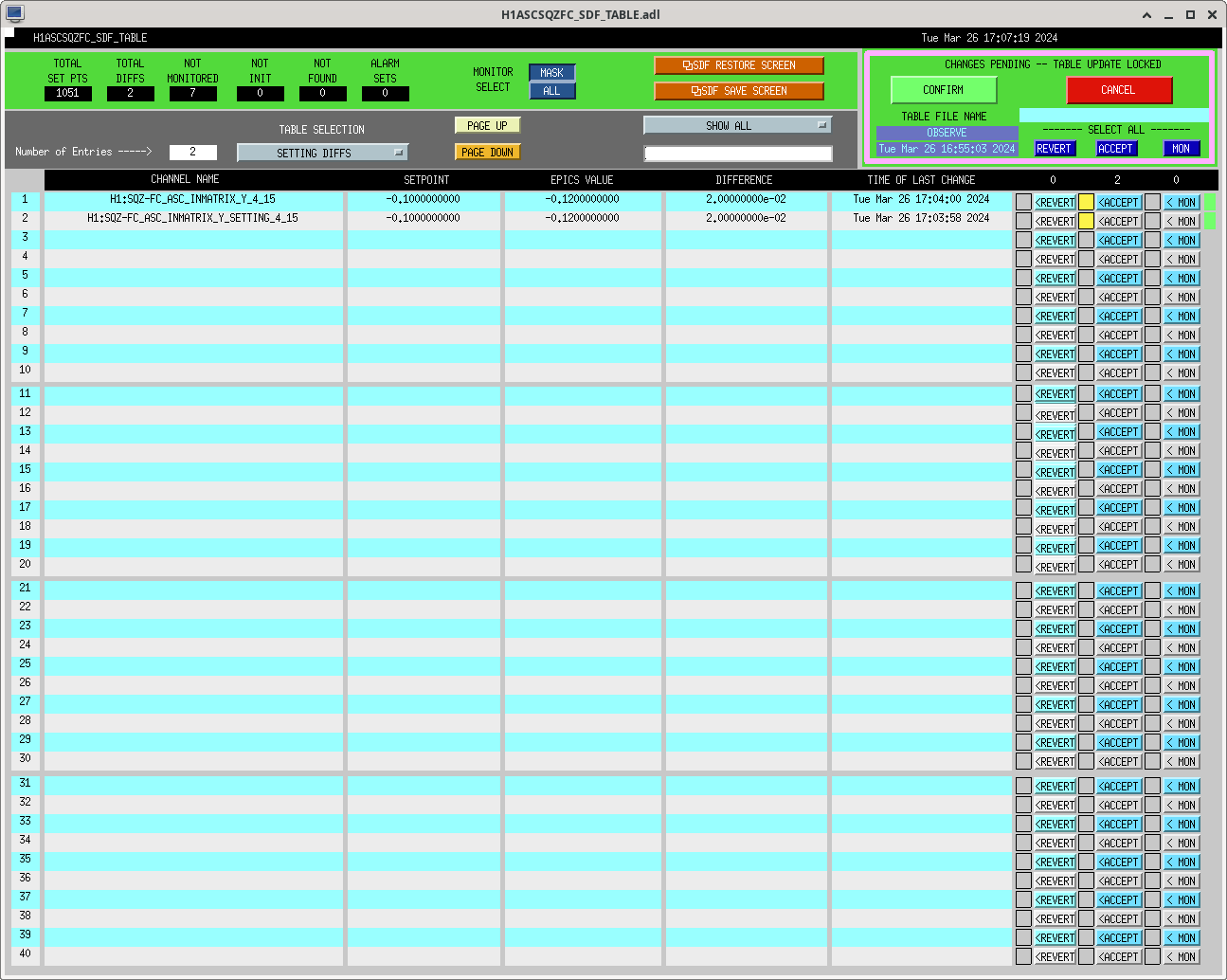
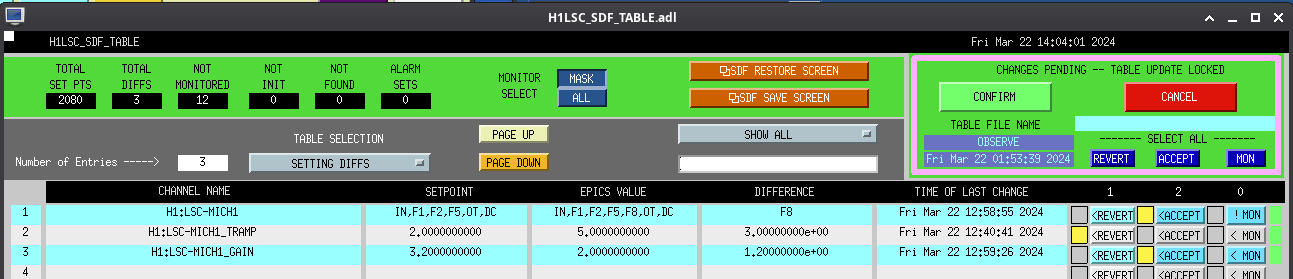
SDFs in OBSERVE.snap table on the LSC model following Evan's work. New filter and gain accepted, ramp time reverted.
On/off testing shows some mild improvement in the 18–23 Hz region, possibly because of less drive around the BS bounce mode. We may want to re-engage the bounce/roll notches in this length loop.
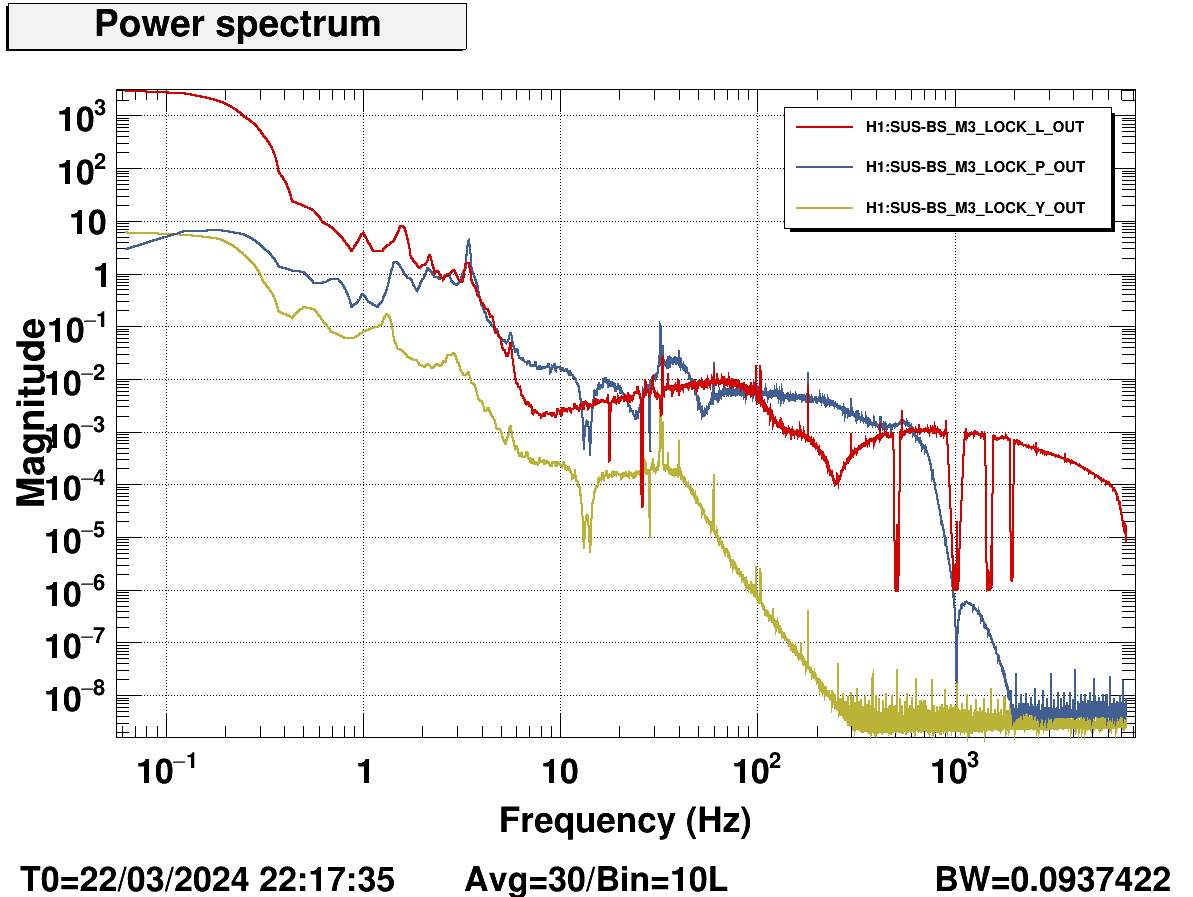
Also, it seems like the drive to the BS coils above 10 Hz is actually dominated by pitch drive. Someone may want to redo the plant inversion for the ASC-MICH_P loop, as it appears to be much more aggressive than the yaw loop.
Regarding the ASC MICH P drive, I was looking into updating the filter and realized there is a sneaky 17 Hz low pass filter on BS M2 Lock P and Y. Gabriele and I did not take this filter into account when redesigning the MICH ASC filters (69370). Just adding this additional filter into the model shows quite a bit of gain peaking around 3 Hz. I'm not sure if that's actually the big problem here, but clearly this could use a redesign. I'll work on it, and also check the MICH Y control design.
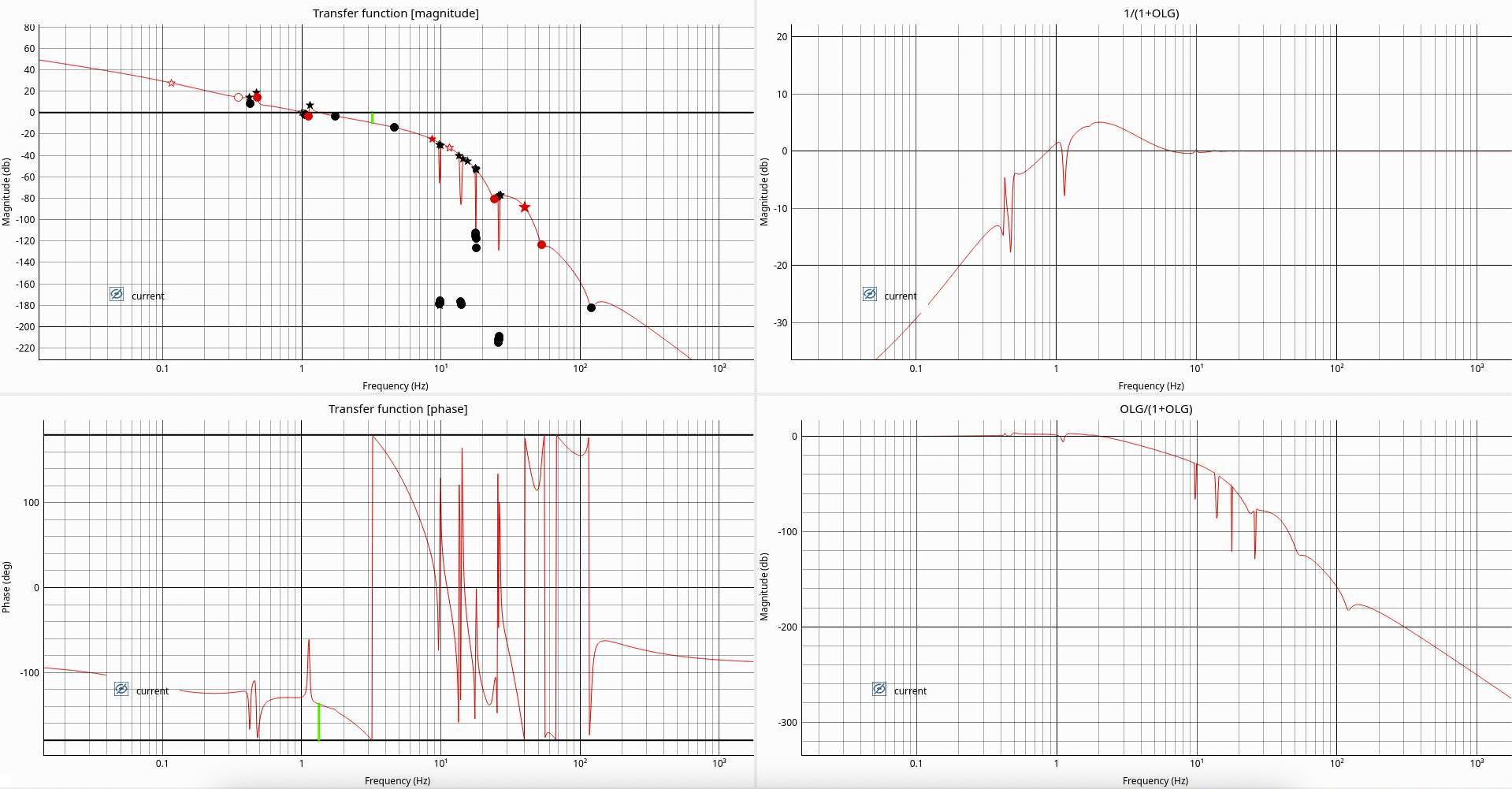
Edit: actually, that might not be that much of a problem after all. We could probably improve some low frequency suppression, but I don't know how much we can reduce the pitch drive above 10 Hz. After correcting the model according to my measurement in 72117, there is not much gain peaking and a good amount of phase and gain margin. Yes, the plant inversion is aggressive, but it seems to be working. Attached a screenshot from Gabriele's loop designer code, where I have implemented the BS M2 pitch model, BS M2 locking filters, and current ASC MICH P control design. Black dots/stars in the top left plot are the Zs/Ps of the plant model and locking filters, red dots/stars are the Zs/Ps of the control loop filters. The UGF is around 1 Hz as I measured, and there is 5 dB of gain peaking at 2 Hz (top right plot).
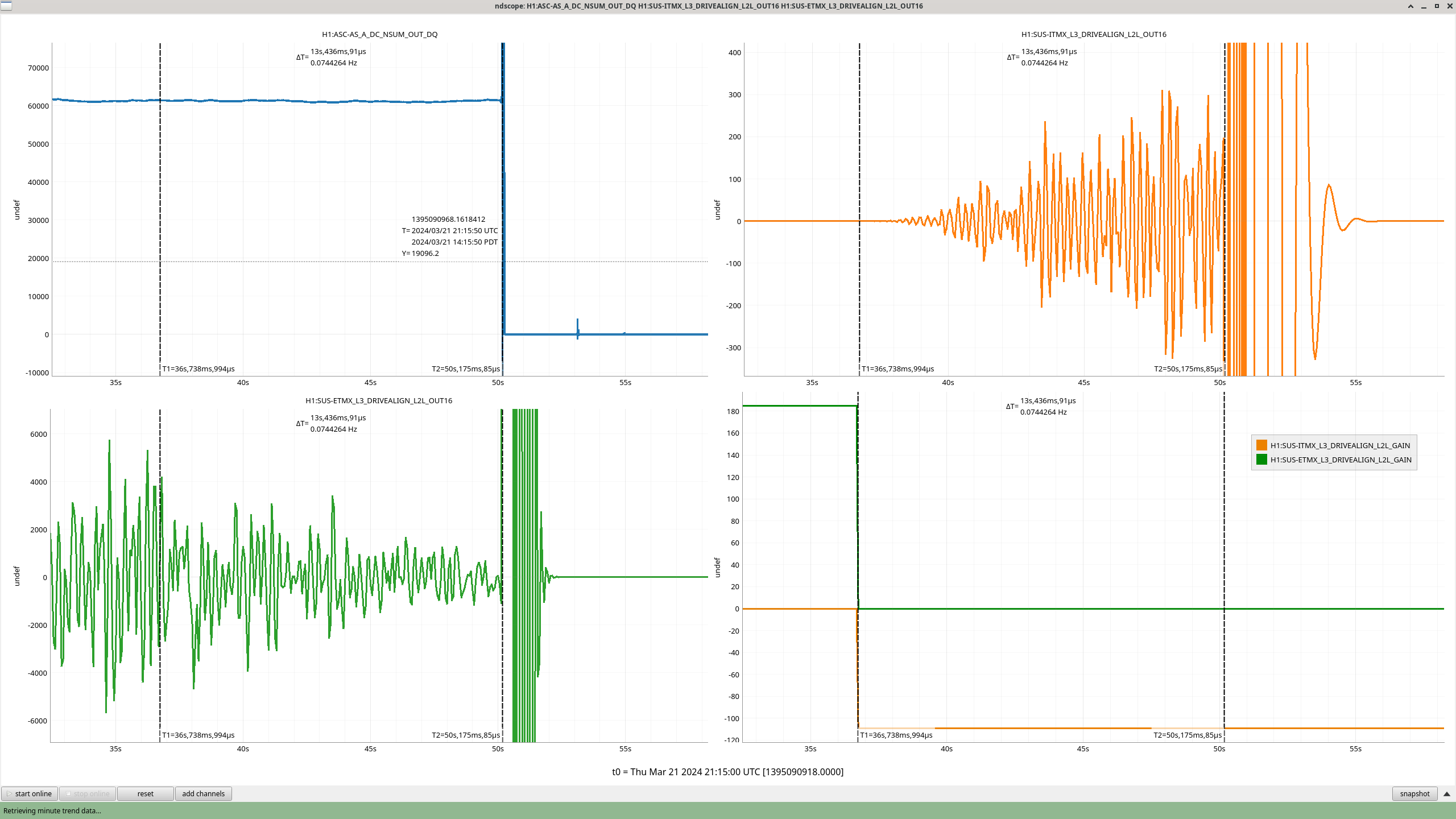
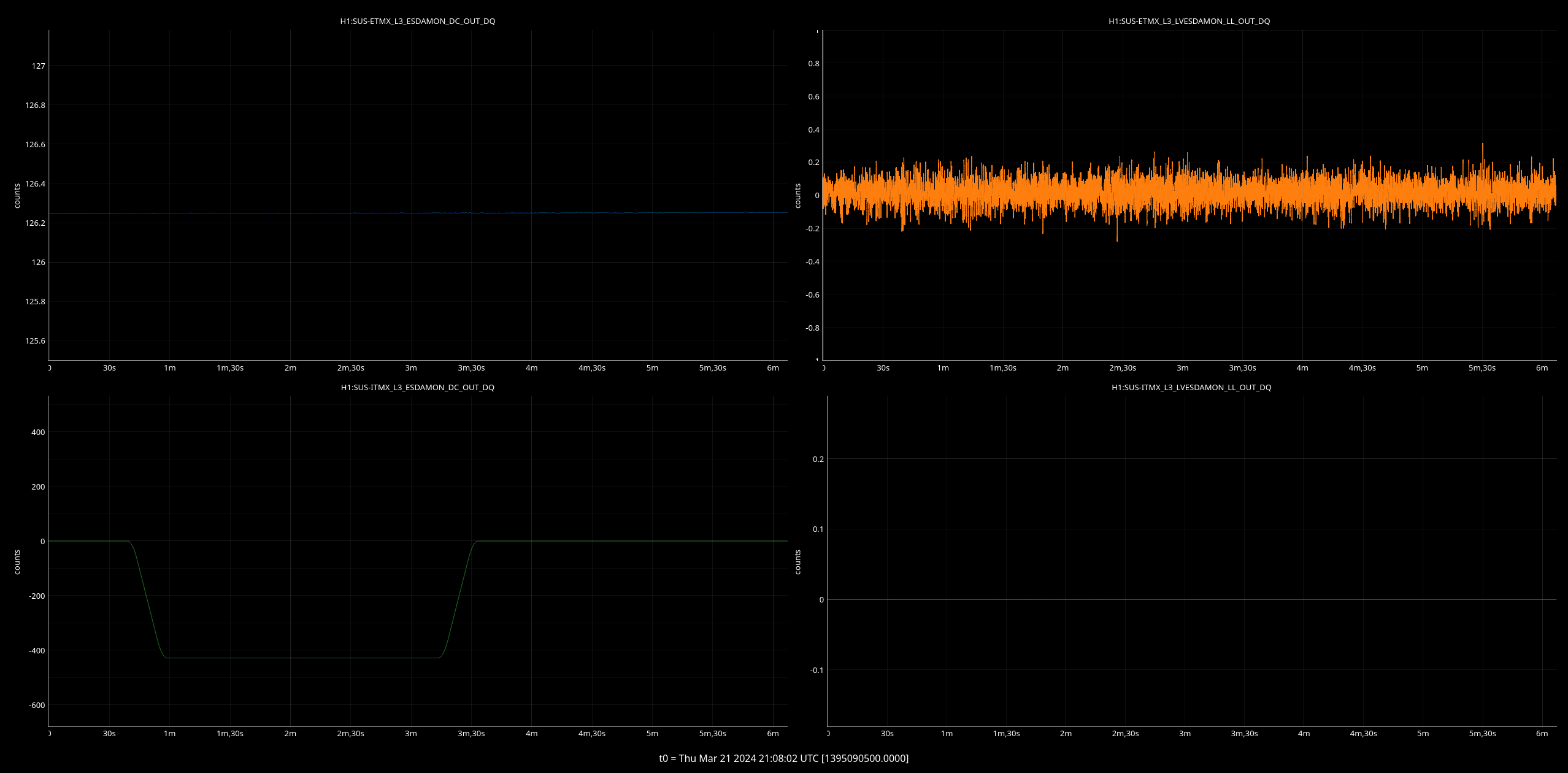
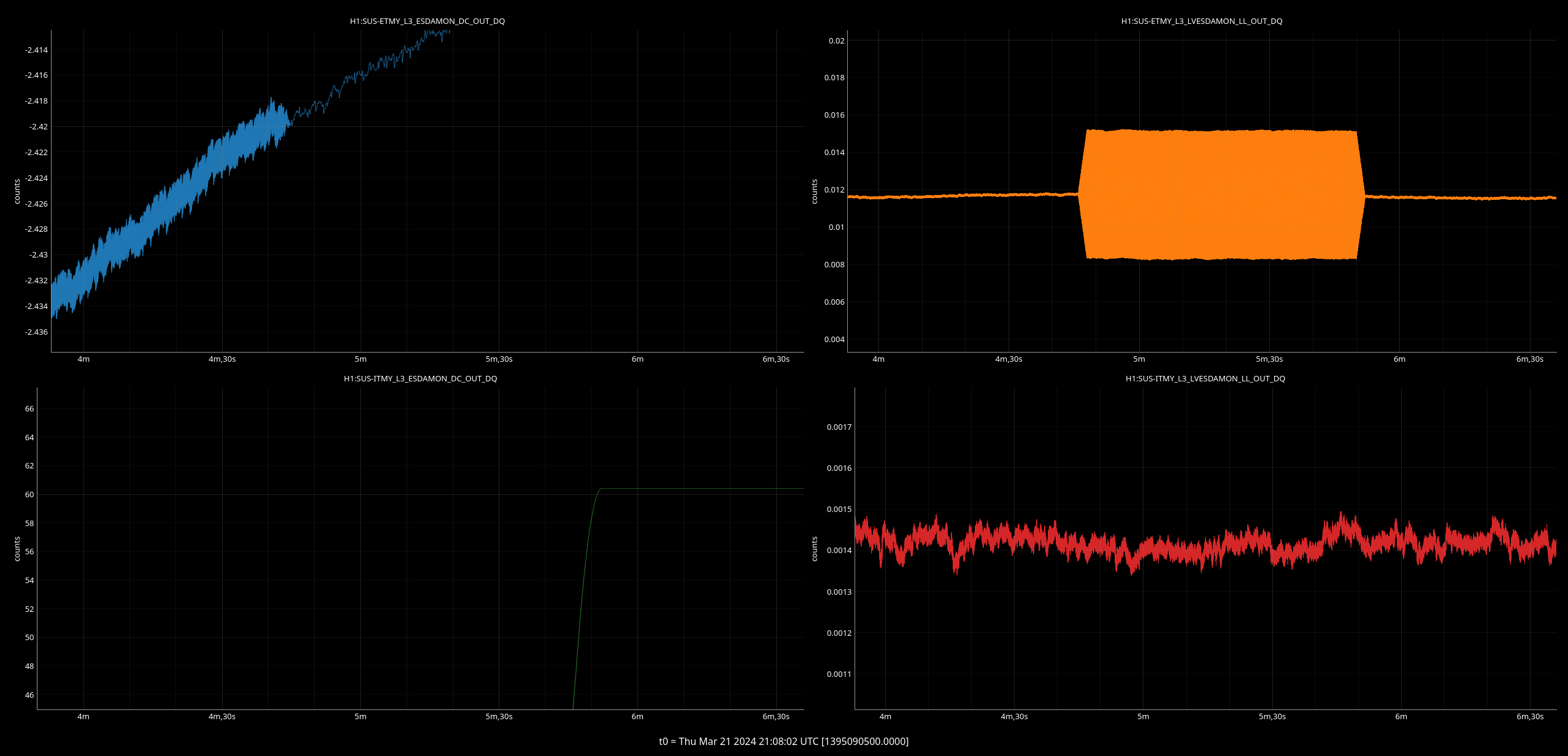
We tried the in-lock charge measurements but forgot about the New-DARM configuration so caused a lockloss in the SWAP_TO_ITMX state.
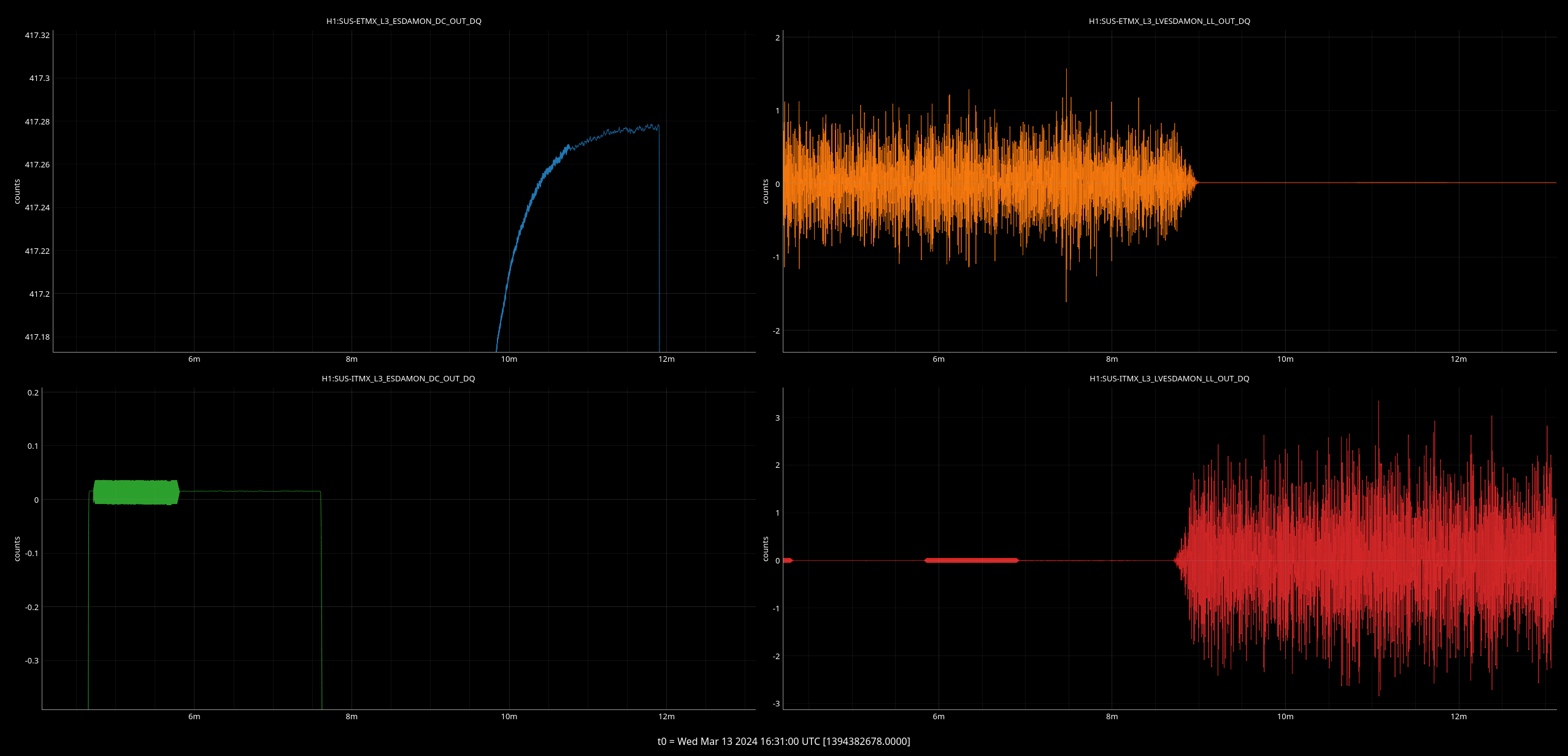
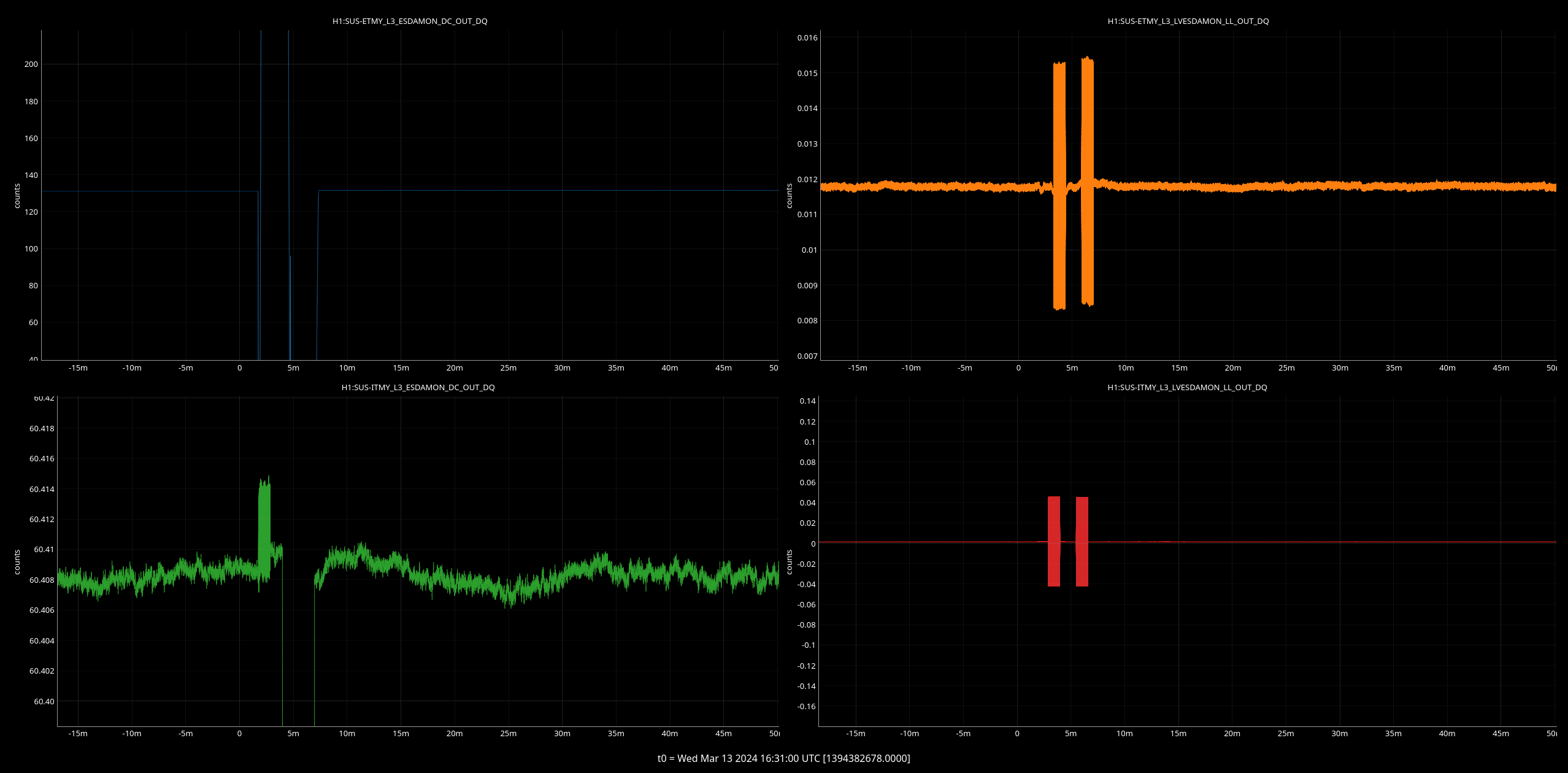
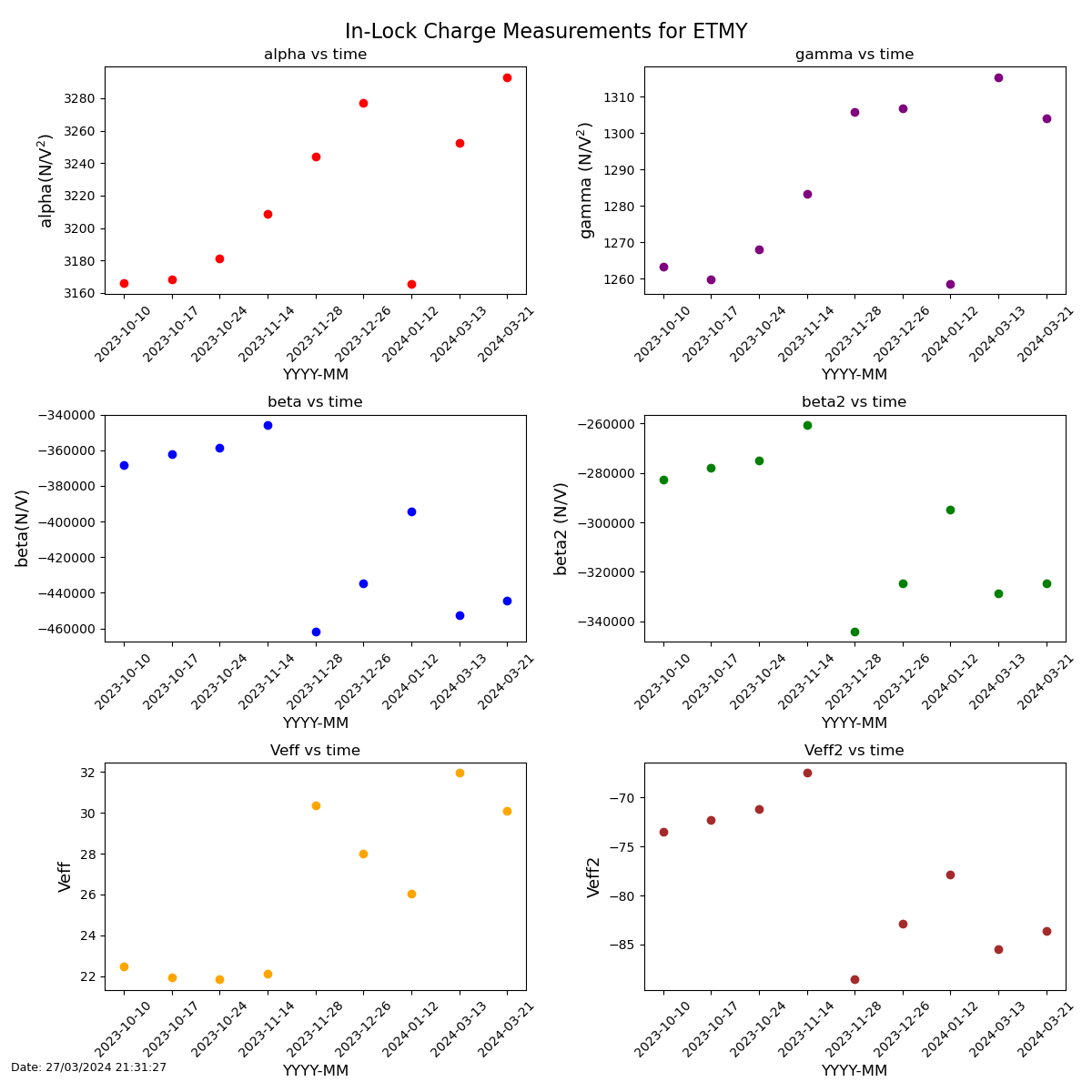
It seems also that only ETMY was ever moved during the part of the test that did run (I'd expect everything but ETMX measured, because the last one requires switching control to the other TM which caused lock loss). In the measurement last week, it seems excitation was applied on all masses as it should be. Attached are plots from this week and last week.
I've attached the plots for ETMY, since that's the only one that had the excitations this last week.