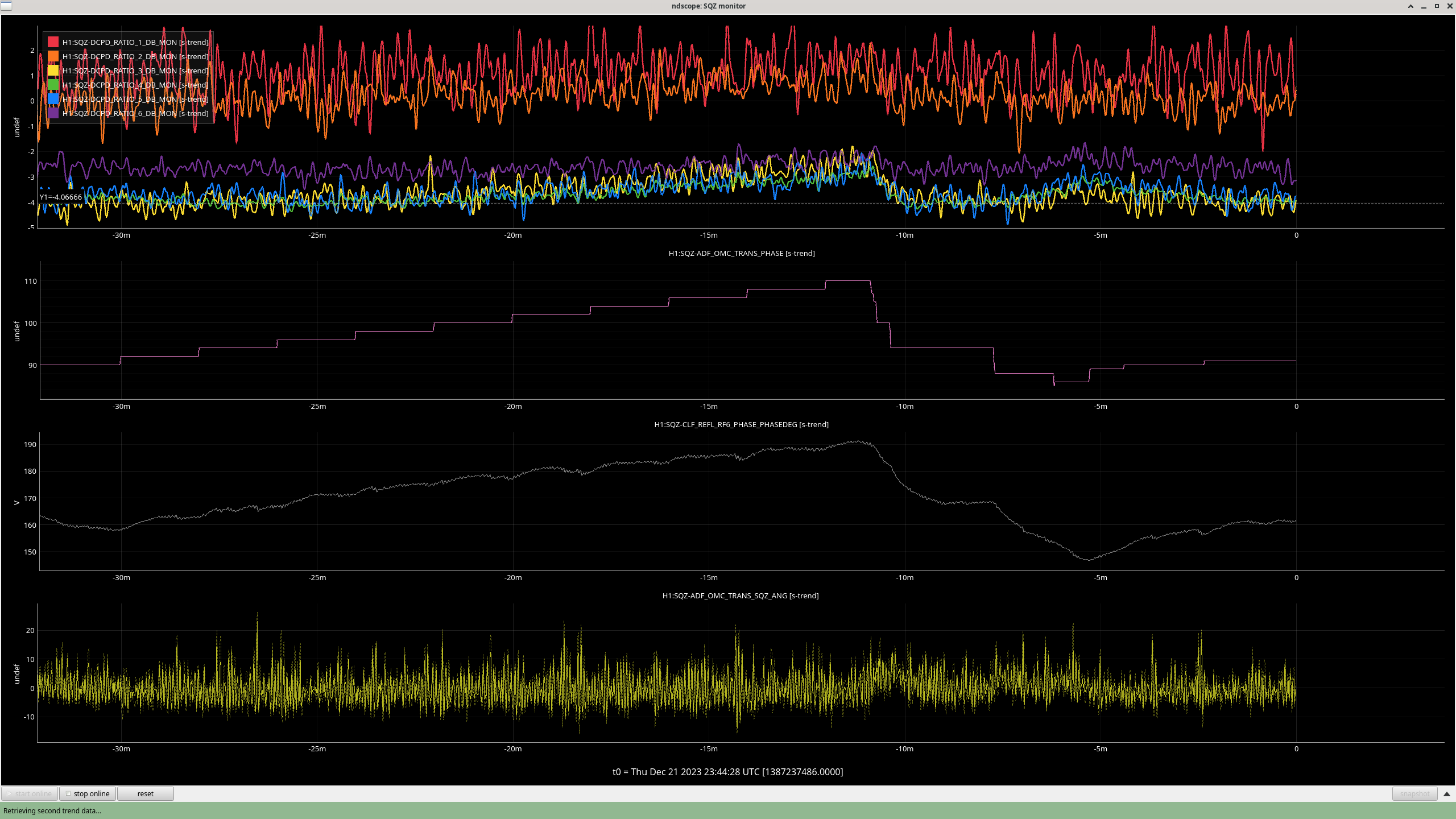
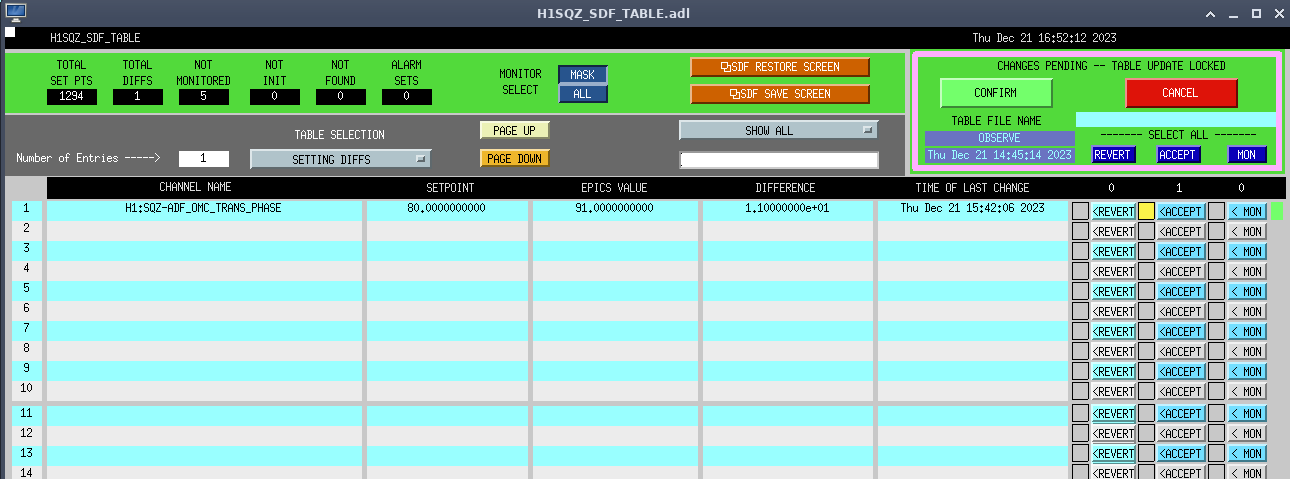
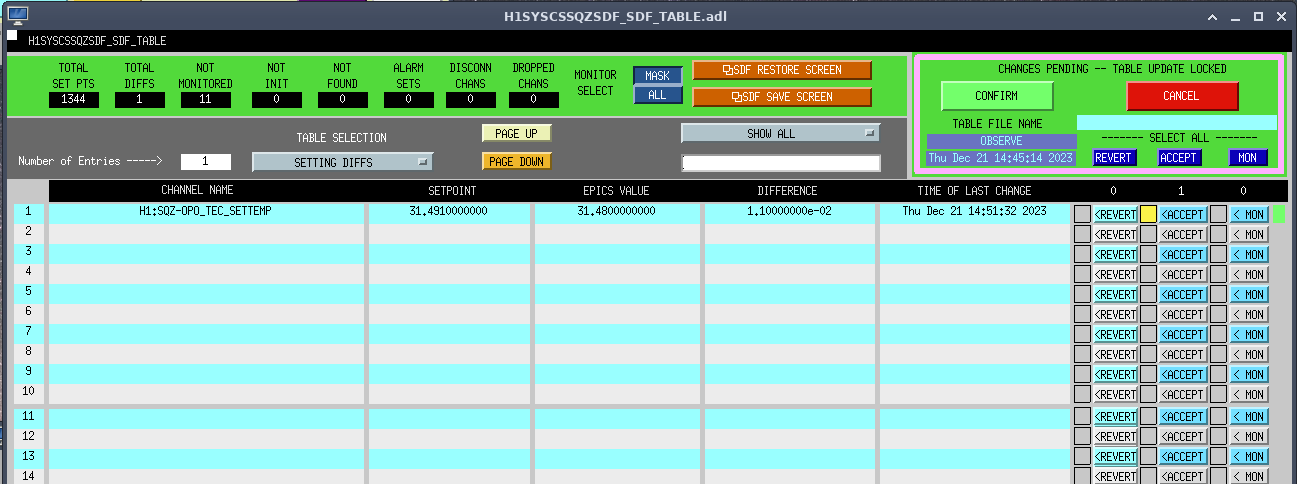
While Robert was doing some low-level commissioning (so, relatively quiet time), I had the NonSENS cleaning on again. Data is good from 17:34:13 UTC - 18:07:48 UTC (12 Oct 2023). It gave us about 7 Mpc. Since the LSCFF is being tuned, hopefully most of that will just be taken care of with the in-loop feedforward, since the cleaning is not yet approved for use in Observe.
Jenne, Camilla
We've moved the LSC FF from ETMX to ETMY PUM and turned on the new LSC FF filters measured in 73393.
This has reduced noise above 50Hz but increased noise below 50Hz, plots attached of the FF and DARM, compare gold to pink. H1 range is simular.
We've left this configuration, edited ISC_LOCK for this to be the new nominal and accepted attached sdfs. We plan to work to iteratively improve the filters in the next few hours with a new set of measurements we took this morning ~18:40UTC.
Jenne and I re-fit new filters iteratively to using the measurements we took this morning and loaded new filters into MICHFF and SRCL1FF, sdf safe and observe accepted and ISC_LOCK updated. H1 range is up ~7Mpc, plot attached, thin line is without cleaning.
We are hopeful that now the LSC FF is driven on ETMY, it will not need to be tuned as often as won't be effected by changing charge ETMX.
Attached MICH excitation comparison (new trace is light blue) which shows we are putting in more MICH 20Hz that previously but this isn't visible in DARM. Note that during the day today Tyler/Robert has turned off fans, reducing peaks ~25, 40, 52Hz 73424.
We checked that these LSC FF filters are not injecting any low frequency noise into DARM.
Locked for 13 hours. We have been taking opportunistic commissioning time this morning while LLO is down from seismic noise, but have just went back to Observing.
Vicky, Regina, Naoki, Sheila
We took squeeze data with PSAMs on ZM4 and ZM5 both at 120V, and four squeeze angles. Summary screenshot here, with these trends of squeezed BLRMS. All of the following data was done with frequency dependent squeezing.
With ZM4/5 at 120/120 V, +/- mid squeeze have noticibly different misrotations across the band. In alog 71902 from Aug. 2 with PSAMS at 200/200V, we didn't see strong misrotations down to ~80 Hz. From FDS data on Aug 2, compare today's green/blue lines to the green and yellow +/- mid squeeze lines in this plot.
DTT saved at $(userapps)/sqz/h1/Templates/dtt/DARM/PSAMS_tests_Oct112023.xml
For reference, with ZM4/5 PSAMS at 200/200V (what we've been operating with in O4).
H1:AWC-ZM4_PSAMS_STRAIN_VOLTAGE 7.52377
H1:AWC-ZM4_PSAMS_DEFOCUS_MON_MDIOPTER 201.544
H1:AWC-ZM5_PSAMS_STRAIN_VOLTAGE 3.49813
H1:AWC-ZM5_PSAMS_DEFOCUS_MON_MDIOPTER -1030.69
I took more data with PSAMS ZM4/5 = 200V/200V, using the same injected sqz angles as above.
See comparisons of anti-squeezing and squeezing with PSAMS @ 200/200V (dotted lines) vs. 120/120V (solid lines).
Notes / thoughts:
BLRMS trends here. All traces saved to same DTT file, $(userapps)/sqz/h1/Templates/dtt/DARM/PSAMS_tests_Oct112023.xml
Vicky, Sheila, Regina, Dorotea
We followed up by checking ZM Sliders to see if there is misalignment with different PSAMS was a factor in addition to the mode mismatches from changing PSAMS. There seems to be a large static alignment shift from changing PSAMS, we're not sure if it is fully compensated by ASC especially in yaw. We might do more measurements tomorrow to follow up.
| Squeezing | ZM4/ZM5 Voltage | Demod Phase (deg) | ZM4 P | ZM4 Y | ZM5 P | ZM5 Y | ZM6 P | ZM6 Y |
| +Mid SQZ | 120/120 | +200 | -41 | 255 | -176 | 339 | 780 | 805 |
| +Mid SQZ | 200/200 | +200 | -9.5 | 254 | -241 | 439 | 807* | 801* |
| -Mid SQZ | 120/120 | +32 | -12 | 257 | -176 | 351 | 753 | 793 |
| -Mid SQZ | 200/200 | +32 | -9.6 | 254 | -244 | 450 | 792 | 790 |
| ASQZ | 120/120 | +242 | -41 | 257 | -165 | 343 | 765 | 792 |
| ASQZ | 200/200 | +242 | -9.55 | 254 | -238 | 439 | 843 | 787 |
| FDS | 120/120 | +150 | -41 | 257 | -177 | 391 | 756 | 797 |
| FDS | 200/200 | +150 | -9.48 | 254 | -244 | 446 | 800 | 789 |
*+Mid SQZ: ZM6 was not flat for the 200/200 squeezing. It was increasing in P and Y for +Mid SQZ, didn't seem to reach the steady state. It seems like the ASC is keeping up better with 120/120 because the angles converged, whereas the angles of ZM5 and ZM6 for the 200/200 case kept increasing and did not reach steady state in the time given.
ASQZ: ZM5 pitch for 120/120 has some shaking, ZM6 pitch is rising and yaw is dropping
Full DQ shift report is at: https://wiki.ligo.org/DetChar/DataQuality/DQShiftLHO20231002
Overall a relatively uneventful week.
Range frequently stable around 150 Mpc with some drops down to 140
Found that hveto was looking at unsafe channels to generate vetos, should be fixed now
Some safe channels also found by hveto as good witnesses:
H1:PEM-EX_EFM_BSC9_ETMX_Y_OUT_DQ
H1:SUS-ETMX_L3_OPLEV_PIT_OUT_DQ
H1:SUS-ETMX_L3_OPLEV_YAW_OUT_DQ
Glitches continue to be problematic, much higher glitch rate than L1.
Some of the glitches most affecting the PyCBC search have werd morphologies
Thu Oct 12 10:11:05 2023 INFO: Fill completed in 11min 1secs
Jordan confirmed a good fill curbside.
Closes FAMIS#26482, last checked 72639
check_T240_centering.py - 2023-10-12 08:41:09.262244
There are 12 T240 proof masses out of range ( > 0.3 [V] )!
ETMX T240 2 DOF X/U = -0.918 [V]
ETMX T240 2 DOF Y/V = -1.076 [V]
ETMX T240 2 DOF Z/W = -0.32 [V]
ITMX T240 1 DOF X/U = -0.87 [V]
ITMX T240 1 DOF Z/W = 0.428 [V]
ITMX T240 3 DOF X/U = -0.842 [V]
ITMY T240 3 DOF X/U = -0.56 [V]
ITMY T240 3 DOF Z/W = -1.111 [V]
BS T240 1 DOF Y/V = -0.456 [V]
BS T240 3 DOF Y/V = -0.358 [V]
BS T240 3 DOF Z/W = -0.573 [V]
HAM8 1 DOF Z/W = -0.306 [V]
All other proof masses are within range ( < 0.3 [V] ):
ETMX T240 1 DOF X/U = 0.219 [V]
ETMX T240 1 DOF Y/V = 0.125 [V]
ETMX T240 1 DOF Z/W = 0.152 [V]
ETMX T240 3 DOF X/U = 0.1 [V]
ETMX T240 3 DOF Y/V = 0.114 [V]
ETMX T240 3 DOF Z/W = 0.097 [V]
ETMY T240 1 DOF X/U = -0.013 [V]
ETMY T240 1 DOF Y/V = 0.058 [V]
ETMY T240 1 DOF Z/W = 0.124 [V]
ETMY T240 2 DOF X/U = -0.082 [V]
ETMY T240 2 DOF Y/V = 0.146 [V]
ETMY T240 2 DOF Z/W = 0.028 [V]
ETMY T240 3 DOF X/U = 0.128 [V]
ETMY T240 3 DOF Y/V = 0.002 [V]
ETMY T240 3 DOF Z/W = 0.09 [V]
ITMX T240 1 DOF Y/V = 0.267 [V]
ITMX T240 2 DOF X/U = 0.086 [V]
ITMX T240 2 DOF Y/V = 0.217 [V]
ITMX T240 2 DOF Z/W = 0.188 [V]
ITMX T240 3 DOF Y/V = 0.107 [V]
ITMX T240 3 DOF Z/W = 0.112 [V]
ITMY T240 1 DOF X/U = 0.068 [V]
ITMY T240 1 DOF Y/V = -0.008 [V]
ITMY T240 1 DOF Z/W = -0.14 [V]
ITMY T240 2 DOF X/U = 0.061 [V]
ITMY T240 2 DOF Y/V = 0.13 [V]
ITMY T240 2 DOF Z/W = 0.014 [V]
ITMY T240 3 DOF Y/V = 0.039 [V]
BS T240 1 DOF X/U = -0.225 [V]
BS T240 1 DOF Z/W = -0.009 [V]
BS T240 2 DOF X/U = -0.184 [V]
BS T240 2 DOF Y/V = -0.084 [V]
BS T240 2 DOF Z/W = -0.226 [V]
BS T240 3 DOF X/U = -0.295 [V]
HAM8 1 DOF X/U = -0.131 [V]
HAM8 1 DOF Y/V = -0.094 [V]
check_sts_centering.py - 2023-10-12 08:43:32.265464
There are 2 STS proof masses out of range ( > 2.0 [V] )!
STS EY DOF X/U = -4.106 [V]
STS EY DOF Z/W = 2.601 [V]
All other proof masses are within range ( < 2.0 [V] ):
STS A DOF X/U = -0.614 [V]
STS A DOF Y/V = -0.874 [V]
STS A DOF Z/W = -0.437 [V]
STS B DOF X/U = 0.519 [V]
STS B DOF Y/V = 0.874 [V]
STS B DOF Z/W = -0.547 [V]
STS C DOF X/U = -0.365 [V]
STS C DOF Y/V = 0.808 [V]
STS C DOF Z/W = 0.217 [V]
STS EX DOF X/U = -0.246 [V]
STS EX DOF Y/V = 0.01 [V]
STS EX DOF Z/W = 0.059 [V]
STS EY DOF Y/V = 0.13 [V]
STS FC DOF X/U = 0.4 [V]
STS FC DOF Y/V = -0.74 [V]
STS FC DOF Z/W = 0.793 [V]
Closes FAMIS#26212, last checked 73167
Everything looking good besides ISS diffracted power low
Laser Status:
NPRO output power is 1.822W (nominal ~2W)
AMP1 output power is 67.6W (nominal ~70W)
AMP2 output power is 136.1W (nominal 135-140W)
NPRO watchdog is GREEN
AMP1 watchdog is GREEN
AMP2 watchdog is GREEN
PMC:
It has been locked 20 days, 1 hr 15 minutes
Reflected power = 16.57W
Transmitted power = 109.4W
PowerSum = 125.9W
FSS:
It has been locked for 0 days 10 hr and 20 min
TPD[V] = 0.7294V
ISS:
The diffracted power is around 1.7%
Last saturation event was 0 days 10 hours and 20 minutes ago
Possible Issues:
ISS diffracted power is low
TITLE: 10/12 Day Shift: 15:00-23:00 UTC (08:00-16:00 PST), all times posted in UTC
STATE of H1: Observing at 150Mpc
OUTGOING OPERATOR: Ibrahim
CURRENT ENVIRONMENT:
SEI_ENV state: CALM
Wind: 3mph Gusts, 2mph 5min avg
Primary useism: 0.02 μm/s
Secondary useism: 0.21 μm/s
QUICK SUMMARY: Locked for 9 hours, useism trending down to good levels.
CDS Overview OK, no alarms
DIAG_MAIN - ITMY HWS code has stopped
TITLE: 10/12 Eve Shift: 23:00-07:00 UTC (16:00-00:00 PST), all times posted in UTC
STATE of H1: Observing at 148Mpc
INCOMING OPERATOR: Ibrahim
SHIFT SUMMARY: Two mystery locklosses with some opportunistic commissioning activities interspersed throughout the shift since L1 has been down.
HWS ITMX code is stopped and has been for the majority of this shift, tagging TCS.
LOG:
| Start Time | System | Name | Location | Lazer_Haz | Task | Time End |
|---|---|---|---|---|---|---|
| 23:48 | PEM | Robert | CER | - | Adjust PSL chassis grounding | 23:57 |
| 00:28 | SQZ | Vicky, Naoki, Regina | CR | - | SQZ tests | 01:57 |
Lockloss @ 05:10 UTC - no immediately obvious cause. Another quick lockloss, no DCPD saturation this time.
Back to observing at 06:04 UTC
While L1 was down this evening, H1 dropped out of observing between 03:23 and 04:26 UTC to opportunistically continue SQZ tests (see alog 73408).
Tagging DetChar: although gwistat reported H1 was "Ready" for much of this time (where the GDS range was being computed since we could have flipped the intent bit to start observing), H1 was not observing between 03:23 UTC and 04:26 UTC for commissioning time.
H1 has just started observing at 146Mpc as of 02:54 UTC.
There's a M5.5 earthquake coming in from Alaska, so hopefully we can hold on through the rest of the evening.
Lockloss @ 01:50 UTC - no immediately obvious cause, happened quickly with a DCPD saturation.
H1 had reached NLN at 23:52 UTC and resumed with commissioning since L1 was not locked. There were SQZ-related tests being run at this time, but it's very unlikely they were the cause of this lockloss.
Back to observing at 02:54 UTC.
On Tuesday I tuned the periscope in the PSL by adjusting weights and Tyler and I shut down SF2, which was responsible for the new 120 Hz HVAC peak ( https://alog.ligo-wa.caltech.edu/aLOG/index.php?callRep=73378 ). Figure 1 shows the reduction of the periscope peak from tuning, and from tuning plus the fan shutdown. The fan shutdown had the greatest effect.
Figure 2 shows the disappearance of the peak from the summary pages, as well as the 3+ MPc increase in range from the fan change only.
During commissioning today I looked for the source of the 13.1 Hz harmonics that began to appear on Oct. 3, by testing some of the things that were done that Tuesday. First I temporarily shut down the DC-DC converter and oplev laser for ITMX that had been worked on. But the noise, likely from the very high microseism, made my tests inconclusive. I also tried disconnecting the new grounding on the TCS and PSL chassis. Since DARM noise was too high for me to tell if this helped, I have left them disconnected and will reconnect the grounds when we can tell that they are not part of the problem.