Displaying reports 17561-17580 of 86770.Go to page Start 875 876 877 878 879 880 881 882 883 End
Reports until 00:02, Friday 14 July 2023
LHO General
ryan.short@LIGO.ORG - posted 00:02, Friday 14 July 2023 (71314)
Ops Eve Shift Summary

TITLE: 07/14 Eve Shift: 23:00-07:00 UTC (16:00-00:00 PST), all times posted in UTC
STATE of H1: Observing at 133Mpc
SHIFT SUMMARY: H1 has been locked for 21 hours and observing for 8 hours. Very quiet evening with one earthquake passing through.

Handing off to Corey for the night.


LOG:

No log for this shift.

H1 ISC (ISC, TCS)
elenna.capote@LIGO.ORG - posted 22:00, Thursday 13 July 2023 - last comment - 14:47, Friday 14 July 2023(71284)
Current 60W thermal/mode matching state different from April 60W

Dan Brown, Cao, Kevin K., Elenna

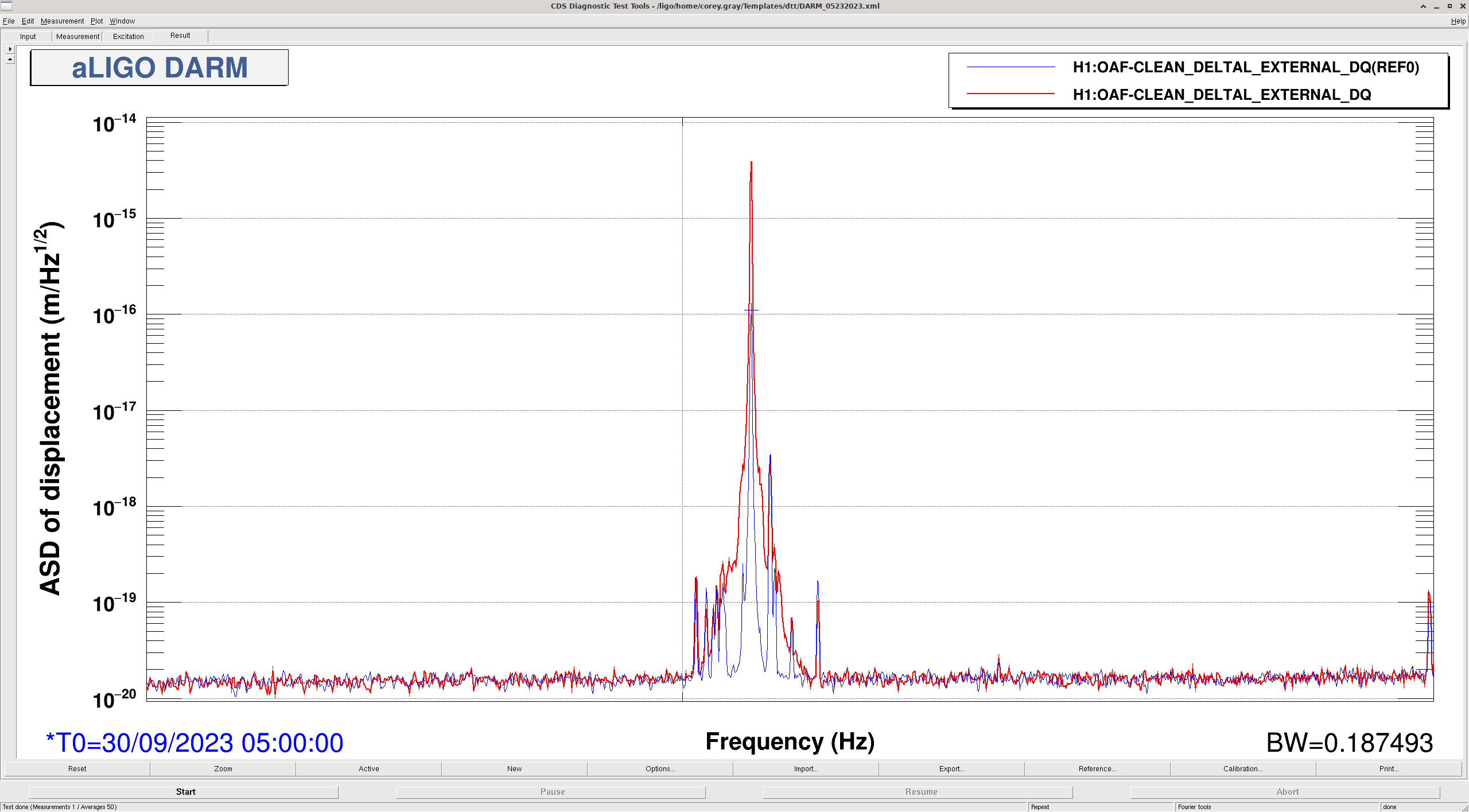
I made a plot comparing the high frequency DARM spectrum around 10 kHz comparing our current 60W configuration to the configuration we had the last time we were at 60W, specifically April 6. These plots were both made well into each lock, so the thermal transients had settled. I believe they are an apples-to-apples comparison of the high frequency region for these two locks and IFO configurations. Three features stand out as different between the two spectra: the 2nd order HOM peaks are not in the same location, they are not the same height, and the overall DARM spectrum is lower in the blue trace (April), than the red trace (now). This indicates that the arm modes are not as well matched now as they were in April, and the frequency noise noise now is higher by a factor of 1.7 than it was in April.

If nothing else had changed in the IFO, we should have been able to successfully revert to the blue trace by powering down and reverting all other settings.

I think the reason we haven't been able to revert to the previous 60W state is related to the mysterious changes that occurred on and after May 19 when the HVAC caused many issues. Whatever changed in May caused us to ring up a PI, increased the jitter noise, and changed our mode matching. My hypothesis is that the alignment shifted in some way. Unfortunately none of the suspension, oplev or ISC signals indicate an alignment shift.

I asked Cao to take a look at the ITMX hartmann wavefront sensor. Cao made the following two plots: one showing the center of the beam position in x (yaw) and y (pitch), and the other showing a heat map of ITMX. The two times they compare are the two locks I compare in my DARM plot: the blue "old" trace from April 6, 60W, and the orange "new" trace showing now at 60W. The beam position has changed, and the heat map shows that we are heating the ITMX point absorber more than we did previously.

If the spot has moved closer to a point absorber, this would explain our increase in jitter. If the spots on the test masses are shifting, this could also affect PIs like the 80 kHz that may be spot dependent. A spot position change could also aggravate the point absorber to where the radius of curvature and substrate lensing would change enough that our mode matching solution via the ring heaters would no longer be sufficient. We only have evidence that the spot has changed on ITMX, but there is a chance that it could have changed on the ETMs as well, where we know the 80 kHz acoustic mode is located. Unfortunately, we don't seem to have any good signals that could track this on the ETMs, so we are flying blind.

Overall, one of our goals (especially in powering down) is to get the IFO mode matched well enough that we can reduce frequency noise and be able to achieve a good level of squeezing. I think we should consider moving the spots on the test masses, especially ITMX. Those who remember, you might be thinking "we already tried this and saw no effect!" However, we have a different IFO now, and I think it is worthwhile to try moving further away from our point absorbers.

Images attached to this report
Comments related to this report
victoriaa.xu@LIGO.ORG - 12:21, Friday 14 July 2023 (71329)SQZ

From 70263, see screenshot comparing DCPD spectra at the 4.5dB sqz times from 3/29 -- H1 was more shot-noise-limited in that configuration, aka technical noise was lower, so squeezing quantum noise was more effective at reducing total noise. At e.g. 10 kHz around 2xHOM spacing, ignoring the 3dB difference b/c we are at 40mA vs. 20mA then, and comparing noise levels at 10.1 kHz near 2xHOM,
   ~ 2e-8, on 3/29 for 4.5dB sqz (20mA on dcpd's);
   ~ 6e-8, from elenna's plot on 4/6, assuming the channel is also H1:OMC-PI_DCPD_64KHZ_AHF_DQ, and still 20mA on dcpd's;
   ~ 8.5e-8, today 7/14 from CR screenshots (I think still 40mA vs. 20mA on dcpds; so over 4x as high as the best squeezing time at 60W, but only ~2x higher is kinda expected)

Since the HVAC changes, at least the disaggrated temperature trends at EX VEA do see an overall change, see individual sensor temp trends at EX from 70518; I looked into it then to see if anything has changed for the 80.3kHz ETMX PI that started ringing up. While the "average VEA" trends show almost no total change over the last few months, the individual sensors have seen considerable changes between March/April and now.

camilla.compton@LIGO.ORG - 14:47, Friday 14 July 2023 (71334)

Nice plots Elenna. I was concerned that we did a lot of CO2 changes 6th April but get the same result remaking Elenna's plot using April 5th data. The HWS beam can move if SR3 moves (HWS beams reflected off SR3) but SR3 has the same position between the 2 times to < 2urad. All TCS settings and ITMX A2L the same in both times. See attached plots comparing 04/05 and 07/13.

Images attached to this comment
LHO General
ryan.short@LIGO.ORG - posted 20:01, Thursday 13 July 2023 (71313)
Ops Eve Mid Shift Report

State of H1: Observing at 132Mpc

H1 has been locked for 17 hours and observing for 4 hours. Just rode out a 5.3 earthquake from Japan; otherwise a quiet evening.

H1 DetChar (DetChar)
marissa.walker@LIGO.ORG - posted 16:25, Thursday 13 July 2023 - last comment - 01:44, Friday 14 July 2023(71301)
Daily range drop at 17:00 UTC

Brina, Marissa

We noticed that there seems to be a daily drop in the BNS range by a few megaparsecs for about 10 minutes at around 17:00 UTC. I have found it most clearly since June 22, but there are a couple of times before that. 

I scrolled through the daily Lasso pages and found that two of the days (June 24 and 25) picked up the channel H1:SUS-ITMY_L3_OPLEV_BLRMS_P_3_10 as correlated with this dip (see this figure). On June 30 lasso picked up the channels H0:VAC-LY_TERM_M17_CHAN2_IN_{MA, COUNTS} and  H0:VAC-LY_CP1_PT101_DISCHARGE_PRESS_{MA/PSIG}.mean (figure). 

I plotted H1:SUS-ITMY_L3_OPLEV_BLRMS_P_3_10 and H0:VAC-LY_TERM_M17_CHAN2_IN_MA for June 22 - 25, 28, 30, July 6-8, and saw that both channels spike each day at the same time as the drop in range. 

I’ve attached examples from June 23 and July 7 showing the lineup of these channels at 17 UTC. I have not yet checked to see if these channels spike at other times causing dips in the range, but I haven’t noticed any other regular times with dips like these.

Just from looking at the summary pages, we weren't able to see anything noticeable in the strain spectrogram at these times. We made spectra comparing a few minutes before the range drop (16:55) and during the range drop (17:02) - see attached spectrum. We did this for a couple of times and don't see a huge obvious difference, but during the dip the spectrum does show slightly higher noise from around 20-200Hz.

Images attached to this report
Non-image files attached to this report
Comments related to this report
ryan.short@LIGO.ORG - 16:40, Thursday 13 July 2023 (71306)

This is likely correlated to the daily fill of CP1 based on the timing. Interesting about the noticeable range drop during observing, though.

Log from June 23 fill; log from July 7 fill

travis.sadecki@LIGO.ORG - 17:55, Thursday 13 July 2023 (71311)VE

Tagging VE

Note that the CP1 autofills were moved from 20:00 UTC to 17:00 UTC on May 4 (aLog 69315).  

shivaraj.kandhasamy@LIGO.ORG - 01:44, Friday 14 July 2023 (71317)

On all the six occasional of the CP1 fill last week, we see this drop in the range (plot attached).

Images attached to this comment
H1 ISC
sheila.dwyer@LIGO.ORG - posted 16:09, Thursday 13 July 2023 - last comment - 17:23, Thursday 13 July 2023(71302)
alignment offsets

Jenne, Naoki, Brina, Sheila

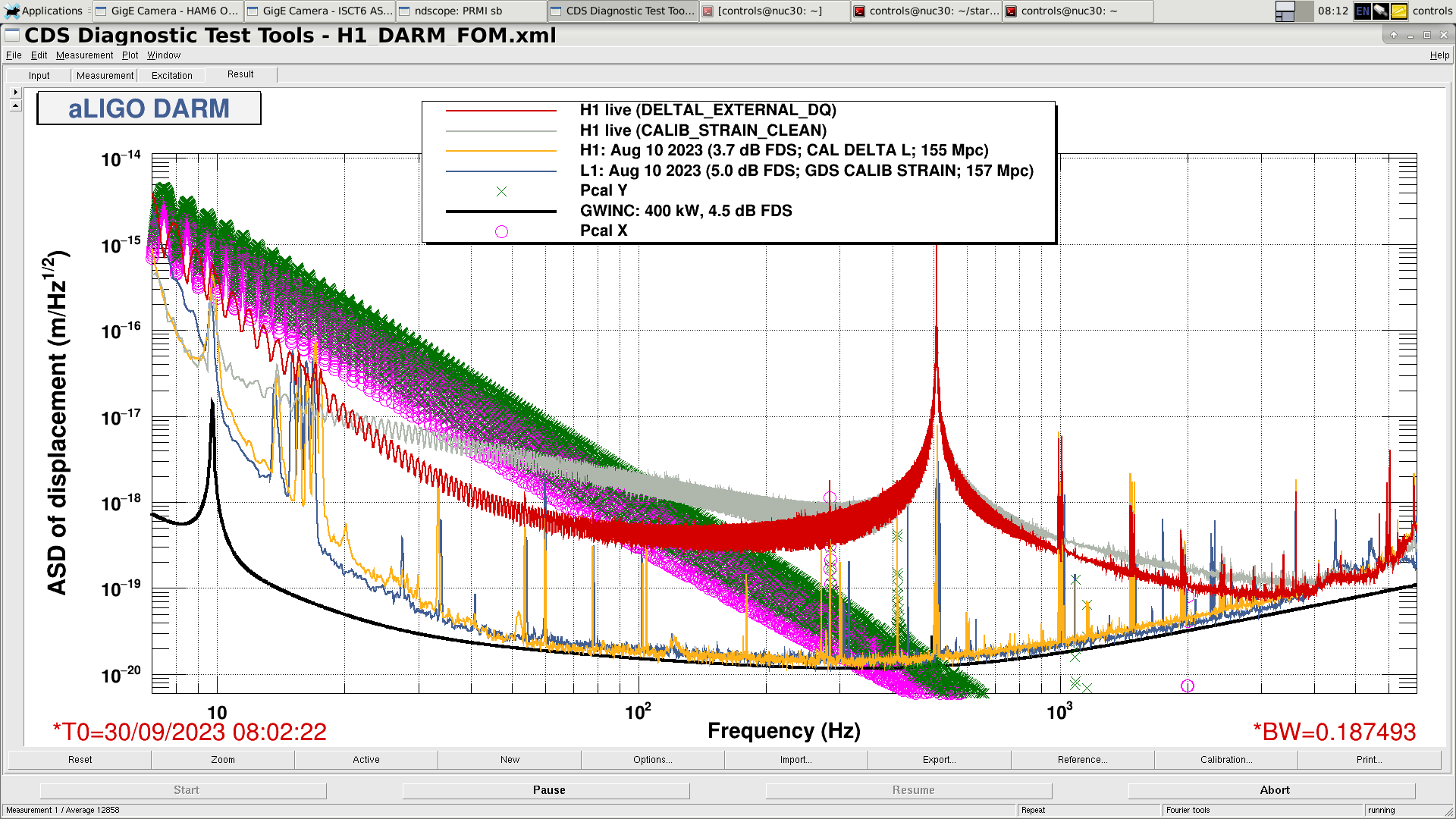
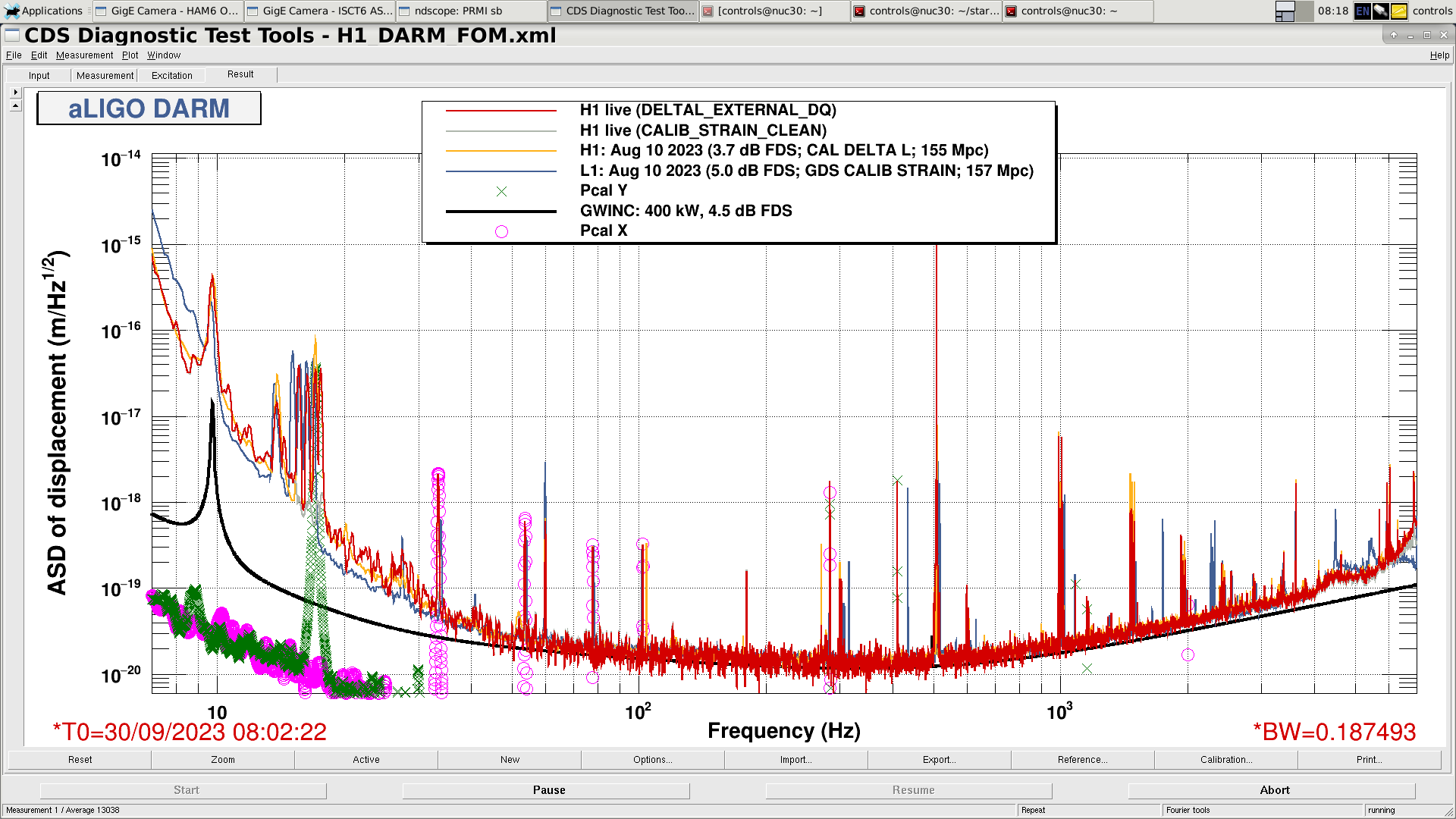
We put some offsets into the AS WFS loops, to check test if offsets in these loops caused by the OM2 change might be responsible for the change in jitter coupling that we see with heating of OM2.  We didn't see much improvement in the jitter coupling from adding pitch offsets to AS 72Q (SRM) or AS 36Q (MICH), but yaw moves made a big difference in the jitter coupling, as well as the low frequency noise.  

Times with om2 cold today :

Gabriele ran a bruco for the first time here.  He also notes that the low frequency at this time looks like it could be scattered light. 

We are leaving offsets in AS 36Q yaw +35000, no offsets in AS72. 


Images attached to this report
Comments related to this report
gabriele.vajente@LIGO.ORG - 16:56, Thursday 13 July 2023 (71307)

A spectrogram of DARM during the time used for the BruCo scan. It looks to me like it's scattered light, with clear bumps at 13, 18, 23 and 28 Hz

Images attached to this comment
gabriele.vajente@LIGO.ORG - 16:56, Thursday 13 July 2023 (71308)

A higher resolution (0.1 Hz) BruCo scan is available here: https://ldas-jobs.ligo-wa.caltech.edu/~gabriele.vajente/bruco_DARM_1373320218_HR/

jenne.driggers@LIGO.ORG - 17:23, Thursday 13 July 2023 (71309)

Here are a few other comparisons, but using GDS-CALIB_STRAIN_NOLINES so that we can see things, including the effect of things (like optical gain) that affect the calibration.

The teal is from 28 June 2023 08:00:00 UTC, when OM2 was hot. 

Blue is from 13 July 2023 20:00:00 UTC, so basically the same situation we had overnight all night, OM2 cold and no ASC offsets. (Same time as the black traces in Sheila's plots above).  Here, the jitter peak around 120 Hz is very high, and there are several other peaks throughout the bucket that could be jitter-related.

Red is as we are now, 13 July 2023 23:02:00 UTC, with a cold OM2 and AS A 36 Q yaw offset of +35000 counts. The 120 Hz jitter peak is about the same, or maybe better than while OM2 was hot. Since kappa_c is 1, our optical gain is better than the hot OM2 state, which improves our high frequency sensitivity.  Also, the sensitivity below 30 Hz seems quite good.  However, the sensitivity from 30 Hz - 100 Hz isn't great, and it could be related to scattered light, as Gabriele is pointing out.  We should consider checking things like the alignment of the compensation plates with this overall IFO alignment.

Also attached is the SDF Observe being accepted with +35000 counts for AS36Q yaw and offset on.  Note that the TRAMP is saved as 10 sec, but I'm putting it in to the guardian as 30 sec, so we should accept a 30 sec tramp next time we're out of Observe.

I have modified the ADS_TO_CAMERAS state in ISC_LOCK to also turn on this offset.  I haven't loaded it since we're in Observing.  I've only "checked the syntax" by confirming that I can open the graph.  I've written it assuming that SDF revert will turn off the offset and set it to zero. 

Images attached to this comment
LHO General
ryan.short@LIGO.ORG - posted 16:08, Thursday 13 July 2023 (71305)
Ops Eve Shift Start

TITLE: 07/13 Eve Shift: 23:00-07:00 UTC (16:00-00:00 PST), all times posted in UTC
STATE of H1: Observing at 135Mpc
CURRENT ENVIRONMENT:
    SEI_ENV state: CALM
    Wind: 9mph Gusts, 6mph 5min avg
    Primary useism: 0.03 μm/s
    Secondary useism: 0.04 μm/s
QUICK SUMMARY: Taking over from TJ and Oli. H1 has been locked for 13 hours, just returned to observing as of 23:02.

H1 General
oli.patane@LIGO.ORG - posted 16:02, Thursday 13 July 2023 (71304)
Ops DAY Shift End

TITLE: 07/13 Day Shift: 15:00-23:00 UTC (08:00-16:00 PST), all times posted in UTC
STATE of H1: Commissioning
SHIFT SUMMARY:

15:00 Detector locked and observing for 5:02

16:25 Left Observing for Commissioning
    Alternating between NLN_CAL_MEAS and NOMINAL_LOW_NOISE for 5 mins each (71295):
    - 16:25:13 NLN_CAL_MEAS
    - 16:30:57 NOMINAL_LOW_NOISE
    - 16:35:21 NLN_CAL_MEAS
    - 16:41:21 NOMINAL_LOW_NOISE
    - 16:46:18 NLN_CAL_MEAS
    - 16:51:43 NOMINAL_LOW_NOISE
    
17:01 Commissioning done, back into NLN and Observing    

18:14 Out of Observing, Commissioning started
    - 19:22 CAL measurement started
    - 21:13 CAL measurement ended

23:00 Commissioning wrapping up. Interferometer has been Locked for 13:01.

Handing off to Ryan S.


LOG:


Start Time System Name Location Lazer_Haz Task Time End
13:36 FAC Cindi Weld Shop N Technical cleaning 14:36
16:30 - Marc MY n Looking for parts 17:13
16:40 CAL Jenne, Oli RM n Alternate between NLN and NLN_CAL_MEAS for 5 mins each 17:03
16:48 PEM Robert CER n Going into CER 18:13
16:56 PCAL Rick PCAL Lab y (local) Pcal 18:26
17:13 FAC Karen Opt Lab n Tech clean 17:28
18:18 SEI Jim MX n Look at HEPI piers 18:54


H1 ISC
sheila.dwyer@LIGO.ORG - posted 12:32, Thursday 13 July 2023 (71299)
OMC alignment shift with cold OM2: does not improve jitter much

Naoki, Sheila

We revisted the alignment shifts of the OMC that we did yesterday morning, (71268) with a cold om2 today.  Yesterday we saw that we were able to reduce the jitter coupling measured by exciting the IMC PZT, but that this didn't improve the peaks caused by ambient jitter in DARM (see Brina's comment).  So, today we didn't bother with the injections on the PZT, but moved the QPD offsets and looked at the jitter peaks in DARM and the coherence with the IMC WFS DC channels.  We weren't able to reduce the jitter peaks by much with om2 cold, we moved both OMC QPDs in both pitch and yaw to explore the alignment space, we found that we could make the jitter peaks very slightly better at the cost of 10% loss of optical gain, or in other parts of the space we started to saturate the suspensions when we moved to where the jitter peaks were very slightly reduced.  None of these slightly reduced peaks gave us jitter as low as we had with hot om2.  We've returned the offsets to the original offsets, found before we turned on the TSAMs.  This has restored the optical gain to what it was before the TSAMs was on. 

H1 CAL
louis.dartez@LIGO.ORG - posted 11:58, Thursday 13 July 2023 - last comment - 17:28, Thursday 13 July 2023(71298)
updated calibration DTT templates
I updated the swept-sine frequency vectors used in the calibration swept-sine DTT templates. They now match what is used in LHO's simulines configuration.

Frequency points changed (Hz): 

10.01 -> 10.11
59.78 -> 64.78
180.5 -> 175.5

DTT templates are located at /ligo/groups/cal/H1/ifo/templates. pyDARM cmd tools will automatically use these templates on future runs.
Comments related to this report
vladimir.bossilkov@LIGO.ORG - 15:52, Thursday 13 July 2023 (71303)

Reasons behind changes were to avoid the QUAD bounce mode; and steer clear of the 60 Hz line and its harmonics. These impacted the transfer function and coherence of the measurements.

louis.dartez@LIGO.ORG - 17:28, Thursday 13 July 2023 (71310)
I'll add that we're building the confidence to move completely over to simulines for future calibration injection suites. However, it's good to have the corresponding DTT templates kept up to date for the scenario in which they're needed.
H1 ISC (CAL)
oli.patane@LIGO.ORG - posted 10:15, Thursday 13 July 2023 - last comment - 10:41, Thursday 13 July 2023(71295)
Alternating between NLN_CAL_MEAS and NOMINAL_LOW_NOISE to Compare Noise Floor

While Livingston is down, we took the opportunity to take some measurements to verify this alog by Elenna (71149). We moved out of Observing into Commissioning and alternated between NLN_CAL_MEAS and NOMINAL_LOW_NOISE, switching between them every 5 minutes and going through three cycles of this.

Times (UTC):

 - 16:25:13 NLN_CAL_MEAS
 - 16:30:57 NOMINAL_LOW_NOISE
 - 16:35:21 NLN_CAL_MEAS
 - 16:41:21 NOMINAL_LOW_NOISE
 - 16:46:18 NLN_CAL_MEAS
 - 16:51:43 NOMINAL_LOW_NOISE


Comments related to this report
gabriele.vajente@LIGO.ORG - 10:38, Thursday 13 July 2023 (71296)

Wiith this higher low-frequency noise, there is only a small improvement around 20 Hz when the lines are off.

Images attached to this comment
louis.dartez@LIGO.ORG - 10:41, Thursday 13 July 2023 (71297)
tagging CAL

IFO was thermalized during these tests
H1 DetChar (DetChar, ISC)
gabriele.vajente@LIGO.ORG - posted 08:43, Thursday 13 July 2023 - last comment - 14:10, Thursday 13 July 2023(71293)
Coherences after OM2 change

DARM coherences after OM2 was turned off and is now cold: https://ldas-jobs.ligo-wa.caltech.edu/~gabriele.vajente/bruco_DARM_1373284789_COLDOM2/ 

It looks like the low frequency noise has now higher than usual coherence with:
DHARD_Y: https://ldas-jobs.ligo-wa.caltech.edu/~gabriele.vajente/bruco_DARM_1373284789_COLDOM2/ASC-DHARD_Y_IN1_DQ.html
MICH: https://ldas-jobs.ligo-wa.caltech.edu/~gabriele.vajente/bruco_DARM_1373284789_COLDOM2/LSC-MICH_OUT_DQ.html
PRCL: https://ldas-jobs.ligo-wa.caltech.edu/~gabriele.vajente/bruco_DARM_1373284789_COLDOM2/LSC-PRCL_OUT_DQ.html

and adding jitter coherence for reference: https://ldas-jobs.ligo-wa.caltech.edu/~gabriele.vajente/bruco_DARM_1373284789_COLDOM2/PEM-CS_ACC_PSL_TABLE1_X_DQ.html

Comments related to this report
jenne.driggers@LIGO.ORG - 14:10, Thursday 13 July 2023 (71300)

These excess coherences are also evident in our range (as has been mentioned elsewhere in the alog).

In the attached figure, I show both the 'usual' range that's on the wall in the control room in blue, as well as the range calculated from the GDS-CALIB_STRAIN channel (it's probably actually the CLEAN version of GDS).

We turned on the OM2 heater at the time of the T-cursor around -16 days.  Prior to this time, the CAL-DELTAL channel was well matched to the GDS-CALIB_STRAIN calibration, so blue and orange overlap nicely.  The lower Y-cursor is roughly around the middle of our range values for the past OM2-cold times. 

During the time that OM2 was hot (up until about -1 day on this plot), both versions of the range are higher than before, although the orange calculation that takes into account our optical gain loss shows a more modest improvement than what we see on the wall (blue trace).  The upper Y-cursor is roughly around the middle of the corrected-for-optical gain orange trace.

We turned OM2's heater off yesterday, and so we're back to the calibration situation where CAL-DELTAL matches GDS-CALIB.  But, it's clear that both versions of our range are dramatically lower today than they were the last time we had OM2 cold.  Reasons for this are still under investigation. 

Images attached to this comment
Displaying reports 17561-17580 of 86770.Go to page Start 875 876 877 878 879 880 881 882 883 End