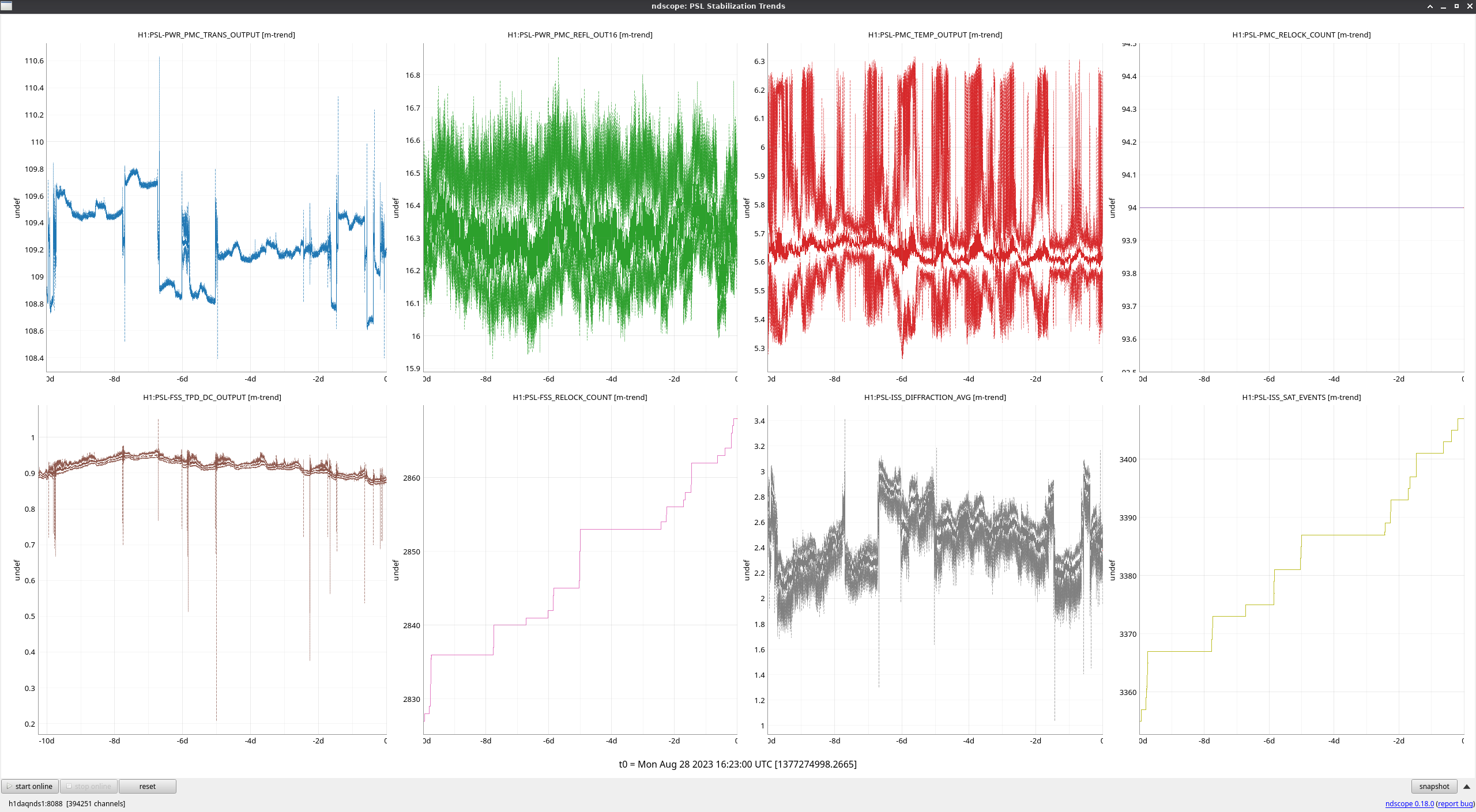
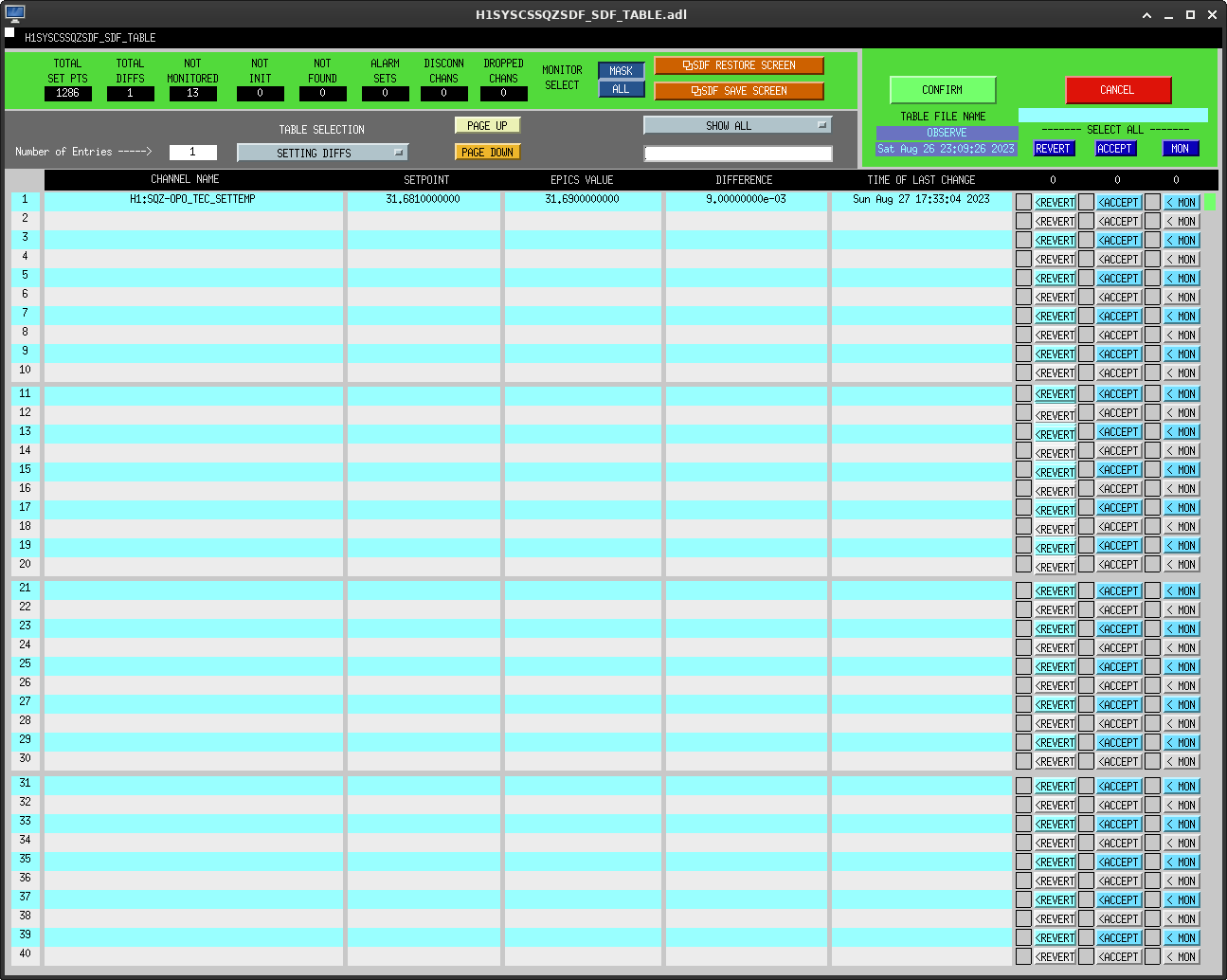
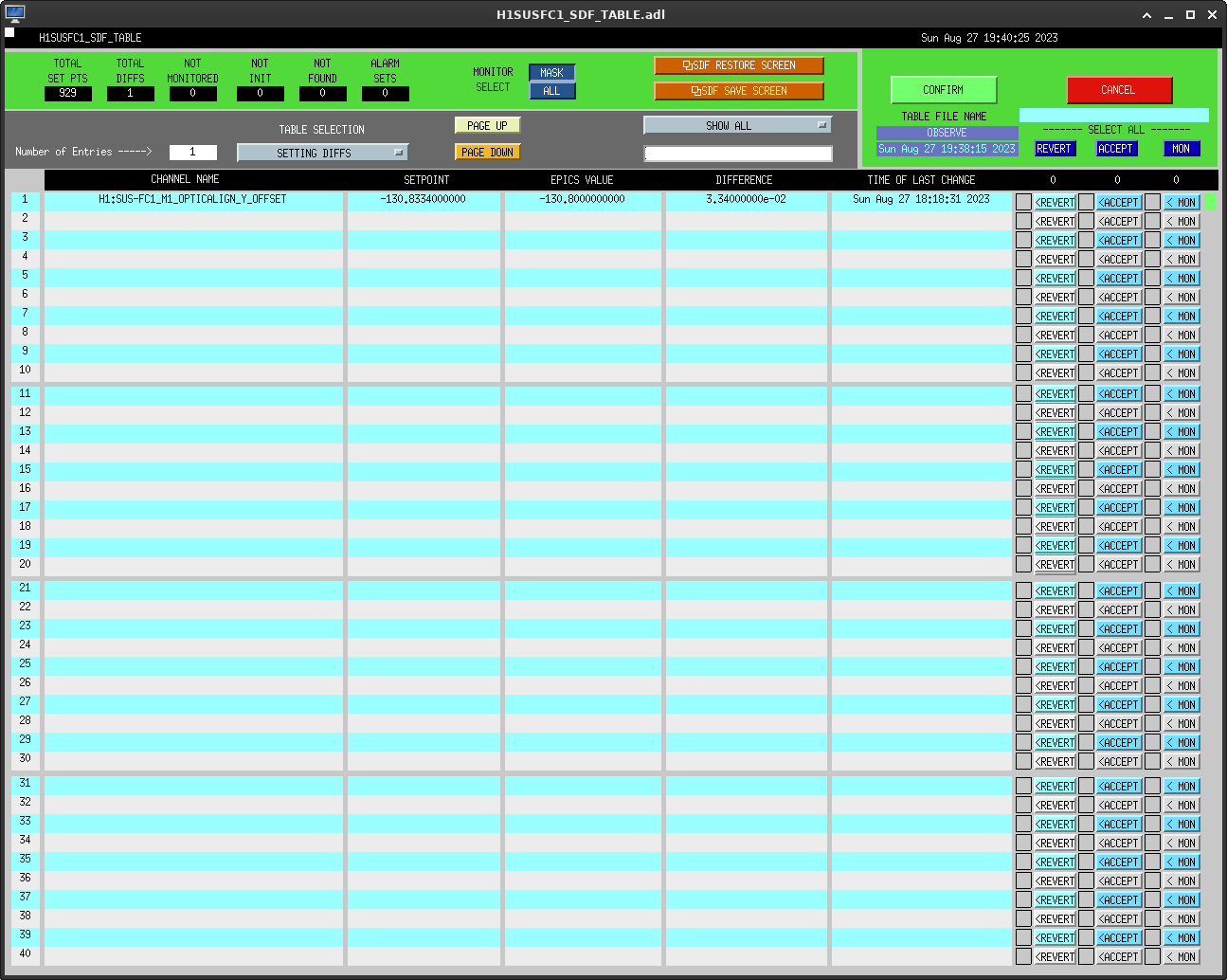
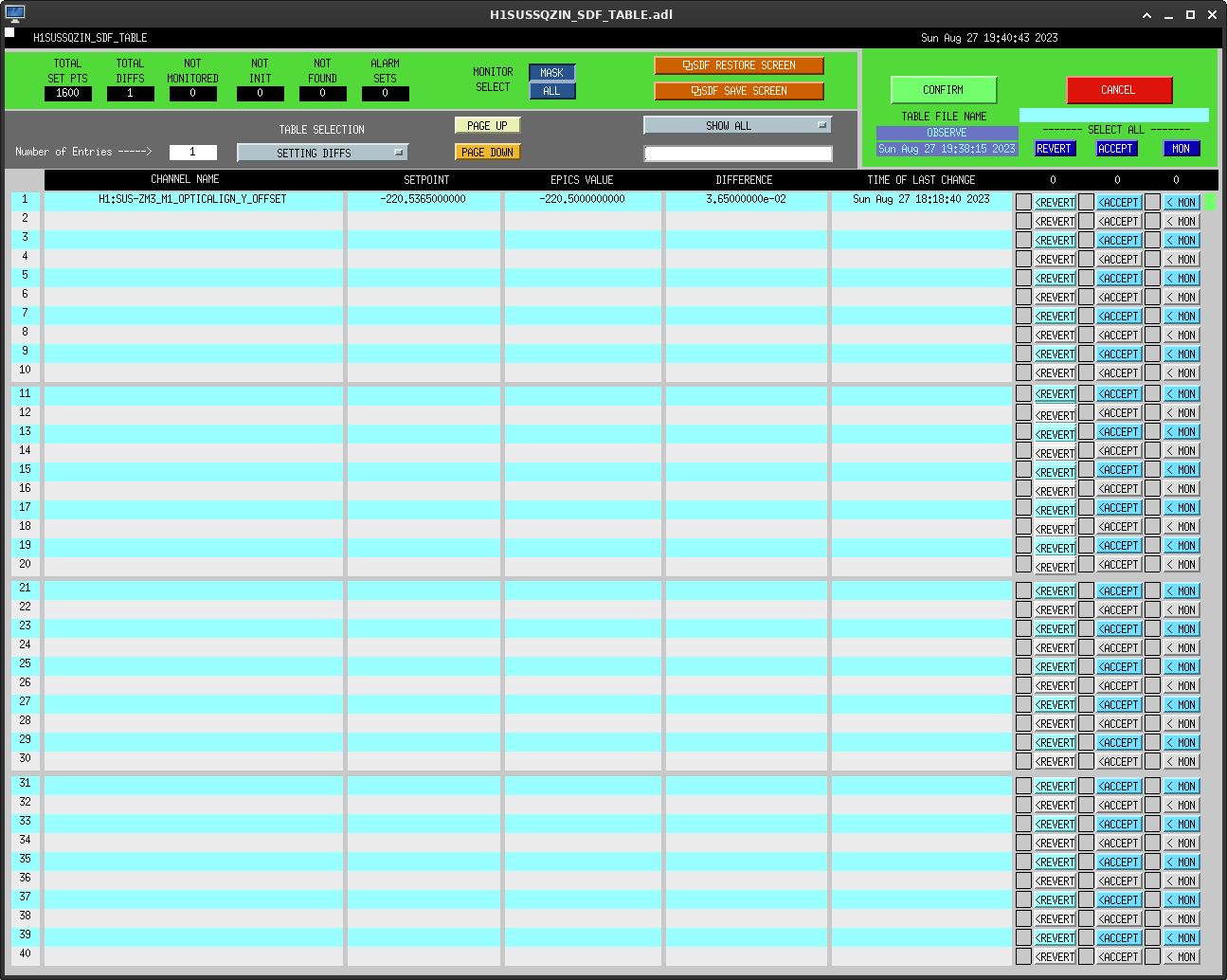
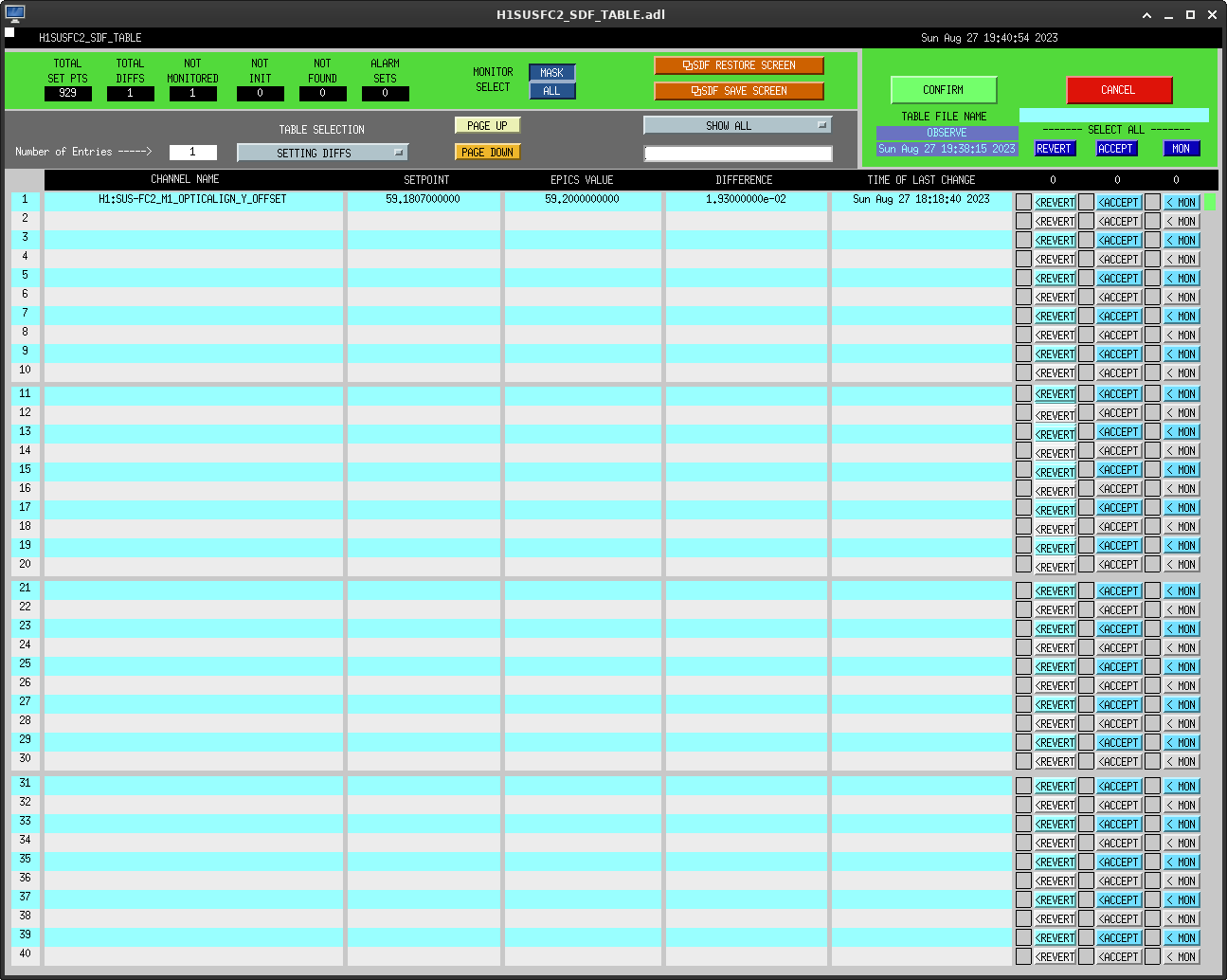
The nominal value of the squeezer laser diode current was change to 1.863 from 1.95. The tolerance is unchanged at 0.1. Looking at trends we sometimes read a value just below 1.85 leading to a failed laser condition which in turn triggers a relocking of the squeezer laser. However, since we are already locked, all we see is the fast and commen gains ramping down and up.
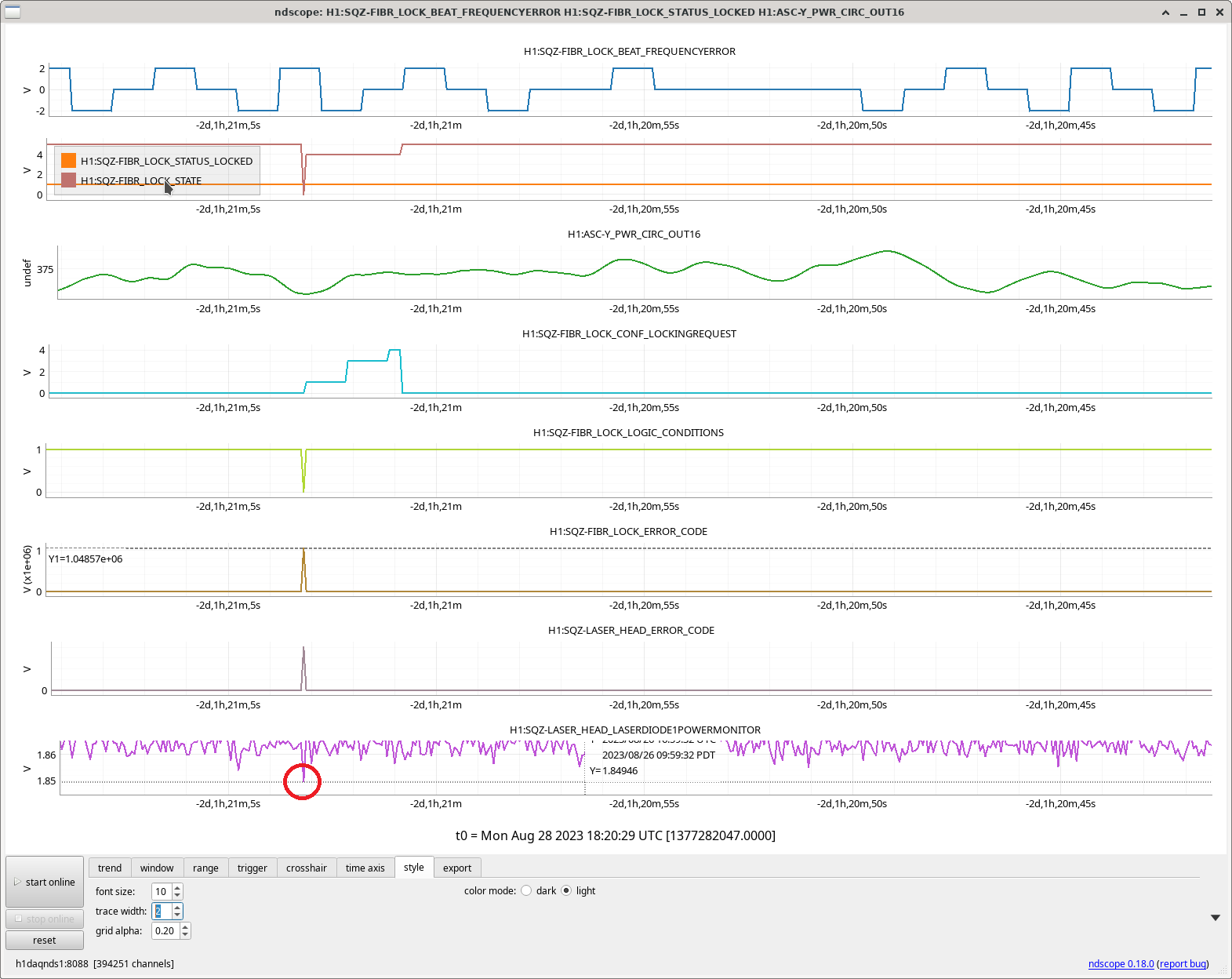
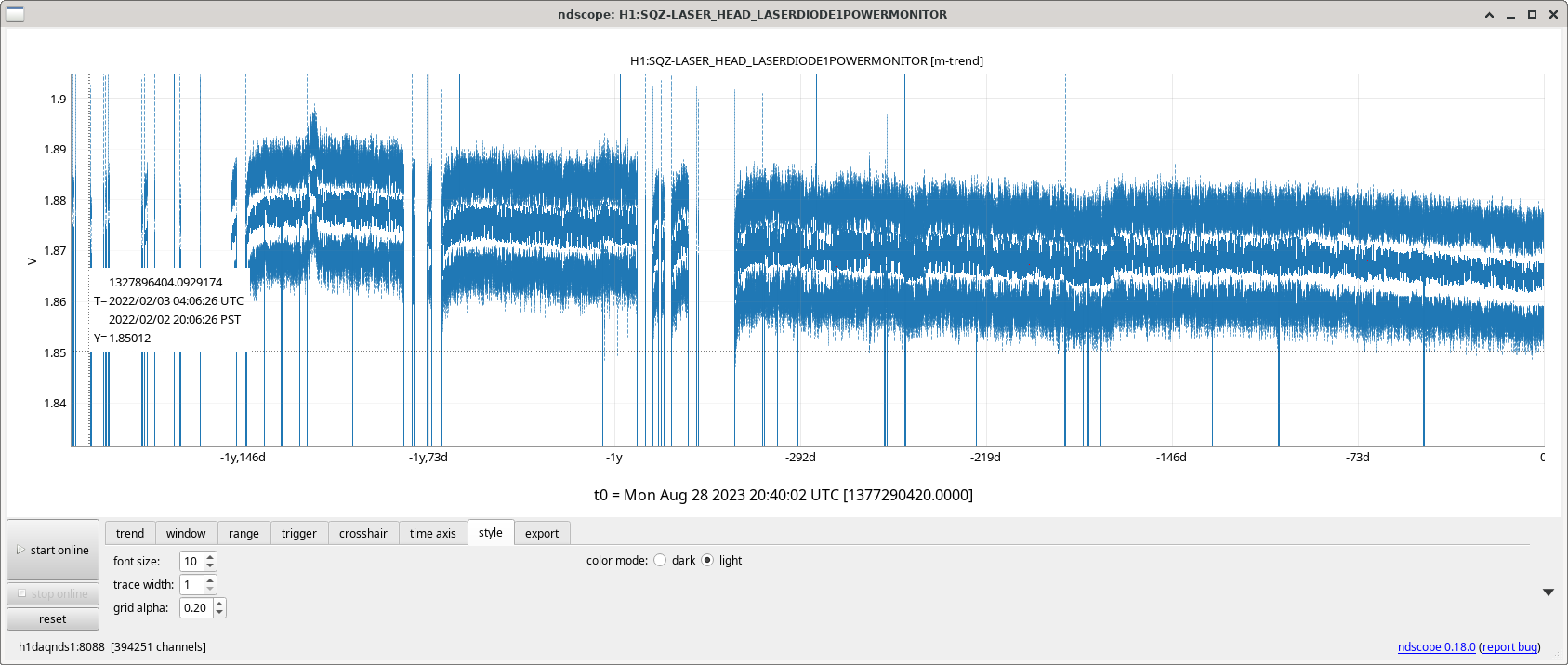
Looking at this diode current trend over the past 500 days, we see it fairly stable but trending down very slowly. It may have lost 10 mA over the past year. Resetting the nominal value should keep us in the good band for a while if this trend continues.
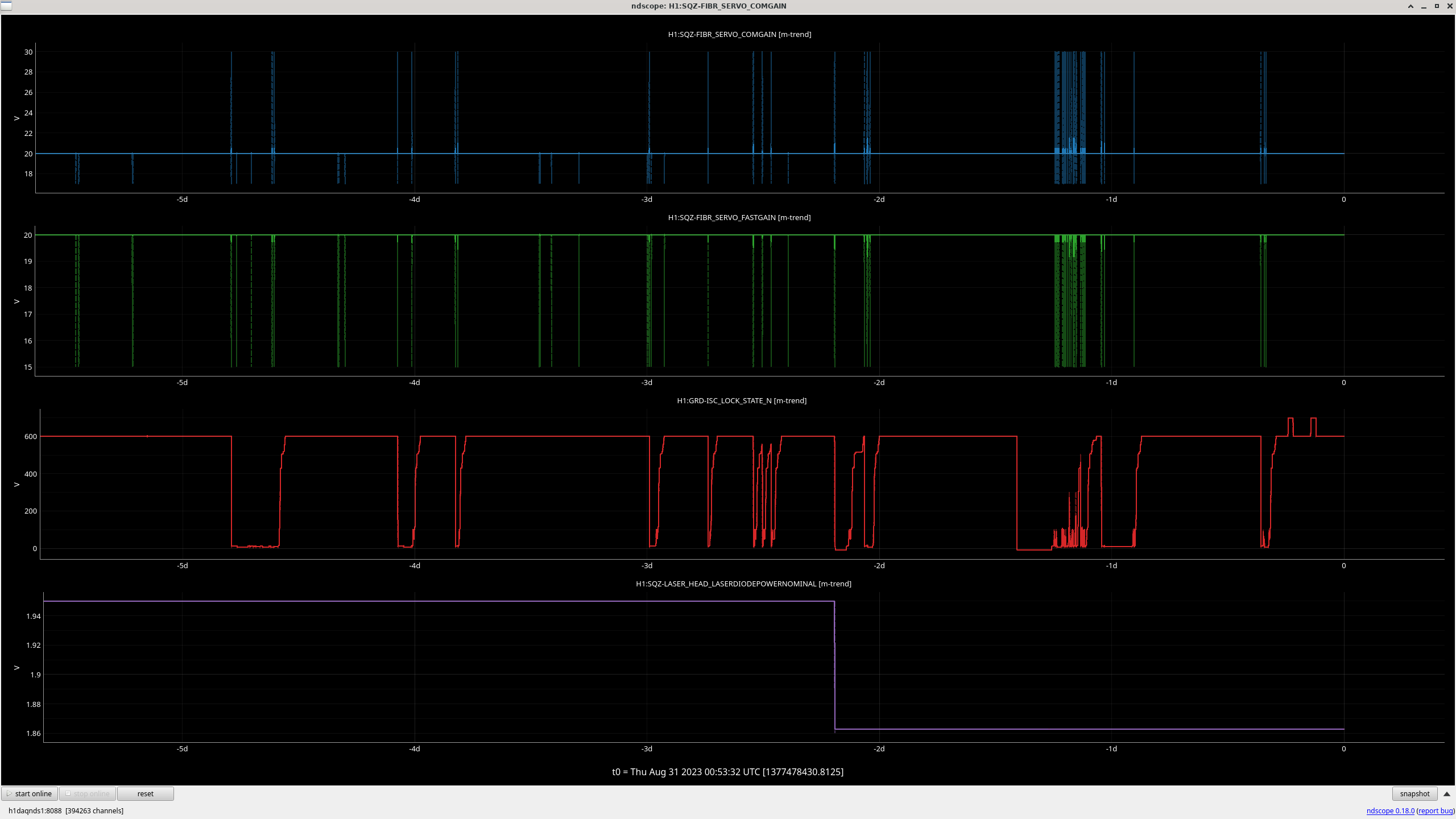
So far this seems to have fixed the TTFSS gain changing issue! Haven't seen gain changes while locked in the past couple days, since Daniel changed the laser diode nominal current (bottom purple trend).
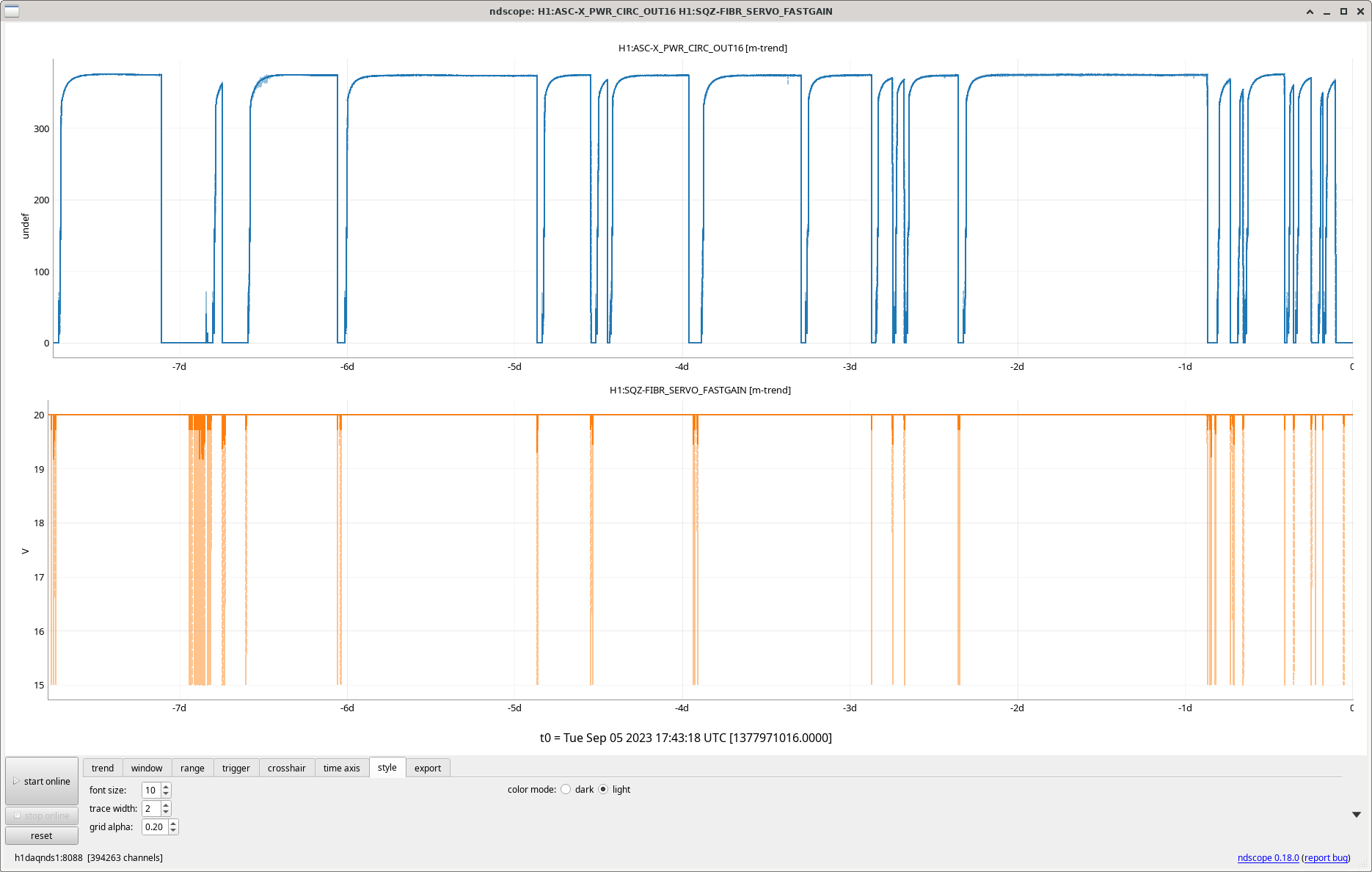
In the past week there wasn't single TTFSS gain ramping incident during lock. The fast and common gains are again monitored in SDF.
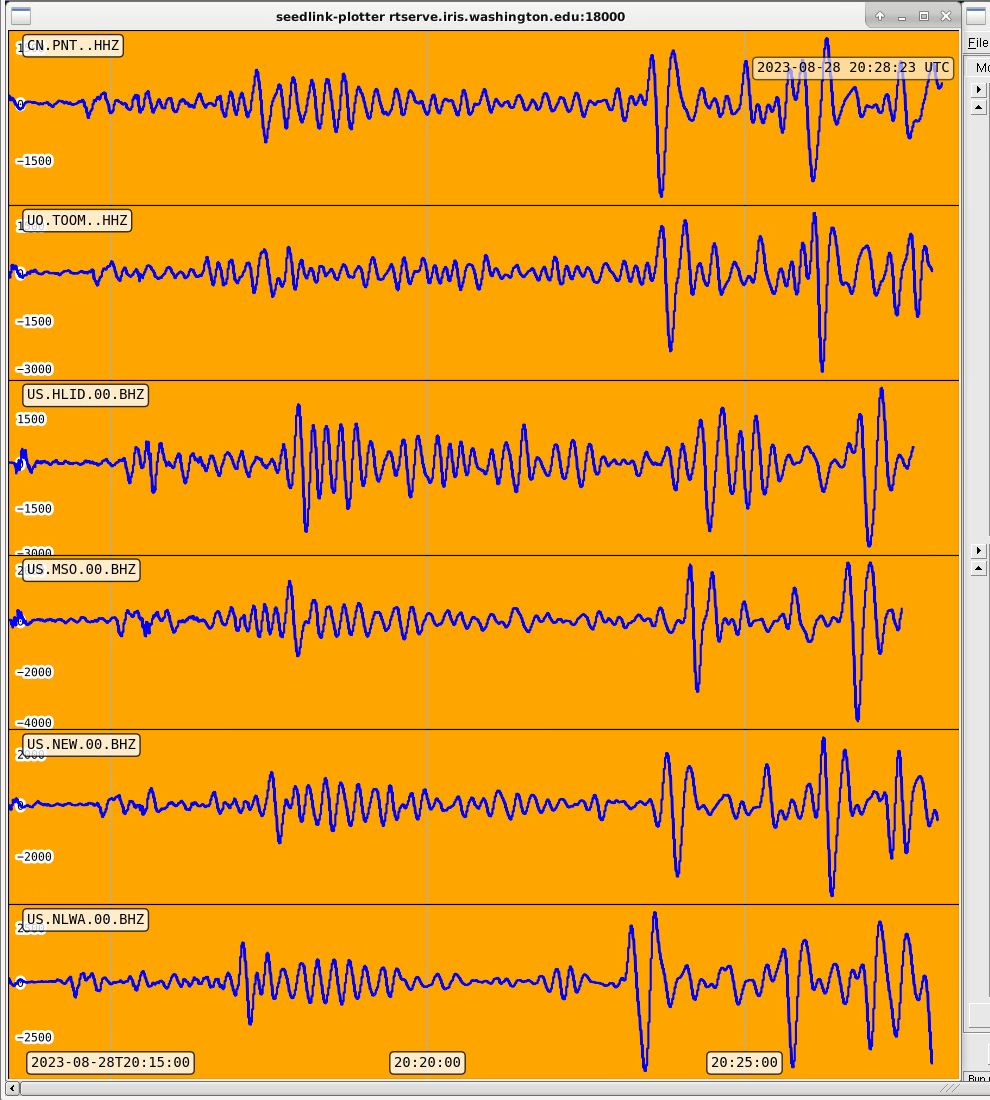
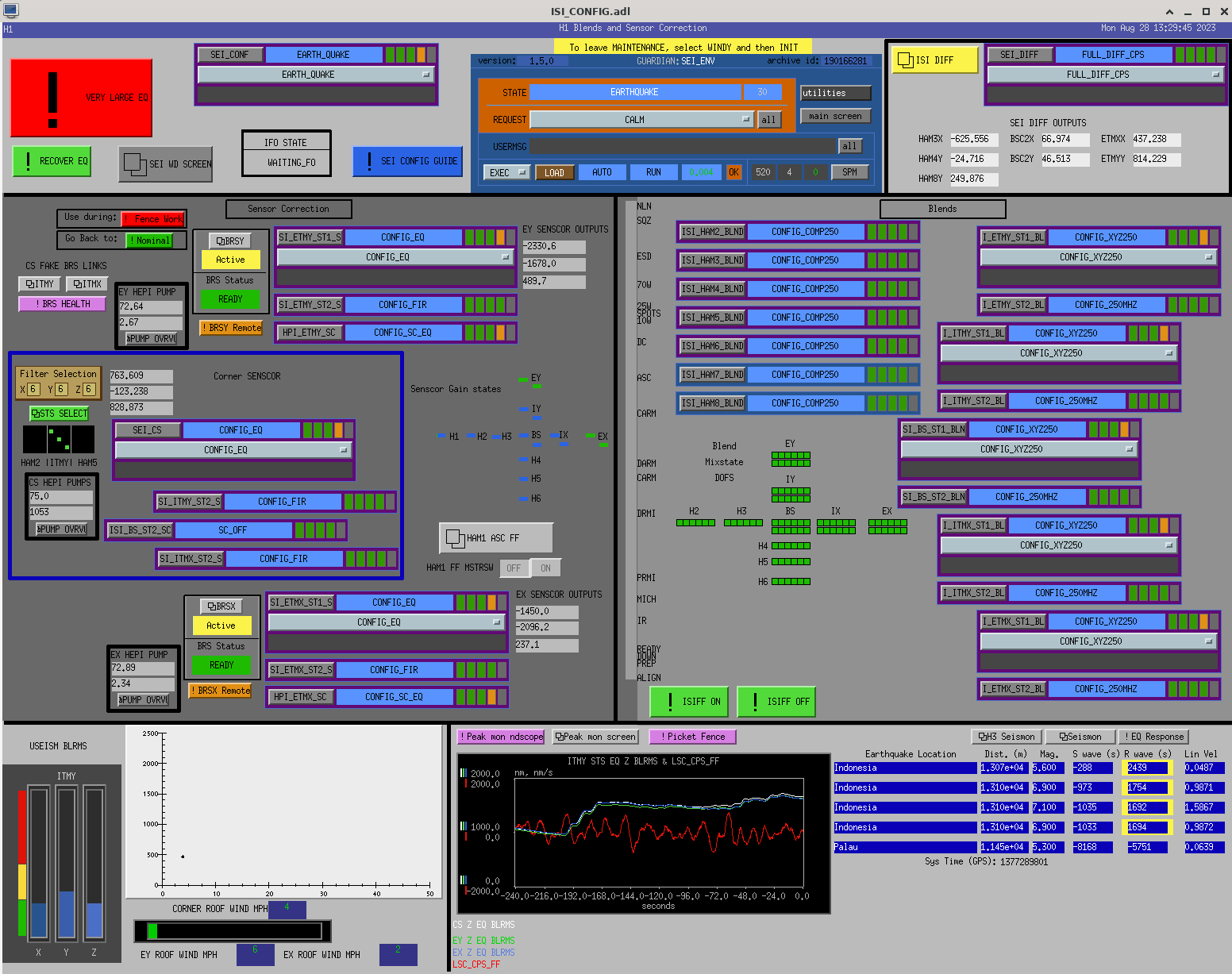
2016 H1 lost lock due to 7.1 south pacific earthquake.
We rode through the P & S waves....the R wave is still about 30+min away and it will be "spicy" ~Jim W.
I have taken H1 to IDLE....while we wait for the R wave to pass & for the planet to calm down after that.
Attached are some screenshots Tony snapped.
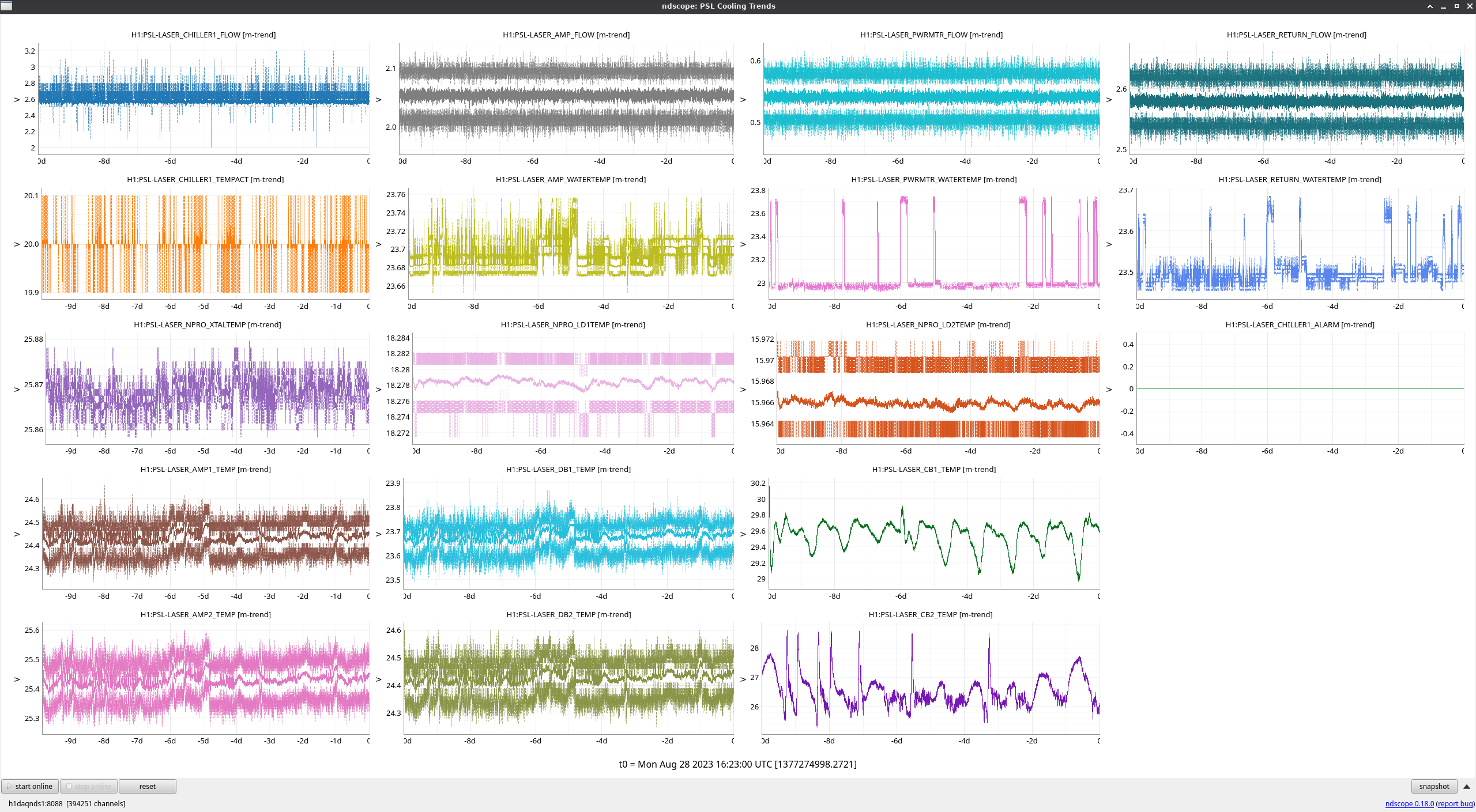
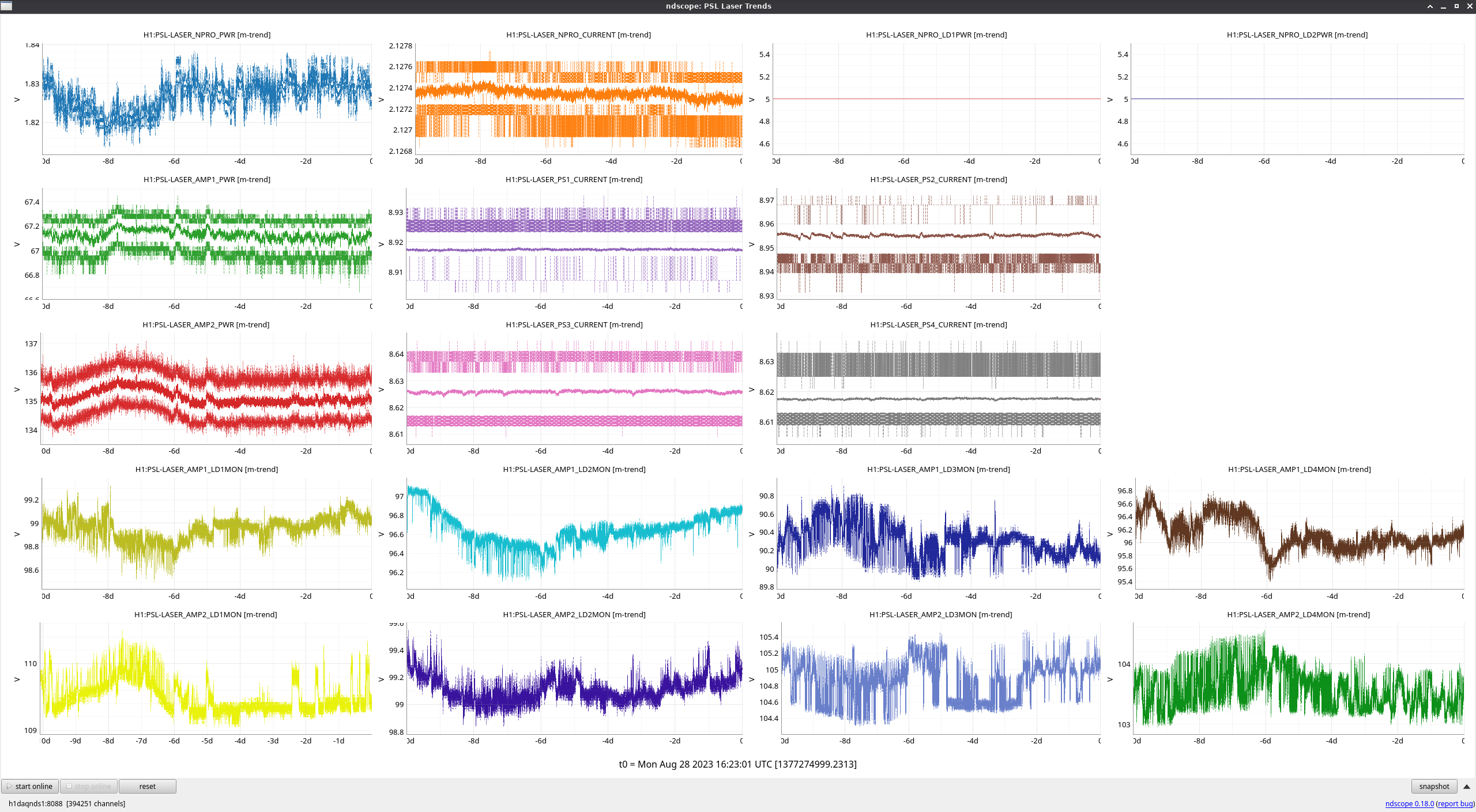
Closes FAMIS 21128
The cup in back corner of mezzanine was empty
Mon Aug 28 10:10:25 2023 INFO: Fill completed in 10min 20secs
Travis confirmed a good fill curbside.
FAMIS 19991
Jason was in the anteroom last Tuesday for inventory, which is seen by the environmental trends. Since then, the differential pressure between the anteroom and the laser room has been elevated, but not alarmingly so.
Well pump is running to replenish the fire water tank. The pump will run for 4 hours and automatically shut down.
TITLE: 08/28 Day Shift: 15:00-23:00 UTC (08:00-16:00 PST), all times posted in UTC
STATE of H1: Lock Acquisition
OUTGOING OPERATOR: Tony
CURRENT ENVIRONMENT:
SEI_ENV state: CALM
Wind: 4mph Gusts, 2mph 5min avg
Primary useism: 0.01 μm/s
Secondary useism: 0.12 μm/s
QUICK SUMMARY:
H1 lost lock at 1152utc (452amPT) and literally as I type it was at Nominal Low Noise & waiting for the CAMERA_SERVO to have its channels converge! Camera Servo completed, so I just took H1 to OBSERVE at 1506utc (806amPT). Scanning Verbal it looks like H1 made several lock attempts over the 3hrs and made it fairly far into locking each time (Power Up and a little beyond) before locklosses. Does not look like an Initial Alignment was run overnight. Looks like Tony received no locking alerts overnight.
Big picture for the range is our locks over the last day or two (153Mpc and about 146Mpc at the very beginning of ths current lock).
TITLE: 08/27 Eve Shift: 23:00-07:00 UTC (16:00-00:00 PST), all times posted in UTC
STATE of H1: Observing at 154Mpc
INCOMING OPERATOR: Tony
SHIFT SUMMARY:
- Arrived with H1 locked for 17.5 hours
- 0:21 UTC - ISS pump turned off, followed alog 70050 to troubleshoot
- Lockloss @ 1:08
- Relocking was troublesome, had to tinker a lot with ALS Y to try and find light on the PD. After a few slider restorations and trial/error attempts later, I was finally able to get it to catch. Writing down the golden sus values here for future reference:
- Rest of unlocking went unaided, acquired NLN @ 2:38, OBSERVE @ 2:54
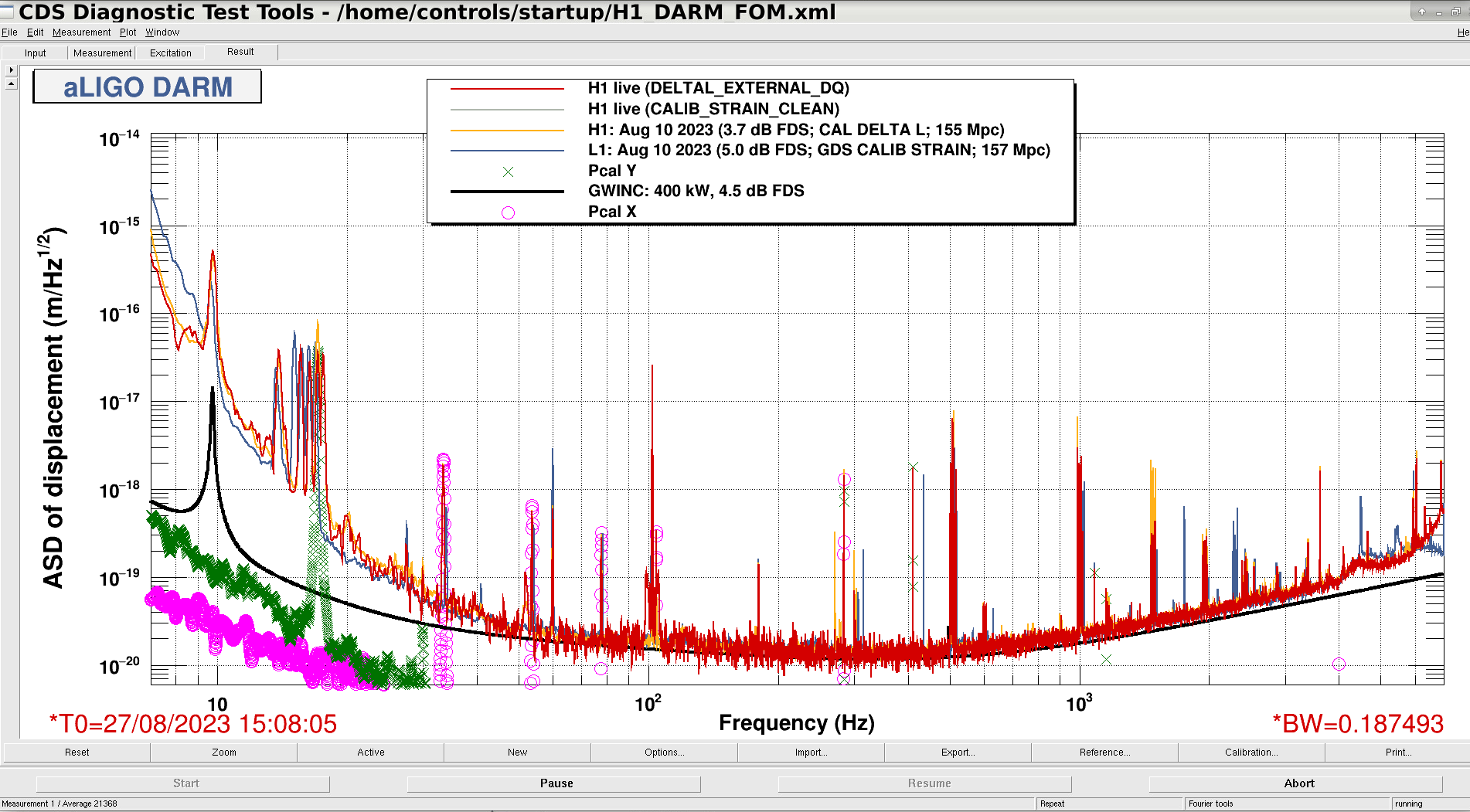
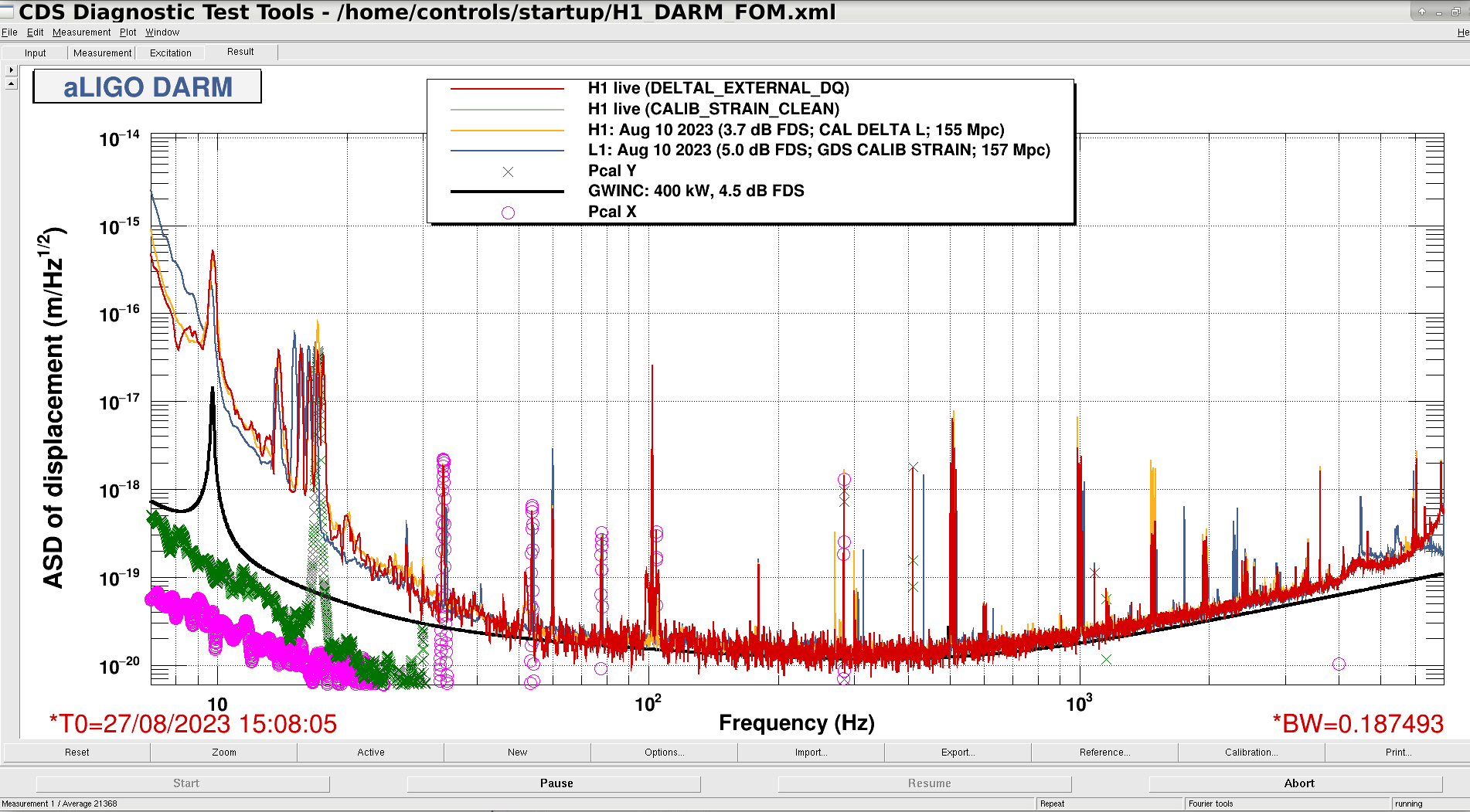
- 102 Hz peak is apparent for this lock, screenshot
- EX saturation @ 4:43/5:07
- Microseism looks to be on the rise, but otherwise all looks nominal. Setting H1 to managed to handing off to Tony for the night.
LOG:
| Start Time | System | Name | Location | Lazer_Haz | Task | Time End |
|---|---|---|---|---|---|---|
| 23:33 | EPO | Corey | Deck + overpass | N | Tour +1 | 23:50 |
Following a lockloss followed by a cumbersome relocking process, we have just made it back to observing as of 2:54 UTC. 102 Hz peak is apparent for this lock - ss attached.
Lockloss @ 1:08, no obvious cause.
TITLE: 08/27 Day Shift: 15:00-23:00 UTC (08:00-16:00 PST), all times posted in UTC
STATE of H1: Observing at 160Mpc
INCOMING OPERATOR: Austin
SHIFT SUMMARY:
Nice shift riding through breezes and Colombian seismic waves. If there's a lockloss, Dave may take the opportunity to clear up CRC on the CDS overview for SUSH2B.
LOG:
TITLE: 08/27 Eve Shift: 23:00-07:00 UTC (16:00-00:00 PST), all times posted in UTC
STATE of H1: Observing at 152Mpc
OUTGOING OPERATOR: Corey
CURRENT ENVIRONMENT:
SEI_ENV state: CALM
Wind: 9mph Gusts, 6mph 5min avg
Primary useism: 0.03 μm/s
Secondary useism: 0.10 μm/s
QUICK SUMMARY:
- H1 has been locked for just under 17 hours
- DMs/CDS ok
- Was able to ride out a 5.7 EQ from Colombia, just riding out the remnants of it
Quiet shift; winds slightly picking up. Chatted with Dave regarding (1) RED CRC (Cyclic Redundancy Check) for SUSH2B (He will address this after a future lockloss.) and (2) h1digivideo3 memory issue/bumping us out of Observing.
As Corey mentioned, the DAQ stream from h1sush2b to DC0 had a checksum mismatch in one of its 1/16th second data blocks during the 05:56:09 PDT second. The data stream to DC1 did not see this issue.
This was a true data error for this data block, which meant that FW0 wrote a different frame than FW1 for the frame which encompassed this 1/16th of a second. We know that FW1's frame is correct, FW0's frame has bad h1sush2b data.
For the full frame file H-H1_R-1377176128-64.gwf:
| FW | SIZE (bytes) | CKSUM |
| FW0 | 2115565285 | 4100757796 |
| FW1 | 2115562427 | 1319327622 |
Interestingly the correct frame is smaller than the bad frame, meaning the corrupt signal did not compress as well as the actual signal.
At 9:45am local time Chiller 1 at End Y went into alarm for "Evaporator Water Flow Lost". When I arrived at the EY chiller yard I observed that neither chiller was running but chilled water pump 1 was continuing to run. I noted the alarm and headed for the mezzanine above the AHU's to asses what the supply and return pressures were nearest the evaporator coil. Immediately I read 0 (or what I thought was 0) at the return line. This would generally indicate that there has been enough glycol loss within the system that makeup is necessary via the local tank (though I've never seen it get to 0). Until I read that both supply lines were at an alarming 140psi (normal operating pressures for all 4 supply and return float around 30). I immediately phoned Richard to have him command the chilled water pump 1 off to stop the oversupply of chilled water. For reasons not clear to me the disable command via FMCS Compass was not taken at the pump. I went back to the chiller yard and observed that 1: the pump had not been disabled and 2: pressures at the pump were at around 100psi (normal operating for the current frequency is about 50). Following that, I manually threw the pump off at the VFD to prevent further runaway of the system. Between the time of noting 140psi and manually throwing the pump off, the system pressure increased to 160psi. After a thorough walk-down of the system, I elected not to utilize our designed redundancy in chiller 2 and chilled water pump 2 as I was still unaware what was causing the massive overpressure at all supply and return lines. It was also found that the return line was not actually at 0, but instead had made a full rotation and was pegged on the backside of the needle (all of these need replacement now). Macdonald-Miller was called on site to help asses what the issue might be. Given that there was recent incursions to flow via R. Schofield the strainer was the primary point of concern. We flushed the strainer briefly at the valve and noted a large amount of debris. after a second flush, much less/next to none was noted. This alleviated the system pressure substantially. The exact cause of the fault and huge increase of pressure is still not clear. There are a number of flow switches at the chiller. Bryan with Mac-Miller suspects part of the issue may live there, and we are going to pursue this further during our next maintenance window. Work was also performed at the strainer within the chiller where rubber/latex-esque debris was found. Work on Chiller 1 to continue but for now the system and end station is happy on chiller2/CHWP2. Looking at the FMCS screen shows temp's have normalized as of the writing of this log. T. Guidry B. Haithcox. R. Thompson C. Soike R. McCarthy
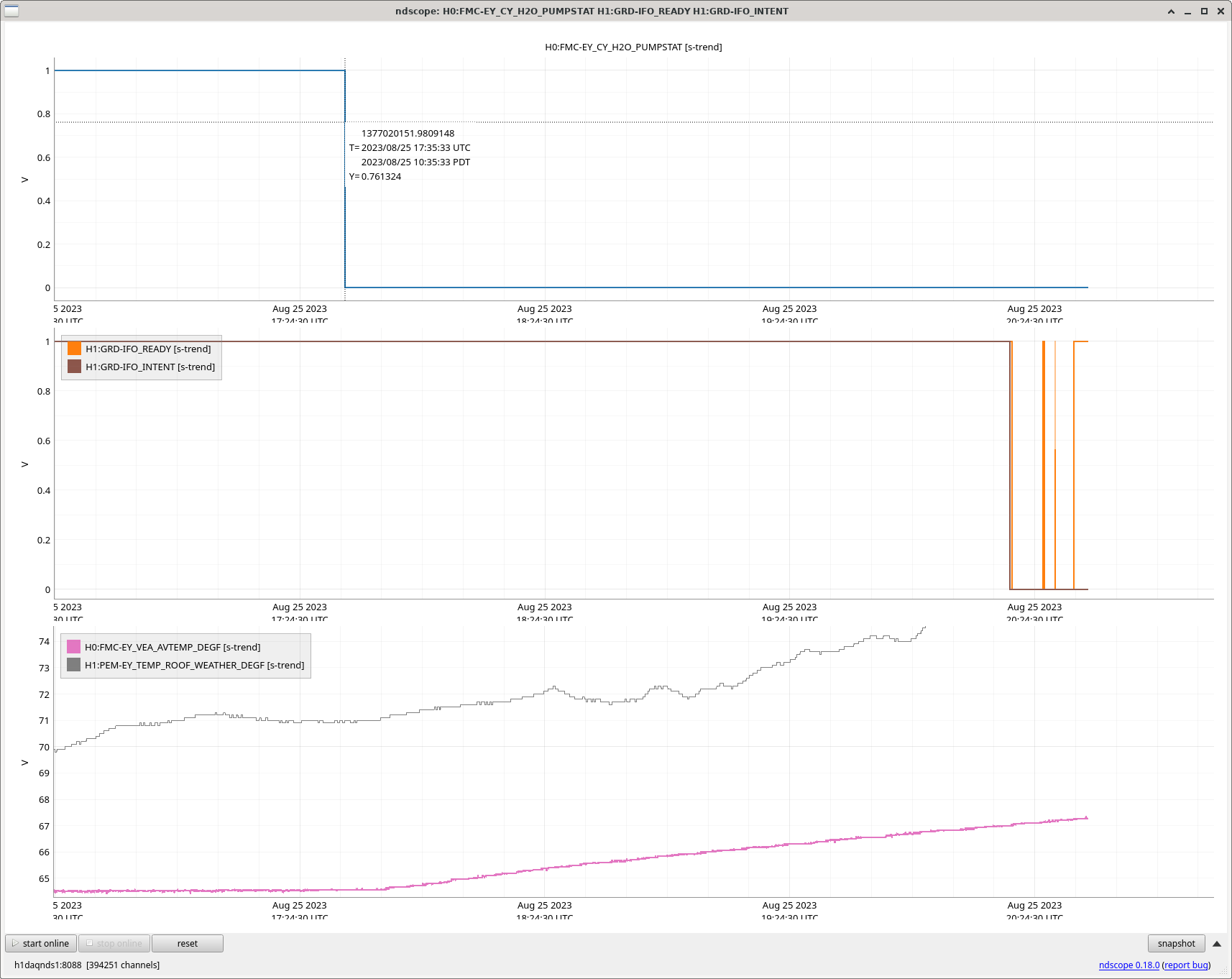
J. Kissel, for T. Guidry, R. McCarthy Just wanted to get a clear separate aLOG in regarding what Corey mentioned in passing in his mid-shift status LHO:72423: The EY HVAC Air Handler's chilled water pump 1 of 2 failed this morning 2023-08-25 at 9:45a PDT, and thus the EY HVAC system has been shut down for repair at 17:35 UTC (10:35 PDT). The YVEA temperature is therefore rising as it equilibrates with the outdoor temperature; thus far from 64 deg F to 67 deg F. Tyler, Richard, and an HVAC contractor are on it, actively repairing the system, and I'm sure we'll get a full debrief later. Note -- we did not stop our OBSERVATION INTENT until 2h 40m hours later 2023-08-25 20:18 UTC (13:18 PDT), when we've gone out to do some commissioning.
The work that they've been doing so far today to diagnose this issue has been in the 'mechanical room'. Their work should not add any additional significant noise over what aready occurs in that room at all times, so I do not expect that there should be any data quality issues as a result of this work. But, we shall see (as Jeff points out) if there are any issues from the temperature itself changing.
They are done for the weekend and temperatures are returning to normal values.
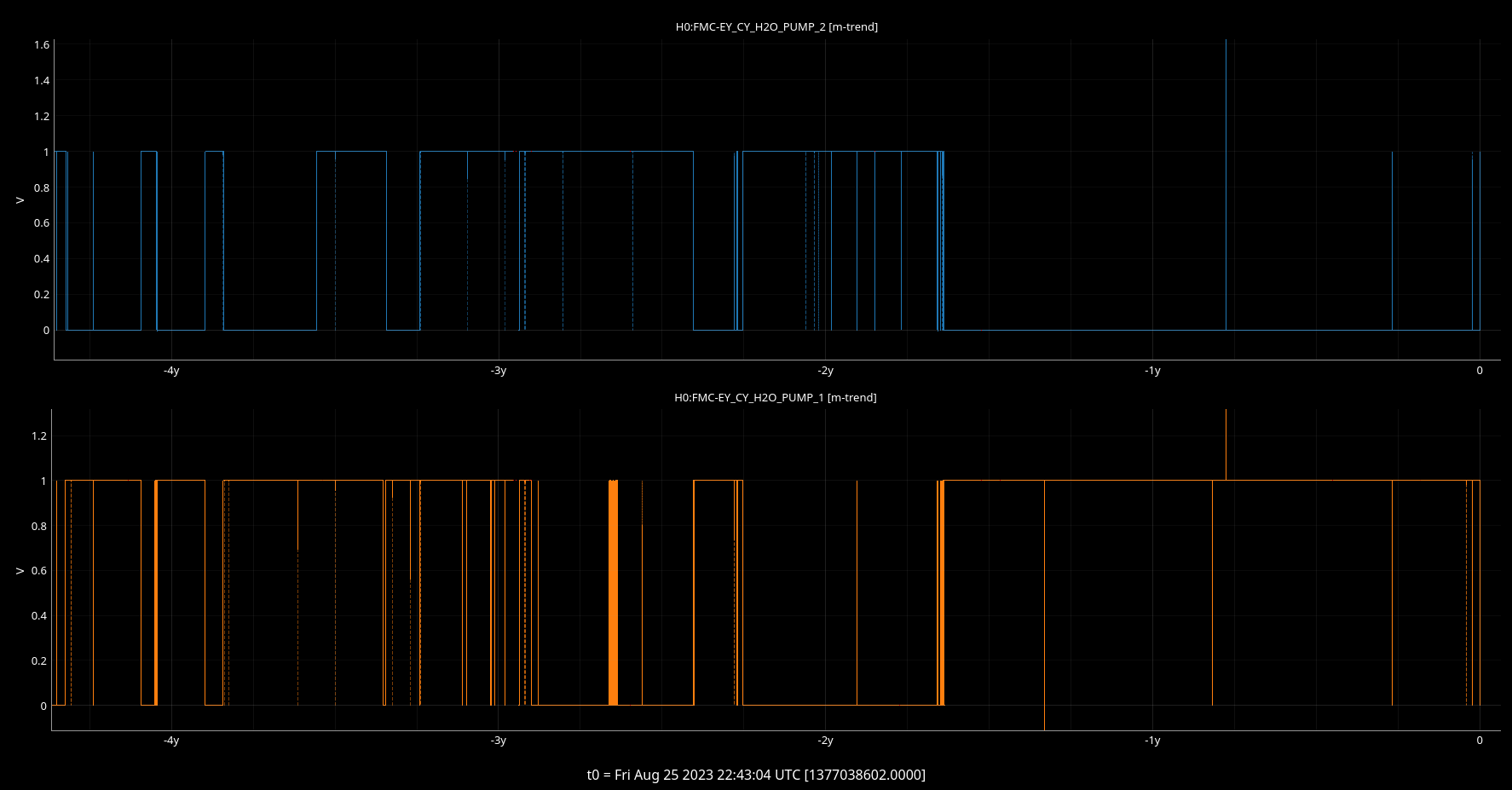
Chiller Pump #2 is the chiller we are now running.
Chiller Pump #1 will need to be looked at some more (Tyler mentioned the contractor will return on Tues).
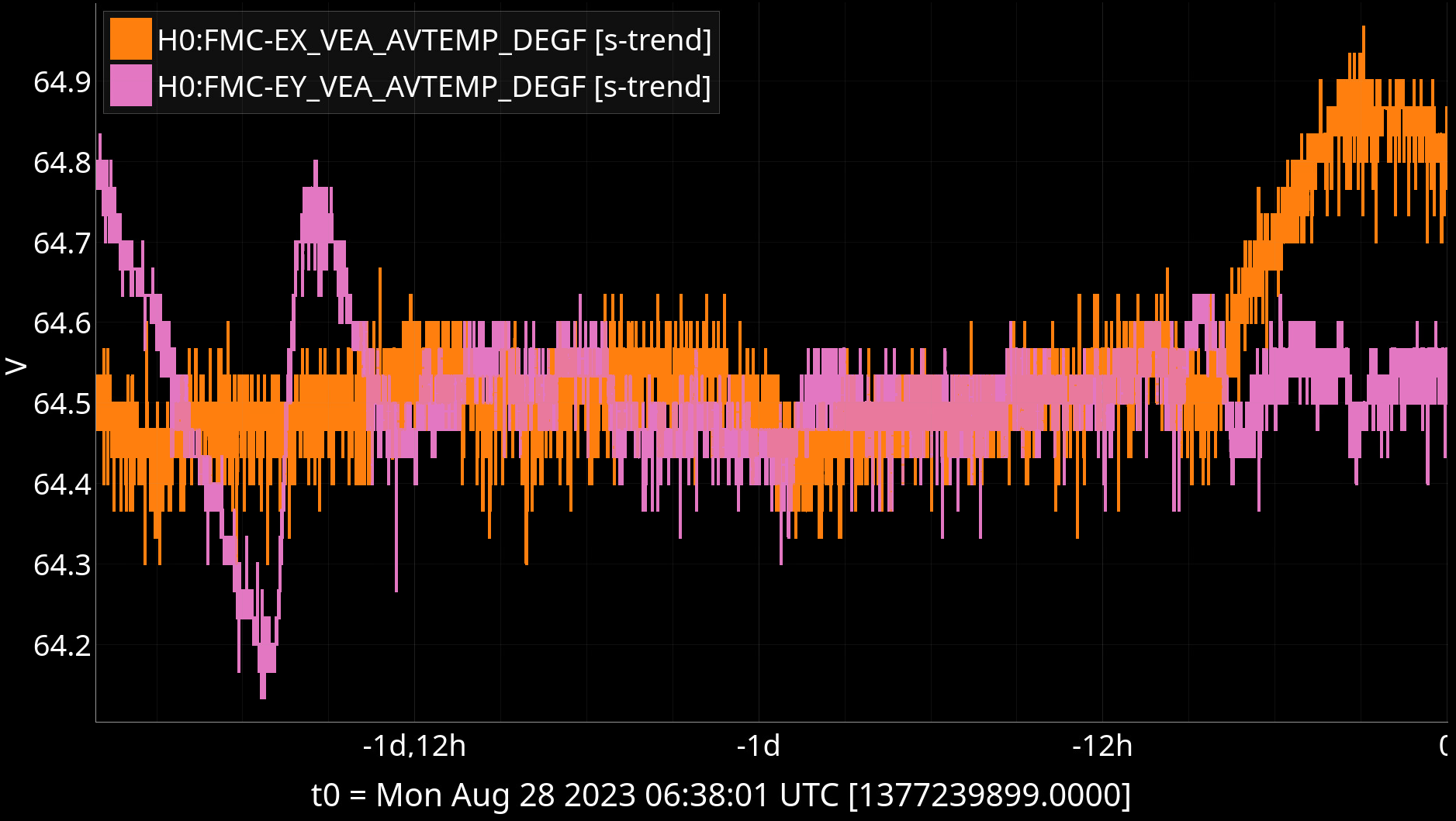
Attached is a look at the last 4+yrs and both EY chillers (1 = ON & 0 = OFF).
See Tyler's LHO:72444 for more accurate and precise description of what had happened to the HVAC system.
TITLE: 08/25 Day Shift: 15:00-23:00 UTC (08:00-16:00 PST), all times posted in UTC
STATE of H1: Observing at 147Mpc
OUTGOING OPERATOR: Tony
CURRENT ENVIRONMENT:
SEI_ENV state: CALM
Wind: 14mph Gusts, 11mph 5min avg
Primary useism: 0.05 μm/s
Secondary useism: 0.07 μm/s
QUICK SUMMARY: H1 has been locked for 46 hours.
Just a note: I was the Day Operator, but arrived late due to Route10 being CLOSED. :(
Genevieve, Lance, Robert
To further understand the roughly 10Mpc lost to the HVAC (https://alog.ligo-wa.caltech.edu/aLOG/index.php?callRep=72308), we made several focussed shutdowns today. These manipulations were made during observing (with times recorded) because such HVAC changes happen automatically during observing and also, we were reducing noise rather than increasing it. The times of these manipulations are given below.
One early outcome is that the peak at 52 Hz in DARM is produced by the chilled water pump at EX (see figure). We went out and looked to see if the vibration isolation was shorted, it was not, though there are design flaws (the water pipes arent isolated). We switched from CHWP-2 to CHWP-1 to see if the particular pump was extra noisy. CHWP-1 produced a similar peak in DARM at its own frequency. The peak in accelerometers is also similar in amplitude to the one from the water pump at EY. One possibility is that the coupling at EX is greater because of the undamped cryobaffle at EX.
Friday HVAC shutdowns; all times Aug. 18 UTC
15:26 CS SF1, 2, 3, 4 off
15:30:30 CS SF5 and 6 off
15:36 CS SF5 and 6 on
15:40 CS SF1, 2, 3, 4 back on
16:02 EY AH2 (only fan on) shut down
16:10 EY AH2 on
16:20 EY AH2 off
16:28 EY AH2 on
16:45 EY AH2 and chiller off
16:56:30 EY AH2 and chiller on
17:19:30 EX chiller only off, pump stays on
17:27 EXwater pump CHWP-2 goes off
17:32: EX CHWP-2 back on chiller back on right after
19:34:38 EX chiller off, CHWP-2 pump stays on for a while
19:45 EX chiller back on
20:20 EX started switch from chiller 2 to chiller 1 - slow going
21:00 EX Finally switched
21:03 EX Switched back to original, chiller 1 to chiller 2
Turning Roberts reference to LHO:72308 into a hyperlink for ease of navigation. Check out LHO:72297 for a bigger picture representation of how the 52 Hz peak in the broader DARM sensitivity, and from the Time Stamps in Elenna's plots, they were taken at 15:27 UTC, just after the corner station (CS) "SFs 1, 2, 3, 4" are off. SF stands for "Supply Fans" i.e. those air handler unit (AHU) fans that push the cool air in to the LVEA. Recall, there are two fans per air handler unit, for the two air handler units (AHU1 and AHU2) that feed the LVEA in the corner station. The channels that you can use to track the corner station's LVEA HVAC system are outlined more in LHO:70284, but in short, you can check the status of the supply fans via the channels H0:FMC-CS_LVA_AH_AIRFLOW_1 Supply Fan (SF) 1 H0:FMC-CS_LVA_AH_AIRFLOW_2 Supply Fan (SF) 2 H0:FMC-CS_LVA_AH_AIRFLOW_3 Supply Fan (SF) 3 H0:FMC-CS_LVA_AH_AIRFLOW_4 Supply Fan (SF) 4
My Bad: -- Elenna's aLOG is showing the sensitivity on 2023-Aug-17, and the Robert logging of times listed above are for 2023-Aug-18. Elenna's demonstration is during Robert's site-wide HVAC shut down 2023-Aug-17 -- see LHO:72308 (i.e. not just the corner as I'd errantly claimed above.).
For these 2023-Aug-18 times mentioned in this LHO aLOG 72331, check out the subsequent analysis of impact in LHO:72778.
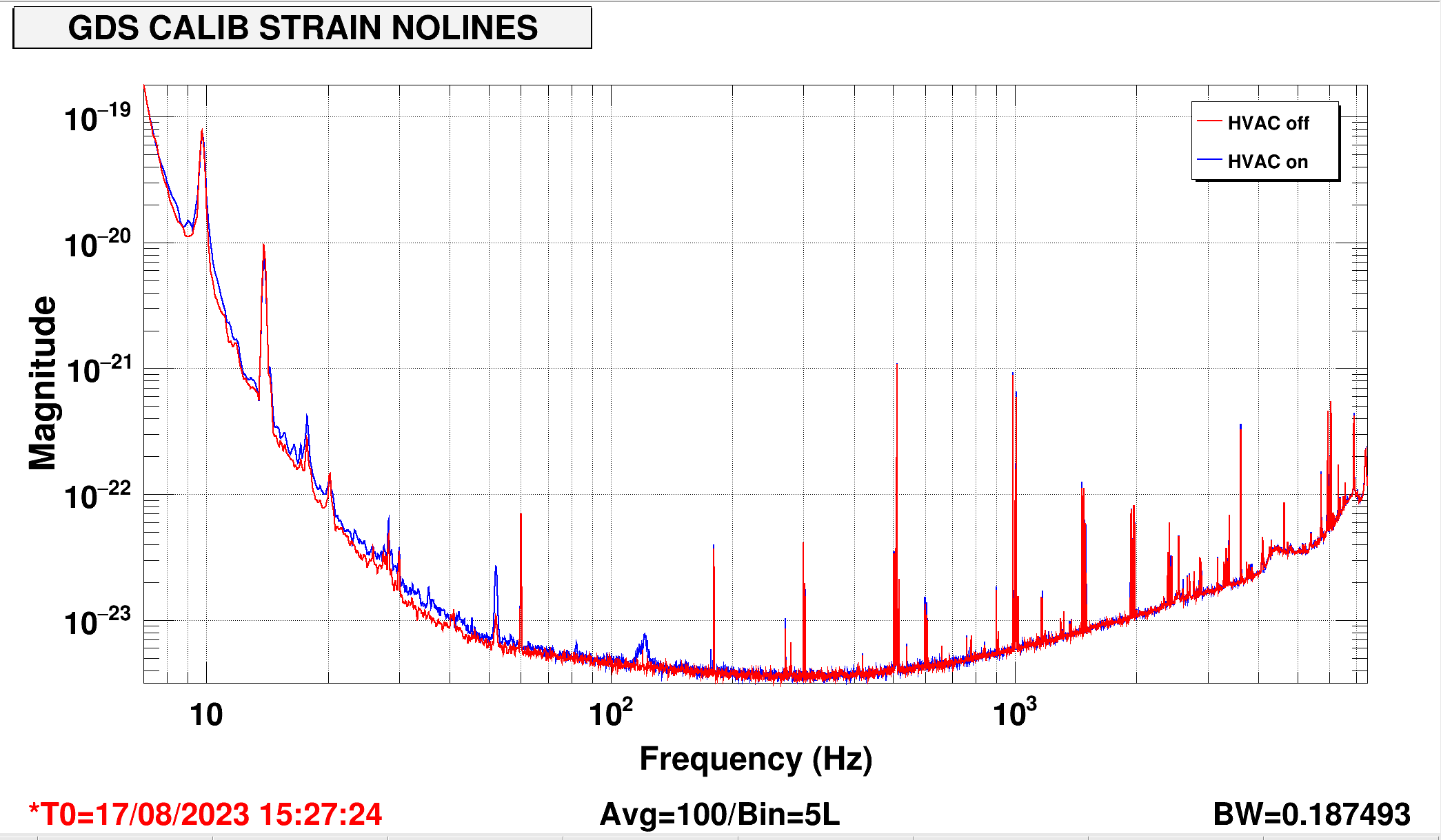
Robert did an HVAC off test. Here is a comparison of GDS CALIB STRAIN NOLINES from earlier on in this lock and during the test. I picked both times off the range plot from a time with no glitches.
Improvement from removal of 120 Hz jitter peak, apparent reduction of 52 Hz peak, and broadband noise reduction at low frequency (scatter noise?).
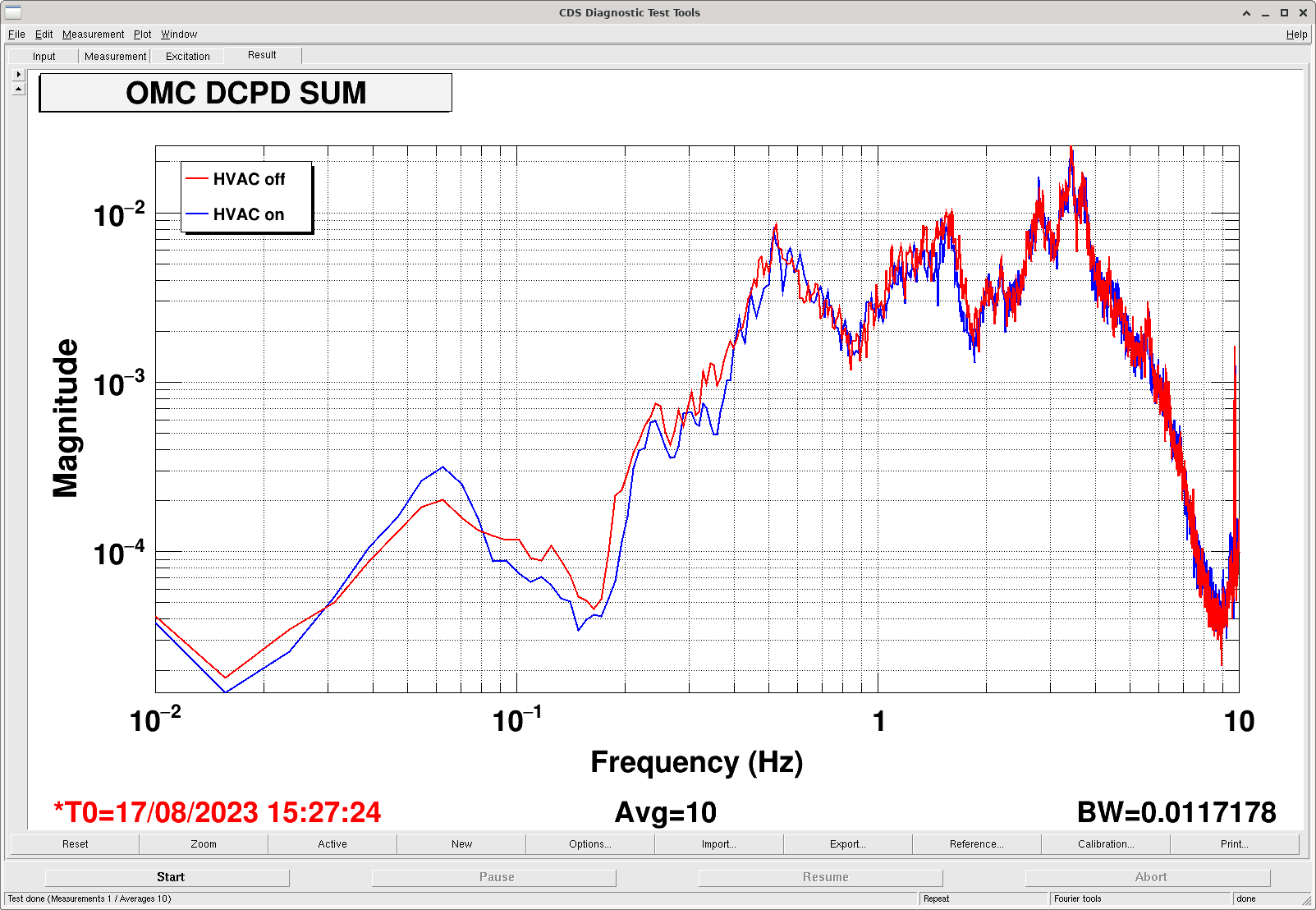
I have attached a second plot showing the low frequency (1-10 Hz) spectrum of OMC DCPD SUM, showing no appreciable change in the low frequency portion of DARM from this test.
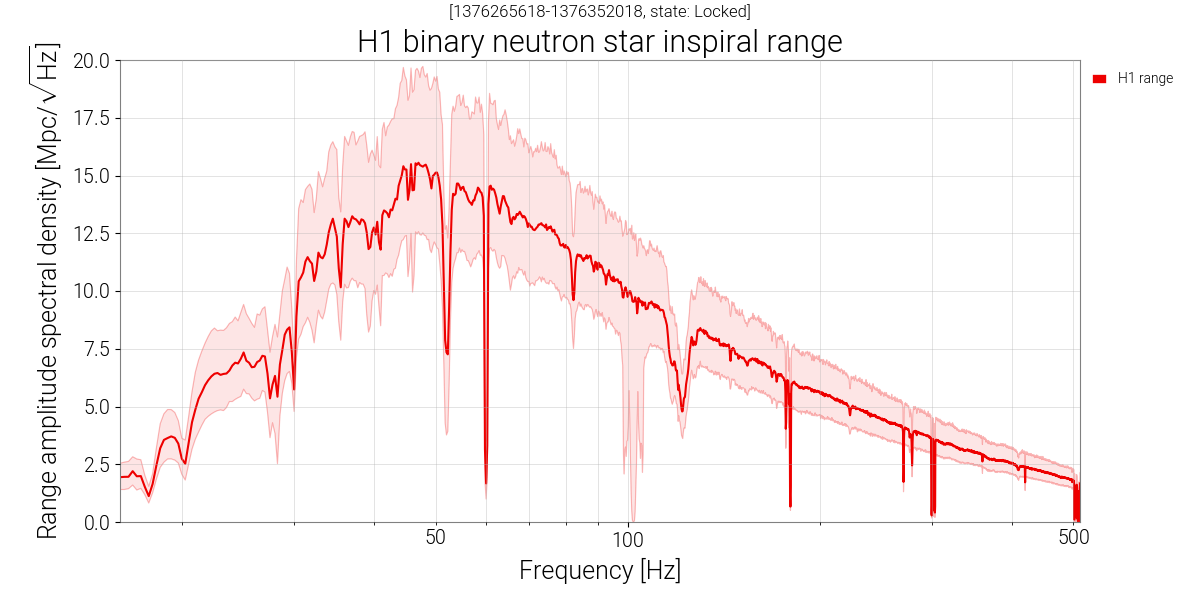
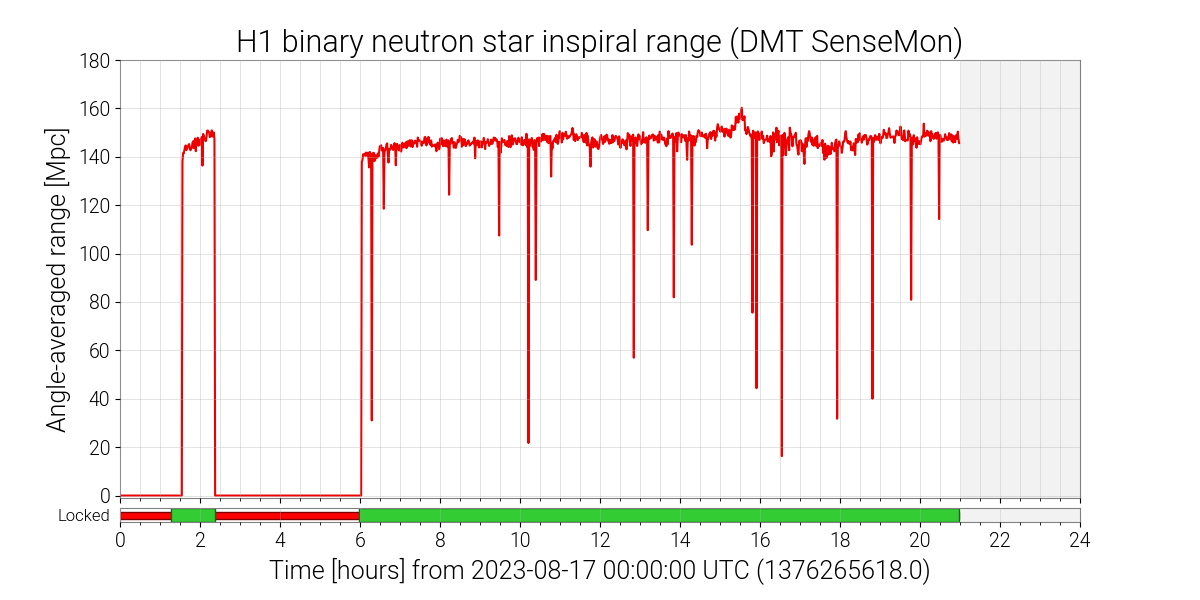
Reminders from the summary pages as to why we got so much BNS range improvement from removing the 52 Hz and 120 Hz features shown in Elenna's ASD comparison. Pulled from https://ldas-jobs.ligo-wa.caltech.edu/~detchar/summary/day/20230817/lock/range/. Range integrand shows ~15 and ~5 MPC/rtHz reduction at the 52 and 120 Hz features. BNS range time series shows brief ~15 MPC improvement at 15:30 UTC during Robert's HVAC OFF tests.
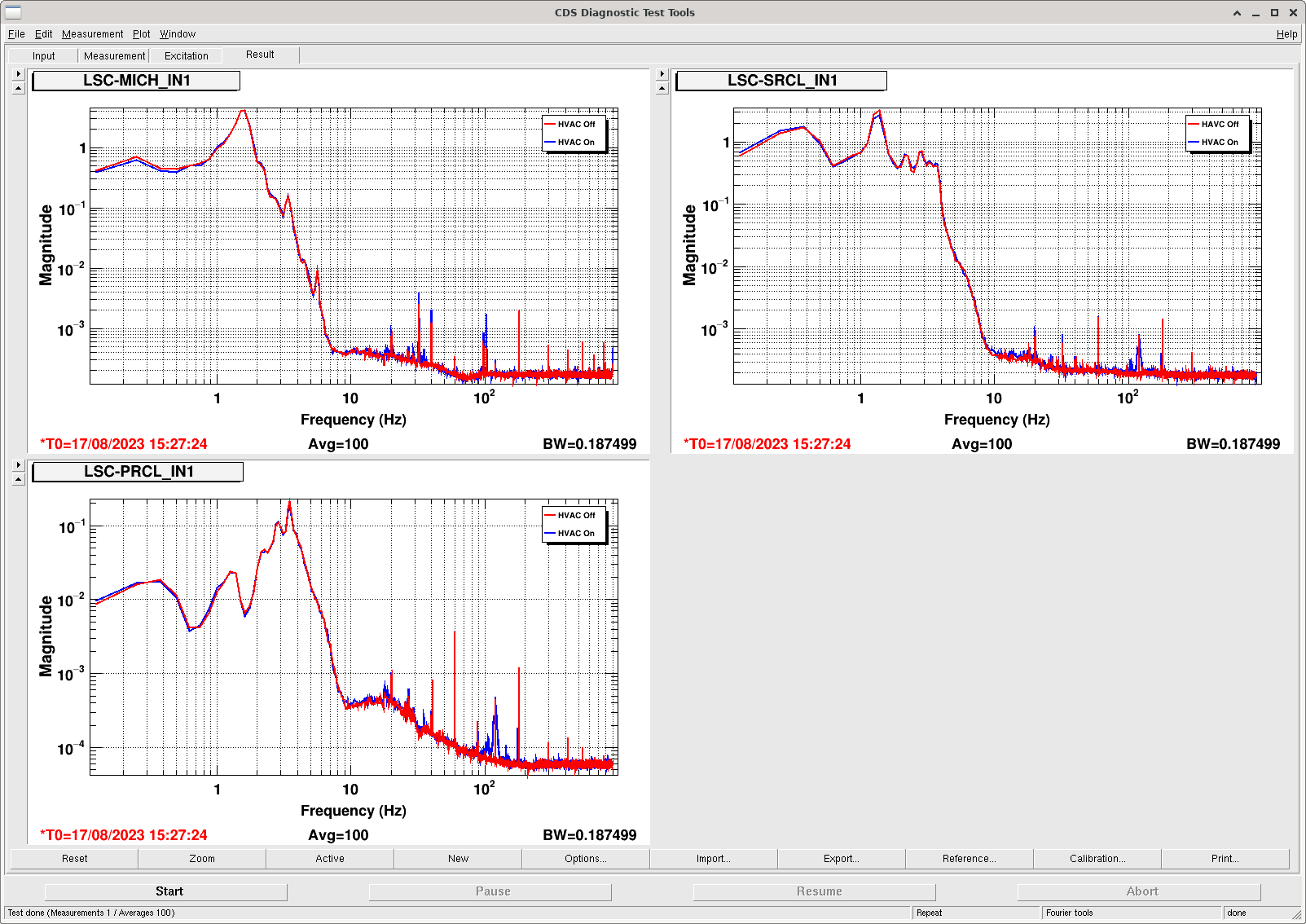
Here is a spectrum of the MICH, PRCL, and SRCL error signals at the time of this test. The most visible change is the reduction of the 120 Hz jitter peak also seen in DARM. There might be some reduction in noisy peaks around 10-40 Hz in the signals, but the effect is small enough it would be useful to repeat this test to see if we can trust that improvement.
Note: the spectra have strange shapes, I think related to some whitening or calibration effect that I haven't bothered to think about to make these plots. I know we have properly calibrated versions of the LSC spectra somewhere, but I am not sure where. For now these serve as a relative comparison.
According to Robert's follow-up / debrief aLOG (LHO:72331) and the time-stamps in the bottom left corner of Elenna's DTT plots, she's is using the time 2023-08-17 15:27 UTC, and that corresponds to the time when Robert had turned off all four the supply fans (SF1, SF2, SF3, and SF4) in the corner station (CS) air handler units (AHU) 1 and 2 that supply the LVEA around 2023-08-17 15:26 UTC.