Displaying reports 18681-18700 of 88722.Go to page Start 931 932 933 934 935 936 937 938 939 End
Reports until 14:45, Friday 11 August 2023
H1 SEI
jim.warner@LIGO.ORG - posted 14:45, Friday 11 August 2023 (72158)
August Wind Fence inspection

Finished a walk through of the wind fences today. Both fences looked fine, no damage. Attached photo is of the EX fence. No pics of the EY fence, still waiting on my replacement phone, but there's nothing to show.

Images attached to this report
H1 PSL
ryan.short@LIGO.ORG - posted 11:28, Friday 11 August 2023 (72155)
PSL Status Report - Weekly

FAMIS 25491


Laser Status:
    NPRO output power is 1.83W (nominal ~2W)
    AMP1 output power is 67.19W (nominal ~70W)
    AMP2 output power is 134.8W (nominal 135-140W)
    NPRO watchdog is GREEN
    AMP1 watchdog is GREEN
    AMP2 watchdog is GREEN

PMC:
    It has been locked 5 days, 3 hr 15 minutes
    Reflected power = 17.33W
    Transmitted power = 108.6W
    PowerSum = 125.9W

FSS:
    It has been locked for 0 days 1 hr and 45 min
    TPD[V] = 0.9241V

ISS:
    The diffracted power is around 2.1%
    Last saturation event was 0 days 1 hours and 45 minutes ago


Possible Issues: None

LHO VE
david.barker@LIGO.ORG - posted 10:20, Friday 11 August 2023 (72153)
Fri CP1 Fill

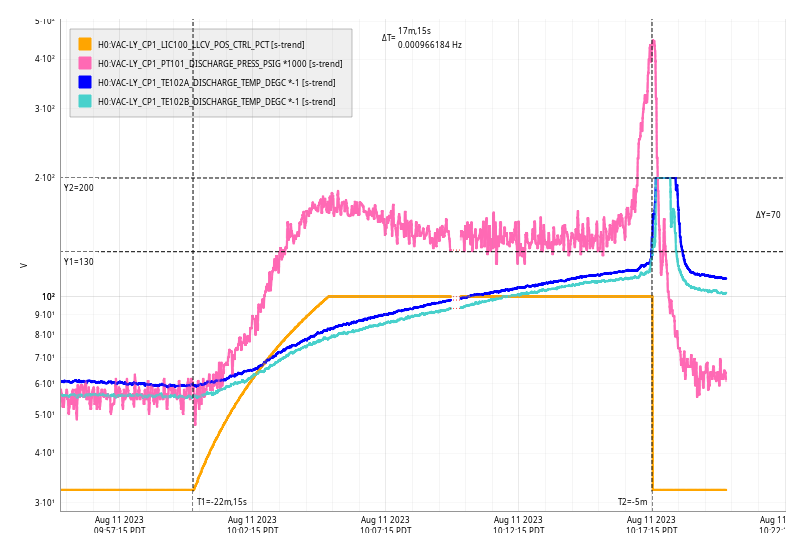
Fri Aug 11 10:17:15 2023 INFO: Fill completed in 17min 10secs

Gerardo confirmed a good fill curbside.

Images attached to this report
H1 ISC (SUS)
jenne.driggers@LIGO.ORG - posted 10:04, Friday 11 August 2023 - last comment - 10:51, Friday 11 August 2023(72152)
Locking is better with higher SR2, SR3 damping gains

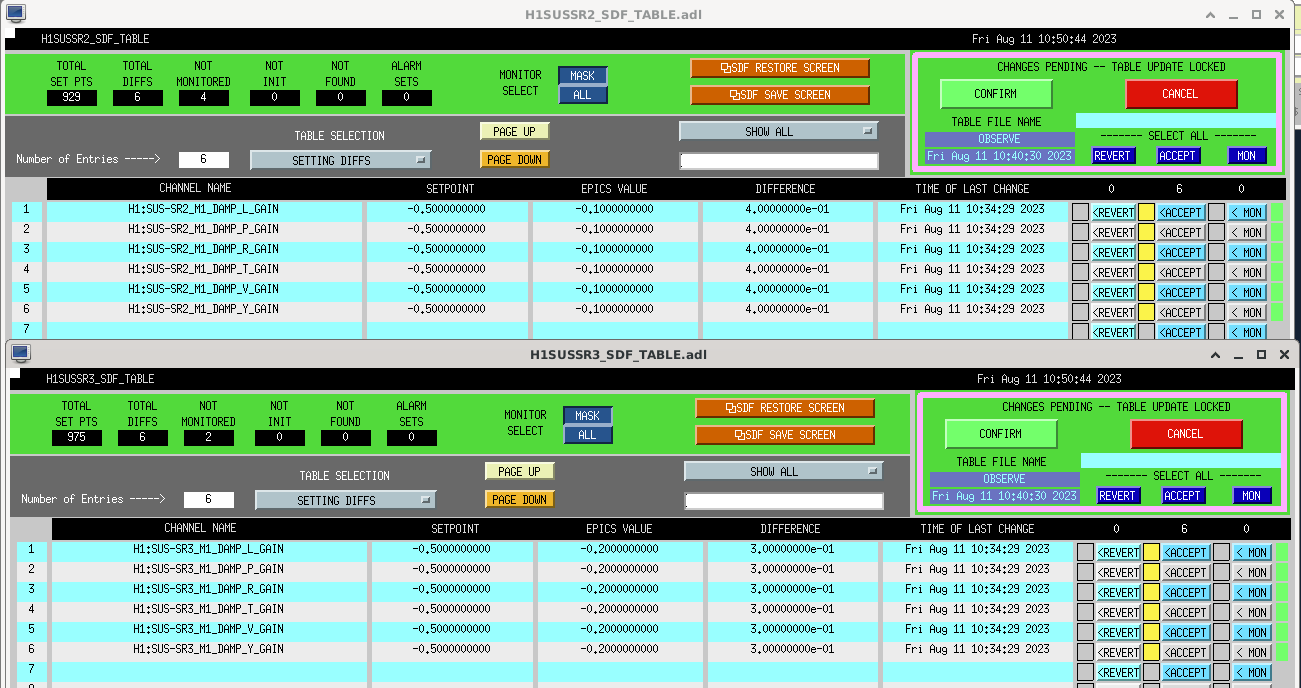
After the locking struggles this morning (alogs 72145 and 72149), Gabriele suggested reverting the SR2 and SR3 damping gains back to a higher value.  RyanS did that by hand, and the IFO got all the way to NLN the next lock with no further assistance (I believe). 

While the IFO was relocking, I added a few lines to the end of LOWNOISE_ASC to set the SR2 and SR3 damping gains to their lower values from alog 72130.

TJ and RyanS are working right now on a way to ensure that we have the higher gain values for lock acquisition and initial alignment, but also the lower gains accepted in the Observe.snap file (as of early this morning, the safe.snap and observe.snap files are still linked).

Comments related to this report
thomas.shaffer@LIGO.ORG - 10:51, Friday 11 August 2023 (72154)

The safe and observe files for SR2 and SR3 are now unlinked. The higher gain values are saved in the safe.snaps and the lower gains have been accepted in the observe.snaps.

Images attached to this comment
LHO General
ryan.short@LIGO.ORG - posted 08:02, Friday 11 August 2023 (72150)
Ops Day Shift Start

TITLE: 08/11 Day Shift: 15:00-23:00 UTC (08:00-16:00 PST), all times posted in UTC
STATE of H1: Lock Acquisition
OUTGOING OPERATOR: Austin
CURRENT ENVIRONMENT:
    SEI_ENV state: CALM
    Wind: 5mph Gusts, 4mph 5min avg
    Primary useism: 0.01 μm/s
    Secondary useism: 0.09 μm/s
QUICK SUMMARY: H1 lost lock at 11:55 UTC and has been struggling to relock since; appears to be the same issue encountered by Ryan C. and Austin last night (alogs 72145 and 72149). Starting with troubleshooting now.

H1 ISC (OpsInfo)
austin.jennings@LIGO.ORG - posted 03:15, Friday 11 August 2023 (72149)
Troubleshooting Mysterious DRMI Locklosses - 8/11

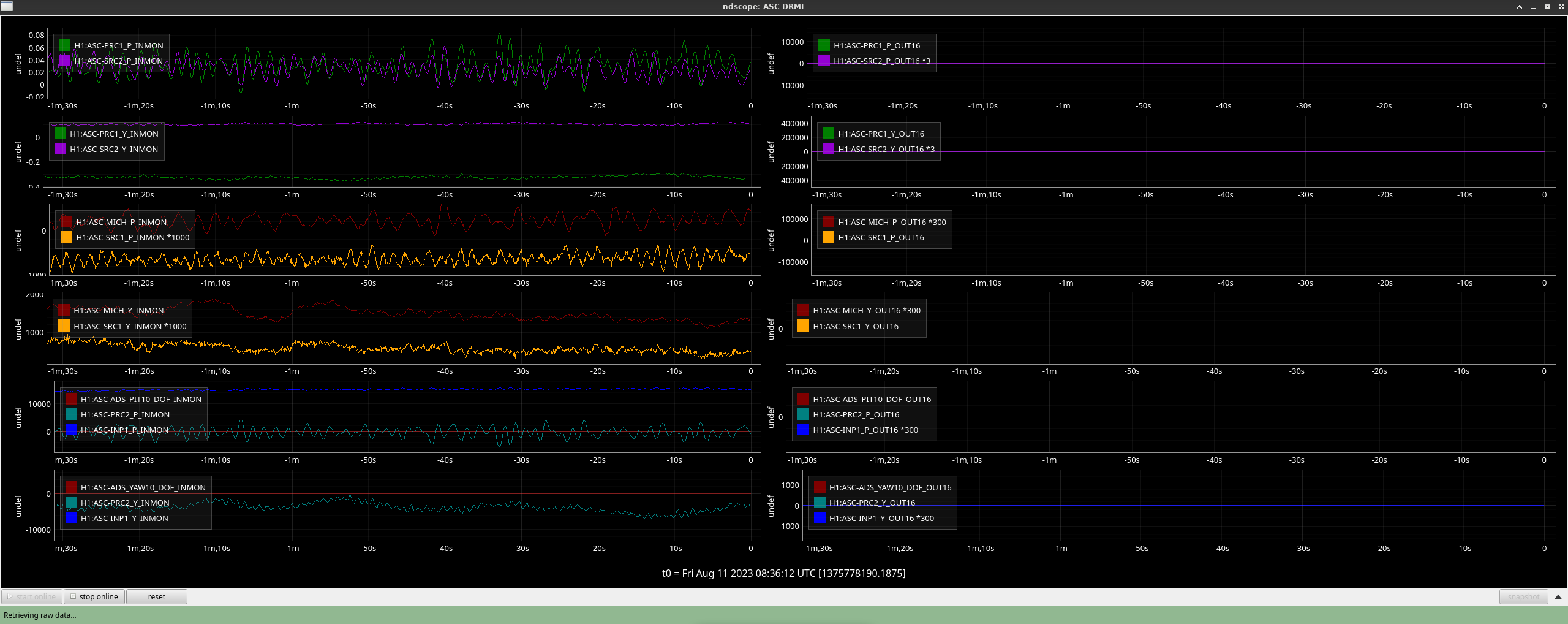
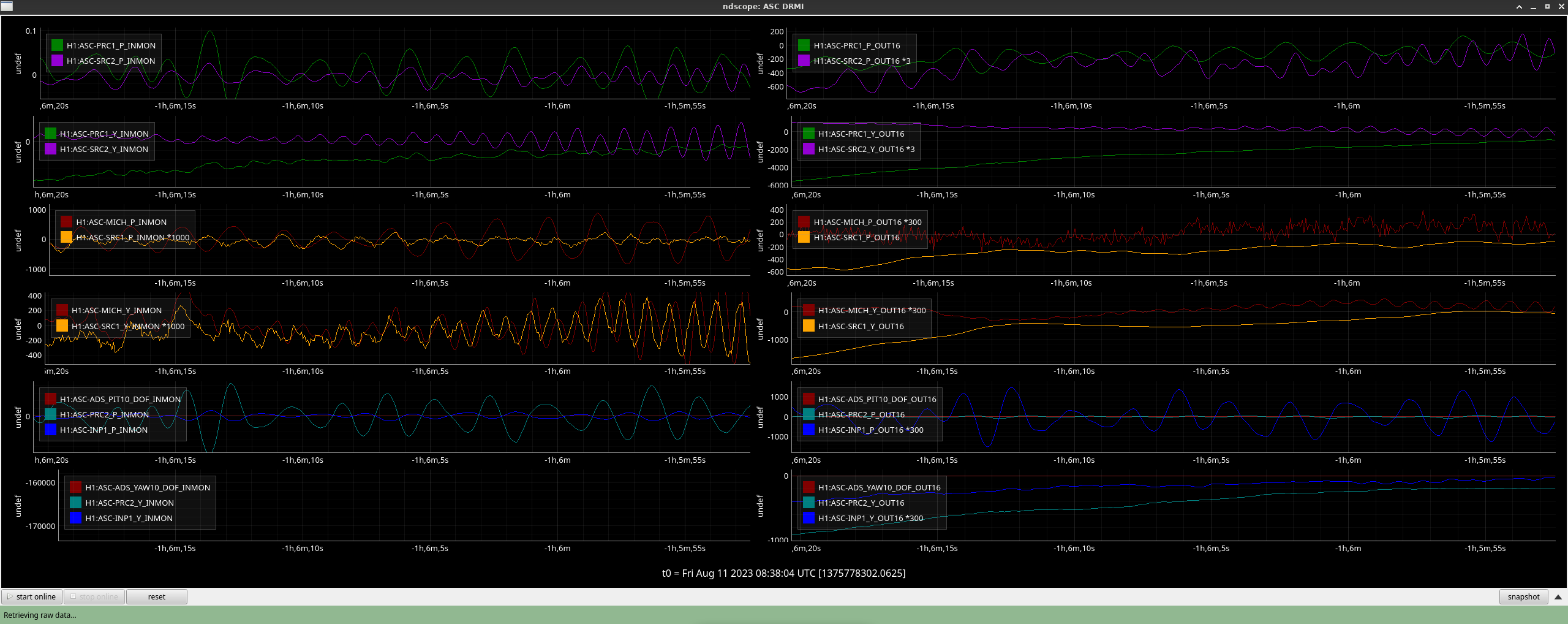
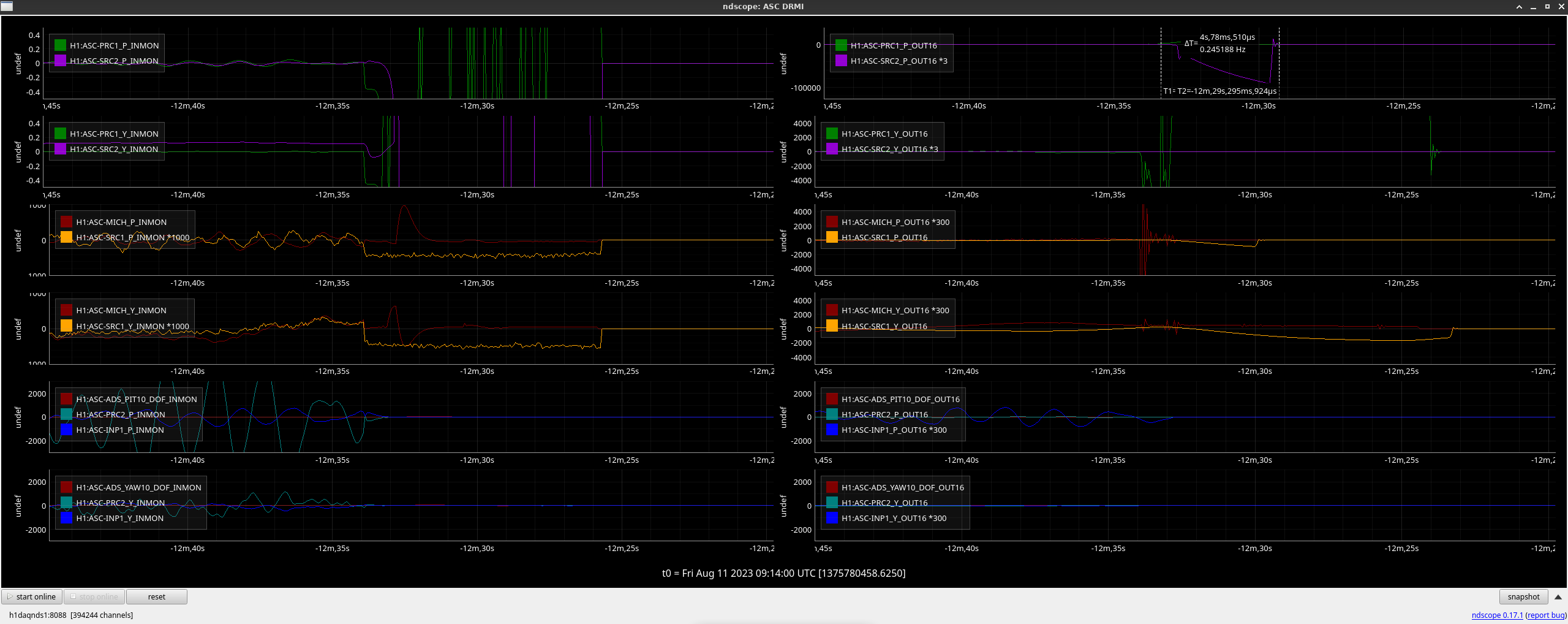
Follow up to Ryan C. alog. Previously when running into issues engaging DRMI ASC, we would wait in ENGAGE DRMI ASC for a few minutes to let the signals converge. In this case, we would lose lock after a few seconds, we noticed that a few ASC signals would start to converge then suddenly swing wildly, causing the lockloss. These were most apparent in the MICH, SRC1, and PRC2 signals, both in P and Y. Keita and I decided to try and walk the suspensions that feed into these signals, as their signal input was well into the thousands (into the tens of thousands particularly for PRC2). After attempting to walk the BS (MICH), SRM (SRC1), and PRC2 (PR2), we were able to get the ASC signals closer to 0, however this didn't appear to help once we went back to ENGAGE DRMI ASC.

Here are the original values for the 3 suspensions I moved in case they need to be reverted at a future time:

PR2 P: 1582.4 Y: 3236.0

BS P: 98.61 Y: -395.81

SRM P: 2228.3 Y: -3144.0

This image is showing the the ASC signals looked like pre movement of the three suspensions, and this is what the signal looked like post movement (sorry these scopes have poor scaling). Keita suggested we start looking into the ASC loops themselves, particularly at SRC2. Before the DRMI ASC loops turned on we turned OFF the SRC2 servo, then went back to ENGAGE DRMI ASC. This seemed to be able to hold us in ENGAGE ASC. At this point, we tried turning the SRC2 loop back on, but with a halved gain for both P/Y (P original gain was 60, Y was 100). When turning on the servo with half the gain, we were still seeing a good amount of 1hz motion in the signal, so we tried setting the gain to be a quarter of the original value...same result.

Next, we tried halving the SRC1 gains, from 4, down to 2. Then, we tried to add back in the quartered SRC2 gains, which still yielded the same result. At this point, it was decided that we entirely leave the SRC2 loop off, while keeping the halved SRC1 P/Y loops and try to continue locking - this worked and we were able to continue locking. Eventually, guardian took over the ASC loops once we got to ENGAGE ASC, and we had no issues relocking afterwards. This should be looked at tomorrow during the day, but at least now we have a temporary workaround if we lose lock again.

Steps taken to bypass this issue - Tagging OpsInfo:

1) Wait in DRMI LOCKED PREP ASC

2) Turn OFF the SRC2 P/Y loops

3) Set SRC1 P/Y gains to 2 (originally 4) - note this step was us taking extra safe steps to err on the side of caution since the SRC2 oscillation was coupling into SRC1

4) Continue the locking process - guardian will eventually take over and set the control loops to their nominal state

Back to NLN @ 10:12 UTC.
 

Images attached to this report
H1 AOS
ryan.crouch@LIGO.ORG - posted 00:30, Friday 11 August 2023 (72145)
OPS Thursday eve shift summary

TITLE: 08/11 Owl Shift: 07:00-15:00 UTC (00:00-08:00 PST), all times posted in UTC
STATE of H1: Lock Acquisition
INCOMING OPERATOR: Austin
SHIFT SUMMARY:

Lock#1:

We rode through a 5.9 from Japan and a 5.1 from NZ which came through within a few minutes of eachother around 00:45UTC (peakmon maxed out at 1100).

Superevent S23081n

Lockloss @ 04:25

Lock#2:

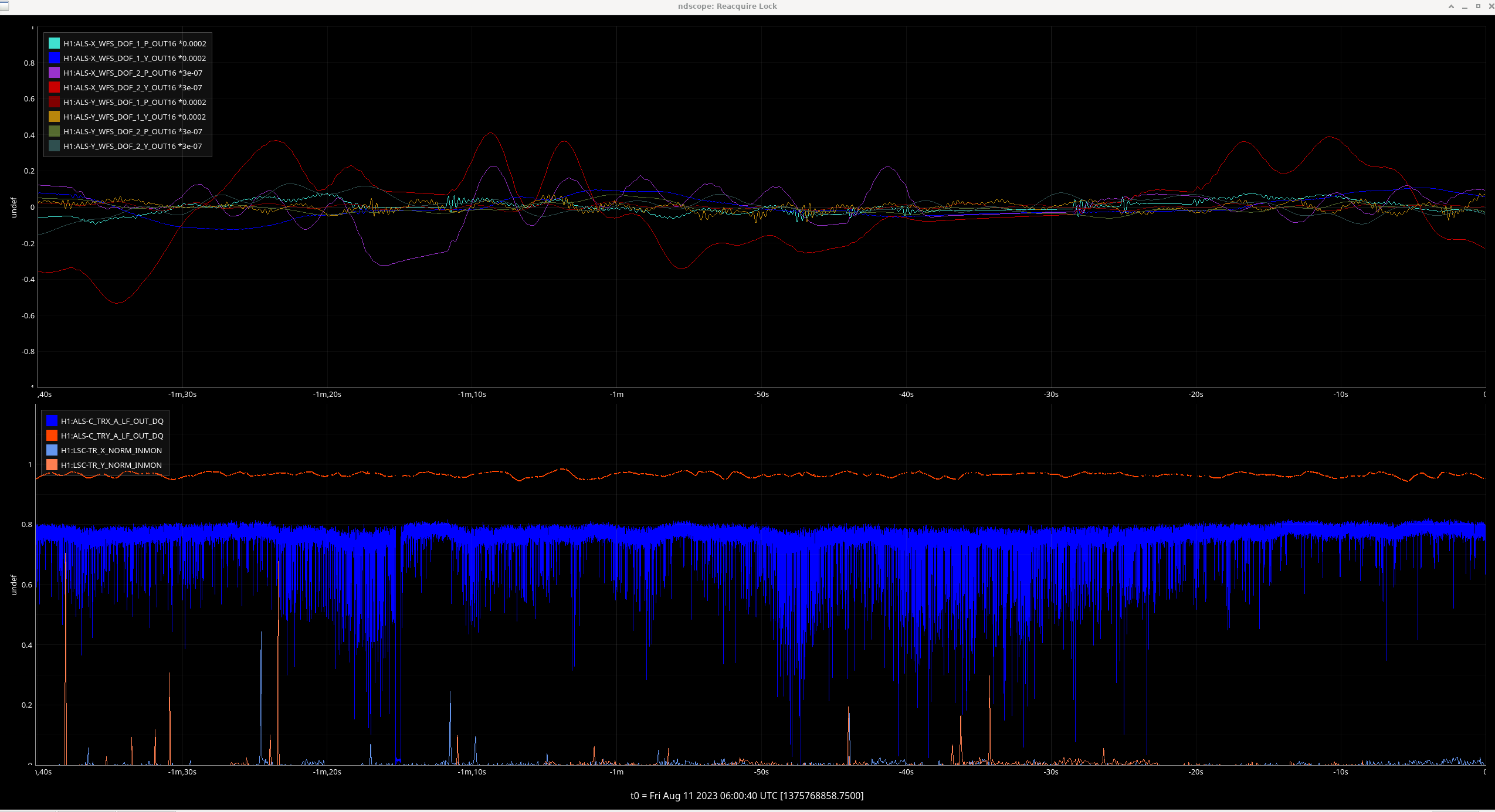
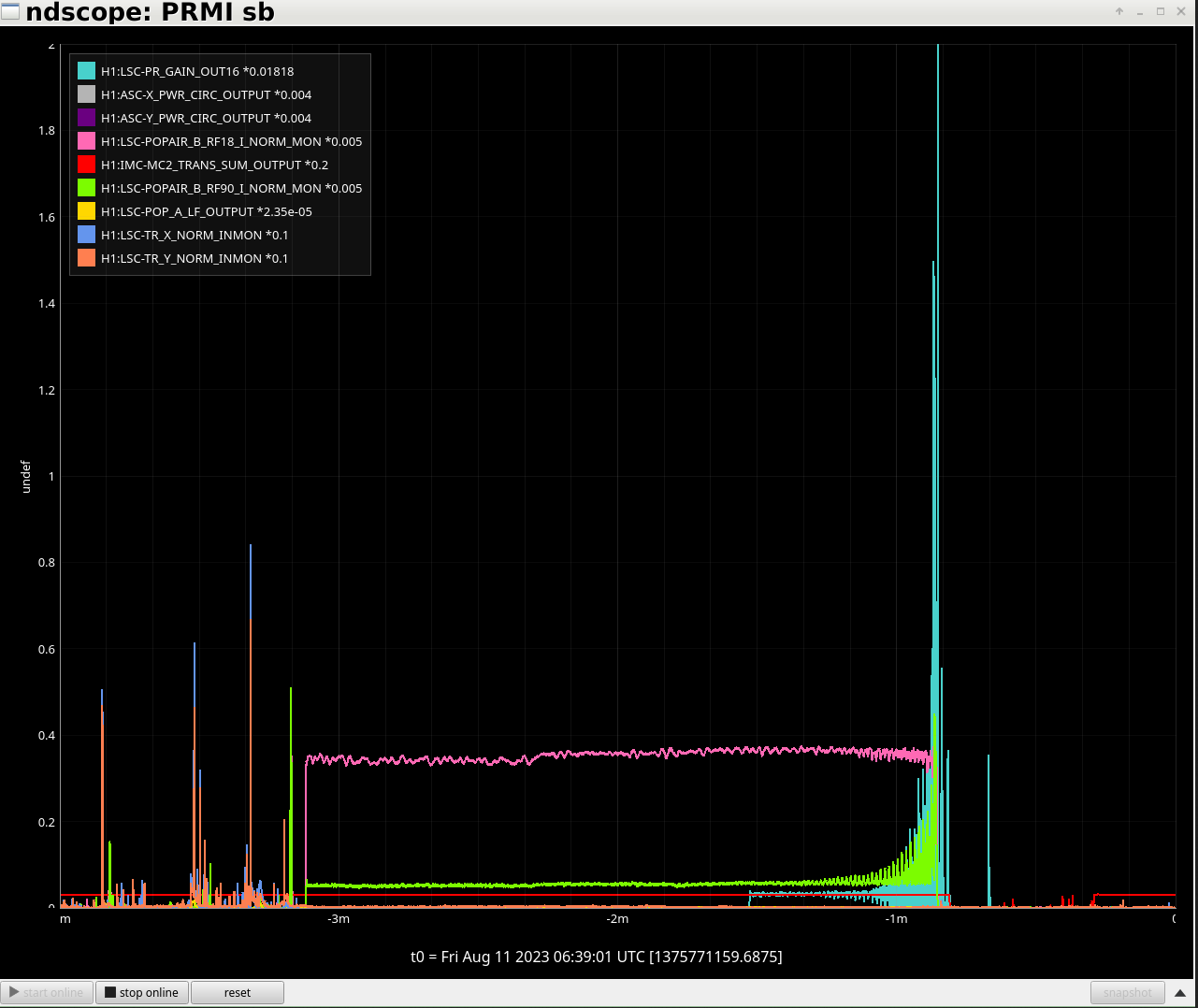
Couldn't get any flashes at DRMI or PRMI, went through CHECK_MICH, still nothing on PRMI, so H1MANAGER took us to initial alignment. Lost it during OFFLOAD_DRMI_ASC, SRM SR2 BS saturations then LL. LSC-POPAIR_B_RF90_I_ERR_DQ starts oscillating and growing a minute of so before we lose it.

Lock#3:

Lost it at OFFLOAD_DRMI_ASC again, same situation.

Lock#4:

Lost it at FIND_IR

Lock#5-6:

The IMC seems to be taking longer to lock, Lost it at DRMI. The flashes were noticibly worse during aquire_drmi so I decided to try and do another initial alignment.

Xarm was struggling and looked weird and was very fuzzy on the scope but the camera image looked fine? The signals weren't converging so I requested XARM to unlocked and it then went into increase flashes then locked but encountered the same issue but it was able to get to offload this attempt and get past green_arms. During SRY the OM suspensions weren't getting cleared so there were a lot of IFO_OUT saturations from OM1_Y and OM3_P.  Finished initial alignment then went back into locking.

Same issue, theres a ringup during DRMI_LOCKED_CHECK_ASC that kills it. I called Keita for some help near the end of the shift and told the incoming operator about the issues and at his suggestion tried to hold us in TURN_ON_BS_STAGE2 since it may be the ASC signals that are causing issues? We're holding here as of 07:00UTC

LOG:                                                                                                                                                                         

Start Time System Name Location Lazer_Haz Task Time End
22:03 PEM Robert EX N PEM injection 22:54
Images attached to this report
H1 General
ryan.crouch@LIGO.ORG - posted 21:26, Thursday 10 August 2023 - last comment - 23:43, Thursday 10 August 2023(72147)
Lockloss @ 04:45

No clear reason, quick lockloss

Comments related to this report
ryan.crouch@LIGO.ORG - 23:43, Thursday 10 August 2023 (72148)

Relocking is struggling, theres some ringup during DRMI_LOCKED_CHECK_ASC that keeps killing it.

Images attached to this comment
H1 General
ryan.crouch@LIGO.ORG - posted 20:06, Thursday 10 August 2023 (72146)
OPS Thursday eve shift midshift update

STATE of H1: Observing at 151Mpc

We've been locked for 18:13, everythings stable.

H1 AOS
robert.schofield@LIGO.ORG - posted 16:23, Thursday 10 August 2023 (72144)
PEM injections at CS and EX today

I injected acoustically today in the PSL, the LVEA, and EX. These are to update the coupling functions for the automated detection vetting system after the drop from 75 to 60W.

H1 General
anthony.sanchez@LIGO.ORG - posted 15:58, Thursday 10 August 2023 (72142)
Thursday Ops day Shift End


TITLE: 08/10 Day Shift: 15:00-23:00 UTC (08:00-16:00 PST), all times posted in UTC
STATE of H1: Observing at 154Mpc
OUTGOING OPERATOR: Ryan
CURRENT ENVIRONMENT:
    SEI_ENV state: CALM
    Wind: 14mph Gusts, 9mph 5min avg
    Primary useism: 0.02 μm/s
    Secondary useism: 0.09 μm/s
QUICK SUMMARY:

Dropped into Comissioning at 16:07 UTC
ISC Lock taken to NLN_CAL_MEAS for an Injection 17:04 UTC

Patrick working on the FMCS FOMS and Alerts , which are making the Alarms alarm. 20:32 UTC
Back to OBSERVING 22:55 UTC

H1 Current Status: NOMINAL_LOWNOISE & OBSERVING 


Start Time System Name Location Lazer_Haz Task Time End
15:24 Electrical Ken Mid Y N Swapping out light fixtures 19:24
16:05 SRCL Gabrielle Remote N SRCL and DARM  Measurements 16:58
16:58 ASC Elena Ctrl Rm N ASC tests & measurments 17:13
17:18 SQZ Sheila Ctrl Rm N 20 Minutes of no SQZn 17:58
18:08 Vac Travis FMCE N Looking for parts 18:23
18:19 Commish Sheila LVEA N Plugging in Freq Injection cable. 18:28
18:37 FAC Karen Optics & VAC Labs N Technical cleaning 19:07
18:43 Commish Elena Ctrl Rm N Noise budget injections 18:49
19:11 PEM Robert LVEA N Plugging in a cable 19:32
19:46 PEM Robert EX N Turning on an amp 21:02
20:27 FMCS Patrick Ctrl Rm N Working on the FMCS Screens 20:42
22:03 PEM Robert EX N PEM injections 23:33
H1 General
ryan.crouch@LIGO.ORG - posted 15:58, Thursday 10 August 2023 (72141)
OPS Thursday eve shift start

TITLE: 08/10 Eve Shift: 23:00-07:00 UTC (16:00-00:00 PST), all times posted in UTC
STATE of H1: Observing at 153Mpc
OUTGOING OPERATOR: Tony
CURRENT ENVIRONMENT:
    SEI_ENV state: CALM
    Wind: 8mph Gusts, 3mph 5min avg
    Primary useism: 0.02 μm/s
    Secondary useism: 0.09 μm/s
QUICK SUMMARY:

H1 ISC
elenna.capote@LIGO.ORG - posted 15:56, Thursday 10 August 2023 - last comment - 10:36, Friday 08 December 2023(72137)
DHARD P and CHARD P Open Loop Gain Measurements

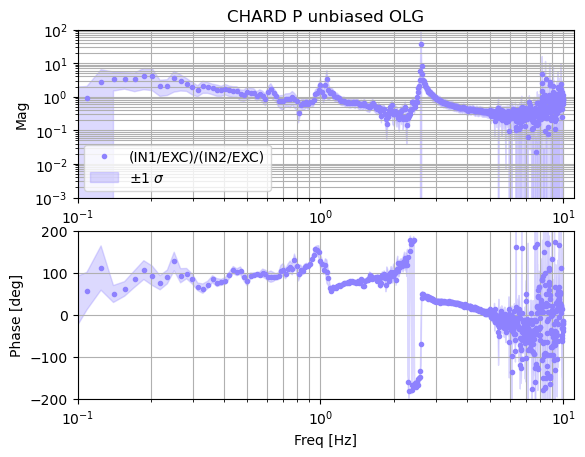
Today I took "unbiased" OLGs of DHARD P and CHARD P (see 67187 for discussion of unbiased measurements and methods). Craig previously measured these loops at 60W input power before I did some additional redesign of the loops (68698, 67488, 67518).

I have plotted the open loop gain with error shading in the attached plots. You can find the measurement templates, exported data, and processing code in '/ligo/home/elenna.capote/ARM_ASC/{DHARD,CHARD}'.

The templates for the these measurements are also saved in [userapps]/asc/h1/templates/{DHARD,CHARD} as '{DHARD,CHARD}_P_olg_broadband_shaped.xml'.

CHARD P has a UGF of 3 Hz with a phase margin of 33 deg. DHARD P has a UGF of 3.4 Hz with a phase margin of 27 deg.

DHARD has two other UGFs at 1.6 Hz and 2.4 Hz. CHARD has additional UGFs around 2.5 Hz, 1.2 Hz, 0.95 Hz and 0.65 Hz.

Images attached to this report
Comments related to this report
elenna.capote@LIGO.ORG - 16:17, Thursday 10 August 2023 (72143)

These are recent measurements by Gabriele of DHARD Y and CHARD Y, plotted with the error shading as well.

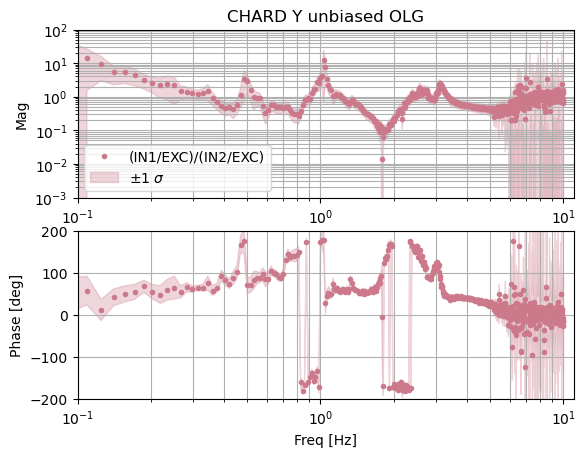
CHARD Y has a UGF of 3.3 Hz and 44 deg of phase margin. DHARD Y has a UGF of 5 Hz and a phase margin of 22 deg.

DHARD Y has additional UGFs at 2.1 and 1.5 Hz. CHARD Y has some interesting peak features that cross zero a few times between 2.3 and 3.3 Hz. There also appear to be additional UGFs around 1.2, 0.9, 0.5, 0.4 and 0.3 Hz.

Images attached to this comment
elenna.capote@LIGO.ORG - 10:36, Friday 08 December 2023 (74680)CAL

Taking another look at these measurements, DHARD P has about 6 dB gain margin at the highest UGF. DHARD Y's gain margin about 3 or 4 dB. Tagging CAL because this comment might be useful for DARM loop investigations.

H1 ISC
sheila.dwyer@LIGO.ORG - posted 15:44, Thursday 10 August 2023 - last comment - 18:19, Friday 08 September 2023(72140)
Noise budget injections run

Elenna, Sheila

We got data today to rerun our noise budget with the current noise (150Mpc).  We got quiet time with no squeezing for 10 minutes starting at 1375723813, with no large glitches.  We ran excitations for LSC, laser noise, and ASC.  We had quiet time with squeezing injected from the previous night of observing, I choose 1375695779 as a time with high range and no large glitches.  This is commit 50358cda

Comments related to this report
sheila.dwyer@LIGO.ORG - 16:12, Tuesday 15 August 2023 (72245)

Elenna, Sheila

We ran the noise budget code for this no squeezing time. 

  • We updated the optical gain (Calibratations.py, in the closedLoopSenseing function) using the calibration report here which Jeff pointed us to.  (The most recent one with the exported tag is the current calibration.)  This is the same as the inverse of the gain in H1:CAL-CS_DARM_CFTD_ERR filter called O4 gain if you have the correct calibration report.  Elenna also found the ratio of DCPD mA to DARM err counts by running the template that measures their transfer function aligoNB/H1/couplings/check_DARM_gain.xml for the braodband pcal injection from alog 72047.  These two steps are what we needed to do to get the calibration right so that the semiclassical shot noise caluculation seems correct.  
  • We are using CAL_DELTAL, since this noise budget was run before the calibration fix of last week that channel is more accurate.  We are also using the TDCFs kappa_c and the cavity pole to calculate the shot noise. The radiation pressure noise is calculated with the arm transmitted power monitors. 
  • There is no DAC noise included in this budget, as we aren't confident in our usual DAC noise projection right now.  68869  With recent improvements in the low frequency noise it would be good for us to revisit the PUM DAC noise projections soon, by running in the higher noise state and running the noise monitor estimate for that higher noise state. 
  • We have changed the frequency noise in this budget. We measure frequency noise by switching CARM onto one sensor, (REFL B), then using that sensor as a out of loop frequency noise sensor.  There was a mistake in the code where the psd was instead multiplied by sqrt(2).  We have now divided the PSD by 2, which should give us the correct frequency noise projection where we are frequency noise limited.  Interestingly, this correctly predicts the darm noise at 4-5kHz where it should be an underestimate by sqrt(2) in the ASD.
  • Vicky is working on modeling the quantum noise with Kevin, we are just doing the no squeeze budget here and will return to the noise budget with squeezing with Vicky.  
  • Also attached are the sub budgets for laser, asc and length noise, with the DARM noise plotted from a time with squeezing.
  • Laser noise: The 120Hz peak is well predicted by the IMC PZT yaw injection.  The frequency noise has the factor described above applied, and there may be some double counting at low frequency although we aren't sure.  
  • ASC: CSOFT P, and the hard loops are the dominant contribution.  CHARD Y in particular is large, this is because of Gabriele's recent loop change which helped reduce the RMS and improve some nonlinear noise in DARM. 71927 Elenna is looking at if we can roll that off to keep the low frequency gain without this additional noise at 40Hz. 
  • LSC: MICH is the dominant contribution to LSC, it is similar to the level of the ASC total. 

This is all commited as 0f9ffe0e

Non-image files attached to this comment
victoriaa.xu@LIGO.ORG - 12:50, Thursday 07 September 2023 (72717)SQZ

Sheila, Vicky - we have re-run the noise budget for following times:

Noise budget with squeezing. Changes here: using GDS instead of CAL-DELTAL, closer thermalized FDS time to no-sqz, using updated IFO gwinc parameters related to quantum noise calculation.
(Edit: was a glitch in the old time; updated to an FDS time without glitches. All plots updated.)

PDT: 2023-08-10 08:45:00.000000 PDT
UTC: 2023-08-10 15:45:00.000000 UTC
GPS: 1375717518.000000

PDT: 2023-08-10 09:35:52.000000 PDT
UTC: 2023-08-10 16:35:52.000000 UTC
GPS: 1375720570.000000

Noise budget with no squeezing. Same time as above, now calculates using gwinc quantum noise calculation instead of semiclassical calculation used previously.

PDT: 2023-08-10 10:18:11.000000 PDT
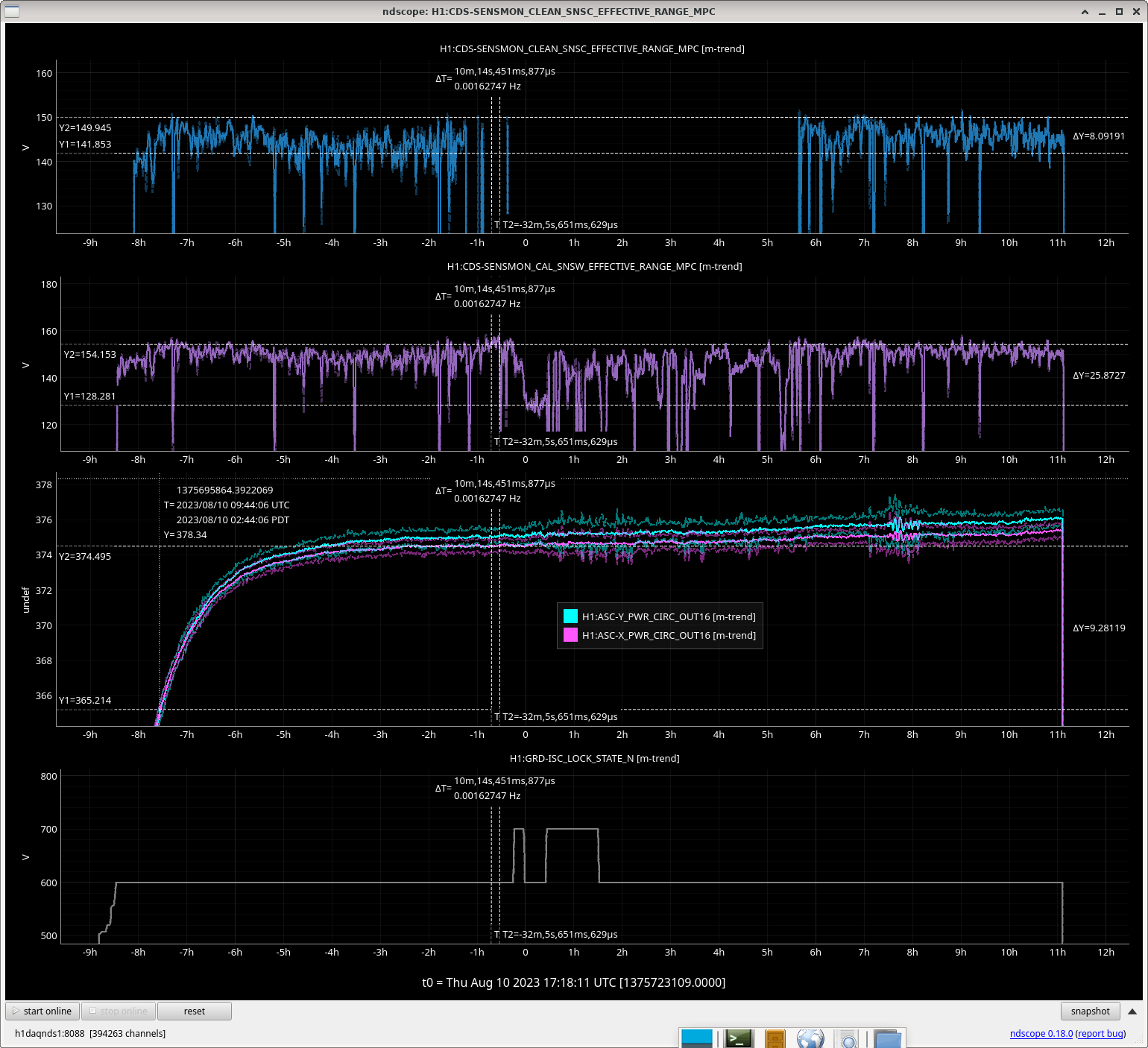
UTC: 2023-08-10 17:18:11.000000 UTC
GPS: 1375723109.000000

Both sqz & no-sqz noise budgets now use the correlated quantum noise calculation from gwinc, instead of semiclassical calculations for SN & QRPN. The gwinc budget parameters related to quantum noise calculation are consistent with the recent sqz data set (8/2, alog 72565), with readout losses evenly split between IFO output losses that influence optical gain (20%) and SQZ injection losses (20%), parameters in plot title here. This is high on SQZ injection losses, and slightly conservative on IFO output losses. This updated FDS time is thermalized and closer to the No-SQZ time; the time used previously was several hours earlier near the start of lock, w/ ifo not yet thermalized.

Unlike before, both budgets now show GDS-CALIB STRAIN, which on 8/10 was more accurately calibrated (see Louis's alog on Aug 8, LHO:72075, comparing CAL-DELTAL and GDS vs. PCAL sweep, and his record from 72531). CAL-DELTAL was previously overestimating range due to calibration inaccuracies. We got GDS-CALIB_STRAIN data from nds servers, and at first weren't able to get input jitter data from nds, due to the sampling rate change of IMC-WFS channels from 2k to 16k, 71242. Jonathan H. helped us fix this issue, so we can now pull GDS data and input jitter data from nds.ligo-wa.caltech.edu:31200 -- thank you Jonathan!! With this, the input jitter sub-budget is kind of interesting, looks to be mostly IMC-WFS in YAW.

A quick thought on discrepancy between expected and measured DARM between below several hundred Hz-- I don't know if this could be related to the recent update to gwinc CTN parameters (high/low index loss angles), related to quantum noise, or mystery noise. The recent gwinc CTN update seemed to have dropped the calculated CTN level slightly (maybe 10-15% or so). In April 2023, Kevin helped update CTN parameters LHO:68499 to reconcile H1 budget with the official gwinc parameters, while Evan made a correlated noise measurement 68482 where noise in the bucket seems more consistent with the older CTN estimate from gwinc (or very slightly higher). Another idea is that it could be related to quantum noise, such as SRCL detuning or sqz angle which could've changed since the sqz dataset, as quantum noise can also affect the noise in this region.

All pushed as git commit 28cf2664.

Edit: All pushed again as git commit 33ffd60b.

Images attached to this comment
Non-image files attached to this comment
victoriaa.xu@LIGO.ORG - 16:01, Wednesday 06 September 2023 (72719)AOS, PEM, SQZ

Added noise budgets with squeezing for HVAC off time on August 17 from alogs 72308, 72297.

When comparing this HVAC off time on Aug 17 with the noise budget from above on Aug 10, it's interesting to note the broadband difference in input jitter (Aug 10 vs Aug 17, HVAC off). Between these times, worth noting that I think there were several additional improvements (like LSC FF or SUS-related) as well.

Edit: updated 8/10 input jitter budget to the less glitchy noise budget time.

Non-image files attached to this comment
victoriaa.xu@LIGO.ORG - 17:08, Friday 08 September 2023 (72768)AOS, SQZ

Much of the gap between expected DARM (black traces) and measured DARM (red traces) in the noise budget looks compatible with elevating the CTN trace. Budget plots with 100 Hz CTN @ 1.45e-20 m/rtHz are attached below for the no-HVAC times. This is almost 30% higher than the new gwinc nominal CTN at 100 Hz (i.e., 1.128e-20 m/rtHz --> 1.45e-20 m/rtHz). Compared to the old gwinc estimate of 1.3e-20, this is ~11% higher. Quantum noise calculation unchanged here.

This CTN level is similar to the 30% of excess correlated noise that Evan H. observed in April 2023, see LHO:68482. His cross-correlation measurement sees ~30% excess correlated noise around 100 Hz after subtracting input jitter noise, where that "30%" is using the newer gwinc CTN estimate of 1.128e-20 m/rtHz @ 100 Hz. This elevated correlated noise, if attributed to CTN, corresponds to CTN @ 100 Hz of about 1.3*1.128 = 1.46e-20 m/rtHz. See this git merge request for the gwinc CTN update ; this update lowered the expected CTN at 100 Hz by ~15%, from 1.3e-20 (old) to 1.1e-20 m/rtHz (new), based on updated MIT measurements.

For reference, I have plotted these various CTN levels as dotted traces in the thermal sub-budget.

To elevate CTN levels by 30% in the budget code, I scaled both high+low index loss angles by a factor of 1.8, specifically Philhighn 3.89e-4 --> 7e-4 ; Phillown 2.3e-5 --> 4.14e-5. It seems like much higher than this level ~1.45e-20 might be difficult to reconcile with the full budget.

Noteworthy w.r.t. squeezing: from the laser noise sub-budget, laser frequency noise looks within 33% of squeezed shot noise with ~3.7dB of squeezing. By contrast, the L1 noise budget from Aug 2023 (LLO:66532) shows laser noise at the ~20% level of squeezed shot noise with 5.3 dB of squeezing -- i.e. a lower laser noise floor past shot noise.

The following plots can be found in /ligo/gitcommon/NoiseBudget/aligoNB/out/H1/lho_all_noisebudgets_081723_noHVAC_elevatedCTN, and not yet commited to the git repo.

Non-image files attached to this comment
victoriaa.xu@LIGO.ORG - 18:19, Friday 08 September 2023 (72770)

Plots with higher CTN are attached here for the SQZ / no-SQZ proper noise budget times from 8/10, when injections were run.

Comparing the sqz vs. no-sqz budgets suggests there might be more to understand here, to tease apart the contributions from coating thermal noise (CTN) vs. quantum noise in the bucket. In particular, something disturbing that stands out, is that I imagined that if elevated CTN is the physical effect we're missing, it would reconcile both NBs with and without squeezing. However, there is still some discrepancy in the un-squeezed budget, which was not resolved by CTN, and seems to have a consistent shape. I'm wondering if this is related to the IFO configuration as it affects the quantum noise without squeezing. I think this could result from a non-zero but small SRCL detuning since it looks like elevated noise, with a clear shape, that increases below the DARM pole. Simply elevating CTN to match the no-sqz budget would put us in conflict with squeezed darm, so I don't think it makes sense to elevate CTN further. The budget currently has 0 SRCL detuning as it "seems small-ish", but this parameter is somewhat unconstrained in the quantum noise models.

In models, the readout angle is upper-bounded by Sheila's contrast defect measurement, though in principle it could probably be anything lower than that too, which could be worth exploring. It might be helpful to have an external measurement of the thermalized physical SRCL detuning, or in the models allowing the SRCL detunings to vary, to explore how it fits or is constrained by the fuller noise budget picture.

Plots with squeezing can be found in /ligo/gitcommon/NoiseBudget/aligoNB/out/H1/lho_all_noisebudgets. No squeezing plots are in /ligo/gitcommon/NoiseBudget/aligoNB/out/H1/lho_darm_nosqz_noisebudget.

I pushed to git commit 70ca191c without elevated CTN and the associated extra traces. The relevant parameters are left commented out at the bottom of the QuantumParams file, and relevant code to plot the extra traces is commented out in the lho_all_noisebudgets script.

Non-image files attached to this comment
H1 DetChar (CAL, DetChar)
derek.davis@LIGO.ORG - posted 15:01, Tuesday 08 August 2023 - last comment - 21:49, Tuesday 29 August 2023(72064)
Excess noise near 102.13 Hz calibration line

Benoit, Ansel, Derek

Benoit noticed that for recent locks, the 102.13 Hz calibration line is much louder than typical for the first few hours of the lock. An example of this behavior is shown in the attached spectrogram of H1 strain data on August 5 - this is the first day this behavior appeared. Ansel noted that this feature includes a comb-like structure around the line that is only present in the H1:GDS-CALIB_STRAIN_NOLINES channel and not H1:GDS-CALIB_STRAIN (see spectra for CALIB_STRAIN and CALIB_STRAIN_NOLINES on Aug 5). This issue also visible in the PCAL trends for the 102.13 Hz line. 

We are not sure if the excess noise near 102.13 Hz is from the calibration line itself or another noise source that is near the line. However, the behavior has been present for every lock since 12:30 UTC on August 5 2023. 

Images attached to this report
Comments related to this report
jeffrey.kissel@LIGO.ORG - 09:21, Wednesday 09 August 2023 (72094)CAL
FYI, 
$ gpstime Aug 05 2023 12:30 UTC
    PDT: 2023-08-05 05:30:00.000000 PDT
    UTC: 2023-08-05 12:30:00.000000 UTC
    GPS: 1375273818.000000
so... this behavior seems to have started at 5:30a local time on a Saturday. Therefore *very* unlikely that the start of this issue is intentional / human change driven.

The investigation continues....
making sure to tag CAL.
jeffrey.kissel@LIGO.ORG - 09:42, Wednesday 09 August 2023 (72095)
Other facts and recent events:
- Attached are 2 screenshots that show the actual *digital* excitation is not changing with time in anyway.
    :: 2023-08-08_H1PCALEX_OSC7_102p13Hz_Line_3mo_trend.png shows the specific oscillator, --- PCALX's OSC7 which drives the 102.13 Hz line's EPICs channel version of its output. The minute trend shows the max, min, and mean of the output, and there's no change in amplitude.
    :: 2023-08-08_H1PCALEX_EXC_SUM_3mo_trend.png shows a trend of the total excitation sum from PCAL X. This also shows *no* change in time in amplitude.

Both trends show the Aug 02 2023 change in amplitude kerfuffle I caused that Corey found and a bit later rectified -- see LHO:71894 and subsequent comments, but that was done, over with an solved, definitely by Aug 03 2023 UTC and unrelated to the start up of this problem.

It's also well after I installed new oscillators and rebooted the PCALX, PCALY, and OMC models on Aug 01 2023 (see LHO:71881).
Images attached to this comment
jeffrey.kissel@LIGO.ORG - 10:44, Wednesday 09 August 2023 (72100)
The front-end version of the calibration's systematic error at 102.13 Hz also shows the long, time-dependent issue -- this will allow us to trend the issue against other channels

Folks in the calibration group have found that the online monitoring system for the
    -  overall DARM response function systematic error
    - (absolute reference) / (Calibrated Data Product) [m/m] 
    - ( \eta_R ) ^ (-1) 
    - (C / 1+G)_pcal / (C / 1+G)_strain
    - CAL-DELTAL_REF_PCAL_DQ / GDS-CALIB_STRAIN
(all different ways of saying the same thing; see T1900169) in calibration at each PCAL calibration line frequency -- the "grafana" pages -- are showing *huge* amounts of systematic error during these times when the amplitude of the line is super loud.

Though this metric is super useful because it's dreadfully obvious that things are going wrong -- this metric is not in any normal frame structure, so you can't compare it against other channels to find out what's causing the systematic error.

However -- remember -- we commissioned a front-end version of this monitoring during ER15 -- see LHO:69285.

That means the channels 
     H1:CAL-CS_TDEP_PCAL_LINE8_COMPARISON_OSC_FREQ        << the frequency of the monitor
    H1:CAL-CS_TDEP_PCAL_LINE8_SYSERROR_MAG_MPM        << the magnitude of the systematic error
    H1:CAL-CS_TDEP_PCAL_LINE8_SYSERROR_PHA_DEG        << the phase of the systematic error 

tell you (what's supposed to be***) equivalent information.

*** One might say that "what's suppose to be" is the same as "roughly equivalent" due to the following reasons: 
    (1) because we're human, the one system is displaying the systematic error \eta_R, and the other is displaying the inverse ( \eta_R ) ^ (-1) 
    (2) Because this is early-days in the front-end system, it uses the "less complete" calibrated channel CAL-DELTAL_EXTERNAL_DQ rather than the "fully correct" channel GDS-CALIB_STRAIN

But because the problem is so dreadfully obvious in these metrics, even though they're only *roughly* equivalent, you can see the same thing.
In the attached screenshot, I show both metrics for the most recent observation stretch, between 10:15 and 14:00 UTC on 2023-Aug-09.

Let's use this front-end metric to narrow down the problem via trending.
Images attached to this comment
jeffrey.kissel@LIGO.ORG - 10:58, Wednesday 09 August 2023 (72102)CAL, DetChar
There appears to be no change in the PCALX analog excitation monitors either.

Attached is a trend of some key channels in the optical follower servo -- the analog feedback system that serves as intensity stabilization and excitation power linearization for the PCAL's laser light that gets transmitted to the test mass -- the actuator of which is an acousto-optic modulator (an AOM). There seems to be no major differences in the max, min, and mean of these signals before vs. after these problems started on Aug 05 2023.

H1:CAL-PCALX_OFS_PD_OUT_DQ
H1:CAL-PCALX_OFS_AOM_DRIVE_MON_OUT_DQ
Images attached to this comment
madeline.wade@LIGO.ORG - 11:34, Wednesday 09 August 2023 (72104)

I believe this is caused by the presence of another line very close to the 102.13 Hz pcal line.  This second line is present at the start of a lock stretch but seems to go away as the lock stretch continues.  I have attached a plot showing a zoom-in on an ASD around 102.1-102.2 Hz right after a lock stretch (orange), where the second peak is evident, and well into a lock stretch (blue) where the PCAL line is still present, but the second peak right below it in frequency is gone.  This ASD is computed using an hour of data for each curve, so we can get the needed resolution for these two peaks.

I don't know the origin of this second line.  However, a quick fix to the issue could be moving the PCAL line over by about a Hz.  The second attached plot shows that the spectrum looks pretty clean from 101-102 Hz, so somewhere in there would be probably be okay for a new location of the PCAL line.

Images attached to this comment
ansel.neunzert@LIGO.ORG - 11:47, Wednesday 09 August 2023 (72105)

Since it looks like the additional noise is at 102.12833 Hz, I did a quick check in Fscan data from Aug 5 for channels where there is high coherence with DELTAL_EXTERNAL at 102.12833 but *not* at 102.13000 Hz. This narrows down to just a few channels:

  • H1:PEM-EX_MAG_EBAY_SEIRACK_{Z,Y}_DQ .
  • H1:PEM-EX_ADC_0_09_OUT_DQ
  • H1:ASC-OMC_A_YAW_OUT_DQ. Note that other ASC-OMC channels (Fscan tracks A,B and PIT,YAW) see high coherence at both frequencies.

(lines git issue opened as we work on this.)

jeffrey.kissel@LIGO.ORG - 14:45, Wednesday 09 August 2023 (72110)
As a result of Ansel's discovery, and conversation on the CAL call today -- I've moved the calibration line frequency from 102.13 to 104.23 Hz. See LHO:72108.
derek.davis@LIGO.ORG - 13:28, Friday 11 August 2023 (72157)

This line may have appeared in the previous lock the day before (Aug 4). The daily spectrogram for Aug 4 shows a line near 100 Hz starting at 21:00 UTC. 

Images attached to this comment
elenna.capote@LIGO.ORG - 16:49, Friday 11 August 2023 (72163)

Looking at alogs leading up to the time Derek notes above, I noticed that Gabriele retuned and tested new LSC FF. This change may be related to this new peak. Remembering some issues we had recently where DHARD filter impulses were ringing up violin modes, I checked the new LSC FF filters and how they are engaged in the guardian. Some of them have no ramp time, and the filter bank is turned on immediately along with the filters in the guardian. I have no idea why that would cause a peak at 102 Hz, but I updated those filters to have a 3 second ramp.

oli.patane@LIGO.ORG - 16:51, Friday 11 August 2023 (72164)

Reloaded the H1LSC model to load in Elenna's filter changes

ansel.neunzert@LIGO.ORG - 13:36, Monday 14 August 2023 (72197)

Now that the calibration line has been moved, the comb-like structure at the calibration line frequency is no longer present (checked in the CLEAN channel).

We can also see the shape of the 102.12833 Hz line much more clearly without the overlapping calibration line. I have attached a plot for reference on the width and shape.

Images attached to this comment
camilla.compton@LIGO.ORG - 16:33, Monday 14 August 2023 (72203)ISC

As discussed in todays commissioning meeting, I checked TMSX and ETMX movement for a kick during locking and couldn't see anything suspicious. I did find some increase motion/noise every 8Hz in TMSX 1s into ENGAGE_SOFT_LOOPS when ISC_LOCK isn't explicitly doing anything, plot attached. However this noise was present prior to Aug 4th, (July 30th attached).

TMS is suspicious as Betsy found that TMS's have violin modes ~103-104Hz.

Jeff draws attendtion to 38295, showing modes of quad blade springs above 110Hz, and 24917 showing quad top wire modes above 300Hz.

Elenna's notes with calibration lines off (as we are experimenting with for current lock) we can see this 102Hz peak at ISC_LOCK state ENGAGE_ASC_FOR_FULL_IFO. We were mistaken.

Images attached to this comment
elenna.capote@LIGO.ORG - 21:49, Tuesday 29 August 2023 (72544)

To preserve documentation, this problem has now been solved, with more details in 7253772319, and 72262.

The cause of this peak was a spurious, narrow, 102 Hz feature in the SRCL feedforward that we didn't catch when the filter was made. This has been been fixed, and the cause of the mistake has been documented in the first alog listed above so we hopefully don't repeat this error.

H1 OpsInfo
ryan.short@LIGO.ORG - posted 15:51, Saturday 05 August 2023 - last comment - 15:35, Friday 11 August 2023(71990)
nln_not_obs Timer in IFO_NOTIFY Increased

At 13:00 UTC this morning, H1 had relocked automatically all the way to NOMINAL_LOW_NOISE and the only thing preventing the observation intent bit to be set to OBSERVE was for the ADS to converge in order to switch over to the camera servos. Even though this is expected behavior, IFO_NOTIFY sent an alert to me as the operator because H1 had been in NLN for 3 minutes and the intent bit had not been flipped. After 13 minutes of waiting in NLN for the camera servos to turn on, the intent bit was set to OBSERVE automatically without any intervention.

Since we've seen ADS take up to 15 minutes to converge while in NLN before we can go to observing, I've increased IFO_NOTIFY's nln_not_obs timer from 3 minutes to 15 to avoid unnecessary notifications while ADS is converging as expected.

Comments related to this report
ryan.short@LIGO.ORG - 15:35, Friday 11 August 2023 (72160)

I've made this alert condition a bit smarter. IFO_NOTIFY will now wait for 20 minutes after reaching NOMINAL_LOW_NOISE for the camera servos to turn on before moving to 'ALERT_ACTIVE.' If ADS converges and the camera servos turn on before then (as we'd expect), the timer is stopped and a new 3 minute timer starts to indicate we've actually reached the point where nominally we would move to OBSERVE. If that timer expires, IFO_NOTIFY moves to 'ALERT_ACTIVE' to indicate something is preventing the move to OBSERVE.

These changes are loaded into the guardian and committed to svn, revision 26132.

H1 TCS
camilla.compton@LIGO.ORG - posted 11:37, Tuesday 17 January 2023 - last comment - 15:08, Tuesday 07 October 2025(66832)
TCS HWS SLED Stock.
Last recorded on alog 58758. Both were replaced in Dec 2022 (66179) so we expect they will be fine until the end of 2023.
Currently have two new 840nm spares, and one 790nm used spare that could be used in a pinch. We will order more spares. 

* Added to ICS DEFECT-TCS-7753, will give to Chrisitna for dispositioning once new stock has arrived. 

Comments related to this report
camilla.compton@LIGO.ORG - 12:47, Monday 30 January 2023 (67079)

New stock arrived and has been added to ICS. Will be stored in the totes in the TCS LVEA cabinet. 

  • ITMX: Superluminescent Diode QSDM-790-5 
    • S/N 11.21.380
    • S/N 11.21.382
    • S/N 05.21.346 (note the data sheet is labeled 04.21.346 but QPhotonics noted this is a typo) 
  • ITMY: Superluminescent Diode QSDM-840-5
    • S/N 11.21.303
camilla.compton@LIGO.ORG - 15:33, Thursday 10 August 2023 (72139)
  • ITMX: Superluminescent Diode QSDM-790-5 
    • S/N 06.18.002 - used spare
    • S/N 11.21.380
    • S/N 11.21.382
    • S/N 05.21.346 - Installed July 2023 71476
    • S/N 07.14.255 Old sled, removed 71476
  • ITMY: Superluminescent Diode QSDM-840-5
    • S/N 03.20.479 
    • S/N 06.16.005 
    • S/N 11.21.303 - Installed July 2023 71476
    • S/N 11.17.127 Old sled, removed 71476

ISC has been updated. As of August 2023, have 2 spare SLEDs for each ITM HWS.  

camilla.compton@LIGO.ORG - 14:41, Tuesday 10 October 2023 (73373)
  • ITMX Superluminescent Diode QSDM-790-5 
    • S/N 06.18.002 - used spare
    • S/N 11.21.380 - Installed Oct 2023 73371
    • S/N 11.21.382
    • S/N 05.21.346 - Old sled, removed  73371
    • S/N 07.14.255 Old sled, removed 71476
  • ITMY: Superluminescent Diode QSDM-840-5
    • S/N 03.20.479 - Installed Oct 2023 73371
    • S/N 06.16.005 
    • S/N 11.21.303 - Old sled, removed  73371
    • S/N 11.17.127 Old sled, removed 71476

ISC has been updated. As of October 2023, have 1 spare SLEDs for each ITM HWS, with more ordered.  

camilla.compton@LIGO.ORG - 15:31, Wednesday 06 December 2023 (74645)

Spare 8240nm SLEDs QSDM-840-5 09.23.313 and QSDM-840-5 09.23.314 arrived and will be placed in the TCS cabinets on Tuesday. We are expecting qty 2 790nm SLEDs too. 

camilla.compton@LIGO.ORG - 16:26, Thursday 14 March 2024 (76393)

Spare 790nm SLEDs QSDM-790-5--00-01.24.077 and QSDM-790-5--00-01.24.079 arrived and will be placed in the TCS cabinets on Tuesday. 

camilla.compton@LIGO.ORG - 16:12, Monday 09 June 2025 (84906)

In 84417, we swapped:

The removed SLEDs have been dispositioned, DEFECT-TCS-7839.

camilla.compton@LIGO.ORG - 15:08, Tuesday 07 October 2025 (87355)

In 87353 we removed 11.21.382 and installed 01.24.077.

Displaying reports 18681-18700 of 88722.Go to page Start 931 932 933 934 935 936 937 938 939 End