Matthew Ball, Adrian Helmling-Cornell, Jim Warner, Robert Schofield
Noise around 48 Hz in DARM is often driven by variable frequency fans of chiller units; dip switches could be changed to eliminate high fan frequencies when not necessary.
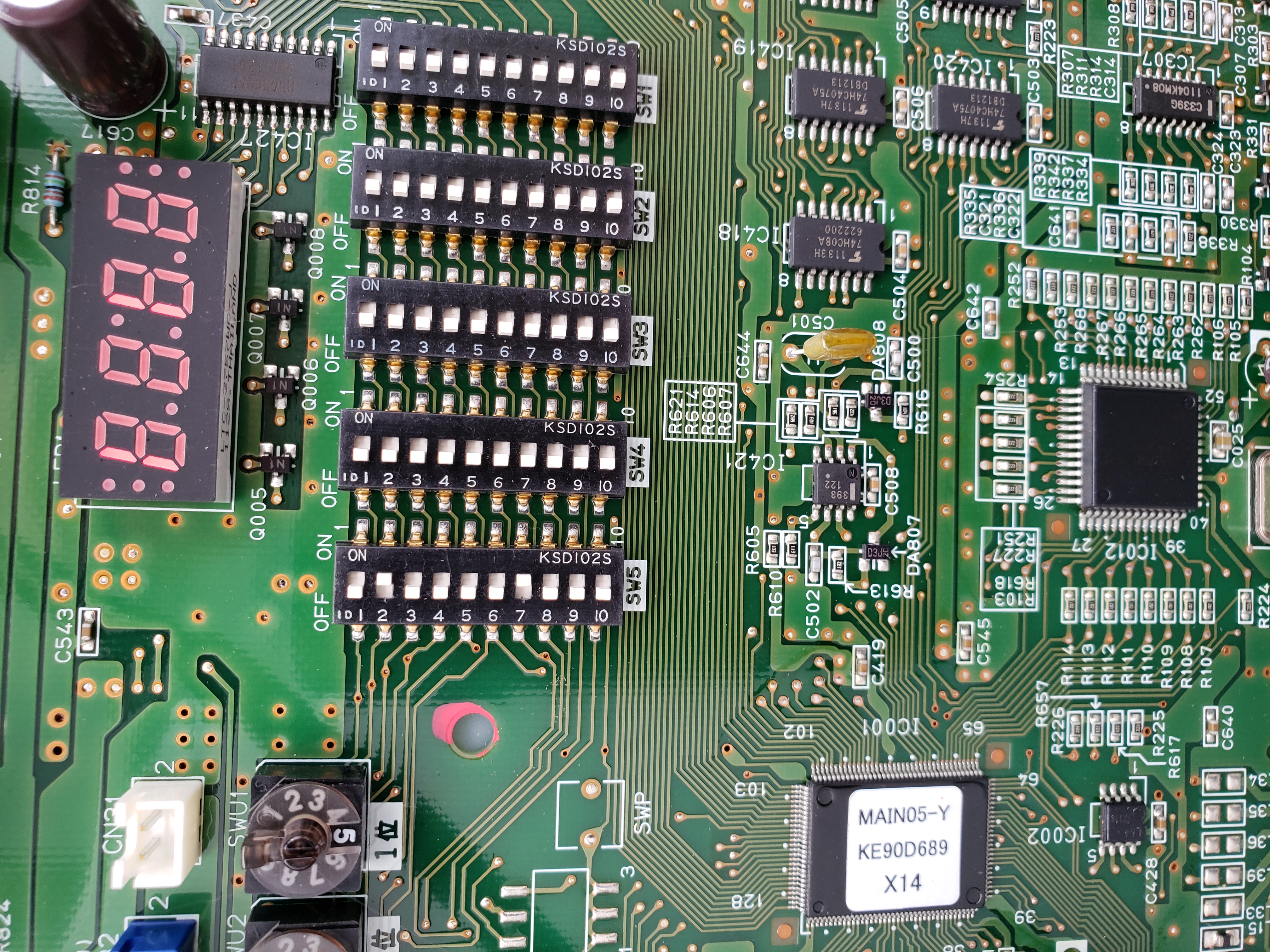
The 48 Hz band in DARM is often increased by variable frequency HVAC fans that step through this band (see Figure 1). We tracked one of the intermittent signals to a particular HVAC unit CU-2A, that I think is cooling the electronics bay (Figure 1). These and many of the other units that are stepping in frequency are Mitsubishi model PUHY-P, or similar units. I think we can prevent the fans from stepping into the 48 Hz band by setting Dip SW4-4 to “off” to put it in low-noise mode (uses lower fan frequencies), and, if we are worried about capacity, set Dip SW5-5 to “off” so that "capacity priority" mode overrides "low-noise" mode in certain conditions (https://planetaklimata.com.ua/instr/Mitsubishi_Electric/Mitsubishi_Electric_PUHY-P_YJM-A_PUHY-EP_YJM-A_Service_Manual_Eng.pdf).
Laser vibrometry of the X and Y TCS 2 mirrors does not show 48 Hz resonance
We were able to point the laser vibrometer at the struts of the large TCS mirrors in BSC2 using the illuminator and camera viewports of BSC2 (for the Y-arm mirror), and the illuminator viewport of BSC3 (for the X-arm mirror). Spectrograms in Figure 2 show that the vibrometer detected fan vibrations exciting the mirror in the 48 Hz region, but not a 48 Hz resonance.
Does not appear to be related to 48 Hz peak on ISI tables
We also found a peak that was very similar to the DARM 48 Hz peak on the Z-axis of GS13s in all LHO (not LLO) ST2 ISI signals. But injections that increased the 48 Hz motion of each of the tables individually by an order of magnitude did not appear in DARM. In addition, changing the isolation gain from 1 to 0.7 on the BS ST1 ISI isolatiobn and shutting down FF01 individually on all tables did not change the 48 Hz peak in DARM.

Opened the unit control panel today and the unit is already set to Low Noise SW-4-4 off and Capacity Priority SW 5-5 off. See attached Photo