As a test, HAM3 Ry loop was switched to SUPERSENS6 blend, which includes a newly designed 30mHz CRS blend. It has been running stably for the last 20 minutes.
start_gps = 1468138518
note - to avoid confusing results I also turned off the CPS-DIFF loop
| UTC | Jul 15, 2026 | 08:15:00 | UTC |

As suggested by Huyen, attached in pdf1 is the comparison with all hams remade, including HAM1, which is the only chamber in the vicinity of HAM3 that also has the fine CPS upgrade.
Jim asked to plot a comparison of the CPS Ry channe before/after, which is attached in the 2nd pdf.
Finally, there is a typo in all plots and figure names from the other comments - the blends between the CRS and the GS13 is at 800mHz, not 80mHz (thanks Michael for the catch), so the blend plots and noise budget plots were regenerated, and are attached below as reference.
The loops stayed stable overnight and have been running for ~12 hours.
The overnight data was analyzed (first pdf) and spectra of the GS13 and CRS Ry were compared with the data from last week wtih the CPS/GS13 400mHz blend on the Ry loop. The in-loop CRS shows a factor of 100 improvement in the 0.2-0.5Hz band between the two times (purple vs pink), and the GS13 is now self noise limited up to ~0.8Hz (compare dark blue vs light blue).
A comparison of the Ry dof between all HAMs is also attached in the second pdf as a reference.
A tilt noise estimate used to design the blends is shown in the third pdf. This estimate uses the 3 sensor noises (CPS, GS13 and the updated CRS noise model), as well as (estimated) tilt input, and the 3 way blend. The total platform tilt noise for the new blend is shown in the dark blue dash lines and compared with the in-loop CRS measured spectrum. The dash green line shows the estimate for the 400mHz previous blend, compared with out-of-loop CRS spectrum.
Note the 1-20mHz noise in the measured spectra is from windowing leakage (2582) rather than real tilt. I kept using the same Hanning window to be consistent with the reference data saved in dtt from last week. Eventually we should remake those plots in matlab (or dtt) with bmh windowing.
The blends were designed using Brian's script attached to T2200393 as a starter point. The CRS sensor response is inverted in the blend filter (the same way we do with the GS13). The installed blend filters (including sensor response, as opposed to the plot shown in the main alog above) are shown on the last pdf.
Next, we will assess how this improvement can help reducing the blend frequency in the horizontal loop.
The dtt template, blend script and blend filters are saved under :
/ligo/svncommon/SeiSVN/seismic/HAM-ISI/H1/HAM3/CRS/Templates/dtt/2026-07-25_CRS_Spectra.xml
/ligo/svncommon/SeiSVN/seismic/HAM-ISI/H1/HAM3/CRS/Scripts/make_crs_blends.m
/ligo/svncommon/SeiSVN/seismic/HAM-ISI/H1/HAM3/CRS/Filters/CRS_BLNDS_30mHZ.mat
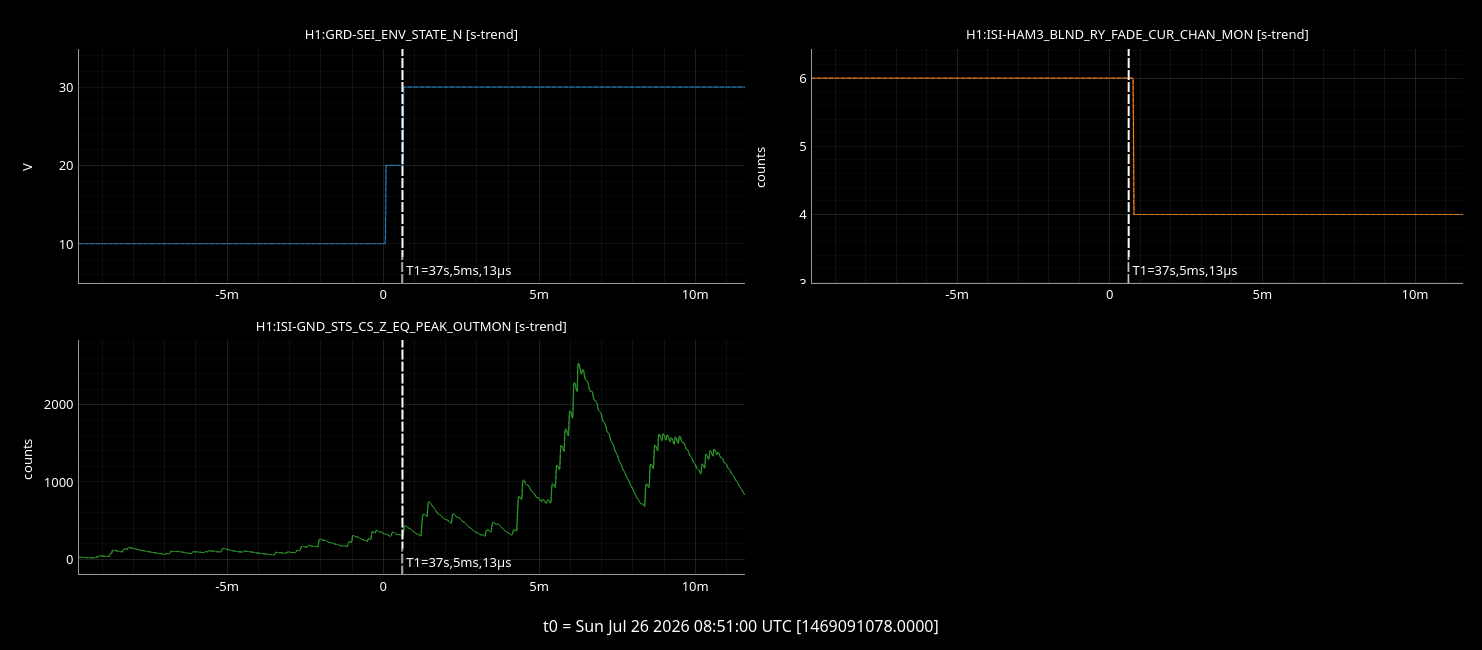
The SEI_ENV automation guardian transitioned back HAM3-ISI Ry loop to the nominal blend (SUPERSENS4) before an earthquake on July 26 at 01:51 UTC
Analysis time for the CRS in-loop is between July 25 08:15 UTC and July 26 08:51 UTC
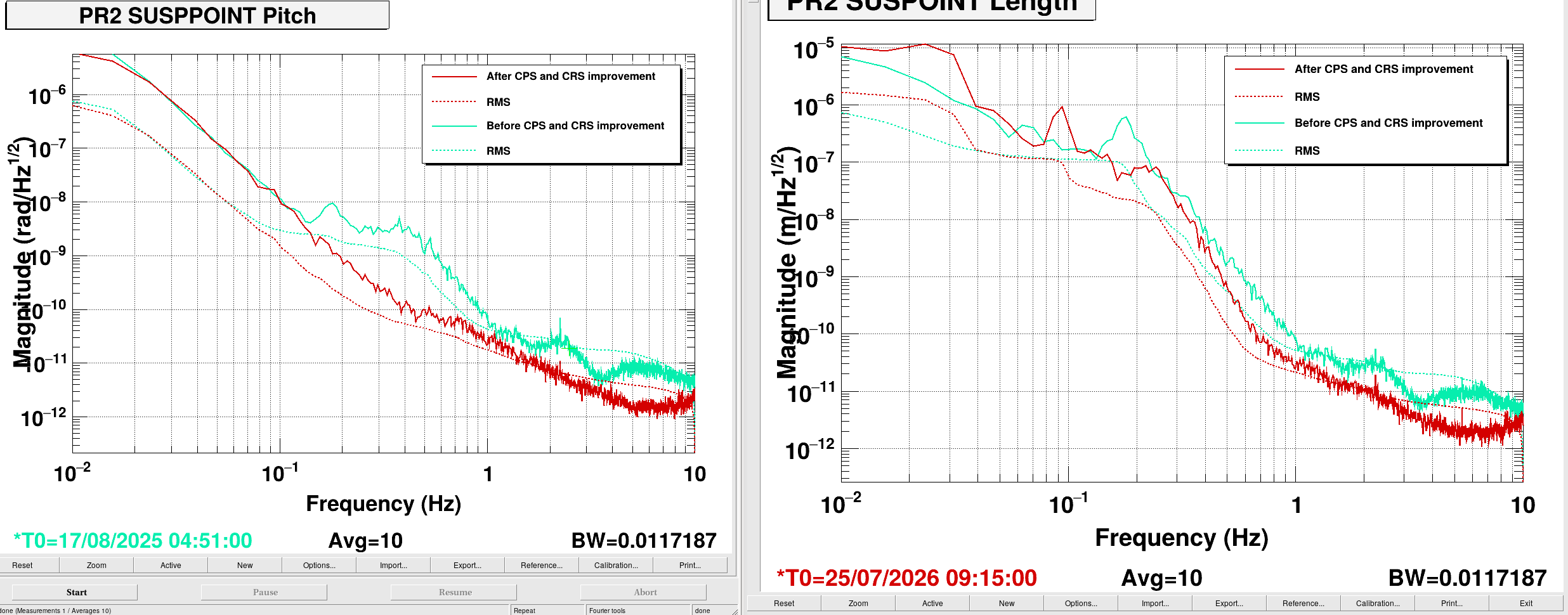
I was excited, so I made a comparison of PR2 suspoint motion in pitch and length during Arnaud's test time, which encompasses both the CRS change made here and the CPS improvement made in 91113.
For a comparison time I went back roughly a year ago to August, to a time when we were in observing. Hopefully the seismic environment is fairly similar.
The attached plot shows pitch on the left, length on the right, along with the RMS. The channels are calibrated into rad and m respectively.
Overall, the pitch is the most straightforward: between 0.1 to 1 Hz there is up to a factor of 25 reduction in the motion, and between 1 and 10 Hz roughly a factor of 4 reduction. These plots purposefully don't show anything above 10 Hz because we don't expect improvement there, and we're still returning from the vent so there's lots of ambient noise which could be confusing.
Length has some weird features, which I'm not sure are attributable to the changes in the sensors and blends, but also shows improvement between 0.1-10 Hz.
As a reminder, PR2 is used to control the PRC alignment.