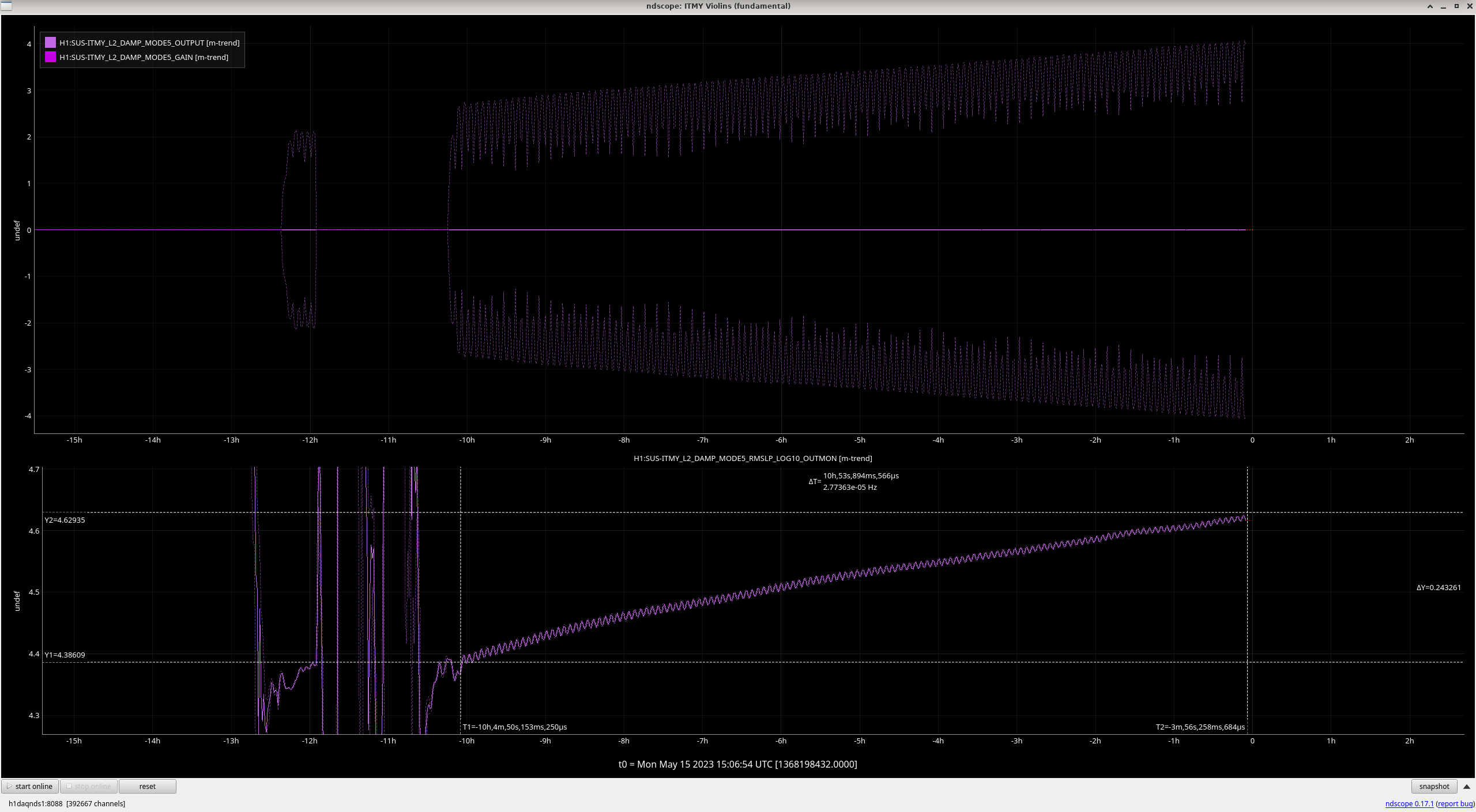
Looking into the Violins this morning I noticed that Violin ITMY Modes 5 and 8 were still high, and had been rising for several hours.
Please see Attached screen shots of ndsopes and Gains. I have not interfered yet.
I have switched off the gains for both the modes since they are rising and will look for new settings now.
IY08 damps fine with this new setting found last week, I have accepted it in the lscparams FM1 FM3 FM10, Gain = 0.01
TITLE: 05/15 Day Shift: 15:00-23:00 UTC (08:00-16:00 PST), all times posted in UTC
STATE of H1: Observing at 126Mpc
CURRENT ENVIRONMENT:
SEI_ENV state: CALM
Wind: 6mph Gusts, 3mph 5min avg
Primary useism: 0.02 μm/s
Secondary useism: 0.17 μm/s
QUICK SUMMARY:
Current IFO Status: Locked in NOMINAL_LOW_NOISE
The fire water tank is low so I have started the well pump to replenish the tank. The pump should run ~4 hours.
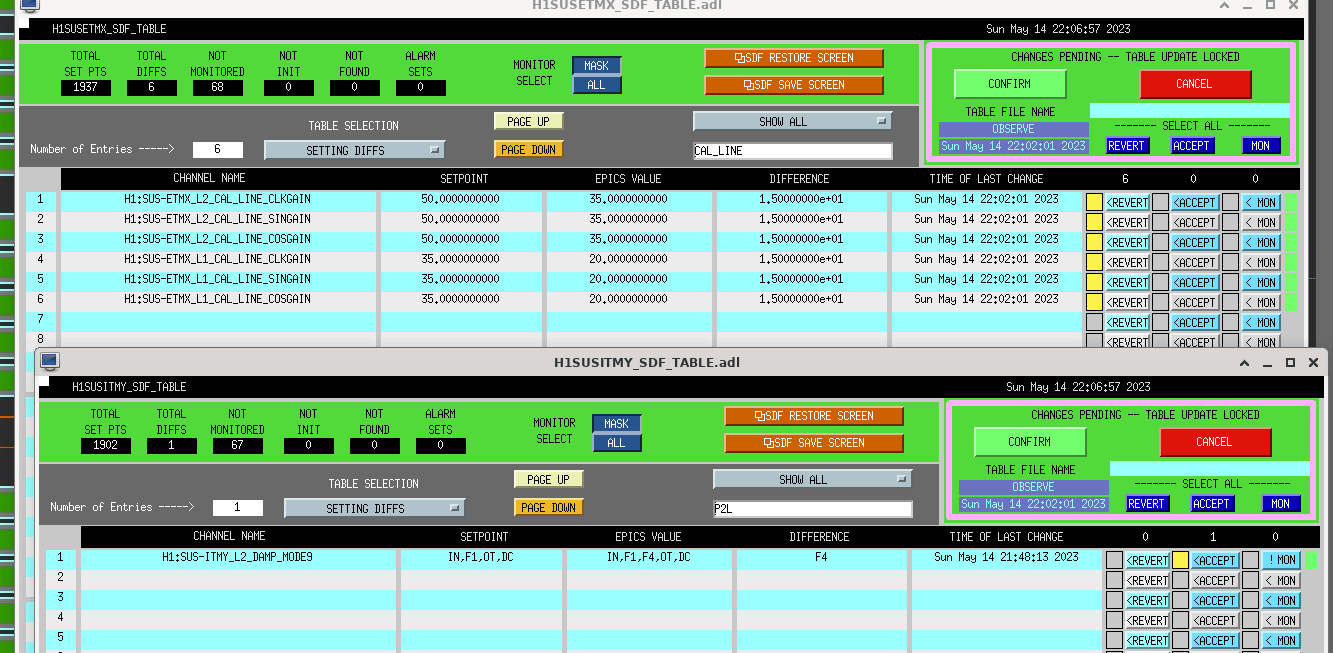
I've clicke the Observation Intent bit. Since all the SDFs are clear, the IFO should go to Observing as soon as the Violin damping guardian returns True.
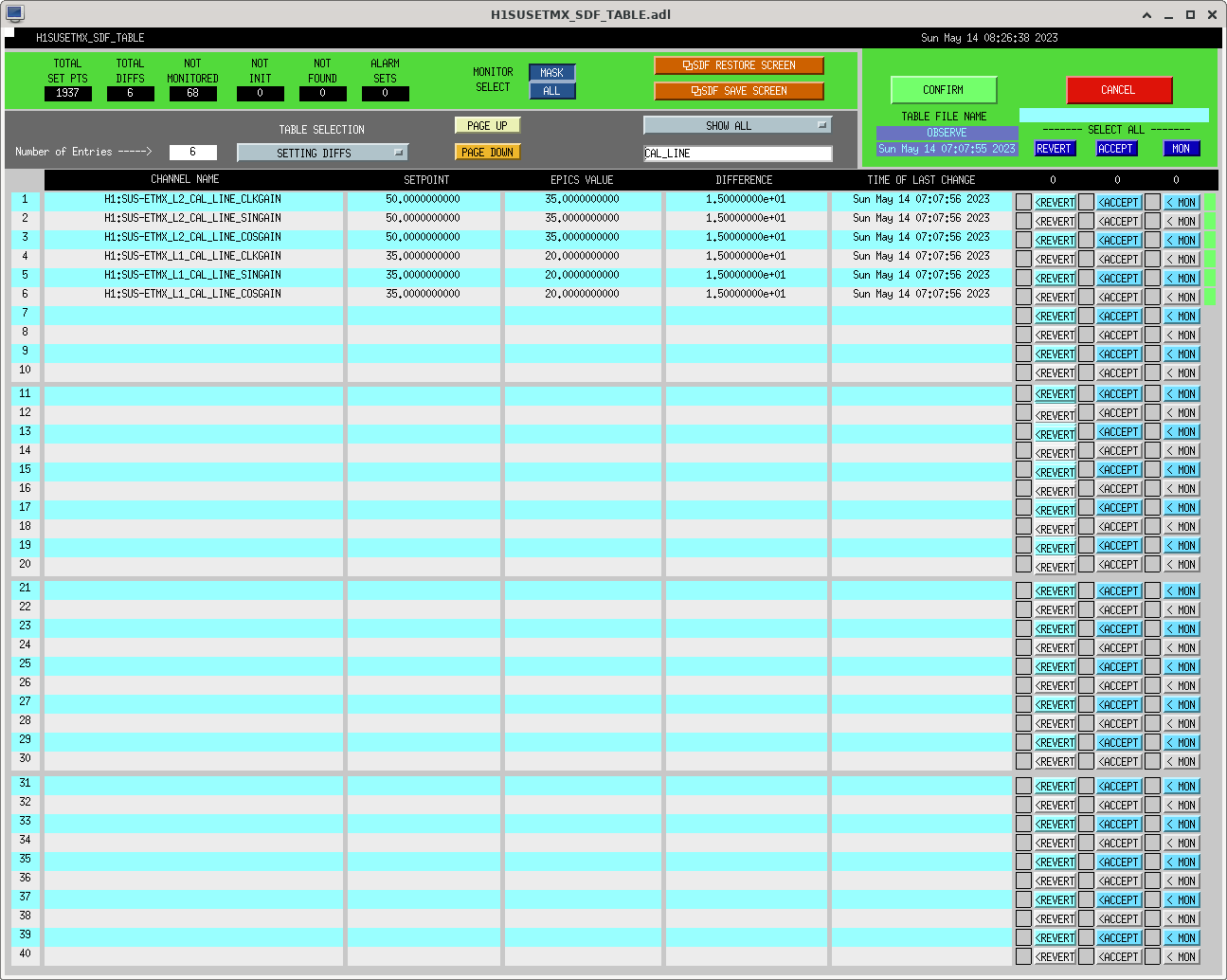
I've reverted EX cal line amplitudes, as RyanS and Ibrahim have done several times over the last few days. Calibrators, please have a look and change guardian to set these to the values you want.
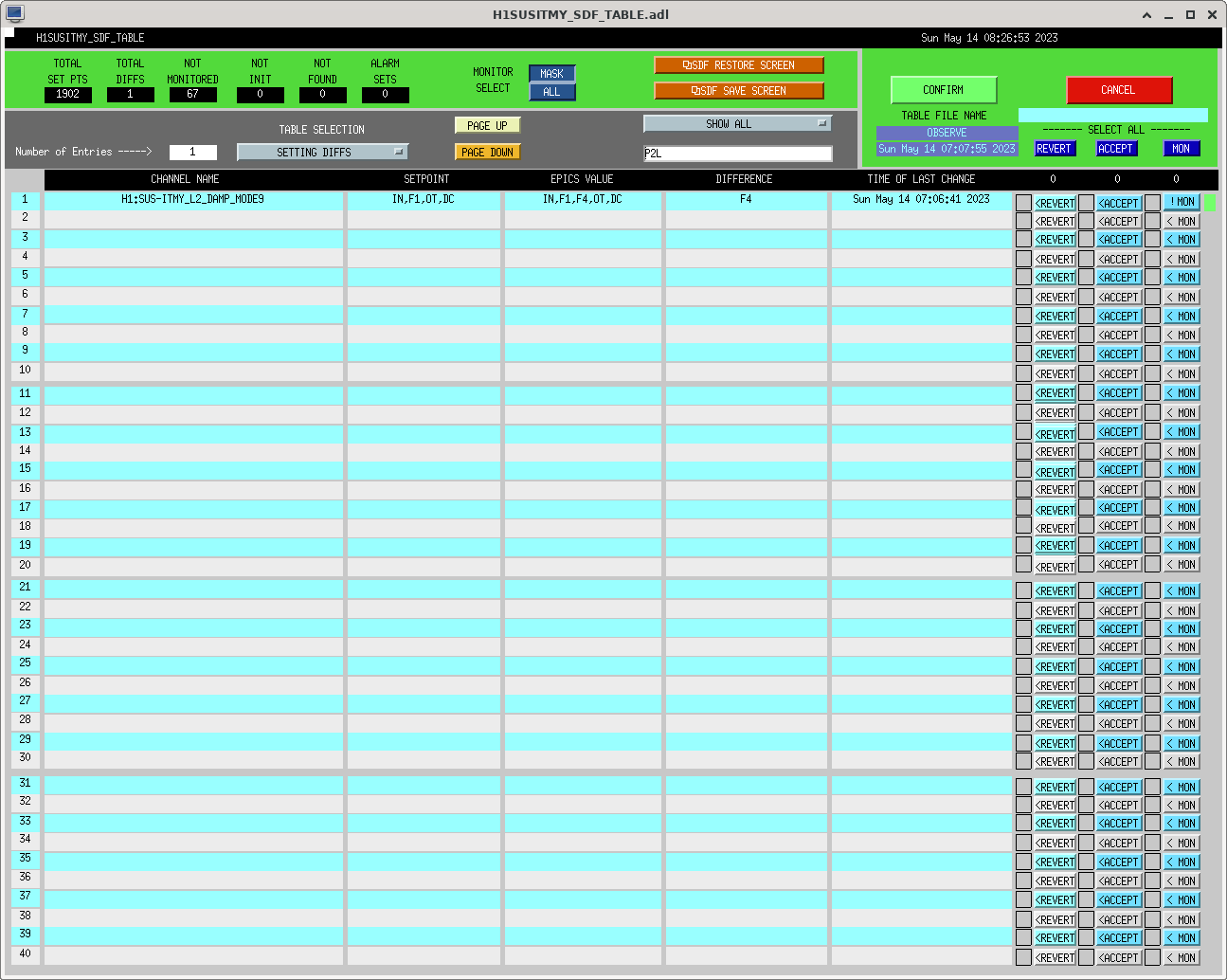
I've also accepted FM4 of ITMY Mode 9 being off, since that's what guardian seems to have done. Rahul, please have a look.
I will un-monitor IY mode 9 from the SDF since we don't use this filter bank.
J. Kissel Ah! Right! Forgot that NOMINAL_LOW_NOISE has these gains hard-coded in place such that when we return from NLN_CAL_MEAS they get turned back on. And even worse, this is hidden in lines 261 thru 263 of the ISC_GEN_STATES.py code that the ISC_LOCK.py guardian calls around its line 244. Here's the changed code in ISC_GEN_STATES.py: 259 #make sure cal lines are on 260 for g in ['CLK','SIN','COS']: 261 ezca['SUS-ETMX_L3_CAL_LINE_%sGAIN'%(g)] = 0.3 262 ezca['SUS-ETMX_L2_CAL_LINE_%sGAIN'%(g)] = 50 263 ezca['SUS-ETMX_L1_CAL_LINE_%sGAIN'%(g)] = 35 (lines 262 and 263 had been set to the former PUM and UIM gains of L2 = 35 and L1 = 20, respectively.) The fixed ISC_LOCK guardian has been reloaded as of 2023-05-15 16:55:18 UTC.
After deciding to finish PEM injections for the day due to a lockloss from nominal low noise maybe 20 min in (cause not obvious), I waited to relock hoping to set to observe for the night. However, we lost lock again in MAX_POWER state. I leave it to try to relock itself, already past DRMI, but will not be here to set it to observe.
No intentional disturbances are running.
Because the ALS beatnotes were low earlier in the day, I had moved PR3 a hair: -118.4 to -118.0 P and -151.6 to -151.4 Y. This should be reset when the ALS table is re-aligned this coming Tuesday, it's only a bandaid until then.
Anamaria, Adrian, Robert
In Sept. of 2020 I checked all four cryobaffles and recommended that all but the ITMX cryobaffle be damped (https://alog.ligo-wa.caltech.edu/aLOG/index.php?callRep=56857). We damped 2 of the 3 recommended ones and we even damped the one I didn’t recommend, but we were unable to damp the ETMX cryobaffle because there was no incursion at that station. Damping worked well on the cryobaffles that were damped (https://alog.ligo-wa.caltech.edu/aLOG/index.php?callRep=65621).
The undamped ETMX cryobaffle appears to be the source of the 4.1 Hz noise comb in DARM. The figure shows a spectrogram comparison of a 3-5 Hz swept sine injection using the architectural shaker attached to the manifold reduction flange at EX in 2020 and now. The 4.1 Hz frequency and the Q of the decaying scatter shelf are very similar in 2020 and now, but the SNR of the scattered light noise is much higher now, at least ten times worse. The figure also shows, on the second page, DTT spectra as the 4.1 Hz harmonics become a shelf as the shaking amplitude increases. While the mechanical shaker produced the 4.1 Hz noise in DARM, the HEPI shaking that I did at EX a few weeks ago did not, further supporting the contention that it is the cryobaffle and not the ACB (which may also have a 4 Hz resonance), or anything else isolated by HEPI.
One possibility is that the increase in arm power resulted in more scattered light at EX, but the first appearance that Gabriele found of the 4 Hz comb, Jan. 31 of this year (https://alog.ligo-wa.caltech.edu/aLOG/index.php?callRep=69406), doesn’t seem to coincide with a power increase. Scattered light might also have increased from alignment changes.
I think that I could damp the EX cryobaffle through a viewport in a short vent like I did with the Swiss Cheese baffle (https://alog.ligo-wa.caltech.edu/aLOG/index.php?callRep=36147 ).
[Jenne, Anamaria]
Anamaria ran an initial alignment this afternoon, but noted that OM1 wasn't getting cleared after the Input_Align step. I had thought I fixed this a few weeks ago, but we should go back and double check that it gets cleared so that we can finish initial alignment automatically.
Also, I trended the ITM green camera error signals, and it looks like they've been drifting away from 0 throughout the day (which is why initial alignment was needed). They are uncontrolled except for initial alignment, but they should still usually be roughly stationary. I assume it's the heat, but all of the VEA temperatures on the control room screenshots look fine at first glance. Anyhow, maybe things are all fine, and it was just time for an alignment, but noting in case it's helpful to look at Monday morning.
TITLE: 05/14 Day Shift: 15:00-23:00 UTC (08:00-16:00 PST), all times posted in UTC
STATE of H1: Commissioning
SHIFT SUMMARY:
Locks:
Locklosses at 16:33 UTC (DRMI) and 16:34 UTC (Locking arms green).
Lock/NLN acquired at 18:12 - in comissioning for PEM Injections.
Lockloss at 22:37 UTC (DRMI) - the cause of this is unknown and it doesn't seem to be the wind (no gusts when trending for 1 hr before lockloss). Lockloss at 23:00. Shift ended while guardian was relocking.
Manual Touching:
Other:
Before brief (sub 1 minute due to PEM starting injections) observing this morning, I REVERTED 7 SDF diffs. These 7 were the exact same (channels and change types/magnitudes) as the ones Ryan S reverted in alog 69565 during his Friday EVE shift.
LOG:
| Start Time | System | Name | Location | Lazer_Haz | Task | Time End |
|---|---|---|---|---|---|---|
| 16:04 | PEM | Robert, Anamaria, Adrian | CTRL | N | PEM Inj | 23:55 |
| 20:05 | PEM | Robert, Adrian | LVEA | N | Moving speaker | 20:23 |
| 21:20 | PEM | Anamaria, Robert | EY | N | PEM Inj Stuff | 23:15 |
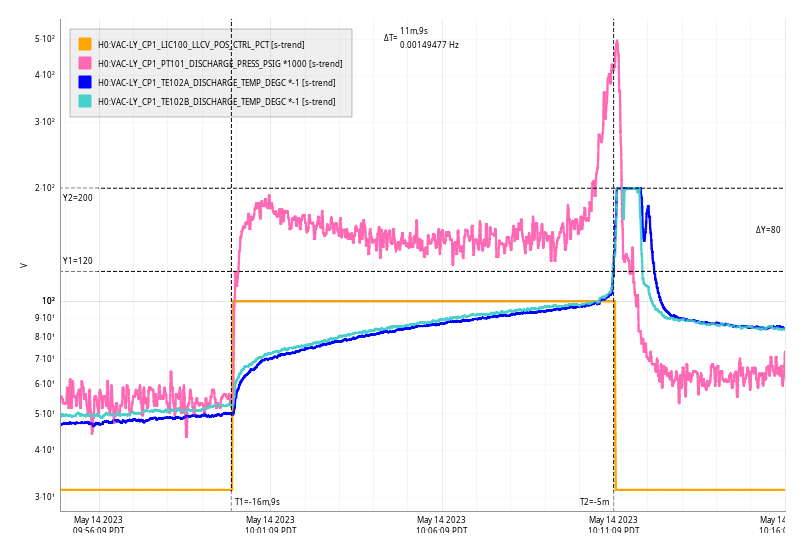
Sun May 14 10:11:09 2023 INFO: Fill completed in 11min 8secs
TITLE: 05/14 Day Shift: 15:00-23:00 UTC (08:00-16:00 PST), all times posted in UTC
STATE of H1: Wind
CURRENT ENVIRONMENT:
SEI_ENV state: CALM
Wind: 18mph Gusts, 14mph 5min avg
Primary useism: 0.05 μm/s
Secondary useism: 0.13 μm/s
QUICK SUMMARY: IFO has been locked for an hour. Working to get it to observing now.
Once the wind quieted down, I logged back in to relock. The DIFF beatnote was nonexistent, so I took us through initial alignment. It worked all the way through, no errors. Once that completed, I took us through locking. I was suprised that the IFO couldn't lock DRMI on the first try and had to go through PRMI after the timer ran out. But once PRMI locked DRMI was no problem. We are headed all the way back up to NLN for the night.
TITLE: 05/14 Day Shift: 15:00-23:00 UTC (08:00-16:00 PST), all times posted in UTC
STATE of H1: Wind
SHIFT SUMMARY:
Locks:
The first lockloss was at 18:26 following a 16:22 hour lock with observing until 15:35 UTC.
Locklosses at: 22:12, 22:04, 21:59, 21:53, 21:50, 21:36, 21:32, 21:25, 21:12,21:09, 21:03, 19:36, 19:28, 19:21, 18:51 (all UTC) all assumed due to the same issue. Troubleshooting the issue is described below.
Manual Touching:
Troubleshooting:
SRM Misalignment:
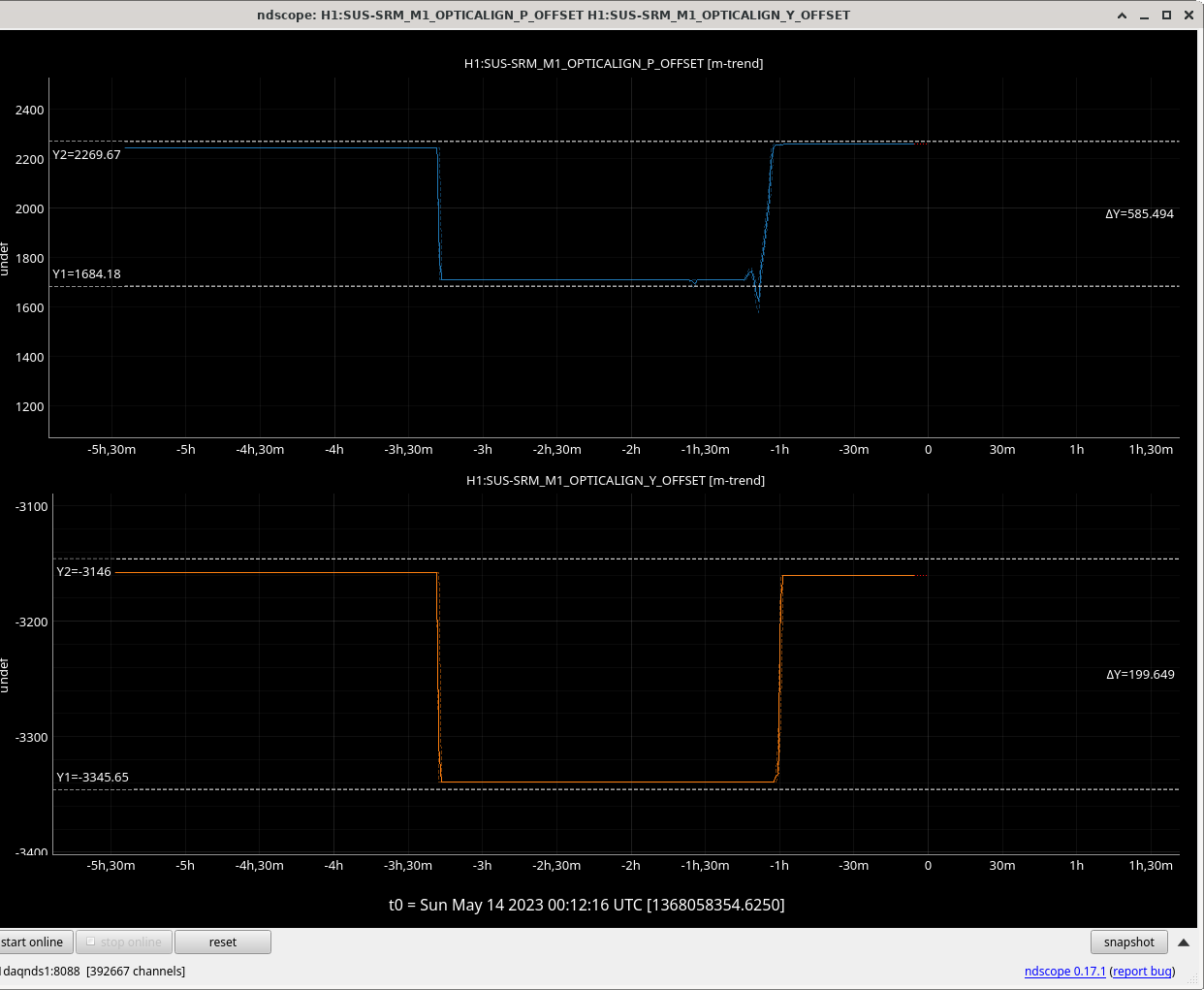
The problem is that the SRC1 Pitch was heavily misaligned (either due to the failed initial alignment or prior). Upon using the usual troubleshooting page, the "misaligned?" checker showed that nothing was super misaligned since the last 24 hrs. However, when we trended the SRM P/Y channels, we saw that the SRC1 P/Y were not converging at all and was heavily misaligned. Figuring that this was an issue with the failed initial alignment, we tried another initial alignment. This time, guardian got stuck at align SRC so we took it into our own hands and did a manual SRC alignment per the initial alignment checklist. We had to move SRM by a lot (see screenshot) due to it being kicked badly right after the failed initial alignment (one could only assume this is what caused it to terribly misalign though this is unknown). After this was tackled, initial alignment went fine and then we went onto normal locking. Now we are losing lock at ALS every single time due to what can only be assumed to be the wind or an actual fault/issue with ALSX (ALSY is fine and catches great every time). On the rare occasion that ALS offloads, we lose lock for no apparent reason when IR is found just as we are "supposed" to go continue (either at Check MICH or at DRMI 1F). SRM was badly railed and not converging properly. Now that it has been realigned, in theory everything should work when the wind dies down. Overall, might just be a natural issue (wind) messing with a very bad (now fixed) alignment issue. Since I'm operating tomorrow, I'll see if this is the case (given low wind).
Other:
Called TJ - helped troubleshooting.
Got Called by Sheila who also helped with troubleshooting and suggesting going to down (along with Jenne later) until the wind dies down.
Huge thank you to Elenna who came in and continued troubleshooting with me. She also informed/taught me which confusions were valid and which were NOS (new operator syndrome). This was all on her own time during the weekend after giving a tour - thanks!
LOG:
| Start Time | System | Name | Location | Lazer_Haz | Task | Time End |
|---|---|---|---|---|---|---|
| 15:36 | PEM | Robert | Ctrl | N | PEM Injection | 16:46 |
| 16:47 | PEM | Robert and Anamaria | EX | N | PEM Injections | 17:47 |
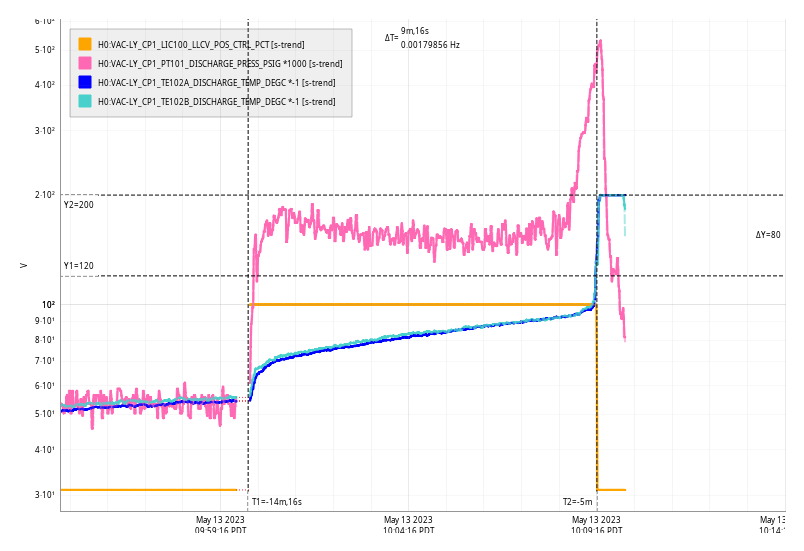
Sat May 13 10:09:16 2023 INFO: Fill completed in 9min 15secs
Continuing my work from last night on getting the magnetic injection suite ready for O4, I've finished tuning all frequency bands on all seven coils we'd like to run injections through. The exception to this is the EY VEA coil, as I could not see a response in the nearby magnetometers when trying to drive it. We do not yet have remote control over the AC Pulizzi unit for this coil, so someone may need to manually turn it on until we have that ability.
Following a discussion with Robert this evening, I tuned an additional high frequency band (1kHz-4kHz) on each coil in hopes to reach the Nyquist frequency of the magnetometers, although we're not sure if this will prove useful as it's challenging to drive the coils enough in this frequency band to get a response above background. I populated the appropriate filter banks in the PEMCS, PEMEX, and PEMEY front-ends with the 6th-order elliptical bandpass filter and 40db attenuation we use for the other injections and loaded them.
After tuning the coils I could, I added the injection states into the PEM_MAG_INJ guardian for these new high frequency injections and ran the magnetic injection suite with 128 second injection duration. All 18 injections (plus time for a background taken beforehand) took a total of 47 minutes and ran from 05:44 to 06:31 UTC. The injection log for this run is:
/ligo/www/www/exports/pem/WeeklyMagneticInjection/logs/1367991892.txt
The injection suite is not currently set to run automatically on Tuesday morning, but one could set it by simply requesting INJECTIONS_COMPLETE in the PEM_MAG_INJ guardian. The start time is read in from the associated injparams.py file, so one should look there if they'd like to change the start time of the injections.
We found a couple issues:
1) the lower band injections, 10-100, were still saturating a few samples, which messes up the analysis code - I have reduced all the amplitudes by 10%. If that doesn't work, then the analysis code will have to have a way of saying that some 10-20 samples saturated out of a million is pretty ok.
2) The higher bands drop off with frequency, so I added a zero to the 100-1000 Hz band and two zeros to the 1k to 4k Hz band. I changed all the corresponding filters in the 7 coil GDS filters (FM2 and FM3) and updated the gains in the guardian.
EY VEA coil was reconnected and included in the guardian.
Two stages of whitening were enabled for the OMC-REFL_A photodetector.
The slow controls DC readout is very close to +10V and sometimes saturates. The fast DAQ has more headroom and should be fine. If not the analog PD gain should be reduced to 10dB.
PS. OMC_REFL_A is using the old DCPD whitening chassis: Only the 24dB gain step works, all others will short the output. Filter stage 2 is not a whitening stage.
Here is a spectrum of the OMC_REFL PD with 2 stages of whitening. Looking at the violin modes around 500Hz the signal is about a factor of 10 stronger (in Watts) in the OMC-DCPD_SUM compared to OMC_REFL_A.
Clearly visible are the 32Hz and 40Hz lines as well as 2 lines around 100Hz, see also alog 68078. Maybe these lines are added by the AM stabilization circuit for the 45MHz sidebands?
A lot of acoustic coherence with PSL accelerometers.
Some comments to the possible coupling mechanism:
The EOM mount was changend on Sep 6, 2022, see alog 64882. Looking at the pics one can see the coils just sitting there.
Unfotunately turning off the cosmic ray power supply did not remove the intermittent 4.05 Hz bumps in DARM, even though all the CS signals that showed a large peak at 4.06 Hz are now clean.
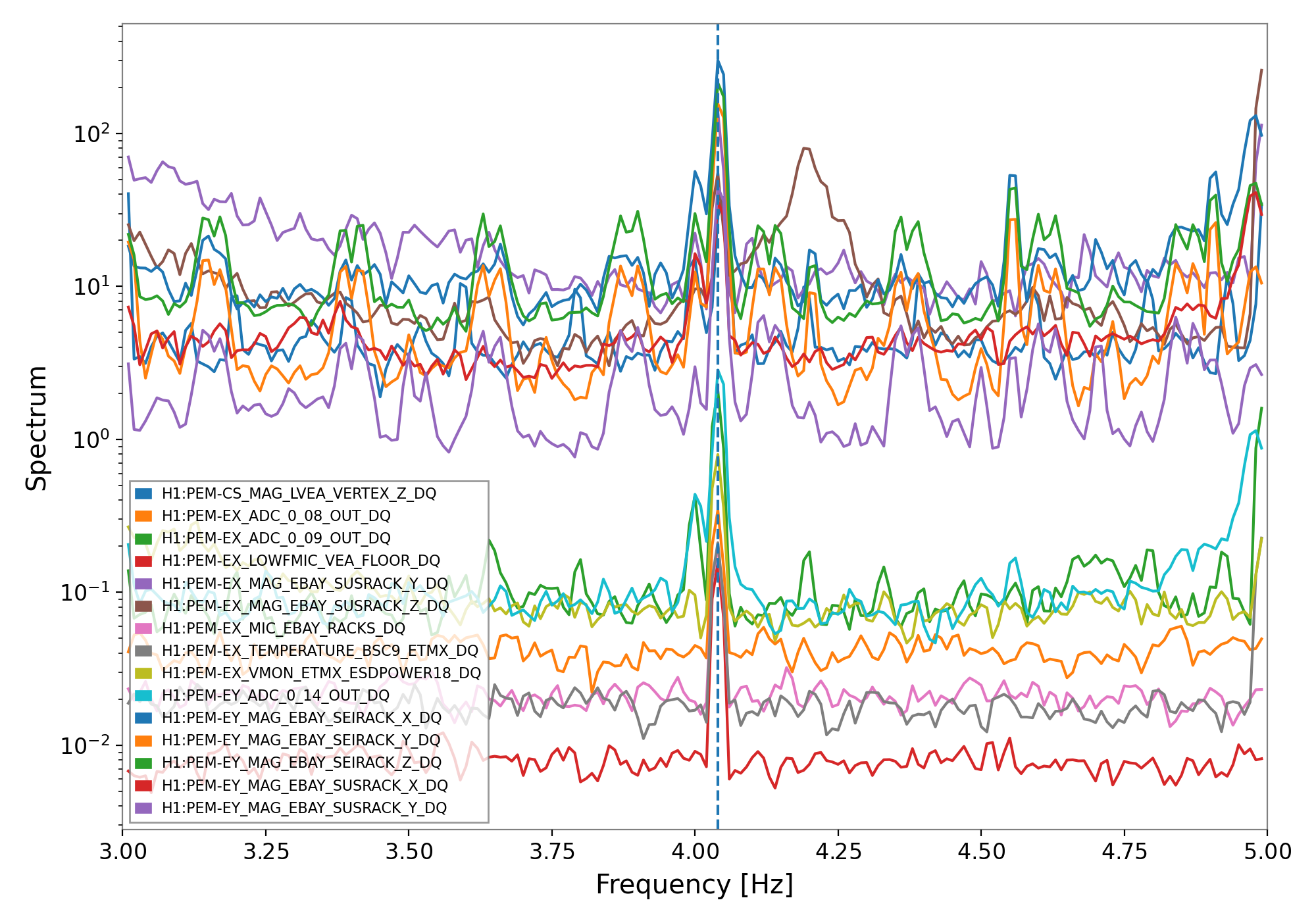
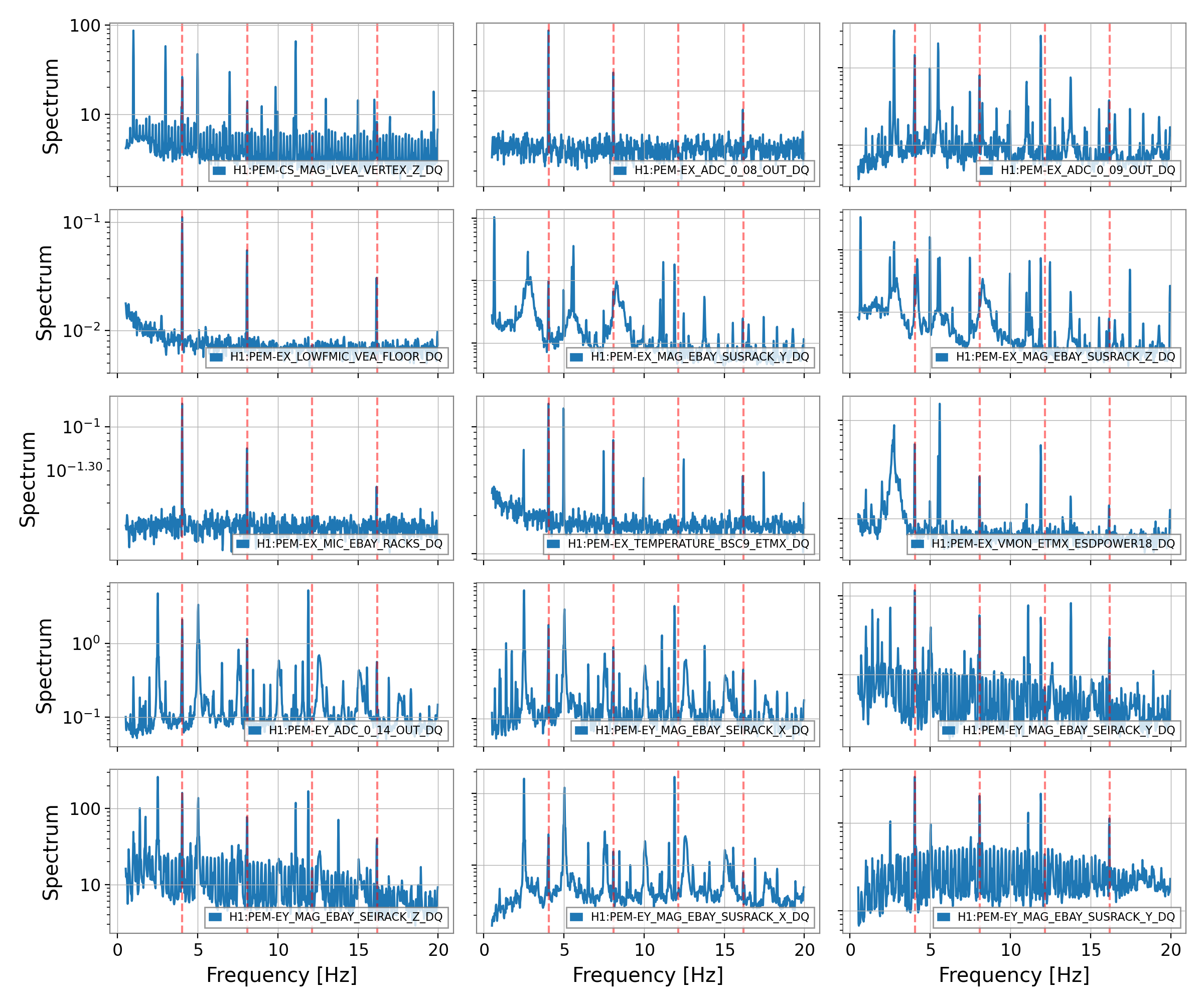
Looking again at all the signals that contain a peak around 4.05 Hz, we now have
H1:PEM-CS_MAG_LVEA_VERTEX_Z_DQ 4.050 Hz
H1:PEM-EX_ADC_0_08_OUT_DQ 4.040 Hz
H1:PEM-EX_ADC_0_09_OUT_DQ 4.040 Hz
H1:PEM-EX_LOWFMIC_VEA_FLOOR_DQ 4.040 Hz
H1:PEM-EX_MAG_EBAY_SUSRACK_Y_DQ 4.040 Hz
H1:PEM-EX_MAG_EBAY_SUSRACK_Z_DQ 4.040 Hz
H1:PEM-EX_MIC_EBAY_RACKS_DQ 4.040 Hz
H1:PEM-EX_TEMPERATURE_BSC9_ETMX_DQ 4.040 Hz
H1:PEM-EX_VMON_ETMX_ESDPOWER18_DQ 4.040 Hz
H1:PEM-EY_ADC_0_14_OUT_DQ 4.040 Hz
H1:PEM-EY_MAG_EBAY_SEIRACK_X_DQ 4.040 Hz
H1:PEM-EY_MAG_EBAY_SEIRACK_Y_DQ 4.040 Hz
H1:PEM-EY_MAG_EBAY_SEIRACK_Z_DQ 4.040 Hz
H1:PEM-EY_MAG_EBAY_SUSRACK_X_DQ 4.040 Hz
H1:PEM-EY_MAG_EBAY_SUSRACK_Y_DQ 4.040 Hz
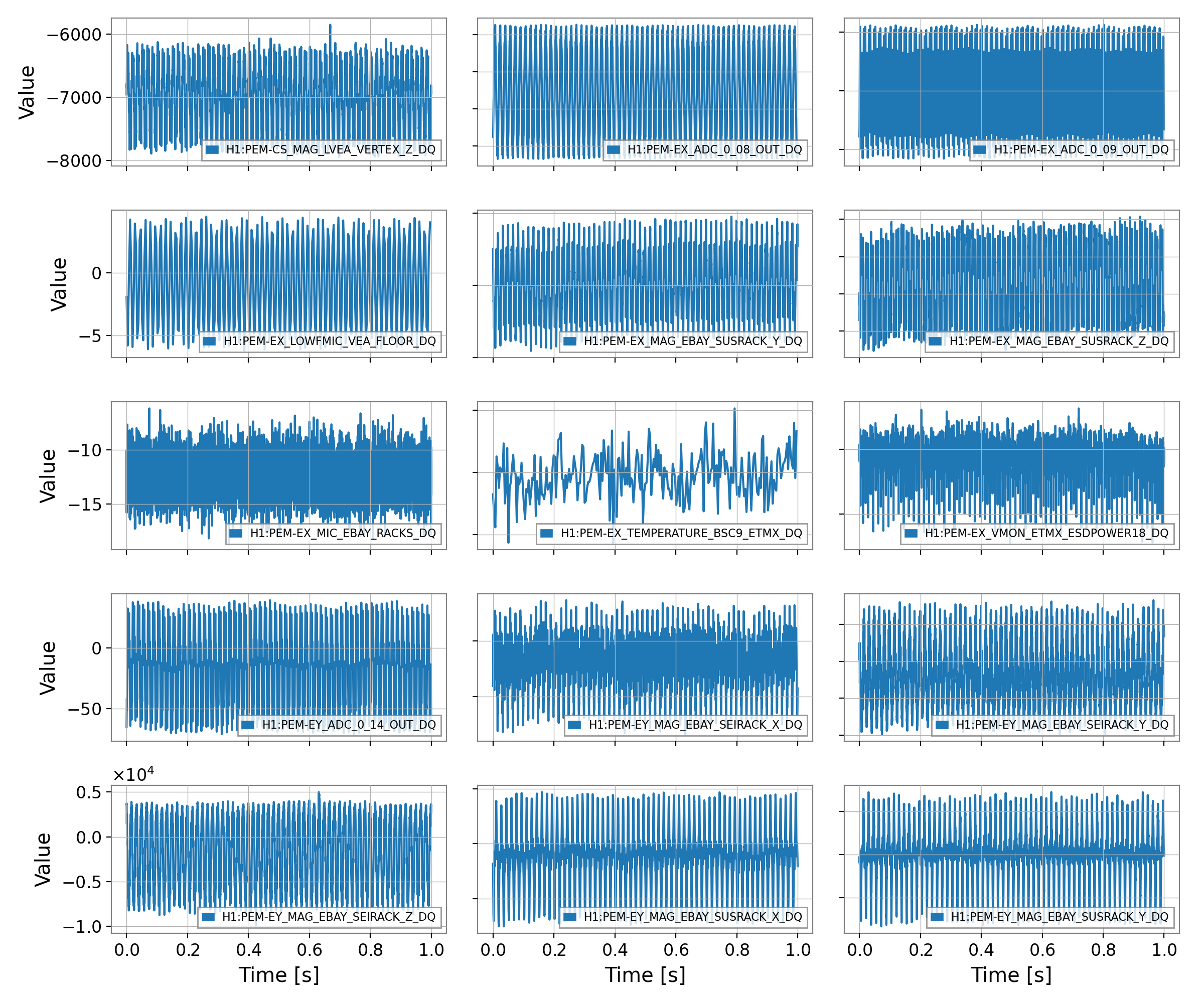
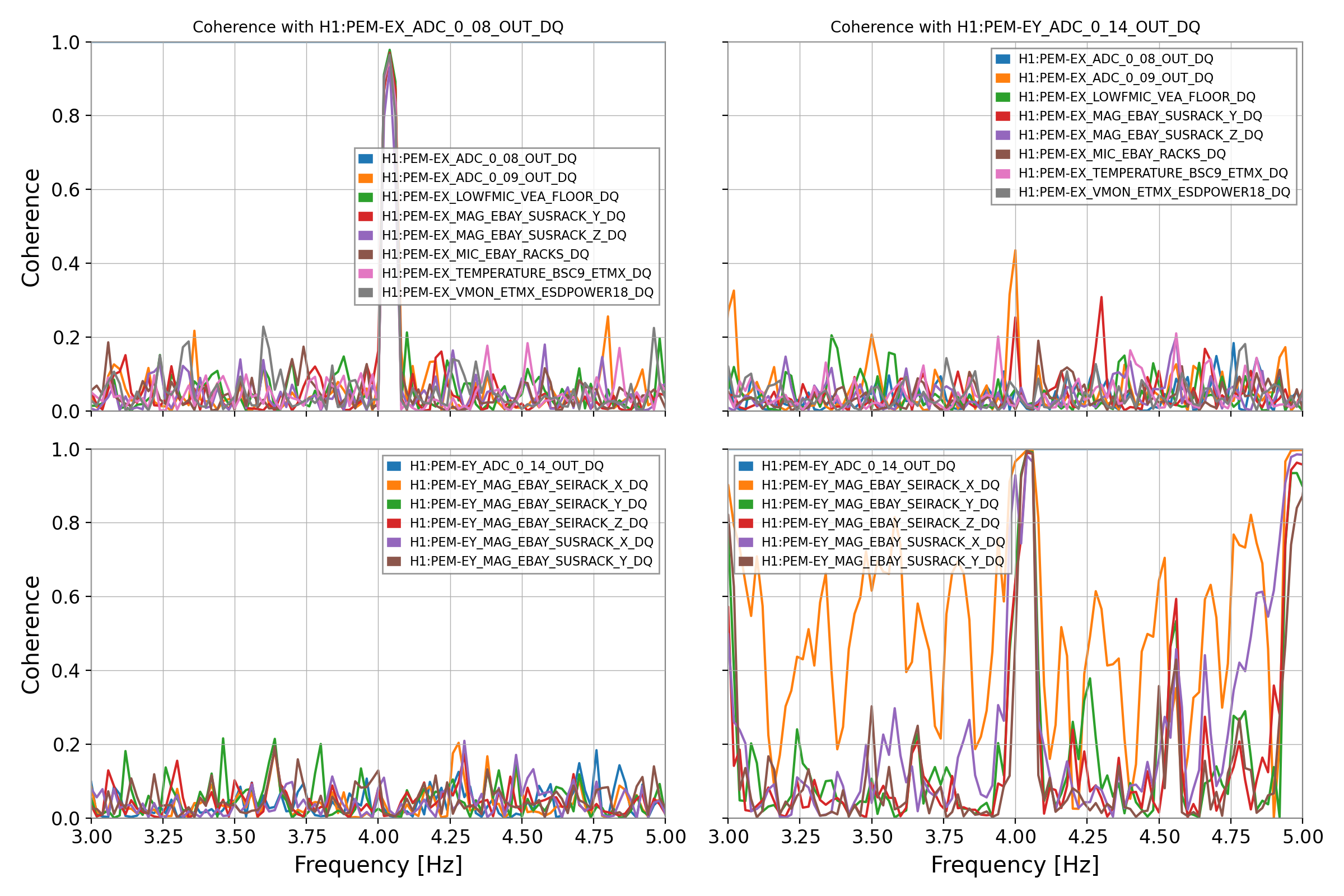
Attached plots shows spectra and time series. Although the frequency of all peaks is very close, EX signals are only coherent among themselves, and not with EY signals, and the other way around too. So it looks like at both end stations there is a source of 4.04 Hz that is local. Maybe a clue? Still, we don't have evidence that those sources are related to the DARM noise.
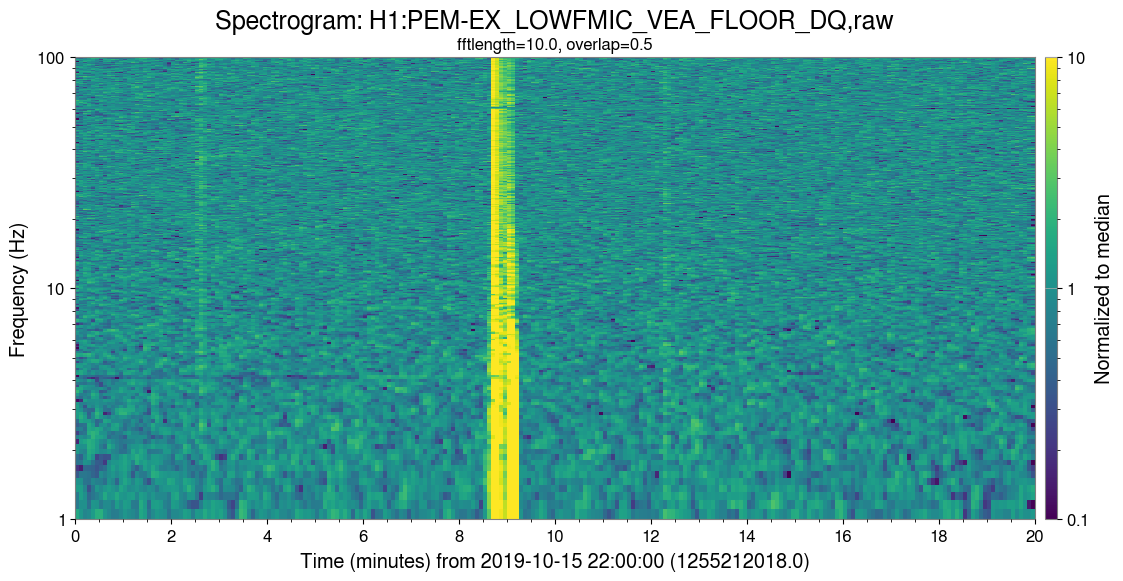
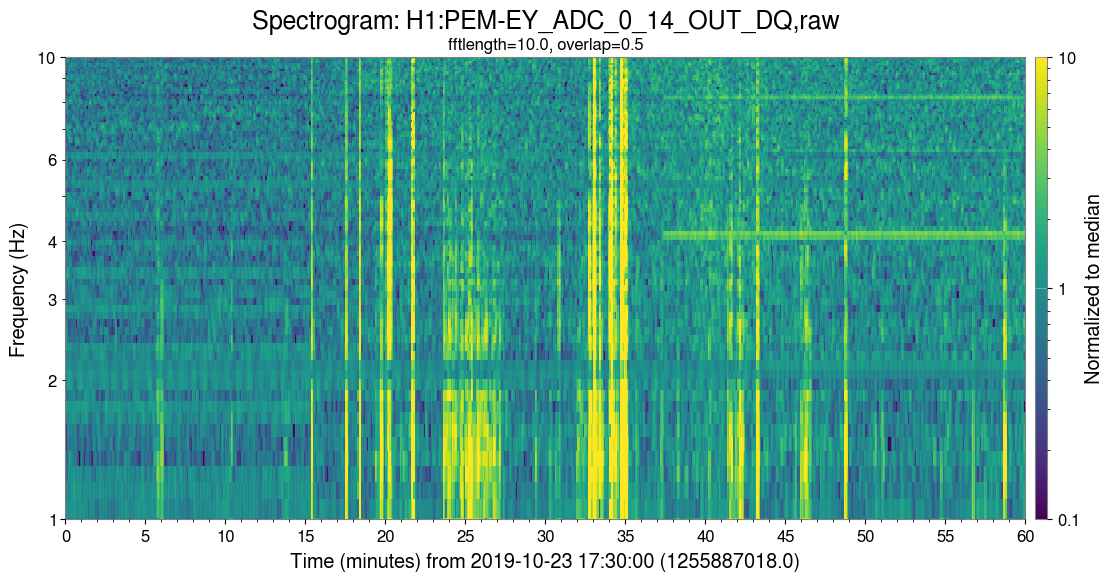
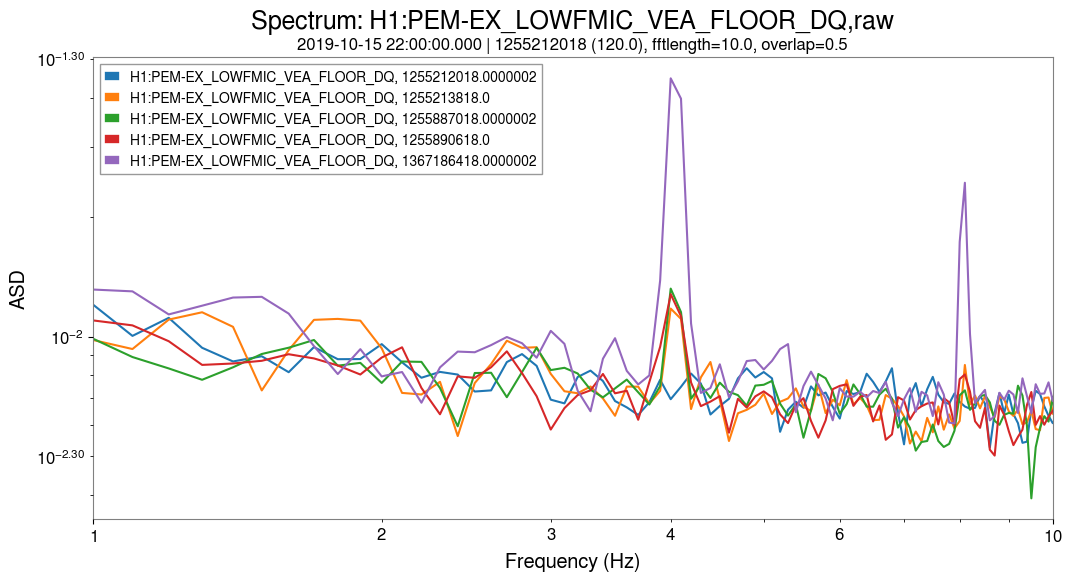
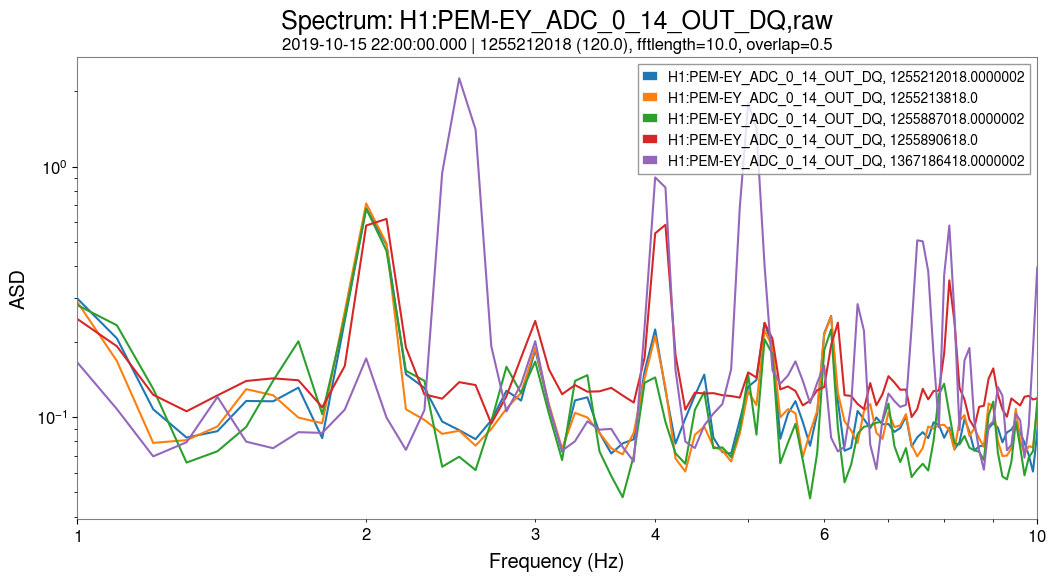
To help track down the source of these lines, I've been investigating the time this feature appeared in these channels. The two channels that were the first to have this feature are H1:PEM-EX_LOWFMIC_VEA_FLOOR_DQ and H1:PEM-EY_ADC_0_14_OUT_DQ, which both have had a 4 Hz line present since October 2019. The exact time of appearance for each is:
The attached spectrograms show the lines appearing at the above times. I have also includes plots of the channel spectra (plot 3 and plot 4) that show the 4 Hz line before/after these times, as well as a recent time (2023-05-03 22:00:00).
Looking through the alogs posted on these days, there may be an association to install work for BRS heaters. The related EX work (alog 52494) was on 2019-10-15, and the EY work (alog 52542) was on 2019-10-23. The time on both days roughly lines up with when the lines appeared.
The full day shift reports for these days are alogs 52495 and 52656. SInce these days were during the O3a-O3b commissioning break, there are a number of other activities that could be related.
I checked several spectragras from the summary pages during the last month of O3. There was no sign of the 4 Hz bumps.
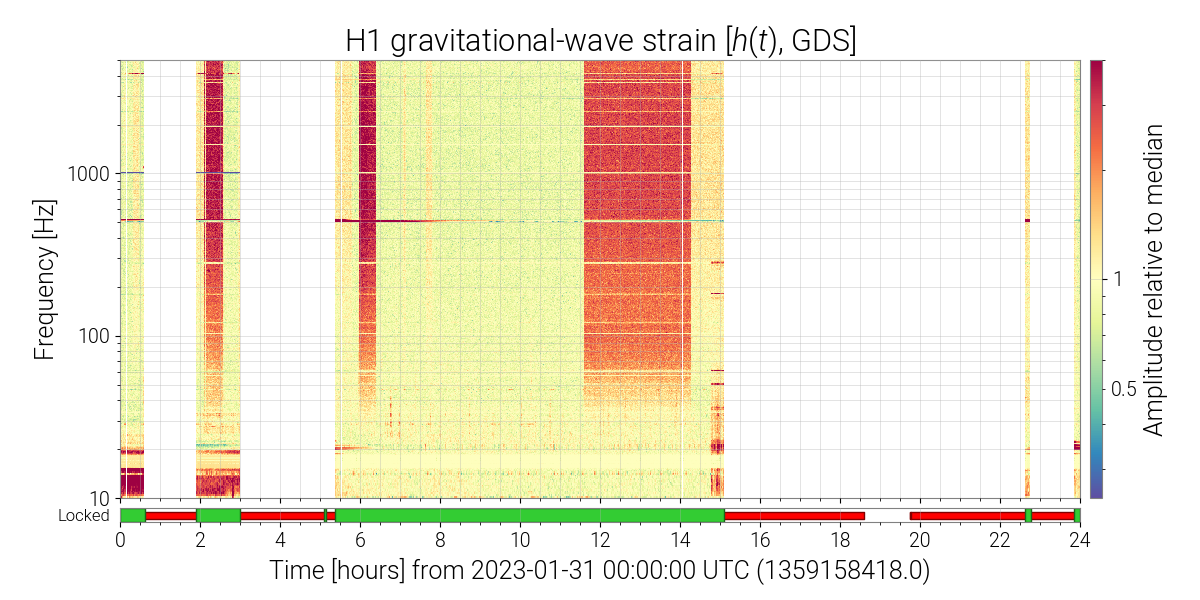
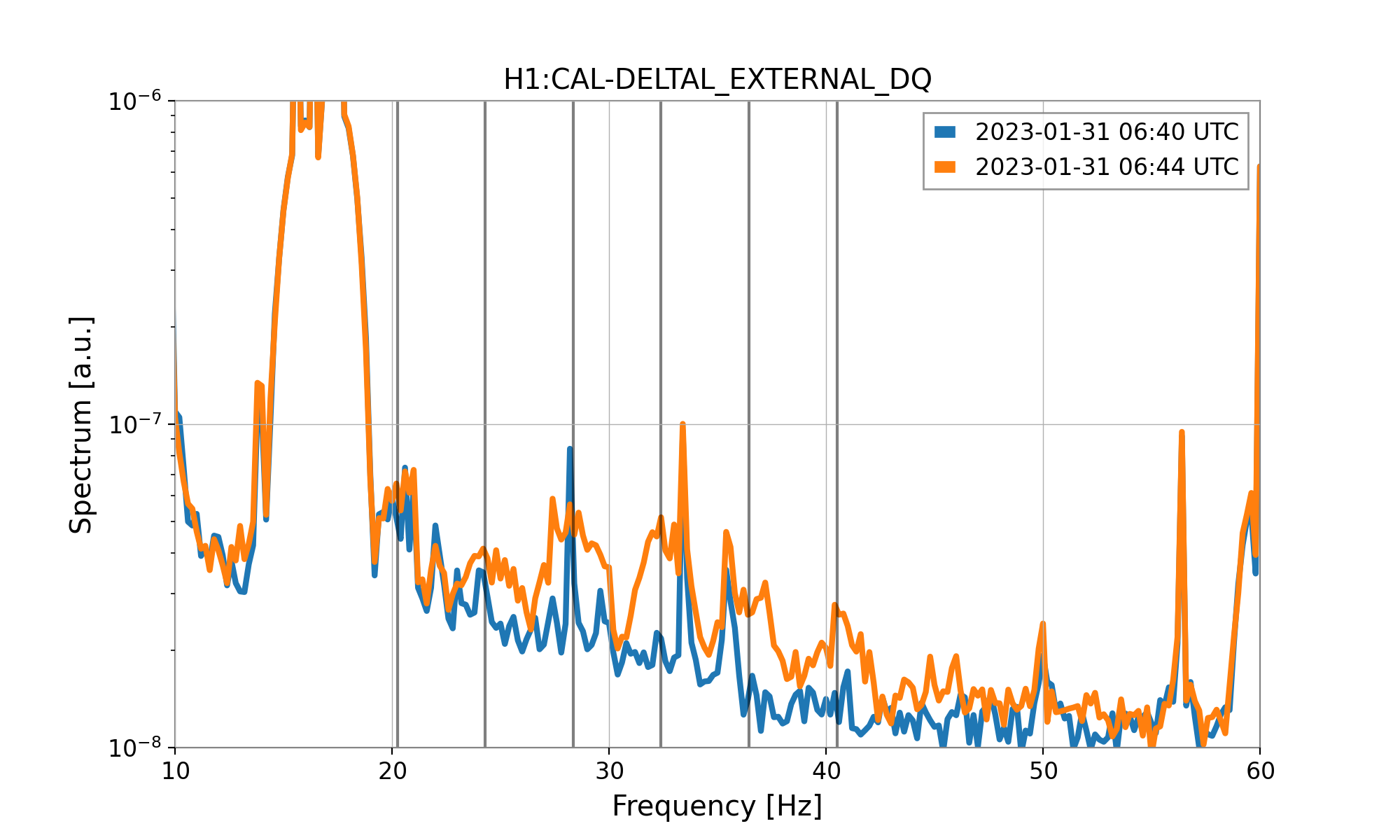
Looking back at spectrograms since the restart, the first evidence I could find of the 4 Hz bumps is on January 31, 2023. I could not find any sign of the 4 Hz bumps in any lock stretch before that time
Under Robert's suggestion that this might have resulted from some alignment change of the beam at EX (LHO:69578), the ISC_LOCK guardian archives show the following A2L gain changes in January 2023:
The issue with trying to blame the 13 Jan gain change is that there were subsequent long locks with high sensitivity around 30 Hz that did not show the bumps.
Since January, there was also a retuning of the IY P2L/Y2L (commit 463245ed, see LHO:69082).
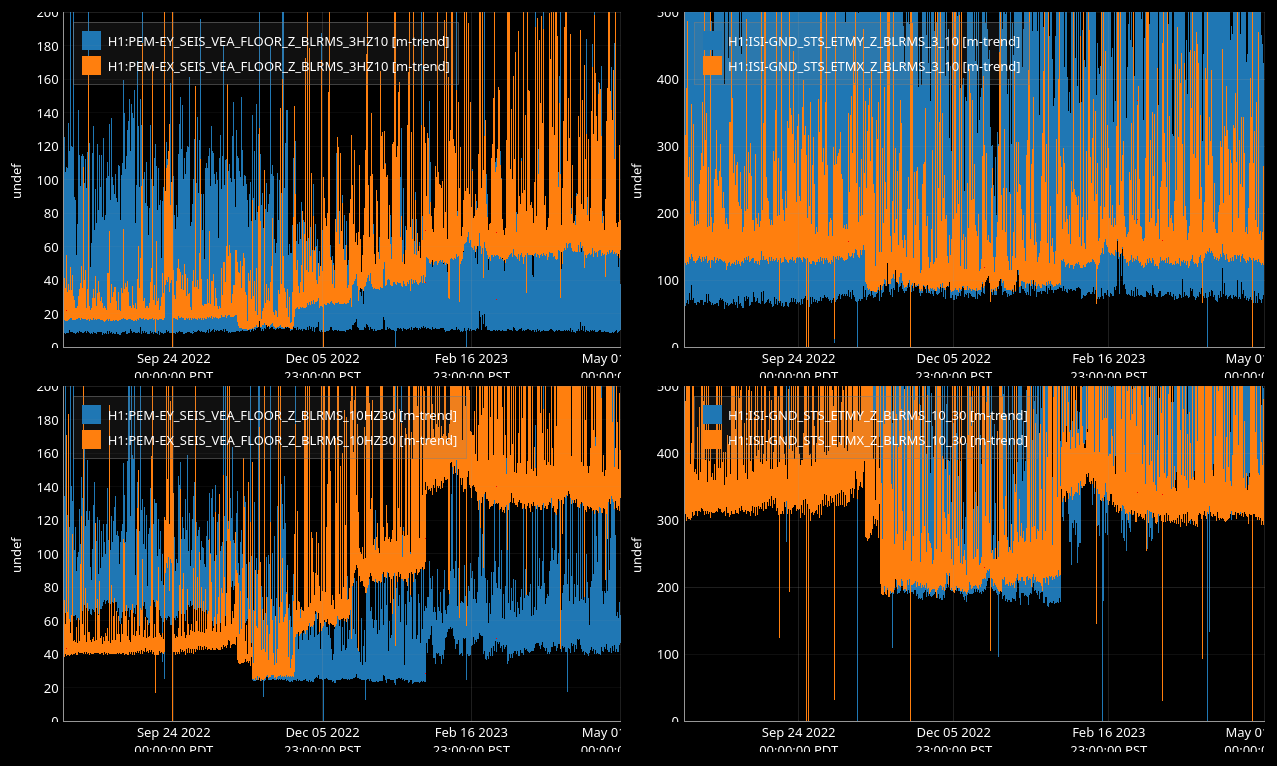
Some more clues — seems like the ground motion at EX from 3 Hz to 30 Hz experienced a step increase on January 25 and has not settled back down since then. The Güralps and STSs agree on this point, but as for what the ground motion was like in the fall of 2022 they seem to diverge.
Looking at the summary pages in fall of 2022 it seems like the bumps were intermittently present in DARM, e.g.: https://ldas-jobs.ligo-wa.caltech.edu/~detchar/summary/day/20220902/#gallery-6
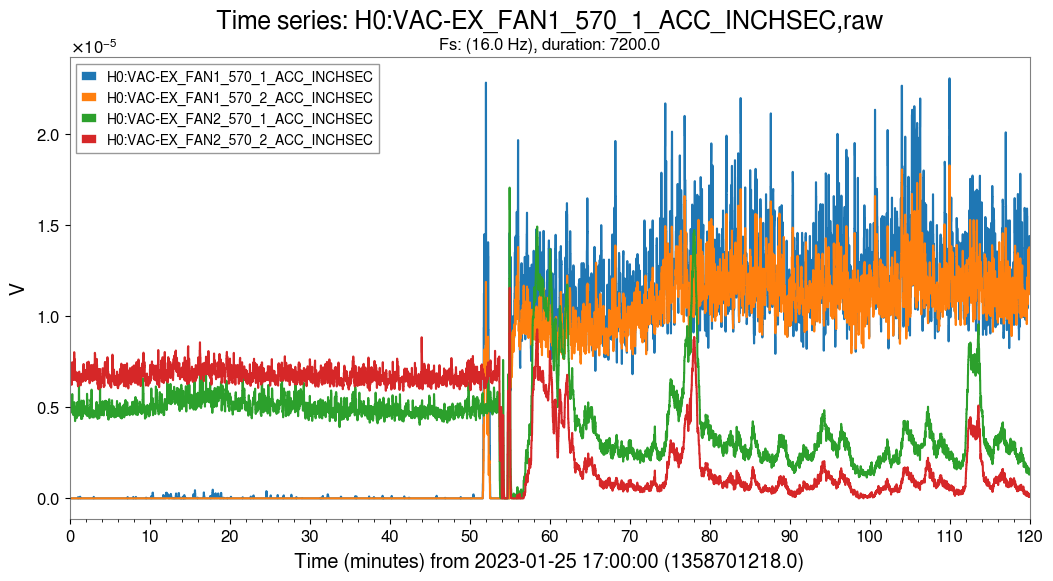
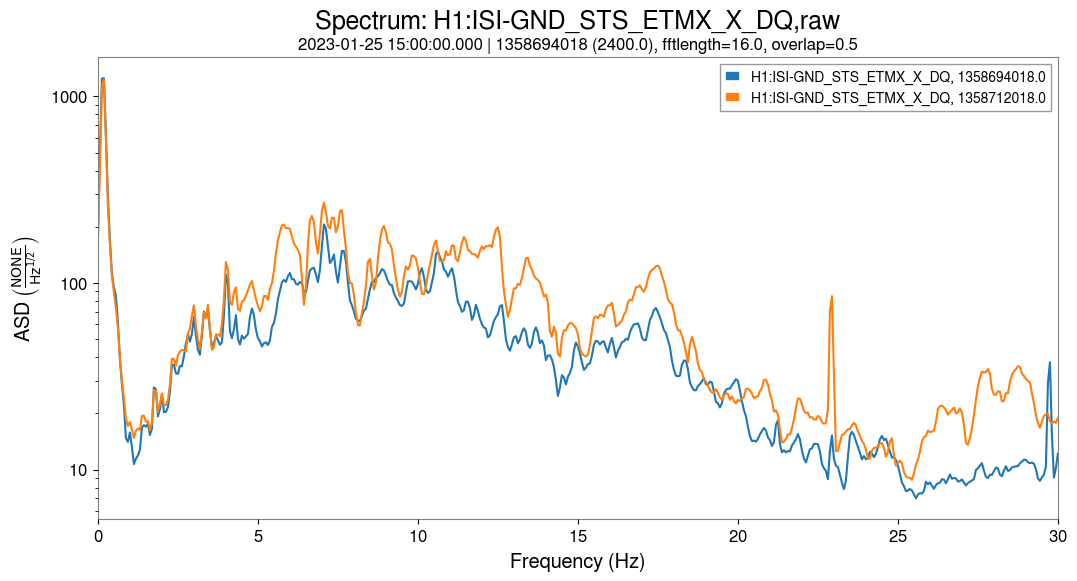
The increase in ground motion corresponds to turning on FAN1 at each of the end stations. Betsy points to alog 67055 indicating this work, and the change can be seen on the fan vibrometers (first attached plot). There is a peak at 22.5 Hz that pops up, and a broad increase in noise which includes the 4 Hz region, though not so strongly (attachment 2).
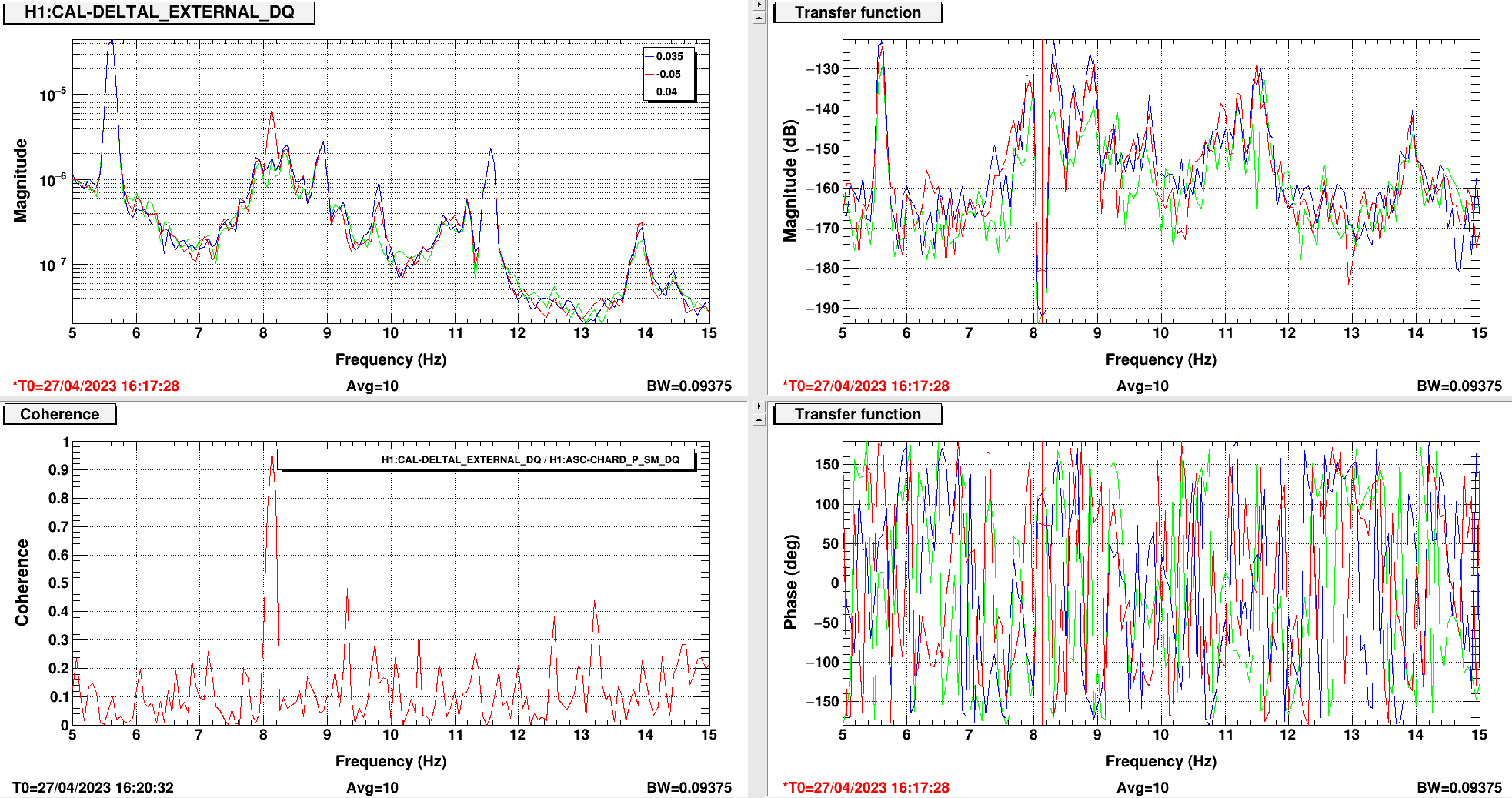
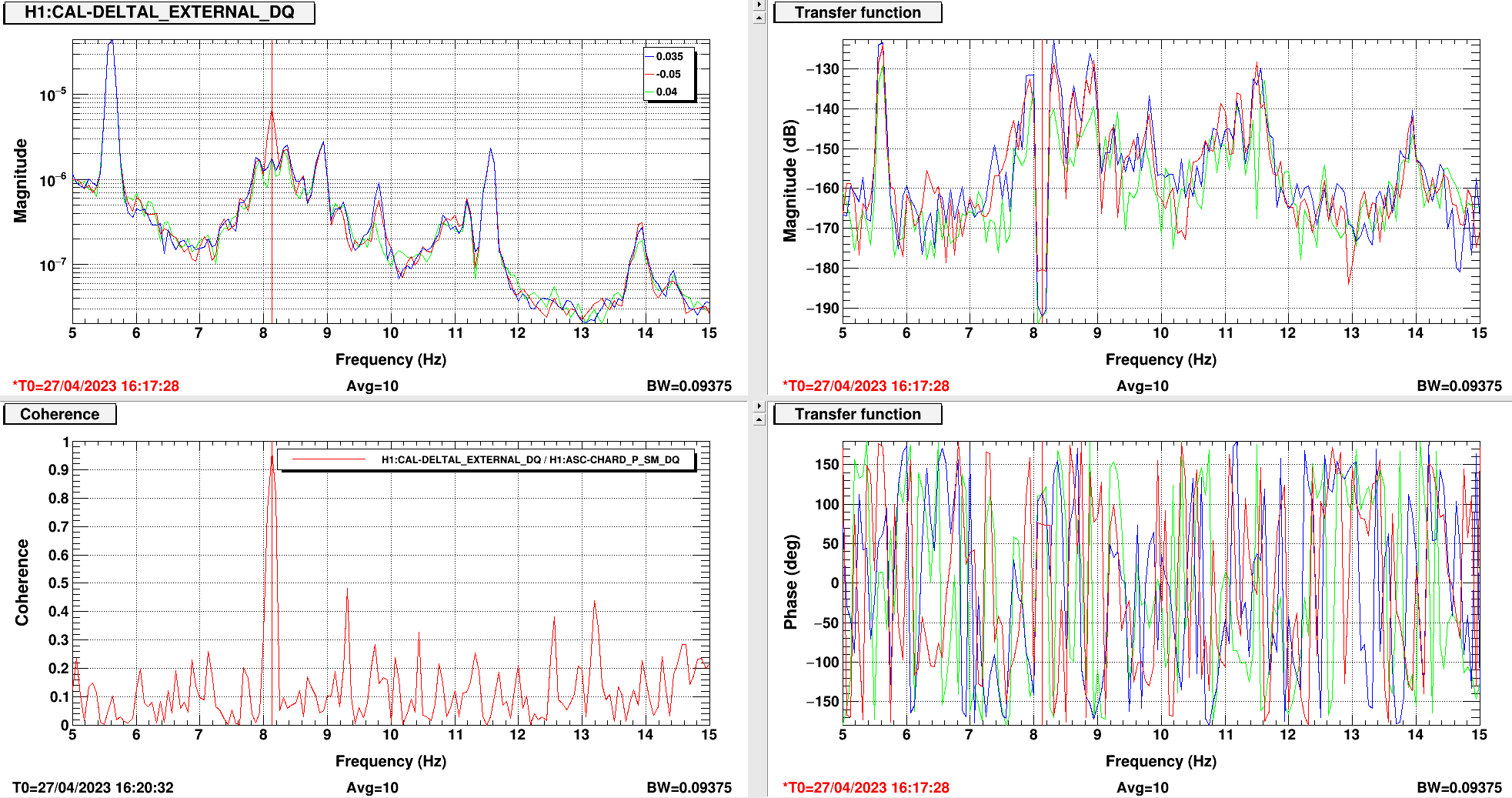
Retuned ITMY angle to length gains, looking at reducing the coupling of CHARD pitch and yaw lines at 8.125 Hz.
Old settings:
P2L = -0.05
Y2L = -1.7
New settings:
P2L = 0.04
Y2L = -0.17
Coupling from CHARD_P to DARM is reduced by 12 db
Coupling from CHRAD_Y to DARM is reduced by 35 db
In case people are trying to mark changes to the IFO relative to this change, the updated A2L gains in this alog only held for the lock they were changed in. They were not put in the guardian for weeks after. This error was recently fixed, see alog 69557.