Displaying reports 20361-20380 of 87739.Go to page Start 1015 1016 1017 1018 1019 1020 1021 1022 1023 End
Reports until 16:55, Monday 08 May 2023
H1 CAL
jameson.rollins@LIGO.ORG - posted 16:55, Monday 08 May 2023 (69421)
offline vs. online issues with H1:GDS-CALIB_STRAIN data over the weekend

At some point either last friday or over the weekend we started to see some very strange behavior in the H1:GDS-CALIB_STRAIN_NOLINES channel in the low-latency frames.  It manifested as what appeared to be a large DC offset in the channel, and polution of the spectrum at higher frequencies.  The problem was not seen in the data on disk, and only in the data in the low-latency frames.  Due to a quirk in the DMT systems, the low-latency hoft frames and the to-disk hoft frames are created by different DMT machines, running their own gstlal-calibration processes. It appears that the calibration process on h1dmt1 which writes out the low-latency hoft frame somehow got into a bad state.  The issue was resolved by restarting the gstlal-calibration processes on the two DMT machiens (h1dmt1 and h1dmt2).  It's unclear why this happened, the calibration group is looking into it.
H1 ISC
elenna.capote@LIGO.ORG - posted 16:47, Monday 08 May 2023 (69420)
Changed soft loop gains (again)

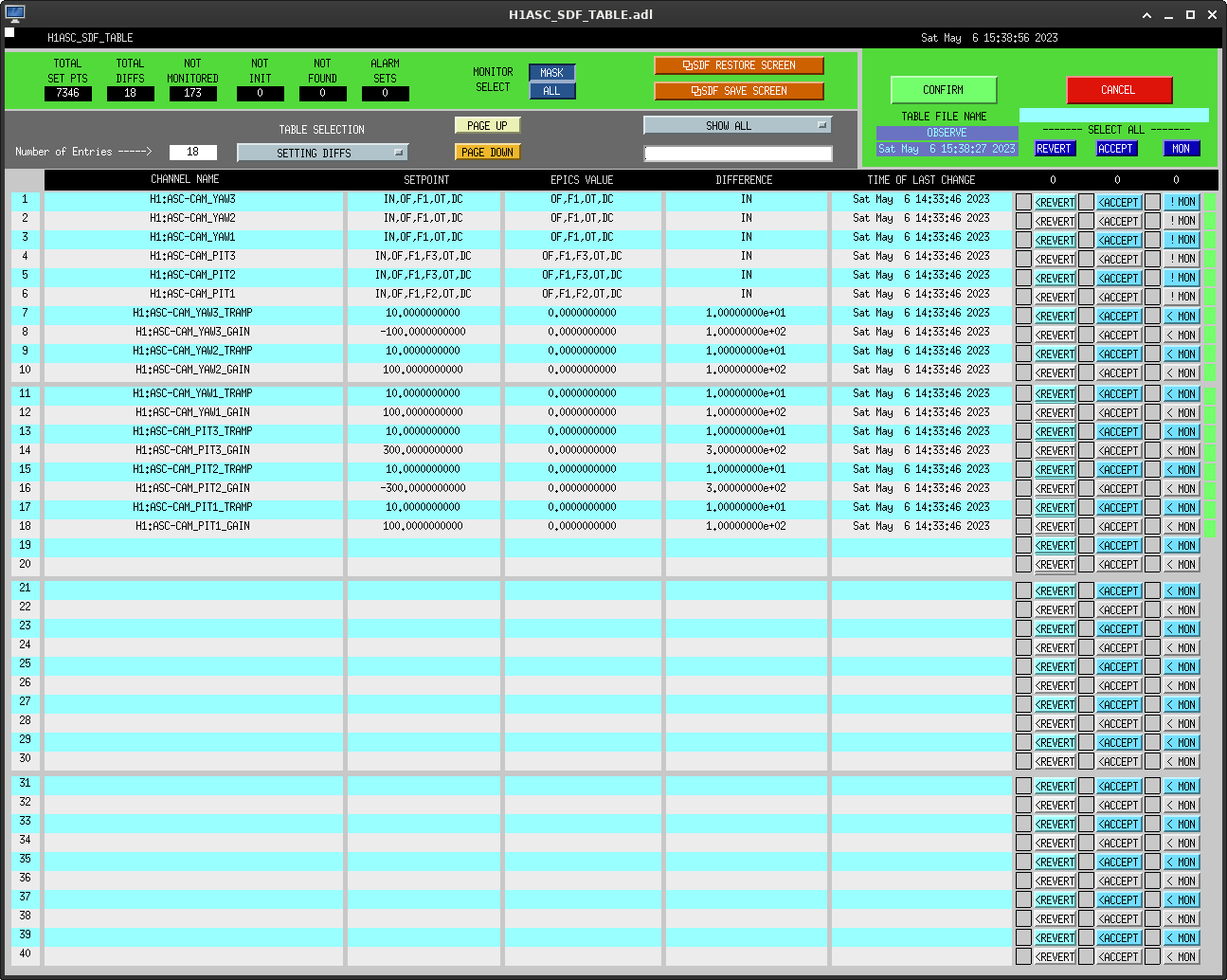
We narrowly avoided disaster today when CSOFT P again rung up at 0.45 Hz. I was able to drop the gain and save the lock. This was in the midst of many SRCL offset changes and measurements. Once we settle on a SRCL offset, I will take another sensing matrix measurement and check if the input matrix needs updating again. I have updated the soft loop gains in the guardian again.

When we get back to NLN, there will be SDFs that need to be accepted in the ASC model.

H1 General
anthony.sanchez@LIGO.ORG - posted 16:20, Monday 08 May 2023 (69419)
Monday Eve OPS Shift Start

TITLE: 05/08 Eve Shift: 23:00-07:00 UTC (16:00-00:00 PST), all times posted in UTC
STATE of H1: Commissioning
CURRENT ENVIRONMENT:
    SEI_ENV state: CALM
    Wind: 12mph Gusts, 10mph 5min avg
    Primary useism: 0.03 μm/s
    Secondary useism: 0.09 μm/s
QUICK SUMMARY:
IFO Has been locked for 25:05.
ISC LOCK STATE : NLN_CAL_MEAS
Currently some SQZ and SRCL measurements are being done and the IFO is in commissioning mode.
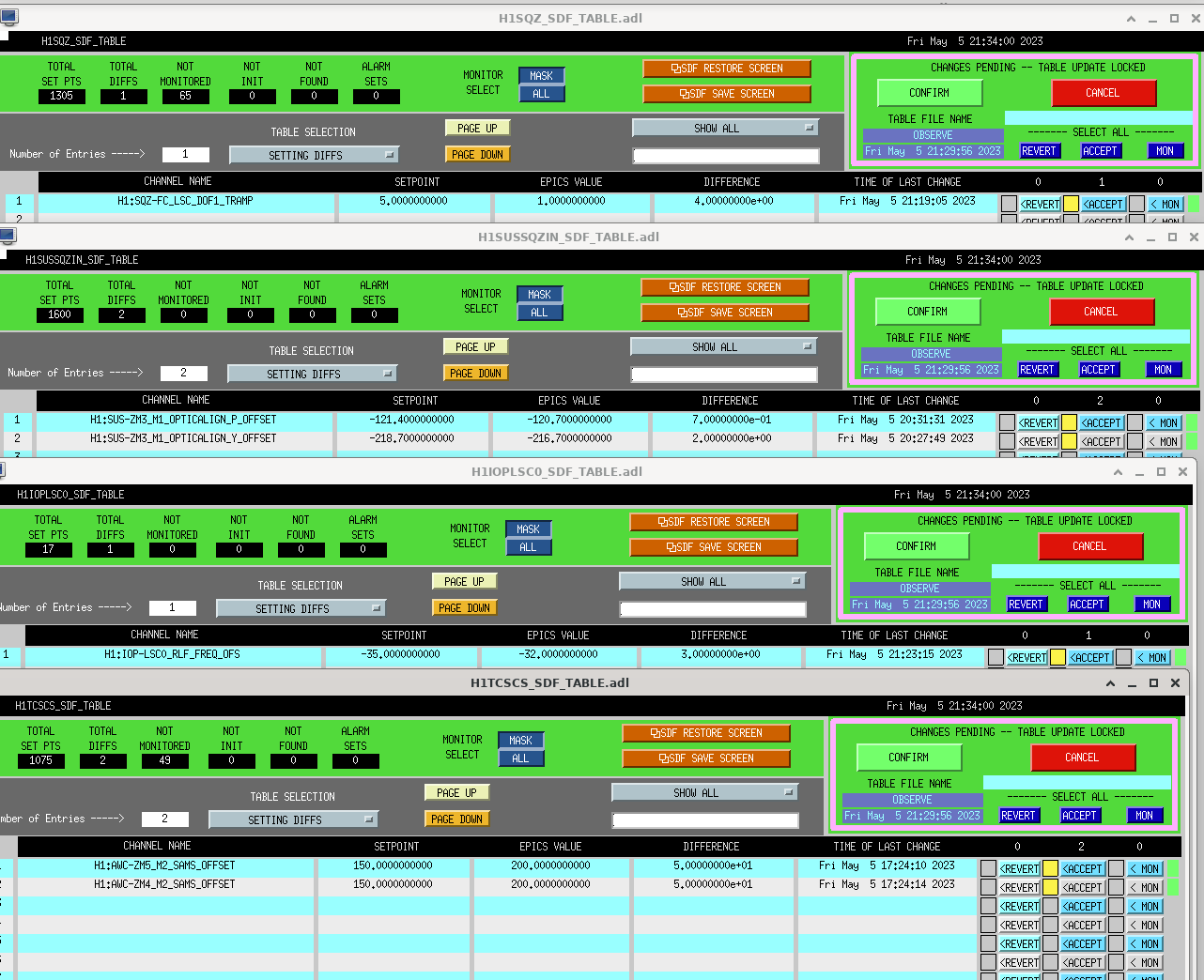
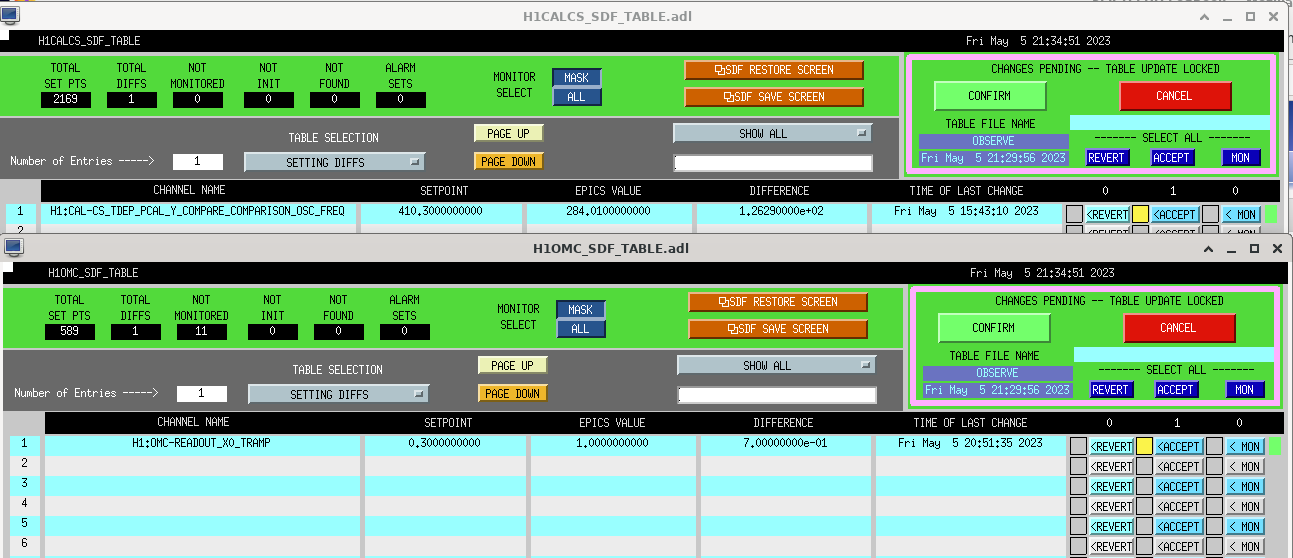
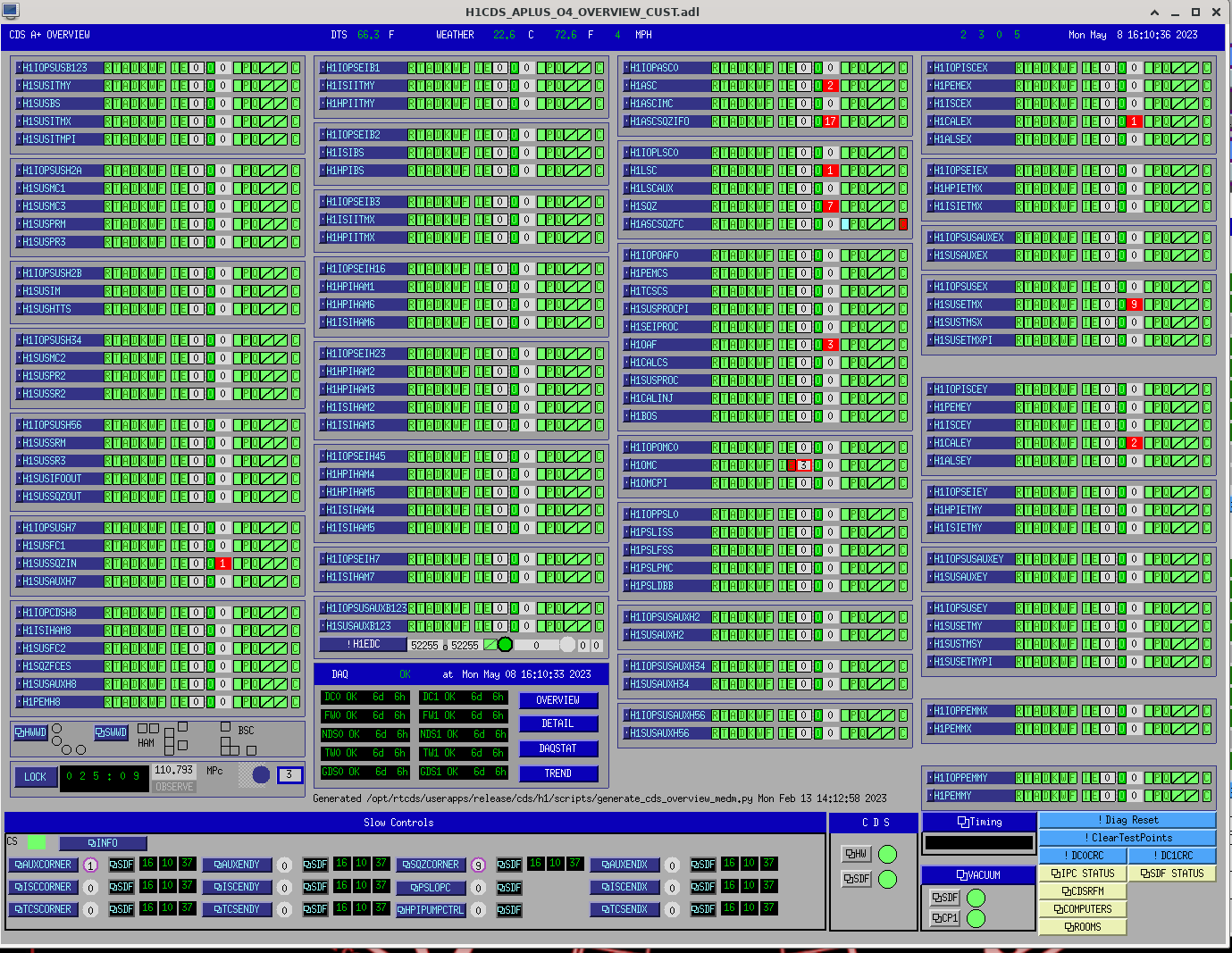
CDS Overview has some red bits on it denoting SDF Diffs. Pic of CDS overview included.

Images attached to this report
H1 General
austin.jennings@LIGO.ORG - posted 16:01, Monday 08 May 2023 (69393)
Monday Operator Summary

TITLE: 05/08 Day Shift: 15:00-23:00 UTC (08:00-16:00 PST), all times posted in UTC
STATE of H1: Observing at 136Mpc
SHIFT SUMMARY:

Main Notes:

- IFO has been locked for ~25 hours! Range is 112 Mpc

- SQZ and SCRL measurements are currently ongoing

Lock #1:

LOG:

Start Time System Name Location Lazer_Haz Task Time End
15:00 FAC Chris/Randy/Mitch EY N Wind fence work 21:53
15:40 FAC Kim Optics Lab/MY/MX N Tech clean 17:20
15:51 PEM RyanS/Fil EX/EY Elec Bay N Plug in cables 16:44
16:02 SQZ Camilla CR N No sqz tests 16:32
16:39 CAL Austin/Jeff CR N Calibration suite 18:25
17:18 PEM RyanS/Fil CER N Plug in cable 17:29
17:50 FAC Cindy/Kim FCES N Tech clean 18:12
18:13 EE Fil/Mark CER N Look at power supplies 18:23
18:27 ISC Jennie CR N SRCL detuning measurement 19:33
19:24 SEI Jim Remote N Changing filters while we are not observing, will have sdf diffs 19:35
19:59 SQZ Naoki CR N SQZ measurements 00:16
20:37 HWS Camilla CR N HWS channel changes 21:48
20:41 CAL Elenna CR N DARM offset change for test 20:47
21:08 ISC Jennie/Jeff/Louis CR N SRCL measurement ??
21:25 EE Mark CER N Check power supply ??
21:35 EE RyanS/Fil CER N Check cables ??
H1 PEM (PEM)
adrian.helmling-cornell@LIGO.ORG - posted 14:17, Monday 08 May 2023 (69411)
No Crosstalk Performance Differences in CS CER PEM Accelerometer Chassis

Adrian, Marc

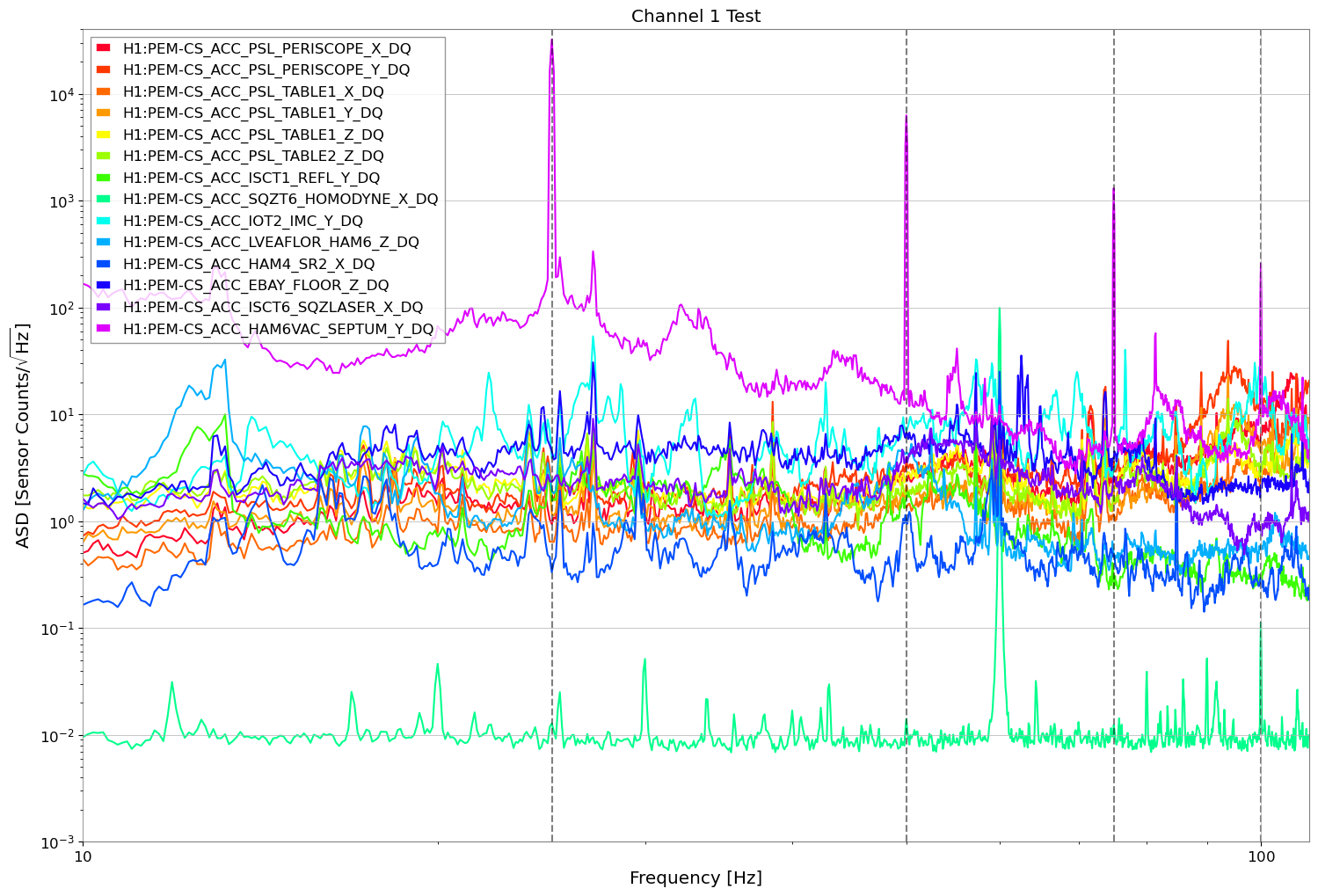
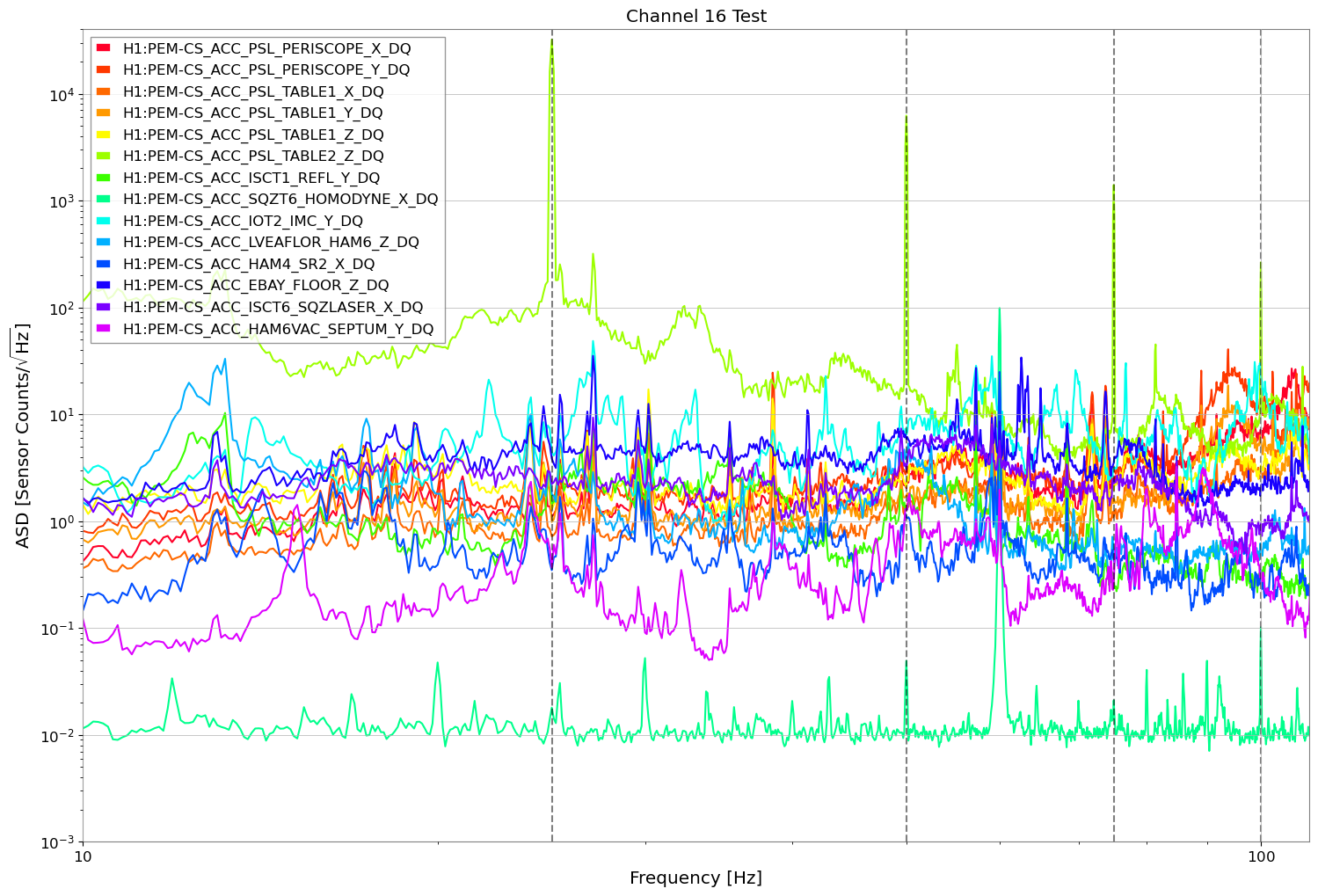
Last week we looked for evidence of crosstalk between PEM accelerometer channels in the PEM rack at the CS CER. We compared the crosstalk performance of channels which use an inductor versus a resistor by shaking a temporary accelerometer plugged into a permanent PEM channel at 25 Hz with a damped speaker. We find that there is no difference between the two configurations - the ratio of counts in the unexcited channels (i.e. possibly from crosstalk) to counts in the excited channel at 25, 50, 75 and 100 Hz range from O(1E-5) to O(1E-2). Attached are plots of ASDs of the CS accelerometers we tested during the tests as well as a file with the list of ASD ratios. The test were 5 minutes apiece, but the times given below used in our analysis are a little shorter - we want to build in some buffer time for us moving around after setting a test up.


Channel 1 Test Details:

Excited Channel: H1:PEM-CS_ACC_HAM6VAC_SEPTUM_Y_DQ

Start: 1367347574 (May 5, 2023 18:45:56 UTC)

End: 1367347744 (May 5, 2023 18:49:56 UTC)

Channel 16 Test Details:

Excited Channel: H1:PEM-CS_ACC_PSL_TABLE2_Z_DQ

Start: 1367347851 (May 5, 2023 18:50:33 UTC)

End: 1367348041 (May 5, 2023 18:50:56 UTC)

Images attached to this report
Non-image files attached to this report
H1 CAL (CAL, DetChar, ISC, OpsInfo)
jeffrey.kissel@LIGO.ORG - posted 12:55, Monday 08 May 2023 - last comment - 13:17, Monday 08 May 2023(69413)
CAL_AWG_LINES Test Point Kill left Thermalization Lines OFF This Weekend
J. Kissel

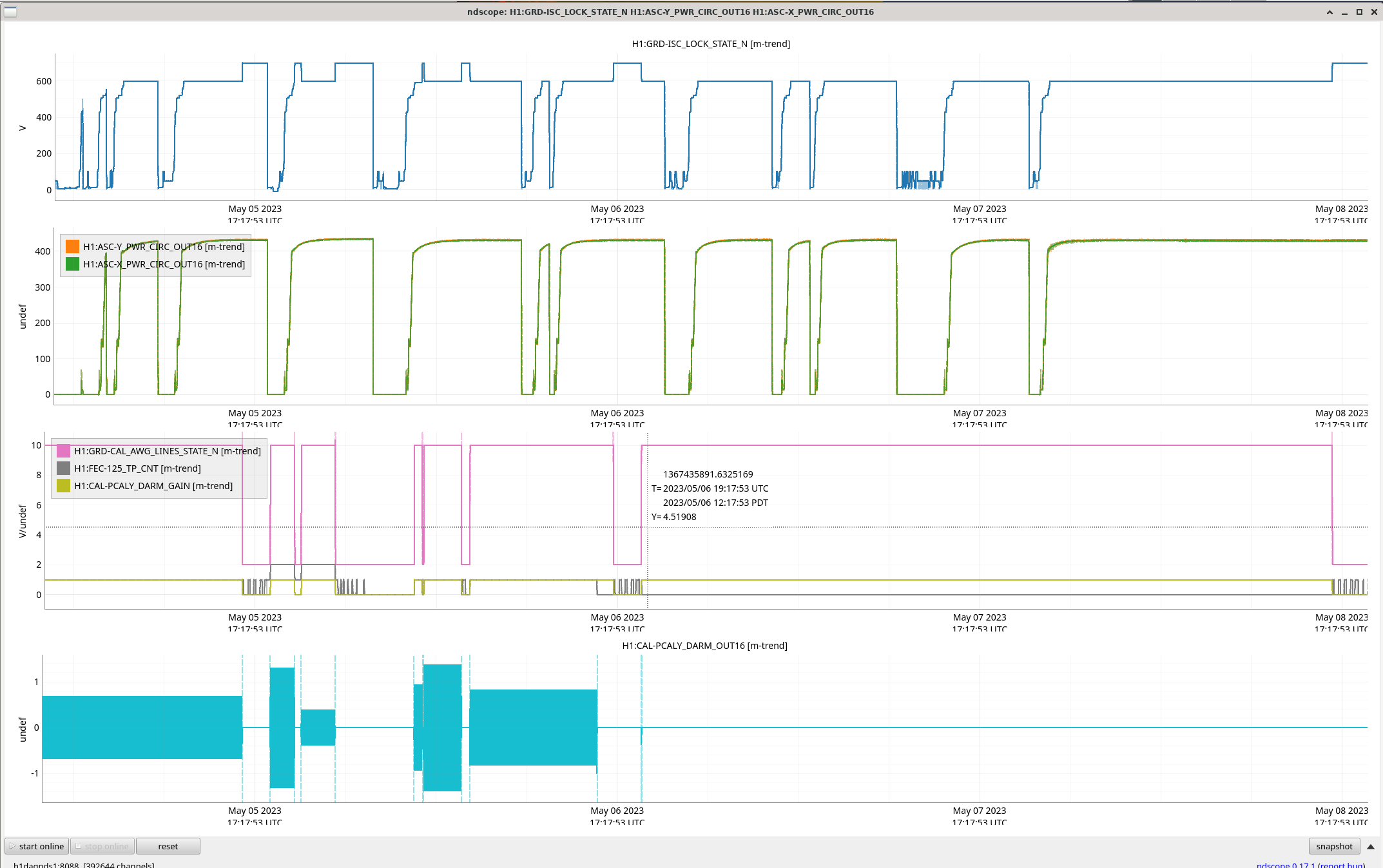
In hopes that we would have a few thermalization periods measured over the weekend in our new SRCL offset at -265 (LHO:69359) and our new DARM offset set such that there's 40 mA total of photocurrent on the DCPDs (H1:OMC-READOUT_X0_OFFSET ~= 9.7, see LHO:69358), I went to run Evan's thermalization script (LHO:69301) ... but came up with noise only for the PCALY 8.925, 11.575, 15.275, 24.5 Hz lines driven by CAL_AWG_LINES. 

Sadly, it looks like the PCAL model's test points (FEC DCUID 125) were cleared on 2023-05-06 15:57 UTC, or (Saturday morning at 08:57 PDT), and they've not been restored. I think this might have resulted in some confusion regarding instructions on how to run calibration measurements headlessly, in that the test points were cleared even though the headless measurement succeeded normally without the IFO losing lock. (LHO:69396).
 
I've edited the wiki page instructions to be more clear.

I'll get lines restarted ASAP so we can catch the next lock acquisition.
Images attached to this report
Comments related to this report
jeffrey.kissel@LIGO.ORG - 13:17, Monday 08 May 2023 (69416)CAL, CDS, DetChar, OpsInfo
The cycle of the ISC_LOCK guardian from NOMINAL_LOW_NOISE to NLN_CAL_MEAS, then from NLN_CAL_MEAS back to NOMINAL_LOW_NOISE after the successful completion of this morning's calibration suite, LHO:69396 restored the these CAL_AWG_LINES thermalization lines, since that process requests CAL_AWG_LINES to go to LINES_OFF, then LINES_ON -- rekindling the excitation test point.
So, they're back ON as of 2023-05-08 19:34 UTC.
H1 ISC
camilla.compton@LIGO.ORG - posted 12:52, Monday 08 May 2023 (69414)
Accepted JITTER_NONSENS_COEFF sdfs

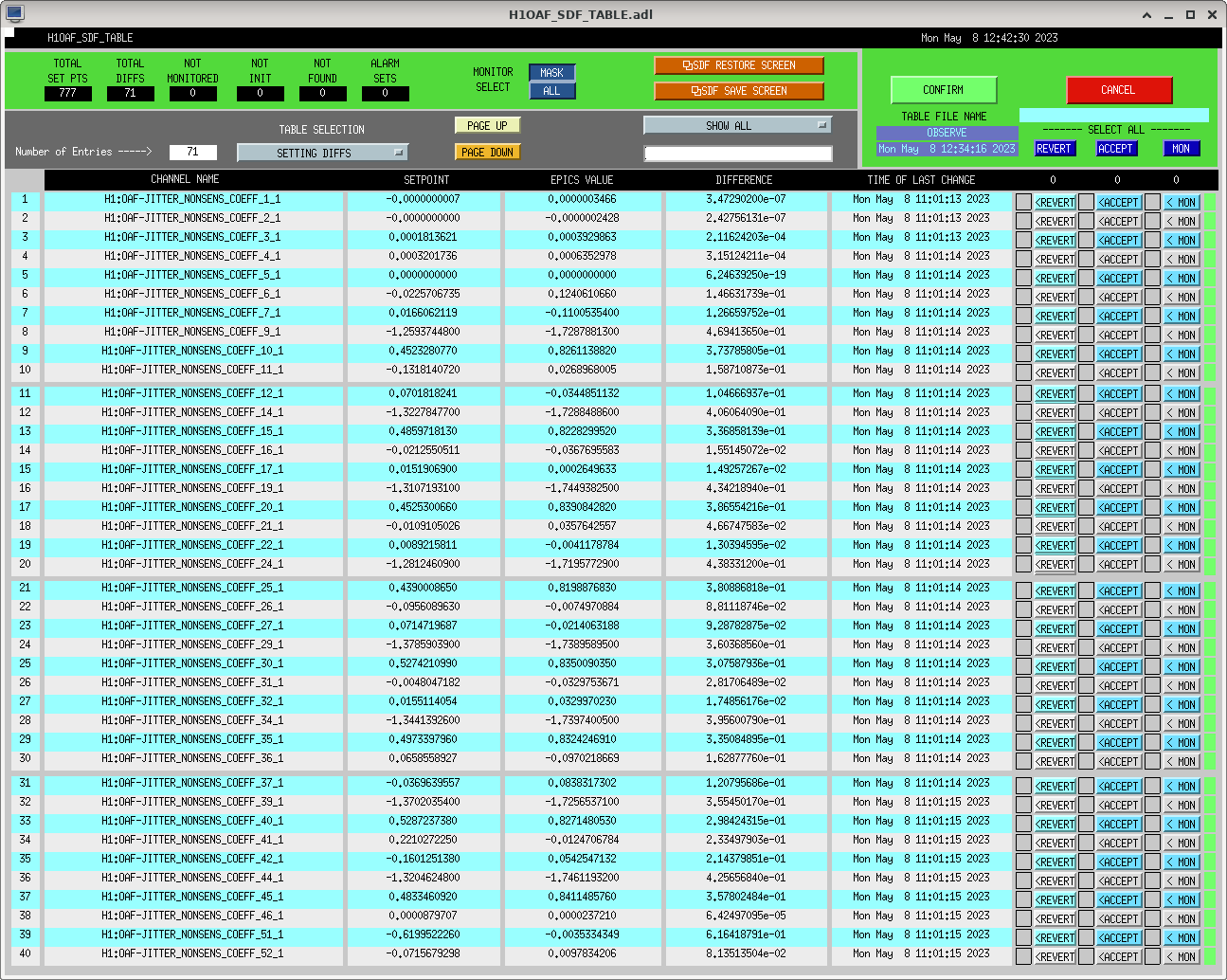
Accepted attached JITTER_NONSENS_COEFF sdfs on behalf of Jenne.

Images attached to this report
H1 SUS
camilla.compton@LIGO.ORG - posted 12:39, Monday 08 May 2023 (69412)
In-lock Charge Measurements at 5.45am if IFO Locked Tomorrow

Ryan C, Camilla.  As suggested by Ryan, we've edited the SUS_CHARGE guardian to take the In-lock Charge Measurements at 5.45am if we are locked tomorrow. This is 2 hours earlier than the nominal, during observing run, time of 7:45am to maximize our changes of getting data as we have lost lock before they started/finished the last 2 weeks. 

H1 CAL
austin.jennings@LIGO.ORG - posted 11:48, Monday 08 May 2023 - last comment - 12:30, Monday 08 May 2023(69396)
Calibration Suite taken using pydarm measure at 16:40UTC to 18:23UTC

Referencing Camilla's alog 69333, I ran a calib suite.

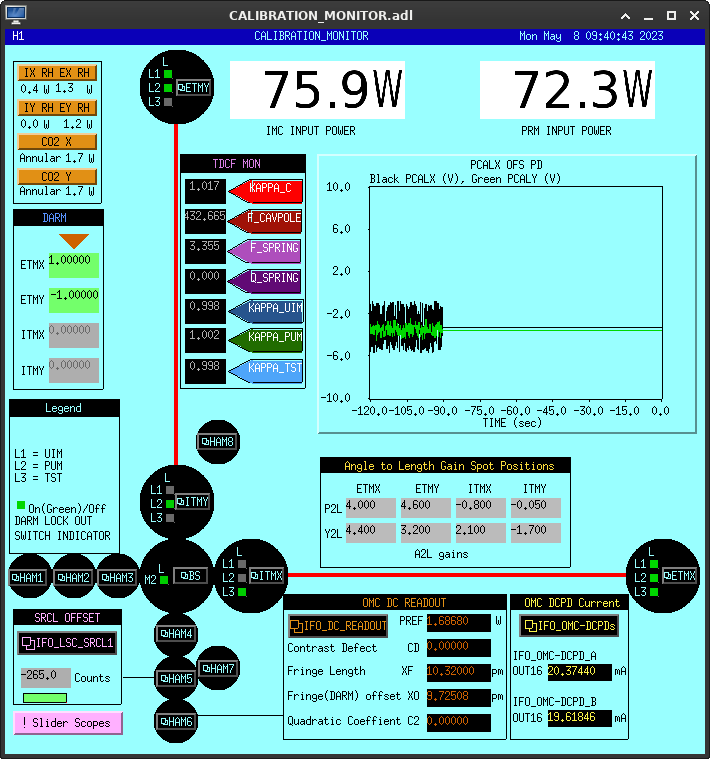
Attached is a screenshot of the sitemap > CAL CS > Calibration Monitor screen shortly after starting the measurement.

'pydarm report' command gave attached report: 

Images attached to this report
Non-image files attached to this report
Comments related to this report
camilla.compton@LIGO.ORG - 12:30, Monday 08 May 2023 (69410)

The Taking Calibration Measurements wiki has been updated with these instructions. 

H1 PSL (PEM)
ryan.short@LIGO.ORG - posted 11:29, Monday 08 May 2023 (69407)
PSL 10-Day Trends

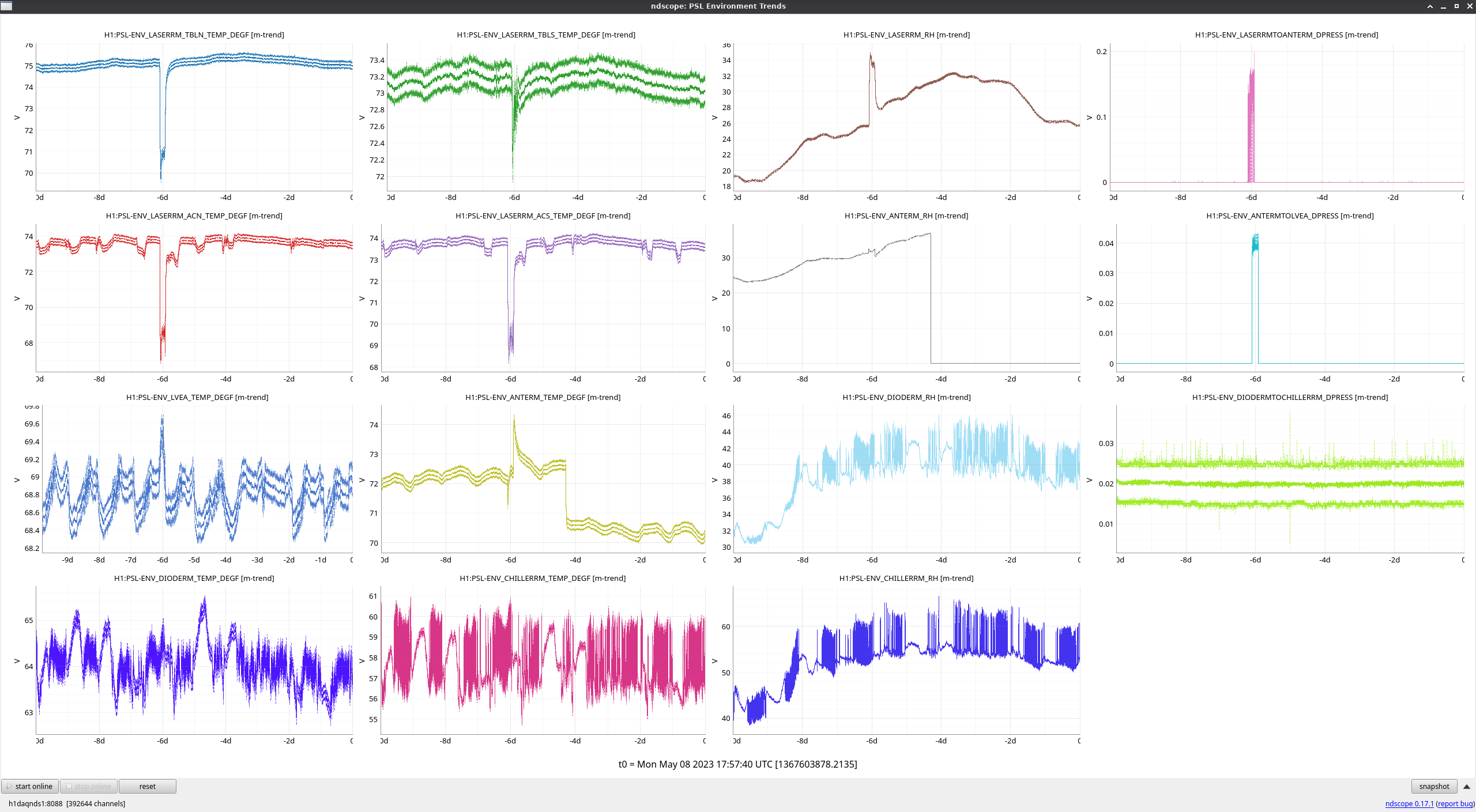
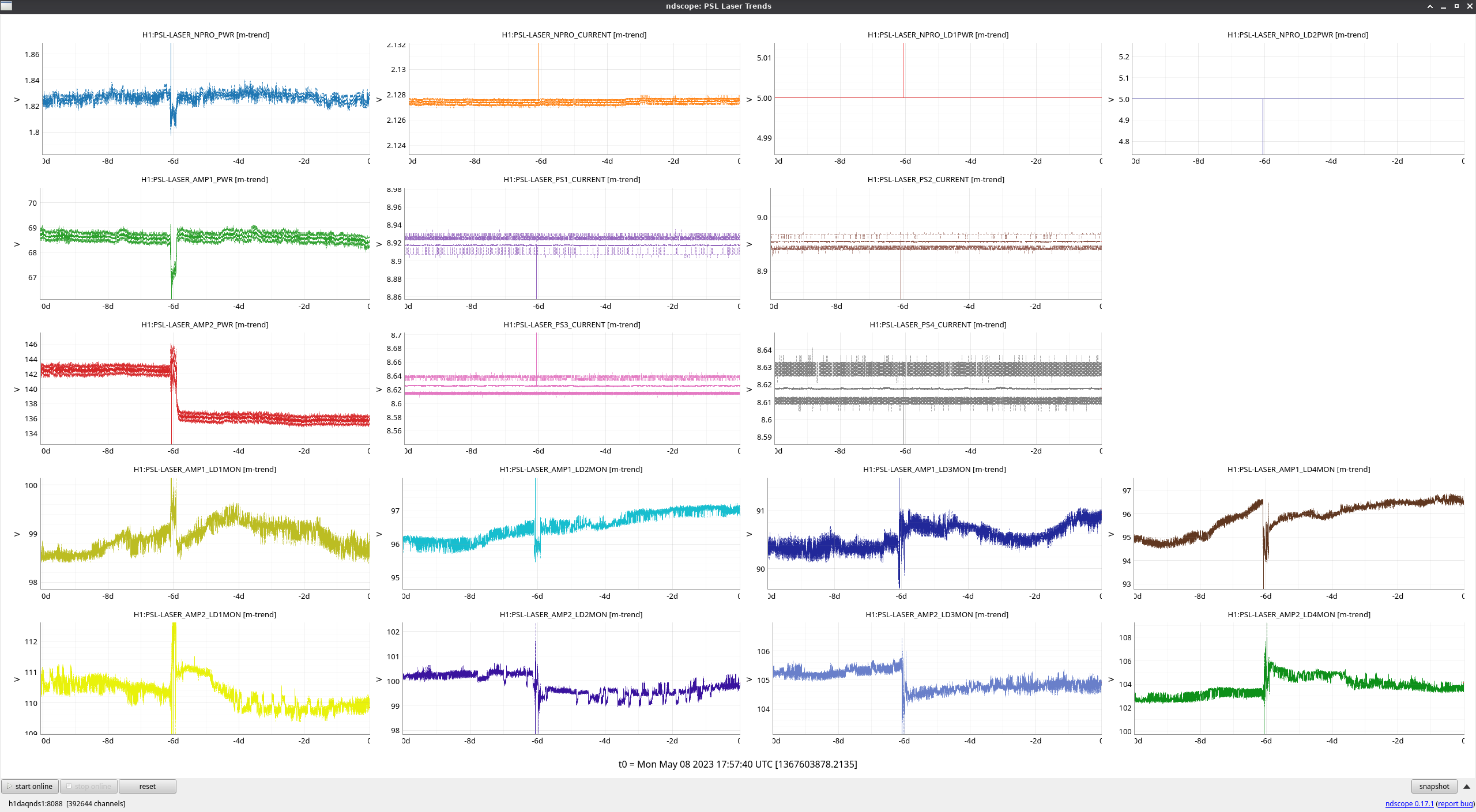
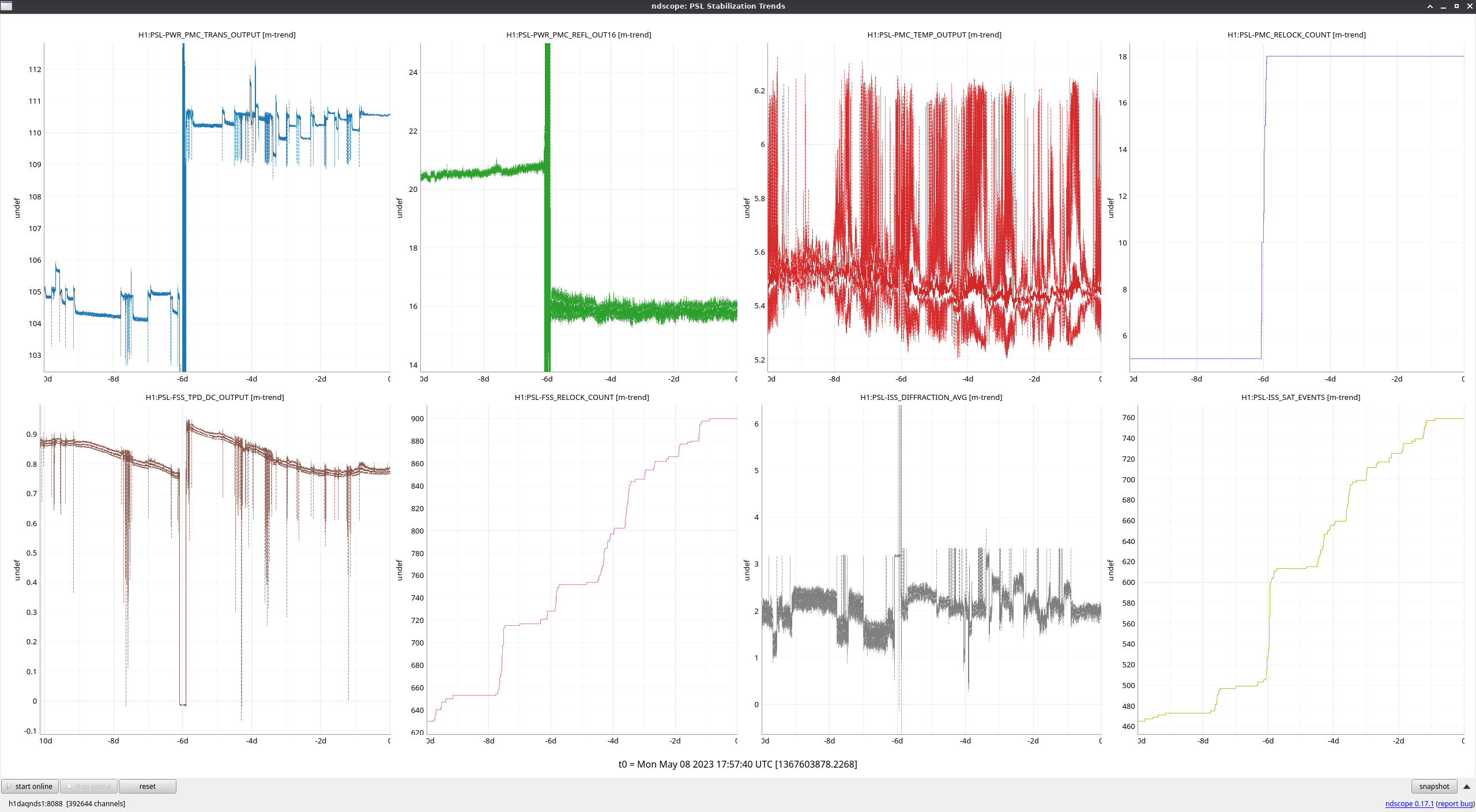
FAMIS 19975

Looks like the anteroom relative humidity sensor went dead ~4 days ago, at the same time as the temperature in there dropped by 2 degrees F (environment trends, tagging PEM).

Incursion work 6 days ago and calibration for AMP2 power update shown (see alog 69259 for full summary of work last week).

Images attached to this report
H1 SQZ
camilla.compton@LIGO.ORG - posted 09:46, Monday 08 May 2023 - last comment - 13:43, Monday 08 May 2023(69395)
30 minutes of no SQZ time this Morning

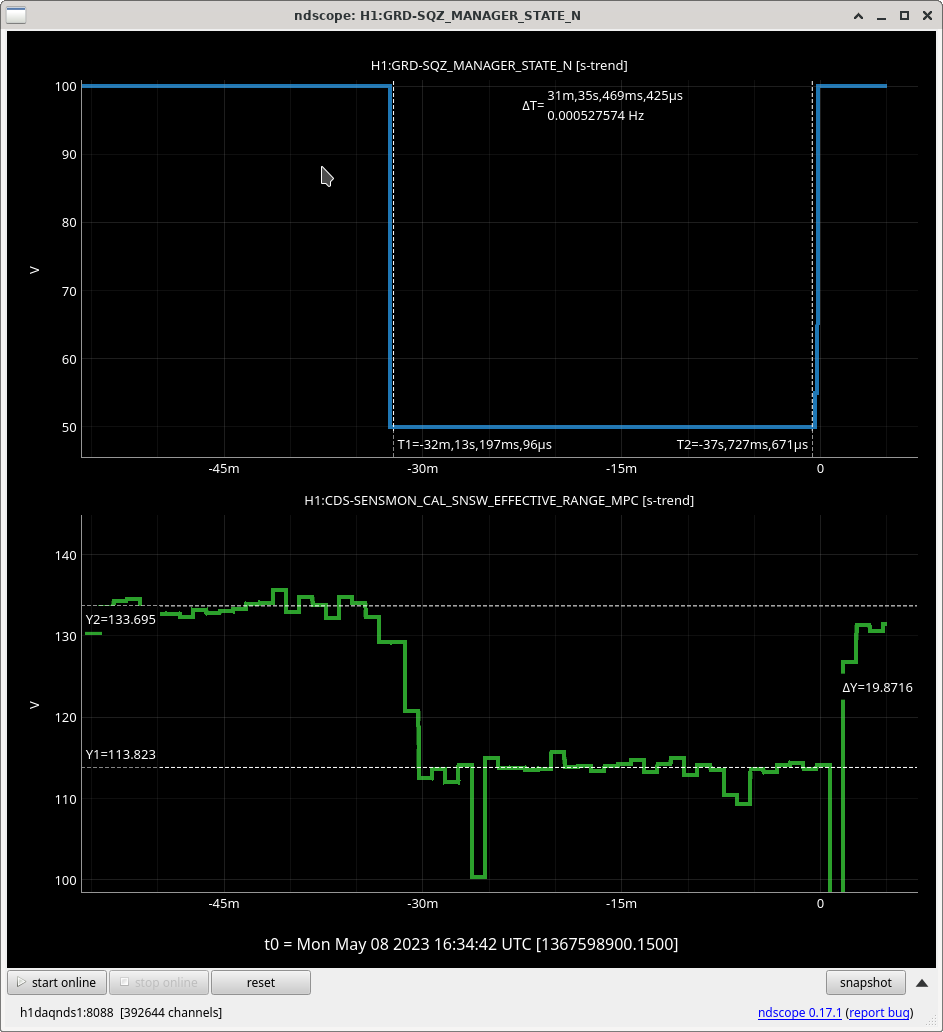
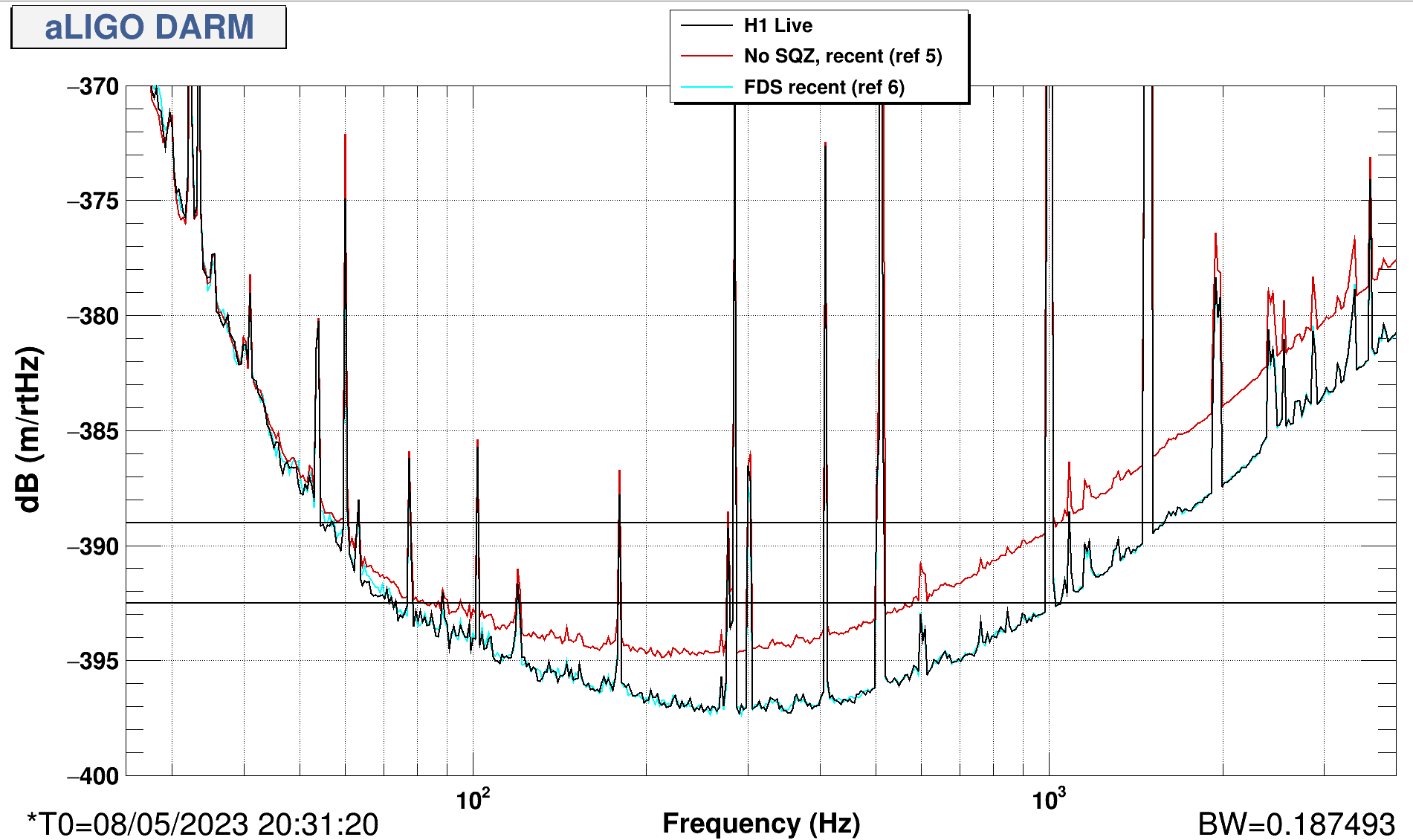
Austin and I took SQZ_MANAGER from FREQ_DEP_SQZ to SQZ_READY_IFO for 30 minutes of no-squeezing time 16:02UTC to 16:34UTC

The IFO had been locked for 18 hours. Range dropped from 133MPc down to 113MPc. Both of these range values seem lower than earlier in the week but there was a lot of changes on Friday (69365). 

Images attached to this report
Comments related to this report
victoriaa.xu@LIGO.ORG - 13:43, Monday 08 May 2023 (69417)

Just checking -- and it seems not a huge difference in squeezing levels over ~10 min with squeezer ASC's ON/OFF. Low frequency differences likely just due to noise technical noise drifts. GPS times:
FDS FC+SQZ ASC OFF (blue): 1367613320 + 10 min
FDS FC+SQZ ASC ON (black) 1367612238 + 15 min

Images attached to this comment
H1 General (SUS, VE)
austin.jennings@LIGO.ORG - posted 16:02, Saturday 06 May 2023 - last comment - 11:44, Monday 08 May 2023(69378)
Saturday Operator Summary

TITLE: 05/06 Day Shift: 15:00-23:00 UTC (08:00-16:00 PST), all times posted in UTC
STATE of H1: Commissioning at 130 Mpc
SHIFT SUMMARY:

Main Notes:

- Second ER15 candidate! @ 17:09:35

- ACQUIRE_XARM_IR during IA is still failing, and therefore I cannot run a full initial alignment

- ACQUIRE DRMI 1F has been quite cumbersome recently trying to acquire

- IFO is at OBSERVING @ NLN @23:02
Lock #1:

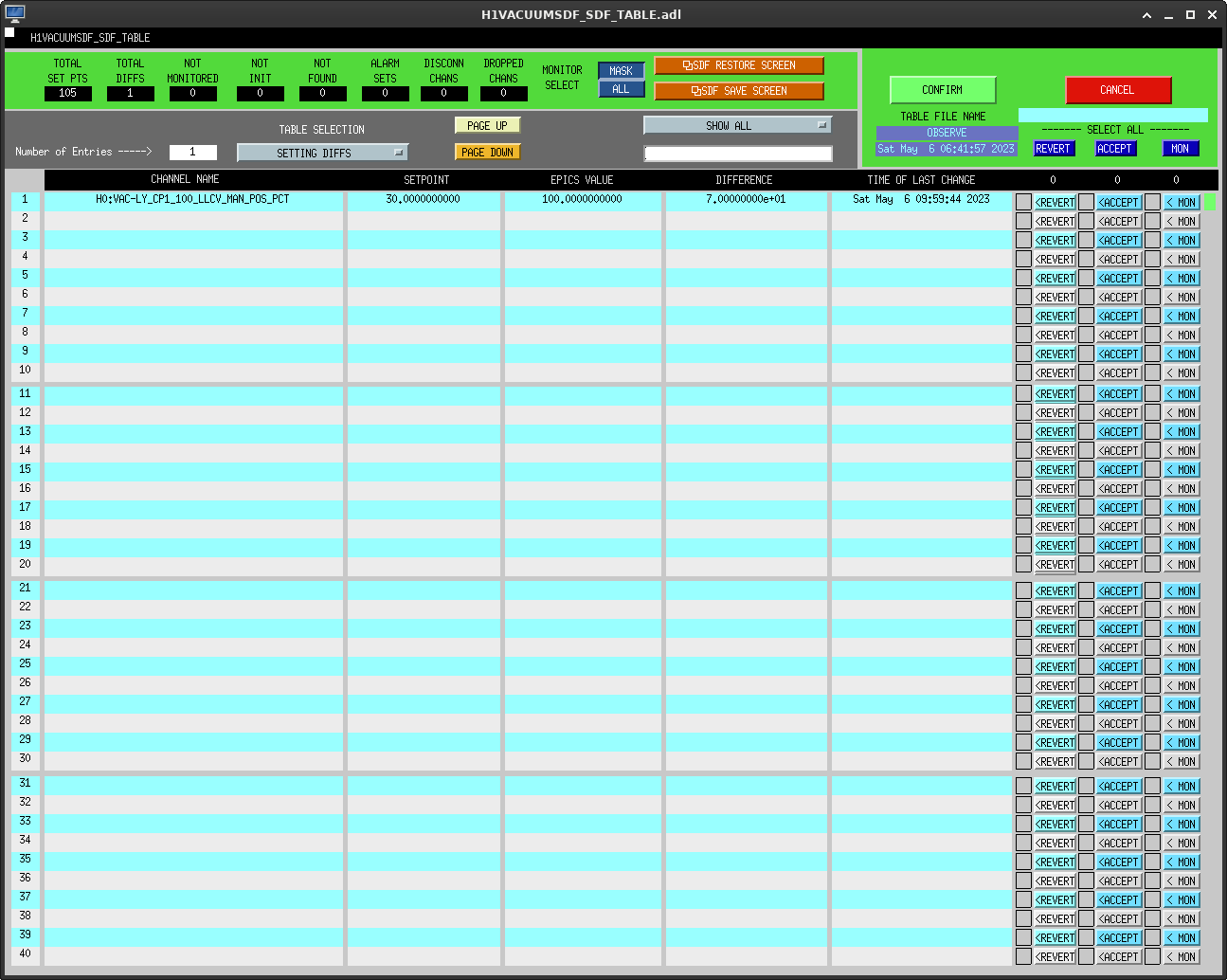
- Came in with IFO locked, switched to OBSERVING @ 14:56 UTC, out of OBSERVING @ 17:00 UTC due to difference from VAC SDF (was only temporary, but maybe this channel should be unmonitored), screenshot attached - Tagging Vac

- PI 24 ring ups at 15:26/15:37 UTC, but the SUS_PI guardian was able to damp it - no intervention needed

- Starting a calibration suite @ 17:01 UTC in NLN CAL MEAS

- EX saturation @ 18:02 UTC and again @ 20:20, huge jump in ADS signals and OMC DCPD output went off the rails - glitch?

- Back to NLN and OBSERVING @ 18:53 UTC

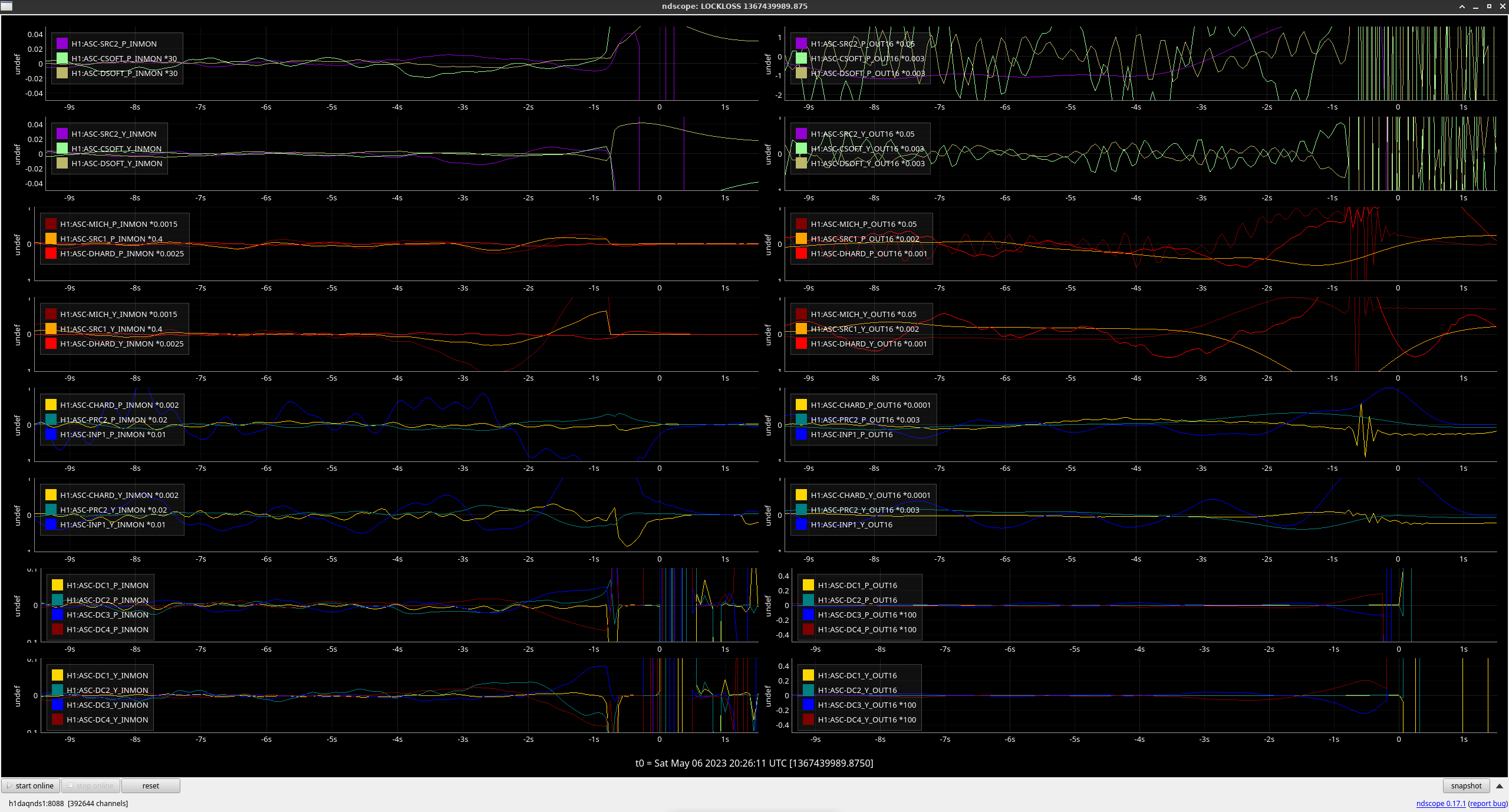
- LOCKLOSS @ 2026 UTC - this looks like an ASC ringup, potentially from SRC1/2 and/or MICH? - however ground motion looks a bit elevated so that could be a culprit as well

Lock #2:

- IMC had issues acquiring, but resetting ISC_LOCK to INIT and having it tried again worked fine

- DRMI issues 3x times trying to lock, gave up and trying an initial alignment - just like yesterday I again cannot ACQUIRE_XARM_IR. Skipping IA and trying again.

- Acquired NLN @ 22:38

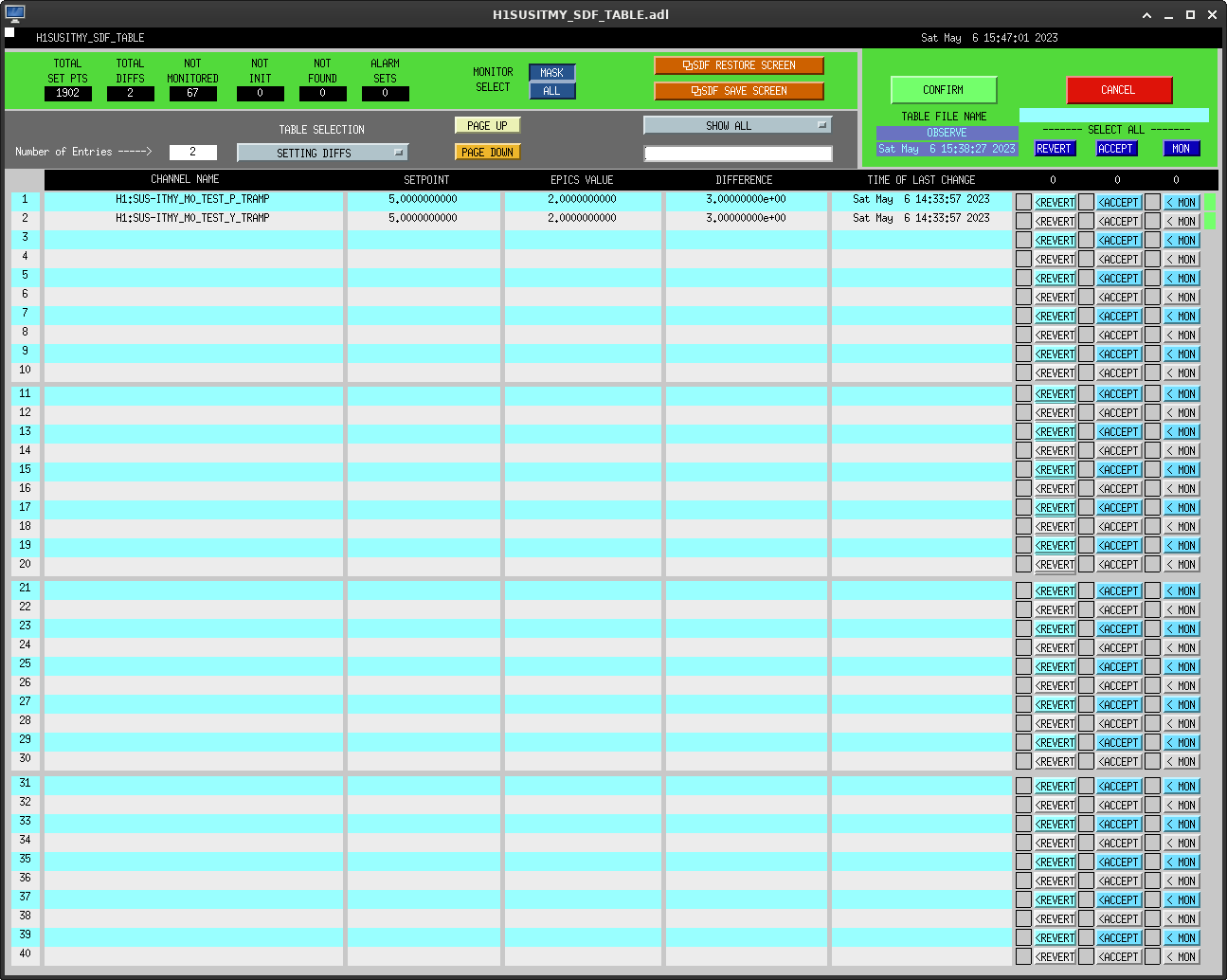
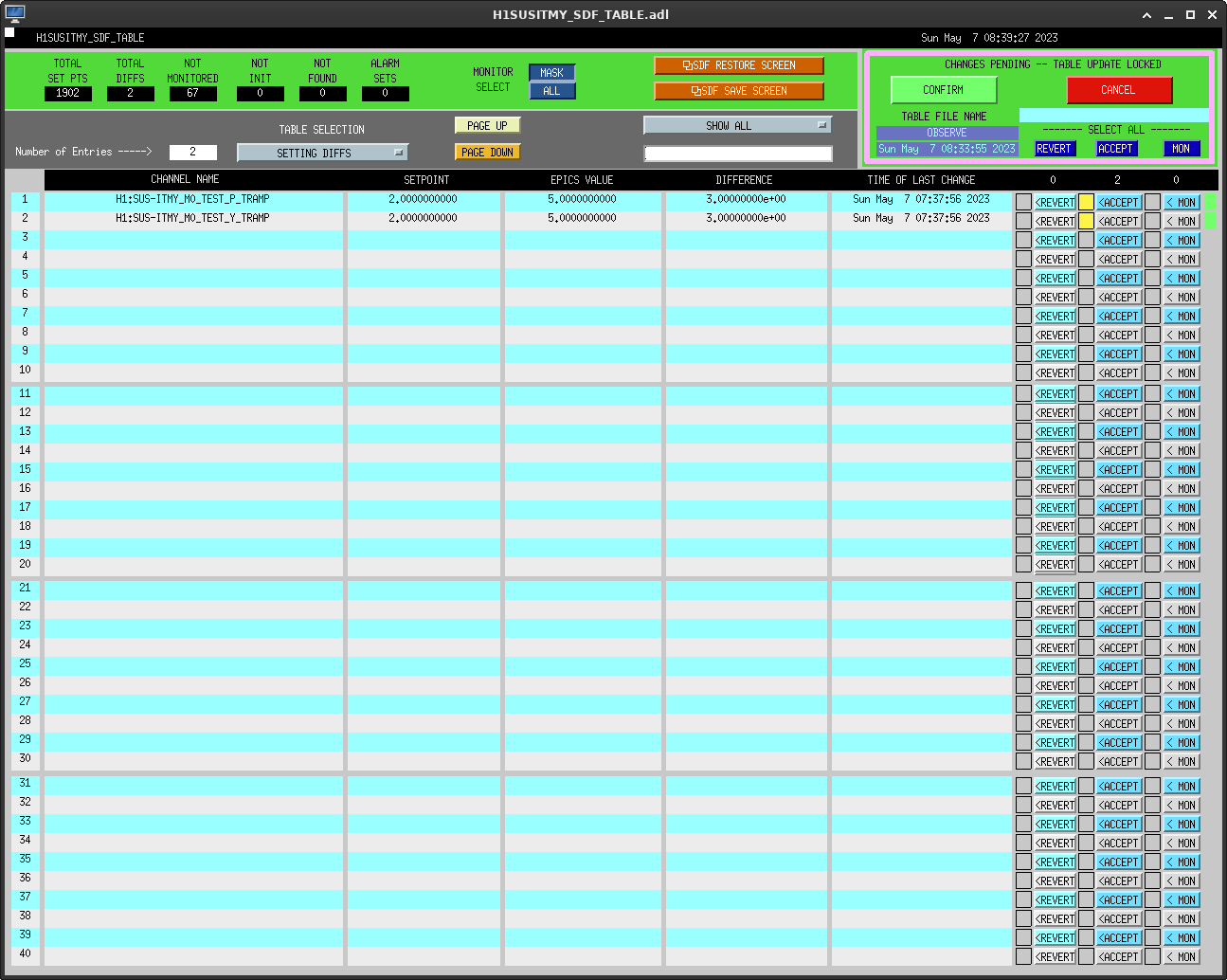
- Some OBSERVE snaps are preventing me from going to OBSERVING, SUSITMY - Screenshots attached, accepting and went into OBSERVING, Tagging SUS

LOG:

No log for this shift.

Images attached to this report
Comments related to this report
austin.jennings@LIGO.ORG - 08:40, Sunday 07 May 2023 (69389)

For ITMY diffs, the changes I accepted showed up as differences on SDF observe. Accepting them and setting them back to what they were before.

Images attached to this comment
elenna.capote@LIGO.ORG - 11:44, Monday 08 May 2023 (69408)

This doesn't appear to be an ASC instability lockloss. Looks like something kicked all the ASC signals right before lockloss- potentially the large ground motion you mention? I attached a screenshot of the DRMI signals for example.

Images attached to this comment
H1 DetChar (DetChar, ISC)
andrew.lundgren@LIGO.ORG - posted 04:49, Saturday 06 May 2023 - last comment - 11:54, Monday 08 May 2023(69376)
DCPD overflows after DARM offset change
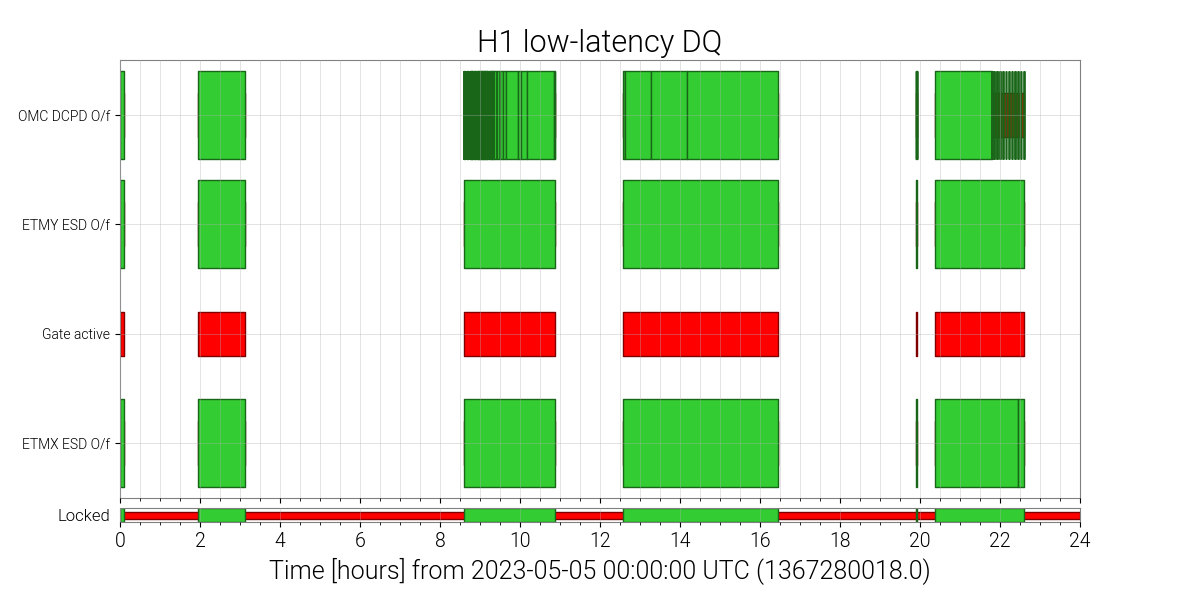
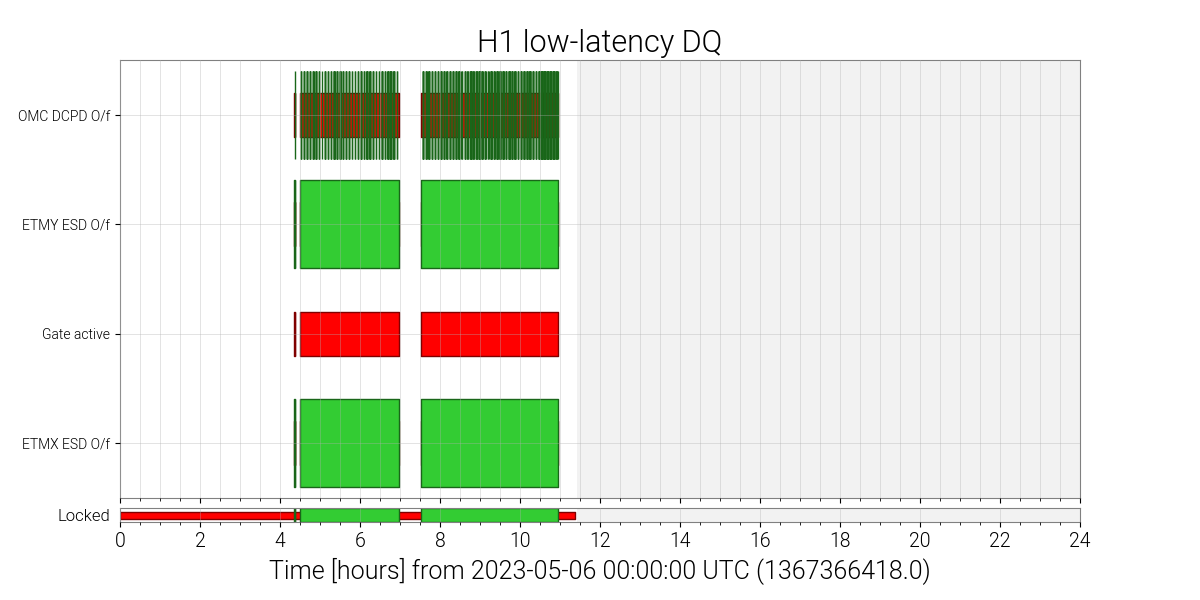
Tito Dal Canton from PyCBC reported that there are periods with many ADC overflows of the DCPD in the last few days. This is probably due to the increased DARM offset alog 69358. See attached plots of the DQ vector. There's no obvious effect on the spectrum or the glitchiness, so it must not be a severe overflow. But at least some of the searches are using this as a veto and aren't analysing the data.
Images attached to this report
Comments related to this report
daniel.sigg@LIGO.ORG - 12:47, Saturday 06 May 2023 (69382)

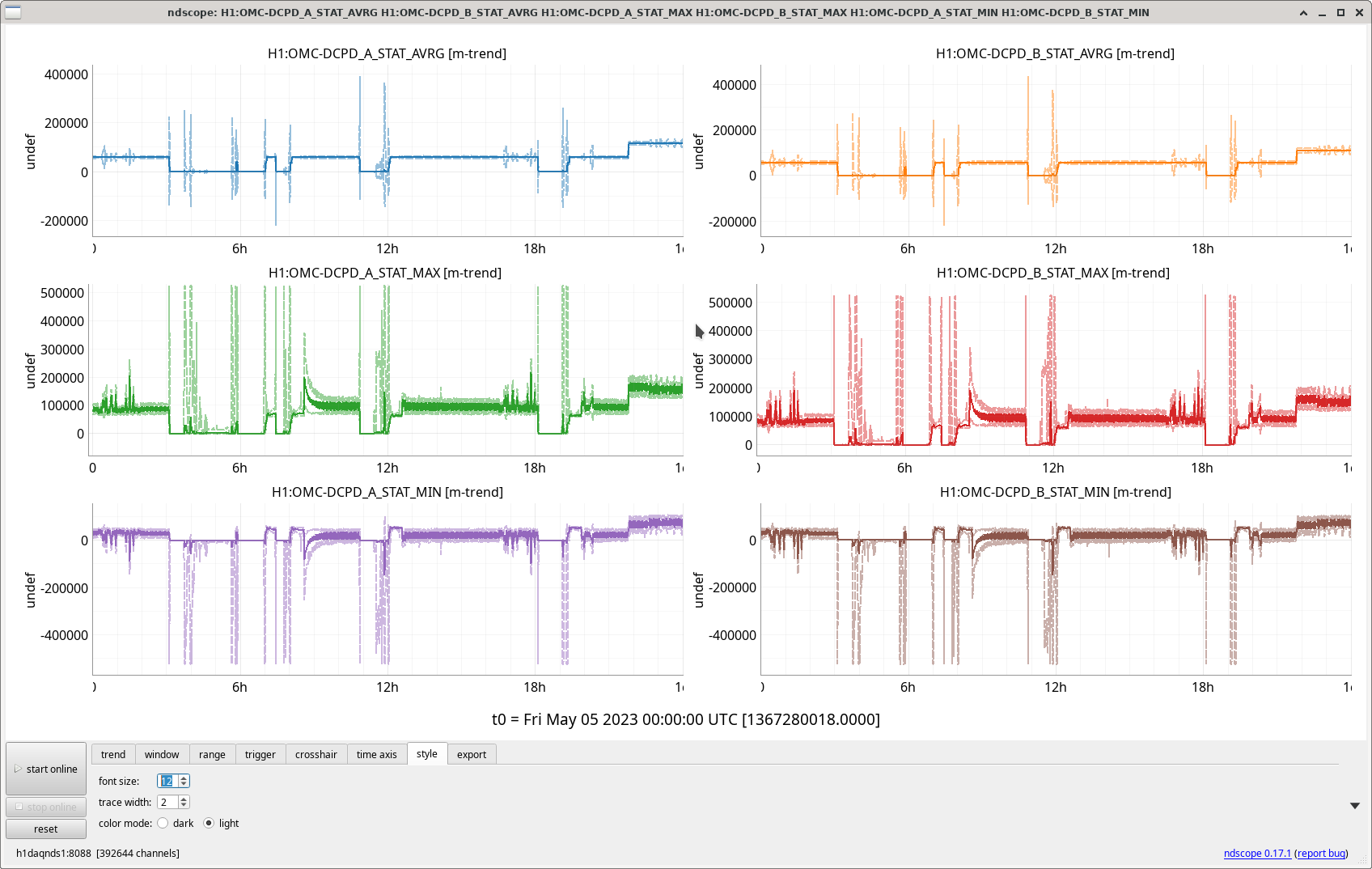
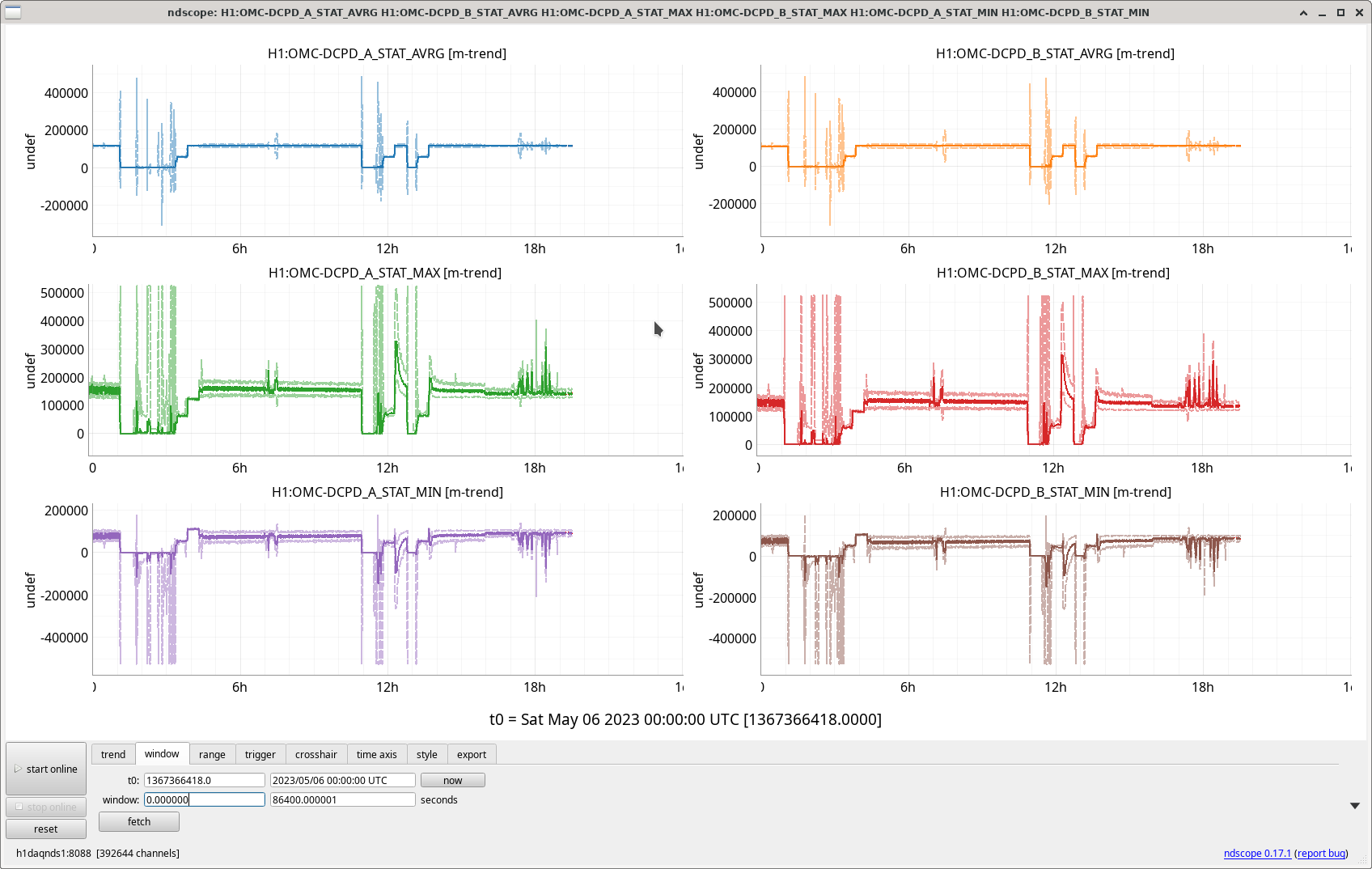
What is this triggered on? The attached plots show the DCPD min/max monitors for the same time. There are saturation events at the beginning (violin modes) and at the end of locks (lock loss), or during lock attempts, there are no saturations visible once the instruments have stabilized. One can also see some larger values during the most recent lock, which are still below saturation and which might be violin modes or parametric instabilities.

The plotted channels are 16 Hz EPICS channels that are caluclated in the front-end using data at the full converter rate (219 Hz). For each DCPD channel 4 18-bit ADC channels are getting summed to form a 20-bit word. Saturation happens once the sum channels reach ±219 counts. Since individual ADC offsets and gains could be slighlty different, a saturation monitor should propbably trigger around ±500,000.

Images attached to this comment
andrew.lundgren@LIGO.ORG - 14:37, Saturday 06 May 2023 (69384)DetChar
It will just be using the overflow channel calculated in the front end, H1:FEC-8_ADC_OVERFLOW_0_12 and 0_13 for DCPD A and B. The Simulink models that are exported show those as the only ADCs for the DCPDs, but they haven't been updated since 2022-07. Looking at the traces closely, the overflows do seem to be reported whenever STAT_MAX goes over ~2^17.
daniel.sigg@LIGO.ORG - 15:00, Saturday 06 May 2023 (69385)

No sure what this indicates, seems wrong. Use H1:FEC-179_ADC_OVERFLOW_0_x with x = 0, 1, 4, 5, 8, 9, 12, and 13 instead.

jeffrey.kissel@LIGO.ORG - 10:05, Monday 08 May 2023 (69398)CAL, CDS, DetChar, ISC
Indeed, filling out Daniel's description:
This is one of the major changes to the detector for O4 -- the OMC DCPD signal processing chain is entirely different.

At LHO, we're reading out the same two in-vacuum OMC DCPDs with
    - A brand new low-noise transimpedance amplifier
    - A brand new whitening chassis
    - *no* analog anti-aliasing filter, but making 4 analog copies of the two input voltages
    - digitized with a brand new, lower noise, 18- (instead of 16 bit), 32 channel (instead of 16) ADC, sampled at 524 kHz, in an entirely new "segregated" IO chassis,
    - whose digital signal is created with a brand new real-time code Input-Output processing architecture -- whose DCUID is 179, hence H1:FEC-179_ADC_OVERFLOW_0_x with x = 0, 1, 4, 5, 8, 9, 12, and 13  -- that is "sampling" the 524 kHz voltage from the ADC at 65 kHz (i.e. grabbing 8 samples each 65 kHz clock cycle)
    - a new time-stamping system correlated with the DAQ, such that the data is *time stamped* as though its 5x 524 kHz clock cycles (i.e. 9.6 usec) behind all other data in the CDS architecture

After digitization, each channel's 4 copies are coherently summed, then divided by 4.0 in order to average the signal coherently across the 4 ADC channels (and thus improving the noise further by reducing the coherent digitization noise by sqrt(4)). Then, each averaged channel is
    - signal conditioned in new filter banks (running at 524 kHz)
        H1:OMC-DCPD_A0
        H1:OMC-DCPD_B0
    where the signal conditioning includes conversion from ADC counts back into milli-amps of current from the DCPDs via
        i. inversion of the measured transimpedance amplifier response
        ii. inversion of measured analog whitening response
        iii. inversion of the ADC "gain", now 2^18 ct / 40 V
        iv. two digital anti-aliasing filters, one for 524 kHz to 65 kHz, and one for 65 kHz to 16 kHz
and then that down-sampled, conditioned 524 kHz is shipped over inter-process communication to the old h1omc front-end model (with DCUID 8  -- i.e. H1:FEC-8_ADC_OVERFLOW), where it marries with identical 16 kHz digital infrastructure from O3 (save the *lack* of signal conditioning in 16 kHz the H1:OMC-DCPD_A and H1:OMC-DCPD_B filter banks because their function is now in the 524 kHz IOP model).

Please check out LHO:67644 for all the current digital version of the OMC DCPD channels.

Apologies that we've not yet had time to present this formally to all members of the collaboration repeatedly, as it was not until ~2 months ago that all this was settled. Information is stil scattered across aLOGs, to be gathered for review documentation.
And, naturally, only a portion of this is true at LLO. (They're still using a 65 kHZ analog AA filter, not using segregated IO chassis, and they're shipping from the 524 kHz IOP model to 16 kHz OMC model directly, rather than over IPC so their 524 kHz data is stamped as though it is 3 524 kHz clock cycles = 5.7 usec *ahead* of all the other CDS channels).

Note, all of these changes are "calibrated out" of the data stream, so down stream data analysis need not know *anything* about this, nor treat the calibrated data stream any different. 
But -- *that* why the number to look at for ADC saturation has changed.
ezekiel.dohmen@LIGO.ORG - 11:54, Monday 08 May 2023 (69409)CDS
We have found an issue, with the calculation of the ADC limit in user models. User models are not accounting for 18 bit ADC values, and are erroneously reporting ADC overflows.

IOP models do have the proper logic. Can you switch the channel you use to check for overflows to the one provided by h1iopomc0?

Example:  H1:FEC-179_ADC_OVERFLOW_0_12 instead of  H1:FEC-8_ADC_OVERFLOW_0_12
H1 General (CAL, SQZ)
camilla.compton@LIGO.ORG - posted 00:03, Saturday 06 May 2023 - last comment - 11:29, Wednesday 10 May 2023(69365)
OPS Evening Shift Summary
TITLE: 05/06 Eve Shift: 23:00-07:00 UTC (16:00-00:00 PST), all times posted in UTC
STATE of H1: Calibration
SHIFT SUMMARY:  Lots of IFO changes today, locking was a little tricky, we had 2 hours in Observing and now Losuis is taking some Calibration measurements,
LOG:
 
Lots of changes during the day today, mainly:

LOCK#1

After the IFO was locked 5h13, we lost lock at 01:06UTC from ASC changes.

Elenna loaded a new MICH filter after the lockloss.

LOCK #2

Had a tough time relocking (later we noticed it seemed like CHECK_MICH_FRINGES moved the BS the wrong way at around 2:00UTC). This BS move made the DIFF beat note too low (-30) for LOCKING_ALS. I attempted an initial alignment. Couldn't get XAMR IR locked eso exited from initial alignment. Reverted BS pointing to before CHECK_MICH_FRINGES and touched PRM during ACQUIRE PRMI. Finally locked again. Inputting 76W at 03:45 UTC and at NLN at 04:20UTC. Delay due to OMC_WHITENING limited needed to be changed, alog69371.

Observing at 04:35UTC. SDFs accepted:

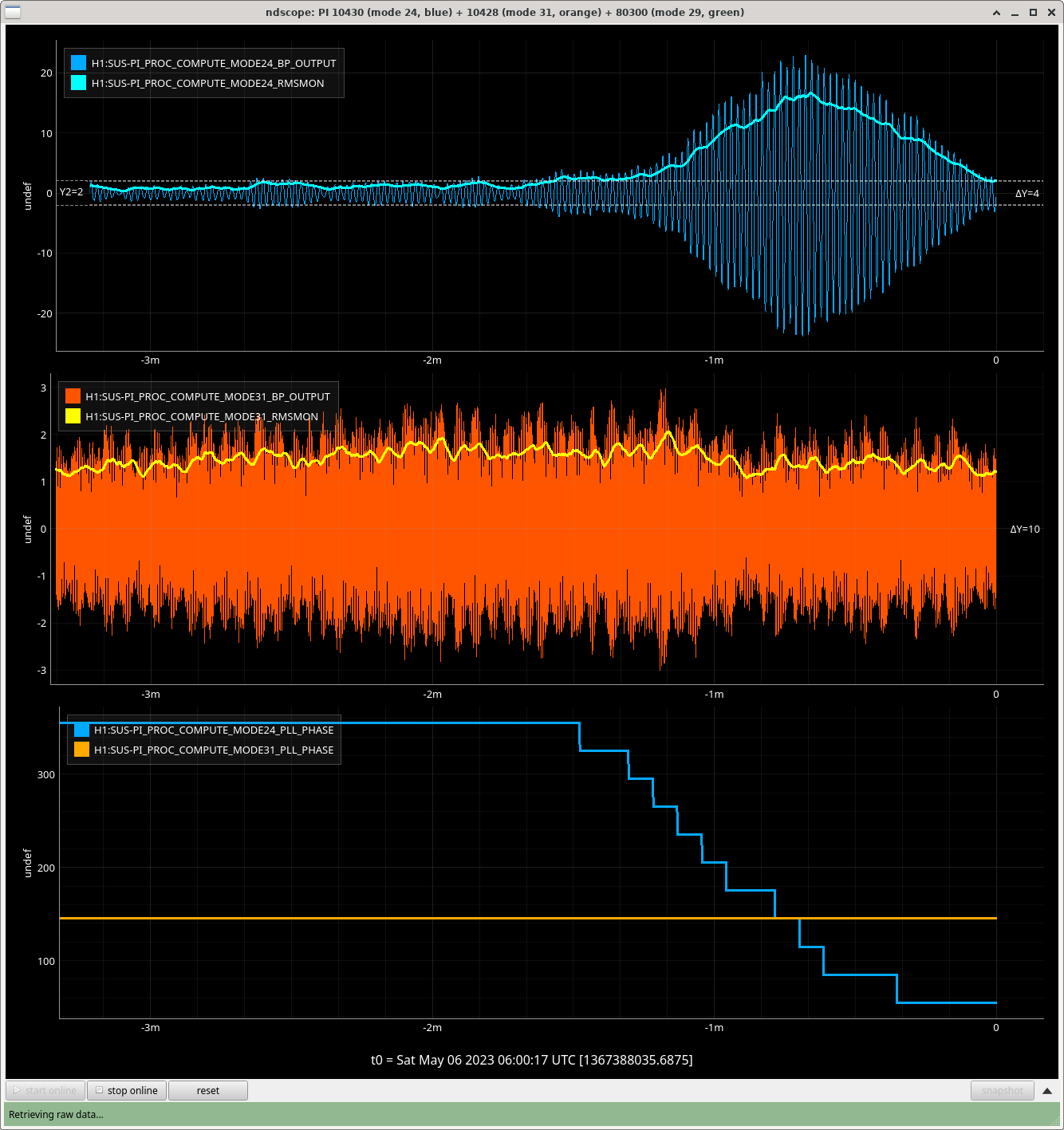
At 05:59UTC we had the 10.4Hz PI ring up (PI # 24), I was notified via verbalalarms and it and was successfully damped by the PI_DAMPING guardian, no intervention needed, Vicky's alog 69318 changes were good. See attached plot.

Start Time System Name Location Lazer_Haz Task Time End
21:39 COMM Jennie.Naoki.Vicky CR N

DARM spring and SCRL offsets, SQZ, FC alignments.

01:08
03:22 SQZ Naoki CR N Injecting SQZ during locking 04:22
6:45 SQZ Camilla CR N SQZ angle adjustments 6:52
6:55 CAL Louis Remote N Calibration eta 7:30
Images attached to this report
Comments related to this report
camilla.compton@LIGO.ORG - 11:22, Monday 08 May 2023 (69405)

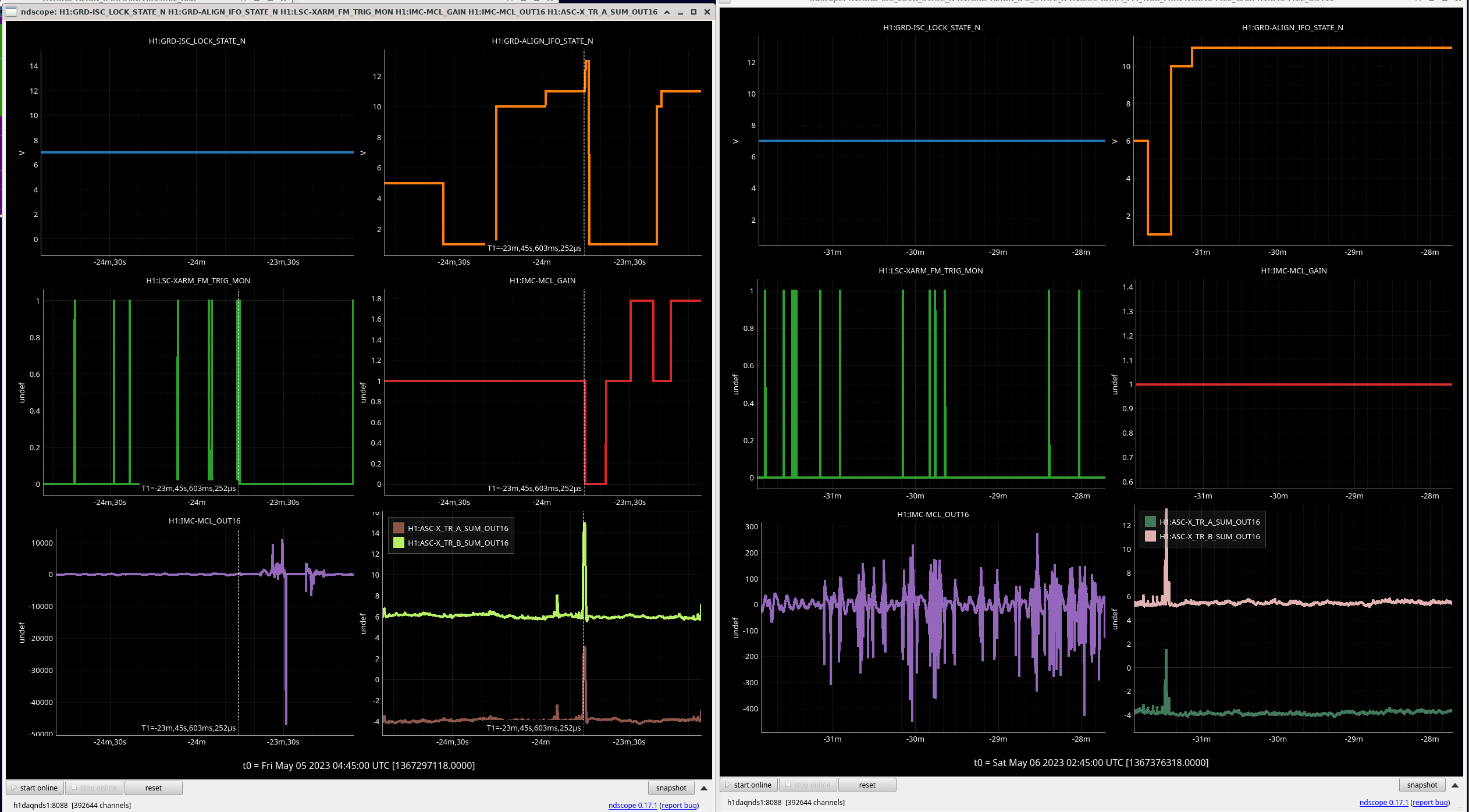
Notes on struggle Austin (69378) and I had for ACQUIRE_XARM_IR (state 11 of ALIGN_IFO) during INITIAL_ALIGNMENT. ALIGN_IFO is checking for LSC-XARM_FM_TRIG_MON to trigger and then it will turn off MCL gain and continue, since Friday evening this has triggered but not hed and ALIGN_IFO hasn't moved forward.

Plot attached comparing on the left a successful Initial alignment 2023/05/05 04:15 UTC verus on the right the failed alignment 2023/05/06 02:00 UTC. Light levels on the H1:ASC-X_TR_A_SUM_OUT16 while unlocked didn't get above their zero values.

Images attached to this comment
camilla.compton@LIGO.ORG - 11:29, Wednesday 10 May 2023 (69477)

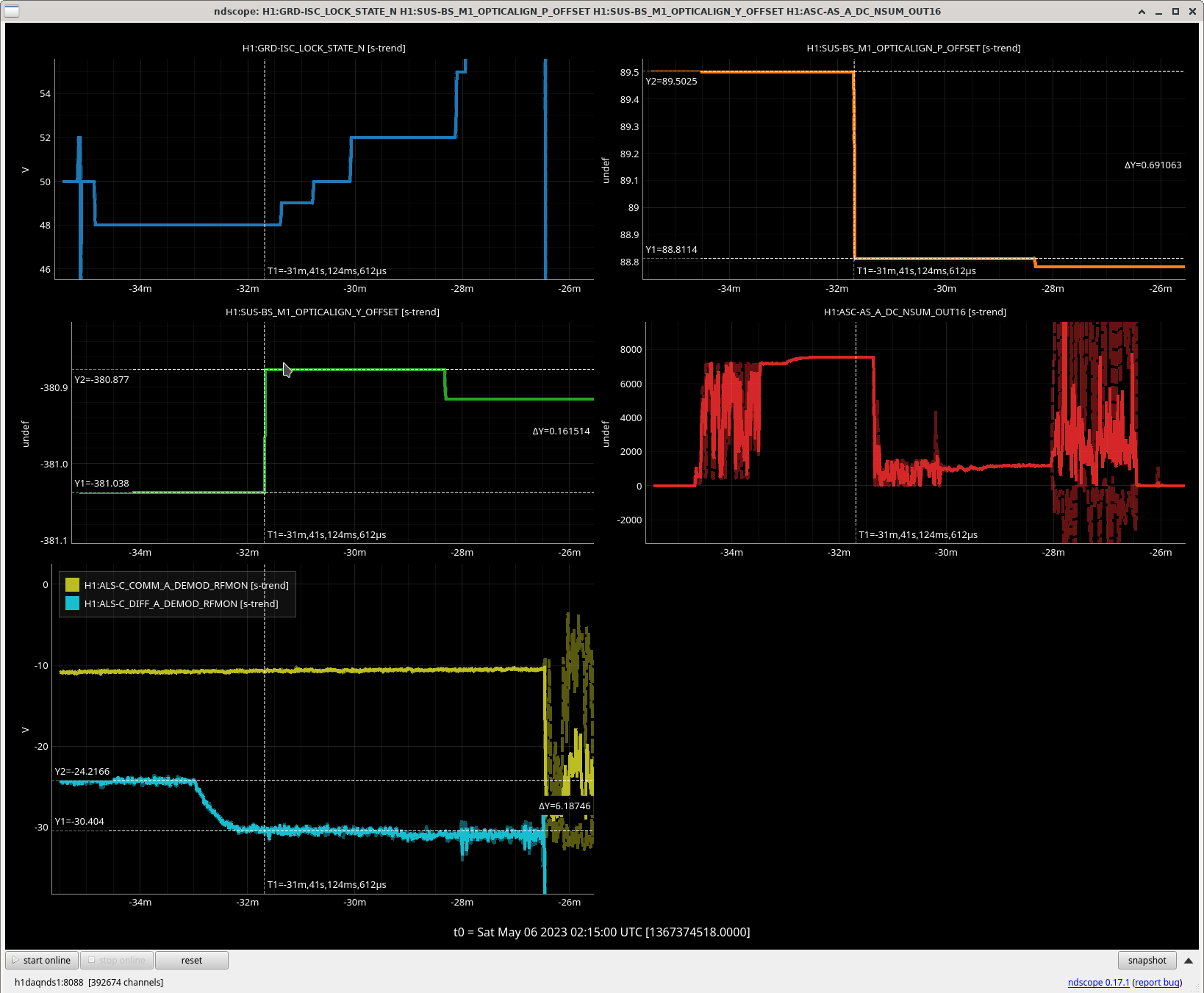
Attaching plot for time (2023/05/06 01:43 UTC) that CHECK_MICH_FRINGES reduced DIFF beatnote from -24 to -30. Not sure if this is expected.

Images attached to this comment
H1 SQZ
naoki.aritomi@LIGO.ORG - posted 23:09, Friday 05 May 2023 - last comment - 12:57, Monday 08 May 2023(69374)
Beam spot control with green QPD at FC trans successfully works

Naoki, Vicky

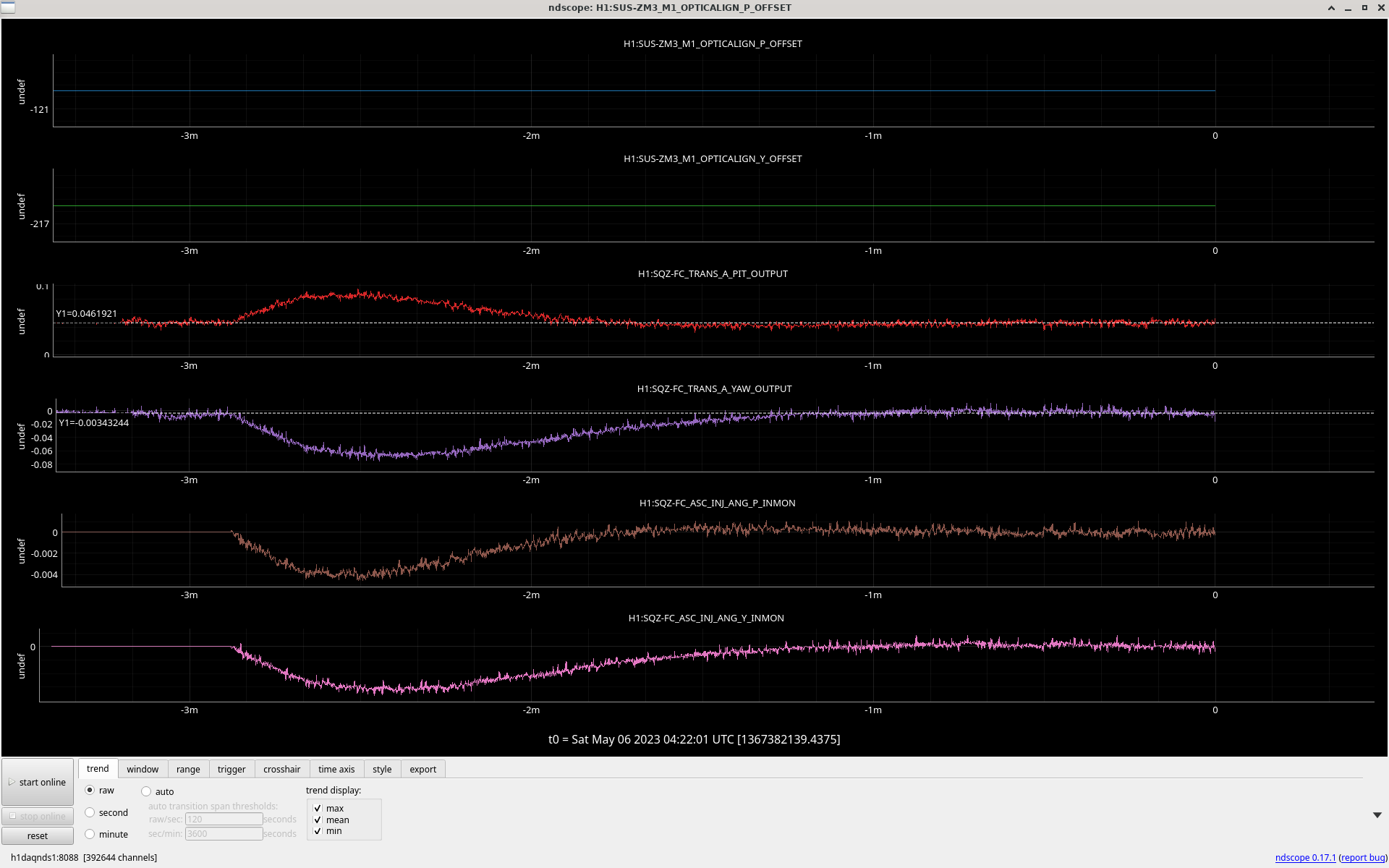
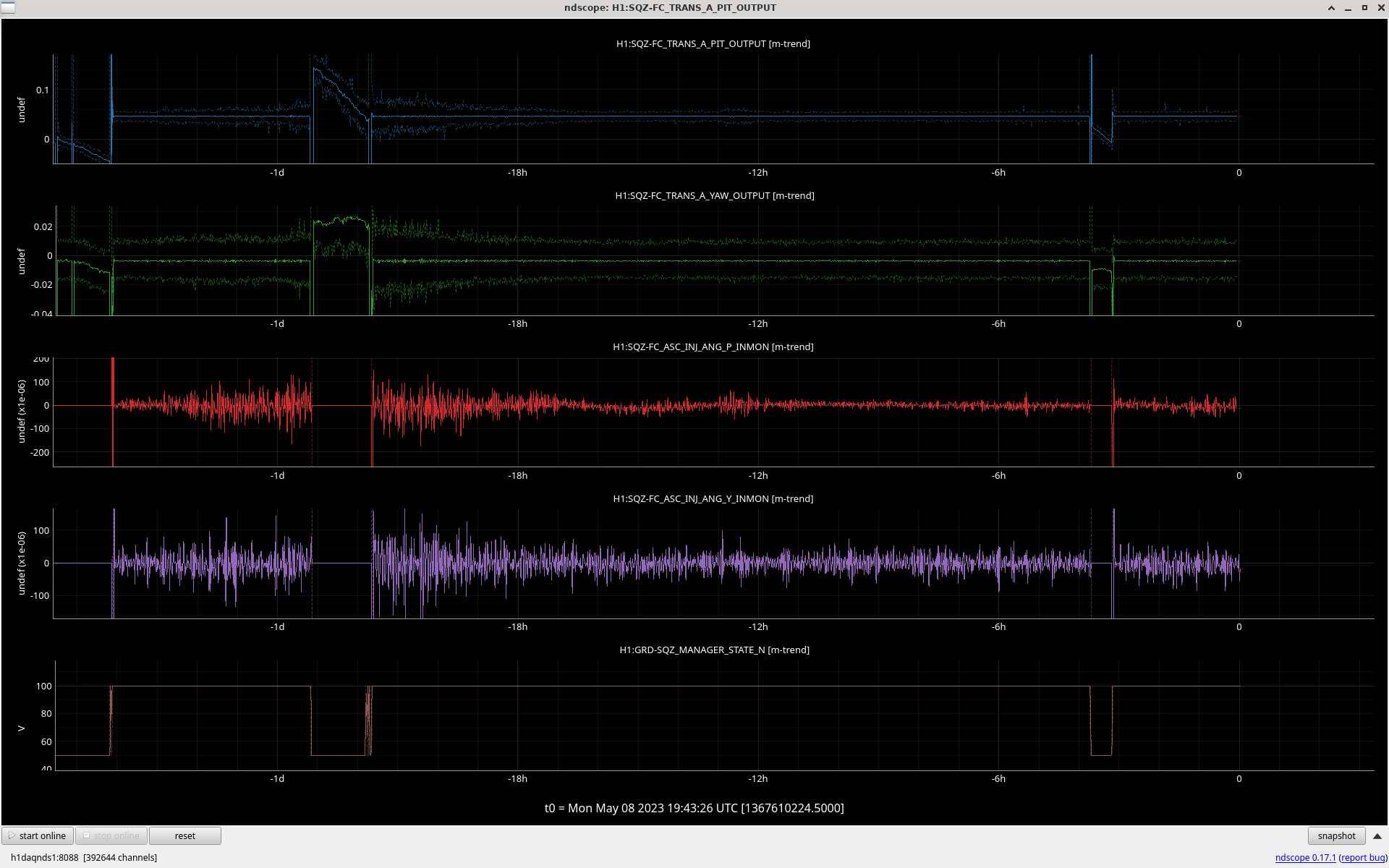
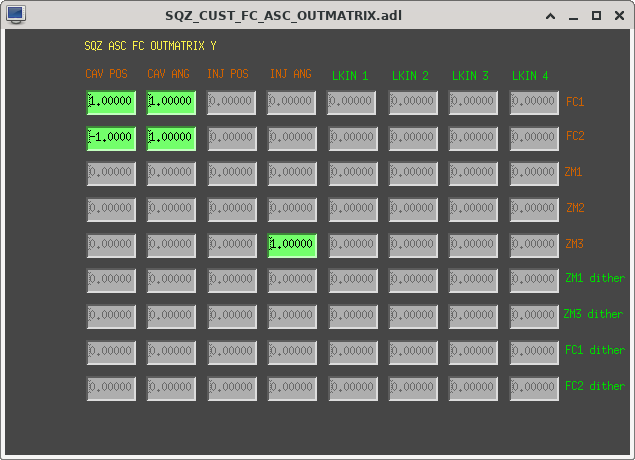
We successfully implemented the beam spot control with green QPD at FC trans by feeding back to ZM3 (Fig.1). The middle two are the green QPD P/Y signals and the bottom two are the error signals of the beam spot control P/Y. The cursors show the optimal green QPD offset for FC2 center which is decided in alog69338. After engaging the control, the green QPD signals settle to the optimal offset and the error signals become 0. The time scale of this control is ~1 min.

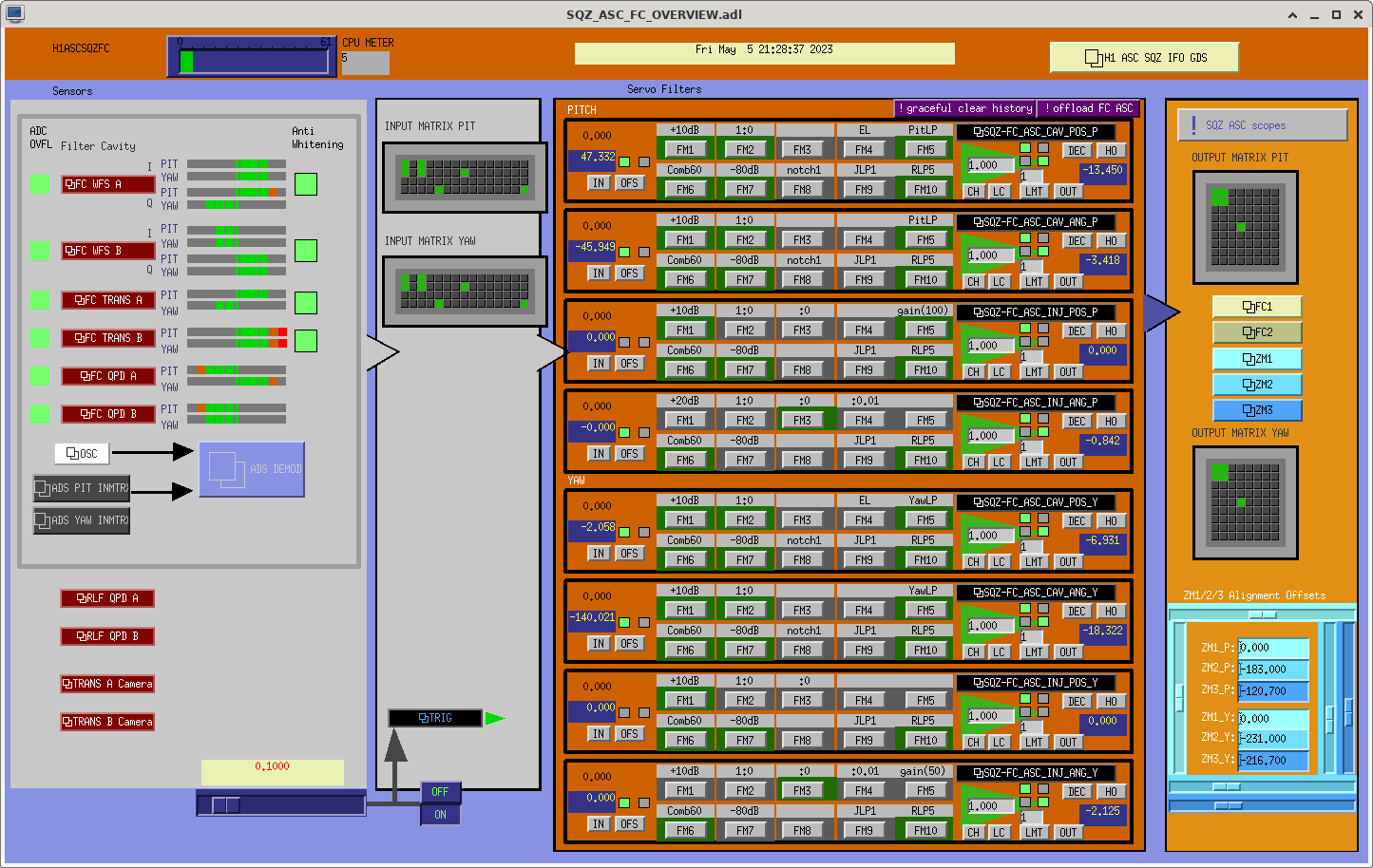
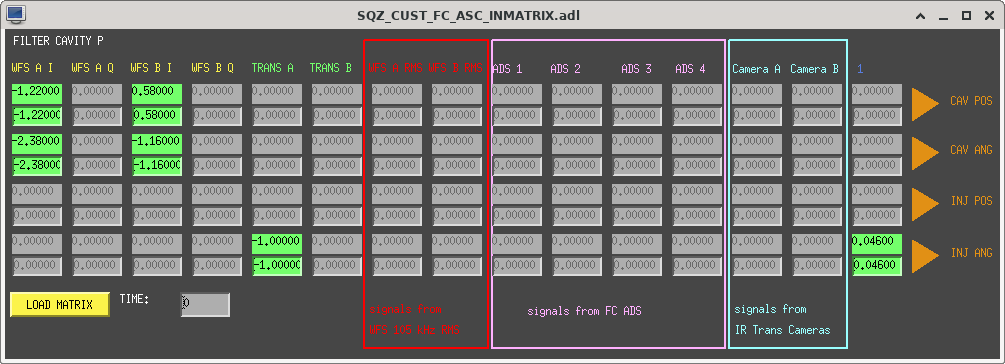
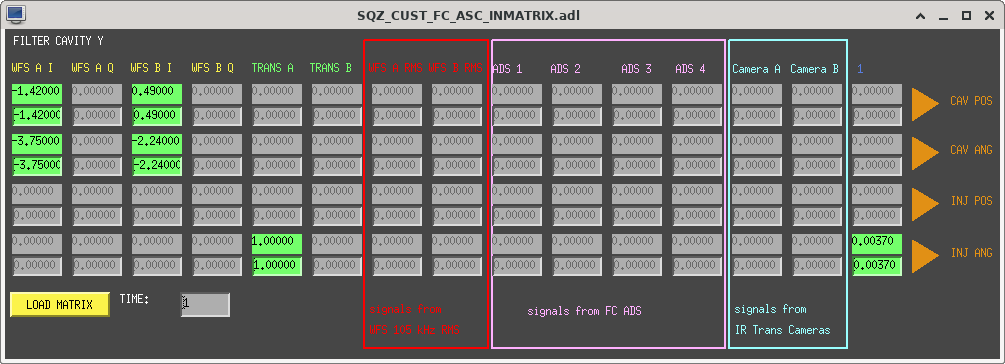
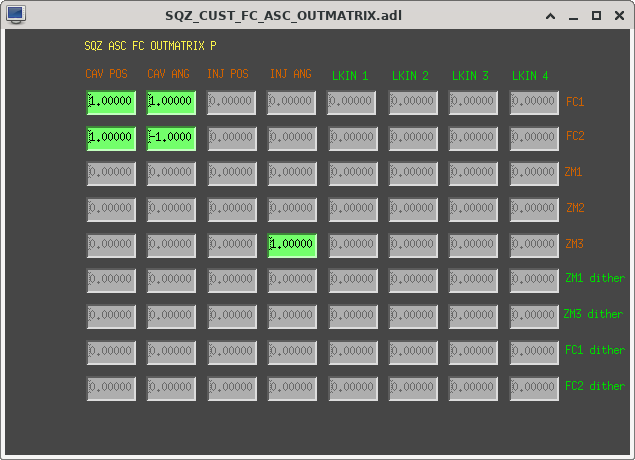
Fig. 2 shows the medm of FC ASC and Fig. 3-6 show the input/output matrix of FC ASC.

For stable FC green and IR lock with the beam spot control, we needed to clear history of filter bank of the beam spot control when the FC loses lock. Vicky added the clear history in down state of SQZ_FC guardian. The FDS with the beam spot control can be operated well by guardian.

Images attached to this report
Comments related to this report
naoki.aritomi@LIGO.ORG - 12:57, Monday 08 May 2023 (69415)

The attached figure shows the last 28 hours trend. The beam spot control works well when FC is working. I walked the green QPD offset by centering the FC2 when the beam spot control is engaged. The updated QPD offset is 0.07 for pitch and -0.0037 for yaw (yaw is not changed).

Images attached to this comment
H1 CAL (DetChar, ISC)
evan.goetz@LIGO.ORG - posted 16:43, Wednesday 03 May 2023 - last comment - 11:02, Monday 08 May 2023(69301)
Sensing and response function during one IFO thermalization
Several special calibration lines have been running for the past couple of weeks so that the calibration group can assess how IFO thermalization impacts the response function (see LHO aLOG 69284). We observe the coupled-cavity pole frequency and optical gain evolving over the first ~2 h of lock when the IFO is "cold" and still thermalizing to normal high-power operations as measured by the calibration lines.

These additional lines, together with the standard set of calibration lines, have been processed offline to measure the transfer function of PCAL / DARM_IN1 = ( 1 + G) / C = R, and DARM_EXC / DARM_IN1 = (1 + G) so that we can actively track the changing response function (R) and the sensing function, derived from the combination of the measurements to isolate C [(DARM_EXC/DARM_IN1) x (DARM_IN1/PCAL)]. The DARM_EXC lines are placed close in frequency to additional PCALY lines so that is is straightforward to remove the effect of the closed servo loop.

At present the script to do this is still in "draft" form (see merge request), but we expect further improvements to analysis, plotting, and general robustness for future use cases.

I downloaded this script to my home directory (~evan.goetz/lscrepos), activated Louis' environment (conda activate cds-pydarm-test), and ran:
$ python process_sensing_darm_comb.py -i H1 -s 'may 2 2023 11:00:00' -e 'may 2 2023 11:30:00' --pydarm_ini=/ligo/groups/cal/H1/ifo/pydarm_H1.ini --pydarm_unc_ini=/ligo/groups/cal/H1/ifo/pydarm_uncertainty_H1.ini

This queries for the data and saves it so that re-running the script does not require re-querying for the data. It processes the data to determine R(t,f) and C(t,f). Attached is an initial series of plots showing the evolution from the start of the analysis period (data points in blue) to the end of the analysis period (data points in yellow). The pyDARM modeled values are shown in blue lines for comparison. This initial measurement shows the sensing function evolving from a pro-spring response to nearly no spring over the course of 30 minutes.

Future work should be to go back and run this program on all of the lock stretches for at least the last few days. Going back to the initial locks may not prove as useful because the front-end TDCF values were not correct, owing to incorrect "reference transfer function" EPICS records. Nevertheless, we can collect a few more of these "thermalization" measurements over the next several lock stretches will help inform the additional uncertainty needed for start of lock stretches.
Non-image files attached to this report
Comments related to this report
louis.dartez@LIGO.ORG - 11:02, Monday 08 May 2023 (69403)
There is a cronjob that pulls the latest pydarm master commit and installs pydarm to 'cds-pydarm-test' at midnight every day. 
H1 DetChar
gabriele.vajente@LIGO.ORG - posted 15:17, Friday 28 April 2023 - last comment - 14:30, Monday 15 May 2023(69164)
More hunting for 4.05 Hz bump origin

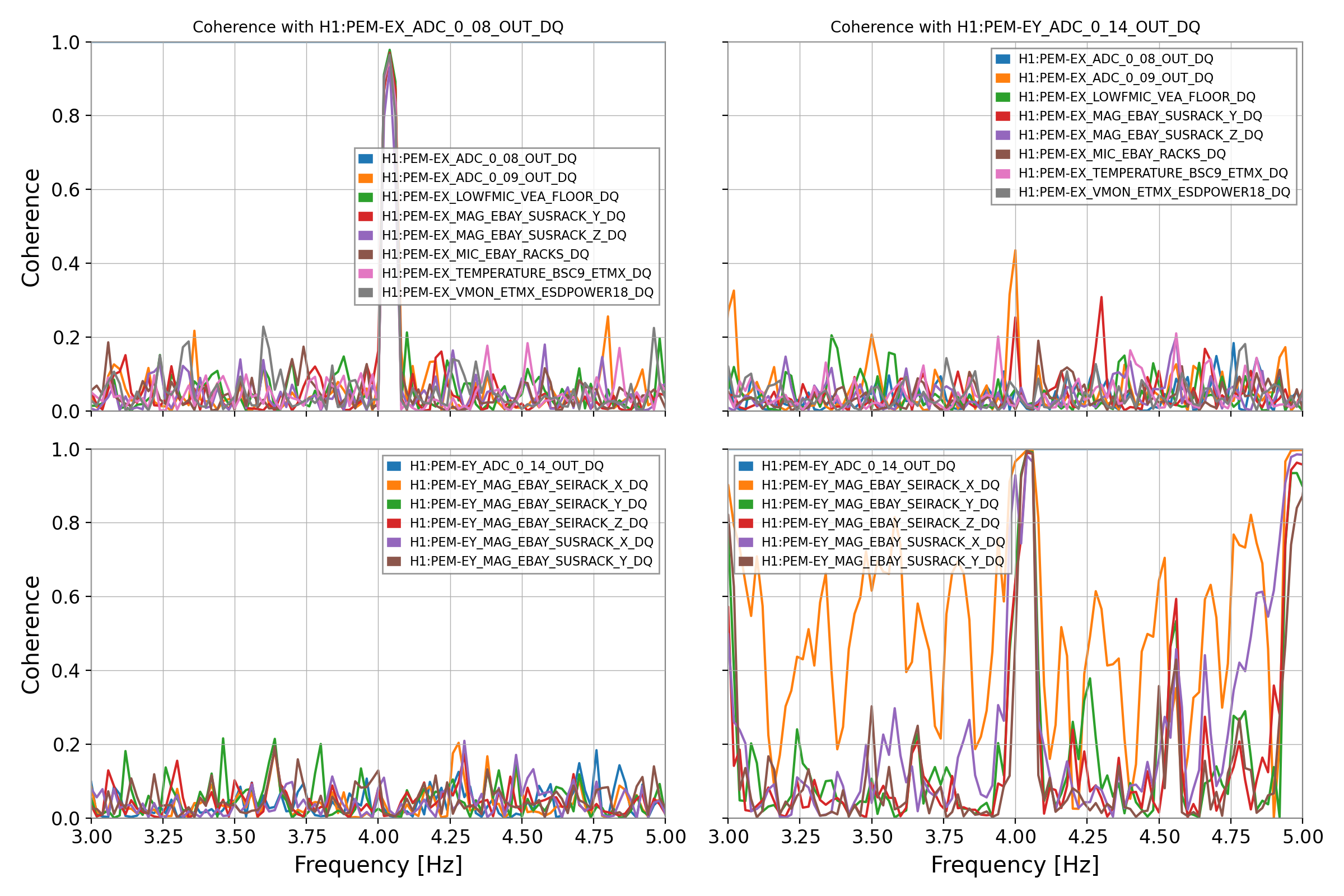
Unfotunately turning off the cosmic ray power supply did not remove the intermittent 4.05 Hz bumps in DARM, even though all the CS signals that showed a large peak at 4.06 Hz are now clean.

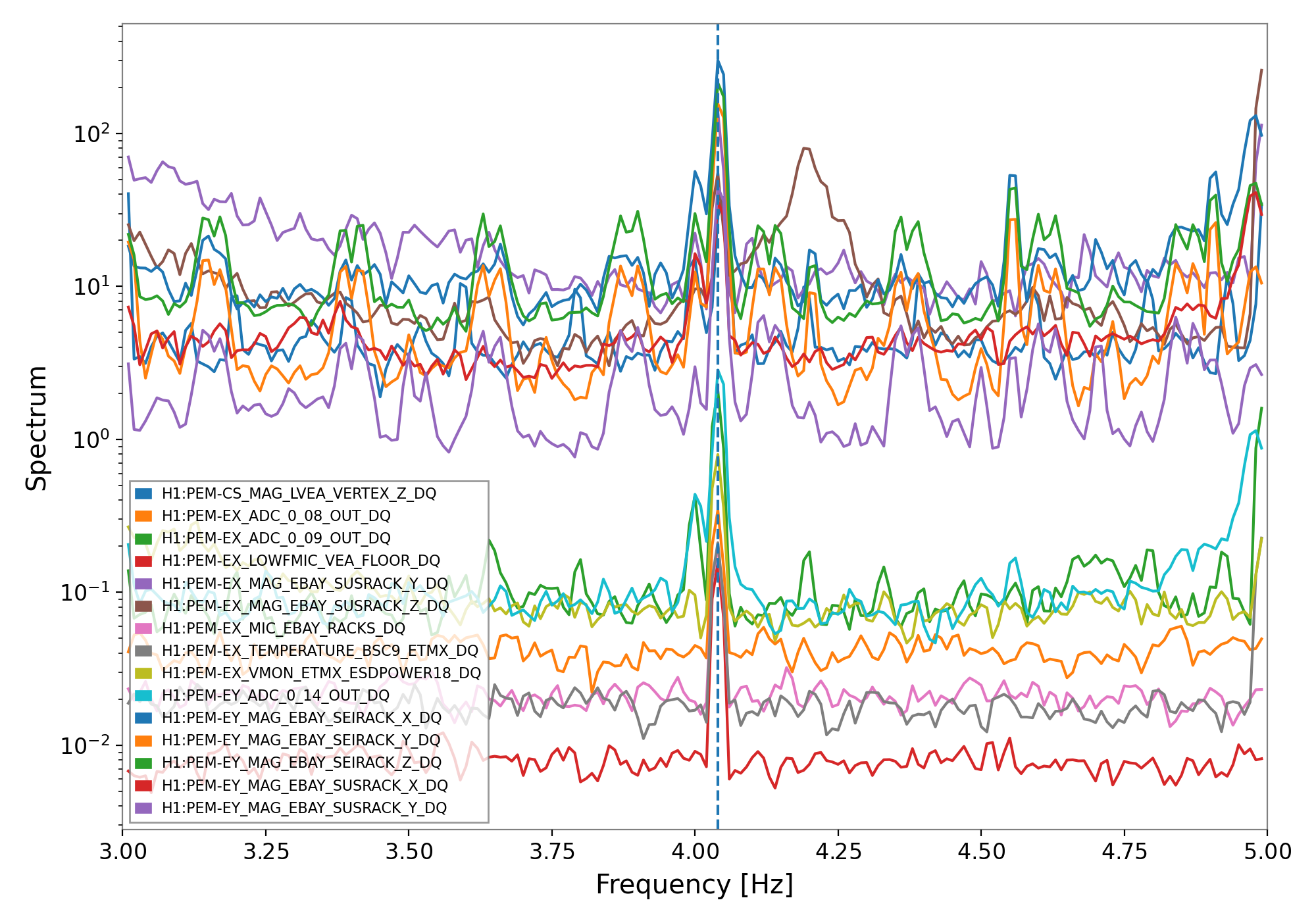
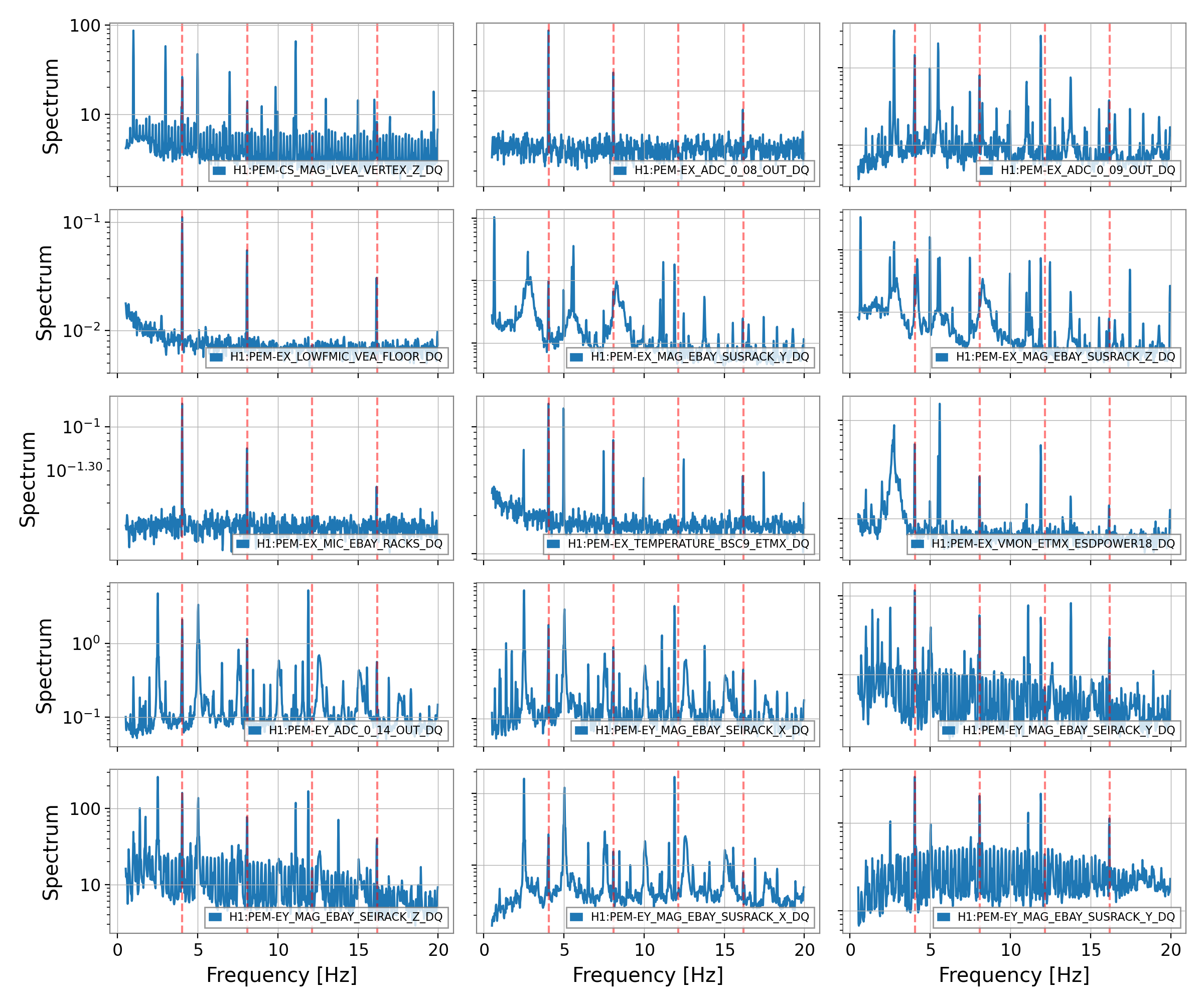
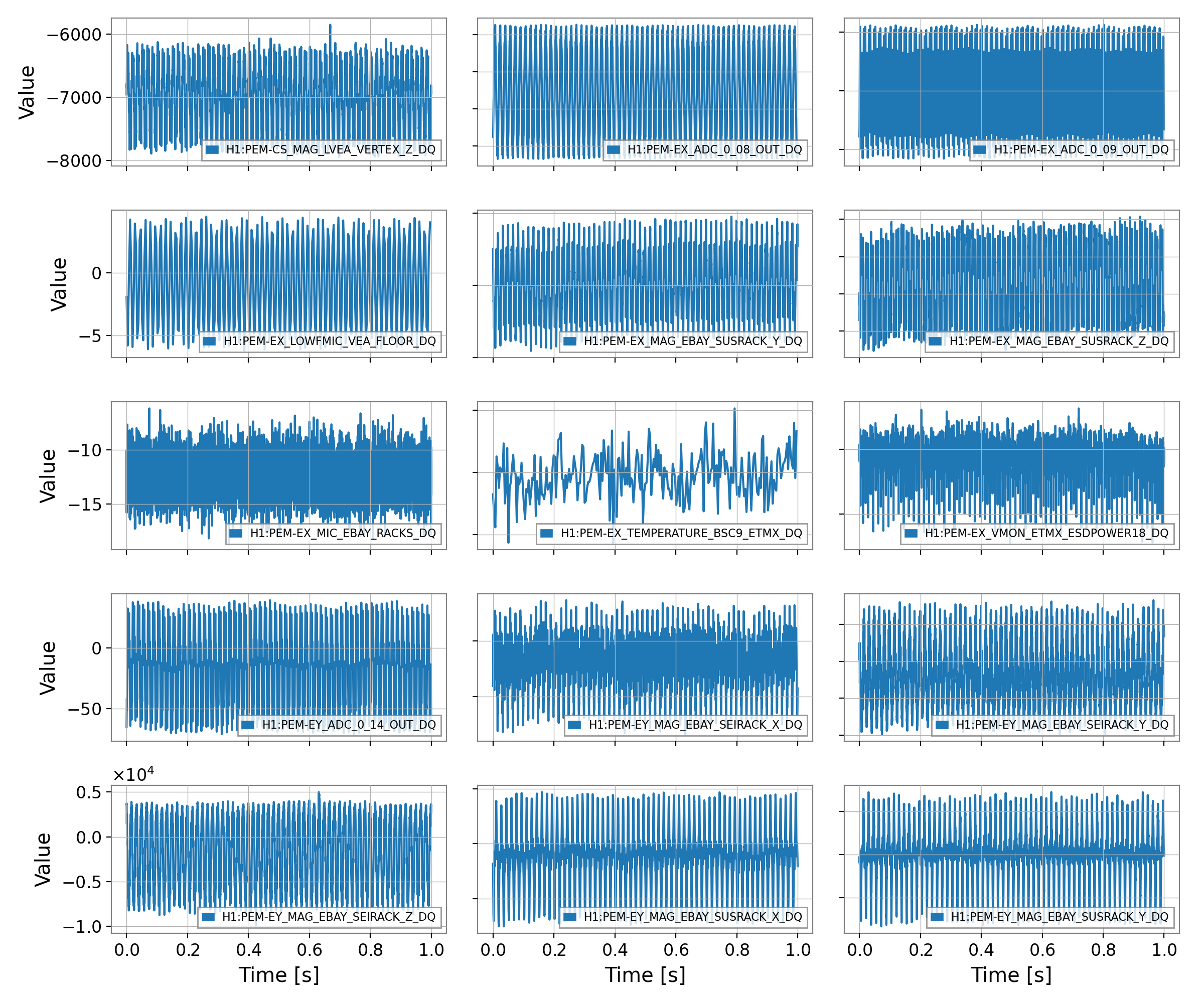
Looking again at all the signals that contain a peak around 4.05 Hz, we now have

          H1:PEM-CS_MAG_LVEA_VERTEX_Z_DQ 4.050 Hz
               H1:PEM-EX_ADC_0_08_OUT_DQ 4.040 Hz
               H1:PEM-EX_ADC_0_09_OUT_DQ 4.040 Hz
          H1:PEM-EX_LOWFMIC_VEA_FLOOR_DQ 4.040 Hz
         H1:PEM-EX_MAG_EBAY_SUSRACK_Y_DQ 4.040 Hz
         H1:PEM-EX_MAG_EBAY_SUSRACK_Z_DQ 4.040 Hz
             H1:PEM-EX_MIC_EBAY_RACKS_DQ 4.040 Hz
      H1:PEM-EX_TEMPERATURE_BSC9_ETMX_DQ 4.040 Hz
       H1:PEM-EX_VMON_ETMX_ESDPOWER18_DQ 4.040 Hz
               H1:PEM-EY_ADC_0_14_OUT_DQ 4.040 Hz
         H1:PEM-EY_MAG_EBAY_SEIRACK_X_DQ 4.040 Hz
         H1:PEM-EY_MAG_EBAY_SEIRACK_Y_DQ 4.040 Hz
         H1:PEM-EY_MAG_EBAY_SEIRACK_Z_DQ 4.040 Hz
         H1:PEM-EY_MAG_EBAY_SUSRACK_X_DQ 4.040 Hz
         H1:PEM-EY_MAG_EBAY_SUSRACK_Y_DQ 4.040 Hz

Attached plots shows spectra and time series. Although the frequency of all peaks is very close, EX signals are only coherent among themselves, and not with EY signals, and the other way around too. So it looks like at both end stations there is a source of 4.04 Hz that is local. Maybe a clue? Still, we don't have evidence that those sources are related to the DARM noise.

Images attached to this report
Comments related to this report
derek.davis@LIGO.ORG - 17:29, Friday 05 May 2023 (69363)DetChar

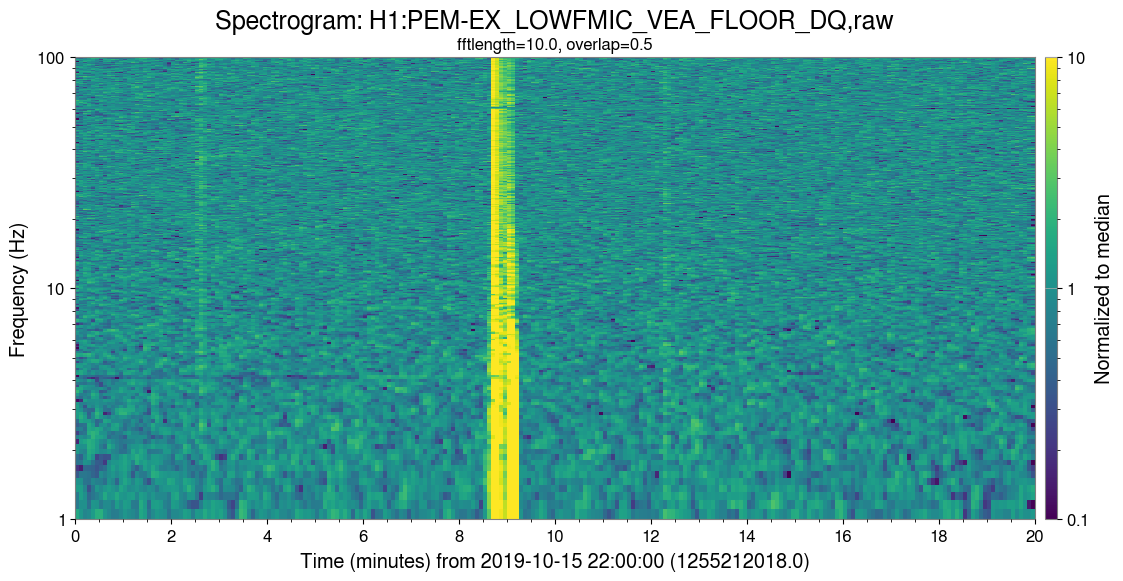
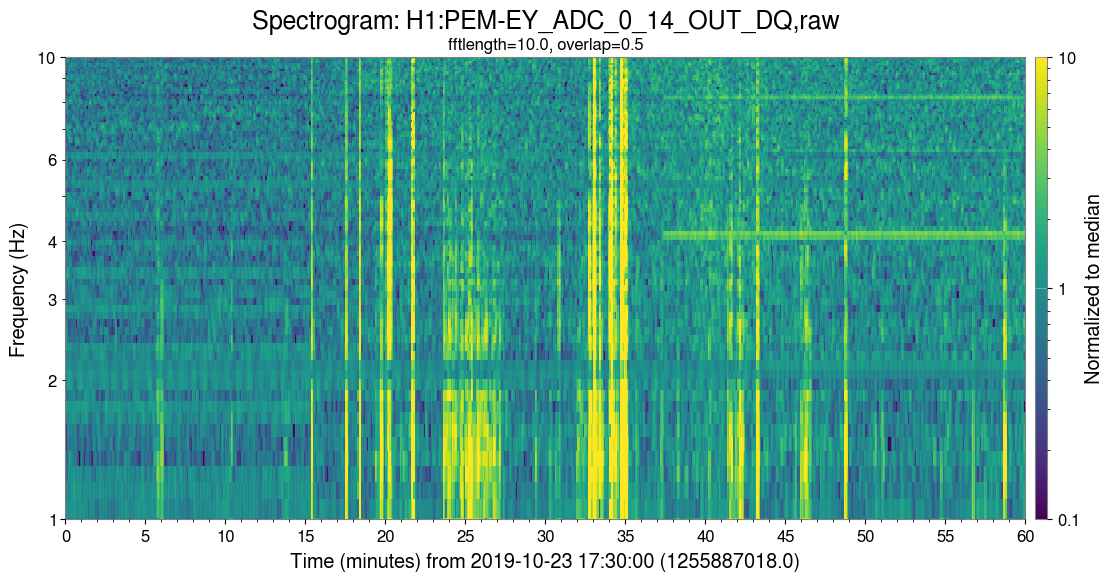
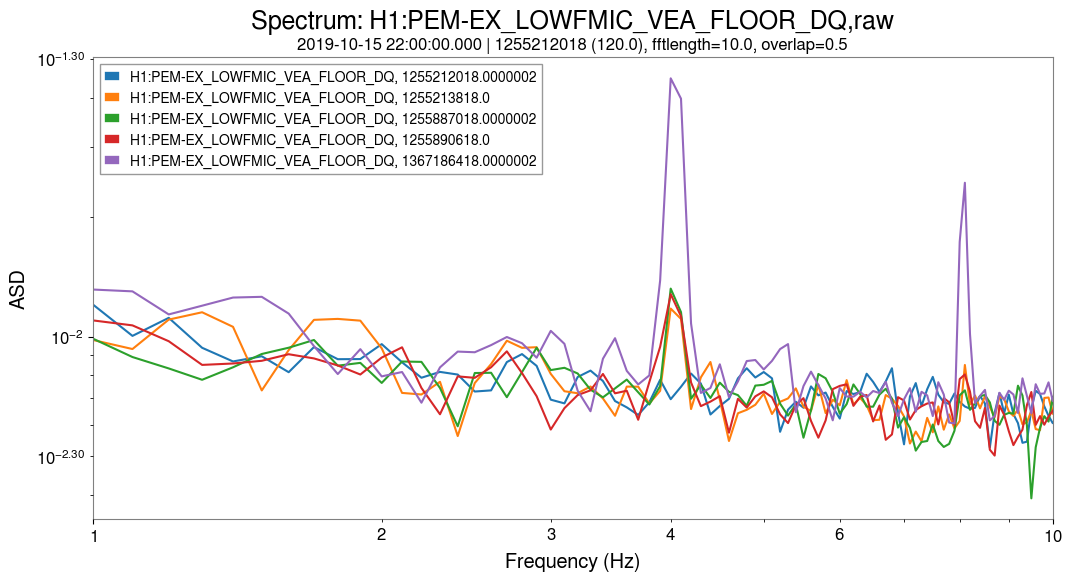
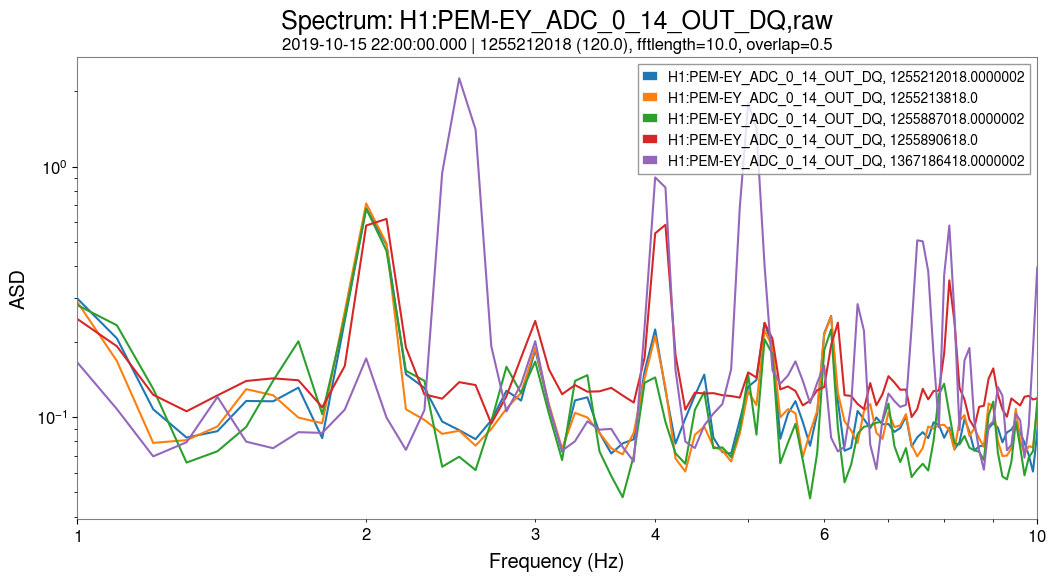
To help track down the source of these lines, I've been investigating the time this feature appeared in these channels. The two channels that were the first to have this feature are H1:PEM-EX_LOWFMIC_VEA_FLOOR_DQ and H1:PEM-EY_ADC_0_14_OUT_DQ, which both have had a 4 Hz line present since October 2019. The exact time of appearance for each is:

  • H1:PEM-EX_LOWFMIC_VEA_FLOOR_DQ : 2019-10-15 22:06:00 (plot 1)
  • H1:PEM-EY_ADC_0_14_OUT_DQ : 2019-10-23 18:07:00 (plot 2)

The attached spectrograms show the lines appearing at the above times. I have also includes plots of the channel spectra (plot 3 and plot 4) that show the 4 Hz line before/after these times, as well as a recent time (2023-05-03 22:00:00).

Looking through the alogs posted on these days, there may be an association to install work for BRS heaters. The related EX work (alog 52494) was on 2019-10-15, and the EY work (alog 52542) was on 2019-10-23. The time on both days roughly lines up with when the lines appeared.

The full day shift reports for these days are alogs 52495 and 52656. SInce these days were during the O3a-O3b commissioning break, there are a number of other activities that could be related.

Images attached to this comment
gabriele.vajente@LIGO.ORG - 11:02, Monday 08 May 2023 (69404)

I checked several spectragras from the summary pages during the last month of O3. There was no sign of the 4 Hz bumps.

gabriele.vajente@LIGO.ORG - 11:25, Monday 08 May 2023 (69406)

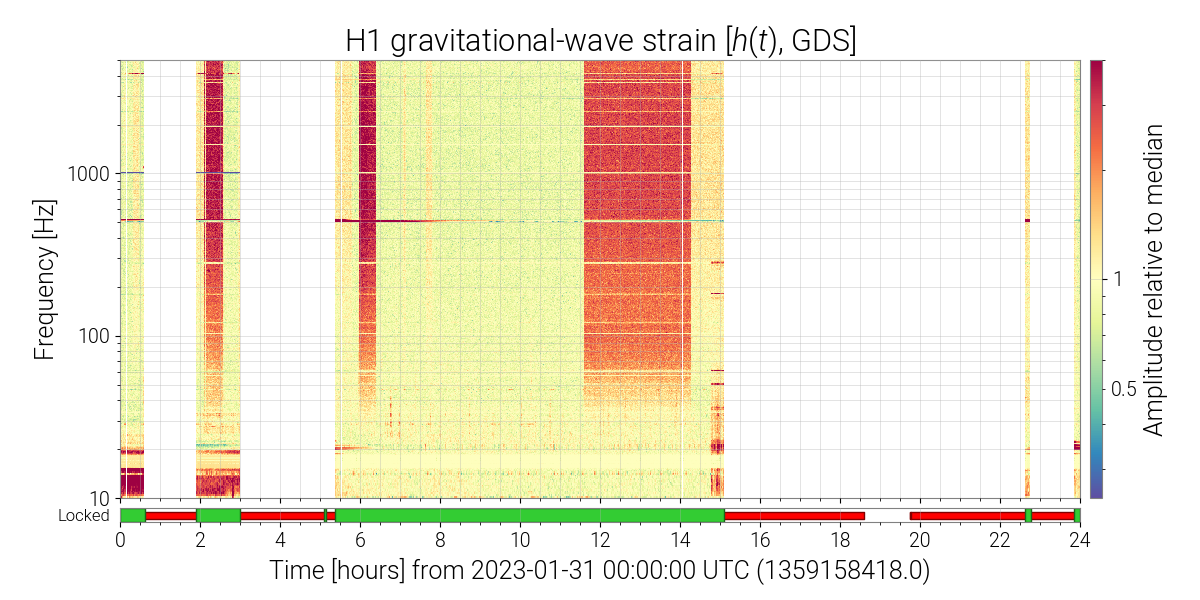
Looking back at spectrograms since the restart, the first evidence I could find of the 4 Hz bumps is on January 31, 2023. I could not find any sign of the 4 Hz bumps in any lock stretch before that time

Images attached to this comment
evan.hall@LIGO.ORG - 08:26, Monday 15 May 2023 (69585)ISC, PEM

Under Robert's suggestion that this might have resulted from some alignment change of the beam at EX (LHO:69578), the ISC_LOCK guardian archives show the following A2L gain changes in January 2023:

  • 13 Jan 2023: IX Y2L changed from +1.7 to +2.1 (commit 69c3a530)
  • 26 Jan 2023: IY Y2L changed from −1.3 to −1.7 (commit de0e26b4)

The issue with trying to blame the 13 Jan gain change is that there were subsequent long locks with high sensitivity around 30 Hz that did not show the bumps.

Since January, there was also a retuning of the IY P2L/Y2L (commit 463245ed, see LHO:69082).

evan.hall@LIGO.ORG - 12:57, Monday 15 May 2023 (69598)

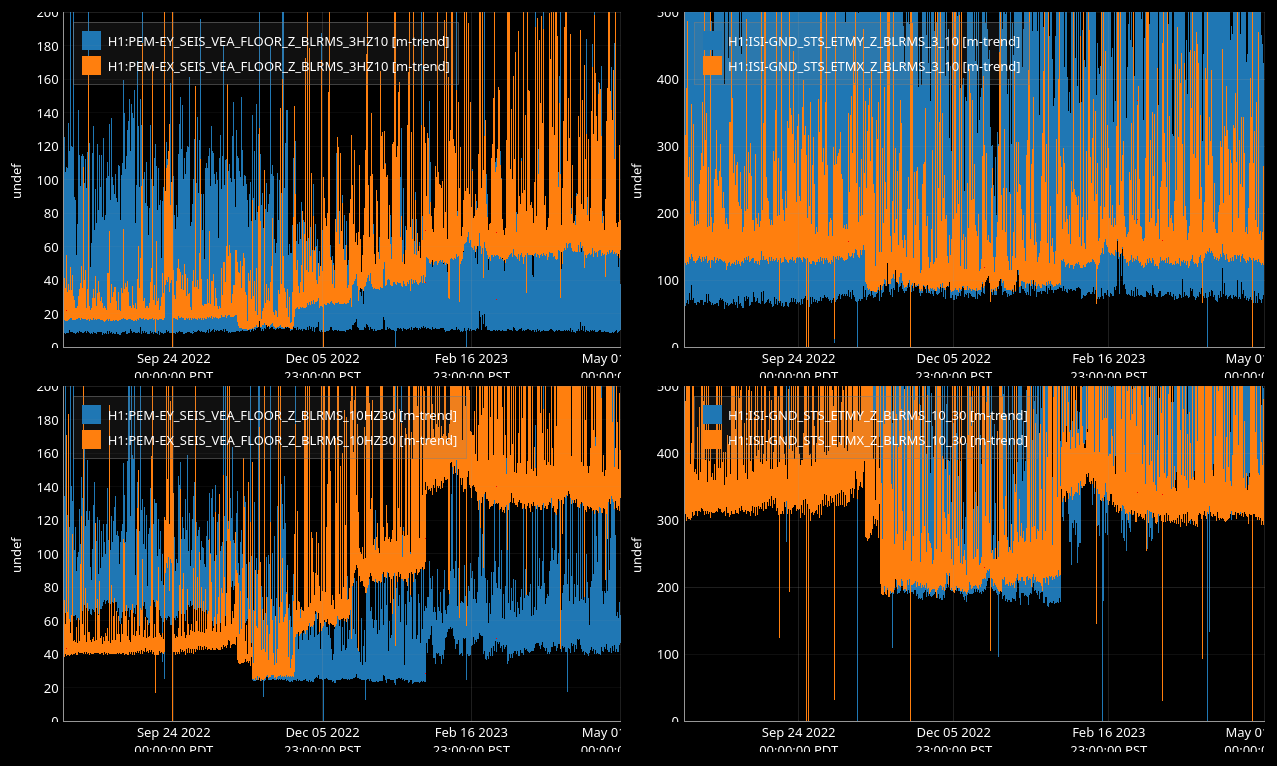
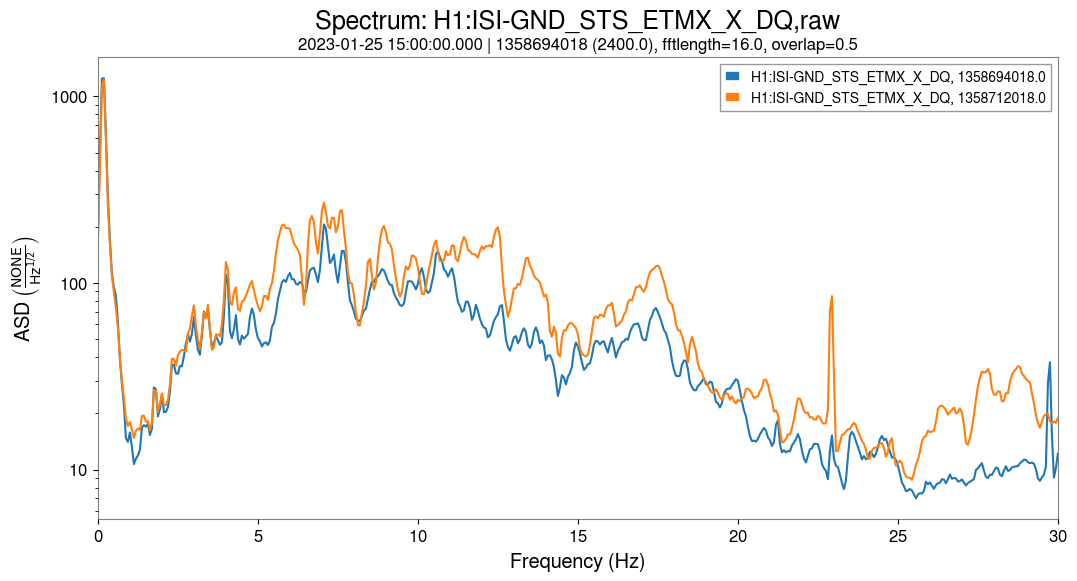
Some more clues — seems like the ground motion at EX from 3 Hz to 30 Hz experienced a step increase on January 25 and has not settled back down since then. The Güralps and STSs agree on this point, but as for what the ground motion was like in the fall of 2022 they seem to diverge.

Looking at the summary pages in fall of 2022 it seems like the bumps were intermittently present in DARM, e.g.: https://ldas-jobs.ligo-wa.caltech.edu/~detchar/summary/day/20220902/#gallery-6

Images attached to this comment
andrew.lundgren@LIGO.ORG - 14:30, Monday 15 May 2023 (69603)DetChar, PEM
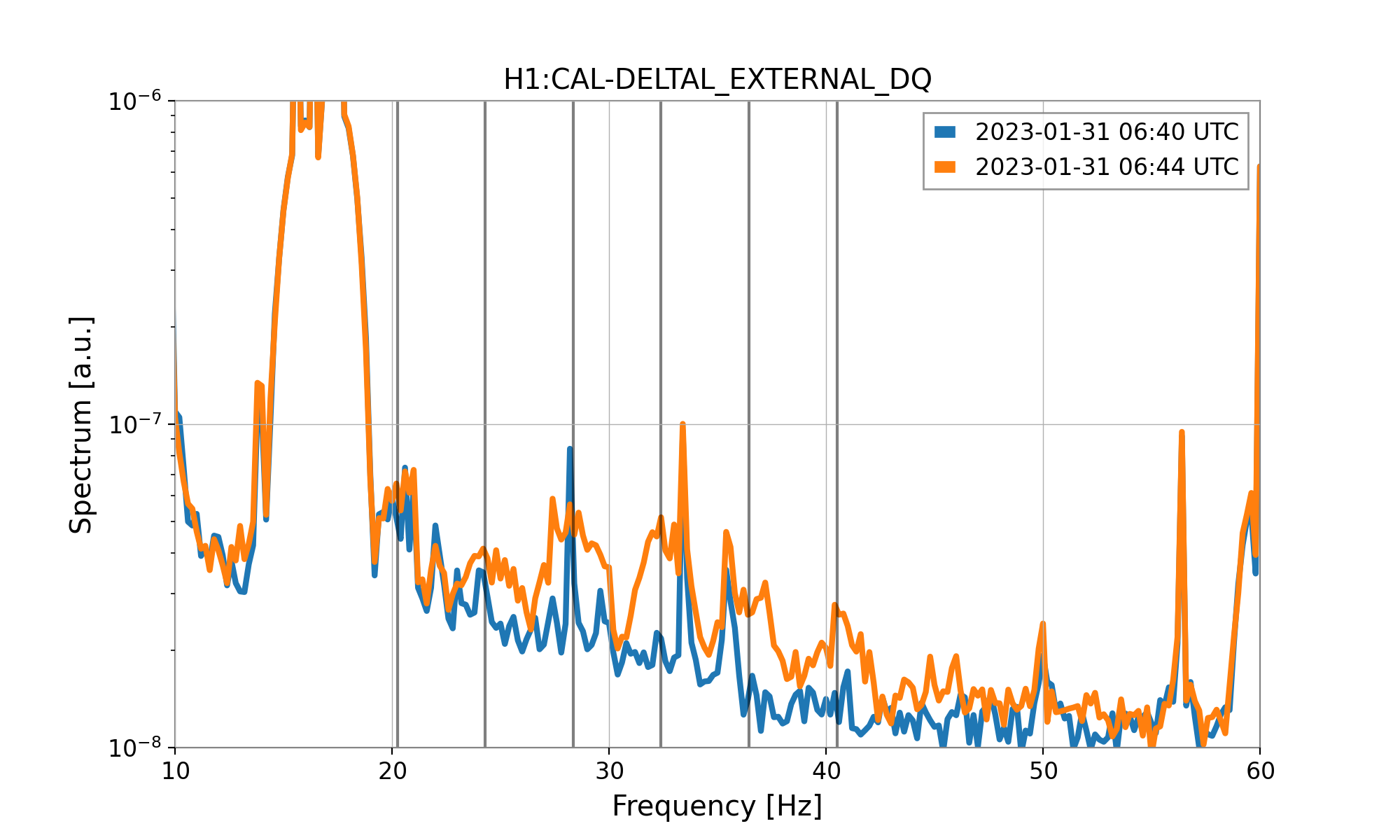
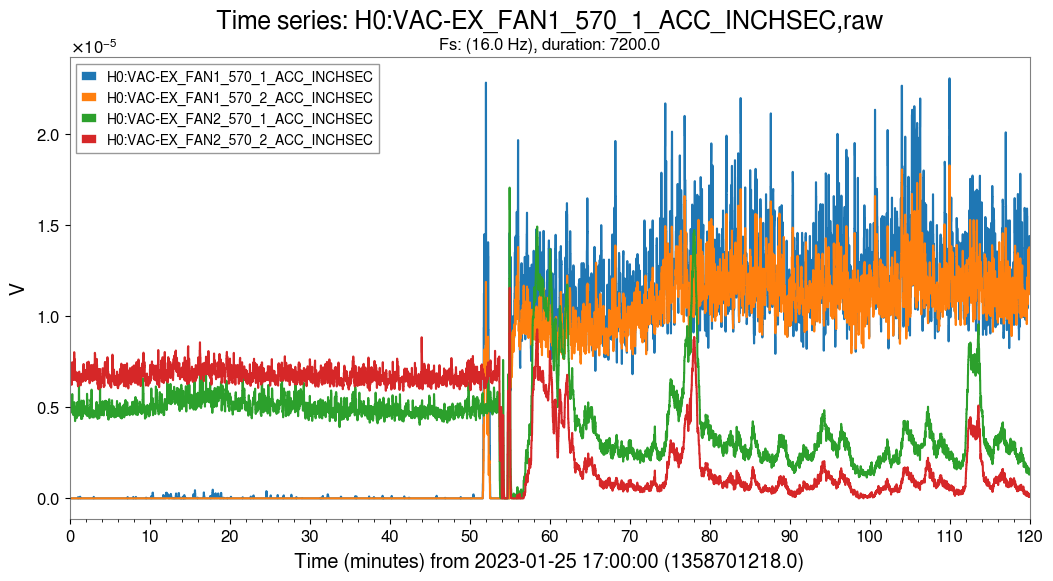
The increase in ground motion corresponds to turning on FAN1 at each of the end stations. Betsy points to alog 67055 indicating this work, and the change can be seen on the fan vibrometers (first attached plot). There is a peak at 22.5 Hz that pops up, and a broad increase in noise which includes the 4 Hz region, though not so strongly (attachment 2).
Images attached to this comment
Displaying reports 20361-20380 of 87739.Go to page Start 1015 1016 1017 1018 1019 1020 1021 1022 1023 End