TITLE: 05/05 Day Shift: 15:00-23:00 UTC (08:00-16:00 PST), all times posted in UTC
STATE of H1: Lock Acquisition
SHIFT SUMMARY:
Calibration & Commissioning time (as well as some LVEA incursions) today. With one seismic lockloss.
LOG:
LOCKING NOTES:
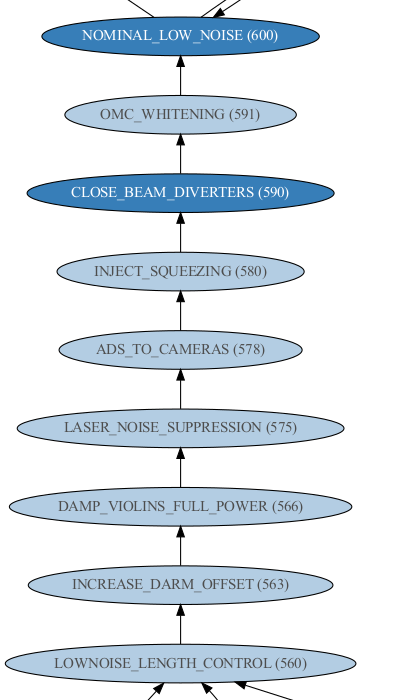
We have determined that 40 mA is a better DARM offset to operate at (more in-depth alog coming soon). I have added back in the guardian state "INCREASE_DARM_OFFSET" to the ISC_LOCK guardian. This state will occur between lownoise_length_control and damp_violins_full_power. We will increase the DARM offset to 40 mA in this state. This value is set in lscparams as DCPD_SUM_NLN. For lock acquisition, we will continue to use 20 mA, which is set via DCPD_SUM_TARG in lscparams. We will still have the OMC whitening off in this state, and the OMC_WHITENING state will still check the DCPD counts before turning on the whitening, in case we are in danger of saturation. If the violins are rung up particularly high, we might have to wait a little longer in OMC whitening now before we can proceed to NLN.
The guardian state uses a 5 second ramp time to increase the DARM offset.
Jennie, Jenne, Elenna, Vicky, Erik
As referred to in this entry we took a suite of measurements on the 3rd May to determine what changing the SRCL offset, DARM offset and turning off the whitening on DCPD would have on the sensitivity.
Measurement Order: from 05/03/2023
| Measurement Set | DARM Measurement Time | PCAL > DARM Measurement Time | DARM offset (mA) | Whitening? | SRCL1 OFFSET | Squeezing optimised? | DARM Measurement (1 min) | PCAL > DARM Measurement (3 mins) | Figure Folder |
| 1 | 1367179951 | 1367180172 | 20 | ON | -200 | YES but slightly different squeezing angle was set between PCAL and DARM measurements | /ligo/home/jennifer.wright/git/DARM_offset/2023-05-03_2009UTC_H1_DARMSPEC_1m.xml |
Ref 1
|
|
| 2 | 1367184708 | 1367183677 | 40 | ON | -200 | YES | /ligo/home/jennifer.wright/git/DARM_offset/2023-05-03_2131UTC_H1_DARMSPEC_1m.xml |
Ref 2
|
|
| 3 | 1367184497 | 1367184372 | 40 | OFF | -200 | YES | /ligo/home/jennifer.wright/git/DARM_offset/ |
ref 3
|
At low frequencies DARM looks better with 20mA offset, but we must remember that many things at low frequency are optimised for this DARM offset. See first plot for 20mA/40mA comparison.
The whitening ON/OFF (see second plot attached) does not look to have made a large difference to the sensitivity from these plots.
There is no coherence in the PCAL > DARM BB measurements we took at high frequency so to give us a good idea of the difference between 20mA and 40 mA DARM offset we will scale the DARM spectra using the one of the high frequency calibration lines.
Unfortunately, we did not spend any time in NLN with 40mA (just NLN CAL MEAS) so we will need to measure another DARM spectra in that state today.
The code I used to correct the DARM spectra with the PCAL to DARM measurements is in /ligo/home/jennifer.wright/git/DARM_offset
The contrast defect measurement I made indicated that the contrast defect is still 1.7 mW. This measurement was taken about 18 hrs into lock, so we were fully thermalized.
Added in a third plot of the power scaling in the anti-symmetric port with DARM offset changing the power at the DCPDs.
The inverse of the slope of this plot gives the loss term as in this entry.
loss term = 1/1.219 = 0.820,
the amount of light at the anti-symmetric port insensitive to DARM is 837.5 mW.
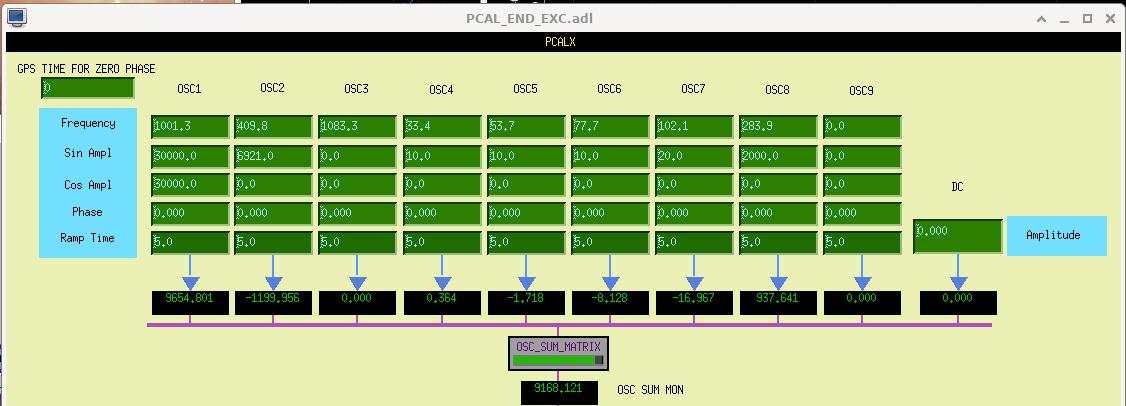
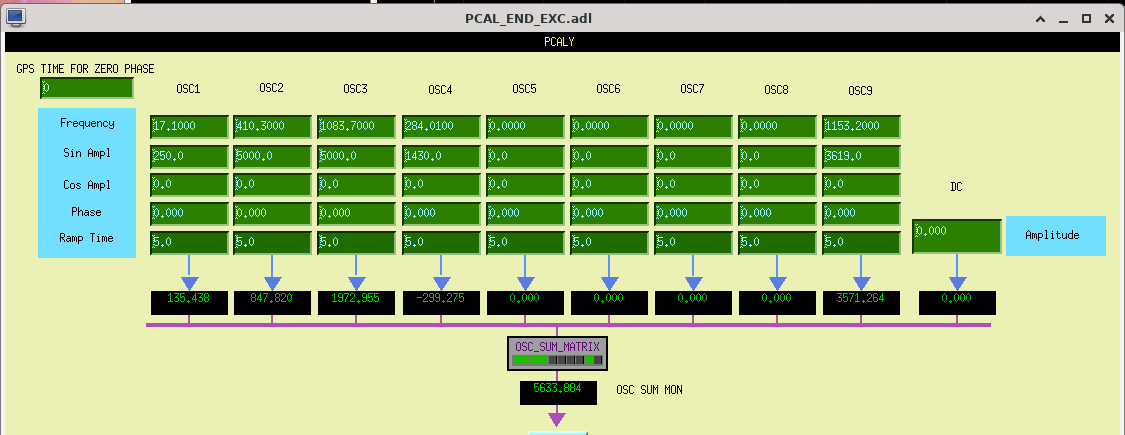
J. Betzwieser, D. Bhattacharjee, J. Kissel, R. Savage Executive summary: More changes to calibration lines in order to commission the best answer out of the PCALXY comparison. Based on the systems level compromises discussed on Friday last week about having the PCALX contribution to the PCALXY comparison right next to the 410.3 Hz PCALY line that's used for TDCFs (LHO:69175), I moved the PCALX comparison line from 410.2 Hz (0.1 Hz below 410.3 Hz) to 409.8 Hz (0.5 Hz below 410.3 Hz). LHO:69303. After looking at the results from that move to 409.8 Hz, Joe, Rick, and Dripta re-discovered that there's a notch in the DARM loop at 410.3 Hz (see LHO:48530), which is a relatively wide elliptic bandstop (whose boundaries are 409.4 and 411.2 Hz, i.e. 410.3 +/- 0.9 Hz). That means the frequency response change of IFO's response function, C / (1 + G), is changing quite rapidly between the two 410.3 and 409.8 Hz frequencies. *That* means that the traditional, easy, side-by-side PCALXY comparison of lines to arrive at a ratio of amplitudes -- which assumes that the response function ratio isn't changing between frequencies -- becomes harder, and loop model dependent. As such, yesterday, Joe, Rick, and Dripta got together and posted the proposal outlined last night LHO:69331, to move the lines that inform the PCALXY comparison entirely away from 410.3 Hz, such that the comparison is between H1:CAL-PCALX_PCALOSC8_OSC_FREQ 283.91 Already present as a "Systematic Error" line, but now louder, increasing amplitude from 200 to 2000 cts. H1:CAL-PCALY_PCALOSC4_OSC_FREQ 284.01 New PCALY line dedicated to this test, set with an amplitude of 1430 cts I've implemented their proposal at of 2023-05-05 20:00 UTC. Knock-on effects: - Because there's a new line on PCALY, I wanted to check whether we still have enough OFS range to drive the temporary, ER15 "thermalization" lines, driven by the CAL_AWG_LINES guardian. We do, so we're good there. - The new addition of 284.01 Hz PCALY *may* impact (bias) the demodulation (answer) of the 283.91 Hz PCALX systematic error line, given that that line's front-end DEMOD still uses a +/- 0.1 Hz wide SIG band pass, and 0.1 Hz corner frequency low pass, i.e. a 10 second FFT. - Because the systematic Error line is much louder, and has a new companion, equally loud "next door," the CW searches may be more likely to complain about sidebands and non-linearities not subtracted out. - Because I'm using a new PCALY oscillator, I need to double check that the GDS pipeline still safely subtracts this out in the GDS-CALIB_STRAIN_NOLINES channel. - This renders the DEMOD10 PCALX non-functional, since it's stuck demodulating the 409.8 Hz PCALX line that isn't there. Ideally, we'd convert PCALX DEMOD 10 to watching the new 284.01 Hz PCALY line, but that would require a front-end code change. Eventually, once we're done the 24.5 Hz PCALY thermalization line, then we can switch that PCALY DEMOD 4 over to using that. Things that need to change in order to accommodate this move: (1) Accepted new oscillator settings in h1calex and h1caley SDF systems. (2) Modified the pydarm_H1.ini parameter file which now is up to version marked by git hash 156230c7. Parameters cal_line_cmp_pcalx_frequency and cal_line_cmp_pcaly_frequency have changed. (3) Pushed new DARM_ERR / PCAL and DELTAL / PCAL EPICs records at these line frequencies with the updated parameter file, using the command $ pydarm export --push --epics-only --model /ligo/groups/cal/H1/ifo/pydarm_H1.ini (4) Accepted them in h1calcs SDF. Rick said he's going to take care of modifying the DEMOD SIG and low pass filters for the X Y comparisons as he needs. Here's the latest list of calibration lines: Freq (Hz) Actuator Purpose Channel that defines Freq Since O3 15.6 ETMX UIM (L1) SUS \kappa_UIM excitation H1:SUS-ETMY_L1_CAL_LINE_FREQ Amplitude Change on Apr 2023 (LHO:68289) 16.4 ETMX PUM (L2) SUS \kappa_PUM excitation H1:SUS-ETMY_L2_CAL_LINE_FREQ Amplitude Change on Apr 2023 (LHO:68289) 17.1 PCALY actuator kappa reference H1:CAL-PCALY_PCALOSC1_OSC_FREQ Amplitude Change on Apr 2023 (LHO:68289) 17.6 ETMX TST (L3) SUS \kappa_TST excitation H1:SUS-ETMY_L3_CAL_LINE_FREQ Amplitude Change on Apr 2023 (LHO:68289) 33.43 PCALX Systematic error lines H1:CAL-PCALX_PCALOSC4_OSC_FREQ New since Jul 2022 (LHO:64214, LHO:66268) 53.67 | | H1:CAL-PCALX_PCALOSC5_OSC_FREQ Frequency Change on Apr 2023 (LHO:68289) 77.73 | | H1:CAL-PCALX_PCALOSC6_OSC_FREQ New since Jul 2022 (LHO:64214, LHO:66268) 102.13 | | H1:CAL-PCALX_PCALOSC7_OSC_FREQ | 283.91 V V H1:CAL-PCALX_PCALOSC8_OSC_FREQ V 284.01 PCALY PCALXY comparison H1:CAL-PCALY_PCALOSC4_OSC_FREQ TURNED ON THIS ALOG ---- PCALX PCALXY comparison H1:CAL-PCALX_PCALOSC2_OSC_FREQ TURNED OFF THIS ALOG 410.3 PCALY f_cc and kappa_C H1:CAL-PCALY_PCALOSC2_OSC_FREQ No Change 1083.7 PCALY f_cc and kappa_C monitor H1:CAL-PCALY_PCALOSC3_OSC_FREQ No Change n*500+1.3 PCALX Systematic error lines H1:CAL-PCALX_PCALOSC1_OSC_FREQ No Change (n=[2,3,4,5,6,7,8])
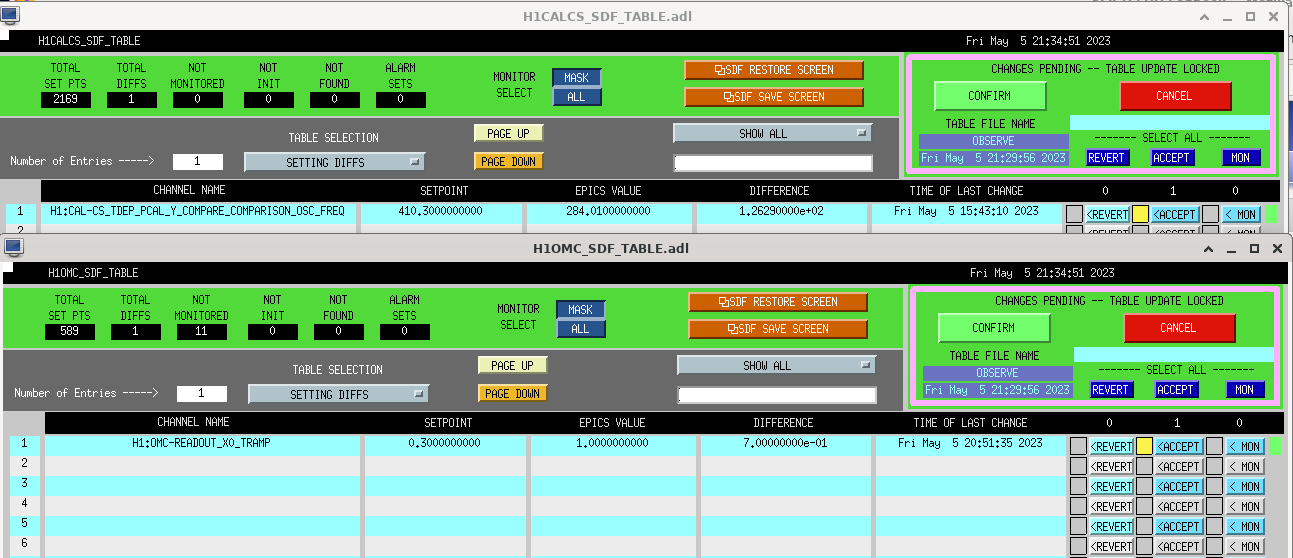
Accepted the new value of 284.01 for H1:CAL-CS_TDEP_PCAL_Y_COMPARE_COMPARISON_OSC_FREQ in sdf, screenshot attached.
(Corey, Jeff, Louis)
Ran another suite of calibration measurements (referencing Camilla's alog 69333). Measurement ended at 1h54min due to a lockloss (most likely seismic, specifically 5.9 EQ from Japan).
Attached is a screenshot of the sitemap > CAL CS > Calibration Monitor screen shortly after starting the measurement.
'pydarm report' command gave attached report:
As a target of opportunity during lockloss downtime, I ran the End Y Hepta roughing pump which is located in the mechanical room from ~11:40am to ~11:50am local time. There is an outstanding question of how much of a noise issue it is to run this pump during non-Tuesday-maintenance periods during the Engineering Run. I have tagged PEM so they can have a look at this.
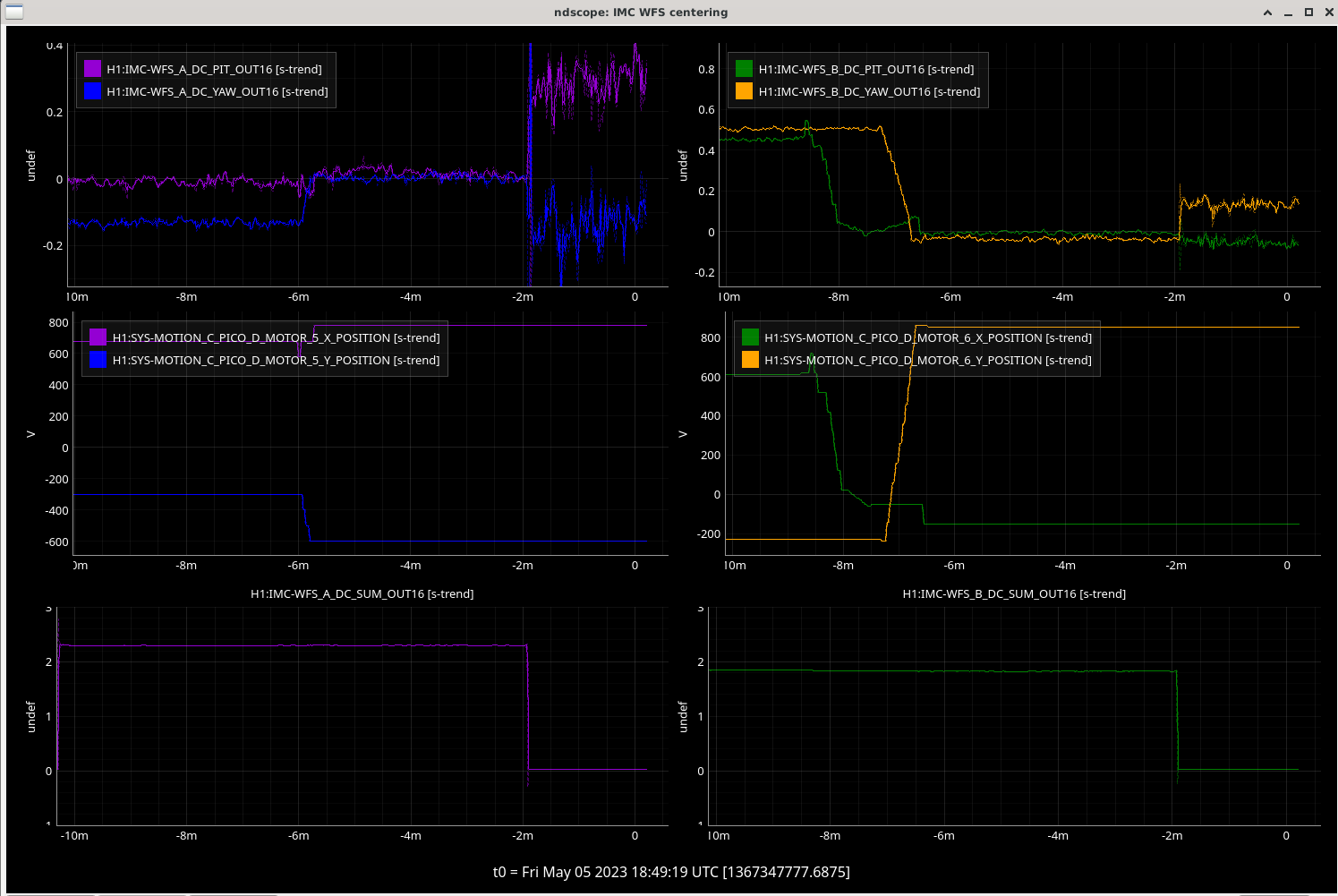
The IMC_LOCK node has been notifying of the IMC WFS not being centered for some number of days. While we were waiting for a small earthquake to roll through, I centered the WFS with a reminder from Sheila's alog54340. Steps were:
A screenshot of the final ndscope showing the movement is attach 2.
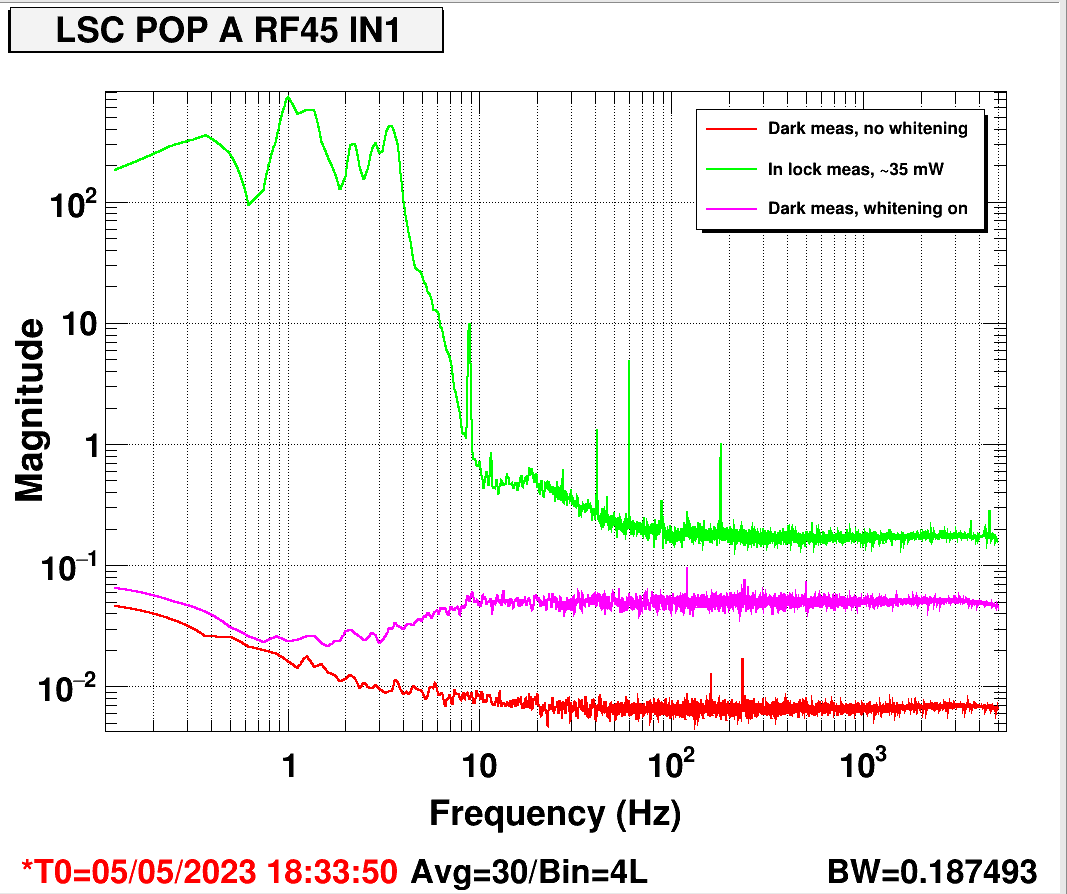
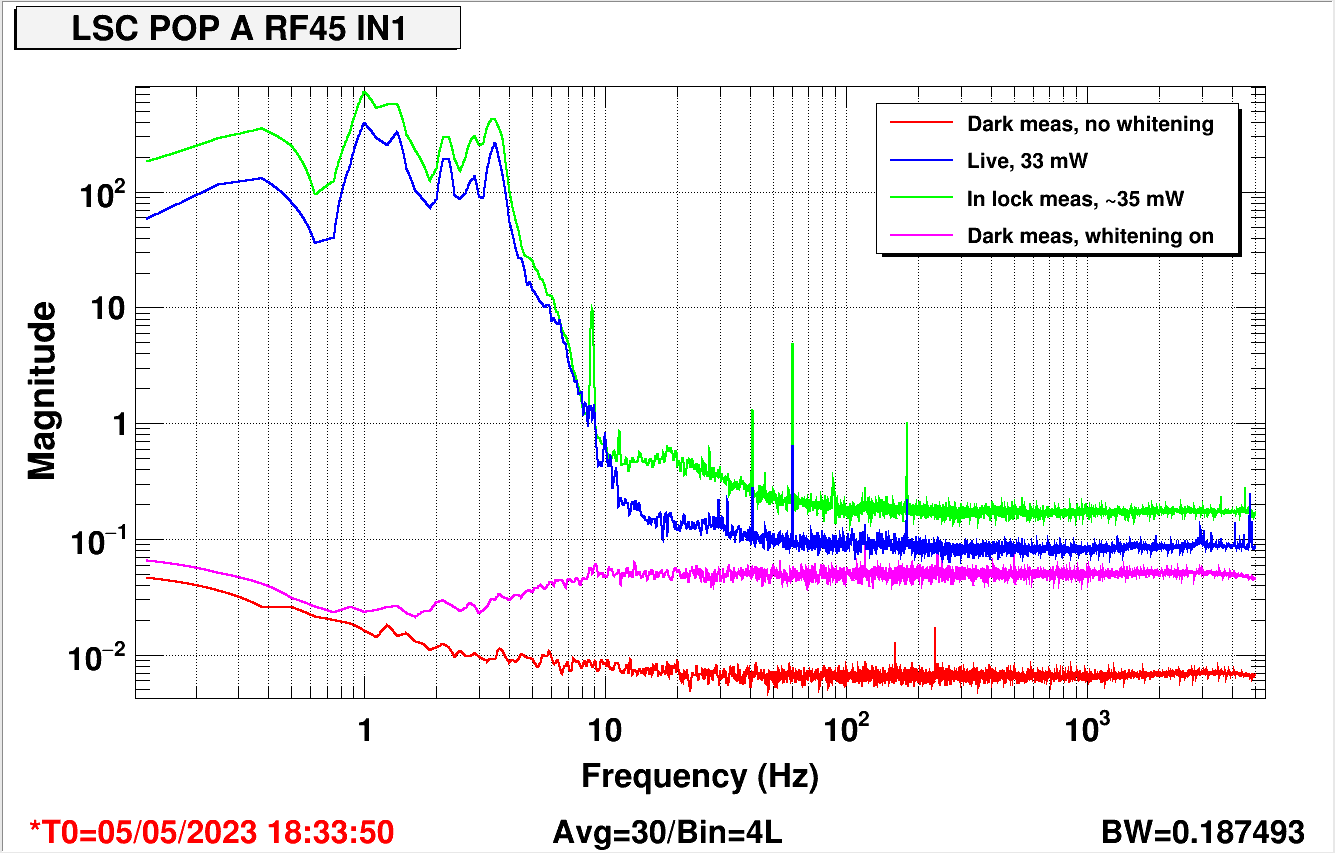
We have been changing the digital SRCL offset to undetune ("zerotune"- Peter F.) the SRC. However, we are wary of saturating POP RF45, and also leaving enough ADC range to handle any glitches. We have been running with 21 dB of whitening gain on POP45. I just did a quick measurement while we are down to determine if we can change the whitening gain. We are shot noise limited on this photodiode, with about 1e-10 W/rtHz of shot noise. The attached screenshot shows three measurements: in lock with 35 mW incident, a dark measurement (IMC offline) with the whitening on, and a dark measurement with the whitening off. Jenne and I determined we can reduce the whitening gain by 6 dB. I made this plot showing the comparison of the three measurements.
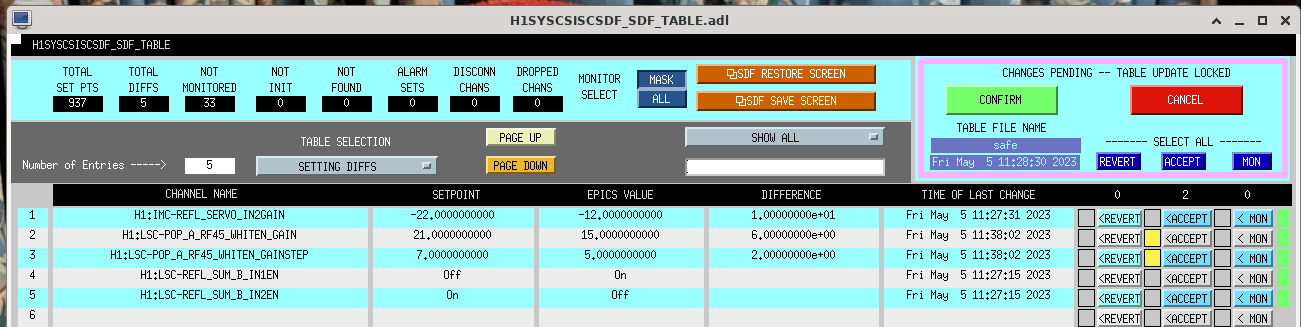
I updated the whitening gain and the anti-whitening gain filter to be 15 dB and -15 dB respectively. These changes were SDFed by Jenne.
This will hopefully allow to increase the magnitude of the SRCL offset further.
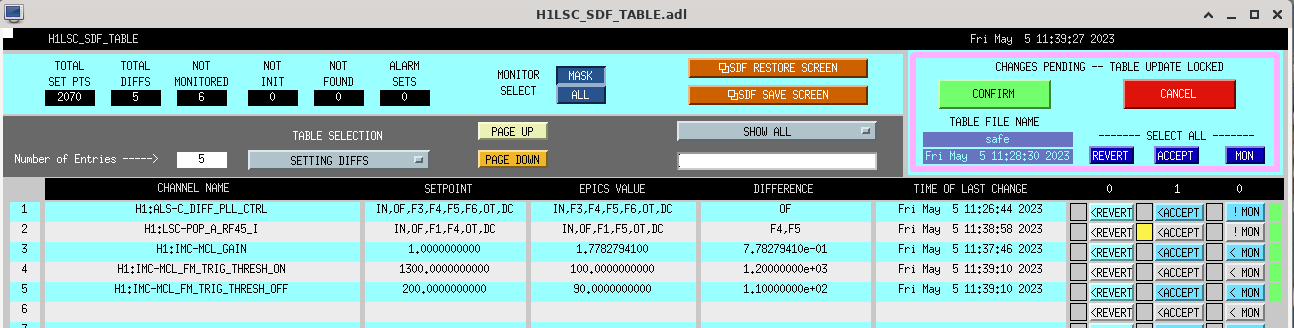
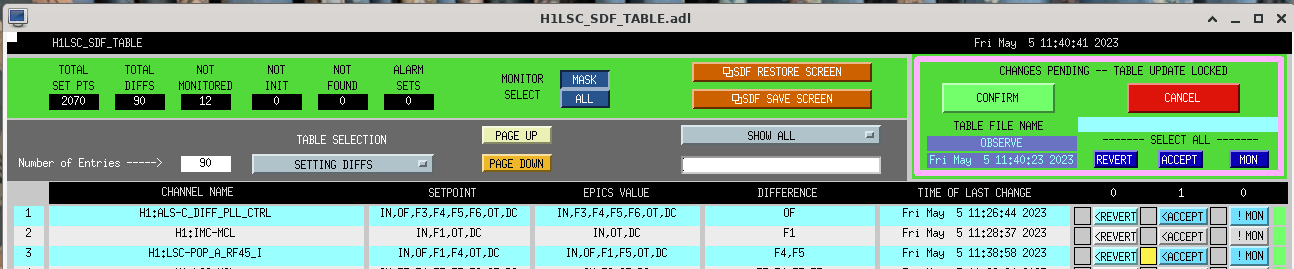
I accepted these changes in SDF. The slow SDFs are same, so only one screenshot. For the FM change, I accepted in both safe and observe.
I forgot to make a corresponding -15 dB filter for the Q channel. I just corrected that now and SDFed in safe. We will need to SDF in observing when we get there.
I added a trace of POP45 back in full lock with the 6 dB less whitening gain. The incident power at the time of this new trace (blue) was about 33 mW. The green trace is from a previous full lokc with the full 21 dB of gain.
With the -200 digital SRCL offset, we now have about 11000-12000 cts on POP45 (versus the ~22000 cts from before), so we have much more room to increase this offset further. Jennie has tested that -240 is even better for undetuning SRCL.
J. Kissel We've been confused when reading off calibration line frequency values from the PCAL oscillator MEDM screen more times than I'd like to admit, so I've edited the screen such that all displays of oscillator frequencies have a precision of 4 digits beyond the decimal place. Compare first row of values in the attached before vs. after. Screen update has been committed to /opt/rtcds/userapps/release/cal/common/medm/ PCAL_END_EXC.adl for LLO to import should they so chose.
Fri May 05 10:05:44 2023 INFO: Fill completed in 5min 43secs
Travis confirmed a good fill via camera.
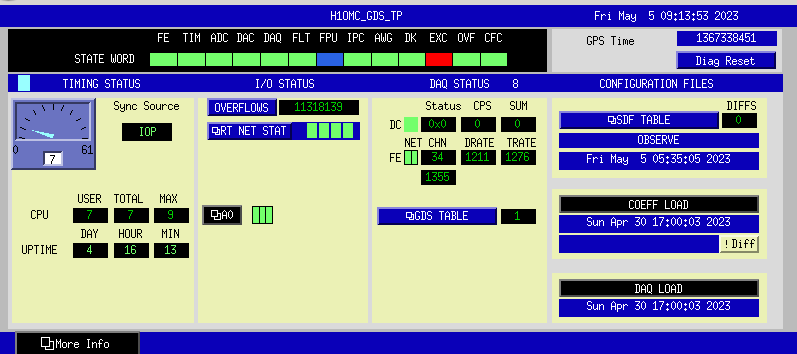
To synchronize the CDS Overview and GDS_TP MEDM colours for O4, I've modified calm_fpu.py to change the colour of some STATE_WORD blocks to RED. The colour changes implemented by this code are:
| FPU | Was RED, Now BLUE |
| EXC | Was BLUE, Now RED |
| OVR,CFC | Was YELLOW, Now RED |
These changes will be made permanent in future RCG releases, but obviously we would not do an RCG upgrade for these cosmetic changes.
L. Dartez, J. Kissel, J. Rollins
In order to
- Improve the answer for the optical gain and cavity pole with the 2023-05-04 (2023-04-20 was the last update had a different 2023-05-03 SRCL offset LHO:69289 and 2023-04-26 TCS settings LHO:69032)
- Make sure GDS has absorbed the PCALX calibration line change from 410.2 Hz to 409.8 Hz (LHO:69303)
- Exercise the more automated updates to "the calibration" using the new command line infrastructure
- Populate the "compensated for time dependence" CFTD path with the correct optical gain (hasn't been updated in forever)
- synchronize the push of CAL-CS Filters, EPICs records and GDS pipeline's FIR filters with the latest parameter file
we've pushed a new calibration to "the calibration," updating
:: H1:CAL-DELTAL_EXTERNAL_DQ
:: H1:GDS-CALIB_STRAIN
:: H1:GDS-CALIB_STRAIN_NOLINES
The preliminary results, by eye, indicate that everything looks great.
Notes are attached. More details to come.
The pydarm_H1.ini file version that corresponds to what was pushed in this aLOG is e6c0e612. Copying over the output of the git history of the file, in order to better annotate it and explain the evolution since the last major review (68514), sorting between major changes that actually impact the IFO's calibration: e6c0e612 Fixed typo in cavity pole frequency and cleened up surrounding notes. - Major Change/Calibration Impacting - In our verbal copy and paste, we made a mistake in the coupled_cavity_pole_frequency. 48728fe7 Updated MCMC parameters and foton export of NoD2N bank with updated cavity pole - Major Change/Calibration Impacting: to facilitate adding in the 2023-05-04 MCMC values for the new IFO based on the 20230504T055052Z measurement and data processing: - coupled_cavity_optical_gain -- new MCMC value - coupled_cavity_pole_frequency -- new MCMC value - uim_NpA -- new MCMC value - pum_NpA -- new MCMC value - tst_NpV2 -- new MCMC value - LHO:69303 - Minor Change: here, the git commit message is actually sufficient. While there is something changing in the noise of the IFO, the darm loop is not changing here, so nothing about the calibrated data stream or its systematic error changes. Changing parameter for these monitor lines "just" impacts the "DARM loop transfer function values at calibration line frequencies" EPICs records, which in turn "just" adjusts the calibration of the output of these monitor lines to match the frequency. 574beded Adding new PCALX systematic error frequencies. fb67ad1c Change the pcal line 4 to 24.5 to temporarily monitor the guardian line being injected 0b863b93 added pcal line low - Major Changes but impacts only out-of-loop monitors: Clustered group of commits as Evan builds in the pydarm infrastructure to process the new PCALX systematic error lines, where the frequencies of those lines have been defined in LHO:64214 for 33 through 283 Hz lines and LHO:69284 for the 24.5 Hz cal_line_low_pcal_frequency. These new parameters correspond to, and are new as of, merge requests to pydarm, MR 237 and MR 238, and the "first light" end results that show the benefits of adding these parameters are shown in LHO:69301. c512d474 Updating free parameters to 20230420T014029Z MCMC values; foton inverse - Major Change/Calibration Impacting: This the parameter set that was used during the Apr 26 2023 pushed discussed in LHO:69047 to update to the Apr 20 2023 configuration of the IFO. - coupled_cavity_optical_gain -- new MCMC value - coupled_cavity_pole_frequency -- new MCMC value - uim_NpA -- new MCMC value - pum_NpA -- new MCMC value - tst_NpV2 -- new MCMC value - [calcs] parameter xarm_output_matrix to represent reality of the matrix, set at -1. 3a36bec4 updated val to boolean - Minor change: use syntax change changing the SRC detuning is_pro_spring, converting a "1" to a "True." This parameter is a part of the sensing function MCMC processing that's currently is not use. cd52bb42 Modified pydarm representation of the CALCS actuator output matrix. Disagrees... - Major Change/Calibration Impacting: Changed the [calcs] parameter xarm_output_matrix because of confusion about signs -- see G2300832. Namely, we were under the impression that GDS preferred the sign of this matrix to be +1 in order to make GDS FIR filters make sense. Turns out there was an issue with Maddie's branch of the repo, and/or her local checkout of pydarm. 83764fcb The conceptual error in LHO:68514 was NOT a conceptual error -- re-adding... - Minor change: had mistaken the 44 kHz pole in the OMC DCPD whitening filter as switchable, but it's not. So, made sure the "whitening OFF" list of super-Nyquist poles still had this in place. A lot of work over the past two weeks!
TITLE: 05/05 Day Shift: 15:00-23:00 UTC (08:00-16:00 PST), all times posted in UTC
STATE of H1: Lock Acquisition
CURRENT ENVIRONMENT:
SEI_ENV state: CALM
Wind: 15mph Gusts, 12mph 5min avg
Primary useism: 0.04 μm/s
Secondary useism: 0.13 μm/s
QUICK SUMMARY:
H1's been locked just over 2hrs (after being down ~100min to relock on its own). Range is hovering just below 135Mpc.
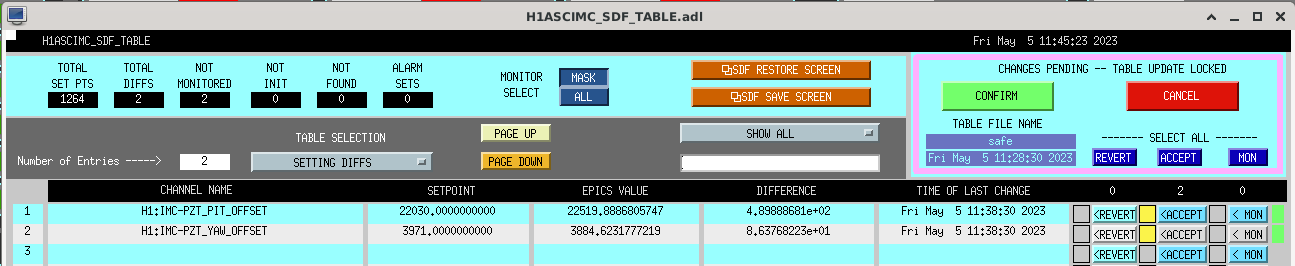
I forgot to note we are running in "Automatic" with GRD_IFO and we are NOT in observing. In SDF I do see (2) diffs for SUS damping filters for ITMx & ETMy. (screenshot is attached). Didn't see anything in a quick scan of chat, and will look at alog next.
Also: When I click the "list" feature for the Observation Bit, it comes up with an error: "python3: can't open file '/opt/rtcds/userapps/release/sys/ifo/guardian/IFO_NODE_LIST.py': [Errno 2] No such file or directory"
ACCEPTED the ITMX/ETMy L1_DAMP Filter diffs noted aboe. Which automatically took us to OBSERVING. (I then switched to Managed Observation Bit mode.)
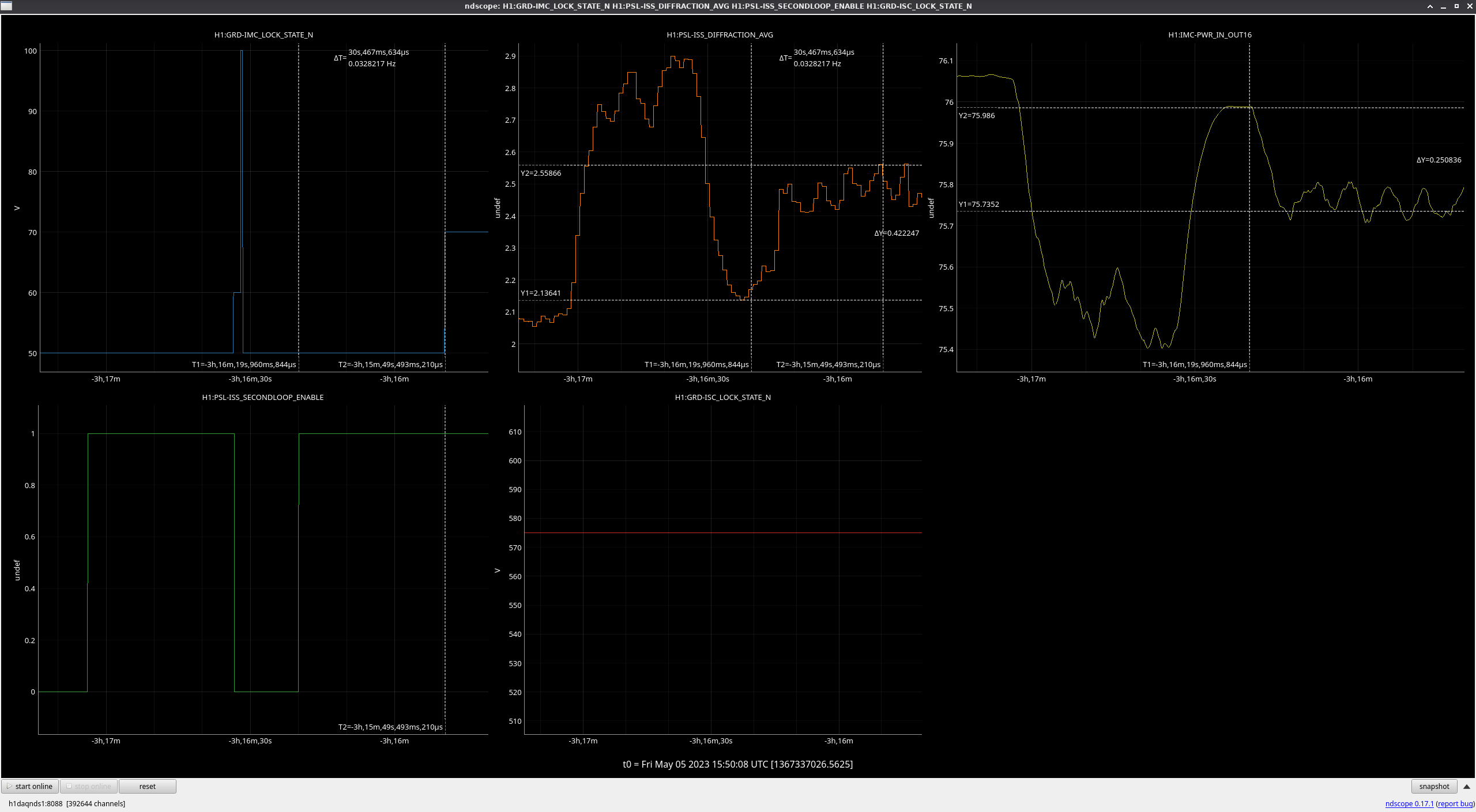
I have updated the IMC_LOCK guardian to open the ISS second loop if the diffracted power changes by more than 30% when first closed, then close it again. The check lives in the CLOSE_ISS state, where the necessary things are done to close the second loop. When the second loop closes, the guardian now waits for 30 seconds to see if the ISS diffracted power changes by more than 30% (high or low), and if it does, request OPEN_ISS to open it again. The node will stall briefly, but then it will move to close the second loop again by going through the LOCKED and CLOSE_ISS states. This update should fix our recurring issue where the input power differs lock to lock due to the second loop engaging its DC coupling at an irregular place and changing our input power, sometimes by up to 1.5W.
I encountered an issue when testing this change where if the node had a notification, in this case the IMC WFS needed centering, the unstall_nodes decorator used by ISC_LOCK to revive its subordinates wouldn't work. This meant that IMC_LOCK would see the diffracted power had changed too much, correctly move to OPEN_ISS, then get stuck. To remedy this, TJ and I decided the best course of action was to move this notification into DIAG_MAIN. I then raised the threshold for the IMC WFS checker in IMC_LOCK to 0.7, up from 0.5, so that IMC_LOCK would only show a notification if the WFS are very off-centered.
All of these changes have been appropriately updated in svn.
Austin, Betsy, Karla, Rahul
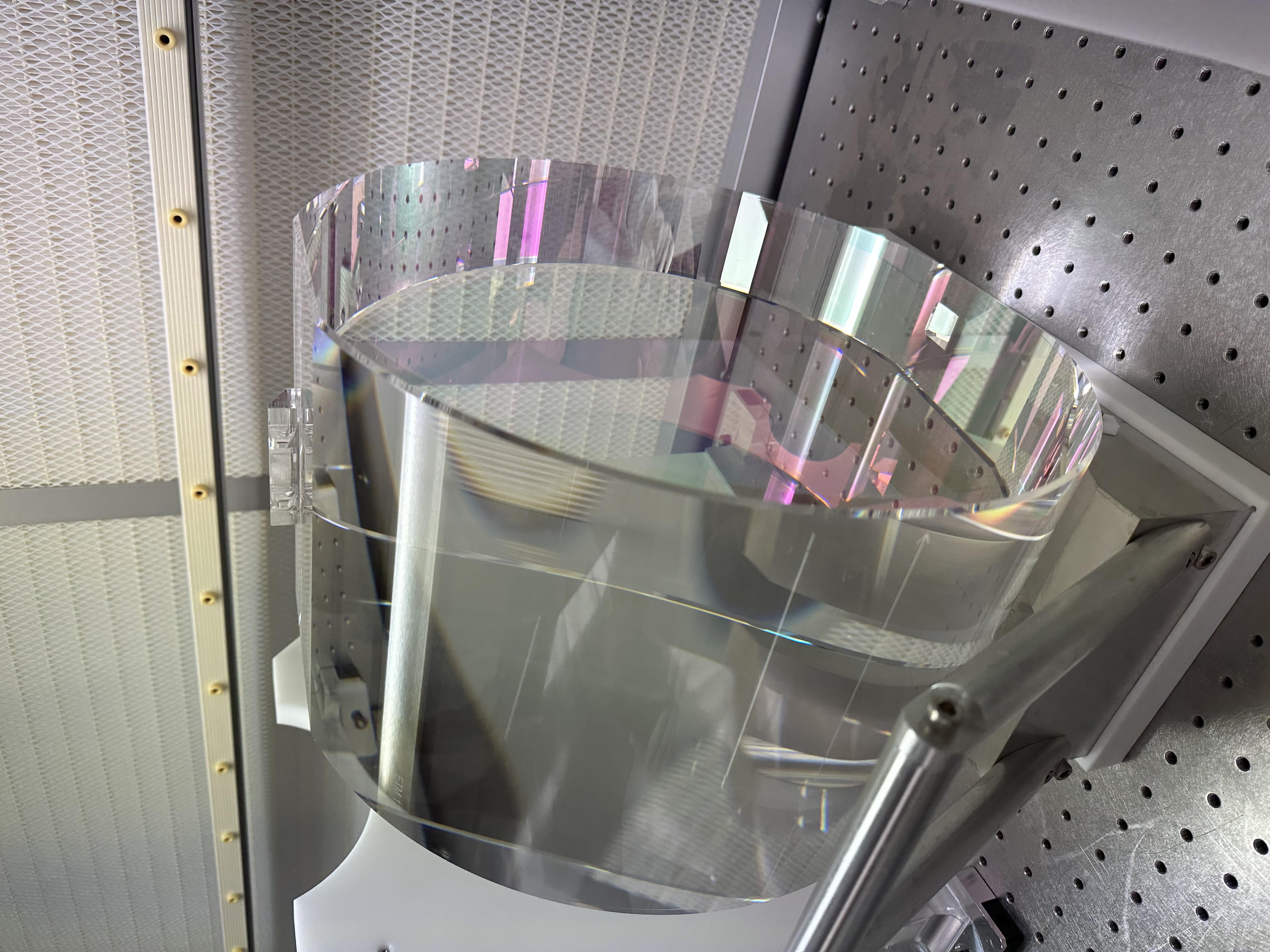
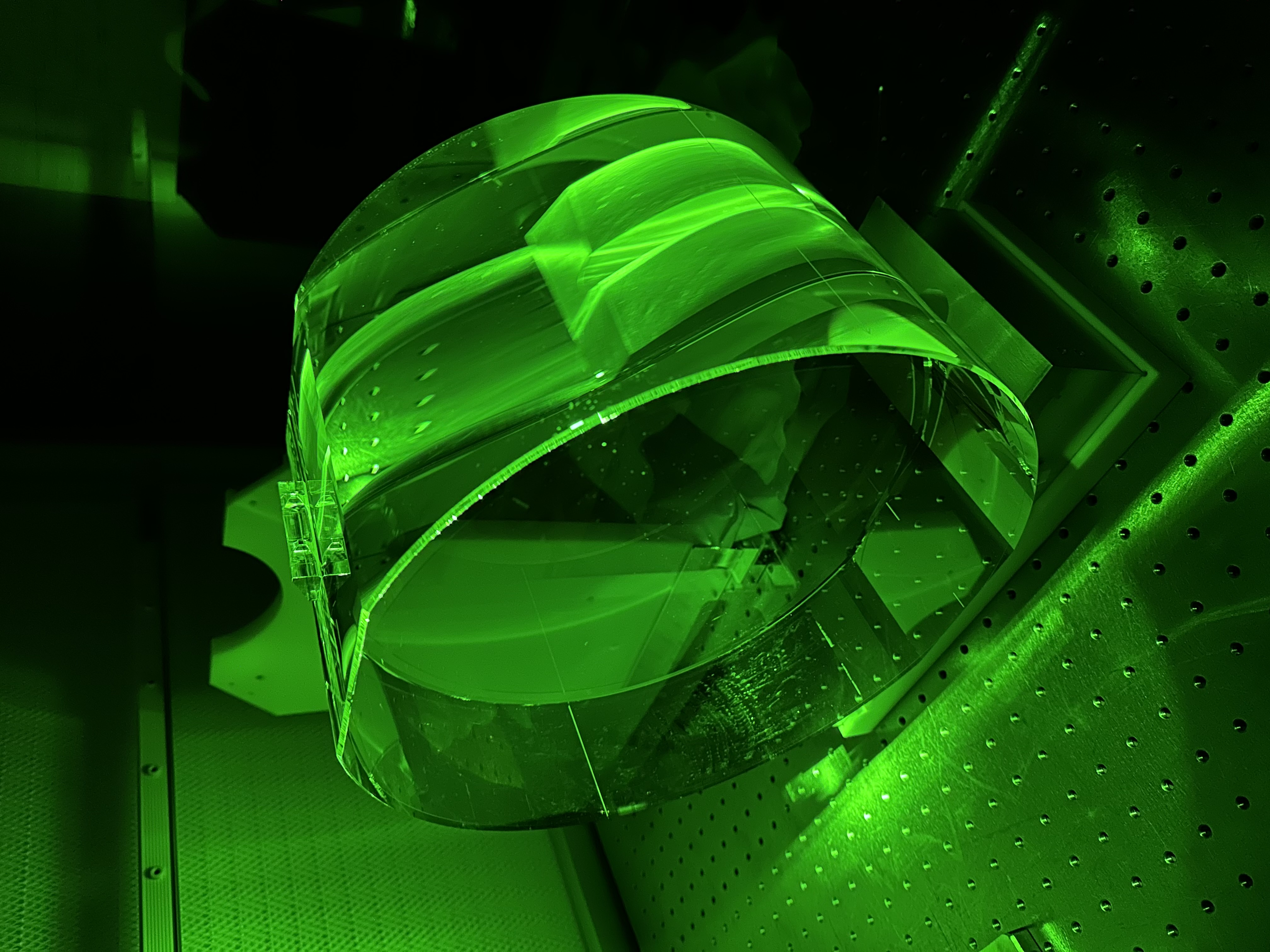
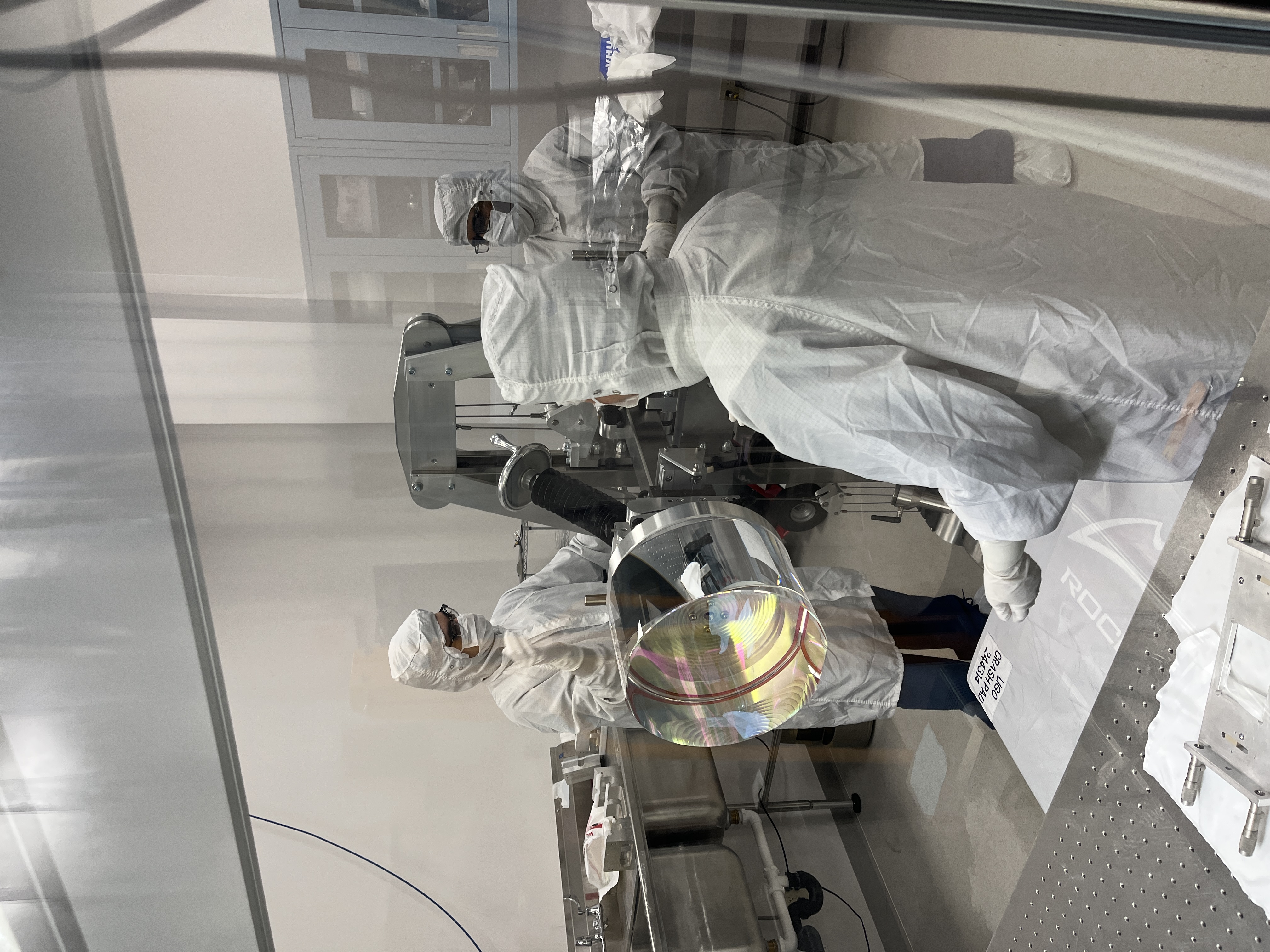
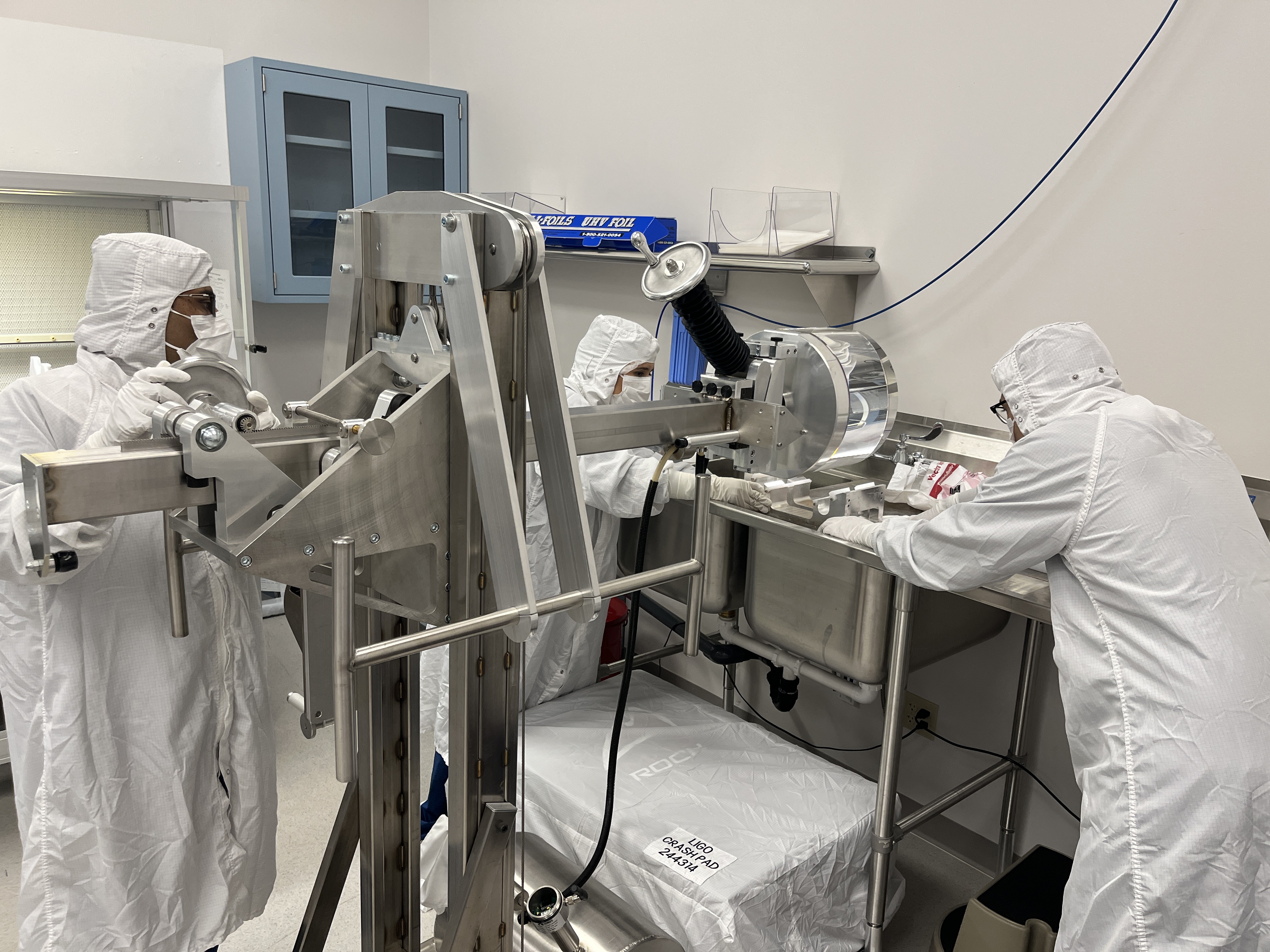
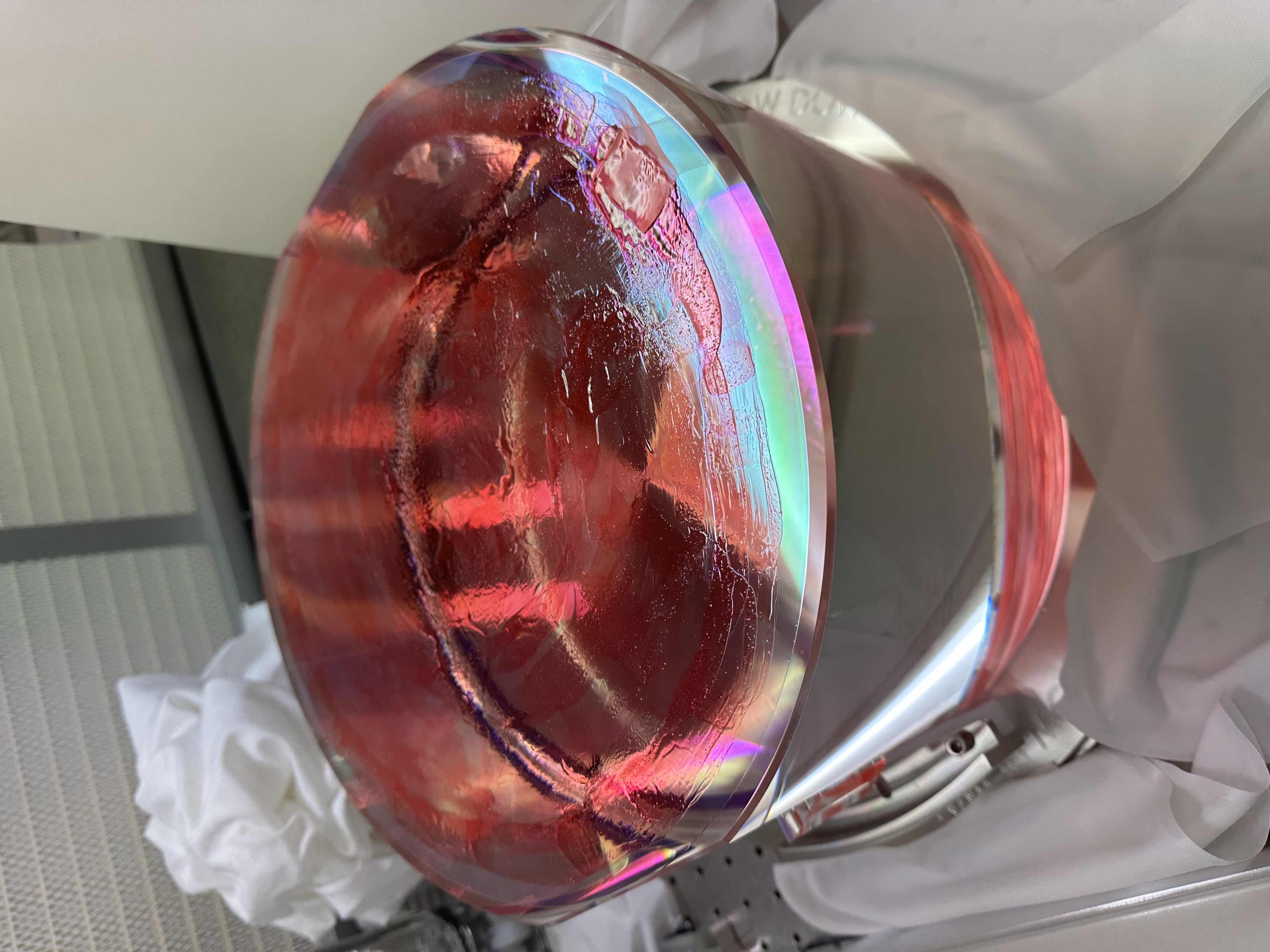
We have finished bonding fused sillica Ears to ETM12 using Hydroxide Catalysis Bonding (HCB) technique, please see pictures attached below for reference. The ear-test mass bond layer has few air bubbles within our tolerance (less than 50 sq mm of the total bond area). We can confirm that the position of both the ears on the two flat surface of the mirror are within the required +-0.1mm.
ETM12 (also see galaxy page for details on the optic) is a our spare test mass mirror between the two sites. The details of the ear and test mass mirror is given below,
- Ear s/n 30077403-04 (Q2300015) is bonded to the flat side S3.
- Ear s/n 30077403-05 (Q2300016) is bonded to the flat side S4.
Both the ears were 22.3 grams heavy (measured using a calibrated scale in a clean room).
The fiducial line measurements on the optic was performed at CIT and the details are posted in E2200356_v1.
I have uploaded the latest version V27 of Jig settings calculation on the DCC.
We still need to measure the total weight of the optic and apply First contact to clean the HR side.
This afternoon Karla and I applied First Contact on the HR side of ETM12 to clean the speckles. See the picture attached below. Later we removed it when it was dry. We then inspected the HR surface and it looks cleaner than before.
Today we measured the mass of ETM12 and it was found to be 39606 grams (Jig + ETM12 =46602grams, Jig= 6996grams).
The humidity in the lab was 40% and temperature was 20.2 degree C (measured using ThermPro borrowed from Rick's PCAL stuff).