
erik.vonreis@LIGO.ORG - posted 06:16, Tuesday 25 April 2023 (68972)
Workstations rebooted
Workstations were updated and rebooted.
Workstations were updated and rebooted.
Elenna, Dan
We wanted to test the original asymmetric CO2 powers we had back at 60W to see if we could get back to lower frequency noise.
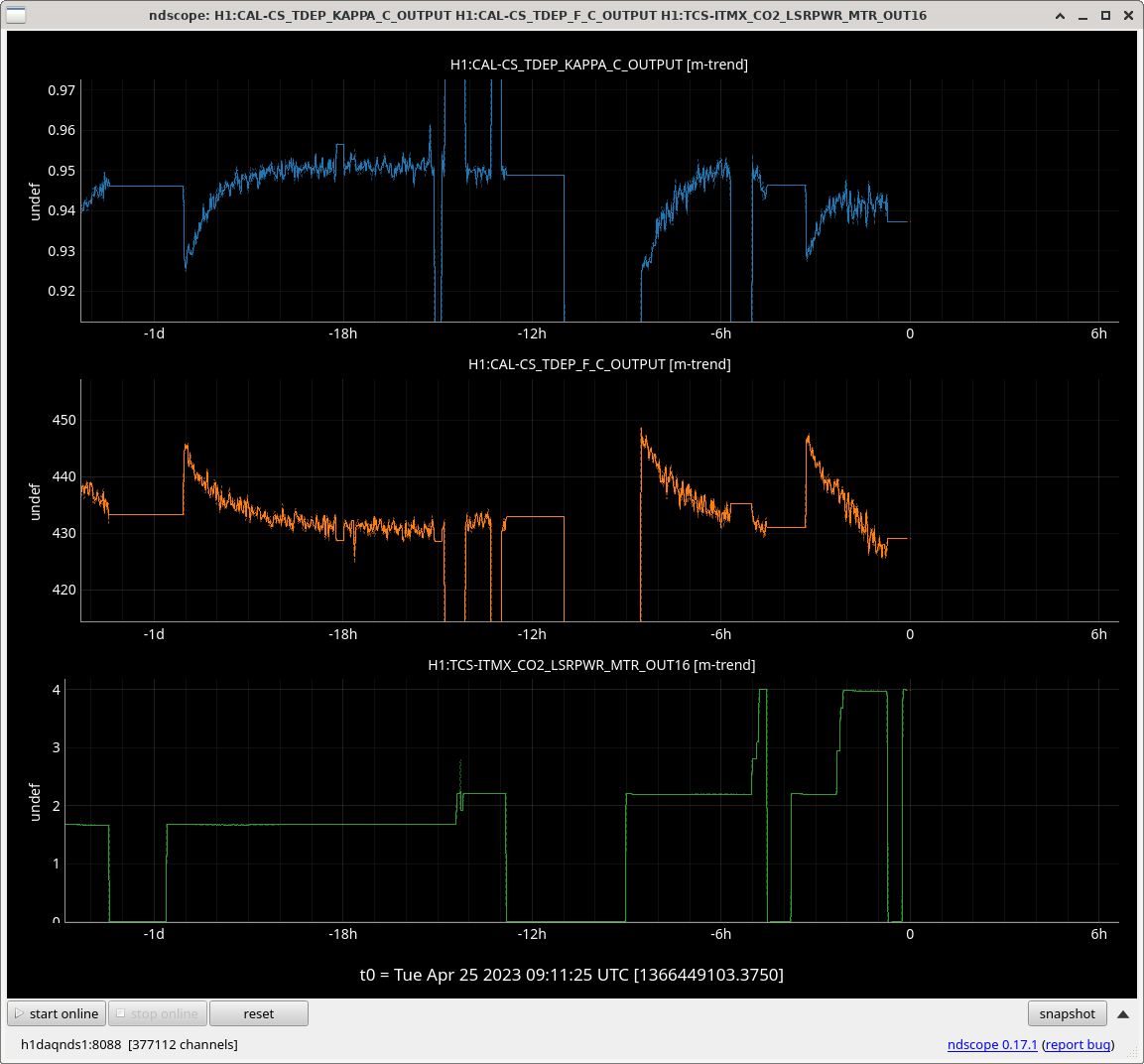
Elenna had been doing some steps and measurements and I took over when she left. Elenna had set the nominal requested CO2 in lscparams to 2.7W (which is actually 4W of actual annular CO2) and I was going to come in a few hours later and take some measurements. However the TCS guardians didn't seem to take us there, probably not reloaded. I changed CO2X by hand up to 4W with the aim of coming back a few hours later to do the measurement.
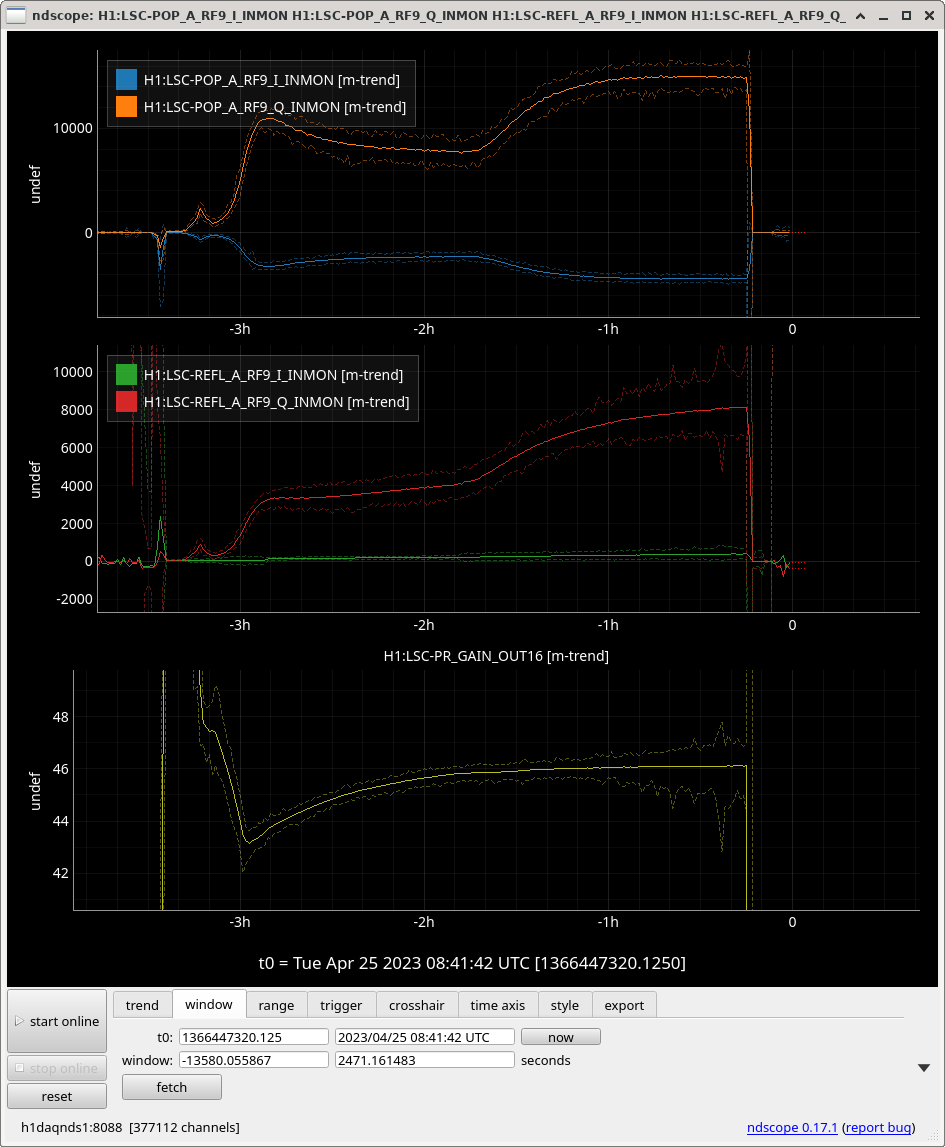
About 1.5 hours later there was a lockloss, PRG became very noisy. Looking at POP_A_RF9_{I,Q}_INMON they both doubled in counts. I didn't measure PRCL gain but maybe this CO2 change in combination with the new fixed thermalisation gain scaler increased it too much.
I didn't get a chance to do the measurements we wanted (contast, spring, frequency coupling) so I've set the nominal CO2X to 2.7W requested and reloaded the guardians. I've set the THERMALISATION guardian to IDLE to see if this will hold a longer lock. I'll come back in a few hours and see how it's doing and try to take the measurements if it survives.
Looking at the lines before lockloss, it seems going back to an asymmetric CO2 setting 4W and 1.7W on X and Y reduces the 200 and 4500 Hz frequency noise coupling a little but increases the 25.2Hz coupling. Arm power is also slightly down by a few kW. This also looks like it will eventually reduce both the optical gain and cavity pole judging by their trends.
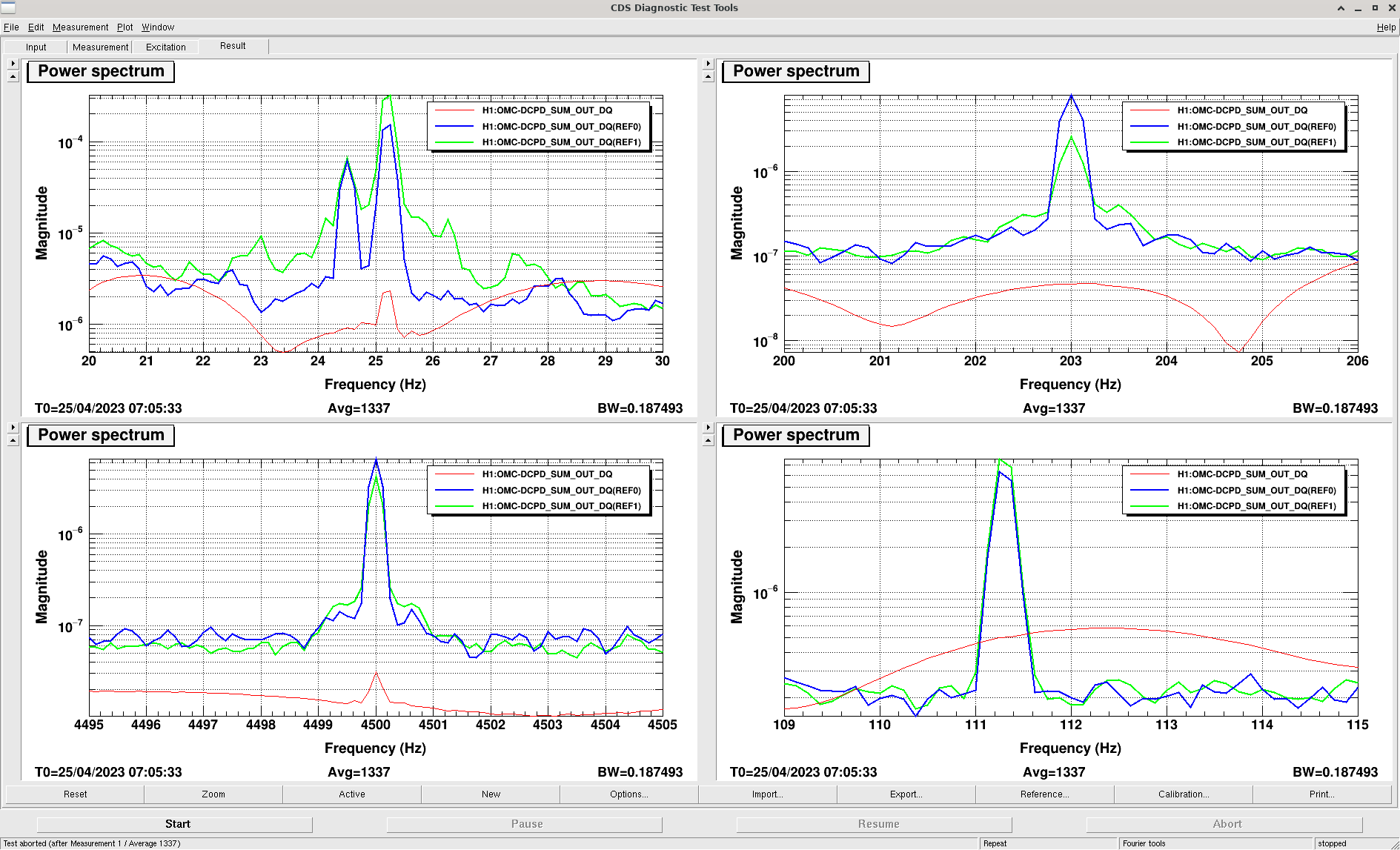
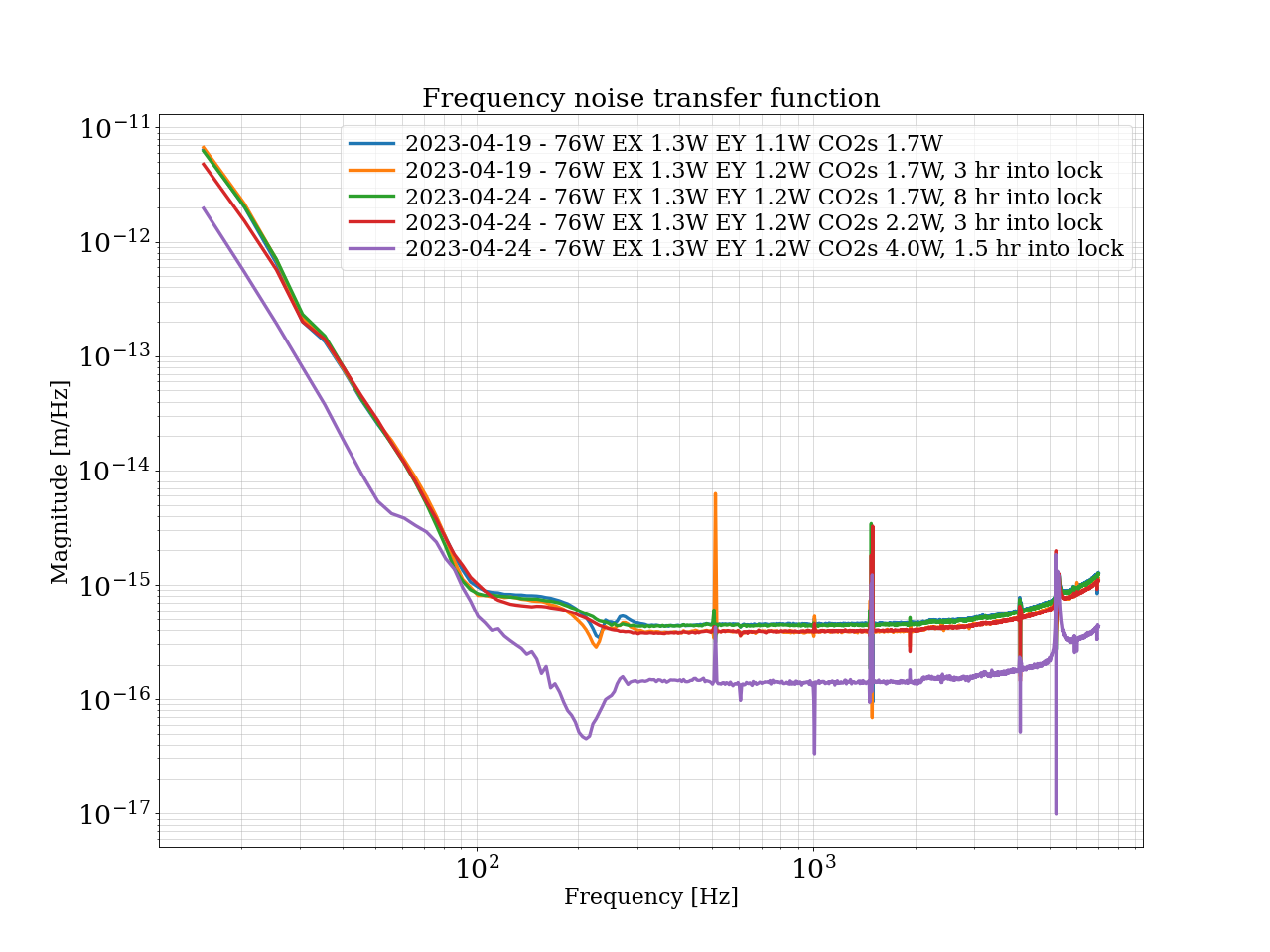
I think we have some promising results from this test, although it is mostly inconclusive because we were unable to get well-thermalized data. As an aside, I think many of our locklosses were related to the fact that the PRCL UGF servo trend had been measured at a different thermal state, so it might not have been properly tuned for the new CO2 settings.
CO2X at 4W, CO2Y at 1.7W
Frequency noise: according to this plot it has improved. Keep in mind we are comparing traces later in lock with a trace 1.5 hrs into the lock. However, that is a significant change.
Contrast defect: slightly worse, 2.2 mW again. Same caveat as above
DARM spring: appears improved too, again with caveats. This was measured with the SRCL offset at -165 (nominal)
The frequency noise and DARM spring plots also show the results with CO2X at 2.2W (CO2Y at 1.7W). The results show either no change or minimal change.
I think these results are promising enough that we should keep these CO2 settings in the guardian. Tonight's lock after maintenance we will remeasure these parameters while we thermalize and after thermalization (~3-5 hrs into lock). We will also monitor and adjust the PRCL gain by hand. When we do DARM spring measurements, we will take multiple measurements with different SRCL offsets.
Overnight locklosses reported in alog 68988. One unknown, one from a PI, last 3h lock ended by Tuesday maintainance.
Analysis from the modulation depth test.
Power-recycling gains for sidebands and carrier
9 MHz PRG = 54.6
45 MHz PRG = 27.2
Carrier PRG = 46.2
Reflection ratios for sidebands and carrier
9 MHz reflection ratio = 0.226
45 MHz reflection ratio = 0.316
Carrier reflection ratio = 0.063
| Channels | 9 MHz | 45 MHz | Carrier |
|---|---|---|---|
| H1:IMC-PWR_IN_OUT16 | 0.013 | 0.015 | 0.973 |
| H1:IMC-IM4_TRANS_NSUM_OUT16 | 0.013 | 0.015 | 0.972 |
| H1:LSC-REFL_A_LF_OUT16 | 0.043 | 0.068 | 0.889 |
| H1:LSC-REFL_B_LF_OUT16 | 0.041 | 0.066 | 0.893 |
| H1:LSC-POP_A_LF_OUT16 | 0.015 | 0.009 | 0.976 |
| H1:ASC-POP_A_NSUM_OUT16 | 0.015 | 0.009 | 0.976 |
| H1:ASC-POP_B_NSUM_OUT16 | 0.015 | 0.009 | 0.976 |
| H1:ASC-AS_C_NSUM_OUT16 | 0.190 | 0.509 | 0.301 |
| H1:ASC-OMC_A_NSUM_OUT16 | 0.190 | 0.557 | 0.253 |
| H1:ASC-OMC_B_NSUM_OUT16 | 0.197 | 0.635 | 0.168 |
| H1:ASC-X_TR_A_NSUM_OUT16 | 0.004 | 0.007 | 0.989 |
| H1:ASC-X_TR_B_NSUM_OUT16 | 0.004 | 0.007 | 0.989 |
| H1:ASC-Y_TR_A_NSUM_OUT16 | 0.004 | 0.007 | 0.989 |
| H1:ASC-Y_TR_B_NSUM_OUT16 | 0.004 | 0.007 | 0.989 |
Relative to https://alog.ligo-wa.caltech.edu/aLOG/index.php?callRep=68696
We seem to be reflecting more 9 and less 45. The 45 PRG has increased to 27. We appear to still have a large percentage of 9 at the AS port
TITLE: 04/25 Eve Shift: 23:00-07:00 UTC (16:00-00:00 PST), all times posted in UTC
STATE of H1: Commissioning
SHIFT SUMMARY:
- Beginning of shift was mostly waiting for ringdown from the huge EQ from earlier in the day and getting the IMC to lock after a power supply swap, log here
LOCK #1:
- Had to intervene with locking ALS and DRMI (through ACQUIRE_PRMI), but not by much
- Acquired NLN @ 00:35 UTC, where multiple measurements were done
- LOCKLOSS @ 4:38 UTC due to CARM sensor switching from B to A
LOCK #2:
- Again, had to intervene with locking ALS, though I probably should have given GRD more time to see if it could do it on its own
- Had issues with DRMI again, gave GRD ~5 minutes before intervening, I moved PRM ~35 microradians in Y and ~6 microradians in P to be able to catch PRMI
- Acquired NLN @ 5:50 UTC
- Leaving the IFO locked at NLN, Dan is currently running AWG lines and CO2 stepping from 2.2 W to 4 W
LOG:
| Start Time | System | Name | Location | Lazer_Haz | Task | Time End |
|---|---|---|---|---|---|---|
| 00:05 | ISC | Adrian | CER | N | Quick checks | 00:07 |
| 00:37 | ISC | Jeff | CR | N | Turning on PCAL/DARM lines | 03:27 |
| 01:40 | ISC | Elenna | CR | N | AWG line injections/ADS lines/DARM OLG | 05:44 |
| 06:52 | ISC | Dan | Remote | N | CO2 stepping/AWG lines | ONGOING |
Next three locklosses:
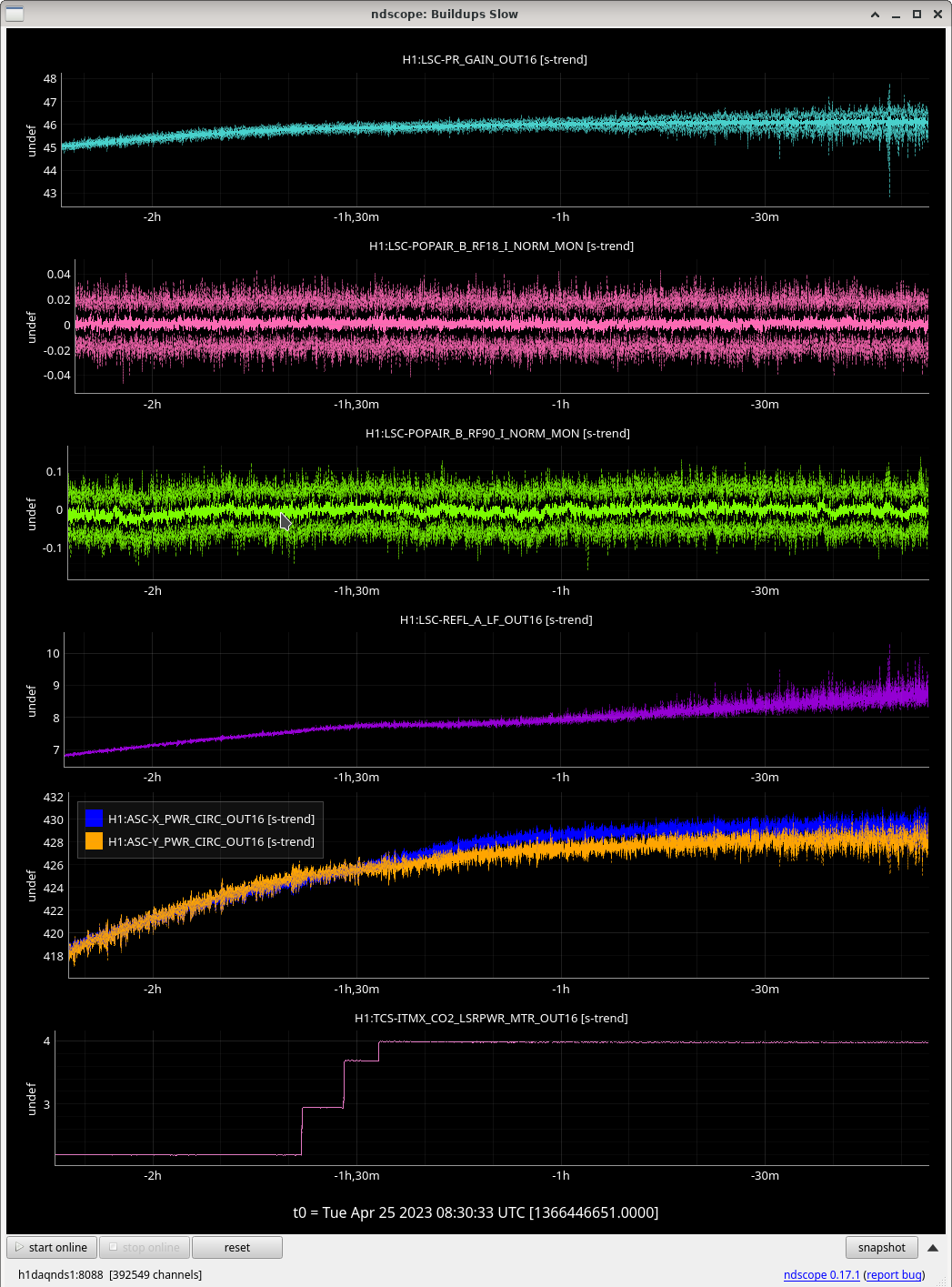
2023-04-25 08:28:29 UTC 2h30 at NLN. CO2X was increased from 2.2W to 4.0W 1h30 before lockloss. Unsure of cause. Not PI. Not Violins. Buildups attached.
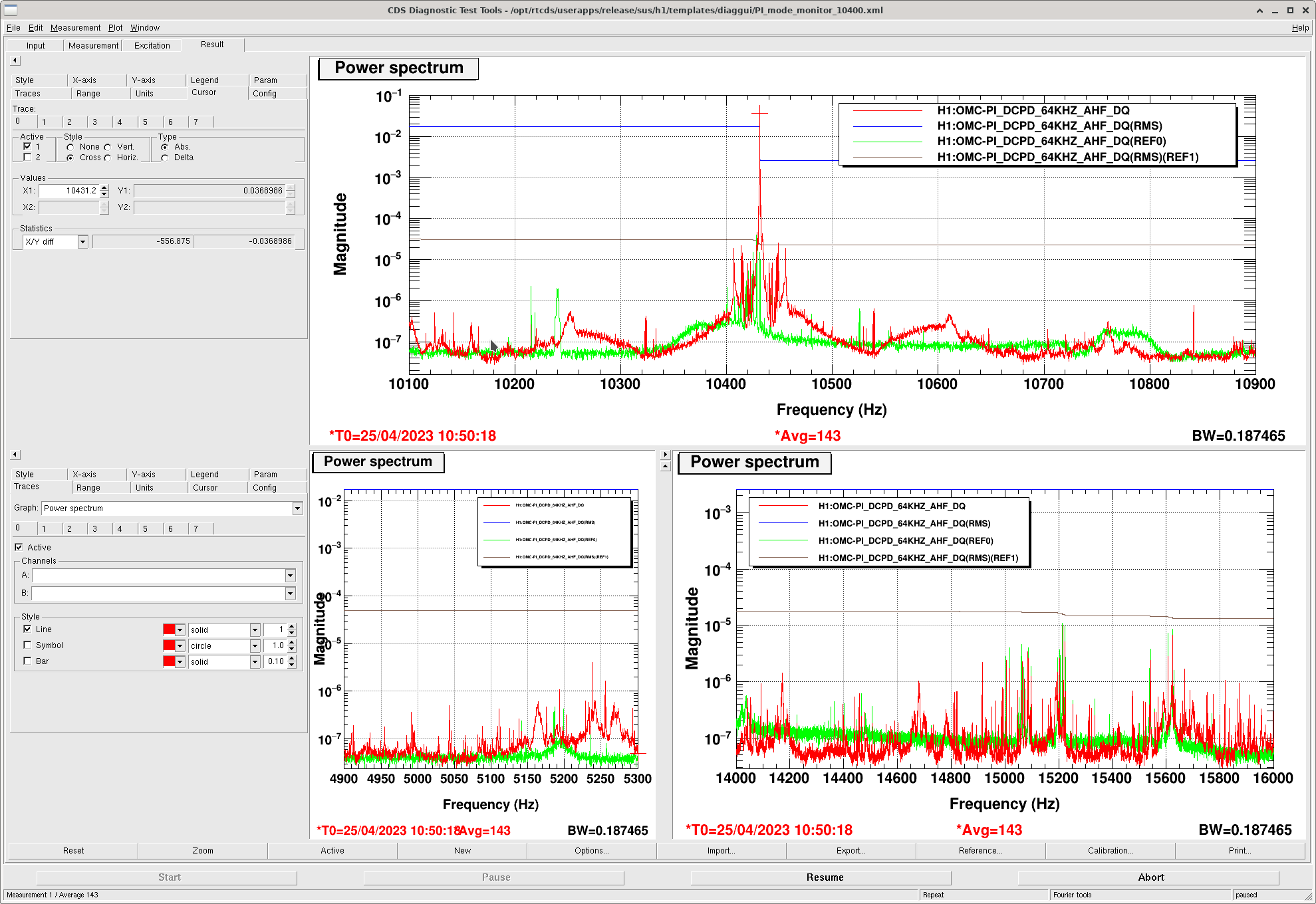
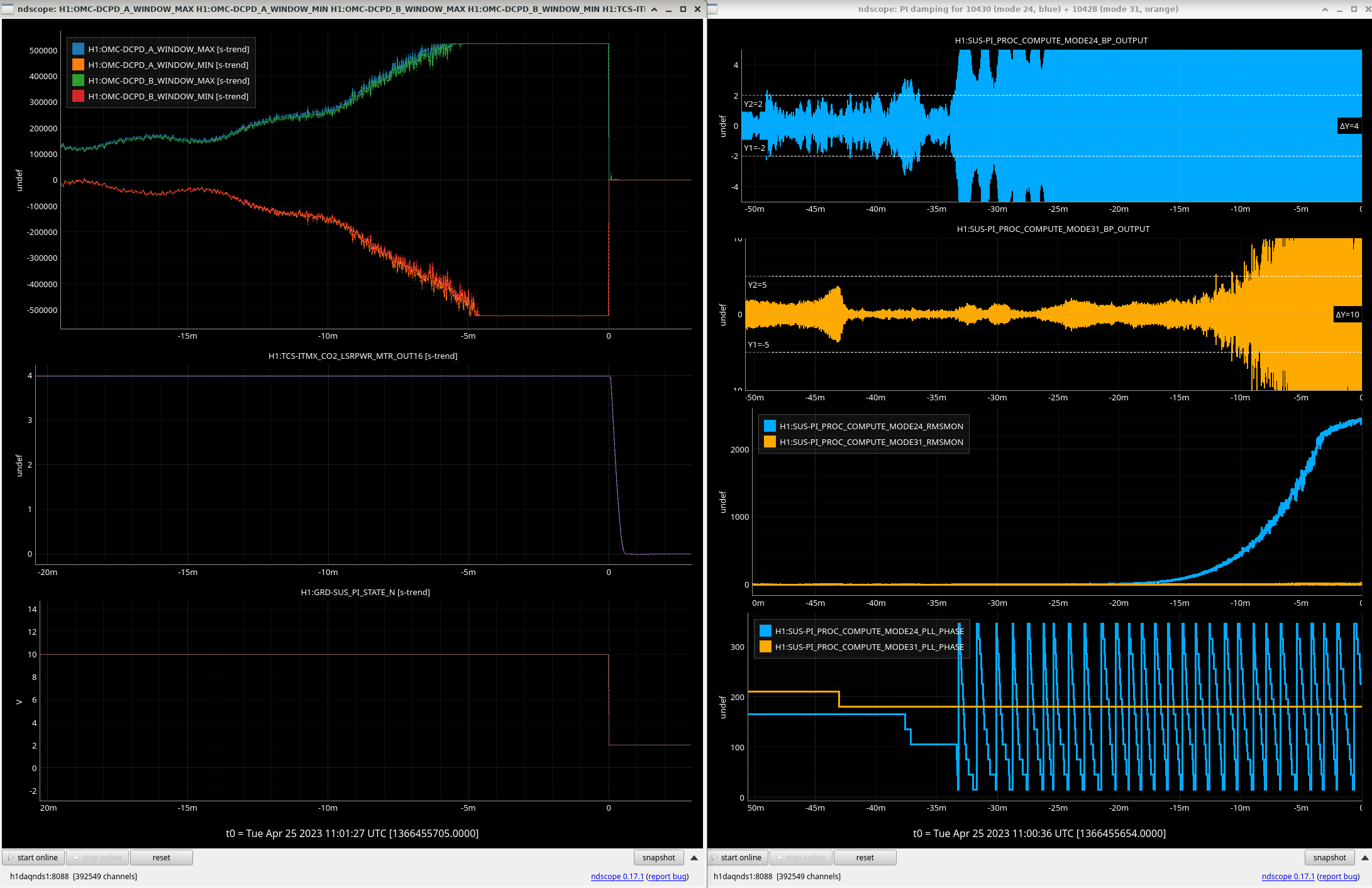
2023-04-25 11:01:27 UTC 1h30 at NLN. CO2X at 4W throughout lock. 10.4kHz PI. See attached. SUS_PI guardian was in state PI_DAMPING but didn't work well enough, maybe the mode rang up to quickly. We can make guardian smarter if these locklosses continue as it currently changes phase if the RMSMON is above a certain value rather than checking if RMSMON is decreasing. See attached.
2023-04-25 15:00:29 UTC 3h into NLN. CO2X at 4W throughout lock. Lockloss from Tuesday Maintenance start.
All locks: CO2Y at 1.7W, Ring Heaters: IX 0.4W, EX: 1.3W, IY 0W, EY 1.2W.
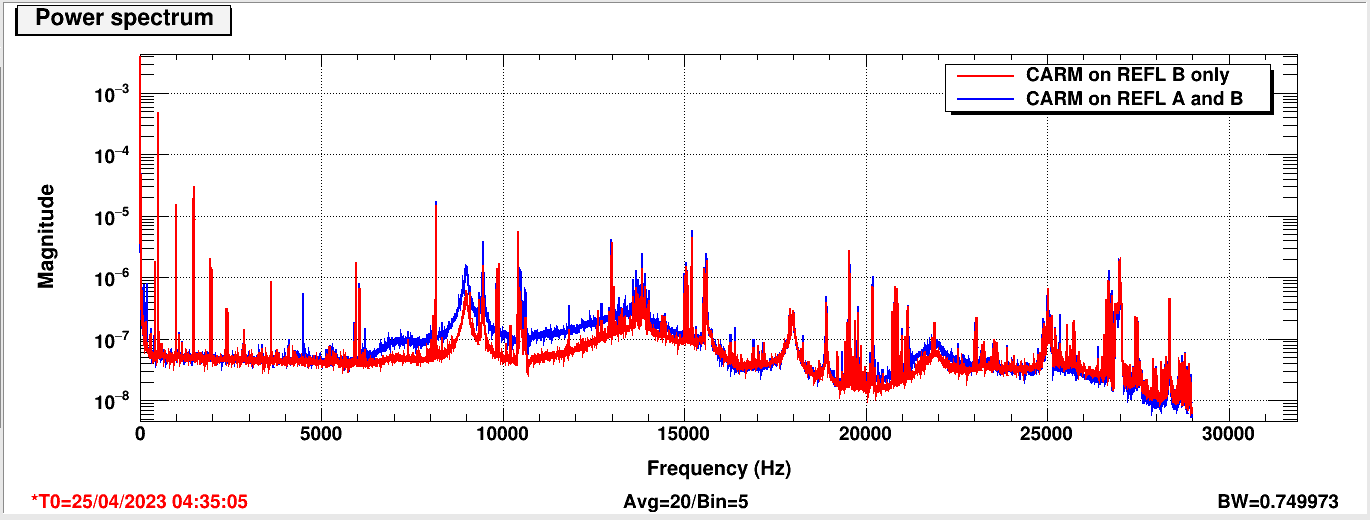
The high frequency "tail" of DARM from 5-7 kHZ, which is a region limited by frequency noise, seems to improve when the CARM sensor is switched to REFL B only. I discovered this first by accident: when we run the frequency noise injection for the noise budget, we switch CARM over to REFL B and measure the frequency noise using REFL A as an out of loop sensor.
The process by which I switch the sensor is one that Craig described to me, and I have done several times:
To switch back to two sensors, I reverse the steps above.
I have attached the high frequency spectrum of DARM from the 64kHz channel, showing the reduction in noise in DARM when CARM is just sensed on REFL B. I believe this is occurring because this is the region where CARM is gain limited. What I don't understand is how switching to one sensor (and correcting for the gain), is causing such a large change.
I was hoping to switch over to REFL A only and see if this holds true for the other PD, but I forgot I was running ADS on at the time and I railed the ADS causing a lockloss.
I see that this is likely a math error on my part. When I made the change I thought "12 dB on each sensor, 24 dB on one sensor", but I need to add the gains, meaning factor 4 gain on two sensors, factor 8 gain on one, or 18 dB (oops!). I have been inadvertently increasing the CARM gain by a factor of two when moving to one sensor. I'm impressed that I was able to do this without causing any problems. If we feel we have room to increase the CARM gain, we can improve the high frequency tail on DARM. I'm not sure what kind of gain margin we have, but apparently 6 dB extra does not cause immediate problems. Happy accidents and/or math errors?
I think alog67214 and alog67584 are the latest measurements of CARM OLG in Feb. The gain margin was ~13dB at that time. It might be better to measure it again with current 76W configuration.
Looking at the CARM OLGs Naoki posted, we were running with a lower UGF than in O3.
In O3, we pushed the CARM UGF up to around 25 kHz to suppress the HF noise we saw.
You can't go beyond 37 kHz because of the FSR.
IFO acquired NLN @ 00:35 UTC and is still locked. Wind started picking up at the end stations but nothing too crazy. There are currently a few measurements/injections ongoing, namely PCAL/DARM lines and AWG line injections.
J. Kissel

Testing out the new CAL_AWG_LINES guardian between lock stretches (LHO:68950), I ran into some errors that I didn't understand and didn't have time to debug. But, I also want to see this lock stretch's thermalization, so I've turned on the new thermalization calibration lines in the same way I drove them during amplitude testing (see LHO:68947).

There's a DTT template on cdsws03 driving the DARM_EXC lines in the control room. Let's hope it doesn't crash. Abort it if there's another lock loss, or you need to take sweeps.

OR alternatively it's saved to
    /ligo/home/jeffrey.kissel/2023-04-25
        2023-04-25_DARM_EXC.xml
if you need to restart it before tomorrow.

The lines have been in and on since 2023-04-25 00:40 UTC.
J. Kissel, J. Betzwieser
WP 11138

Importing more needed infrastructure from LLO (LLO:64213) I've updated some library parts which take in the following changes to the corner-station CAL-CS model (h1calcs):
    - Adding more infrastructure to be able to demodulate the new(ish) PCALX systematic error lines,
    - Adding a few more EPICs records that represent corrections to PCAL, DARM, and DELTAL channels, after finding a new level of understanding about correction factors, delays, and advances from LHO:68880
    - Along the way, this brings in a (what will be unused here at LHO) alternative method to subtract all the calibration lines from DELTAL_EXTERNAL
    - Adding an EPICs record that represents how the ratio between PCALX and PCALY should be corrected for known / expected differences
    - And with all the extra demodulation infrastructure, it means we need to re-introduce the setting that adds one 16 kHz clock cycle delay before sending channels out over RFM (the rfm_delay=1) into the cdsParams parameter block to allow for the extra time to compute what should be sent from the corner station to the end station (which is also unused her at LHO).

Attached are a ton of "before" vs. "after" screenshots. I'll walk through the meaning of these changes in detail in the comments in the fullness of time.

For now, the message that I've imported the changes to
    /opt/rtcds/userapps/release/cal/common/models/
        CAL_CS_MASTER.mdl
        CAL_LINE_MONITOR_MASTER.mdl

and committed the rfm_delay=1 parameter add to the
    /opt/rtcds/userapps/release/cal/h1/models/
        h1calcs.mdl

to the svn repo, and tested that the h1calcs model successfully builds.
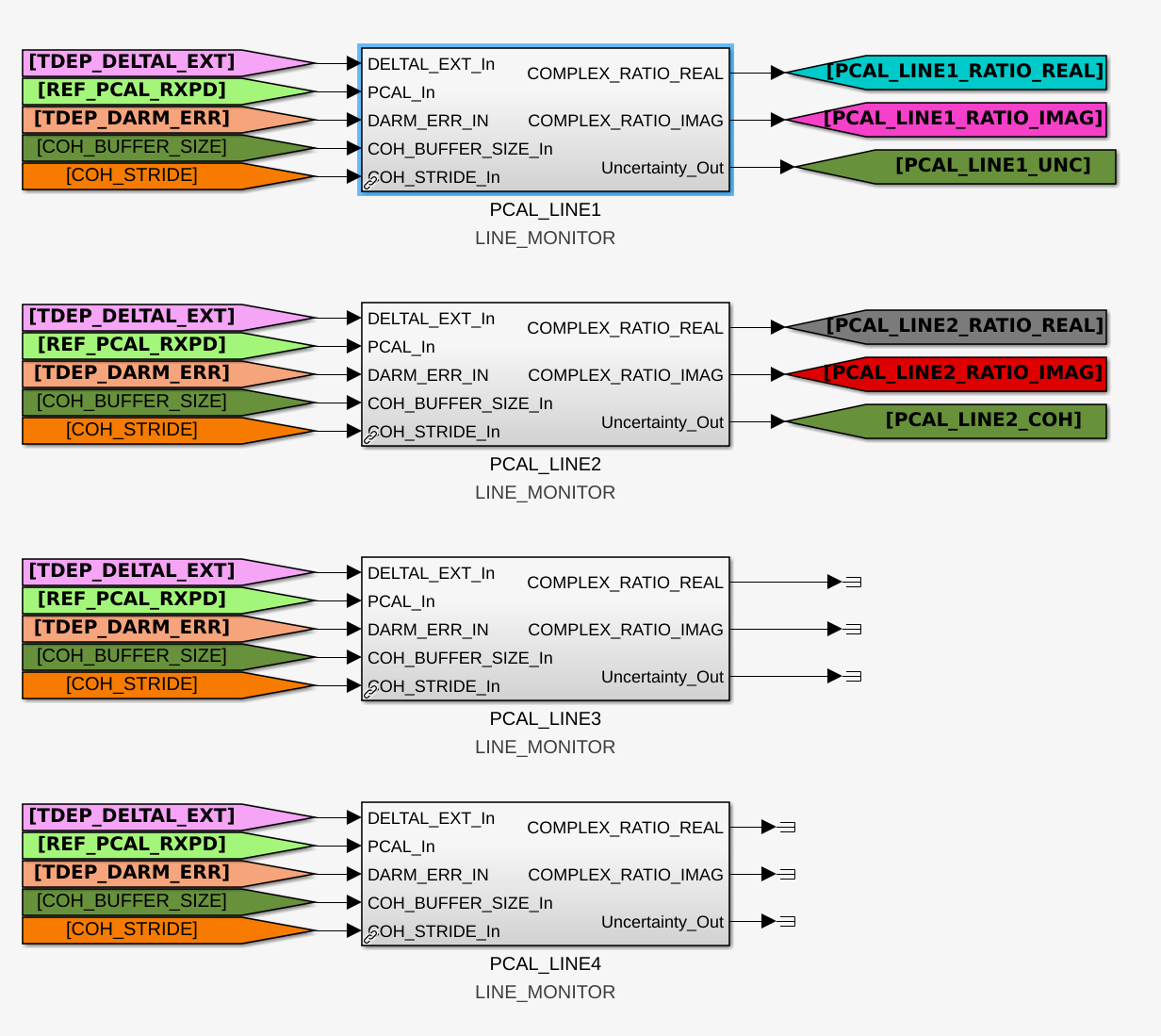
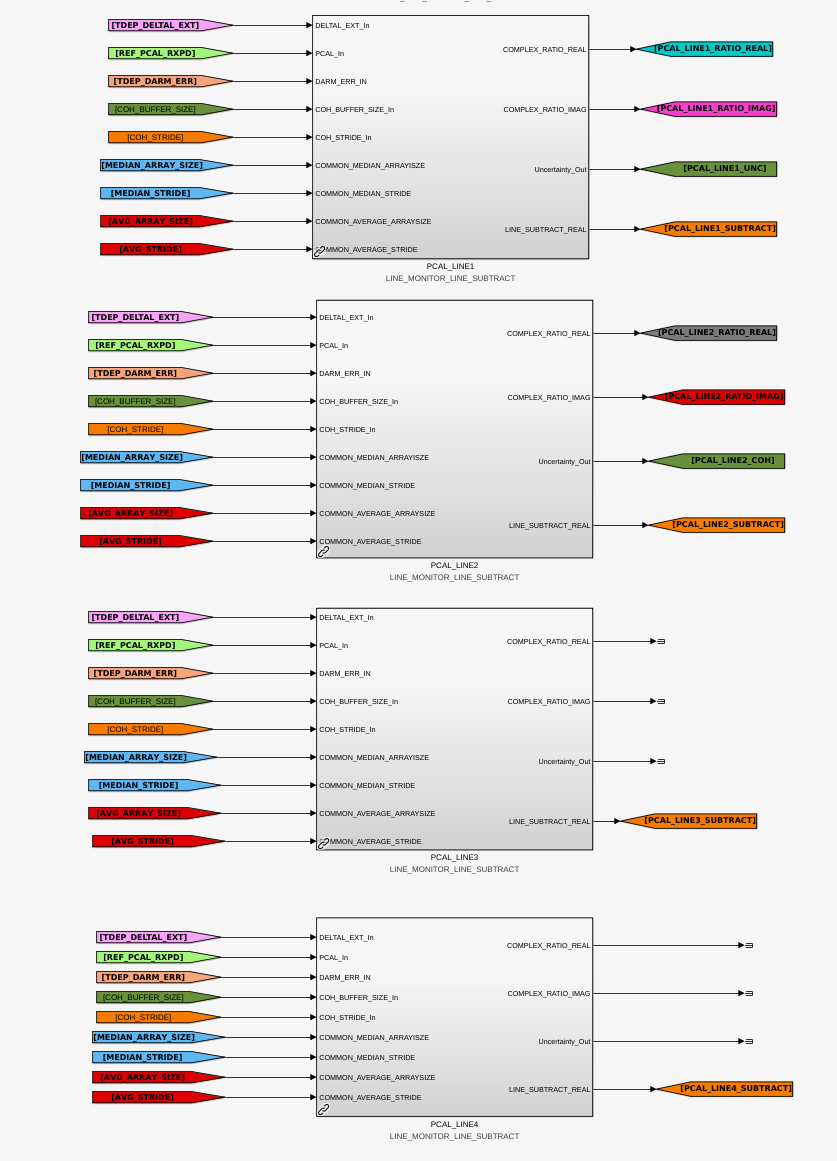
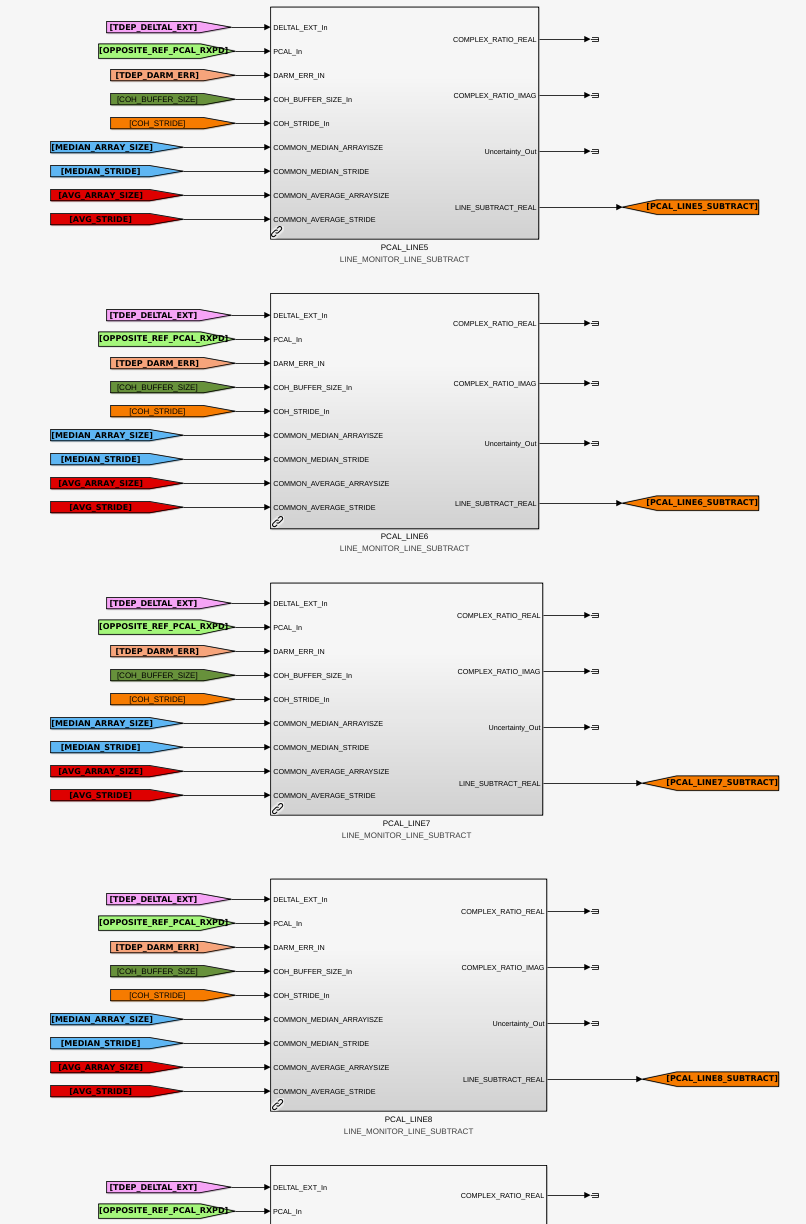
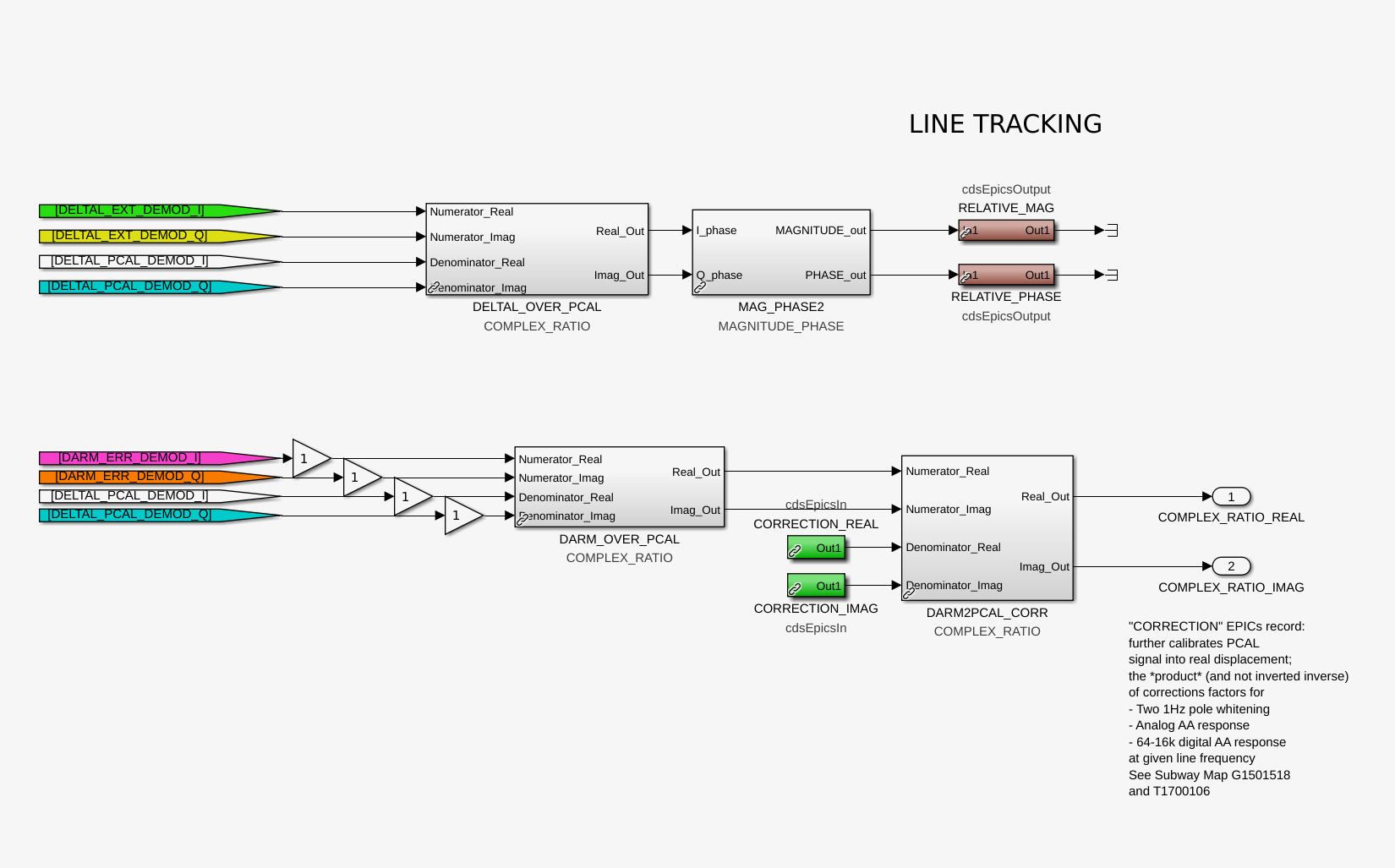
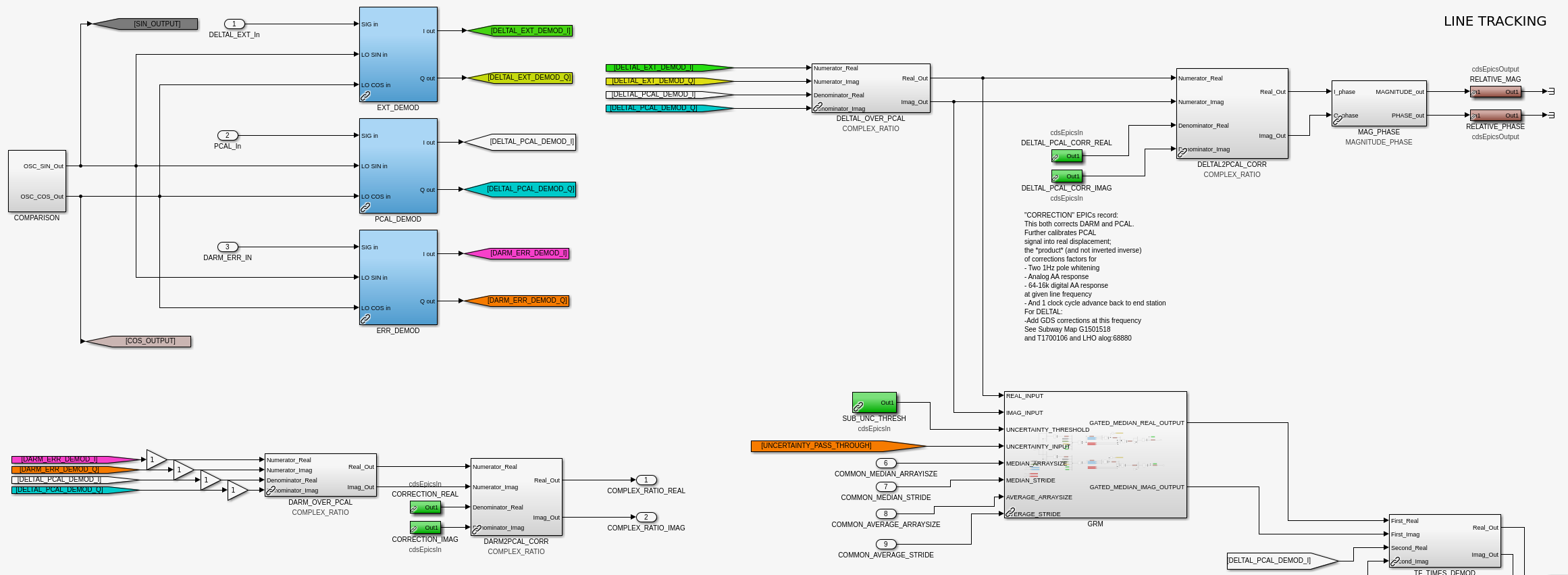
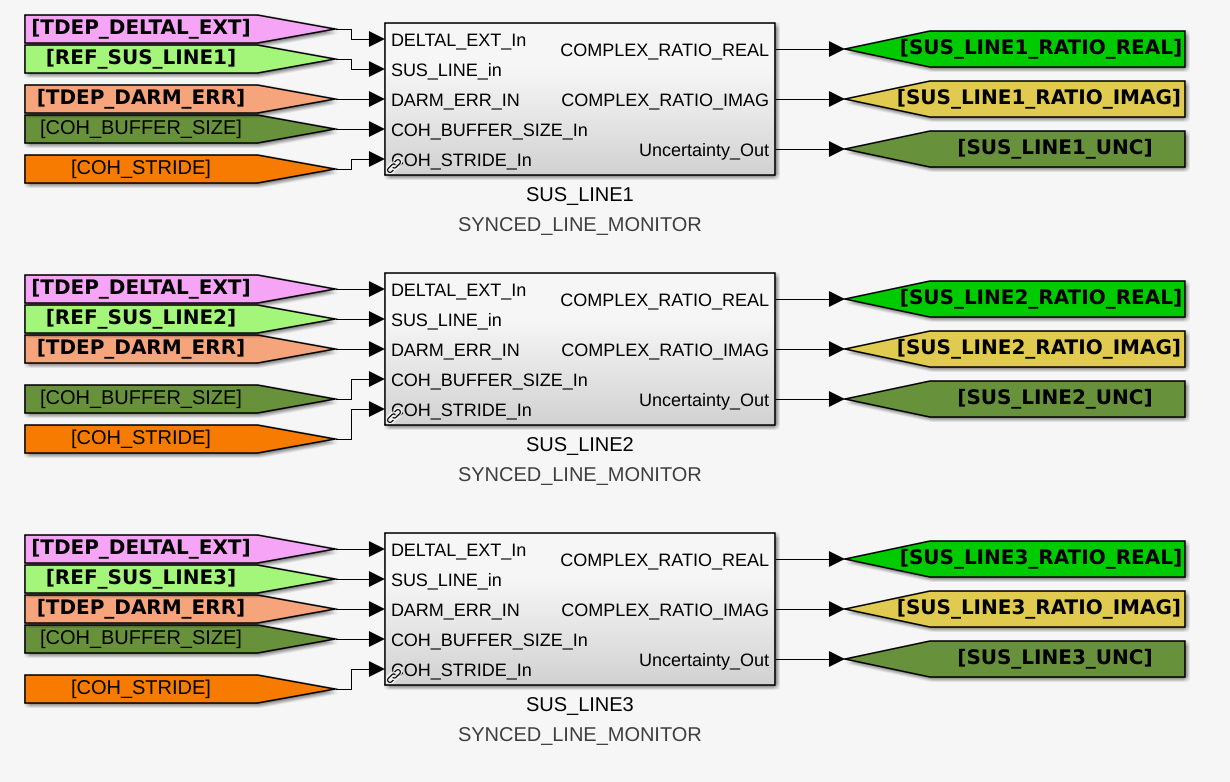
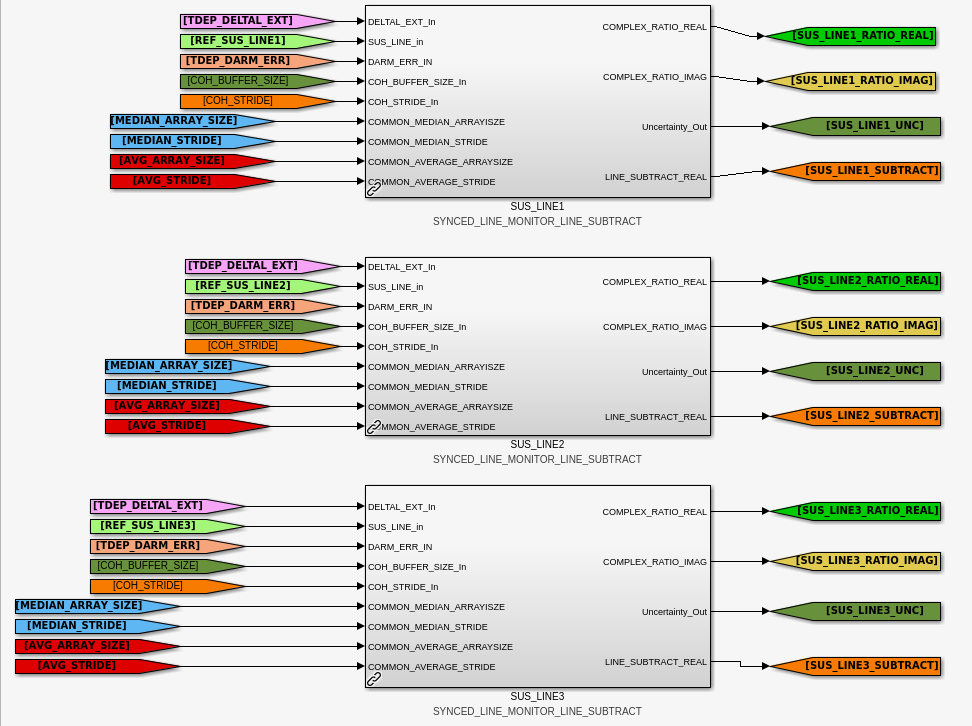
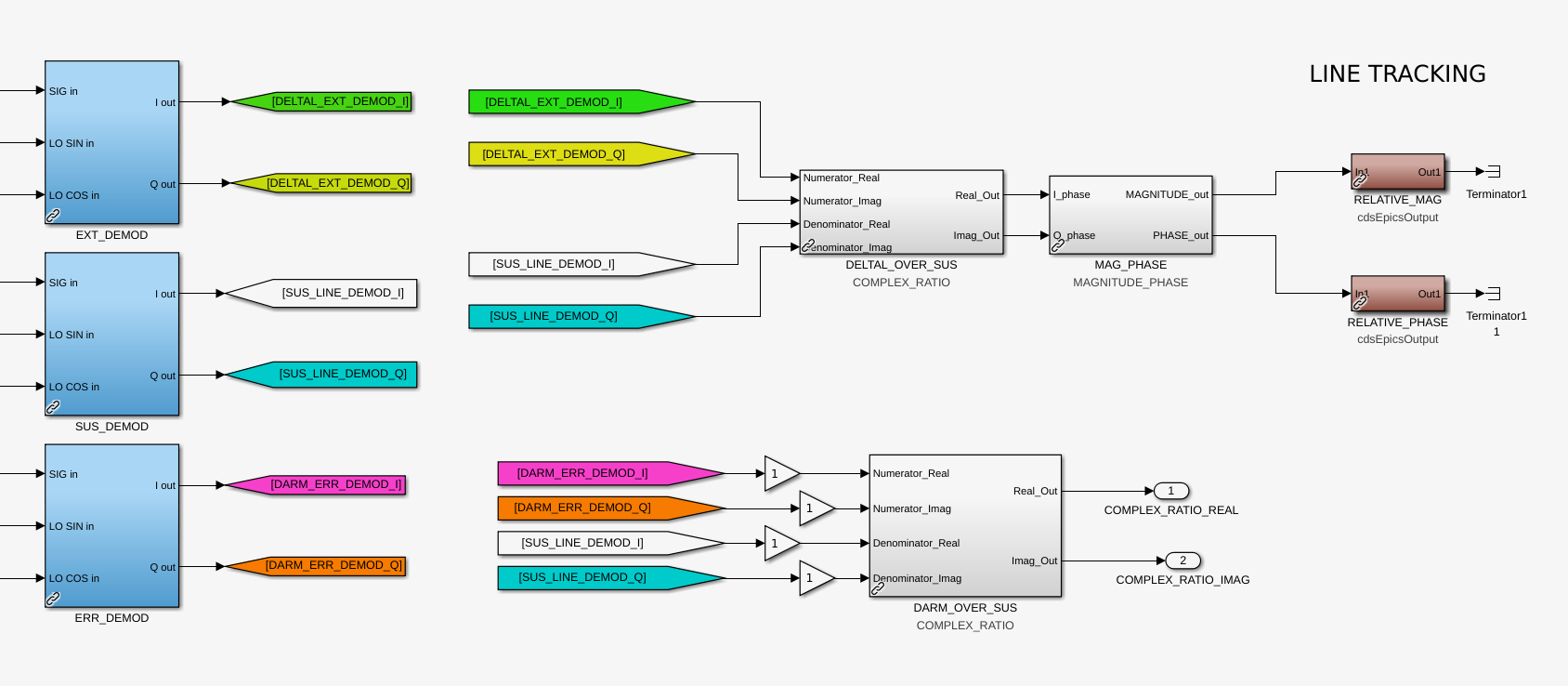
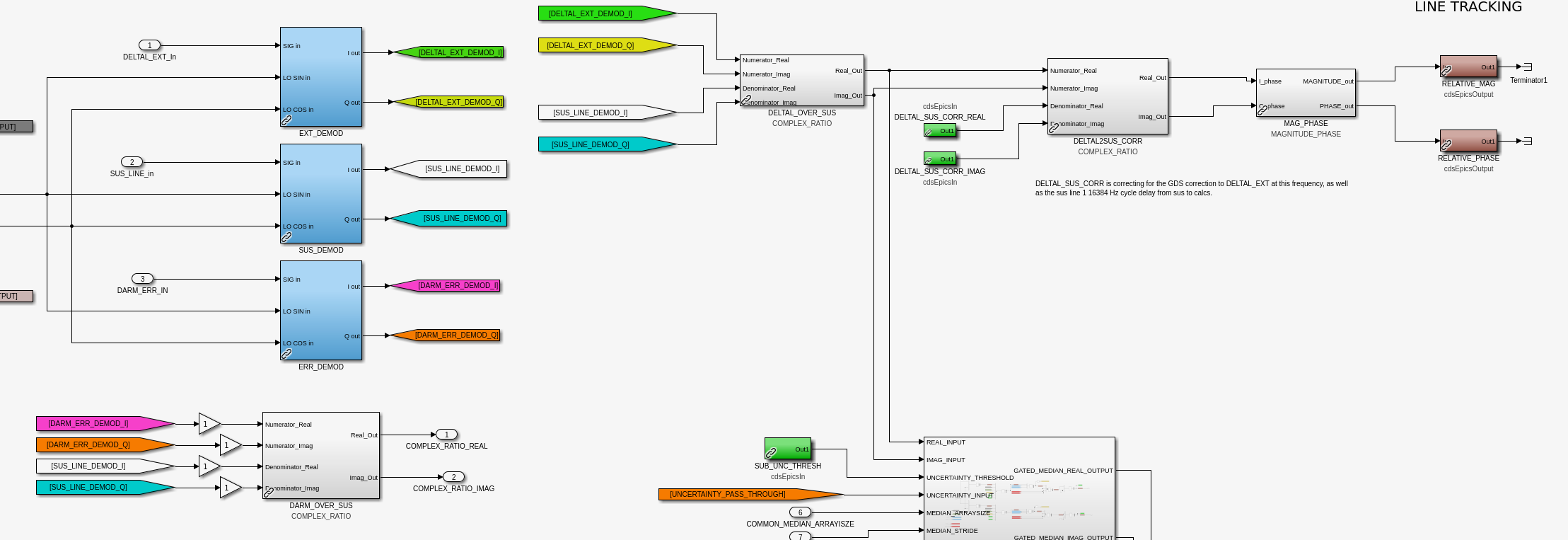
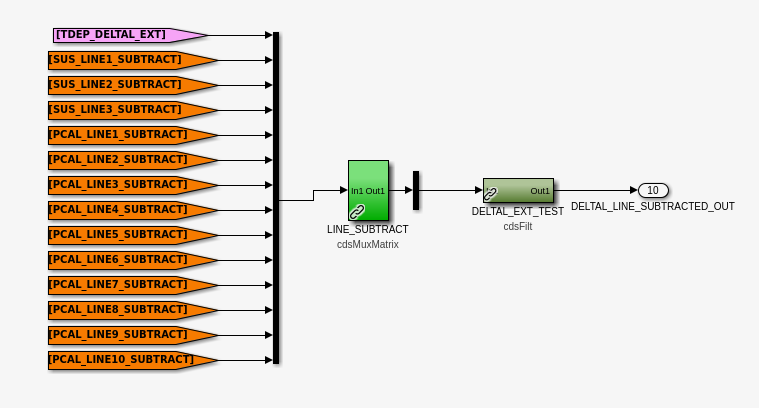
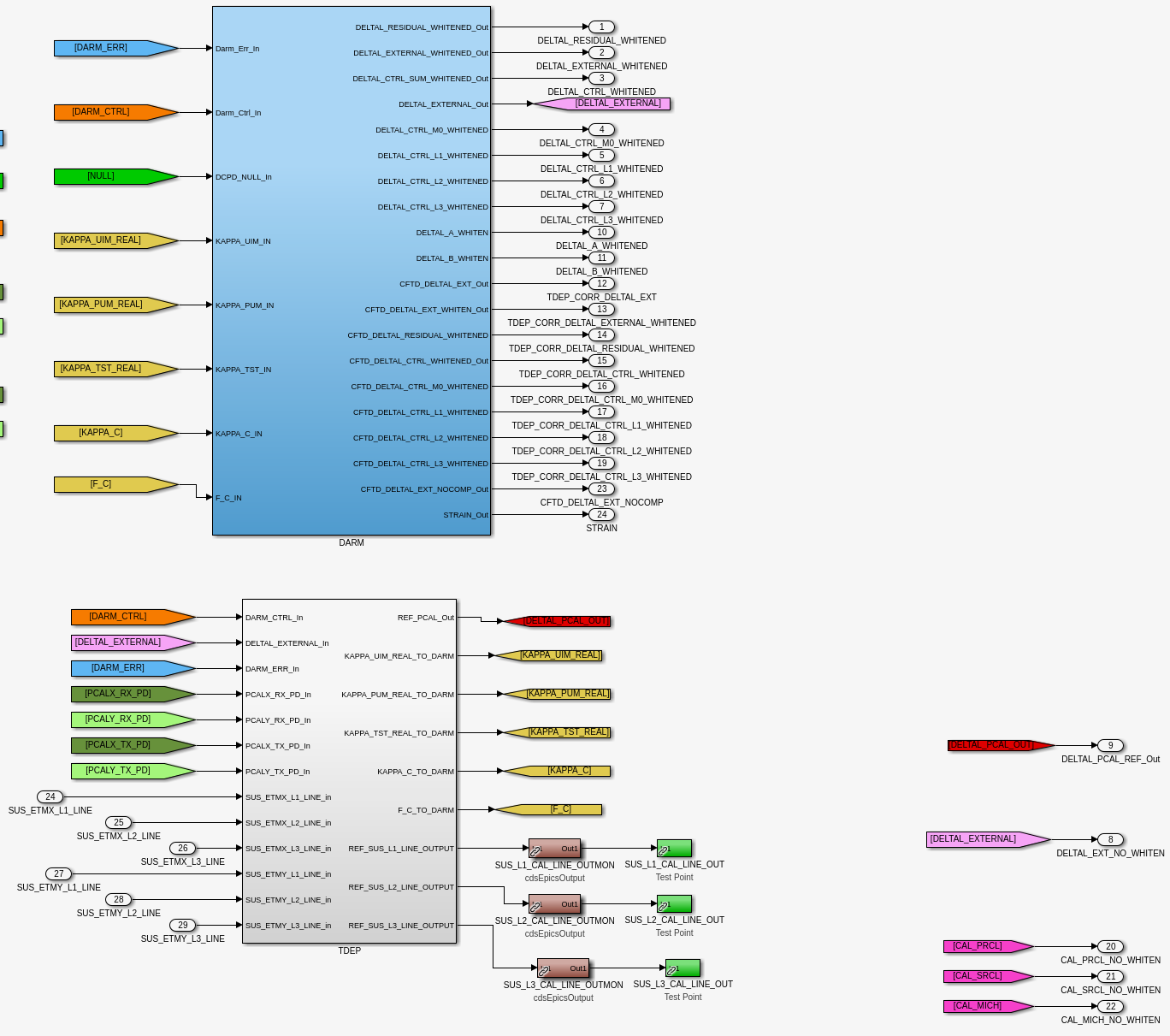
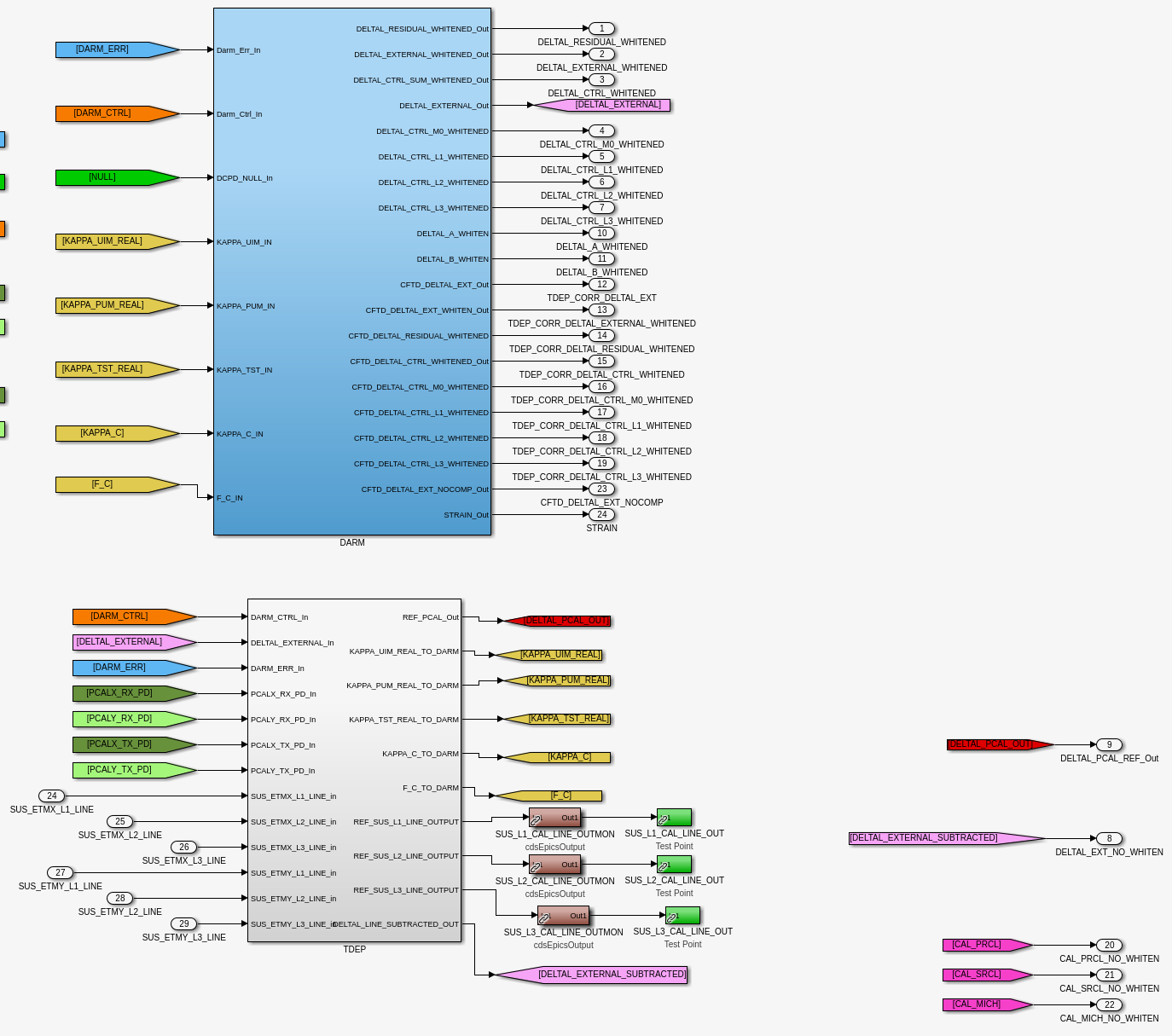
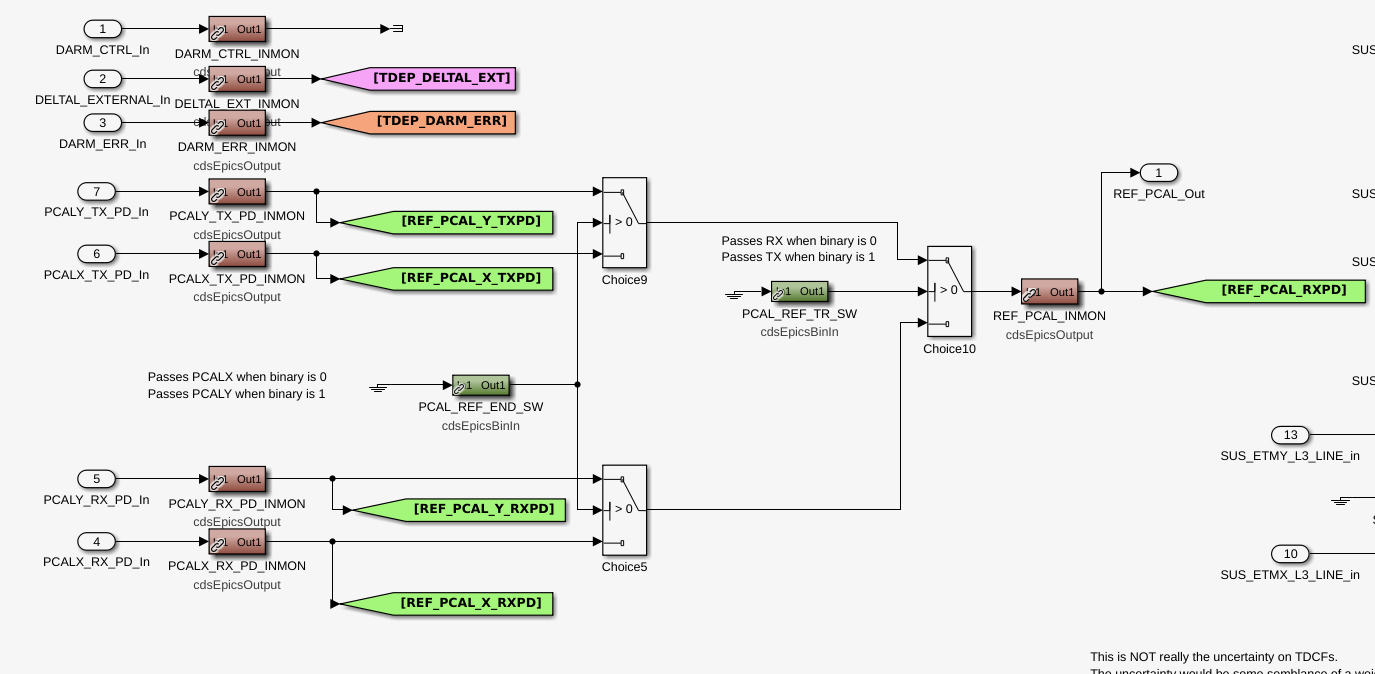
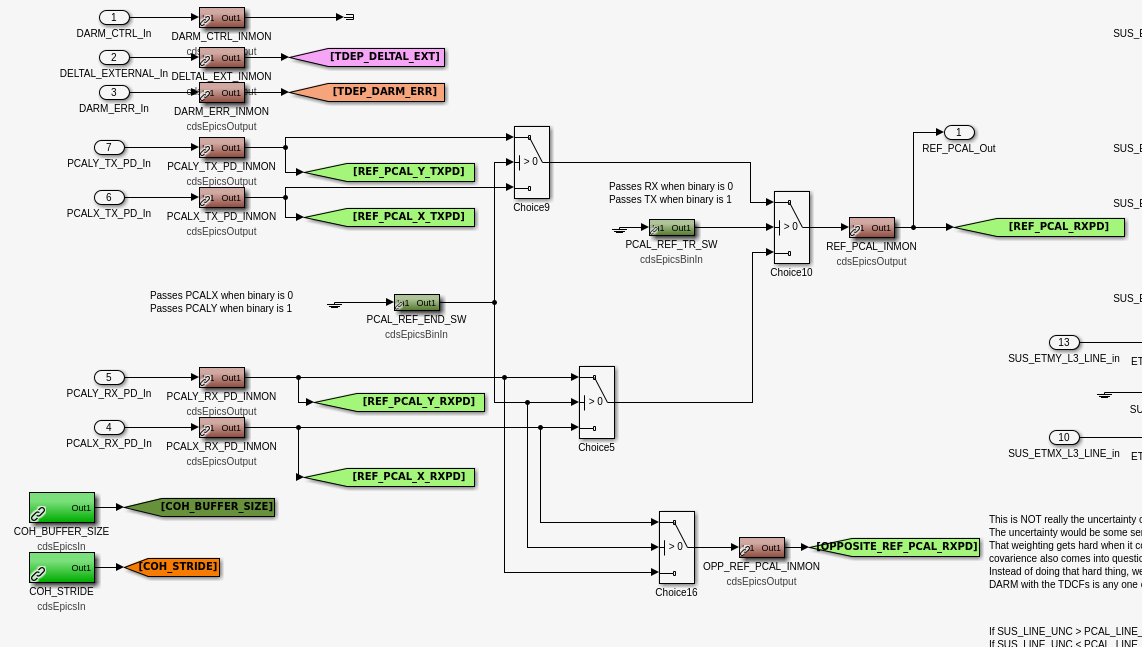
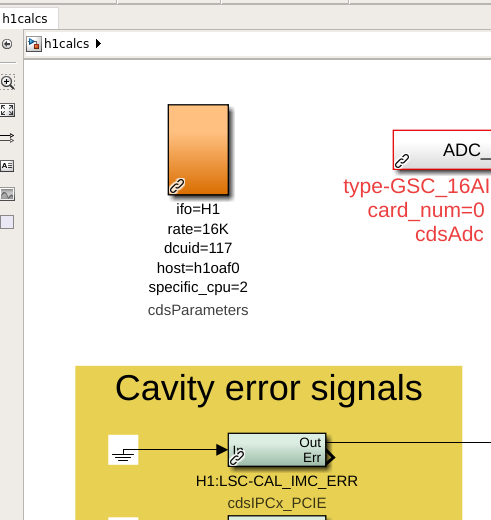
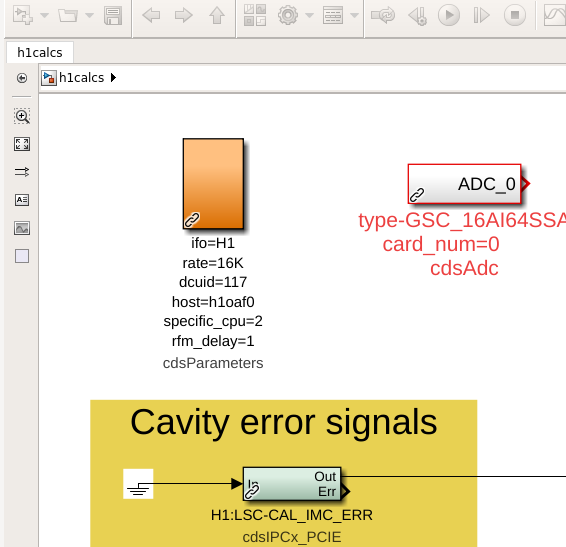
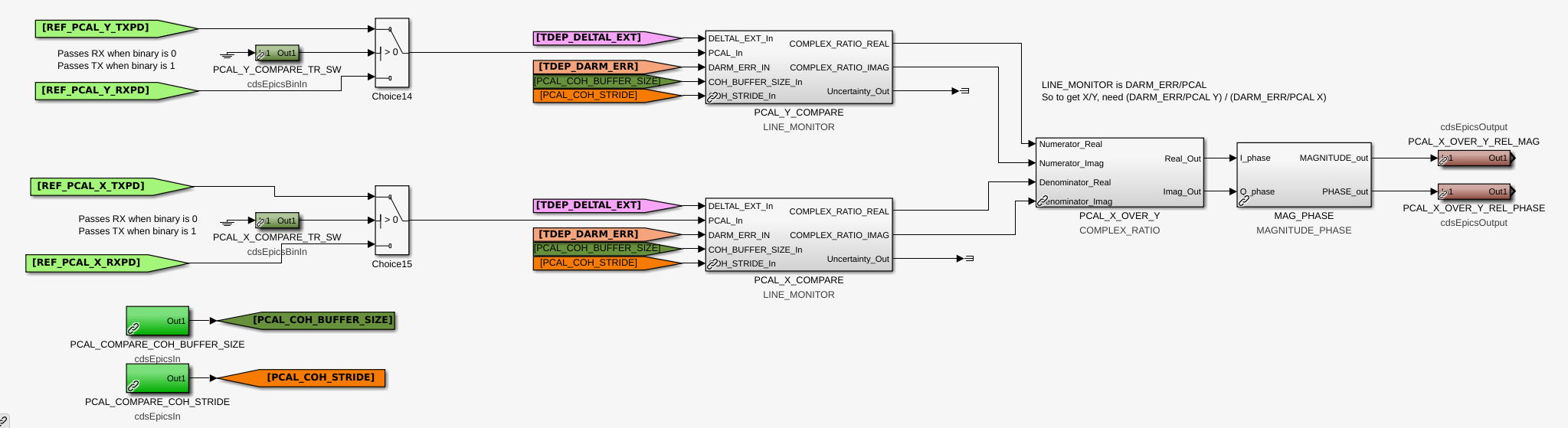
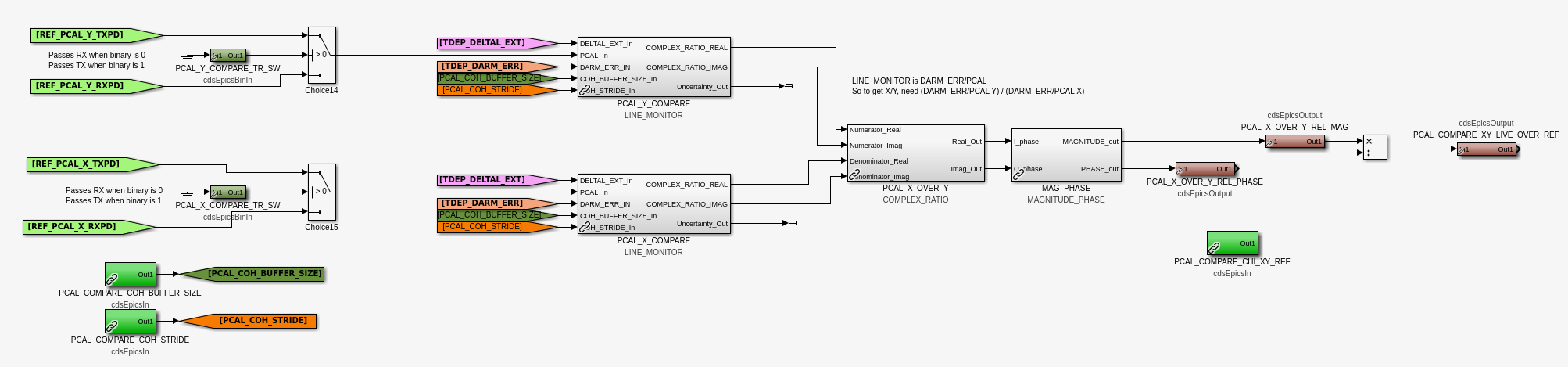
Here's the list of channels added to CALCS as a result of this change.
No channels have been removed.


jeffrey.kissel@cdsws03:~$ check_model_daq_configuration h1calcs
--------------------- file times ----------------------
Tue Apr 25 07:53:26 2023 = Model build time

Tue Apr 18 10:21:21 2023 = Current configuration load time


DAQ configuration is changed, processing...

++: slow channel H1:CAL-CS_TDEP_PCAL_COMPARE_XY_LIVE_OVER_REF added to the DAQ

[... see h1calcs_channelchange_list.txt ...]

++: slow channel H1:CAL-CS_LINE_INJ_SWSTAT added to the DAQ
Total number of DAQ changes = 1220
(1220 additions, 0 deletions)
Naoki, Camilla
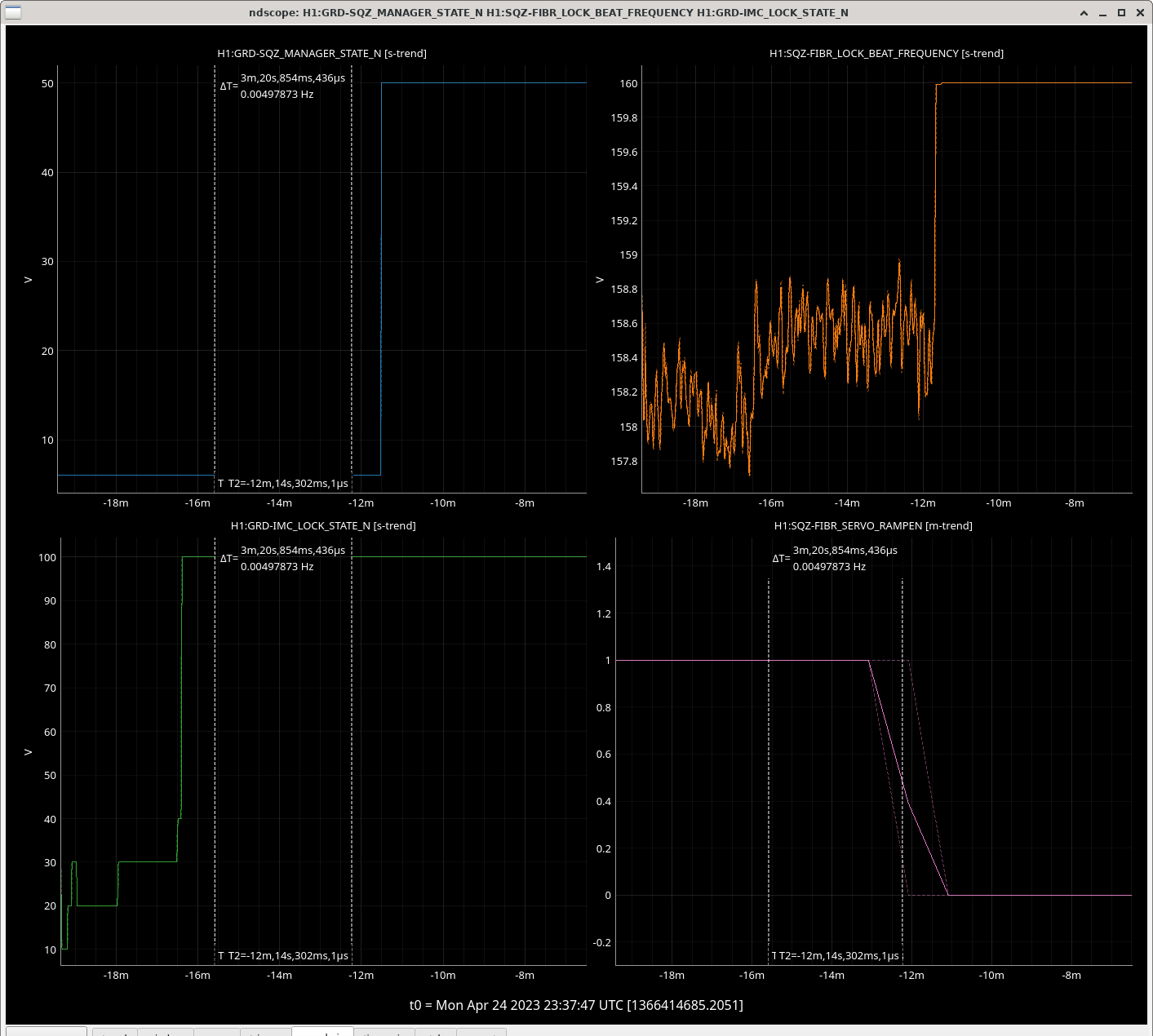
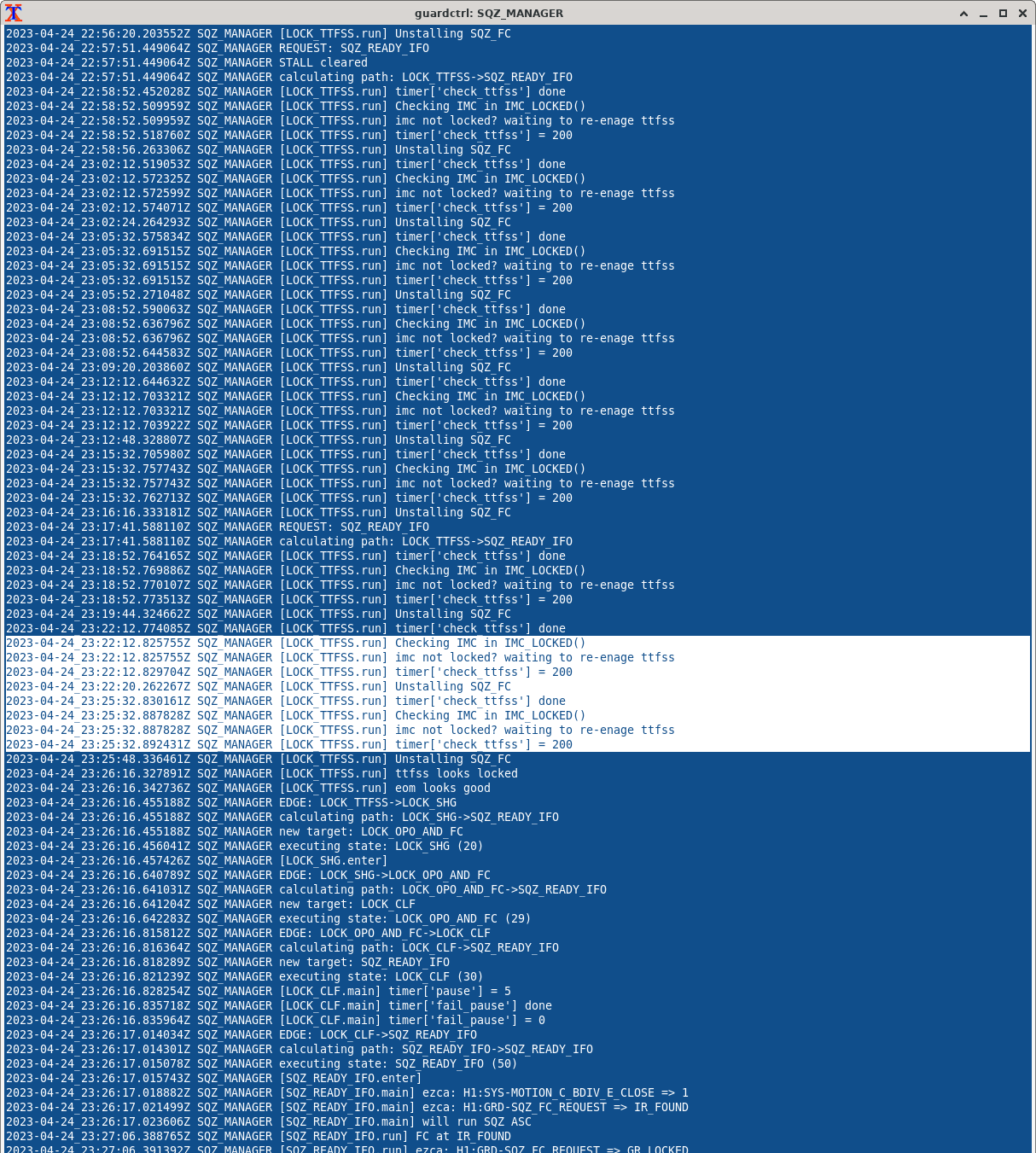
We found that the TTFSS autolock did not work while the IMC was locked as shown in the attached ndscope and guardian log. The two cursors in the ndscope show when the SQZ MANAGER guardian checked the IMC. Although the IMC was locked, the SQZ MANAGER guardian thought that the IMC is not locked and kept waiting. We manually turned off the ramp and turned on the booster on the fast path and then TTFSS recovered.
We think we fixed this in snv commit #25404. There was a small typo that stopped the fiber enable being toggled and made the guardian incorrectly report "IMC unlocked". IFO has not been in a state to test the fix yet.
J. Kissel, D. Bhattacharjee, T. Sanchez, J. Betzwieser
WP 11138

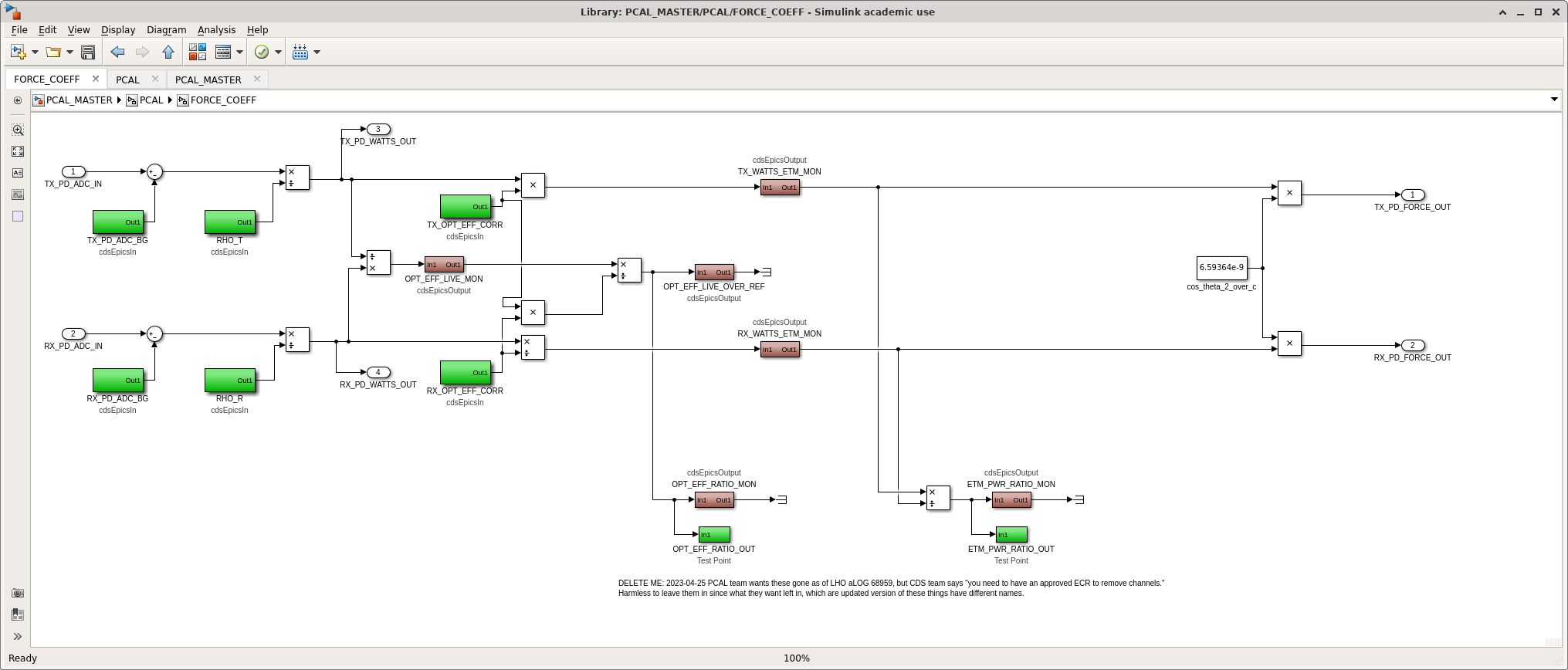
From LLO:64213, I'm importing three changes to, and one feature removal from, the PCAL end-station calculations to compute the representative force and corresponding displacement for each channel, updating them for the latest methodology the team wishes to use in O4.

Within the force calculation block this includes:
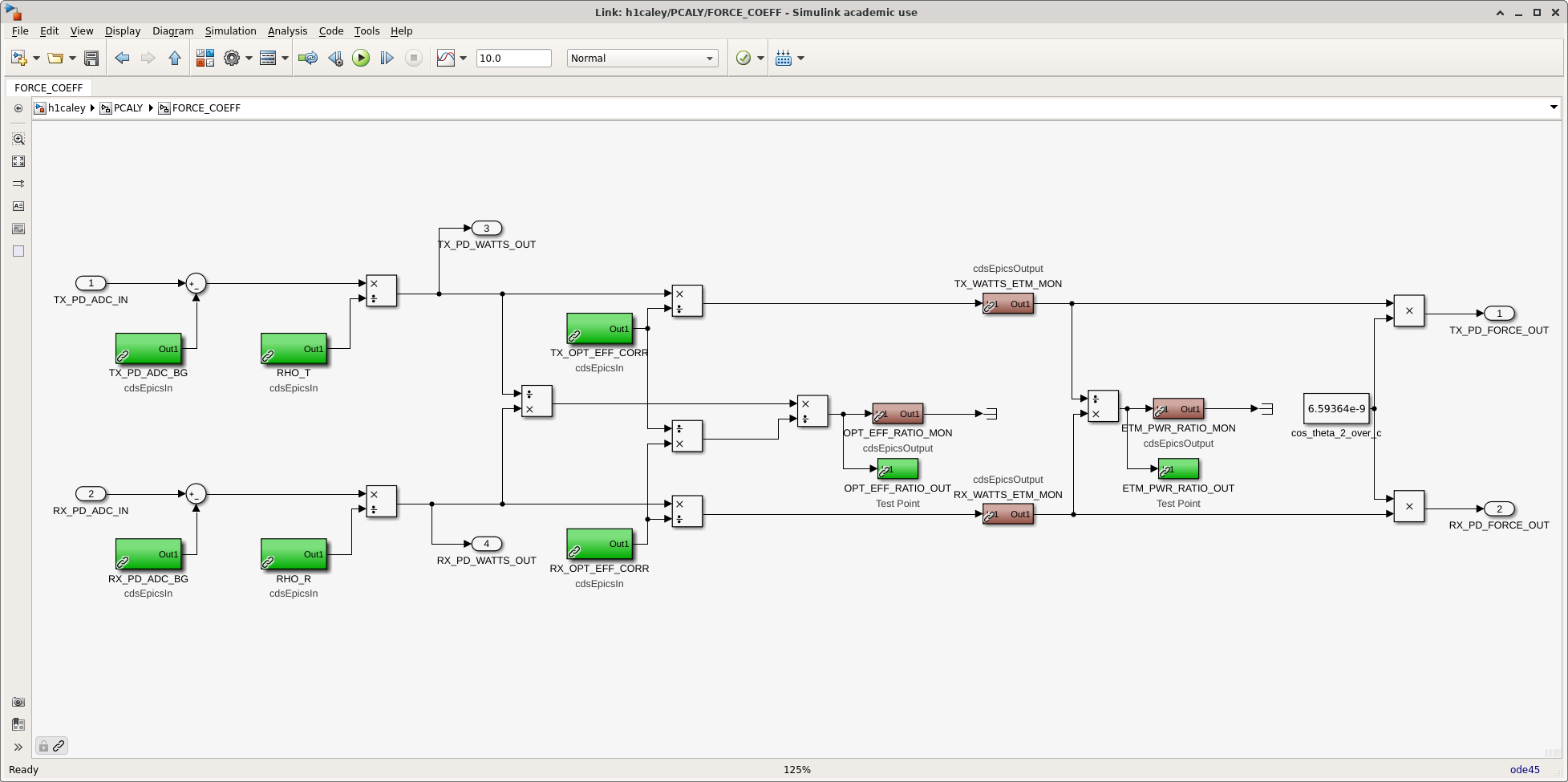
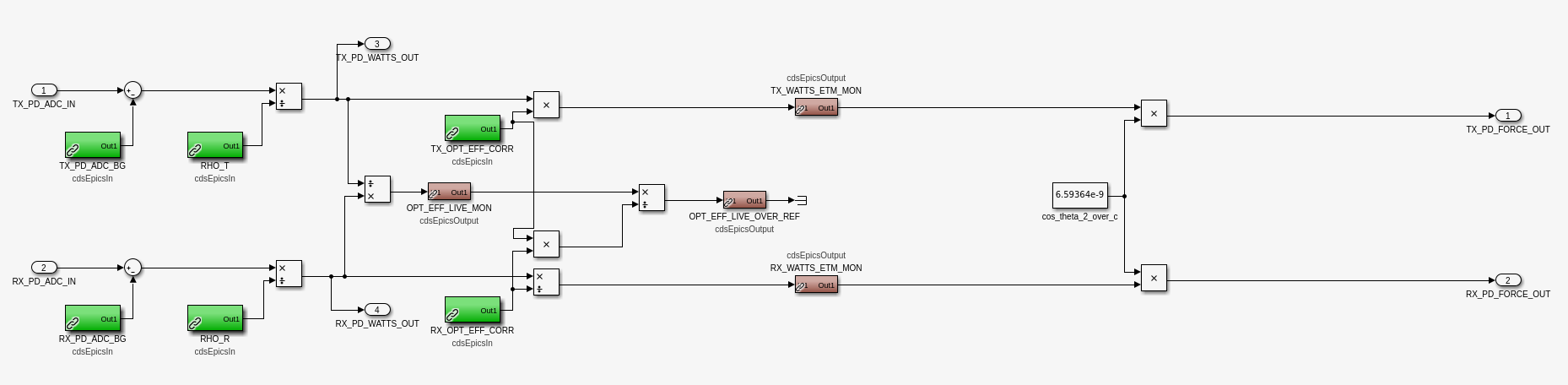
    (1) Correcting an inconvenience an EPICs record set in the computation of force coefficient, where the reference optical efficiency for the RX and TX PDs are stored.
        Where before the RX and TX optical efficiency EPICs records (TX_OPT_EFF_CORR and RX_OPT_EFF_CORR) were divided into each channels path, now, the TX record is multiplied in and the RX record remains divided in to each respective channel.
    (2) The calculation of optical efficiency *ratio* (comparing the ratio of TX to RX, then normalized by the above reference values) has been re-arranged, with an additional EPICs monitor of the unnormalized ratio for better understanding.
        Note: this causes a channel name change -- formerly, the normalized ratio was called OPT_EFF_RATIO_MON, and now it's called OPT_EFF_LIVE_OVER_REF. The new channel monitoring the unnormalized ratio is called OPT_EFF_LIVE_MON.
    (3) The former monitor of the ratio between channels was taken *after* this optical efficiency correction, with an EPICs and test point channel called ETM_PWR_RATIO_MON and ETM_PWR_RATIO_OUT. These have been unceremoniously removed.
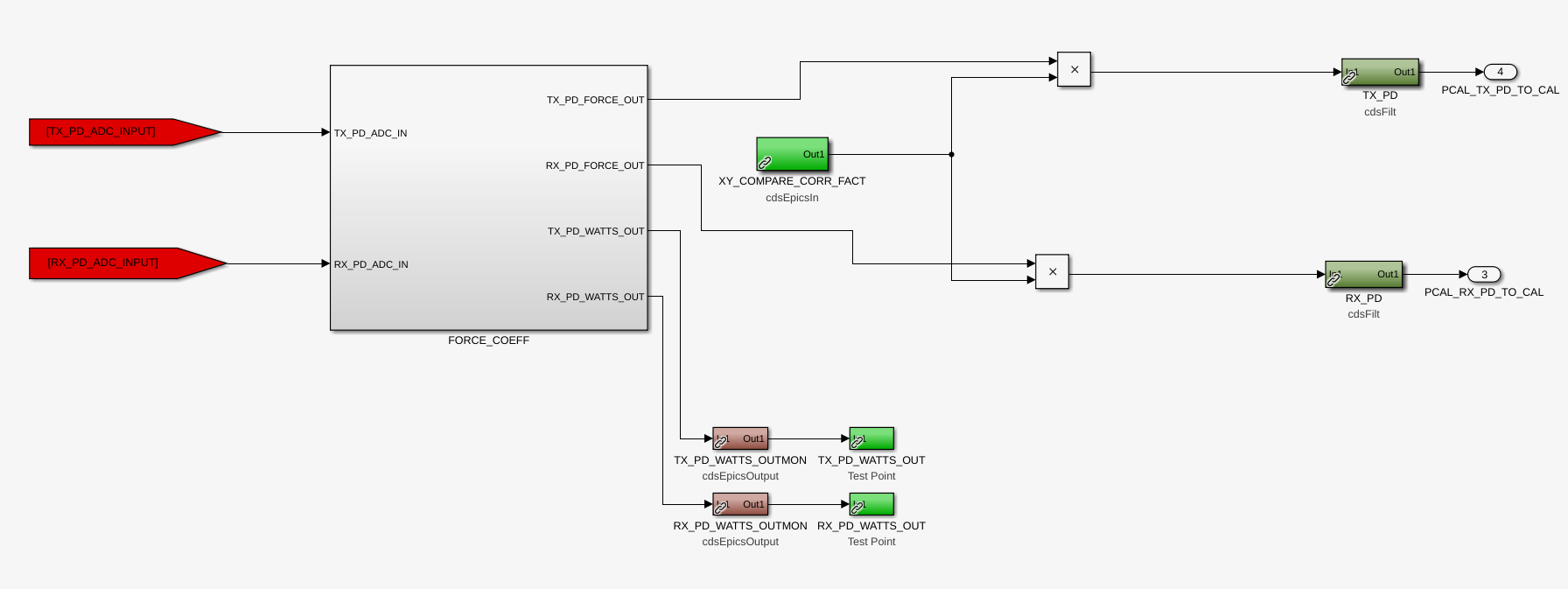
See before vs. after screenshots.

Outside the force calculation, just prior to the conversion to displacement in the TX_PD and RX_PD filter banks, there's now a new EPICs record that applies the multiplicative correction to account for the differences in displacement between the X and Y arm, informed by the side-by-side comparison between the answer as seen in DARM. This new record is XY_COMPARE_CORR_FACT. See before vs. after screenshots.

To import these changes was relatively simple, just an svn up to
    /opt/rtcds/userapps/release/cal/common/models
       PCAL_MASTER.mdl


The h1calex and h1caley models, with the following updated library part, have been built successfully in prep for tomorrow's install and restart.
I'll update MEDM screens tomorrow.
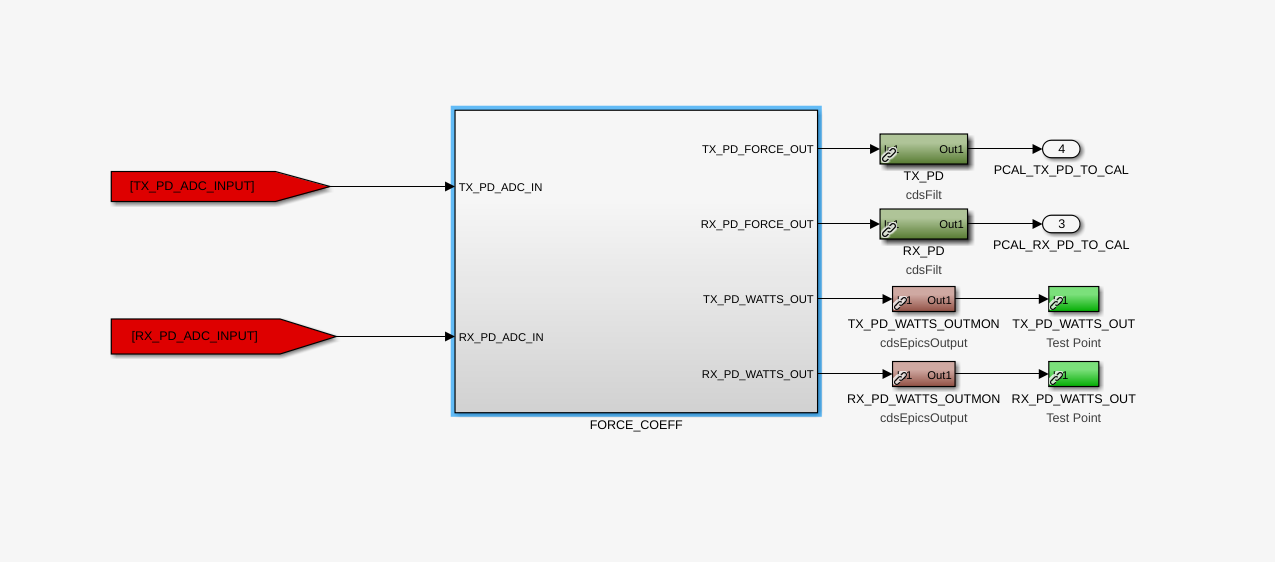
The CDS team informs me that it's been recently decreed that "no channels shall be removed without ECR," so I've reverted the removal of the OPT_EFF_RATIO_MON, OPT_EFF_RATIO_OUT, ETM_PWR_RATIO_MON, ETM_PWR_RATIO_OUT channels since the PCAL team doesn't have an ECR for these changes.
All other infrastructure that rearranges the calculation and adds new channels will still go in as described above.

See new screenshot of the FORCE_COEFF block.

Here's the official channel change list for these changes
jeffrey.kissel@cdsws03:~$ check_model_daq_configuration h1calex
--------------------- file times ----------------------
Tue Apr 25 07:54:43 2023 = Model build time

Tue Apr 18 10:21:21 2023 = Current configuration load time


DAQ configuration is changed, processing...

++: slow channel H1:CAL-PCALX_FORCE_COEFF_OPT_EFF_LIVE_OVER_REF added to the DAQ
++: slow channel H1:CAL-PCALX_FORCE_COEFF_OPT_EFF_LIVE_MON added to the DAQ
++: slow channel H1:CAL-PCALX_XY_COMPARE_CORR_FACT added to the DAQ
Total number of DAQ changes = 3
(3 additions, 0 deletions)
jeffrey.kissel@cdsws03:~$ check_model_daq_configuration h1caley
--------------------- file times ----------------------
Tue Apr 25 07:59:02 2023 = Model build time

Tue Apr 18 10:21:21 2023 = Current configuration load time


DAQ configuration is changed, processing...

++: slow channel H1:CAL-PCALY_FORCE_COEFF_OPT_EFF_LIVE_OVER_REF added to the DAQ
++: slow channel H1:CAL-PCALY_FORCE_COEFF_OPT_EFF_LIVE_MON added to the DAQ
++: slow channel H1:CAL-PCALY_XY_COMPARE_CORR_FACT added to the DAQ
Total number of DAQ changes = 3
(3 additions, 0 deletions)


which all match the functional changes expected from above.
R. Short, J. Kissel
After Marc and Fernando replaced the ISC-R4 power supply this afternoon, the IMC couldn't lock and appeared poorly aligned. We checked that the MC and IMC PZT sliders/OSEM values hadn't changed, so I tried moving the PZTs to realign the cavity. Around that time we realized that the IMC had not been taken offline before the rack was taken down, so the IMC WFS had just been trying to follow noise. I then cleared the history on the WFS filter banks and brought the PZT sliders back, and the IMC was able to lock successfully.
The -18V power supply located in the Power Mezanine above the CER in rack C5 slot U13-U15 on the Right Hand Side (RHS) was measured over 130F+ from the front of the supply. This is indicative of a failed fan, so this supply was pulled and replaced. We took the opportunity to do this due to the earthquake.
Old Supply S1201952 was set to -18.97V
New Supply S1201930 was set to -18.93V
We used the sequencer aboev the rack ISC-R4 to make sure that we did not damage any low noise power boards.
We noted that the power supply is routed to the junction box above PSL-R2 and then jumps across to power ISC-R4.
M. Pirello, F, Mera
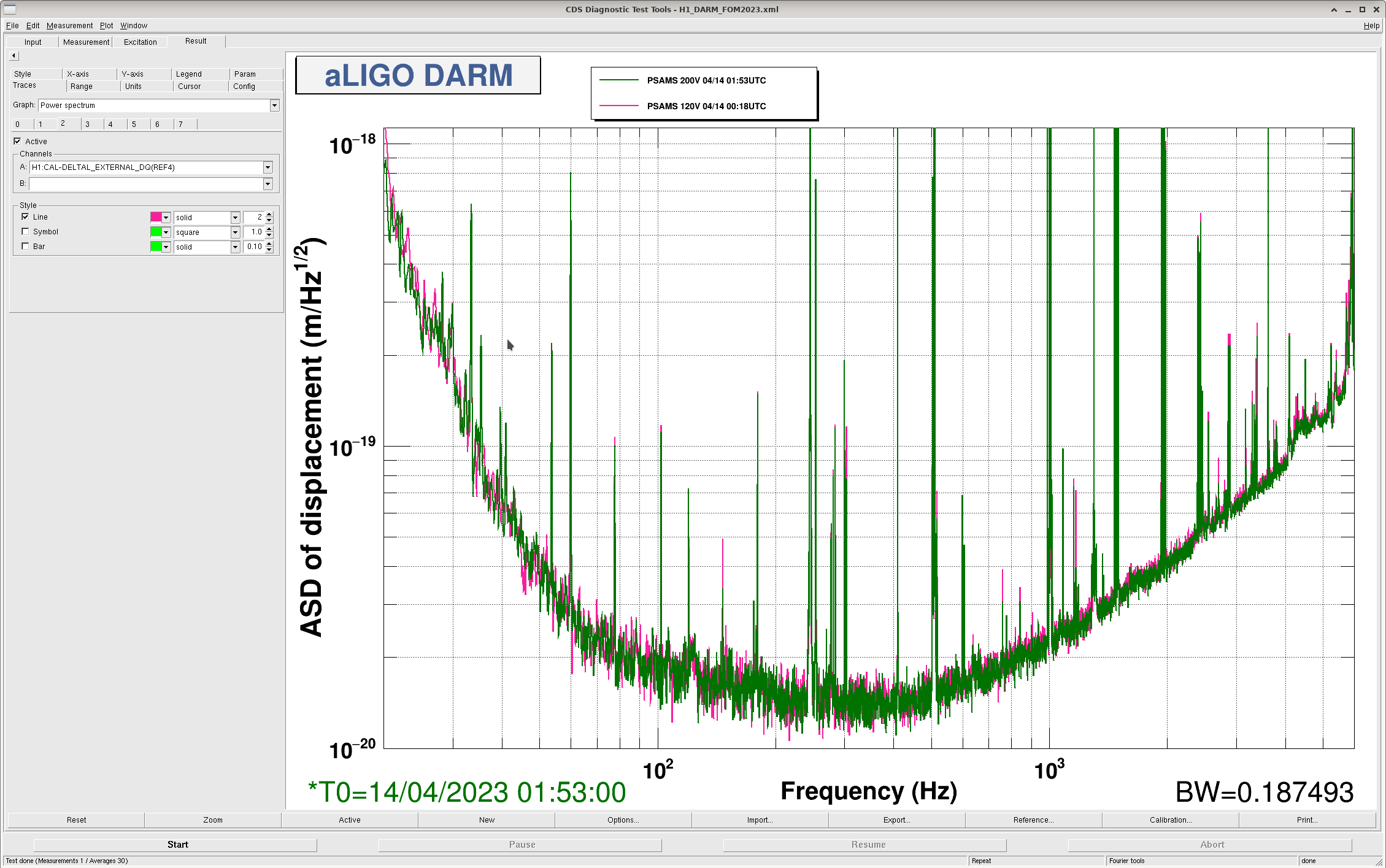
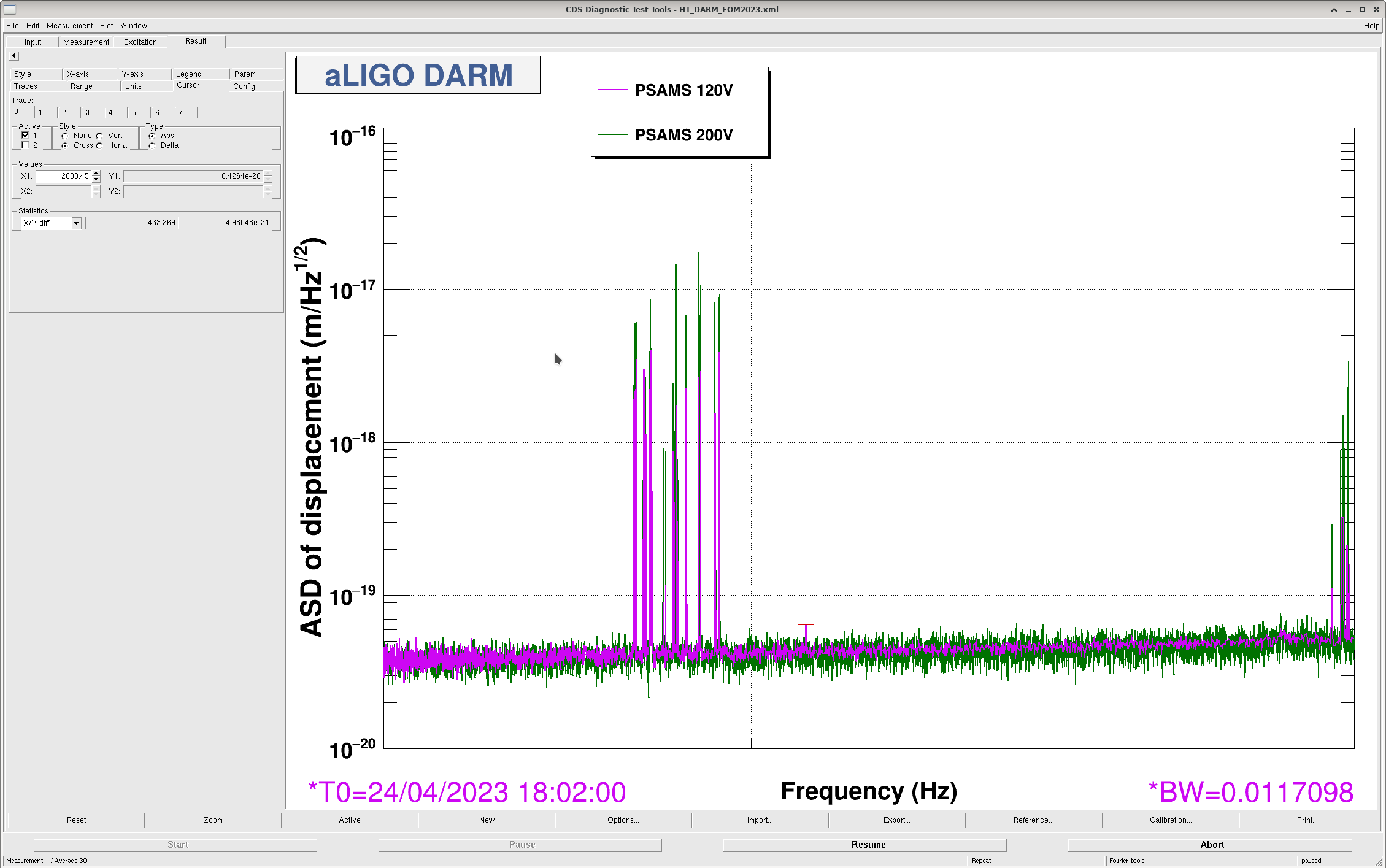
Nutsinee and I looked at LLO alog #64483 from Masayuki where LLO had a found 2050Hz peak in DARM when ZM4 PSAMS are at 200V.
We do have this 2050Hz peak in DARM but only when the PSAMS are actively changing. See attached. These PSAMS will not be adjusted while Observing. Nutsinee suggests it could be a jitter coupling with an alignment change. When The SQZ ASC are changing without PSAMS there seems to be a smaller 2033Hz peak.
I compared three times (2023/04/10 02:35 - 03:05 UTC; 2023/04/14 00:18 - 1:53UTC; 2023/04/20 08:53 - 10:23UTC) where we changed PSAMS between <150V and 200V and didn't see any peaks in the 2000Hz region before/after the change, only during.

TITLE: 04/24 Eve Shift: 23:00-07:00 UTC (16:00-00:00 PST), all times posted in UTC
STATE of H1: Commissioning
CURRENT ENVIRONMENT:
SEI_ENV state: CALM
Wind: 16mph Gusts, 11mph 5min avg
Primary useism: 0.18 μm/s
Secondary useism: 0.16 μm/s
QUICK SUMMARY:
- IFO still recovering from a 7.x mag EQ that kicked a bunch of sus
- Things have started calming down a bit so we're going to try and relock now (might be starting with an initial alignment)
- DMs ok/CDS ok
TITLE: 04/24 Day Shift: 15:00-23:00 UTC (08:00-16:00 PST), all times posted in UTC
STATE of H1: Commissioning
SHIFT SUMMARY:
Locks:
Lockloss at 20:22 UTC due to a 7.1 magnitude Indonesia earthquake (10hr 15 min lock).
Put IFO in DOWN while the earthquake rings down
IFO went into SEI_CONF EARTHQUAKE mode for ~15s before losing lock
Achieved NLN after shift - started locking as shift ended.
Manual Touching:
SQZ was touched up at 16:17 UTC →16:45 UTC
Done due to live squeezing looking worse than the 4/20 reference - Camilla realized this and took a new reference.
Changing the SQZ phase, I started at 164.03 Deg and ended at 135.59 Deg
Resulted in FDS lower than the last 4/20 reference as well as Camilla’s reference - both as seen on the FDS FOM.
Turned off sensor correction at 20:44 UTC by changing SEI_ENV to maintenance. This put SEI_CONF from EARTHQUAKE to SC_OFF. This was done due to the Earthquake.
SEI_ENV and SEI_CONF returned to EARTHQUAKE Mode with sensor correction on. This happened at 21:51 UTC.
Turning back to SEI_ENV is CALM (SEI_CONF is WINDY) at 22:43 UTC
Turned on ALS Polarizer through ALS Guardian (to fix some polarization ring-ups) at 21:23 UTC.
SUS_RM1 and SUS_RM2 turned to SAFE at 22:02 UTC.
SUS_RM1 and SUS_RM2 returned to ALIGNED at 22:35 UTC.
Done due to a power supply switch.
Automatic Early Morning Lock:
This morning’s running 5-hour lock was automatic. There seem to have been three NLN attempts during Sunday night, two of which were successful!
Attempt 1: Started trying at about 5:07 UTC (22:07 PDT) and eventually achieved NLN at around 6:00 UTC (23:00 PDT) before losing lock 1 hour and 48 minutes later at 07:45 UTC (00:45 PDT). Relocking was attempted immediately after lockloss.
Attempt 2: Reached and stayed CAMR_TO_TR at 8:31 UTC (1:31PDT) for ~9 minutes before losing lock at 8:40 UTC (1:40 PDT). Relocking was attempted immediately after lockloss.
Attempt 3: Reached NLN at around 10:06 UTC (3:06 PDT), which was the state I found it in.
Other:
- Dust monitor investigation at 16:55UTC -
- The locked period of the day had a couple of state changes between Cal Meas and NLN for measurement taking.
Cal Meas at 18:27 UTC
Back to NLN at 19:02 UTC
Cal Meas at 19:52 UTC
Back to NLN at 20:11 UTC
- At 19:33 UTC - Monthly Hanford Site scheduled test alert successful (and at the right, right phone)
LOG:
| Start Time | System | Name | Location | Lazer_Haz | Task | Time End |
|---|---|---|---|---|---|---|
| 15:03 | FAC | Karen | Optics & Vacuum Prep Labs | N | Technical Cleaning | 15:28 |
| 15:28 | FAC | Karen | MY | N | Technical Cleaning | 16:26 |
| 16:18 | FAC | Kim | MX | N | Technical Cleaning | 17:18 |
| 16:49 | FAC | Tyler | EX (Chiller Yard) | N | Dropping Parts | 17:19 |
| 17:34 | CDS | Marc | CER Mezzanine | N | Writing down values | 17:54 |
| 17:35 | FAC | Karen & Kim | FCES | N | Technical Cleaning | 18:11 |
| 19:51 | CDS | Fil | EX & EY | N | PEM Injection Work | 20:51 |
| 20:49 | VAC | Gerardo & Travis | LVEA | N | Ion Pump Measurements | 21:09 |
| 21:01 | CDS | Fil | EY & EX | N | Electronics Work | 23:30 |
| 21:20 | EE | Marc. Jason, Fernando, Betsy | CER Mezzanine | N | Stagnig for Tues Maint | 21:49 |
| 21:26 | VAC | Vac Team | MX | N | Purge AIR Check | 22:03 |
| 21:46 | SYS | Gabriele | X/Y Arms | N | DSR (Daily Schedule Run) | 23:08 |
| 22:05 | CDS | Marc, Fernando | CER Mezzanine | N | Switch Power Supply | 22:29 |
| 22:21 | SUS | Betsy | LVEA | N | Walkabout | 23:08 |
Gabriele ran a recent bruco in CHARD Y, and noticed there was large coherence between CHARD Y and the IM damping loops between 4-10 Hz. The IM damping loops have been updated before to improve noise reinjection into CHARD and therefore DARM. Take a look at alogs 64007 and 64017 for more information. Over the summer, I updated the damping loop cutoff to a high Q elliptical low pass at 7 Hz. There is room for improvement, by reducing the Q of the elliptical filter and moving the cutoff to 5 Hz. There is quite a lot of phase margin in the loops to do this. The new cutoff loses about 11 degrees of phase, but all three damping dofs have 70 or more degrees of phase margin. This new cutoff allows 23 dB less gain at 8 Hz and no change in the Q. Comparison of the damping design is here.
I placed the new cutoff in all IMs and all dofs. I made measurements of IM1 in L, P and Y. The new measurements are saved in "/ligo/svncommon/SusSVN/sus/trunk/HAUX/H1/IM1/SAGM1/Data" as "2023-04-24_2206_H1SUSIM1_M1_WhiteNoise_{dof}_0p05to100Hz.xml".
The new cutoff filters are SDFed.


Changed tcs_nom_annular_pwr for CO2X in lscparams.py from 1.15 to 1.5W and re-loaded the TCS_ITMX_CO2_PWR guardian. On our next power-up, the CO2X will turn on with 2.2W rather than the nominal 1.7W. This is so that Elenna can cotinine her CO2 measurements that were stopped when we lost lock (she increased CO2X from 1.7 to 2.2W at 18:47UTC). We should revert this change later after the CO2 tests are finished.
I have edited LSCparams to take CO2X to 4W annular. Again, this is just for testing, so that as soon as we have lock we can start thermalizing these settings and running measurements. This is not necessarily the nominal operating point.
Measured and retuned the PRCL feedforward with a measurment with the IFO about 5 hours into a lock.
Good performance measured.
Everything is in guardian.
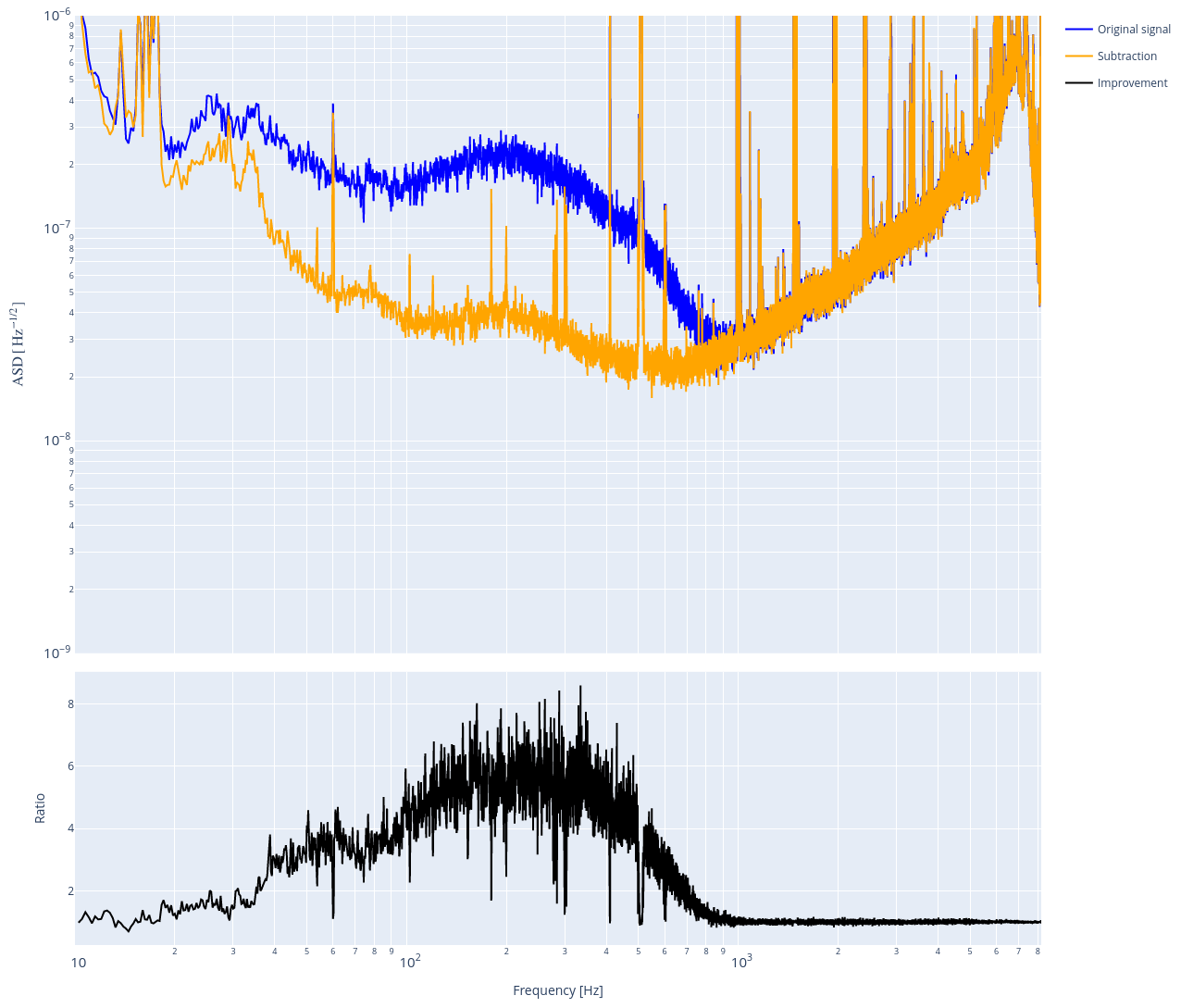
The interesting observation is that we are now limited by non-linear / non-stationary coupling of PRCL to DARM: while injecting PRCL noise with the new FF on, there is little coherence betwen DARM and PRCL, but DARM noise is increased broadband by ~10.
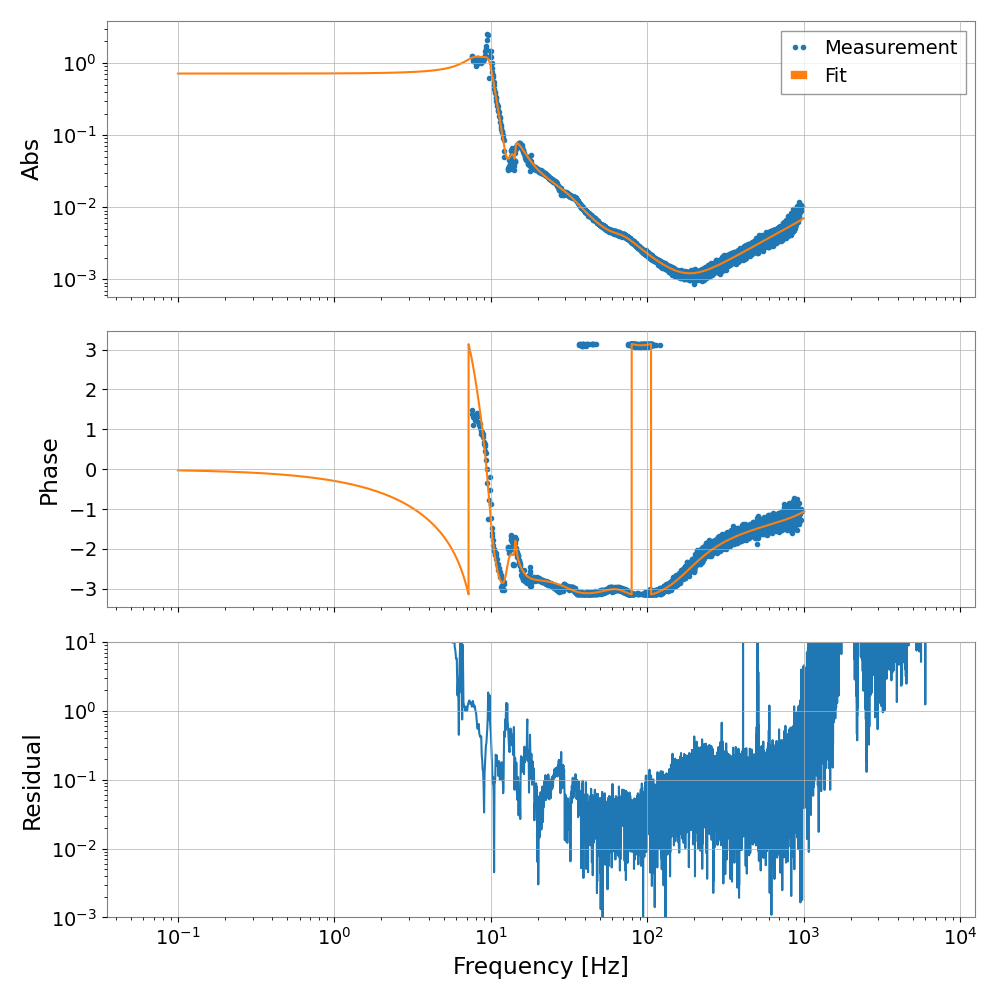
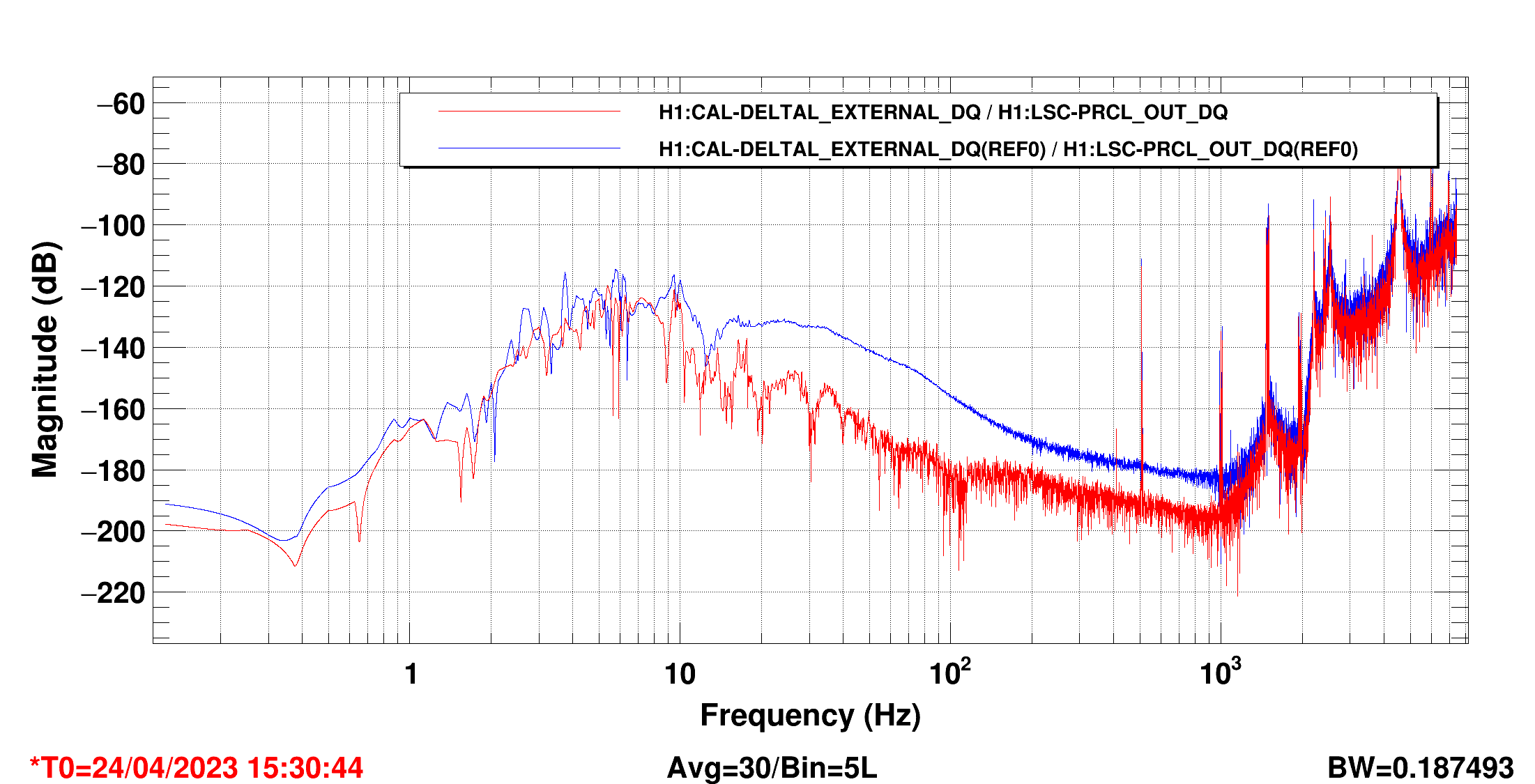
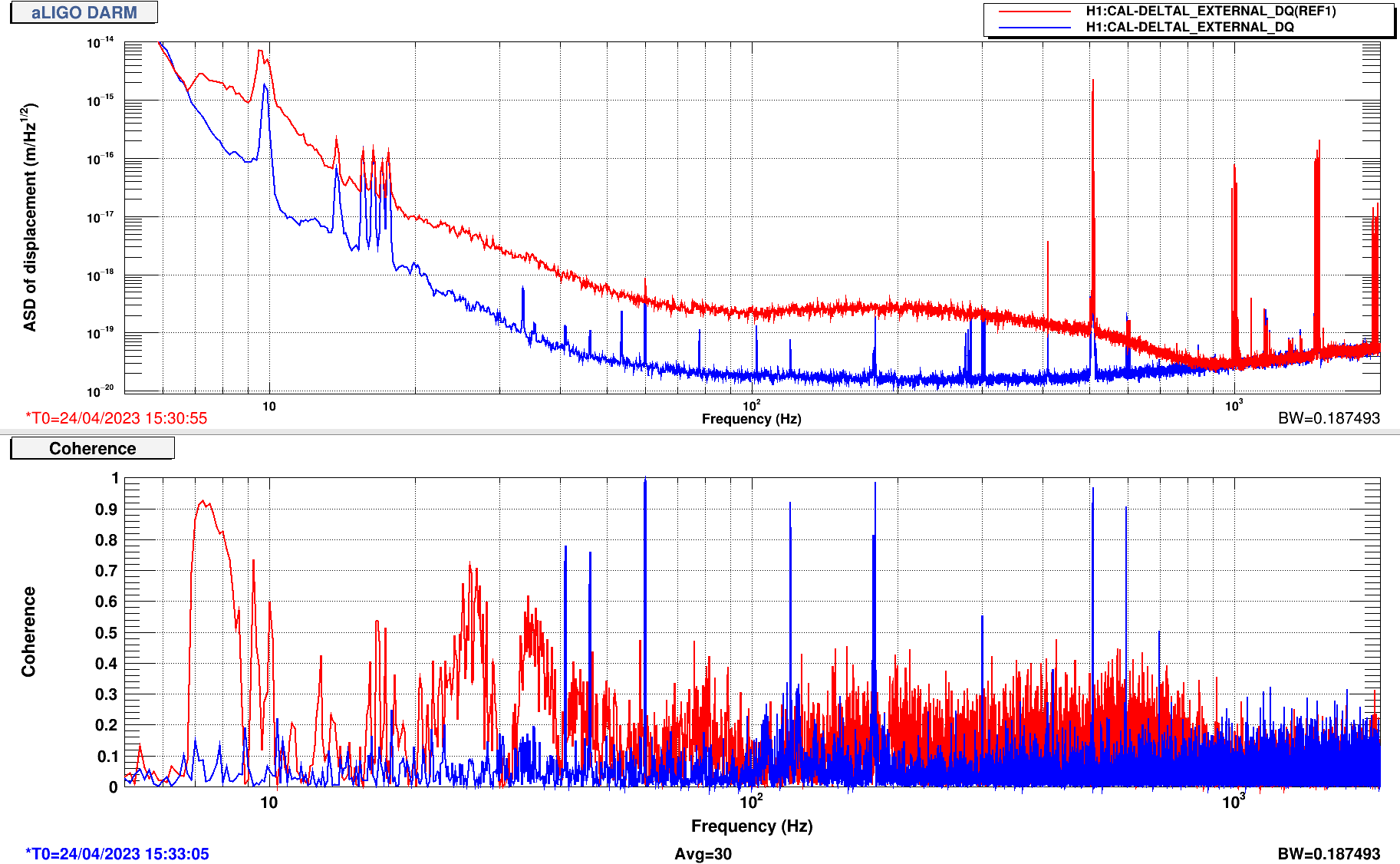
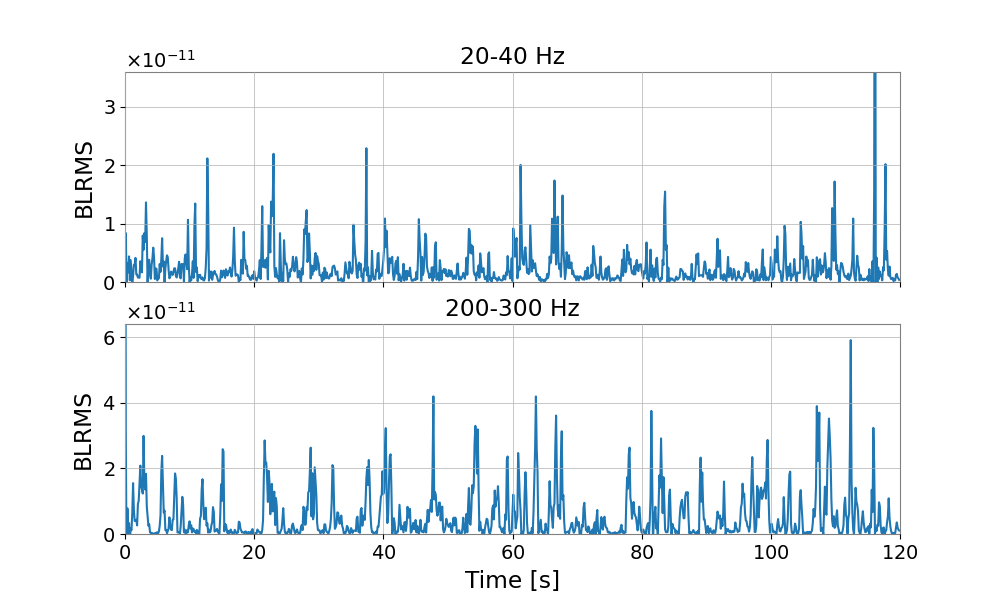
The residual PRCL noise ocupling to DARM is non-statioanry, as shown in the attached spectrogram and BLRMS plots.
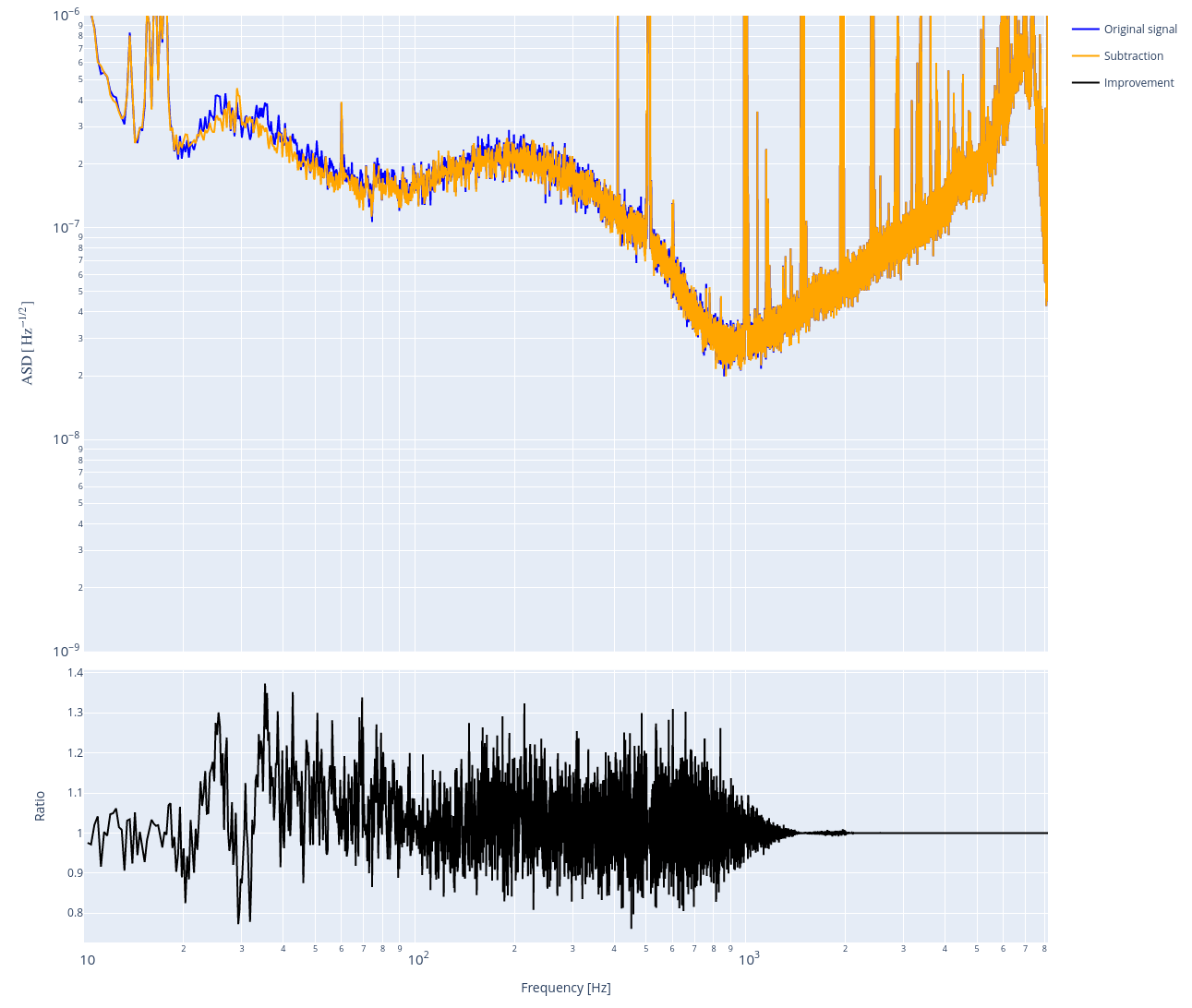
One cal also look at the time with a PRCL noise injection and the PRCL FF on. A linear and stationary subtraction can improve DARM just a little, showing that the FF is already doing a good job. Allowing the subtraction to use ASC signals for coupling modulation allows us to subtract a lot of the residual PRCL coupling from DARM.
However, this is not necessary to clean DARM in normal condition: we had to inject PRLC noise to see the effect.

Jennie, Elenna, Craig
For seven calibration meeasurements over the last two weeks I captured the thermal state of the interferometer, and used the broadband calibration injection taken at that time, and a 10 minute DARM measurement from a nearby quiet time, to get the calibration corrected DARM plots.
The thermal states were captured using thermal_state_capture.py in labutils.
The data was processed using Run_DARM_calib.ipynb in ligo/jennifer.wright/Documents/thermal_state
The BB injection measurements I used are in: /ligo/svncommon/CalSVN/aligocalibration/trunk/Runs/O3/H1/Measurements/FullIFOSensingTFs
The DARM spectra I used for quiet times are in /ligo/home/jennifer.wright/Documents/thermal_state
Calibrated DARM plots are saved in /ligo/gitcommon/labutils/pcal_bb_inj_quick_cal/plots and data is saved in /ligo/gitcommon/labutils/pcal_bb_inj_quick_cal/data
| BB Cal Injection Start | DARM measurement start | Input Power of IFO to nearest W | Guardian State During Quiet time | DARM measurement filename | BB Cal Injection filename | Thermal State Filename |
| 1364697812 | 1364699612 | 60 | 600 | 2023-04-05_0313UTC_H1_DARMSPEC_0-1Hz.xml | 2023-04-04_1945UTC_H1_PCALY2DARMTF_BB_3min.xml | therm_state_1364697812.txt |
| 1364775641 | 1364777441 | 60 | 700 | 2023-04-06_0050UTC_H1_DARMSPEC_0-1Hz.xml | 2023-04-05_1727UTC_H1_PCALY2DARMTF_BB_3min.xml | therm_state_1364775641.txt |
| 1364872253 | 1364871648 | 60 | 700 | 2023-04-07_0300UTC_H1_DARMSPEC_0-1Hz.xml | 2023-04-07_0316UTC_H1_PCALY2DARMTF_BB_3min.xml | therm_state_1364872253.txt |
| 1364882935 | 1364885358 | 70 | 700 | 2023-04-07_0649UTC_H1_DARMSPEC_0-1Hz.xml | 2023-04-07_0612UTC_H1_PCALY2DARMTF_BB_3min.xml | therm_state_1364882935.txt |
| 1365031551 | 1365030706 | 70 | 700 | 2023-04-08_2311UTC_H1_DARMSPEC_0-1Hz.xml | 2023-04-08_2327UTC_H1_PCALY2DARMTF_BB_3min.xml | therm_state_1365031551.txt |
| 1365040525 | 1365039740 | 70 | 600 | 2023-04-09_0142UTC_H1_DARMSPEC_0-1Hz.xml | 2023-04-09_0412UTC_H1_PCALY2DARMTF_BB_3min.xml | therm_state_1365040525.txt |
| 1365385287 | 1365383774 | 78 | 700 | 2023-04-13_0115UTC_H1_DARMSPEC_0-1Hz.xml | 2023-04-12_0145UTC_H1_PCALY2DARMTF_BB_3min.xml | therm_state_1365385287.txt |
I am going to add post some more DARM measurements from other days as I process them.
I plotted all the DARM spectra scaled by the PCAL BB measurement on the same graph, and corrected the parts where the coherence was low to match the unscaled DARM measurement.
Plot is in /ligo/home/jennifer.wright/Documents/thermal_state/pcal_corrected_darm_2023-04-05_0313UTC-to-2023-04-13_0115UTC.pdf
And code is in /ligo/home/jennifer.wright/Documents/thermal_state/Run_DARM_calib.ipynb.
I updated the code to include GPS reference times for the DARM spectra and some additional measurements which were taken on the 10th, 14th and 20th of April.
Code is in: /ligo/home/jennifer.wright/Documents/thermal_state/Run_DARM_calib_20230424.ipynb
Data for broadband calibration TFs to DARM is taken from:
/ligo/groups/cal/data/H1/measurements/PCALY2DARM_BB/
/ligo/svncommon/CalSVN/aligocalibration/trunk/Runs/O3/H1/Measurements/FullIFOSensingTFs/
Data for quiet times:
/ligo/home/jennifer.wright/Documents/thermal_state/*H1_DARMSPEC_0-1Hz.xml

