TITLE: 03/06 Day Shift: 16:00-00:00 UTC (08:00-16:00 PST), all times posted in UTC
STATE of H1: Observing at 119Mpc
INCOMING OPERATOR: Corey
SHIFT SUMMARY: Locked for 6h30
LOG:
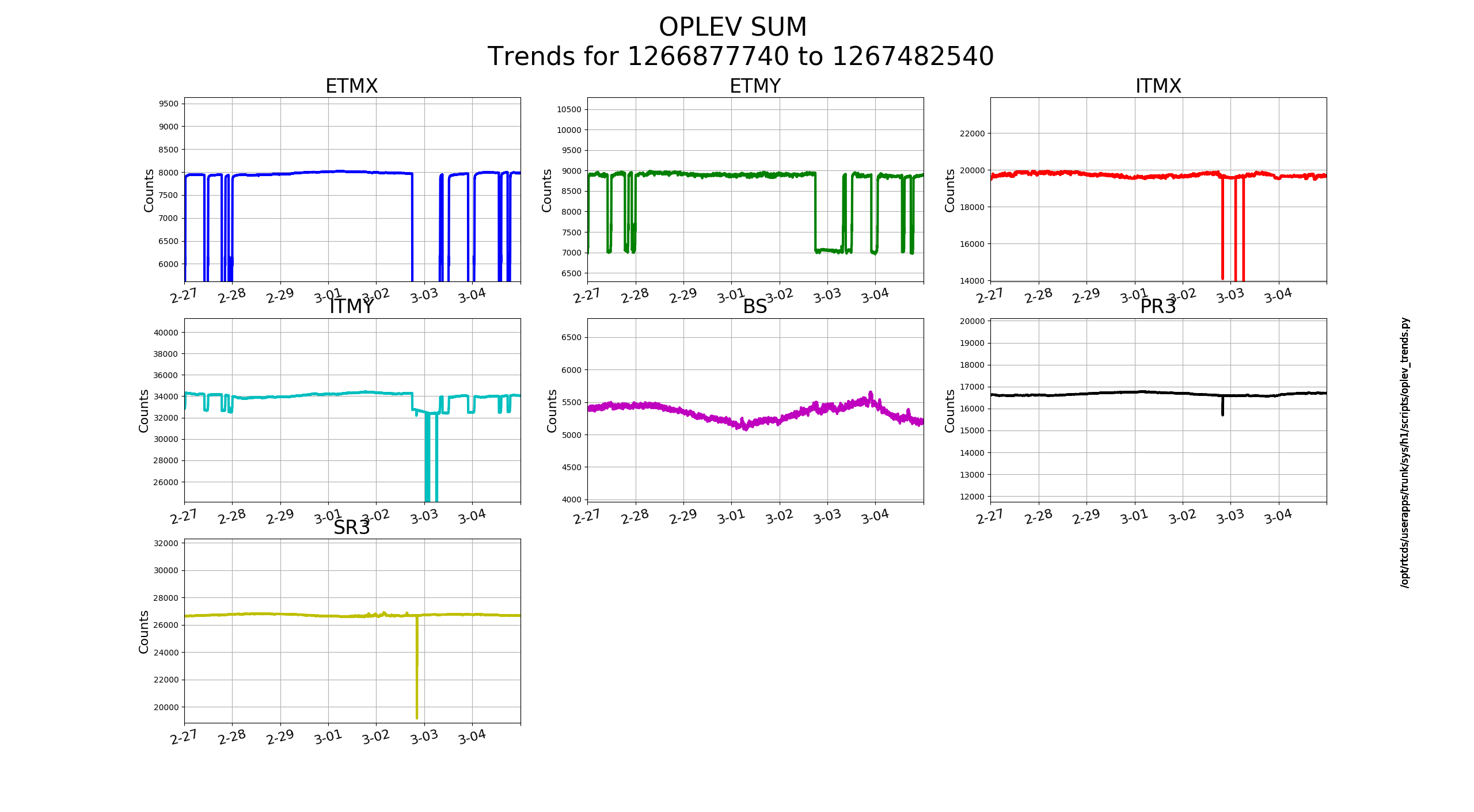
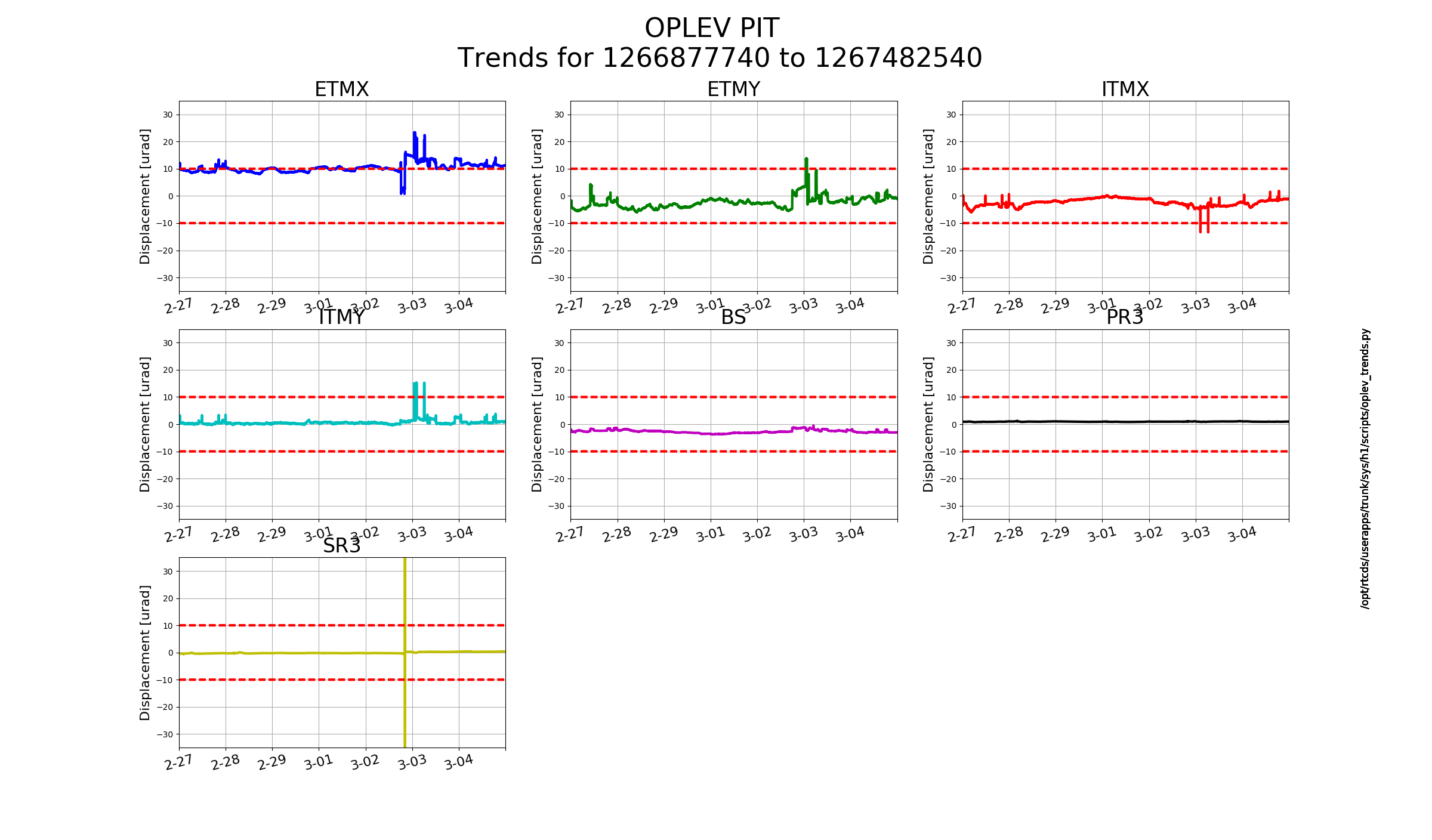
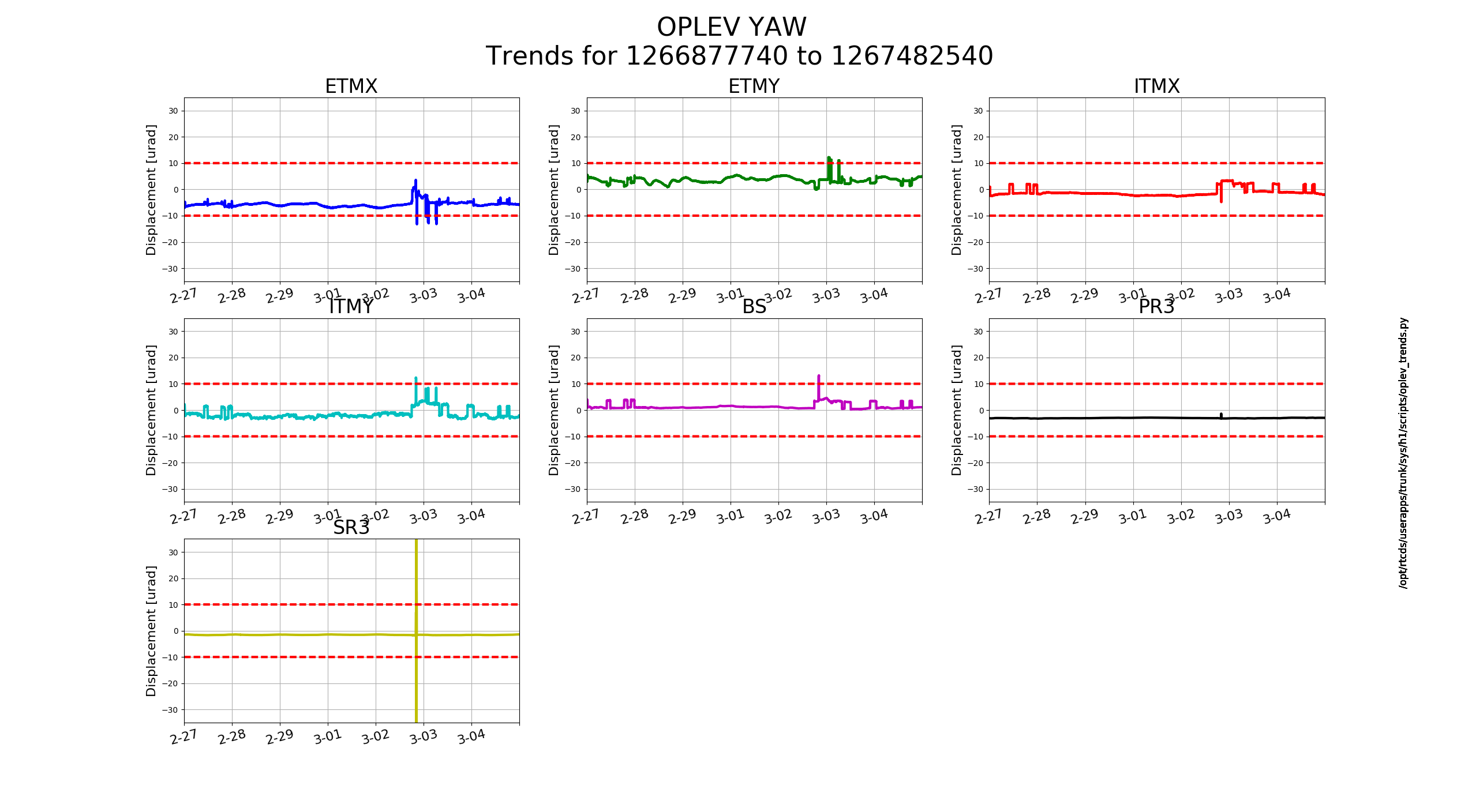
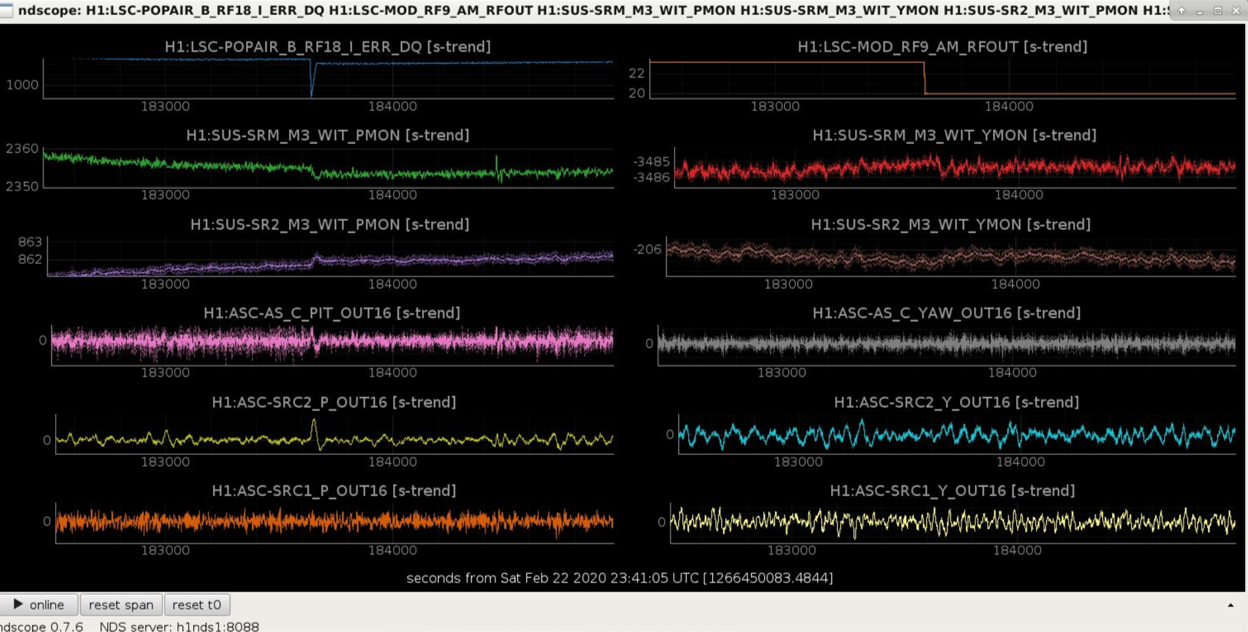
All oplevs recently dentered on unlocked/aligned IFO. Loops have driven ETMX OpLev to te limits shown in the trend plots. Not much to do about this at this time. It is our present reference of locked/"stable" alignment.
chiller water at max on Xtal chiller. No alarms on Diode chiller. No water added
There was a small earthquake this morning that passed through, which I expected to have cause the seismic system to transition to the earthquake state. It didn't, and probably didn't need to, but it did indicate that the seismon test in SEI_ENV was too strict. That test stopped checking whenever the seismon arrival time went to 0, so wouldn't trigger on an earthquake if arrived after the seismon prediction. There's an independent "passive" test that triggers when peak mon goes above 1000 nm/s, but for moderate earthquakes, that could be too late to prevent a lockloss.
I've changed the test to give us a window of 2 minutes after the seismon prediction. So line 49 used to be:
ezca['SEI-SEISMON_LHO_R35_ARRIVALTIME_TOTAL_SECS_{}'.format(i)] > 0:
is now:
ezca['SEI-SEISMON_LHO_R35_ARRIVALTIME_TOTAL_SECS_{}'.format(i)] > -120:
My choice of 2 minutes was a bit arbitrary and LLO uses 6 minutes, which seems reasonable. Not on site today, so I (or TJ or someone) will update at some point soon.
This time was updated to 6 minutes on March 11, 2020.
[A. Viets, M. Wade, J. Kissel]
The filters for C01 calibration for the first part of O3b are now ready for use. There will only be one epoch spanning the GPS time period 1256655618 - 1263060018. Information about filters and configurations to be used for each epoch can be found on the GDS/DCS configurations wiki page.
Epoch 1: 1256655618 (Nov 01 2019) - 1263060018 (Jan 14 2020)
This epoch uses filters file aligocalibration/trunk/Runs/O3/GDSFilters/H1DCS_C01_1256655618.npz which is made from the model file aligocalibration/trunk/Runs/O3/H1/params/modelparams_H1_20200103.
Info about model file: This model includes a dynamical model of the UIM to TST transfer function which mitigates the 3%-level systematic error in the response function at ~150 Hz. This model also includes an updated test mass mass for O3, improved locations of violin mode frequencyes for L2 and L3 transfer function, reduction in amount of violin modes accounted for on the L1 to L3 stage, updated actuation strength coefficients for all three stages, updated sensing function parameters to account for switch to 38W power from 36W.
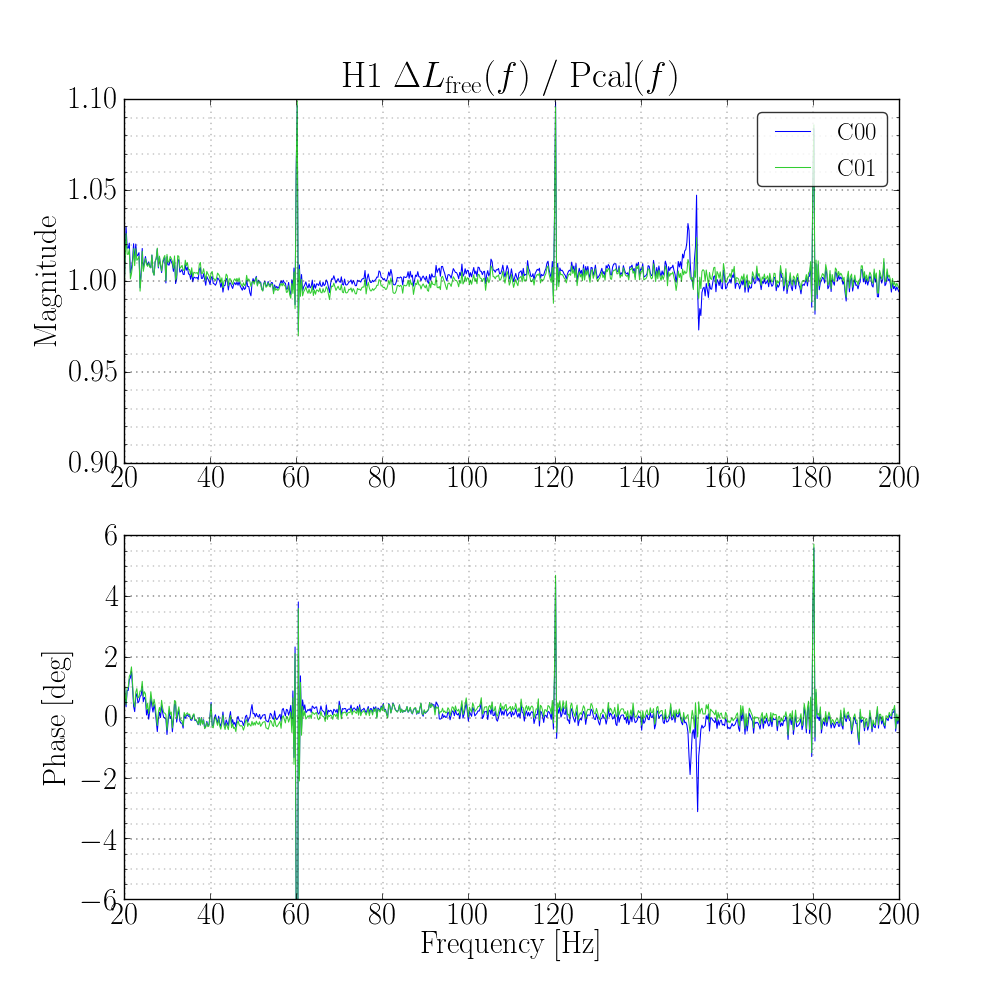
These filters were tested by calibrating C01-style data during three different PCAL broadband injection throughout this epoch and comparing the calibrated strain data to the broadband injection. The three attached plots show this ratio for broadband injections at GPS times 1258923929, 1260738026, and 1262638968, respectively. Plots of the filters themselves can be found in aligocalibration/trunk/Runs/O3/H1/Scripts/TDfilters/H1DCS_C01_1256655618_plots.
17:36 UTC Observing
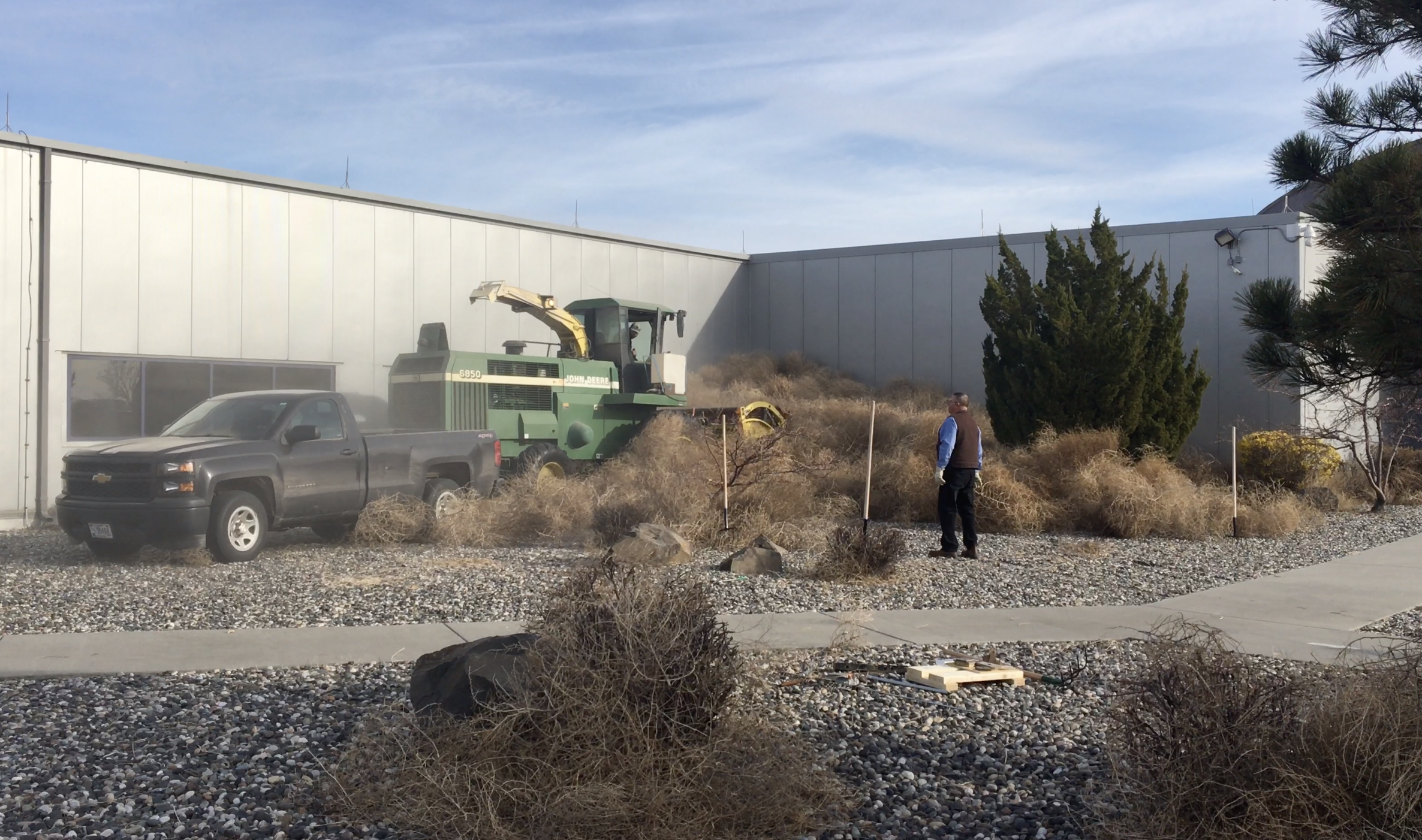
It was my understanding that this activity with the tumbleweeds took place AFTER the lock loss. We typically try to use the machine only in areas where it will not disrupt the instrument or if there is a lock loss. We do not want to be the cause of the instrument going down.
TITLE: 03/05 Day Shift: 16:00-00:00 UTC (08:00-16:00 PST), all times posted in UTC
STATE of H1: Observing at 120Mpc
OUTGOING OPERATOR: Jim
CURRENT ENVIRONMENT:
SEI_CONF state: WINDY
Wind: 4mph Gusts, 3mph 5min avg
Primary useism: 0.03 μm/s
Secondary useism: 0.49 μm/s
QUICK SUMMARY: Locked 3 hours. Lock acquisition from last nights 2020-03-05 11:49:11 UTC lockloss happened 100% automatically!
This is a follow up to alog 47604, mostly this gif. LHO is currently locking the SRCL degree of freedom with 50 cts of offset. Detuning in the SRCL dof causes an optical spring to appear in DARM. (see e.g. alog 52981, host to this plot). From the many DARM TFs, 50 cts in the SRCL loop corresponds to about 0.5 degrees of detuning from perfect resonance. Why should the SRCL loop lock in a detuned state? I am testing the idea that higher order modes existing in the SRC spoils the SRCL error signal. The SR3 heater alters the radius of curvature of the SR3, changing the mode content in the SRC. The gif above shows the effect of a SR3 heater off-on-off test has on the DARM plant. The DARM plant TF changes from anti-spring to spring to anti-spring again. This suggests that the mode content of the SRC has a strong effect on the SRCL error signal. Using Finesse, I have modeled the LHO higher order mode content in each cavity while changing the SR3 radius of curvature (via "lock dragging"). If I change the SR3 RoC by ~10 mm, we start to see a number of effects on the model: 1) The 02 and 20 HOM content in the SRC starts to become significantly high. (Plot 1, [here "omc" means incident on omc, and "as" means OMC DCPDs]) 2) The SRCL error signal becomes distorted on the upper side (Plot 2) 3) The SRCL error signal zero-crossing moves away from 90 degrees (Plot 3) 4) SRM tuning moves away from 90 degrees to keep the IFO locked (Plot 4) 5) As SRCL becomes detuned, we see the optical spring appear in the DARM TF (Plot 5) At the moment, this model cannot totally explain the DARM optical spring. This Finesse model is fairly optimized, with no astigmatism in the arms or mode mismatch from IMC to IFO. But if we take the DARM plant MCMC fits from the gif to be accurate enough, the SR3 heater caused the optical spring frequency to flip from around -3 Hz to 3 Hz and back again. This model is good to about that order of magnitude.
more observations: 1) MICH is also affected, as seen by the ITMs moving (the model moves ITMs and not BS) 2) 10 mm is a reasonable amount of RoC change for SR3 according to Aiden (LLO alog 27262) 3) SRCL is susceptible to mode mismatch errors because the levels of TEM00 light in the SRC is low.
TITLE: 03/05 Eve Shift: 00:00-08:00 UTC (16:00-00:00 PST), all times posted in UTC
STATE of H1: Observing at 114Mpc
INCOMING OPERATOR: Jim
SHIFT SUMMARY:
H1 running smoothly for almost 8.25hrs.
If the FSS has trouble locking, call Jason (Rick is back up if you don't reach Jason).
LOG:
Had a recent stint of glitches, but other than that, smooth sailing with H1 locked for 4.5hrs and a range hovering around 117Mpc.
TITLE: 03/05 Eve Shift: 00:00-08:00 UTC (16:00-00:00 PST), all times posted in UTC
STATE of H1: Observing at 116Mpc
OUTGOING OPERATOR: Cheryl
CURRENT ENVIRONMENT:
SEI_CONF state: WINDY
Wind: 11mph Gusts, 9mph 5min avg
Primary useism: 0.03 μm/s
Secondary useism: 0.39 μm/s
Microseism has inched up slightly over the last 24hrs.
QUICK SUMMARY:
H1 was recently locked as I arrived. Currently seeing the range decrease (it's under 115Mpc currently).
FSS: If there are issues with it locking, we are to call Jason/Rick.
TITLE: 03/05 Day Shift: 16:00-00:00 UTC (08:00-16:00 PST), all times posted in UTC
STATE of H1: Observing at 116Mpc
INCOMING OPERATOR: Corey
SHIFT SUMMARY: Lost lock in the middle from, seemingly, commissioning activities. We then took some time to try to diagnose the FSS relocking issues we have had lately. Lock acquisition after that was all autonomous.
LOG:
A few weeks ago we tried to install an new network switch in the CER. For some reason it did not work for uur needs. We pulled the switch out today to download the config to show the vendor as we try to figure out what happened.
Back to Observing at 2344UTC, after some FSS corrective maintenance.
[Sheila, Jenne]
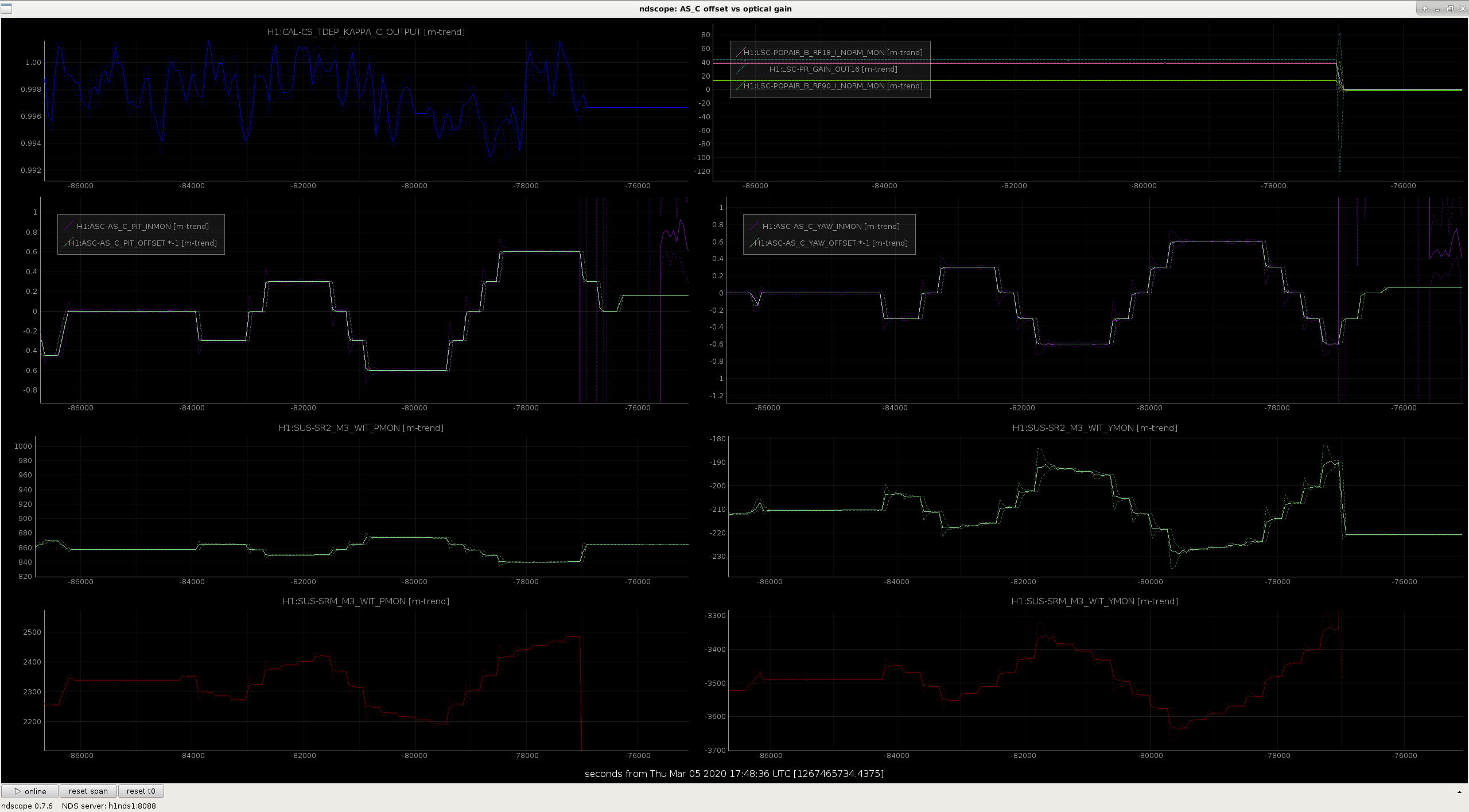
We took a few tens of minutes this morning to check how far and fast we can move the SRC spot by changing the AS_C offset. Once we had those numbers, we started a script to slowly move the offsets while we're Observing. The script started at 18:21 UTC.
This measurement is now over. We lost lock during the second to last move that this script makes (going from -0.6 P 0.6 Y offsets to -0.3 P 0.3 Y). Perhaps those last moves were too large to take at once.
The pdf attachment shows the median of the kappa c value reported by the front end in the last 60 seconds of each measurement time. (Jenne's script moved the offset, waited 300 seconds, I'm grabing the last 60 seconds of the 300 seconds.). There is about a 0.5% change in kappa_c over the scan. When we are servoing the power on the DCPDs to 20mA and changning the amount of junk light photocurrent, the optical gain would be proportional to sqrt(20mA -junk light photocurrent). If we use 1.3mA of junk light estimated in 55287 then we are reducing the junk light from 1.3 to 1.1mA, or by about 15%.
While there is some noise in the data, the optical gain does seem higher for offsets in the negative pitch direction (as the beam moves up on AS_C). Our nominal position is pit -0.16 and yaw -0.06.
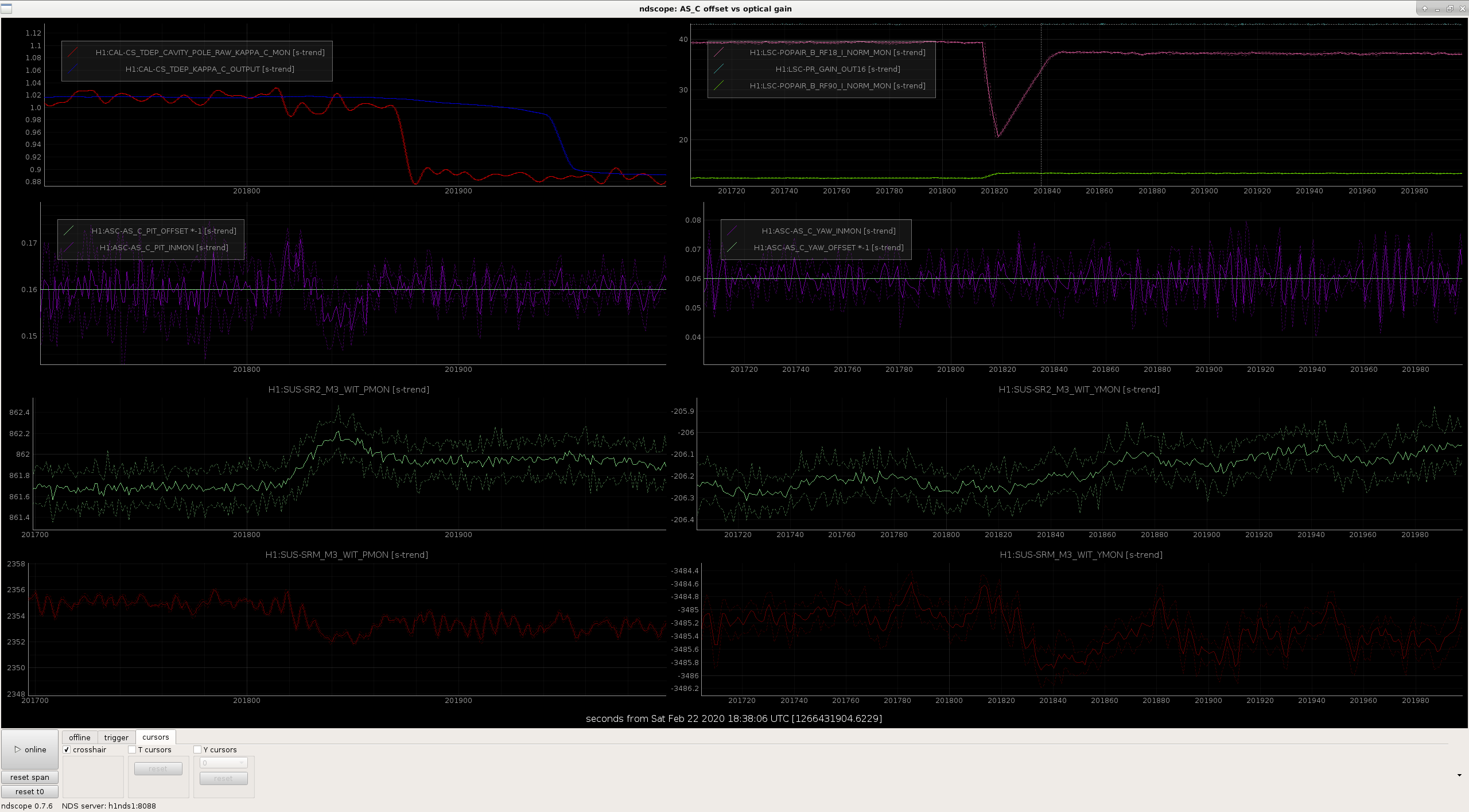
The second attached png is a plot of the time that we changed the modulation depth and changed the darm offset in 55405. In this offset test we are moving AS_C, SR2 and SRM much further for a smaller change in the apparent junk light compared to the modulation depth change test.
[Sheila, Jenne]
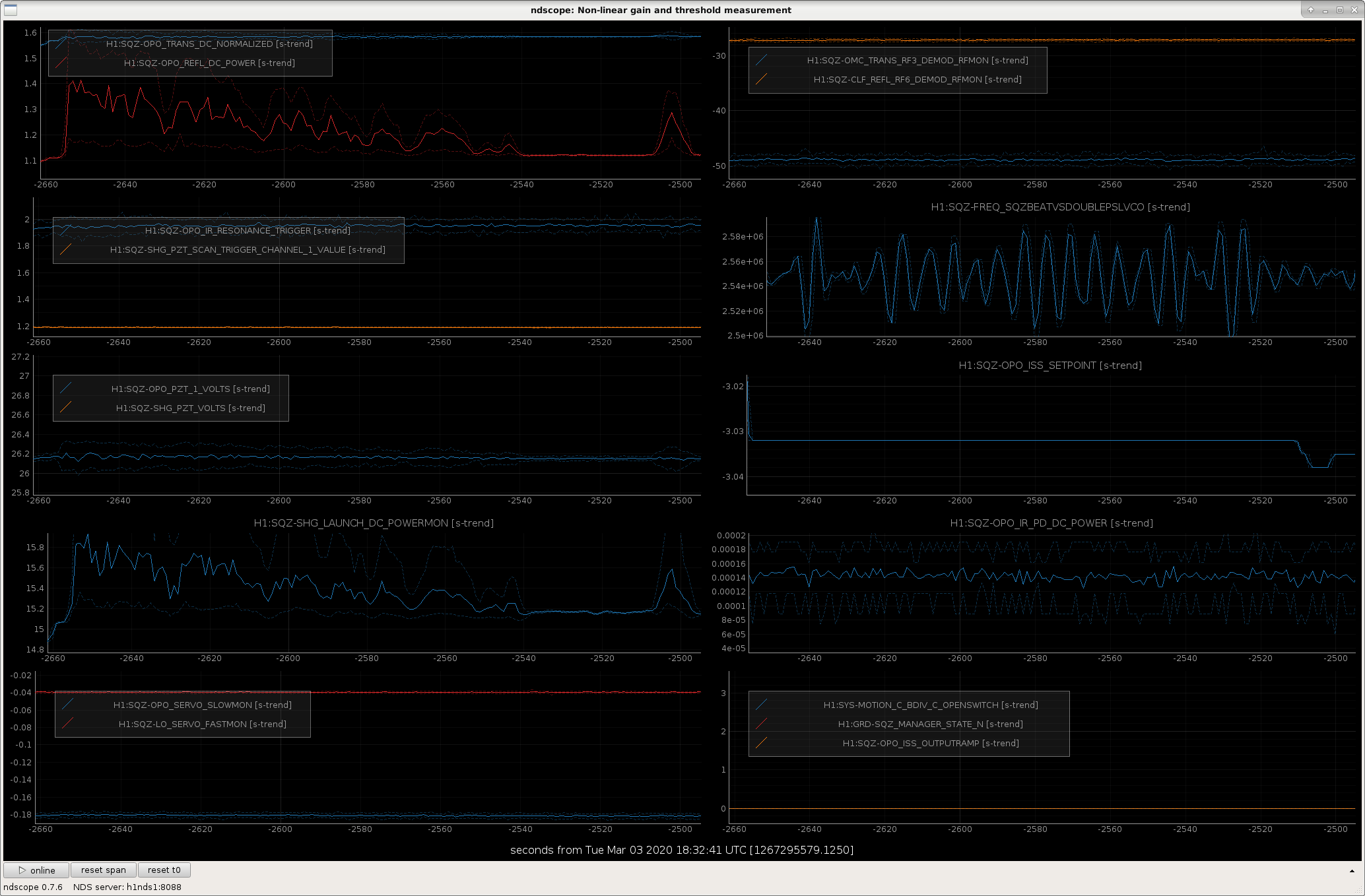
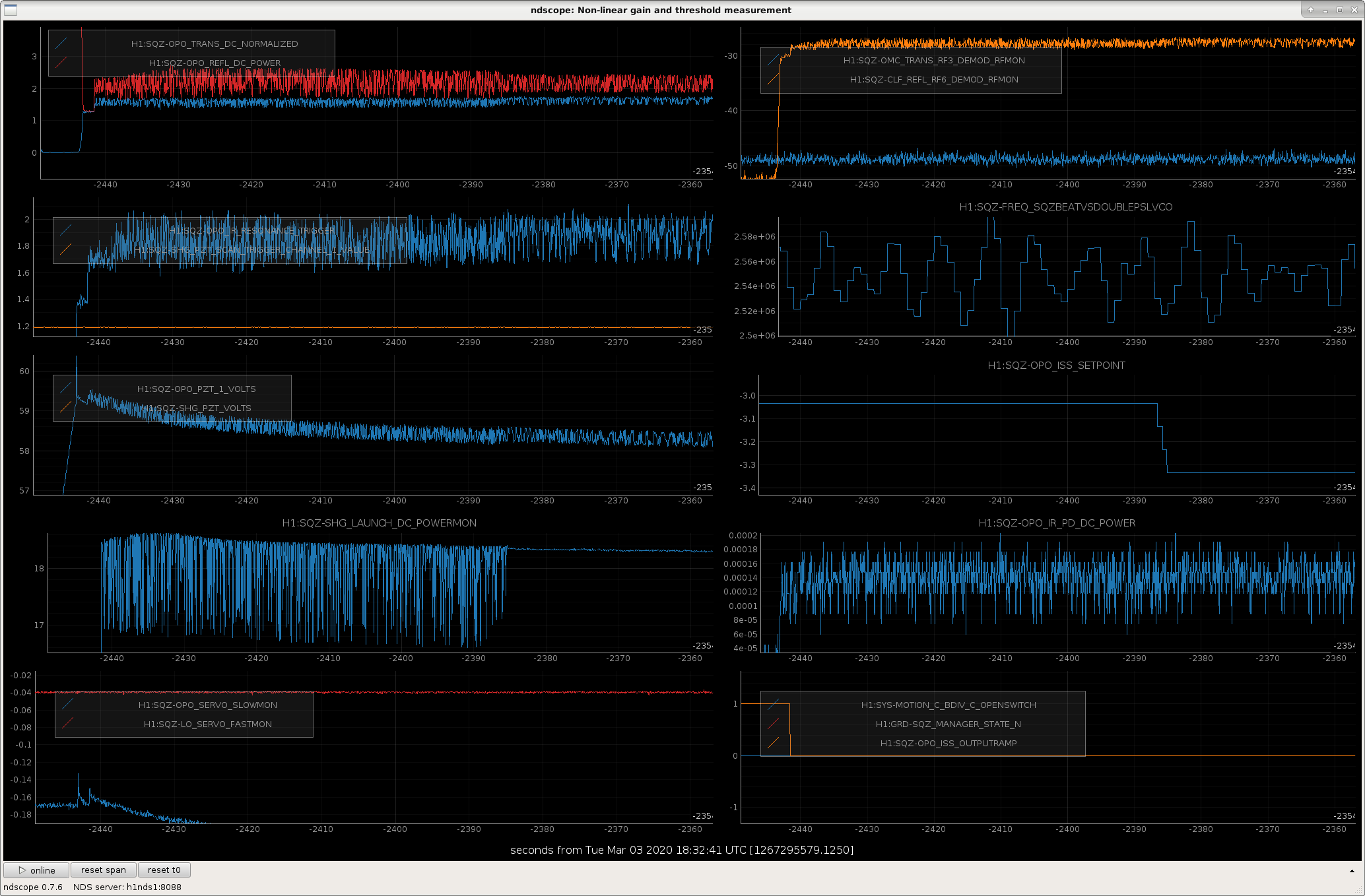
Although the squeezer seems to not have gone into oscillation since last Thursday when we lowered the green power (alog 55339), we are looking to see if we can better understand the cause and ameliorate it (spoiler alert: so far we don't know, although we have further tests to try today).
Here's what we've done so far:
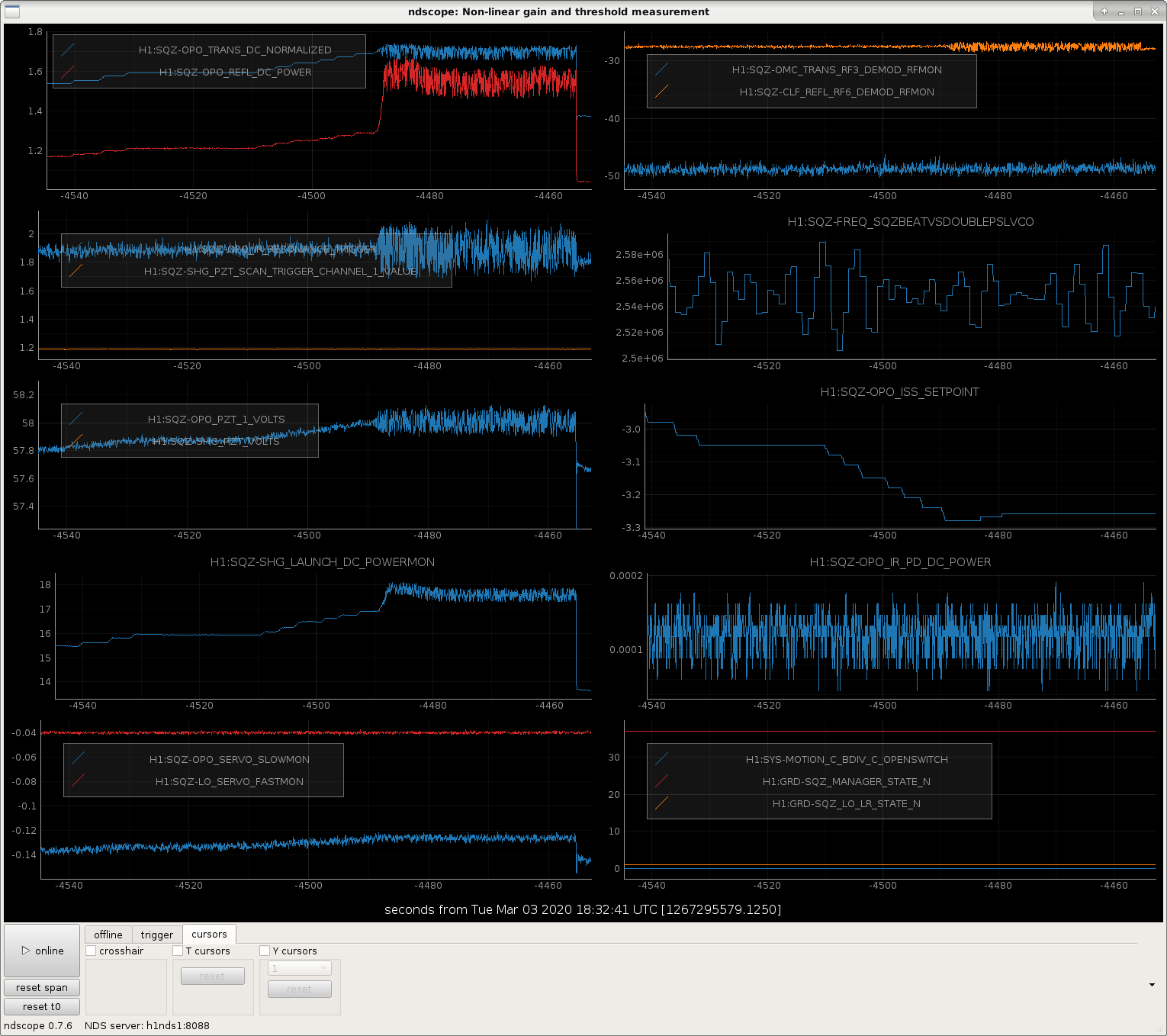
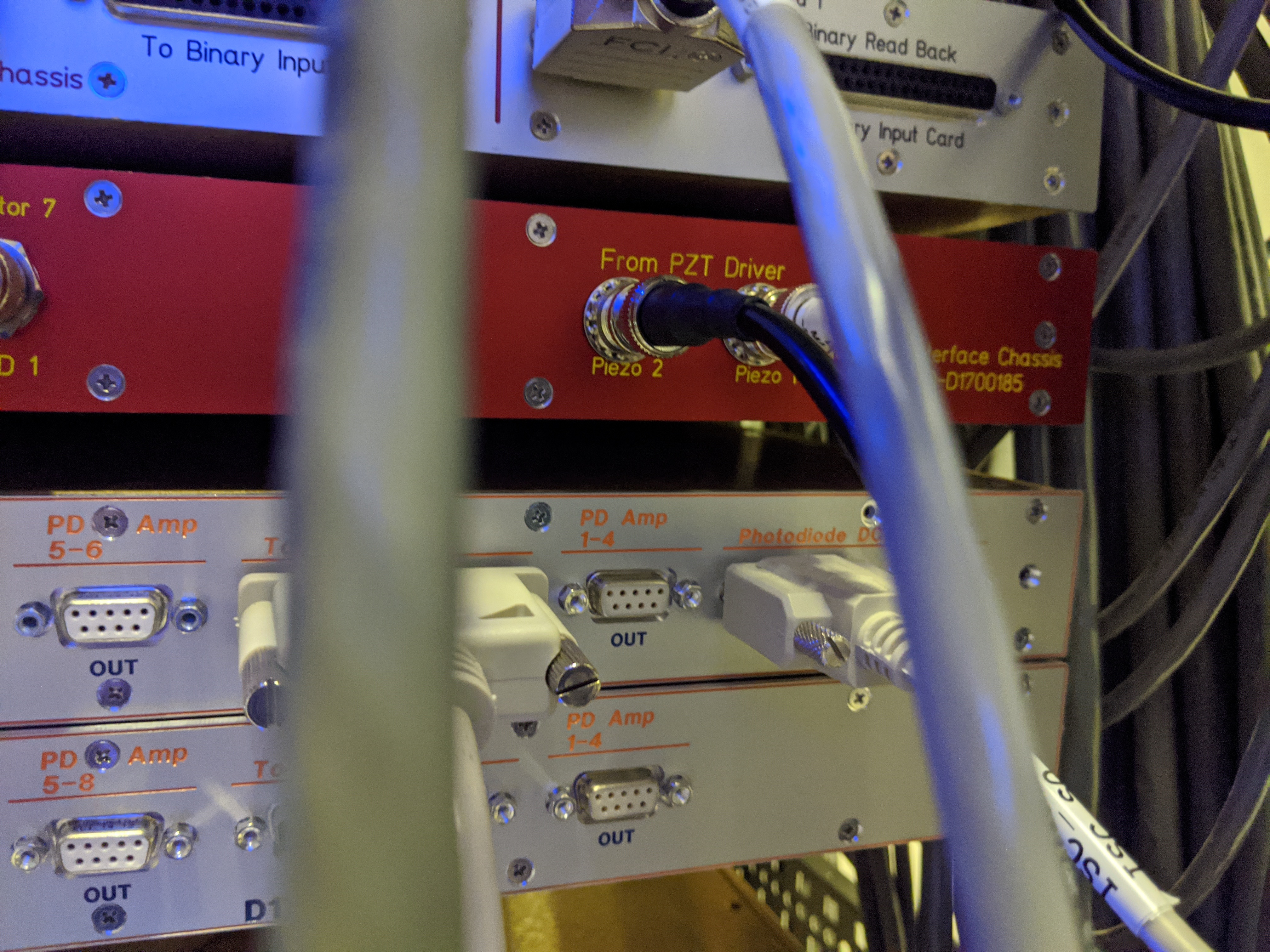
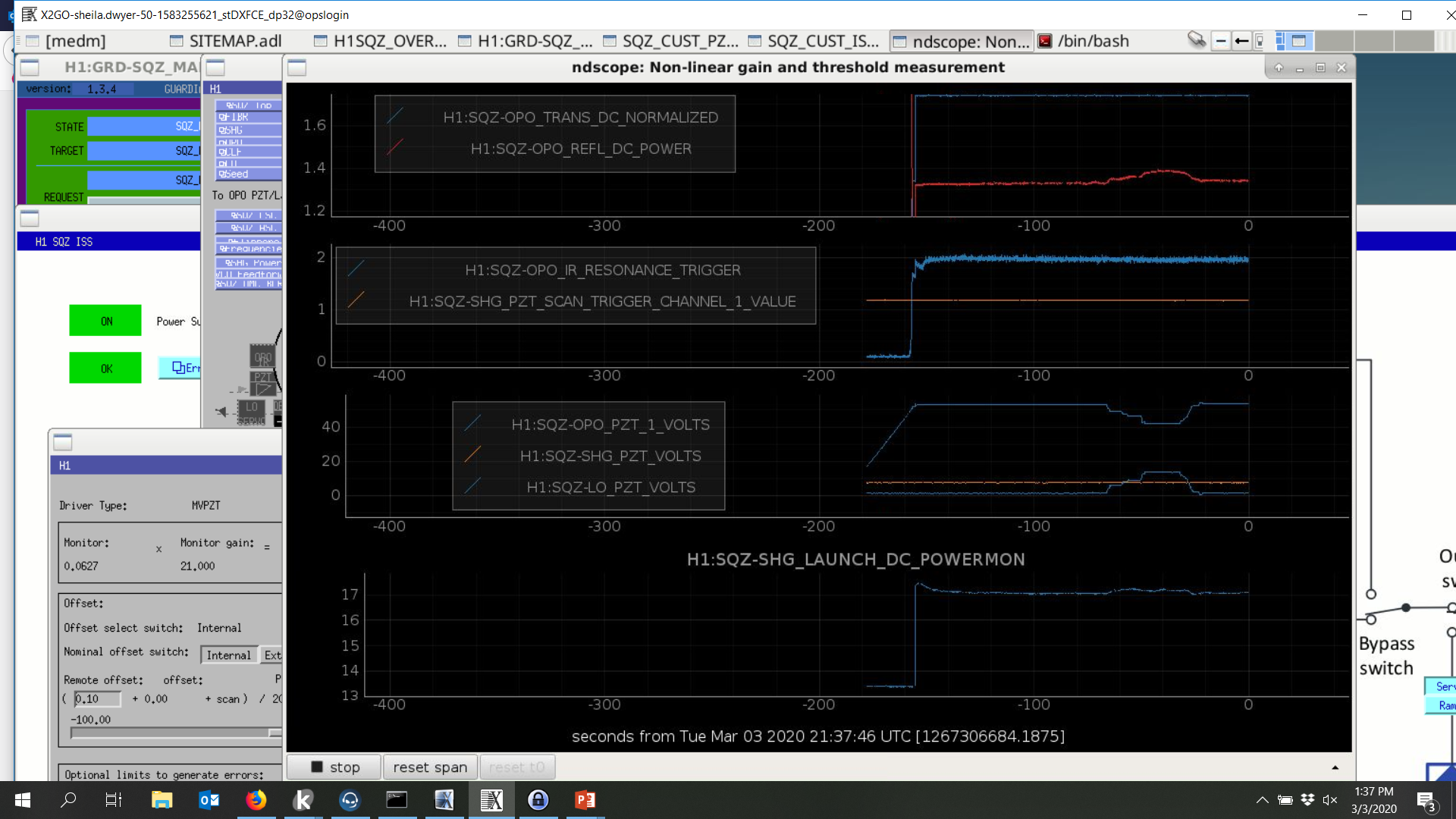
Jenne cabled the LO PZT driver channel (used only for locking with the diagnostic homodyne, not during runing) to the OPO PZT2. The attached screenshot shows that with the OPO locking using PZT1 (blue line, around 50V), we can move the offset on PZT2 (LO channel, blue line around 0-20V) to reduce the voltage on PZT1. You can see that the reflected power increases when there is a higher voltage on PZT2, which is on one of the curved mirrors, because the cavity gets more misaligned from driving PZT2 than PZT1.
We tried but weren't able to recreate the oscillation a second time, so we don't know if moving around the offset on the second PZT will have any impact on the instability. We can try to move this offset if the instability does reappear, although it might not help if the problem is related to the misalignment of the OPO that the high PZT1 voltage causes.
Keita was wondering if part of the difference (that prevented us from recreating the oscillation) was the fact that both PZTs were connected to cables, neither of them was connected to a terminator. So, I reverted PZT2 back to being a terminator (and re-plugged in the LO cable to the LO PZT output of the driver). Now everything cable-wise is back to how it was this morning. However, I still wasn't able to cause oscillations, even if I brought the green power up above 1.8.
So, for now I'll leave all of the cables as they are, which is fully reverted from the tests today. If we see the oscillations come back, then we'll reconsider again borrowing the LO driver channel for PZT2.
When I left things at a green power of 1.3, I had also reverted the squeezer angle, but had forgotten to revert the OPO crystal temperature, H1:SQZ-OPO_TEC_SETTEMP. I have now reverted it to its value from before last Thursday's green power change (33.014 C). I did not measure the nonlinear gain. For this, we were out of Observing for ~1 minute.