Displaying reports 37641-37660 of 89097.Go to page Start 1879 1880 1881 1882 1883 1884 1885 1886 1887 End
Reports until 21:03, Tuesday 05 November 2019
H1 General
jim.warner@LIGO.ORG - posted 21:03, Tuesday 05 November 2019 - last comment - 10:07, Thursday 07 November 2019(53034)
Duty cycle during Owl shifts in O3a

I've had a quick look at the duty cycle during owls for O3a. A couple of quick numbers:

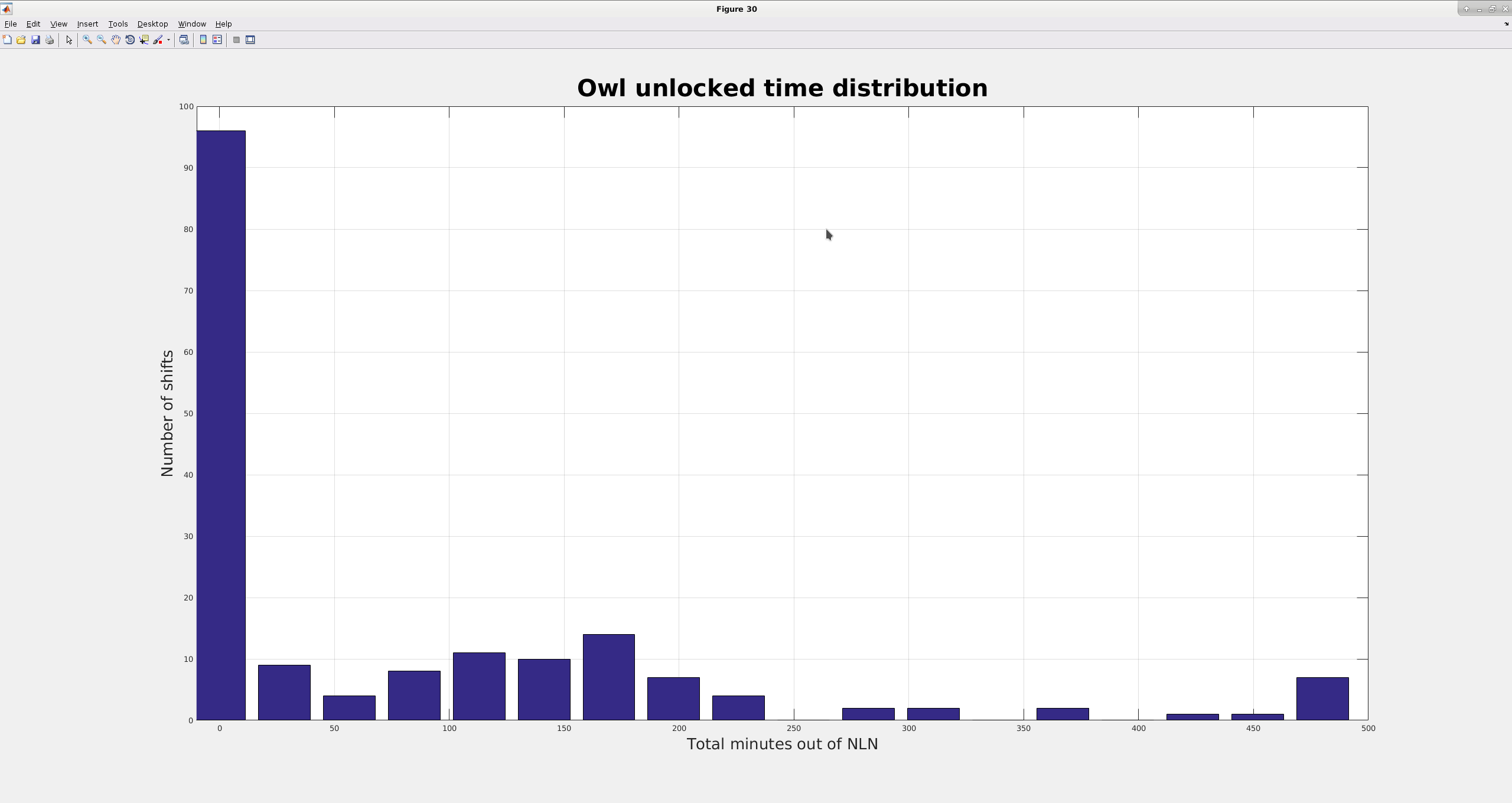
Of 176 total owl shifts, there were 96 shifts the IFO was locked when the owl shift started and stayed locked the entire time.

There were 7 shifts where the IFO never got to NLN.

The duty cycle for all O3a owl shifts was 84%, or: we were in some state other than NLN for 16% of the time.

Attached plot is the distribution for the amount of time the IFO was not in nln. The X bins are the number of minutes (with 30 minute bins) the IFO wasn't locked, the Y axis is the number shifts for each bin (i.e if the ifo was out of nln for 130 minutes, that shift gets counted as 1 instance in the 120-150 minute bin). I'll point out the tallest spike by far is the one at 0,  where the IFO was locked the entire shift. 

Not too sure what else to make of this, but the lump around 150 minutes kind of lines up with our normal time required to relock, indicating to me that mostly we lost lock once, then had a normal time relocking. Probably, most of the bins below 100 and above zero are from locklosses at the end of a shift, or a reacquisition that was started before the owl shift.

Images attached to this report
Comments related to this report
jeffrey.kissel@LIGO.ORG - 10:07, Thursday 07 November 2019 (53066)DetChar, FMP, GRD, ISC, Lockloss, OpsInfo, SEI
Adding a few tags so that more people see this entry. Great information, Jim!
H1 TCS (TCS)
aidan.brooks@LIGO.ORG - posted 16:42, Tuesday 05 November 2019 - last comment - 09:06, Tuesday 08 March 2022(53031)
H1 ETMY HWS measurements update - strong coupling from PIT and YAW

I've been doing some investigation into the ETMY HWS measurements. The HWS shows negative lensing when the IFO is locked. However, this doesn't seem very physical. I had 4 working hypotheses as to what might be going on:

  1. We're not imaging the ETM HR surface correctly onto the HWS
  2. The TMS telescope is heating up from absorption on the secondary mirror
  3. There is somehow cross-coupling from optic alignment changes
  4. It's real distortion from an absorption ring about 100mm in diameter.

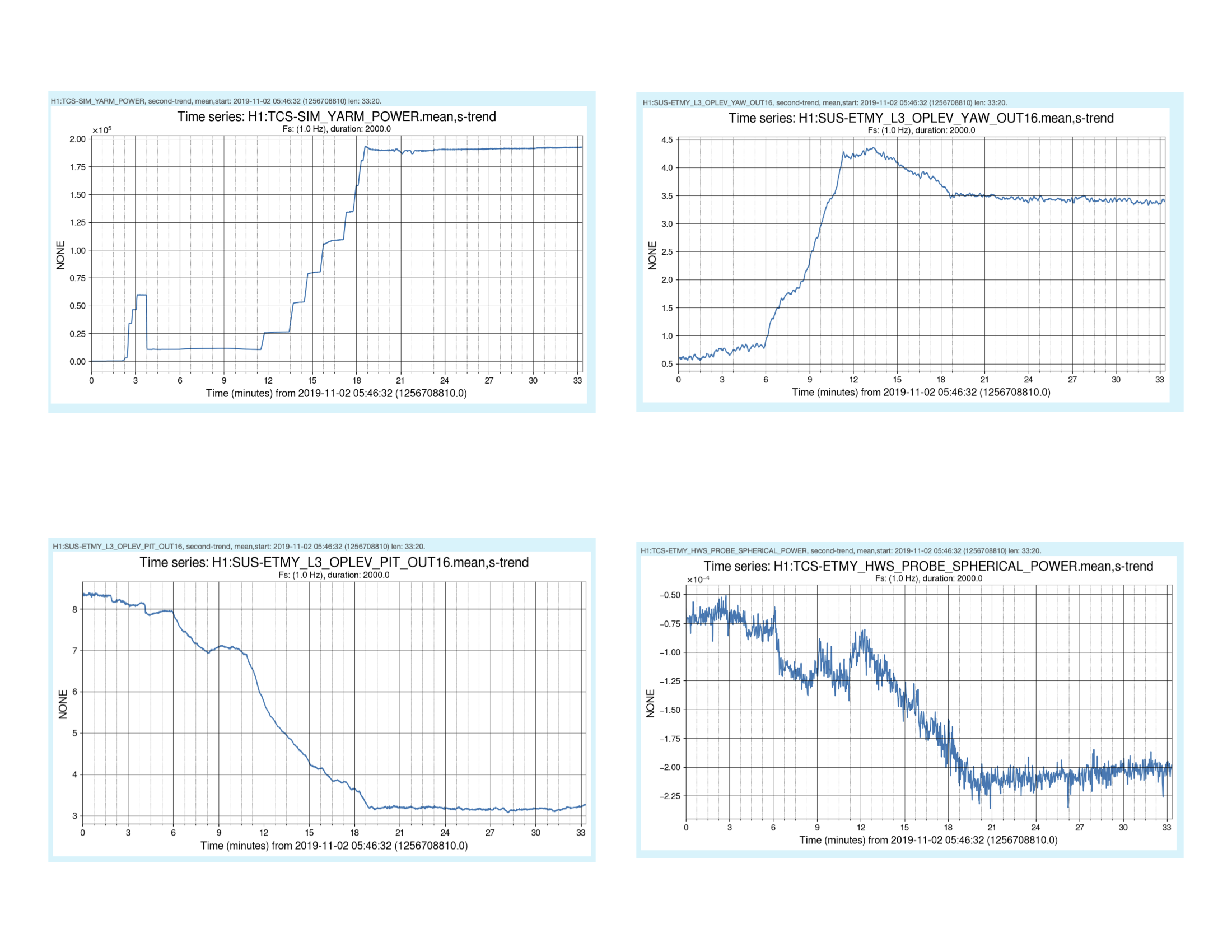
Without going into a lot of detail on these, I'm pretty convinced that the issue is Number 3: Cross-coupling from absorption. The main reasons for this is that he HWS spherical power and OPLEV PIT/YAW signals are highly correlated. Also, a linear change of -200 micro diopters in defocus over 7 minutes followed by a sudden stop is not remotely physical for a thermal effect in glass.

Why there is such a strong coupling for ETMY HWS and whether or not it can be removed (optically or digitally) is still TBD.

Correlation of HWS SPHERICAL power PIT/YAW signals:

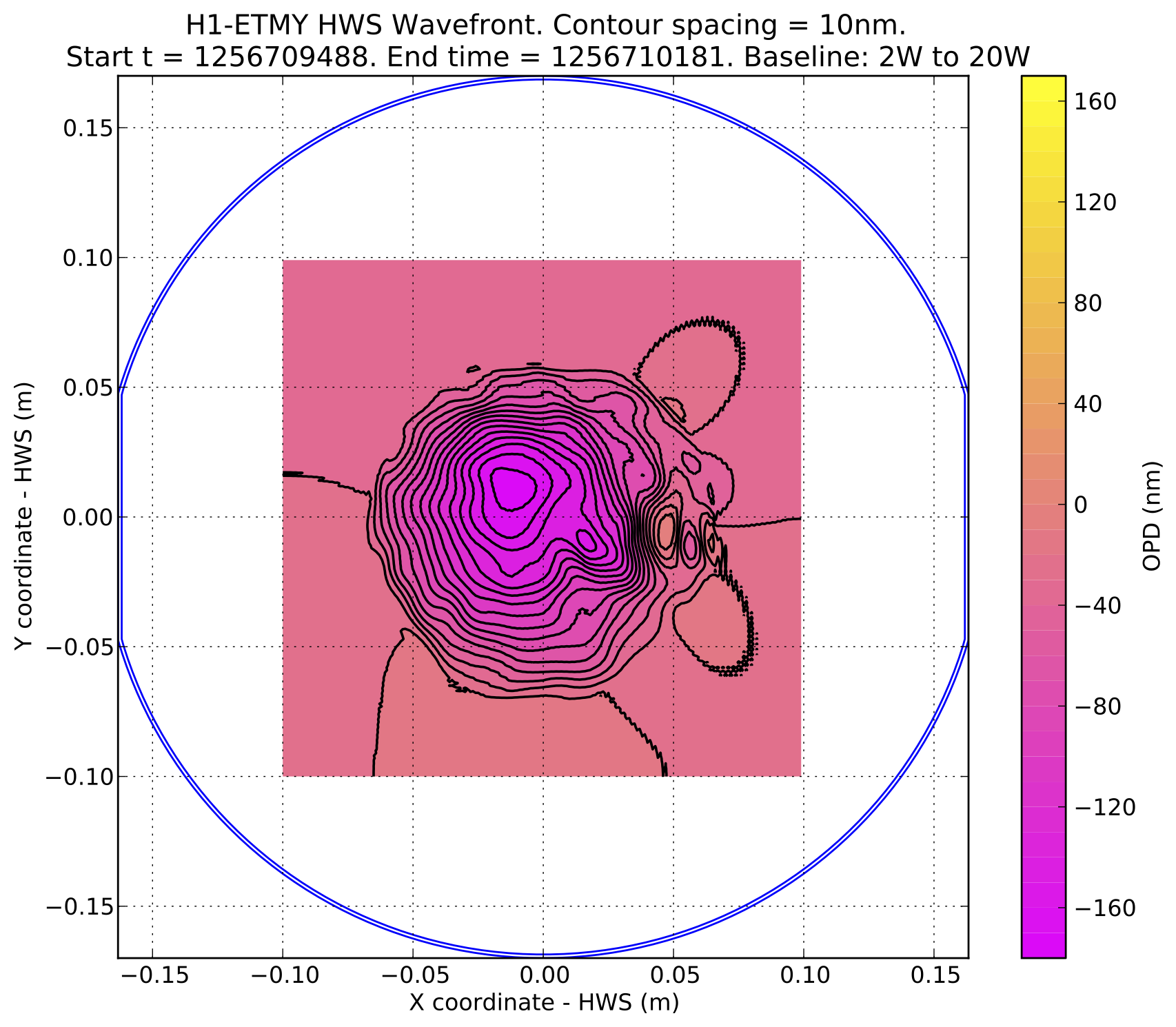
HWS wavefront from above time series: comparing t = 11.3 minutes to t=22.7 minutes


Images attached to this report
Non-image files attached to this report
Comments related to this report
aidan.brooks@LIGO.ORG - 09:06, Tuesday 08 March 2022 (62098)

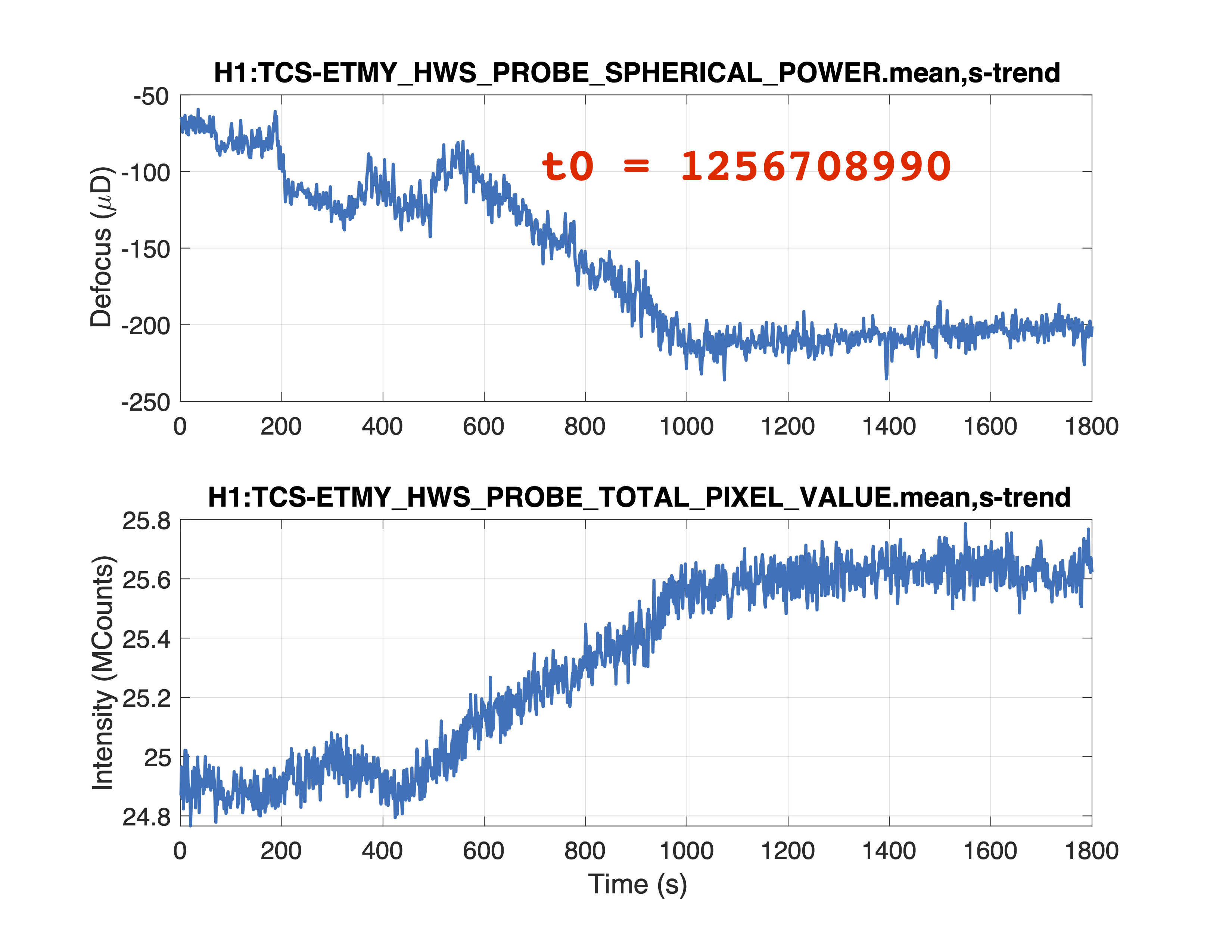
For LHO ETMY HWS, there is a direct correlation between the spherical power and the total intensity on all pixels on the camera. 

  • H1:TCS-ETMY_HWS_PROBE_TOTAL_PIXEL_VALUE

  • H1:TCS-ETMY_HWS_PROBE_SPHERICAL_POWER

The attached plots start from t=1256708990

The next step is to determine a baseline for how much we expect this to be, i.e how much this exists for other ETM HWS (do we see excess intensity on the HWS when powering up those arms in the IFO).

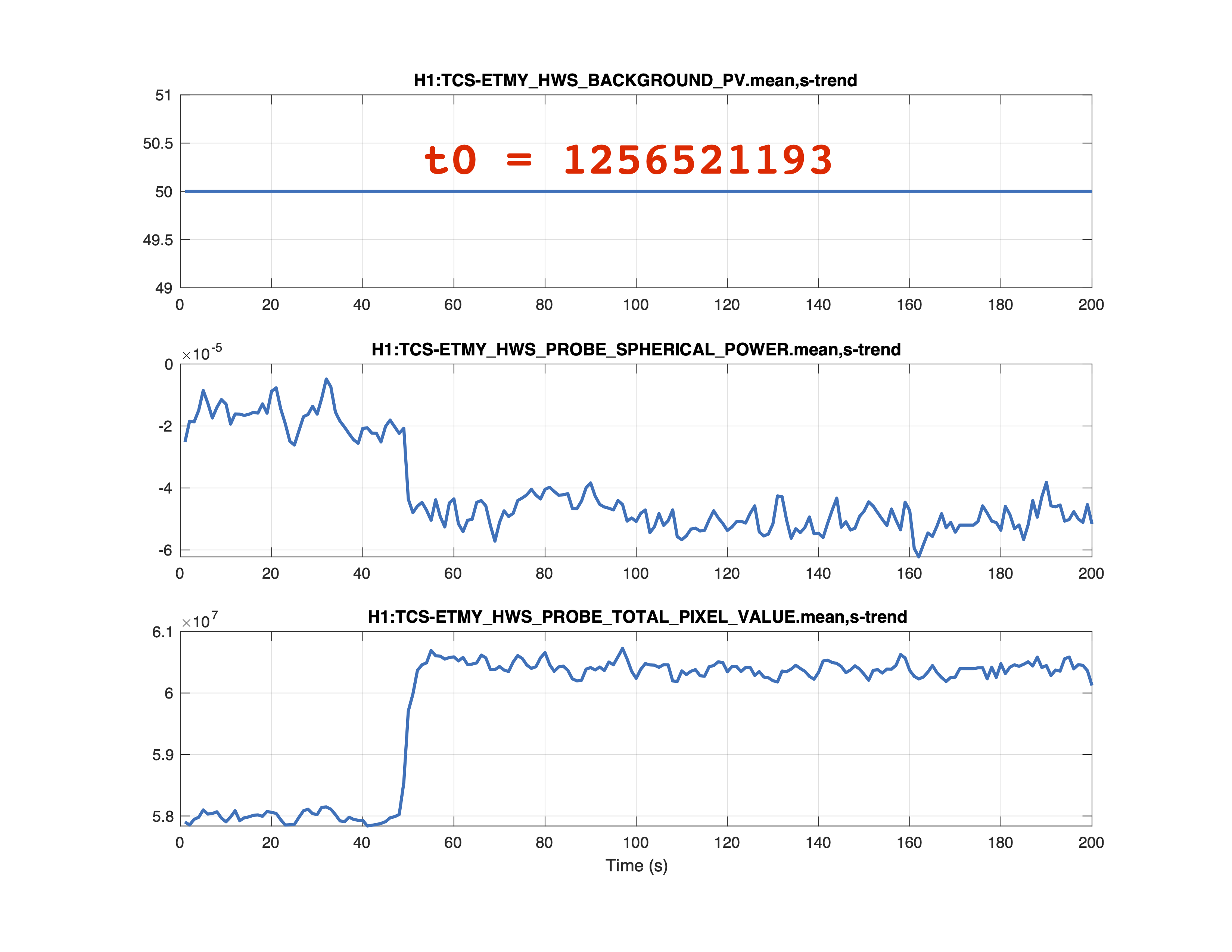
Non-power up coupling: 

My analysis of an earlier spherical power jump (at t0=1256521193 and unassociated with a power-up) suggested that intensity and spherical power might be linked here.


Images attached to this comment
Non-image files attached to this comment
LHO General
thomas.shaffer@LIGO.ORG - posted 16:00, Tuesday 05 November 2019 (53000)
Ops Day Shift Summary

TITLE: 11/05 Day Shift: 16:00-00:00 UTC (08:00-16:00 PST), all times posted in UTC
STATE of H1: Observing at 115Mpc
INCOMING OPERATOR: Jim
SHIFT SUMMARY: Busy maintenance day, recovered to observing at 2249 UTC. A series of earthquakes has been steadily shaking us most of the day. Just transitioned to earthquake mode.
LOG:

H1 IOO
sheila.dwyer@LIGO.ORG - posted 15:52, Tuesday 05 November 2019 - last comment - 17:52, Tuesday 05 November 2019(53020)
pico'd ISS

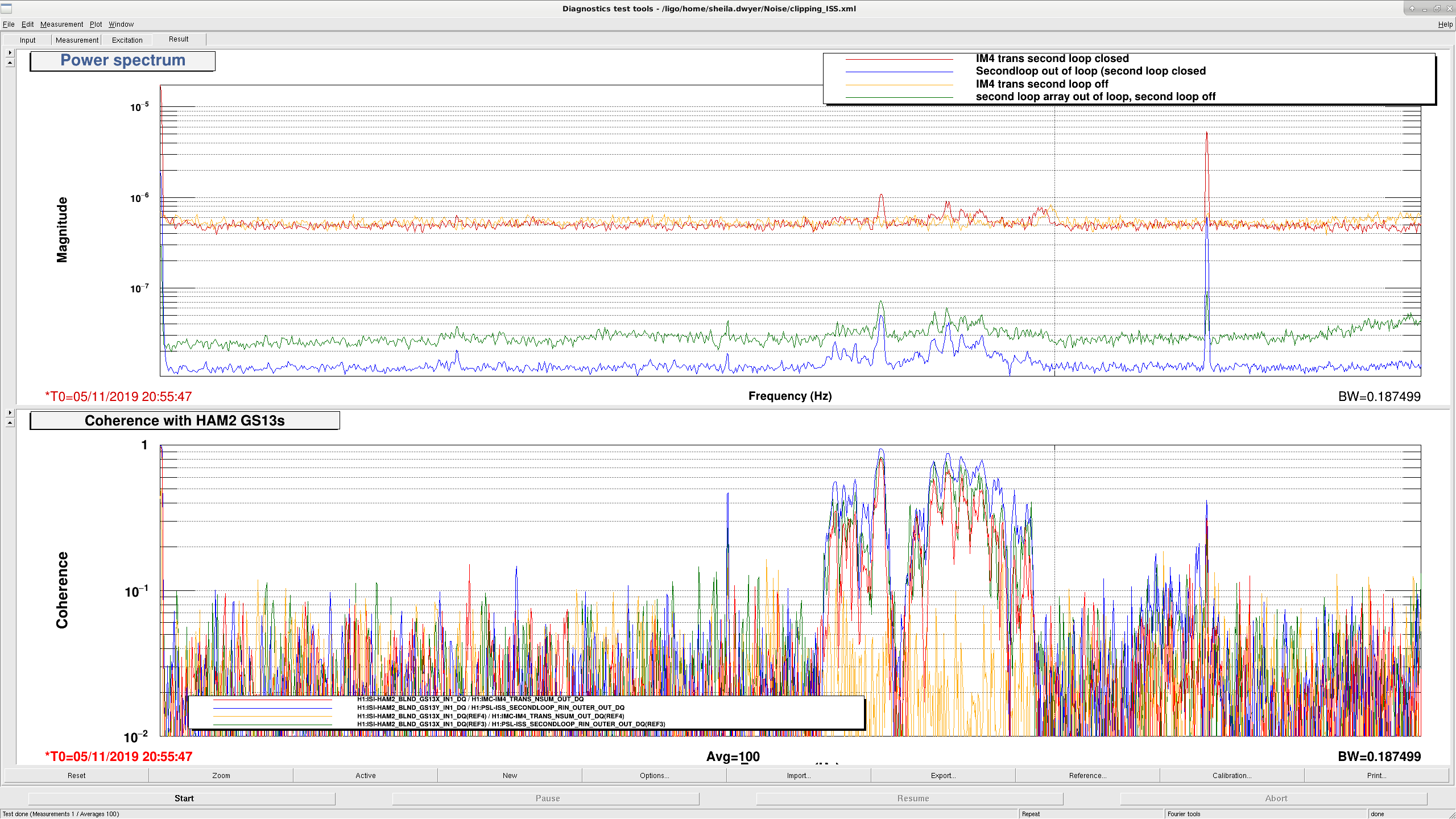
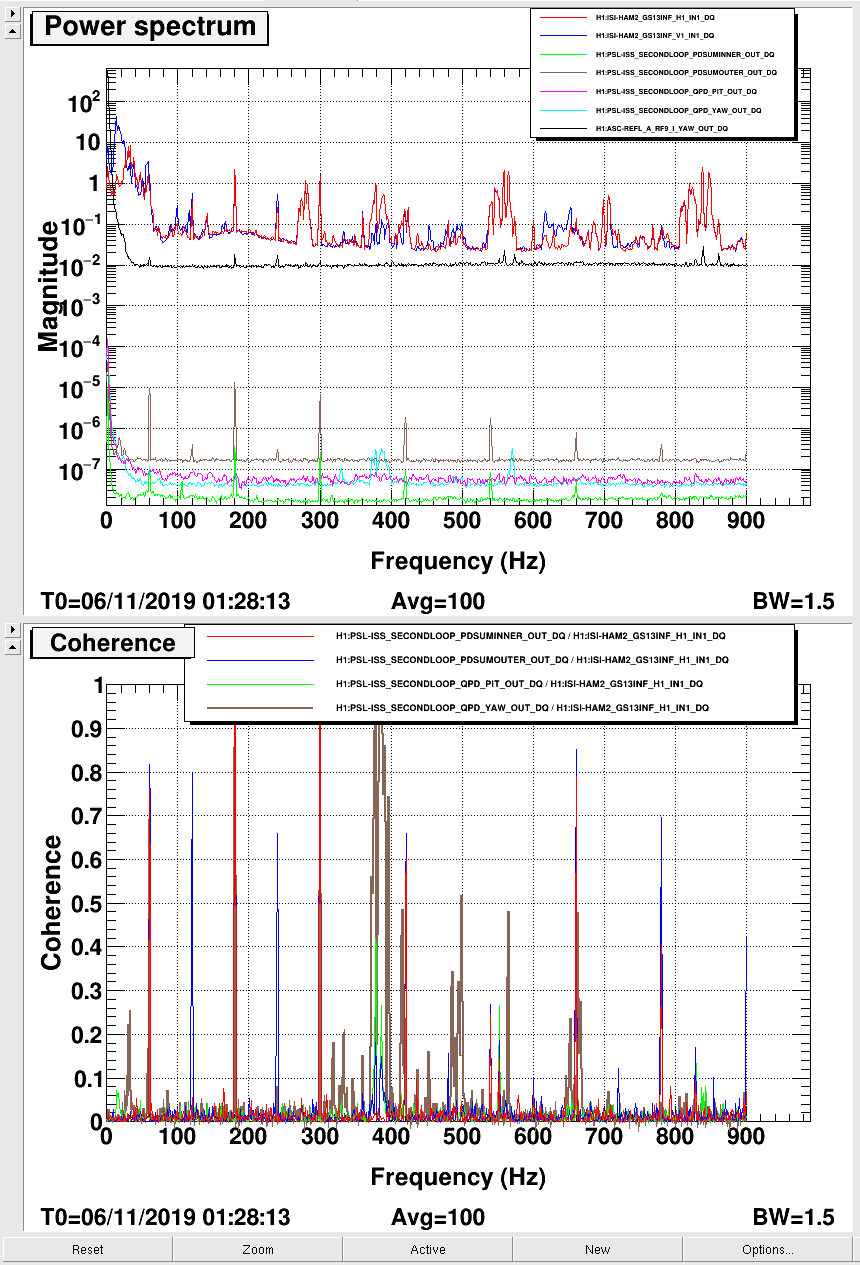
While TJ and Camilla finished initial alignment I looked at the coherence between intensity noise (seen by ISS array and IM4 trans) with the ISS on and off.  The 1st attachment plot shows that there is not coherence between IM4 trans and HAM2 GS13s until the second loop is on, meaning that the clipping problem is in the path to the ISS array.  

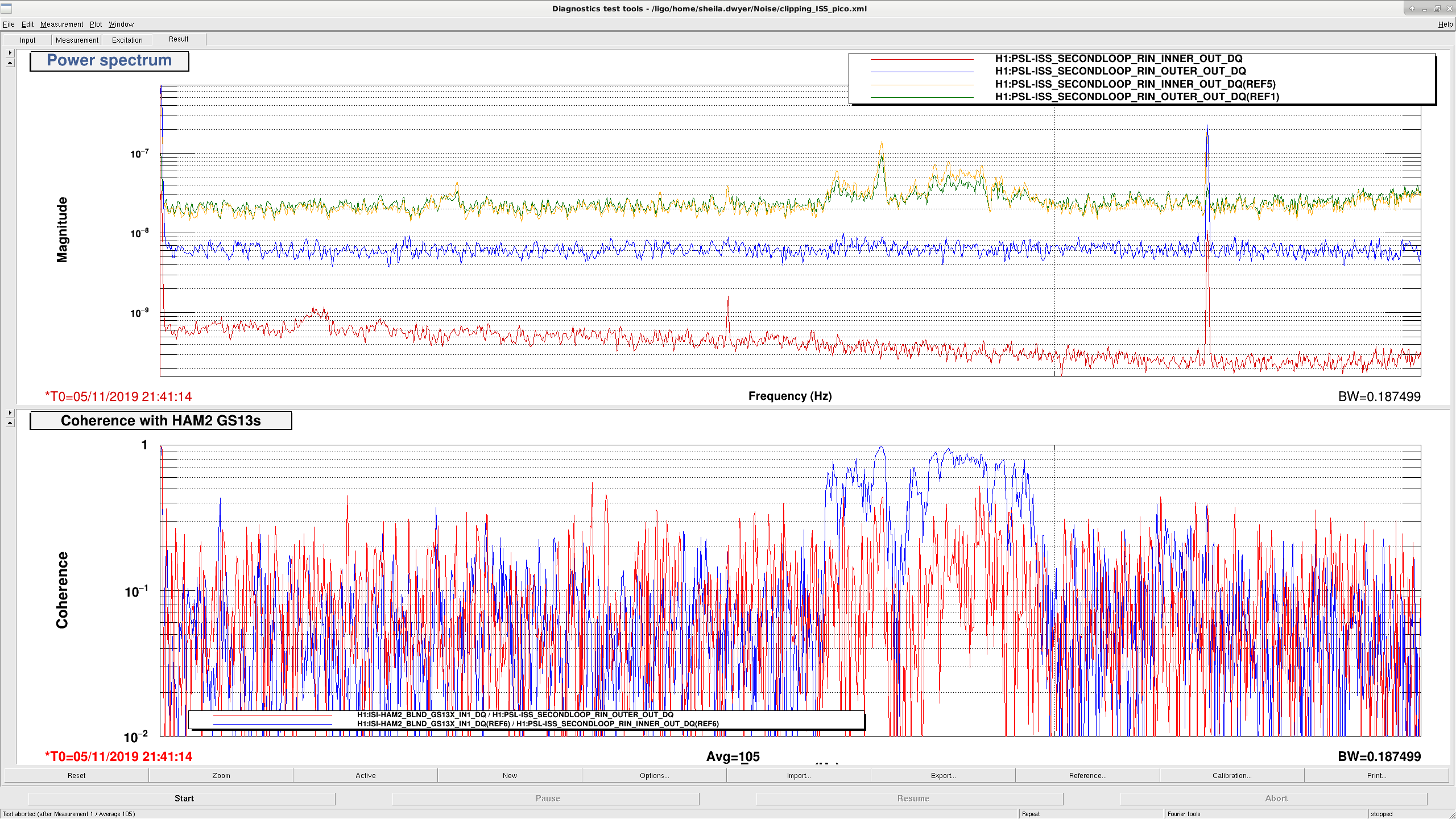
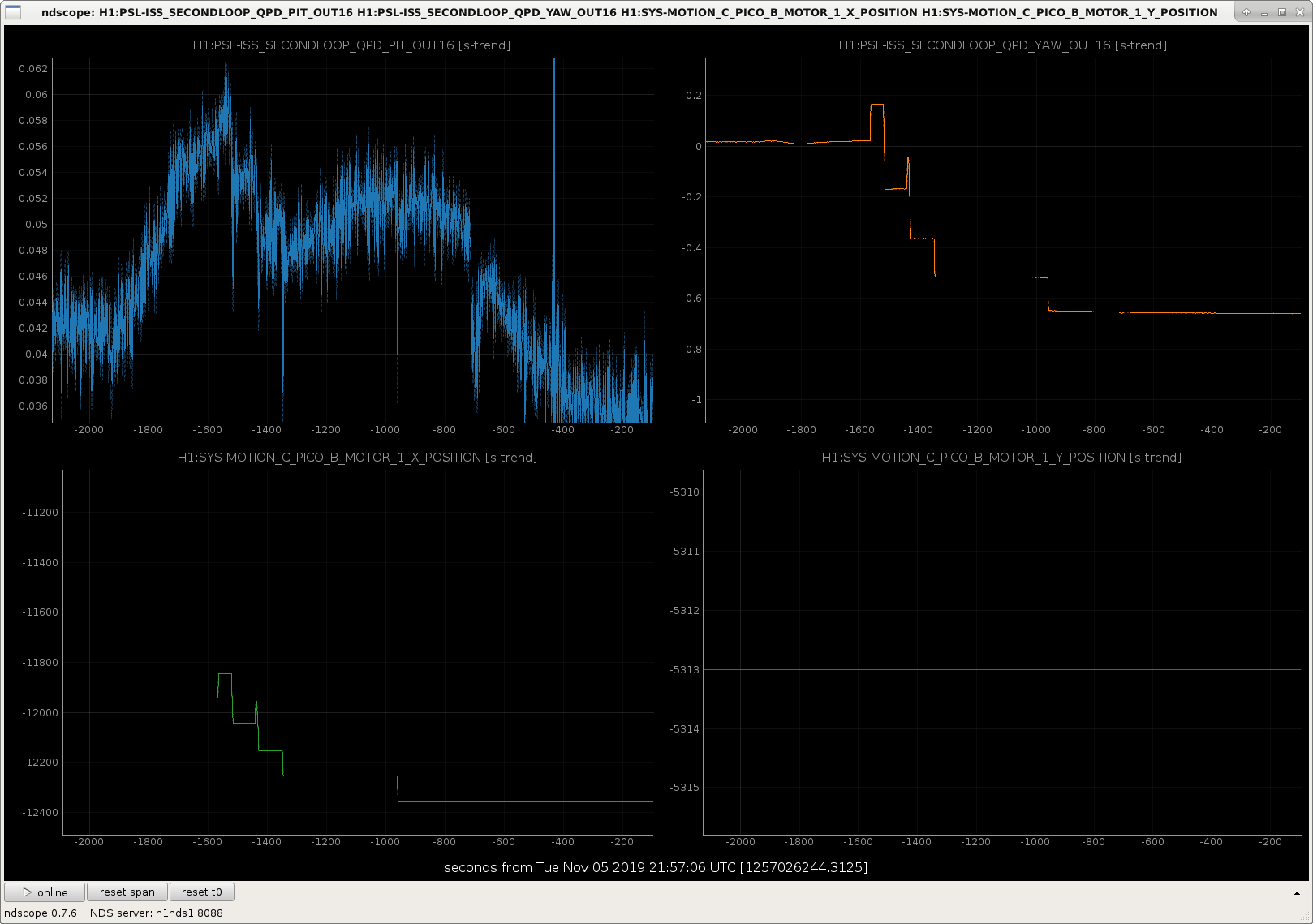
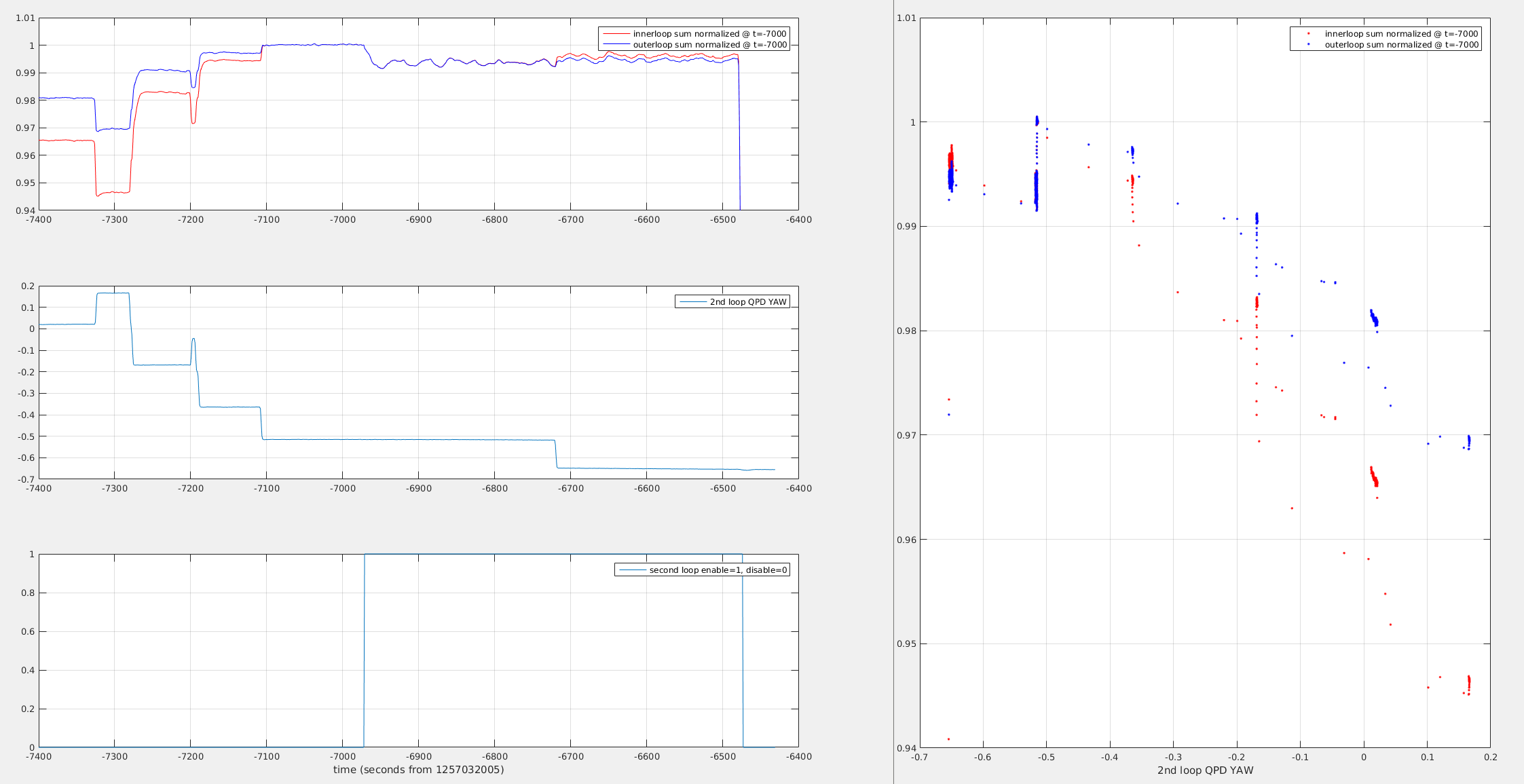
We went to 30W input power, waiting for the IMC WFS to settle (the beam moved on the ISS 2nd loop QPD while this was happening) and then I pico'd using PM1 while the ISS was open.  I was able to reduce the peaks until I could no longer see them in the ISS array spectra this way, but when I closed the ISS 2nd loop the peaks became visible again (and the coherence between the GS13 and the ISS out of loop signal was near 1).  I continued to pico in the yaw direction until the ISS QPD reached -0.66 Y, and the coherence and peaks were again reduced.  The third attachment shows the change to the pico motors and the ISS 2nd loop QPD.  It looks suprisingly similar to the move that Jenne made, 52815.  

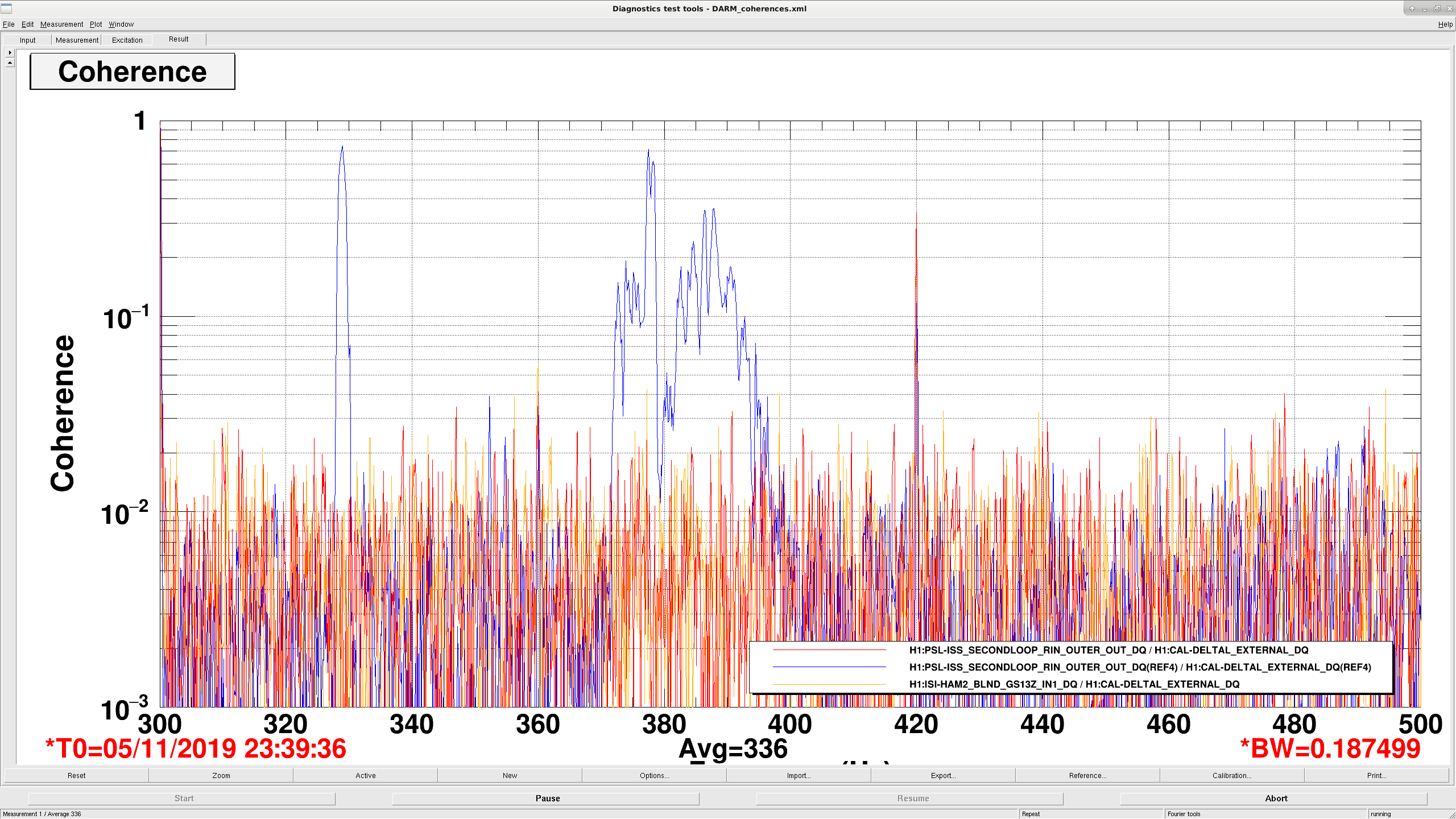
The 4th attachment shows the coherence between HAM2 and ISS and DARM in last night's lock, which is lower than the coherence before Jenne's pico'ing 52815 but still pretty high. 

Edit:  the coherence between DARM and the ISS at 380Hz seems to be gone in this lock, last attachment here, reference is in last night's lock, live traces are after pico'ing.

Images attached to this report
Comments related to this report
keita.kawabe@LIGO.ORG - 17:52, Tuesday 05 November 2019 (53033)

This 400Hz-ish thing is mostly the yaw coupling. Look at coherence between 2nd loop QPD YAW HAM2 GS13 (1st plot, this is right now in NLN).

Since we don't see this in DARM probably this doesn't matter that much, but with the current input alignment, inner loop is more sensitive to the YAW beam motion than the outer loop. Look at the 2nd attachment where Sheila was pico-ing things. Inner- and outer-loop sum are normalized at an arbitrary time at around t=-7000 to make the plot easier to understand. In the right is the plot of the 2nd loop sensor sum VS 2nd loop QPD YAW. It seems like the inner loop is about a factor of 1.7 or so more sensitive to YAW motion than outer sensor.

We might be able to slightly improve the YAW to intensity coupling using the outer loop sensor.

Images attached to this comment
H1 ISC
daniel.sigg@LIGO.ORG - posted 15:46, Tuesday 05 November 2019 (53030)
ASC AS_B RF72

H1:ASC-AS_B_RF72_DEMOD shows an error on the LO rf power. H1:ASC-AS_B_RF72_DEMOD_LOMONCHANNEL_1 reads -74dBm rather than +15.5dBm. It stopped working on 10/16.

H1 CDS (SEI)
filiberto.clara@LIGO.ORG - posted 15:40, Tuesday 05 November 2019 (53029)
EY BRS Heater Installation

Terminated thermocouple wires with K type connectors.

H2 SEI (SYS, VE)
hugh.radkins@LIGO.ORG - posted 15:37, Tuesday 05 November 2019 (53026)
H2 HAM7 A+ SEI Transport Fixturing added

Gavin & Hugh WP 8384 to secure the Support Tubes in the Chamber and stabilize them for transport for use in the A+ expanded Filter Cavity.

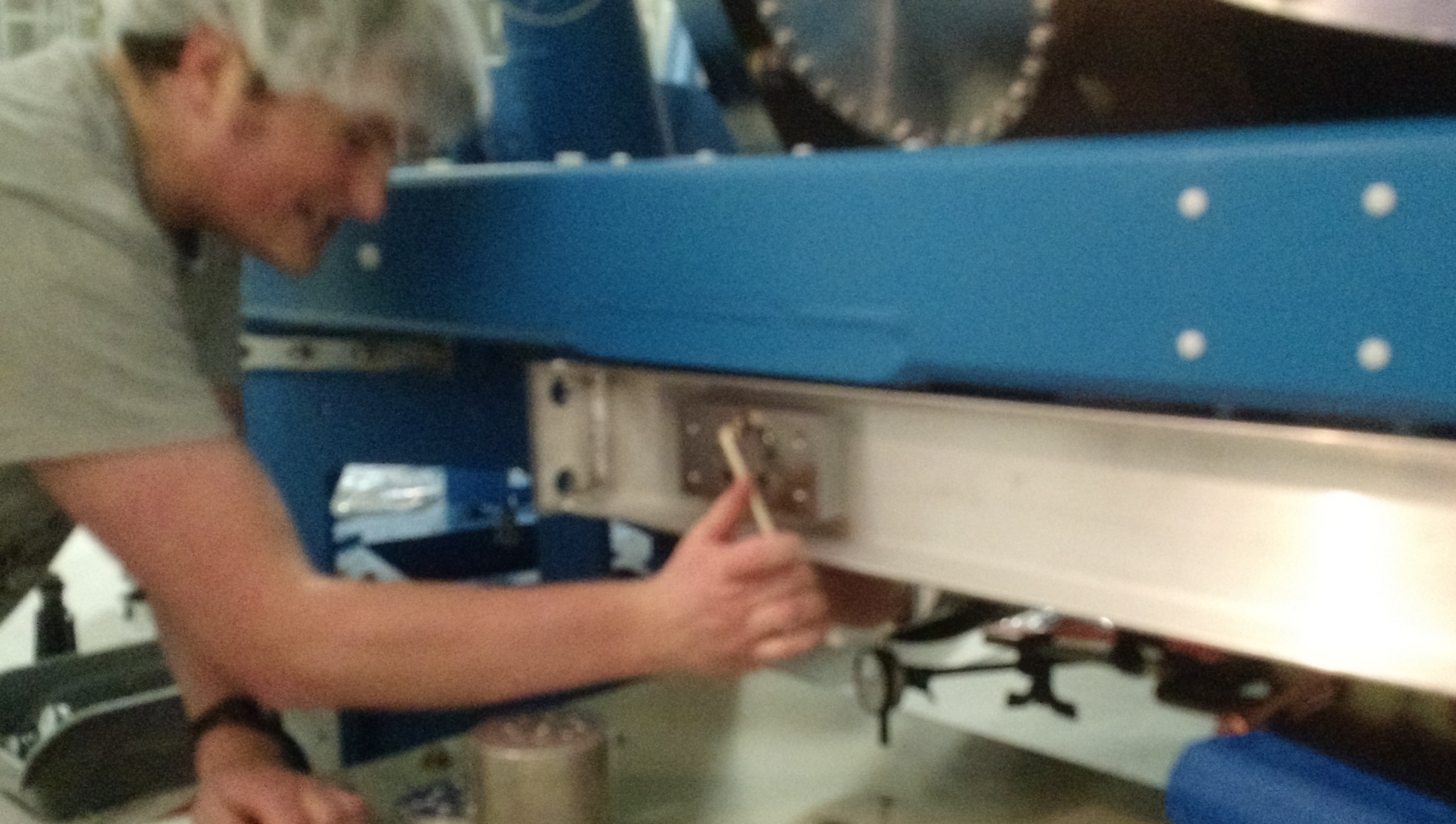
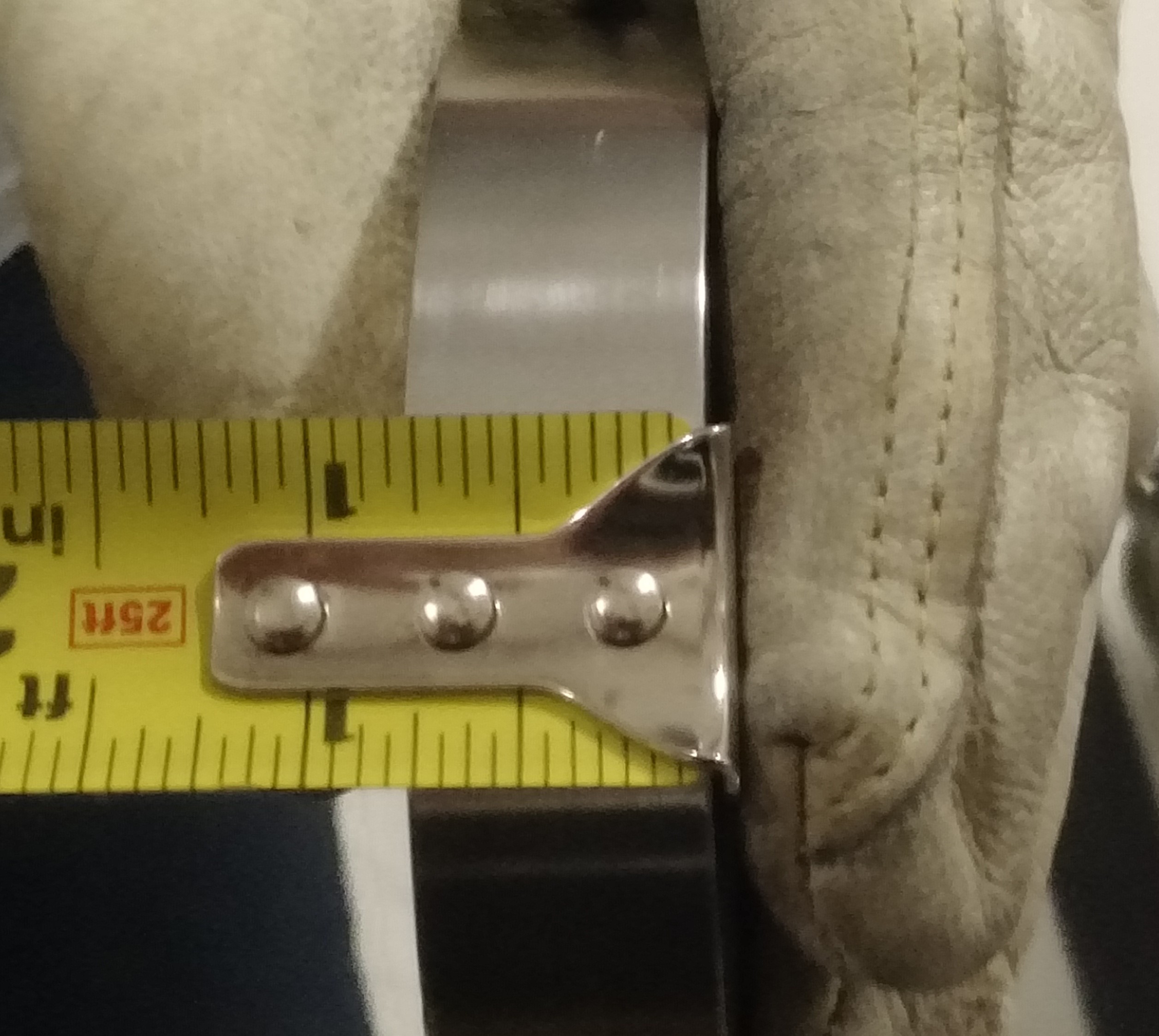
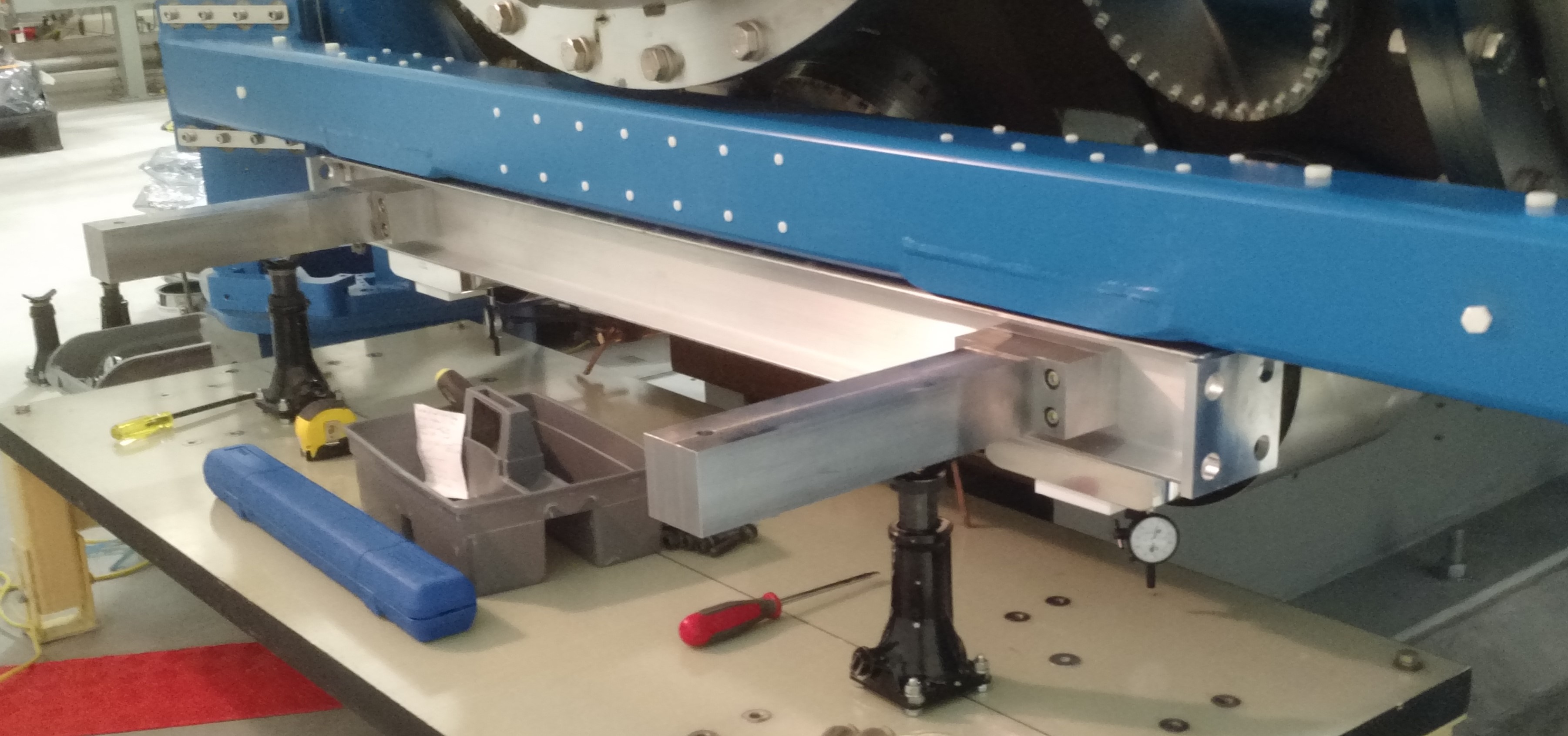
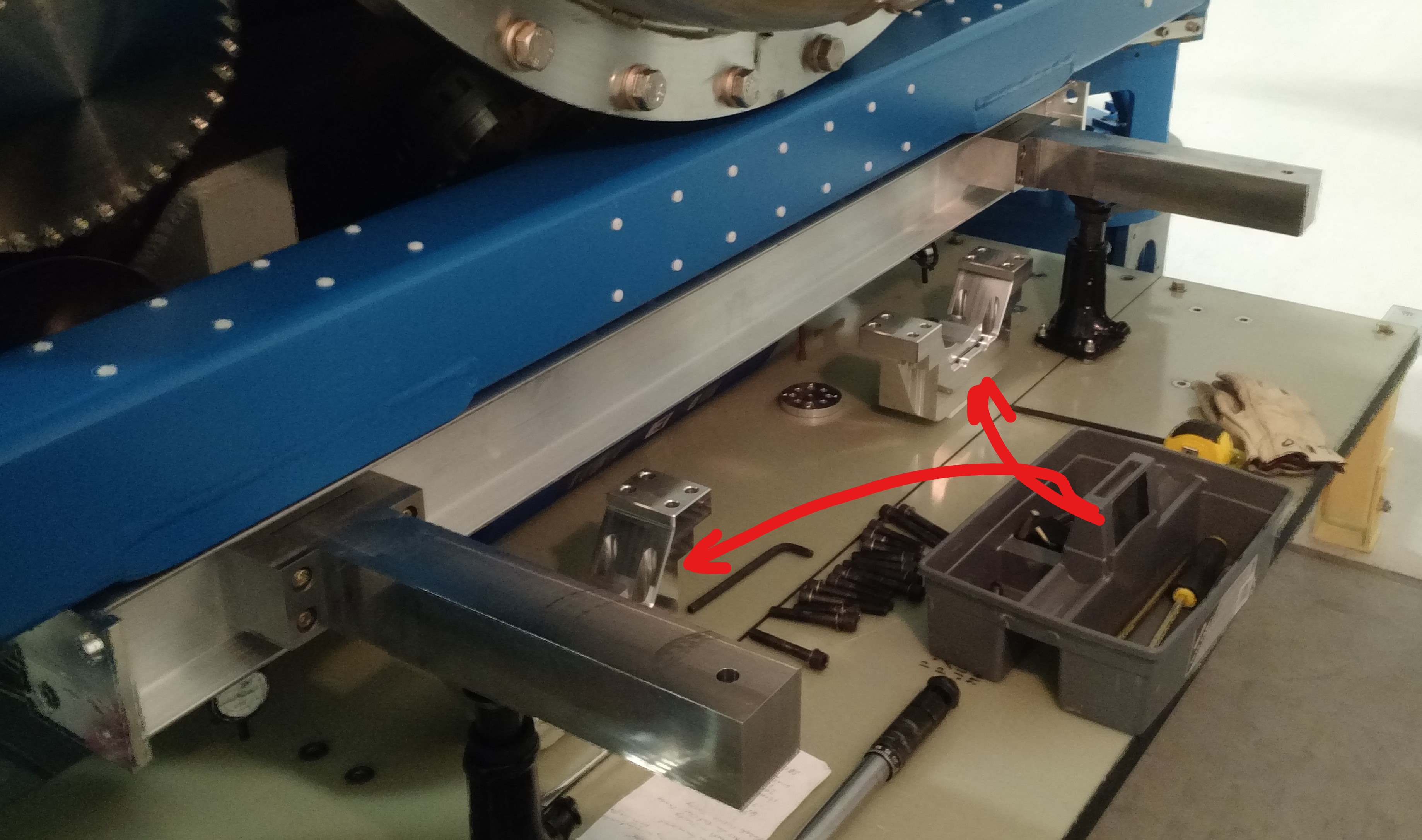
Following T1800511, the A+ SEI External Support Structure Installation Procedure, well we skip to 3.2.1 and attach the u-channel and mount blocks-see photo 1.  The H2 support tubes are a shorter version and the 1/2" spacer, D1100076, is too thin to allow the U-channel to clear the cap clamp.  We scrounged PEM 3/4" spacers, see photo 2, and completed the installation.  We then added Mount Block 2 allowing jack support, photo 3, and the removal of the Crossbeam Clamp Cap, D080375, see photo 4.

Images attached to this report
H1 General
tyler.guidry@LIGO.ORG - posted 15:18, Tuesday 05 November 2019 - last comment - 16:58, Tuesday 05 November 2019(53028)
Tumbleweed Processing
Tyler G. Chris S.

Run time from approx. 9:45a-11:58a

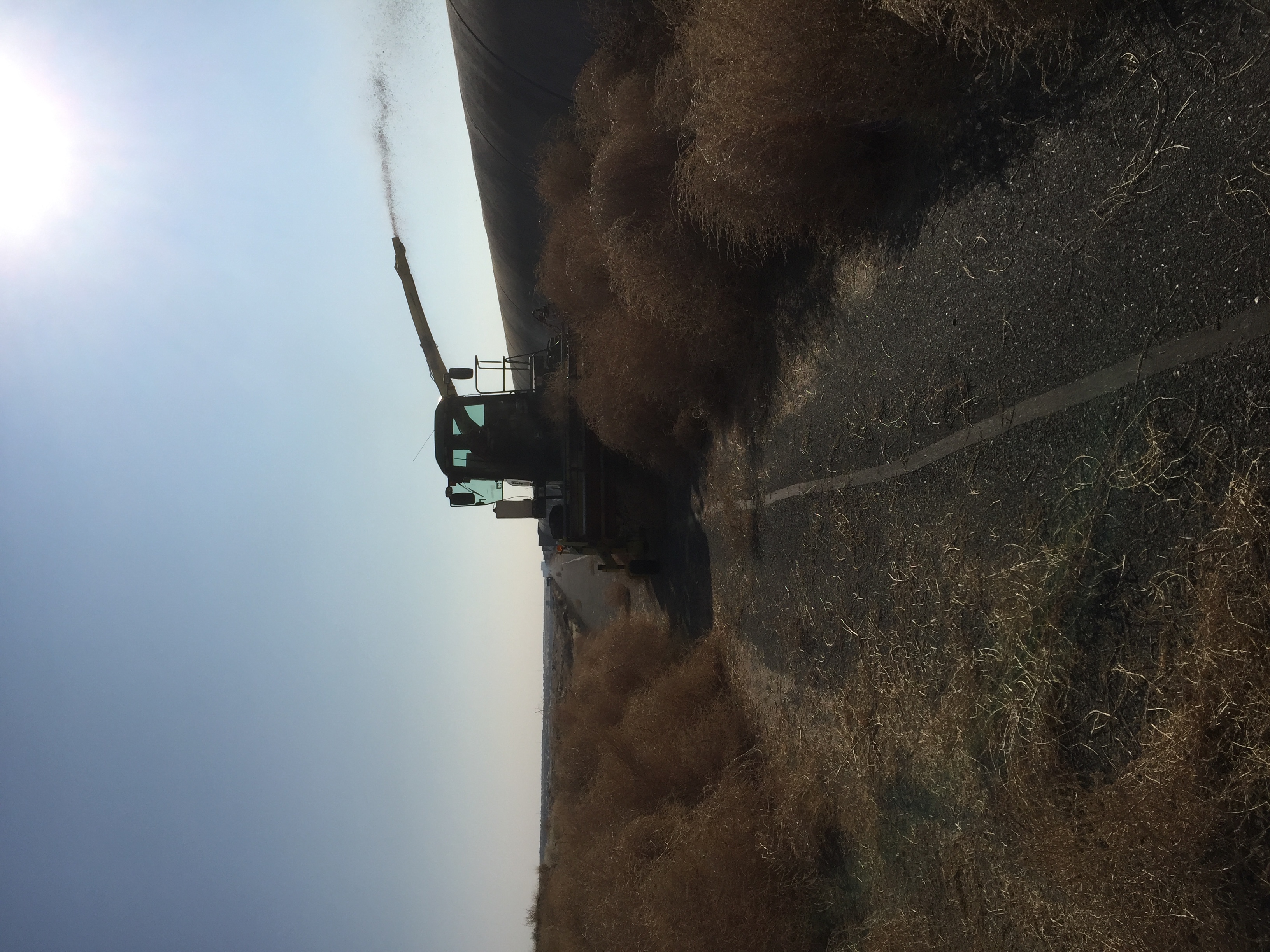
Despite its reluctancy to wake up on this frigid November morning, "Big Green" was put to work during our maintenance window clearing large piles of tumbleweeds. Predominately on the X arm beginning at the mid station with one nearly impassable section just before the end station.

With the falling temps I expect tumbleweed build-up to be a regular occurrence in the coming months. So as a PSA (NOT motivated by any incident or near miss) please allow plenty of space when traveling ahead of or behind Big Green. It is large, noisy and generally commands that the operators attention be forward during processing. Unless specifically called to pass by the operator, please do not attempt to pass alongside of the equipment. We will be mindful of traffic and pull off whenever possible.
Images attached to this report
Comments related to this report
chandra.romel@LIGO.ORG - 16:58, Tuesday 05 November 2019 (53032)

Tagging facilities (FMCS) found under LHO section.

H1 General
thomas.shaffer@LIGO.ORG - posted 15:11, Tuesday 05 November 2019 (53019)
Observing 2249 UTC

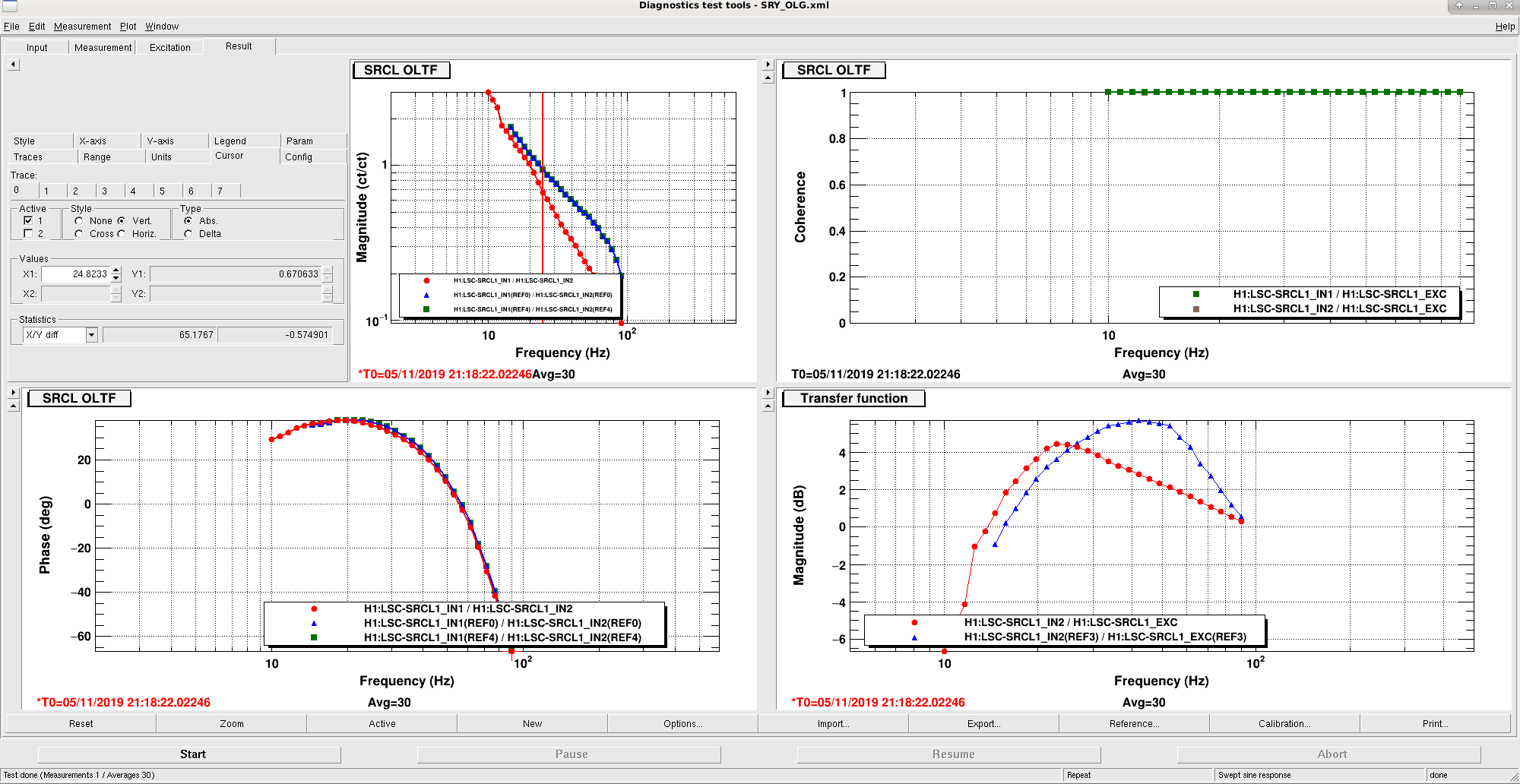
Overall, an easier time to get to low noise. Had a minor issue with SRY locking in initial alignment, but Sheila and I measured the OL gain and it looks like we needed a bit more. Now sitting at 116Mpc.

Initial Alignment:

Locking:

Attempt1

Attempt 2

SDFs:

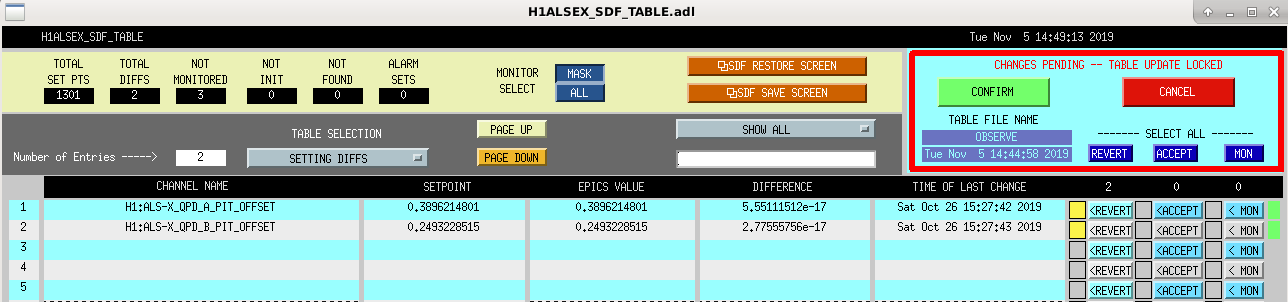
Many rounding errors and one polarization adjustment that I just reverted, as this shouldn't matter.

Images attached to this report
H1 SYS
filiberto.clara@LIGO.ORG - posted 15:06, Tuesday 05 November 2019 (53027)
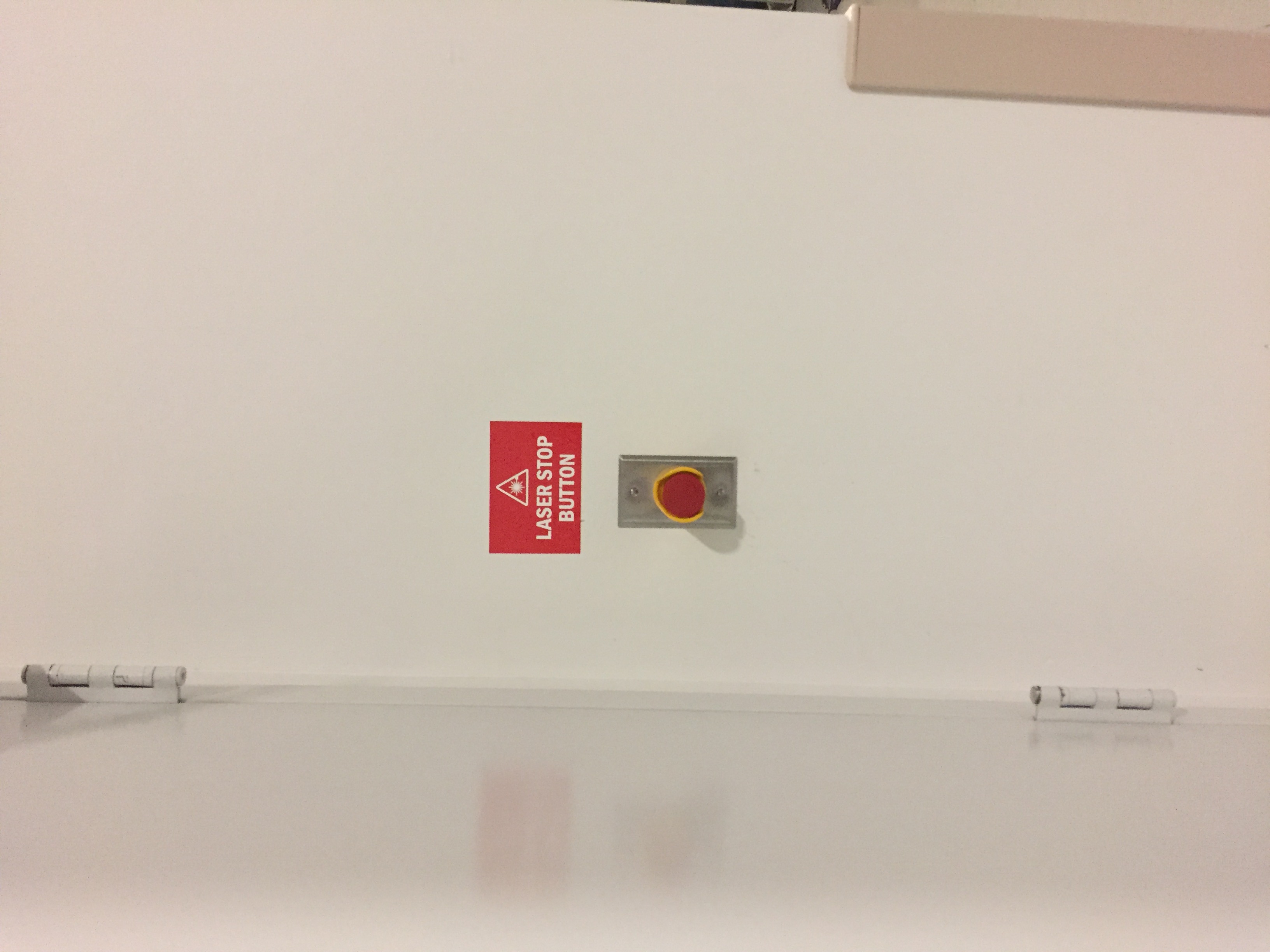
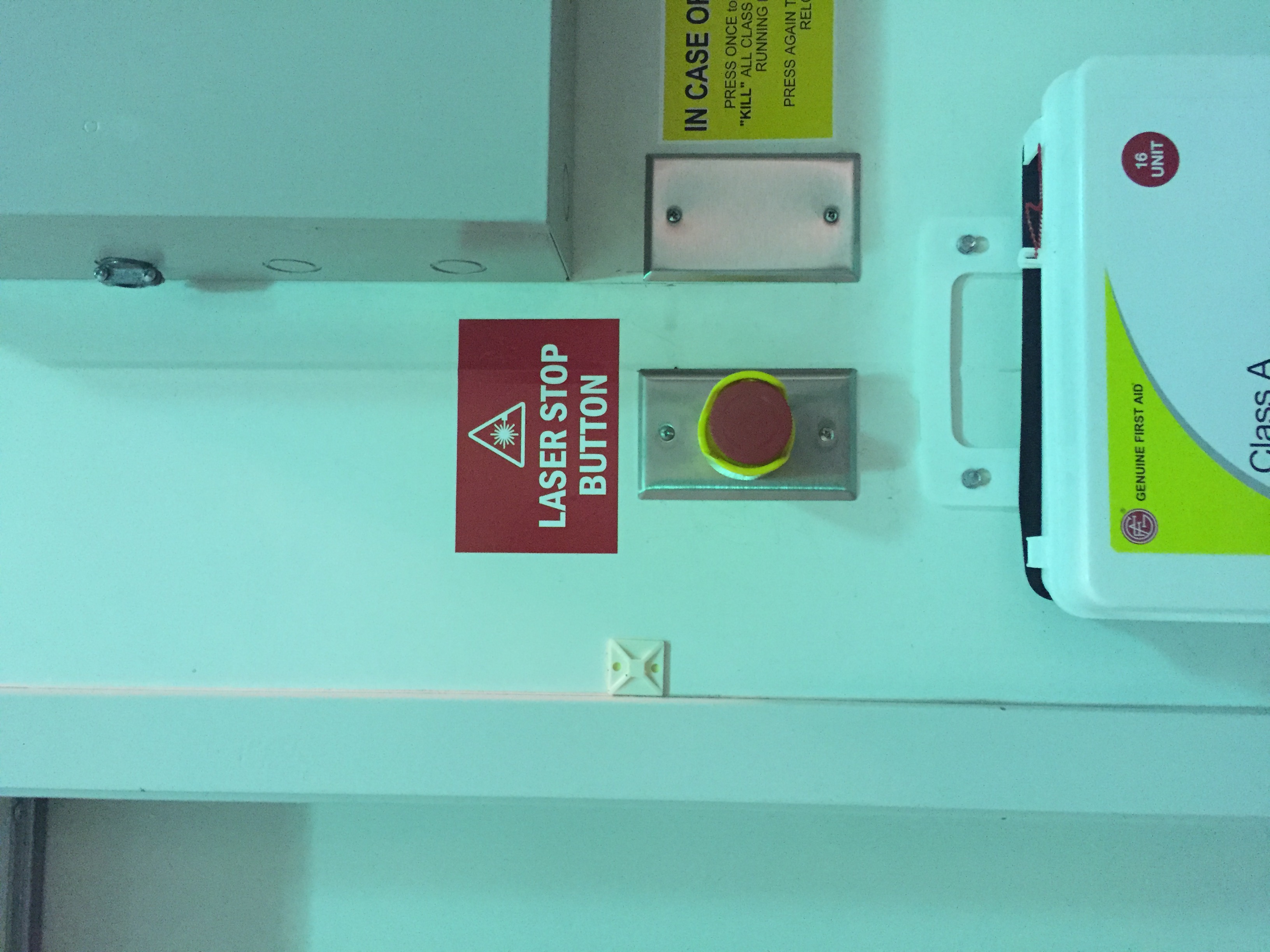
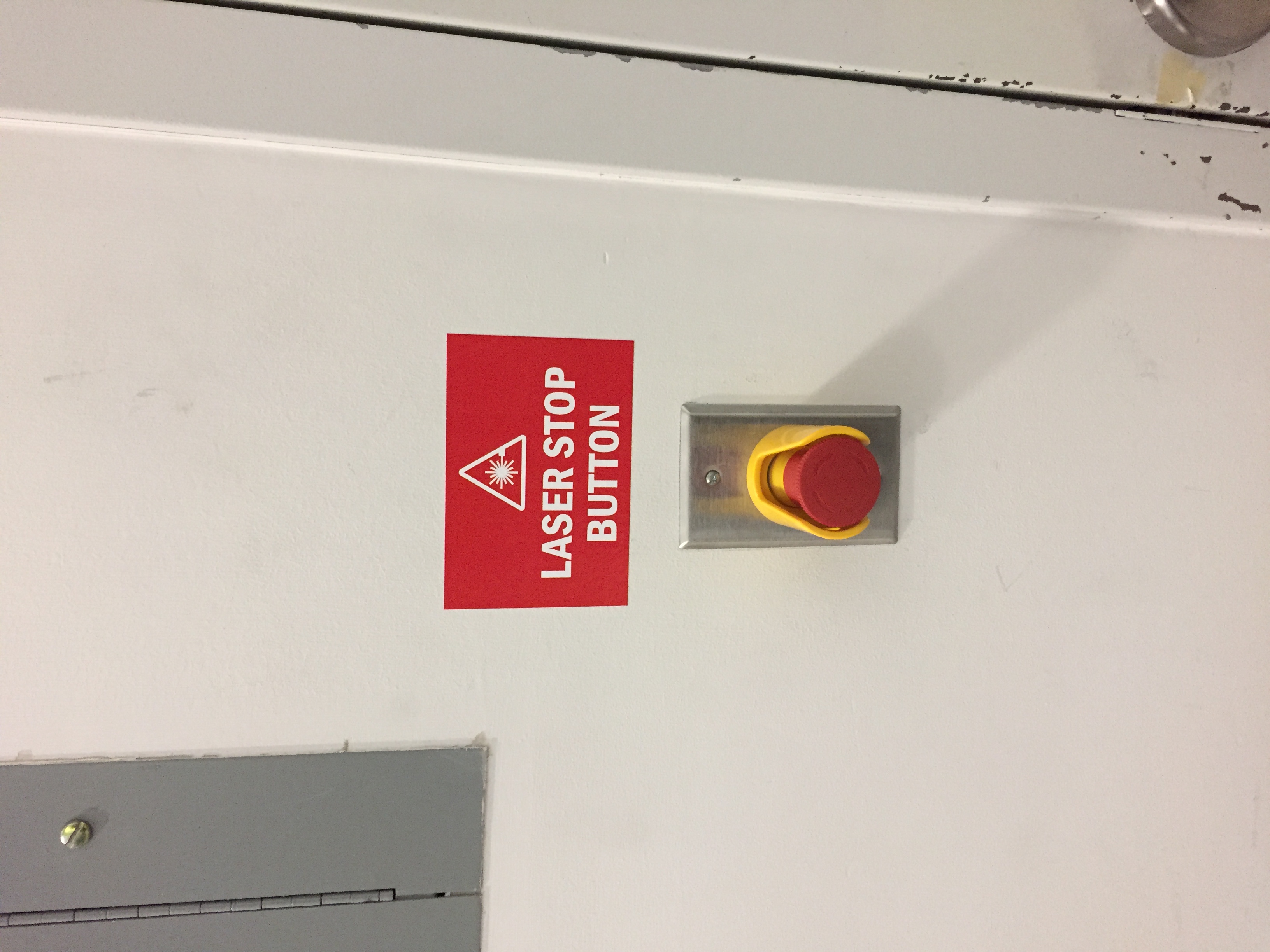
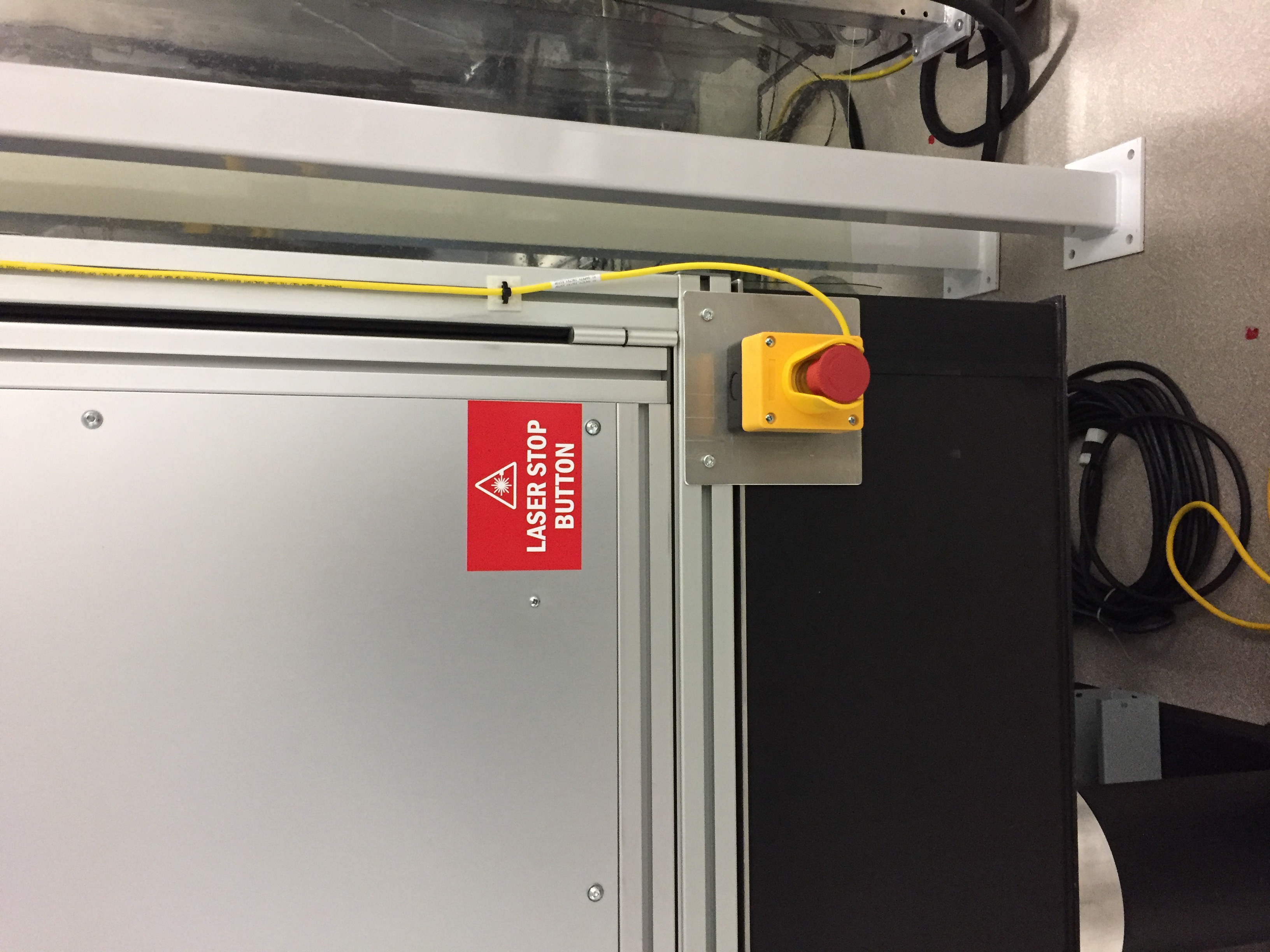
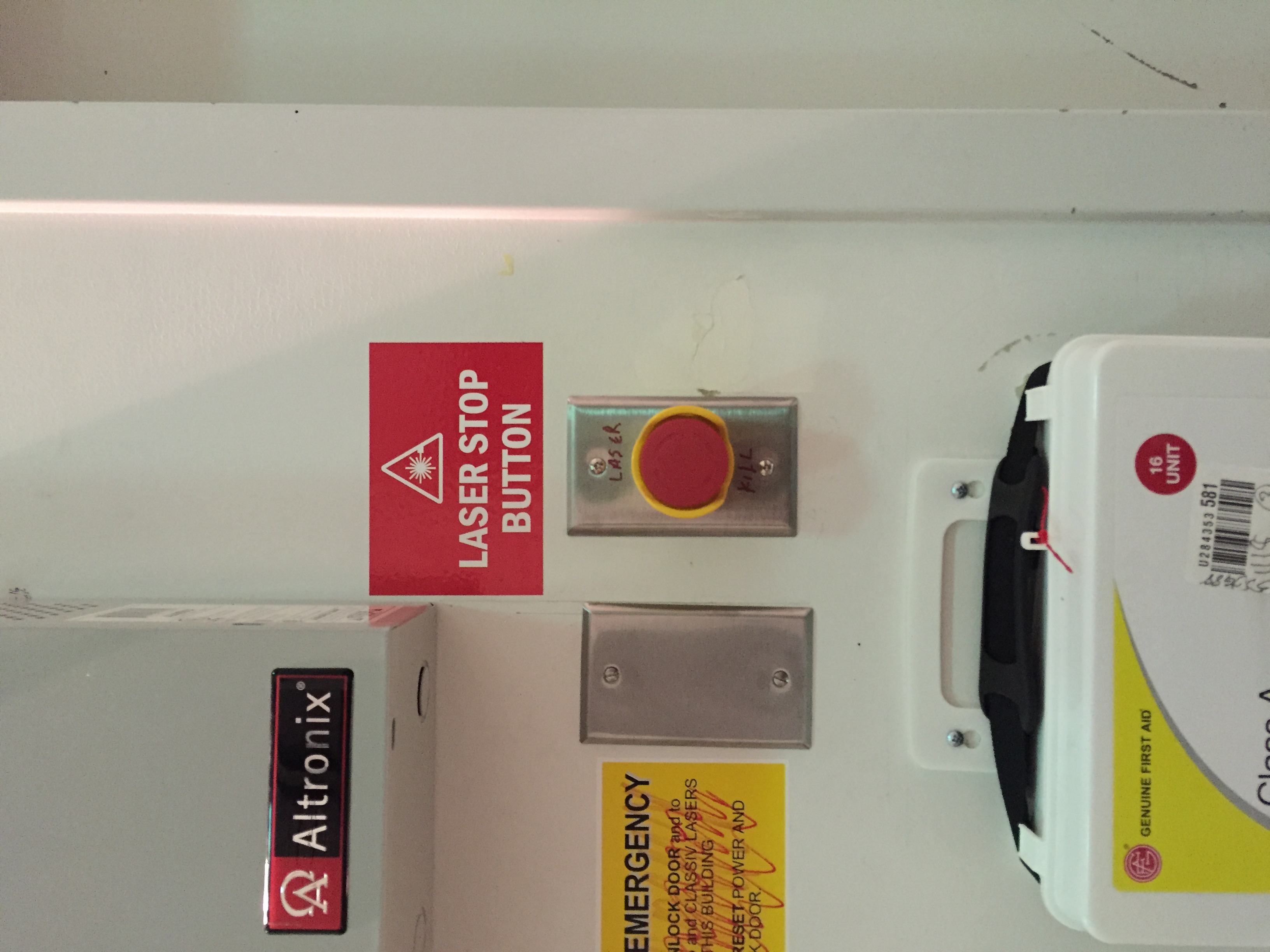
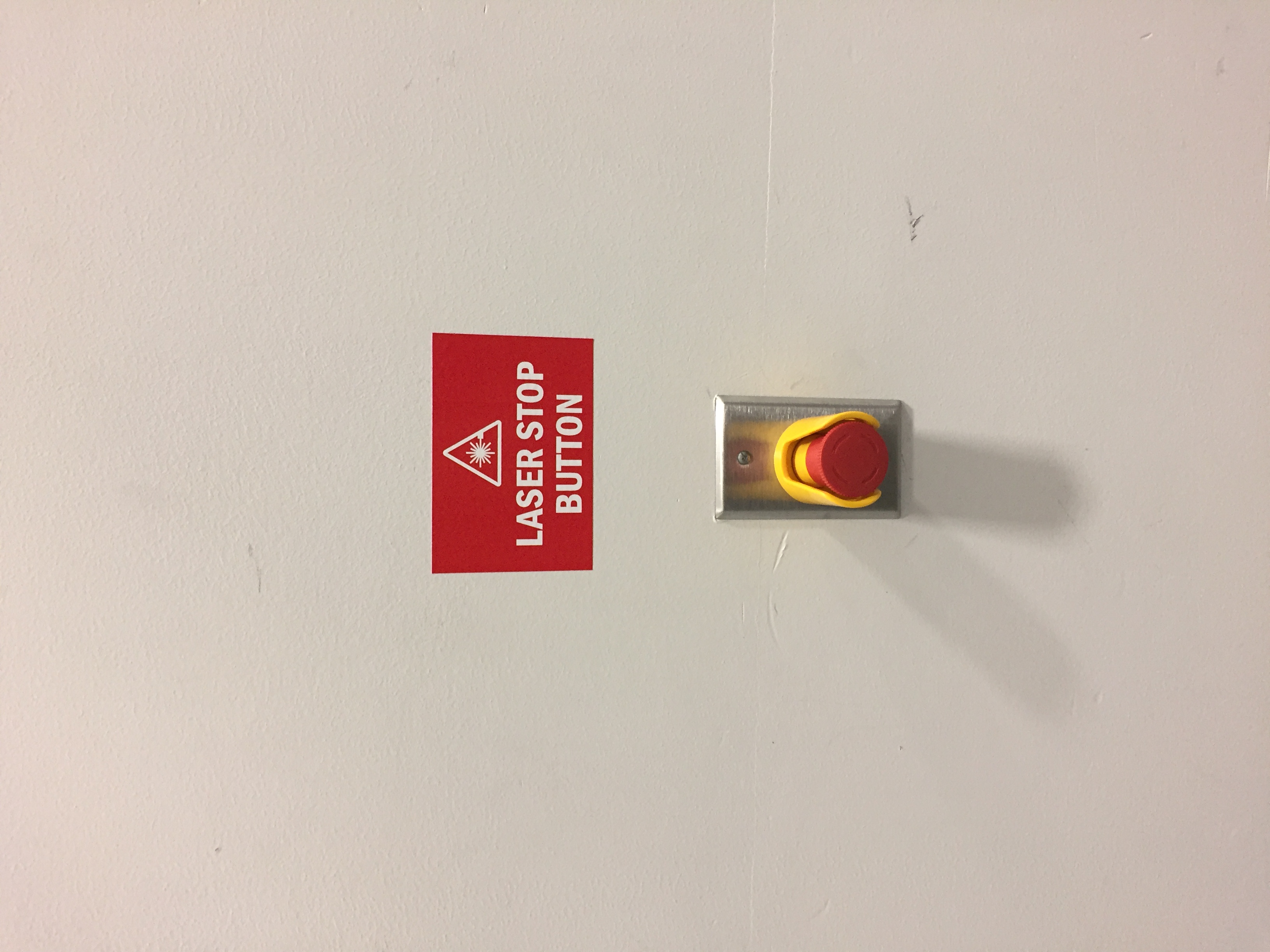
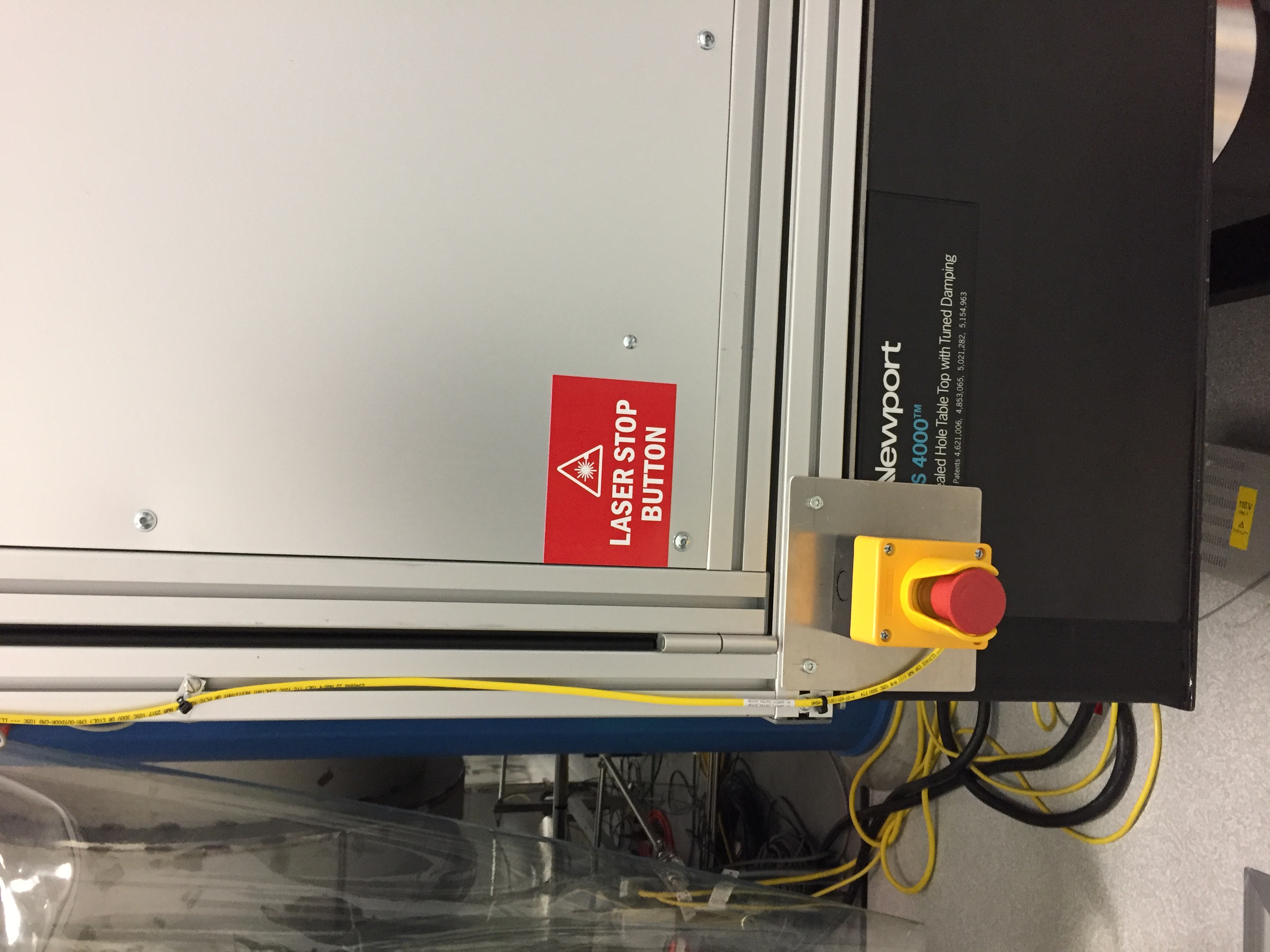
E-Stop Buttons labeled

FRS 11943

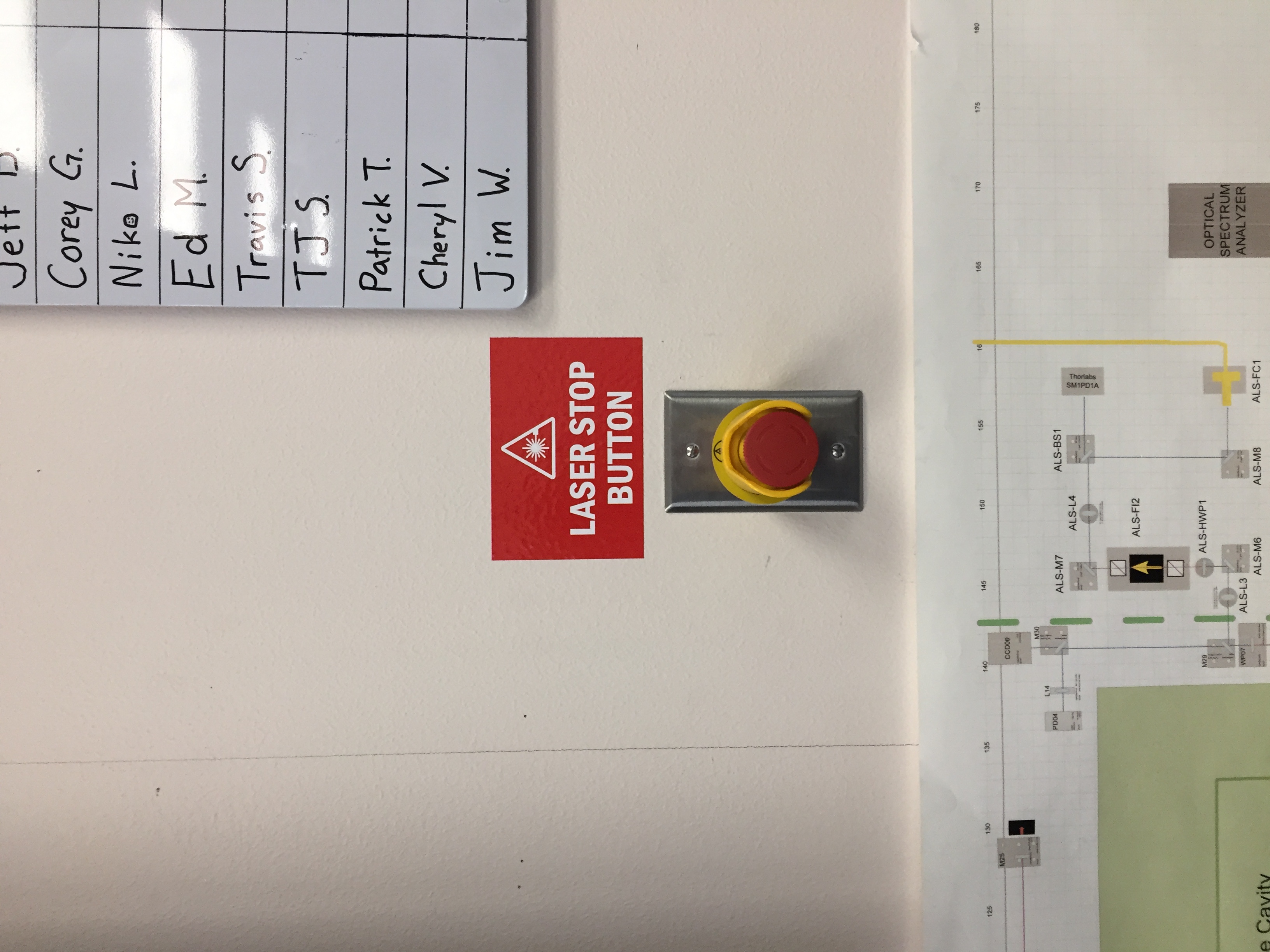
E-Stop buttons in the LVEA, EX, and EY have been labeled with proper signage. Table enclosures in the LVEA still need to be labeled.

Images attached to this report
H1 CDS (DAQ)
david.barker@LIGO.ORG - posted 14:43, Tuesday 05 November 2019 (53025)
CDS Maintenance Summary, Tuesday 5th November 2019

h1ncalex computer setup

Timesh, Erik, Dave:

Starting yesterday and completing this morning, h1ncalex was racked in EX, connected to the AUX-LAN and KVM. It is now accessible via remote desktop.

I created an target directory and autoBurt.req file for this system.

Beckhoff Slow Controls changes

Daniel, Dave:

Daniel made several changes which resulted in new DAQ INI files for C1PLC1 and C1PLC2. Also new autoBurt.req files for these two systems and a new SDF monitor file for c1plc2.

I restarted the SDF systems h1sysecatc1plc4sdf and h1sysecatc1plc2sdf.

DAQ Restart

Dave:

DAQ was restarted at 12:07, followed immediately with a h1edc restart to install the new Beckhoff INI files. Number of channels acquired by h1edc decreased from 40775 to 40699.

LHO VE
david.barker@LIGO.ORG - posted 14:35, Tuesday 05 November 2019 (53024)
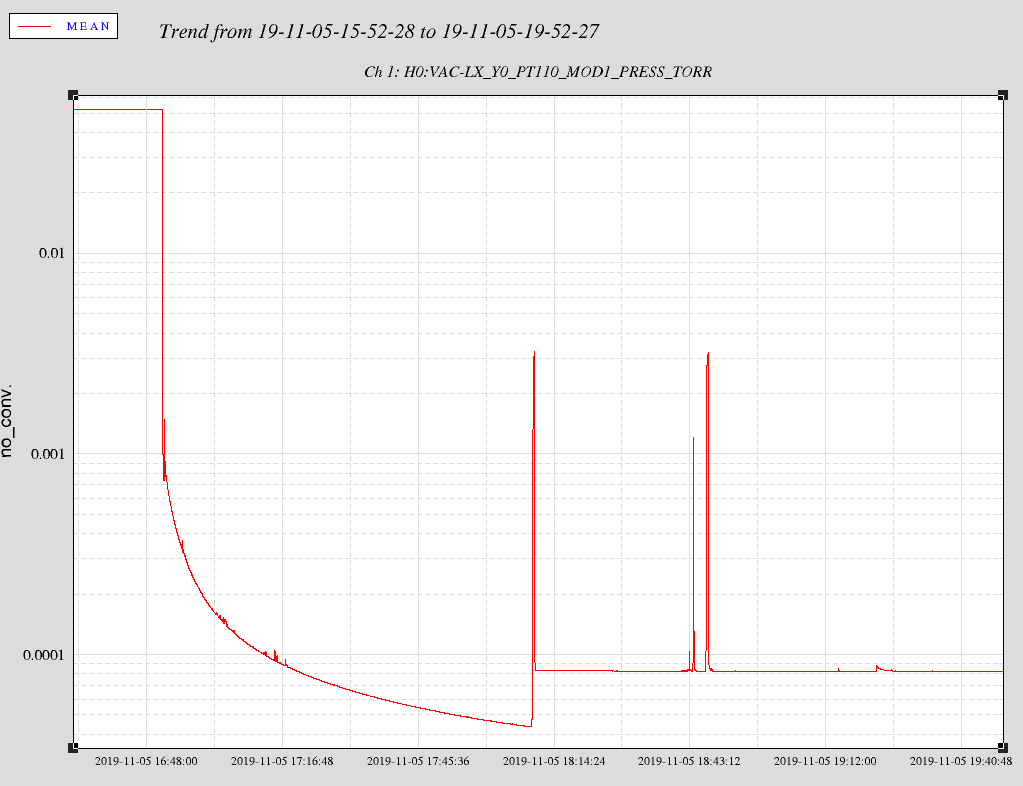
Extended bypass of HAM6 PT110 cell phone alarms for another week

Gerardo, Richard suggest that the PT110 alarm bypass be extended by another week, here is the new bypass expiration date:

Bypass will expire:
Tue Nov 12 14:30:31 PST 2019
For channel(s):
    H0:VAC-LX_Y0_PT110_MOD1_PRESS_TORR


H1 PSL
jason.oberling@LIGO.ORG - posted 14:23, Tuesday 05 November 2019 (53018)
FSS Tune-Up & Power Watchdog Reset (FAMIS 10735)

J. Oberling, R. Savage

Quick Summary

Max TPD I could get before any changes was ~3.6V.  Nothing wrong with the FSS AOM, measured a diffraction efficiency of 75.5%.  We found the FSS EOM alignment off and the beam clipping on the output aperture of the EOM housing, causing a 2nd beam in the FSS path.  Fixing the EOM alignment issue took care of the 2nd beam and we were able to get the RefCav TPD up to ~5.0V.  We also changed the ND filter on the RefCav Refl camera, centered the RefCav cameras, and installed a cover on the PMC voltage terminals.  By measuring the crossover and the OLTF, we set the FSS loop gains to a common gain of 20 and a fast gain of 16.  At the end of the maintenance window we noticed that the loop was having difficulties locking.  I lowered the fast gain to 12 and things looked better, but was still not locking.  I turned the FSS autolocker OFF then immediately turned it back ON and the loop locked right away without issue; I returned the fast gain to 16.  RefCav TPD is currently reading ~4.7V.  I expect this to drift some as the PSL enclosure temperature returns to normal; if necessary I can tweak the beam alignment at the nex available opportunity (earthquake, next maintenance window, etc.).

Details

This morning we tuned up the FSS path on the PSL table, to fix the drop in RefCav TPD we've been seeing.  Before going into the enclosure I tweaked the beam alignment into the RefCav using our picomotor-controlled mounts; I started with a TPD of ~3.0V and ended with a TPD of ~3.6V.  This is well below both my adjustment from last week (TPD = 4.8V) and my adjustment from October 14th (TPD = 5.4V), which definitely indicates something is off with the FSS path.

When we last tuned the FSS path in May the AOM was our primary culprit, so we started there.  Nothing looked out of the ordinary; no obvious misalignment, no "structure" on the beam visible on an IR viewing card as last time.  We measured the diffraction efficiency:

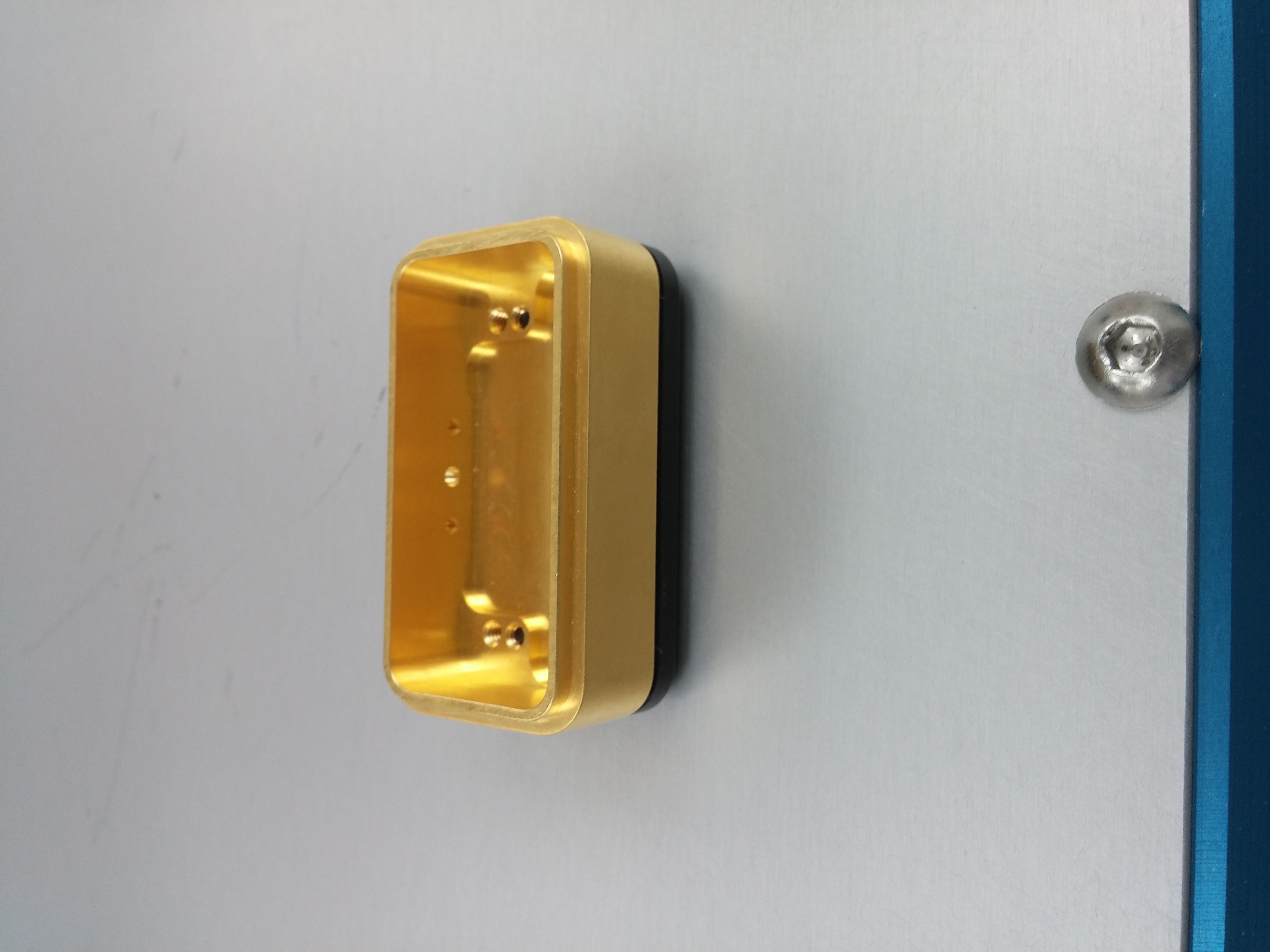
Nothing terribly alarming there, so we moved down the beam path towards the RefCav.  At the EOM (provides the 21.5MHz sidebands for PDH locking the RefCav) we noticed that what was one beam at the input became two at the output, which is definitely a problem.  Looking at the output aperture of the EOM it was obviously clipping, so a realignment was necessary.  Also, we noticed that the EOM pedestal was tilted at a rather extreme angle, and that the EOM mount was using almost all of its horizontal adjustment range to compensate for this tilt.  Before changing anything, we re-centered 2 irises for alignment recovery: the iris right in front of the RefCav (Input Periscope Iris, or IPI), and the iris in the RFPD path.  We then began the realignment by straightening the EOM pedestal, then backing out the horizontal adjustment screws so we actually had some adjustment range.  We then aligned the EOM itself.  To do this, we removed the EOM and replaced it with an empty EOM base (1st picture); this allowed us to see the inside of the EOM housing and get a really accurate alignment to the input and output apertures.  We carefully replaced the EOM and checked the alignment, which looked good.  We then looked for our second beam and, lo and behold, the 2nd beam was gone (yay!).  Alas, this change in EOM alignment also changed our beam alignment to the RefCav (awww...).  To recover this we used mirror M27 to center the beam on the IPI, and used the top periscope mirror to center the beam on the RFPD iris.  This was sufficient for the FSS to relock, and it had a TPD = 3.4V.  Tweaking this with the picomotor brought the TPD up to ~4.3V, but couldn't get any higher than that.

Thinking we we falling off of the RFPD, Rick used an IR viewer to take a look.  Sure enough, we were falling off of the top of the RFPD.  So we unlocked the FSS and re-centered the beam on the RFPD.  Before re-centering the RFPD DC was reading ~0.12V, after it was reading ~0.61V, so a 5x increase.  Upon relocking the FSS the RefCav TPD was reading ~4.5V without us doing anything.  Tweaking the alignment with the picos brought the TPD up to ~4.7V.  Since we had to re-center the RFPD, we checked the centering of the TPD as well and noticed that there was almost no "flat spot" when moving the beam over the TPD.  We looked at the beam with a card and noticed it was fairly large and was not focusing down onto the TPD, despite passing through a lens.  Well, upon removing the lens to check its focal length we found out why: it was a 200mm lens, and with only roughly 4" between the turning mirror and the TPD, of course it wasn't focussing the beam.  We swapped this out for a 50mm focal length lens and centered the beam on the TPD.  The TPD now read 5.0V, which is where we left it.  Before launching on TF measurements to set the loop gains, we did a couple of other quick things:

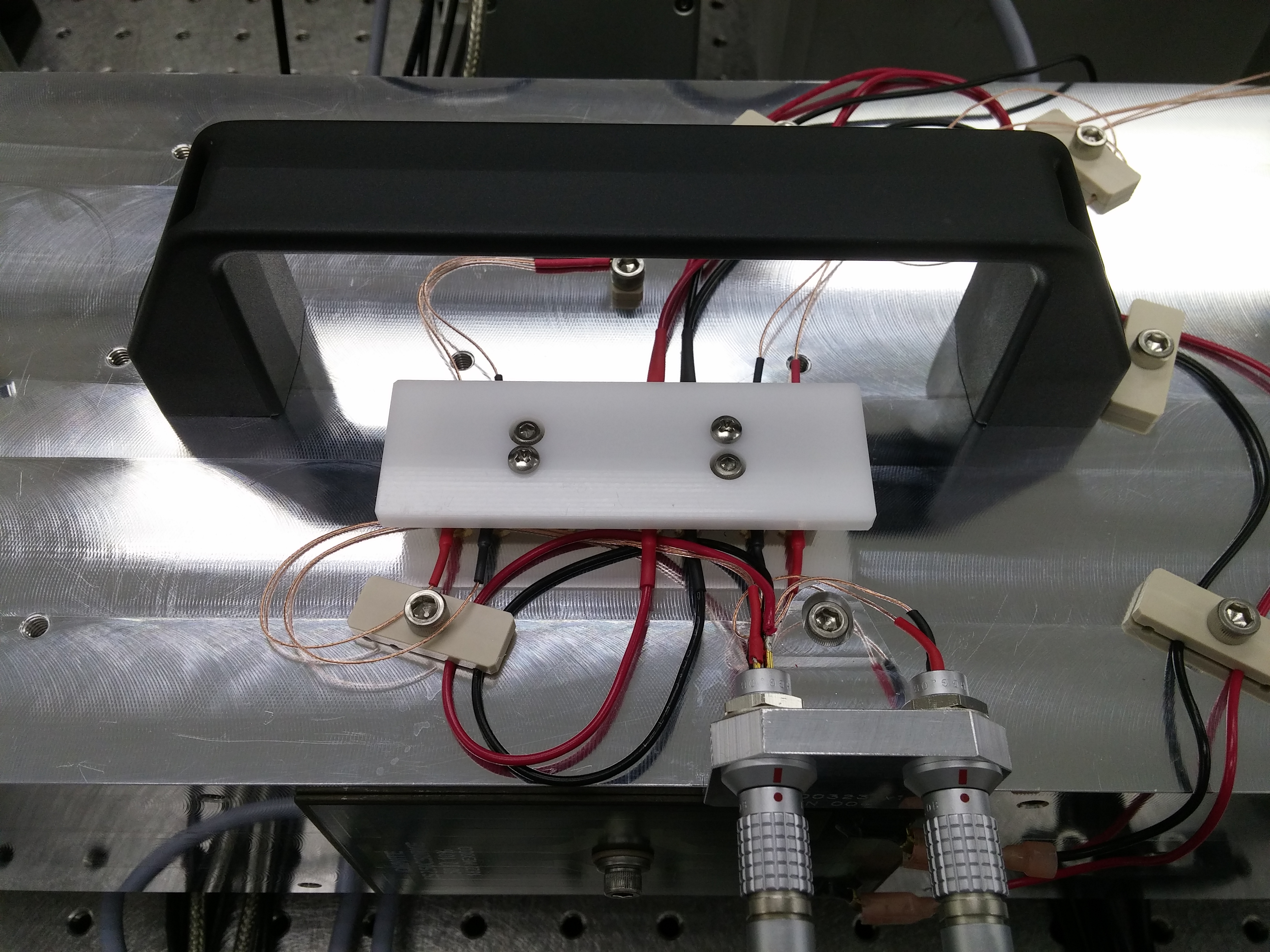
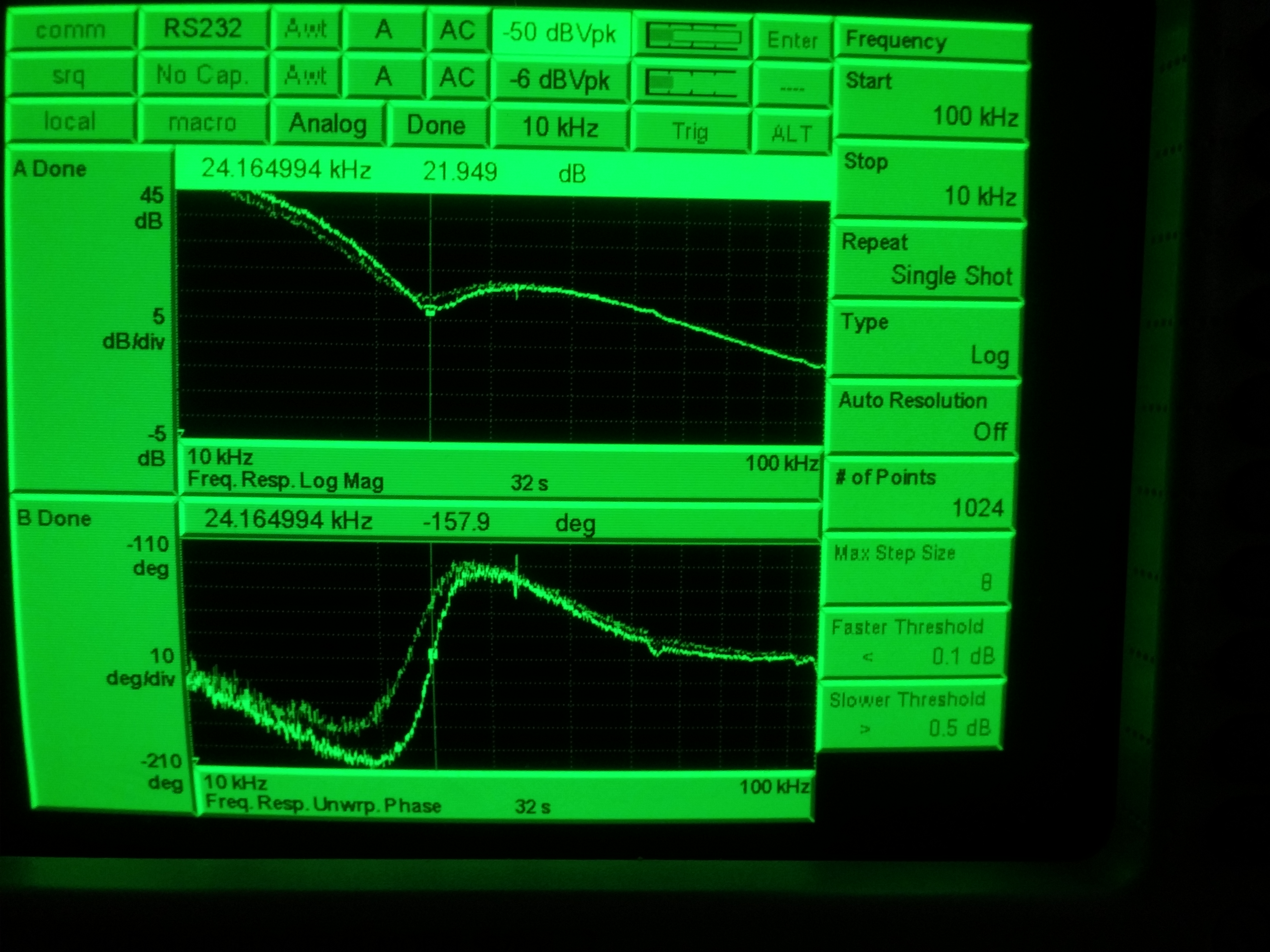
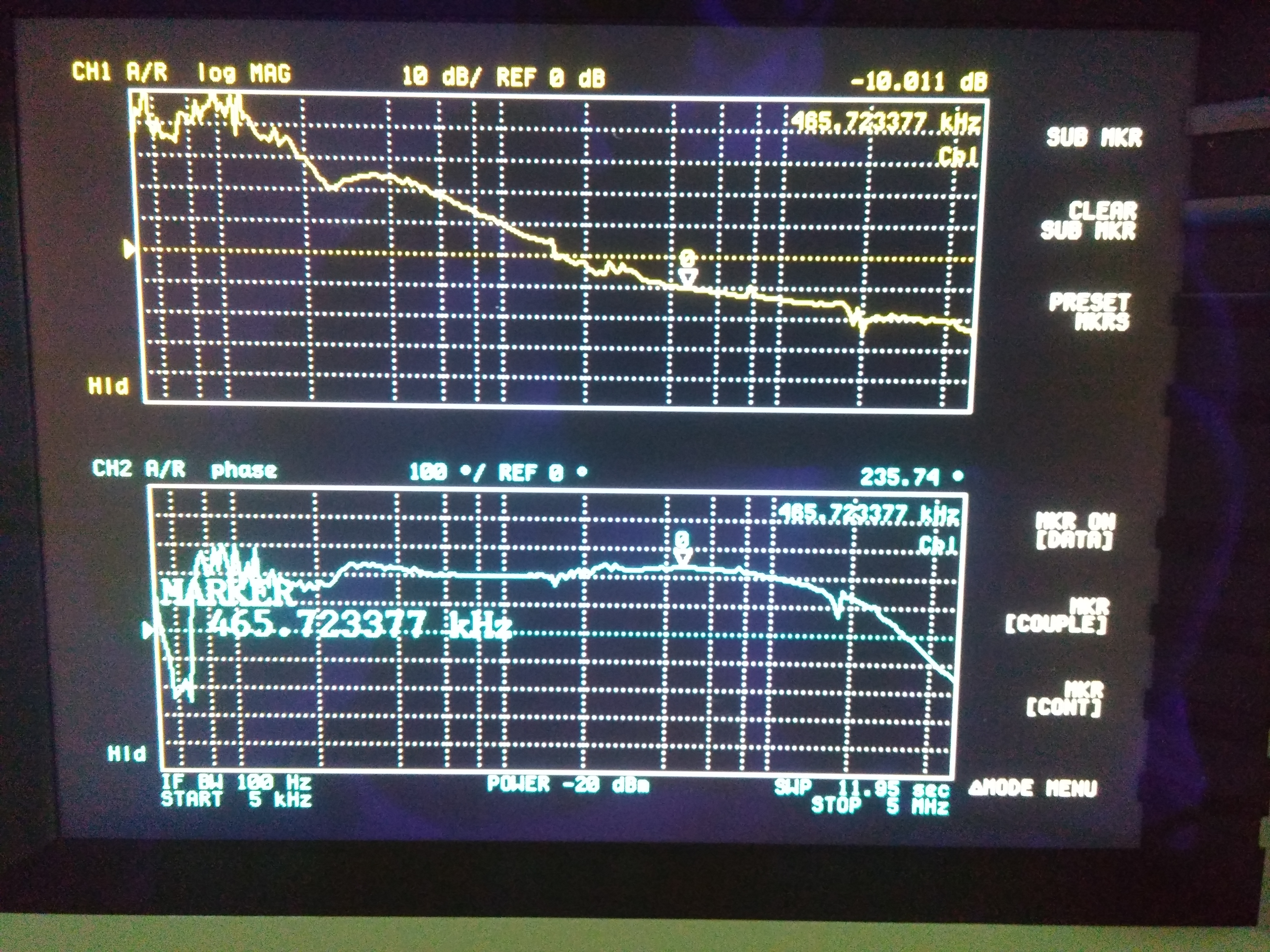
Moving on to setting the loop gains, we started with measuring the crossover (which is at ~20kHz).  We settled on a Fast gain of 16, see 3rd picture (the more faint reference trace is with the Fast gain at 14; we unwrapped the phase for the lower plot so we could see what it was doing).  There was no evidence of the loop oscillating or really having any problems at all with this gain setting (we're well above the UGF here); in fact, the EOM voltage was much lower at this gain setting, indicating we weren't driving it as hard to keep the loop locked (this puts most of the burden on the NPRO PZT, which showed no signs of having problems), so we kept this value.  If there's evidence of the "breathing" Keita logged here, this setting can be changed, but we found no evidence of issues on the PSL side of things.  We then measured the OLTF for the FSS, see 4th attachment.  This is with a common gain of 20 and a fast gain of 16; at these gain settings the UGF of the FSS is 465kHz, so we made no changes.  At this point we were at the end of the maintenance window, so we cleaned up and left the enclosure.  Before leaving, I reset both PSL power watchdogs (20:05 UTC, 12:05 PST) to complete FAMIS 10735.

I should note that as we were leaving the enclosure we did notice that the FSS took a while to lock for the final time.  As the only gain we changed was the Fast gain, I dropped it to about 12 and things seemed like it would lock, but it continued to have some issue.  I turned off the autolocker and immediately turned it back on, and the FSS locked right up without a problem.  I returned the Fast gain to 16 and the loop had zero issues with the change, just hummed right along.  Not sure what caused this, but simply turning the FSS autolocker off then immediately on again had it locked.

Back in the control room, the RefCav TPD was reading ~4.7V, so there was some change between our last adjustment and us leaving the enclosure (and subsequently turning off the environmental controls).  I'll monitor this to see if it continues to change or if it stabilizes; I expect it to stabilize as the temperature in the enclosure stabilizes after our incursion.  After we left, both temperature sensors were reading 70 °F; the temp generally hangs out around 73 °F, so I'm expecting some drift as the enclosure temp returns to normal.  I can tweak this, if necessary, at the next available opportunity (earthquake, next maintenance window, etc.).

Images attached to this report
H1 AOS
daniel.brown@LIGO.ORG - posted 14:06, Tuesday 05 November 2019 (53022)
Phase camera removed from ISCT1

Cao, Dan

We removed the phase camera this morning from ISCT1.

On ISCT1 we left the beam being dumped via a 90:10 BS into the black glass beam dump and then dumped the transmission with razor blades at angles. Double checked the beam dumping whilst DRMI just now. The only thing that is left is the safety curtains and the fibers for the network and PSL light. The sample port on the ALS distribution box was capped so no light will come out of the PSL fiber.


H1 General
thomas.shaffer@LIGO.ORG - posted 12:24, Tuesday 05 November 2019 - last comment - 13:26, Tuesday 05 November 2019(53016)
LVEA Swept

Unplugged a few extension cords. North is still in last weeks position, sign has been moved, thanks Betsy.

Comments related to this report
betsy.weaver@LIGO.ORG - 13:26, Tuesday 05 November 2019 (53017)

Camilla and I moved the "crane table" and sign over ~20ft to where the crane is actually parked in the West bay, see pix.  Who ever uses the crane next can return it to it's original parking spot, but we didn't want to proactively move it today and cause potential new alignment.


Images attached to this comment
LHO VE
chandra.romel@LIGO.ORG - posted 11:55, Tuesday 05 November 2019 - last comment - 07:51, Wednesday 06 November 2019(53015)
PT-110 pressure gauge swap on HAM6

{Gerardo, Chandra}

Replaced faulty PT-110 pressure gauge (SN 217) on HAM6 today with SN 214; however, the hot filament will not come on after some pressure transitions. I've asked Patrick to try to force it on through software when he is on shift tonight. Here is what we did:

  1. isolated gauge from HAM6
  2. connected aux cart and hung turbo
  3. vented gauge tee with room air
  4. replaced gauge
  5. pumped back down
  6. pressure fell as expected into low e-5 Torr range
  7. helium leak checked 2-3/4" CF (no leaks beyond 6e-10 Torr-L/s background)
  8. valved out turbo and then valved in gauge to main volume
  9. pressure is flat lined at 8e-5 Torr, suggesting the filament is not turning on after a pressure spike from isolating "wet" gauge/tee
  10. reset gauge, rebooted power, increased gauge pressure --> none triggered the filament
  11. next Patrick will run emissions command in software
  12. if that doesn't work we will replace with a different model gauge

Gauge is Inficon BCG450-SE and was tested on pump cart prior to installation. IP14 and small 10 l/s IP on RGA both remain stable.

Images attached to this report
Comments related to this report
chandra.romel@LIGO.ORG - 14:00, Tuesday 05 November 2019 (53021)PEM

In order to connect the pump cart, I had to temporarily move the PEM Vibration Table sitting on 16.5" flange set on top of HAM6.

patrick.thomas@LIGO.ORG - 07:22, Wednesday 06 November 2019 (53041)
I set the units for the gauge to Torr. It is now reading around 6E-7.
chandra.romel@LIGO.ORG - 07:51, Wednesday 06 November 2019 (53042)

Thank you, Patrick!!

LHO General
patrick.thomas@LIGO.ORG - posted 00:00, Saturday 02 November 2019 - last comment - 12:50, Tuesday 05 November 2019(52913)
Ops Eve Shift Summary
TITLE: 11/01 Eve Shift: 23:00-07:00 UTC (16:00-00:00 PST), all times posted in UTC
STATE of H1: Observing at 113Mpc
INCOMING OPERATOR: Jeff
SHIFT SUMMARY: One lock loss, no immediately apparent cause. Only required intervention was to adjust ETMX, TMSX and ETMY for LOCKING_ARMS_GREEN.
LOG:

23:37 UTC Kyle, Robert, Chandra to LVEA to adjust pressure on gate valves
23:40 UTC Dropped out of observing. Changed observatory mode to preventative maintenance.
23:44 UTC Sheila and Keita changing FSS fast gain
00:07 UTC Robert, Chandra back
00:12 UTC Back to observing
00:46 UTC Lock loss
Waited for 5 minutes for green arms to lock. Neither arm locked on its own. Flashes are around .4.
Set both arms to UNLOCKED. Moved ETMX and TMSX. The starting values were:
ETMX: 64.4 P, -132.5 Y
TMSX: -84.2 P, -50.6 Y
I lost the ending values when I set the arm to ETM_TMS_WFS_OFFLOADED.
Moved only ETMY: 130.5 P. -136.7 Y -> 132.1 P, -137.1 Y
Set Y arm to ETM_TMS_WFS_OFFLOADED.
Both arms locked.
FIND_IR appears to be failing, taking a really long time with no flashes.
Lock loss waiting for FIND_IR
Both arms locked on green on their own
FIND_IR worked this time
Green arms still appear locked even after going through ARMS_OFF_RESONANCE. Can't remember if that is normal.
DRMI failed and it automatically went to PRMI.
PRMI locked very poorly, but ASC fixed it.
DRMI locked.
06:10 UTC NLN
06:13 UTC Observing
Comments related to this report
sheila.dwyer@LIGO.ORG - 12:50, Tuesday 05 November 2019 (53012)

I'm just following up on what patrick logged here about th eneed to intervene in x arm alignment. I think that there is probably a typo above and the lockloss that Patrick is talking about is at 4:46 UTC. 

Starts at the time of the lockloss (ALS_XARM state goes from 100 (shuttered) to the various locking states).  You can see that the optics get kicked when the ASC control signals turn off, and that this is a DC alignment shift for them, bringing the arm closer to the alignment at which it can lock.  
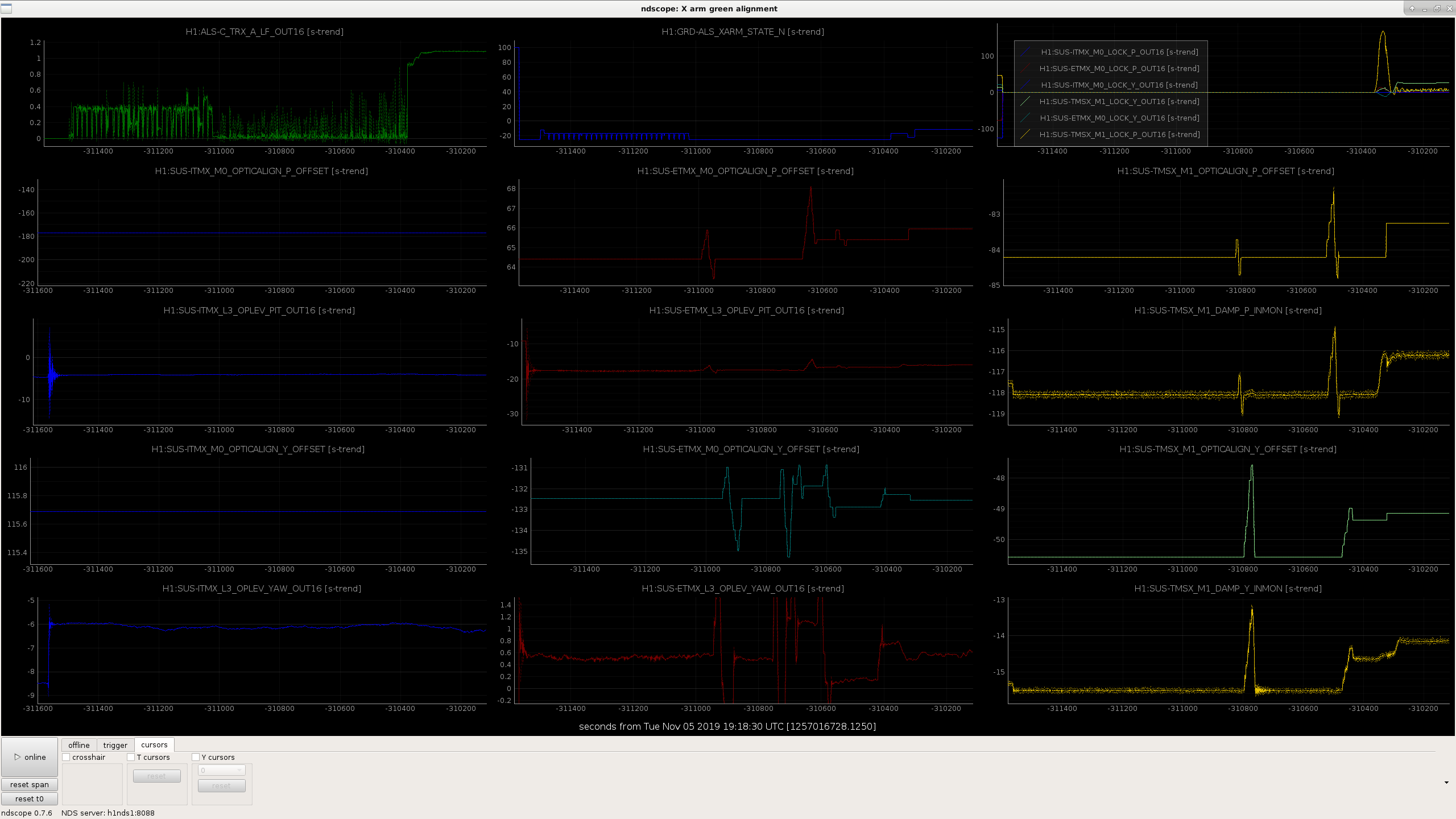
The changes from the free swining alignment after the lock to the alignment after the arm is locked and WFS engaged:

  PIT YAW
ITM not much change not much
ETM +1.5 not much
TMS +1.8
+1.4

The sliders are in pretty good agreement with the witness sensors about these shifts.  I've added the ndscope that I used to make this, and a similar one for the Y arm, to the ALS overview screen, to help make it easier for operators to find and report this kind of information. 


Images attached to this comment
Displaying reports 37641-37660 of 89097.Go to page Start 1879 1880 1881 1882 1883 1884 1885 1886 1887 End