Displaying reports 41381-41400 of 88811.Go to page Start 2066 2067 2068 2069 2070 2071 2072 2073 2074 End
Reports until 19:56, Tuesday 30 April 2019
H1 DetChar (DetChar, ISC)
sumeet.kulkarni@LIGO.ORG - posted 19:56, Tuesday 30 April 2019 (48864)
DQ Shift: LHO O3 Week 4 Monday 22 April 2019 00:00 UTC - Sunday 28 April 23:59 UTC

Shifter: Sumeet Kulkarni

Fellow/Mentor: Ling Sun

Summary:


Complete details can be found at https://wiki.ligo.org/DetChar/DataQuality/DQShiftLHO20190422.

Images attached to this report
H1 DetChar (DetChar, ISC)
sumeet.kulkarni@LIGO.ORG - posted 19:53, Tuesday 30 April 2019 - last comment - 13:57, Thursday 02 May 2019(48863)
Whistle glitches in LHO


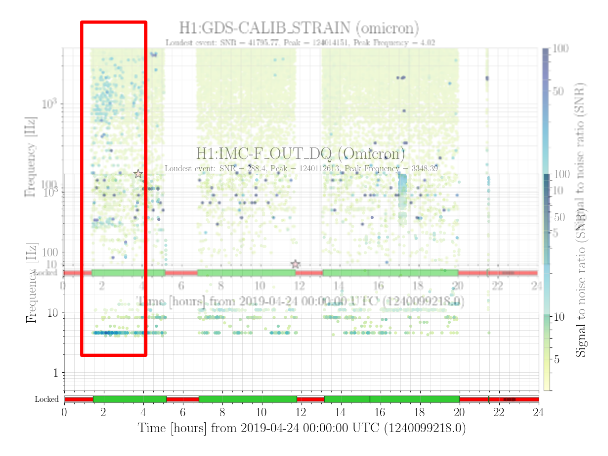
Whistle glitches are being seen with an increasing frequency of occurrence starting from April 22.

The stretches of time when they were seen over the last week are as follows:

* April 22 (Monday): between 09:00-11:00 UTC; this coincided with an Earthquake.

* April 24 (Wednesday): between 01:45-02:30 UTC

* April 26 (Friday): between 13:00-16:30 UTC; this coincided with a period of high winds.

Today (April 30), they can be seen throughout the stretch of Lock between 02:00-15:00 UTC.

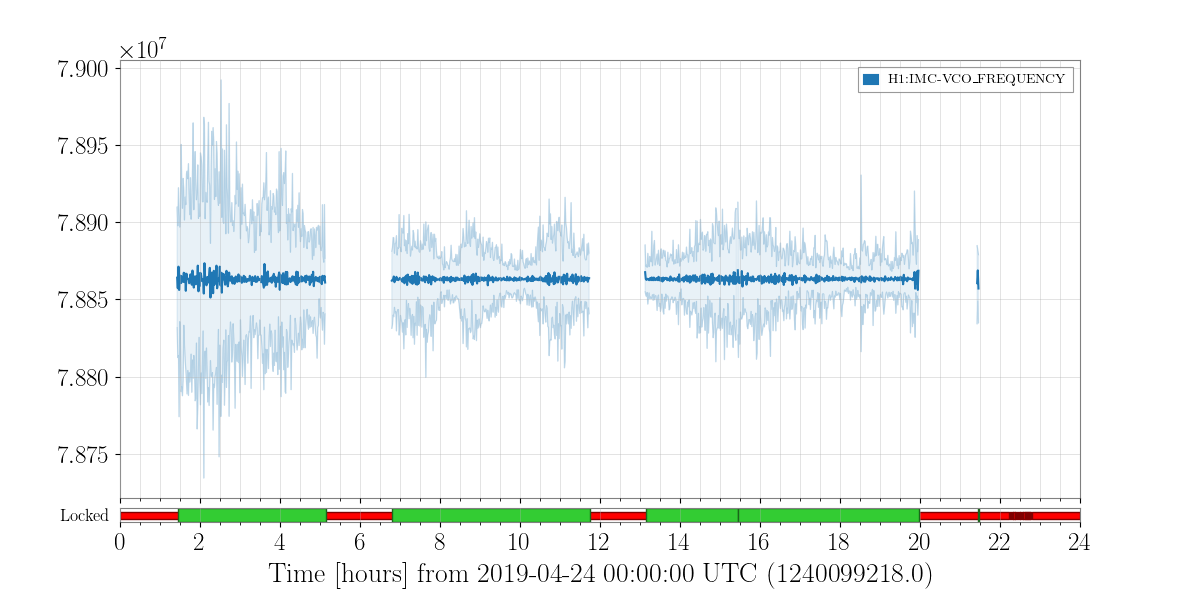
The whistles are accompanied by an increase in variance of the VCO frequency and a corresponding low-frequency (4-5 Hz.) glitching in the IMC-F motion. (plots attached from Wed. April 24).

While high winds and an Earthquake might have been the cause on a couple of instances listed above, whistles have also been seen when the wind and ground motion has not been high. It is not known what causes the increased VCO motion at other times.

Images attached to this report
Comments related to this report
kentaro.mogushi@LIGO.ORG - 13:57, Thursday 02 May 2019 (48939)DetChar

I have noticed that the variance between ASC DHARD increases when that of VCO frequency increases, for example, on the following days,

* April 22 (Monday)

* April 24 (Wednesday)

* April 26 (Friday)

* April 29 (Monday).

Please let me know if someone has known this correlation. 


H1 PEM (DetChar)
robert.schofield@LIGO.ORG - posted 17:32, Tuesday 30 April 2019 (48886)
Impulse injection techniques point towards septum as being main source of HAM5/6 scattering at LLO and at LHO

Sharan Banagiri, Corey Austin, Philippe Nguyen, Anamaria Effler, Robert Schofield

Summary: For impulse injections from multiple locations, signals from accelerometers mounted on the HAM5/6 septum are the best match to DARM in arrival time, have the most consistent amplitude ratios with DARM, and have the most similar frequency structure to the effect of the impulse in DARM. Together with shaking data, this suggests that the septum is the dominant vibration coupling site in the LVEA at both sites. These vacuum enclosure impulse techniques promise to be a useful new tool for diagnosing scattering noise.

Shaking injections made throughout the corner station have shown, in recent PEM injections, as well as for some time before that, that above a few Hz, motion of the vacuum enclosure couples most strongly to DARM in the HAM5/6 area of both LHO and LLO. We have had trouble narrowing down the coupling site further using the shaking amplitude technique because the HAM5/6 region is relatively small and interconnected (if you shake one side of HAM5, the opposite side of HAM6 moves almost as much).

Impulse injection delays

To provide extra information, we investigated the use of impulse propagation delays to help identify coupling sites. In the past, we have narrowed down coupling sites by looking for the microphone that detects an acoustic impulse at about the same time that the signal appears in DARM. And, of course, we have tapped on the vacuum enclosure. But we hadn’t tried using propagation delays from impacts on the vacuum enclosure to accelerometers mounted on the enclosure. While the vacuum enclosure is made of steel, the propagation velocity of waves on the steel membrane and structure is much lower than the velocity for bulk steel, resulting in tens of millisecond delays for propagation between HAM5 and 6.

Figures 1 and 2 show, for LHO and LLO respectively, examples of impulse injection data. These and other injections indicate that vacuum enclosure impulses show up in DARM about the same time as it shows up on the septum accelerometer.

The down side to the impulse timing technique is that higher frequencies are needed in order to discriminate arrival times (here we have used a 70-200 Hz band). Thus, there is the danger that a coupling site that dominates at low frequencies is not the dominant site at high frequencies. However, we have checked bands at lower frequencies and not seen obvious differences and results from two other impulse-based techniques are consistent.

Impulse injection amplitudes

In addition to arrival timing, we also used the amplitude of the prompt impulse vs. the amplitude of the prompt signal in DARM to discriminate coupling locations. The examples in Figures 1 and 2 show that the amplitude in DARM is most consistent with the amplitude of the signal on the septum accelerometer. An advantage of the impulse technique over our usual shaking is that there appears to be a greater difference in amplitude between accelerometers on HAM5 and those on HAM6 for an impulse injection than for a steady state injection. This may be because, for the steady state, the many late reflections have built up the amplitude to nearly the same at all locations in the region (in equilibrium, the energy gets distributed more evenly).

Impulse injection frequency content

A third impulse technique that points towards the septum at both sites, is a comparison of the frequency structure of the impulse signal in DARM to the frequency structure of vacuum enclosure resonances at the various accelerometers. Figure 3 shows that, for both sites, the frequencies that appear strongest in DARM are also the frequencies with the greatest motion in the signals from the beam-axis accelerometers on each site’s septum. That is, the septum resonance pattern appears to best match the frequency pattern produced by the impulse in DARM. 

While results from these three techniques are not individually overwhelming evidence that the dominant coupling site is the septum, together they build a strong case.

We started out using soft hammers to impact the vacuum enclosure, but this evolved into using a long rod, with an inch-thick soft rubber pad mounted at the end, that could reach the tops of enclosures and keep the user further away from sensitive regions. In addition, the extended impact associated with the pad and the flexing of the long rod helped emphasize lower frequencies. A photograph is shown in Figure 4.  For this study, all impulse injections were analyzed by hand. It may be worth beginning to automate these techniques.

In addition to the HAM 5/6 area, we also made impulse injections at end stations and other LVEA locations during the PEM injection program, which will be discussed in a future log (preliminary: at LLO EY impulse injections are consistent with coupling at the manifold).

Non-image files attached to this report
LHO VE
kyle.ryan@LIGO.ORG - posted 17:14, Tuesday 30 April 2019 (48887)
PT510B tripped off due to radio broadcast

The Hanford Fire people were on site this morning and their radios often cause our CC gauges to trip off -> I re-enabled PT510B and it "fired" shortly thereafter.  Chandra R. spoke with them and they agreed to use there cell phones instead.  

H1 IOO
cheryl.vorvick@LIGO.ORG - posted 17:03, Tuesday 30 April 2019 (48884)
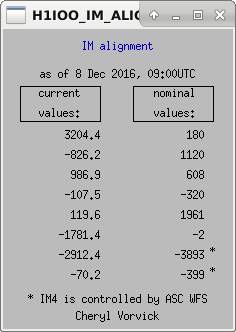
IM nominal alignment medm updated
Images attached to this report
H1 CDS (DAQ)
david.barker@LIGO.ORG - posted 16:58, Tuesday 30 April 2019 (48885)
CDS Maintenance Summary, Tuesday 30th April 2019

DMT broadcaster, removal of channels

Dave, John Z:

The H1 DAQ DMT broadcaster was still configured to send nonexistent channels. These fell into three categories: removed SQZ guardian node, removed ODC and renamed PSL Bullseye photodiode. I removed the first two categories from H1BROADCAST.ini and renamed the PSL channels. The broadcaster was restarted at 11:48 PDT.

h1edc accumulated CRC errors cleared

This was done by hand since there was  no DAQ restart today.

WP8191 DMT upgrades

Greg:

Production DMT machines were upgraded and restarted.


H1 General
jeffrey.bartlett@LIGO.ORG - posted 16:20, Tuesday 30 April 2019 (48883)
Ops Evening Shift Transition
Ops Shift Transition: 04/30/2019, Evening Shift 23:00 – 07:00 (16:00 -00:00) - UTC (PT)
State of H1: Locked at NLN
Intent Bit: Observing
Weather: Sunny with scattered light clouds. Temperatures are between mid-60s and mid-40s. No rain in the forecast. Winds are around a Gentle Breeze.
Primary 0.03 – 0.1Hz: Z-Axis 0.09um/s, X & Y Axis 0.07um/s
Secondary 0.1 – 0.3Hz: 0.7mu/s
Outgoing Operator: TJ
Quick Summary: IFO is locked and observing after maintenance Tuesday. The range 104.2Mpc.
LHO General
thomas.shaffer@LIGO.ORG - posted 15:58, Tuesday 30 April 2019 (48880)
Ops Day Shift Summary

TITLE: 04/30 Day Shift: 15:00-23:00 UTC (08:00-16:00 PST), all times posted in UTC
STATE of H1: Observing at 110Mpc
INCOMING OPERATOR: Jeff
SHIFT SUMMARY: Maintenance Day wasn't awful and we were able to recovery before my shift ended, see previous alog for locking details.
LOG:

1500 Richard to LVEA adn CER for 60Hz work
1502 Ed to LVEA to check laser tables
1507 Ed out
1510 Vanessa to EX
1512 Richard out
1518 Christina to EX, MX, EY, MY
1520 Karen to EY
1522 Hugh and Corey taking ITMX to ISOLATED_DAMPED to test CPS
1523 SEI_CONF to TO SC_OFF_NO_BRSXY
1528 Lock loss
1533 Rahul starting charge meas.
1546 HFD at gate, headed to OSB, mids, and ends
1549 Jason to optics lab and then to PSL enclosure
1551 Chandra to LVEA to check on vac equip and make video
1558 Cheryl to PSL
1606 Hugh to end for HEPI maint. and MY
1621 Karen leaving EY
1631 Vac EX PT-510B alarm
1635 Norco at gate, heading to 374?
1649 Kyle to EX to check on PT510B
1650 Fil, Patrick to EY to start enclosure/fan work
1652 Corey to LVEA to look for 3IFO
1652 Charge meas. done
1657 Richard to LVEA with contractors for tour
1700 Norco at the gate, heading to 379
1702 Hugh back from ends
1719 Vanessa leaving EX for LVEA
1719 Marc to LVEA to swap baluns
1726 Dick joining Marc in the LVEA
1733 Fil, Patrick back
1735 Christina back from outbuildings
1743 Patrick restarting Beckhoff at EY
1815 Richard to CER
1825 Fil back
1837 Richard out
1844 Marc, Dick out
1848 Cheryl done with sweep, out
2228 Observing

H1 DetChar (DetChar, ISC)
andrew.lundgren@LIGO.ORG - posted 15:39, Tuesday 30 April 2019 - last comment - 02:01, Wednesday 01 May 2019(48881)
AS-A Rephasing Degraded Sensitivity
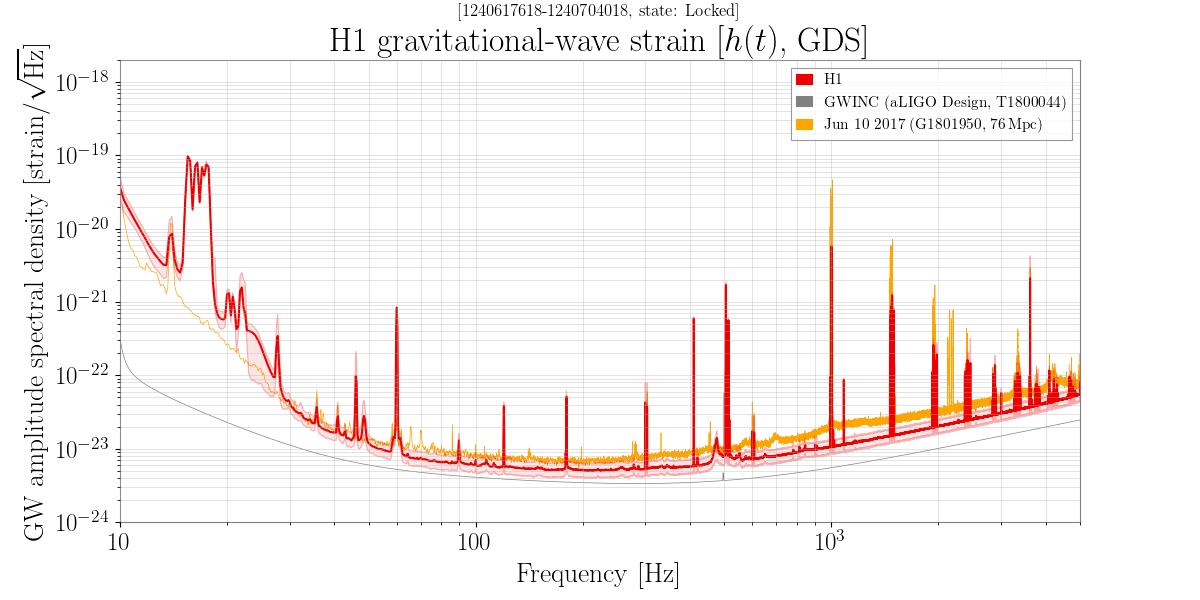
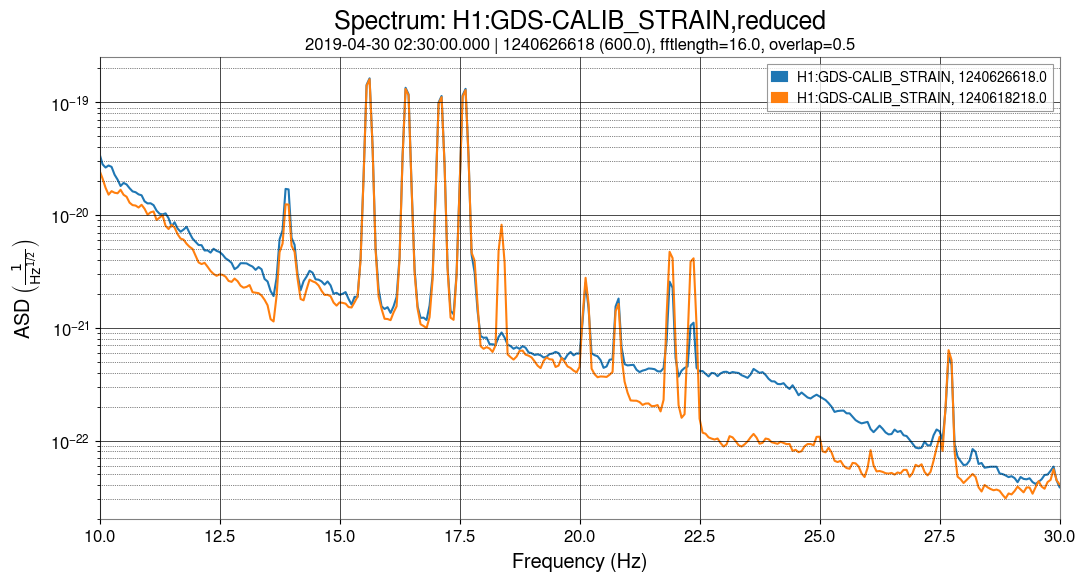
The rephasing of AS-A, since reverted, caused a big bump in h(t) from 20 to 30 Hz that I think was responsible for the drop in range by 10-15 Mpc.

The rephasing (alog 48857) improves the 9 MHz buildup and the slow yaw oscillation. But the range (plot 1) drops from 115 to 105 MPc (roughly) due to a feature from 20 to 30 Hz (plot 2). It looks a bit like a scattering shelf but has a featureless spectrogram - no arches.

I don't see any coherence of the new noise with the MICH_P or Y channels. I've set up a BRUCO run that might help figure out where the excess noise comes from.
Images attached to this report
Comments related to this report
georgia.mansell@LIGO.ORG - 16:05, Tuesday 30 April 2019 (48882)

When we rephrased rf36 we changed the pointing of the beamsplitter. The extra noise looked a bit like bad A2L decoupling to me. I think maybe we should phase rf36 so the 9 MHz build ups are good and then revisit the A2L to fix the low frequency noise?

andrew.lundgren@LIGO.ORG - 02:01, Wednesday 01 May 2019 (48890)DetChar, ISC
The Bruco results show big coherence with REFL_A RF45  yaw (both I and Q). The spectrum of REFL LF is elevated after the rephasing and has coherence in the same place. So A2L or touching up the alignment after the beamsplitter moves seems like it would help.

Note: My first Bruco run failed (user error), so here's the new link.
H1 General
thomas.shaffer@LIGO.ORG - posted 15:33, Tuesday 30 April 2019 (48879)
Observing 2228 UTC

Officially recovered from maintenance day. Summary of locking:

H1 CDS (CAL, CDS, DCS)
gregory.mendell@LIGO.ORG - posted 13:42, Tuesday 30 April 2019 - last comment - 08:04, Wednesday 08 May 2019(48877)
DMT patched and updated to gds-2.18.17; GDS calibration restated to remove Cal lines in GDS CLEANED STRAIN.

With M Wade.

The DMT computers have patched and updated to gds-2.18.17; GDS calibration restated to remove Cal lines in GDS CLEANED STRAIN. This completes WP 8191.

Comments related to this report
madeline.wade@LIGO.ORG - 08:04, Wednesday 08 May 2019 (49107)

Just to give some more details on the updates to the GDS calibration pipeline: We restarted the pipelines with a new configuration file

aligocalibration/trunk/Runs/O3/GDSFilters/H1GDS_1240326116.ini

The new configuration file includes the correct list of line frequencies to be subtracted from the GDS-CALIB_STRAIN_CLEAN channel.  The restart occurred around GPS time 1240691683.

H1 SEI
hugh.radkins@LIGO.ORG - posted 13:38, Tuesday 30 April 2019 (48876)
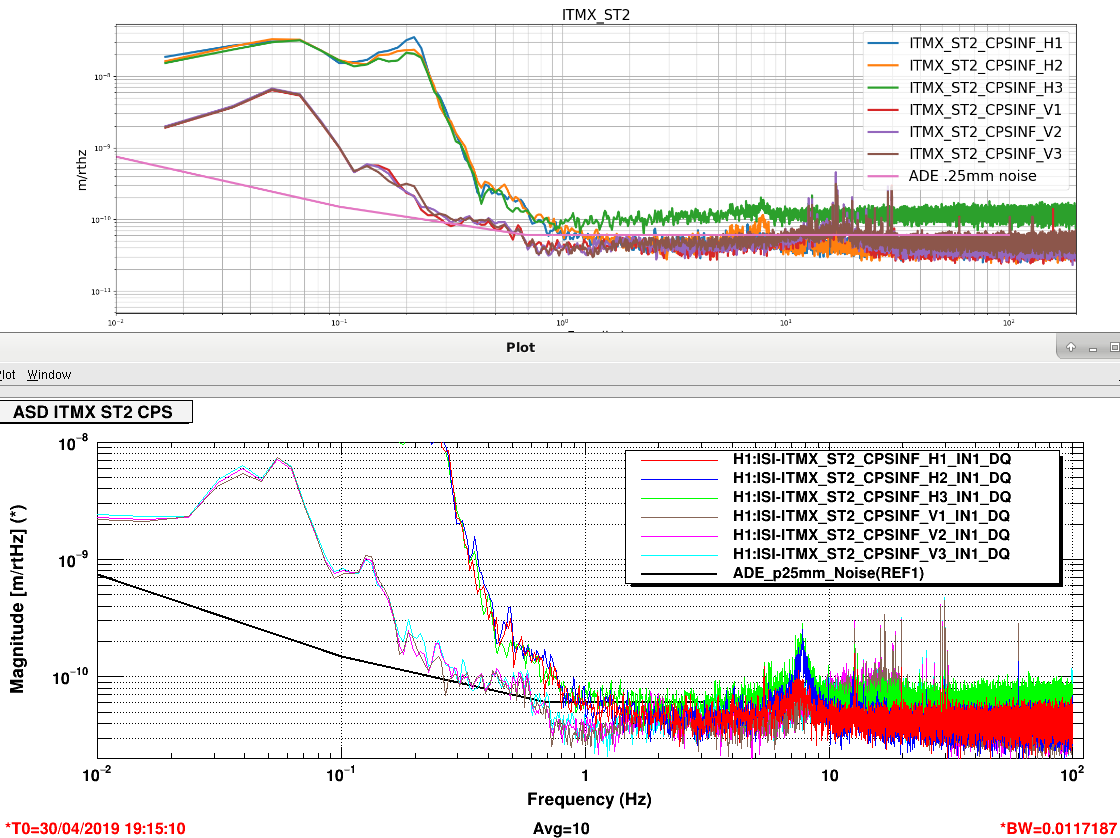
ITMX Stage2 H3 CPS gauge board extracted and reinserted to reset

As Jim pointed out in 48854, this sensor's noise has been elevated for many weeks.  This morning, we transitioned the ITMX ISI to Isolated Damped to take the CPSs out of the control loop.  The IFO survived this but when the cable was unplugged from the rack, the output went to the far limit rail.  This would have tripped the ISI WD but we had increased the WD Limit, smart.  When the card was removed from the rack, the signal went to zero.  After a minute of so, the card was replaced.  And the ISI was returned to the nominal configuration of Fully Isolated.  Sadly, while the IFO survived the transition of the ISI stage2 to damped, it could not tolerate my banging around with the ladder and bumping my head (w/bump cap, smart) on the suspended HEPI, dummy.

Below is a comparison of the ITMX stage2 CPSs that Jim posted last night and one from just an hour ago.  Clearly the noise is reduced but H3 remains noisier than the others of the stage.  If this continues to be of concern, we'll take the next step of power cycling the CPS interface.  That however, will require the platform to go into fully Damped which the IFO is not likely to survive, but, we'll see.

Images attached to this report
H1 PSL (PSL)
cheryl.vorvick@LIGO.ORG - posted 12:58, Tuesday 30 April 2019 (48875)
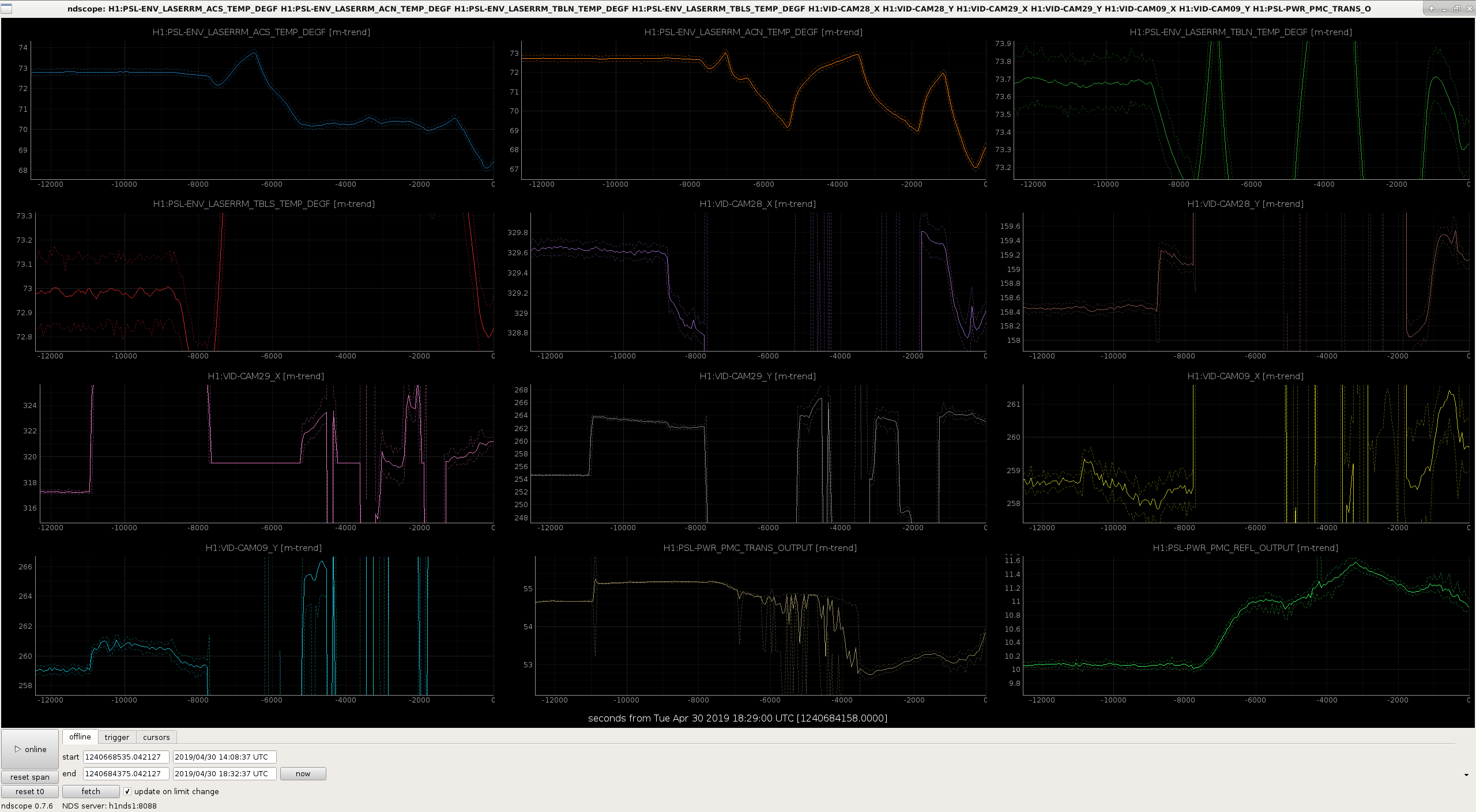
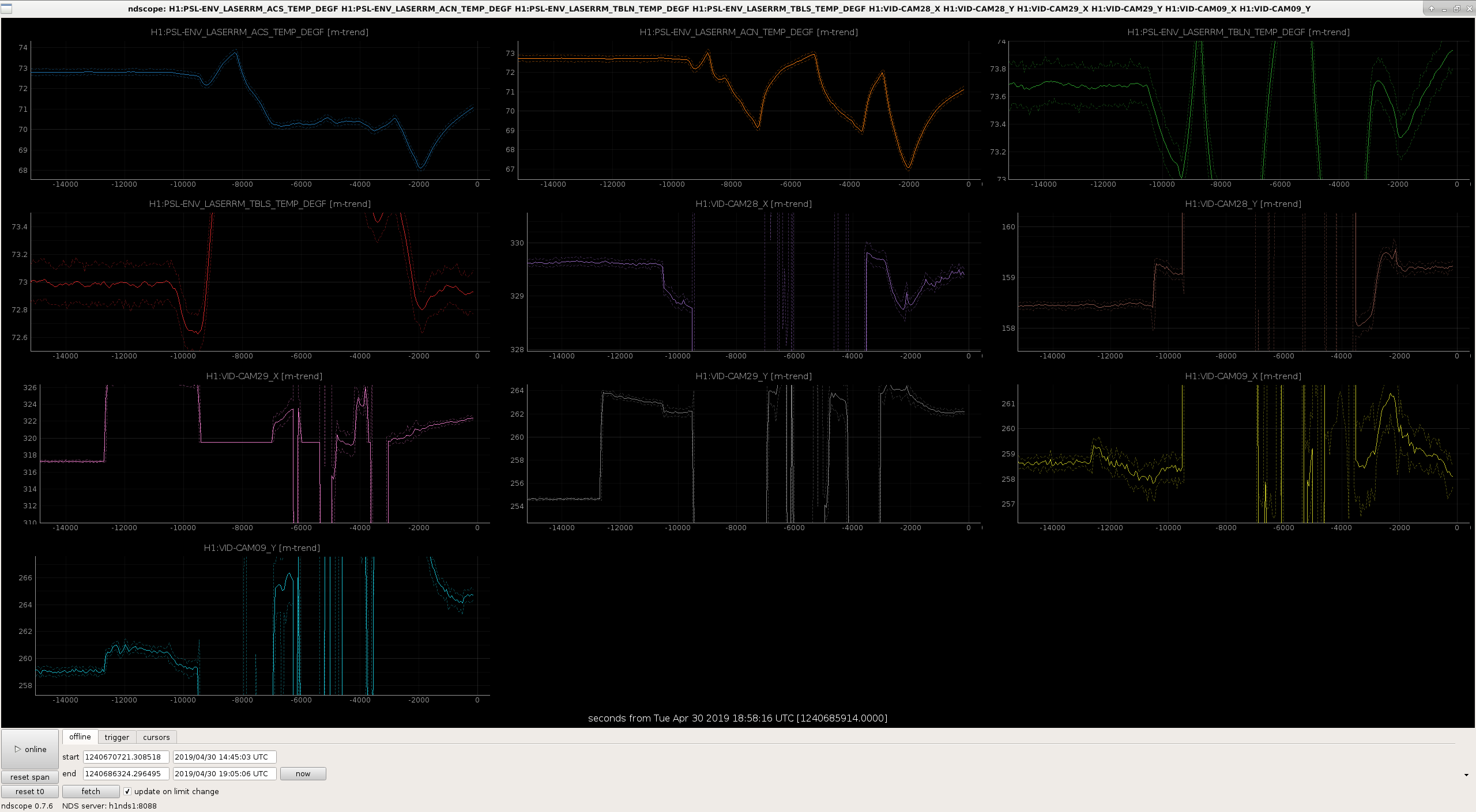
PSL temperature tuning after incursion

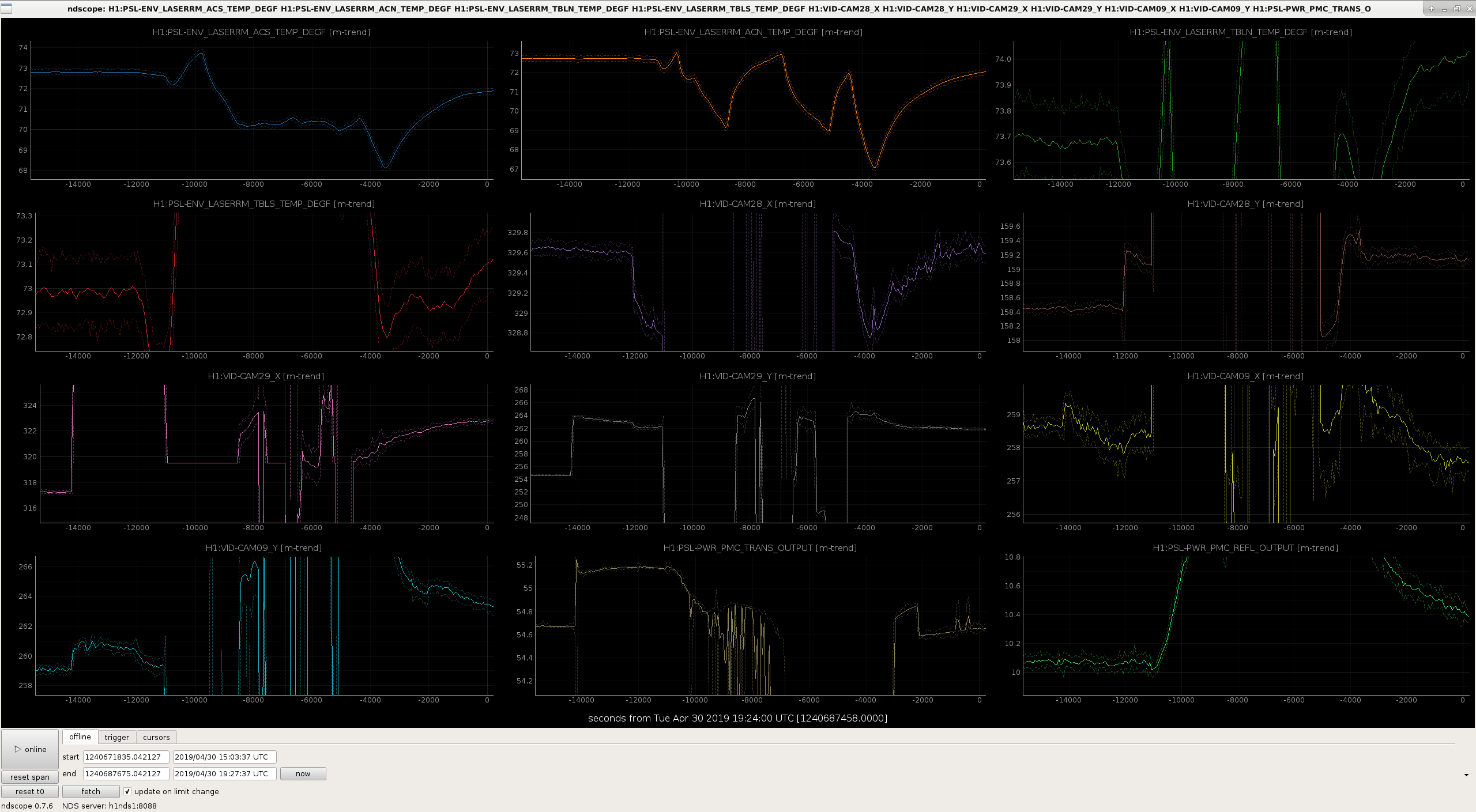
After exiting the PSL, we watched the PSL temperatures, and waited until they were close to their nominal values, before fully tuning the PSL HVAC to Commissioning Mode.

- Jason, Cheryl

Images attached to this report
H1 PSL
jason.oberling@LIGO.ORG - posted 11:55, Tuesday 30 April 2019 - last comment - 08:50, Friday 03 May 2019(48871)
PSL Work Today (WP 8188 & FAMIS 10708)

WP 8188

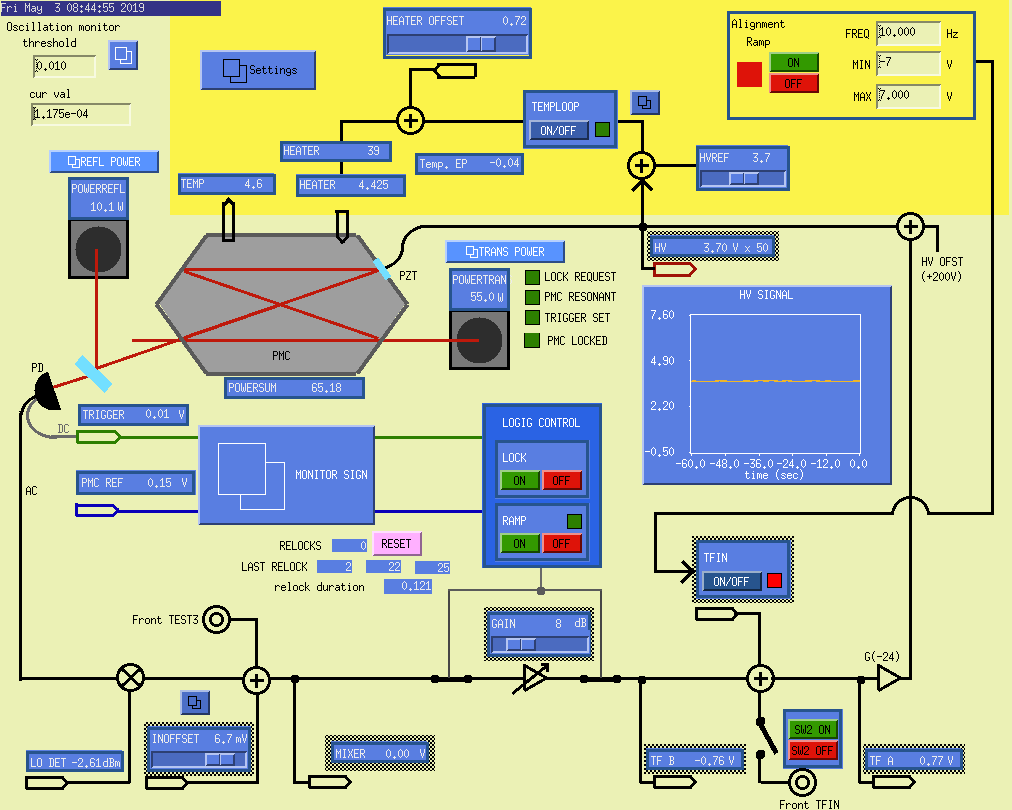
I made I slight adjustment to the light level on the PMC locking PD to hopefully alleviate the constant increase in the relock counter we've been seeing lately (LHO alog 48568 & FRS 12753).  I began by tweaking the alignment into the PMC locking PD, which did not change the PD voltage.  I then slightly tweaked the TFP directly in front of the PD to increase the PD voltage; this had a small effect on the PD voltage.  The changes are:

I did not change the PMC gain.  I reset the PMC relock counter at 18:44 UTC (11:44 PDT) and will monitor this over the next few days before closing the work permit.

FAMIS 10708

Both PSL power watchdogs were reset at 18:35 UTC (11:35 PDT).  This completes FAMIS 10708.

Other Work

I happened to notice that the ISS diffraction % was at ~1.7% with the just the 1st loop locked; the diffracted power should be between 2% and 3%.  I changed the ISS Reference Signal from -2.08 V to -2.07 V; this brought the diffraction % to ~2.1%.  The change was accepted in both the SAFE and OBSERVE SDF files.

Comments related to this report
jason.oberling@LIGO.ORG - 08:50, Friday 03 May 2019 (48961)

In almost 3 days there have been 0 relocks on the PMC, see attached.  Increasing the light level on the diode cured the behavior.  This closes WP 8188 and FRS 12753.

Images attached to this comment
LHO General
thomas.shaffer@LIGO.ORG - posted 11:50, Tuesday 30 April 2019 (48872)
Tuesday Maintenance Update

Maintenance activities are done for the day, and we are beginning to lock.

LVEA, EYVEA have been swept

LHO General
ryan.blair@LIGO.ORG - posted 09:52, Tuesday 30 April 2019 - last comment - 11:20, Tuesday 30 April 2019(48866)
WP#8185 maintenance being performed (external network connection reconfiguration)

Maintenance for WP#8185 is beginning shortly (at 10:00 AM Pacific / 17:00 UTC). There may be a brief loss of external network connectivity while this work is being performed.

Comments related to this report
ryan.blair@LIGO.ORG - 11:20, Tuesday 30 April 2019 (48870)

Work has been completed.

H1 ISC (ISC)
georgia.mansell@LIGO.ORG - posted 19:02, Monday 29 April 2019 - last comment - 14:42, Tuesday 30 April 2019(48857)
ASC-AS_A_RF36 re-phased, ASC oscillation gone

All day today the 2-minute-period oscillation in the yaw ASC loops persisted. We tried turning off the ADS loops, this had no effect. We tried lowering the gain of the SRC1 loop, this did nothing.

We decided to re-phase sensor for the beamsplitter ASC (AS_A_RF36_Q), since:

I added ~25 degrees to each quadrant, (now all around 225 degrees). This stopped our ASC oscillation, and increased our 9MHz build up (POPAIR_B_RF18) freom ~42 to ~45. There might be more improvements to be had by turning up the phase further, I just stopped here since the rest of the ASC was taking a while to catch up.

Comments related to this report
jenne.driggers@LIGO.ORG - 14:42, Tuesday 30 April 2019 (48878)

We're struggling to lock, and seeing some ASC oscillations, so I've reverted this change for now.

H1 AOS (DetChar, PSL)
pep.covas@LIGO.ORG - posted 13:07, Monday 29 April 2019 - last comment - 09:28, Thursday 02 May 2019(48850)
Bump in DARM at 540 Hz

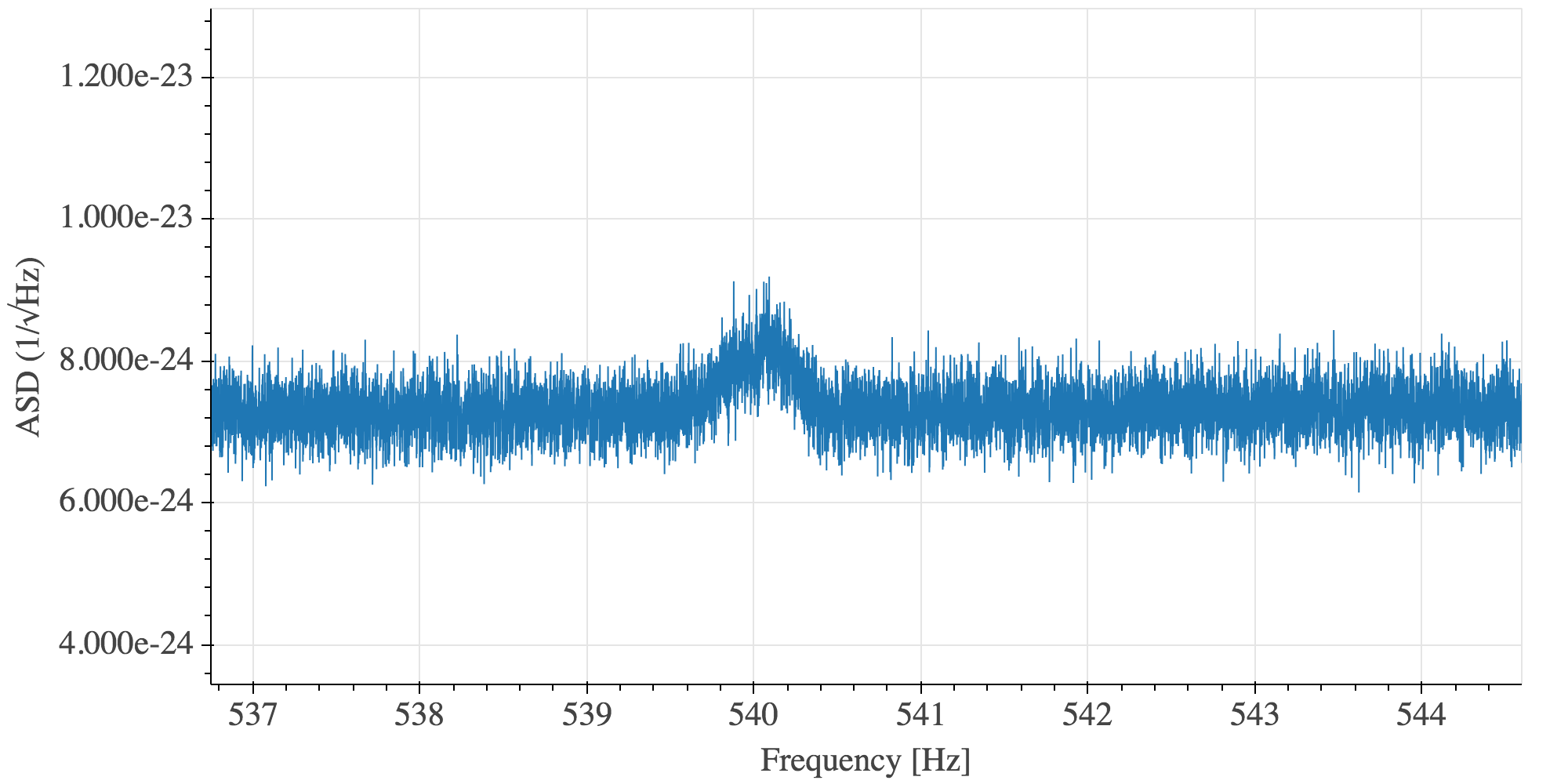
I've been looking at the bump around 540 Hz which can be seen with long integrations (1800 s), see first attachment.

I ran a BruCo job to try to find coherences (results here https://ldas-jobs.ligo-wa.caltech.edu/~pep.covas/bruco/bruco_1240272018/), and some channels related to PSL (ISS), HPI and ISI showed high values. These are the top 20 channels found by BruCo and their coherence: 

540.12 HPI-HAM1_TT
_L4C_Z_DQ

(0.79)
ISI-HAM6_GS13INF
_H1_IN1
_DQ

(0.78)
HPI-HAM1_TT
_L4C_RX_DQ

(0.78)
ISI-HAM6_BLND
_GS13RZ
_IN1_DQ

(0.77)
PEM-CS_ADC
_5_18_2K_OUT
_DQ

(0.77)
PSL-ISS_PDB
_REL_OUT_DQ

(0.77)
PSL-ISS_SECONDLOOP
_RIN
_CTRL_OUT
_DQ

(0.77)
PSL-ISS_SECONDLOOP
_OUTPUT
_DQ

(0.77)
HPI-HAM1_TT
_L4CINF_V2
_IN1_DQ

(0.77)
PSL-ISS_SECONDLOOP
_RIN
_ERR1_OUT
_DQ

(0.77)
HPI-HAM1_TT
_L4CINF_V3
_IN1_DQ

(0.77)
PSL-ISS_SECONDLOOP
_ERR1
_DQ

(0.77)
ISI-ETMX_ST1
_L4CINF_V3
_IN1_DQ

(0.76)
ISI-ETMX_ST1
_MASTER_H1
_DRIVE_DQ

(0.76)
ISI-ETMX_ST1
_L4CINF_H3
_IN1_DQ

(0.76)


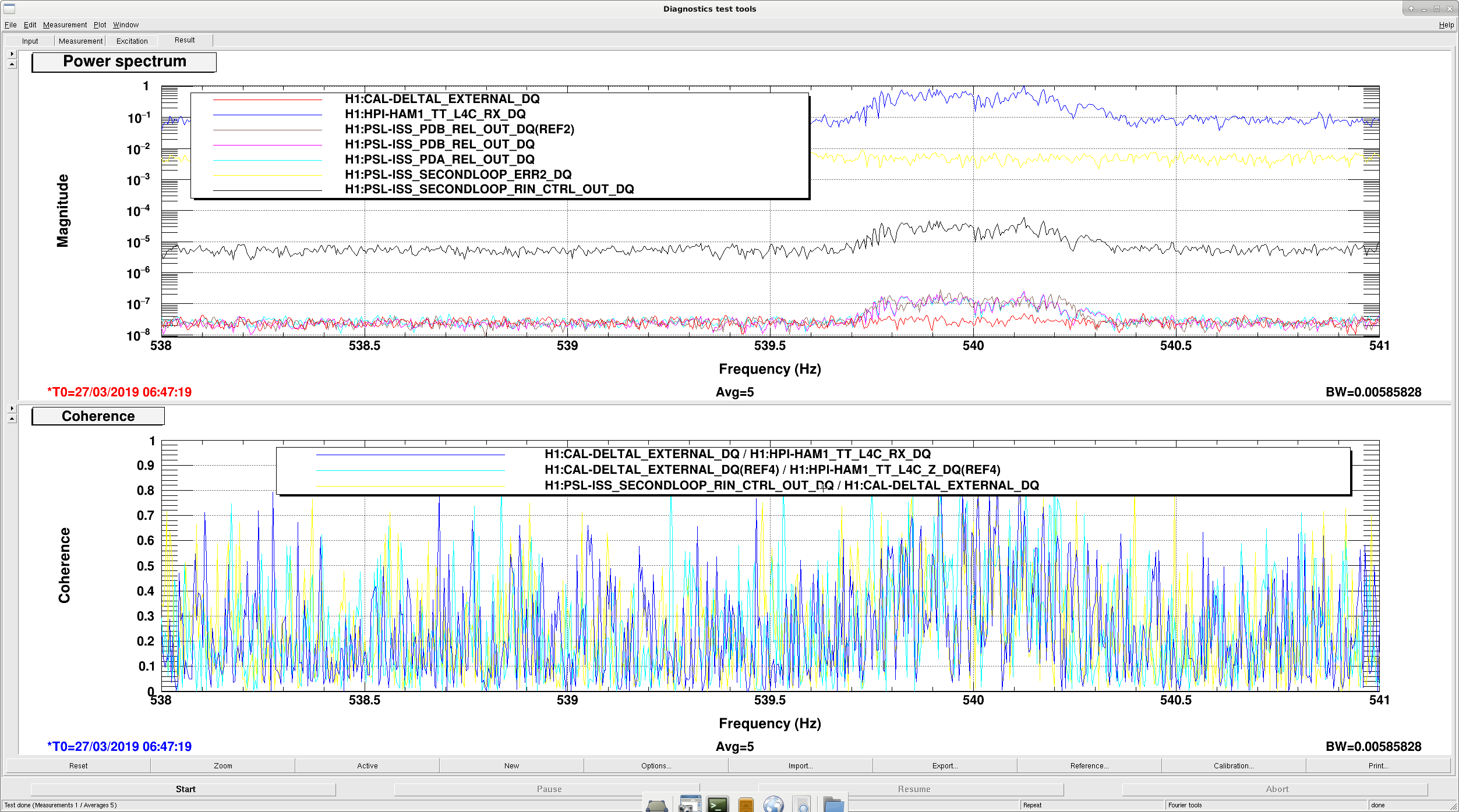
The second attachment shows a DTT plot showing some power spectrums and some coherence traces. A region of high coherence between approximately 539.7 and 540.3 Hz can be seen, and also a bump at these channels at the same frequencies as in DARM. It shows both curves from 27 March and 27 April (refs), which show very similar features. This bump seems to be a stable feature in DARM

Images attached to this report
Comments related to this report
pep.covas@LIGO.ORG - 14:35, Monday 29 April 2019 (48852)

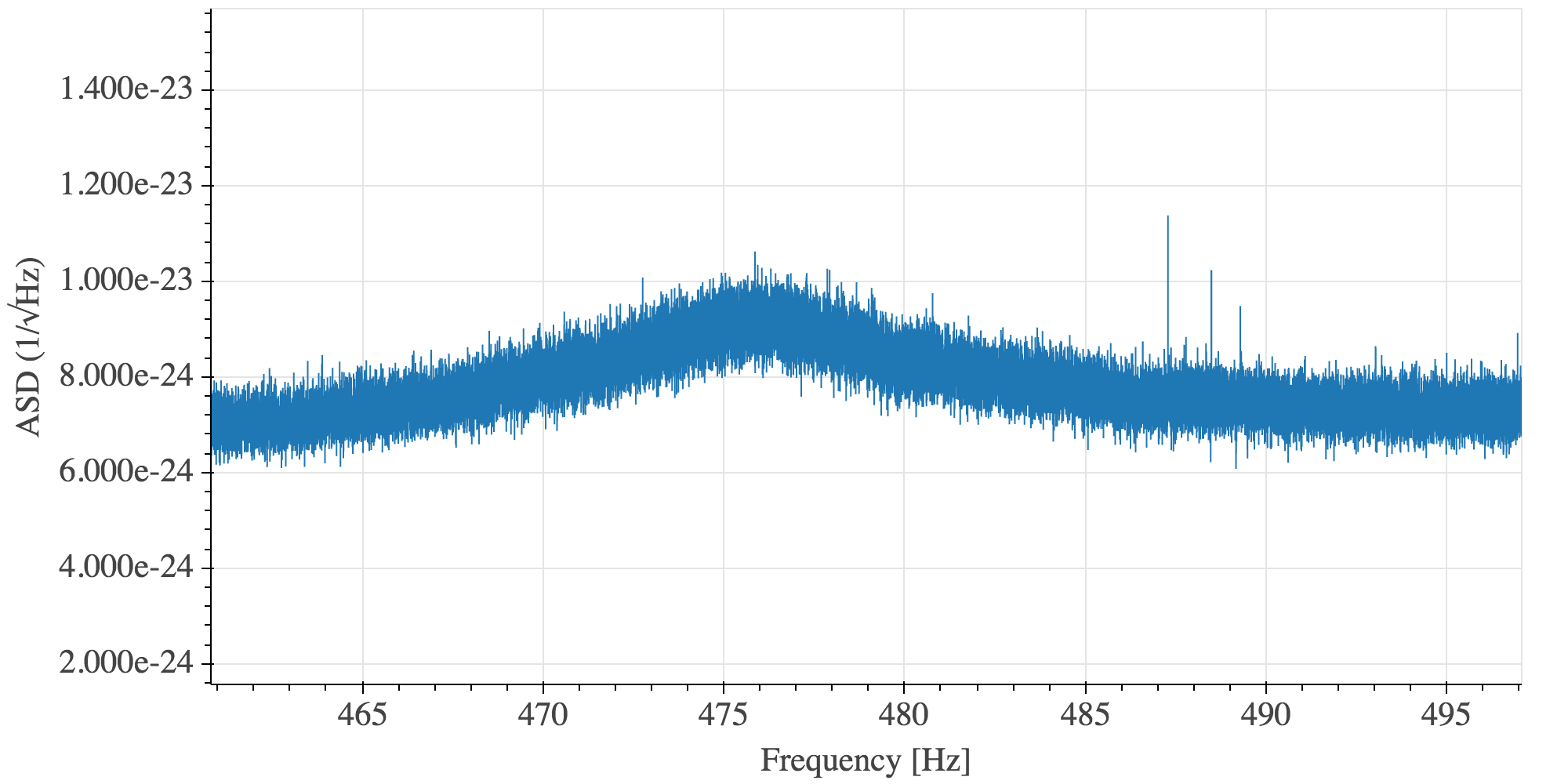
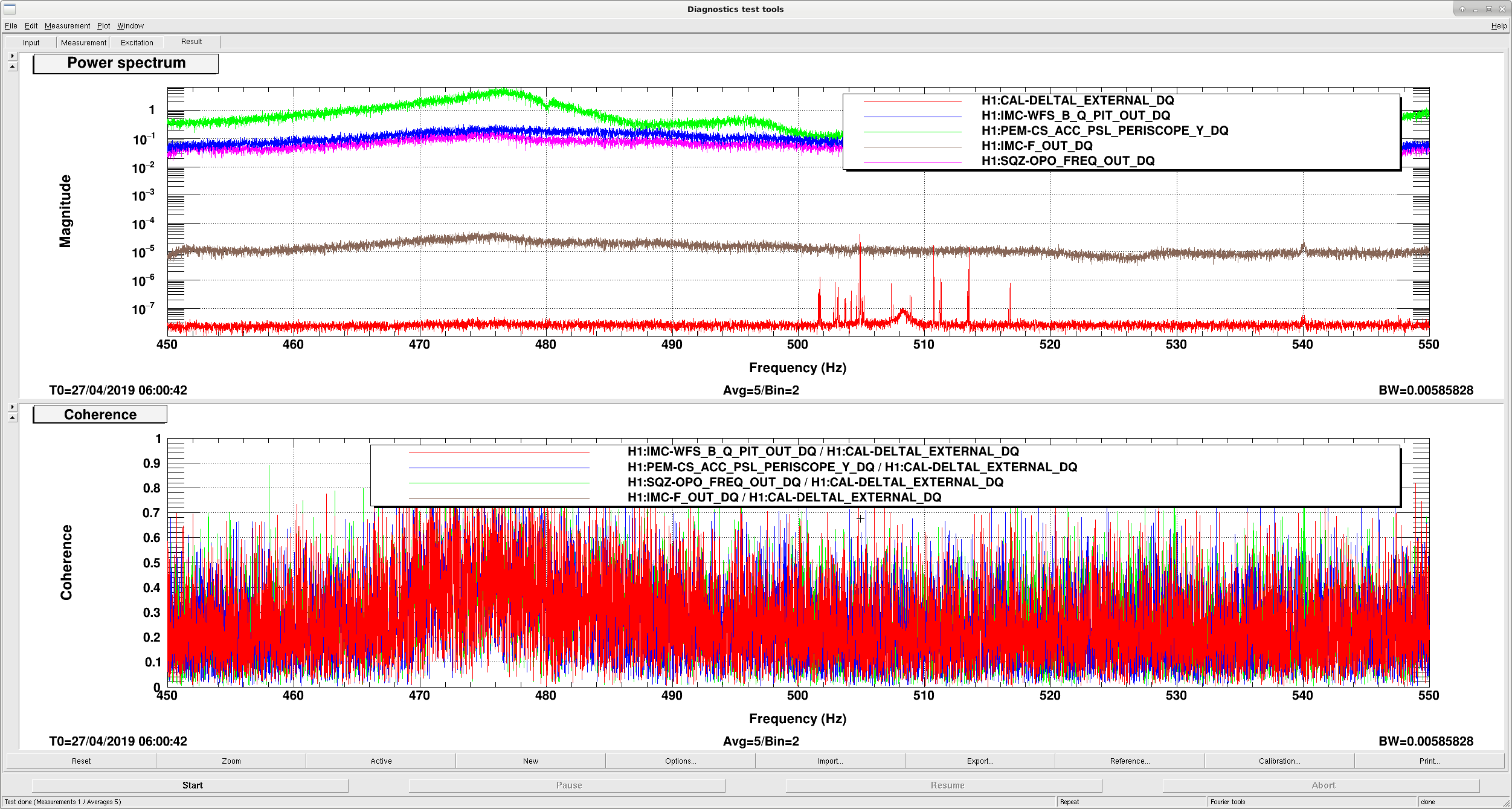
A similar but much wider bump between 465 and 485 Hz (first attachment) also has coherence with some other channels, for example:

476.62 IMC-WFS_B_Q
_PIT_OUT_DQ

(0.70)
IMC-WFS_B_Q3
_ERR_DQ

(0.70)
IMC-DOF_4_P
_IN1_DQ

(0.68)
IMC-WFS_B_DC
_PIT_OUT
_DQ

(0.68)
IMC-WFS_B_Q4
_ERR_DQ

(0.68)
IMC-WFS_A_DC
_PIT_OUT
_DQ

(0.68)
IMC-WFS_A_DC
_YAW_OUT
_DQ

(0.67)
PEM-CS_ACC
_PSL_PERISCOPE
_X_DQ

(0.67)
IMC-WFS_B_Q
_YAW_OUT_DQ

(0.66)
IMC-WFS_B_Q1
_ERR_DQ

(0.65)
PEM-CS_ACC
_PSL_PERISCOPE
_Y_DQ

(0.65)
IMC-WFS_B_Q2
_ERR_DQ

(0.64)
IMC-WFS_B_I4
_ERR_DQ

(0.63)
PEM-CS_ACC
_PSL_TABLE1
_Z_DQ

(0.62)
IMC-F_OUT_DQ
(0.61)
476.75 IMC-WFS_B_Q
_PIT_OUT_DQ

(0.78)
PEM-CS_ACC
_PSL_TABLE1
_Z_DQ

(0.76)
IMC-WFS_B_Q3
_ERR_DQ

(0.76)
IMC-WFS_A_DC
_PIT_OUT
_DQ

(0.75)
IMC-DOF_2_P
_IN1_DQ

(0.75)
PEM-CS_ACC
_PSL_PERISCOPE
_Y_DQ

(0.75)
IMC-DOF_4_P
_IN1_DQ

(0.74)
IMC-WFS_B_DC
_PIT_OUT
_DQ

(0.74)
IMC-WFS_B_Q1
_ERR_DQ

(0.74)
IMC-F_OUT_DQ
(0.74)
IMC-F_IN1_DQ
(0.74)
SQZ-OPO_FREQ
_OUT_DQ

(0.74)
SQZ-PSL_FF
_OUT_DQ

(0.74)
PEM-CS_ACC
_PSL_PERISCOPE
_X_DQ

(0.74)
IMC-L_IN1_DQ
(0.74)


The second attachment again shows the power spectrum and coherence with some channels. You can see an increase in coherence around this same frequency range, with all channels compared showing similar behaviour. 

This being a 20 Hz wide feature, it would be interesting to try to do more studies in order to get rid of this, if possible.

Images attached to this comment
jenne.driggers@LIGO.ORG - 09:22, Tuesday 30 April 2019 (48865)

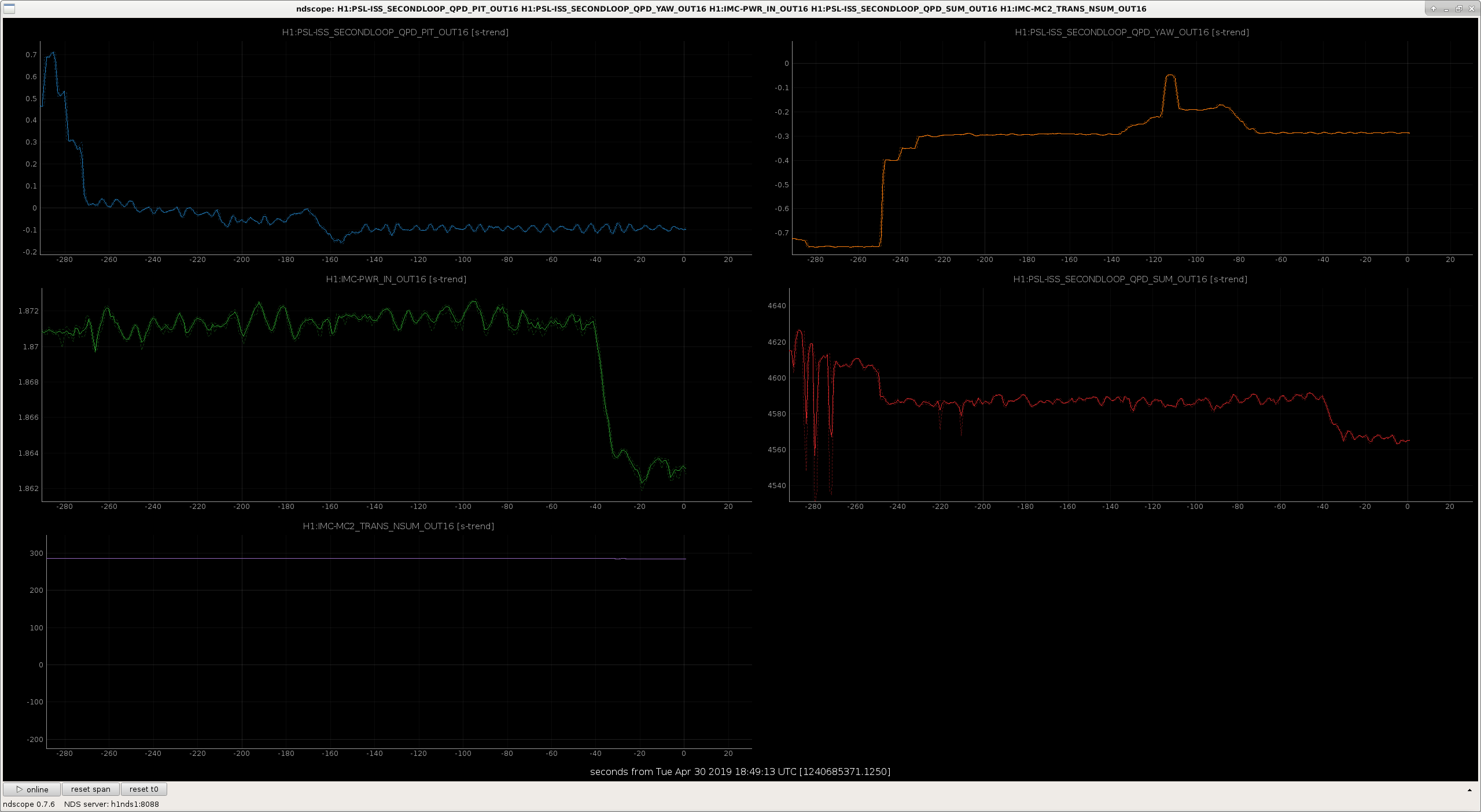
Particularly since the ISS channels are coherent with the ISI, Pep and I talked about this being potentially beam motion that is then coupling in to the ISS second loop, which is then putting it onto the 1st loop.  The attached figure shows that while we're in lock, the second loop QPD is near one of the edges in pitch.  Note however that when we have just the IMC and not the full IFO that the QPD doesn't look centered.  So, I want to move the spot during an IMC-only time the amount that I think it needs for full lock - I don't want to actually center the beam while we have IMC only. 

jenne.driggers@LIGO.ORG - 11:55, Tuesday 30 April 2019 (48874)

[Pep, Jenne]

We move the picomotors in front of the ISS second loop array by +0.8 in pitch and +0.47 in yaw, such that the beam should be centered when we're in full IFO 35W lock.  On the HAM2+oplev picomotor controller, we mostly used the picomotor channel 8 (PSL ISS QPD/PD (PM5)) to do the centering, and then checked with channel 1 (PSL ISS QPD/PD (PM1)) that there was no change in the SUM if we moved a few fractions of a beam diameter.  This check helped us feel more confident that the beam is not clipping.  Pep will check if there is an improvement in this coupling, once we're relocked.

Images attached to this comment
pep.covas@LIGO.ORG - 09:28, Thursday 02 May 2019 (48928)

After the changes made this Tuesday, the noise floor has improved (see here https://ldas-jobs.ligo-wa.caltech.edu/~pep.covas/O3/AfterPSLPicomotor/Comparison.png), but it could be better. We have used again the picomotors (mostly in YAW) while at 35 W to try to make a better improvement.

H1 ISC (ISC)
marc.pirello@LIGO.ORG - posted 14:15, Tuesday 02 April 2019 - last comment - 13:49, Tuesday 02 July 2019(48165)
Installed new v3 Baluns in CER

M. Pirello, D. Gustafson

We installed new v3 Baluns on the following signals in the CER:

ISC-C3(37-1) 40Mhz TCS AOM Return exchanged v1-117 with v3-S002

ISC-C3(33-4) 158.8Mhz Fiber Beat Note Return exchanged v1-193 with v3-S003

ISC-C3(33-5) 79.4Mhz SQZ VCO Return exchanged v1-151 with v3-S004

ISC-C3(33-6) 203.125MHz SQZ VCXO Return exchanged v1-052 with v3-S005

ISC-C4(39-3) 79.4MHz PSL VCO Return exchanged v1-093 with v3-S010

These are all return signals, the impact should be minimal.  Work was completed per WP8150

Balun status can be seen here E1900100.

Comments related to this report
marc.pirello@LIGO.ORG - 11:55, Tuesday 30 April 2019 (48873)

Continuing the Balun exchange program:

We installed new v3 Baluns on the following signals in the CER:

ISC-C4(39-1) 79.4MHz "ALS DIFF VCO Return" exchanged v1-102 with v3-S006

ISC-C4(39-2) 79.4MHz "ALS COMM VCO Return" exchanged v1-094 with v3-S068

ISC-C4(26-2) 45.5MHz "PEM Readback for Antenna Demod"  exchanged v1-055 with v3-S009

ISC-C4(19-8) 9.1MHz "PEM Readback for Antenna Demod" exchanged v1-147 with v3-S116

Work was completed per WP8190.  WP was modified to reduce impact to the IFO during this weeks maintenance, we did not touch squeezer.

Balun status can be seen here E1900100.

marc.pirello@LIGO.ORG - 15:26, Tuesday 07 May 2019 (49074)

Continuing the Balun exchange Program:

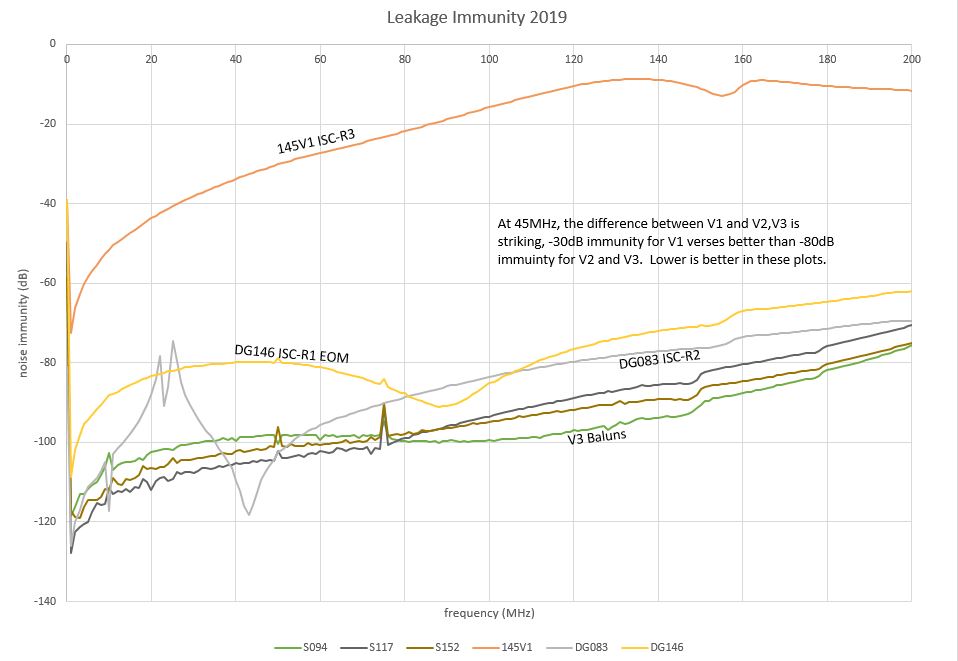
We installed new V3 baluns on the following 45MHz signals in the LVEA:

ISC-R1 (41-6) 45MHz Auxiliary Modulation (EOM Driver) exchanged v2-DG146 with v3-S152

ISC-R2 (41-2) 45MHz Distribution exchanged v2-DG083 with v3-S094

ISC-R3 (41-3) 45MHz Distribution exchanged v1-145 with v3-S117

Work was completed per WP8200, balun status can be seen here E1900100.

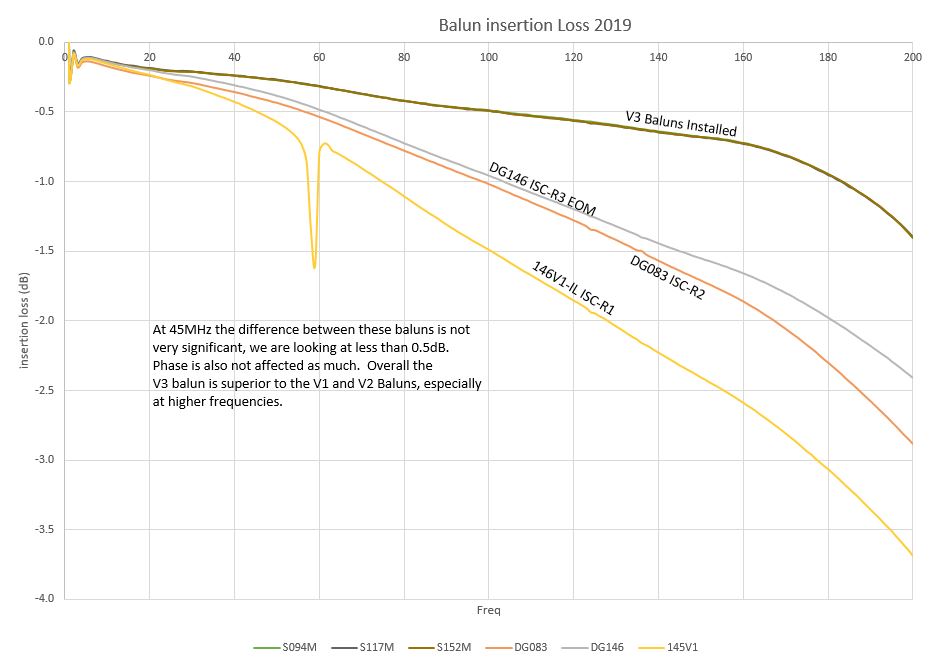
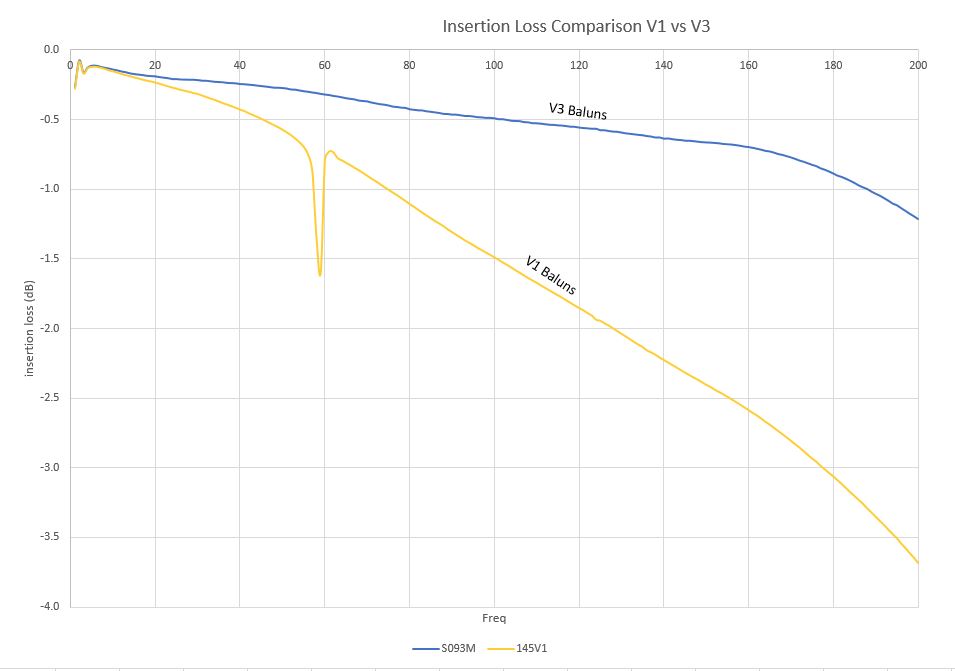
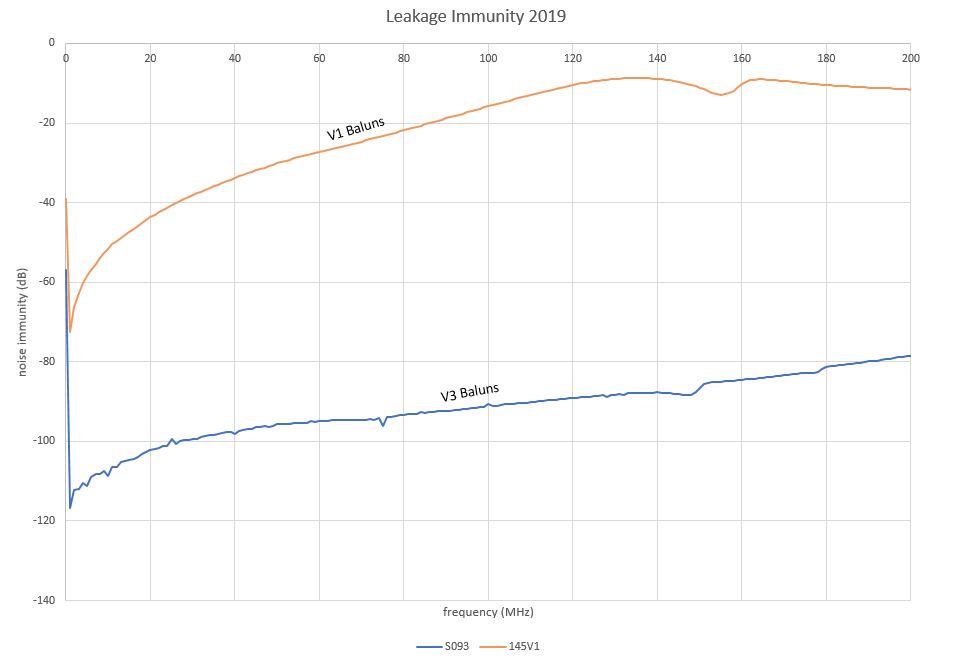
I have attached Insertion Loss and Leakage scans from the old baluns as well as the new ones.

Images attached to this comment
marc.pirello@LIGO.ORG - 12:10, Tuesday 21 May 2019 (49379)ISC

M. Pirello, D. Gustafson

Continuing the Balun exchange Program:

We installed new v3 baluns on the following signals at the PSL racks and at HAM6:

PSL-R2 (18-2) ISS AOM 80MHz exchanged DG-104 with v3-S069

ISC-R3 (41-2) Distribution 4th Harmonic exchanged v1-053 with v3-S160

ISC-R3 (41-4) Distribution 8th Harmonic exchanged v1-091 with v3-S040

ISC-R3 (39-4) Distribution 42.2MHz exchanged v1-125 with v3-S060

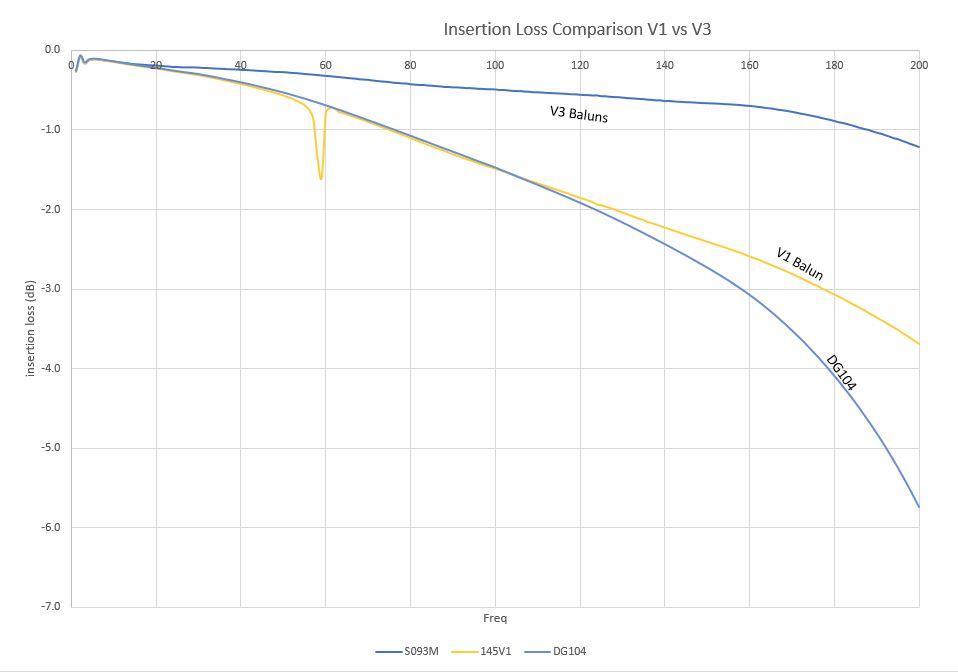
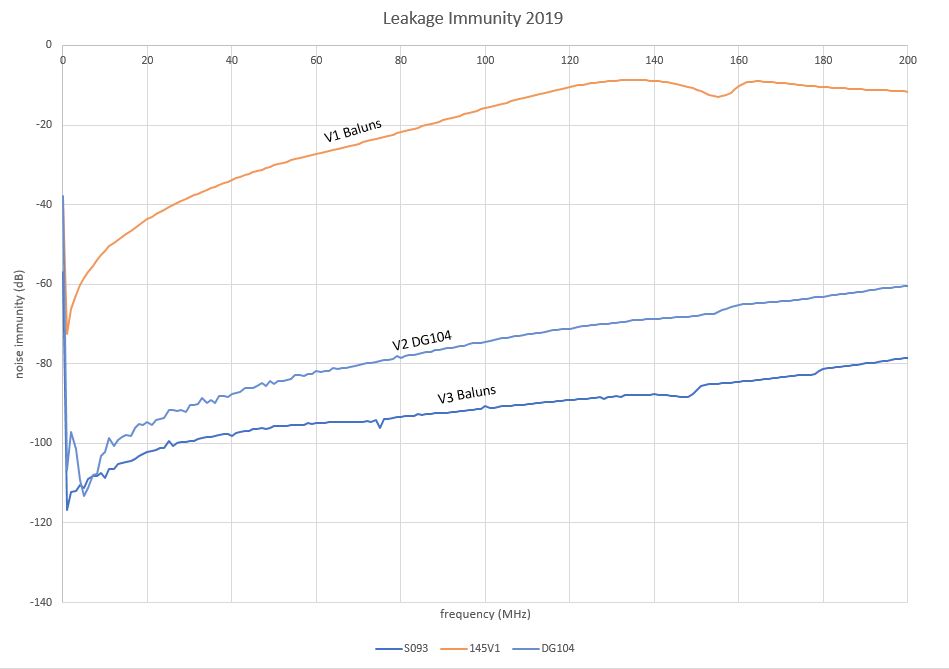
Work was completed per WP8215, balun status is in the same place it was last week, E1900100.

Attached is a comparision between the balun modified by hand (DG-104), and the new v3 balun which replaced it.

Images attached to this comment
marc.pirello@LIGO.ORG - 16:31, Tuesday 14 May 2019 (49243)

M. Pirello, P. King, D. Gustafson

Continuing the Balun exchange Program:

We installed new v3 baluns on the following signals at the PSL racks:

PSL-R2(17-1) FSS Modulation exchanged v1-043 with v3-S157

PSL-R2(17-2) FSS exchanged v1-014 with v3-S093

PSL-R2(17-4) PMC Modulation exchanged v1-021 with v3-S115

PSL-R2(17-5) PMC exchanged v1-050 with v3-S156

PSL-R2(17-6) Injection Locking exchanged v1-084 with v3-S095

ISC-R1(41-2) Distribution JAC Future exchanged v1-159 with v3-S092

** On the last one, the labels on the feed through may be more correct than the DCC.  I followed the cable path to the ALS VCO for the PSL.

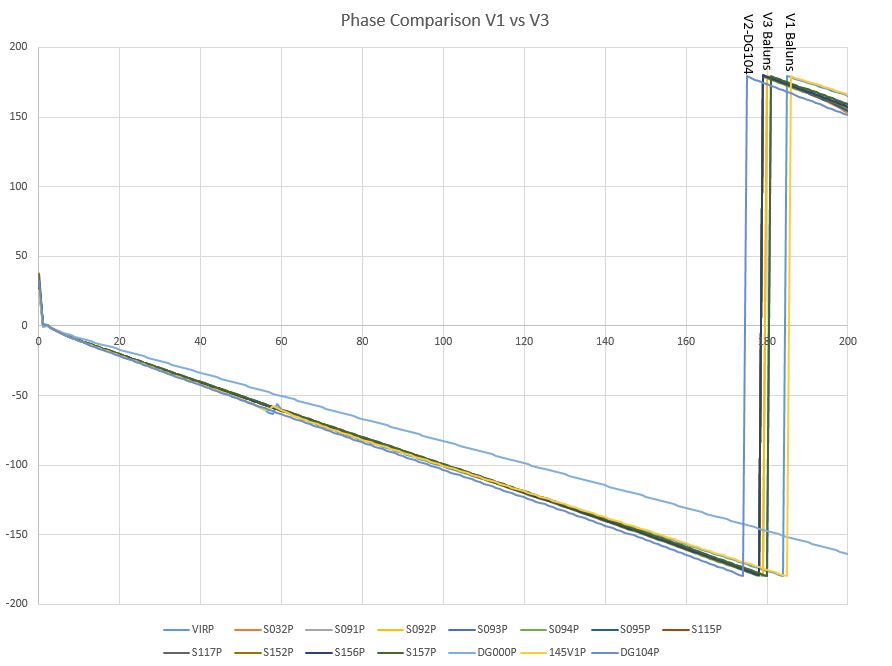
If it is the ALS VCO, Peter told me that it is possibly 80MHz and in this case the difference between V1 and V3 is about 0.75dB more power, and no measurable difference in phase.  The PSL signals being under 45Mhz should be less than 1 degree difference in phase, and less than 0.25dB difference in power.

Work was completed per WP8208, balun status is in the same place it was last week, E1900100.

I have attached insertion loss and leakage scans of v1 vs v3 baluns.

Images attached to this comment
marc.pirello@LIGO.ORG - 13:54, Thursday 16 May 2019 (49283)

We checked the ISC-R1 (41-2) Balun and determined this signal is the REFL_B demod, 9MHz.  There should be very little phase & power difference between V1 and V3 baluns at this frequency.

marc.pirello@LIGO.ORG - 14:09, Tuesday 28 May 2019 (49507)

M. Pirello, D. Gustafson

Continuing the Balun exchange Program:

We installed new v3 baluns on the following signals at the end stations.

EX-ISC-C1 (41-5) Return PLL Beat Note 39.5MHz exchanged v1-176 with v3-S050

EX-ISC-C1 (41-6) Return ALS Laser VCO 79.4Mhz exchanged v1-049 with v3-S042

EX-ISC-R1 (41-1) ALS Laser VCO 71MHz exchanged v1-189 with v3-S114

EX-ISC-C1 (41-5) Return PLL Beat Note 39.5MHz exchanged v1-137 with v3-S041

EX-ISC-C1 (41-6) Return ALS Laser VCO 79.4Mhz exchanged v1-199 with v3-S155

EX-ISC-R1 (41-1) ALS Laser VCO 71MHz exchanged v1-039 with v3-S059

Work was completed per WP8222, balun status is in the same place it was last week, E1900100.

marc.pirello@LIGO.ORG - 11:14, Tuesday 04 June 2019 (49644)

M. Pirello, D. Gustafson

Continuing the Balun exchange Program:

We installed new v3 baluns on the following signals at the Squeezer

ISC-R3 (39-1) 80MHz SQZ EOM (OPO) exchanged v1-178 with v3-S082

ISC-R3 (39-2) 35.5MHz SQZ EOM (SHG) exchanged v1-060 with  v3-S089

ISC-R3 (39-3) 200MHz SQZ EOM (CLF) exchanged v1-166 with v3-S031

SQZ-R1 (41-1) 80MHz OPO Demodulation exchanged v-122 with v3-S084

SQZ-R1 (41-2) 35.5MHz SHG Demodulation exchanged v1-020 with v3-S033

SQZ-R1 (39-3) 71MHz SQZ VCO Laser Locking exchanged v1-190 with v3-S083

Work was completed per WP8230, balun status is in the same place it was last week, E1900100.

** The 200MHz SQZ EOM CLF signal may require a slight phase change, about 8 degrees difference and 2dB more power with the V3.

marc.pirello@LIGO.ORG - 14:09, Tuesday 11 June 2019 (49820)

M. Pirello, D. Gustafson

Continuing the Balun exchange Program:

We installed new v3 baluns on the following signals at the Squeezer and the PSL racks:

SQZ-R1 (41-3) 3.125MHz SQZ Angle Demodulation exchanged v1-171 with v3-S108

SQZ-R1 (41-4) 3.125MHz SQZ Angle Demodulation exchanged v1-145 with v3-S109

SQZ-R1 (41-5) 6.25MHz CLF Demodulation exchanged v1-183 with v3-S085

ISC-R1 (41-1) 71MHz Distribution exchanged DG-02 with v3-S086

ISC-R1 (41-3) 15th Harmonic Modulation exchanged DG-01 with v3-S058

TCS-MEZ (41-1) TCS exchanged v1-153 with v3-S079

Work was completed per WP8240, balun status is in the same place it was last week, E1900100.


marc.pirello@LIGO.ORG - 10:17, Tuesday 18 June 2019 (50025)

M. Pirello, D. Gustafson

Continuing the Balun exchange Program:

We installed new v3 baluns on the following signals at the field racks near the PSL:

ISC-R2 (41-1) 9MHz Distribution exchanged v1-047 with v3 S019

ISC-R2 (41-3) 2nd Harmnonic Distribution exchanged v1-098 with v3-S019

ISC-R2 (41-4) 3rd Harmonic Distribution exchanged v1-157 with v3-S015

ISC-R2 (41-5) 10th Harmonic Distribution exchanged v1-179 with v3-S016

ISC-R2 (41-6) 15th Harmonic Distribution exchanged v1-074 with v3-S132

ISC-R1 (41-4) 24MHz MC Distribution exchanged v1-040 with v3-S017

ISC-R1 (41-5) 9MHz Main Modulation exchanged v1-033 with v3-S018

Work was completed per WP8244, balun status located at this link: E1900100.  This concludes all "known" balun work at the corner station.  We are sprinting to next week where we intend to replace the remaining twelve v1 baluns at the end stations.

marc.pirello@LIGO.ORG - 16:15, Tuesday 25 June 2019 (50184)

M. Pirello, D. Gustafson

Continuing the Balun exchange Program, we installed new v3 baluns on the following signals at both end stations:

EX

ISC-R1 (41-2) 24.4MHz Modulation exchanged v1-022 with v3-S074

ISC-R1 (41-3) 24.4MHz Demodulation exchanged v1-184 with v3-S131

ISC-R1 (41-4) Not Connected exchanged v1-064 with v3-S078

ISC-R1 (39-1) 24.4 WFS A Demod exchanged v1-077 with v3-119

ISC-R1 (39-2) 24.4 WFS B Demode exchanged v1-026 with v3-S076

ISC-R1 (39-3) 71 CPS Timing Fanout exchanged v1-059 with v3-S020

EY

ISC-R1 (41-2) 24.4MHz Modulation exchanged v1-127 with v3-S073

ISC-R1 (41-3) 24.4MHz Demodulation exchanged v1-118 with v3-S011

ISC-R1 (41-4) Not Connected exchanged v1-013 with v3-S012

ISC-R1 (39-1) 24.4 WFS A Demod exchanged v1-126 with v3-S075

ISC-R1 (39-2) 24.4 WFS B Demod exchanged v1-161 with v3-S013

ISC-R1 (39-3) 71 CPS Timing Fanout exchanged v1-191 with v3-S135

Work was completed per WP8255, balun status located at this link: E1900100.  

** In the process of walking through the LVEA we found 4 more Baluns hidden among the TCS and SUS racks which need upgrading.  We were able to upgarde one of these with this Tuesday, and will finish the remainder next maintenance day.

SUS-R3 (40-1) CPS HAM 71MHz exchanged v1-011 with v3-S113

This additional work was started per WP8261

marc.pirello@LIGO.ORG - 13:49, Tuesday 02 July 2019 (50349)

M. Pirello, H. Radkins

The final three baluns were exchanged at the corner this morning for a total of 64 baluns replaced over 14 weeks.

TCS-R2 (41-1) 71Mhz CPS Timing exchanged v1-088 with v3-S144

TCS-R2 (41-2) N/A Empty signal with Balun exchanged v1-081 with v3-S001

TCS-R1 (41-6) TCS Signal from Mechanical Room exhcnaged v1-143 with v3-S045

All work finished per WP8261.  This completes work done per FRS9794 and ECR-E1700404 at LHO.

Displaying reports 41381-41400 of 88811.Go to page Start 2066 2067 2068 2069 2070 2071 2072 2073 2074 End